MUMBAI
|
Mumbai on the West coast of India is the financial capital of India. The City has grown phenomenally over the years with several suburbs and extended suburbs being added to it. The city is bustling with over 18 million people. Add to this the growing number of immigrants and the pressure on transportation systems. The city has one of the best public transport systems, with a network of suburban railways, public bus, auto rickshaws, taxis, radio cabs. But these do not meet the growing demand for travel. The city has to grapple with traffic congestion and health hazards from air pollution. The city will have to scale up its mobility transition. |
||
Air and mobility facts |
||
| Vehicle: Galloping numbers | Air quality trends – Annual average levels of PM10 and NOx | |
 |
 |
|
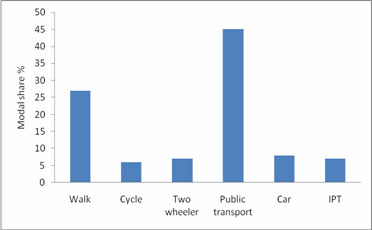
| How people travel? Maximum people are on foot, pedals, buses and autos | ||
 |
||
|
Congestion indicators |
||
Public action: |
||
|
Mumbai Environmental Social Network (MESN): Started in 2005 is primarily focused in providing discipline and governance oriented information and solutions to the growing traffic congestion. Action: MESN has developed a web and SMS based comprehensive solution for Car Pooling and is working towards mobilizing the critical mass required to make a difference. The are also working towards a range of traffic management measures that include lane and Traffic management, use of space under the flyovers, carving out bus lane wherever possible, dedicated right turn lanes at junctions to reduce conflict and improve throughput, intelligent use of bollards to improve lane discipline and throughput, use of videography to compare the “Before” & “After” situations. Clean Air Group: This coalition of civil society groups and volunteers has played an important role |
||
Policy action |
||
|
Action on vehicles
|
||
|
Action on industrial pollution
|
||
Down to Earth
.jpg)
October 31, 2017

October 31, 2017
.jpg)
October 31, 2017
.jpg)
October 31, 2017
.jpg)
October 31, 2017
| Action in news | |
|
221 new buses leave BEST thinking about parking space in Mumbai For commuters who use the Brihanmumbai Electric Supply and Transport (BEST) buses every day, the addition of 221 swanky new buses to the BEST’s fleet in the next two months is an assurance of a more comfortable daily commute in the near future. For the BEST dministration, however, the new buses are an addition to its serious administrative problems. Wanted: parking schemes in Mumbai that don’t encourage congestion. It began with urban planners and now, a state-appointed body of environmentalists has urged the state government to have a relook at the city’s parking policy. In a letter expressing concern, the state level expert appraisal committee (SEAC) recently said that the government should encourage schemes that do not add congestion in areas which are already congested. SEAC is an advisory body set up by the central government to scrutinise development projects in the state. Their letter said that the city already has narrow roads and once such schemes are allowed, there is no restriction on parking on that stretch of road. Source: www.dnaindia.com Share-an-auto service launched in bandra MUMBAI: Maharashtra government on Thursday launched 'share-an-auto' service in suburban Bandra in order to ease traffic congestion and reduce commuter woes in the metropolis. "The service would help commuters as well as the auto drivers. It will take the commuters to and from railway stations in the suburbs," transport minister Radhakrishna Vikhe-Patil said. Source: The Times of India |
|
| Knowledge tracking | |
UNIFIED MUMBAI METROPOLITAN TRANSPORT AUTHORITY (UMMTA), Urban Bus Policy to Reduce Air Pollution and Congestion, |
|
| See other Cities | |
Share this article