|
Dear readers,
Welcome to the Climate Weekly digest by the Centre for Science and Environment’s Climate Change programme and Down to Earth.
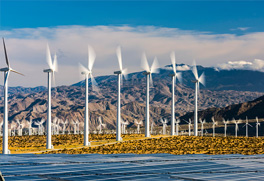
A report by Wellesley College has found that in Trump’s first six months in office, clean energy projects in the US have been paused or closed at a rate six times higher than 2024 and 30 times higher than 2023. CSE Climate’s Rudrath Avinashi writes that 26 projects adding up to $27.6 billion in capital investment and 18,849 jobs have been paused or cancelled in the past six months, while 29 new projects have been announced over the same period worth $3 billion and creating 8,334 jobs. By comparison, the first half of 2024 saw 54 new projects announced with $15.9 billion in capital investments and creating over 25,000 jobs.
The Trump administration has been rolling back Biden-era legislations aimed at promoting significant investments in US’s domestic clean energy manufacturing, particularly the Inflation Reduction Act (IRA) and the Bipartisan Infrastructure Law (BIL). The US is the world’s largest historical polluter with almost 20 per cent of global greenhouse gas emissions since the pre-industrial era. The clean energy projects that have been targeted by Trump include solar, wind, battery and electric vehicle (EV) manufacturing.
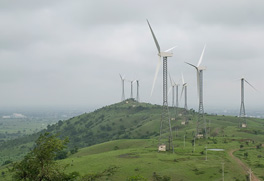
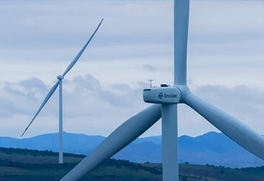
In India, the domestic wind energy sector is set for a major boost, with new regulations mandating domestic supply chains and data localisation for wind turbines. With this policy, manufacturing capacity utilisation is set to increase from the current 25-30 per cent to 70-80 per cent. The move is targeted at the competitive imbalance between Chinese and domestic manufacturers and aims to improve local industry competitiveness. Under the new framework, manufacturers must establish research and development centres in India within a year to design turbines that are specific to Indian conditions. National security concerns are also addressed, with regulations mandating that all wind turbine data is stored within India—underscoring the risk associated with foreign-controlled data servers being used for critical energy infrastructure.
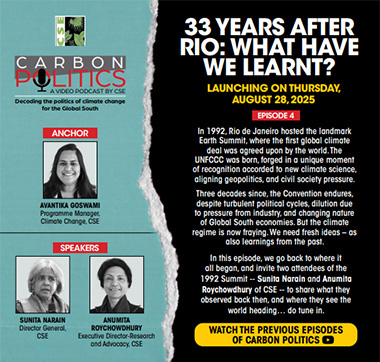
Finally, the fourth episode of our new podcast, Carbon Politics, is set to launch on August 28, featuring CSE’s Director General Sunita Narain alongside CSE’s Executive Director Anumita Roychowdhury in a conversation with CSE Climate’s Avantika Goswami. In this episode, the duo will discuss how the 1992 Rio Earth Summit shaped global climate action and what lessons must be drawn from the past three decades. Watch the trailer here.
|
|
|
| |
|
|
| |
 |
|
| |
By - Upamanyu Das
Climate Change, CSE
|
| |
|
|
|
|
| |
|
|
| |
| EXTREME WEATHER TRACKER |
| |
Western Australia records longest, largest and most intense coral bleaching and mortality on record, 12 August 2025
|
|
 |
|
|
| |
|
|
| |
 |
|
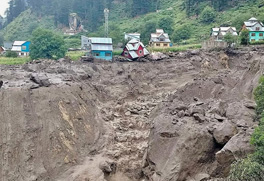
Uttarakhand faces worst monsoon in four years, with 65% of days marked by extreme weather, 08 August 2025
|
|
|
| |
|
|
| |
|
|
| |
|
|
| |
CLIMATE NEWS | SCIENCE| IMPACTS| POLITICS |
|
| |
|
|
| |
|
|
| |
|
|
| |
|
|
| |
|
|
| |
|
|
| |
|
|
| |
|
|
| |
|
|
| |
|
|
| |
|
|
| |
|
|
| |
|
|
| |
|
|
| |
|
|
| |
|
|
| |
|
|
| |
|
|
| |
|
|
| |
|
|
| |
|
|
| |
|
|
| |
|
|
| |
|
|
| |
|
|
| |
| Carbon Politics Podcast |
|
Online Training Course |
| |
|
|
|
|
|
|
|
|
| |
|
|
| |
|
|
| |
|
|
| |
|
|
| |
|
|