|
Dear readers,
Welcome to the Climate Weekly digest by the Centre for Science and Environment’s Climate Change programme and Down to Earth.
Donald Trump’s weaponisation of trade for political and economic gains presents a marked shift in global diplomacy, where developing countries are making costly concessions to accommodate the US. CSE Climate’s Rudrath Avinashi writes that the rules of global trade—championed for so long by the Global North—are now being broken by the world’s largest economy. For instance, India is facing an additional 25 per cent tariff as penalty for importing Russian oil. Brazil faces a 50 per cent tariff for ‘persecuting’ their former President. Vietnam, threatened by a 46 per cent tariff, has brokered a deal to bring the tariff down to 20 per cent by making wide-ranging concessions to the US.
Avinashi writes that developing countries, with largely export-oriented economic models, face the possibility of erosion of development gains——especially in the horizontal and vertical diversification of their natural resource endowment. Indonesia, in its trade deal with the US, has removed export restrictions on industrial commodities, including critical minerals. The country is home to 42 per cent of the world’s nickel reserves and placed its export ban on raw nickel in 2020 to capture greater value domestically. The dilution of that policy spotlights the asymmetric power relations between the US and the Global South, and how development trajectories can be impacted on a whim.
Continuing with the Trump presidency’s impacts, CSE’s Director General, Sunita Narain, in her new article, explains how the size of the US’s consumer market allows it to browbeat other nations. The country is home to 4 per cent of the world’s population but accounts for 30 per cent of global household consumption—consuming double or more of what it produces. By comparison, China accounts for 17 per cent of the world population but only 12 per cent of global consumption. This means that countries desperately want a share of the US market, and Trump is counting on that. However, Narain warns, US-style consumption will not work in a carbon- and resource-constrained world. Climate change cannot be discussed without confronting the consumption-oriented economic model.
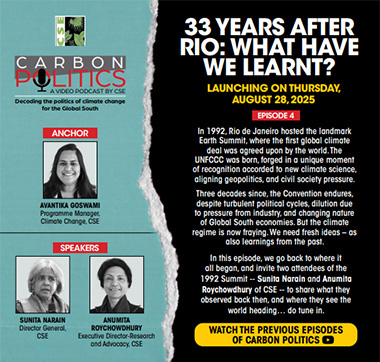
Lastly, Sunita Narain and Anumita Roychowdhury discuss the lessons learnt since the 1992 Rio Earth Summit and what the future holds for Global South economies in the latest episode of the Carbon Politics podcast.
|
|
|
| |
|
|
| |
 |
|
| |
By - Upamanyu Das
Climate Change, CSE
|
| |
|
|
|
|
| |
|
|
| |
| EXTREME WEATHER TRACKER |
| |
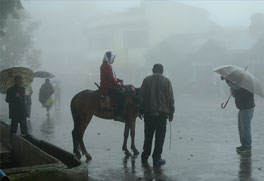
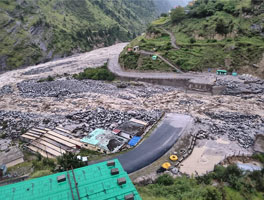
Char Dham Yatra reels from climate shocks as 55 “zero-pilgrim days” recorded, 02 September 2025
|
|
 |
|
|
| |
|
|
| |
 |
|
Global temperatures to remain above normal despite La Nina return in September, 02 September 2025
|
|
|
| |
|
|
| |
|
|
| |
|
|
| |
|
|
| |
|
|
| |
|
|
| |
|
|
| |
|
|
| |
|
|
| |
|
|
| |
|
|
| |
CLIMATE NEWS | SCIENCE| IMPACTS| POLITICS |
|
| |
|
|
| |
|
|
| |
|
|
| |
|
|
| |
|
|
| |
|
|
| |
|
|
| |
|
|
| |
|
|
| |
|
|
| |
|
|
| |
|
|
| |
|
|
| |
|
|
| |
|
|
| |
|
|
| |
|
|
| |
 |
|
|
Power paradox, 01 September 2025
|
|
|
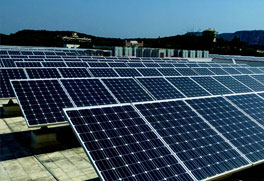
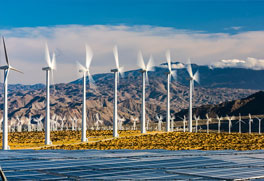
In drought-prone districts of Karnataka, solar parks promise prosperity but deliver displacement, exposing the fault lines of India’s renewable energy transition
|
|
|
|
|
| |
|
|
| |
|
|
| |
|
|
| |
|
|
| |
|
|
| |
|
|
| |
|
|
| |
|
|
| |
|
|
| |
|
|
| |
|
|
| |
| Carbon Politics Podcast |
|
Onsite Training Course |
| |
|
|
|
|
|
|
|
|
| |
|
|
| |
| Book Release |
|
Cartoon |
| |
|
|
|
|
|
|
| |
|
|
|
Video |
| |
|
|
 |
|
WATCH |
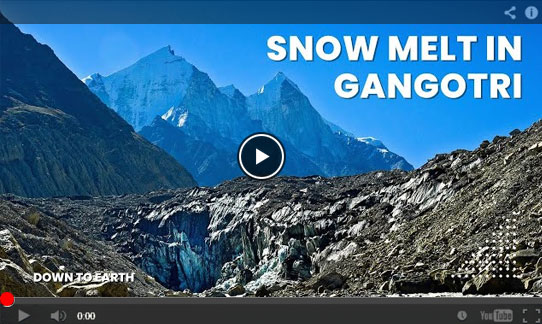
Gangotri glacier’s snowmelt flow down by 10% as climate change bites
|
|
| |
|
|
|
|
|
| |
|
|