May 15 – May 21, 2026
  A weekly digest on impacts, politics and science of the climate emergency from the Global South perspective. You can find this digest in the web here.  
     
Dear readers,

Welcome to the Climate Weekly Digest by the Centre for Science and Environment’s Climate Change and Green Economy programme and Down to Earth.

According to the latest climate finance report by the Organisation for Economic Co-operation and Development (OECD), developed countries provided $136.7 billion in climate finance to developing countries in 2024. Down to Earth’s Puja Das writes that this is the third consecutive year that climate finance mobilised by developed economies surpassed the $100 billion annual goal, after crossing the $100 billion mark in 2022 and reaching $132.8 billion in 2023.

Mitigation finance continued to dominate overall flows, accounting for nearly two-thirds of the mobilised finance, with adaptation finance remaining laggard and reaching $34.7 billion. Public climate finance continued to account for nearly three-quarters of the total in 2024, while private finance mobilised through public interventions recorded its biggest annual increase to reach $30.5 billion. However, loans accounted for 67 per cent of all public climate finance, while grants represented 29 per cent—raising concerns over debt burdens, equity and fairness. Das also highlights distributional concerns, with low-income countries receiving just 7 per cent of total climate finance.

Moving to the world of energy, CSE’s Director General Sunita Narain, in her latest editorial, discusses India’s energy options given the ongoing energy disruption. The question, she writes, is how green technologies like solar and wind can fit into the grid while ensuring that the supply remains reliable. The intermittent nature of renewable sources and limited availability of energy storage are critical concerns to be resolved. For India, ensuring that the grid can meet demand during non-solar hours will require redesigning coal plants for ‘flexibility’—to be able to ramp up and ramp down the plant’s capacity based on the energy demand.

Grid planning needs a rethink to prevent a buildout of more coal plants, which would otherwise lead to similar concerns around intermittency of renewables and inflexibility of coal. Another part of the solution is to build storage for electricity generated during the day to be used at night. The future of energy, Narain writes, is no longer about the reliability of old technologies but about “finding order in great disorder.”

Finally, the upcoming episode of the Carbon Politics podcast is set to be released on Thursday, May 28. In this episode, titled “Can Climate Finance be too Expensive?”, CSE Climate’s Sehr Raheja speaks with Neha Khanna from Climate Policy Initiative about the high cost of capital for green technologies in the Global South, why this is a barrier for climate action, and how developing countries can address this issue.  
   
 
Down To Earth
 
By - Upamanyu Das
Climate Change and Green Economy, CSE


EXTREME WEATHER TRACKER


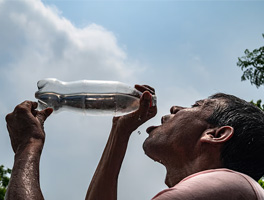
The 2026 El Niño is developing unusually fast — and may rival the strongest ever recorded, 20 May 2026
Down To Earth


Down To Earth Explosive winds in the deadly Uttar Pradesh storms a symptom of warming, 15 May 2026


COMMENTARIES
Between coal, chaos and green power, 19 May 2026
The challenge is no longer about adding green power, but about planning an energy mix that can be fitted and flexed


Around 74% Asian investor groups adopt Net Zero goals, but only 42% publish transition plans, 18 May 2026
Less than a third of investors established strategies related to fossil fuels
 
   
  CLIMATE NEWS | SCIENCE| IMPACTS| POLITICS  
   
 
Down To Earth
US opposes, India and 27 nations abstain as UN backs ICJ climate ruling by 141-8 vote, 21 May 2026
Abstentions highlighted divisions over how climate obligations should be legally enforced


Down To Earth
Developed economies deliver $136.7 billion in climate finance in 2024, but low-income nations receive only 7%, 21 May 2026
Adaptation gap and unequal access remain major concerns despite developed nations crossing $100 billion target, finds OECD report


Down To Earth
Climate stress hits Bihar’s litchi crop as Muzaffarpur farmers report losses of up to 70%, 21 May 2026
Scientists say unusual weather between November 2025 and April 2026 affected flowering, fruit setting and fruit drop, leaving many Bihar orchards with only 30% to 40% of the usual crop


Down To Earth
What women’s work songs reveal about the changing climate, 21 May 2026
Against archives that have historically privileged elite and male voices, work songs preserve forms of knowledge grounded in everyday labour


Down To Earth
India among biggest new carbon markets as global carbon pricing covers 29 per cent of emissions, 21 May 2026
If all carbon pricing policies currently under development are implemented by 2030, nearly a third of global GHG emissions could come under carbon pricing systems, says new report


Down To Earth
Ahead of COP31 in Antalya, Türkiye calls for global push to electrify economies and expand renewables, 20 May 2026
Speaking at the Copenhagen Climate Ministers’ Meeting, Türkiye’s environment minister and COP31 President-Designate Murat Kurum said electricity must play a much larger role in transport, buildings and industry if countries are to meet climate goals agreed under previous UN summits


Down To Earth
India loses 300 GWh renewable energy in 2026 first quarter due to transmission delays, 19 May 2026
Transmission bottlenecks, delayed grid projects and slow infrastructure expansion are forcing India to waste rising volumes of clean electricity


Down To Earth
India’s future climate resilience will depend on its ability to build a public healthcare system that recognises heat as a highly gendered disaster, 19 May 2026
Women experience heat differently due to physiological, occupational, and socio-economic factors; they cannot be considered an “invisible category” within climate governance


Down To Earth
One step closer, 19 May 2026
India attains criticality in fast breeder reactor technology, reaching the second stage of the country’s three-stage nuclear programme towards energy security


Down To Earth
Delhi temperatures may touch 45°C as campaigner claims paved Ghaziabad locality recorded 50°C, 19 May 2026
IMD issues yellow alert as urban heat islands push real feel beyond official readings in Delhi-NCR


Down To Earth
How decentralised energy is reshaping rural livelihoods through women-led enterprises, 18 May 2026
Through local initiatives, women are trained to maintain solar structures


Down To Earth
How Wayanad’s climate calendar is rewriting farming futures, 15 May 2026
In a district where the monsoon no longer keeps its word, a farmer-led calendar blends tradition, science, and local governance to build climate resilience from the ground up


Down To Earth
Delhi once had harsh but breathable summers. Now humid heat is making the city harder to endure, 15 May 2026
Why the capital's growing green cover has not stopped the city from becoming hotter and less liveable


    Carbon Politics: A Video Podcast by CSE
 
    Online Training Course
spacer
DTE Hindi   DTE Hindi


Cartoon   Video
     
Down To Earth
 
Down To Earth
 
     
This weekly digest is published by Down to Earth and the Centre for Science and Environment, a Delhi-based global think tank advocating on global south developmment issues.
We would love your feedback on this weekly digest. To speak to our experts for quotes and comments on the above stories. Please email to vikas@cseindia.org
 
Follow us on
spacer facebook spacer Down to Earth video spacer twitter spacer
  If you like our work and would like others to join our climate network and the climate conversation, please forward this to your friends. Interested in Climate weekly? Sign Up here