
Cse In News

दिल्ली में गर्मी का कहर, अच्छे मॉनसून के बाद भी नहीं मिली राहत, बिजली की बढ़ी मांग, आखिर क्यों पड़ रही इतनी गर्मी? एक्सपर्ट्स से समझिए

सेंटर फॉर साइंस एंड एनवायरनमेंट (CSE) की रिपोर्ट के अनुसार, दिल्ली में गर्मी और उमस के कारण बिजली की मांग रिकॉर्ड स्तर पर पहुँच गई है. 12 जून 2025 को रात 11:09 बजे बिजली की मांग 8442 मेगावॉट रही, जो पिछले 10 वर्षों में 44% की वृद्धि दर्शाती है. दिल्ली की रोजाना बिजली की मांग का 67% हिस्सा गर्मी और उमस से जुड़ा है. मानसून में भी रात का तापमान सामान्य से छह डिग्री ज्यादा रहा, जिससे डिहाइड्रेशन, थकान, सिरदर्द, चक्कर आना और लू जैसी स्वास्थ्य समस्याएं बढ़ी हैं.
Rain washes away pollutants, 1st week of Sept cleanest in Gurgaon in 6 years

Gurgaon: Every cloud has a silver lining? Bouts of heavy monsoon rain this season flooded streets and brought the city to a standstill but also washed away pollutants from the air. Data from Gurgaon's only functioning air quality station – Gwalpahari – recorded the cleanest air quality for the first week of Sept in six years. Average AQI dropped to 47.8 – firmly in the ‘good' category. AQI on Sept 1 was the best, at 39. The week's ‘worst' reading was on Sept 6, when 24-hour air quality index touched a high of 59. In 2024, average AQI for the city in the first week of Sept – calculated from data from four monitoring stations – was 76 (‘satisfactory'). In 2023, it was 167.7, or ‘moderate'. 2018's average AQI was relatively better, at 44, but data was only recorded for three days over the week. Record-keeping in Gurgaon began only in 2016. Experts said the reason for cleaner air so far this month was simple – 100mm of rainfall on Sept 1, followed by on and off showers in the days after. "Rain essentially pressure-washed the city's air. They scrubbed out PM2.5 and PM10 particles, improved visibility and reduced ozone formation by lowering surface temperatures," Shubhansh Tiwari, research associate with the Centre for Science and Environment, said on Sunday. The week's downpour also reduced vehicular movement and likely affected industrial operations for brief periods due to waterlogging. Gusty winds, too, helped disperse pollutants. Experts also cautioned against drawing definitive conclusions from limited data. Only one of Gurgaon's four continuous air monitoring stations remains functional, potentially skewing readings compared to the more comprehensive coverage previously available. With the approaching Oct-Nov period—characterised by stubble burning, festival fireworks, and winter smog — they warned that the improvement may prove fleeting. "Think of the recent rain as a temporary curtain drawn over a stage where the set is still broken. Once winter sets in, we will be back to the same reality. We must use this intermission to fundamentally change production, instead of presentation, of how we improve NCR's air quality through decisive, coordinated action," Sunil Dahiya, founder and lead analyst at think-tank Envirocatalysts. An official of the Haryana State Pollution Control Board (HSPCB) acknowledged data limitations of one functional monitoring station, but said efforts were being taken to restore inactive stations. "Even with limited data, the downward AQI trend is evident. Rainfall played a significant role, but ongoing policy measures are also contributing to gradual improvement," the official said.

Kashmir Is Still Unprepared For The Next Flood

Experts have been raising alarms for years. In 2014, environmentalist Sunita Narain bluntly asked: “Was this a natural disaster—or could better planning have prevented it? The lakes that once buffered floods are now built over, and waterways are blocked.” Her warning was just one among many that went unheeded. The Associated Press provided a global perspective this year: “Human factors like rapid urbanisation, deforestation, and poor infrastructure worsen the damage. The South Asian region needs to better prepare for rain-related disasters.” Yet in Kashmir, “preparation” seems to involve more paperwork than actual progress. September 4, 2014, should have been a turning point for Kashmir. On that day, the Jhelum overflowed and flooded Srinagar and nearby areas. Hospitals were cut off, leaving newborns and patients without oxygen. Families huddled on rooftops, frantically signalling for help that never arrived. Shops were ruined by muddy water, and entire harvests were buried under silt. More than 200 lives were lost, and damage worth billions was recorded. For ordinary people, the emotional scars remain. Eleven years later, the same date has returned as a harsh reminder. Heavy rains, sudden floods, and rising river levels once again threaten Kashmir. People are watching the sky and river with the same dread. The state has had over a decade to prepare, yet nothing has changed. This is not just nature’s doing. This is a failure. Promises That Went Nowhere After 2014, leaders made grand promises. They pledged to dredge the Jhelum, strengthen embankments, restore wetlands like Hokersar and Wular to serve as natural buffers, modernise urban drainage systems, and install a real-time flood warning network. They promised fair compensation for families and long-term rehabilitation plans. But reality tells a different story. Embankments remain weak, repaired only when they fail. Dredging started with great enthusiasm but soon ground to a halt. Wetlands have shrunk even more due to construction and landfill. Srinagar still floods with every heavy rain. Warning systems are unreliable, and many residents learn about rising waters from neighbors rather than officials. Efforts for rehabilitation have been slow, inconsistent, and, in some cases, did not happen at all. Current Chief Minister Omar Abdullah acknowledged this week: “It seems that 11 years have been wasted by previous governments. Questions need to be asked about what has been done in the last 11 years.” The people already know the answer: very little. Ignored Warnings This neglect is not due to ignorance. Experts have been raising alarms for years. In 2014, environmentalist Sunita Narain bluntly asked: “Was this a natural disaster—or could better planning have prevented it? The lakes that once buffered floods are now built over, and waterways are blocked.” Her warning was just one among many that went unheeded. The Associated Press provided a global perspective this year: “Human factors like rapid urbanisation, deforestation, and poor infrastructure worsen the damage. The South Asian region needs to better prepare for rain-related disasters.” Yet in Kashmir, “preparation” seems to involve more paperwork than actual progress. The Human Cost Statistics mask the real suffering. Reuters recently reported on a survivor of a cloudburst in Chasoti: “We heard a huge sound followed by a flash flood and mud.” Al Jazeera quoted Ruksana, whose home was destroyed: “My husband is handicapped. Everything else, including clothes, books, and food, has been lost.” These voices reflect the cries from 2014, when hospitals like Lal Ded and SMHS were isolated. Patients pleaded for evacuation. Families made rafts from doors. Young volunteers risked their lives in waist-deep water to save neighbors. Relief camps were chaotic, lacking medicine, lists, and facing a growing fear of disease. Even now, health experts warn of a second wave of crises after the waters subside. Health Policy Watch noted: “Disrupted medical care, contaminated water, and rises in mosquito-borne diseases turn floods into months-long disasters, not just days.” Mental health is another hidden toll. A young student in Srinagar shared: “My mental health medications were delayed. Without them, the flooding felt even more suffocating.” Studies Without Action Officials often cite new studies. The National Disaster Management Authority and the J&K State Disaster Management Authority, with support from ISRO, have launched surveys to map cloudbursts, glacial lakes, and flood paths. These efforts are important but do not replace the work that should have been done over the last eleven years. Science is ineffective if politics continues to delay action. Breaking the Cycle • It is no longer enough to blame nature. Kashmir deserves more than condolences and photo opportunities. It deserves: • A solid flood management plan with strict timelines and transparency. • Regular dredging and proper strengthening of embankments. • Legal protection for wetlands and floodplains, with penalties for encroachment. • Reliable urban drainage systems. • A real-time flood warning system that actually informs people. • Transparent, fast, and fair rehabilitation policies. • Community involvement in planning and monitoring. Eleven Years Wasted The fact that we are writing these words on September 4 again, eleven years later, is an indictment. Every year wasted has increased the risk. Every encroachment on wetlands, every neglected dredging plan, and every half-finished embankment has brought the valley closer to disaster. September 4 should have marked progress. Instead, it is a reminder of promises drowned in floodwaters. Eleven years have passed, yet Kashmir remains just as vulnerable, ignored, and exposed. This is no longer a natural disaster. It is a man-made failure. And it will stay that way until leaders stop delivering the same speeches and start building the protection that people need.

Agra News: नगर निगम को मिली शोधित पानी के सुरक्षित उपयोग को बढ़ावा देने की जिम्मेदारी

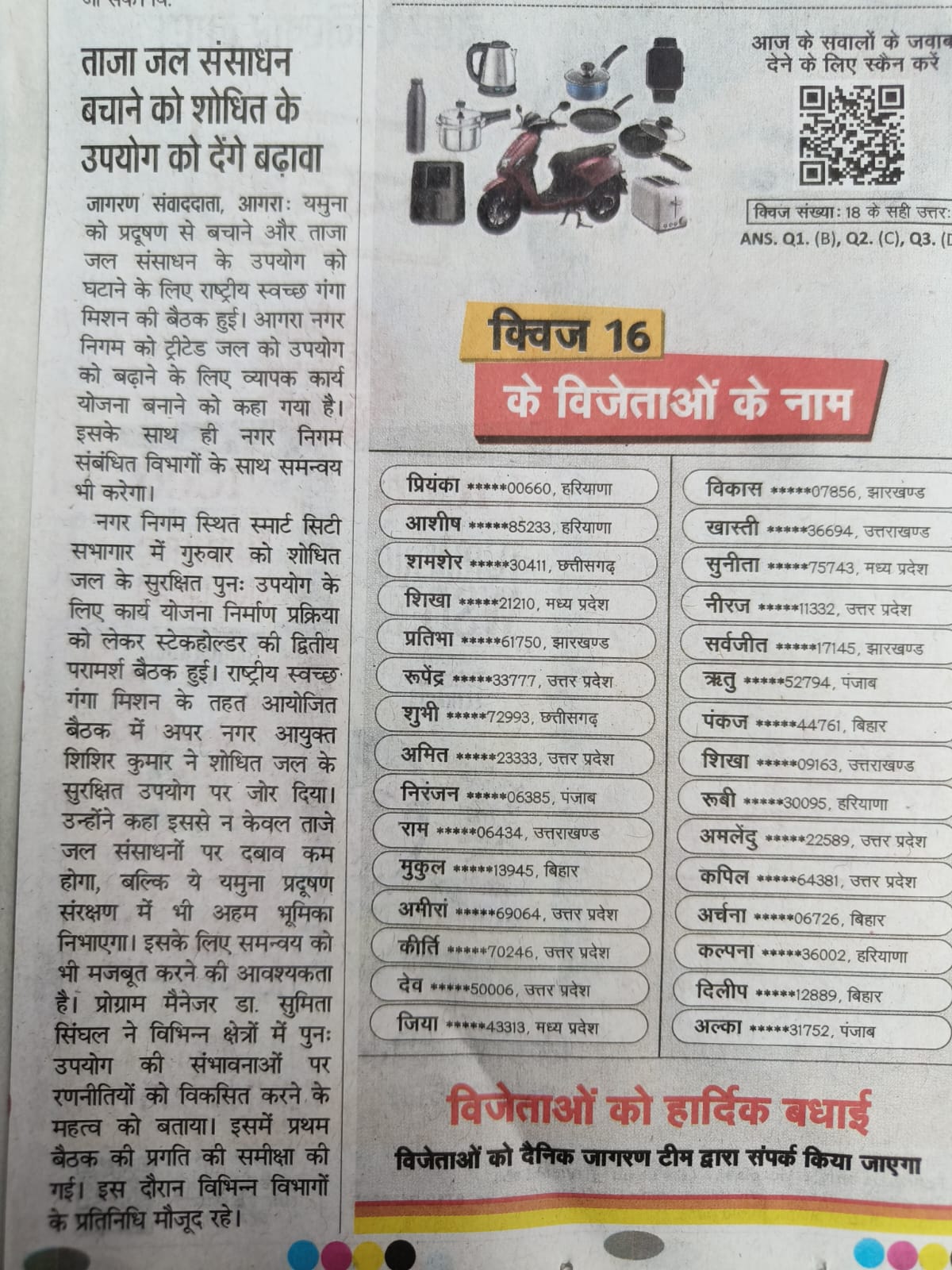
नगर निगम को शोधित पानी के सुरक्षित उपयोग को बढ़ावा देने के लिए व्यापक कार्ययोजना तैयार करने जिम्मेदारी सौंपी गई है। बृहस्पतिवार को स्टेकहोल्डर की दूसरी परामर्श बैठक के दौरान यह फैसला लिया गया। बैठक निगम के स्मार्ट सिटी हॉल में आयोजित हुई। अध्यक्षता करते हुए अपर नगर आयुक्त शिशिर कुमार ने कहा कि इस योजना को तैयार करने में सेंटर फॉर साइंस एंड एनवायरमेंट (सीएससी) नई दिल्ली तकनीकी सहयोग कर रहा है। शोधित पानी के सुरक्षित उपयोग को बढ़ावा देने से यमुना नदी में प्रदूषण नियंत्रण एवं संरक्षण सुनिश्चित करने में मदद मिलेगी। उन्होंने विभागों के बीच समन्वय को मजबूत करने पर बल दिया। सीएससी के डिप्टी प्रोग्राम मैनेजर ज्योति प्रसाद दधीच ने प्रमुख निष्कर्षों और विश्लेषण को प्रस्तुत किया। डाॅ. सुमिता सिंघल ने विभिन्न क्षेत्रों में दोबारा पानी के उपयोग की संभावनाओं पर प्रकाश डाला। इस दौरान प्राप्त सुझावों को अंतिम मसौदे में शामिल करने के लिए राष्ट्रीय स्वच्छ गंगा मिशन (एनएमसीजी) को प्रस्तुत किया जाएगा। बैठक के दौरान एडीए, जलकल, सिंचाई विभाग, सीपीसीबी, यूपीपीसीबी, समेत कई अन्य विभागों और संस्थानों के प्रतिनिधि शामिल हुए।

India’s Journey Towards Sustainable, Low-Carbon Farming

India roughly comprises about 20% of the carbon credits in the world based on a 2023 report from the Delhi-based think tank, Centre for Science and Environment (CSE). More than Rs. 5,525.65 crore (US$ 650 million) has been earned in revenues by the carbon credits. Agriculture in India has always been more than just a sector—it is the soul of the nation’s economy. Feeding more than a billion people, providing livelihood for almost 46% of the workforce and contributing 16% (FY24) to the Gross Domestic Product (GDP), this industry has long been the backbone of India’s rural economy and national resilience. Today, this sector is rapidly emerging as a significant climate force, whether for better or worse. The voluntary carbon market in India was estimated to be worth over Rs. 10,201 crores (US$ 1.2 billion), as of May 2023, with 1,451 projects either registered or undergoing various stages of consideration through two leading global registries, Verra and Gold Standard. India roughly comprises about 20% of the carbon credits in the world based on a 2023 report from the Delhi-based think tank, Centre for Science and Environment (CSE). More than Rs. 5,525.65 crore (US$ 650 million) has been earned in revenues by the carbon credits. Thus, one can see that the country stands pivotal in the global carbon offset ecosystem and has a growing thrust on climate-conscious development. What does ‘low-carbon agriculture’ mean? Low-carbon agriculture actively minimises its contribution to global warming by reducing emissions. A low-carbon footprint for agriculture means low emissions of carbon dioxide (CO2) and other greenhouse gases due to all types of agricultural activities, such as fuel and other farm inputs, emissions from the field, livestock processes, etc. In broad terms, it means smart farming: implementing methods that minimise energy consumption and waste and improve the efficiency of every production stage. Why it matters for India’s future? India's agricultural sector, which is currently struggling with climate change and food security issues, will be the forerunner of the country's future. With agriculture playing an active part with approximately 13–14% of total greenhouse gas (GHG) emissions of the country, it has become inevitable to adopt low-carbon pathways. These carbon emission reductions would not only help India achieve its national climate targets and a sustainable economy but secure the livelihoods of millions of farmers. How farming activities contribute to carbon emissions? Farming is essential for our food supply, but it simultaneously releases GHG emissions from several commonly adopted agricultural practices, contributing to global warming. Here are a few examples of how agriculture causes these emissions:

Delhi struggles to protect yamuna floodplains amid urbanisation and encroachment

New Delhi: When the Yamuna was in spate in 2023, the city got an opportunity to recharge the aquifers in the floodplain and excess water to sustain the wetlands during water-scarce months. But the regularity with which the river can recharge groundwater is hampered by rapid and unplanned urbanisation, concretisation and encroachment of river zones. "We once did a calculation on the amount of water needed to recharge the aquifers and support the river, but realized concretization was a huge problem," said Sushmita Sengupta, programme manager (water), Centre for Science and Environment. "Wetland encroachment impedes the natural function of the river in its floodplain. Concretisation and urbanisation are killing the city." In 2023, the National Green Tribunal instructed Delhi Development Authority to demarcate the Yamuna's one-in-100-year floodplain, a crucial step in eco-conservation that remains to be done. Without such a demarcation, Delhi is unable to fully assess the impact of floods. Environmentalist Faiyaz A. Khudsar reiterated, "In Delhi, floodplain restoration must be the ultimate goal, and this is the right moment. We must identify the floodplain wetlands from Palla to Okhla, restore them and identify the floodplain grasslands that have been taken over by woody weed species." Ecologists note that the river's survival during dry months depends on interconnected wetlands and waterbodies and natural flora. If the floodplain is managed properly, the aquifers can augment potable water supply in the capital. Scientist Vikram Soni termed water the ‘blue gold' for Delhi, a DDA official did admit, "When you use concrete or stones, or select non-native grasses or lawn grasses for greening the active floodplain, how will the river interact with its components? A river cannot be healed without healing its floodplain." Time and again, the ground reports of several organisations tell of Delhi losing its biggest natural resource to unabated encroachments in ecologically sensitive zones. "In the past few decades, a large number of cross-sectional and linear projects including bridges, roads, metro train depots, Akshardham Temple and Commonwealth Games Village have greatly compromised the flooding pattern and flood carrying capacity of floodplain," pointed out Bhim Singh Rawat, associate coordinator, South Asia Network on Dams, Rivers and People. "The beautification of riverbanks undertaken in the guise of riverfront development is concretising a natural resource, further compromising the flood absorption capacity of the floodplain."

City experts highlight local climate shock issues ahead of COP30 meet

Current pledges fell short, said Anumita Roychowdhury, executive director, Centre for Science and Environment. It's time we focused on transitioning energy, industry and transport, protecting biodiversity, reforming food systems and building resilience, added Harjeet Singh, a global advocate for climate and social justice. Kolkata: The message was loud and clear: local climate shocks, the results of global warming, are now striking harder than the larger, slower-moving universal crisis. Climate experts, activists and NGOs on Wednesday met to present a ‘Climate emergency charter' at COP30, to be held in Brazil from Nov 10 to 21. Sujata Bose of EnGIO, a key organiser of the event, said, "From the cyclone-ravaged Sundarbans to Kolkata's overheated streets, Bengal is already living through the kind of climate disasters that the world hopes COP30 will act to prevent." The event is being organised also by CANSA and Press Club, Kolkata. The meeting was attended online by Ana Toni, CEO of COP30 and Brazil's national secretary for climate change, and in person by Pradeep Khemka, honorary consul of Brazil in Kolkata. Toni's participation underscored the urgency of linking Bengal's local climate vulnerabilities with the global negotiation table. Speakers stressed Bengal's struggles — the cyclone-battered Sundarbans to peri-urban Kolkata, reeling from urban heat spikes — demanded immediate recognition under COP's loss and damage financing, said Abhijit Chatterjee, a professor at Bose Institute. India's first climate assessment in 2020 had identified Bengal among the most vulnerable states. By 2050, the state is projected to be the 60th climate risk-prone region globally. Cyclone Amphan in 2020 claimed 99 lives in the Sundarbans, destroyed 29 lakh homes and caused a damage of Rs 1,02,442 crore. Cyclone Bulbul in 2019 had affected 35 lakh people there and led to losses of Rs 23,813 crore. In 2021, Cyclone Yaas had affected more than 5 crore people there and led to losses of Rs 21,535 crore, said Tuhin Ghosh, director of School of Oceanographic Studies, Jadavpur University. He pointed out the Sundarbans was as vulnerable as low-lying Pacific island nations, such as Tuvalu or Kiribati, in terms of population density and poverty. But unlike those island states, it supported 4.5 million people, many displaced or impoverished by storms, erosion and rising seas, he added. The core agenda for COP30 is to strengthen nationally determined contributions (NDCs 3.0) due in 2025, aligning them with Paris Agreement's 1.5°C goal. Current pledges fell short, said Anumita Roychowdhury, executive director, Centre for Science and Environment. It's time we focused on transitioning energy, industry and transport, protecting biodiversity, reforming food systems and building resilience, added Harjeet Singh, a global advocate for climate and social justice. Local experts urged Bengal's ground-level realities be folded into this global agenda as Kolkata's warming trend was among the steepest globally — a rise of 2.6°C between 1950 and 2018. Sea-level rise is another looming threat.

Climate Disaster Relief Fund: Need of the Hour

INDIA experienced extreme weather events on 322 out of the 366 days in 2024, surpassing the 318 days in 2023 and 314 days in 2022. Nearly 88 per cent of the previous year saw extreme weather in one or more parts of the country, up from 87 per cent in 2023 and 86 per cent in 2022. These extreme weather events have resulted in severe human and economic losses, with 3,472 fatalities in 2024, up from 3,287 in 2023 and 3,026 in 2022 – an increase of 15 per cent in three years. These figures are based on the data available with the Centre for Science and Environment (CSE) and Down to Earth (DTE). According to the reports thus far this year, the situation is only escalating and if so, it surely points to a worrying trend. In August 2025 itself, Uttarakhand, Himachal Pradesh, Punjab, Haryana, Madhya Pradesh, Bihar, and Jammu & Kashmir have experienced unprecedented rains and floods, resulting in significant destruction, numerous fatalities, missing persons, and widespread infrastructure damage. In Uttarakhand's Uttarkashi district, severe flash floods struck primarily due to cloudbursts. Catastrophic rainfall and landslides occurred in Himachal Pradesh. 40 out of 55 districts in Madhya Pradesh have received above normal rainfall this monsoon season. Nearly 25 lakh people in low-lying areas of Bihar were affected by floods in 10 districts along river Ganga. Heavy rainfall, particularly in the border districts of Amritsar, Pathankot, Gurdaspur and Tarn Taran, caused floods in Punjab. Jammu & Kashmir had their wettest monsoon spell since 1950. Frederick Engels had explained in his Dialectics of Nature, “at every step we are reminded that we by no means rule over nature like a conqueror over a foreign people, like someone standing outside nature – but that we, with flesh, blood, and brain, belong to nature, and exist in its midst, and that all our mastery of it consists in the fact that we have the advantage over all other beings of being able to know and correctly apply its laws.” He went on to say, “with every day that passes we are learning to understand these laws more correctly, and getting to know both the more immediate and the more remote consequences of our interference with the traditional course of nature.” However, our track record on conducting Environmental Impact Assessments (EIA) – which is an essential pre-requisite before any major project is conceived and implemented – point to the fact that we are yet to truly understand and apply ‘these laws’. EIA is mandatory for any project, especially in environmentally fragile areas. Unfortunately, in most cases, in our country this is either violated or compromised. Additionally, no information regarding projects labelled ‘strategic’ by the union government, is disclosed to the public. Most studies on environment and climate change also underline our lack of understanding and application of ‘these laws’. According to the Climate Risk Index (CRI) – one of the longest-running climate impact indices, being brought out since 2006 – published by Germanwatch, a non-profit advocating for sustainable development, India ranks 6th among the countries most affected by extreme weather events over the three decades from 1993 to 2023. We have experienced devastating floods in 1993, 1998, and 2013, along with severe heat waves in 2002, 2003, and 2015. Overall, more than 400 extreme events have hit India since 1993, causing $180 billion in losses and at least 80,000 fatalities. However, the effects of global warming and climate change induced by it, which often manifest as extreme weather events, are not restricted to India alone. They are now truly a global phenomenon. As per the annual report of the National Centers for Environmental Information (NCEI) – part of the National Oceanic and Atmospheric Administration (NOAA), under the US Department of Commerce – 2024 was the warmest year since global records began in 1850. Earth’s temperature has risen by an average of 0.06°C per decade since 1850. However, the rate of warming since 1982 is more than three times as fast, 0.20° C per decade. 2024 was 1.18 °C warmer than the 20th century average of 13.9 °C. It was 1.35 °C warmer than the average of 13.7 °C, for the second half of the 19th century. The 10 warmest years in the historical record have all occurred in the past decade, 2015 to 2024. Yet, the very same United States that came up with this report, pulled out of its Paris Agreement commitments! Under such circumstances, there is a lot of attention on India, especially since we have set ambitious climate targets, aiming for net-zero emissions by 2070 and a 50 per cent reduction in emissions intensity by 2030. However, this year’s union budget offered only a token acknowledgement of climate action. Though the Ministry of Environment, Forest, and Climate Change (MoEFCC) did receive a modest increase in its budget allocation, funding for critical sectors such as industrial decarbonisation, climate adaptation, and ecosystem conservation remained grossly inadequate. The National Coastal Mission funding was reduced by 96 per cent, from Rs 50 crore to a mere Rs 2 crore. This would undoubtedly weaken efforts in coastal protection and resilience-building amidst growing sea-level rise and cyclone risks. The O-SMART programme, critical for modelling oceanic climate changes, received no allocation for the second consecutive year, limiting India’s ability to monitor changes in vulnerable coastal ecosystems. The National Adaptation Fund for Climate Change (NAFCC), Climate Change Action Plan (CCAP), and National Mission on Himalayan Studies (NMHS) were moved to the secretariat budget, earmarked as administrative expenses rather than key programmatic initiatives within the budget. All this was despite warnings from experts that if climate risks remain unmitigated, India faces the possibility of losing 24.7 per cent of its GDP by 2070, due to rising climate-induced disruptions. The union government’s utter lack of intent and concern is laid bare in the fact that they are yet to set up a dedicated Climate Disaster Relief Fund, aimed at providing non-repayable aid to states during emergencies and ensuring sustained support in the aftermath of disasters. With more and more states facing the vagaries of nature, the creation of such a fund needs immediate attention. In the backdrop of the union government refusing to extend loan waivers to the victims of natural calamities like the Wayanad landslides of 2024, state governments should have considerable say in the fund’s administration. It is high time that the union government wakes up from its slumber and addresses climate change – an issue which affects peoples lives and livelihoods – with due seriousness. On global warming and climate change, if we fail to act now, we risk being subjected to the recurrent crises that seek to restore “the equilibrium by destroying not only the means of life, enjoyment and development that have been produced, but also a great part of the productive forces themselves”, as warned by Engels. Therefore, “let us not, however, flatter ourselves overmuch on account of our human conquest over nature. For each such conquest takes its revenge on us.”

Sunita Narain on monsoon fury, climate emergency and more

In an exclusive interview with India Today, Sunita Narain, DG, Centre for Science & Environment (CSE) talked about monsoon mayhem in North India, climate change and steps needed to address the issue. On climate change, Sunita Narain said, "The fact is, we have climate change, but that we can do nothing about. But at least you can start accepting the fact that every year, extreme weather events are going to increase. You have to accept the fact the Himalayas are the world's youngest mountain range. They are the most vulnerable. You have to start planning for it.

Delhi’s EV push not enough to cut transport emissions, warn experts

Other panellists included Anumita Roychowdhury from Centre for Science and Environment, Dhavala Srinivas from Delhi Integrated Multi-Modal Transit System , Harshal Salve from AIIMS and Anup Patil from Intangles. Transport and emissions experts on Tuesday said that while Electric Vehicle (EV) uptake in Delhi has crossed 12%, the transition alone may not be a viable solution to cut transport-related emissions in the Capital. Speaking at a session during Connect Karo 2025 organised by WRI India, experts noted that frequent technological shifts and changing norms often deliver short-term, superficial results without addressing long-term challenges. Gazala Habib, professor at IIT Delhi, said the rush to push EVs in Delhi overlooks the city’s lack of preparedness to deal with the waste generated. “Increasing EVs is not really helping with ‘zero emission’ as it also means higher electricity consumption, and our power generation is still largely fossil fuel-based. Moreover, if all vehicles move to EVs, are we prepared for the disposal of batteries that will also increase? We do not have the infrastructure for it as of now,” she said. Habib added that reducing emissions requires realistic monitoring and assessment, along with multiple measures, rather than relying on a single technology. Representatives from the trucking industry also flagged practical concerns. Pradeep Singhal, general secretary of the All India Truckers Welfare Association, said, “The truck industry operates at a very low margin and already faces competition from railways and inland waterways. The push towards frequently changing vehicles—from BSIV to BSVI to electric—adds to costs. We do not mind switching if the technology is not obsolete before at least the loans are paid. It is a matter of livelihoods.” Experts further noted that India’s urban mobility planning has channelled significant investments into metro rail and electric buses, in line with national goals. However, rising private vehicle use is worsening air quality, safety, and equity due to weak holistic planning and limited commuter data. They emphasised the need for a comprehensive, data-driven framework to guide future mobility policies. Other panellists included Anumita Roychowdhury from Centre for Science and Environment, Dhavala Srinivas from Delhi Integrated Multi-Modal Transit System , Harshal Salve from AIIMS and Anup Patil from Intangles.

‘Flawed planning, vanishing ecosystems’: Key flood causes in Gurugram

Urban experts attributed the crisis to the erasure of Gurugram’s natural sponges, such as johads, seasonal streams and Aravalli runoff channels Every monsoon, Gurugram, the so-called Millennium City, comes to a grinding halt. On Monday, heavy rainfall once again left the city paralysed, with commuters stranded for up to ten hours, underpasses submerged, and residents wading through waist-deep water. While officials blamed “unprecedented rainfall”, experts and residents said the crisis is rooted in flawed planning, vanishing ecosystems and misplaced priorities. Residents questioned the government’s repeated claims of “abnormal rain”. “Every year we are told it’s because of unusual rain. But what’s unusual about rain in monsoon? The unusual thing is that a city like Gurgaon still has no working drainage system,” said Sushil Mehta, a Sector 46 resident who spent five hours stuck in traffic on Monday night. Urban experts attributed the crisis to the erasure of Gurugram’s natural sponges, such as johads, seasonal streams and Aravalli runoff channels, which have been replaced by glass towers, asphalt and poorly maintained drains. “It’s like pouring a bucket of water onto a plastic sheet instead of grass. The problem is the surface, not the water,” said an urban planner with the Gurugram Metropolitan Development Authority (GMDA). The city’s reliance on car-centric infrastructure, particularly flyovers and underpasses, has worsened flooding. “Underpasses are designed as bowls without proper drainage. They fill up first and then trigger city-wide jams. More roads don’t mean less congestion; they mean more cars,” said Sarika Panda Bhatt, Director at Nagarro and Trustee, Raahgiri Foundation. To be sure, according to data from India Meteorological Department (IMD), Gurugram recorded 577.3mm of seasonal rainfall from June 1 to September 2, which is 39% higher than the normal. Bhatt added, “It’s shocking that in a city as new as Gurgaon, it can take two hours to travel two kilometres during a downpour. This isn’t an old legacy city; it’s a textbook failure of modern planning. Solutions are not new. We need at least 1,000 public buses, safe footpaths and a metro system expanded to Dwarka, Manesar, Sohna and Faridabad. The Comprehensive Mobility Plan has been on paper for a decade. What’s missing is execution.” Multiple agencies, including GMDA, Municipal Corporation of Gurugram (MCG), Haryana State Industrial and Infrastructure Development Corporation (HSIIDC) and National Highways Authority of India (NHAI), operate with overlapping jurisdictions, resulting in a diffusion of accountability. Developers have encroached on wetlands and drains, while citizens have worsened the problem by dumping waste. DCP (Traffic) Rajesh Kumar Mohan said the police are left firefighting civic failures. “On Monday, we deployed over 5,000 personnel across key junctions to keep traffic moving. But no amount of manpower can solve a structural drainage failure. Unless long-term solutions are implemented, the chaos will repeat.” Experts called for urgent systemic change. “The maniacal pace of construction of wider roads, flyovers and underpasses to accommodate vehicles has worsened urban flooding,” said Anumita Roychowdhury, Executive Director of Research and Advocacy at the Centre for Science and Environment (CSE). “This requires a serious rethink. We need water-sensitive urban design, green spaces, permeable surfaces, rainwater harvesting, and drainage that doubles as public space. Public transport, walking and cycling infrastructure reduce road paving and allow better percolation. Gurgaon must shift away from its obsession with cars if it wants to be climate resilient.”

राजदीप सरदेसाई से बोलीं सुनीता नारायण: जलवायु परिवर्तन को नहीं रोक सकते

उत्तर भारत के बड़े हिस्से इन दिनों बाढ़ की चपेट में हैं। लाखों लोग पानी में फंसे हुए हैं और जनजीवन पूरी तरह अस्त-व्यस्त हो गया है। यह स्थिति केवल प्राकृतिक आपदा नहीं बल्कि जलवायु परिवर्तन का सीधा असर है। पर्यावरण विशेषज्ञों का कहना है कि देश अब जलवायु आपातकाल का सामना कर रहा है, लेकिन संसद, मंत्रिमंडल की बैठकों या टीवी चैनलों पर इस गंभीर विषय पर बहुत कम चर्चा होती है। सवाल उठ रहा है कि आखिर जलवायु परिवर्तन से निपटने के लिए राष्ट्रीय स्तर पर ठोस योजना कब बनेगी। सेंटर फॉर साइंस एंड एनवायरनमेंट (CSE) की महानिदेशक सुनीता नारायण ने राजदीप सरदेसाई के शो में स्पष्ट रूप से कहा है कि, हम जलवायु परिवर्तन को रोक नहीं सकते, लेकिन हमें इस सच्चाई को स्वीकार करना होगा कि हर साल चरम मौसम की घटनाएँ और बढ़ेंगी। उन्होंने चेतावनी दी कि अगर सरकारें अभी से ठोस कदम नहीं उठातीं तो हर साल बाढ़, सूखा, लू और असामान्य बारिश जैसी आपदाएँ आम होती जाएँगी। दरअसल, विशेषज्ञों का कहना है कि बाढ़ जैसी आपदाएँ केवल प्राकृतिक कारणों से नहीं बल्कि आंशिक रूप से मानव निर्मित भी हैं। अनियोजित शहरीकरण, नदियों के किनारे अतिक्रमण और जल निकासी तंत्र की कमजोरियों ने स्थिति को और भयावह बना दिया है।

Sunil Rajguru, editor of Dataquest and PCQuest, passes away

Beyond CyberMedia, Rajguru contributed to the Hindustan Times and the Centre for Science & Environment, and wrote columns for Sify and India Today’s DailyO. CyberMedia today announced with deep sorrow the passing of Sunil Rajguru, Editor of Dataquest and PCQuest, who died at 2:30 pm IST on Monday while undergoing treatment at a hospital. He had been battling cancer for over a year. He is the first working editor from CyberMedia to pass away, a loss that has left colleagues across the organisation and the wider journalism community deeply saddened. A seasoned journalist, Rajguru had a long and distinguished career in technology and business media. At CyberMedia, he helmed Dataquest and PCQuest, and had previously worked with the other group publication, Living Digital, as well as the research agency IDC India. He was known for his editorial insight, his ability to explain complex technology trends, and his active role in moderating panels, conducting video interviews, and leading industry conferences and webinars. Beyond CyberMedia, Rajguru contributed to the Hindustan Times and the Centre for Science & Environment, and wrote columns for Sify and India Today’s DailyO. An alumnus of the Asian College of Journalism, Bangalore, he combined a strong academic grounding with professional versatility. Colleagues remember him for his editorial acumen as well as his warmth and mentorship. His death is being mourned across the CyberMedia group and the technology journalism community. Rajguru is survived by his wife, Suma Ramachandran, and their son.

Is India's E20 fuel rollout damaging engines?

Anumita Roychowdhury, executive director of research at the Centre for Science and Environment, a New Delhi-based think tank, told DW that higher ratios of ethanol blends of gasoline are creating a different energy system for vehicles. India's E20 ethanol fuel rollout is supposed to boost energy security and cut oil imports, but owners of older petrol cars are reporting engine damage, reduced mileage, and rising maintenance costs. Ajay Raj, a government official in New Delhi, noticed a drop in his car's mileage and an increase in its maintenance costs just months after the government introduced 20% ethanol-blended fuel across India. "The mechanic told me E20 blended petrol is making my engine lethargic and the rubber seals are not built for it," Raj told DW. "In the coming months, I may have to replace parts and recalibrate the engine." Government aims for energy security and reduced oil imports Meenakshi Natrajan, a sales executive in the southern Indian city of Chennai, also reported reduced mileage and potential damage to her vehicle. "I used to get 18 kilometers [11 miles] per liter on the highway, but now it barely touches 13. I can see and feel the car losing power," Natrajan told DW. "The workshop has warned me that there could be injector clogging and the fuel pump could get damaged on E20 blend." India rolled out E20 fuel with the aim of reducing oil imports as part of Indian Prime Minister Narendra Modi's focus on clean energy. Ethanol is a biofuel derived from agricultural produce or organic waste. The move has saved over $16 billion (around €14 billion) in foreign exchange over the past decade, according to official government data and reports — equating to a reduction in crude oil imports by about 24.5 million metric tons. Mixed views on ethanol blending A public interest litigation (PIL) was filed last month at India's Supreme Court after E20 became the only choice of fuel at nearly 90,000 fuel stations across India, leading to an uproar among motorists concerned about the impact on their older vehicles. The PIL, filed by advocate Akshay Malhotra, sought a direction to the country's Petroleum Ministry to ensure the availability of ethanol-free gasoline at all fuel stations and to ensure that consumers were informed about ethanol compatibility of their vehicles at the time of fuel dispensing. But the country's top court on Monday rejected the PIL and claimed that the introduction of E20 fuel was well considered and would also benefit farmers who grow sugarcane, the main ingredient of ethanol. Environmentalists and industry experts have expressed mixed views on whether the switch to E20 is essential for sustainability and energy independence. Anumita Roychowdhury, executive director of research at the Centre for Science and Environment, a New Delhi-based think tank, told DW that higher ratios of ethanol blends of gasoline are creating a different energy system for vehicles. "This requires very diligent evaluation of the potential impacts on emissions, especially evaporative emissions and unregulated emissions of toxic gases," she said. "The potential lowering of fuel economy performance, corrosive impacts on the structural systems of the on-road vehicles, and the implications for food security as food stock is the primary source of this fuel," Roychowdhury added. She pointed out that while ethanol blend aims to strengthen energy security, it needs to be pursued with caution to avoid unintended consequences. Survey reveals widepread issues with E20 A recent Local Circles survey involving over 37,000 petrol vehicle owners across the country revealed that 28% of owners of vehicles purchased in 2022 or earlier experienced unusual levels of wear and tear or repairs in 2025, particularly affecting components such as the engine, fuel lines, tanks, and carburetors. Additionally, two-thirds of vehicle owners who bought their cars in 2022 or earlier have observed reduced fuel efficiency after using E20 fuel, the survey found. "Ethanol is a well-proven fuel suitable for automobiles, but the fuel lines should not have rubber parts that ethanol can dissolve," said automobile expert Murad Ali Baig, who noted that ethanol produces about 30% less energy than standard gasoline, so "acceleration may suffer and cars will have less power." Is E20 key to a safe and greener future? Proponants of India's rollout point to successes in other countries. For example, they say, Brazil's ethanol fuel program faced initial technical challenges, which were largely resolved through technological upgrades, but now saves $10 to $15 billion annually. "In the current geopolitical scenario, it is needed to appreciate and support nations moving towards self-reliance and energy security through such steps, rising beyond individual and political aspirations," Neelkanth Marathe from the Emission Controls Manufacturers Association told DW. However, Marathe admitted that there were technical challenges involved with adopting higher levels of ethanol blending typically beyond 15%. "Ethanol absorbs moisture, which can lead to corrosion of related engine parts and hardening of seals and gaskets causing leakages and compression loss, thus impacting engine performance," said Marathe, who said that it is essential to replace these parts with compatible grade materials. While E20 blending has made a notable impact by cutting CO2 emissions so far, shifting to EVs remains essential for accelerating transport sector decarbonization and meeting India's long-term climate goals, noted Roychowdhury. "The future automotive roadmap requires rapid market uptake of electric vehicles with zero tailpipe emissions to address the air pollution, public health crisis and growing energy intensity of vehicles in India," she concluded.