Cse In News

Ground Report: देश का पहला Zero Dumpsite बना अम्बिकापुर, सेंटर फॉर साइंस एंड एनवायरमेंट की रिपोर्ट में टॉप

सेंटर फॉर साइंस एंड एनवायरमेंट ने अम्बिकापुर को वायु प्रदूषण नियंत्रण का आदर्श माडल बताया है. यह रिपोर्ट राष्ट्रीय स्वच्छता वायु कार्यक्रम के तहत् जारी किया गया है. छत्तीसगढ़ का सरगुजा अपने हसीन वादियों के लिए देशभर में जाना जाता है, ऐसे में कुछ वर्षों पहले कि बात करें, तो संभाग मुख्यालय अम्बिकापुर से लगे मडीपुर में शहरा का कचरा डंप होता था, और जब लोग इस रास्ते से गुजरते थे तो अपने नाक बंद कर लेते थे, वज़ह दुर्गंध, लेकिन अब यह कचरा डंपिंग साइड नहीं रहा. यहां नगर निगम ने डंप साइड में स्वच्छता चेतना पार्क का निर्माण कर दिया है, जहां तमाम तरह कि प्रदर्शिनी लगाईं गई है, एफिल टॉवर हो,चाहे हरियाली हो चाहे प्लास्टिक से बना टायर व अन्य वस्तुएं लोगों के लिए आकर्षण का केंद्र बना हुआ है. ऐसे में सरगुजा जिले के अम्बिकापुर शहर के डंप साइड को देशभर में जीरो डंप साइड स्वच्छता के क्षेत्र में पहला स्थान हासिल हुआ है और इसकी मुख्य वजह स्वच्छता अभियान नगर निगम ने स्वच्छता दीदी यों कि कि सरहाना,, प्लास्टिक मुक्त शहर अम्बिकापुर. नगर निगम कि पहल से अब लोग कचरे का भरपूर फायदा उठा रहे है, जहां पहले कचरा फेका जाता था. अब उसी कचरे से तरह तरह कि प्लास्टिक कि वस्तुएं तैयार हो रही है जों अन्य राज्यों में भेजा जा रहा है, सेंटर फॉर साइंस एंड एनवायरमेंट ने अम्बिकापुर को वायु प्रदूषण नियंत्रण का आदर्श माडल बताया है. यह रिपोर्ट राष्ट्रीय स्वच्छता वायु कार्यक्रम के तहत् जारी किया गया है. दरअसल अम्बिकापुर नगर निगम कचरे के प्रबंधन में देशभर के लिए एक मिशाल कायम किया है. पहले कचरे के डंपिंग यार्ड में परिवहन और 45 लाख रुपए खर्च होते थे लेकिन अब पुरी तरह बंद हो गया है. यही नहीं निगम को डंप साइड हटाने से उसी कचरे से अब 12 लाख रुपए और युजर्स चार्ज से 16 लाख रुपए कुल 28 लाख रुपए कि आमदनी हो रही है. इस बदलाव के बाद शहर में प्रतिदिन एकत्र होने वाले प्लास्टिक कचरे को निगम तीन बड़ी सिगरेट, फैक्ट्रीयों के साथ अनुबंध कर सप्लाई कर रहा है जिससे यहां काम करने वाले लोगों कि कमाई का साधन बन चुका है.
Scooters Starting at ₹44,999, Aims for Mass Market Adoption

As Indian author and environmentalist Sunita Narain once noted, “If we are serious about fighting climate change, we must begin with making clean energy affordable and accessible.” Warivo’s product philosophy reflects exactly that. With low prices starting at just ₹44,999, Warivo Motors India has introduced six new electric scooters under its Nova and Edge series in a dynamic push towards inclusive and accessible green mobility. The launch is a strong statement about the future of transit in India: electric, inexpensive, and accessible to all. It is designed to address the changing demands of contemporary Indian commuters, from urban professionals to everyday riders in rural areas. The new models, boasting a range of up to 120 kilometres per charge, are now available across Warivo’s nationwide dealership network. With integrated smart connectivity and a three-year comprehensive warranty, the scooters combine technology with reliability, redefining expectations in the entry-level electric vehicle segment. Bridging Urban Style and Rural Utility | Warivo Motors Warivo’s twin-series strategy is both ambitious and inclusive. With its sophisticated design, enhanced comfort, and app-driven, cutting-edge features that enhance the riding experience, the Nova series is designed for riders who want more than just functionality. Imagine intelligent dashboards, easy-to-use controls, and a streamlined appearance that will draw attention in urban traffic. On the other hand, the Edge series is Warivo’s answer to India’s massive demand for robust, reliable, and no-nonsense vehicles. Built for endurance and simplicity, these models are ideal for daily commuting, last-mile deliveries, and rural navigation. All six scooters feature lightweight, ergonomic frames that are suitable for various terrains and rider profiles. Warivo has factored in age, gender, geography, and economic diversity, ensuring that the electric revolution doesn’t leave anyone behind. Electric Scooters in India: The Time Is Now India’s two-wheeler market, long dominated by petrol-driven models, is undergoing a fundamental shift. With rising fuel prices and growing environmental concerns, electric scooters in India are no longer fringe alternatives; they’re becoming mainstream choices. “Electric mobility should not be a luxury and should be a choice available to everyone,” said Yuvraj Garg, Co-founder of Warivo Motors India. “With this new lineup, we have addressed various price points and use-cases, creating a scooter for everyone, whether they live in metro cities or smaller towns.” The ambitious EV policy framework of the Indian government, which promotes sustainable urban mobility and domestic innovation, aligns with this vision. Warivo’s launch comes at an opportune moment, riding the wave of policy momentum and growing consumer interest. Retail Expansion to Match the Ambition Warivo isn’t stopping at product innovation. By the end of this fiscal year, the company plans to open 200 new retail locations throughout India, demonstrating a robust growth strategy that extends beyond urban areas. A dedicated customer support network, improved spare part availability, and enhanced after-sales infrastructure will all contribute to the retail push, ensuring a seamless ownership experience. It is a vital differentiator in a market where concerns around EV servicing and support still linger. With a dual focus on urban density and rural reach, Warivo is positioning itself as a pan-India EV brand — one that not only sells products but also builds ecosystems. Sustainability Meets Affordability What sets Warivo apart is its unyielding focus on affordable electric mobility. While several players in the EV space are pursuing premium segments, Warivo’s sub-₹50,000 starting price is a compelling proposition. It's a democratised approach to sustainability, ensuring that green choices aren’t just for the rich, but for the everyday Indian. And make no mistake, Warivo isn’t compromising on features. With mobile app connectivity, intelligent diagnostics, range analytics, and a rider-friendly UI, these scooters bring smart mobility to budget-conscious consumers without compromising quality. As Indian author and environmentalist Sunita Narain once noted, “If we are serious about fighting climate change, we must begin with making clean energy affordable and accessible.” Warivo’s product philosophy reflects exactly that. Riding Toward the Future | Warivo Motors Warivo’s six new electric scooters aren’t just new models; they’re milestones in India’s journey toward sustainable transport. With strategic segmentation, thoughtful design, and competitive pricing, the company is carving out a distinct niche in the rapidly growing EV market. And in a country where two-wheelers are more than just vehicles, they're lifelines, business tools, and symbols of aspiration. Warivo’s timing couldn’t be better. As the buzz grows and dealerships begin to register interest from all quarters, one thing is clear: India’s electric future isn’t coming. It’s already here, and it’s riding on two wheels.

Rajasthan CM calls for public participation in water conservation initiatives

A memorandum of understanding was signed between the State Pollution Control Board and the Centre for Science and Environment, New Delhi, to prepare the Climate Change Adaptation Plan 2030. MoUs were also signed for an emission trading scheme and an early warning system for Alwar and Bhiwadi. A fortnight-long water conservation campaign was launched in Rajasthan on Thursday with an emphasis on restoration of traditional water sources, construction of water harvesting structures, ground water recharge, and repair of dams and canals. The campaign’s inauguration coincided with World Environment Day. Chief Minister Bhajan Lal Sharma inaugurated the campaign at the Rajasthan International Centre here while calling for greater public participation in water conservation initiatives. “The traditions of water conservation have been an integral part of our cultural heritage. It is our moral responsibility to prevent the adverse impact of climate change,” Mr. Sharma said. Mr. Sharma said people in Rajasthan had adopted unique methods to conserve water in the past. “Structures like stepwells, johads, ponds, and wells are living examples of the water conservation traditions of our State,” he said, while pointing out that his government was constructing at least 125 water conservation structures in each district. Conservation projects Foundation stones for projects worth ₹345 crore will be laid during the campaign until June 20, while water sources will be cleaned and shramdaan (voluntary labour) camps will be organised, besides tree plantation activities, and people will take a pledge to reduce plastic use. The Chief Minister appealed to people to adopt an “eco-friendly lifestyle” and plant at least one tree in their vicinity in the upcoming monsoon season and take regular care of it. “We will be able to gift clean air, water, and earth to the coming generations with this initiative and help make a green Rajasthan,” he said. A memorandum of understanding was signed between the State Pollution Control Board and the Centre for Science and Environment, New Delhi, to prepare the Climate Change Adaptation Plan 2030. MoUs were also signed for an emission trading scheme and an early warning system for Alwar and Bhiwadi. Mr. Sharma also addressed a shramdaan programme at the historic Ramgarh dam, near Jaipur, aimed at its restoration, and later visited the banks of the Chambal river at Keshoraipatan in Bundi district to perform rituals and inaugurate development projects related to water conservation.

गार्बेज कैफे जैसी योजनाओं की सफलता: CSE रिपोर्ट ने वायु प्रदूषण नियंत्रण का देश में सबसे आदर्श मॉडल अंबिकापुर को बताया - CSE REPORT DECLARED

सेंटर फॉर साइंस एंड एनवायरनमेंट: हाल ही में राष्ट्रीय स्वच्छ वायु कार्यक्रम (NCAP) के तहत सेंटर फॉर साइंस एंड एनवायरनमेंट (CSE) द्वारा की गई ताजा समीक्षा रिपोर्ट में अंबिकापुर शहर को एक बेहतरीन उदाहरण के रूप में प्रस्तुत किया गया है, जिसने ठोस अपशिष्ट प्रबंधन के जरिए न केवल पर्यावरणीय बल्कि सामाजिक और आर्थिक सुधार भी हासिल किए हैं. अम्बिकापुर में देश का पहला गार्बेज कैफे अंबिकापुर में खोला गया. पर्यावरण के लिए यह गार्बेज कैफे कितना सहायक सिद्ध हुआ. इसके लिए हमने आंकड़े जुटाए. साल 2019 में गार्बेज कैफे खोला गया तब से अब तक के प्लास्टिक वेस्ट के आंकड़े कहते हैं कि अंबिकापुर के लोग प्लास्टिक का उपयोग कम कर रहे हैं. ये आंकड़ा मिलता है उन स्वच्छता दीदियों के काम से जो रोज शहर के घर-घर से कचरा कलेक्ट करती हैं और हर कचरे को अलग करके उसका रीयुज किया जाता है. CSE रिपोर्ट: स्वच्छता दीदियों के द्वारा कलेक्ट किये गये प्लास्टिक वेस्ट में 2020 में 292 टन, 2021 में 270 टन, 2022 में 269 टन, 2023 में 254 टन और 2024 में मात्र 226 टन प्लास्टिक वेस्ट ही शहर में जमा हुआ है. हर साल प्लास्टिक वेस्ट की घटती संख्या बताती है कि लोग प्लास्टिक के उपयोग के प्रति जागरूक हो रहे हैं. वेस्ट के आंकड़ों में भी गिरावट: गार्बेज कैफे में आने वाले प्लास्टिक वेस्ट के आंकड़ो में भी गिरावट आई है. 2019 में करीब 5400 किलो प्लास्टिक कैफे में आई. कोरोना काल में 2020-21 में कैफे बंद रहा, 2022 में 2500 किलो और 2024 में 2000 किलो प्लास्टिक वेट गार्बेज कैफे के माध्यम से पहुंचा. इसका सीधा मतलब है कि सड़क किनारे एकत्र होने वाली प्लास्टिक में भी कमी आई है. सेंटर फॉर साइंस एंड एनवायरनमेंट: हाल ही में राष्ट्रीय स्वच्छ वायु कार्यक्रम (NCAP) के तहत सेंटर फॉर साइंस एंड एनवायरनमेंट (CSE) द्वारा की गई ताजा समीक्षा रिपोर्ट में अंबिकापुर शहर को एक बेहतरीन उदाहरण के रूप में प्रस्तुत किया गया है, जिसने ठोस अपशिष्ट प्रबंधन के जरिए न केवल पर्यावरणीय बल्कि सामाजिक और आर्थिक सुधार भी हासिल किए हैं. जीरो डंपसाइट शहर: सीएसई की रिपोर्ट में बताया गया है कि अंबिकापुर आज देश का पहला जीरो डंपसाइट शहर बन गया है. कभी कचरे के ढेर जलते डंपसाइट और खुले में कचरा फेंकने की समस्याओं से जूझने वाला यह शहर अब अपने सुदृढ़ और समुदाय आधारित अपशिष्ट प्रबंधन मॉडल के लिए पूरे देश में जाना जाता है. कचरे के खुले में जलने और फेंके जाने की प्रवृत्ति पर भी प्रभावी नियंत्रण पाया गया, जिससे पीएम 2.5 और पीएम 10 जैसे हानिकारक कणों में भारी कमी आई है. रिसाइक्लिंग प्लांट: स्वच्छ भारत मिशन शहरी के नोडल ऑफिसर रितेश सैनी ने कहा कि "इस कैफे को चलाने का मुख्य उद्देश्य प्लास्टिक कचरे को सड़कों और नालियों में जाने से रोकना, सही तरीके से रिसाइक्लिंग करने के साथ साथ प्लास्टिक के बदले भोजन उपलब्ध कराना है. अंबिकापुर मॉडल: साल 2019 में लगभग 5400 किलो प्लास्टिक प्राप्त हुआ. इसके बाद कोरोना काल में कैफे बंद थे. वर्ष 2022 में लगभग 2500 किलो प्लास्टिक प्राप्त हुआ है, इस वर्ष लगभग 2000 किलो प्लास्टिक प्राप्त हुआ है, देखा जा रहा है कि प्लास्टिक कचरे में कमी आ रही है. प्लास्टिक का घटना वजन बता रहा है कि शहर में इसका उपयोग कम हो रहा है. इतना ही नहीं अब तो सेंटर फॉर साइंस एंड एनवायरनमेंट विभाग ने भी अपनी रिपोर्ट में ये बताया है कि अंबिकापुर मॉडल वायु प्रदूषण नियंत्रण के लिए सबसे प्रभावी है. प्लास्टिक वेस्ट: पर्यावरण के जानकर मौसम विज्ञानी ए एम भट्ट कहते हैं कि "प्लास्टिक वेस्ट समेत अन्य ऐसे कचरे जो रासायनिक असर डालते हैं, उन सबको नगर निगम प्रशासन ने प्रकृति में मिलने से रोका है. अगर ये कचरा शहर में जाता तो मिट्टी, पानी और जलवायु को नुकसान पहुंचाता, लेकिन लगातार इस प्रयास से इसमें कमी आई है. इसके साथ ही प्लास्टिक के निदान से मिट्टी और पानी के साथ साथ पशुओं को होने वाले नुकसान को भी कम किया गया है. क्योंकि गाय या अन्य पशुओं के पालीथिन खा लेने से वो बीमार होकर मौत तक की स्थिति में आ जाते थे. लेकिन इसमें कमी आई है और उम्मीद है कि आगे इसमें और बेहतर काम किये जायेंगे. वायु प्रदूषण नियंत्रण: पूर्व एनसीसी कैडेट राकेश तिवारी कहते हैं, जब भी कोई बड़ा या नया काम शुरू किया जाता है तो उसकी आलोचना होती है, कई लोग होते हैं जो अभियान में कमियों को खोजते हैं, जाहिर है कि मानव स्वभाव है कि उससे गलतियां होंगी, योजनाओं को भी मानव ही संचालित करते हैं, लेकिन अभियान के पीछे की मंशा और फिर उसका प्रतिसाद क्या निकला ये देखना चाहिए. अम्बिकापुर का स्वच्छता मॉडल बेस्ट है. ये हर मौके पर देश और प्रदेश की एजेंसियों ने स्वीकार किया है. शहर में अगर प्लास्टिक की आमद कम हुई है तो जाहिर सी बात है की वो पर्यावरण के हित में है. केन्द्रीय विभाग अगर ये कहता है कि वायु प्रदूषण को नियंत्रित करने का आदर्श मॉडल है तो ये गर्व की बात है. डंपिंग यार्ड खत्म: पर्यावरण संरक्षण के लिए काम करने वाले राजीव पाठक कहते हैं कि एक तरफ हमारे जैसे लोग पेड़ लगाते हैं, हम लोग करीब 12 साल से वृक्षा रोपण करते हैं, ताकि पर्यावरण संतुलन बना रहे, लेकिन पर्यावरण में प्लास्टिक का मिलना एक गंभीर समस्या है. अंबिकापुर नगर निगम ने जिस तरह प्लास्टिक के उपयोग पर नियंत्रण किया, इनके स्वच्छता मॉडल के करण शहर में डंपिंग यार्ड खत्म हो गये, हानिकारक वेस्ट को इनसीनेटर में नष्ट किया जाता है, इससे निश्चित ही हमारा वातावरण स्वच्छ हुआ है" कचरे का प्रबंधन: नगर निगम आयुक्त डी एन कश्यप ने बताया कि " सबको पता है कि अंबिकापुर शहर में पहले से ही कचरे का प्रबंधन किया जाता है. यहां कचरा डंपिंग यार्ड में नहीं जाता है. हर कचरे का सेग्रीगेशन कर लिया जाता है, प्लास्टिक वेस्ट का दाना बना लिया जाता है, कुछ प्लास्टिक को सीमेंट फैक्ट्री को भेज दिया जाता है. स्वछता के क्षेत्र में अम्बिकापुर में काफी बेहतर काम हो रहा है, आगे हम इसको और बेहतर करने की दिशा में काम कर रहे हैं."

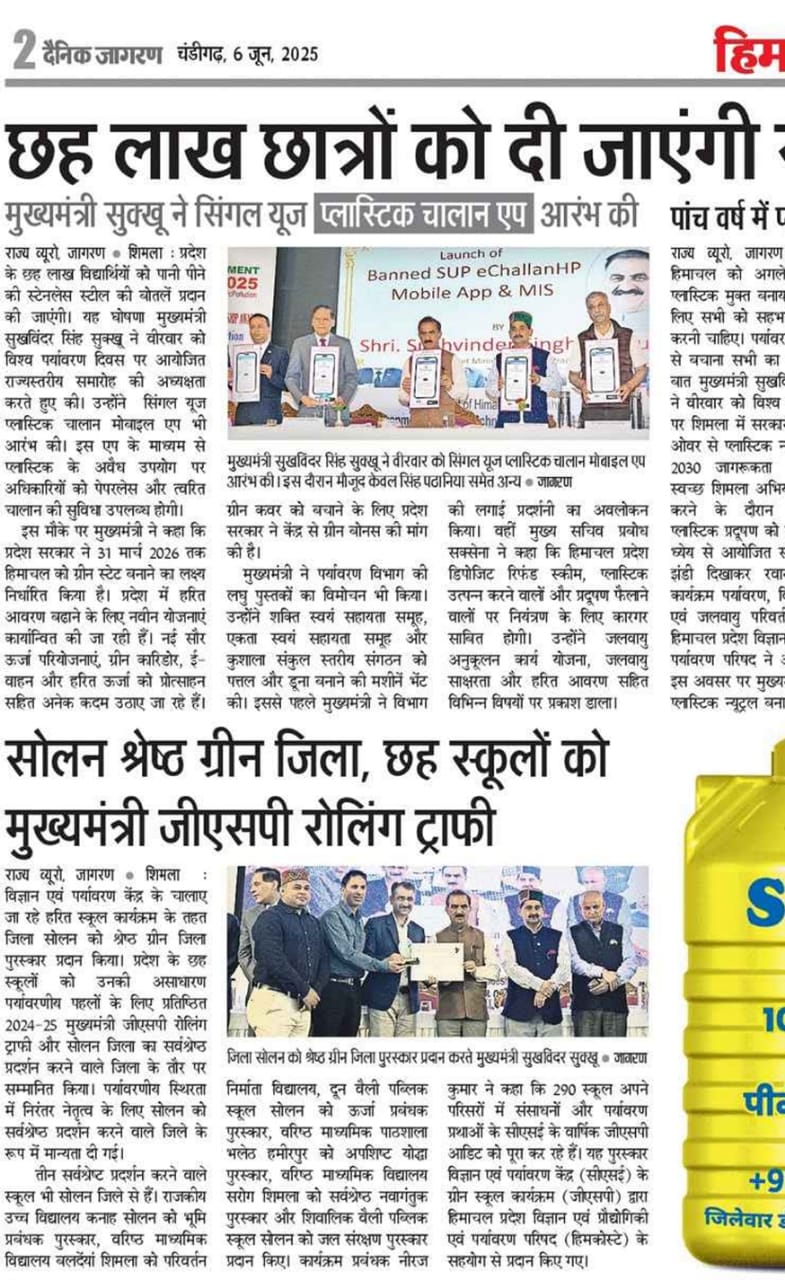
विश्व पर्यावरण दिवस, CM Sukhu ने हरित पथप्रदर्शकों को किया सम्मानित

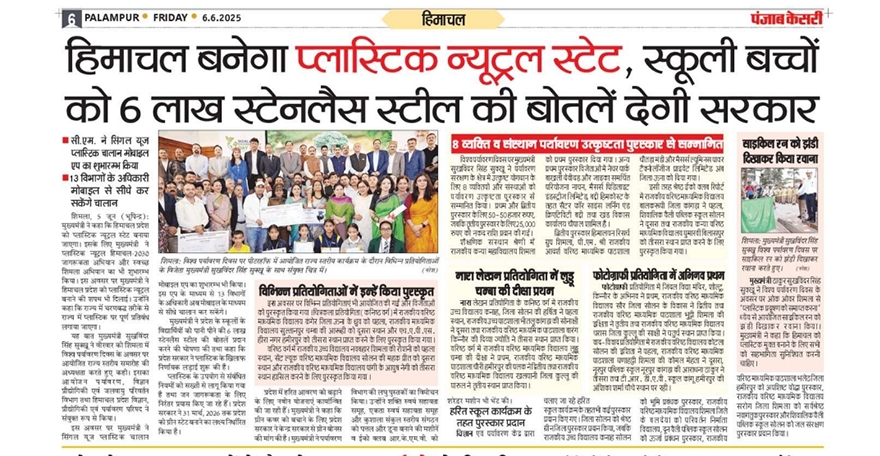
हिमाचल प्रदेश: विश्व पर्यावरण दिवस पर मुख्यमंत्री सुखविंदर सिंह सुक्खू ने पर्यावरण संरक्षण में उल्लेखनीय योगदान के लिए आठ व्यक्तियों और संस्थाओं को पर्यावरण नेतृत्व पुरस्कार से सम्मानित किया। प्रथम और द्वितीय पुरस्कार में 50-50 हजार रुपये की नकद राशि दी गई, जबकि तीसरे पुरस्कार में 25 हजार रुपये की राशि दी गई। मुख्यमंत्री ने "प्लास्टिक चैलेंजिंग मोबाइल ऐप" भी लॉन्च किया और इसे पर्यावरण कानूनों के डिजिटलीकरण की दिशा में एक बड़ा कदम बताया। उन्होंने सतत जीवन के बारे में जागरूकता फैलाने के लिए छात्रों, शिक्षकों और संस्थानों की सराहना की। राजकीय कन्या महाविद्यालय (आरकेएमवी), शिमला ने शैक्षणिक संस्थान श्रेणी में प्रथम पुरस्कार प्राप्त किया। अन्य शीर्ष विजेताओं में नेचर पार्क बाखली, नाचन में जेआईसीए समर्थित परियोजना, मेसर्स पिडिलाइट इंडस्ट्रीज लिमिटेड, बद्दी, हिमकोस्ट के तहत विज्ञान शिक्षण और रचनात्मकता केंद्र और खंड विकास कार्यालय, चौपाल शामिल थे। द्वितीय पुरस्कार विजेताओं में हिमालयन रिसर्च ग्रुप, शिमला, पीएम श्री गवर्नमेंट मॉडल सीनियर सेकेंडरी स्कूल, चौंतड़ा (मंडी) और मेसर्स ल्यूमिनस पावर टेक्नोलॉजीज प्राइवेट लिमिटेड शामिल थे। लिमिटेड। इस कार्यक्रम में कई प्रतियोगिताएं भी आयोजित की गईं। सेंटर फॉर साइंस एंड एनवायरनमेंट द्वारा ग्रीन स्कूल प्रोग्राम के तहत सोलन ने सर्वश्रेष्ठ ग्रीन डिस्ट्रिक्ट अवार्ड जीता, जीएचएस कनाह (सोलन) को भूमि प्रबंधन अवार्ड मिला और जीएसएसएस बल्देयान (शिमला) ने परिवर्तन निर्माण विद्यालय अवार्ड जीता। बेस्ट इको-क्लब रिपोर्ट श्रेणी में, जीएसएसएस बालकरूपी (कांगड़ा) ने पहला पुरस्कार जीता, उसके बाद शिवालिक वैली पब्लिक स्कूल (सोलन) और जीएसएसएस (गर्ल्स) घुमारवीं (बिलासपुर) रहे। भाषण प्रतियोगिता में इशिता (जीएसएसएस कोटला, सोलन) ने शीर्ष स्थान हासिल किया, जबकि कोमल मेहता और आराधना ठाकुर ने तीसरा स्थान हासिल किया।

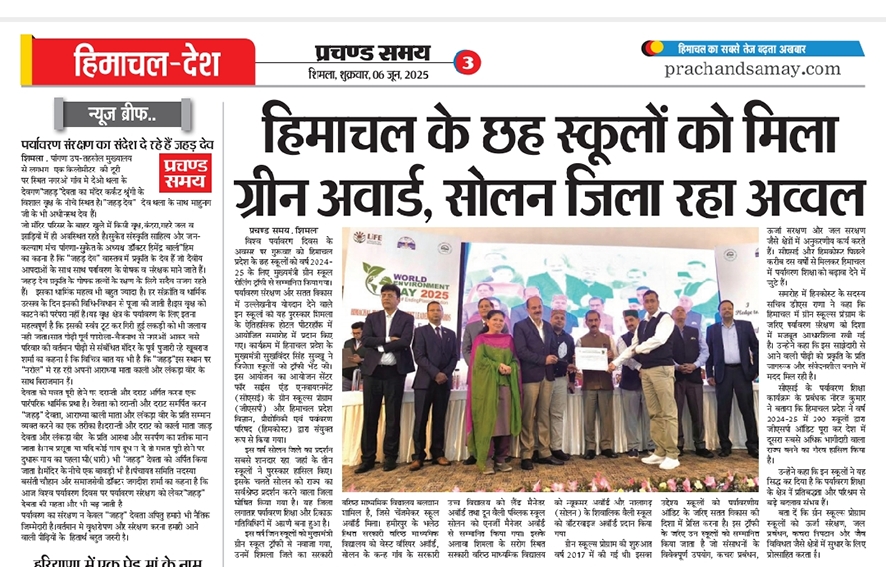
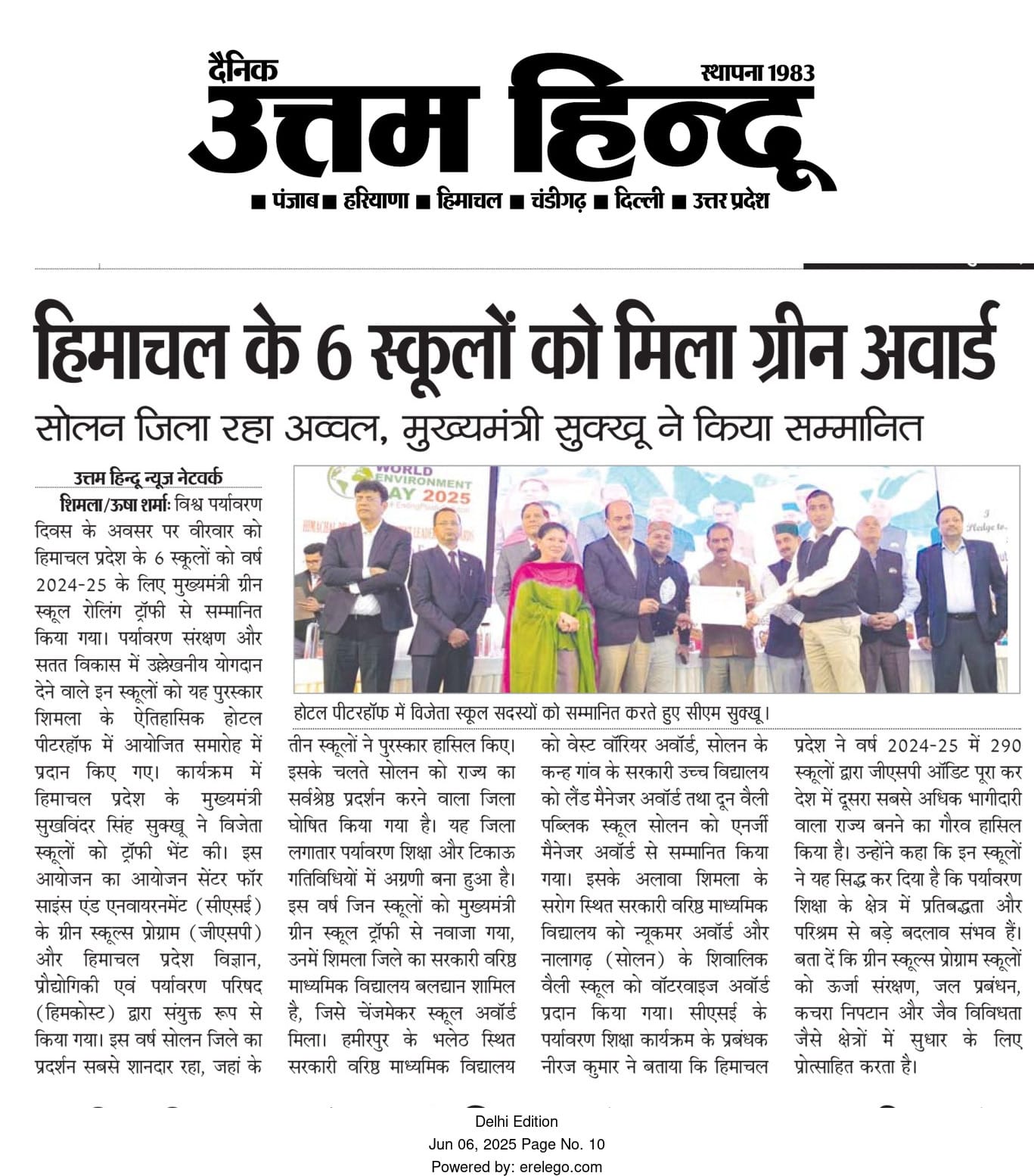
हिमाचल प्रदेश के पांच स्कूलों को मिला ‘ग्रीन स्कूल अवार्ड’, सोलन जिला फिर अव्वल

अपने परिसर को पर्यावरण के अनुकूल बनाने के लिए हिमाचल प्रदेश के पांच स्कूलों को ‘ग्रीन स्कूल अवार्ड’ से सम्मानित किया गया है। इनमें 4 सरकारी स्कूल शामिल हैं। पर्यावरण के क्षेत्र में कार्य करने वाली संस्था सेंटर फॉर साइंस एंड एनवायरमेंट (सीएसई) के ग्रीन स्कूल प्रोग्राम (जीएसपी) के तहत स्कूलों की पर्यावरण व्यवस्था के आधार पर अलग-अलग वर्ग में सम्मानित किया गया। ऐसे में पर्यावरण के अनुकूल माहौल बनाए रखने के लिए सोलन को इस बार भी राज्य का सर्वश्रेष्ठ जिला घोषित किया गया। आपको बता दें कि पिछले चार वर्षों से सोलन जिला पूरे प्रदेश में अव्वल आ रहा है। विश्व पर्यावरण दिवस पर सोमवार को शिमला स्थित राज्य अतिथि गृह पीटरहॉफ में मुख्यमंत्री सुखविंदर सिंह सुक्खू ने ग्रीन स्कूल अवार्ड प्रदान किए। पर्यावरण के तय मानकों पर सोलन और हमीरपुर जिला के स्कूलों ने सर्वश्रेष्ठ प्रदर्शन किया है। सोलन जिला के जीएमबी स्कूल नालागढ़ और कसौली इंटरनेशनल स्कूल को चेंजमेकर स्कूल अवार्ड प्रदान किया गया है। वहीं, चंबा की राजकीय वरिष्ठ माध्यमिक पाठशाला हिमगिरी को लैंड मैनेजर अवार्ड मिला है। इसके अलावा हमीरपुर जिला के राजकीय वरिष्ठ माध्यमिक पाठशाला गुलेला को वेस्ट वैरियर अवार्ड और राजकीय वरिष्ठ माध्यमिक पाठशाला कुल्हेड़ा को एनर्जी मैनेजर अवार्ड से नवाजा गया। बता दें कि प्रत्येक वर्ष ये पुरस्कार सीएसई और हिमाचल प्रदेश विज्ञान प्रौद्योगिकी और पर्यावरण परिषद के सहयोग से दिए जाते है। दरअसल, सीएसई का ग्रीन स्कूल प्रोग्राम एक पहल है, जो स्कूलों के छात्रों और शिक्षकों को उनके परिसरों पर्यावरण के अनुकूल बनाने के लिए प्रोत्साहित करता है।

At 156.87%, groundwater extraction highest in Punjab: Report

Punjab is grappling with an alarming groundwater crisis, according to the latest State of India's Environment 2025 report by an environmental NGO. The report, released ahead of World Environment Day on June 5 by the Centre for Science and Environment (CSE) and Down to Earth, highlights that over 75% of Punjab's blocks are classified as overexploited, with groundwater extraction soaring to 156.87%—the highest in the country. Punjab also faces widespread contamination of its groundwater with toxic elements such as uranium, arsenic, and nitrate, affecting nearly all its districts, according to the report. The number of districts with groundwater levels deeper than 40 metres rose from three in 2014 to 11 in 2024 in Punjab, while those with shallower water tables have declined. Punjab also suffers from severe contamination issues. Nine of its 23 districts show abnormal salinity levels; 17 report fluoride anomalies; uranium contamination affects 20 districts; nitrate and iron pollutants appear in 20 and 18 districts, respectively; and arsenic contamination is present in 12 districts, according to the report. The report further said that Punjab, alongside Ladakh, ranks lowest in the country for tree and forest cover. At the national level, India, according to the report, has witnessed a decline in agricultural land from 62.33% in 1952-53 to 58.69% in 2022-23, driven by population growth, rapid urbanisation, and industrialisation. Irrigation has increasingly shifted towards tubewell dependence, rising from 0.55% in 1960-61 to 43.34% in 2022-23, with Punjab among 10 states relying almost entirely on tubewells for irrigating farmland.

World Environment Day: Indian Financial System Funding Infrastructure Projects In The Hills Faces A Himalayan Challenge

The State of India’s Environment 2024 report by the Centre for Science and Environment reveals that nearly half (44 per cent) of all climate-related events recorded in India between 2013 and 2022 took place in the Himalayan region. The Indian financial system is quite literally facing a Himalayan challenge. As the Himalayan region veers down the climate precipice with rising temperatures, unprecedented rains, floods, landslides, avalanches and threateningly expanding glacial lakes, it has become a critical site for what bankers refer to as climate-related finance risks. All big investments such as dams, tunnels, highways, solar parks and transmission lines dotting the mountain region, and those at the planning stage, are at risk of physical destruction owing to climate-related extreme events. As a result, investing institutions are staring at rising costs and possible losses. How should Financial Institutions (FIs) such as banks and non-banking financial institutions take into account climate-induced risks while extending big credit for projects in the increasingly vulnerable Himalayan region? This is the question that looms large as we observe yet another World Environment Day today. The numerous guidelines issued by the Reserve Bank of India (RBI) to banks and other FIs on how to incorporate ‘climate-related financial risks’ face the Himalayan test, especially when India is on a building spree on its seismically sensitive mountains. The Rising Graph of Himalayan Vulnerability The recent spurt of disasters—unprecedented rain episodes, floods and landslides—witnessed in the Himalayas are highlights of the grim futures prophesied by science. The State of India’s Environment 2024 report by the Centre for Science and Environment reveals that nearly half (44 per cent) of all climate-related events recorded in India between 2013 and 2022 took place in the Himalayan region.

Data and statistics point to difficult times ahead for the nation: CSE

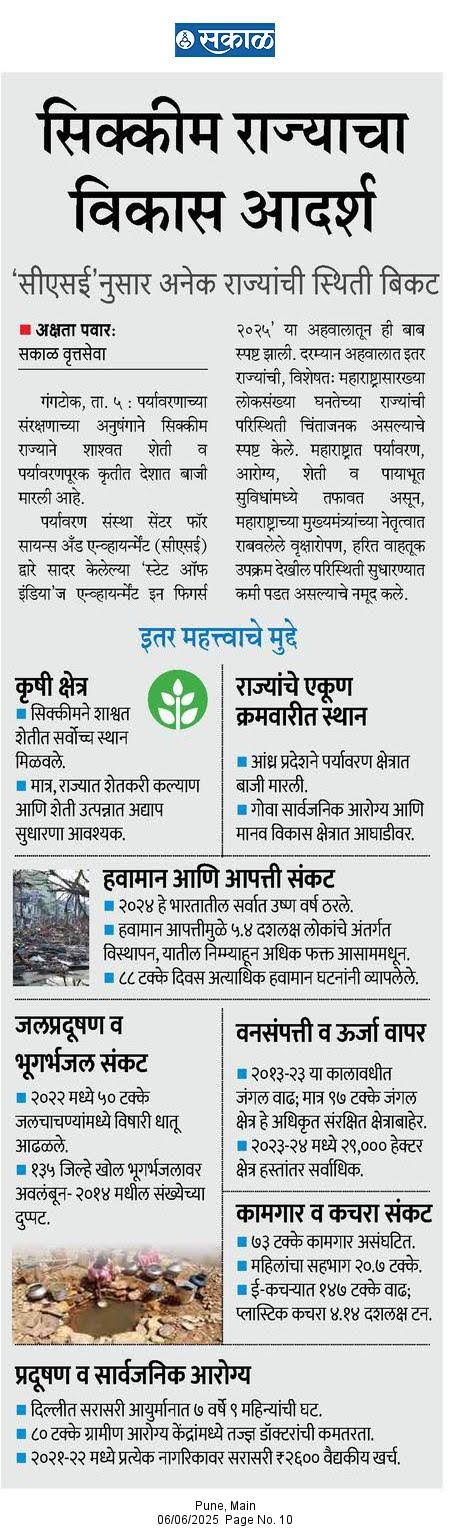
Releasing the analysis in the form of an e-compendium of data and statistics titled State of India’s Environment in Figures 2025 , CSE director general Sunita Narain said: “Numbers usually give us the truth, and what we are unveiling on this eve of this year’s World Environment Day – based on data that the government itself has generated and which is available publicly — clearly indicates that this is not the time for complacency, nor for chest-thumping.” She added: “Take just one indicator. India’s most populous states – Uttar Pradesh, Maharashtra, Bihar, West Bengal and Madhya Pradesh – that are together home to 49 per cent of the country’s population, rank low on the themes that our analysis has focused on. This means large segments of the country’s population remain vulnerable and exposed to multiple threats.” Speaking at the launch, Richard Mahapatra, managing editor of Down To Earth , said: “This is the 10 th year of publication of this seminal analysis and data compendium from CSE and Down To Earth. We have used 48 indicators clubbed under 12 sub-categories to assess all the 36 states and UTs. Though data gaps remain a major concern, the report is important because it joins the dots and interprets whatever data is available and existing to make a factual statement on environment and development.” Mahapatra adds: “Besides this, the report also brings out the key trends, such as the occurrence of extreme weather events and declining landholdings in agriculture.” State of the states: Andhra Pradesh, Sikkim and Goa bag the top spots None of the states are emerging as complete winners, says Mahapatra. Andhra Pradesh tops the rankings in the ‘environment’ category, having excelled in managing its forests and biodiversity and for its efforts to contain the impacts of climate change. “However,” Mahapatra points out, “it continues to struggle with its sewage treatment and management of polluted river stretches.” In ‘agriculture’ , Sikkim scores the highest with its strong performance in agricultural inputs and sustainable land-use practices; but it lags behind in farmer welfare and agricultural economy. Goa is at the top spot in the thematic areas of both ‘public health’ and ‘human development and public infrastructure’ . It is the only state – says the CSE report – where all registered deaths are medically certified with a known cause of death. At the same time, Goa has a shortage of hospital beds per 1,000 people, and also lags behind in per capita power availability and the number of women in its labour force. State of climate change and extreme weather: Dire prognosis 2024 was the warmest year on record for India; it was also the period in which 25 states recorded their monthly highest 24-hour rainfall in the last 123 years. Presenting the CSE- Down To Earth analysis, Rajit Sengupta, associate editor of the magazine and one of the authors of the study report, said: “Extreme weather events occurred on 88 per cent of the days in 2024, marking a sharp rise in both frequency and impact since 2022. Natural disasters induced by extreme weather and other reasons emerged as the primary drivers of internal displacement.” India recorded 5.4 million internal displacements across at least 27 states and UTs in 2024, with Assam alone accounting for nearly half of them. This was the largest internal displacement in volume due to weather and geophysical disasters since 2013. In terms of disaster types, floods accounted for 64 per cent of the displacement. The country’s greenhouse gas (GHG) emissions had declined in 2020 for the first time since 2011, largely due to the COVID-19 pandemic. In 2023, India accounted for 7.8 per cent of global GHG emissions — the highest level since 1970. In 1980, the country’s contribution had stood at just 3.3 per cent: its share has since risen by roughly 1 percentage point each decade. Sengupta points out that this growth has accelerated in recent years: between 2020 and 2023 alone, India’s share increased by 0.84 percentage points. All signs point to a future that will continue to be severely taxed by changing climate. The first quarter of 2025 stands out as one of the wettest starts to a year in recent memory. Compared to the same period in the past three years (2022–24), India witnessed an alarming spike in heavy rains, floods and landslides, reported on 80 out of 90 days. The toll has been significant: 122 lives lost — the second-highest after 2023 — and 24,807 ha of cropped area affected. State of energy, agriculture and forests: Hits and misses Despite comprising 36 per cent of the installed capacity, new renewable sources (solar, wind, bio-power and small hydro) currently generate only 14 per cent of our total electricity – Sengupta says that this points to severe under-utilisation of capacity. Rajasthan, Gujarat and Tamil Nadu lead in adapting new renewable sources, which account for over 20 per cent of the power generation in these states. The analysis report notes that population growth, rapid urbanisation and industrialisation have led to a steady decline in the share of agricultural land in India: from 62.33 per cent in 1952-53 to 58.69 per cent in 2022-23. This shift has contributed to unsustainable farming practices, including an over-reliance on groundwater and the cultivation of water-intensive crops in regions where they are ill-suited. Tubewell irrigation has surged dramatically — from just 0.55 per cent in 1960-61 to 43.34 per cent in 2022-23 — with over half of the irrigated land in Punjab and nine other states now dependent almost completely on tubewells. India added 16,630 sq km of forest cover between 2013 and 2023, but 97 per cent of this increase was outside officially recorded forests. At the same time, the country approved the diversion of 29,000 hectare of forestland in 2023-24, the highest since 2014-15. Five states including Jharkhand and Uttar Pradesh, recorded decade-high diversions. Says Kiran Pandey, programme director of CSE’s Environmental Resources unit and an author of the report: “These diversions, which disrupt wildlife corridors, are one of the factors behind increasing incidences of human-animal conflicts in the country. In 2023-24, human deaths due to elephant attacks rose by 36 per cent compared to 2020-23. Tiger attacks caused 82 human deaths during this period, marking the second highest toll since 2020.” State of air pollution and public health: Lower life expectancy, higher costs Since 2021, residents of 13 Indian capital cities, including Delhi, have faced polluted air on at least one out of every three days, says the report. The impact is severe, with 18 of 28 state capitals experiencing greater life expectancy loss from air pollution than their state averages. For instance, in Lucknow, the average life expectancy loss has been six years and five months – this is six months more than Uttar Pradesh’s state average of five years and 11 months. In 2022, the average life expectancy of an Indian was estimated to have shortened by three years and six months due to air pollution. The National Capital Territory of Delhi faces the worst scenario: its population loses seven years and nine months of life expectancy. In terms of public health, the report notes that nearly five years after the pandemic began, its impact still lingers in the country. Government data estimates 3.06 million excess deaths in 2020 and 2021 — over six times the official COVID-19 toll. India continues to grapple with weak health infrastructure, needing 36 per cent more Community Health Centres, which face an 80 per cent shortfall in specialist doctors. Out-of-pocket healthcare spending (direct payment for healthcare by individuals which may or may not be reimbursed) rose 24 per cent to Rs 2,600 per person in 2021-22, making up 45.1 per cent of health costs – thus surpassing government spending and highlighting the heavy financial burden on individuals. Residents in five out of 21 states spent more than 50 per cent of their total health expenditure from their own pockets in 2021-22. Uttar Pradesh recorded the highest share, with out-of-pocket payments accounting for 63.7 per cent of the per capita total health expenditure. Kerala and West Bengal also showed significant reliance on out-of-pocket spending, at 59.1 per cent and 58.3 per cent, respectively. State of water and waste: Twin trauma Pandey says that “water quality remains a major concern across both surface and groundwater sources. This is compounded by significant data gaps in monitoring, making accurate assessments difficult.” For instance, in 2022, India monitored only 37 per cent of its river quality stations — and nearly half of these detected toxic heavy metals at hazardous levels. While India’s overall reliance on groundwater increased slightly in 2024, some 16 states and UTs face critical over-extraction. As a result, districts where groundwater is available at depths of over 40 m rose from 75 in 2014 to 135 in 2024. In waste management, with just 18 months left to meet its 2026 target, India has remediated only half of its legacy waste. Meanwhile, generation of most other kinds of waste has jumped up. E-waste generation surged by 147 per cent in seven years, rising from 0.7 million tonne (MT) in 2017-18 to 1.75 MT in 2023-24. Hazardous waste generating industries have had a 25 per cent rise since 2017-18, pushing waste generation up by 66 per cent to 15.66 MT. Plastic waste had reached a record 4.14 MT in 2022-23, despite the ban on certain single-use plastics. Fifteen states and UTs saw plastic waste generation increase by more than 50 per cent between 2018-19 and 2022-23. State of employment: A ferment in the making The report indicates that India’s workforce is facing a rapidly deepening economic stress. Between 2017-18 and 2022-23, incomes for both salaried and self-employed workers have declined when adjusted for inflation. Over 73 per cent of India’s workers are in the informal sector, where job security is rare. More than half of the country’s regular employees lack basic social security like contracts, paid leave, or pensions. Gender disparities persist in the work force: while 60.8 per cent of men work nearly eight hours daily, only 20.7 per cent of women are engaged in employment, and even then, for fewer hours. Says Narain: “The report does not discount the enormous strides that India has made in many fields. What it essentially does is hold up a mirror and make us acquainted with the fact that we need to sit back and take note of the trends, make sense of them, and initiate corrective actions. As we step into June 5, the State of India’s Environment in Figures reminds us that there is work to be done.” In her closing remarks, Narain made a strong case for data: “We have to understand our world as it is changing. We have to see what others are doing and what is working and what is not. We do not deny the problem and its scale, but we must also applaud the good work that is happening and what it can tell us. And to do that, data is critical. Data is not about the problem – it is about the solution. Unless we have clear, credible data, there can be no solutions or policies. Our strong plea therefore is that we need more – not less – data.”

दिल्ली में साफ हवा के लिए और क्या किया जा सकता है? पद्मश्री सुनीता नारायण ने Exclusive इंटरव्यू दिया ये जवाब

नई दिल्ली: देश में पर्यावरण पर कहीं सबसे अधिक काम हुआ है तो राजधानी दिल्ली में हुआ है। 2015 से पर्यावरण को बचाने की लड़ाई लगातार मजबूत होती दिख रही है। दिल्ली को इस लड़ाई के कई सुखद नतीजे भी मिले हैं। सेंटर फॉर साइंस एंड एनवायरमेंट (CSE) की डीजी पद्मश्री सुनीता नारायण ने इस पर पूनम गौड़ से बात की: दिल्ली को बीते कुछ साल में पर्यावरण के प्रति सबसे बड़ा बदलाव क्या देखने को मिला है? दिल्ली ने पर्यावरण बचाने और प्रदूषण कम करने की लड़ाई में कई मिसाल कायम की हैं। सबसे बड़ी बात तो यह है कि लोग पर्यावरण को लेकर अवेयर हुए हैं। उनके दबाव और सवालों की वजह से दिल्ली सरकार पर दबाव बना है कि वह पर्यावरण के लिए काम करें। चाहे वह आम आदमी पार्टी की पिछली सरकार हो या बीजेपी की मौजूदा दिल्ली सरकार, दोनों ने ही पर्यावरण की अहमियत को समझा और इसके एक्शन प्लान बनाए और उन पर काम भी किया। पहली बार ऐसा हुआ कि दिल्ली के चुनावों में सभी पार्टियों के एजेंडे में हवा का प्रदूषण के अलावा कूड़ा और यमुना तीनों मुद्दे दिखे। पीएम और गृहमंत्री अमित शाह दिल्ली में यमुना प्रदूषण को लेकर मीटिंग ले रहे हैं। दिल्ली में रिज की हालत पर कई बार सवाल उठते रहे हैं। रिज दिल्ली के लिए कितनी जरूरी है? दिल्ली ऐसा शहर है, जहां अतिक्रमण बहुत तेजी से बढ़ रहा है। इस शहर का जो स्वरूप है, उसमें रिज को काफी हद तक बचाए रखना बहुत बड़ी बात है। बीते कुछ साल में रिज से काफी अतिक्रमण हटाया गया है। रिज में हरियाली बढ़ाई गई है। एक और बड़ी बात, दिल्ली पेड़ों की अहमियत समझ रही है। यहां पर सबसे बड़ा लाभ ग्रीन कवर के तौर पर सामने आया है। यह कई गुना बढ़ा है। मान सकते हैं कि यह सब जगह समानांतर नहीं है, ईस्ट में पार्क काफी कम है तो लुटियंस और साउथ दिल्ली में पार्क काफी हैं। इसके बावजूद दिल्ली में ग्रीन कवर बढ़ रहा है। कूड़ा प्रदूषण के खिलाफ लड़ाई को कमजोर कर रहा है? इस समस्या को कैसे दूर किया जा सकता है? ऐसा कहा जा सकता है कि लखनऊ, इंदौर जैसे शहर जब साफ सुथरे हैं तो दिल्ली गंदी क्यों? लेकिन यह भी समझना होगा कि दिल्ली की आबादी बहुत अधिक है। यहां कई अवैध सेटलमेंट हैं, जहां कूड़े का कुछ अता-पता ही नहीं है। ऐसे में यहां चुनौतियां बहुत अधिक हैं। जोनल स्तर पर इस लड़ाई को लड़ने की शुरूआत की जा सकती है। कचरे की छंटाई जरूरी है। वेस्ट टु एनर्जी प्लांट के लिए भी यह जरूरी है। फिर हम ऐसा नियम बना सकते हैं कि एक दिन एमसीडी गीला कूड़ा उठाए और एक दिन सूखा कूड़ा उठाए, ताकि गाड़ियों में ऐसा कूड़ा आए ही नहीं। अभी तक कूड़ा उठाने के लिए टिपिंग फीस देते हैं। यानी जितना कूड़ा उठाया उसके हिसाब से पेमेंट करते हैं, लेकिन होना इसके उलट चाहिए। कम कूड़ा उठाने पर प्रोत्साहन राशि मिलनी चाहिए। लेकिन इसके लिए मॉनिटरिंग जरूरी करनी होगी, ताकि कम कूड़े के चक्कर में कूड़ा सड़कों या यमुना में न जाए। दिल्ली में साफ हवा के लिए और क्या किया जा सकता है? सीएनजी, इलेक्ट्रिक बसें, ईस्टर्न वेस्टर्न पेरिफेरल एक्सप्रेस-वे जैसे ऐतिहासिक काम राजधानी ने उठाए हैं। इनके रिजल्ट भी मिले हैं। सरकार एक्शन प्लान भी लाई है जो काफी मायनों में अच्छा है। लेकिन अभी प्राइवेट गाड़ियों को कम करने की दिशा में दिल्ली को काम करना बहुत जरूरी है। यह समझना होगा कि ईंधन कहां जल रहा है। यह गाड़ियों, किचन और फैक्ट्रियों पर चल रहा है। गाड़ियों से सबसे अधिक प्रदूषण आ रहा है और इस पर अभी जरूरत के मुताबिक फोकस नहीं हो रहा है। यमुना बीते काफी समय से सुर्खियों में है। यमुना आरती शुरू हुई है। रिवरफ्रंट के तहत कुछ पार्क बने हैं। इन्हें किस तरह देख रही हैं? यह लोगों को यमुना से जोड़ने का बहुत अच्छा प्रयास है। पर्यावरणविद् के तौर पर मैं कहना चाहूंगी कि शिव की जटाओं से गंगा निकलती है और वह धीरे धीरे बहती है। हिमालय शिव है और वहां के पेड़, चट्टानें, इकोलॉजी गंगा के प्रवाह को कम करती है और गंगा तबाही नहीं लाती। इन प्रोजेक्ट के जरिए जब लोग यमुना का हाल देख रहे हैं तो उन्हें दुख हो रहा है और यमुना साफ करने की मुहिम जोर पकड़ रही है। रिवरफ्रंट बनाने में कोई बुराई नहीं है, लेकिन इनमें कंक्रीट का इस्तेमाल न हो। नदी अविरल बहे यह प्रयास करने हैं। यमुना को साफ करने के लिए भी लोगों की यही अवेयरनेस काम आएगी।