“In an atmosphere of aid cuts and reducing international cooperation, there are few hooks remaining to hold developed countries accountable for what they owe and committed to. Reinforcing their duty to provide finance to developing countries is a demand that the Global South must not give up on,” said Avantika Goswami, Programme Manager, Climate Change Centre for Science and Environment. India has put forth its expectations on the ideal “Baku To Belem Roadmap to 1.3T” ahead of the Bonn Climate Meeting which begins on June 16, stating that without sufficient climate finance, even proposed nationally determined contributions will not materialise, leave alone any ambitious future NDCs. In a succinct and strongly worded submission to the UN climate body, United Nations Framework Convention on Climate Change (UNFCCC) on May 27, India has said climate finance should flow from developed countries to developing countries and that public capital should be used strategically to crowd in private investments for climate action, pointing out that excessive borrowing poses risks to a country’s fiscal stability. It added that the roadmap should support meaningful translation of developing country NDCs to concrete actions. “At the outset, India expresses concern with the substantial gaps remaining between the current annual quantum provided under the New Collective Quantified Goal (NCQG) on Climate Finance and the financing needs currently identified by developing countries for their 2030 NDC commitments,” India flagged in its submission. “Without sufficient climate finance, even the proposed NDCs would not fructify, leave alone any enhanced level of ambition in future NDCs. The NCQG outcome of COP 29 was adopted despite India’s objection and signals the unwillingness and failure of developed countries to fulfil their responsibilities under the Convention and its Paris Agreement. The “Baku to Belém Roadmap to 1.3T” is an opportunity to put the financial discussion on the right track in accordance with Article 9.1 of Paris Agreement,” India added. Article 9.1 of the Paris Agreement states “Developed country Parties shall provide financial resources to assist developing country Parties with respect to both mitigation and adaptation in continuation of their existing obligations under the Convention.” HT reported on November 25 last year that the COP29 climate talks in Baku ended in unprecedented acrimony as India led a fierce pushback against what it called a “stage-managed” climate finance deal, moments after the Azerbaijan Presidency hastily gavelled through a contentious proposal. India was the first to reject the decision for not reflecting the priorities of the Global South — a dismissal endorsed by many other countries. Baku was expected to see progress on NCQG, basically a new commitment on climate funding by developed countries. The NCQG text set a climate finance goal of “at least $300 billion per year by 2035” and launched the “Baku to Belém Roadmap to 1.3T.” COP 30 is scheduled for later this year at Belem, Brazil, and the understanding at Baku was that countries would use the year between the two conferences to arrive at a roadmap for climate funding goal of $1.3 trillion. However, India identified specific problems that could fundamentally alter climate finance obligations: “As we struggle to deal with climate change, the outcome proposed in the paper will further affect our ability to adapt to climate change, greatly impact our NDC ambition, and its implementation... will severely affect our growth,” Chandni Raina, the negotiator from India and a finance ministry advisor said then, emphasising that “the amount proposed to be mobilised is abysmally poor, it is a paltry sum and it will not enable climate action.” She specifically highlighted three problematic paragraphs in the Baku declaration: Allowing finance from “a wide variety of sources, public and private, bilateral and multilateral ; recognising climate finance mobilised through multilateral development banks and ; and encouraging developing country contributions through South-South cooperation. The NCQG text had decided that the roadmap will be joint initiative of the Presidencies and not a negotiated outcome. India said in its latest submission that it should be seen that this is indeed not a negotiated outcome among parties. Further action should be country led, India stressed. “The roadmap must be based on approaches that duly recognise the country-led nature of climate action. In the context of developing countries, achieving sustained growth depends on fostering a “virtuous cycle” of domestic savings and productive investment. There is a well-established link between the Human Development Index (HDI) and per capita energy consumption,” India’s submission added. Global tax levies and specific sector approaches must be excluded, the submission went on to say. These not only lack international consensus but also run counter to the principles of equity and CBDR-RC and the bottom-up, nationally determined nature of climate action. The financial commitments of developed nations should reflect their historical responsibilities in their contribution to global cumulative GHG emissions. In 1992, at the 1992 United Nations Conference on Environment and Development (UNCED) in Rio de Janeiro, Brazil, the CBDR-RC was officially enshrined in the UNFCCC treaty on Climate Change. Article 3 paragraph 1 of the UNFCCC said: “The Parties should protect the climate system for the benefit of present and future generations of humankind, on the basis of equity and in accordance with their common but differentiated responsibilities and respective capabilities. Accordingly, the developed country Parties should take the lead in combating climate change and the adverse effects thereof” . Further, overleveraging for climate initiatives through excessive borrowing poses risks to the country’s fiscal stability, India said in its submission. Finally, India has said the roadmap should convey the right signals and messages for urgent climate actions enabled by scaling up climate finance to developing countries effectively. “In an atmosphere of aid cuts and reducing international cooperation, there are few hooks remaining to hold developed countries accountable for what they owe and committed to. Reinforcing their duty to provide finance to developing countries is a demand that the Global South must not give up on,” said Avantika Goswami, Programme Manager, Climate Change Centre for Science and Environment.
Though public perception often blames stubble burning or fireworks for Delhi’s toxic air, a Centre for Science and Environment (CSE) analysis confirms that vehicular pollution is the leading contributor among combustion sources. Every day, Delhi’s waste pickers walk three to four kilometers under the blazing sun, collecting and sorting the garbage that keeps India’s capital functioning. Their work is essential—yet largely invisible. There are an estimated 200,000 waste pickers in Delhi, many of whom are migrants from landless, rural families in northern and eastern India. Pushed out of agriculture and informal rural economies, they arrive in the city with little more than the hope of survival, often ending up in the informal recycling sector. Labeled as “unskilled” or “semi-skilled” labor, they perform some of the city’s most crucial work—without contracts, protection, or recognition. Sheikh Akbar Ali, a waste picker from Seemapuri who has worked with the community for over 15 years, paints a grim picture. “We’re often denied access to public buses because people say we smell,” he says. With a daily income of ₹300 (roughly USD 3.60), even a single auto ride costing ₹150 (USD 1.80) one way is unaffordable. For women waste pickers, things are worse—no access to toilets, no place to change, and no shelter from the searing heat. “Since COVID-19, we’ve been pushed off shaded footpaths and society corners to work under the open sky,” he adds. The Smart Cities Mission, aimed at modernizing urban infrastructure, has only shrunk their access to public spaces, replacing common corners with beautified zones and surveillance. Sumit Chaddha, another waste picker in Kamla Nagar, recalls how there once was a rule to stop work by 10am during peak summer hours. “Now, the heat is unbearable, but we have to keep going. One man collapsed while working—he started vomiting and died,” Sumit says. “There’s no medical card or health service for us through the MCD. We handle waste for the whole city but don’t even get gloves, let alone health insurance.” In 2024, Delhi recorded a temperature of 52.3°C during what the World Meteorological Organization declared the hottest year in 175 years. The city also continues to rank among the world’s most polluted, with 74 of the 100 most polluted cities in the world located in India, according to the 2024 World Air Quality Report. Though public perception often blames stubble burning or fireworks for Delhi’s toxic air, a Centre for Science and Environment (CSE) analysis confirms that vehicular pollution is the leading contributor among combustion sources. Pollution in Delhi is Not Seasonal. Delhi breathes hazardous air nearly all year round—99 percent of the time. PM2.5 levels, which measure the concentration of fine particles that can penetrate deep into the lungs, regularly exceed the World Health Organization’s safe limit by 30 times. Even short-term exposure to PM2.5 has been linked to heart attacks, strokes, and severe respiratory illnesses. Yet, the poorest—those already battling extreme heat, living in cramped settlements, and working with hazardous waste—remain stranded. Public buses, their main mode of mobility, are in a state of collapse. Over 100,000 bus breakdowns were reported in just nine months of 2024 alone. Transport-related emissions, while relatively easier to reduce, are still not a priority in most countries. Globally, the transport sector accounts for 15 percent of greenhouse gas emissions, with road transport alone responsible for 71 percent of that figure in 2019. India, now the third-largest emitter of CO₂ in the world, released 2.69 billion tons of fossil CO₂ in 2022—up by 6.5% from the previous year.
The policy statement initiated by Nutrition Advocacy in Public Interest (NAPi) is endorsed by 28 organisations, including PHFI, Centre for Science and Environment (CSE), Indian Public Health Association (IPHA), Consumer VOICE, and Diabetes India. Patient groups like Kidney Warriors have also supported the statement. A coalition of India’s 29 leading public health and consumer organisations on Tuesday urged the centre to mandate front-of-pack warning labels on pre-packaged food and beverage products high in sugar, salt, and saturated fat (HFSS). The leading public health leaders gave the call for warning labels, responding to the mounting evidence of health risks posed by HFSS and ultra-processed food (UPF) products. Prof. K. Srinath Reddy, Honorary Distinguished Professor and Goodwill Ambassador of Public Health Foundation of India (PHFI) for Public Health Partnerships, who has been a longstanding voice in India’s public health landscape, said: “India cannot afford to wait while non-communicable diseases (NCDs) escalate and children become marketing targets.” “Warning labels are simple, effective, and evidence-based,” he added. The policy statement initiated by Nutrition Advocacy in Public Interest (NAPi) is endorsed by 28 organisations, including PHFI, Centre for Science and Environment (CSE), Indian Public Health Association (IPHA), Consumer VOICE, and Diabetes India. Patient groups like Kidney Warriors have also supported the statement. Dr Arun Gupta, Convener of NAPi, a national think-tank on nutrition consisting of independent medical experts, paediatricians, and nutritionists, said: “Without mandatory warning labels, the public remains in the dark. Industry interests must not override children’s right to health.” Quoting the Economic Survey, he added: “Globally, self-regulation has been ineffective. Stringent front-of-pack labelling rules are needed and must be enforced.” The Supreme Court has also recently expressed concern over misleading and insufficient food labelling practices. The apex court in its order in April, directed the centre to amend the 2022 draft regulation within three months, stating food packets “have no information” and raised concern about products like Kurkure and Maggi. According to the Indian Council of Medical Research-National Institute of Nutrition (ICMR-NIN) Guidelines, 2024 HFSS foods are defined as foods or diets that exceed recommended thresholds for added fat, sugar, or salt. These foods are typically energy dense, low in micronutrients and fibre, and are associated with increased risk of NCDs such as obesity, diabetes, hypertension, and cardiovascular disease, the statement said. NAPi further said that Prime Minister Narendra Modi, in his Mann Ki Baat address, emphasised the critical need to raise awareness among children about their sugar consumption, how much they are eating and what they should ideally consume. Earlier this year also, the prime minister had emphasised on reducing fat consumption to tackle the obesity crisis in India. He had suggested that such awareness would guide them toward healthier choices. Warning labels on HFSS products do exactly that, they said. The public health organisations said warning labels on HFSS food products is the need of the hour as India is witnessing an alarming rise in non-communicable diseases and related premature deaths. As per national data, 28% of adults are overweight or obese, while one in four adults is diabetic or pre-diabetic. Alarmingly, 10% of 10–19-year-olds are pre-diabetic. “Children are consuming increasing amounts of packaged foods high in sugar and salt, accelerating childhood obesity. As many as 54% of all deaths are linked to unhealthy diets,” the policy statement said. Senior constitutional expert Rajeev Dhawan, Senior Advocate, Supreme Court, said: “Proper and accurate labelling of all pre-packaged food products is not only consumer protection and a right to know, it is part of the right to health and life.” The policy statement called for mandatory warning labels (like High in Sugar) on the front of the pack; rejection of the 2022 draft “Star Rating” model, which is misleading and favours industry; labelling thresholds based on the 2022 Draft Regulation, WHO SEARO, or ICMR-NIN criteria; prohibition of marketing to children, including cartoons, celebrity endorsements, and health claims; transparent and time-bound regulation, with a 12-month compliance deadline; and protection of public health in trade negotiations involving food labelling standards. Dr. Nupur Bidla, National Coordinator, Breastfeeding Promotion Network of India (BPNI) said the Supreme Court’s question, “You all have grandchildren?... the packets have no information”, highlights the urgent need to protect future generations. “We have urged the government of India to heed the apex court’s concern and mandate warning labels - not star ratings on all ultra-processed packaged foods/ HFSS.” She said NAPi has also launched a public petition in support of this campaign.
Delhi is not the city that comes to mind with the words ‘Clean Air’ but rather the abject absence of it. A recent nationwide review of the National Clean Air Programme (NCAP), by the Centre for Science and Environment (CSE), has shown that the Delhi administration’s multi-pronged actions to crack down on sources of air pollution has covered much ground, yet more remains to be done. Delhi’s clean air action precedes the NCAP programme. Its early moves were driven by interventions from the Supreme Court and its monitoring body, the Environment Pollution (Prevention and Control) Authority, established by the top court in 1998. Road dust due to transport is the source of close to 40 per cent of PM (particulate matter) 2.5 pollution. To begin with, Delhi substituted diesel fuel with compressed natural gas (CNG) in its public transport and local commercial transport. Then it put restrictions on entry of trucks; imposed a pollution tax on daily truck entries, diesel fuel sold and diesel cars sold with 2000 cc engines; phased out 10-year-old diesel and 15-year-old petrol vehicles; banned polluting industrial fuels like coal, furnace oil and pet coke; and also closed all coal-based power plants. After 2020, the Commission for Air Quality Management (CAQM) has restricted the entry of pre-Bharat Stage IV inter-state buses; banned diesel generator sets; and initiated hotspot action on dispersed sources. The Delhi government’s electric vehicle policy has attained fleet electrification level of 12 per cent. The long-term action on coal and diesel has cumulatively led to major reductions in their consumption and led to reduction of emissions.
According to a report by the Centre for Science and Environment (CSE), Delhi experienced approximately 121 days where the air quality met the national standards, a decline from 152 days in 2023. Delhi Chief Minister Rekha Gupta on Tuesday launched the Air Pollution Mitigation Plan 2025 and announced major steps to mitigate the menace — mandating installation of anti-smog guns on high-rise commercial buildings in the capital — particularly those above 3,000 metres like malls, hotels, and office complexes. The government also ordered the installation of mist sprayers at 13 air pollution hotspots in the capital and the entry of only BS-VI, EVs, and CNG vehicles from November 1. Cameras to detect end-of-life vehicles CM Rekha Gupta added that the government plans to install ANPR (Automatic Number Plate Recognition) cameras at all entry points to Delhi, and petrol pumps to detect end-of-life vehicles contributing to pollution. The ANPR cameras will automatically identify such vehicles, enabling authorities to take immediate action to trace and stop them from operating within the capital. Delhi's air pollution woes Delhi consistently ranks among the most polluted cities in the world, with PM2.5 levels often exceeding safe limits, especially during winter. According to a report by the Centre for Science and Environment (CSE), Delhi experienced approximately 121 days where the air quality met the national standards, a decline from 152 days in 2023. Delhi to have first artificial rain through cloud seeding As part of the Air Pollution Mitigation Plan 2025, Delhi CM further announced that the government will collaborate with leading scientific institutions to combat pollution using cutting-edge technologies. Delhi has already signed a memorandum of understanding (MoU) with IIT Kanpur to launch a pilot project on cloud seeding for artificial rain. Gupta said this move marks the beginning of Delhi’s efforts to explore innovative solutions, such as artificial rain, to tackle its persistent air quality crisis.
A coalition of India’s leading public health and consumer organisations in India has urged the central government to introduce mandatory front-of-pack warning labels on pre-packaged food and beverage products that are high in sugar, salt, and saturated fat (HFSS). The policy statement was initiated by Nutrition Advocacy in Public Interest (NAPi), a national think tank focused on nutrition, and has been endorsed by 28 other organisations, including the Public Health Foundation of India (PHFI), the Centre for Science and Environment (CSE), the Indian Public Health Association (IPHA), Consumer VOICE, and Diabetes India. Dr. Arun Gupta, Convener of NAPi, warned that without clear and mandatory warning labels, consumers remain unaware of what they are eating. “Without mandatory warning labels, the public remains in the dark. Industry interests must not override children’s right to health,” he was quoted as saying by The New Indian Express. Referring to the Economic Survey, Dr. Gupta noted that voluntary self-regulation has consistently failed worldwide, emphasising the need for enforceable front-of-pack labelling norms. According to the latest guidelines from the Indian Council of Medical Research-National Institute of Nutrition (ICMR-NIN), HFSS foods are defined as those exceeding recommended limits for added sugar, salt, or fat. These items are typically energy-dense, low in essential nutrients and fiber, and have been linked to higher risks of obesity, diabetes, hypertension, and cardiovascular disease. Recently, Prime Minister Narendra Modi, in his Mann Ki Baat radio address, stressed the importance of educating children on their sugar intake and promoting healthier food choices. “Warning labels on HFSS foods directly support these goals by helping consumers make more informed decisions,” the policy statement said. The policy statement makes several key recommendations: Mandating clear front-of-pack warning labels (e.g., “High in Sugar”) Rejecting the 2022 draft “Star Rating” system, which the groups say is misleading and industry-friendly Setting labelling thresholds in line with WHO SEARO, ICMR-NIN, or the 2022 Draft Regulation Banning the marketing of HFSS products to children, including the use of cartoon characters, celebrities, and health claims Establishing transparent, time-bound regulations with a 12-month compliance period Safeguarding public health standards in all trade negotiations involving food labelling
“The EPR regulations can create much-needed transparency and accountability to ensure that the cost of managing plastic waste, which is significantly higher than other waste types, is borne by those who produce it,” says Siddharth Ghanshyam Singh, programme manager, Centre for Science and Environment, a think tank. The contradiction is evident: plastic pollution is pervasive, endemic and easy to visualise, choking rivers with waste and littering oceans. Yet when it comes to tracing and tracking producers of plastic packaging, there is little visibility on its journey from production to disposal. But come July 1, plastic bags and multi-layered plastic packaging must mandatorily carry a bar or QR code that would include details of the material, its thickness, the name of the manufacturer and their contact information. The regulation also applies to importers and brand owners of a product. The idea is simple: improving the traceability of plastic packaging in products and making producers accountable for the life cycle of the material. Penalties for non-compliance include up to five years in prison or fines up to ₹1 lakh. Tracking Trash The build-up to tracking and tracing plastic packaging has been some time in the making. The Ministry of Environment, Forest and Climate Change has streamlined the Plastic Waste Management Rules, 2016 over the years to curb rising plastic pollution. Since April 2025, beverage makers are mandated to use 30% recycled plastics in rigid packaging, such as polyethylene terephthalate (PET) bottles. The plan is to reach 60% by financial year 2029. Experts point out that the barcode system, under the Extended Producer Responsibility (EPR) regulations, marks a shift in government strategy to make producers responsible for funding recycling of plastics used in packaging. So far, local governments and municipalities have been paying for end-of-life costs of using plastics, largely funded by taxpayers. “The EPR regulations can create much-needed transparency and accountability to ensure that the cost of managing plastic waste, which is significantly higher than other waste types, is borne by those who produce it,” says Siddharth Ghanshyam Singh, programme manager, Centre for Science and Environment, a think tank. In several states in the US and the European Union (EU), where EPR laws are well developed, producers need to pay a fee to fund collection, sorting and processing of packaging material. As a result, brands incentivise consumers to return packaging and used bottles. These packaging materials are then recycled or destroyed depending on their end-of-life status. In India, bringing producers, importers and brand owners to account for plastic used in product packaging is much more complex given the informal nature of waste collection, segregation and processing ecosystem. The informal sector, estimated to handle around 60% of India’s waste, needs training and additional resources to scan and segregate barcoded plastics. Businesses, too, need to figure out how to inculcate circularity within their value chain. Accountability Matters Traceability and accountability for plastic use put a real cost on the use of plastic. Experts suggest that to cut down on their dependence on plastics, businesses need to shift to rigid packaging formats or embrace reuse and refill systems. However, these solutions have costs and liability implications. According to Hisham Mundol, chief adviser, India, Environmental Defence Fund, a non-profit, India’s new EPR regulations for traceability are a necessary step, signalling a shift from voluntary action to enforceable responsibility. “But regulation alone won’t be enough—we must prepare Indian businesses not just to comply, but to lead,” he says. For that, the plastic-waste challenge before industry needs to be reframed as an opportunity. “A low-plastic world will create new markets, drive entrepreneurship and open export possibilities for Indian solutions,” he adds. “Compliance with EPR norms, traceable recycling mechanisms and usage of eco-friendly packaging materials are fast becoming prerequisites for international trade,” says Ajit Gupta, managing director, Ajit Industries, a leading manufacturer of industrial tapes. Industry players say businesses should focus on expanding collection and segregation mechanisms, investing in certified recycling technologies and adopting digital tracking systems to fulfil their EPR obligations. “Public-private partnerships can further accelerate capacity building in underserved regions,” suggests Jeevaraj Pillai, director, sustainability and president, flexible packaging and new product development at Uflex, a major packaging company. These changes not only hold manufacturers accountable for the plastic they generate but also offer Indian businesses a rare opportunity “to align environmental stewardship with economic competitiveness”, as Gupta puts it.
Delhi Chief Minister Rekha Gupta on Tuesday launched Air Pollution Mitigation Plan 2025 and announced major steps to mitigate air pollution - mandating installation of anti-smog guns on high-rise commercial buildings in the capital - particularly those above 3,000 metres like malls, hotels, and office complexes. The government also directed for mist sprayers to be installed in 13 air pollution hotspots in the capital, along with the entry of only BS-VI, EVs, CNG vehicles from November 1. Cameras to detect end-of-life vehicles Chief Minister Rekha Gupta added that the government plans to install ANPR (Automatic Number Plate Recognition) cameras at all entry points to Delhi, and petrol pumps to detect end-of-life vehicles contributing to pollution. Also Read | Delhi CM Rekha Gupta announces stricter pollution control measures The ANPR cameras will automatically identify such vehicles, enabling authorities to take immediate action to trace and stop them from operating within the capital. Delhi's air pollution woes Delhi consistently ranks among the most polluted cities in the world , with PM2.5 levels often exceeding safe limits, especially during winter. New Delhi, May 23 (ANI): An anti-smog gun on a multi-purpose vehicle sprays water droplets to curb air pollution, at South block on Raisina Hills in New Delhi on Friday. (ANI Photo/Jitender Gupta) Also Read | Delhi Air Pollution: CAQM invokes Stage I of GRAP with immediate effect According to a report by the Centre for Science and Environment (CSE), Delhi experienced approximately 121 days where the air quality met the national standards, a decline from 152 days in 2023. Delhi to have first artificial rain through cloud seeding As part of the Air Pollution Mitigation Plan 2025, Delhi CM further announced that the government will collaborate with leading scientific institutions to combat pollution using cutting-edge technologies.
Cyclists in Kolkata rallied behind chief minister Mamata Banerjee, hailing her visionary Sabuj Sathi scheme that distributed over 1.15 crore bicycles to girl students across Bengal. In a heartfelt open letter, cycling enthusiasts and advocacy groups appealed to the CM to go a step further by lifting restrictions on bicycle use across city roads and formally recognising cycles as a legitimate, non-polluting mode of transport in the urban mobility landscape. The appeal comes amidst growing concern over police-imposed restrictions that prohibit cyclists from using several arterial roads in Kolkata. These curbs, according to the letter jointly signed by organisations, including Kolkata Cycle Samaj, BYCS, Cyclology India, Nagarik Mancha, and Sabuj Mancha, run counter to the spirit of Sabuj Sathi, a scheme globally recognised for its environmental and social impact. "Bicycles are not a problem—they are the solution," reads the letter. "The ban on cycles contradicts the CM's pioneering vision, and it disproportionately harms livelihood cyclists who rely on this humble, sustainable vehicle to support their families." Recent studies back the cyclists' claim. A speed-mapping analysis found cycles outperforming motor vehicles on 60% of Kolkata's congested corridors. In high-traffic zones like Tollygunge Phari, cycles matched or exceeded the average bus and car speeds during peak hours. Health and mobility experts are echoing the urgency of policy change. "Kolkata has already made strides by integrating non-motorised transport into its mobility plans," said Anumita Roychowdhury, a mobility expert from CSE. "The next big leap is implementation—designing our cities for people, not just cars." The Sabuj Sathi initiative, implemented by the West Bengal SC/ST Development and Finance Corporation, not only empowered students but also made a substantial dent in the state's carbon footprint. According to data from the West Bengal Pollution Control Board, Sabuj Sathi cyclists saved nearly 8.4 million tonnes of CO₂ between 2013 and 2022—valued at over Rs 750 crore in climate benefits. Despite having one of the highest rates of walking and cycling commutes among Indian cities, Kolkata lags in infrastructure. Cycle parking at metro hubs, protected bike lanes, and designated corridors are either missing or inadequate. "Kolkata's compact layout makes it ideal for cycling," said Satanjib Gupta, bicycle mayor of Kolkata. "It's time we stop penalising cyclists and instead invest in making streets safer and more inclusive." Christopher Gerber, Ajay Mittal, Inspector Prosenjit Chakraborty of Kolkata Police, and others pointed to promising examples across Indian cities like Chennai, where 40% of streets are earmarked for walking and cycling, with Rs 200 crore allocated for NMT in 2025. Pune, where 15% of the transport budget is for NMT, integrates public bicycle sharing with bus networks. Bengaluru, where Safe School Zones and dedicated cycle corridors are underway.Advocates say Kolkata now stands at a crossroads—quite literally. "This is a choice between choking in traffic or moving towards a healthier, accessible, and more breathable city," said Sanjiv Gopal from Asar. "Cycling must no longer be treated as an afterthought in policy and planning."
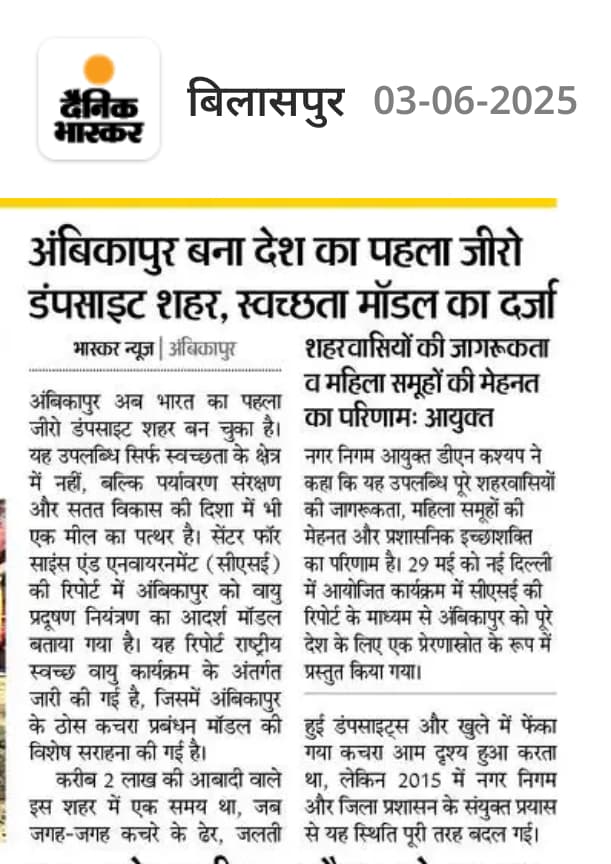
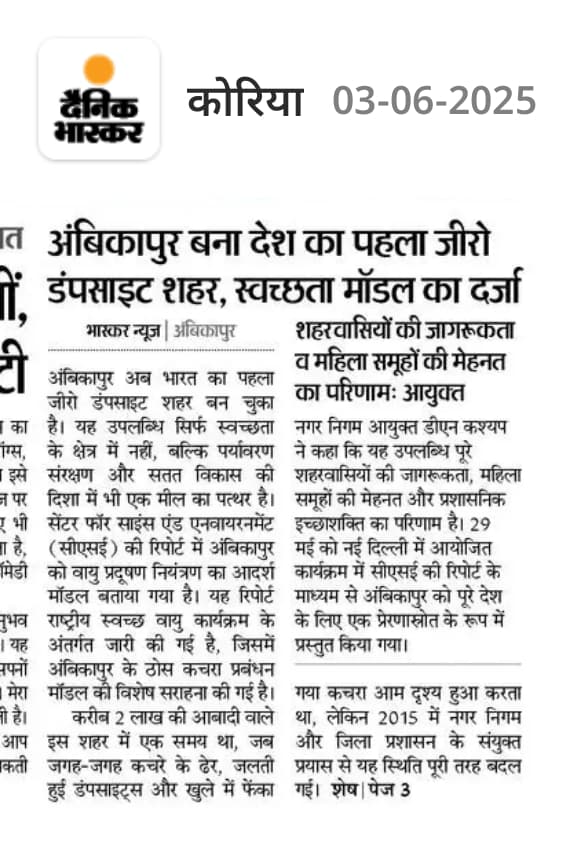
राष्ट्रीय स्वच्छ वायु कार्यक्रम (NCAP) के तहत सेंटर फॉर साइंस एंड एनवायरनमेंट (CSE) द्वारा की गई ताज़ा समीक्षा रिपोर्ट में अंबिकापुर शहर को एक बेहतरीन उदाहरण के रूप में प्रस्तुत किया गया है, जिसने ठोस अपशिष्ट प्रबंधन के जरिए न केवल पर्यावरणीय बल्कि सामाजिक और आर्थिक सुधार भी हासिल किए हैं। छत्तीसगढ़ के सरगुजा ज़िले का मुख्यालय अंबिकापुर, जिसकी आबादी 2.25 लाख से अधिक है, आज देश का पहला “ज़ीरो डंपसाइट” शहर बन गया (Ambikapur Waste Management Model)है। कभी कचरे के ढेर, जलते डंपसाइट और खुले में कचरा फेंकने की समस्याओं से जूझने वाला यह शहर, अब अपने सुदृढ़ और समुदाय-आधारित अपशिष्ट प्रबंधन मॉडल के लिए पूरे देश में जाना जाता है।
भारत के 29 प्रमुख सार्वजनिक स्वास्थ्य और उपभोक्ता संगठनों के गठबंधन ने मंगलवार को केंद्र सरकार से चीनी, नमक और संतृप्त वसा (HFSS) की अधिकता वाले पहले से पैक किए गए खाद्य और पेय उत्पादों पर पैक के सामने चेतावनी लेबल लगाने का आग्रह किया। प्रमुख सार्वजनिक स्वास्थ्य नेताओं ने HFSS और अल्ट्रा-प्रोसेस्ड फूड (UPF) उत्पादों से उत्पन्न स्वास्थ्य जोखिमों के बढ़ते सबूतों पर प्रतिक्रिया व्यक्त करते हुए चेतावनी लेबल लगाने का आह्वान किया। भारत के सार्वजनिक स्वास्थ्य परिदृश्य में लंबे समय से आवाज़ उठाने वाले पब्लिक हेल्थ फाउंडेशन ऑफ इंडिया (PHFI) के मानद प्रतिष्ठित प्रोफेसर और सद्भावना राजदूत प्रोफेसर के. श्रीनाथ रेड्डी ने कहा, भारत गैर-संचारी रोगों (NCD) के बढ़ने और बच्चों के विपणन लक्ष्य बनने तक इंतज़ार नहीं कर सकता। उन्होंने कहा, चेतावनी लेबल सरल, प्रभावी और साक्ष्य-आधारित हैं। न्यूट्रिशन एडवोकेसी इन पब्लिक इंटरेस्ट (एनएपीआई) द्वारा शुरू किए गए नीति वक्तव्य को पीएचएफआई, सेंटर फॉर साइंस एंड एनवायरनमेंट (सीएसई), इंडियन पब्लिक हेल्थ एसोसिएशन (आईपीएचए), कंज्यूमर वॉयस और डायबिटीज इंडिया सहित 28 संगठनों द्वारा समर्थन दिया गया है। किडनी वॉरियर्स जैसे रोगी समूहों ने भी इस वक्तव्य का समर्थन किया है। स्वतंत्र चिकित्सा विशेषज्ञों, बाल रोग विशेषज्ञों और पोषण विशेषज्ञों से मिलकर बने पोषण पर एक राष्ट्रीय थिंक-टैंक एनएपीआई के संयोजक डॉ. अरुण गुप्ता ने कहा, अनिवार्य चेतावनी लेबल के बिना, जनता अंधेरे में रहती है। उद्योग के हितों को बच्चों के स्वास्थ्य के अधिकार पर हावी नहीं होना चाहिए। आर्थिक सर्वेक्षण का हवाला देते हुए उन्होंने कहा, विश्व स्तर पर, स्व-नियमन अप्रभावी रहा है। सख्त फ्रंट-ऑफ-पैक लेबलिंग नियमों की आवश्यकता है और उन्हें लागू किया जाना चाहिए। सुप्रीम कोर्ट ने भी हाल ही में भ्रामक और अपर्याप्त खाद्य लेबलिंग प्रथाओं पर चिंता व्यक्त की है। अप्रैल में अपने आदेश में सर्वोच्च न्यायालय ने केंद्र को तीन महीने के भीतर 2022 के मसौदा विनियमन में संशोधन करने का निर्देश दिया था, जिसमें कहा गया था कि खाद्य पैकेटों पर “कोई जानकारी नहीं है। भारतीय आयुर्विज्ञान अनुसंधान परिषद-राष्ट्रीय पोषण संस्थान (ICMR-NIN) के दिशा-निर्देशों के अनुसार, 2024 HFSS खाद्य पदार्थों को ऐसे खाद्य पदार्थों या आहार के रूप में परिभाषित किया गया है, जो अतिरिक्त वसा, चीनी या नमक के लिए अनुशंसित सीमा से अधिक हैं। बयान में कहा गया है कि, ये खाद्य पदार्थ आमतौर पर ऊर्जा से भरपूर होते हैं, सूक्ष्म पोषक तत्वों और फाइबर में कम होते हैं, और मोटापे, मधुमेह, उच्च रक्तचाप और हृदय रोग जैसे एनसीडी के बढ़ते जोखिम से जुड़े होते हैं। एनएपीआई ने आगे कहा कि, प्रधानमंत्री नरेंद्र मोदी ने अपने मन की बात संबोधन में बच्चों के बीच चीनी की खपत, वे कितना खा रहे हैं और उन्हें आदर्श रूप से क्या खाना चाहिए, इस बारे में जागरूकता बढ़ाने की महत्वपूर्ण आवश्यकता पर जोर दिया। इस साल की शुरुआत में भी, प्रधान मंत्री ने भारत में मोटापे के संकट से निपटने के लिए वसा की खपत को कम करने पर जोर दिया था। उन्होंने सुझाव दिया था कि इस तरह की जागरूकता उन्हें स्वस्थ विकल्पों की ओर ले जाएगी। उन्होंने कहा कि, HFSS उत्पादों पर चेतावनी लेबल बिल्कुल यही करते हैं। सार्वजनिक स्वास्थ्य संगठनों ने कहा कि, HFSS खाद्य उत्पादों पर चेतावनी लेबल समय की मांग है क्योंकि भारत में गैर-संचारी रोगों और उनसे संबंधित असामयिक मौतों में खतरनाक वृद्धि देखी जा रही है। राष्ट्रीय आंकड़ों के अनुसार, 28% वयस्क अधिक वजन वाले या मोटे हैं, जबकि चार में से एक वयस्क मधुमेह या प्री-डायबिटिक है। चिंताजनक रूप से, 10-19 वर्ष के 10% बच्चे प्री-डायबिटिक हैं। नीति वक्तव्य में कहा गया है की, बच्चे चीनी और नमक से भरपूर पैकेज्ड खाद्य पदार्थों का अधिक मात्रा में सेवन कर रहे हैं, जिससे बचपन में मोटापा बढ़ रहा है। सभी मौतों में से 54% अस्वास्थ्यकर आहार से जुड़ी हैं। वरिष्ठ संवैधानिक विशेषज्ञ, सुप्रीम कोर्ट के वरिष्ठ अधिवक्ता राजीव धवन ने कहा, सभी प्री-पैकेज्ड खाद्य उत्पादों पर उचित और सटीक लेबलिंग न केवल उपभोक्ता संरक्षण और जानने का अधिकार है, बल्कि यह स्वास्थ्य और जीवन के अधिकार का हिस्सा है।
More than five years since the launch of its National Clean Air Programme (NCAP), a new review by the Centre for Science and Environment (CSE) has noted progress as well as persistent gaps in the country’s fight against air pollution menace. CSE’s latest report, Driving Clean Air Action under NCAP, released today, on May 29, at a national conference in New Delhi, evaluates the on-ground implementation of clean air measures in various Indian cities. Focusing on vehicles, industries, solid waste, and construction and demolition (C&D) waste, the report uses case studies from cities including Delhi, Kolkata, Noida, Surat, Indore, Kochi, Srinagar and Bengaluru. "Clean air action needs to be taken sector by sector and within each sector, we need game changers," saidSunitaNarain, Director General of CSE, addressing the conference. “Incremental action will not solve the pollution problem. We need transformational measures," Narain added.
Experts point out that it's a serious pollution issue too. Vivek Chattopadhyay, principal programme manager (Clean air and sustainable mobility), Centre for Science and Environment, said, "For all public infrastructure, SOPs, responsibility and action taken reports should be part of the regular activity. So, noise barrier installation must be addressed on a priority basis because persistent traffic noise is a major pollution issue and affects residential areas, schools, hospitals and even other commuters. Creating and installing them should always be accompanied by an SOP and maintenance protocol along with accountable agencies." To protect people living along the flyovers on Outer Ring Road from the constant noise of passing traffic, particularly at night when heavy trucks rumble along this route, noise barriers were installed a few years back. Due to lack of maintenance, huge gaps are now visible in what was supposed to be an impregnable wall that would block the sound. Sections have either disappeared or are damaged. Besides being an eyesore, these barriers are no longer serving their purpose. If any visitor to the city drives down this route, after landing at Delhi airport, the experience can hardly be pleasing to the senses. His cab will cross a series of flyovers that have these fractured noise barriers installed on both sides looking quite grim. The Rao Tula Ram, Munirka and Africa Avenue flyovers now have empty frames at many places and sheets that are coming off, flapping dangerously when the wind blows. Installing these barriers along both sides of the flyover had, according to one estimate, cost around Rs 40–50 lakh, said a PWD source. "Theft is the biggest problem. People steal the sheets and railings, anything they can sell. Storms too inflict a lot of damage. We try to replace them when we can. PWD is always keen on maintaining aesthetics and we will undertake repairs on this stretch soon," said the source. Residents say they have been waiting for this to happen. "It's not just the noise. If you're driving from the airport at night, the headlights from the RTR flyover, which is at a height, shine straight into your eyes," said Jaspreet, a Vasant Vihar resident. "Our homes shake when heavy trucks pass by. It's like sleeping on a railway track," added Suresh Goel of the Vasant Vihar Federation of RWAs. Another resident added: "The sound levels are high and cause noise pollution. Opening windows is impossible and using open areas at our home not feasible." Dr Nasim Akhtar, chief scientist at Central Road Research Institute (CRRI), says the so-called "noise barriers" are mostly just "view-cutters" and don't do the job of reducing noise anyway. "These are not proper barriers," he says. "For a noise barrier to be effective, you need two things: strong columns or posts that can hold the structure, much like a photo frame, and high-quality panels (which is the photo itself) that can absorb or reflect sound. If the columns are weak, the barriers can't last. That's why you see them breaking so often. Even when they are installed, they don't reduce noise properly, which means high maintenance costs." He added that CRRI had provided the design for noise barriers on five flyovers (Madhuban Chowk to Mukarba Chowk, Mangolpuri to Mukarba Chowk, Prembari to Azadpur, Vikaspuri to Meera Bagh and Vasant Vihar) which guarantees that the structure would remain in place for at least 20 years. "But that hasn't been implemented yet. The focus should be on proper design," he emphasized. Dr Akhtar pointed out that PWD uses multiwall polycarbonate sheets for the barriers. While this material is often used for soundproofing walls, it's not the best choice. The ideal material, according to him, is PMMA (polymethyl methacrylate), which is stronger, more durable and better at blocking noise. PMMA is a transparent plastic commonly used for sound barriers installed along roads, railway tracks and airports. Experts point out that it's a serious pollution issue too. Vivek Chattopadhyay, principal programme manager (Clean air and sustainable mobility), Centre for Science and Environment, said, "For all public infrastructure, SOPs, responsibility and action taken reports should be part of the regular activity. So, noise barrier installation must be addressed on a priority basis because persistent traffic noise is a major pollution issue and affects residential areas, schools, hospitals and even other commuters. Creating and installing them should always be accompanied by an SOP and maintenance protocol along with accountable agencies." He added, "Further, in consultation with CRRI, even more advanced sound-absorbing features, materials and designs should be considered. Also, there should be no unnecessary, habitual honking. Perhaps even noise meters with public displays should be installed at strategic points to make people aware of the safe limits and by how much these are being exceeded; like colour-coded AQI helps people to understand severity."