
Cse In News

Delhi में बारिश नहीं कहर! पानी में डूबी बस और कार कहीं आपकी गाड़ी भी ऐसे न डूब जाए!

सेंटर फॉर साइंस एंड एनवायरनमेंट की रिपोर्ट्स पहले भी चेतावनी देती रही हैं कि दिल्ली जैसे शहरों को मॉडर्न स्टॉर्म वॉटर मैनेजमेंट की सख्त जरूरत है लेकिन आज भी हालात वही हैं नालियों की सफाई समय पर नहीं होती और सीवर ओवरफ्लो हर बारिश में आम बात हो जाती है। दिल्ली में बारिश का कहर, सड़कों पर बही मुसीबत 25 मई 2025 की सुबह दिल्ली वालों के लिए परेशानी की नई तस्वीर लेकर आई दिल्ली कैंट इलाके में हुई भारी बारिश ने एक बार फिर राजधानी के ढीले इंफ्रास्ट्रक्चर की सच्चाई सामने रख दी। सोशल मीडिया पर वायरल हो रही ANI की पोस्ट में साफ देखा जा सकता है कि कैसे एक बस और एक कार पूरी तरह से पानी में डूबी हुई हैं यह सिर्फ एक इलाका नहीं बल्कि पूरे शहर की हालत बयान कर रहा है। दिल्ली के सफदरजंग वेधशाला में 81.4 मिमी बारिश दर्ज की गई यह बारिश सामान्य से कहीं ज्यादा थी लेकिन सवाल ये उठता है कि क्या हर बार मौसम को दोष देना ही काफी है, दिल्ली जैसे महानगर में हर साल यही नजारा देखने को मिलता है लोग परेशानी में होते हैं प्रशासन हर बार सिर्फ वादे करता है। 1976 की प्लानिंग से 2025 की दिल्ली कैसे बचेगी दिल्ली डिजास्टर मैनेजमेंट अथॉरिटी ने खुद मान लिया है कि राजधानी का ड्रेनेज सिस्टम अब पुराने जमाने की चीज बन चुका है। 1976 का मास्टर प्लान आज की जरूरतों को पूरा नहीं कर पा रहा, जितनी तेजी से दिल्ली में कंस्ट्रक्शन और जनसंख्या बढ़ी है उतनी तैयारी इंफ्रास्ट्रक्चर की नहीं हुई। दिल्ली मास्टर प्लान 2041 में बारिश के पानी के संरक्षण की बातें जरूर की गई हैं लेकिन उसमें जमीन पर लागू करने जैसा कुछ ठोस नहीं है खासकर घनी बस्तियों में कोई क्लियर प्लानिंग नहीं है जो हर साल की जलभराव की समस्या को सुलझा सके। एक्सपर्ट्स ने पहले ही चेताया था फिर क्यों नहीं सीखी सबक सेंटर फॉर साइंस एंड एनवायरनमेंट की रिपोर्ट्स पहले भी चेतावनी देती रही हैं कि दिल्ली जैसे शहरों को मॉडर्न स्टॉर्म वॉटर मैनेजमेंट की सख्त जरूरत है लेकिन आज भी हालात वही हैं नालियों की सफाई समय पर नहीं होती और सीवर ओवरफ्लो हर बारिश में आम बात हो जाती है। लोगों का कहना है कि अब सिर्फ प्लान और मीटिंग से काम नहीं चलेगा, सरकार को ग्राउंड लेवल पर काम करना होगा नहीं तो हर साल यही तस्वीरें दोहराई जाती रहेंगी। सोशल मीडिया पर लोग पूछ रहे हैं कि आखिर राजधानी में ये हालात कब तक सहने पड़ेंगे। जनता बेहाल सिस्टम ठप दिल्ली शर्मसार हर साल दिल्ली में यही कहानी दोहराई जाती है लोग ऑफिस नहीं पहुंच पाते स्कूल बंद हो जाते हैं ट्रैफिक घंटों जाम रहता है। फिर भी कोई ठोस कदम नहीं उठाया जाता, हर बार रिपोर्ट बनती है लेकिन कोई समाधान जमीन पर नहीं दिखता। सवाल ये है कि देश की राजधानी की ये तस्वीर क्या हमें स्वीकार है।
Emerging Opportunities In The Climate Tech Ecosystem

The State of India’s Environment Report 2025, released by the Centre for Science and Environment, states, “For the first generation of the 21st century — Generation Alpha — it is an inheritance of profound loss. For their predecessors, climate change has been an unfolding planetary emergency. But Generation Alpha — which will comprise an estimated two billion people by 2025, making it the largest generation in history — is enduring a climatologically changed, warmer planet.” The upcoming generations are facing a mammoth challenge. Moreover, India faces a multifold problem: as per the World Health Organisation, climate change can cause 2.5 Lakh additional deaths per year between 2030 and 2050 from malnutrition, diarrhoea and heat stress. As the scale of the impact is colossal, so is the opportunity to tackle it. “The first trillionaire on the planet will be someone solving climate problems," mentioned Nikhil Kamath, founder of Zerodha. Mr Kamath's comment highlights how climate change poses an opportunity to solve the biggest existential threat faced by humanity. Several strides have been made to tackle it. Understanding the emerging trends in the climate tech ecosystem can help startups and ecosystem players identify new opportunities and manage risks. Carbon credit trading scheme The Union Ministry of Power, through The Bureau of Energy Efficiency (BEE), announced a carbon credit trading scheme (CCTS) in June 2023. The BEE released a follow-up notification in March 2024. The scheme creates a policy environment where industries will get incentives for reducing GHG emissions and be penalised for non-compliance. It will be a market-driven approach that will entail trading carbon credit certificates. As per the expected timelines, carbon credit trading will start in October 2026. The CCTS scheme is a mandatory framework by the government to remove, avoid or reduce greenhouse gas emissions(GHG) in India. The CCTS is a significant opportunity for startups in the Climate tech space. Startups working in carbon capture, utilisation, and storage (CCUS), biofuels, industrial productivity solutions, and tech-in-nature-based solutions can monetise from deploying their solutions to emission-intensive industries. The scheme will also push corporations towards co-creating solutions with the startup ecosystem and open new avenues in climate corporate innovation. The CCTS also focuses on emission offsets. This means that an industry can compensate for its emissions by investing in projects that remove or store carbon. The offset projects can be mainly classified into four categories- Nature-Based Solutions (NBS): NBS relies on Natural ecosystems to absorb carbon. As per the International Union for Conservation of Nature (IUCN), NBS are "Actions to protect, manage and restore natural or modified ecosystems, which address societal challenges, effectively and adaptively, providing human well-being and biodiversity benefits." For instance, ‘Farmers for Forest’ provides farmers with monetary incentives to plant forests on degraded lands. They are able to incentivise the farmers through carbon finance (carbon credits). Currently, startups like Farmers for Forest rely on voluntary carbon markets. The implementation of CCTS may result in an influx of capital by the Indian companies in the NBS. Renewable Energy Projects: We see an increase in traction in renewable energy projects due to a host of government subsidies. The offset will add another layer of policy push for capital flow in renewable energy projects. Carbon Capture Utilisation and Storage(CCUS): As the name suggests, CCUS is a technology that can capture carbon and utilise or store it permanently, thus abating emissions. Startups working in CCUS are well-positioned to be approached by emission-intensive industries. These are the three main areas that will play a crucial role in offsetting industries' emissions. Hence, startups working in these areas have a great potential to deploy their solution at scale due to the conducive regulatory environment. The government has taken other policy initiatives like FAME I and II and National Missions for production-linked incentive (PLI) schemes for various sectors, which is creating a conducive ecosystem for climate tech startups. Science Based Targets Initiative (SBTi) The SBTi is an initiative by the UN Global Compact (UNGC), World Resources Institute (WRI), World Wide Fund for Nature (WWF) and CDP (Carbon Disclosure Project). They provide a pathway for corporations to reduce emissions in accordance with the Paris Agreement goals. It's a voluntary initiative, and yet, across the globe, more than six thousand corporations are working with SBTi to reduce their emissions. Google is a signatory of the SBTI, and it has announced that it will procure 100,000 tons of biochar carbon removal from Varha, an Indian startup, by 2030. Biochar Carbon removal (BCR) is produced by partial combustion of biomass in the absence of oxygen. It is an efficient way of sequestering carbon dioxide from the atmosphere. Enhanced rock weathering and direct air capture are other methods through which Carbon can be removed from the environment. Wipro, Mahindra & Mahindra, Dr Reddy’s Laboratories, ACC Limited and UltraTech Cement are a few of the corporations in India that have subscribed to the SBTi. It clearly underscores a massive opportunity which is unravelling for climate tech startups in years to come. There are several such trends defining the climate tech landscape in India. However, the regulatory push by the Carbon credit trading scheme and corporate initiative by the Science Based Targets initiative (SBTi) are fundamentally shaping the climate tech ecosystem. Understanding both of them is a crucial aspect of tapping the right opportunities for startups building in the climate tech ecosystem.

6-km precision: India’s new weather forecast model races ahead of UK, US and EU in accuracy race

Citing Centre for Science and Environment data, the survey noted that 2024 saw more crop damage than the previous two years due to such events. In a bid to sharpen weather predictions down to the village level, the Indian government on May 26 unveiled the Bharat Forecasting System (BFS) — the world’s most precise weather model operating on a 6-km grid. Union Minister of Earth Sciences Dr. Jitendra Singh inaugurated the world’s first indigenously developed high-resolution weather forecast systems at a launch ceremony held at Vigyan Bhawan today. Spearheaded by researchers, including Parthasarathy Mukhopadhyay, the breakthrough was enabled by the high-performance supercomputer Arka, installed at the Indian Institute of Tropical Meteorology last year. With a processing speed of 11.77 petaflops, Arka crunches data in four hours, less than half the time taken by its predecessor, Pratyush. "The previous supercomputer 'Pratyush' used to take up to 10 hours to run the forecasting model. Arka performs the same data-crunching within four hours," Mukhopadhyay told PTI. At 6 km resolution, BFS becomes the only global numerical weather prediction system in the world at such granularity. In contrast, the global models run by European, British, and US weather agencies operate between 9 km and 14 km resolution. This new model significantly enhances India’s ability to forecast localised weather patterns. While older systems operated on a 12 km grid, BFS slices that range in half, providing detailed insight into 6x6 km zones — critical for nowcasting and real-time alerts. Supporting this effort is a network of 40 Doppler Weather Radars across India, which will feed data into the BFS. The radar count is expected to rise to 100, enabling the issuance of hyperlocal nowcasts — forecasts for the next two hours — nationwide.Designed for the tropical belt between 30° South and 30° North, BFS covers the full extent of India, which spans from 8.4°N to 37.6°N latitudes. The economic stakes are high. The government's Economic Survey pointed to persistent food inflation over the past two years, worsened by frequent extreme weather events. Citing Centre for Science and Environment data, the survey noted that 2024 saw more crop damage than the previous two years due to such events. The India Meteorological Department recorded a sharp spike in heatwaves — 18% of days between 2022 and 2024, up from 5% in 2020-21. In response, the survey advocates for climate-resilient crops, better price monitoring systems, and reduced post-harvest losses.

Uttar Pradesh’s leap in faecal sludge management—but can the system sustain it?

Five years ago, only one town in Uttar Pradesh had faecal sludge and septage management infrastructure. Today, there are 59. But sustaining it demands stronger operational and financial systems, as per a CSE study. In just five years, Uttar Pradesh has made big strides in managing toilet waste by setting up 59 faecal sludge treatment plants by the end of 2024—up from just one in 2018. This shows a strong push to improve sanitation, especially in places that rely on septic tanks and other on-site systems. But while building these plants is a big achievement, keeping them running smoothly is just as important. Their long-term success depends on how well they are operated and maintained. For towns without sewer lines, waste from toilets often goes into pit latrines, septic tanks or other onsite sanitation systems. This waste, called faecal sludge, needs to be collected, emptied, transported, treated, and safely disposed of or reused. That whole process, from emptying to treatment, is called Faecal Sludge and Septage Management (FSSM). It’s not just about creating infrastructure for each stage; it’s about making sure the system works smoothly with trained staff, proper contracts, and regular payments. But many plants remain underused or poorly maintained. A recent study by the Centre for Science and Environment (CSE) looked at the performance of operation and maintenance (O&M) models in faecal sludge and septage management plants across 21 Urban Local Bodies (ULBs) in Uttar Pradesh. They found that three main models are being used: plants run by local municipal bodies (ULBs), those managed by women’s self-help groups (SHGs), and ones handled by private contractors, highlighting their financial, operational, and institutional strengths and weaknesses. The report also offers pragmatic recommendations for improving the sustainability and scalability of these sanitation systems, with implications far beyond Uttar Pradesh. Each model has its own benefits and challenges. A closer look: How are these plants being managed? In faecal sludge treatment, infrastructure is only the beginning. The regular and reliable operation of these facilities is essential to safeguard public health, prevent environmental contamination, and promote water security. The CSE study finds that the actual utilisation and maintenance of these plants vary dramatically depending on the type of operations and management arrangement in place. From the study’s sample, eight plants are operated by ULBs, four by SHGs, and nine by private contractors. Each of these models comes with trade-offs in terms of cost-effectiveness, performance, and administrative feasibility.

Govt Launches ‘Bharat Forecasting System’: World’s Highest-Resolution Weather Model – Know How It Works & the Journey of India’s Meteorological

Data from the Centre for Science and Environment (CSE) showed crop damage in 2024 surpassed that of previous years due to extreme weather. IMD data revealed a steep rise in heatwave frequency between 2022 and 2024, with heatwaves occurring on 18% of days, up from 5% in 2020-21. In a landmark development for meteorology in India, the government on Monday launched the Bharat Forecasting System (BFS) – the world’s highest-resolution weather model operating on a 6-kilometre grid. This cutting-edge numerical weather prediction system enables the government to offer highly localized forecasts, down to the panchayat level, significantly improving the accuracy of small-scale weather pattern predictions. Developed indigenously by researchers at the Indian Institute of Tropical Meteorology (IITM), including notable scientist Parthasarathy Mukhopadhayay, BFS leverages the powerful new supercomputer Arka, installed at the IITM campus last year. The supercomputer boasts an impressive processing capacity of 11.77 petaflops and a storage capacity of 33 petabytes, enabling the BFS to perform complex weather simulations at unparalleled speeds. Addressing India’s Increasing Extreme Weather Challenges The launch of BFS comes at a critical time as India grapples with severe and frequent extreme weather events. This month alone, intense dust storms and thunderstorms in Delhi and the National Capital Region caused at least 12 fatalities, disrupted flight operations, and resulted in widespread waterlogging and power outages. These incidents underscored the need for more precise forecasting to improve disaster preparedness and infrastructure resilience. According to IITM scientists, BFS has already been tested experimentally since 2022, demonstrating a 30% improvement in extreme rainfall forecasts and a 64% improvement in rainfall predictions over the core monsoon region. Furthermore, cyclone track and intensity forecasts have seen marked enhancements. This progress is attributed in large part to the enhanced computing power of Arka, which reduces forecasting runtime from 10 hours to just 4 hours. How Bharat Forecasting System Enhances Accuracy The BFS model predicts weather on a 6 km x 6 km grid, compared to earlier models that operated at 12 km resolution. This finer grid enables meteorologists to issue more localized weather warnings and nowcasts – short-term forecasts up to the next two hours. A network of 40 Doppler Weather Radars across the country feeds real-time data into BFS. The plan is to expand this network to 100 radars, ensuring comprehensive nowcasting capabilities nationwide. IITM director Suryachandra Rao explained that BFS provides 6 km resolution forecasts across the tropics (30°S to 30°N), with slightly lower resolution (7-8 km) near the poles. This surpasses the global forecast models used by Europe, Britain, and the US, which operate on 9 to 14 km grids. How the Bharat Forecasting System Works The Bharat Forecasting System (BFS) is a numerical weather prediction model that uses advanced computer simulations to predict weather patterns with unprecedented precision. Here’s how it works: Data Collection from Observations: BFS gathers real-time atmospheric data from a vast network of instruments, including 40 Doppler Weather Radars spread across India. These radars measure rainfall intensity, wind speed, and storm movement in fine detail. This network is planned to expand to 100 radars to improve coverage further. High-Resolution Grid System: The model divides the atmosphere into a grid of 6 km by 6 km squares, a much finer scale compared to previous models that used 12 km grids. This finer grid allows BFS to capture small-scale weather phenomena like localized thunderstorms and heavy rainfall more accurately. Supercomputer Processing Power: The heart of BFS is the supercomputer Arka installed at the Indian Institute of Tropical Meteorology (IITM). With a processing power of 11.77 petaflops, Arka crunches enormous volumes of data using complex mathematical equations that simulate atmospheric physics. This supercomputer runs the weather model much faster than before, reducing forecast times from 10 hours to around 4 hours. Mathematical Simulation of Weather: BFS uses numerical equations that represent atmospheric processes – such as temperature changes, humidity, wind patterns, and air pressure – to simulate how weather systems evolve over time. By iterating these calculations across each grid cell, BFS predicts weather developments up to several days ahead. Localized Forecast Output: The system produces detailed forecasts that can zoom into very local areas, including small towns and panchayats. This enables authorities and citizens to receive timely and precise weather warnings, allowing better preparation for events like heavy rainfall, cyclones, or heatwaves. Continuous Updates and Nowcasting: BFS incorporates data continuously from weather radars and satellites, updating forecasts frequently. This capability allows for “nowcasting” – very short-term forecasts covering the next 1-2 hours – essential for warning about rapidly developing weather events. By combining cutting-edge computing, high-resolution data, and advanced simulation techniques, BFS significantly enhances India’s ability to predict and prepare for weather extremes. Strategic Benefits Beyond Meteorology Union Earth Sciences Minister Jitendra Singh officially dedicated the BFS to the nation, calling it a “major leap in India’s self-reliance in meteorological sciences.” The system’s enhanced granularity will support disaster risk reduction, agriculture planning, water resource management, and public safety. Mrutyunjay Mohapatra, Director General of the India Meteorological Department (IMD), highlighted BFS’s importance for strategic sectors like defense and emergency response, emphasizing its role in improving rescue and relief operations. Economic Implications of Improved Weather Forecasting India’s economy, particularly its agricultural sector, is heavily impacted by weather variability. The government’s latest Economic Survey pointed out that extreme weather events have caused increasing crop damage, exacerbating food inflation – already a persistent issue over the past two years. Data from the Centre for Science and Environment (CSE) showed crop damage in 2024 surpassed that of previous years due to extreme weather. IMD data revealed a steep rise in heatwave frequency between 2022 and 2024, with heatwaves occurring on 18% of days, up from 5% in 2020-21.

The Heatwave: A Geographer’s Insight into Kashmir’s Rising Thermal Extremes

Research by the Centre for Science and Environment (CSE) indicates that black carbon loading on snowfields has sped up glacier melting and caused local warming in Kashmir. This contributes to warming’s feedback loop: increased melt results in increased heat absorption, which results in additional melting. The Kashmir Valley, which has historically experienced mild summers and snowy winters, is presently seeing an unexpected shift in its climate, with heat waves returning and getting stronger. With meteorological data indicating a worrying rise in the greatest temperatures from important locations in the area, such as Srinagar, Gulmarg, Pahalgam, Qazigund and Kokernag, this has been increasingly noticeable since 2020. Breaking all time record Temperature in valley hit new heights on 22 May, setting new records and taking the region to its limits of heat. Srinagar saw a sizzling 34.4°C, a new high, while Qazigund recorded 33.4°C, Kokernag 33.2°C, and even the cooler Pahalgam reaching 27.8°C. These were record highs for some of these places during the month of May. The scorching temperature forced individuals to stay indoors, particularly in cities where concrete infrastructure made the heat more unbearable by trapping it. Outdoor events were significantly curtailed as the suffocating conditions lasted. In turn, the administration made official announcements of heat wave warnings and public health alerts, calling on citizens to drink plenty of fluids, stay away from direct sunlight, and keep a special eye on vulnerable populations like children and the elderly. In the interest of health and students’ safety, the Directorate of School Education changed school hours for both government and private schools. The classes would start earlier in the morning to escape the hottest part of the day. Hospitals are gearing up to handle patient flow with cases of increase in dehydration, heat stress, and sunstroke, especially among children and elderly. This is not the first time but the frequency of heatwaves have been observed in valley from past few years when in August 2020, Srinagar had 35.7°C, the highest August temperature in almost four decades. This was again followed by an abnormal peak in July 2021 when Srinagar reached 35.0°C, which was the highest July temperature in eight years. This further intensified in June 2023, when the same city reached 35.0°C, tying for the highest June temperature in the last ten years. In September 2023, Srinagar reported an abnormal high of 34.2°C, the second highest-ever temperature for September since 1891, according to the India Meteorological Department (IMD). Early 2024 saw January’s unprecedented average maximum of 11.7°C tie the highest January ever in 1902 and 2001.The situation took a turn for the worse in May 2024, when several records were broken across the valley. On May 23, Srinagar reported 32.2°C, the highest May temperature in more than a decade. Qazigund recorded an all-time high of 34.0°C on May 27, breaking the previous record of 33.6°C set in 1981. Pahalgam, a popular hill resort, recorded 28.6°C in the same month, its second-highest in 23 years, after 30.8°C recorded in 2000. Kokernag reported 31.6°C in May 2024, the second-highest in 22 years. Once again in July 2024, Srinagar reached 36.2°C, the highest July day in the past 25 years. This dramatic upward trend in summer temperatures is typical of a larger pattern associated with regional climate change. A number of scientific studies blame this trend for being caused by global warming due to greenhouse gas emissions. The Sixth Assessment Report of the Intergovernmental Panel on Climate Change (IPCC) states that Himalayan places such as Kashmir are heating up at almost twice the global average. This is exacerbated by domestic factors like widespread deforestation, hasty urbanization, and growing infrastructure. The construction of highways, railways, transmission lines, housing colonies, and industry units has decreased natural cover and enhanced land heat absorption. Glacier and snowpack melting in the higher Himalayas has added to this warming via decreased albedo—less snow results in more solar radiation being absorbed instead of reflected. Satellite imagery from ISRO and studies by the Snow and Avalanche Study Establishment (SASE) indicate that key glaciers feeding the Jhelum and Lidder rivers have shrunk by over 15% in the last two decades. This not only contributes to local warming but also reduces water availability during peak summer months. Land use changes are playing a significant role as well. Wider urban habitations and lesser forest cover have formed urban heat islands, particularly in lower-altitude towns such as Anantnag, Pulwama Baramulla, and Budgam. Heatwaves are no longer limited to Srinagar; rural and hill districts, earlier regarded as cool belts, are witnessing excessive heat. Statistics provided by the Jammu and Kashmir State Disaster Management Authority (SDMA) indicate that the number of heat stress calls and hospitalizations for heat exhaustion grew more than 200% between 2020 and 2025. Another underappreciated culprit is the build-up of black carbon—fine aerosol particles from fossil fuel combustion, biomass burning, and diesel emissions. Research by the Centre for Science and Environment (CSE) indicates that black carbon loading on snowfields has sped up glacier melting and caused local warming in Kashmir. This contributes to warming’s feedback loop: increased melt results in increased heat absorption, which results in additional melting. The consequences of increasing heatwaves are threatening. Agriculture, the backbone of Kashmir’s economy, is under serious threat. Apple orchards in Sopore and Shopian, saffron fields in Pampore, and rice paddies in Anantnag are suffering from heat stress. Premature ripening, flower drop, and decreased yields have been observed by field experts at SKUAST-Kashmir. Water supplies are being stressed by premature snowmelt, which disturbs the magnitude and timing of river flow. This has impacts on irrigation, hydroelectric power generation, and domestic supply. Public health effects are increasing too. Heat illnesses like dehydration, sunstroke, and heat-induced cardiovascular disease have increased, particularly in May and July, as per a 2025 report by the Directorate of Health Services. The susceptible group—elderly, children, and outdoor workers—are disproportionately affected. Tourism, a vital source of income for the region, is not spared. The reputation of Kashmir as a cool summer destination remains shaken when heatwaves overlap with tourist peak season. Even upper-altitude spots like Pahalgam and Gulmarg witnessed temperature hikes-putting impact on tourism sector. The increasing heat wave trend in Kashmir Valley is an environmental crisis that is a combination of global climate disturbance as well as local mismanagement of natural resources. The combined effect of global warming, glacial melting, land-use alteration, and pollution has altered the climatic character of the valley. If left unabated, the valley could see irreparable ecological, economic, and public health impacts over the next few decades. Urgent policy action, sustainable development planning, and community-based climate adaptation are essential to safeguard Kashmir’s environmental heritage and human well-being. The Author is Environmental Geographer and teaches Geography at Altaf Memorial Government Degree College Kelam Kulgam

From Crores To Course Correction: The Yamuna Needs Smarter Action

Delhi boasts 37 sewage treatment plants and 80% sewer connectivity, yet Yamuna stays choked with waste. A new CSE report calls for a shift in focus to real outcomes rather than infra alone Between 2017 and 2022, the Delhi government spent over Rs 6,856 crore to clean the Yamuna, commissioning 37 sewage treatment plants (STPs) and expanding sewer coverage to 80 per cent of the city. But despite the massive investments and infrastructure, the river remains toxic and biologically dead for most of its 22-kilometre journey through the capital.

Why More People Are Replacing Cement with Lime Plaster in Indian Homes

Centre for Science and Environment often promote lime-based heritage practices. Eco-building Think back to the last time you visited an old Indian home — a haveli in Rajasthan, a Chettinad mansion in Tamil Nadu, or even a village house in coastal Kerala. Remember how cool and calm it felt inside, even without fans or air conditioning? That comfort wasn’t accidental. It was built into the walls themselves. For centuries, Indian homes used natural, climate-responsive materials like mud, wood, and lime plaster. These materials didn’t fight the weather — they worked with it. Today, as cement homes crack under heat and humidity, it might be time to bring some of that wisdom back. Lime plaster: India’s age-old, climate-smart secret Lime plaster is a traditional mix of calcium hydroxide and sand, sometimes enhanced with natural additives like jaggery, fenugreek seeds, or bael fruit. This humble blend formed the skin of our homes for generations—from palaces and forts to temples and village homes. A great example is the Thirumalai Nayakkar Mahal in Madurai. Its lime-plastered halls stay naturally cool, even during peak summer. There’s no AC, no fancy insulation—just good design and timeless materials. So what changed? After Independence, cement became the go-to material. It promised speed, strength, and modernity. But with those promises came problems. Cement doesn’t breathe. It traps heat. It can crack easily under seasonal stress. Over time, moisture seeps in, leading to damp walls, peeling paint, and even structural issues. And let’s not forget: cement production is one of the biggest contributors to carbon emissions globally. Why lime plaster deserves a comeback — especially now As India faces record-breaking heat and the need for greener living, lime plaster offers a quiet, powerful solution: 1. It keeps homes cool Lime reflects sunlight and helps regulate temperature. It doesn’t trap heat like concrete, which means cooler interiors even during intense summers. 2. It breathes Lime allows moisture to escape. This reduces dampness, bubbling paint, and mould—a huge benefit in humid or coastal areas. 3. It doesn’t crack easily Unlike rigid cement, lime expands and contracts with temperature shifts. That flexibility means fewer cracks and repairs. 4. It’s better for the planet Lime requires less energy to produce, and it absorbs carbon dioxide as it sets. It can also be recycled, making it a win for sustainability. 5. It revives Indian craftsmanship Using lime supports traditional artisans and brings back aesthetic richness to modern homes. It’s a way of reconnecting with India’s architectural heritage. How you can bring lime back into your own home You don’t have to rebuild from scratch to benefit from lime. Here are a few simple, practical ways to start: Talk to your contractor or mason Ask if they have experience with lime plaster. Many skilled masons and artisans still use it for restoration or eco-building projects. Try limewash paint for interiors Lime-based paints are breathable, anti-fungal, and naturally cooling. They come in subtle, earthy shades and can be used on both interior and exterior walls. Start small: where to use lime at home Lime plaster works beautifully in spaces that need thermal comfort or moisture control. Try it in bedrooms to reduce heat, in kitchens and bathrooms to combat dampness, or even on balcony walls that get direct sun. Planning a renovation? Choose lime over cement If you’re redoing walls, lime is a sustainable, low-maintenance alternative that gets better with time. Resources to explore Organisations like INTACH and Centre for Science and Environment often promote lime-based heritage practices. Eco-building collectives such as “Made In Earth” (Bengaluru) or “The Earth Home” (Goa) offer consultations, materials, or workshops. For paints, look up brands offering limewash or mineral paints like LimeCoat or Back to Earth. Rediscovering lime plaster isn’t about looking back with nostalgia. It’s about moving forward with insight. As our homes heat up and cement shows its limits, lime gives us a way to build that’s cooler, healthier, and more aligned with the planet. Maybe the future of Indian homes doesn’t lie in something new, but in something ancient—quiet, resilient, and wise.

Ozone Pollution: The Hidden Threat Behind Declining Crop Yields And Rising Food Shortages

Summer has arrived, and with it, ozone pollution is rapidly increasing in the air across many parts of India, including Delhi. This rising ozone pollution could lead to a food crisis in the future. A study by researchers from IIT Kharagpur found that ozone pollution might cause a decline in the yield of wheat, rice (paddy) and maize in India. According to scientists, if ozone pollution isn't controlled, India could see a 20 per cent reduction in wheat production and a 7 per cent reduction in rice and maize crops by 2050. Scientists at IIT Kharagpur utilised data from the climate model (CMIP6) for their study, which is aimed at understanding the impact of increasing ozone pollution on major food crops in India. Vivek Chattopadhyay, a scientist at the Centre for Science and Environment who has extensively worked on air pollution, explains that ozone is an oxidant and damages the leaves and tissues of plants. Its effects cause green leaves to turn yellow. He said that plant leaves are damaged in two stages: the first is chlorosis, where leaves turn yellow, and the second is necrosis, where the leaf cells are damaged. Ozone also harms the stomata, the tiny pores on the underside of leaves through which plants exchange gases. During the summer, polluted smoke containing nitrogen dioxide, released from vehicles and power plants, reacts with the sun's heat to form oxygen (which then contributes to ozone formation). ADVERTISEMENT Jagran2Jagran2 Ozone is also an extremely dangerous pollutant gas. It is also a greenhouse gas that promotes climate change. To control ozone pollution, we need to curb pollution from vehicles and power plants. Additionally, technology must be used at petrol pumps to prevent the evaporation of petrol fumes into the air while refuelling. Ozone pollution has emerged as a major problem not just in India but in many countries around the world. ozonepollution Several studies are ongoing to understand the impact of ozone pollution on crop production. Dr Naresh Kumar, a scientist with the Indian Council for Agricultural Research (ICAR), a government institution, states that ozone levels above 40 ppb in the air harm plants. Ozone disrupts the process of photosynthesis in plants, weakening them and affecting their yield. He also notes that urea and other fertilisers used in fields can contribute to ozone formation in hot weather. However, he cautions that it would be premature to definitively state the extent of damage to crops from ozone alone, as climate change and various other factors also influence plant health and productivity. Vivek A recent report from the Centre for Science and Environment (CSE) claims a worrying increase in ozone pollution levels in several Indian cities. Dr Vivek Chattopadhyay says that we found in our study that earlier the problem of ozone pollution was only in summer, but now it has become a year-round problem. This problem has increased a lot, especially in the southern and western coastal metropolitan areas. Generally, an increase in ozone pollution is seen only when there is sunlight, heat is high, and pollutants from vehicle smoke are present in the air. But we found in our study that the level of ozone in the air remains high even after sunset in metropolitan cities. The special thing about ozone pollution is that it is in the form of gas. In such a situation, Delhi's ozone pollution can reach the surrounding areas through the air where there is no source of pollution. In such a situation, people of a very large area come under the grip of this pollution. Ozone Is Poisoning The Air We Breath According to Dr Narendra Saini, Chairman of the Scientific Committee of the Delhi Medical Council, the rising ozone levels in the air are quite dangerous. It directly affects our lungs. Increased ozone in the air can lead to problems like chest pain, coughing, throat irritation and inflammation of the respiratory tract while breathing. Lung function can also decrease. Ozone can worsen conditions like bronchitis and asthma. Ozone can also cause cardiovascular diseases that affect the heart. Prolonged exposure to ozone through breathing can even increase the risk of diseases like cancer. Narendrasaini Impact of Increased Ozone on Maize Production Damage to the ozone layer is leading to a decrease in global maize production. This revelation comes from a study conducted by the USDA ARS Global Change and Photosynthesis Research Unit, a research arm of the US Agriculture Department. According to the report, the damage to the lower levels of the ozone layer has resulted in reduced maize crop yields. When the lower ozone layer is harmed, certain sun rays penetrate to the Earth's surface that disrupt the chemical balance in maize leaves. Researchers at the University of Illinois in Chicago have been studying the effects of ozone pollution on crops for 20 years at a specialized farm where different ozone levels are tested on crops. The scientists studied three varieties of maize and found that hybrid crops experienced up to a 25 per cent reduction in yield due to the impact of ozone. However, traditional varieties were not significantly affected. Furthermore, hybrid maize plants subjected to ozone's effects showed signs of premature ageing. RamChet Dr Ram Chet Chaudhary, former Chief Technical Advisor and Project Manager at the World Food Organisation (United Nations), states that, along with climate change, damage to the ozone layer has a direct impact on crops. Due to the effect of ozone, a lot of the energy produced in plant leaves is destroyed. Additionally, the tissues in the leaves are also damaged. He emphasizes the need to improve the environment and for the future, develop more resistant crop varieties. What Is Solution In its study on ozone pollution, CSE (Centre for Science and Environment) has offered some suggestions. It states that due to ozone's complex chemical structure, it's difficult to track and control. There's a need to establish a system for its tracking and control. According to global experiences, as the level of particulate matter in the air decreases, the levels of nitrogen oxides and ground-level ozone tend to increase. Therefore, to control ozone, there should be strict regulations to curb emissions from industries, vehicles, homes and open burning. Ozone spreads far and wide from cities and increases pollution. This requires monitoring at local and regional levels. (This article was translated forJagran English by Akansha Pandey.)

Heatwave: A Geographer’s Insight into Kashmir’s Rising Thermal Extremes

Research by the Centre for Science and Environment (CSE) indicates that black carbon loading on snowfields has sped up glacier melting and caused local warming in Kashmir. This contributes to warming’s feedback loop: increased melt results in increased heat absorption, which results in additional melting. The Kashmir Valley, which has historically experienced mild summers and snowy winters, is presently seeing an unexpected shift in its climate, with heat waves returning and getting stronger. With meteorological data indicating a worrying rise in the greatest temperatures from important locations in the area, such as Srinagar, Gulmarg, Pahalgam, Qazigund and Kokernag, this has been increasingly noticeable since 2020. Breaking the all time record Temperature in valley hit new heights on 22 May, setting new records and taking the region to its limits of heat. Srinagar saw a sizzling 34.4°C, a new high, while Qazigund recorded 33.4°C, Kokernag 33.2°C, and even the cooler Pahalgam reaching 27.8°C. These were record highs for some of these places during the month of May. The scorching temperature forced individuals to stay indoors, particularly in cities where concrete infrastructure made the heat more unbearable by trapping it. Outdoor events were significantly curtailed as the suffocating conditions lasted. In turn, the administration made official announcements of heat wave warnings and public health alerts, calling on citizens to drink plenty of fluids, stay away from direct sunlight, and keep a special eye on vulnerable populations like children and the elderly. In the interest of health and students’ safety, the Directorate of School Education changed school hours for both government and private schools. The classes would start earlier in the morning to escape the hottest part of the day. Hospitals are gearing up to handle patient flow with cases of increase in dehydration, heat stress, and sunstroke, especially among children and elderly. This is not the first time but the frequency of heatwaves have been observed in valley from past few years when in August 2020, Srinagar had 35.7°C, the highest August temperature in almost four decades. This was again followed by an abnormal peak in July 2021 when Srinagar reached 35.0°C, which was the highest July temperature in eight years. This further intensified in June 2023, when the same city reached 35.0°C, tying for the highest June temperature in the last ten years. In September 2023, Srinagar reported an abnormal high of 34.2°C, the second highest-ever temperature for September since 1891, according to the India Meteorological Department (IMD). Early 2024 saw January’s unprecedented average maximum of 11.7°C tie the highest January ever in 1902 and 2001.The situation took a turn for the worse in May 2024, when several records were broken across the valley. On May 23, Srinagar reported 32.2°C, the highest May temperature in more than a decade. Qazigund recorded an all-time high of 34.0°C on May 27, breaking the previous record of 33.6°C set in 1981. Pahalgam, a popular hill resort, recorded 28.6°C in the same month, its second-highest in 23 years, after 30.8°C recorded in 2000. Kokernag reported 31.6°C in May 2024, the second-highest in 22 years. Once again in July 2024, Srinagar reached 36.2°C, the highest July day in the past 25 years. This dramatic upward trend in summer temperatures is typical of a larger pattern associated with regional climate change. A number of scientific studies blame this trend for being caused by global warming due to greenhouse gas emissions. The Sixth Assessment Report of the Intergovernmental Panel on Climate Change (IPCC) states that Himalayan places such as Kashmir are heating up at almost twice the global average. This is exacerbated by domestic factors like widespread deforestation, hasty urbanization, and growing infrastructure. The construction of highways, railways, transmission lines, housing colonies, and industry units has decreased natural cover and enhanced land heat absorption. Glacier and snowpack melting in the higher Himalayas has added to this warming via decreased albedo—less snow results in more solar radiation being absorbed instead of reflected. Satellite imagery from ISRO and studies by the Snow and Avalanche Study Establishment (SASE) indicate that key glaciers feeding the Jhelum and Lidder rivers have shrunk by over 15% in the last two decades. This not only contributes to local warming but also reduces water availability during peak summer months. Land use changes are playing a significant role as well. Wider urban habitations and lesser forest cover have formed urban heat islands, particularly in lower-altitude towns such as Anantnag, Pulwama Baramulla, and Budgam. Heatwaves are no longer limited to Srinagar; rural and hill districts, earlier regarded as cool belts, are witnessing excessive heat. Statistics provided by the Jammu and Kashmir State Disaster Management Authority (SDMA) indicate that the number of heat stress calls and hospitalizations for heat exhaustion grew more than 200% between 2020 and 2025. Another underappreciated culprit is the build-up of black carbon—fine aerosol particles from fossil fuel combustion, biomass burning, and diesel emissions. Research by the Centre for Science and Environment (CSE) indicates that black carbon loading on snowfields has sped up glacier melting and caused local warming in Kashmir. This contributes to warming’s feedback loop: increased melt results in increased heat absorption, which results in additional melting. The consequences of increasing heatwaves are threatening. Agriculture, the backbone of Kashmir’s economy, is under serious threat. Apple orchards in Sopore and Shopian, saffron fields in Pampore, and rice paddies in Anantnag are suffering from heat stress. Premature ripening, flower drop, and decreased yields have been observed by field experts at SKUAST-Kashmir. Water supplies are being stressed by premature snowmelt, which disturbs the magnitude and timing of river flow. This has impacts on irrigation, hydroelectric power generation, and domestic supply.

CSE Study on Seed Banks Highlights Role in Climate-Resilient Farming

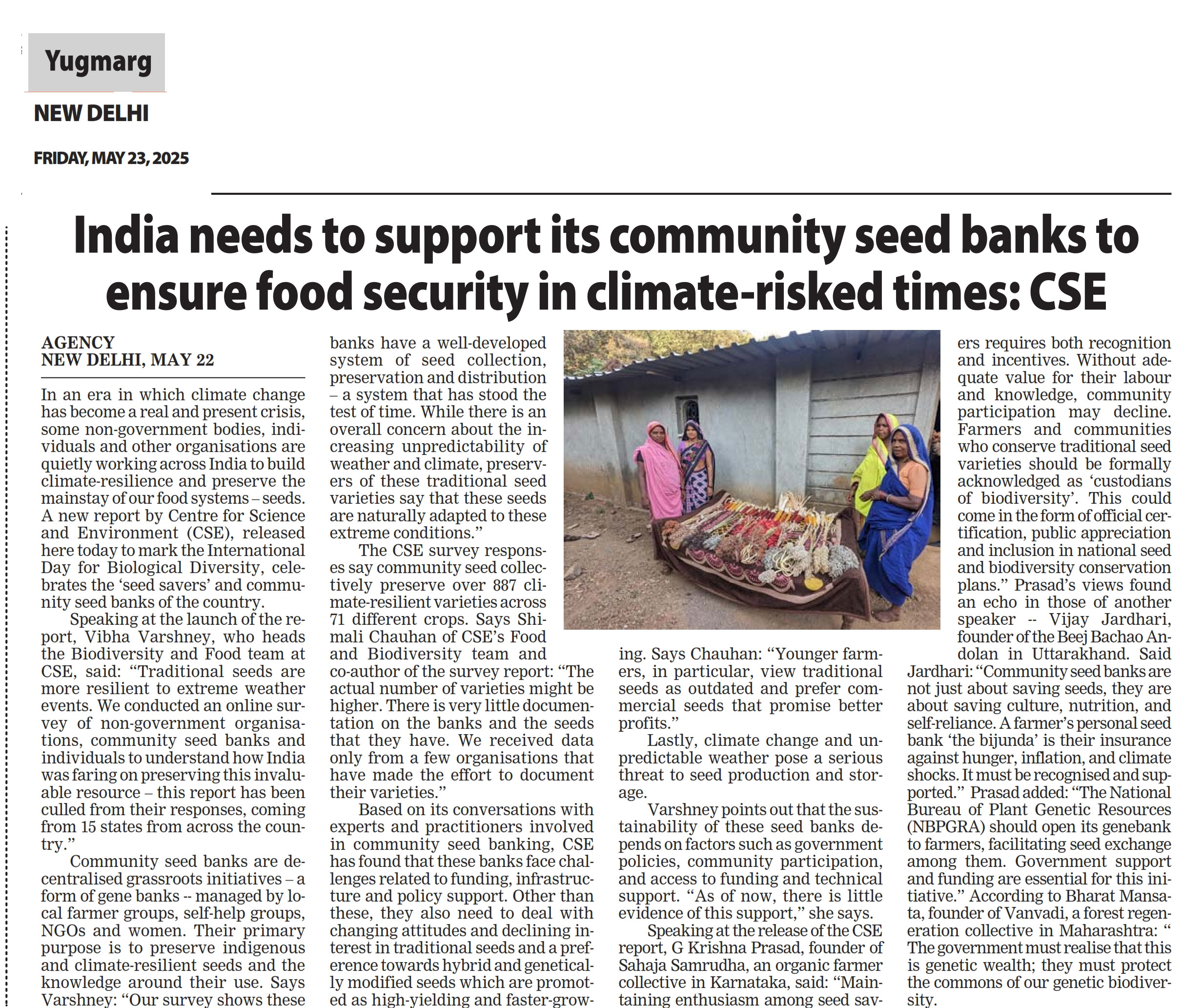
CSE Study on Seed Banks: In an era in which climate change has become a real and present crisis, some non-government bodies, individuals and other organisations are quietly working across India to build climate-resilience and preserve the mainstay of our food systems – seeds. A new report by Centre for Science and Environment (CSE), released here today to mark the International Day for Biological Diversity, celebrates the ‘seed savers’ and community seed banks of the country. Speaking at the launch of the report, Vibha Varshney, who heads the Biodiversity and Food team at CSE, said: “Traditional seeds are more resilient to extreme weather events. We conducted an online survey of non-government organisations, community seed banks and individuals to understand how India was faring on preserving this invaluable resource – this report has been culled from their responses, coming from 15 states from across the country.” Community seed banks are decentralised grassroots initiatives – a form of gene banks — managed by local farmer groups, self-help groups, NGOs and women. Their primary purpose is to preserve indigenous and climate-resilient seeds and the knowledge around their use. Says Varshney: “Our survey shows these banks have a well-developed system of seed collection, preservation and distribution – a system that has stood the test of time. While there is an overall concern about the increasing unpredictability of weather and climate, preservers of these traditional seed varieties say that these seeds are naturally adapted to these extreme conditions.” The CSE survey responses say community seed collectively preserve over 887 climate-resilient varieties across 71 different crops. Says Shimali Chauhan of CSE’s Food and Biodiversity team and co-author of the survey report: “The actual number of varieties might be higher. There is very little documentation on the banks and the seeds that they have. We received data only from a few organisations that have made the effort to document their varieties.” Based on its conversations with experts and practitioners involved in community seed banking, CSE has found that these banks face challenges related to funding, infrastructure and policy support. Other than these, they also need to deal with changing attitudes and declining interest in traditional seeds and a preference towards hybrid and genetically modified seeds which are promoted as high-yielding and faster-growing. Says Chauhan: “Younger farmers, in particular, view traditional seeds as outdated and prefer commercial seeds that promise better profits.” Lastly, climate change and unpredictable weather pose a serious threat to seed production and storage. Varshney points out that the sustainability of these seed banks depends on factors such as government policies, community participation, and access to funding and technical support. “As of now, there is little evidence of this support,” she says. Speaking at the release of the CSE report, G Krishna Prasad, founder of Sahaja Samrudha, an organic farmer collective in Karnataka, said: “Maintaining enthusiasm among seed savers requires both recognition and incentives. Without adequate value for their labour and knowledge, community participation may decline. Farmers and communities who conserve traditional seed varieties should be formally acknowledged as ‘custodians of biodiversity’. This could come in the form of official certification, public appreciation and inclusion in national seed and biodiversity conservation plans.” Prasad’s views found an echo in those of another speaker — Vijay Jardhari, founder of the Beej Bachao Andolan in Uttarakhand. Said Jardhari: “Community seed banks are not just about saving seeds, they are about saving culture, nutrition, and self-reliance. A farmer’s personal seed bank ‘the bijunda’ is their insurance against hunger, inflation, and climate shocks. It must be recognised and supported.” Prasad added: “The National Bureau of Plant Genetic Resources (NBPGRA) should open its genebank to farmers, facilitating seed exchange among them. Government support and funding are essential for this initiative.” According to Bharat Mansata, founder of Vanvadi, a forest regeneration collective in Maharashtra: “ The government must realise that this is genetic wealth; they must protect the commons of our genetic biodiversity. Tragically, our stuff is readily available for big buyers, but not for the common farmers.” “The world is celebrating the International Day for Biological Diversity today. While there is biodiversity all around us, what nourishes us is the biodiversity available on our plates,” says Varshney. With their stash of local crop varieties and related knowledge, these community seed banks can support diversified farming systems and ensure food security, she adds.

Community buy-in, economic gains drive voluntary carbon market success

Trishant Dev, programme officer, Climate Change, Centre for Science and Environment, says that on-ground analysis of VCM projects is vital in ensuring these markets work for the people who safeguard the carbon sinks. “It is crucial to ask if the economics of the current system work in their favour. In our studies, we have seen that communities rarely reap the benefits of what has been promised to them when it comes to projects under forestry and agriculture. Long-term carbon benefits can be obtained from tree-planting projects in the voluntary carbon market (VCM) when these initiatives bolster the economic well-being of local stakeholders and establish lasting relationships with them, finds a new study. Published in April 2025 in the Environmental Research Letters journal, the study looked at the changes in tree cover, project longevity, and the changes in income and assets for participating households in select tree-planting projects, that received carbon credits till 2022. The voluntary carbon market mechanism allows corporations to meet their carbon neutrality goals by investing in initiatives that offset or reduce carbon emissions. According to a report by the non-profit organisation Citizen Consumer and Civic Action Group, India’s VCM market has seen phenomenal growth in recent times and is worth more than $1 billion as of 2021. These projects are certified by programmes such as the Verified Carbon Standard (VCS) by Verra and the Gold Standard. VCM projects broadly focus on energy efficiency, carbon sequestration, methane capture, forest conservation, and renewable energy. Tree planting projects fall under the ‘afforestation and reforestation’ category. Based on five tree-planting projects across 21,767 farmer plots, the study found that tree cover increased by 48% in participating plots compared to a 26% increase in non-participating plots. For two of the above projects, the researchers also conducted household surveys to understand the impacts on household incomes and asset acquisition (such as concrete houses, gas connections, mobile phones, cycles, motorbikes, etc). The results show almost a 95.6% increase in income for participating households (households of farmers who are a part of the project) in one project and a significant improvement in assets for another. The study’s most crucial finding was that along with economic benefits, long-term community engagements are vital in ensuring project longevity and scalable impacts. The researchers, therefore, emphasise the need for careful examination of ground-level implications of VCM projects for successful management and outcomes. On-ground monitoring is crucial Despite the increase in demand for VCM projects, these initiatives have also received criticism for overstating their impacts or encouraging greenwashing claims by corporations where on-ground efforts and activities do not match carbon capture or offset declarations. Due to their voluntary nature, such projects are not subject to the regulations of the compliance market, which has caps on greenhouse gas emissions. In 2024, researchers from the Goldman School of Public Policy, University of California, Berkeley, assessed the impacts of energy-efficient cookstoves that reduced the dependence on greenhouse gas-intensive fuels. Efficient cookstoves are the fastest-growing project type in the global VCM, and the researchers found that across 51 cookstove projects from 25 countries, the reduction in emissions was overstated by 9.2 times. “During my research on VCMs, I realised that most studies were based on secondary data analysis and remote sensing, but not much focus was given to the on-ground analysis of these projects,” says Shivani Agarwal, lead author of the May 2025 study and former associate research scientist at the Department of Ecology, Evolution, and Environmental Biology, Columbia University, New York. Agarwal adds that while the current study looks at a small number of afforestation and reforestation VCM projects in India, it paves the way for systematic analysis across categories. She further explains that such analysis, while aiding in understanding factors that enable project longevity, also provides insights into why projects cease operations despite positive outcomes. For example, one of the projects in Agarwal’s study involved planting eucalyptus plants for a company’s timber factory. “As obtaining raw materials for the timber factory was the primary motive, the VCM project served as the secondary objective for the company. The investment in the validation process was expensive, as there were fewer buyers for eucalyptus plantation projects. Therefore, the company decided not to participate in the VCM,” the project developer told Agarwal. The project was initiated in 2001 and was on the verge of closing in 2022. Of the six projects that researchers analysed for longevity, only three were ongoing and scaling, and they were implemented by local non-governmental organisations (NGOs) that have long-term associations with the local farming communities. Private corporations, on the other hand, established projects in new areas by approaching the village heads first. The NGOs also provided saplings and training for the community members, with one NGO sharing all of the carbon credit benefits with the farmers. The authors explain that while NGOs focus on the community’s development, private corporations focus on profitability, so they close projects when sufficient returns are not obtained. The study also revealed that access to extra income is the main reason for farmer participation, and 85% of the non-participant farmers were willing to join future VCM projects if given the opportunity. Ensuring VCM projects benefit the environment and the people Researchers note that while the recent study does conclusively provide evidence of an increase in tree cover through satellite analysis, resulting changes in carbon stock can only be measured when there is data on the nature of this increase — tree species, structure, etc. Another limitation of the current study is that ecological parameters such as biodiversity conservation were not assessed, the authors state. “The main focus of the projects in this study was participation and not biodiversity conservation. However, it is important to understand how participants can be incentivised for non-fruit trees that are native to the landscape and add to their biodiversity. While sharing carbon credit revenue is one way to do so, it is not popular among project developers as the initial investment in the carbon market is higher,” explains Agarwal. Co-author of the study Ruth DeFries, professor of ecology and sustainable development and co-founding dean of Columbia Climate School, Columbia University, adds that while the focus on biodiversity is slowly gaining attention, it requires further analysis. “The carbon market was not designed to be biodiversity-friendly, so it’s possible for monoculture, non-native tree-planting projects to receive credit for sequestering carbon without providing a biodiversity benefit. There is a lot of discussion about biodiversity markets that would reward projects that enhance diversity. It is unclear at this point what the market demand is for such projects and how they could be monitored,” she says. Trishant Dev, programme officer, Climate Change, Centre for Science and Environment, says that on-ground analysis of VCM projects is vital in ensuring these markets work for the people who safeguard the carbon sinks. “It is crucial to ask if the economics of the current system work in their favour. In our studies, we have seen that communities rarely reap the benefits of what has been promised to them when it comes to projects under forestry and agriculture. This is also a question that governments must address when designing or setting policies for offset mechanisms. Without adequate returns, we risk asking communities in the Global South to subsidise the emissions of wealthier nations,” shares Dev, who is not associated with the study.

Why India Needs To Urgently Rehaul Sewage Treatment Plans

Sewage in India is a growing problem. According to the Center for Science and Environment (CSE), wastewater generation will increase by about 75–80% (54-58,000 MLD) by 2050. That would result in a figure that is approximately 3.5 times the country's existing installed treatment capacity, highlighting an urgent need to significantly scale up wastewater treatment infrastructure, the CSE report says. Indian cities and towns produce about 72,368 million litres of sewage per day (MLD)--enough to fill 30,000 Olympic-size swimming pools--but has the operational capacity to treat only 37% of it, and actually treats only 28%. Even the sewage treatment plants India has are often unable to cope during monsoons, are impacted by frequent power cuts, and unable to treat heavy metals and most pharmaceutical contaminants, reports show and experts say. The result? More than half of the rivers in India are highly polluted, and many others are at levels considered unsafe by modern standards. In a study in 2018, the Central Pollution Control Board (CPCB) found that about 13% of 351 river stretches on 323 rivers were severely polluted and 17% were moderately polluted. And it is the disposal of domestic sewage from cities and towns that is the biggest source of pollution of water bodies in India, the CBCB has found. According to the World Bank, 21% of communicable diseases are linked to unsafe water with contaminated water a major contributor to diarrhoea, opportunistic infections, and malnutrition, globally leading to around 1.7 million deaths each year. Over 90% of these fatalities occur in developing nations, with nearly half being children. Sewage in India is a growing problem. According to the Center for Science and Environment (CSE), wastewater generation will increase by about 75–80% (54-58,000 MLD) by 2050. That would result in a figure that is approximately 3.5 times the country's existing installed treatment capacity, highlighting an urgent need to significantly scale up wastewater treatment infrastructure, the CSE report says. Experts say India needs a better system of sewage treatment that is decentralised, nature-based, and more suited for filtering pollutants that are common in India. Water Pollution in India The 2018 CPCB study monitored river water quality using Biochemical Oxygen Demand (BOD) as an indicator of pollution. Apart from high BOD, they found high levels of Chemical Oxygen Demand (COD), heavy metals, arsenic, fluorides and hazardous chemicals in many places, especially in the groundwater in these regions. Even the Ganga, considered holy in India--and where many take a dip--is in a dire state, with mounds of rubbish strewn along the riverbanks and in the water. According to the CPCB, in the first week (January 12-20) of the 2025 Kumbh Mela--a religious gathering--at Prayagraj, the level of faecal coliform varied between under 1.8 and 49,000 MPN, the most probable number, per 100 ml for the Ganga; and between 2,000 MPN and 33,000 MPN, per 100 ml for the Yamuna. According to the norms of the Ministry of Environment, Forest and Climate Change (MoEFCC), this often exceeded the maximum permissible limit for bathing water of 2,500 MPN per 100 ml and the desirable level of 500 MPN per 100 ml. As per third party inspection in 2019, 71% of towns along the Ganga were directly disposing their waste into the river, because they lacked proper municipal waste plants. South Asia produces just about 7% of global wastewater despite a population share of 24%, whereas the 5% of people living in North America account for 20% of global wastewater production, as per these 2021 estimates of wastewater produced globally. Yet, India accounts for 17% of the world’s scattered municipal waste, while “70% of potential leakage of municipal solid waste into aquatic environments occurs in China, South Asia, Africa, and India”, Adriana Gomez Sanabria and Florian Lindl of the Pollution Management Research Group in Austria estimated in a 2024 study published in the journal Nature. Access to safe water can improve with better wastewater management India has 1,486 cubic metres (m3) of annual per capita freshwater availability, making it ‘water stressed’, a Ministry of Jal Shakti press release in 2024 said. A country is classified as ‘water stressed’ when its annual per-capita water availability is below 1,700 m3 per capita per year, and as ‘water scarce’ when the availability is below 1,000 m3 per capita per year. However, the water availability in many regions of the country may vary due to high temporal and spatial variation of precipitation, another government press release from 2020 noted. There are 163 million Indians who lack access to safe drinking water, especially in urban areas where water resources are under significant pressure due to increasing demand. The average water supply in urban local bodies in India is 69.25 litres per capita per day (LPCD) against the benchmark of 135 LPCD, as per Central Public Health and Environmental Engineering Organisation. Water pollution worsens India’s water crisis by contaminating available sources, making them unsafe for consumption. India’s rivers receive about 100 times more sewage per capita from urban than rural populations. Treating this wastewater could help India mitigate water stress, IndiaSpend had reported in April 2025. But southern Asia has the lowest rates of used water collection, treatment and reuse globally. For instance, even as 24 out of 34 districts experience water shortage in Maharashtra, only 4% of wastewater in Maharashtra is reused. This is contrary to the State Water Policy (2019) which says that “a minimum of 30% of recycled water should be reused to reduce freshwater demand within five years.” And this is not limited to Maharashtra, According to NITI Aayog, less than 1,000 MLD of treated wastewater is currently being reused in India. This accounts for just 3% of the total treated wastewater and only about 1% of the total wastewater generated in the country. India’s efforts at sewage treatment According to Swachh Bharat Mission (SBM) 2.0 guidelines from 2021, Indian cities with less than 100,000 population require 13,000 MLD of STP capacity for which SBM budgeted Rs 79,983 crore ($9.3 billion) between October 2021 and October 2026. This includes construction of STPs, interceptor and diversion drains and procurement of desludging vehicles.

"Visited Talcher yesterday. The air was so toxic, I could taste the pollution": Odisha's Industrial Growth vs Breathing Crisis

Environmental activist Sunita Narain posted on Instagram: "Visited Talcher yesterday. The air was so toxic, I could taste the pollution. How are people living in these conditions? Immediate action needed!" The eastern Indian state of Odisha faces an escalating environmental crisis as air pollution levels continue to surge across major cities, posing severe health risks to its 45 million residents. Recent data from the Odisha State Pollution Control Board reveals alarming increases in particulate matter concentrations, particularly in industrial hubs like Bhubaneswar, Cuttack, and Rourkela. The Growing Threat Air quality monitoring stations across the state have recorded PM2.5 levels consistently exceeding the World Health Organization's recommended limits. The industrial corridor stretching from Jharsuguda to Angul has emerged as a particular hotspot, where coal-fired power plants, steel mills, and aluminum smelters contribute significantly to atmospheric contamination. Dr. Pradeep Kumar Jena, an environmental scientist at the Indian Institute of Technology Bhubaneswar, explains the severity of the situation. "The rapid industrialization without adequate pollution control measures has created a perfect storm for air quality deterioration. We're seeing a 40% increase in respiratory ailments in children over the past three years." Citizens Voice Their Concerns Social media platforms have become battlegrounds for concerned residents sharing their experiences with deteriorating air quality. Rajesh Mohanty, a Bhubaneswar resident, tweeted: "Morning jogs have become impossible. The smog is so thick you can barely see 50 meters ahead. When will our government take this seriously? #OdishaAirPollution" Priya Dash, a school teacher from Cuttack, shared on Facebook: "My students are constantly coughing during classes. Parents are reporting increased asthma cases. This is not the future we want for our children." Environmental activist Sunita Narain posted on Instagram: "Visited Talcher yesterday. The air was so toxic, I could taste the pollution. How are people living in these conditions? Immediate action needed!" Health Impact Escalates Medical professionals across Odisha report a significant uptick in pollution-related health issues. Hospitals in major cities have witnessed a 35% increase in respiratory disease cases, with children and elderly populations being most vulnerable. "We're treating patients as young as five years old for chronic bronchitis and asthma, conditions traditionally seen in much older populations," states Dr. Mamata Sahoo, a pulmonologist at AIIMS Bhubaneswar. "The correlation with air pollution is undeniable." Industrial Contribution The state's heavy reliance on coal-based industries has created multiple pollution sources. The Mahanadi Coalfields Limited operations, coupled with thermal power stations, contribute approximately 60% of the region's air pollution load. Vehicle emissions in urban areas add another 25%, while construction dust and agricultural burning account for the remainder. Government Response and Challenges The Odisha government has initiated several measures, including the installation of continuous ambient air quality monitoring systems and the introduction of BS-VI fuel standards. However, enforcement remains inconsistent, and industrial lobbying often dilutes regulatory effectiveness. An official from the Ministry of Environment recently announced a comprehensive air quality management plan, stating, "We're committed to reducing pollution levels by 30% over the next five years through stricter industrial emission norms and enhanced monitoring." The Path Forward Environmental experts emphasize the need for immediate, coordinated action involving stricter emission standards, promotion of renewable energy sources, and public transportation improvements. Citizens continue to advocate for their right to breathe clean air, while the state grapples with balancing economic growth and environmental protection. As netizen Amit Patra summarized on Twitter: "Development without environmental consideration isn't progress—it's suicide. Odisha needs sustainable solutions now, not later." The battle for cleaner air in Odisha represents a critical juncture where public health, economic interests, and environmental sustainability must find common ground before the crisis becomes irreversible.

A paramount need of the hour

VVater is one of the essential and basic necessities for all the living organisms existing on the earth. lt is an important component for all the natural pfOCeSSeS. Total water on the earth is constant and is balanced through continuous hydrological …