Cse In News

India ranks fifth in polluted air globally in 2024, says IQAir report

India ranks as the fifth country worldwide that had the most polluted air in 2024 after Chad, Congo, Bangladesh and Pakistan, according to Switzerland-based air quality monitoring company IQAir. However, the country marginally improved its position from third in 2023. India saw a 7 per cent decline in PM2.5 concentrations last year, averaging 50.6 micrograms per cubic metre air (µg/m³) compared to 54.4 µg/m³ in 2023. Yet, six of the world’s ten most polluted cities are in India. New Delhi maintained consistently high pollution levels, with an annual average of 91.6 µg/m³, nearly unchanged from 92.7 µg/m³ a year ago, the report said. IQAir analysed data from 40,000 air quality monitoring stations in 138 countries. More air quality monitors are being set up to counter the issue, the report said. This year, the report authors were able to incorporate data from 8,954 new locations and around a thousand new monitors as a result of efforts to better monitor air pollution. Only 12 countries, regions, and territories recorded PM2.5 concentrations below the WHO annual PM2.5 guideline of 5.0 µg/m³, most of which were in the Latin America and Caribbean or Oceania region. However, in 2024, 17 per cent of cities included in the report met the WHO annual PM2.5 guideline level, up from 9 per cent in 2023, according to the report. Air pollution remains a significant health burden in India, reducing life expectancy by an estimated 5.2 years. The World Health Organization (WHO) estimates that air pollution kills around 7 million people each year. Instances of severe pollution persisted in 2024, particularly in northern states. Air quality in January was especially poor in Delhi and Himachal Pradesh. Baddi in Himachal Pradesh saw a monthly PM2.5 average of 165 µg/m³. Air quality deteriorated sharply in Manipur in October, while November saw extreme pollution levels in Delhi, Punjab, Chandigarh, Haryana, and Himachal Pradesh with stubble burning remaining a major contributor to PM2.5 levels, accounting for 60 per cent of pollution during peak periods. Overall, 35 per cent of Indian cities reported annual PM2.5 averages exceeding 10 times the World Health Organisation guideline. The WHO air quality guideline states that annual average concentrations of PM2.5 should not exceed 5 µg/m3, while 24-hour average exposures should not exceed 15 µg/m3 more than 3-4 days per year. PM2.5, fine particulate matter of 2.5 micrometres or less in diameter, is the most dangerous pollutant because it can penetrate the lung barrier and enter the blood system, causing cardiovascular and respiratory disease and cancers. It affects more people than other pollutants and has health impacts even at very low concentrations. India faces significant air quality challenges, with major pollution sources including vehicular emissions, industrial discharges, construction dust, and the burning of crop residues. In urban centres like Delhi, vehicular emissions are a leading contributor to fine particulate matter (PM2.5), exacerbated by traffic congestion and fuel adulteration. Seasonal agricultural practices, particularly the burning of crop residues in states like Punjab and Haryana, further deteriorate air quality during winter months. Industrial emissions and construction activities also contribute significantly to pollution levels. Despite governmental measures, such as the National Clean Air Programme aiming to reduce pollution levels, challenges persist due to inconsistent policy implementation and inadequate infrastructure. “Vehicular emission is a major source of pollution in Delhi-NCR. Emission per unit distance travelled increases for older vehicles. Public transport needs to be revamped,” suggested Sagnik Dey, professor at the Centre for Atmospheric Sciences, IIT Delhi. “The government is already pushing for EVs (electric vehicles) with better infrastructure. Scientific evidence already suggested that we require an airshed approach and CAQM is there to efficiently implement airshed management within NCR across the five states. Accountability and interim targets to track progress will be key to strengthen the clean air implementation, along with synergising with climate actions,” Dey added. To combat air pollution in Delhi, the state government, last week, announced that vehicles older than 15 years will be denied fuel at petrol pumps starting April 1. Last October, India’s Supreme Court affirmed that breathing clean, pollution-free air is a fundamental right. The top Court found that the federal government and the governments of Delhi, Punjab, Haryana, Uttar Pradesh, and Rajasthan must more effectively control air pollution at its source. Despite numerous rulings requiring government action, the court determined that the governments had taken only limited action to curb stubble burning and must submit reports demonstrating compliance with court orders. During a November hearing, the Supreme Court criticised Delhi officials for “serious lapses” in curbing pollution under the Graded Response Action Plan (GRAP), multi-stage emergency measures for reducing pollution during poor air quality days. On December 16, 2024, Stage 4 of GRAP, the strictest level of anti-pollution measures, was enforced as the air quality index (AQI) exceeded 400, indicating “severe” conditions. This marked the second instance in the last winter, with the first triggered on November 18 due to stubble burning, which pushed AQI to 494. A study by the Centre for Science and Environment conducted last year found that during mid-October to early November — when farmers burn paddy stalks — only 8 per cent of Delhi-NCR’s air pollution came from stubble burning, while nearly two-thirds originated from local sources, with the transport sector contributing more than half.
India’s metro rail system is world’s third-longest, but it needs buses to grow

Ms Rajani S.S. uses the Bengaluru metro rail to get to her workplace because it “saves time and saves me from the pollution on the roads”, she told The Straits Times. But getting to the metro station 1.5km away is a hassle for the 65-year-old, who works for a state child welfare agency. She can take her scooter, but the parking zone is muddy and messy at most metro stations. Buses are out of the question, said Ms Rajani, as their frequency is unpredictable; they are also often stuck in Bengaluru’s congested roads. Tuk-tuks or auto-rickshaws, when available, charge exorbitant fares, but she usually takes them to save time. “The metro ride itself is clean and fast, but getting to and from the station is still a pain,” she said. Her pain point is at the crux of what ails India’s growing metro rail system today. In February, India reached a milestone of laying 1,000km of metro rail across 23 cities. This is the third-longest metro network in the world, after China (over 11,000km) and the US (over 1,300km), according to railway tracker Metro Report International. Prime Minister Narendra Modi’s government said it wants to overtake the US soon, by commissioning 6km of new tracks every month. Modern and environmentally sustainable metro rail systems in India are key urban infrastructure to arrest the use and ownership of personal vehicles, and remedy congestion and pollution problems in cities, where around 36 per cent of Indians live. But metro ridership is much lower than expected. Ridership in national capital Delhi, which has the country’s largest metro network, is just 47 per cent of its projected figure. Mumbai’s stands at 30 per cent, and Bengaluru’s, barely 6 per cent. Tier-2 cities such as Lucknow, Kanpur and Jaipur, where the metro systems are smaller, have hit just 2 per cent to 3 per cent of their ridership targets. This is primarily due to the lack of comprehensive first- and last-mile connectivity via buses, cycle lanes and footpaths, and metro fares that far exceed what the majority of Indians can afford, experts said. The ideal public transport system for Indian cities would combine buses and metro trains. But India’s razor-sharp focus on metro rails alone, even in cities where they are superfluous, has been its undoing. “Almost 46 per cent of India’s urban development ministry’s budget has gone towards funding metros, but they don’t have enough commuters to break even. This is because last-mile buses and footpaths are getting defunded as states invest more in metros,” said Dr Geetam Tiwari, chair professor of the Transportation Research and Injury Prevention Programme at the Indian Institute of Technology Delhi. Noting that Delhi’s electric and natural gas-powered buses carry 40 per cent more passengers at 5 per cent of the metro’s investment, Dr Tiwari said almost double the number of people would have benefited if the tax exemptions and interest-free loans made available to the city’s metro were given to the bus system. In Bengaluru today, there are just 6,769 buses for a population that exceeds 13 million. Their ridership is 3.2 million each day, while the metro stands at 900,000 per day. But the bus fleet size has remained largely static. Most metro systems in Indian cities are jointly funded by the federal and state governments, along with loans from international financial institutions. More than 1.02 trillion rupees (S$15.6 billion) has been allocated by the central government to metro rail systems since 2014. As states match the investment from their own transport funds, this comes at the expense of funding more affordable and accessible modes of transport such as buses or trams, which could have created a well-integrated public transport system, said Dr Tiwari. While congested cities such as Bengaluru, Delhi and Mumbai may need metro lines, smaller cities like Jaipur, Agra and Kanpur should not waste money on it, experts said. Jaipur, whose metro railway opened in 2015, did not in fact require one till 2025 based on projected population growth and travel patterns, India’s 2018 auditor-general report noted. Instead of considering the most effective, efficient and affordable multimodal urban public transit mix to meet different commuter needs, “many Indian cities are lured into investing heavily on glamorous, capital-intensive metro rail systems largely with taxpayer money”, said Dr Sandip Chakrabarti, co-chairman of the centre for transportation and logistics at the Indian Institute of Management Ahmedabad, in a 2024 academic report. Ironically, the singular focus on metro rail at the expense of other feeder transport such as trams, e-rickshaws, buses and footpaths has “derailed” the metro system, Dr Tiwari said. A July 2023 working paper from a three-city survey of 7,200 metro commuters by the World Resources Institute (WRI) India found that Indian metro systems attract young (age 19 to 35) and middle-income commuters. Affluent users are not attracted to the system, and low-income users are priced out of it. Bus fares in all cities remain significantly lower than metro fares, especially for shorter distances. In 2019, the Centre for Science and Environment found that an unskilled daily wage labourer in Delhi, on average, has to spend around 8 per cent of his income if he travels on a non-air-conditioned bus, 14 per cent for an air-conditioned bus, and 22 per cent for the Delhi Metro. Today, the disparity is higher across all Indian cities with metro fare increases, and women being allowed free bus travel in Delhi and Bengaluru since 2019 and 2023. Indians using the metro are also highly sensitive to last-mile wait times and costs, the WRI report said. Women are especially averse to waiting, and may opt for more expensive services such as taxis and tuk-tuks. Even walking to or from the station is often hazardous. Researcher and writer Sruthi K., who lives in a suburb on the outskirts of Bengaluru, had to cross a six-lane highway with no safe crossing to reach the metro station nearest her home, so that she could take the train to the city. She has since switched to taking a tuk-tuk to a station that is farther away, to avoid crossing the highway. Despite that inconvenience, taking the metro train is still more affordable and faster than taxis and carpooling, which used to be her modes of transport. “There needs to be more coordination between different modes of transport. Things will change if agencies think about mobility like the commuter,” said Mr Srinivas Alavalli, a civic activist in Bengaluru. Urban transport experts say that few cities today properly analyse their residents’ travel patterns, income range and demand before deciding whether to invest in metro systems, nor how it can be integrated with other modes of transport.

पैकेटबंद खाद्य पदार्थों से चौपट होता स्वास्थ्य?, रसोई पर संकट मंडरा रहा, पिछले 15 साल में 11 फीसदी वृद्धि

पैकेटबंद खाद्य पदार्थों से चौपट होता स्वास्थ्य?, रसोई पर संकट मंडरा रहा, पिछले 15 साल में 11 फीसदी वृद्धि Highlights15 साल में दुनियाभर में पैकेटबंद खाद्य पदार्थों की बिक्री 11 फीसदी बढ़ी है.'नेचर फूड' पत्रिका में प्रकाशित इस रिपोर्ट को गंभीरता से लेना होगा.भारत, बांग्लादेश, अमेरिका, संयुक्त अरब अमीरात, सिंगापुर जैसे देश हैं.

Kerala scores low on gender equality: CSE report

While Kerala claims gender equality and better living standards for its womenfolk than any other state in the country, its performance in SDG 5 (gender equality) was much below par, according to a report by Centre for Science and Environment (CSE). The report ‘Are We on Track to Achieve Sustainable Development Goals 2030' analyzes statewise performances of the 20 SDGs (sustainable development goals) and provides insights into the challenges and successes in India's path to 2030, examining whether the country can accelerate its progress and bridge the gaps in time. While Kerala is the country's top performer for most SDGs, it has not reached the halfway mark in 20 of the 107 assessed indicators. These low-scoring indicators are spread across 13 of the 16 SDGs, with the highest concentration in SDG 5 (gender equality), SDG 3 (good health and well-being), SDG 4 (quality education) and SDG 8 (decent work and economic growth). In SDGs that focus on a fairer society for citizens, Kerala stands fourth in the country. This includes SDG 5, 10 and 16 — namely gender equality, reduced inequalities and peace, justice and strong institutions. In SDG 5, which largely focuses on gender equality, the state scored poorly in four targets, including the ratio of female to male labour force participation rate, the proportion of women in managerial positions, female-operated operational land holdings, and the ratio of female to male average wage/salary earnings. "The state will need to look at its ground reality. Kerala has performed exceptionally well but in some SDGs, including 5, 8, 9, 10 and 12, the score is much lower. We used data from NITI Aayog report of 2023-24, so it must include details of the Covid and post-Covid situation, which is why there is such a huge difference in the SDG scores," said Kiran Pandey, programme coordinator, environment resources, CSE. "These are several gaps that authorities need to address looking at gender in Kerala, as it is projected as more balanced in development because of its high education and health indicators," Pandey said. She said that the report was based on data from ‘Sustainable Development Report 2024', published by Dublin University. India's state-wise performance is based on the ‘SDG Index 2023-24', released by NITI Aayog in July 2024, and projected population data has been sourced from ‘Report of the Technical Group on Population Projections 2011-2036.'

अगर आपके बच्चे भी इससे हैं पीड़ित...तो हो जाइए सावधान

आजकल की भागदौड़ भरी जिंदगी में लोगों के पास समय की भारी कमी होती जा रही है। ऐसे में बढ़ते होटल और रेस्तरां में खाने की प्रवृत्ति तेज़ी से बढ़ रही है। खासतौर पर युवाओं को तब तक संतुष्टि नहीं मिलती जब तक वे बाहर का भोजन न कर लें। इसी कारण पैकेटबंद खाद्य पदार्थों का उपयोग अप्रत्याशित रूप से बढ़ रहा है। हाल ही में यूनिसेफ (UNICEF) की एक रिपोर्ट में भारत समेत 97 देशों में किए गए अध्ययन के अनुसार, पिछले 15 वर्षों में पैकेटबंद खाद्य पदार्थों के सेवन में 11% की वृद्धि हुई है। इसका असर न केवल लोगों के बजट पर पड़ा है, बल्कि स्वास्थ्य पर भी नकारात्मक प्रभाव देखने को मिला है। बीते कुछ वर्षों में बड़े ब्रांडों के रेस्तरां और फूड आउटलेट्स के खुलने के बाद ये जगहें लोगों के लिए मनोरंजन और आराम करने के केंद्र बन गए हैं। इसी के चलते बच्चों में मोटापा और महिलाओं में खून की कमी जैसी समस्याएं अधिक पाई गई हैं, क्योंकि ये दोनों वर्ग तुलनात्मक रूप से इनका अधिक सेवन करते हैं। जिन राज्यों में ज्यादा फूड आउटलेट्स खोले गए हैं, वहां यह समस्या अधिक देखने को मिलती है। पैक्ड फूड खाने की बढ़ती लत नेचर फूड पत्रिका के विश्लेषण के अनुसार, सुपरमार्केट से तरल और तले-भुने खाद्य पदार्थ, जैसे कोल्ड ड्रिंक्स, चिप्स, कुरकुरे आदि की खपत भारत, बांग्लादेश, अमेरिका और सिंगापुर जैसे देशों में 11% तक बढ़ी है। खाद्य पदार्थों के व्यापार से जुड़ी एक एजेंसी यूरोमॉनिटर की रिपोर्ट के अनुसार, भारत में अल्ट्रा-प्रोसेस्ड फूड की प्रति व्यक्ति वार्षिक खपत 2010 में 2 किलोग्राम थी, जो 2019 में बढ़कर 6 किलोग्राम हो गई और 2024 में यह 8 किलोग्राम तक पहुंच गई है। हेल्थ पर पड़ने वाले दुष्प्रभाव सेंटर फॉर साइंस एंड एनवायरनमेंट के अनुसार, भारत में पैकेटबंद और जंक फूड के बढ़ते उपयोग के कारण मधुमेह, उच्च रक्तचाप और हृदय रोग तेजी से फैल रहे हैं। इसी खतरे को देखते हुए भारत सरकार ने अल्ट्रा-प्रोसेस्ड फूड पर अधिक कर (टैक्स) लगाने की सिफारिश की है। पैकेटबंद खाद्य पदार्थों का बढ़ता उपयोग स्वास्थ्य के लिए गंभीर खतरा बनता जा रहा है। यह न केवल मोटापा, मधुमेह और हृदय रोगों को बढ़ावा देता है, बल्कि पोषण की कमी और आर्थिक बोझ भी बढ़ाता है। ऐसे में स्वस्थ जीवनशैली अपनाने के लिए संतुलित आहार, ताजे और घर के बने भोजन को प्राथमिकता देना आवश्यक है।

In a First, Environmental Concerns Dominated Delhi Elections, Voters Demanded Clean Yamuna, Air Quality | Interview

Despite being one of the most-polluted cities in the world, Delhi has not seen environmental issues dominate voters’ concerns. However, the recently concluded Assembly elections signaled a pivotal shift, with voters, for the first time, prioritising environmental concerns, demanding a clean Yamuna and improved air quality. “Post-elections, when people were asked the reasons why they voted out the then ruling party – for the first time they said pollution in Yamuna, toxic air and the garbage on the streets. This means that we have reached a stage, where these issues have become poll issues. There is huge environmental consciousness, and we must recognise that," said Sunita Narain, Director-General, Centre for Science and Environment (CSE), citing the latest Centre for the Study of Developing Societies (CSDS)- post-poll survey. In an exclusive interview to CNN-News18, the noted environmentalist said the voters have now made their voices heard, and it is now up to the new government to make sure that these issues are prioritised. Delhi continues to breathe toxic air year after year reducing the life expectancy of its 33 million population, and rendering them susceptible to multiple illnesses. The Yamuna, which flows through much of its territory, has also remained highly-polluted, with large amounts of sewage being dumped into it. The latest data from monitoring stations shows that its Dissolved Oxygen (DO) – an indicator of life in the river – plummets to ‘zero’ at multiple points from ISBT to Okhla from where it finally exits the city. While thousands of crores have been spent in cleaning the river in the past, it has only got more polluted over the years. “We must not forget that these issues were also part of previous governments’ agendas and manifestoes. However, despite all the action, we have not succeeded. So, this is a moment of reflection. The new government must take this challenge of acting differently," she emphasised, while speaking to CNN-News18 on the sidelines of the Anil Aggarwal Dialogue (AED) 2025.

Strong winds blow away bad air, gift city best AQI since Sept

New Delhi: Strong and cool northwesterly winds, which blew in the city on Wednesday, helped Delhiites inhale clean air. The city recorded an air quality index (AQI) of 119 in the lower end of the moderate category. The last time Delhi recorded a lower AQI was on Sept 29, 2024, at 76, in the satisfactory category. Wednesday was the fifth consecutive moderate day. Anumita Roychowdhury, executive director of research and advocacy at Centre for Science and Environment, said, "This has been possible primarily because of strong breeze and relatively lower impact of wind-blown dust haze as we normally see during summer. Pollution has dispersed faster than usual." However, she pointed out, "This is only a temporary reprieve. We need deeper and round the year action to meet the clean air benchmark." According to India Meteorological Department, strong surface wind conditions from west with 25-35kmph speed prevailed during the past 24 hours. Strong winds aid in dispersion of pollutants while calm winds lead to their accumulation. Met department has predicted that strong surface winds at the speed of 20-30kmph are likely to prevail till Thursday noon. Air Quality Early Warning System for Delhi, the forecasting body under the Union ministry of earth sciences, the air quality is likely to stay moderate till Saturday. "The outlook for the subsequent six days is that the air quality is likely to be in the moderate to poor category," it added. Meanwhile, the maximum temperature is likely to rise from Thursday and it may reach 33 degrees Celsius by March 10. Strong winds caused the day temperature to dip on Wednesday. The maximum temperature was 25 degrees Celsius, two degrees below normal, at Safdarjung, the city's base station. The minimum temperature settled at 11.8 degrees Celsius, two degrees below normal. It was 3.8 degrees lower than Tuesday's minimum temperature. IMD has predicted that the maximum temperature may remain in the range of 28-30 degrees Celsius on Thursday, but is likely to surpass 30 degrees Celsius by Saturday. It is predicted to reach in the range of 31-33 degrees Celsius by March 10.

कचरे का होगा बेहतर इस्तेमाल CSE रिपोर्ट में बताया भारत में उद्योगों से निकलने वाले कचरे को कैसे किया जाएगा यूज

Industrial Waste: भारत में उद्योगों से निकलने वाले कचरे को लेकर सेंटर फॉर साइंस एंड एनवायरनमेंट (CSE) की रिपोर्ट में तेजी से बढ़ते उत्सर्जन पर कंट्रोल का बताया तरीका। भारत में उद्योगों से निकलने वाले करीब 75 करोड़ टन कचरे का दोबारा इस्तेमाल किया जा सकता है। इसमें स्टील स्लैग, कचरे से पैदा ईंधन (RDF), फ्लाई ऐश, रेड मड, बायोमास आदि शामिल हैं। इससे प्राकृतिक संसाधनों पर बढ़ते दबाव को कम करने में मदद मिलेगी। तेजी से बढ़ते उत्सर्जन पर भी लगाम लगाई जा सकेगी। सेंटर फॉर साइंस एंड एनवायरनमेंट (CSE) की रिपोर्ट में यह बात कही गई। बचेगा प्राकृतिक संसाधन ‘गुड प्रैक्टिस इन इंडस्ट्रियल वेस्ट सर्कुलेरिटी’ नाम की रिपोर्ट के मुताबिक औद्योगिक कचरे के दोबारा इस्तेमाल से कोयला, जिप्सम जैसे 45 करोड़ टन प्राकृतिक संसाधनों को बचाया जा सकेगा और पांच से नौ करोड़ टन कार्बन उत्सर्जन रोका जा सकेगा। सीएसई के औद्योगिक प्रदूषण कार्यक्रम के प्रबंधक शोभित श्रीवास्तव ने कहा, कई भारतीय उद्योगों ने इस दिशा में बेहतर काम किए हैं। इन्हें आगे बढ़ाने की जरूरत है। स्टील स्लैग से सीमेंट रिपोर्ट के मुताबिक 2030 तक भारत में करीब 5.25 करोड़ टन स्टील स्लैग पैदा हो सकता है। इसमें से 3.53 से 4.1 करोड़ टन का इस्तेमाल सीमेंट बनाने में किया जा सकता है। इसी तरह 43.7 करोड़ टन फ्लाई ऐश में से 20.8 से 23.1 करोड़ टन का इस्तेमाल सीमेंट उद्योग में किया जा सकता है। मूल्यवान संसाधन सीएसई की महानिदेशक सुनीता नारायण का कहना है कि उद्योग भारत के सकल घरेलू उत्पाद में 30 फीसदी से ज्यादा का योगदान देते हैं। ये बड़ी मात्रा में प्राकृतिक संसाधनों का इस्तेमाल कर रहे हैं। कचरे के साथ बड़ी मात्रा में उत्सर्जन भी कर रहे हैं। अपशिष्ट मूल्यवान संसाधन हो सकता है। सर्कुलरिटी से कार्बन उत्सर्जन कम सीएसई में औद्योगिक प्रदूषण कार्यक्रम के निदेशक निवित यादव ने बताया कि “इस बात पर प्रकाश डाला है कि कैसे सर्कुलरिटी अपशिष्ट प्रबंधन में सुधार ला सकती है, साथ ही कार्बन उत्सर्जन को कम कर सकती है। यह संसाधनों की बचत के साथ-साथ लागत में भी कटौती कर सकती है।“ सरकारी नीतियों की जरुरत सीएसई रिपोर्ट में भारत में औद्योगिक कचरे को ट्रैक और रिकॉर्ड करने की आवश्यकता पर जोर दिया गया है। सर्कुलरिटी को बढ़ावा देने के लिए, उद्योगों को प्रोत्साहन दिया जाना चाहिए। साथ ही सरकार को विभिन्न क्षेत्रों के लिए कचरे के पुनर्चक्रण से जुड़ी नीतियां बनानी चाहिए।

How to save Delhi from turning waste capital? Indore says...

India has 42 of the 50 most polluted cities in the worlda stark failure of municipal governance, India’s G20 Sherpa Amitabh Kant has said at the Anil Agarwal Dialogue 2025, an event organised by the Centre for Science and Environment (CSE) in Rajasthan. Kant emphasised that waste mismanagement is not just a governance issue but also a failure of citizen responsibility. “People do not take responsibility for separating their waste at the household level,” he said. “If we continue down this path, we will become a country of filth.” WHY WASTE SEGREGATION Segregation is the practice of essentially not mixing waste and slotting different kinds of garbage separately at the household/ source level and giving it separately to the garbage collector in different packages. Experts say it is extremely fundamental to addressing the challenges of waste management in India. “Segregation is the single-biggest factor that can save Delhi or any other city from turning into a dump-yard,” Atin Biswas, programme director for solid waste management and circular economy at CSE, told INDIA TODAY on the sidelines of the Anil Agarwal Dialogue 2025. “In fact, it can solve at least half of the [waste] problem.” HOW TO SEGREGATE AT HOME Household waste can broadly be divided into two large sectionswet and dry. Each kind of waste requires a different type of facility to manage it. However, if both wet and dry waste get mixed, which happens in most households today, half the battle is already lost, said Biswas. The main reason is that when mixed, wet waste (such as vegetable peels, which have 70 per cent water) contaminates dry waste. As a result, the value of dry waste reduces. That’s essentially because dry waste includes a wide spectrum of materialspaper, metal, glass, plastic, discarded medicines, broken thermometers, electronic waste, sanitary napkins and diapers, to name a few. All of these contain chemicals that don’t react unless exposed to moisture or liquid. Experts say that if segregated, both these wastes can be treated for making money, something that forms the ethos of a circular economy, wherein nothing goes to landfill but is circulated back into the system. For instance, wet waste gets converted into biogas, bio-CNG or compost.

How to save Delhi from turning waste capital? Indore says...

India has 42 of the 50 most polluted cities in the worlda stark failure of municipal governance, India's G20 Sherpa Amitabh Kant has said at the Anil Agarwal Dialogue 2025, an event organised by the Centre for Science and Environment (CSE) in Rajasthan. Kant emphasised that waste mismanagement is not just a governance issue but also a failure of citizen responsibility. "People do not take responsibility for separating their waste at the household level," he said. "If we continue down this path, we will become a country of filth." WHY WASTE SEGREGATION Segregation is the practice of essentially not mixing waste and slotting different kinds of garbage separately at the household/ source level and giving it separately to the garbage collector in different packages. Experts say it is extremely fundamental to addressing the challenges of waste management in India. "Segregation is the single-biggest factor that can save Delhi or any other city from turning into a dump-yard," Atin Biswas, programme director for solid waste management and circular economy at CSE, told INDIA TODAY on the sidelines of the Anil Agarwal Dialogue 2025. "In fact, it can solve at least half of the [waste] problem." HOW TO SEGREGATE AT HOME Household waste can broadly be divided into two large sectionswet and dry. Each kind of waste requires a different type of facility to manage it. However, if both wet and dry waste get mixed, which happens in most households today, half the battle is already lost, said Biswas.

Centre for Science and Environment, New Delhi, School of Planning and Architecture, University of Mysore

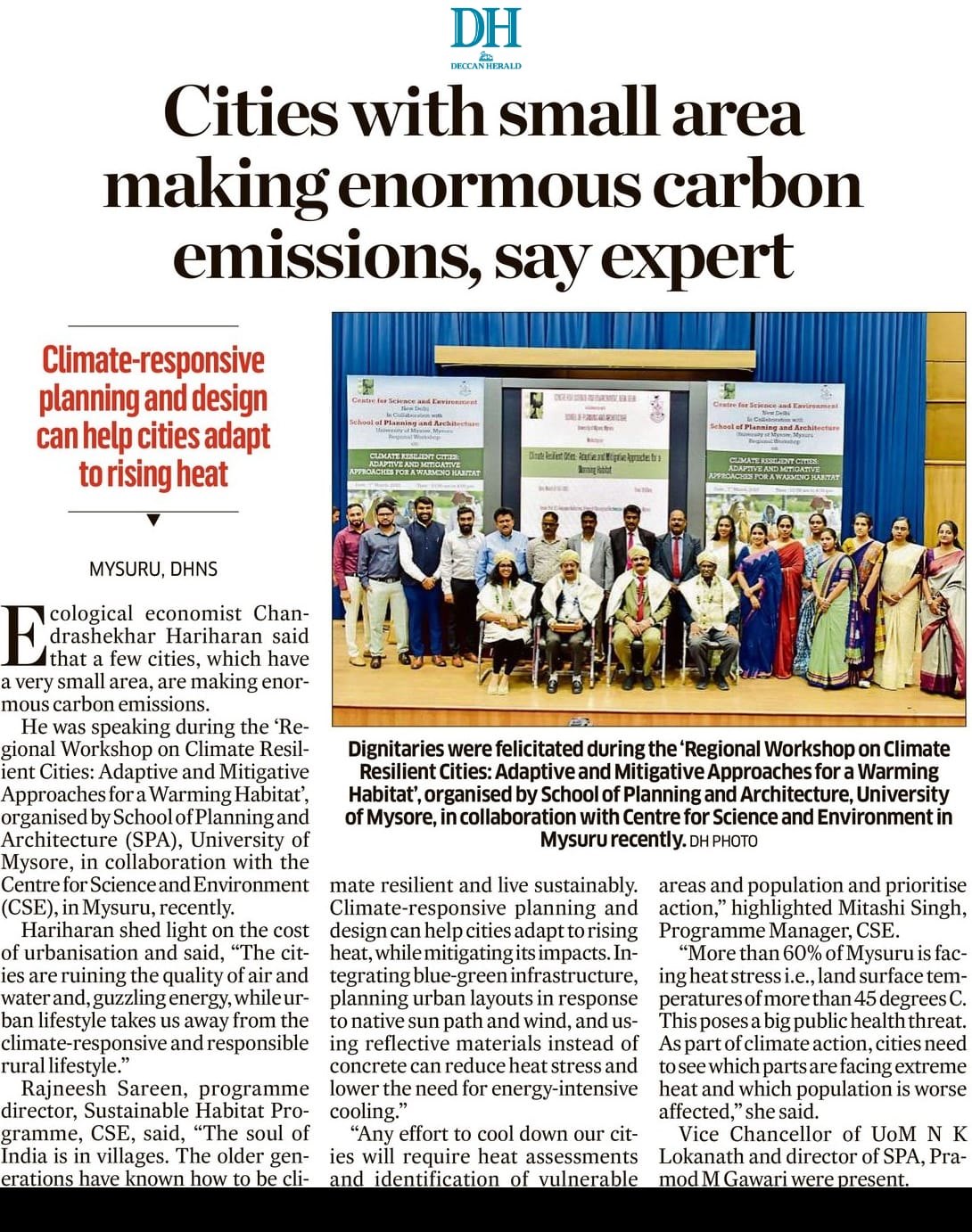
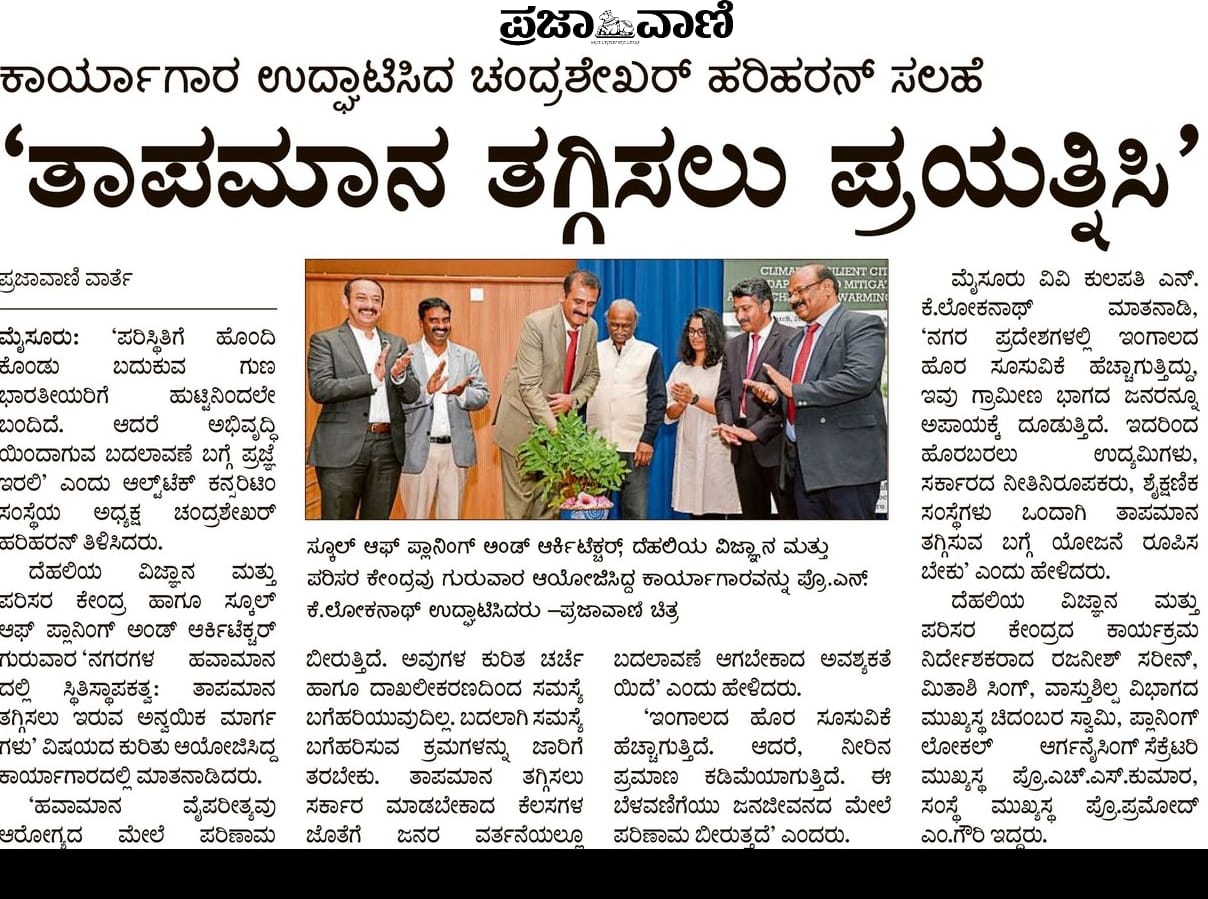
Regional workshop on Climate Resilient Cities: Adaptive and Mitigative Approaches for a Warming Habitat, Prof. N.K. Lokanath, Vice-Chancellor, University of Mysore, inaugurates; Rajneesh Sareen, Programme Director for Sustainable Building and Habitat Programme, Centre for Science and Environment, New Delhi, chief guest; Dr. Chandrashekar Hariharan, Chairman, AltTech Consortium, Bengaluru, delivers keynote address; Mitashi Singh, Programme Manager, Sustainable Building and Habitat Programme at Centre for Science and Environment, New Delhi and M.K. Savitha, UoM Registrar, guests of honour, Prof. K.S. Rangappa Auditorium, School of Planning and Architecture, Manasagangothri, 12 noon.

Industrial waste is a potential gold mine. India can reuse up to 750 million tonnes, says CSE report

Circularity is the answer to India’s rising industrial waste and carbon missions. The country could reuse up to 750 million tonnes (MT) of industrial waste, such as steel slag and fly ash, by 2030. It can also reduce carbon dioxide emissions by 50-90 million tonnes (MT), according to a Centre for Science and Environment (CSE) report. “Circularity has emerged as a critical focus area globally and nationally, emphasising on the principle that waste is not merely waste, but a valuable resource,” Sunita Narain, the director general at the Centre for Science and Environment (CSE), said in a press release. Circularity is the sustainable use of waste material from a production process by reusing it in various forms, ensuring that any economic process is circular and not linear, limiting waste production. There has been a renewed focus in India on circularity, which Finance Minister Nirmala Sitharaman mentioned in the 2025 Budget speech. Over the last decade, Swacch Bharat Abhiyan, the 2022 ban on single-use plastic, and the E-Waste Management Rules that India passed in 2022 are all geared towards a more circular economy. According to the CSE report, India’s material industrial consumption will likely double from seven billion tonnes in 2015 to 14.2 billion tonnes by 2030. In Europe, the quantum of goods recycled is as high as 70 percent, but the goods India recycles is a mere 20 percent. Globally, there is a big gap in overall circularity, with only 7.2 percent of the global economy being circular. “Many Indian industries are already taking steps to improve circularity—they have a number of good practices that need to be scaled up. States like Gujarat, Goa and Karnataka have taken initiatives towards circularity, but more states need to follow their example,” Shobhit Srivastava, the industrial pollution programme manager at CSE, said in the press release. Challenges to circularity The CSE report comes at an opportune time. Currently, the state leaders are meeting in Jaipur for the 12th edition of the Regional 3R and Circular Economy Forum in Asia and the Pacific. Inaugurated by Union Minister of Housing and Urban Affairs Manohar Lal Khattar, the forum focuses on global strategies and collaboration for reducing waste and promoting sustainability. Over 500 representatives from over 20 countries in the Asia Pacific region and the United Nations will be participating in the forum, slated to pass a Jaipur Declaration on 5 March 2025, stating goals for a more resource-efficient economy. The large-scale generation of industrial and hazardous waste, along with improper handling and mismanagement, has, in several cases, resulted in environmental accidents, such as the 1984 Bhopal Gas Tragedy. Waste poses risks to local communities, wildlife, and vegetation, with the CSE report stressing the need to shift towards a circular economy. Circularity conserves resources—for instance, alternative fuels and raw materials derived from industrial waste, such as biomass, can reduce coal consumption in India.