Cse In News

KV 2 organises expert talk on green school and sustainable practices

Kendriya Vidyalaya 2 (KV 2) at Yekkur in the city recently organised an expert talk on green school and sustainable practices to enhance environment conservation awareness among students. Interacting with students, environmentalist Jeeth Milan Roche highlighted the current alarming state of the environment with special focus on challenges in and around Mangaluru. He emphasised the critical importance of not compromising on humanity’s basic needs – air, water, food, and shelter – stressing that these resources must be preserved and protected for future generations. Sharing techniques for increasing green cover, Mr. Roche spoke about the need for balanced urban development that doesn’t come at the cost of nature. “We must ensure that our city remains livable and sustainable, with all kinds of development happening harmoniously with nature,” he said. The session also celebrated the school’s achievement of earning the ‘Green’ rating in the Green School Audit conducted by The Centre for Science and Environment (CSE), New Delhi. School principal Jaswinder Lal and others were present.
Global trade shifts open doors for India, it’s time to lead cleantech: Amitabh Kant

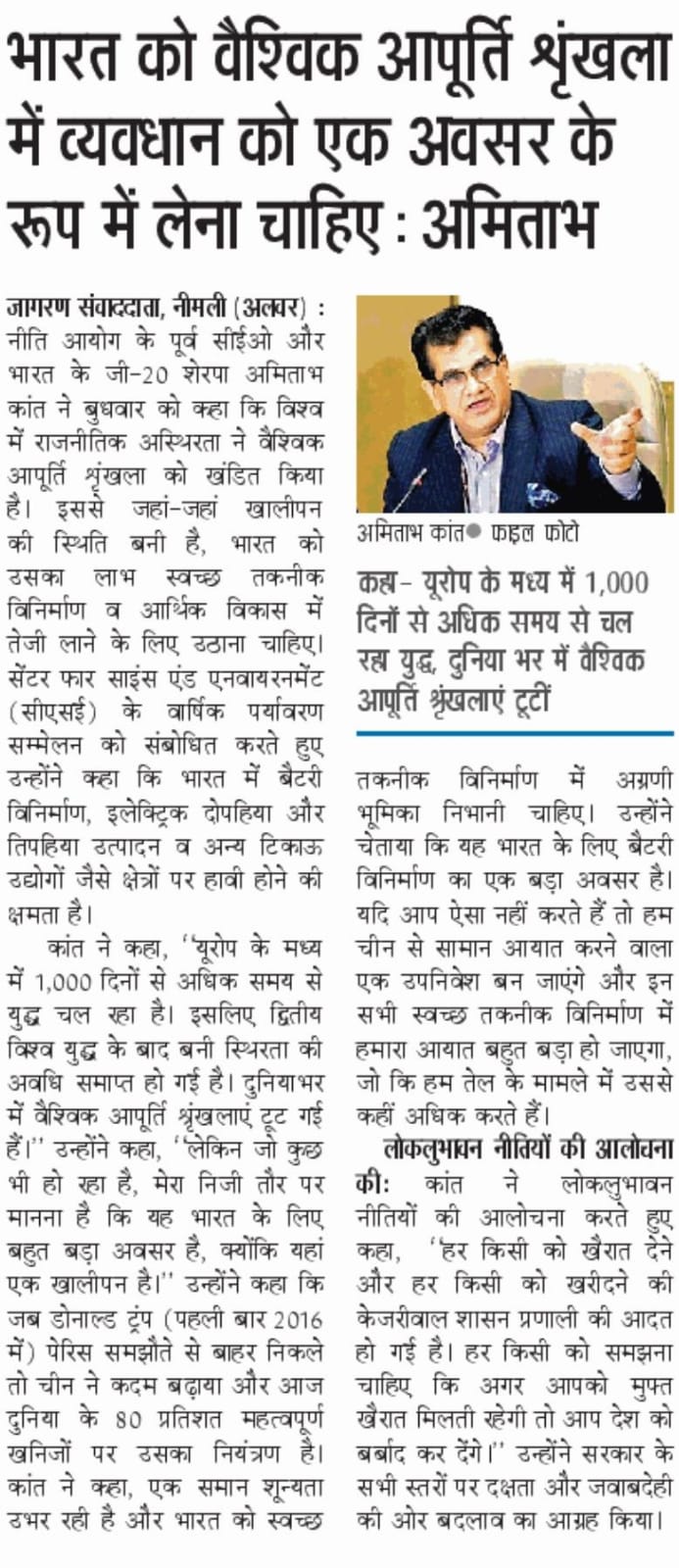
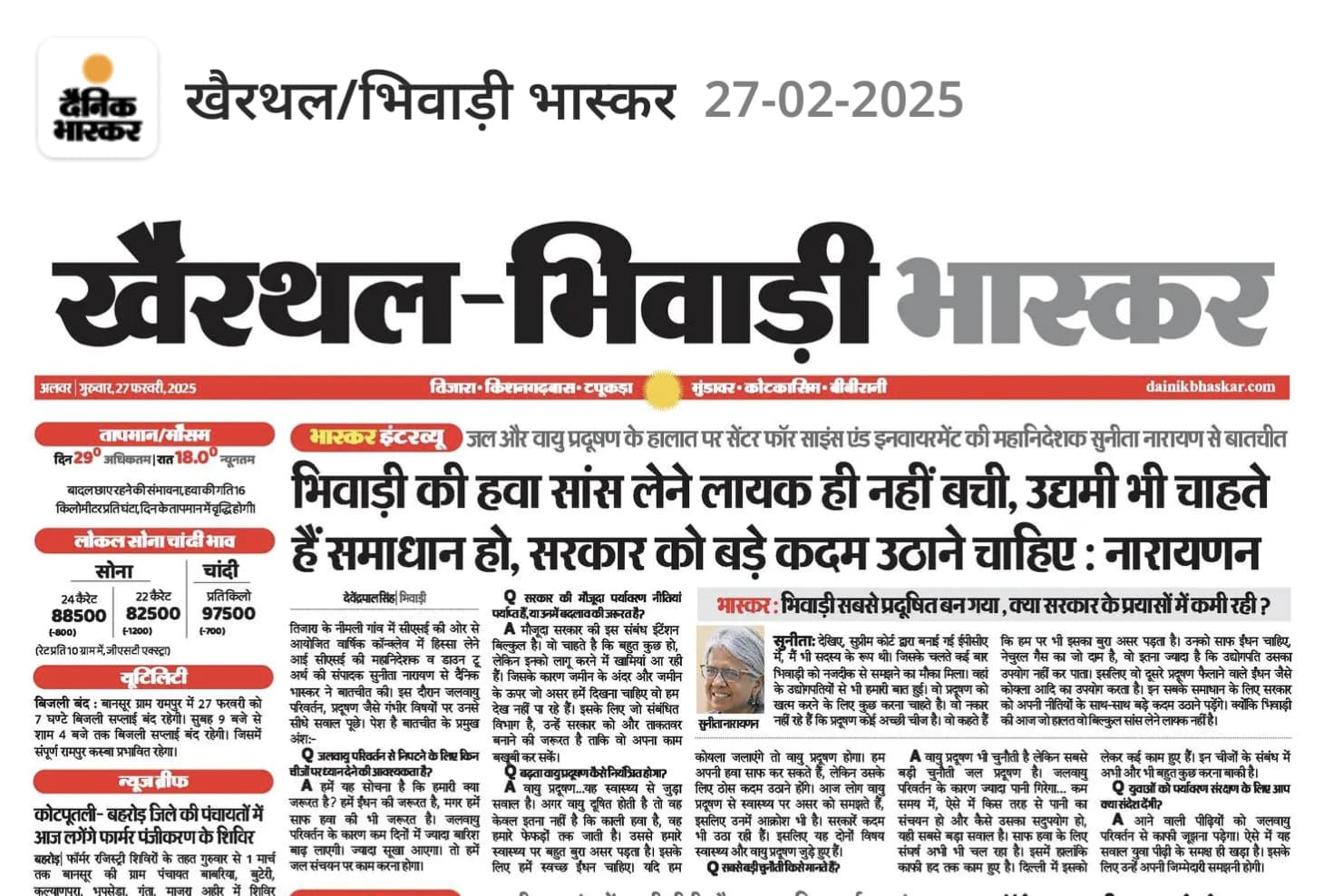
New Delhi, Feb 27 Geopolitical instability has disrupted global trade, creating a vacuum that India must use to boost its cleantech manufacturing and economic growth, former NITI Aayog CEO and India’s G20 Sherpa, Amitabh Kant said on Wednesday. In his address at the annual Anil Agarwal Dialogue organised by the Centre for Science and Environment, Amitabh Kant highlighted India’s potential to become a global leader in battery manufacturing, electric two-wheeler, and three-wheeler production, and other sustainable industries. “It’s a huge opportunity for India to do battery manufacturing. If you do not do this, we will become a colony importing goods from China and our imports in all these clean tech manufacturing will become huge, much more than what we do in terms of oil,” he said. He recalled how China stepped up when US President Donald Trump withdrew from the Paris Agreement in 2016. As a result, China now controls 80 per cent of the world’s critical minerals. Amitabh Kant believes a similar opportunity is emerging, and India should seize it to strengthen its clean-tech sector. However, he also pointed out weaknesses in India’s municipal governance, stating that poor management has worsened pollution and urban challenges. “If 42 of the cities in India are amongst the 50 worst polluting cities in the world, then there is a huge failure of municipal governance,” he said. He added that it has nothing to do with finances or the Central government. He stressed the need for better pricing of water and electricity to prevent wastage, contending that free electricity has led to excessive groundwater extraction. He suggested a pricing model where those who consume less should pay lower rates, while heavy consumers should pay significantly more. “I entirely agree that water needs to be priced because India, with 17 per cent of the world’s population, has just 4 per cent of water,” he noted. He added that 90 per cent of water is being consumed by agriculture. “That means rice and sugar cane are consuming all your water. And we are actually exporting virtual water in the name of basmati rice,” he noted. Citing Singapore’s transformation from a per capita income of $600 in 1965 to $90,000 today, he said India can achieve similar success through governance and economic reforms.

India's tardy progress on development goals set by UN, ranks 109th among 167 countries

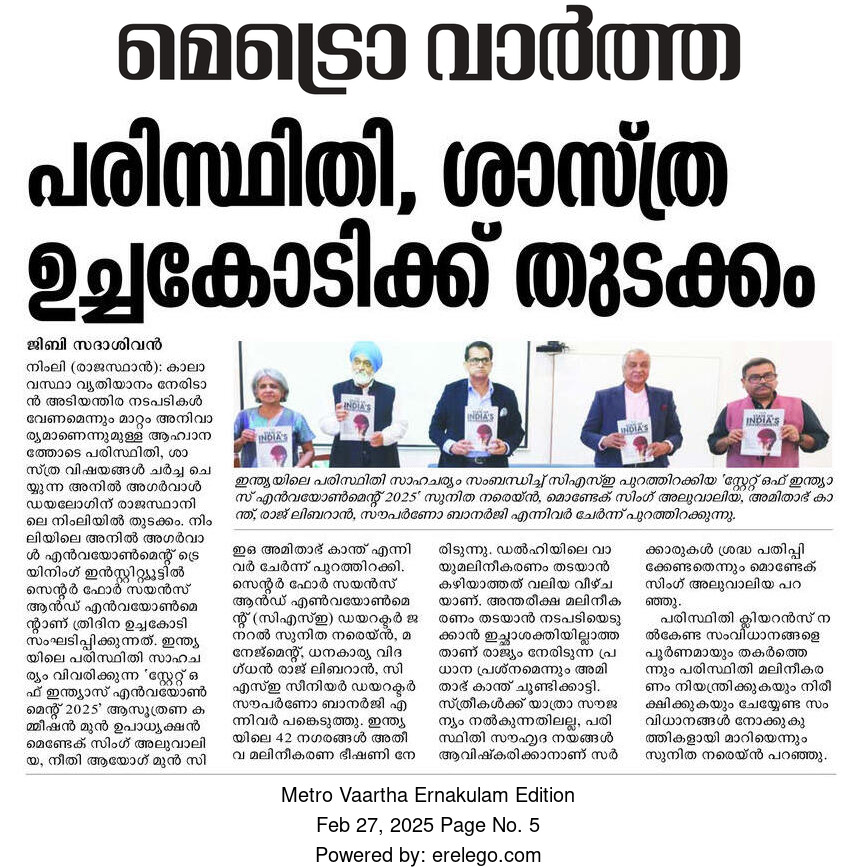
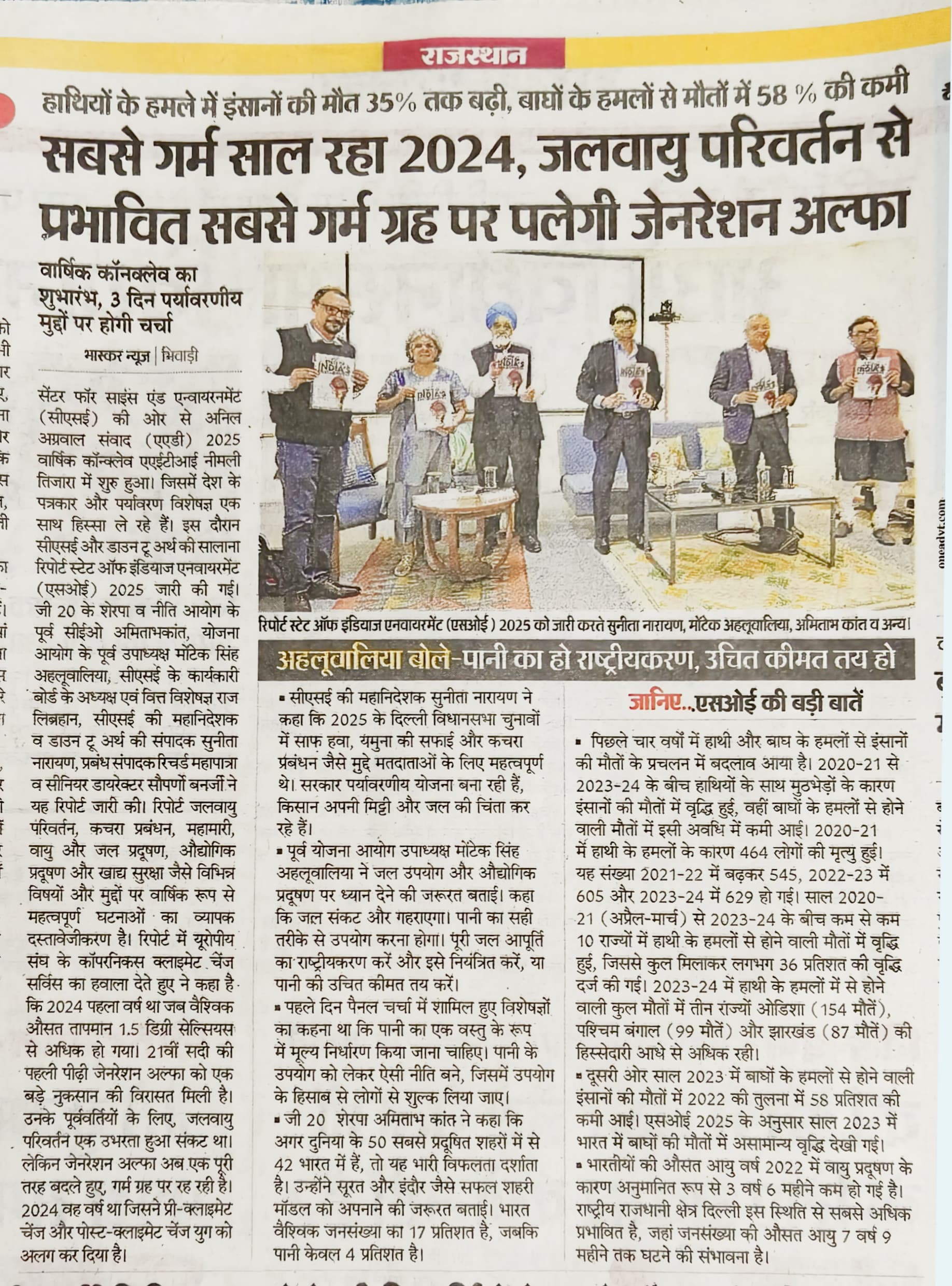
India ranks 109th among 167 countries in terms of its performance in 2024 towards achieving the United Nation-mandated sustainable development goals (SDGs), a report released on Wednesday said, adding that it was a cause for “concern” not only for India but globally as well. India has improved its ranking by three positions over the last year. The State of India’s Environment 2025 report, published by the Centre for Science and Environment (CSE), is based on the UN-backed Sustainable Development Report and the Niti Aayog report for 2024. The report has been published jointly by former deputy chairman of the Planning Commission Montek Singh Ahluwalia, former CEO of Niti Aayog and India’s G-20 Sherpa Amitabh Kant and CSE director-general Sunita Narain. “As the world’s most populous nation, home to over 1.4 billion people, India’s progress on SDGs matters not just for itself, but for the planet. However, between 2019 and 2022, the country’s SDG performance fell behind global trends. While 2023 saw a reversal, India’s 2024 ranking remains a concern — 109th out of 167,” the report stated. All UN member countries have agreed to achieve 16 sustainable development goals by 2030, which aim to improve the quality of life for people and the planet. India, with a score of 63.9 per cent, is lagging behind the composite global score of 67 per cent. India’s scores in nine parameters out of the 16 SDGs are lower than the world average. They include zero hunger; good health and well-being; gender equality; clean water and sanitation; industry, innovation and infrastructure; reduced inequalities; sustainable cities and communities; life on land; and peace, justice and strong institutions. Uttarakhand tops the SDG chart in the country with an overall score of 79.2 per cent. Tamil Nadu and Kerala have clocked 77.4 per cent and 77 per cent, respectively. Bengal, which has marginally improved its score to 72.1 per cent, has been ranked 13, Gujarat 16, Maharashtra 17 and Uttar Pradesh 21. Bihar is at the bottom of the list with 56.9 per cent.

A technological leapfrog will transform India: Amitabh Kant

Rajasthan: India A technological leapfrog will transform India and the country must seize the opportunity to lead in clean-tech manufacturing amid global disruptions, India's G20 Sherpa and former Niti Aayog CEO Amitabh Kant has said. In an interview with PTI on the sidelines of the Centre for Science and Environment's annual Anil Agarwal Dialogue, Kant also acknowledged that the lack of financial support from developed nations, historically responsible for climate change, could i...

Big Opportunity For India To Boost Clean Tech Manufacturing, After US Climate Withdrawal: Amitabh Kant

There is a massive opportunity for India to boost clean technology manufacturing in wake of the US withdrawal from global climate action efforts, and ongoing breakdown of global supply chains, said India’s G20 Sherpa Amitabh Kant on Wednesday. “Last time when the US withdrew from the Paris Agreement, China capitalised on it, and now controls the critical minerals, EVs and battery supply chains. With the US backing out again, India has huge opportunity to fill the vacuum, because we manufacture two-wheelers, four wheelers and electric products," said Kant speaking to CNN-News18 on the sidelines of 2025’s Anil Aggarwal Dialogue (AED) organised by Delhi-based Centre for Science and Environment (CSE).

Global Trade Shifts Create Cleantech Opportunity for India: Amitabh Kant

Geopolitical shocks have rocked international trade, creating an opportunity for India to become a leader in cleantech production and drive economic growth, according to Amitabh Kant, ex-NITI Aayog CEO and India's G20 Sherpa. Addressing the Centre for Science and Environment's annual Anil Agarwal Dialogue, he highlighted India's ability to dominate clean industries such as battery manufacturing and electric vehicle production. It's a massive opportunity for India to do battery production. If we don't, we will become import-dependent, like oil," Kant cautioned, pointing out how China's dominance of key minerals increased after the U.S. pulled out of the Paris Agreement in 2016. He underlined that India needs to move fast to not fall behind in the clean-tech race. But Kant identified glaring faults in India's urban administration, attributing increasing pollution and urban problems to bad management. "If 42 of the world's 50 most polluted cities are in India, that indicates a colossal governance failure," he said, pointing out that the problem is not due to inadequate central funding but local mismanagement. He also emphasized the necessity of improved resource pricing to limit overconsumption. "India, whose population accounts for 17% of the world, controls just 4% of the world's water resources. And yet, 90% of our water goes into agriculture," he pointed out, citing rice and sugarcane as two prominent offenders. Kant contended that prevailing subsidies reward unsustainable behavior and advocated a tiered pricing system in which low-consumption houses pay less and heavy users pay more. Taking cue from Singapore's meteoric growth from a $600 per capita income in 1965 to $90,000 today, Kant said that India, too, could follow suit with strong governance and systemic changes. "The solution lies in reforming the way we govern, pricing resources correctly, and grabbing this clean-tech opportunity to redefine India's future", he concluded.

Pan-India report ranks West Bengal at 13 among 28 states in development action taken

The performance of the India and West Bengal governments in undertaking sustainable development actions was below par in 2024 despite improving barely upon the earlier year’s performances, a report published in Nimli, Rajasthan, on Wednesday has shown. West Bengal has been ranked 13th out of 36 states and Union Territories in terms of its actions on achieving sustainable development, marginally improving over its last year’s performance but still lags in several key parameters. India has been ranked 109th among 167 countries based on its performance in 2024 towards achieving the UN-mandated sustainable development goals (SDGs). It has climbed three positions over last year. The State of India’s Environment 2025 report, published by the think tank Centre for Science and Environment (CSE), is based on the United Nations-backed Sustainable Development Report 2024 and Niti Ayog report 2024. The report has been released jointly by economist Montek Singh Ahluwalia, former deputy chairman of Planning Commission; Amitabh Kant, former chief executive officer of Niti Ayog and G 20 lead of India, alongside environmentalist CSE director-general Sunita Narain. All the countries of the world are mandated to meet targets — 100 per cent in all categories — in 2030 on 16 designated sustainable development goals, those define the quality of life of common people. In 2023-24, West Bengal scored 72.1 per cent and got the 13th rank out of 36 states and Union Territories being assessed. A year before, its score was 70 per cent. “In 34 of the 106 assessed indicators — or 32 per cent — the state has not reached even half of the target”, reads the report, flagging concern for the city.

A technological leapfrog will transform India: Amitabh Kant

A technological leapfrog will transform India and the country must seize the opportunity to lead in clean-tech manufacturing amid global disruptions, India's G20 Sherpa and former Niti Aayog CEO Amitabh Kant has said. In an interview with PTI on the sidelines of the Centre for Science and Environment's annual Anil Agarwal Dialogue, Kant also acknowledged that the lack of financial support from developed nations, historically responsible for climate change, could impact developing countries' new climate targets. Kant said disruptions in global trade have created a significant opportunity for India. "There is a vacuum, and India can fill it. By doing so, we can accelerate economic growth," he said.

Generation Alpha will inherit a profound loss in a planet that is much warmer, climatologically changed – says State of India’s Environment 2025 report

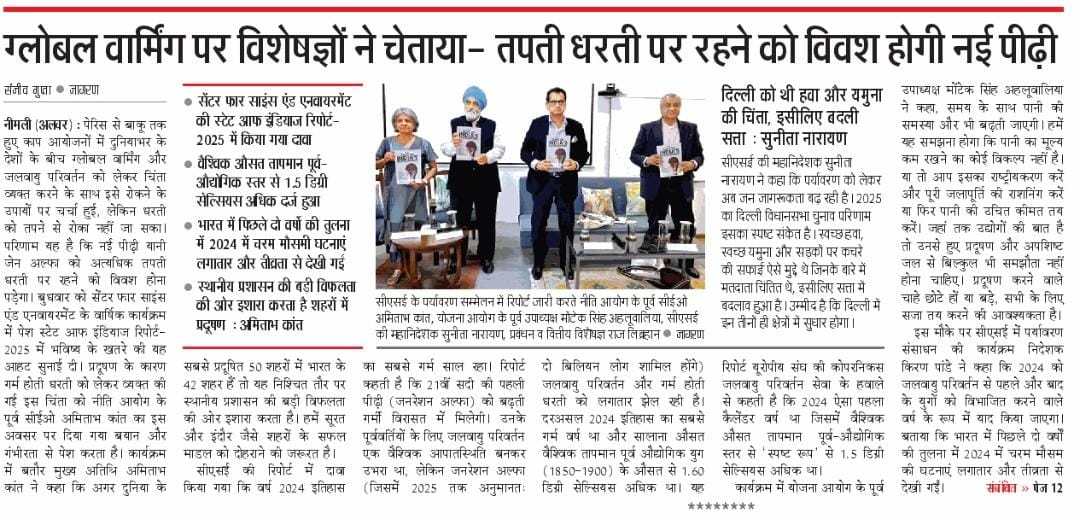
The 2025 Delhi assembly elections told us that clean air, clean Yamuna, and garbage on the streets were issues that voters were concerned about. Governments are introducing programmes for environment; farmers care about their soil and water; industry needs resource security without any conflicts. On the ‘bad news’ front, we are saddled with programmes that are not ambitious enough; institutions that are weak; and a way of environmental management that is expensive and non-inclusive,” said Dr.Sunita Narain, director general, Centre for Science and Environment (CSE) here yesterday. She was speaking at the Anil Agarwal Dialogue 2025, an annual conclave of journalists from India who write on environment and development issues. Over 80 journalists from across the country are participating in this one-of-its-kind platform, organised every year by CSE at its facility, the Anil Agarwal Environment Training Institute, located in Nimli, Rajasthan. Write the report’s authors: “For the first generation of the 21 st century – Generation Alpha – it is an inheritance of profound loss. For their predecessors, climate change has been an unfolding planetary emergency. But Generation Alpha – which will comprise an estimated two billion people by 2025, making it the largest generation in history – is enduring a climatologically changed, warmer planet.” The State of India’s Environment 2025 report, published by the Centre for Science and Environment (CSE), is based on the UN-backed Sustainable Development Report and the Niti Aayog report for 2024. The report has been published jointly by former deputy chairman of the Planning Commission Montek Singh Ahluwalia, former CEO of Niti Aayog and India’s G-20 Sherpa Amitabh Kant and CSE ddirector-general Dr. Sunita Narain. Addressing the assembled mediapersons, Kant said: “If in India, 42 of our cities are among the world’s 50 most polluted ones — this points to a huge failure of municipal governance. We need to replicate successful models of cities like Surat and Indore.” Mr. Ahluwalia focused on two critical aspects – that of water use and pricing and of industrial pollution. He pointed out: “With time, water issues will become worse. We have to recognise that water has to be economised – either you nationalise and ration the entire water supply or you price water adequately… With industry, there should be absolutely no compromise on pollution and wastewater. The polluter must pay – regardless of whether they are small or large.” Warmest year on record: The State of India’s Environment report quotes the European Union’s Copernicus Climate Change Service, which says that 2024 was the first calendar year with a global average temperature “clearly exceeding” 1.5 o C above the pre-industrial level. The year 2024, in fact, was the warmest year on record, with the average global temperature at 1.60 o C above the pre-industrial era (1850-1900) average. Says Kiran Pandey, programme director, environmental resources at CSE: “2024 will be remembered as the year that divided the pre- and post-climate change eras.” She adds: “Given the fact that atmospheric moisture levels rise by 7 per cent for every one degree rise in global average temperatures, this is a perfect brew for planetary disruptions in terms of extreme weather events.” CSE’s assessment indicates that India saw more frequent and intense extreme weather events in 2024, compared to the previous two years. In the first nine months of 2024, India witnessed extreme weather events on 255 of the 274 days as against 235 days for the same period in 2023 and 241 days in 2022. The events drastically impacted agriculture, with 3.2 million hectare of cropland affected in 2024 – 74 per cent more than in 2022. (Inputs from CSE & edited by Pratyusha Mukherjee ) (Pratyusha Mukherjee, a Sr. Broadcast Journalist of British Media is associated with us as the Editorial head of Defence, Sports & Current Affairs.She is covering CSE’s media conclave at Nimli, Rajasthan)

India's Technological Leap: Amitabh Kant on Clean-Tech & Climate

A technological leapfrog will transform India and the country must seize the opportunity to lead in clean-tech manufacturing amid global disruptions, India's G20 Sherpa and former Niti Aayog CEO Amitabh Kant has said. In an interview with PTI on the sidelines of the Centre for Science and Environment's annual Anil Agarwal Dialogue, Kant also acknowledged that the lack of financial support from developed nations, historically responsible for climate change, could impact developing countries' new climate targets. Kant said disruptions in global trade have created a significant opportunity for India. "There is a vacuum, and India can fill it. By doing so, we can accelerate economic growth," he said. He said that India has made remarkable technological progress in areas like fintech, citing UPI as an example. "We should replicate this success in clean-tech manufacturing, including solar energy, green hydrogen, batteries and electric vehicles. This is an opportunity for India to exceed 500 GW of renewable energy capacity by 2030. Technological disruptions are inevitable and we must be the first to lead. A technological leapfrog will transform India," he said. Kant warned that if India fails to seize this opportunity, it will become dependent on imports. "If India does not seize this opportunity, we will become dependent on China for imports. Our spending on clean-tech imports will far exceed what we currently spend on oil," he said. Asked whether insufficient funding from developed countries would impact the new climate goals of developing nations, Kant agreed. "The developed world, responsible for financing climate action in developing countries, has failed to provide adequate funds. They did not fulfil their promise of USD 100 billion annually by 2020. Developing nations need USD 1.3 trillion per year and the total requirement for both climate and sustainable development goals is USD 3 trillion," he said. Kant said that developing nations are not responsible for the climate crisis. "We did not cause global carbonisation; developed countries are responsible for 80 per cent of greenhouse gas emissions. It is extremely difficult for developing nations to meet their climate targets and decarbonise without adequate support," Kant said. Countries are required to submit their next round of Nationally Determined Contributions (NDCs), or climate plans, for the 2031-2035 period this year. The collective aim of these climate plans is to limit global temperature rise since the start of the Industrial Revolution to 1.5 degrees Celsius, the key goal of the 2015 Paris Agreement. Developed countries, historically responsible for most of the greenhouse gas emissions driving climate change, were required to deliver a new and ambitious financial package to support climate action in the developing world at the UN climate conference in Azerbaijan last year. However, they offered a paltry USD 300 billion by 2035, a mere fraction of at least USD 1.3 trillion needed annually from 2025. India had called the sum "too little, too distant", "paltry" and "an optical illusion". The government's Economic Survey 2024-25 tabled in Parliament in January said the lack of funding from developed countries to mitigate climate change in the Global South may prompt developing countries to "rework" their climate targets. Kant also criticised governance failures in Delhi, which he said have worsened pollution and mismanagement in the city. "Air pollution and the garbage crisis are clear results of governance failure in Delhi under the previous government," he said. Kant had on Wednesday said that thermal power plants and industries in Delhi-NCR are a major reason for high pollution levels. "Of the 36 units, only seven have adopted technology (to capture sulphur dioxide emissions). Action against them was supposed to be taken in 2018, but nothing has been done. There is a lack of strong political will. Many industrial plants and boilers need to be relocated," he said. Kant also said that while stubble burning outside Delhi is often blamed for pollution, biomass burning within and around the city is a serious issue. "We need strict action against industries, brick kilns, and factories near Delhi. Brick kilns from Delhi to Rajasthan must adopt new technology," he said.