
Cse In News

India must seize global supply chain disruption as opportunity: Amitabh Kant

Former Niti Aayog CEO and India's G20 Sherpa Amitabh Kant said on Wednesday that while geopolitical instability has fractured global trade, India must capitalize on this "vacuum" to accelerate clean-tech manufacturing and economic growth. Addressing the Centre for Science and Environment's annual Anil Agarwal Dialogue here, he said India has the potential to dominate sectors like battery manufacturing, electric two-wheeler and three-wheeler production, and other sustainable industries. "You have a war going on for over 1,000 days in the heart of Europe. So, the period of stability which was created after World War Two has come to an end. And you have a breakdown of global supply chains across the world," Kant said.
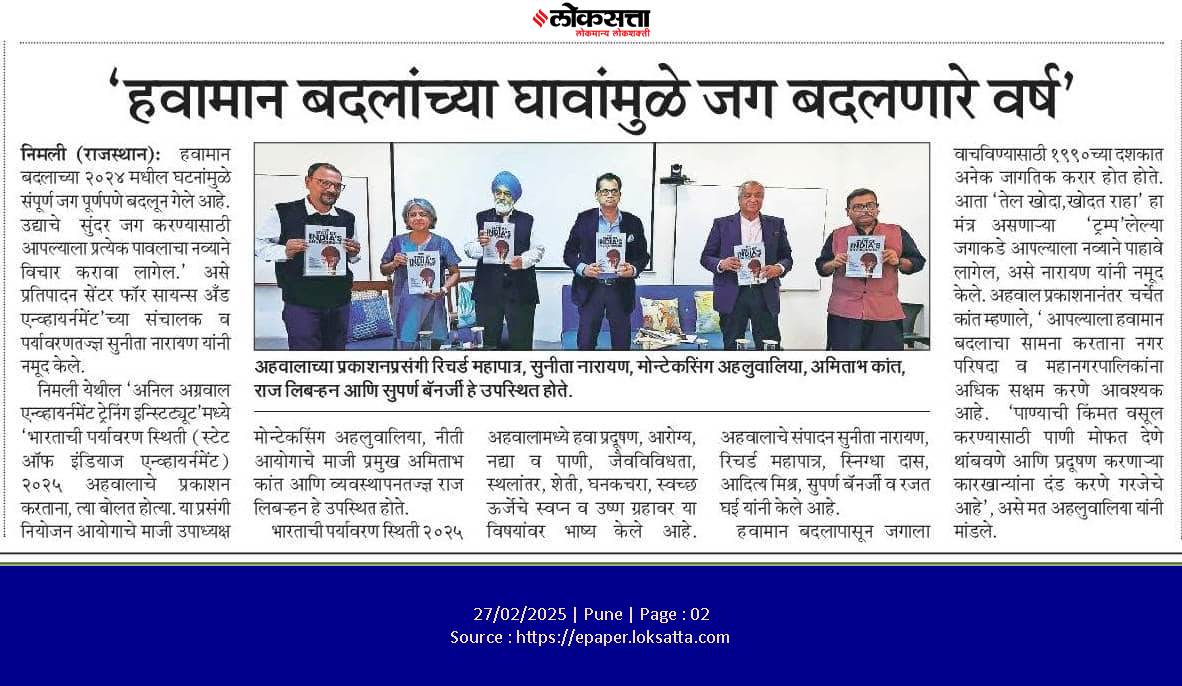
amitabh-kant.jpg Global trade shifts open doors for India, it's time to lead cleantech: Amitabh Kant

Geopolitical instability has disrupted global trade, creating a vacuum that India must use to boost its cleantech manufacturing and economic growth, former NITI Aayog CEO and India’s G20 Sherpa, Amitabh Kant said on Wednesday. In his address at the annual Anil Agarwal Dialogue organised by the Centre for Science and Environment, Amitabh Kant highlighted India’s potential to become a global leader in battery manufacturing, electric two-wheeler, and three-wheeler production, and other sustainable industries. "It's a huge opportunity for India to do battery manufacturing. If you do not do this, we will become a colony importing goods from China and our imports in all these clean tech manufacturing will become huge, much more than what we do in terms of oil," he said. He recalled how China stepped up when US President Donald Trump withdrew from the Paris Agreement in 2016. As a result, China now controls 80 per cent of the world's critical minerals. Amitabh Kant believes a similar opportunity is emerging, and India should seize it to strengthen its clean-tech sector. However, he also pointed out weaknesses in India's municipal governance, stating that poor management has worsened pollution and urban challenges. "If 42 of the cities in India are amongst the 50 worst polluting cities in the world, then there is a huge failure of municipal governance," he said. He added that it has nothing to do with finances or the Central government. He stressed the need for better pricing of water and electricity to prevent wastage, contending that free electricity has led to excessive groundwater extraction. He suggested a pricing model where those who consume less should pay lower rates, while heavy consumers should pay significantly more. "I entirely agree that water needs to be priced because India, with 17 per cent of the world's population, has just 4 per cent of water," he noted. He added that 90 per cent of water is being consumed by agriculture. “That means rice and sugar cane are consuming all your water. And we are actually exporting virtual water in the name of basmati rice," he noted. Citing Singapore’s transformation from a per capita income of $600 in 1965 to $90,000 today, he said India can achieve similar success through governance and economic reforms.

The State of India’s Environment 2025

The State of India’s Environment 2025 report presents a comprehensive analysis of environmental issues in India. Released on February 26, 2025, it marks developments in climate change, waste management, and pollution. The report was produced by the Centre for Science and Environment (CSE) and Down To Earth (DTE). Key Themes of the Report The report covers a wide array of topics. Major themes include climate change, air and water pollution, waste management, and biodiversity. Special sections address specific issues such as plastics, antimicrobial resistance, and the impact of climate change on the Thar desert. Additionally, it reflects on the 40th anniversary of the Bhopal Gas Tragedy and discusses India’s renewable energy targets. Environmental Challenges in 2024 According to the report, 2024 marked increase in extreme weather events in India. The country experienced extreme conditions on 255 out of 274 days in the first nine months of the year. This was a notable rise from previous years. Such events severely impacted agriculture, affecting over 3.2 million hectares of cropland. Public Awareness and Political Response There is a growing public consciousness regarding environmental issues. The 2025 Delhi assembly elections indicated that voters prioritised clean air and waste management. Governments are responding with initiatives aimed at improving environmental conditions. However, the report criticises the lack of ambition in current programmes and the weakness of institutions. Future Generations and Climate Change Generation Alpha, the youngest cohort, faces the repercussions of climate change. The report warns that they inherit a planet that is warmer. The year 2024 was recorded as the warmest on record, with global temperatures exceeding 1.5°C above pre-industrial levels. This trend poses serious risks for future generations.

Global trade shifts open doors for India, it's time to lead cleantech: Amitabh Kant

Geopolitical instability has disrupted global trade, creating a vacuum that India must use to boost its cleantech manufacturing and economic growth, former NITI Aayog CEO and India’s G20 Sherpa, Amitabh Kant said on Wednesday. In his address at the annual Anil Agarwal Dialogue organised by the Centre for Science and Environment, Amitabh Kant highlighted India’s potential to become a global leader in battery manufacturing, electric two-wheeler, and three-wheeler production, and other sustainable industries.

Sikkim एक्सप्रेस की रिपोर्टर इसाबेला गुरुंग ने निमली

निमली (राजस्थान), : हमारी अगली पीढ़ी ऐसी दुनिया में बड़ी होगी जो कहीं ज़्यादा गर्म होगी। इस साल के अनिल अग्रवाल डायलॉग (एएडी) 2025 में जारी भारत के पर्यावरण की स्थिति 2025 रिपोर्ट में कहा गया है कि नई पीढ़ी को एक ऐसे ग्रह पर बहुत ज़्यादा नुकसान होगा जो कहीं ज़्यादा गर्म और जलवायु परिवर्तन वाला होगा। यह रिपोर्ट सेंटर फॉर साइंस एंड एनवायरनमेंट (सीएसई) और डाउन टू अर्थ पत्रिका द्वारा हर साल प्रकाशित की जाती है।

Chemical Pollution Kills 2 Million People Globally: India’s Environment Report Says

Chemical Pollution: “In the Anthropocene age, human-made chemicals are not only “forever”, but have also become “everywhere” pollutants. From high in the atmosphere to deep inside oceans, from soils and trees to uninhabited regions – they are everywhere”: says the State of India’s Environment 2025 report, released here yesterday. The report was released at the Anil Agarwal Dialogue 2025, an annual conclave of journalists from India who write on environment and development issues. Over 80 journalists from across the country are participating in this one-of-its-kind platform, organised every year by CSE at its facility, the Anil Agarwal Environment Training Institute, located in Nimli, Rajasthan. CSE director general Sunita Narain released the report along with India’s G20 Sherpa Amitabh Kant; former deputy chairperson of the Planning Commission Montek Singh Ahluwalia; and management and financial guru Raj Liberhan. Over the next three days, the media conclave will touch upon a wide range of issues – from human-animal conflicts in India and the phenomena of urban heat islands and warm nights to India’s targets on renewable energy and the return of zoonotic diseases and outbreaks. The chemical clutter Anchoring a special session at the Dialogue today on ‘chemicals in the environment’, Down To Earth correspondent Rohini Krishnamurthy said: “In 2019, chemicals in the environment reportedly accounted for two million deaths worldwide. New chemicals are often released into the market before we have fully understood their impacts. As a result, there are gaps in our understanding of the scale and threat of the risks posed by them in our environment.” According to the World Health Organization, some 160 million chemicals are known to humans. Data from the Chemicals Abstracts Service, a global inventory of these substances, indicates that countries across the world are making, using and importing some 60,000 chemicals that are not well understood and regulated. The State of India’s Environment 2025 report says humans have “synthesised some 140,000 chemicals and mixtures of chemicals”. These are chemicals that did not exist till a few decades ago. New chemicals are being invented and developed at an unprecedented rate. As per 2019 data, the US produces an average of 1,500 new substances a year. Says Krishnamurthy: “Naturally, the rate at which chemicals are released into the environment is also very high. Annually, some 220 billion tonne of chemicals are released. In fact, humans are responsible for pumping in 65 kg of cancer-causing chemicals every second into the atmosphere.” Speaking at the Dialogue, Dr Donthi N Reddy, visiting senior fellow, Impact and Policy Research Institute, New Delhi, said: “We are indiscriminately using pesticides in our rural regions – 255,000 tonne every year – when even a single gramme is lethal.” The disease burden Says Krishnamurthy: “Once they get into our bodies, synthetic chemicals first encounter the lungs, skin and gut. They can also travel through the bloodstream to affect other organs like the kidneys or the immune system. They can enter individual cells and affect how instructions in the DNA are converted into protein. Long terms exposure to chemicals leads to a range of health issues such as cancer, organ damage, weakening of the immune system, development of allergies or asthma etc.” The State of India’s Environment report asks if the world has reached a critical situation in terms of chemical pollution – aside from it accounting for two million deaths (2019, WHO), 53 million disability-adjusted life years have also been lost due to exposures to certain chemicals.

Global Warming पर विशेषज्ञों ने चेताया-तपती धरती पर रहने को विवश होगी नई पीढ़ी…

2024 को इतिहास में अब तक का सबसे गर्म साल दर्ज किया गया है। यूरोपीय संघ की कोपरनिकस क्लाइमेट चेंज सर्विस के अनुसार, यह पहला वर्ष था जब वैश्विक औसत तापमान 1.5 डिग्री सेल्सियस से अधिक दर्ज किया गया–जो औद्योगिक क्रांति से पहले (1850-1900) के औसत तापमान से काफी ज्यादा था। इस बढ़ते तापमान का सबसे गहरा असर आने वाली पीढ़ी ‘जनरेशन अल्फा’ पर पड़ेगा। स्टेट ऑफ इंडियाज़ एनवायरनमेंट 2025 रिपोर्ट के अनुसार, यह पीढ़ी एक पूरी तरह से बदले हुए जलवायु परिदृश्य के साथ बढ़ेगी। जहां पिछली पीढ़ियों के लिए जलवायु परिवर्तन एक चेतावनी मात्र था, वहीं जनरेशन अल्फा इसे एक नई वास्तविकता के रूप में अनुभव करेगी। रिपोर्ट में कहा गया है कि 2024 की वैश्विक औसत तापमान वृद्धि 1.60 डिग्री सेल्सियस तक पहुंच गई, जिससे यह साल जलवायु परिवर्तन के युग को स्पष्ट रूप से विभाजित करने वाला वर्ष बन गया। अनिल अग्रवाल संवाद 2025 में रिपोर्ट जारी स्टेट ऑफ इंडियाज़ एनवायरनमेंट 2025 रिपोर्ट को राजस्थान के निमली में आयोजित अनिल अग्रवाल संवाद 2025 में जारी किया गया। इस अवसर पर भारत के जी20 शेरपा अमिताभ कांत, योजना आयोग के पूर्व उपाध्यक्ष मोंटेक सिंह अहलूवालिया, प्रबंधन विशेषज्ञ राज लिबरहान, और सीएसई की महानिदेशक सुनीता नारायण ने इसे संयुक्त रूप से प्रस्तुत किया। इस संवाद में देशभर से 80 से अधिक पत्रकारों और 20 से ज्यादा विशेषज्ञों ने भाग लिया और भारत की पर्यावरणीय चुनौतियों पर चर्चा की। सीएसई की निदेशक सुनीता नारायण ने कहा, “2025 की शुरुआत एक मिश्रित तस्वीर पेश कर रही है। अच्छी बात यह है कि अब पर्यावरणीय मुद्दों को अधिक गंभीरता से लिया जा रहा है। 2025 के दिल्ली विधानसभा चुनावों में स्वच्छ हवा, स्वच्छ यमुना और कचरा प्रबंधन जैसे विषय चुनावी एजेंडा में शामिल रहे। सरकारें पर्यावरण से जुड़े कार्यक्रम लागू कर रही हैं, किसान अपने जल और मिट्टी की रक्षा के लिए जागरूक हो रहे हैं, और उद्योग भी संसाधनों की सुरक्षा को प्राथमिकता दे रहे हैं।” हालांकि, उन्होंने चिंता जताई कि “बड़ी योजनाओं की कमी, कमजोर संस्थाएं और महंगे तथा गैर-समावेशी पर्यावरण प्रबंधन से हमें अभी भी संघर्ष करना पड़ रहा है।” “42 भारतीय शहर दुनिया के 50 सबसे प्रदूषित शहरों में” – अमिताभ कांत भारत के जी20 शेरपा अमिताभ कांत ने शहरी प्रदूषण पर चिंता व्यक्त करते हुए कहा, “अगर दुनिया के 50 सबसे प्रदूषित शहरों में से 42 भारत में हैं, तो यह हमारे नगर निगम प्रशासन की भारी असफलता को दर्शाता है। हमें सूरत और इंदौर जैसे सफल शहरी मॉडल को अपनाना होगा, जहां नगर निकायों ने प्रभावी समाधान विकसित किए हैं।” “जल संकट और औद्योगिक प्रदूषण को लेकर कड़े कदम उठाने होंगे”–मोंटेक सिंह अहलूवालिया पूर्व योजना आयोग उपाध्यक्ष मोंटेक सिंह अहलूवालिया ने जल संकट और औद्योगिक प्रदूषण को लेकर चेताया। “समय के साथ जल संकट और गंभीर होता जाएगा। हमें या तो पूरे जल आपूर्ति तंत्र का राष्ट्रीयकरण कर इसे राशनिंग करना होगा, या फिर जल उपयोग का उचित मूल्य निर्धारण करना होगा। इसके बिना जल संकट को हल करना संभव नहीं होगा।” औद्योगिक प्रदूषण पर उन्होंने कहा, “चाहे छोटा उद्योग हो या बड़ा, पर्यावरणीय नियमों के उल्लंघन पर कड़ी कार्रवाई होनी चाहिए। ‘पोल्यूटर पे’ सिद्धांत को सख्ती से लागू करना होगा।” सीएसई की रिपोर्ट के अनुसार, 2024 में भारत में चरम मौसम घटनाएँ पहले की तुलना में अधिक और तीव्र थीं। वर्ष के पहले नौ महीनों में 255 दिन चरम मौसम घटनाएँ दर्ज की गईं, जबकि 2023 में यह आंकड़ा 235 दिन और 2022 में 241 दिन था। बढ़ते तापमान और जलवायु परिवर्तन का सबसे अधिक प्रभाव कृषि क्षेत्र पर पड़ा। 2024 में 3.2 मिलियन हेक्टेयर कृषि भूमि जलवायु आपदाओं से प्रभावित हुई, जो 2022 की तुलना में 74% अधिक थी। सीएसई की कार्यक्रम निदेशक किरण पांडेय ने कहा, “प्रत्येक 1 डिग्री सेल्सियस तापमान वृद्धि के साथ वायुमंडलीय आर्द्रता स्तर 7% बढ़ जाता है। यह स्थिति जलवायु अस्थिरता और चरम मौसम की घटनाओं को और अधिक गंभीर बना देती है।” क्या हो सकते हैं समाधान? रिपोर्ट के अनुसार, भारत को नवीकरणीय ऊर्जा, जल संरक्षण, और प्रदूषण नियंत्रण पर बड़े और प्रभावी कदम उठाने की आवश्यकता है। इसके लिए निम्नलिखित सुझाव दिए गए हैं: 1. स्वच्छ ऊर्जा को बढ़ावा – कोयले और तेल जैसे प्रदूषणकारी ऊर्जा स्रोतों की जगह सौर और पवन ऊर्जा को प्राथमिकता दी जाए। 2. जल संरक्षण नीतियां – जल के दुरुपयोग को रोकने और वर्षा जल संचयन को अनिवार्य बनाने की जरूरत। 3. प्रदूषण नियंत्रण – सख्त नियमों के साथ-साथ नागरिकों को पर्यावरण की रक्षा के लिए जागरूक करना आवश्यक। 4. नगर प्रशासन में सुधार – सफल शहरी मॉडल को अपनाकर प्रदूषण नियंत्रण और कचरा प्रबंधन को बेहतर बनाना। 2024 के रिकॉर्डतोड़ तापमान और बढ़ते जलवायु संकट के बीच, भारत को अब ठोस नीतिगत बदलावों की आवश्यकता है। अगर सही कदम नहीं उठाए गए, तो जनरेशन अल्फा को एक और अधिक गर्म, अस्थिर और संकटग्रस्त दुनिया विरासत में मिलेगी।

Chemical Pollution: A Growing Global Threat, Warns Report

Nimli (Rajasthan): The State of India's Environment 2025 report has raised alarms over the widespread impact of chemical pollution, stating that in 2019, chemicals in the environment were responsible for two million deaths and 53 million disability-adjusted life years worldwide, as per World Health Organization (WHO) data. Released at the Anil Agarwal Dialogue 2025, an annual environmental journalism conclave organized by the Centre for Science and Environment (CSE), the report highlights how human-made chemicals have become “forever” and “everywhere” pollutants, contaminating the atmosphere, oceans, soil, and even remote regions. CSE's Director General Sunita Narain, along with India's G20 Sherpa Amitabh Kant, former Planning Commission Deputy Chairperson Montek Singh Ahluwalia, and management expert Raj Liberhan, unveiled the report at the event. Over 80 journalists from across India are participating in discussions on key environmental issues, including urban heat islands, renewable energy targets, and zoonotic disease outbreaks. The Chemical Crisis In a session on 'Chemicals in the Environment', Down To Earth correspondent Rohini Krishnamurthy emphasized the lack of regulation for thousands of chemicals in global markets. “Annually, 220 billion tonnes of chemicals are released into the environment, including 65 kg of carcinogens every second,” she noted. Dr. Donthi N Reddy, senior fellow at the Impact and Policy Research Institute, highlighted India's indiscriminate pesticide use, exceeding 255,000 tonnes annually, despite minimal lethal doses. The report warns of serious health risks from prolonged chemical exposure, including cancer, organ damage, immune disorders, and genetic mutations. With over 140,000 synthetic chemicals in circulation, experts caution that the world may be at a critical tipping point in chemical pollution.

Blame local emissions, Gurgaon’s air quality turns ‘poor’ again after a gap of 6 days

Gurgaon: The city's air quality, at an index of 250 (poor), deteriorated on Tuesday after six ‘moderate' days. The AQI was 198 (moderate) on Monday. Experts attributed the decline in air quality to local factors. Among the four AQI monitoring stations, Sector 51 and Gwalpahari recorded a ‘poor' AQI of 227 and 266, respectively. In Vikas Sadan, the index was registered at 116. Teri Gram readings were unavailable due to insufficient data. The city sees ‘poor' AQI after a gap of six days of staying in the ‘moderate' category. The sub-committee on the Graded Response Action Plan (GRAP) of the Commission for Air Quality Management (CAQM) revoked GRAP stage II in NCR and adjoining areas on Monday. According to the System of Air Quality and Weather Forecasting and Research (Safar), the city might encounter ‘very poor' and ‘poor' air quality over the subsequent three days due to unfavourable conditions for the dispersion of pollutants. "Surface winds from the north will likely prevail at speeds under 4kmph during morning hours. Northwest winds may intensify to 4-6kmph in the afternoon, but they will subside by evening," Safar stated. The level of PM2.5 — a toxic particulate matter that can penetrate the bloodstream via the lungs — peaked in Sector 51 at 400 µg/m³, followed by Teri Gram (334 µg/m³), Vikas Sadan (319 µg/m³), and Sector 51 (301 µg/m³). For PM10, Gwalpahari topped with 401 µg/m³, followed by Teri Gram at 387 µg/m³ and Sector 51 at 354 µg/m³. Vikas Sadan did not monitor PM10 levels. These levels substantially exceed the CPCB's permissible annual thresholds of 60 µg/m³ for PM2.5 and 100 µg/m³ for PM10. According to CPCB guidelines, 'poor' AQI can cause respiratory difficulties during prolonged exposure, whilst 'moderate' AQI can trigger respiratory discomfort in individuals with asthma or cardiopulmonary conditions. An AQI between zero and 50 is considered ‘good', 51 and 100 ‘satisfactory', 101 and 200 ‘moderate', 201 and 300 ‘poor', 301 and 400 ‘very poor', and 401 and 500 ‘severe'. Experts said that civic bodies must implement measures throughout the year to ensure 'satisfactory' or 'good' air. "Over the years, vehicular emissions and construction activities have increased in the region. The civic bodies need to ensure that the emissions are lowered and take adequate steps like increasing public transport and greenery on pavements," said Shubhansh Tiwari, a research associate at the centre for science and environment. HSPCB officials stated local issues are responsible for the deteriorating AQI for most of the year. They cited factors like suspension of road dust due to vehicular traffic, surge in construction activities, and waste burning as concerns that have increased the pollutants. Meanwhile Delhiites woke up to clear skies on Tuesday, with the minimum temperature settling at 11.7 degrees Celsius. The weather department predicted a cloudy sky during the day with predominant surface winds. The humidity level at 8.30 am stood at 93 percent. The maximum temperature is expected to touch 28 degrees Celsius, according to the India Meteorological Department (IMD). The air quality at 9 am was recorded in the moderate category, with an AQI reading of 188, according to the Central Pollution Control Board. An AQI between zero and 50 is considered good, 51 and 100 satisfactory, 101 and 200 moderate, 201 and 300 poor, 301 and 400 very poor, and 401 and 500 severe.

अगर देखनी है ग्रीन और क्लीन दिल्ली, तो जिम्मेदारी से उठाएं ये कदम

प्रदूषण से बचना और फिर प्रदूषण को कम करने की कोशिश करना ही दिल्ली-एनसीआर में स्वस्थ्य रहने का एकमात्र फॉर्म्युला है। एक्सपर्ट के अनुसार, जब तक हर व्यक्ति अपनी जिम्मेदारी नहीं समझता प्रदूषण से जंग कमजोर ही रहेगी। अकेले न तो सरकार न आम लोग इससे निपट सकते हैं। इस जंग में हो शामिल सीएसई (सेंटर फॉर साइंस एंड एनवायरमेंट) की एग्जीक्यूटिव डायरेक्टर अनुमिता राय चौधरी ने बताया कि प्रदूषित माहौल में सबसे पहले खुद को सेफ रखना ही हमारी जिम्मेदारी है। प्रदूषण के स्तर के हिसाब से मास्क पहनना बहुत जरूरी है। पीएम 2.5 का स्तर 100 एमजीसीएम से अधिक हो गया है तो मास्क पहनना चाहिए। अस्थमा के मरीजों को दवाइयां हमेशा अपने पास रखनी चाहिए। सरकार की तरफ से जारी एडवाइजरी व सिटिजंस चार्टर का पालन करने की कोशिश करें। खाना हेल्दी खाएं ताकि इम्युनिटी कम न हो। योगा करें, भारी एक्सरसाइज से बचें। इसके बाद लोग प्रदूषण को कम करने के उपाय कर सकते हैं।

India’s environmental challenges highlighted at Anil Agarwal Dialogue 2025

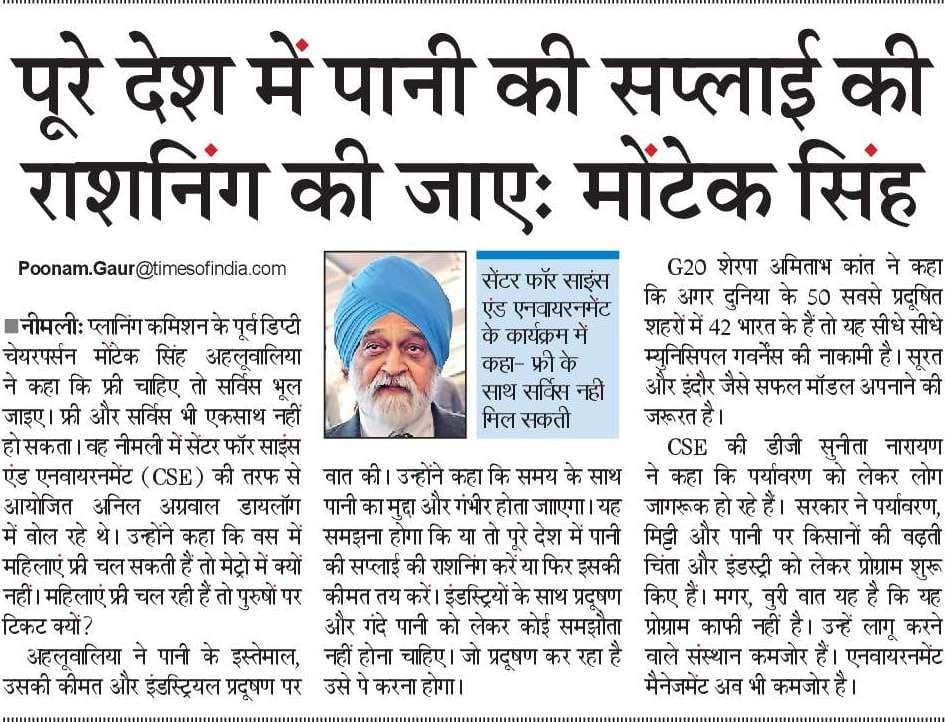
ALWAR: As 2025 unfolds, India faces both promising developments and significant challenges in its environmental journey, according to Sunita Narain, Director General of the Centre for Science and Environment (CSE). Speaking at the Anil Agarwal Dialogue 2025, an annual gathering of journalists covering environmental and developmental issues, Narain highlighted a growing public consciousness about environmental concerns, as evidenced by the 2025 Delhi Assembly elections, where clean air, the Yamuna river, and waste management emerged as key voter concerns. “There is good and bad news as we move ahead in 2025. The good news is the increased environmental consciousness. Governments are introducing programs for the environment; farmers are prioritizing soil and water conservation; industries recognize the need for resource security without conflicts. However, the bad news is that our programs lack ambition, institutions remain weak, and our approach to environmental management is costly and non-inclusive,” Narain stated. The event, held at the Anil Agarwal Environment Training Institute in Nimli, Rajasthan, brought together over 80 journalists from across India. During the dialogue, Narain launched the 2025 State of India’s Environment report alongside India’s G20 Sherpa Amitabh Kant, former Planning Commission Deputy Chairperson Montek Singh Ahluwalia, and financial expert Raj Liberhan. Speaking to the gathering, Amitabh Kant underscored the dire state of India’s urban air quality, citing a report that placed 42 Indian cities among the world’s 50 most polluted. “This is a glaring failure of municipal governance. We need to replicate successful models from cities like Surat and Indore,” he said. Ahluwalia addressed critical issues related to water management and industrial pollution, warning that water scarcity would intensify unless drastic measures were taken. “We must acknowledge that water needs to be economized—either by nationalizing and rationing supply or by pricing it appropriately. Additionally, there must be zero tolerance for industrial pollution and wastewater discharge. The polluter must pay, whether big or small,” he asserted. The newly released State of India’s Environment report cites data from the European Union’s Copernicus Climate Change Service, confirming that 2024 was the first calendar year where the global average temperature clearly exceeded 1.5°C above pre-industrial levels. “For Generation Alpha, which will comprise an estimated two billion people by 2025, this is an inheritance of profound loss. Climate change has shifted from being an impending planetary emergency to an ongoing crisis,” the report’s authors noted. In fact, 2024 was officially the warmest year on record, with the global temperature averaging 1.60°C above the pre-industrial era (1850-1900) baseline. Kiran Pandey, Programme Director for Environmental Resources at CSE, remarked, “2024 will be remembered as the year that marked the clear divide between the pre- and post-climate change eras.” She further explained that rising atmospheric moisture levels—estimated to increase by 7% for every 1°C rise in global temperature—are exacerbating extreme weather events. CSE’s analysis indicates a worrying trend in extreme weather events across India. In 2024, India experienced extreme weather events on 255 of the first 274 days of the year, compared to 235 days in 2023 and 241 days in 2022. The impact on agriculture has been severe, with 3.2 million hectares of cropland affected in 2024—a staggering 74% increase from 2022. With climate change intensifying, experts at the conference called for urgent policy reforms, better urban planning, and a more robust approach to environmental governance. The dialogue concluded with a renewed call to action for all stakeholders—governments, industries, and citizens—to accelerate sustainable development efforts and ensure a healthier future for the next generation.

2024 Hottest Year on Record, CSE Releases India’s Environment Report

2024 Hottest Year on Record: There is good and bad news as we move ahead in 2025. The good news is there is increased environmental consciousness. The 2025 Delhi assembly elections told us that clean air, clean Yamuna, and garbage on the streets were issues that voters were concerned about. Governments are introducing programmes for environment; farmers care about their soil and water; industry needs resource security without any conflicts. On the ‘bad news’ front, we are saddled with programmes that are not ambitious enough; institutions that are weak; and a way of environmental management that is expensive and non-inclusive,” said Sunita Narain, director general, Centre for Science and Environment (CSE) here today. She was speaking at the Anil Agarwal Dialogue 2025, an annual conclave of journalists from India who write on environment and development issues. Over 80 journalists from across the country are participating in this one-of-its-kind platform, organised every year by CSE at its facility, the Anil Agarwal Environment Training Institute, located in Nimli, Rajasthan. Narain released the 2025 State of India’s Environment report along with India’s G20 Sherpa Amitabh Kant; former deputy chairperson of the Planning Commission Montek Singh Ahluwalia; and management and financial guru Raj Liberhan. Addressing the assembled mediapersons, Kant said: “If in India, 42 of our cities are among the world’s 50 most polluted ones — this points to a huge failure of municipal governance. We need to replicate successful models of cities like Surat and Indore.” Ahluwalia focused on two critical aspects – that of water use and pricing and of industrial pollution. He pointed out: “With time, water issues will become worse. We have to recognise that water has to be economised – either you nationalise and ration the entire water supply or you price water adequately… With industry, there should be absolutely no compromise on pollution and wastewater. The polluter must pay – regardless of whether they are small or large.” Warmest year on record The State of India’s Environment report quotes the European Union’s Copernicus Climate Change Service, which says that 2024 was the first calendar year with a global average temperature “clearly exceeding” 1.5 o C above the pre-industrial level. Write the report’s authors: “For the first generation of the 21 st century – Generation Alpha – it is an inheritance of profound loss. For their predecessors, climate change has been an unfolding planetary emergency. But Generation Alpha – which will comprise an estimated two billion people by 2025, making it the largest generation in history – is enduring a climatologically changed, warmer planet.” The year 2024, in fact, was the warmest year on record, with the average global temperature at 1.60 o C above the pre-industrial era (1850-1900) average. Says Kiran Pandey, programme director, environmental resources at CSE: “2024 will be remembered as the year that divided the pre- and post-climate change eras.” She adds: “Given the fact that atmospheric moisture levels rise by 7 per cent for every one degree rise in global average temperatures, this is a perfect brew for planetary disruptions in terms of extreme weather events.” CSE’s assessment indicates that India saw more frequent and intense extreme weather events in 2024, compared to the previous two years. In the first nine months of 2024, India witnessed extreme weather events on 255 of the 274 days as against 235 days for the same period in 2023 and 241 days in 2022. The events drastically impacted agriculture, with 3.2 million hectares of cropland affected in 2024 – 74 per cent more than in 2022.

Climate justice has become a 'dirty word' amid geopolitical shifts: Environmentalist Sunita Narain

Environmentalist Sunita Narain said on Wednesday that the concept of climate justice is being undermined as global trade conicts and political shifts reshape climate action. Addressing the Centre for Science and Environment's annual Anil Agarwal Dialogue here, the CSE director general said that US President Donald Trump's policies, coupled with economic deglobalization, have turned climate justice into a "dirty word". Narain said that starting from the 1990s, rich countries shifted industrial production to emerging economies like China and India which allowed rich nations to maintain high consumption levels without cutting their emissions. Now, as countries are nally forced to act on climate change, backlash is growing. "There is anger against the government, against renewable energy, against electrication. Trump has only capitalized on this anger," she said. "They want their jobs back. They say they want manufacturing back. But where will the labour come from? And more importantly, will bringing back manufacturing does not lead to more emissions in their own countries?" Narain said that this has serious implications for the global carbon budget, which is the amount of carbon dioxide the world can emit from 1850 to 2030 to keep temperatures below 1.5 degrees Celsius. "The US, which had a 24 per cent share of the budget, was expected to reduce it to 22 per cent. But with Trump, its share will actually increase. China was at 13 per cent and was expected to rise to 16 per cent. This leaves no space for the rest of the world," she said. "The appropriation that was done ... There are no apologies about it. The word 'climate justice,' the word 'climate equity' has become a dirty word. But what happens to us? We need to grow, we need to develop, we need more energy. Where will that come from?" She said there was good news on the domestic front, pointing out that in the 2025 Delhi Assembly election, a survey by CSE revealed that voters considered issues like the Yamuna's condition, air quality, and garbage as key factors in their decision to vote out the AAP government. She said that this marked a shift, as environmental concerns were no longer limited to elite, middleclass neighbourhoods.