
Cse In News

Kalyan's B K Birla School boosts student safety with female bus drivers, offers free training to women

KALYAN: Following the heinous sexual abuse incident involving two young girls at a nursery school in Badlapur, the B K Birla School in Kalyan has taken the initiative to bolster the safety and security of their students. Although all of the staff in the nursery section are already women, the school now wants to employ a female bus driver to transport the children to and from the school premises. Due to the scarcity of skilled female bus drivers in the workforce, the school has extended an opportunity to women who currently operate auto rickshaws. They have announced that any woman auto rickshaw driver who is willing to transition to driving a bus, or any other interested woman, will be provided with complimentary training to acquire the necessary skills and qualifications. The school recently was honoured as a 'Green School' by the Delhi-based Centre for Science and Environment for its implementation of significant eco-friendly initiatives, including rainwater harvesting, solar power, and effective wet and dry waste management. Additionally, the school recently received five national awards in recognition of its sustainable practices that includes. While announcing about getting these awards by school, O R Chitlange, Chairman of the B.K Birla School Management Committee, said, "Our school is known for doing every new innovative and advanced thing first for the education and well-being of students. In such a situation, keeping in view the safety of the girls in the nursery school, we have decided to have women drivers in the school buses in the coming new academic year so that along with women empowerment, the safety of the girls, which is our first priority, will be further strengthened." Ranjana Jangra, Principal of the school, said, "The school has decided to keep all-electric buses looking at environment purpose, and to run buses, we will provide free-of-cost training to women who are rare in this field and will also provide them jobs after training." The school has garnered numerous accolades. Among its recent recognitions, it was ranked 2nd in Thane and 3rd in Maharashtra among the top 20 CBSE schools by Education Today. In 2023, it was ranked 8th among the top 20 CBSE schools in India in the School Merit Awards by Education Today.
Kalyan's B K Birla School boosts student safety with female bus drivers, offers free training to women

KALYAN: Following the heinous sexual abuse incident involving two young girls at a nursery school in Badlapur, the B K Birla School in Kalyan has taken the initiative to bolster the safety and security of their students. Although all of the staff in the nursery section are already women, the school now wants to employ a female bus driver to transport the children to and from the school premises. Due to the scarcity of skilled female bus drivers in the workforce, the school has extended an opportunity to women who currently operate auto rickshaws. They have announced that any woman auto rickshaw driver who is willing to transition to driving a bus, or any other interested woman, will be provided with complimentary training to acquire the necessary skills and qualifications. The school recently was honoured as a 'Green School' by the Delhi-based Centre for Science and Environment for its implementation of significant eco-friendly initiatives, including rainwater harvesting, solar power, and effective wet and dry waste management. Additionally, the school recently received five national awards in recognition of its sustainable practices that includes. While announcing about getting these awards by school, O R Chitlange, Chairman of the B.K Birla School Management Committee, said, "Our school is known for doing every new innovative and advanced thing first for the education and well-being of students. In such a situation, keeping in view the safety of the girls in the nursery school, we have decided to have women drivers in the school buses in the coming new academic year so that along with women empowerment, the safety of the girls, which is our first priority, will be further strengthened."

How Much Does Stubble Burning Contribute To Delhi’s Air Pollution? What Are The Alternatives?

Delhi air quality slipped to ‘very poor’ category on Monday morning, with the AQI reading of 307 , according to SAFAR-India. While stubble burning is considered to be the chief contributor of air pollution, it accounts for 1% of Delhi’s air quality, per official data. The Air Quality Index (AQI) scale categorises air quality into six levels: 0-50 is ‘good,’ 51-100 is ‘satisfactory,’ 101-200 is ‘moderate,’ 201-300 is ‘poor,’ 301-400 is ‘very poor,’ and 401-500 is ‘severe.’ According to the Central Pollution Control Board (CPCB), a ‘poor’ AQI can cause breathing discomfort, while ‘very poor’ levels increase the risk of respiratory illnesses. The deteriorating air quality can be attributed to several factors, including stubble burning in neighbouring states. September saw a 19.8% rise in stubble-burning incidents in Haryana, although Punjab recorded a 28.7% decline. How Much Stubble Burning Contribute to Air Pollution? Data released by the Indian Institute of Tropical Meteorology (IITM) in Pune, mentioned in an India Today report, showed stubble burning accounted for just 1.3% of air pollution in the capital. The data suggests that the burning of crop residue is likely to contribute 2.3% and 2.4% to Delhi’s bad air quality. The study showed that vehicular pollution in Delhi essentially is the most significant contributor, accounting for 14.2%. Projections indicate it could decrease slightly further to 10.5% during subsequent days. Delhi’s construction activities and dust contribute less than 2% and near about 1%, respectively. The study highlighted that a significant level of pollution between 32% and 44% is caused by sources unknown. Meanwhile, neighbouring Noida has been consistently contributing between 10 and 11% to Delhi’s pollution, while Ghaziabad’s share ranges from 5 to 10%, as per the IITM data. Bulandshahr, a district in Uttar Pradesh around 110 km from Delhi, adds a noteworthy 6 to 9%. Meanwhile, Gurugram and Faridabad in Haryana contribute somewhere between 1.5 and 3% and 3 and 5%, respectively. What is Stubble Burning and Its Impact? Stubble or Parali burning is a method of removing paddy crop residues from the field to sow wheat from the last week of September to November. The process includes setting on fire the straw stubble, left after the harvesting of grains, like paddy and wheat. It is usually required in areas that use the combined harvesting method which leaves crop residue behind. The practice of paddy stubble burning is practiced mainly in Indo-Gangetic plains of Punjab, Haryana and Uttar Pradesh to clear the fields for Rabi crop sowing. The paddy crop is harvested between the first and last weeks of October in Punjab and Haryana. Then, farmers sow the wheat crop from the first week of November until the middle of December. The rice stubble burning is highest in the state of Punjab followed by Haryana, whereas Uttar Pradesh ranks higher in wheat stubble burning. Stubble burning emits toxic pollutants in the atmosphere containing harmful gases like Carbon Monoxide, methane, carcinogenic polycyclic aromatic hydrocarbons, volatile organic compounds. These pollutants disperse in the surroundings and eventually affect air quality and people’s health by forming a thick blanket of smog. Stubble burning also makes soil less fertile and its nutrients are destroyed when the husk is burned on the ground. It also generates heat that penetrates into the soil, causing an increase in soil erosion. Why Are Farmers Burning Crop Residues? Only a very little time of two to three weeks is available to farmers between the harvesting of the paddy crop and the sowing of the next crop. This does not give farmers enough time to allow straw to be incorporated in the soil or use other methods of disposal. As per Centre for Science and Environment (CSE), use of expensive labour for stubble extraction is not feasible. Costs are especially high in Punjab and Haryana, where farm sizes are large and use of mechanised harvesters is common. Burning of residues is a cheaper and an easier option. With little commercial and economic value of crop residues, coupled with high processing, the value is reduced for farmers. What are the Alternatives to Stubble Burning? The Indian Agriculture Research Institute has devised a bio-enzyme called PUSA, which decomposes the stubble in 20-25 days, turning into manure. It leads to an increase in organic carbon and soil health while significantly reducing the fertiliser expense for the next cropping cycle. Prolonged practice over a period can considerably increases the soil’s nutrient health and microbial activity. Technology can be an enabler to help scale, reach and extend the benefits of a shared economy to the farmers. Biomass pellets can be sold commercially as the main fuel for industrial boilers and replace coal. Micro-pelletization should be incentivised and its local usage promoted. For in-situ management (example: crop residue management by zero-tiller machines and use of bio-decomposers) the government is currently giving equipment to farmers to mix the stubble back into the soil so that they don’t have to burn it. Reports, however, suggest despite the distribution of nearly 20,000 subsidised crop residue management (CRM) machines under a Central Government-sponsored scheme this year, only about 1 lakh of the total 1.5 lakh machines are expected to be operational this season. A uniform decentralised mechanism for the collection, storage and commercial sale of crop residue should be created, which will facilitate easy procurement of biomass fuel for power generation and other uses. Farm Fires and Stubble Burning Between 2018 and 2023 Since 2018, Punjab has recorded 50,590 farm fire incidents in 2018, 55,210 in 2019, 76,929 in 2020, 71,159 in 2021, 49,922 in 2022, and 36,629 in 2023. The area of paddy burned in 2018 was 17.81 lakh hectares out of the total paddy area of over 3 million hectares. In 2019, 18.54 lakh hectares were burned; in 2020, 17.55 lakh hectares were burned; in 2021, 15.64 lakh hectares were burned; in 2022, 15.43 lakh hectares were burned, which accounted for more than 50% of the total paddy area. However, in 2023, the burned area increased to 19 lakh hectares. The data suggests while the number of farm fire incidents decreased, the actual burned area of paddy rose by 26% compared to 2022. Punjab is expected to generate around 20 million tonnes of stubble this season. The state aims to manage 12.70 million tonnes through in-situ methods, while the remaining 6 million tonnes will be managed ex-situ, with the straw being collected and utilised in power plants, gas plants, and boilers.

Why a new climate finance goal already has countries fighting

Even though India’s southwest monsoon season is officially over, it left much loss and damage in its wake. The most devastating disaster this season was the landslide in Kerala’s Wayanad which killed over 400. The impact of climate change on India’s weather systems is well recorded. As every season becomes more intense and deadly, people are grappling with more intense and longer droughts, floods, landslides, cyclones, heatwaves and such. Against this backdrop, world leaders will convene in Azerbaijan next month for the 29th annual climate conference or COP29. The conference will go on for two weeks, but its centrepiece is likely to be the next climate finance goal. Historically, there has been a schism between members of this conference over money to deal with climate change. Developed countries were supposed to provide $100 billion per year up to 2020 to developing countries in order to deal with the effects of climate change such as for adaptation and taking steps to curb global warming. However, developed countries did not meet that deadline, and even when they have completed the target now, there are questions around it, furthering the atmosphere of distrust. As per the Paris Agreement, countries are supposed to agree on the next finance goal that will come into effect 2025 onwards, taking the $100 billion as the floor and raising it suitably as per developing countries’ needs. This new corpus will be called the New Collective Quantified Goal on Finance or NCQG. India was one of the few countries in the world to put a number to this finance goal, demanding that the developing world be given around $1 trillion per year, starting from 2025. But NCQG’s journey has already been rocky, with disagreements over what kind of finance, paid by whom, to whom and related matters. Since all countries are supposed to revise their climate pledges by February 2025, developing countries need to see the money in order to finalise their plans. As COP29 starts in less than a month, we explain what is at stake. What is NCQG? Money has always been at the heart of global climate negotiations because the world will need this sum to curb global warming and deal with the effects of climate change while transitioning away from fossil fuel. In fact, money has been crucial from the beginning. In 2009, at the then 15th annual climate conference or COP15, it was decided that developed countries would provide $100 billion in finance to developing countries to combat climate change. The rationale behind this is that it is the developed countries that have historically contributed the most to greenhouse gas emissions and therefore, have a greater responsibility. At the conference’s 21st session in 2015, countries decided to extend the $100 billion goal through 2025 and to set the NCQG by then. They agreed that $100 billion per year would be a floor for the new goal, which means that the new goal will build on that. Then, what would the ceiling be? Developing countries require about $5.8-5.9 trillion up until 2030 in order to meet their climate goals and comply with what they promised as per the Paris Agreement, according to the United Nations’ Framework Convention on Climate Change’s (UNFCCC) own estimate. Meanwhile, during COP27, the Independent High Level Expert Group had stated that annual investments in climate action need to increase to $2.4 trillion annually by 2030 for developing countries (excluding China) to ensure accelerated energy transition, investment in resilience and the protection of nature. Of this, $1.4 trillion needs to be mobilised from domestic sources, whereas $1 trillion a year will be needed in external climate finance by 2030. India had become one of the first countries earlier this year to put a number to what developing nations need, in its official submission to UNFCCC over the NCQG. It had said that developed countries should provide at least $1 trillion in climate finance to developing countries every year from 2025 onwards. It also mentioned that this should be in the form of grants and concessional finance, while suggesting a 10-year time frame. Formal NCQG deliberations have been going on for about three to four years now. There is an ad hoc working programme, high level ministerial dialogue, regular stocktake and guidance, along with many other elements to the day-to-day deliberations on NCQG. The process was supposed to have moved closer to completion at the recently concluded talks in Bonn, Germany, but many sticking points led to a disappointing result. Avantika Goswami, programme manager (climate change) at the Centre for Science and Environment, said that the floor has to be $100 billion but whether that will be a token increase of a few billions higher or climb into the trillions is a bit uncertain right now. “Some developed countries are positive about the figure being in trillions, but they are doing some clever workshopping by saying that there will be a larger private finance mobilisation goal,” Goswami said. “Now that's a bit dicier because there's no accountability and guarantee in the private sector. Private capital mobilisation for climate needs has been underwhelming so far. Most of the funding has been through public sources.” How the cookie crumbles Disagreements started with the earlier finance goal. Developed countries failed to fulfill the promise of $100 billion by 2020. It was only in May 2024 that data from the Organisation for Economic Co-operation and Development (OECD) showed that, for the first time, developing countries had in fact hit that target. The OECD’s seventh assessment found that in 2022, developed countries provided and mobilised a total of $115.9 billion in climate finance for developing countries, exceeding the annual goal for the first time. At the request of donor countries, the OECD has been tracking progress towards this goal since 2015. However, Oxfam research shows that while nearly $92 billion of the reported amount was provided as public finance, nearly 70% of this money was again in the form of loans provided at profitable market rates, all adding to the debt levels of the Global South countries. “Oxfam estimates that the ‘true value’ of climate finance provided by rich countries in 2022 is only between $28 billion and $35 billion, with at most only $15 billion earmarked for adaptation,” it stated. Against this backdrop, the NCQG too is facing issues such as who should pay and how much. Currently, “developed countries” are defined as the 24 countries that were OECD members in 1992, when the Framework Convention was signed. There are some developed countries which believe that this list needs to be updated now, since there are countries beyond the original 24 that are capable of paying. Similarly, there is debate over who should get the funding--whether it should go to the most vulnerable countries only, or to all developing countries.

Traffic, pollution fears in Kolkata after 2.4L two-wheelers hit roads in 4 years flat

Kolkata has experienced an unprecedented surge in two-wheeler ownership, with 2,36,948 new such vehicles added to the city's fleet since the outbreak of the pandemic in 2020. This is the highest addition recorded over any five-year span, pushing the total number of two-wheelers in the city to over 10 lakh, clogging Kolkata's roads and worsening pollution. Pollution levels have gone up because of this, as many older and inefficient motorbikes and scooters are still in use, contributing to emission. A transport department official highlighted the issue. "Since there is no policy to phase out private vehicles, particularly two-wheelers, they change hands and continue to emit filthy smoke," he said. The dramatic rise in two-wheelers has also made traffic management harder. "The explosive growth in two-wheelers has made managing traffic difficult," said a senior traffic officer. The surge in two-wheelers is largely attributed to the declining state of Kolkata's public transport, particularly following the pandemic. "With fewer buses on the roads due to non-revision of bus fares, many were forced to shift to autos. And the high cost of multiple auto rides forced a shift to two-wheelers," said Aniket Banerjee of Bus-o-Pedia. Transport experts warn that the growing reliance on private vehicles is eroding Kolkata's reputation as a public transport-centric city. Anumita Roychowdhury, executive director of the Centre for Science and Environment, said: "Kolkata faces the risk of meeting the same fate as Bengaluru, where a sea of vehicles has choked the city. The city is adding nearly one lakh vehicles annually, though the road space is just 206sq km." The demand for two-wheelers has been further fuelled by the increasing demand for last-mile delivery services. "Two-wheelers, used for cab and delivery services received a massive boost during this period," Roychowdhury said. With the city logging 0.3 billion parcel deliveries by two-wheelers each year, a recent study by the Stand.earth Research Group. commissioned by the Clean Mobility Collective, found that "last-mile emissions" from delivery and e-commerce services in Kolkata, accounted for 60,000 tonnes of carbon dioxide annually. Public transport users are feeling the pinch of reduced bus services, especially during peak hours. "It's nearly impossible to find a bus after 9pm," said Amardeep Singh, a Kidderpore resident who commutes from Jadavpur. "Now, I spend five times more on my daily commute, and it takes almost twice as long to get home. I am seriously thinking of buying a two-wheeler," he added. Experts say punitive measures, such as higher taxes on two-wheelers, may not in itself deter people from using them. "‘Push' strategies, such as raising taxes, will only work if combined with ‘pull' strategies such as improving public transport and making them more affordable and attractive," said Bhargav Maitra, a transport expert from IIT-Kharagpur.

Drop in mercury and low wind speed turn city air ‘poor’ again

Gurgaon: The city's air quality deteriorated significantly on Sunday to the "poor" level (219) from the previous day's "moderate" level of 176. The highest air quality index (AQI) was recorded at Teri Gram (253), followed by Vikas Sadan (195) and Sector 51 (192). The System of Air Quality and Weather Forecasting and Research (Safar) has predicted that weather conditions will be highly unfavourable for dispersion of pollutants starting from Oct 20. Gurgaon last recorded "poor" air on Friday. "The predominant surface wind, according to SAFAR, is likely to be coming from the northeast or southeast with speed up to 8 kmph and there will also be fog. The maximum mixing depth is likely to be between 600 m2/s and 3,500 m2/s in the region. A ventilation index lower than 6,000 m2/s with an average wind speed of less than 10 kmph is unfavorable for the dispersion of pollutants," it stated. Experts said the AQI is likely to worsen in the coming days. Shubhansh Tiwari, a research associate at the Centre for Science and Environment, attributed the deterioration of air quality to the region entering the winter cycle, which leads to thermal inversion, making pollutants heavy. He also pointed out that local emissions such as vehicular pollution, road dust, garbage burning, and construction dust are very high, and unless policies are implemented to curtail these emissions at sources, pollution will remain a perennial problem. The minimum temperature was recorded at 18.5 degree Celsius on Sunday, while the maximum was logged at 36.4 degree Celsius. The PM2.5 level was highest on Sunday in Sector 51 (289 µg/m³), followed by Teri Gram (222 µg/m³) and Vikas Sadan (198 µg/m³). The level of PM10 was the highest at Sector 51 (267µg/m³), followed by Teri Gram (245 µg/m³). The annual average permissible limits for PM2.5 and PM10 are 60 µg/m³ and 100 µg/m³, respectively, according to Central Pollution Control Board (CPCB). Dr Arunesh Kumar, a senior consultant in respiratory medicine at Paras health said there is a sharp increase in respiratory cases, with hospitals seeing a 30-40% rise in footfall at OPDs. He attributed this surge to worsening air pollution. "Pollutants such as PM2.5, PM10, and nitrogen dioxide (NO2) remain suspended in the air for longer, causing more harm to those who breathe it in. The impact is widespread, with both vulnerable populations — such as children, the elderly, and those with pre-existing respiratory conditions — and healthy people being affected. We often see a spike in cases of asthma and bronchitis, and other respiratory infections. Air pollutants not only exacerbate asthma but can also cause airway inflammation and increase the risk of developing new respiratory conditions," he said.

Homage to Tata from an environmentalist

As we mourn the passing of Ratan Tata, let’s also mourn the passing of the time when business leaders like him ruled our world; when values of frugality and simplicity in personal life were cherished; and when business was not only about private gain but also about securing public good Our first interaction with the late Ratan Tata was not pleasant. Delhi was choking with pollution; our campaign on the right to clean air had been launched. Diesel was a fuel that was being indicted for emissions of tiny particulate matter, PM2.5—this was all new in the mid-1990s, as science was discovering how fuel and vehicle quality, when improved, would lead to an unexpected outcome of smaller particulates, which could go deep into our lungs. So, my late colleague Anil Agarwal and I wrote about the dangers of diesel. And we promptly got a defamation notice of some consequent sum of money from Tata Motors. That was the time when Ratan Tata had just launched his car enterprise; it was riding on the change of fuel—diesel, which would give his company an edge over the petrol variants of Maruti Suzuki and others. We were not the kind to back down. Nor was he. It was a messy battle in the highest court of the country.

Anand Vihar and RK Puram continue to totter as usual suspects see little progress

New Delhi: Anand Vihar has been in the news due to the severe air pollution, measured in the ‘severe' level, this past week. Not surprising, because the locality is one of the 13 pollution hotspots and the most polluted spot in Delhi in 2023 with an annual average PM2.5 concentration of 126 micrograms per cubic metre and the second most polluted in 2022 after Jahangirpuri. Comparably, the national annual standard is 40 micrograms per cubic metre while WHO's guideline is 5 micrograms per cubic metre. While Delhi govt claims to be implementing measures to mitigate pollution at these hotspots identified in 2018, data proves these areas continue to suffer high pollution. Nine of the 13 places recorded higher annual average PM2.5 concentrations in 2023 than in 2022. The Centre for Science and Environment's analysis of the Central Pollution Control Board's real-time air quality data shows that the annual average PM2.5 level at Jahangirpuri in 2024 (till Oct 20) at 100 micrograms per cubic metre was 20 times higher than WHO's annual safe guideline and 2.5 times higher than national ambient air quality standards. The PM2.5 concentration at Jahangirpuri is expected to rise further in Nov and Dec. Jahangirpuri recorded an annual average PM2.5 level of 127 micrograms per cubic metre in 2022 and 123 last year. Another example is RK Puram, which saw annual average PM2.5 levels of 106 micrograms per cubic metre in 2022. It rose further to 120 micrograms per cubic metre in 2023, and this station has already recorded an annual average concentration of 93 micrograms per cubic metre till now. In 2023, when the winter pollution strategy was released, Delhi govt had decided on separate hotspot-specific action plans. Delhi Pollution Control Committee too prepared an inventory of pollution sources at each hotspot, identifying 65 major sources and 4,555 minor ones of pollutants. The agencies concerned were asked to handle these and a survey is under way on how many pollution sources continue to exist. In Sept, it was announced that drones would be used for the first time to monitor real-time sources of pollution at the hotspots. However, this is yet to begin, admitted a govt official. Mukesh Khare, professor emeritus, civil engineering, IIT-Delhi, said CPCB categorised air quality monitoring stations in four categories: residential, commercial, industrial and sensitive areas. "Unlike abroad, we don't have a ‘roadside' category for monitoring stations. Anand Vihar actually falls in this category because it is surrounded by bus and railway stations and the air quality station is located 200-300 metres from the roadside. IITs in Delhi and Kanpur have pointed out to CPCB to recategorise the Anand Vihar station." Khare said in the non-winter months, AQI was mostly in the ‘moderate' category at the hotspots when there is no rain and dust was the major source of pollution, followed by vehicular exhaust. "In a tropical country, dust is transferred from other areas too. Road dust is stirred by movement of vehicles and the time of dust retention is high," he said. "Though dust is a bigger PM10 pollutant, it can also be PM2.5 sized. Water sprinkling and road vacuuming can help." Anumita Roychowdhury, executive director, research and advocacy, CSE, said, "The hotspots management approach was adopted in 2018. Since then, enough inventory taking of pollution sources should have been done. However, as the hotspots continue to record high pollution levels, it means there is a gap in action taken." She added, "Local problems have to be resolved at the hotspots. For instance, Anand Vihar has complex sources, including the inter-state bus terminal there, industrial areas in close proximity and the Ghazipur landfill around 3km away. To reduce pollution at Anand Vihar, a systematic approach is needed to deal with deep-rooted problems like industries in Patparganj and the UP border, the landfill and transiting buses to cleaner fuels." In response, Delhi govt said it was making consistent efforts and taking all steps to fight pollution, which mostly originated in neighbouring states.

Insurance query: Is there a plan to protect my belongings from natural, climatic disasters like rain, floods?

Last week, Chennai and its surrounding districts witnessed heavy to very heavy rainfall as the northeast monsoon season began. The region was placed on high alert due to a developing depression in the Bay of Bengal heading towards the Tamil Nadu coast. The consequential power outages and flight cancellations led to significant disruptions, leaving thousands of residents struggling amidst continuous downpours throughout the week. This incident serves as a poignant example of the escalating frequency of extreme weather events in India. Over the past decade, the country has observed a surge in natural disasters. Between 2000 and 2019, India ranked third globally in the number of natural disaster occurrences. The outlook appears bleak as projections indicate a rise in both the frequency and intensity of these calamities, resulting in substantial financial losses amounting to billions of US dollars. A report from the Centre for Science and Environment reveals that in the initial nine months of 2022 alone, India faced weather-related disasters almost every day. This alarming trend underscores the urgent need for robust disaster preparedness and mitigation measures to safeguard lives and infrastructure in the face of increasingly volatile climatic conditions. Between 2019 and 2023, these disasters led to damages worth $56 billion. Extreme weather events have a significant impact on the economy in two key phases. Initially, there is damage to both human and physical capital. Subsequently, there is a reduction in productivity as resources are diverted towards reconstruction efforts. One effective way to ensure the timely, targeted, and transparent allocation of funds for reconstruction is through the use of specialized climate insurance. Climate insurance operates by providing financial compensation to insurers in the event of a natural disaster. By transferring funds from one party to compensate for the losses of another, albeit at an additional premium cost, climate insurance can play a crucial role in climate adaptation strategies. "The frequency and severity of natural disasters like torrential rains and floods are increasing year on year. To safeguard yourself and your financial assets, it is crucial to prioritize insurance coverage. Whether you live in a city or tier-2 or tier-3 towns, incessant rains causing havoc each year have become common in India. Most metropolitan cities are exposed to urban flooding that disrupts daily lives every season. They have the potential to not only damage and destroy homes but also your two- or four-wheeler vehicles. Floods and rain also bring with them various water-borne, vector-borne, and other types of diseases. It is, hence, crucial to have 360-degree protection and take a comprehensive health, motor, and home insurance plan," said Vivek Chaturvedi, CMO and Head of Direct Sales, Go Digit General Insurance. Insurance cover for home, car Climatic disasters such as cyclones lead to significant damage to many motor vehicles. Affected vehicles may qualify for coverage under comprehensive motor insurance policies. To ensure enhanced protection, consider adding features like zero depreciation and engine protection. Insurance claims can be filed in cases where vehicles have been swept away while parked or involved in collisions due to floods or other unexpected natural disasters. "If your car is stuck in a waterlogged area or drowns due to flooding in your area or basementand gets damaged, comprehensive motor insurance can cover the repair costs. Even if your car is swept away and goes missing and is not found, it can be considered total loss, and you may be able to get a claimfor the same up to the Insured Declared Value (IDV). To provide enhanced protection to your vehicle, consider add-ons like Engine and Gearbox Protect Cover, Return to Invoice Cover, Roadside Assistance Cover, Zero Depreciation Cover, and Consumable Cover," Chaturvedi added. He further said: "Amidst the changing weather and increased risk of waterborne or vector-borne diseases that see a spike when there are floods, taking health insurance is essential. Utilizing the vast network of cashless hospitals would ensure that you receive timely and qualitative care without worrying about any upfront cost." For home insurance, Chaturvedi said: "Your home is not only a place of comfort but also one of the biggest financial investments you make. Any damage to your property can have severe consequences. Comprehensive Home insurance can protect you against any type of inundation caused due to floods, torrential rains, etc.,and pay for the costs of repairing your home structure as well as the contents of the house. and its contents if they are damaged due to flooding." Government's stand During a recent discussion, P K Mishra, the principal secretary to the Prime Minister, expressed concern about the escalating frequency and intensity of disasters. He stressed the pressing need to provide accessible disaster risk insurance to vulnerable communities. Mishra highlighted the importance of public-private partnerships in expanding insurance options and ensuring financial sustainability. For instance, after Cyclone Nilam struck Tamil Nadu in 2010, the insurance industry and the Finance Ministry collaborated to establish a dedicated catastrophe pool to mitigate losses from natural disasters. In February 2024, the Standing Committee on Finance of the 17th Lok Sabha suggested that the government consider ways to provide insurance for homes and properties, particularly for economically vulnerable groups in disaster-prone areas, through collaboration with Central/State Governments. This initiative aims to reduce the financial burden of rebuilding lives after disasters and offer significant relief to citizens, the government, and the insurance sector. If implemented nationwide, the proposed Insurance for Natural Catastrophes and Pandemics (INCIP) could potentially cost up to Rs 5,000 crore. In a 2023 report, the State Bank of India noted: “What we need is a public-private solution, say a Disaster Pool, for natural disaster risk involving the insurance sector could offer many benefits over government crisis loans and grants. If we consider the 2020 floods in India, the total economic loss was of $7.5 billion (Rs 52,500 crore) but insurance cover of only 11 per cent.” the SBI report said. It further noted that besides the loss of human life, natural disasters also lead to significant economic impacts. In India, for instance, there has been a reported economic loss of $150 billion since 1900, with floods accounting for $92.1 billion and storms for $44.7 billion of that total. The frequency and intensity of natural calamities, particularly cyclones, have significantly increased in recent years. Of note, the occurrence of cyclones on the west coast of India, specifically Maharashtra and Gujarat, has seen a notable uptick. Despite this, only 8% of total losses are currently covered by insurance, leaving a protection gap of 93% from 1991 to 2022. It is imperative to take early action to address this gap across all lines of insurance.

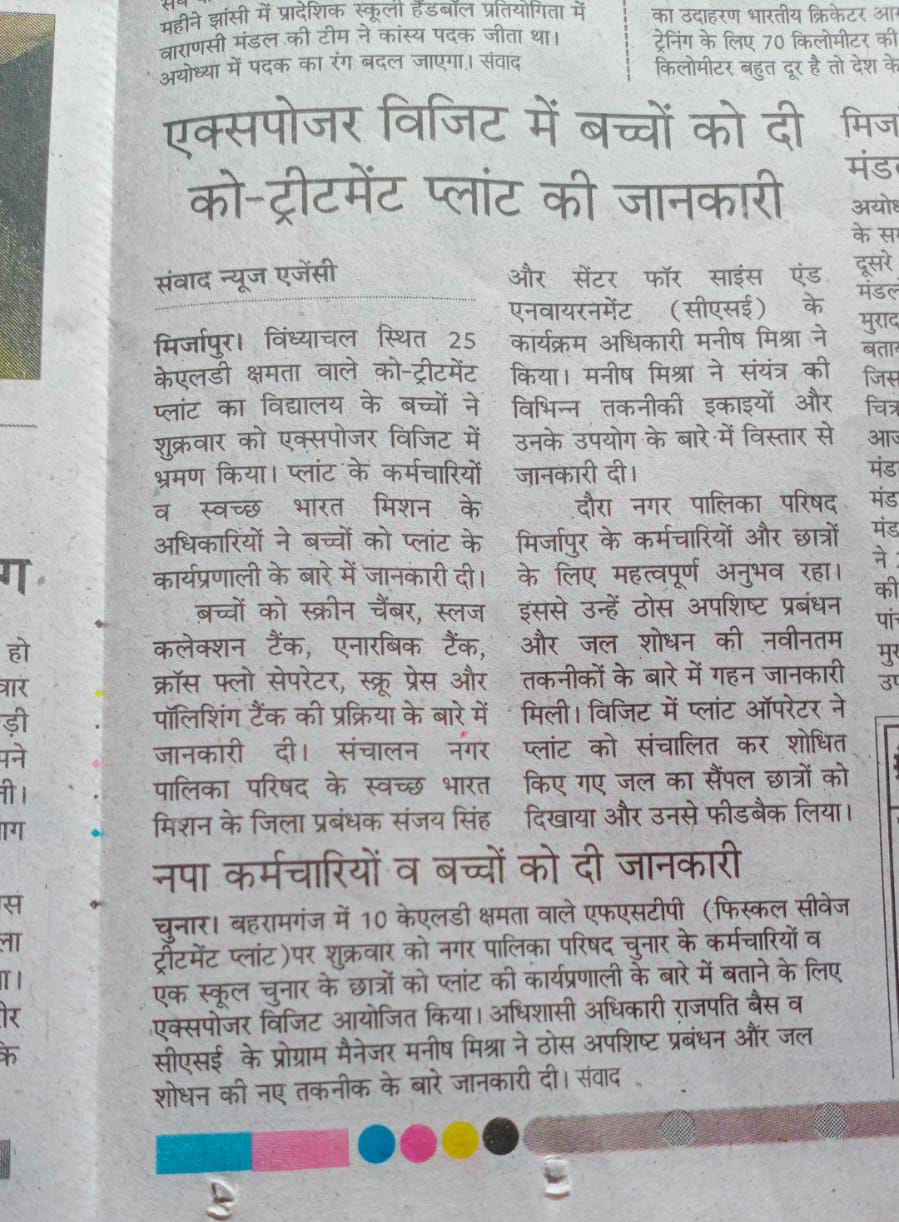
एक्सपोजर विजिट में बच्चों को दी को-ट्रीटमेंट प्लांट की जानकारी

विंध्याचल स्थित 25 केएलडी क्षमता वाले को-ट्रीटमेंट प्लांट का विद्यालय के बच्चों ने शुक्रवार को एक्सपोजर विजिट में भ्रमण किया। प्लांट के कर्मचारियों व स्वच्छ भारत मिशन के अधिकारियों ने बच्चों को प्लांट के कार्यप्रणाली के बारे में जानकारी दी। बच्चों को स्क्रीन चैंबर, स्लज कलेक्शन टैंक, एनारबिक टैंक, क्रॉस फ्लो सेपरेटर, स्क्रू प्रेस और पॉलिशिंग टैंक की प्रक्रिया के बारे में जानकारी दी। संचालन नगर पालिका परिषद के स्वच्छ भारत मिशन के जिला प्रबंधक संजय सिंह और सेंटर फॉर साइंस एंड एनवायरनमेंट (सीएसई) के कार्यक्रम अधिकारी मनीष मिश्रा ने किया। मनीष मिश्रा ने संयंत्र की विभिन्न तकनीकी इकाइयों और उनके उपयोग के बारे में विस्तार से जानकारी दी। दौरा नगर पालिका परिषद मिर्जापुर के कर्मचारियों और छात्रों के लिए महत्वपूर्ण अनुभव रहा। इससे उन्हें ठोस अपशिष्ट प्रबंधन और जल शोधन की नवीनतम तकनीकों के बारे में गहन जानकारी मिली। विजिट में प्लांट ऑपरेटर ने प्लांट को संचालित कर शोधित किए गए जल का सैंपल छात्रों को दिखाया और उनसे फीडबैक लिया।

33% of India’s soil degraded

RAJASTHAN: India is witnessing an alarming rise in soil degradation, threatening its agricultural productivity, food security, and environmental sustainability. Soil, a vital resource supporting the livelihoods of millions of farmers and maintaining ecosystem balance, is under siege from various forms of degradation. According to recent estimates, nearly 115 to 120 million hectares (Mha)—roughly 33% of the country’s total geographic area (TGA)—are affected by soil degradation, including water erosion, wind erosion, salinity, and vegetation loss. This growing issue was discussed in detail by all stakeholders at the Climate Week organised by the New-Delhi based Centre for Science and Environment (CSE) at its Anil Agarwal Environment Training Institute in Nimli, Rajasthan. N K Lenka, principal scientist and head, Soil Physics Division of ICAR-Indian Institute of Soil Science, Madhya Pradesh told TNIE on the sidelines of the event: “Out of 360 million hectares of total geographical area, 115 to 120 million hectares are degraded. This data was harmonised from different sources, including ISRO’s Satellite Application Centre (SAC), National Bureau of Soil Survey and Institute of Soil Science. The parameters to categorise soil degradation are chemical and physical. For instance, in the case of chemical degradation, soil would have become acidic. Even if farmers apply loads of urea, the soil will give no produce. Our trials show in some locations, the soil quality came down by 10 times,” he said. The latest Desertification and Land Degradation Atlas of India published by the SAC, which formed the basis for the assessment, reveals that water erosion is the most significant contributor, affecting 11.01% of India’s land. Other major processes include vegetation degradation (9.15%) and wind erosion (5.46%). These processes, compounded by deforestation, poor agricultural practices, and climate change, are particularly prevalent in semi-arid and dry sub-humid regions of the country. The atlas also highlights the growing impact of desertification, with 83.69 Mha of dryland classified as undergoing this process, which has seen a cumulative increase of over 1 million hectares since 2003-05. In addition to natural processes, human-induced activities, such as mining, overgrazing, and industrial pollution have further exacerbated the problem. States like Rajasthan, Maharashtra, Gujarat, and Telangana are among the worst affected, with significant portions of their land showing severe degradation. Rajasthan alone, for example, has over 21 million hectares classified as degraded, largely due to wind erosion in its arid and semi-arid zones. Soil degradation has far-reaching consequences on India’s agricultural sector, which contributes significantly to the national economy and provides employment to a large percentage of the population. The loss of topsoil and nutrients due to erosion has reduced the land’s ability to sustain crops, leading to lower yields and increased vulnerability to extreme weather events. Sunita Narain, Director General of CSE told this newspaper: “Depletion in soil quality means depletion of carbon content and increased need for fertilisers. This adds to Greenhouse Gases emissions. The way ahead is to increase soil carbon through increased use of biomass. There can be many options to do this - from natural farming to increased use of nitrogen fixing crops and increased use of organic manure. This is a win-win as it will add fertility, reduce subsidies for fertilisers and emissions.” Soil degradation in Tamil Nadu Tamil Nadu, a state heavily reliant on agriculture, is also witnessing significant soil degradation. According to the Desertification and Land Degradation Atlas, the state had 1.60 million hectares affected by various forms of degradation as of 2018-19. Water erosion, particularly in the plains and riverine regions, accounts for a substantial portion of the degradation, along with localised salinity issues in coastal areas. In the hilly regions of Tamil Nadu, land degradation manifests through mass movements, where steep slopes and heavy rainfall result in soil loss and landslides. Additionally, unsustainable agricultural practices, such as excessive use of chemical fertilizers and improper irrigation methods, have contributed to soil hardening and reduced fertility in many parts of the state. Ongoing efforts The government, under its commitment to the United Nations Convention to Combat Desertification, has set an ambitious target of achieving land degradation neutrality by 2030. This includes the restoration of 26 million hectares of degraded land.

Delhi air pollution: How open burning is adding fuel to fire

NEW DELHI: The share of pollutants emitted by burning of waste in PM2.5 is expected to rise in the coming days. Though open burning is currently insignificant as a factor in pollution at the moment, it assumes bigger proportions as winter sets in when the poor and homeless people burn waste, wood and other combustibles to beat the cold. "The air quality is likely to be in the ‘very poor' to ‘poor' categories for the six days from Oct 21 onwards," forecast the Air Quality Early Warning System for Delhi, the forecasting body under the Union ministry of earth sciences. "Meteorological conditions are highly unfavourable for the effective dispersion of pollutants. Additional emissions from sources such as stubble and waste burning are likely to deteriorate air quality significantly." How open burning is adding fuel to fire According to the real-time source apportionment study undertaken by Delhi Pollution Control Committee and IIT-Kanpur, the share of biomass burning (burning of wood, dung and agricultural residue) was 24% from Nov 2022 to Jan 29, 2023. An IIT-Delhi study in 2021 found that haze episodes in Jan were highly affected by biomass burning, likely from the burning wood, coal or roadside trash for cooking or warming. Similarly, a 2018 joint report by The Energy and Resources Institute and Automotive Research Association of India stated that during winter, fuel (mainly biomass) burning in houses and agricultural fields accounted for an average 14% of PM2.5 and 13% of PM10 pollutants. In Aug, the Commission for Air Quality Management issued an advisory to all residents' welfare associations and housing societies to provide electric heaters or other suitable appliances to security personnel and other staff to help them avoid burning wood to keep themselves warm. Anumita Roychowdhury, executive director, research and advocacy, Centre for Science and Environment, said, "Waste burning can be controlled only when 100% collection, segregation and material recovery is achieved. Alongside, the legacy waste at landfills must be remediated. In fact, the municipality has to implement the Waste Management Rules and central govt programme on this." Delhi Fire Services received 2,425 calls about garbage burning from Jan to May this year compared with 1,498 in the same period last year. "Burning garbage emits such thick smoke that it can hinder rescue operations. It's also hazardous if inhaled," a fire official had earlier told TOI.

Winter Pollution in Delhi: Stubble Burning, Emissions, and Traffic Cited as Major Factors

With winter approaching, the national capital braces for a recurring issue: deteriorating air quality. Environment expert Vivek Chattopadhyay emphasized multiple factors contributing to the seasonal spike in pollution, including emissions, traffic congestion, and industrial activities. According to Chattopadhyay, Principal Program Manager at the Air Pollution Centre for Science and Environment, “The major factor is the sudden change in weather conditions, which is not allowing pollutants to disperse. Emissions are rising, and new sources, such as biomass and garbage burning, also add to the pollution load.” He noted that the differences between summer and winter pollution are stark, with winter’s lack of wind trapping emissions and creating the infamous haze over Delhi. Traffic congestion and industrial emissions continue to aggravate the situation. Chattopadhyay stressed the need for clean fuel in industries and called for action against coal-based plants outside Delhi to mitigate the issue. “We need to address this at a regional level to optimize solutions,” he added. One of the most pressing contributors to pollution in northern India remains stubble burning by farmers in states like Punjab and Haryana. Despite various measures, the issue persists, and the Supreme Court has stepped in, summoning the Chief Secretaries of both states for a report on why stricter legal actions have not been implemented. Aam Aadmi Party leader Jasmine Shah shared a mixed report, stating a 27% reduction in stubble burning incidents in Punjab this year, while Haryana saw a 23% increase. “We are witnessing a reduction in Punjab, but efforts in Haryana need to intensify,” Shah said during a press conference.