
Cse In News

Delhi minister stages hunger strike for more water to city amid extreme heat

“There are 2.8 million people in the city who are aching for just a drop of water,” Delhi Water Minister Atishi said on Monday, the fourth day of her fast. Millions of Indians face water shortages every summer when water demand rises in farms, offices and homes against a limited supply, but a prolonged heatwave this year has worsened the shortfall, including in Delhi and the southern tech hub of Bengaluru. Delhi relies on the Yamuna River that runs through the capital for most of its water needs but the river slows down during dry summer months, causing shortages that lead to protests and calls for better water conservation. Atishi blamed the neighbouring farming state of Haryana for guzzling up a large share of river water. Haryana’s government responded that it was Delhi’s mismanagement that was causing water shortages. Experts said a federal-level review of decades-old water sharing pacts was needed to accommodate population growth. Delhi, a city of 20 million people, is one of the world’s most densely populated capitals, where upscale neighbourhoods and manicured lawns are just a few miles away from unplanned working-class areas and slums. But, in contrast to growing unplanned development over the years, the city’s water allocation from rivers has remained unchanged since 1994, said Depinder Kapur, the director of water programme at think tank Centre for Science and Environment. The technologies will enable, still, all of us to enjoy fashion because isn’t that at the end of the day everyone wants to be looking good. “What was true 10-15 years ago is not true anymore. So, there is a situation of crisis and it’s a distribution issue,” he said. The Delhi government is working on plans to improve the groundwater table by reviving lakes and storing water overflow from the Yamuna during the seasonal monsoon rains, but officials say the summer shortfall is difficult to tackle by these measures alone. “Water crisis in Delhi is a year-long crisis because extreme temperatures are not going anywhere,” said environmentalist Vimlendu Jha. “Delhi needs a comprehensive water management plan in which Yamuna can’t be the only major source of water.”
Send only less-polluting buses to Delhi region, non-NCR states told

Buses from five states coming to Delhi and National Capital Region (NCR) will have to transition to electric, CNG or BS VI by the end of the year to reduce vehicular emissions in the region, the Commission for Air Quality Management (CAQM) in NCR has said in an order. CAQM has asked Punjab, Himachal Pradesh, Madhya Pradesh, Uttarakhand and Jammu and Kashmir, the states from which inter-city buses come to Delhi-NCR, to facilitate transition to cleaner fuels by the end of 2024, fixing deadlines for each of the states and UTs. The apex pollution control body for NCR said that this will be applicable to buses operated by the state Public Sector Undertakings (PSUs) as well as private entities, which make trips to Delhi-NCR and back. The decision was taken after deliberations with these state governments in a meeting held on April 5, CAQM said. “It emerged during the meeting with these five states and UTs that transition to only CNG or EV buses by these states will take much longer time. But it becomes necessary to prioritise replacing older BS-III or BS-IV inter-city diesel buses running from these states to Delhi-NCR with BS-VI diesel compliant buses and action was initiated in this direction towards appropriate replacement of such buses,” CAQM said in its order, dated June 14, a copy of which HT has seen. The document said the deadline to switch to cleaner fuels for inter-city buses from Punjab, Himachal Pradesh and Madhya Pradesh is December 31, 2024, and for Jammu and Kashmir, it is September 30, 2024. For Uttarakhand, CAQM said that out of the 541 buses required to run to and from Delhi-NCR, 160 were currently complaint, and the remaining 379 is required to switch to clean fuels. For 190 buses, the deadline to transition is December 31, 2024, with the remaining required to be done by March 31, 2025. After Uttarakhand, the highest number of inter-city buses to Delhi-NCR comes from Himachal Pradesh (238), followed by Punjab (147). Himachal Pradesh already has 207 of its buses using clean fuels, and Punjab has 105 out of its 147 buses running on cleaner fuels, it said. “Apart from the bus services operated by the state government, inter-city bus services being operated by the state PSUs and private entities also have to switch to electric or CNG or BS VI complaint. Bus services operating under the Association of Independent Tour Operators (AITO) licence regime are, however, presently not to be covered in the ambit of these guidelines,” the order added. Earlier, CAQM set a deadline of January 1, 2024 for all NCR states to ensure their buses going to Delhi were running on cleaner fuel, stating that those not following these norms would not be allowed to enter the Capital. Anumita Roychowdhury, executive director, research and advocacy, Centre for Science and Environment, said that the latest move is an important one for transition to cleaner fuels in NCR. “This can not only provide cleaner public transport, but also ensure significantly lower emissions from tailpipes of these heavy-duty buses. This will also help pollution hot spots in Delhi such as Anand Vihar,” she said.

City to get 500 more e-buses, premium services planned

Chennai: State transport minister SS Sivasankar announced on Tuesday the procurement of 500 additional electric buses for Chennai, with tenders for the first batch of 500 e-buses reaching the final stage this week. These A/C e-buses will replace a third of the Metropolitan Transport Corporation’s ageing fleet. The second phase of the project will cost approximately 959 crore, with 70% funded by the World Bank and the rest by the state govt. Another key announcement by the minister was a feasibility study for introducing premium bus services in the city. These services would feature A/C, Wi-Fi connections, CCTV, GPS trackers, and luxury seats in the existing newer red-coloured MTC buses. In response to opposition leader Edappadi Palaniswamo’s remarks about the old bus fleet, the minister noted that when the DMK came to power in 2021, 50% of the transport department’s fleet consisted of old buses. “During the previous DMK regime (2006-2011), about 15,000 new buses were added. However, from 2011 to 2021, under AIADMK, only 14,000 buses were bought. Under the current leadership, new buses have been procured, evident to the opposition leader while traveling from Chennai to Salem,” he said, adding that 7,700 new govt buses will replace old ones by the end of this year. We also published the following articles recently Buses & Bongos: This 86-year-old dabbles both with easeDriven by passion and talent, I continue to captivate audiences in London with my rhythmic performances. From discovering my talent as a schoolboy in Bhopal to becoming a sought-after percussionist, my journey showcases dedication and musical excellence, despite challenges posed by technology and the pursuit of financial security.111150644 Inter-City Buses Entering Capital To Switch To Cleaner Fuels By Year-End Anumita Roychowdhury advocates integrating battery technology in heavy-duty bus fleets for emission control, emphasizing the importance of transitioning to clean fuel technologies to effectively reduce pollution around high-traffic areas like interstate bus terminals.111269705 JK Tyre launches new tyre range for trucks, buses, and EVs: Lower operating costs, 10% longer lifeDiscover JK Tyre's latest tyre lineup, featuring energy-efficient options like JETWAY JUM XM and long-lasting models such as JETWAY JUC XM. Also, explore heavy-load transportation solutions with JETSTEEL JDC XD and the low-noise design of JETWAY JUXe for TATA Motors' EV buses.111169308

India's Air Pollution Crisis: Over 870 Million Slowly Being Poisoned, Promises To Clean Air Fail. What Modi 3.0 Can Do

In 2019, the BJP government pledged to reduce pollution by 20-30% in 131 cities and launched a national clean air programme, but India is still home to 42 of the world’s 50 most polluted cities. About 876 million Indians, more than the combined population of the United States and Canada, live in areas where pollution far exceeds national air quality standards. The capital city experiences inhalable dust levels 100 times higher than WHO guidelines. Kolkata: It was 2016 when Prasanta Purkait, 43, a technician for a pest control company here in West Bengal’s capital, first experienced difficulty breathing. He noticed an uneasiness in his throat and a heavy feeling in his chest, the symptoms progressively worsening while a persistent cough would not subside despite medication. Living in a densely populated South Kolkata locality near Gariahat police station, Purkait cycles about 10 km every day to different parts of Kolkata for work. Over time, the city’s air pollution took a toll on his health, leading to a diagnosis of asthma and chronic obstructive pulmonary disease (COPD). As these conditions progressively damage his lungs and strain his heart, Purkait continues to cycle through the congested streets for his job. "I have never smoked,” said Purkait. Doctors told him Kolkata's pollution was to blame. "I wear masks and gargle with warm water… but my symptoms become unbearable during the winter." In November 2023, Kolkata’s air quality was in the ‘moderately polluted’ and ‘poor’ categories according to the ​​National Air Quality Index run by the union ministry for environment, forests and climate change (MoEF&CC), which considers eight pollutants including particulate matter and noxious gases. Kolkata’s AQI levels hovered between 195 and 271 in the winter of 2023, crossing 300 in January 2024. As per AirNow, following the U.S. Environmental Protection Agency index, an AQI over 100 is considered "unhealthy for sensitive groups," while 151-200 is "unhealthy" for the general public and poses increased risks for sensitive groups. Levels between 201-300 are "very unhealthy," with heightened health risks for everyone. AQI exceeding 301 is labelled "hazardous," indicating emergency health conditions affecting everyone. During this period, Kolkata's PM 2.5 level, which measures inhalable particulate matter or dust particles of diameters below 2.5 micrometres or microns, were up to 20 times higher than the WHO’s safe limit. Particulate matter that falls within the PM 2.5 category are very fine particles, about 30 times thinner than the width of a human hair, which, when inhaled, penetrate deep into the lungs and are associated with a variety of respiratory and cardiovascular failures. A 2010 study by the Chittaranjan National Cancer Institute, the West Bengal Department of Environment, and the Central Pollution Control Board (CPCB) found that about 70% of Kolkata's residents suffer from respiratory disorders due to air pollution. "When I struggle with my COPD flares, I cannot sleep at night,” Purkait said, struggling for breath as he spoke. “I feel like I am dying." Purkait's medical expenses have increased, with inhalers becoming a lifeline. The unhygienic conditions and lack of ventilation in the settlement where he lives, one of the regions in South Kolkata with a poor air quality index (AQI), worsen his health. Over 800 Million At Risk Of Dying Earlier Delhi, the world’s most polluted capital city, sees PM 2.5 levels soaring 100 times above WHO limits during peak winter months. From October to February, Delhi’s air quality fluctuates between ‘very poor’ and ‘severe’, while from March to May, it remains in the ‘poor’ category. India is home to 42 of the world's top 50 most polluted cities. Whether ruled by parties that constitute India’s political opposition or by the ruling Bharatiya Janata Party (BJP), 1.3 billion Indians live in areas where the annual average particulate pollution level exceeds the WHO’s guideline of 5μg/m3 (microns per cubic metre) by 16 times. More than two-thirds of the population, or 876 million people, more than the population of the United States and Canada combined, live in areas where air pollution exceeds India’s own national air quality standard of 40 µg/m3, which shaves 5.3 years off the life of the average Indian. While air pollution remained absent from political discourse during the recently concluded 45-day general elections to the Lok Sabha, the 2024 State Of Global Air Report, a work of collaborative research by the US-based Health Effects Institute and Institute for Health Metrics and Evaluation, gives the Modi 3.0 government a clear and urgent agenda to address air pollution and its health impacts. With their billion-plus populations, India and China together accounted for 54% of the total global disease burden from air pollution-related ailments in 2021; and the same year, nearly 50% of all ozone-related COPD deaths in the world were in India, according to the report. The study pegged pollution-related deaths among children under five in India in 2021 at 169,400 deaths, the highest in the world, followed by Nigeria and Pakistan. “Increasingly, rising temperatures are worsening air pollution and its health effects,” the report said, underscoring the need for urgent and integrated action on improving air quality and cutting greenhouse gas emissions. “Pollution undercuts health, stability, and productivity from individuals and families up to entire societies, nations, and regions.” ‘Year-Round Measures Needed’ Air quality improvement or environmental issues are not yet a priority in India, said Abhijit Chatterjee of Bose Institute, an interdisciplinary research centre in Kolkata, also an advisor to the National Clean Air Programme (NCAP), an MoEF&CC project. “If you don't get water for four days, there is outrage,” said Chatterjee. “But have you ever protested about the quality of the air you breathe?” Chatterjee said clean air, unlike drinking water, was not a voting issue because it was not visible. Residents in Delhi, particularly those with jobs that required exposure to the outdoors, echoed similar concerns. A 30-year-old reporter in the capital city said her coughing and breathlessness fade away when she leaves the city. "Half of the winter, I'm either coughing or sneezing," she said, requesting that her name not be used. A post-Covid bout of bronchitis has meant that her condition is easily triggered by pollution and dust. In 2019, for the first time, both the BJP and the Congress included in their election manifestos promises to address air pollution. The BJP promised to completely eliminate crop residue burning, and to develop advanced technologies and devices for better pollution monitoring in major cities. The BJP’s manifesto also announced the relaunch of the NCAP as a mission to reduce air pollution in the country’s most polluted 131 cities, with a goal to reduce pollution levels in each of these cities by at least 35% over the next five years. Delhi’s ruling Aam Aadmi Party (AAP), in its 2019 manifesto, promised measures such as the odd-even number plate scheme for vehicles and the graded response action plan (GRAP) during winter, citing Delhi’s non-statehood status as a limitation to implementing comprehensive pollution control measures. Full statehood would allow them to introduce 100% electric buses in Delhi, vacuum cleaning of roads within a year, and enforcement of stringent rules for construction sites, the manifesto said. Air quality improvement measures are largely seen as stopgap arrangements, said Keshav Suryanarayanan, deputy manager at ITDP India, which represents the Institute of Transportation and Development Policy (ITDP), a global non-profit organisation that works with cities worldwide to design transport systems that, among other things, reduce pollution. "Measures to improve air quality need to be permanent and implemented year-round. Because pollution is permanent, the solutions should be too,” said Suryanarayanan. Winter smog becomes a concern because of its visibility, he said, “but the air is toxic all year round". The Stubble-Burning Threat The union government has said that a central sector scheme for promotion of mechanisation for in-situ management of crop residue in Punjab, Haryana, Uttar Pradesh and the national capital territory of Delhi promotes use of machines to clear post-harvest fields with a 50% subsidy to individual farmers and 80% subsidy for establishments. The schemes for crop residue management are aimed at reducing pollution from stubble burning. In 2023, the BJP government in Haryana also announced a paddy stubble management policy, aiming to utilise paddy straw left over on the field post-harvest for generation of sustainable energy. The policy aims to completely curb crop residue burning practices by 2027. Similarly, the Punjab government has promised to manage all 19.5 million tonnes of paddy straw in the state post-harvest, to prevent air pollution from crop residue burning. Between 2018 and 2022, the centre released funds totalling Rs 2,440.07 crore to these states, through which more than 200,000 machines to clear crop residue have been delivered to individual farmers and groups. Despite these measures and notwithstanding reductions in emissions in recent years, stubble burning remains a contributor to Delhi's air pollution during peak pollution seasons. In 2023, between 15 September and 23 November, 55,725 farm fires were recorded across six states of Punjab, Haryana, Uttar Pradesh, Delhi, Rajasthan and Madhya Pradesh. Ravi Kumar, 32, a small farmer from Punjab’s Ferozepur district, has elderly family members suffering from asthma. “I know stubble burning is harmful to health, but I don’t have the money to use machines to clear my field,” he told Article 14. “We don’t burn the stubble by choice.” In response to AQI levels dipping in Delhi, the AAP, BJP and Congress have blamed one another (here, here, and here) for the worsening conditions. The BJP has accused the Arvind Kejriwal-led AAP for air pollution in Delhi and stubble burning in Punjab, while AAP has pointed fingers at the Haryana and Uttar Pradesh governments for not taking steps to address the issue. Experts and environmentalists said resolving the air pollution crisis would need a coordinated approach among state and central governments. “Addressing air pollution cannot solely be a state agenda, as national-level policies play a pivotal role,” said Naba Dutta, general secretary of Sabuj Mancha, a platform of environmental groups. Promit Mookherjee, a researcher at the think tank Observer Research Foundation (ORF), said India needed a framework to bring different state governments together by establishing regional task forces or groups to formulate policies collaboratively. “The challenge lies in coordinating efforts between states, as the political will required to prioritise air pollution varies,” said Mookherjee. Unlike Delhi, where air pollution is a pressing issue, states such as Punjab or Uttar Pradesh may not prioritise it, he said. Fixing The National Plan For Better Air The flagship National Clean Air Programme (NCAP), outlined in the BJP's 2019 manifesto, was launched in January 2019 to reduce particulate pollution of key pollutants PM 10 and PM 2.5 by 20%-30% in 131 cities by 2024. In September 2022, this target was revised to a 40% reduction by 2026. Multiple independent studies showed how the NCAP’s targets and methods require updating. A 2024 analysis by the think tank Climate Trends revealed mixed results for NCAP, showing that 17 cities had witnessed improvements while others experienced worsening air quality. While cities such as Kanpur, Meerut, and Lucknow met the NCAP targets, all of India’s 13 least polluted cities in 2023 still exceeded the WHO's limit of 5 µg/m³, which underscores the challenges in achieving internationally recognised air quality standards. Meanwhile, despite the NCAP’s focus on better monitoring and mitigation measures, air pollution levels in major Indian cities including Delhi, Patna, Kolkata and Mumbai remained mostly unchanged or worsened during the winter months of 2023 compared to 2022, according to data. ... A cyclist rides through Kolkata's streets, passing construction sites. In January 2024, Kolkata's PM 2.5 level, which measures inhalable particulate matter or dust particles of diameters below 2.5 micrometres or microns, were up to 20 times higher than WHO-prescribed safe limits. Delhi reported the highest PM2.5 levels at 102 µg/m³ in 2023, a 2.5% increase from 2022. Patna recorded the highest PM10 levels in 2023, at 212.1 µg/m³, a 5.8% worsening from its 2019 levels. Uttar Pradesh’s Varanasi city, with a population of 1.78 million, saw a 72% reduction in PM 2.5 and a 69% decrease in PM 10, according to official data. However, independent monitors still flag Varanasi’s air quality as ‘unhealthy’. Cities such as Navi Mumbai, Ujjain, and Mumbai observed a rise in PM 2.5 levels, possibly due to an increase in active monitors as well as extended monitoring time. For PM10, Durgapur, Thane, and Mumbai showed an increase of 53%, 46% and 36%, respectively. A 2024 article in Health Policy Watch, an online news outlet, highlighted that by the end of 2023, more than half of the funding allocated for the NCAP remained unused. Compliance with the National Ambient Air Quality Standards and the clean air targets under the NCAP requires extensive air quality monitoring. However, a 2023 study by the Centre for Science and Environment (CSE) revealed that only 12% of India’s 4,041 census cities and towns have such monitoring systems, and just 200 cities monitor all six key pollutant criteria. A major challenge with the implementation of NCAP is that it lacks legal enforcement. “It serves more as a guideline for the government rather than a mandated requirement,” Mookherjee said. Scorecards maintained under the programme offer a measure of accountability but there is no legal obligation for compliance. Ending The Rural-Urban Divide The programme’s urban-centric focus also neglects rural areas and non-NCAP cities, which also face significant pollution. “Air pollution is not restricted to cities,” Chatterjee said, adding that addressing this problem would require a regional ‘airshed’ management approach, which monitors pollutants concentrated in given areas not limited to conventional city or district boundaries. In 2023, union minister of state for environment, forests and climate change Ashwini Kumar Choubey told Parliament that an IIT-Delhi study to delineate India’s major airsheds based on satellite data had found eight to nine major airsheds of “varying geographic coverage”, such as one or two over the Indo-Gangetic Plain, two to three smaller airsheds in north-eastern India, etc. Sector-wise recommendations had been made by a committee regarding an airshed-based approach, he said. Even five years since its launch, the NCAP lacks a roadmap for defining airsheds and developing cross-jurisdictional monitoring processes needed for effectively implementing airshed-based air quality management.

भारत के हर दूसरे घर में पहुंच गई है कोल्ड ड्रिंक, हाल ही में आई रिपोर्ट में आए चौंकाने वाले आंकड़े

क्या आप भी गर्मी में कोल्ड ड्रिंक पीने के शौकीन हैं? तो यह रिपोर्ट आपको जरूर पढ़नी चाहिए। हाल ही में आई एक रिपोर्ट के मुताबिक पिछले 2 साल में सॉफ्ट ड्रिंक्स की खपत लगभग 50% तक बढ़ गई है। रिपोर्ट की मानें तो पिछले 2 साल में पैकेज्ड सॉफ्ट ड्रिंक्स की खपत में 250 मिलीलीटर की औसत बढ़ोत्तरी हुई है। कांतार FMCG पल्स की रिपोर्ट की मानें तो इस बढ़ती गर्मी में इस खपत के और भी बढ़ने की संभावना है। जानलेवा है कोल्ड ड्रिंक्स का अधिक इस्तेमाल ‘सेंटर फॉर साइंस एंड एनवायरमेंट’ द्वारा जारी एक एक शोध के आंकड़ों के अनुसार दुनिया भर में 1,84,000 मौत का कारण कोल्ड ड्रिंक बन रही है। क्योंकि कोल्ड ड्रिंक में शुगर में भरपूर मात्रा पाई जाती है, जो लोगों को डायबिटीज का शिकार बना रही है। वहीं डायबिटीज के कारण लगभग 1,33,000 लोग हर साल मौत का शिकार हो रहे हैं।

पुराने जलस्रोत फिर पानीदार हो रहे: सी एस ई

भारत के जल निकायों में बदलाव आ रहा है: कई जलाशय जो पिछले कुछ वर्षों में बुरी तरह प्रदूषित या अतिक्रमणग्रस्त थे या सूख गए थे, अब पुनर्जीवित और कायाकल्प हो रहे हैं, और ऐसा सरकारी योजनाओं के साथ-साथ निजी और सामुदायिक पहलों की बदौलत हो रहा है - सेंटर फॉर साइंस एंड एनवायरनमेंट (सीएसई) के शोधकर्ताओं द्वारा किए गए एक नए राष्ट्रव्यापी सर्वेक्षण में यह बात सामने आई है। सर्वेक्षण के निष्कर्षों को 'बैक फ्रॉम द ब्रिंक: रिजुवेनेटिंग इंडियाज लेक्स, पोंड्स एंड टैंक्स - ए कम्पेंडियम ऑफ सक्सेस स्टोरीज' नामक पुस्तक में संकलित किया गया है, जिसे आज यहां एक राष्ट्रीय संगोष्ठी में जारी किया गया। कार्यक्रम में बोलते हुए, सीएसई की महानिदेशक सुनीता नारायण ने कहा: “हमें जल निकायों, झीलों, टैंकों और पोखरों की कला को फिर से सीखने की जरूरत है। यह हमारे लिए एक अवसर है - हम भारत की जल कहानी को बदल सकते हैं, खासकर आज के जलवायु परिवर्तन के समय में; सीएसई की यह पुस्तक हमें यही बताती है। लेकिन अभी भी बहुत कुछ किया जाना बाकी है। हमें स्थानीय जल प्रणालियों में निवेश करने के लिए अपने काम को बढ़ाने की जरूरत है ताकि बारिश की हर बूंद को इकट्ठा किया जा सके ताकि हम सूखे के खिलाफ स्थानीय लचीलापन बना सकें। हमारे शहरों में, हमें अपनी झीलों और पोखरों को पुनर्जीवित करने की जरूरत है, जो स्पंज हैं जो हमें बारिश-बाढ़ को इकट्ठा करने और यह सुनिश्चित करने की अनुमति देंगे कि यह पानी बर्बाद न हो। हमें अपने जंगलों और हरे भरे स्थानों की रक्षा करने की जरूरत है क्योंकि इसी तरह से जल पुनर्भरण बढ़ेगा।” नारायण ने कहा कि "जल संकट के इस समय में यह सुनिश्चित करना भी महत्वपूर्ण है कि अपशिष्ट जल - सीवेज - का न केवल उपचार किया जाए, बल्कि इसे रीसाइकिल करके पुनः उपयोग किया जाए। यहीं पर हमारे शहरों में संरक्षित जल निकाय, वही तालाब और टैंक जिनका उपयोग हम वर्षा जल को मोड़ने और संचय करने के लिए करते हैं, उनका उपयोग उपचारित सीवेज को चैनलाइज़ करने और बदले में भूजल को रिचार्ज करने के लिए किया जा सकता है।" सीएसई सर्वेक्षण : सीएसई की टीम ने लगभग एक वर्ष की अवधि में भारत के चार अलग-अलग पारिस्थितिक क्षेत्रों में 22 राज्य स्तरीय कार्यक्रमों और पांच केंद्रीय योजनाओं के तहत बनाए गए और/या बहाल किए गए 250 जलाशयों की समीक्षा की: सिंधु-गंगा के मैदान, रेगिस्तान, तटीय मैदान और दक्कन का पठार। जिन योजनाओं और कार्यक्रमों को शामिल किया गया है, उनमें मिशन अमृत सरोवर, अमृत 2.0, दिल्ली में झीलों का शहर परियोजना और तमिलनाडु की अनाइथु ग्राम अन्ना मरुमलार्ची थिट्टम ​​(एजीएएमटी) योजना शामिल हैं। समीक्षा किए गए 250 जलाशयों में से लगभग 140 सबसे अच्छे मामले थे। सीएसई के जल कार्यक्रम के कार्यक्रम निदेशक दीपिंदर एस कपूर ने कहा: "पिछले साल प्रकाशित देश की पहली जल संसाधन जनगणना के अनुसार भारत में 2,424,540 जल निकाय हैं। इनमें से 97 प्रतिशत से ज़्यादा ग्रामीण इलाकों में स्थित हैं। ये जल निकाय, उनके जलग्रहण क्षेत्र और उनके फीडर चैनल महत्वपूर्ण भूजल पुनर्भरण क्षेत्रों के रूप में कार्य करते हैं, बाढ़ को नियंत्रित करते हैं और अद्वितीय जैव विविधता का घर हैं।" उन्होंने आगे कहा: "सीएसई सर्वेक्षण और उसके परिणामस्वरूप प्रकाशित - केस स्टडीज़ का हमारा संग्रह - इन जलाशयों में से उन झीलों, तालाबों और टैंकों पर केंद्रित है जिनका उपयोग समुदायों द्वारा किया जाता है। यह एक दस्तावेज है, इन जलाशयों के सफल पुनरुद्धार का उत्सव है - कि क्या काम किया है, क्या नहीं किया है, और क्या और किया जा सकता है।" सीएसई के जल कार्यक्रम की वरिष्ठ कार्यक्रम प्रबंधक और बैक फ्रॉम द ब्रिंक की मुख्य लेखिका सुष्मिता सेनगुप्ता ने कहा: "हमने पाया है कि राजनीतिक और नौकरशाही-प्रशासनिक इच्छाशक्ति के साथ-साथ सामुदायिक भागीदारी ने जलाशयों के सफल पुनरुद्धार में महत्वपूर्ण भूमिका निभाई है। कुछ बेहतरीन बहाली कार्य वहीं हुए हैं, जहां जिला कलेक्टरों या स्थानीय राजनीतिक नेताओं ने विशेष रुचि दिखाई है।" उन्होंने कहा कि"कार्यक्रमों और योजनाओं में से, मिशन अमृत सरोवर ने निश्चित रूप से स्थिति को बदल दिया है, जबकि राज्य स्तरीय परियोजनाओं ने भी महत्वपूर्ण भूमिका निभाई है। गिरावट को रोकने के लिए एक शुरुआत की गई है - लेकिन गति को बनाए रखने की आवश्यकता है। सीएसई सर्वेक्षण और हमारे प्रकाशन ने भी ऐसा करने के लिए सिफारिशों का एक सेट प्रस्तावित किया है।" आगे का रास्ता क्या है? जल निकायों में प्रवेश करने से पहले अपशिष्ट जल का उपचार करें: ज़्यादातर मामलों में झीलें और जलाशय अनुपचारित अपशिष्ट जल और सीवेज के लिए पात्र बन गए हैं। इसका समाधान अपशिष्ट जल को जल निकायों में प्रवेश करने से पहले उपचारित करना और इस तरह से ट्रैक करना है कि कोई मलजल जल निकायों में न जाए। कपूर कहते हैं: " अटल मिशन फॉर रिजुवेनेशन एंड अर्बन ट्रांसफॉर्मेशन (AMRUT) 2.0 में जल निकायों के कायाकल्प के साथ-साथ अपशिष्ट जल के पुनर्चक्रण और पुनः उपयोग का प्रावधान है। इस मिशन के तहत निधियों का उपयोग सभी राज्यों द्वारा जल निकायों को बहाल करने के लिए प्रभावी ढंग से किया जा सकता है।" हर जल निकाय को समग्र रूप से देखें : जल निकाय, जलग्रहण क्षेत्र और उसके पोषक चैनलों को पुनर्जीवन के लिए एक साथ उपचारित किया जाना चाहिए। जलग्रहण क्षेत्र, जल निकाय और पोषक चैनलों की वास्तविक सीमाओं का मानचित्रण किया जाना चाहिए। क्षेत्रीय और स्थानीय स्तर पर जलभृत मानचित्रण से भूजल स्तर को बढ़ाने और बाढ़ को कम करने के लिए वैज्ञानिक बहाली सुनिश्चित करने की आवश्यकताओं को समझने में मदद मिलेगी। डेटाबेस बनाएं, जलाशयों की पहचान करें: भारत में शहर या जिला स्तर के प्रशासन को शायद ही कभी पता हो कि उनके पास कितने जलाशय हैं। शहर अक्सर अतिक्रमण और गाद से भरे जलाशयों को सूची से बाहर कर देते हैं। जलाशयों के जीर्णोद्धार की योजना बनाने के लिए, प्रत्येक राज्य के लिए अपनी सीमाओं के भीतर झीलों और जलाशयों की कुल संख्या की पहचान करना, रिकॉर्ड करना और संकलित करना अनिवार्य होना चाहिए। प्रौद्योगिकियों की एक सूची विकसित करें: इसे अपशिष्ट जल के उपचार और जल निकायों में प्रदूषण के उपशमन के लिए उपलब्ध कराया जाना चाहिए। रखरखाव और निगरानी सुनिश्चित करें : उदाहरण के लिए, 15 वें वित्त आयोग (एफएफसी) के तहत एमजीएनआरईजीएस फंड और वित्त का उपयोग पुनरुद्धार परियोजनाओं की स्थिरता सुनिश्चित करने के लिए किया जा सकता है। सेनगुप्ता कहते हैं: "ग्राम पंचायतें तालाबों के रखरखाव के लिए एफएफसी फंड का एक हिस्सा इस्तेमाल कर सकती हैं। किसी भी कायाकल्प या जीर्णोद्धार परियोजना की स्थिरता के लिए, रखरखाव और निगरानी को परियोजना का एक अभिन्न अंग बनाया जाना चाहिए - फंडिंग का एक हिस्सा केवल इसके लिए ही रोका जाना चाहिए।" सीएसई संगोष्ठी में कई लोग एकत्रित हुए - जल निकाय प्रबंधक, परियोजना प्रस्तावक, आरंभकर्ता और चालक - जो भारत के जल निकायों को पुनर्जीवित करने के इस मिशन में सबसे आगे रहे हैं। चर्चाओं का समापन करते हुए नारायण ने कहा: "हमें झीलों को जल सुरक्षा के एक प्रमुख स्रोत के रूप में एक बार फिर से देखना चाहिए, साथ ही बाढ़ शमन और सूखे प्रबंधन के लिए भी। यदि हमारे सीवेज का प्रबंधन नहीं किया जाता है तो झीलों को बचाया नहीं जा सकता है - इसलिए, सीवेज प्रबंधन प्रणाली का पुनर्निर्माण आवश्यक है, खासकर जब शहरी जल निकायों की बात आती है। हमें जमीनी स्तर पर उन अनुभवों से सीखने की ज़रूरत है जहाँ कार्यक्रम और योजनाएँ काम कर रही हैं, और कैसे और क्यों। हमें सीखना चाहिए क्योंकि जलवायु परिवर्तन के इस युग में अधिक बारिश होगी - लेकिन अगर हम बारिश का संचयन नहीं करते हैं तो बाढ़ और सूखे भी अधिक होगा।

जौनपुर में 32 केएलडी फीकल स्लज ट्री टमेंट प्लांट का निरीक्षण और महत्वपूर्ण बैठक संपन्न

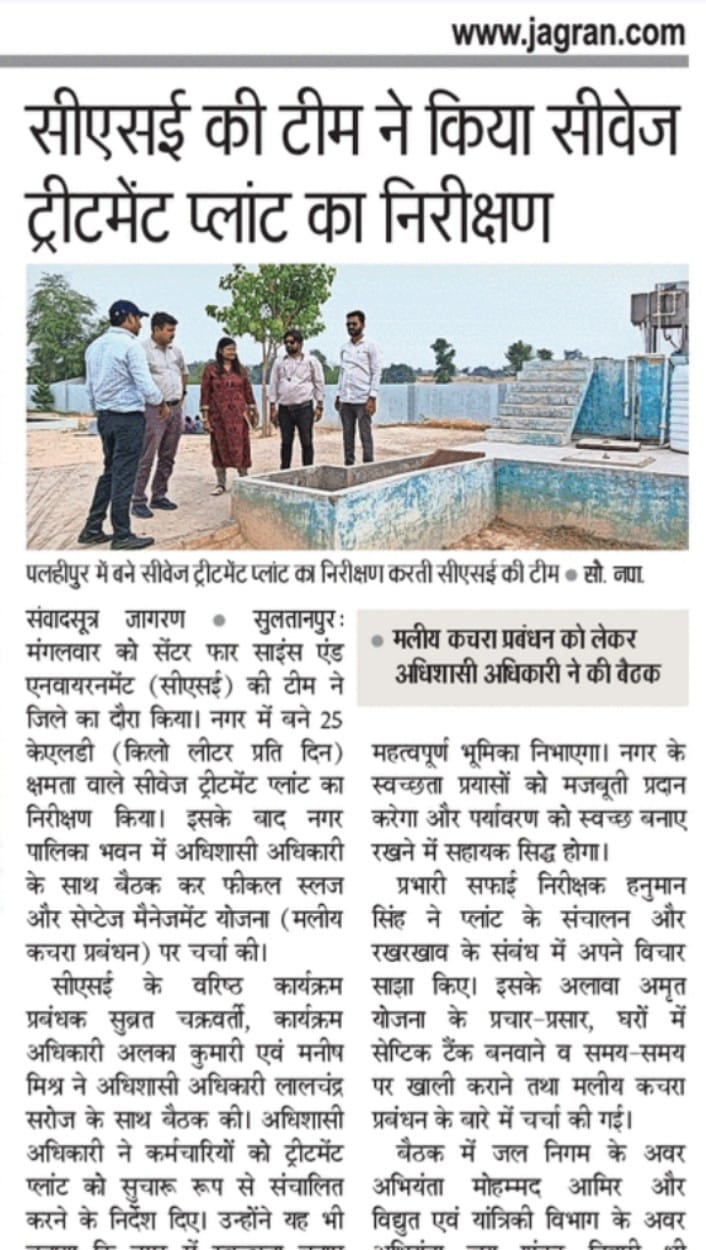
जौनपुर, 26 जून 2024: सेंटर फॉर साइंस एंड एनवायरमेंट के कार्यक्रम अधिकारी ईo मनीष मिश्रा ,अलका कुमारी , वरिष्ठ कार्यक्रम प्रबंधक सुब्रत चक्रवर्ती ने 26 जून 2024 को जौनपुर जिले का दौरा किया। इस दौरे का उद्देश्य 32 केएलडी (किलो लीटर प्रति दिन) क्षमता वाले फीकल स्लज ट्री टमेंट प्लांट का निरीक्षण और नगर पालिका में एफएसएसएम (फीकल स्लज और सेप्टेज मैनेजमेंट) योजनाओं पर चर्चा करना था। इस प्लांट का रखरखाव अमृत मित्र योजना के अंतर्गत महिलाओं द्वारा किया जा रहा है, जिनका आंकलन अलका कुमारी ने प्लांट विजिट के दौरान किया। जौनपुर नगर पालिका परिषद में आयोजित बैठक में निम्नलिखित बिंदुओं पर चर्चा और मार्गदर्शन दिया गया: 1. एफएसएसएम बाईलॉज जो की बोर्ड बैठक में स्वीकृत किया जा चुका है उसे समाचार पत्र में प्रकाशित करने के उपरांत गजट हेतु प्रेषित किया जाए 2. संस्थागत शेड्यूल डीस्लजिंग प्लान की तैयारी। 3. सभी निजी सेप्टिक टैंक डीस्लजिंग ऑपरेटरों के पंजीकरण पर चर्चा और निर्देश दिए। 4. सभी जनमानस को अपने घरों के सेप्टिक टैंक को प्रत्येक 3 वर्ष में खाली करने के संबंध में चर्चा। 5. अमृत योजना के अंतर्गत जन जागरूकता अभियान चलाने के लिए रणनीति बनाई गई। बैठक में जौनपुर नगर पालिका परिषद के अधिशासी अधिकारी पवन कुमार ने अपने स्टाफ को फीकल स्लज ट्री टमेंट प्लांट को सुचारू रूप से संचालित करने के निर्देश दिए। उन्होंनेन्हों नेयह भी बताया कि नगर में स्वच्छता बनाए रखने के लिए यह प्लांट एक महत्वपूर्ण भूमिका निभाएगा। जलकल के अवर अभियंता रागिनी मौर्या, सफाई एवं खाद्य निरीक्षक अवधेश कुमार, यूआईएस घनश्याम, डीपीएम एसबीएम खुशबू,डूडा सीएमएम जितेंद्र तथा अरविंद सिंह (एसबीएम) ने भी अपने विचार साझा किए और प्लांट के संचालन और रखरखाव के संबंध में महत्वपूर्ण सुझाव दिए। इस बैठक में उठाए गए कदम नगर के स्वच्छता और स्वास्थ्य में सुधार की दिशा में महत्वपूर्ण साबित होंगेहों गे। यह फीकल स्लज ट्री टमेंट प्लांट जौनपुर नगर के स्वच्छता प्रयासों को मजबूती प्रदान करेगा और पर्यावरण को स्वच्छ बनाए रखने में सहायक सिद्ध होगा।

Uttar Pradesh leads the nation in compressed biogas potential, but challenges persist: say experts at CSE-UPNEDA joint symposium

New Delhi-based think tank Centre for Science and Environment (CSE) and the Uttar Pradesh New and Renewable Energy Development Agency (UPNEDA) jointly organise a symposium in Muzaffarnagar to discuss the challenges facing the compressed biogas (CBG) industry in the state, and the way ahead Uttar Pradesh accounts for 24 per cent of the total compressed biogas (CBG) generation potential in India. According to CSE’s latest report, UP alone can install 1,000 CBG projects out of the 5,000 plants envisioned nationwide under the Sustainable Alternative Towards Affordable Transportation (SATAT) scheme, if a mere 20 per cent of its surplus feedstock is tapped Western UP (especially Muzaffarnagar, Meerut, Saharanpur, Bijnor, Bulandshahar and Aligarh) leads in feedstock availability as well as maximum number of functional and upcoming CBG plants in the state Despite leading the way in bioenergy sector in India, UP faces several challenges — from limited offtake of the bioslurry generated during production of CBG, to lack of trained personnel See CSE’s report on CBG in Uttar Pradesh: https://www.cseindia.org/compressed-biogas-landscape-in-uttar-pradesh-12120 For the symposium proceedings, please visit: https://www.cseindia.org/compressed-biogas-cbg-the-case-of-western-uttar-pradesh-12216 Muzaffarnagar (Uttar Pradesh), June 22, 2024:“Compressed biogas (CBG) offers a multitude of benefits for India: it can help enhance waste management, promote local clean energy solutions, and bring down our dependence on imported compressed natural gas (CNG). And Uttar Pradesh – especially its western districts of Muzaffarnagar, Meerut, Saharanpur, Bijnor, Bulandshahar and Aligarh — leads the nation in the potential to generate compressed biogas: it accounts for a sizable 24 per cent of the country’s total potential”: said researchers from New Delhi-based think tank Centre for Science and Environment (CSE) here today. They were speaking at a one-day symposium on CBG in western Uttar Pradesh; the symposium was jointly organised by CSE and the Uttar Pradesh New and Renewable Energy Development Agency (UPNEDA). Compressed biogas is made from various feedstocks, including municipal solid waste, agricultural waste, press-mud, and animal wastes. It is a purified version of biogas, and is also referred to as bio-CNG. Over 90 per cent of CBG, which is produced from anaerobic digestion from organic waste or biomass, constitutes of methane. Speaking at the symposium, Nivit Kumar Yadav, programme director, industrial pollution, CSE said: “Among Indian states, Uttar Pradesh has taken the lead in this sector with its ambitious bioenergy policy, allocating Rs 750 crore (2022-27) for CBG, while providing subsidies, land for lease and other incentives. This symposium has been organised to discuss the challenges faced by CBG producers, share successful practices, highlight opportunities for start-ups, raise awareness among district-level bioenergy committees, and educate farmer-producer bodies on the potential of bioenergy.” Echoing Yadav’s comments on the state government’s strides in the sector, Pankaj Singh, secretary/CPO, UPNEDA, said: “Uttar Pradesh has the most advanced bioenergy policy in India and leads in the number of upcoming CBG projects. Of the 128 CBG projects, 15 are operational, while the remaining 113 are in various stages of construction.” What are the challenges faced by the sector Limited offtake of by-products/bioslurry/fermented organic manure (FOM): CBG plants generate bioslurry, which can be a used as a fertiliser. However, there are no takers for the bioslurry produced by CBG plants. Says Dr Rahul Jain, deputy programme manager, renewable energy, CSE and the author of CSE’s report on CBG: “Instead of being considered a potential revenue source, bioslurry is perceived as a disposal challenge. Plant owners are either providing it for free to nearby farmers or disposing of it on vacant lands. There is a lack of awareness about the characteristics of bioslurry, appropriate application methods and potential benefits.” Partial gas offtake by oil and gas marketing companies: These companies acquire gas from CBG plants on a ‘best-endeavour’ basis, depending on market demand. This exposes plant owners to the risk of being unable to sell their entire gas production. Some plants are operating below their capacity because they cannot fully offload their gas. The absence of CNG gas pipelines near plant locations is another challenge faced by these facilities. It has been noted that gas transport through cascades is a viable option for plants with capacities below 5 tonne per day (TPD); for anything above this threshold, the most effective offtake model is through gas pipelines. Shortage of skilled technical humanpower: Operational challenges frequently confront functioning plants, resulting in issues like gas leakage, inefficiency and operating below optimal capacity. This arises from a lack of skilled personnel who have adequate understanding of biogas production systems and plant operations. Financing issues: Banks rarely show any interest in financing CBG projects – their concerns revolve around risks, low margins and the non-standardised nature of the industry. Banks commonly require high collateral as a standard practice, and interest rates start at a minimum of 11.5 per cent. Moreover, lending institutions lack the capacity to evaluate CBG proposals, which hampers the decision-making process. Jain points out:“Due to the lack of proper planning on both the upstream and downstream sides, most CBG plants are running below their actual designed capacity. On the upstream side, the plants are not able to source enough quantity of feedstock to run the plant. It is advisable to plan for the availability of surplus feedstock over and above the amount required in the plant annually. This requires plant operators to work with the suppliers (farmers, sugarcane mill owners and city municipalities) to get the feedstock. On the downstream side, the sale of gas is a big challenge due to the low CNG infrastructure presence near the CBG plant. It is critical to set up the plant either near CNG gas grids or where there is a high CNG demand for industrial or transport applications.” What CSE recommends Involve the farmers as shareholders: Encourage farmer-producer organisations through awareness campaigns to assume the role of feedstock aggregators, replacing third-party private entities. This ensures their active participation as project partners, fostering overall profit sharing in bioenergy projects. Ensure complete gas offtake by gas marketing companies: To achieve this, a strategic plan should be formulated to expand gas pipeline infrastructure near CBG plant locations. To stimulate demand in rural regions, introduce incentives for conversion of tractors and two-wheelers to run on CNG, or advocate the adoption of CNG-powered agricultural machinery. Incentivise/sensitise farmers to use bioslurry/FOM: Farmers should be made aware about the potential benefits of using carbon-rich FOM. The possibility of institutionalising incentive programmes for farmers for utilisation of FOM can be explored. To amplify awareness among farmers about the positive effects of FOM, Krishi Vigyan Kendras (KVKs) can play a pivotal role in education and outreach efforts. Address the challenges in bank loan procurement: Says Yadav: “A practical approach here would be to initiate a government-backed guarantee programme to mitigate collateral requirements, thereby encouraging financial institutions to extend loans more readily.” To enhance transparency and efficiency in the loan application process, the Reserve Bank of India (RBI) should oversee and monitor CBG project applications through a centralised online portal, implementing fixed deadlines for streamlined progress tracking. Establish CBG training centres: There is a need to train people to operate the CBG projects. The training centres shall be set up with short-term CBG courses to prepare skilled personnel. Broaden the feedstock variety: Jain says that “while 80 per cent of CBG plants currently rely on pressmud, there is a need to diversify the sources.” In addition to solid organic waste, efforts should be directed towards utilising liquid effluents such as spent wash from distilleries, industrial discharges from paper and pulp manufacturing, and other liquid industrial waste. Appreciating CSE’s inputs,Pankaj Singh, UPNEDA said: “All identified challenges and policy recommendations are noted and will be addressed through effective policy modifications and additions by our department.”

Uttar Pradesh Leads India in Compressed Biogas Production

Uttar Pradesh is a big player in India’s renewable energy market, especially when it comes to making compressed biogas (CBG). The Center for Science and Environment (CSE) released an important report that showed Uttar Pradesh could create 24% of India’s CBG. This was revealed at a symposium in Muzaffarnagar put together by CSE and the Uttar Pradesh New and Renewable Energy Development Agency (UPNEDA). The meeting was about improving waste management, finding local clean energy solutions, and lowering reliance on compressed natural gas (CNG) imports. Strategic Importance of Western Uttar Pradesh Western Uttar Pradesh, including towns like Muzaffarnagar, Meerut, and Saharanpur, is a key area for making CBG because it has a lot of feedstock. Most of the state’s current and future CBG plants are in this area. Uttar Pradesh could probably complete 1,000 of the 5,000 CBG projects planned across the country under the Sustainable Alternative Towards Affordable Transportation scheme with just a fifth of the extra fuel it has on hand. State’s Bioenergy Policy and Support Uttar Pradesh is a leader with its ambitious bioenergy policy. It calls for funding of Rs. 750 crore for CBG projects from 2022 to 2027, along with subsidies and leasing choices. The policy aims to help CBG producers deal with common problems, improve good practices, open up new business possibilities, and teach local groups about the advantages of bioenergy. Challenges Hindering CBG Adoption Even though the outlook is positive, the CBG sector faces many problems: Bioslurry Management: Bioslurry disposal is hard because it is often seen as trash instead of a useful by-product. There needs to be education about how useful it is as organic waste. Inconsistent Gas Offtake: CBG plants often use only some of their available gas because oil and gas companies don’t always buy it and there aren’t any close CNG pipelines. Skilled Personnel Shortage: The world needs highly trained people to run biogas systems, so specialized training centers should be set up. Financial Barriers: Banks are unwilling to lend money to CBG projects because they see them as risky. The government might have to back the projects with guarantees to get banks to lend money. Solutions and Strategic Measures To lessen these problems, changes to policies are being thought about. Some of the ideas being considered are using a variety of feedstocks to make the process more sustainable and making farmers partners in local bioenergy projects so that they directly benefit from them. Getting help from the government and making the payment system more clear are also important steps forward.

Weather: भारत जलवायु के मुद्दे पर और बड़ी भूमिका निभा सकता है, 2028 में COP की मेजबानी करे’, सुनीता नारायण बोलीं

सेंटर फॉर साइंस एंड एनवायरमेंट (सीएसई) की महानिदेशक नारायण ने कहा कि जलवायु परिवर्तन पर संयुक्त राष्ट्र रूपरेखा संधि के तहत पार्टियों का सम्मेलन एकमात्र ऐसा मंच है, जहां जलवायु परिवर्तन से पैदा हुईं चुनौतियों से निपटने के लिए बहुपक्षीय निर्णय लिए जा सकते हैं। हमारे सामने चुनौतियां हैं उन्होंने कहा, ‘दक्षिण के देशों के लिए खड़े होने वाले देश के रूप में हम और भी बड़ी भूमिका निभा सकते हैं। हमारे सामने चुनौतियां हैं। हम अपनी चुनौतियों के बारे में बात कर सकते हैं, उन्हें दबा नहीं सकते। हम दुनिया को आगे बढ़ने का बेहतर रास्ता खोजने में मदद कर सकते हैं। हम नेतृत्व की भूमिका निभा सकते हैं। पीएम मोदी ने दुबई में पार्टियों के सम्मेलन (सीओपी-28) में अपने संबोधन में 2028 में भारत में जलवायु सम्मेलन की मेजबानी करने की पेशकश की थी। सीओपी की अध्यक्षता बारी-बारी से सभी देश करेंगे। भारत के लिए अगला अवसर 2028 में होगा, जब एशिया को अपनी बारी मिलेगी। उस समूह के सभी देशों को मोदी की दावेदारी पर सर्वसम्मति से सहमत होना होगा, तभी इसकी पुष्टि होगी। हमें सीओपी की मेजबानी करनी चाहिए नारायण ने कहा कि हमें सीओपी की मेजबानी करनी चाहिए और बिल्कुल हमें बात करनी चाहिए। देखिए, जलवायु परिवर्तन दुनिया की एक बड़ी समस्या है। इसका द्विपक्षीय स्तर पर समाधान नहीं किया जा सकता है। यह एक बहुपक्षीय मुद्दा है। उन्होंने आगे कहा कि जलवायु परिवर्तन समाजवाद को पुनः सीखने का एक तरीका है, क्योंकि यह एक साझा वातावरण के बारे में है, जहां देशों को एक साथ रहना सीखना होगा, चाहे वे इसे पसंद करें या नहीं।

UP leads in compressed biogas potential, but challenges persist

“Compressed biogas (CBG) offers a multitude of benefits for India: it can help enhance waste management, promote local clean energy solutions, and bring down our dependence on imported compressed natural gas (CNG). And Uttar Pradesh – especially its western districts of Muzaffarnagar, Meerut, Saharanpur, Bijnor, Bulandshahar and Aligarh — leads the nation in the potential to generate compressed biogas: it accounts for a sizable 24 per cent of the country’s total potential”: said researchers from New Delhi-based think tank Centre for Science and Environment (CSE) in Muzaffarnagar. They were speaking at a one-day symposium on CBG in western Uttar Pradesh; the symposium was jointly organised by CSE and the Uttar Pradesh New and Renewable Energy Development Agency (UPNEDA). Compressed biogas is made from various feedstocks, including municipal solid waste, agricultural waste, press-mud, and animal wastes. It is a purified version of biogas, and is also referred to as bio-CNG. Over 90 per cent of CBG, which is produced from anaerobic digestion from organic waste or biomass, constitutes of methane. Speaking at the symposium, Nivit Kumar Yadav, programme director, industrial pollution, CSE said: “Among Indian states, Uttar Pradesh has taken the lead in this sector with its ambitious bioenergy policy, allocating Rs 750 crore (2022-27) for CBG, while providing subsidies, land for lease and other incentives. This symposium has been organised to discuss the challenges faced by CBG producers, share successful practices, highlight opportunities for start-ups, raise awareness among district-level bioenergy committees, and educate farmer-producer bodies on the potential of bioenergy.” Echoing Yadav’s comments on the state government’s strides in the sector, Pankaj Singh, secretary/CPO, UPNEDA, said: “Uttar Pradesh has the most advanced bioenergy policy in India and leads in the number of upcoming CBG projects. Of the 128 CBG projects, 15 are operational, while the remaining 113 are in various stages of construction.”

Delhi Minister Stages Hunger Strike for More Water to City Amid Extreme Heat

A Delhi city minister has started an indefinite hunger strike to demand more drinking water for India's capital, where taps in some of its poorest neighbourhoods are running nearly dry in the middle of searing heat. "There are 2.8 million people in the city who are aching for just a drop of water," Delhi Water Minister Atishi said on Monday, the fourth day of her fast. Millions of Indians face water shortages every summer when water demand rises in farms, offices and homes against a limited supply, but a prolonged heatwave this year has worsened the shortfall, including in Delhi and the southern tech hub of Bengaluru. Delhi, a city of 20 million people, is one of the world's most densely populated capitals, where upscale neighbourhoods and manicured lawns are just a few miles away from unplanned working-class areas and slums. But, in contrast to growing unplanned development over the years, the city's water allocation from rivers has remained unchanged since 1994, said Depinder Kapur, the director of water programme at think tank Centre for Science and Environment. "What was true 10-15 years ago is not true anymore. So, there is a situation of crisis and it's a distribution issue," he said.

Uttar Pradesh leads the nation in compressed biogas potential, but challenges persist: say experts at CSE-UPNEDA joint symposium

“Compressed biogas (CBG) offers a multitude of benefits for India: it can help enhance waste management, promote local clean energy solutions, and bring down our dependence on imported compressed natural gas (CNG). And Uttar Pradesh – especially its western districts of Muzaffarnagar, Meerut, Saharanpur, Bijnor, Bulandshahar and Aligarh — leads the nation in the potential to generate compressed biogas: it accounts for a sizable 24 per cent of the country’s total potential”: said researchers from New Delhi-based think tank Centre for Science and Environment (CSE) here today. They were speaking at a one-day symposium on CBG in western Uttar Pradesh; the symposium was jointly organised by CSE and the Uttar Pradesh New and Renewable Energy Development Agency (UPNEDA). Compressed biogas is made from various feedstocks, including municipal solid waste, agricultural waste, press-mud, and animal wastes. It is a purified version of biogas, and is also referred to as bio-CNG. Over 90 per cent of CBG, which is produced from anaerobic digestion from organic waste or biomass, constitutes of methane. Speaking at the symposium, Nivit Kumar Yadav, programme director, industrial pollution, CSE said: “Among Indian states, Uttar Pradesh has taken the lead in this sector with its ambitious bioenergy policy, allocating Rs 750 crore (2022-27) for CBG, while providing subsidies, land for lease and other incentives. This symposium has been organised to discuss the challenges faced by CBG producers, share successful practices, highlight opportunities for start-ups, raise awareness among district-level bioenergy committees, and educate farmer-producer bodies on the potential of bioenergy.” Echoing Yadav’s comments on the state government’s strides in the sector, Pankaj Singh, secretary/CPO, UPNEDA, said: “Uttar Pradesh has the most advanced bioenergy policy in India and leads in the number of upcoming CBG projects. Of the 128 CBG projects, 15 are operational, while the remaining 113 are in various stages of construction.” What are the challenges faced by the sector Limited offtake of by-products/bioslurry/fermented organic manure (FOM): CBG plants generate bioslurry, which can be a used as a fertiliser. However, there are no takers for the bioslurry produced by CBG plants. Says Dr Rahul Jain, deputy programme manager, renewable energy, CSE and the author of CSE’s report on CBG: “Instead of being considered a potential revenue source, bioslurry is perceived as a disposal challenge. Plant owners are either providing it for free to nearby farmers or disposing of it on vacant lands. There is a lack of awareness about the characteristics of bioslurry, appropriate application methods and potential benefits.”

https://english.jagran.com/india/water-crisis-hits-indian-cities-60-crore-indians-facing-water-scarcity-situation-likely-to-worsen-10169218

Delhi is in a dire situation due to the ongoing water crisis. The situation has deteriorated to the extent that long queues for water tankers are seen in many areas of Delhi, including Kusumpur Pahadi, Okhla, Sangam Vihar and Vivekananda Camp, while NDMC has managed to supply water once in VIP areas.The IT hub of India, Bengaluru, is currently facing a daily shortfall of 200 million litres of water. A report by the Centre for Science and Environment suggests that an estimated 484.2 billion cubic metres, equivalnet to 48.42 billion one-litre water bottles, are wasted every day. Sunita Narain, Director of the Centre for Science and Environment and an environmentalist, says that the water crisis emerging in Bengaluru this year should be a matter of concern for the entire country. Our cities will remain livable only when even the poorest resident has access to clean drinking water. Bengaluru received adequate rainfall, and it has lakes that can collect this rainwater and recharge the groundwater. These lakes also prevent flooding during heavy rains. Every drop of water in cities can be used for the future.

Delhi minister stages hunger strike for more water to city amid extreme heat

A Delhi city minister has started an indefinite hunger strike to demand more drinking water for India’s capital, where taps in some of its poorest neighbourhoods are running nearly dry in the middle of searing heat. “There are 2.8 million people in the city who are aching for just a drop of water,” Delhi Water Minister Atishi said on Monday, the fourth day of her fast. Millions of Indians face water shortages every summer when water demand rises in farms, offices and homes against a limited supply, but a prolonged heatwave this year has worsened the shortfall, including in Delhi and the southern tech hub of Bengaluru. Atishi blamed the neighbouring farming state of Haryana for guzzling up a large share of river water. Haryana’s government responded that it was Delhi’s mismanagement that was causing water shortages. Experts said a federal-level review of decades-old water sharing pacts was needed to accommodate population growth. Delhi, a city of 20 million people, is one of the world’s most densely populated capitals, where upscale neighbourhoods and manicured lawns are just a few miles away from unplanned working-class areas and slums. But, in contrast to growing unplanned development over the years, the city’s water allocation from rivers has remained unchanged since 1994, said Depinder Kapur, the director of water programme at think tank Centre for Science and Environment. “What was true 10-15 years ago is not true anymore. So, there is a situation of crisis and it’s a distribution issue,” he said.