
Cse In News

India's 'heat trap' cities make summers worse, says government official

NEW DELHI (Reuters) - Indian cities have become "heat traps" due to their unbalanced growth devouring water bodies and increasing greenhouse emissions, a senior government official said on Monday, as a scorching summer killed dozens in some parts of the country. The India Meteorological Department (IMD) has forecast above-normal temperatures for June in the northwest and central parts of the country including Delhi, making it one of the longest heatwave spells. The highest daily temperatures in the capital have stayed above 40 degrees Celsius (104 Fahrenheit) since May 12 and are forecast to fall below that mark only on June 26. The IMD's heatwave criteria start with 40 degrees in the plains and 30 degrees for hills where it is generally cooler because of elevation. Delhi, which is also facing a water shortage, recorded about 44 degrees late Monday afternoon but the IMD said it felt like 49.2 degrees. "Climate change plays an important role," Krishna S. Vatsa, a member of the National Disaster Management Authority, told Reuters. Unbalanced urban growth, which has reduced wetlands and water bodies, was another factor, Vatsa said. "The emission of greenhouse gases has gone up. The permeable spaces have gone down considerably. The cities actually have become heat traps." As a result, he said, nights are nearly as uncomfortable as days. According to a study by the Centre for Science and Environment (CSE) published last month, land surface temperatures in the summers of 2001 to 2010 in cities such as Delhi, Hyderabad, Kolkata and Mumbai used to drop by up to 13.2 degrees during the night from their day-time peak. Between 2014 and 2023 they were only cooling off by up to 11.5 degrees. "Hot nights are as dangerous as mid-day peak temperatures," the Centre's report said. "People get little chance to recover from day-time heat if temperatures remain high overnight." Vatsa said most Indian states were implementing heat action plans that include provisioning drinking water and better medical facilities, as well as rescheduling outdoor work and school vacations. But Anumita Roychowdhury, CSE's executive director, said there was no clear mandate to implement long-term strategies. Delhi's long-term plan includes increasing heat insulation of buildings, developing shelters for urban poor and slum dwellers, and investing in cooling water bodies. Such plans need to be backed financially, said Vishwas Chitale of the Council on Energy, Environment and Water think tank in New Delhi. "Cities are struggling with their own finance and they don't have additional budget to implement actions for heat," he said. (Reporting by Krishna N. Das, Shivangi Acharya and Jatindra Dash; Editing by Tomasz Janowski)
India’s ‘heat trap’ cities make summers worse, says government official

Indian cities have become “heat traps” due to their unbalanced growth devouring water bodies and increasing greenhouse emissions, a senior government official said on Monday, as a scorching summer killed dozens in some parts of the country. The India Meteorological Department (IMD) has forecast above-normal temperatures for June in the northwest and central parts of the country including Delhi, making it one of the longest heatwave spells. For all the latest headlines follow our Google News channel online or via the app. The highest daily temperatures in the capital have stayed above 40 degrees Celsius (104 Fahrenheit) since May 12 and are forecast to fall below that mark only on June 26. The IMD’s heatwave criteria start with 40 degrees in the plains and 30 degrees for hills where it is generally cooler because of elevation. Delhi, which is also facing a water shortage, recorded about 44 degrees late Monday afternoon but the IMD said it felt like 49.2 degrees. “Climate change plays an important role,” Krishna S. Vatsa, a member of the National Disaster Management Authority, told Reuters. Unbalanced urban growth, which has reduced wetlands and water bodies, was another factor, Vatsa said. “The emission of greenhouse gases has gone up. The permeable spaces have gone down considerably. The cities actually have become heat traps.” As a result, he said, nights are nearly as uncomfortable as days. According to a study by the Centre for Science and Environment (CSE) published last month, land surface temperatures in the summers of 2001 to 2010 in cities such as Delhi, Hyderabad, Kolkata and Mumbai used to drop by up to 13.2 degrees during the night from their day-time peak. Between 2014 and 2023 they were only cooling off by up to 11.5 degrees. “Hot nights are as dangerous as mid-day peak temperatures,” the Centre’s report said. “People get little chance to recover from day-time heat if temperatures remain high overnight.” Vatsa said most Indian states were implementing heat action plans that include provisioning drinking water and better medical facilities, as well as rescheduling outdoor work and school vacations. But Anumita Roychowdhury, CSE’s executive director, said there was no clear mandate to implement long-term strategies. Delhi’s long-term plan includes increasing heat insulation of buildings, developing shelters for urban poor and slum dwellers, and investing in cooling water bodies. Such plans need to be backed financially, said Vishwas Chitale of the Council on Energy, Environment and Water think tank in New Delhi. “Cities are struggling with their own finance and they don’t have additional budget to implement actions for heat,” he said.

India's 'heat trap' cities make summers worse, says government official

NEW DELHI (Reuters) - Indian cities have become "heat traps" due to their unbalanced growth devouring water bodies and increasing greenhouse emissions, a senior government official said on Monday, as a scorching summer killed dozens in some parts of the country. The India Meteorological Department (IMD) has forecast above-normal temperatures for June in the northwest and central parts of the country including Delhi, making it one of the longest heatwave spells. The highest daily temperatures in the capital have stayed above 40 degrees Celsius (104 Fahrenheit) since May 12 and are forecast to fall below that mark only on June 26. The IMD's heatwave criteria start with 40 degrees in the plains and 30 degrees for hills where it is generally cooler because of elevation. Delhi, which is also facing a water shortage, recorded about 44 degrees late Monday afternoon but the IMD said it felt like 49.2 degrees. "Climate change plays an important role," Krishna S. Vatsa, a member of the National Disaster Management Authority, told Reuters. Unbalanced urban growth, which has reduced wetlands and water bodies, was another factor, Vatsa said. "The emission of greenhouse gases has gone up. The permeable spaces have gone down considerably. The cities actually have become heat traps." As a result, he said, nights are nearly as uncomfortable as days. According to a study by the Centre for Science and Environment (CSE) published last month, land surface temperatures in the summers of 2001 to 2010 in cities such as Delhi, Hyderabad, Kolkata and Mumbai used to drop by up to 13.2 degrees during the night from their day-time peak. Between 2014 and 2023 they were only cooling off by up to 11.5 degrees. "Hot nights are as dangerous as mid-day peak temperatures," the Centre's report said. "People get little chance to recover from day-time heat if temperatures remain high overnight." Vatsa said most Indian states were implementing heat action plans that include provisioning drinking water and better medical facilities, as well as rescheduling outdoor work and school vacations. But Anumita Roychowdhury, CSE's executive director, said there was no clear mandate to implement long-term strategies. Delhi's long-term plan includes increasing heat insulation of buildings, developing shelters for urban poor and slum dwellers, and investing in cooling water bodies. Such plans need to be backed financially, said Vishwas Chitale of the Council on Energy, Environment and Water think tank in New Delhi. "Cities are struggling with their own finance and they don't have additional budget to implement actions for heat," he said.

India’s ‘heat trap’ cities make summers worse, says government official

Indian cities have become “heat traps” due to their unbalanced growth devouring water bodies and increasing greenhouse emissions, a senior government official said on Monday, as a scorching summer killed dozens in some parts of the country. The India Meteorological Department (IMD) has forecast above-normal temperatures for June in the northwest and central parts of the country including Delhi, making it one of the longest heatwave spells. The highest daily temperatures in the capital have stayed above 40 degrees Celsius (104 Fahrenheit) since May 12 and are forecast to fall below that mark only on June 26. The IMD’s heatwave criteria start with 40 degrees in the plains and 30 degrees for hills where it is generally cooler because of elevation. Delhi, which is also facing a water shortage, recorded about 44 degrees late Monday afternoon but the IMD said it felt like 49.2 degrees. “Climate change plays an important role,” Krishna S. Vatsa, a member of the National Disaster Management Authority, told Reuters. Unbalanced urban growth, which has reduced wetlands and water bodies, was another factor, Vatsa said. “The emission of greenhouse gases has gone up. The permeable spaces have gone down considerably. The cities actually have become heat traps.” As a result, he said, nights are nearly as uncomfortable as days. According to a study by the Centre for Science and Environment (CSE) published last month, land surface temperatures in the summers of 2001 to 2010 in cities such as Delhi, Hyderabad, Kolkata and Mumbai used to drop by up to 13.2 degrees during the night from their day-time peak. Between 2014 and 2023 they were only cooling off by up to 11.5 degrees. “Hot nights are as dangerous as mid-day peak temperatures,” the Centre’s report said. “People get little chance to recover from day-time heat if temperatures remain high overnight.” Vatsa said most Indian states were implementing heat action plans that include provisioning drinking water and better medical facilities, as well as rescheduling outdoor work and school vacations. But Anumita Roychowdhury, CSE’s executive director, said there was no clear mandate to implement long-term strategies. Delhi’s long-term plan includes increasing heat insulation of buildings, developing shelters for urban poor and slum dwellers, and investing in cooling water bodies.

India’s ‘Heat Trap’ Cities Make Summers Worse, Says Government Official

Indian cities have become “heat traps” due to their unbalanced growth devouring water bodies and increasing greenhouse emissions, a senior government official said on Monday (June 17), as a scorching summer killed dozens in some parts of the country. The India Meteorological Department (IMD) has forecast above-normal temperatures for June in the northwest and central parts of the country including Delhi, making it one of the longest heatwave spells. Also Read: Centre Tells States To Be Prepared To Meet Challenges Of Heat Wave, Forest Fires The highest daily temperatures in the capital have stayed above 40 degrees Celsius (104 Fahrenheit) since May 12 and are forecast to fall below that mark only on June 26. The IMD’s heatwave criteria start with 40 degrees in the plains and 30 degrees for hills where it is generally cooler because of elevation. Delhi, which is also facing a water shortage, recorded about 44 degrees late Monday afternoon but the IMD said it felt like 49.2 degrees. Krishna S. Vatsa, a member of the National Disaster Management Authority, told Reuters, Climate change plays an important role. Unbalanced urban growth, which has reduced wetlands and water bodies, was another factor, Mr Vatsa said. The emission of greenhouse gases has gone up. The permeable spaces have gone down considerably. The cities actually have become heat traps. As a result, he said, nights are nearly as uncomfortable as days. According to a study by the Centre for Science and Environment (CSE) published last month, land surface temperatures in the summers of 2001 to 2010 in cities such as Delhi, Hyderabad, Kolkata and Mumbai used to drop by up to 13.2 degrees during the night from their day-time peak. Between 2014 and 2023 they were only cooling off by up to 11.5 degrees. The Centre’s report said, Hot nights are as dangerous as mid-day peak temperatures. People get little chance to recover from day-time heat if temperatures remain high overnight. Mr Vatsa said most Indian states were implementing heat action plans that include provisioning drinking water and better medical facilities, as well as rescheduling outdoor work and school vacations. But Anumita Roychowdhury, CSE’s executive director, said there was no clear mandate to implement long-term strategies. Delhi’s long-term plan includes increasing heat insulation of buildings, developing shelters for urban poor and slum dwellers, and investing in cooling water bodies. Such plans need to be backed financially, said Vishwas Chitale of the Council on Energy, Environment and Water think tank in New Delhi. He said,

India’s ‘heat trap’ cities make summers worse, says government official

Indian cities have become “heat traps” due to their unbalanced growth devouring water bodies and increasing greenhouse emissions, a senior government official said on Monday, as a scorching summer killed dozens in some parts of the country. The India Meteorological Department (IMD) has forecast above-normal temperatures for June in the northwest and central parts of the country including Delhi, making it one of the longest heatwave spells. The highest daily temperatures in the capital have stayed above 40 degrees Celsius (104 Fahrenheit) since May 12 and are forecast to fall below that mark only on June 26. The IMD’s heatwave criteria start with 40 degrees in the plains and 30 degrees for hills where it is generally cooler because of elevation. Unbalanced urban growth, which has reduced wetlands and water bodies, was another factor, Vatsa said. “The emission of greenhouse gases has gone up. The permeable spaces have gone down considerably. The cities actually have become heat traps.” As a result, he said, nights are nearly as uncomfortable as days. According to a study by the Centre for Science and Environment (CSE) published last month, land surface temperatures in the summers of 2001 to 2010 in cities such as Delhi, Hyderabad, Kolkata and Mumbai used to drop by up to 13.2 degrees during the night from their day-time peak. Between 2014 and 2023 they were only cooling off by up to 11.5 degrees. “Hot nights are as dangerous as mid-day peak temperatures,” the Centre’s report said. “People get little chance to recover from day-time heat if temperatures remain high overnight.”

India’s ‘heat trap’ cities make summers worse, says government official

NEW DELHI (Reuters) – Indian cities have become “heat traps” due to their unbalanced growth devouring water bodies and increasing greenhouse emissions, a senior government official said on Monday, as a scorching summer killed dozens in some parts of the country. The India Meteorological Department (IMD) has forecast above-normal temperatures for June in the northwest and central parts of the country including Delhi, making it one of the longest heatwave spells. The highest daily temperatures in the capital have stayed above 40 degrees Celsius (104 Fahrenheit) since May 12 and are forecast to fall below that mark only on June 26. The IMD’s heatwave criteria start with 40 degrees in the plains and 30 degrees for hills where it is generally cooler because of elevation. Delhi, which is also facing a water shortage, recorded about 44 degrees late Monday afternoon but the IMD said it felt like 49.2 degrees. “Climate change plays an important role,” Krishna S. Vatsa, a member of the National Disaster Management Authority, told Reuters. Unbalanced urban growth, which has reduced wetlands and water bodies, was another factor, Vatsa said. “The emission of greenhouse gases has gone up. The permeable spaces have gone down considerably. The cities actually have become heat traps.” As a result, he said, nights are nearly as uncomfortable as days. According to a study by the Centre for Science and Environment (CSE) published last month, land surface temperatures in the summers of 2001 to 2010 in cities such as Delhi, Hyderabad, Kolkata and Mumbai used to drop by up to 13.2 degrees during the night from their day-time peak. Between 2014 and 2023 they were only cooling off by up to 11.5 degrees. “Hot nights are as dangerous as mid-day peak temperatures,” the Centre’s report said. “People get little chance to recover from day-time heat if temperatures remain high overnight.” Vatsa said most Indian states were implementing heat action plans that include provisioning drinking water and better medical facilities, as well as rescheduling outdoor work and school vacations. But Anumita Roychowdhury, CSE’s executive director, said there was no clear mandate to implement long-term strategies. Delhi’s long-term plan includes increasing heat insulation of buildings, developing shelters for urban poor and slum dwellers, and investing in cooling water bodies. Such plans need to be backed financially, said Vishwas Chitale of the Council on Energy, Environment and Water think tank in New Delhi. “Cities are struggling with their own finance and they don’t have additional budget to implement actions for heat,” he said. (Reporting by Krishna N. Das, Shivangi Acharya and Jatindra Dash; Editing by Tomasz Janowski)

Climate change: New collective formed

Kochi: A collective of environmentalists, activists and youngsters who engage in climate-related activities has been formed in Kochi to address the issue of climate change. The collective, Climate Leaders Action Network (CLAN30), comprises around 80 climate leaders from Kerala, Tamil Nadu and Uttarakhand. It has been formed under Sustera foundation, a nonprofit organisation and Asar, a collective active in 16 states in the country. In the programme held on Saturday and Sunday, activists and experts discussed various activities related to climate change. The collective is envisaged to carry out works on strengthening local bodies in their works on climate change, creating awareness among the public on environment conservation, policy formulation, skill development activities and ensuring public participation in the works to combat climate change. The collective discussed how policy should be formulated to materialise the collective’s objectives and its further activities. Sunitha Narayan, director of Centre for Science and Environment, addressed the collective online. Representatives of entities including Asar, Poovulakin Nanparkal, Clean Mobility Collective, Climate collective INECC and Well Labs discussed various issues thrown up by climate change. Around 40 environmentalists from Kerala and TN and others spoke at the event.tnn We also published the following articles recently EU puts digital Earth in orbit for climate-change fightThe EU Commission launched the Destination Earth initiative, creating a digital model of the planet using advanced data and AI. Margrethe Vestager highlighted its importance for climate action.110913203 Experts, activists slam 'pointless' G7 on climateThe Group of Seven (G7) failed to make significant new progress on climate commitments during a summit in Italy, reiterating existing pledges. Experts criticized the lack of new commitments and emphasized the insufficient measures to address the climate crisis.111018827 Climate change funding talks stuck ahead of COP29 summitCountries are in disagreement over global funding for the upcoming UN climate summit, particularly regarding support for the developing world at COP29 climate talks in Azerbaijan.

India's Heat Crisis: Unprepared Cities and Rising Temperatures

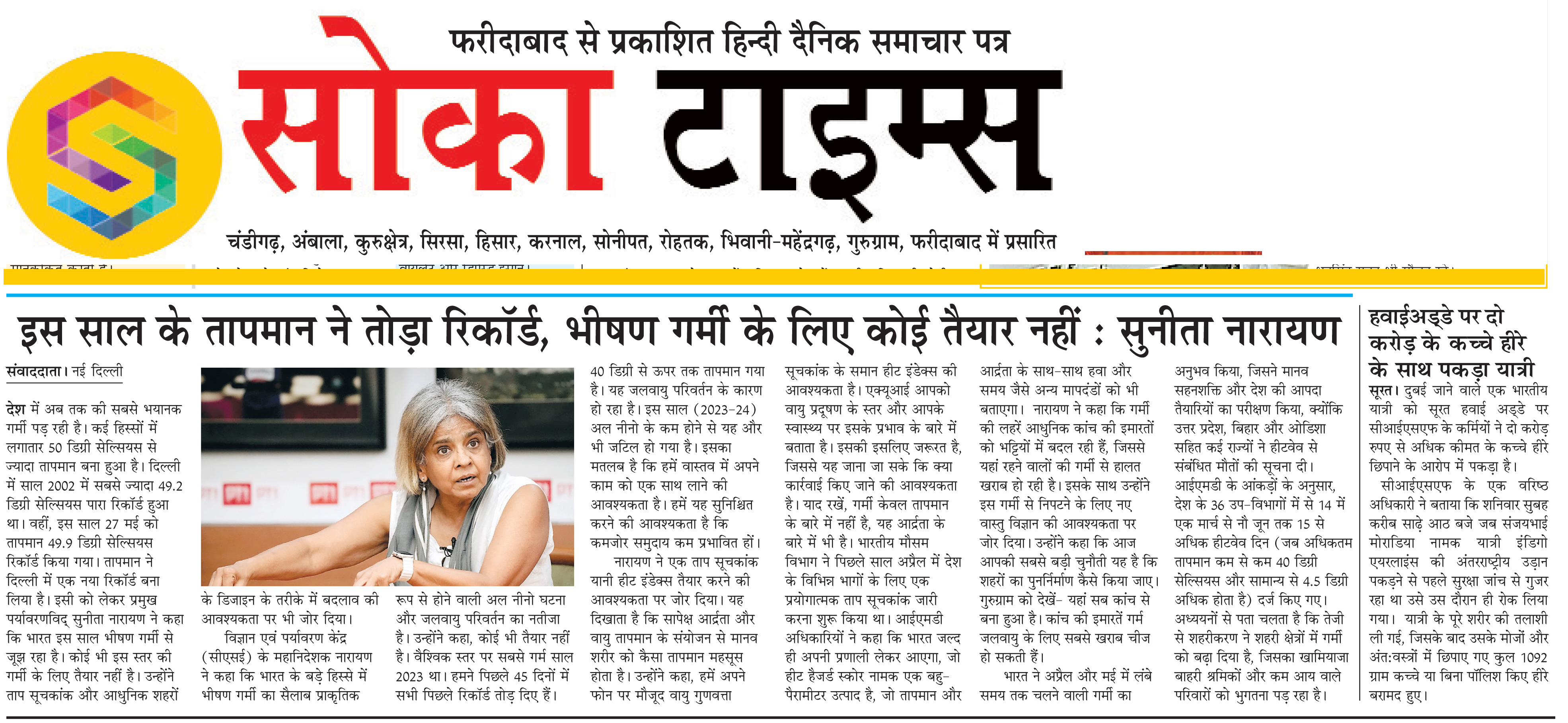
India faces extreme heatwaves this summer, exacerbated by climate change and the El Nino phenomenon. Environmentalist Sunita Narain urges the need for a heat index and revamped city designs. Widespread heatwaves affect vulnerable communities and low-income households severely, while also straining power and water resources. Narain, Director General of the Centre for Science and Environment (CSE), explained during an interaction with PTI editors that the current heat is largely driven by both the natural El Nino phenomenon and climate change. 'Nobody is prepared. 2023 was globally the hottest year on record,' Narain said. She emphasized that the combination of high temperatures and waning El Nino effects necessitates immediate action, particularly to protect vulnerable communities. The Indian Meteorological Department has started issuing an experimental heat index, and is set to introduce a more comprehensive system soon. Narain stressed the importance of this index in helping the public understand and respond to heat dangers, much like the air quality index functions for pollution levels. Modern infrastructure also faces significant challenges. Heatwaves have turned glass-facade buildings into 'furnaces,' demanding new architectural approaches. 'We need to rebuild our cities,' Narain stated. This issue is compounded by rapid urbanization, which worsens the warming effect, particularly for outdoor workers and low-income households with poor access to resources. (This story has not been edited by Devdiscourse staff and is auto-generated from a syndicated feed.)

Conference on “Environment, Mines and Mineral Laws”

A state level conference on “Environment, Mines and Mineral Laws” was organised in the Judicial Academy of Jharkhand at Ranchi. The conference was inaugurated by Hon’ble Mr. Justice Adarsh Kumar Goel, Former Judge Supreme Court of India and former chairperson of National Green Tribunal, Hon’ble Mr. Justice Sujit Narayan Prasad, Hon’ble Mr. Justice Rongon Mukhopadhyay, Judge High Court of Jharkhand, Environmentalist Sunita Narayan. Speaking to the occasion, Justice Adarsh Kumar Goel emphasised that from time immemorial environment has been worshipped in India and India’s contribution to environment has been one of the best in world but sadly India has been a victim of environmental degradation. Justice Goel also lauded the role of state of Jharkhand and congratulated the Judicial Academy for organising the conference as well as coming out with an important research material on the issues of environment. Justice Goel also mentioned that it is axiomatic that we are polluting everything and then suggesting not to consume polluted articles. Highlighting the challenges in environment protection, Justice Goel stated that we are extracting minerals recklessly and the business of illegal mineral extraction has reached around 126 billion dollars; that there are almost 351 polluted rivers in India; there is no culture of initiating Environment Impact Assessment prior to commissioning developmental projects, city like Bangalore is no more a city of lakes and there a poor maintenance of Biodiversity Management Committee. Concluding the address, Justice Goel stated that right to clean environment is a part of right to life under Article 21 and at the same time Article 48 A and 51 A casts a duty on the state and the citizens to maintain a clean and sustainable environment. Whereas Ms. Sunita Narain stated that bottom line of everything in this world is balance but sadly this balance is badly hit due to our poor treatment of environment and the consequence is visible in long stretch of 40 degree plus temperature in India, long droughts and shortage of quality rain water. Ms. Narain stated that life in Jharkhand is intricately linked with forest and people are dependent upon forest for their survival. Ms Narain also highlighted that there is direct relation between clean drinking water and climate change and in order to address the challenges we need to cultivate the habit of storing rain water, establishment of new environmental institution, adopting stricter norms for forest clearances, fixing the accountability of institutions who have duty to maintain environment sustainability and in all these the role of judiciary become pivotal. Ms. Narain highlighted some good practices such as practice of waste management; adoption of renewable energy. Concluding her remarks, Ms. Narain stated that we should not forget that there is a deep connect between cultural diversity and biodiversity. Whereas Senior Advocate Sh. Sanjay Upadhyay highlighted that that the executive implementation is different from that of legislature intent and similarly sometimes the interpretation of laws is different from what is intended by the legislature. Mr. Upadhayay also highlighted that the importance of traditional understanding of environment and underlined the judgements of High Courts wherein rivers have been designated as living entities but the question is how to operationalise it? Mr. Upadhayay also highlighted that today if national highway is less than 100 km we do not need Environment Impact Assessment and this is noting but tweaking the law and all such things are creating a mess. Mr. Upadhayay concluded the session with a question that why we should not have a separate law for a separate eco system. Sri Indrajit Sinha, Advocate, High Court of Jharkhand deliberated upon various provisions of Mines and Minerals Development Regulation Act as well as the rules drafted thereunder. Sri Sinha also addressed the queries of participants with regard to implementation of various Environmental Laws and the execution thereof in the trial courts as well as by the government bodies such as Mines and Forest Departments. The session was greatly was appreciated by all the participants. The conference was attended by the senior Judges of High Court, Judicial Officers from Districts, Officers from police department, forest department, mines and geology department public prosecutors Sh. S. Upadhyay, Senior Advocate of Supreme Court and Sh. Indrajit Sinha, Advocate, Jharkhand High Court. Hon’ble Mrs. Justice Anubha Rawat Chowdhary expressed vote of thanks

Heat Wave: गर्मी से बचना है तो बदलना होगा शहरों का वास्तु; सीएसई की महानिदेशक सुनीता नारायण ने दी सलाह

विज्ञान और पर्यावरण केंद्र (सीएसई) की महानिदेशक और पर्यावरणविद सुनीता नारायण ने कहा कि भारत के बड़े हिस्से में भीषण गर्मी स्वाभाविक रूप से होने वाली अल नीनो घटना है, जो मध्य और पूर्वी उष्णकटिबंधीय प्रशांत महासागर में समुद्र की सतह का असामान्य रूप से गर्म होना और जलवायु परिवर्तन का नतीजा है। Heat Wave: गर्मी से बचना है तो बदलना होगा शहरों का वास्तु; सीएसई की महानिदेशक सुनीता नारायण ने दी सलाह न्यूज डेस्क, अमर उजाला, नई दिल्ली Published by: शिव शरण शुक्ला Updated Mon, 17 Jun 2024 06:00 AM IST सार 81440 Followers देश नारायण ने एक हीट इंडेक्स विकसित करने की जरूरत पर बल दिया। यह हीट इंडेक्स सापेक्ष आर्द्रता को हवा के तापमान के साथ मिलाने पर मानव शरीर को कैसा तापमान महसूस इसे मापता है। CSE DG Sunita Narayan says If we want to avoid heat, architecture of cities will have to be changed सांकेतिक तस्वीर - फोटो : अमर उजाला Reactions1 विस्तार Follow Us विज्ञान और पर्यावरण केंद्र (सीएसई) की महानिदेशक और पर्यावरणविद सुनीता नारायण ने कहा कि भारत के बड़े हिस्से में भीषण गर्मी स्वाभाविक रूप से होने वाली अल नीनो घटना है, जो मध्य और पूर्वी उष्णकटिबंधीय प्रशांत महासागर में समुद्र की सतह का असामान्य रूप से गर्म होना और जलवायु परिवर्तन का नतीजा है। Trending Videos Pause Unmute Remaining Time -0:52 Close PlayerUnibots.com नारायण ने कहा, इसके लिए कोई भी तैयार नहीं है। इन हालात से निपटने के लिए उन्होंने हीट इंडेक्स की जरूरत और आधुनिक शहरों के डिजाइनों में पूरी तरह बदलाव की जरूरत पर बल दिया है। सुनीता नारायण ने कहा कि 2023 वैश्विक स्तर पर रिकॉर्ड पर सबसे गर्म साल था। हमने पिछले 45 दिनों में 40 डिग्री से ऊपर के तापमान के साथ हर रिकॉर्ड तोड़ दिया है। यह जलवायु परिवर्तन है। यह इस साल (2023-24) अल नीनो के कम होने से और भी पेचीदा हो गया है। इसका मतलब है कि हमें वास्तव में अपने काम को एक साथ करने की जरूरत है। हमें यह सुनिश्चित करने की जरूरत है कि कमजोर समुदाय कम प्रभावित हों। हीट इंडेक्स विकसित करने की जरूरत नारायण ने एक हीट इंडेक्स विकसित करने की जरूरत पर बल दिया। यह हीट इंडेक्स सापेक्ष आर्द्रता को हवा के तापमान के साथ मिलाने पर मानव शरीर को कैसा तापमान महसूस इसे मापता है। उन्होंने कहा कि हमें अपने फोन पर मौजूद एयर क्वालिटी इंडेक्स की तरह ही हीट इंडेक्स की जरूरत है। हीटवेव आधुनिक कांच की इमारतों को भट्टियों में बदल रही हैं, जिससे रहने वालों को गर्मी लग रही है और इससे निपटने के लिए नए वास्तुशिल्प विज्ञान की सख्त जरूरत है।

India's 'heat trap' cities make summers worse, says government official

Indian cities have become "heat traps" due to their unbalanced growth devouring water bodies and increasing greenhouse emissions, a senior government official said on Monday, as a scorching summer killed dozens in some parts of the country. The India Meteorological Department (IMD) has forecast above-normal temperatures for June in the northwest and central parts of the country including Delhi, making it one of the longest heatwave spells. The highest daily temperatures in the capital have stayed above 40 degrees Celsius (104 Fahrenheit) since May 12 and are forecast to fall below that mark only on June 26. The IMD's heatwave criteria, opens new tab start with 40 degrees in the plains and 30 degrees for hills where it is generally cooler because of elevation. Delhi, which is also facing a water shortage, recorded about 44 degrees late Monday afternoon but the IMD said it felt like 49.2 degrees. "Climate change plays an important role," Krishna S. Vatsa, a member of the National Disaster Management Authority, told Reuters. Unbalanced urban growth, which has reduced wetlands and water bodies, was another factor, Vatsa said. "The emission of greenhouse gases has gone up. The permeable spaces have gone down considerably. The cities actually have become heat traps." As a result, he said, nights are nearly as uncomfortable as days. According to a study by the Centre for Science and Environment (CSE) published last month, opens new tab, land surface temperatures in the summers of 2001 to 2010 in cities such as Delhi, Hyderabad, Kolkata and Mumbai used to drop by up to 13.2 degrees during the night from their day-time peak. Between 2014 and 2023 they were only cooling off by up to 11.5 degrees. "Hot nights are as dangerous as mid-day peak temperatures," the Centre's report said. "People get little chance to recover from day-time heat if temperatures remain high overnight."

The burning capital: What's driving Delhi's extreme heatwave?

Delhiites have been grappling with an unrelenting and harsh summer as the schorching heat in the capital shows no signs of abating. The oppressive heatwave conditions and warm nights continue to persist in Delhi and its neighbouring areas, making it difficult for residents to find respite from the blistering temperatures. The India Meteorological Department (IMD) has issued a series of alerts for heatwaves in the region. Urban heat island phenomena The urban heat island phenomenon also plays a significant role in exacerbating the heat in Delhi. As a densely populated metropolis with a vast urban sprawl, Delhi's buildings, concrete pavements, and asphalt roads absorb and retain heat from the sun more efficiently than natural landscapes. This phenomenon can significantly increase temperatures within the city compared to surrounding rural areas, according to an analysis by the Centre for Science and Environment (CSE).

‘Heat trap’ cities making summers worse: official

Indian cities have become “heat traps” due to their unbalanced growth devouring water bodies and increasing greenhouse emissions, a senior government official said yesterday, as a scorching summer killed dozens in some parts of the country. The India Meteorological Department (IMD) has forecast above-normal temperatures for June in the northwest and central parts of the country including Delhi, making it one of the longest heatwave spells. The highest daily temperatures in the capital have stayed above 40 degrees Celsius since May 12 and are forecast to fall below that mark only on June 26. The IMD’s heatwave criteria start with 40C in the plains and 30C for hills where it is generally cooler because of elevation. Delhi, which is also facing a water shortage, recorded about 44C late yesterday afternoon but the IMD said it felt like 49.2C. “Climate change plays an important role,” Krishna S Vatsa, a member of the National Disaster Management Authority, said. Unbalanced urban growth, which has reduced wetlands and water bodies, was another factor, Vatsa said. “The emission of greenhouse gases has gone up. The permeable spaces have gone down considerably. The cities actually have become heat traps.” As a result, he said, nights are nearly as uncomfortable as days. According to a study by the Centre for Science and Environment (CSE) published last month, land surface temperatures in the summers of 2001-2010 in cities such as Delhi, Hyderabad, Kolkata and Mumbai used to drop by up to 13.2C during the night from their day-time peak. Between 2014 and 2023 they were only cooling off by up to 11.5C. “Hot nights are as dangerous as mid-day peak temperatures,” the Centre’s report said. “People get little chance to recover from day-time heat if temperatures remain high overnight.” Vatsa said most Indian states were implementing heat action plans that include provisioning drinking water and better medical facilities, as well as rescheduling outdoor work and school vacations. But Anumita Roychowdhury, CSE’s executive director, said there was no clear mandate to implement long-term strategies. Delhi’s long-term plan includes increasing heat insulation of buildings, developing shelters for urban poor and slum dwellers, and investing in cooling water bodies.