Cse In News

India bears brunt of climate change wrath

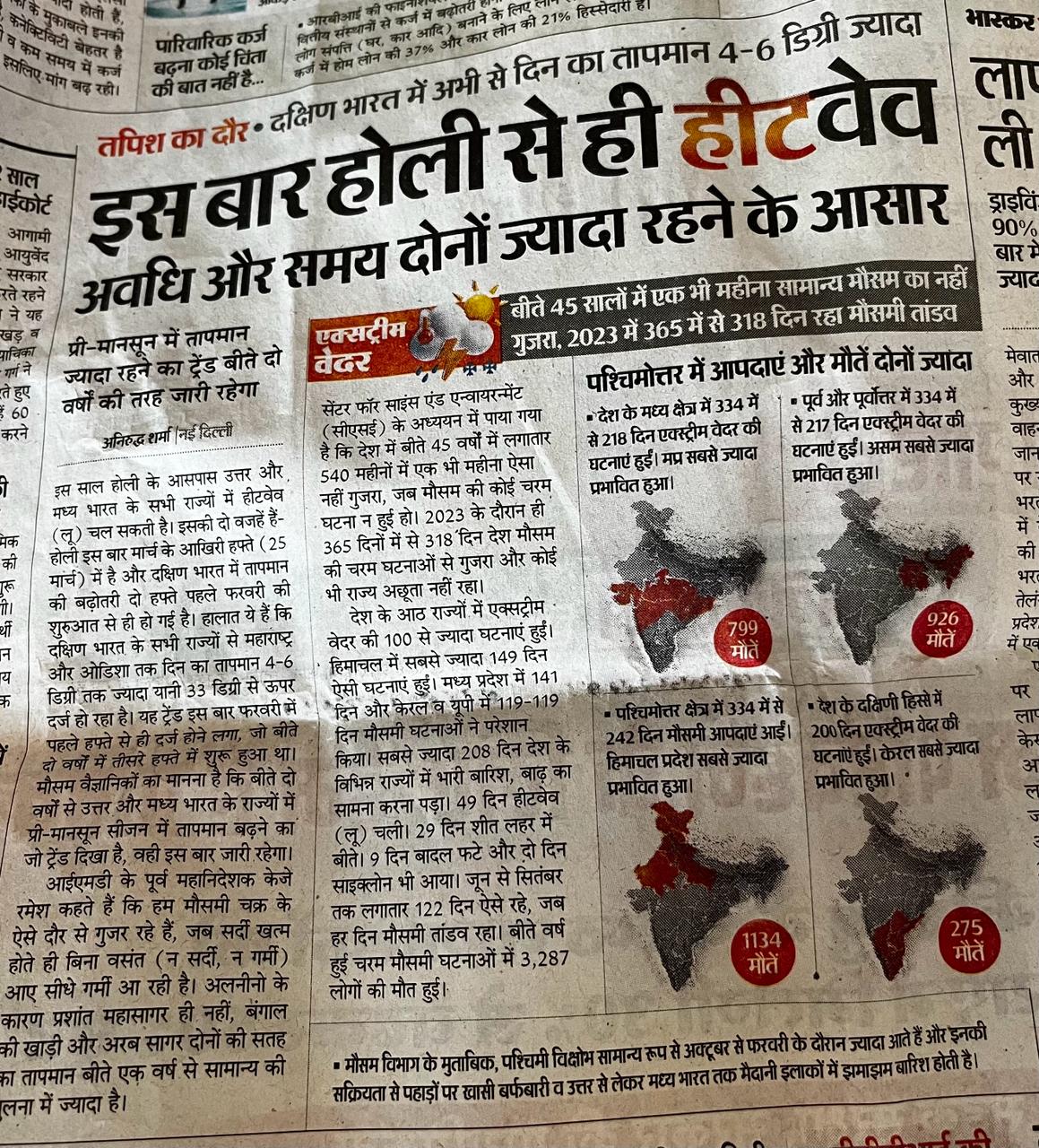
The year 2023 brought forth a concerning reality for India, as every State and Union Territory experienced extreme weather events at least once, disrupting life, livelihoods, and the economy as resources were diverted to tackle flooding or extreme heat, volatile conditions driven by climate change. These occurrences were not sporadic; rather, they persisted for approximately 318 out of 365 days, revealing a disturbingly recurrent pattern of climatic disruptions. In what should be considered a climate change warning to India, the toll on human life was grave, with 3,287 recorded deaths attributed to these extreme weather events. Additionally, the devastation extended to the animal kingdom, with a staggering 1.24 lakh animal deaths reported. The agricultural sector, vital for the nation’s food security, bore a heavy brunt, with 2.21 million hectares of crop area suffering damage, leading to significant economic losses. This widespread impact, detailed in the independent think tank Centre for Science and Environment’s “State of Environment 2024” report, underscores the severity of the challenges posed by climate change. The report said the climate-vulnerable country experienced extreme weather on 86 percent of days from January to September. State-wise, Himachal Pradesh emerged as the most heavily affected zone, enduring extreme weather conditions for 149 days, closely followed by Madhya Pradesh with 141 days. Kerala and Uttar Pradesh also faced prolonged periods of extreme weather, each recording 119 days of such events. The widespread nature of these occurrences is further underscored by the fact that eight States experienced over 100 days of extreme weather. The temperature increase was driven by human-caused climate change and boosted by the natural El Niño weather phenomenon. The types of extreme weather varied, with heavy rains, floods, and landslides occurring on 208 days, while lightning and storms were prevalent for 202 days. Heatwaves persisted for 49 days, cold waves for 29 days, and cloudbursts were recorded on nine days, contributing to localised instances of intense precipitation. Of particular concern was the duration of these extreme weather events, with India enduring 123 consecutive days of such conditions between June and September 2023. This prolonged exposure underscores the significant long-term implications for infrastructure, livelihoods, and ecosystem resilience. The detailed analysis provided by the report offers valuable insights into the multifaceted nature of extreme weather events in India in 2023, emphasising the critical need for proactive measures to address their impacts and build a more resilient society in the face of ongoing climate change. Climate experts warn that it has now been confirmed that global warming exceeded 1.5°C across the 12-month period between February 2023 and January 2024. This followed 2023 being declared the warmest year on record. The United Nations also sounded an alarm that 2023 is set to be the hottest ever recorded. It demanded urgent action to rein in global warming and stem the havoc following in its wake. The UN’s World Meteorological Organisation pointed out that 2023 had shattered a whole host of climate records, with extreme weather leaving “a trail of devastation and despair”. “It’s a deafening cacophony of broken records,” said WMO chief Petteri Taalas. “Greenhouse gas levels are at a record high. Global temperatures are at a record high. Sea level rise is at a record high. Antarctic sea ice is at a record low,” he said. In light of these findings, urgent action is imperative. Comprehensive climate adaptation and disaster management strategies are needed to mitigate risks, enhance resilience, and protect vulnerable communities.

Himachal saw max extreme weather events in 23’: Report

Bathinda: As 2023 became the warmest year in recorded weather history, the northwest region faced its impact. Himachal Pradesh got the maximum extreme weather events — on 149 days — the largest affected crop area was in Haryana, while Punjab lost most livestock. Private think tank Centre for Science and Environment (CSE) shared these figures in its State of India Environment report 2024, which it released on Wednesday during its annual Anil Agarwal Dialogue (AAD) at Nimli in Rajasthan. It claimed 2023 to be 1.48 degrees Celsius warmer than the pre-industrial period average, and with highest number of days with global mean temperatures above 1.5°C. Economist Nitin Desai, journalist T N Ninan, and CSE director general Sunita Narain released the report. In 2023 India faced its warmest-ever August and September in 122 years and recorded extreme weather events on 318 days, which claimed 3,287 lives, affected 22.1 lakh hectare (ha) of crop area, damaged 86,432 houses, and killed almost 1.25 lakh animals. All 36 states and Union Territories were affected. Madhya Pradesh had the second most extreme weather days at 141, followed by Kerala and Uttar Pradesh (119 each). Out of the events, heavy rain, flood, and landslide were recorded on 208 days, lightning and storm on 202 days, heatwave on 49 days, cold wave on 29 days, and cloudburst on 9 days. Bihar lost most people (642) due to extreme weather events, while Gujarat had maximum damaged houses. Sunita Narain claimed that the year 2023-24 is of ‘polycrisis’, a period of multiple conflicts, lost battles with nature, war among humans (Ukraine and Gaza), and fight for control of minerals and technology (with China a big role player). She said: “We should reinvent the environmental management narrative. Technological fixes won’t suffice, we need to strengthen our regulatory institutions.”

Every state, UT saw extreme weather event on at least 1 day in 2023: Report

India recorded extreme weather events on 318 of the 365 days in the year 2023, with all states and Union territories experiencing such events on at least one day, according to a new report released on Wednesday. These extreme weather events resulted in 3,287 human deaths, 1.24 lakh animal deaths, and damage to 2.21 million hectares of crop area, a report by independent think tank the Centre for Science and Environment's "State of Environment 2024" said. Himachal Pradesh recorded the highest number of days with extreme weather at 149, followed by Madhya Pradesh with 141, and Kerala and Uttar Pradesh with 119 each. Eight states recorded more than 100 days of extreme weather, the report said. Heavy rains, floods and landslides were recorded on 208 days in 2023. Lightning and storms occurred on 202 days, heatwaves on 49 days, cold waves on 29 days and cloudbursts on nine days. India experienced extreme weather events for 123 consecutive days between June and September 2023, the report said.

Every state, UT saw extreme weather event on at least 1 day in 2023: Report

India recorded extreme weather events on 318 of the 365 days in the year 2023, with all states and Union territories experiencing such events on at least one day, according to a new report released on Wednesday. These extreme weather events resulted in 3,287 human deaths, 1.24 lakh animal deaths, and damage to 2.21 million hectares of crop area, a report by independent think tank the Centre for Science and Environment’s “State of Environment 2024” said. Himachal Pradesh recorded the highest number of days with extreme weather at 149, followed by Madhya Pradesh with 141, and Kerala and Uttar Pradesh with 119 each. Lightning and storms occurred on 202 days, heatwaves on 49 days, cold waves on 29 days and cloudbursts on nine days. India experienced extreme weather events for 123 consecutive days between June and September 2023, the report said.

Gone With The Wind! Feb AQI Lowest Since 2016

This Feb, Delhi’s average Air Quality Index (AQI) was 220 till Monday, making this the lowest since 2016, shows data of Central Pollution Control Board. Although the average AQI was less than previous years, the air quality was still in the “poor” category. Experts said meteorological conditions, including rain and strong winds, prevented the AQI from rising on most days. An analysis of the CPCB data, which started calculating AQI from April 2015 onwards, shows that the average air quality reading in Feb was 293 in 2016, 267 in 2017, 243 in 2018, 242 in 2019, 241 in 2020, 288 in 2021, 225 in 2022 and 237 in 2023. The comparatively lower AQI, however, never led to a single “good” or “satisfactory” day in Feb, when AQI is below 101. Air quality mostly stayed “moderate” or “poor”. However, a streak of four consecutive “very poor” days, when AQI is between 301 and 400, was also recorded this month. Wednesday’s AQI was 141 in the “moderate” range. Experts said that as strong winds blew in the city on most days during the daytime, it aided in the dispersion of pollutants. The city also recorded excess rain this Feb, and rain helps in settling down the pollutants. India Meteorological Department’s data shows that the city logged 32.5 mm rainfall in Feb this year, which is an excess of 53%. Anumita Roychowdhury, the executive director for research and advocacy at Centre for Science and Environment, said: “We are now virtually out of the winter season with improved ventilation and stronger wind speed. This is helping in dissipating the ambient concentration. We need to watch this trend closely to understand the local and regional impacts of air pollution and to what extent the action is contributing to clean up the air.” Jan was the most polluted since 2016 with an average AQI of 354. Dec 2023 was the most polluted in the past five years. Nov 2023 was the worst ever with AQI staying in the near severe category (an AQI of 390 and above) for 17 days. CPCB classifies an AQI from 0 -50 as “good”, 51-100 “satisfactory”, 101-200 “moderate”, 201-300 as “poor”, 301-400 as “very poor” and over 400 as “severe”.

Revolutionizing Metal Industries: CSE and Uttar Pradesh Govt Tackle Air Pollution in Indo-Gangetic Plains

The Centre for Science and Environment (CSE), Delhi, in partnership with the Department of Environment, Government of Uttar Pradesh, is spearheading a significant initiative to combat air pollution and greenhouse gas emissions in the Indo-Gangetic Plains. This collaboration focuses on the metal-based sector in Aligarh, Moradabad, and Saharanpur, areas known for their environmental challenges due to inefficient industrial practices. Identifying the Core Issues The metal industries in these districts are notorious for their reliance on polluting fuels, the use of inefficient furnaces, and the absence of effective air pollution control mechanisms. Moradabad, labeled as critically polluted, and Aligarh, deemed severely polluted by the Central Pollution Control Board (CPCB), are at the heart of this study. The project aims not only to identify but also implement sustainable and economically viable technological solutions to reduce the ecological footprint of these industries. Engaging Stakeholders for Sustainable Solutions A collaborative effort is underway, involving the Uttar Pradesh Pollution Control Board (UPPCB), industry representatives, and research organizations. The goal is to develop a comprehensive plan for technological upgrades that will improve working conditions, enhance environmental outcomes, and be financially feasible. A critical aspect of this project is the upcoming stakeholder meeting on March 4, 2024, which aims to galvanize support and initiate the activities planned under this initiative. Mapping the Path Forward The project underscores the importance of technology in mitigating environmental harm. By drawing on the expertise of various stakeholders, it seeks to create a roadmap that includes not only the upgrade of technology but also strategies for financing these improvements. This approach is integral to the broader multisectoral air quality management strategy of the State, aiming to introduce new technologies to reduce emissions and pollution, thereby ensuring a healthier environment for future generations. This initiative represents a pivotal step towards addressing the environmental challenges posed by the metal-based sector in the Indo-Gangetic Plains. By prioritizing technological innovation and stakeholder engagement, it sets a precedent for collaborative environmental governance, highlighting the critical role of sustainable industrial practices in the fight against pollution and climate change.

India Experienced Extreme Weather Nearly Every Day in 2023, Shocking New Report Reveals!

India witnessed an alarming escalation of extreme weather events in 2023, according to a new report by the Centre for Science and Environment (CSE). The report, titled "State of India Environment 2024," reveals that the country experienced such extreme events on a staggering 318 out of 365 days, impacting all states and union territories (yep, every single one of them). Of all the destructive weather phenomena, heavy rains, floods, and landslides were the most frequent, occurring on 208 days. Lightning and storms were also prevalent, recorded on 202 days. Additionally, the year witnessed 49 heatwaves, 29 cold waves, and 9 cloudbursts. Notably, India experienced a concerning stretch of 123 consecutive days with extreme weather events between June and September. The consequences of these events were proportionately devastating, claiming 3,287 lives, damaging 2.21 million hectares of crops, and causing the deaths of 124,813 animals. The report further highlights that eight states endured extreme weather for more than 100 days in 2023. Further, as 2023 marked the warmest year in the country's recorded history, the northwest region bore a significant brunt. And among them, Himachal Pradesh recorded the most extreme weather events (149 days), while Haryana suffered the most extensive damage to its crop area. Punjab witnessed the highest livestock loss. Economist Nitin Desai, journalist T N Ninan, and CSE director general Sunita Narain unveiled the report during the annual Anil Agarwal Dialogue. The report emphasises that 2023 witnessed a 1.48°C rise in temperature compared to pre-industrial levels and had the highest number of days exceeding the global mean temperature of 1.5°C. Sunita Narain further stressed on the need to address the "polycrisis" of 2023-24, encompassing environmental challenges, geopolitical conflicts, and resource competition. She talked about the importance of strengthening regulatory institutions and moving beyond mere technological solutions to ensure environmental sustainability. This report serves as a stark reminder of the urgency to combat climate change and its repercussions. India's experience underscores the need for immediate and comprehensive action to mitigate the risks associated with extreme weather events and build resilience for the future.

Every state, UT saw extreme weather event on at least 1 day in 2023: Report

India recorded extreme weather events on 318 of the 365 days in the year 2023, with all states and Union territories experiencing such events on at least one day, according to a new report released on Wednesday. These extreme weather events resulted in 3,287 human deaths, 1.24 lakh animal deaths, and damage to 2.21 million hectares of crop area, a report by independent think tank the Centre for Science and Environment's "State of Environment 2024" said. Himachal Pradesh recorded the highest number of days with extreme weather at 149, followed by Madhya Pradesh with 141, and Kerala and Uttar Pradesh with 119 each. Eight states recorded more than 100 days of extreme weather, the report said. Heavy rains, floods and landslides were recorded on 208 days in 2023. Lightning and storms occurred on 202 days, heatwaves on 49 days, cold waves on 29 days and cloudbursts on nine days. India experienced extreme weather events for 123 consecutive days between June and September 2023, the report said.

Every State, UT Saw Extreme Weather Event On At Least 1 Day In 2023: Report

India recorded extreme weather events on 318 of the 365 days in the year 2023, with all states and Union territories experiencing such events on at least one day, according to a new report released on Wednesday. These extreme weather events resulted in 3,287 human deaths, 1.24 lakh animal deaths, and damage to 2.21 million hectares of crop area, a report by independent think tank the Centre for Science and Environment's "State of Environment 2024" said. Himachal Pradesh recorded the highest number of days with extreme weather at 149, followed by Madhya Pradesh with 141, and Kerala and Uttar Pradesh with 119 each. Eight states recorded more than 100 days of extreme weather, the report said. Heavy rains, floods and landslides were recorded on 208 days in 2023. Lightning and storms occurred on 202 days, heatwaves on 49 days, cold waves on 29 days and cloudbursts on nine days. India experienced extreme weather events for 123 consecutive days between June and September 2023, the report said.

Climate Chaos Grips India: 2023 Witnessed Record-Breaking Extreme Weather Events

A chilling revelation has emerged as India faced a relentless onslaught of extreme weather events throughout 2023, leaving no state or union territory untouched by its devastating impact. The Centre for Science and Environment's "State of Environment 2024" report has painted a grim picture, indicating a disturbing trend of climatic disruptions persisting for approximately 318 out of 365 days, driven by the ominous specter of climate change. The report said the climate-vulnerable country had extreme weather on 86 per cent of days from January to September.

Heat wave likely to breach all previous records this summer, weather experts sound caution for electoral process

ALWAR (RAJASTHAN): Year 2023 was categorized to be one of the warmest years on record which was 1.48 degree C warmer than the average temperature recorded from 1850-1900. Previous warmest year record of 2016 was breached by 0.17 Degree Celsius. The rise in temperature has been attributed to the El Nino effect which is likely to trigger heat wave spells even this summer as it gradually fades out by May. Keeping under consideration the possible heat wave conditions that will prevail, weather experts have expressed concern over the impact it can have when the Lok Sabha Election process is underway. Professor at Indian Institute of Tropical Meteorology (IITM) Pune, Roxy Mathew Koll shared a detailed study here on Wednesday to predict heat wave conditions beginning as early as March and continuing through May, when at one hand the El-Nino effect will subside giving way to La-Nina effect. “Though El-Nino is the hot marine streams that warms up the environment, La-Nina theoretically brings in a cooling effect with cold streams but the overall impact does not quantitatively mitigate the heating effect of El-Nino,” he said. Citing the example of Maharashtra Bhushan award ceremony of April 16, 2023 when as many as 13 people attending the mammoth gathering at Khargarh in Navi Mumbai died of heat stroke, Koll said that the temperature that day was between 34-38 degree Celsius. “It was not the temperature alone but the associated relative humidity of over 45% that was the culprit and did not allow the bodies of the victims to regulate its internal temperature via sweating. “Though the heat is blamed, it is the lack of basic precautions that led to the casualty,” he said, further issuing a caution that during 2024 electioneering such precautions must be in place. Corroborating the findings of IITM Pune, former director general of India Meteorological department, Dr KJ Ramesh who was speaking on the topic of ‘Heat waves: their prediction and current trends’ at the annual Anil Agrawal Dialogue (AAD-2024) organized by Centre for Science and Environment (CSE) said that higher humidity in coastal areas adds to the morbidity factor. “We have noticed unexplained death of newborns in the hospitals of Telengana during 2023 summers, where the maternity ward was located on the top floor. After observing the trend all hospitals were asked to shift their maternity wards,” he said, admitting that there must be precautionary measures in place before the campaign and election process for Lok Sabha election begins. The IITM Pune has released a set of advisory to this effect asking election commission and local administration to make adequate arrangements. “All campaigns and rallies should be planned with the heat impacts factored in. IMD will disseminate heat wave forecasts that should be followed, awareness campaigns, shaded waiting areas, hydration stations, cooling centres, healthcare facilities, flexible attire guidelines, transportation arrangements and outreach to vulnerable communities must be prioritised,” he said. Koll further added that on voting day, extended voting hours could be an option in localities where heatwave is forecasted, Polling booths should ensure that people standing in queues for long hours have access to shade water and toilets.

Himalayas witness 44% of India’s disasters, floods, landslides predominate: CSE report

The Himalayan region, known for its majestic peaks and serene landscapes, has become a hotspot for natural disasters, accounting for 44% of all such events in India between 2013 and 2022, according to the latest State of India’s Environment 2024’ report, released by the Centre for Science and Environment (CSE). A staggering 192 incidents, including floods, landslides, and thunderstorms, have ravaged the region, with the recent cloudbursts and torrential rains of 2023 serving as a grim prelude to a more turbulent future. Kiran Pandey, head of CSE’s Environment Resources Unit, notes an alarming trend in the data, “Disasters are not only becoming more frequent but also increasingly severe, leading to significant loss of life and property.” In just one year, from April 2021 to April 2022, 41 landslide incidents were reported, with the majority occurring in the Himalayan states.