
Cse In News

Rain cleans up Delhi's act, to an extent

New Delhi: Rain and strong winds helped clean up Delhi's air quality on Thursday when the Air Quality Index (AQI) slid to 177 in the "moderate" range from 392, which was "near severe" on Wednesday.The sudden improvement in air quality, although still not ideal, happened after a gap of over three months. A lower AQI than Thursday's was last seen on Oct 19, 2023, when it was 121. The last "moderate" air quality in Delhi before Thursday was on Oct 20 last year when the AQI was 195. Central Pollution Control Board's data shows that Delhi did not see any "moderate" air quality day in Nov and Dec 2023 or Jan 2024. Experts said there was a drastic improvement in the air quality due to the rain, which helped in washing out pollutants. Anumita Roychowdhury, executive director for research and advocacy at Centre for Science and Environment, said: "This is clearly the wash-out effect of the rain. This has cleared the particulates that were trapped due to extremely calm weather conditions and exacerbated by winter inversion for so many days." The Air Quality Early Warning System for Delhi (EWS), which is the forecasting body under the Union ministry of earth sciences, in its bulletin on Thursday said the predominant winds "were from the northeast or southeast direction with wind speed 6-18 kmph in Delhi on Wednesday". Safdarjung got 26.5 mm of rainfall, Palam 20.1 mm and the Ridge 23.4mm. EWS said the air quality is likely to be "moderate" till Feb 4. This January was the most polluted since 2016 with an average AQI of 354. The lowest daily AQI was 273 on Jan 10. With an average AQI of 348, Dec 2023 was the most polluted in the past five years. The month saw three severe days with AQI hovering in the "very poor" category on most days. Nov last year was the worst polluted ever. Delhi saw 17 Nov days when the AQI was 390 or above. The air quality in Delhi in Oct 2023 was the most polluted in the past three years.
As crisis grows, time to revisit plastics policy

Plastic pollution is reaching epic proportions. Traces of plastic have been found in human blood, placenta and even in breast milk. Future generations are exposed to plastic pollution right from birth which is putting humanity at grave risk. Plastic is a synthetic polymer produced from petrochemicals and is non-biodegradable in nature. Once produced, plastic items remain around us long after being discarded. Discarded plastic items often find their way into terrestrial and aquatic ecosystems where they affect wildlife. Polythene bags dumped in landfills are often ingested by animals who mistake it for food. Discarded plastic breaks down into microplastics which are ingested by living organisms and accumulate and amplify in the food chain, all the way up to our platter. When ingested by animals, microplastics potentially impact the reproductive system and affect overall wellbeing. We are only beginning to understand the full impact of microplastics on human health. What is increasingly becoming clear is that plastic pollution is a serious health hazard and must be brought under control. Of particular concern are disposable or single-use plastic items since they are produced in large quantities and are discarded as soon as they are used. These include polythene bags, plastic glasses, potato wafer packets, sachets, straws and plastic bottles. The relative convenience of using plastic items has ensured their rapid spread and deeper penetration in society. According to the Central Pollution Control Board, total plastic waste generated in India in 2020-21 was 4,126,997 tonnes. This figure is more than double of what it was in 2016-17 (1,568,714 tonnes per annum). Concerned with the ever-increasing plastic waste and its impact on the environment, the Government of India banned many single-use plastic items in 2022. The Plastic Waste Management Amendment Rules 2021 prohibit more than a dozen single-use plastic items which have low utility and high littering potential. These include items like plastic cutlery, straws, earbuds, ice cream sticks, invitation cards and cigarette packs. In addition, minimum thickness of permissible polythene bags has been increased to 120 microns so that they can be reused. The initiative to curb the plastic menace by banning specific singleuse plastic items is timely. Plastic bans of some kind exist in many countries around the world. However, implementation of the ban is the real challenge, as is course correction through feedback mechanisms. A recent report on the single-use plastic ban across five Indian cities by the Delhi-based Toxics Link organisation found that more than 50 per cent of surveyed locations continued to sell banned single-use plastic items. The report titled Single-use Plastic Ban in India (2023) mentions polythene bags to be the most abundantly found among banned plastic items across all surveyed cities. Another report on the implementation of single-use plastic ban in India found it to be half-hearted and ambiguous. This 2023 report by the Centre for Science and Environment highlights the need to enforce the ban at the source of production. It also questions the exclusion of other single-use plastic items from the ban. Single-use plastic items like potato wafer bags, plastic water bottles, milk packets and shampoo sachets are not included in the list of banned items. Allowing the use of polythene bags above 120-micron thickness is yet another limitation of the ban. The thickness of polythene bags is not immediately apparent and the resulting confusion promotes use of all types of polythene bags. Secondly, thicker polythene bags are allowed so that they can be used more than once. However, this is often not the case and even when they are reused, they are soon discarded. Keeping them outside the purview of the ban is only adding to the plastic waste burden. There is a need for course correction by banning all polythene bags irrespective of thickness. Similarly, there is a need for regulating the use of all plastics and not just single-use plastic items. Our plastic waste control policy must focus on segregation of waste where it is generated and collection & recycling of every plastic item. The role of plastic in personal protective equipment and other Covid-19 prevention strategies cannot be ruled out. Covid-19 is not the first pandemic to wreak havoc in the world, it certainly isn’t the last. The World Health Organisation has conceptualised Disease X, a hitherto unknown Covid-19 like pandemic against which all nations must start preparing. Plastics will certainly play a life-saving role in pandemic prevention strategies. The greatest hindrance in controlling plastic pollution is the large-scale use of plastic in our daily lives. We must prioritize the use of plastics to where they are absolutely required and ban their use where alternatives are available. (The writers are, respectively, associate professor and a student at the Jindal School of Environment & Sustainability, O.P. Jindal Global University, Haryana, India.)

Showers, wind clear air; Delhi breathes cleanest since Oct 19

Delhi breathed its cleanest air in more than a hundred days on Thursday as two days of rain and strong winds helped wash out pollutants that have clotted the city’s atmosphere for several weeks. The Capital recorded a 24-hour average air quality index (AQI) of 177 (moderate) at 4pm on Thursday, according to data from the Central Pollution Control Board (CPCB), more than 200 points lower than 392 (very poor) on Wednesday and the lowest since 121 on October 19 last year. With this, February snapped the streak of bad air that has dogged 2024 so far, with January this year far more polluted than usual. Indeed, the city’s average AQI last month was 355, the worst since a reading of 370 in January 2016. CPCB classifies an AQI of 51 to 100 as “satisfactory”, between 101 and 200 as “moderate”, between 201 and 300 as “poor”, between 301 and 400 as “very poor” and over 400 as “severe”. Forecasts show Delhi’s air quality is likely to remain “moderate” now for the next few days, with the likelihood of light rain over the weekend. Anumita Roychowdhury, executive director, research and advocacy at the Centre for Science and Environment (CSE) said that the city was missing strong winds for most of the winter, causing long periods where the air quality has remained “very poor”. “We have seen this right from November till January now, where wind speeds have been fairly low. In the absence of rain or strong winds, pollutants will neither disperse or settle. We know Delhi’s emissions are fairly high and that did not allow air quality to improve over the last three months,” she said. Forecasts by the Early Warning System (EWS) for Delhi – a forecasting model under the ministry of earth sciences said Delhi’s air should remain ‘moderate’ in the first week of February. “Delhi’s air quality is likely to be in the ‘moderate’ category from February 2 till February 4. The outlook for the subsequent six days also shows air quality is likely to be in the moderate category,” EWS said in its bulletin on Thursday

High winds & rain clean up air; AQI in ‘moderate’ zone after 14-day gap

Gurgaon: Showers and gusty winds brought some relief for residents as the toxic haze cleared up and the air quality improved by around 55% in the city. The air quality index (AQI) slid to 142 (moderate) on Thursday from 320 (very poor) on Wednesday. The sudden improvement in the air quality happened after a gap of 14 days. The city last saw a ‘moderate’ on January 19. According to the Haryana State Pollution Control Board (HSPCB), the wind speed between 18 kmph to 23 kmph along with rain enabled better ventilation for the pollution to disperse as a result the AQI has improved. According to Haryana State Pollution Control Board (HSPCB), winds with speed up to 23kmph helped disperse pollutants. While Sector 51 station recorded an index of 147, Teri Gram logged 127, and Vikas Sadan 107. The AQI was not recorded by Gwalpahari station on Thursday. According to the guidelines issued by the Central Pollution Control Board (CPCB), when AQI is in the ‘moderate’ category, people suffering from asthma and lung or heart ailments could face discomfort in breathing. While air deteriorates to ‘poor’ category, people may face breathing discomfort due to prolonged exposure. An AQI between zero and 50 is considered ‘good’, 51 and 100 ‘satisfactory’, 101 and 200 ‘moderate’, 201 and 300 ‘poor’, 301 and 400 ‘very poor', and 401 and 500 ‘severe’. The air quality, according to the System of Air Quality and Weather Forecasting And Research (SAFAR), is likely to be in the ‘moderate’ category from February 2 to 4. “The predominant surface wind is likely to be blowing from east and southeast directions in Delhi with wind speed 12-25 kmph.” “For the next few days, the region will again see slight improvement in air quality as it will stay in the lower end of ‘poor’ or ‘moderate’ due to an increase in the minimum temperature and change in wind speed. This will make dispersion of pollutants slow,” said, Shubhansh Tiwari, a research associate at CSE. The air quality in neighbouring Faridabad also improved to ‘moderate’ category with the index recorded at 180. Delhi also witnessed cleaner air on Thursday when the AQI slid to 177 in the “moderate” range from 392, which was “near severe” on Wednesday. The sudden improvement in air quality, although still not ideal, happened after a gap of over three months. A lower AQI than Thursday’s was last seen on Oct 19, 2023, when it was 121. The last “moderate” air quality in Delhi before Thursday was on Oct 20 last year when the AQI was 195. CPCB’s data shows that Delhi did not see any “moderate” air quality day in Nov and Dec 2023 or Jan 2024. Anumita Roychowdhury, executive director for research and advocacy at Centre for Science and Environment, said: “This is clearly the wash-out effect of the rain. This has cleared the particulates that were trapped due to extremely calm weather conditions and exacerbated by winter inversion for so many days.” The Air Quality Early Warning System for Delhi (EWS), which is the forecasting body under the Union ministry of earth sciences, in its bulletin on Thursday said the predominant winds “were from the northeast or southeast direction with wind speed 6-18 kmph in Delhi on Wednesday”.

जहरीला हो रहा अनाज! गेहूं और चावल को लेकर सामने आई एक चौंकाने वाली खबर, ICAR ने जारी की रिपोर्ट

23 जनवरी 2024 को दिल्ली स्थित थिंक टैंक सेंटर फॉर साइंस एंड एनवायरमेंट ने वेबिनार का आयोजन किया। जिसमें भारत में तेजी से उपज की जा रही गेहूं और चावल की किस्मों पर चर्चा की जानी थी। इस वेबीनार में हमारे अनाज को लेकर कुछ चौंकाने वाली बातें सामने आई हैं। जिसमें कहा गया कि आज हमारे गेहूं और चावल दोनों ही अनाज न केवल कम पौष्टिक हो गए हैं बल्कि यह हमारे लिए जहरीले भी होते जा रहे हैं। ICAR के नेतृत्व में किए गए इस अध्ययन में आधुनिक तरीके से उगाए जा रहे अनाजों के खाद्य मूल्य की जांच की गई। जिसमें यह बात साबित हुई है कि उपज को बढ़ाने के लिए विकसित किए गए अनाज की पौष्टिकता को काफी नुकसान पहुंचा है। इस प्रक्रिया से पैदा किए जा रहे अनाज के न केवल पोषक गुण कम हुए हैं बल्कि यह हमारी सेहत के लिए विषाक्त भी होता जा रहा है। बात करें पिछले 50 वर्षों में तो चावल में जिंक और आयरन जैसे पोषक तत्वों में क्रमशः 33 और 27 प्रतिशत तक की कमी आई है। वहीं गेहूं में इन दोनों पोषक तत्वों में 30 और 19 प्रतिशत की कमी देखी गई है। इस वेबिनार में कहा गया कि हमें 1980 के दशक बाद जो अनाज ज्यादा पैदावार के लिए प्रदान कराया जा रहा है वह हमारे लिए पोषक तत्वों के हिसाब से बिल्कुल अच्छा नहीं है। इसके विपरीत जो अनाज हम पारंपरिक रूप से वर्षों से प्रयोग करते चले आ रहे थे वह अनाज अधिक पोषक युक्त था। 1980 के दशक के बाद ऐसे अनाज को विकसित करने पर जोर दिया गया जो कीटों और बीमारियों से लड़ने में सक्षम हो इसके साथ ही वह लवणता और नमी और सूखे जैसी स्थितियों में पैदा किया जा सके। जमीन से पोषक तत्व नहीं ले पा रहे पौधे इस तरह के अनाज की खोज करने वाले वैज्ञानिकों को यह सोचने का मौका नहीं मिला कि पौधा जमीन से पोषक तत्व ले पा रहा है या नहीं। यही कारण है कि समय के साथ हम देख रहे हैं कि पौधों ने जमीन से पोषक तत्व लेने की अपनी क्षमता को काफी हद तक खो दिया है। साल 2023 में ICAR का अध्ययन बिधान चंद्र कृषि विश्वविद्यालय के वैज्ञानिकों द्वारा किए गए 2021 के अध्ययन का विस्तार है। इस अध्ययन में भी अनाज पर निर्भर आबादी में जिंक और आयरन तत्व की कमी के कारणों पर गौर किया गया। वहीं जब अधिक उपज वाले गेंहू और चावल की किस्मों का अध्ययन किया तो इसमें पोषक तत्वों की कमी साफ तौर पर देखने को मिली। जहरीला होता अनाज पिछले 50 साल में अनाज की फूड वैल्यू में लगभग 45% तक कि गिरावट दर्ज की गई है। वही यह बात भी कही जा रही है कि यदि यह गिरावट इसी तरह जारी रहती है तो साल 2040 तक देश में उगाया जा रहा अनाज इंसानों के लिए खाने लायक नहीं रह जाएगा। इस अध्ययन में जो सबसे ज्यादा चौंकाने वाली बात सामने आई वह यह है कि चावल में बीते सालों में जहरीले तत्व आर्सेनिक की मात्रा 1493 प्रतिशत तक बढ़ गई है।

उत्तर प्रदेश के युवाओं की नींद उड़ा रहे हैं एनर्जी ड्रिंक, हो रहा है भारी नुकसान

इन दिनों युवा वर्ग में एनर्जी ड्रिंक पीने का क्रेज बढ़ता ही जा रहा है। उत्तर प्रदेश की राजधानी लखनऊ के डाक्टर सुबोध कुमार ने दावा किया है कि उत्तर प्रदेश समेत देश भर के युवा वर्ग की नींद उड़ाने में एनर्जी ड्रिंक एक बड़ा रोल अदा कर रहे हैं। उत्तर प्रदेश के अलग-अलग शहरों में किए गए एक सर्वे से पता चला है कि उत्तर प्रदेश के युवाओं में एनर्जी ड्रिंक पीने का क्रेज लगातार बढ़ता ही जा रहा है। घातक है एनर्जी ड्रिंक उत्तर प्रदेश के युवा वर्ग में नींद न आने की शिकायत आम होती जा रही है। जब पूरे उत्तर प्रदेश के अलग-अलग शहरों में युवा वर्ग में नींद न आने का अध्ययन किया गया तो पता चला कि उत्तर प्रदेश के युवाओं में एनर्जी ड्रिंक पीने का क्रेज तेजी से बढ़ रहा है। इसी कारण युवा वर्ग में नींद न आने से बहुत कम नींद आने की समस्या बढ़ती ही जा रही है। डाक्टरों की मानें तो उनका कहना है कि एनर्जी ड्रिंक युवा वर्ग में मीठे जहर की तरह घातक परिणाम ला रहे हैं। यह समस्या उत्तर प्रदेश ही नहीं पूरे देश में बढ़ती जा रही है। क्या कहते हैं विशेषज्ञ एनर्जी ड्रिंक के दुष्प्रभाव को लेकर विशेषज्ञों का कहना है कि लोकप्रिय पेय पदार्थों में शुमार एनर्जी ड्रिंक युवाओं की नींद उड़ा रहा है। साथ ही अनिद्रा की समस्या भी पैदा कर रहा है। हाल में हुए अध्ययन में जो युवा महीने में केवल एक से तीन बार एनर्जी ड्रिंक का सेवन करते हैं, उनमें भी नींद से जुड़ी समस्याओं में इजाफा देखा गया। अध्ययन के नतीजे ओपन एक्सेस जर्नल- बीएमजे ओपन में प्रकाशित हुए हैं। शोधकर्ताओं के अनुसार, इन एनर्जी ड्रिंक्स में आमतौर पर प्रति लीटर करीब 150 मिलीग्राम कैफीन होता है। साथ ही इसमें चीनी, विटामिन, खनिज और अमीनो एसिड भी अलग-अलग मात्रा में होते हैं। इन ड्रिंक्स को ऐसे दर्शाया जाता है कि यह मानसिक और शारीरिक शक्ति को बढ़ा सकते हैं। जबकि स्वास्थ्य विशेषज्ञों का तर्क है कि इन्हें एनर्जी ड्रिंक्स बताना भ्रामक है, क्योंकि चीनी को छोडक़र अन्य तत्व ऊर्जा प्रदान नहीं करते। सेंटर फॉर साइंस एंड एनवायरनमेंट ने भी अपने अध्ययन में खुलासा किया है कि एनर्जी ड्रिंक्स में अतिरिक्त कैफीन होता है। भारत की शीर्ष खाद्य नियामक संस्था भारतीय खादय सुरक्षा और मानक प्राधिकरण (FSSAI) ने इन एनर्र्जी ड्रिंक्स को गैर अल्कोहल युक्त पेय पदार्थों के रूप में परिभाषित करती है। हालांकि इसमें कैफीन, ग्वाराना, टॉरिन और जिनसेंग जैसे उत्तेजक पदार्थ होते हैं। बोलते हैं आंकड़े अध्ययन में शोधकर्ताओं ने 18 से 35 वर्ष की आयु के 53,266 युवाओं के आंकड़ों की समीक्षा की। जो छात्र और छात्राएं प्रतिदिन एनर्जी ड्रिंक पीते थे वे उन लोगों की तुलना में करीब एक घंटे कम सोते थे जो कभी-कभार या बिल्कुल भी नहीं पीते थे। इसका प्रभाव इस बात में भी देखा गया कि वे रात में कितनी बार जगे और उन्हें सोने में कितना समय लगा। जैसे-जैसे उन्होंने एनर्जी ड्रिंक की मात्रा बढ़ाई उनके रात में सोने और जागने का समय बढ़ गया। इसका सीधा सा तात्पर्य यह है कि उनकी नींद में लगातार खलल पड़ा। इसी तरह जो लडक़े प्रति दिन एनर्जी ड्रिंक पीते थे उनके हर रात छह घंटे से भी कम सोने की संभावना उनकी तुलना में दोगुनी से भी अधिक थी, जो कभी-कभार इनका सेवन करते थे।

Making global food systems more sustainable has economic benefits 20 times the cost

Tridge summary A report by the Food System Economics Commission suggests that a sustainable transformation of global food systems, costing around $500 billion per year, could yield socio-economic benefits of $5-10 trillion annually. However, the cost of transformation is beyond the financing capacity of lower-income countries. The report warns of increasing food insecurity and obesity by 2050 if changes are not made. Meanwhile, over 150 countries have signed a declaration on sustainable agriculture and climate action at the 28th Conference of Parties to the UN Framework Convention on Climate Change, emphasizing the need for direct action on food system challenges. Original content Globally, current food systems cost significantly more than they contribute to development. A sustainable transformation of existing food systems is urgently required at an estimated total cost of $500 billion per year. This cost is equivalent to only 0.2–0.4 per cent of global GDP and is small relative to the multi-trillion dollar benefits it could bring, according to a new report. The annual environmental cost of the current food systems was $3 trillion, and the additional costs to health was at least $11 trillion. The socio-economic benefits of transforming food systems around the world are estimated to be between $5 trillion and $10 trillion annually, equivalent to between 4 and 8 per cent of global GDP in 2020, according to an estimate made by a committee of eminent scientists and academics. It is feasible to transform the current global food system into one that is inclusive, health-enhancing and environmentally sustainable, said Food System Economics Commission in a new ... Source: Down To Earth https://www.downtoearth.org.in/news/agriculture/making-global-food-systems-more-sustainable-has-economic-benefits-20-times-the-cost-finds-report-94200

Talk on climate change this Sat

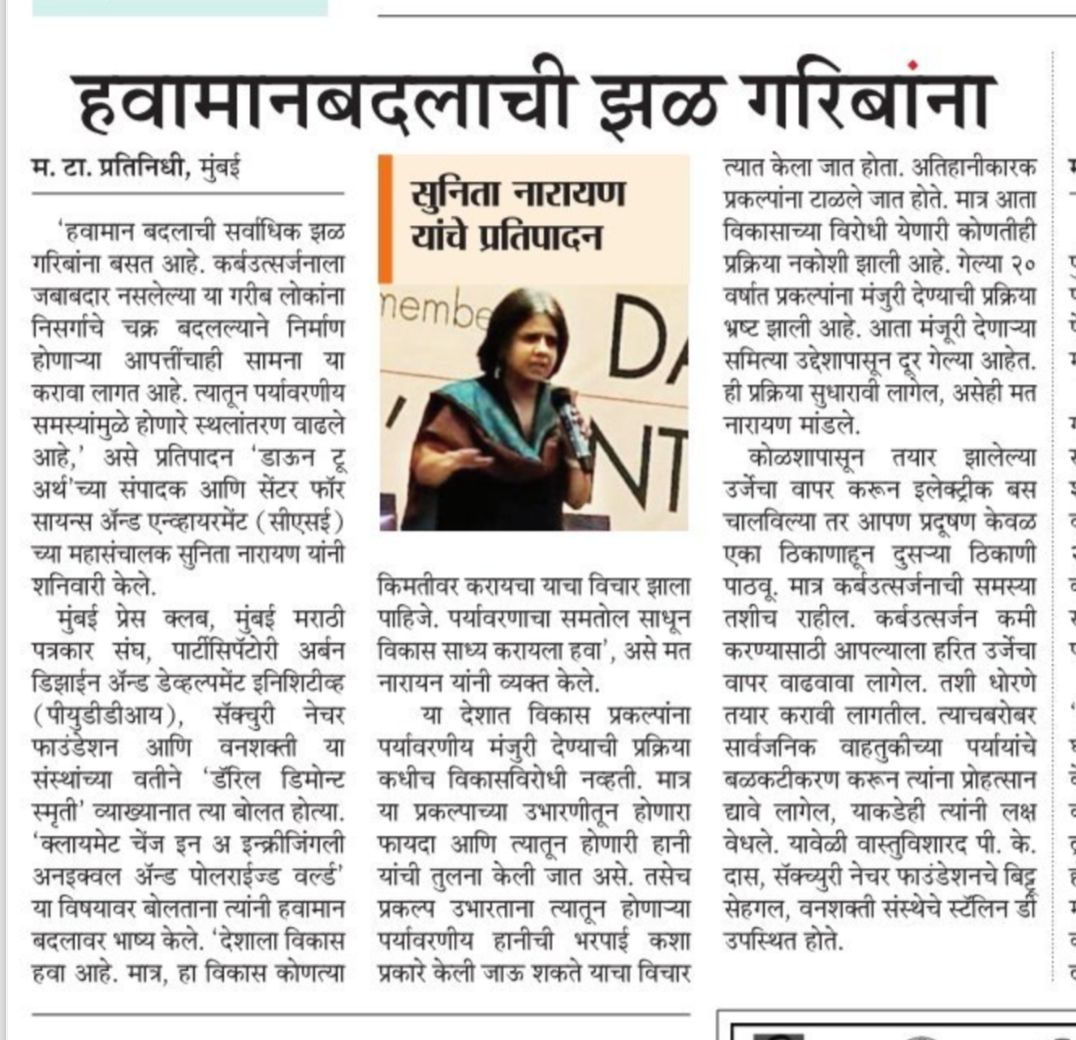
Mumbai: Sunita Narain, Editor of Down to Earth and director general of Centre for Science and Environment, will deliver the second Darryl D’Monte memorial lecture on ‘Climate Change in an Increasingly Unequal and Polarised World: The Future Agenda for Action’ at Mumbai Marathi Patrakar Sangh on Feb 3. tnn We also published the following articles recently Solapur Municipal Corporation plans climate change action planThe Solapur Municipal Corporation (SMC) has prepared an action plan to address climate change concerns. The plan focuses on causes, mitigation, low-carbon development, conserving natural resources, and building resilient systems. It includes a detailed vulnerability assessment and greenhouse gas emissions inventory, aligning with national and global commitments.107130017 Indias climate change goals will serve as world templateThe India Energy Week in Goa will showcase India's strategies for tackling climate change and offer a template for the world to follow. It will strengthen India's position as the third-largest energy consumer, aiming for 50% renewable energy by 2030. The event will host energy ministers, industry leaders, and experts to discuss energy transition and alternate fuels.107302728 Earth Care awards climate warriors their place in the sunNadir Godrej, managing director of Godrej Industries, was recognized as Green Business Titan at the 11th Earth Care Awards for his efforts in steering the Godrej Group towards a sustainable future. The awards, presented jointly by JSW and The Times of India, celebrate work done in mitigating climate change across various categories.107155823

Punjab clinches best state award in green school excellence, Sangrur leads as best district

In the prestigious annual green school awards presented by the Centre for Science and Environment (CSE), Punjab bagged the coveted title of the Best State. This recognition was achieved by setting an exemplary standard with the highest audit registrations and report submissions. A total of 4,734 schools from the state diligently submitted their audit reports, with 70 schools earning the esteemed ‘green’ rating. Sangrur, in Punjab, was honored with the Best District Award, having recorded the maximum submissions at 503. The awards were presented in New Delhi by CSE Director General Sunita Narain. Dr. Kulbir Bath, State Nodal Coordinator of Punjab State Council of Science and Technology (PSCST), the nodal organization coordinating with schools in Punjab, remarked, “Punjab CM Bhagwant Mann mentioned these results on his social media handles.” These accolades are bestowed annually through CSE’s Green Schools Programme (GSP), a 19-year-old initiative. This year, Punjab’s enthusiasm soared, with a total of 7,200 schools initially registering with CSE. Out of this, an impressive 4,734 schools submitted their green audit reports, a level of participation unprecedented in the program’s history. Bath highlighted the significance of Punjab receiving the Best State award, stating, “A total of 199 schools in India were given green school awards, and 70 of them are from Punjab, constituting 35% of the total list. The 4,734 entries from Punjab alone are monumental.” Out of the 4,734 schools, only 70 in Punjab earned the coveted ‘green school’ title by fulfilling the criteria set by CSE. Ludhiana had the highest number of green schools at 30, while Sangrur had one – Government Primary Smart School in Bhattiwal Khurd village. Satya Bharti School Lakhowal, Ludhiana, received the Changemaker Award. Bath emphasized, “It doesn’t matter if only one school in Sangrur received the Green school award. The fact is 503 of them are making significant efforts. Ludhiana had the maximum green schools, but the total number of submissions was far less than Sangrur.” In the green audit report, schools submitted evidence in the form of pictures and videos, showcasing their handling of solid waste. The evaluation also considered green practices related to conserving water, soil, food, energy, and air. Sangrur Deputy Commissioner Jitendra Jorwal expressed his commitment to making every primary and upper primary school in the district a leader in various aspects of environmental conservation. Providing additional insights, Sangrur’s Deputy District Education Officer Preetinder Ghai said, “Apart from the environment-friendly government schools, efforts in Sangrur district focused on conserving air, energy, food, soil, water, as well as electricity, proper maintenance of plants, use of bicycles instead of petrol and diesel vehicles, disposal of biodegradable and non-biodegradable waste, solar systems, mid-day meal systems, the standard of food served to students, and the number of teaching and non-teaching staff.” According to CSE’s statement, over 5,300 schools from 29 states and Union territories participated in the audit, with government schools contributing the majority at 93%, followed by private schools at 6%, and government-aided schools at 1%. Of these, 20 schools received the top awards, and 199 were recognized as ‘green.’ A green school is an environmentally conscious institution that adheres to the following criteria: – Window to floor ratio (WFR) surpassing 5%, facilitating ample daylight and ventilation. – Predominant use of sustainable or non-polluting modes of transport, such as public transport, e-rickshaws, cycling, and walking. – Extensive utilization of energy-efficient lighting to conserve energy, coupled with exploration of alternative energy sources. The Green Schools Programme (GSP) Audit advocates minimizing conventional lights while ensuring sufficient illumination for students. – Maintaining a substantial green cover within and around the school campus, promoting biodiversity through the planting of native plant species. – Adoption of a policy to serve only cooked meals, steering clear of packaged foods high in fats, sugar, and salt, to ensure healthy food consumption. – Implementation of rainwater harvesting (RWH) systems to collect rainwater and the responsible reuse of treated wastewater.

Sangrur ranks No.1 under Green School Program across country

Sangrur has been awarded as the best district in the country under the Green Schools Programme (GSP). Punjab won the ‘best state’ and Sangrur the ‘best district’ awards for its leadership in fostering a culture of environmental consciousness at the Centre for Science and Environment’s (CSE) annual Green Schools Awards announced on Tuesday. Green School Programme is aimed at making school campuses environment-friendly and students conscious about the environment. Punjab bagged the award for the best state by setting the bar with the highest audit registrations and report submissions. A total of 4,734 schools from the state submitted their audit reports – 70 were rated ‘green’. Sangrur bagged the best district award with 503 submissions. The awards are conferred to help schools and students conduct a rigorous on-campus environmental audit to measure efficacy of resource management and green practices in schools. GSP helps schools assess their use of resources and map their consumption and wastage across six key subject areas – air, energy, food, land, water and waste. Satya Bharti School Lakhowal, Ludhiana, Punjab, was one of the winners of the Changemaker Awards, given to schools which improve their sustainability rating to green by monitoring and improving their practices over the years. Chief Minister Bhagwant Mann, through his X account, congratulated Punjabis, especially students and teachers and said that “Jis din se chala hun meri manzil pe nazar hai, aankhon ne kabhi meel ka patthar nahin dekha..Sangrur is number one in the country… Congratulations!” Reacting to the news the Aam Aadmi Party (AAP) said that it is a moment of pride for Punjab. CM Bhagwant Mann-led AAP government is determined to not only provide free & world-class education to every section of Punjab but also educate their students beyond theories and textbooks. Government schools of Punjab are committed to sensitizing students towards the environment through hands-on and thought provoking activities.

DRE, Mini-Grids Can Aid In The Growth Of E-Cooking In India: CSE Report

A latest report from the Centre For Science and Environment (CSE recommended the phasing out of LPG cylinders, used primarily for cooking in India. The CSE researcher advocated for boosting electric cooking (e-cooking) instead. The report also talked about the main challenges in rolling out large-scale adoption of e-cooking in India and the likely solutions to boost its growth. It also said that renewable energy sources like distributed renewable energy (DRE) and mini-grids could play key role in providing energy security for the segment in rural India. The report pointed out that rural India still lacks access to cleaner sources of cleaning. It also pointed out that despite a thrust from the government to push LPG as a cleaner source for cooking, it failed to get the required results.

CSE recognizes top 20 Green schools across India for environmental excellence

The Center for Science and Environment (CSE) has given the Green School Award to 20 schools in India, including those in Kerala, Madhya Pradesh, Punjab, and Delhi-NCR. These schools have done a great job in protecting the environment and teaching students about it. CSE also named 199 other schools as ‘Green Schools’. Every year, CSE’s Green School Program (GSP) gives awards to schools that do a great job with the environment. They’ve been doing this for 19 years. CSE Director General Sunita Narayan says the Green School program is like a learning lab. It teaches young people by letting them do things themselves. They learn about sustainability by practicing it. She says we learn by doing things and then setting goals for what to do next. That’s what the Green School Programme is all about. This year, more than 5,300 schools from all over the country joined in. The top 20 schools got awards. Most of the schools that joined in (93%) were government schools. Six percent were private schools and one percent were government aided schools. CSE’s Green School Program encourages students and teachers to make their schools more eco-friendly. The program helps schools become greener and checks how well they use resources like water and electricity. The Green Schools Program Award goes to schools that do the best job of managing their natural resources. The program started in 2003 after the Supreme Court of India said all schools had to teach about the environment. The first award was given in 2006 to schools that cared about the environment. Now, more than 7000 schools across the country are part of this program.

CSE’s Green Schools Programme honours 199 ‘greenest’ schools in India

One hundred ninety-nine schools from across India were certified ‘green’ at Centre for Science and Environment’s (CSE) annual Green Schools Awards here today, with 20 of them topping their respective categories for their outstanding efforts in making their campuses environment-friendly and their students, environment-conscious. These awards are conferred every year by CSE’s Green Schools Programme, a 19-year-old initiative that helps schools and their students conduct a rigorous in-campus environmental audit to measure the efficacy of resource management and green practices in the school. Schools take ownership of their green journey through self-conducted audits with CSE’s guidance. Speaking on the occasion, CSE director general Sunita Narain said: “CSE’s Green School Programme is a laboratory of practice. The objective is to educate the young through their actions – they walk the talk to understand sustainability. We believe that we learn best when we implement our ideas; when we measure what we have done and we set goals for what needs to be done next. This is what the Green Schools Programme is about.” Among those who handed out the awards – besides Narain – were Sanjay Kumar, secretary, Department of School Education and Literacy, Union Ministry of Education; Julia Marton-Lefevre, former Director General, International Union for Conservation of Nature (IUCN); and Joyce Poan, Programme Specialist and Chief of Education, UNESCO-India. Over 5,300 schools from 29 states and Union territories vied for the honours; 20 of these received the top awards, and 199 were tagged as ‘green’. Of all the schools that participated in the audit, government schools held the crown with 93 per cent submissions, followed by private schools at 6 per cent and government-aided schools at 1 per cent. Apart from the schools, awards were also conferred on the most proactive teachers. Punjab won the “best state” and “best district” prizes for its leadership in fostering a culture of environmental consciousness. GSP helps schools assess their use of resources and map their consumption and wastage across six key subject areas — air, energy, food, land, water and waste. Says Tushita Rawat, programme manager, environment education, CSE: “The Programme uses an analytics platform to track the environmental performance of schools. Over 600 data points are collected, which provide quantifiable environmental impacts within and around the school campus.” *Says Souparno Banerjee, senior director, environment education, CSE: “The unique aspect of this programme is the opportunity that it affords schools to measure their progress year on year and improve their ranking.”* THE 2023-24 AWARDS Best State and District: Punjab bagged the award for the Best State by setting the bar with the highest audit registrations and report submissions. 4734 schools from the state submitted their audit reports – 70 were rated ‘green’. Sangrur in Punjab bagged the Best District Award with 503 submissions. Changemaker Awards: The Changemaker Awards are given to schools which improve their sustainability rating to green by monitoring and improving their practices over the year. The two awardees in this category are: 1. PM SHRI Kendriya Vidyalaya No 1 Ordnance Factory Katni, Madhya Pradesh 2. Satya Bharti School Lakhowal, Ludhiana, Punjab Sterling Schools Awards: Schools that have been rated ‘green’ for five or more consecutive years: Ashok Memorial Public School, Faridabad, Haryana Bal Bharati Public School, IMT Manesar, Haryana Bal Bharati Public School, Noida, Uttar Pradesh DAV International School, Amritsar, Punjab East Point School, Vasundhara Enclave, New Delhi Indirapuram Public School, Pratap Vihar, Ghaziabad, Uttar Pradesh Mahindra World School, Kanchipuram, Tamil Nadu Motilal Nehru School of Sports, Rai, Sonipat, Haryana Sachdeva Global School, South West Delhi, New Delhi Sacred Heart School, Kalyan, Maharashtra Salwan Public School, Ghaziabad, Uttar Pradesh St Edmund’s School, Jaipur, Rajasthan Best Newcomer: Schools that have recently registered to be a part of the programme and have demonstrated considerable potential in managing their natural resources. Toc H Public School, Kochi, Kerala Best in Section: Schools that have performed exceptionally in specific sections. GSP Waste Warrior Award: B. K. Birla Public School, Kalyan, Thane, Maharashtra GSP Land Manager Award: Zila Parishad high school, Gandaboyana Palli, Annamayya, Andhra Pradesh GSP Water Wise Award: Lake Montfort School, Bengaluru, Karnataka GSP Air Action Award: PM SHRI KV AFS Akkulam, Thiruvananthapuram, Kerala GSP Energy Manager Award: Government Model Boys Senior Secondary School Nalagarh (Solan), Himachal Pradesh What it means to be a Green School? A Green School is a resource-efficient school that meets the following criteria: Window to floor ratio (WFR) of more than 5 per cent to allow adequate daylight and ventilation Majority of the population uses sustainable modes of transport (public transport, e-rickshaws, etc) or non-polluting modes of transport (cycling, walking, etc) Maximum use of energy-efficient lighting to conserve energy and use of alternative sources of energy. GSP Audit encourages schools to minimize use of conventional lights without compromising sufficient lighting for students Maintain a high green cover inside and around school campus along with greater biodiversity by planting native species of plants Serve only cooked meals (avoid packaged foods that are high in fats, sugar and salt) to ensure healthy food consumption Harvest rainwater through rainwater harvesting (RWH) systems and reuse treated wastewater. Pre- and post-monsoon cleaning of RWH systems is important Segregate waste at source efficiently and dispose of responsibly. Recycling at least 90 per cent of the waste is recommended Wet waste to be composted Waste not to be burned

ECOFEMINISM: Women and Nature Bonding for a Greener World

Recognizing the invaluable role of women in shaping sustainable futures and preserving our planet The role of women in conserving the environment is essential, as they play a crucial role in ensuring the sustainability and preservation of natural resources. Women are often at the helm of managing natural resources such as water, land, and forests, and they have a unique understanding of the environment and its importance for their families and communities. Women are frequently involved in agricultural activities and small-scale farming, where they make significant contributions to sustainable land management and biodiversity conservation. Serving as caretakers of their families, women play a vital role in promoting environmental education and awareness. The history of women in environmental cases can be traced back to the early 20th century when women began to organize and advocate for environmental and conservation causes. In the 1960s and 1970s, women became increasingly involved in environmental activism, participating in protests, lobbying for environmental regulations, and leading conservation organizations. One of the earliest pioneers in this movement was Rachel Carson, whose groundbreaking book “Silent Spring” in 1962 raised awareness about the harmful effects of pesticides and chemical pollution on the environment. Women like Lois Gibbs, who organized the community effort against the Love Canal toxic waste site, and Wangari Maathai, who founded the Green Belt Movement in Kenya, were instrumental in raising awareness about environmental issues and advocating for change. Similarly, women like Jane Goodall, Sylvia Earle, and Vandana Shiva – primatologist, environmentalist, and activist, Erin Brockovich, Severn Cullis-Suzuki, Berta Cáceres, Marina Silva, and Sylvia Alice Earle are known internationally for their conservation efforts, and advocacy for protecting the world’s environment while opposing the environmental destruction. Similarly in India, women had been the primary caregivers for the land and its resources, and they had a deeper understanding of the interconnectedness between human beings and nature. This knowledge has been passed down through generations, and women have been responsible for the sustainable management of water, agrarian activities, and the conservation of biodiversity. A few renowned women conservationists who played a brave role in environmental conservation in India are Vandana Shiva – An environmental activist and founder of Navdanya, a network of seed keepers and organic producers in India. Medha Patkar – Social activist known for her work on environmental and social issues, particularly on the Narmada River and its surrounding communities. Gauri Devi, Sunita Narain, Priya Shyamsundar, Asha Devi, and Saalumarada Thimmakka all are known for conservation and sustainable developmental practices in the Indian Himalayas and many more. Women have been at the forefront of indigenous and environmental justice movements, advocating for the rights of marginalized communities and the protection of natural resources, and this has led to the evolution of a term known as “Ecofeminism,” a feminist movement and theoretical framework that seeks to address the connections between the exploitation of the environment and the subjugation of women. It highlights how women have often been at the forefront of environmental activism, and advocates for the inclusion of feminist perspectives in environmental decision-making processes. Ecofeminism has aimed to create a more sustainable and equitable world by recognizing and addressing the interconnectedness of gender and environmental issues. Women have also led movements against deforestation, land degradation, and water scarcity, through which they have been instrumental in promoting sustainable agriculture, organic farming, and the use of renewable energy sources. Women have not only been involved in environmental policymaking and advocacy at both the local and national levels but also have taken leadership roles in government agencies, non-profit organizations, and civil society groups to address environmental challenges and promote sustainable development by working as scientists, lawyers, policymakers, and community organizers to address climate change, biodiversity loss, pollution, and other pressing environmental challenges. In conclusion, the role of women in conserving the environment is a story of resilience, leadership, and advocacy. Despite facing challenges, women all across the globe have remained at the forefront of environmental conversation, drawing from their traditional knowledge and practices while also embracing modern innovations and technologies. Their tireless efforts to protect the communities by safeguarding the environment have been instrumental in raising public awareness, inspiring future generations, and shaping environmental policies. Women have made an indispensable contribution to building a sustainable future for our world, creating a safe haven for future generations to flourish. The writer is a researcher and can be reached atsabhainam@gmail.com

‘Poor’ start to year: Jan AQI gives no relief from pollution

Gurgaon: The year started on a ‘poor’ note with the average air quality index in Jan at 252. This was only marginally better than last Jan’s level of 268. According to experts, the region witnessed a rise in wind speed and weaker western disturbances, which led to better dispersion of pollutants in the atmosphere this Jan. No ‘satisfactory’ or ‘good’ air days, however, were reported — there were six ‘very poor’ air days, 21 ‘poor’ days and five ‘moderate’ days. In contrast, the city reported one ‘satisfactory’ air day in Jan 2022 and two each in the month in 2021 and 2020. An AQI between zero and 50 is considered ‘good’, 51 and 100 ‘satisfactory’, 101 and 200 ‘moderate’, 201 and 300 ‘poor’, 301 and 400 ‘very poor’, and 401 and 500 ‘severe’. According to CPCB, when the AQI is ‘poor’, breathing discomfort can be felt by most people on prolonged exposure. Meanwhile, the city’s overall AQI deteriorated to 320 (very poor), from 247 (poor) the day before, due to dense fog. The AQI was the highest at Teri Gram (354), followed by Gwalpahari (351), Sector 51 (339) and Vikas Sadan (246). “We can’t say the city’s air quality has become better just because the average AQI has improved. The gains that we are witnessing are because of meteorological factors. The sources of emissions have remained the same throughout the year, though the concentration varies with the season. The city’s air was ‘poor’ for most of Jan, which is far from calling it better,” said Shubhansh Tiwari, a research associate at the Centre for Science and Environment. Health experts said air pollution poses serious health risks as it affects every part of the body. Dr Pratibha Dogra, senior consultant (pulmonology) at Marengo Asia Hospital, said: “There has been a rise in respiratory ailments in recent years. More people are experiencing frequent bouts of cold and cough and irritation in the eyes, apart from respiratory issues. PM2.5 particles can easily enter the body and lodge in the lungs, resulting in serious health concerns. This might result in asthma attacks and increase the risk of both heart attacks and stroke.” Dogra further said air pollution can also stunt lung development in growing children, reducing their lung function as adults. “Prolonged exposure to air pollution can make breathing harder for people with chronic obstructive pulmonary disease. Severe symptoms can lead to hospitalisation and even death.” Meanwhile, Haryana State Pollution Control Board (HSPCB) officials said the suspension of road dust due to vehicular traffic as well as dust from rampant construction are a special concern in the city. “Air pollution is a long-term issue and we have been taking mitigating measures,” said a HSPCB officer.