
Cse In News

Envu India supports national conclave uniting India’s public health leadership to advance urban vector-borne disease control

A national technical conclave on advances in urban pest management and vector control concluded in Ahmedabad on 28 April 2026, bringing together senior public health leaders, government officials, armed forces medical specialists, and scientific institutions for two days of focused scientific exchange. The conclave addressed the growing burden of dengue, malaria, and chikungunya in India’s rapidly expanding cities, and the need for systematic, evidence-based, integrated strategies to manage them effectively. Organised by the Indian Society for Malaria and Other Communicable Diseases (ISMOCD) in collaboration with Ahmedabad Municipal Corporation (AMC) and supported by Envu India, the conclave drew participants from national and state public health programmes, the Armed Forces Medical College (AFMC), Pune, academic institutions, and international scientific contributors. Sessions covered the epidemiology of dengue, malaria, and chikungunya in Ahmedabad’s urban setting; advances in surveillance, including ovitrap-based monitoring with AI-assisted analysis; the WHO-aligned Integrated Vector Management framework; the Urban Malaria Scheme and National Urban Health Mission; preparedness for vector-borne disease control during mass-gathering events; and some innovations in public health insecticides. Envu contributed an international perspective on integrated urban vector management, drawing on experience from the iDEM (Integrated Dengue Epidemiology and Management) programme in Malaysia. Envu India’s support for this conclave is grounded in a conviction the company holds about the significant opportunity to advance mosquito control in Indian cities. Research by the Centre for Science and Environment (CSE), India, found that the standard municipal thermal fogging mixture is 95 per cent diesel and 5 per cent insecticide, with Delhi alone estimated to consume 4.5 lakh litres of diesel in a single fogging season, comparable to the daily fuel use of over 2,000 cars. The WHO’s guidance on Integrated Vector Management recommends going further: addressing larvae and interrupting the breeding cycle for sustained, measurable impact, rather than relying on adult mosquito knockdown alone. Envu believes Indian cities are ready for that more complete approach, and offers water-based, WHO Pre-Qualified vector control formulation combined with safer larvicidal solutions that make it possible. Envu welcomes engagement from public health authorities, urban local bodies, and state vector control programmes on what that transition could mean in practice for their city or district. “Vector-borne diseases, caused by viruses, bacteria, and parasites, account for over 17% of infectious diseases globally, all transmitted through vectors. India has made remarkable progress in controlling these diseases. Malaria deaths have declined from eight lakh annually at independence to just 83 in 2023. Kala-azar cases dropped from 9,241 in 2014 to 449 in 2024, nearing elimination, while over 100 districts have eliminated lymphatic filariasis as a public health problem. Dengue mortality has also reduced significantly. These achievements reflect India’s sustained commitment to disease control,” said Padma Shri Prof Dr Aditya Prasad Dash, former Vice Chancellor, Central University of Tamil Nadu, and former WHO Adviser. He added, “India aims to eliminate malaria, lymphatic filariasis, and kala-azar by 2030. Achieving this, especially in urban areas, requires stronger collaboration among scientific institutions, government bodies, and municipal agencies. Growing partnerships between academia, industry, and research organisations in innovation, technology transfer, and policy are key to this effort. Strengthening such collaborations will be critical for achieving India’s Sustainable Development Goals.” Dr Bhavin Solanki, Medical Officer of Health, Ahmedabad Municipal Corporation, said, “Ahmedabad Municipal Corporation has always believed that public health outcomes improve when institutions invest in the right science, the right partnerships, and the right people. Our vector control teams are trained, equipped, and committed to adopting approaches that deliver real, measurable results for the communities we serve. The scientific inputs and global experience that Envu brought to this conclave added meaningful depth to the discussions and helped broaden our perspective on integrated vector management. Conclaves like this one, which bring together national scientific expertise, government experience, and industry knowledge, considerably strengthen that work. We look forward to continuing to build on the collaborations that have emerged from this platform.” M. Arun Kumar, Managing Director, Envu India, said, “India’s cities are at the centre of the vector-borne disease risks, and this conclave brought the right people into this conversation at exactly the right time. As a company, our commitment goes beyond supporting events like this. We believe the way mosquito control is practised in Indian cities today has room to advance, and Envu is here for the long term, alongside India’s public health institutions, to help make that happen.”
Ahmedabad hosts national conclave on urban pest and vector control strategies

A national technical conclave on advances in urban pest management and vector control concluded in Ahmedabad on April 28, 2026, bringing together senior public health leaders, government officials, armed forces medical specialists, and scientific institutions for two days of focused scientific exchange. Organised by the Indian Society for Malaria and Other Communicable Diseases in collaboration with the Ahmedabad Municipal Corporation and supported by Envu India, the conclave addressed the growing burden of dengue, malaria, and chikungunya in rapidly expanding urban environments, highlighting the need for systematic and evidence-based strategies. Participants included representatives from national and state public health programmes, the Armed Forces Medical College, academic institutions, and international experts. Key discussions focused on urban epidemiology, AI-enabled surveillance tools such as ovitrap monitoring, and adoption of the World Health Organization-aligned Integrated Vector Management framework. Sessions also explored preparedness for vector-borne disease control during mass gatherings and innovations in public health insecticides. Envu brought global insights from Malaysia’s Integrated Dengue Epidemiology and Management (iDEM) programme, reinforcing the importance of moving beyond traditional fogging practices. Research by the Centre for Science and Environment highlights that conventional thermal fogging in cities relies heavily on diesel, underscoring environmental and efficiency concerns. Experts emphasized the need to target mosquito breeding cycles through larval control for long-term impact. Padma Shri Prof. Aditya Prasad Dash noted that vector-borne diseases account for over 17% of infectious diseases globally and highlighted India’s progress in reducing malaria, kala-azar, and dengue mortality. He stressed that achieving the country’s 2030 elimination targets will require stronger collaboration between government, academia, and industry. Dr. Bhavin Solanki, Medical Officer of Health at AMC, underscored the importance of scientific partnerships and global knowledge exchange in strengthening urban public health outcomes. M. Arun Kumar, Managing Director of Envu India, highlighted that Indian cities are at the centre of vector-borne disease risks and called for advancement in mosquito control practices through sustained collaboration.

Rs 10,000 Fine & No Fuel For Vehicles Without Valid PUC In Delhi

Every year during winter, Delhi and nearby areas experience heavy smog and high AQI levels. Last year, the Centre for Science and Environment released a new analysis stating that gases such as carbon monoxide and nitrogen oxide have shown a significant spike in the Delhi-NCR region. The study also mentioned that emissions from vehicles are adding to the problem and contributing to rising pollution levels. Pollution is one of the major issues that people living in the national capital have been facing for a very long time. Authorities often come up with new regulations, like diesel bans, to keep a check on this issue. Now, in order to intensify efforts to control pollution, concerned authorities have introduced a new set of directives. As per the new circular, fuel pumps in Delhi will only dispense fuel to vehicles with a valid PUC certificate. Vehicles without a valid PUC certificate will not only be denied petrol, diesel, or CNG but will also be given hefty fines. A valid PUC is now mandatory for any kind of fuel, and this new measure has been turned into a permanent anti-pollution initiative, which means these checks will be in place all year round. Agencies such as the Transport Department, the Food and Supplies Department, the Municipal Corporation of Delhi, and the Delhi Traffic Police are responsible for enforcement. If your vehicle doesn’t have a valid Pollution Under Control certificate and you drive to the nearest petrol pump, it can lead to consequences beyond just a basic fine. Under the Central Motor Vehicles Rules, 1989, authorities will issue a challan on the spot. This could be done either by a traffic police officer or through an automated system. The fine amount is expected to be Rs 10,000 and upwards. It doesn’t end there. If your PUC certificate has expired, it may also cause delays or even lead to the denial of insurance claims. Many insurance companies expect compliance with emission norms, and a lack of a valid pollution control certificate could delay or even result in the rejection of claims. While the central law has set the maximum fine, the actual amount may vary depending on the area and how strictly the new rules are enforced. Delhi Chief Minister Rekha Gupta last month had given directives to officials to ensure that the ‘No PUC, no fuel’ rule is strictly followed in Delhi. Every year during winter, Delhi and nearby areas experience heavy smog and high AQI levels. Last year, the Centre for Science and Environment released a new analysis stating that gases such as carbon monoxide and nitrogen oxide have shown a significant spike in the Delhi-NCR region. The study also mentioned that emissions from vehicles are adding to the problem and contributing to rising pollution levels. The analysis by CSE collected data from October 1 to November 15. It found PM2.5 levels rising and falling in tandem with nitrogen oxide (NO₂) during morning and evening hours. PM2.5 levels increased during office hours, when more vehicles are on the road - both during morning commutes and evening returns. The data clearly indicated how vehicles and traffic congestion are contributing to the worsening situation. Hopefully, the new rules and instructions will be implemented strictly, and we will see an improvement in AQI levels in the coming times.

At 8,596, Delhi’s rooftop solar installations double in FY26

However, sustaining this growth will depend on addressing second-order challenges: discom integration, net metering stability, and behind-the-meter storage and load management,” Binit Das, programme manager for the renewable energy team at Centre for Science and Environment (CSE) said. Delhi has recorded the highest number of rooftop solar installations in the 2025-26 financial year, as per government data. The two power distribution companies in the city –- Bombay Suburban Electric Supply (BSES) and Tata Power-DDL (TPDDL) –- logged a total of 8,596 rooftop solar connections in the past year. According to the data provided by discoms, BSES energised 4,585 connections, up from 2,761 connections in 2024-25 and TPDDL recorded 4,011 installations this financial year, up from 1,849 in the previous year. Discom officials have attributed the jump to a stronger solar push, aided by combined incentives of up to ₹1.08 lakh under the PM Surya Ghar: Muft Bijli Yojana and the new Delhi Solar Policy. Delhi’s power minister Ashish Sood said the increase in numbers was a combination of lucrative subsidies and increased awareness. “We know there are challenges as not every household will have a rooftop with adequate space. However, we have been trying to aggressively promote solar rooftop installations and holding camps with RWAs across the city. This serves a dual purpose as it reduces electricity bills as well as air pollution,” Sood told HT. He said the government is analysing alternatives for unauthorised colonies and flats, such as Odisha’s Utility-Led Aggregation (ULA) model, where 1 kilowatt (kW) solar energy can be converted for ₹5,000 upfront cost. “Over time, the number of installations should increase further. The previous governments did not allow the Centre to assist. We are allowing assistance under both the Central and state schemes,” Sood said. Explaining the savings that a typical domestic user can incur, discoms said that under the CAPEX model, one can save around ₹720 per month per kW installed. While, under the RESCO model, the estimated savings can range between ₹240 to ₹350 per month per kW. The solar CAPEX (Capital Expenditure) model involves the consumer paying the full upfront cost for solar equipment, installation, and operation while the RESCO (Renewable Energy Service Company) model is a zero-investment solar financing structure where a third-party developer owns, installs, operates, and maintains a solar power system on a client’s property. Assistance and subsidies have sharply reduced upfront costs and shortened payback periods, making rooftop solar a financially viable option for a much wider base of consumers. With a combined subsidy of up to ₹1.08 lakh from both the central government scheme and state policy, the barriers to entry have vanished,” said a TPDDL official. Meanwhile, BSES officials said that at present, a typical 5 kW residential rooftop solar system can potentially save ₹3,500+ every month, depending on usage pattern and tariff slab. “Every 1 kW rooftop system can generate approximately 100–120 units power per month, and the investment can typically be recovered in around 3–4 years,” said a BSES official. According to the report, BSES energised a record 4,585 rooftop solar connections with a connected load of 53.87 megawatt (MW) in FY 2025–26 . “This is the highest-ever annual addition by BSES in both number of rooftop solar installations and connected load, underlining the rapid acceleration in solar adoption,” the official said. The figures stood at 2,761 in 2024-25, 1,204 in FY 23-24, 941 in 2022-23 and 952 in 2021-22. Overall, around 13,600 rooftop solar net-metering connections have been provided by BSES, with a cumulative connected load of nearly 260 MW across its areas. TPDDL data showed a similar trend. In 2025-26, it provided 4,169 solar rooftop connections. In FY 2024-25, the figure stood at 1,849; in 2023-24, it was 647, in 2022-23, it was 403 and 295 in 2021-22. TPDDL said the connections have been provided across 18,000 households. “Consumers now see it as a smart way to reduce electricity bills, save money and support a cleaner Delhi. Through awareness campaigns, simplified digital processes and dedicated support, the shift to solar has become easier for consumers. At the same time, subsidies, incentives and easy financing have made rooftop solar more affordable and attractive,” the official said. The Delhi Solar Energy Policy 2023 has set a target of total 4,500 MW installed solar capacity by 2026-27. This includes a specific goal of 750 MW for rooftop solar installations within Delhi and 3,750 MW of utility-scale solar from outside the city. Experts in the past had said that Delhi has failed to meet its domestic, as well as national targets for solar rooftop energisation. Experts said the figures point at a clear inflection point in the urban distributed renewable energy uptake. “The trend is consistent with the broader national momentum under the PM Surya Ghar: Muft Bijli Yojana, which has already crossed over 29 lakh installations nationwide as of early 2026. In Delhi, it appears to be policy driven. The convergence of central subsidies (up to ₹78,000) and state top-ups, bring the total support for a typical 3 kW system to around ₹1.08 lakh. However, sustaining this growth will depend on addressing second-order challenges: discom integration, net metering stability, and behind-the-meter storage and load management,” Binit Das, programme manager for the renewable energy team at Centre for Science and Environment (CSE) said.

कैसे भारत में लोकतंत्र के लिए खतरा बन रही हैं चरम मौसमी घटनाएं?

भारत की बात करें तो सेंटर फॉर साइंस एंड एनवायरनमेंट के आंकड़े बताते हैं कि 2022 में 365 में से 314 दिन देश में कहीं न कहीं चरम मौसमी घटना दर्ज हुई। जनवरी से नवंबर 2025 के बीच यह आंकड़ा 331 दिनों तक जा पहुंचा, साल के 99 फीसदी से भी ज्यादा दिन। पिछले चार सालों में यह सबसे ज्यादा है। और भारत में कोई न कोई चुनाव साल के हर हिस्से में होता है। तो यह टकराव अब रुकने वाला नहीं।

How poor classroom design makes schools heat risk sites for children

Children spend approximately 1,000 to 1,200 hours each year in classrooms. As warming becomes a background condition rather than a seasonal trend, schools emerge as one of the primary sites through which climate risk is lived. Summer vacations and reactive closures are no longer sufficient protection. India no longer experiences heat as a summer event; it’s slowly becoming a year-round phenomenon. The country recorded its warmest winter in 124 years in 2025. This came on the back of 2024 being recorded as the hottest year in over a century. An analysis of Delhi’s heat index by the Centre for Science and Environment (CSE) revealed that nearly every year between 2014 and 2023, at least 10 “Extreme Caution” days were recorded per month from May to September, with 42-70 such days between July and September alone. Emerging research also shows a rise in dangerous, “moist” heatwaves during the monsoons, when high humidity combines with high temperatures. High temperatures arrive earlier, last longer and spill across what were once considered cooler months. The school system in India, however, has not woken up to this reality. Most schools continue to rely on summer vacations and closures as the sole means of protecting children from heat. But for millions of children studying in poorly-designed classrooms without adequate coping measures, heat is slowly becoming an everyday condition that threatens their well-being and learning. Schools unprepared Schools across the country rely on heatwave declarations by state governments to trigger responses. In the recent past, several states such as Tamil Nadu, Kerala, West Bengal and others have adjusted timings, extended vacations or ordered closure of schools and colleges on heatwave days. But this alone is insufficient in the long run. Urban heat researchers have demonstrated that temperatures can vary widely across different parts of the city due to the urban heat island effect: high-density neighbourhoods with low-levels of green cover experience hotter conditions than low-density, green neighbourhoods. Not to mention, indoor air temperature can be much higher than ambient air temperature due to factors such as the use of heat-trapping materials like concrete, asbestos, glass, poor building design and lack of ventilation. This means that heatwave-like conditions can exist in pockets of the city even if a heatwave is not declared for the city. Another significant blind spot lies in our understanding of how heat affects children’s bodies. Much of how we define dangerous heat is based on adults’ physiology. Children regulate heat differently. They gain heat faster, sweat less efficiently and lack the agency to control their space or respond to their body’s needs. The impact of heat on pre-existing vulnerabilities like disability, neurodivergence, chronic illness, anaemia, and menstruation is also poorly understood. Studies show that children’s ability to recognise these risks themselves is skewed, making them dependent on their environment and caregivers to cool down. In schools, where one adult oversees dozens of such students, this reliance becomes a serious risk. Schools act as a unique site of heat risk because this poor design and understanding of child physiology is layered with institutional norms that restrict children’s agency and adaptive capacity. Research consistently shows that heat stress impairs concentration, memory, and cognitive performance, and lowering temperatures from 30°C to 20°C can improve performance by about 20%. In addition to the difficult environment that children have to endure, their ability to adapt to this environment is also curbed in schools. They need to ask for permission for everything. Hydration is restricted to breaks. Movement is scheduled. Uniforms remain climatically inappropriate. These are just some of how the modalities of schooling amplify heat risk. In short, schools congregate hundreds of such bodies within poorly designed spaces, under rigid schedules, and with limited personal control. How can schools adapt? Responding to heat in schools begins with acknowledging that dangerous heat stress exists even when heatwave thresholds aren’t crossed. The critical distinction is that heatwaves are meteorological events defined by temperature thresholds, while heat stress is a physiological condition that is a combination of various factors, including physiological vulnerabilities, building design and school pedagogy. Adapting to heat in schools begins by acknowledging that thermal comfort is imperative for learning and well-being. Enhancing thermal comfort is not just about changing spatial design and materials but also about institutional culture, and will require action across policy, school systems and everyday practice. Public schools are often the most vulnerable, and governments need to prioritise their upgradation. Climate education and climate-resilient measures are already being piloted across states like Tamil Nadu and Kerala, through the Green School Initiative and Weather Warriors initiative, respectively. We urgently need to embed climate-responsive design within school board accreditation frameworks. This will mandate schools to proactively adapt and signal quality and safety alongside education outcomes to parents. Schools can experiment with retrofit solutions like green roofs, strategic shading, tree plantation, and passive cooling technologies such as earthen pots for ventilation or solar chimneys. Climate-responsive design must further be accompanied by institutional reforms like flexible hydration, scheduled breaks, season-appropriate uniform and climate education. Sustained sensitisation of students, teachers, parents and support staff is essential to build a shared understanding of heat risk and enable more responsive decision-making within school environments. These pathways point to actions required across the education ecosystem. They ask us to rethink what we consider normal within schooling itself. Responding to heat and shifting our schools from a culture of endurance to one of care is no longer an aspiration but a necessary precondition to education in a warming world. Malavika S and Rohit M are urban researchers working at Socratus and co-founders of Project Living Cities, a collective working to reimagine Indian cities. Malavika has a background in architecture and urban studies, while Rohit comes with a background in history and urban studies. This research was part of Heat Futures at 78° E, an initiative by Lagori Collective and Good Life X, supported by the British Council’s Climate Futures: South Asia programme.

Extreme Weather Hits 94 Global Elections; India's Heatwaves Disrupt Voting

Extreme Weather Disrupts Global Elections The International Institute for Democracy and Electoral Assistance (International IDEA) released a report on Earth Day 2026, finding that 94 elections in 52 countries have been significantly disrupted by extreme weather over the past two decades. India's electoral process is increasingly facing these climate challenges. Data from the Centre for Science and Environment (CSE) shows extreme weather events occurred nearly every day in 2022. The period from January to November 2025 saw the highest frequency in four years, highlighting a growing crisis.

Heatwaves and floods expose India’s urban policy gaps

At a recent conference on urban climate, Anumita Roy Chowdhury of the Centre for Science and Environment noted that Indian architecture has imported Western design models without adapting them to local conditions. Glass-façade buildings trap solar radiation and release heat slowly, raising night-time temperatures. They also drive heavy air-conditioning demand, which further heats the surrounding environment.

How India is emerging as testing ground for agri-based carbon markets

A recent deal between Amazon and Bayer-backed The Good Rice Alliance (TGRA) signals a shift in how companies approach climate goals and highlights India’s growing role as a testing ground for agriculture-based carbon markets. In a statement, the company said Amazon will act as the primary buyer of more than 685,000 tonnes of carbon dioxide-equivalent credits generated by 13,000 Indian rice farmers across 35,000 hectares. These credits come from farming techniques that reduce methane emissions, especially from flooded paddy fields, a major source of greenhouse gases. But the real story lies beyond the numbers. Traditionally, companies bought carbon credits from the market, but now they are investing directly in projects to create their own supply. Also, the voluntary carbon markets have faced criticism for low-quality or unverifiable offsets. The companies are now moving towards 'high-integrity' credits that are measurable, science-backed, and auditable. Amazon said its focus is on “real, verifiable climate outcomes” supported by field measurements and satellite validation. And it is this shift that is increasingly playing out in India, placing the country at the centre of the agriculture-based carbon markets. This is also how industry players are reading the move. Umang Agarwal, head of Carbon and COO (Carbon) at Grow Indigo, a leading Indian agricultural technology company that operates the country’s first science-backed agricultural carbon credit programme, said the deal signals a turning point in how agriculture is being viewed in carbon markets. "When a company like Amazon commits to offtake from a rice methane programme, it tells the market that agricultural carbon is being taken seriously at the highest level of corporate procurement," he told Business Standard, adding that agriculture is increasingly emerging as a "genuine carbon asset class". He added that credibility concerns, which have long been a sticking point in voluntary carbon markets, are evolving rather than disappearing. "What is emerging now is a clearer separation between high-integrity credits and low-quality offsets," Agarwal said. "Projects that go through rigorous standards and multi-year audits are building the trust that institutional buyers are now demanding." Why India is at the centre of this shift Indian Council of Agricultural Research (ICAR)-Central Research Institute for Dryland Agriculture (CRIDA) noted in its 2025 policy paper that agriculture in India contributes around 14 per cent of total greenhouse gas emissions, but also has significant potential to act as a carbon sink through better practices. Also, India’s farmers are highly vulnerable to climate shocks, and over 82 per cent are small and marginal farmers, often facing erratic rainfall and rising costs. Carbon markets are being positioned not just as climate tools, but as income support mechanisms. Agarwal pointed to three structural advantages: "Start with the scale. India is one of the world’s largest agricultural economies, with enormous potential for emissions reduction across crops like rice, wheat, and sugarcane." But scale alone is not enough. "What distinguishes India is the institutional infrastructure. We have research bodies like ICAR, established agri-tech players, and the ability to build last-mile farmer networks and digital monitoring systems," he added. Grow Indigo manages over 2 million acres across seven states, reflecting the operational scale required. Experts say this combination of large farm base, strong research backing, and growing private sector capability is what makes India a credible near-term hub for agriculture-based carbon credits, ahead of regions like Southeast Asia or Africa. Challenges emerging on ground Evidence from the field suggests a more complicated picture. "There are transparency gaps in project implementation. It is difficult to assess whether the reductions are real or the project is financially viable. There are concerns about double additions of the credits. The monitoring and verification systems are also weak, and long delays in issuing credits," said Trishant Dev, deputy programme manager (Climate Change and Green Economy) at Centre for Science and Environment, New Delhi in an interview with Business Standard. Some projects have failed verification due to poor documentation and unclear methodologies. A 2025 study by AG Adeeth Cariappa, an environmental and resource economist, found that trust is a critical barrier. The study titled "Understanding farmers' trust in stakeholders of carbon credit projects" (Elsevier journal Current Research in Environmental Sustainability) found: Government departments and agricultural universities are most trusted Private firms and international organisations are less trusted Financial transparency remains the weakest link The study warns that without trust, farmers may drop out of projects or never adopt them in the first place. "There are 150 agriculture projects in India, but only a small fraction have been registered for issuing credits, many farmers are still waiting for promised returns," Dev added He further said that farmers receive limited economic benefit as much of the revenue goes to project developers, auditors, and certification costs. “What finally reaches farmers is often too little to incentivise them to continue.” What is the policy push and what questions remain? Carbon Credit Trading Scheme (2023) and Framework for voluntary carbon markets in agriculture (2024) aim to create a formal market for carbon credits and incentivise sustainable practices. Cariappa, who is studying and working on Voluntary Carbon Markets at The International Maize and Wheat Improvement Center (CIMMYT), Hyderabad, noted the framework lays out processes for project design, monitoring, verification, and trading of credits. But a key question remains: Who owns the credit? Farmer or developer? Experts say if India sells its low-cost emission reductions (like methane cuts in agriculture) to global buyers, it may be left with more expensive options to meet its own climate targets. This is in line with Paris Climate Agreement’s Article 6, which requires countries to adjust their emissions accounting when credits are exported. Industry experts say while Amazon’s deal may appear singular, it represents a larger experiment to test whether India can turn millions of small farms into a reliable, tradable climate solution. And, if successful, whether it can scale across the Global South.

अब खेती से डॉलर कमाएंगे किसान? जानें Amazon की नई डील क्या है

सेंटर फॉर साइंस एंड एनवायरमेंट के त्रिशांत देव के मुताबिक, कई प्रोजेक्ट्स में पारदर्शिता की कमी है और यह तय करना मुश्किल होता है कि कार्बन में कमी असली है या नहीं। उन्होंने कहा कि मॉनिटरिंग और वेरिफिकेशन सिस्टम अभी कमजोर हैं और कई बार क्रेडिट जारी होने में देरी होती है। रिपोर्ट के मुताबिक, इस सिस्टम में सबसे ज्यादा पैसा प्रोजेक्ट डेवलपर्स, ऑडिट और सर्टिफिकेशन में चला जाता है। किसानों के हिस्से में कम पैसा आता है, जिससे उनका भरोसा कमजोर हो सकता है। कई किसान अभी भी अपने पैसे का इंतजार कर रहे हैं।

Sunita Narain show: War will change the energy map of the world. What will it mean for energy transition?

There is a great energy disruption in our world today because of what I would call the senseless US-Israel war against Iran. The closure of the Strait of Hormuz by Iran because of this aggression has meant that 20 per cent of the world's oil and gas supplies are hit. Governments in both rich and poor countries are warning their people of dire times ahead, unlike anything seen before by this generation: Acute energy scarcity, rationing and even the prospect of cars and aeroplanes running out of fuel. This is colliding with the energy transition that was happening in our world - moving away from fossils to renewables; from petrol and diesel vehicles towards electric. What will this great energy disruption do to the existing energy disruption? What does it mean for us in the countries of the South where cost of energy determines our economy and livelihoods? The question is what will the future energy map look like?

When Ancient Wisdom Meets a Changing Climate: How Assam’s Indigenous Tribes Are Fighting the Battle ?

Agarwal, A. & Narain, S. (1989). Towards Green Villages: A Strategy for Environmentally Sound and Participatory Rural Development. Centre for Science and Environment, New Delhi. When Ancient Wisdom Meets a Changing Climate: How Assam‘s Indigenous Tribes Are Fighting the Battle ? How the Traditional Ecological Knowledge of the Mising, Bodo, Karbi, and Dimasa peoples – systems refined over centuries -is being dismantled by the very crisis it could help solve For thousands of years, the tribes of Assam have read the land the way others read books – in the curvature of a river bend, the height of a bamboo stilt, the length of a fallow field. Their knowledge systems were not passive folklore but living, functional technologies: precision-engineered responses to a dynamic monsoon landscape. Today, in 2026, that landscape is changing faster than any cultural memory can adapt, and the loss is simultaneously ecological, economic, and deeply human.

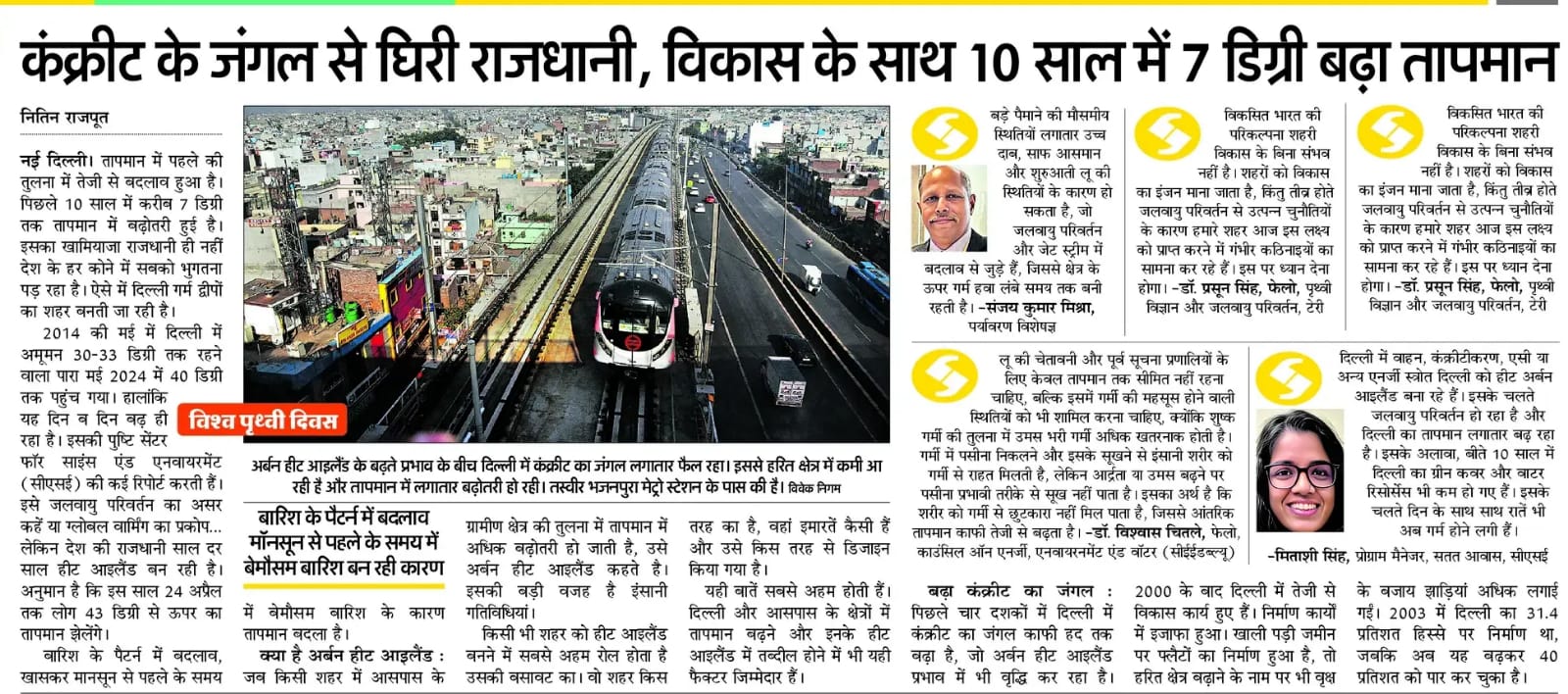
कंक्रीट के जंगल से घिरी राजधानी, विकास के साथ 10 साल में 7 डिग्री बढ़ा तापमान

दिल्ली के तापमान में पहले की तुलना में तेजी से बदलाव हुआ है। पिछले 10 साल में करीब 7 डिग्री तक तापमान में बढ़ोतरी हुई है। इसका खामियाजा राजधानी ही नहीं देश के हर कोने में सबको भुगतना पड़ रहा है। ऐसे में दिल्ली गर्म द्वीपों का शहर बनती जा रही है। 2014 की मई में दिल्ली में अमूमन 30-33 डिग्री तक रहने वाला पारा मई 2024 में 40 डिग्री तक पहुंच गया।

Delhi’s parking wars now end in murder & court cases. It’s the new road rage

“The increased violence due to parking is clearly a symptom of our inability to implement parking management rules,” said Anumita Roychowdhury, Executive Director (Research and Advocacy), Centre for Science and Environment. It was around midnight on Monday when a white Toyota Fortuner pulled up outside a home in Preet Vihar. Hearing the beep, one of the landlords, Paras Nayyar, stepped out and asked the tenant who was driving the car to park elsewhere and not block his gate. The tenant responded by pulling out a gun and firing three shots, killing Paras’ brother, Pankaj Nayyar, in an instant. The shocking Preet Vihar murder is a new flashpoint in Delhi’s growing number of brawls and litigation over parking spaces. With more than 80 lakh cars for a population of 3.3 crore, the national capital is choked already. A designated parking lot is a scarce commodity, and Delhi’s residents are willing to argue, fight, complain, litigate – and even pull out a gun – for it. There has been a string of violent parking disputes in Delhi NCR, where a patch of road has become a marker of power. With streets lined with cars and little room left for pedestrians, even a request can turn into a confrontation few are willing to risk. In 2021, the Delhi police control room received only 2,413 calls related to parking violence, but in 2025, this number crossed 7,000. The district courts have witnessed more and more parking dispute cases with serious violence, reflecting how sharply the conflict has intensified. Fights over parking spaces are the new road rage. “He hit me with the back of the pistol and fled with the other two men who came on the bike,” said Paras Nayyar, who owns two flats in Preet Vihar. This was not the first time. A similar argument had taken place earlier between Nayyar and the accused, Gaurav Sharma. But nobody had anticipated it would spiral into a fatal act of violence. “The man was a tenant here and owned three cars. Paras gave him his own parking space in the side building, but still his attitude was on cloud nine. He was drunk and couldn’t handle the argument. Such parking-related fights have become common day by day,” said Sohan Ahuja, a relative of the Nayyars. The wealthy lanes of East Delhi’s Preet Vihar in A block were covered in cars on both sides. There is limited space on the street, even though people have parking spaces inside the building. This is a common scene across Delhi’s different residential areas. The public space is shrinking, and car ownership has increased. The streets become a zone of daily friction. Small arguments that were handled in RWA groups now reach the police control rooms, district courts, and at times, mortuaries. Tussles over whose car blocked whose gate, who scratched whose bumper, or who “owned” a patch of road have escalated into assaults and murders. Experts and lawyers say that the surge is rooted in a deeper mismatch. The localities were built for fewer vehicles, and now houses have multiple cars, even the publicly available parking often ends up in long bureaucratic disputes. Streets once used by children as playgrounds have become contested storage spaces for private vehicles —especially on weekends, when most cars remain parked at home, and every vacant inch acquires value. “Delhi’s parking violence is ultimately a symptom of bad urban planning,” said former DDA Commissioner (Planning), AK Jain. The big civic problems required a deep policy reform. “The solution is not only policing but policy — regulate car ownership where no parking exists, create shared and underground public parking, and improve last-mile public transport so dependence on private cars reduces,” Jain added. On 20 April, the parking of house number A 144 in Preet Vihar was filled with relatives and neighbours till noon. Everyone was furious about the shooting, and the residents of the colony were discussing the parking issue in small groups. “Bas parking ki baat thi” (It was only about parking), “Raat ko shor-sharabe ki awaaz aa rahi thi” (Screams were heard at night), “Kisiko laga nahi baat yahan tak pahunch jayegi” (No one thought it would go this far), “Ek ghar barbaad ho gaya” (A family has been destroyed). Many of the neighbours had heard noises from the street when the fight was going on at midnight, but only a few people stepped out for help—because such cases are common in the area. “Just last week, two people had a really bad argument about the parking space. But that didn’t go to this level. None of them was drunk. Alcohol also had a huge role to play in last night’s fight. And this was not a brand new argument. Both parties have been arguing, but this time it exploded with this,” said Mahendra Singh, a resident of Preet Vihar. Pankaj Nayyar is survived by his seven-month pregnant wife, their six-year-old child, and his parents. His brother is burdened with guilt, as he was the one who had called Pankaj from Noida to Preet Vihar that night after the parking dispute escalated. The fight resumed around 2 am, when Pankaj Nayyar came to Preet Vihar after Gaurav Sharma’s continuous shouting and abusing. They were first shouting at each other over the call, and then Sharma challenged him to fight him in person. Later, Gaurav Sharma allegedly pulled out a firearm and fired three rounds. One bullet struck Pankaj Nayyar in the chest, while Paras narrowly escaped. Paras Nayyar said that after shooting Pankaj, Gaurav Sharma allegedly walked up to him and struck him in the face with the butt of the gun. Paras still bears bruises from the assault. Sharma owns three cars — a BMW, a Fortuner, and another vehicle. Two of the cars reportedly share the same number plate, a marker of power and wealth in many parts of India. The Nayyars own a Baleno and a Swift. It all started when Sharma came back home at night in his BMW and found Paras’ car parked in his space. Paras was not at home at the time, having dinner at a restaurant having dinner. And his parents had gone to a wedding in Jim Corbett National Park. “He called Paras, and Paras told him he could park his car at A-145, beside Gaurav’s building, where Paras owns another flat. Gaurav parked his car there, but later his 20-year-old son arrived in the Fortuner and demanded a parking space. Paras told him there was only one slot allotted to each family, and Gaurav got furious,” a police officer said, describing the incident. Thus began the fight, and neighbours came out to defuse the matter. Sharma allegedly refused to let go of the matter. After arguing endlessly, Paras decided to call his brother, Pankaj, for help. “The issue had been sorted out and Pankaj was already leaving, but Gaurav started abusing Paras and his family. That is when Pankaj came back, and the whole incident happened,” said a resident of Preet Vihar. “The first reason is convenience, and the other is that they do not want another person parking near their house,” said the resident, pointing at a house where a car was parked outside instead of inside the designated parking area. About 12 hours after the incident, police arrested Gaurav Sharma from Model Town. His two friends, who were allegedly involved in the matter, remain at large. The Delhi Police station at Preet Vihar has registered an FIR under Sections 103(1) (murder), 115(2) (voluntarily causing hurt), and 3(5) (common intention) of the Bharatiya Nyaya Sanhita, along with provisions of the Arms Act. “We have noticed a rise in such fights because now one family easily owns two or three cars, while the buildings are older and even many new ones provide parking for only two vehicles. People do not have the patience to talk things out anymore. We are now thinking about what can be done so such incidents are not repeated,” said a member of Preet Vihar RWA. Numerous complaints, no solution KK Verma, RWA secretary, has been living in Preet Vihar for the last 45 years. He said he has seen a huge spike in parking-related complaints in the last five years. The RWA WhatsApp group has been bombarded with complaints constantly. Sometimes fights become so intense that the police are called. “The small fights are not small anymore. Every day, there are new complaints. It has become a big crisis,” Verma said. He recalled a fight when one angry resident threatened to slash the other’s throat over a parking space. According to Preet Vihar residents, the problem is that the four or five-story buildings only have capacity for one car parking spot per floor, but nowadays, one floor owner owns four or five cars. So they park one vehicle in the parking lot and others on the roads. The lack of public parking and weak enforcement of rules fuel the situation. There are several places in Delhi where public parking projects were announced and construction began, but the facilities never fully materialised. A massive underground parking structure near Jangpura Block-A and Jangpura Extension has remained unfinished for years. Conceived before the 2010 Commonwealth Games, the three-level project was meant to hold around 308 vehicles, but delays, contractor disputes, and funding issues kept it from becoming operational. “The parking situation is worse here as well. If a guest comes in a car on the weekend, finding a spot to park becomes a hassle. The solutions the government announced aren’t helpful because they aren’t working on the ground. The parking facility was announced in 2010, and since then, the problem has increased, but no solution has been found,” said Sonali Verma, a resident of Jangpura. Experts say the rage spilling onto Delhi’s streets is rooted in a deeper governance failure. They argue that parking disputes turning violent are less about individual tempers and more about the absence of clear rules, enforcement, and planned space for vehicles in overcrowded neighbourhoods. “The increased violence due to parking is clearly a symptom of our inability to implement parking management rules,” said Anumita Roychowdhury, Executive Director (Research and Advocacy), Centre for Science and Environment. She added Delhi cannot keep creating endless parking spaces at the cost of roads, footpaths and public land, warning that unmanaged parking is worsening congestion and social tension. “Parking demand and parking supply cannot increase infinitely… in any given locality, any given neighbourhood, there is a need for land for other purposes—for people to walk, for community-level services. So you cannot say that any available vacant space or public space can be given away for parking,” Roychowdhury said.

Parking paradox: Empty lots, choked streets

Every morning thousands of office-goers in Bengaluru’s Gandhinagar and Infantry Road circle blocks go around for 20–30 minutes hunting for parking, even as the ₹80-crore Freedom Park Multi-Level Car Parking nearby stands mostly empty. In Delhi, the situation is no different. A 2025 Jamia Millia Islamia study found motorists in Delhi waste an average of 20 minutes daily searching for parking --- fuel, time and often temper lost before the workday even begins. This pattern repeats across cities in India: expensive multi-level car parking (MLCP) towers stand half-empty while nearby streets remain choked with vehicles. Over the past decade, India has invested hundreds of crores in MLCPs under the Smart Cities Mission, AMRUT and municipal budgets. Delhi’s Municipal Corporation (MCD), for example, operates nearly 30 MLCPs and has proposed nine more at a cost of ₹775 crore, adding over 4,400 spaces and raising total capacity by 40% to roughly 15,157 vehicles. Similarly, Ahmedabad, Bhopal and Chandigarh have built many such facilities, often costing ₹50– ₹100 crore each. Yet most of them remain highly underused. Occupancy in many Delhi facilities hovers at 30–40% , Bengaluru’s average sits around 30%, and similar low utilisation is reported in cities like Pune, Chennai, Ahmedabad and other cities. Meanwhile, free on-street parking continues to dominate, consuming about 14% of Delhi’s road space and over 40% in many other cities, according to a study by the Centre for Science and Environment (CSE).