
Cse In News

Heatwaves and floods expose India’s urban policy gaps

At a recent conference on urban climate, Anumita Roy Chowdhury of the Centre for Science and Environment noted that Indian architecture has imported Western design models without adapting them to local conditions. Glass-façade buildings trap solar radiation and release heat slowly, raising night-time temperatures. They also drive heavy air-conditioning demand, which further heats the surrounding environment.
How India is emerging as testing ground for agri-based carbon markets

A recent deal between Amazon and Bayer-backed The Good Rice Alliance (TGRA) signals a shift in how companies approach climate goals and highlights India’s growing role as a testing ground for agriculture-based carbon markets. In a statement, the company said Amazon will act as the primary buyer of more than 685,000 tonnes of carbon dioxide-equivalent credits generated by 13,000 Indian rice farmers across 35,000 hectares. These credits come from farming techniques that reduce methane emissions, especially from flooded paddy fields, a major source of greenhouse gases. But the real story lies beyond the numbers. Traditionally, companies bought carbon credits from the market, but now they are investing directly in projects to create their own supply. Also, the voluntary carbon markets have faced criticism for low-quality or unverifiable offsets. The companies are now moving towards 'high-integrity' credits that are measurable, science-backed, and auditable. Amazon said its focus is on “real, verifiable climate outcomes” supported by field measurements and satellite validation. And it is this shift that is increasingly playing out in India, placing the country at the centre of the agriculture-based carbon markets. This is also how industry players are reading the move. Umang Agarwal, head of Carbon and COO (Carbon) at Grow Indigo, a leading Indian agricultural technology company that operates the country’s first science-backed agricultural carbon credit programme, said the deal signals a turning point in how agriculture is being viewed in carbon markets. "When a company like Amazon commits to offtake from a rice methane programme, it tells the market that agricultural carbon is being taken seriously at the highest level of corporate procurement," he told Business Standard, adding that agriculture is increasingly emerging as a "genuine carbon asset class". He added that credibility concerns, which have long been a sticking point in voluntary carbon markets, are evolving rather than disappearing. "What is emerging now is a clearer separation between high-integrity credits and low-quality offsets," Agarwal said. "Projects that go through rigorous standards and multi-year audits are building the trust that institutional buyers are now demanding." Why India is at the centre of this shift Indian Council of Agricultural Research (ICAR)-Central Research Institute for Dryland Agriculture (CRIDA) noted in its 2025 policy paper that agriculture in India contributes around 14 per cent of total greenhouse gas emissions, but also has significant potential to act as a carbon sink through better practices. Also, India’s farmers are highly vulnerable to climate shocks, and over 82 per cent are small and marginal farmers, often facing erratic rainfall and rising costs. Carbon markets are being positioned not just as climate tools, but as income support mechanisms. Agarwal pointed to three structural advantages: "Start with the scale. India is one of the world’s largest agricultural economies, with enormous potential for emissions reduction across crops like rice, wheat, and sugarcane." But scale alone is not enough. "What distinguishes India is the institutional infrastructure. We have research bodies like ICAR, established agri-tech players, and the ability to build last-mile farmer networks and digital monitoring systems," he added. Grow Indigo manages over 2 million acres across seven states, reflecting the operational scale required. Experts say this combination of large farm base, strong research backing, and growing private sector capability is what makes India a credible near-term hub for agriculture-based carbon credits, ahead of regions like Southeast Asia or Africa. Challenges emerging on ground Evidence from the field suggests a more complicated picture. "There are transparency gaps in project implementation. It is difficult to assess whether the reductions are real or the project is financially viable. There are concerns about double additions of the credits. The monitoring and verification systems are also weak, and long delays in issuing credits," said Trishant Dev, deputy programme manager (Climate Change and Green Economy) at Centre for Science and Environment, New Delhi in an interview with Business Standard. Some projects have failed verification due to poor documentation and unclear methodologies. A 2025 study by AG Adeeth Cariappa, an environmental and resource economist, found that trust is a critical barrier. The study titled "Understanding farmers' trust in stakeholders of carbon credit projects" (Elsevier journal Current Research in Environmental Sustainability) found: Government departments and agricultural universities are most trusted Private firms and international organisations are less trusted Financial transparency remains the weakest link The study warns that without trust, farmers may drop out of projects or never adopt them in the first place. "There are 150 agriculture projects in India, but only a small fraction have been registered for issuing credits, many farmers are still waiting for promised returns," Dev added He further said that farmers receive limited economic benefit as much of the revenue goes to project developers, auditors, and certification costs. “What finally reaches farmers is often too little to incentivise them to continue.” What is the policy push and what questions remain? Carbon Credit Trading Scheme (2023) and Framework for voluntary carbon markets in agriculture (2024) aim to create a formal market for carbon credits and incentivise sustainable practices. Cariappa, who is studying and working on Voluntary Carbon Markets at The International Maize and Wheat Improvement Center (CIMMYT), Hyderabad, noted the framework lays out processes for project design, monitoring, verification, and trading of credits. But a key question remains: Who owns the credit? Farmer or developer? Experts say if India sells its low-cost emission reductions (like methane cuts in agriculture) to global buyers, it may be left with more expensive options to meet its own climate targets. This is in line with Paris Climate Agreement’s Article 6, which requires countries to adjust their emissions accounting when credits are exported. Industry experts say while Amazon’s deal may appear singular, it represents a larger experiment to test whether India can turn millions of small farms into a reliable, tradable climate solution. And, if successful, whether it can scale across the Global South.

अब खेती से डॉलर कमाएंगे किसान? जानें Amazon की नई डील क्या है

सेंटर फॉर साइंस एंड एनवायरमेंट के त्रिशांत देव के मुताबिक, कई प्रोजेक्ट्स में पारदर्शिता की कमी है और यह तय करना मुश्किल होता है कि कार्बन में कमी असली है या नहीं। उन्होंने कहा कि मॉनिटरिंग और वेरिफिकेशन सिस्टम अभी कमजोर हैं और कई बार क्रेडिट जारी होने में देरी होती है। रिपोर्ट के मुताबिक, इस सिस्टम में सबसे ज्यादा पैसा प्रोजेक्ट डेवलपर्स, ऑडिट और सर्टिफिकेशन में चला जाता है। किसानों के हिस्से में कम पैसा आता है, जिससे उनका भरोसा कमजोर हो सकता है। कई किसान अभी भी अपने पैसे का इंतजार कर रहे हैं।

Sunita Narain show: War will change the energy map of the world. What will it mean for energy transition?

There is a great energy disruption in our world today because of what I would call the senseless US-Israel war against Iran. The closure of the Strait of Hormuz by Iran because of this aggression has meant that 20 per cent of the world's oil and gas supplies are hit. Governments in both rich and poor countries are warning their people of dire times ahead, unlike anything seen before by this generation: Acute energy scarcity, rationing and even the prospect of cars and aeroplanes running out of fuel. This is colliding with the energy transition that was happening in our world - moving away from fossils to renewables; from petrol and diesel vehicles towards electric. What will this great energy disruption do to the existing energy disruption? What does it mean for us in the countries of the South where cost of energy determines our economy and livelihoods? The question is what will the future energy map look like?

When Ancient Wisdom Meets a Changing Climate: How Assam’s Indigenous Tribes Are Fighting the Battle ?

Agarwal, A. & Narain, S. (1989). Towards Green Villages: A Strategy for Environmentally Sound and Participatory Rural Development. Centre for Science and Environment, New Delhi. When Ancient Wisdom Meets a Changing Climate: How Assam‘s Indigenous Tribes Are Fighting the Battle ? How the Traditional Ecological Knowledge of the Mising, Bodo, Karbi, and Dimasa peoples – systems refined over centuries -is being dismantled by the very crisis it could help solve For thousands of years, the tribes of Assam have read the land the way others read books – in the curvature of a river bend, the height of a bamboo stilt, the length of a fallow field. Their knowledge systems were not passive folklore but living, functional technologies: precision-engineered responses to a dynamic monsoon landscape. Today, in 2026, that landscape is changing faster than any cultural memory can adapt, and the loss is simultaneously ecological, economic, and deeply human.

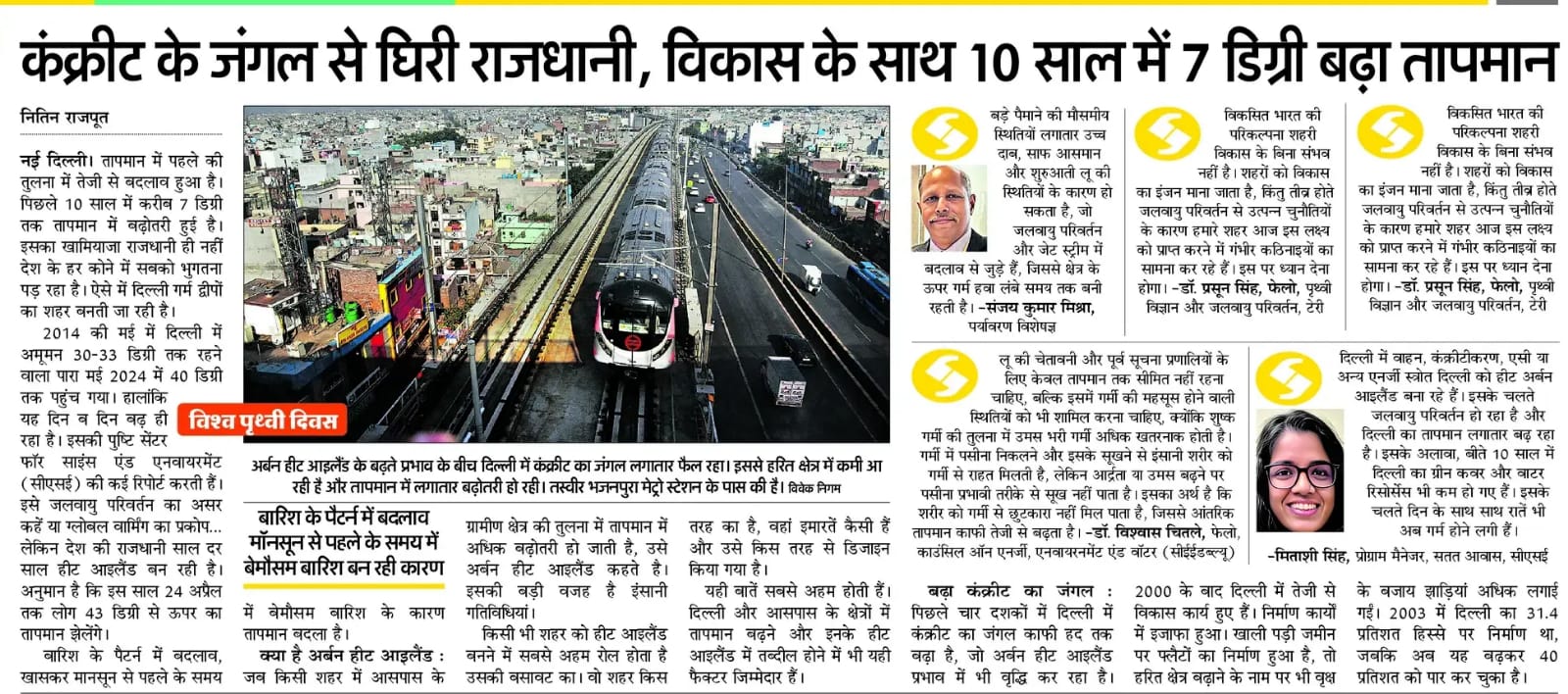
कंक्रीट के जंगल से घिरी राजधानी, विकास के साथ 10 साल में 7 डिग्री बढ़ा तापमान

दिल्ली के तापमान में पहले की तुलना में तेजी से बदलाव हुआ है। पिछले 10 साल में करीब 7 डिग्री तक तापमान में बढ़ोतरी हुई है। इसका खामियाजा राजधानी ही नहीं देश के हर कोने में सबको भुगतना पड़ रहा है। ऐसे में दिल्ली गर्म द्वीपों का शहर बनती जा रही है। 2014 की मई में दिल्ली में अमूमन 30-33 डिग्री तक रहने वाला पारा मई 2024 में 40 डिग्री तक पहुंच गया।

Delhi’s parking wars now end in murder & court cases. It’s the new road rage

“The increased violence due to parking is clearly a symptom of our inability to implement parking management rules,” said Anumita Roychowdhury, Executive Director (Research and Advocacy), Centre for Science and Environment. It was around midnight on Monday when a white Toyota Fortuner pulled up outside a home in Preet Vihar. Hearing the beep, one of the landlords, Paras Nayyar, stepped out and asked the tenant who was driving the car to park elsewhere and not block his gate. The tenant responded by pulling out a gun and firing three shots, killing Paras’ brother, Pankaj Nayyar, in an instant. The shocking Preet Vihar murder is a new flashpoint in Delhi’s growing number of brawls and litigation over parking spaces. With more than 80 lakh cars for a population of 3.3 crore, the national capital is choked already. A designated parking lot is a scarce commodity, and Delhi’s residents are willing to argue, fight, complain, litigate – and even pull out a gun – for it. There has been a string of violent parking disputes in Delhi NCR, where a patch of road has become a marker of power. With streets lined with cars and little room left for pedestrians, even a request can turn into a confrontation few are willing to risk. In 2021, the Delhi police control room received only 2,413 calls related to parking violence, but in 2025, this number crossed 7,000. The district courts have witnessed more and more parking dispute cases with serious violence, reflecting how sharply the conflict has intensified. Fights over parking spaces are the new road rage. “He hit me with the back of the pistol and fled with the other two men who came on the bike,” said Paras Nayyar, who owns two flats in Preet Vihar. This was not the first time. A similar argument had taken place earlier between Nayyar and the accused, Gaurav Sharma. But nobody had anticipated it would spiral into a fatal act of violence. “The man was a tenant here and owned three cars. Paras gave him his own parking space in the side building, but still his attitude was on cloud nine. He was drunk and couldn’t handle the argument. Such parking-related fights have become common day by day,” said Sohan Ahuja, a relative of the Nayyars. The wealthy lanes of East Delhi’s Preet Vihar in A block were covered in cars on both sides. There is limited space on the street, even though people have parking spaces inside the building. This is a common scene across Delhi’s different residential areas. The public space is shrinking, and car ownership has increased. The streets become a zone of daily friction. Small arguments that were handled in RWA groups now reach the police control rooms, district courts, and at times, mortuaries. Tussles over whose car blocked whose gate, who scratched whose bumper, or who “owned” a patch of road have escalated into assaults and murders. Experts and lawyers say that the surge is rooted in a deeper mismatch. The localities were built for fewer vehicles, and now houses have multiple cars, even the publicly available parking often ends up in long bureaucratic disputes. Streets once used by children as playgrounds have become contested storage spaces for private vehicles —especially on weekends, when most cars remain parked at home, and every vacant inch acquires value. “Delhi’s parking violence is ultimately a symptom of bad urban planning,” said former DDA Commissioner (Planning), AK Jain. The big civic problems required a deep policy reform. “The solution is not only policing but policy — regulate car ownership where no parking exists, create shared and underground public parking, and improve last-mile public transport so dependence on private cars reduces,” Jain added. On 20 April, the parking of house number A 144 in Preet Vihar was filled with relatives and neighbours till noon. Everyone was furious about the shooting, and the residents of the colony were discussing the parking issue in small groups. “Bas parking ki baat thi” (It was only about parking), “Raat ko shor-sharabe ki awaaz aa rahi thi” (Screams were heard at night), “Kisiko laga nahi baat yahan tak pahunch jayegi” (No one thought it would go this far), “Ek ghar barbaad ho gaya” (A family has been destroyed). Many of the neighbours had heard noises from the street when the fight was going on at midnight, but only a few people stepped out for help—because such cases are common in the area. “Just last week, two people had a really bad argument about the parking space. But that didn’t go to this level. None of them was drunk. Alcohol also had a huge role to play in last night’s fight. And this was not a brand new argument. Both parties have been arguing, but this time it exploded with this,” said Mahendra Singh, a resident of Preet Vihar. Pankaj Nayyar is survived by his seven-month pregnant wife, their six-year-old child, and his parents. His brother is burdened with guilt, as he was the one who had called Pankaj from Noida to Preet Vihar that night after the parking dispute escalated. The fight resumed around 2 am, when Pankaj Nayyar came to Preet Vihar after Gaurav Sharma’s continuous shouting and abusing. They were first shouting at each other over the call, and then Sharma challenged him to fight him in person. Later, Gaurav Sharma allegedly pulled out a firearm and fired three rounds. One bullet struck Pankaj Nayyar in the chest, while Paras narrowly escaped. Paras Nayyar said that after shooting Pankaj, Gaurav Sharma allegedly walked up to him and struck him in the face with the butt of the gun. Paras still bears bruises from the assault. Sharma owns three cars — a BMW, a Fortuner, and another vehicle. Two of the cars reportedly share the same number plate, a marker of power and wealth in many parts of India. The Nayyars own a Baleno and a Swift. It all started when Sharma came back home at night in his BMW and found Paras’ car parked in his space. Paras was not at home at the time, having dinner at a restaurant having dinner. And his parents had gone to a wedding in Jim Corbett National Park. “He called Paras, and Paras told him he could park his car at A-145, beside Gaurav’s building, where Paras owns another flat. Gaurav parked his car there, but later his 20-year-old son arrived in the Fortuner and demanded a parking space. Paras told him there was only one slot allotted to each family, and Gaurav got furious,” a police officer said, describing the incident. Thus began the fight, and neighbours came out to defuse the matter. Sharma allegedly refused to let go of the matter. After arguing endlessly, Paras decided to call his brother, Pankaj, for help. “The issue had been sorted out and Pankaj was already leaving, but Gaurav started abusing Paras and his family. That is when Pankaj came back, and the whole incident happened,” said a resident of Preet Vihar. “The first reason is convenience, and the other is that they do not want another person parking near their house,” said the resident, pointing at a house where a car was parked outside instead of inside the designated parking area. About 12 hours after the incident, police arrested Gaurav Sharma from Model Town. His two friends, who were allegedly involved in the matter, remain at large. The Delhi Police station at Preet Vihar has registered an FIR under Sections 103(1) (murder), 115(2) (voluntarily causing hurt), and 3(5) (common intention) of the Bharatiya Nyaya Sanhita, along with provisions of the Arms Act. “We have noticed a rise in such fights because now one family easily owns two or three cars, while the buildings are older and even many new ones provide parking for only two vehicles. People do not have the patience to talk things out anymore. We are now thinking about what can be done so such incidents are not repeated,” said a member of Preet Vihar RWA. Numerous complaints, no solution KK Verma, RWA secretary, has been living in Preet Vihar for the last 45 years. He said he has seen a huge spike in parking-related complaints in the last five years. The RWA WhatsApp group has been bombarded with complaints constantly. Sometimes fights become so intense that the police are called. “The small fights are not small anymore. Every day, there are new complaints. It has become a big crisis,” Verma said. He recalled a fight when one angry resident threatened to slash the other’s throat over a parking space. According to Preet Vihar residents, the problem is that the four or five-story buildings only have capacity for one car parking spot per floor, but nowadays, one floor owner owns four or five cars. So they park one vehicle in the parking lot and others on the roads. The lack of public parking and weak enforcement of rules fuel the situation. There are several places in Delhi where public parking projects were announced and construction began, but the facilities never fully materialised. A massive underground parking structure near Jangpura Block-A and Jangpura Extension has remained unfinished for years. Conceived before the 2010 Commonwealth Games, the three-level project was meant to hold around 308 vehicles, but delays, contractor disputes, and funding issues kept it from becoming operational. “The parking situation is worse here as well. If a guest comes in a car on the weekend, finding a spot to park becomes a hassle. The solutions the government announced aren’t helpful because they aren’t working on the ground. The parking facility was announced in 2010, and since then, the problem has increased, but no solution has been found,” said Sonali Verma, a resident of Jangpura. Experts say the rage spilling onto Delhi’s streets is rooted in a deeper governance failure. They argue that parking disputes turning violent are less about individual tempers and more about the absence of clear rules, enforcement, and planned space for vehicles in overcrowded neighbourhoods. “The increased violence due to parking is clearly a symptom of our inability to implement parking management rules,” said Anumita Roychowdhury, Executive Director (Research and Advocacy), Centre for Science and Environment. She added Delhi cannot keep creating endless parking spaces at the cost of roads, footpaths and public land, warning that unmanaged parking is worsening congestion and social tension. “Parking demand and parking supply cannot increase infinitely… in any given locality, any given neighbourhood, there is a need for land for other purposes—for people to walk, for community-level services. So you cannot say that any available vacant space or public space can be given away for parking,” Roychowdhury said.

Parking paradox: Empty lots, choked streets

Every morning thousands of office-goers in Bengaluru’s Gandhinagar and Infantry Road circle blocks go around for 20–30 minutes hunting for parking, even as the ₹80-crore Freedom Park Multi-Level Car Parking nearby stands mostly empty. In Delhi, the situation is no different. A 2025 Jamia Millia Islamia study found motorists in Delhi waste an average of 20 minutes daily searching for parking --- fuel, time and often temper lost before the workday even begins. This pattern repeats across cities in India: expensive multi-level car parking (MLCP) towers stand half-empty while nearby streets remain choked with vehicles. Over the past decade, India has invested hundreds of crores in MLCPs under the Smart Cities Mission, AMRUT and municipal budgets. Delhi’s Municipal Corporation (MCD), for example, operates nearly 30 MLCPs and has proposed nine more at a cost of ₹775 crore, adding over 4,400 spaces and raising total capacity by 40% to roughly 15,157 vehicles. Similarly, Ahmedabad, Bhopal and Chandigarh have built many such facilities, often costing ₹50– ₹100 crore each. Yet most of them remain highly underused. Occupancy in many Delhi facilities hovers at 30–40% , Bengaluru’s average sits around 30%, and similar low utilisation is reported in cities like Pune, Chennai, Ahmedabad and other cities. Meanwhile, free on-street parking continues to dominate, consuming about 14% of Delhi’s road space and over 40% in many other cities, according to a study by the Centre for Science and Environment (CSE).

What are the health impacts of sea-level rise, and who should pay?

The director general of India’s Centre for Science and Environment, Sunita Narain, said: “It is clear that women are disproportionately hit … The increased frequency and intensity of these weather events puts pressure on livelihoods and this means that the men are the first to migrate in search of work. “This then puts additional pressure on women to cope and indeed survive.” In November in Solomon Islands, the former Tongan health minister, Dr Saia Ma’u Piukala, stood outside the main hospital in Honiara and “watched seawater lapping at its outer walls.” “The facility is now under threat, with plans under way to relocate it to higher ground — a massive and costly undertaking,” Saia, a surgeon and now the World Health Organization’s regional director for the western Pacific, tells the Guardian. “It should never have come to this.” The impact on patients and health services is just one part of a growing health burden driven by sea-level rise, including water contamination, infectious disease, food insecurity, displacement and worsening mental health. In 2024, at the inaugural UN General Assembly meeting on sea-level rise, representatives of small island developing states and low-lying countries described the issue as a global crisis threatening one billion people worldwide, urging governments globally to act to protect their health and lives. “We contributed almost nothing to this global scourge, but it is our land that is being consumed by the sea,” Samoa’s then prime minister, Afioga Fiamē Naomi Mataʻafa, told the meeting. The result is a Lancet Commission on sea-level rise health and justice, co-chaired by the leading climate negotiator Christiana Figueres and enlisting almost two dozen health and environment experts as commissioners — Saia among them. One of the most difficult questions the commission will grapple with is this: who should be responsible for paying when cities like Honiara are forced to rebuild critical infrastructure due to the impacts of some of the most polluting corporations and countries? In 14 Pacific island countries, Saia says, 62 per cent of health infrastructure lies within 500 metres of the coast. “The consequences of inaction are now too severe to ignore,” he says. “The evidence of climate‑related health harm is overwhelming and irrefutable. “As both a doctor and a former health minister, I firmly believe that health is ultimately a political choice.” What are the health impacts of sea-level rise? One of the most immediate health consequences is unsafe water, as saltwater seeps into underground freshwater sources and contaminates drinking supplies. Flooding can overwhelm sanitation systems, pushing sewage and pollutants into water sources and increasing the risk of waterborne diseases such as cholera and leptospirosis. Human migrations and displacements caused by sea-level rise also lead to overcrowding and poor conditions, fuelling the spread of infectious disease. Salinated water may lead to increases in blood pressure, with higher salt intake linked to hypertension and damage to the heart, brain, kidneys and blood vessels. And when salinated water destroys crops, populations become malnourished, with many losing their livelihoods as farmland becomes unviable. A co-chair of the commission, Prof. Kathryn Bowen, said sea-level rise would be a core component of the health chapter of the seventh report of the Intergovernmental Panel on Climate Change, the UN body that assesses the science related to climate change. “One of the core human needs is fresh water,” she says. “We’re starting to see that this salinity and contamination is linked to worse cardiovascular, renal and pregnancy related health outcomes, and we know that the combination of sea water intrusion and agricultural practices has also been linked to heavy metal sources being found in groundwater.” What are the gender inequality impacts? In some countries, women and girls are largely responsible for collecting water for cooking and sanitation, and are forced to travel further when local supplies are polluted. Longer journeys increase their exposure to sexual violence, as well as exploitation and waterborne disease. Sea-level rise also makes weather events more dangerous, as storm surges and flooding reach further inland. Crowded emergency shelters can expose women and girls to sexual violence and poor sanitation, leading some to avoid shelters altogether. Pregnant women and young children are particularly vulnerable to diseases from drinking-water contamination and disrupted healthcare access is linked to poor pregnancy outcomes and child health risks. The director general of India’s Centre for Science and Environment, Sunita Narain, said: “It is clear that women are disproportionately hit … The increased frequency and intensity of these weather events puts pressure on livelihoods and this means that the men are the first to migrate in search of work. “This then puts additional pressure on women to cope and indeed survive.” What impacts does relocation have? Even when relocation in response to the threat of sea-level rise is planned, Bowen says, deliberate and permanent relocation ahead of disaster has profound impacts, with education, housing and other critical services also needing to move. Saia has seen the health impacts of this relocation first-hand. “In the Pacific, health is inseparable from identity,” he says. “Sea‑level rise does not just take land; it erodes culture, traditions and people’s sense of belonging. “In low‑lying atoll countries such as Kiribati, Nauru, the Marshall Islands and Tuvalu, families are being pushed off ancestral land as erosion worsens and flooding becomes routine. This disrupts food systems, community practices and social cohesion.

Energy in times of war

THE DISASTROUS US-Israel war against Iran has disrupted energy supply across the world. Governments in both rich and poor countries are warning their people of dire times ahead, unlike anything seen before by this generation: acute energy scarcity, rationing and even the prospect of cars and aeroplanes running out of fuel. The question is what will the future energy map look like? - SUNITA NARAIN \ EDIT As I ask this, I would request you to not make light of the assassinations, the thousands of lives lost and the senseless destruction that we witness so clearly as we scroll through our screens. Let us also not make light of the real pain that this energy disruption has brought to our world. Many countries are facing shortages of cooking fuel, including liquefied petroleum gas (LPG), and households are spending vast portions of their income to procure it at any cost. Long queues at fuel stations are becoming common—again, driving up costs that people can barely afford. In most countries, particularly in our world, fuel imports are the highest charge on trade deficits and in this scenario, rising oil prices have crippling effects on economies. Then the impending shortfall in global fertiliser supply is expected to hit farmers hard—those already reeling from extreme weather driven by climate change and distorted global food prices. All in all, the world is on its knees—not by choice, but because of its pusillanimous and pathetic response to this senseless US-Israel war on Iran. The rules-based order and all its morality lie in tatters. Let's at least be clear on this.

जंगल के करीब मौत की सफारी! पेंच टाइगर रिजर्व में आदमखोर बाघ कर रहा लोगों का शिकार

देश में तेजी से जंगल सिकुड़ रहे हैं. बाघों के नेचुरल हैबिटैट पर बढ़ते दबाव से उन पर संकट है. सेंटर फॉर साइंस एंड एनवायरनमेंट (CSE) की 2026 की रिपोर्ट के अनुसार "पर्यावरणीय बदलावों और मानव गतिविधियों के हस्तक्षेप ने बाघों के व्यवहार को प्रभावित किया है. इसके चलते इंसानों पर हमलों की घटनाएं बढ़ रही हैं. जनवरी से जून 2025 के बीच भारत में बाघों ने कम से कम 43 लोगों की जान ली."

इंसान और फसल दोनों पर भारी पड़ता प्री-मानसून सीजन

श्योपुर जिले के रामेश्वर गांव के रहने वाले रामलखन मीणा ने 15 बीघा में गेहूं की फसल बोई हुई थी। बेहतर उत्पादन की आशा में उन्होंने प्रति बीघा लगभग 10 से 12000 रूपए का निवेश किया था। मगर 4 अप्रैल की दोपहर में अचानक हुई बारिश और ओलावृष्टि ने उनकी फसल नष्ट कर दी। नुकसान के बारे में पूछने पर कहते हैं, “100% फसल ख़राब हुई है।” रामलखन अकेले ऐसे किसान नहीं हैं। इसी जिले के बेहरावदा गांव के योगेश मीणा ने 50 बीघा में गेहूं की बोवाई की थी। 4 अप्रैल को हुई ओलावृष्टि में ये भी ख़राब हो गई। दरअसल 4 अप्रैल को, वेस्टर्न डिस्टर्बेंस की वजह से मध्य प्रदेश के कई जिलों में तेज़ ओलावृष्टि की घटना दर्ज की गई। इससे ग्वालियर क्षेत्र में सबसे ज़्यादा नुकसान हुआ। यहां दोपहर 4 बजे के आस-पास लगातार 15 मिनट तक ओलावृष्टि हुई। भारत मौसम विभाग (IMD) ने दोपहर 3:50 बजे से 4:05 बजे के बीच 2.5 सेमी डायमीटर के ओले रिकॉर्ड किए, जिससे इस इलाके का 50 साल का मौसम रिकॉर्ड टूट गया। मगर यह अकेली घटना नहीं है। राष्ट्रिय स्तर पर भी प्री-मानसून सीजन यानि मार्च से लेकर मई महीने में किसानों को होने वाला नुकसान बढ़ रहा है। इस साल केवल 1 मार्च से 7 अप्रैल के बीच ही देश 24 राज्यों में 38 में से 29 दिन बेमौसम बारिश और ओलावृष्टि की घटना दर्ज की गईं। इससे देश भर में लगभग 6 लाख 21 हज़ार 501 हेक्टेयर में फसल बर्बाद हुई है। प्री मानसून में बढ़ा नुकसान इंडियाज़ इंटरेक्टिव एटलस ऑन वेदर डिज़ासटर के अनुसार 2026 का प्री-मानसून सीजन किसानों पर पिछले साल की तुलना में कहीं ज्यादा भारी रहा है। सीजन के पहले 38 दिनों में ही जितने हिस्से में फसल तबाह हुई है उतनी बीते साल पूरे सीजन में भी नहीं हुई थी। 2025 में भारत में प्री-मानसून के दौरान 6 हज़ार 28 हेक्टेयर की फसल ही ख़राब हुई थी। इस लिहाज़ से 2026 का प्री-मानसून बीते 5 सालों में दूसरा सबसे बुरा साल रहा है। इससे पहले 2023 में सबसे ज़्यादा 6 लाख 36 हज़ार 680 हेक्टेयर क्षेत्र की फसल बर्बाद हुई थी। सेंटर फॉर साइंस एंड एनवायरनमेंट (CSE) के एनवायरनमेंट रिसोर्स यूनिट की प्रोग्राम डायरेक्टर किरण पाण्डेय कहती हैं, “इसमें कोई संदेह नहीं है कि इस साल का प्रीमानसून सीजन बीते 5 सालों में सबसे बुरा साबित होगा।” वह बताती हैं, “अभी हमारे पास जो आंकड़ें हैं उसमें पश्चिम बंगाल का नुकसान शामिल नहीं है। इसके अलावा मध्य प्रदेश से भी पूरे आंकड़ें नहीं मिले।” एटलस के आंकड़ों के अनुसार जहां एक ओर अप्रैल के पहले हफ्ते में ही 4 लाख 26 हज़ार हेक्टयर फसल ख़राब हुई है वहीं मार्च में बढ़ता नुकसान भी बेहद चिंताजनक है। आंकड़ों के अनुसार 1 लाख 94 हज़ार 950.81 हेक्टेयर फसल अकेले मार्च में ही ख़राब हुई है। यह 5 सालों में सबसे ज्यादा है। पाण्डेय के अनुसार मार्च में 3 अलग-अलग घटनाओं के सक्रीय होने के चलते यह नुकसान हुआ है। वह इसे समझाते हुए कहती हैं, “इस बार वेस्टर्न डिस्टर्बेंस मार्च-अप्रैल में काफी सक्रीय रहा है। यह अक्सर जनवरी-फ़रवरी में सक्रीय होता है। इसके अलावा मार्च की शुरुआत में हीट वेव और बंगाल की तरफ से आने वाली पूर्वी हवाएं भी सक्रीय थीं।” उनके अनुसार इन तीन घटनाओं के एक साथ मिलने से भारी ओलावृष्टि हुई है। मध्य प्रदेश में फसलों का नुकसान श्योपुर से लगभग 580 किमी दूर बड़वानी जिले के तलून गांव में राहुल काचरा की मक्के की फसल मार्च में आंधी और बारिश का शिकार हो गई। 19-20 मार्च के दौरान मध्य प्रदेश के कई हिस्सों में ओलावृष्टि और बारिश के चलते फसल ख़राब हुई है। इस पर तब हमने एक ग्राउंड रिपोर्ट भी की थी। गौरतलब है कि 20 मार्च को ही केंद्रीय कृषि मंत्री शिवराज सिंह चौहान ने बैठक कर फील्ड सर्वे करने के लिए निर्देश दिए थे। चौहान ने कहा था कि जिन क्षेत्रों में तेज बारिश, ओलावृष्टि या मौसम की अन्य प्रतिकूल स्थितियों से नुकसान हुआ है, वहां फील्ड स्तर पर समयबद्ध कार्रवाई अनिवार्य है ताकि किसी भी किसान को राहत के लिए इंतजार न करना पड़े। पाण्डेय कहती हैं कि फसल के नष्ट होने की जियोग्राफी भी बदल रही है। वह कहती हैं कि इस बार सेंट्रल इंडिया रीजन ‘क्रॉप लॉस’ का सबसे बड़ा हॉटस्पॉट बनकर उभरा है। हालांकि सबसे ज्यादा नुकसान महाराष्ट्र में हुआ है जहां 1,22,000 हेक्टेयर फसल बर्बाद हुई है। जबकि मध्य प्रदेश में केवल 40 हेक्टेयर फसल ही ख़राब बताई गई है। मगर पाण्डेय के अनुसार चूंकि राज्य से स्पष्ट और पूरे आंकड़े नहीं जारी किए गए हैं इसलिए असल नुकसान इससे भी ज्यादा हो सकता है। हालांकि एटलस में भी मध्य प्रदेश में नुकसान का आंकड़ा स्पष्ट नहीं है। इसके अनुसार 2025 में प्रदेश में 12000 हेक्टेयर फसल बर्बाद हुई थी जो 2024 (0.24000 हेक्टेयर) से कहीं ज्यादा है। पाण्डेय कहती हैं कि सभी फसलों में सबसे ज्यादा नुकसान गेहूं को हुआ है। कई राज्यों में मार्च और अप्रैल के दौरान गेहूं की फसल कटाई के लिए तैयार हो रही होती है जिसे ओलावृष्टि से भारी नुकसान होता है।

Delhi mulls ‘deposit return’ scheme for recyclable, non-degradable waste

The Delhi government is planning to monetarily incentivise the return of recyclable and non-biodegradable waste under a Deposit Return Scheme (DRS), wherein non-biodegradable items may be priced with a refundable deposit component and buyers can get a refund of the same by returning them at designated points or to shopkeepers, environment minister Manjinder Singh Sirsa said on Tuesday. The minister said that the environment department has been asked to analyse existing DRS models and identify the best practices across the country and worldwide, and submit a detailed proposal within a month. “This encourages proper segregation, collection, and recycling of waste, while significantly reducing litter and uncontrolled disposal,” an official aware of the matter said, stating the government will study DRS models in Goa, Himachal Pradesh and Uttarakhand. Sirsa said the Delhi government aims to plug the leak of recyclable plastic waste into the environment, adding that a feasibility study for a Delhi-specific DRS, including financial mechanisms, institutional setup, stakeholder roles, and roll-out strategy, will also be carried out by the environment department. “This scheme has proven its mettle in other states, and Delhi should also look towards adapting it to our unique urban challenges for swift and tangible impact,” Sirsa said, following a high-level meeting with officials from the environment department and other senior officials. Sirsa pointed out that plastic and other non-biodegradable waste were clogging drains, polluting water bodies, degrading soil, and fuelling air pollution through open burning. Experts said implementing such a scheme in Delhi will pose its own challenges, given Delhi’s porous boundaries with Haryana and Uttar Pradesh. “We have seen DRS primarily used for glass bottles - to incentivise people to bring them back, so it can be washed, refilled and reused. Goa is targeting both glass and plastic bottles through DRS, but this also requires the bottler to follow certain norms, and for QR-codes to be scanned at all levels from distribution to retail and consumers. Delhi’s geography and its porous boundaries make it challenging,” said Siddharth Singh, programme manager, Solid Waste Management unit at the Centre for Science and Environment (CSE). He said that while extended producer responsibility (EPR) is already in place, value needs to be added for the collection of non-biodegradable items, such as tetra packs. “The government will have to create some sort of value for these items, as they cannot be directly reused. Thus, there are no monetary benefits for companies producing these,” Siddarth Singh said.

Learning To Live With Nature

Across the world, environmental concerns are no longer abstract scientific debates but lived realities. Rising temperatures, biodiversity loss and resource depletion are shaping how young people perceive their future. Increasingly, education systems are being called upon not just to inform students about these issues, but to help them internalise their role within them. In India, where ecological diversity coexists with rapid urbanisation, this challenge is particularly pronounced. According to the State of India’s Environment Report 2024 by the Centre for Science and Environment (CSE), nearly 40 per cent of districts face climate-related vulnerabilities, while biodiversity loss continues to accelerate in ecologically sensitive zones. The urgency is clear: environmental awareness must evolve into ecological responsibility. It is within this broader context that some schools are attempting to move beyond textbook-based environmental studies towards more immersive and interdisciplinary approaches. Embedding Sustainability in the Campus Ecosystem At Shrewsbury International School India, this shift appears to be anchored both in campus design and classroom practice. The institution has integrated sustainability into its physical infrastructure as well as its pedagogy, aiming to make environmental consciousness a lived experience rather than a theoretical construct. “We’re in a very sunny location and so our ambition is to have at least 40 per cent of our power from solar panels,” says Dominic Tomalin, Founding Headmaster, Shrewsbury International School India. “We’re also very conscious about water harvesting and that’s been built into the design.” The campus itself reflects this intent. With plans to house at least 50,000 trees and incorporate extensive landscaping, the environment becomes a daily point of interaction for students. The emphasis is not merely aesthetic. Tomalin notes that such exposure shapes attitudes: “I also have a remarkable pupil body… they are very sensitive to environmental questions. I’m expecting them to keep the pressure on.” Beyond infrastructure, the school is exploring operational sustainability. Waste management systems, including an on-campus treatment plant, are already in place. Discussions are underway within the broader Jagran Social Welfare Society ecosystem to potentially develop internal recycling capabilities. Exposure to external innovations also plays a role; for instance, the school has collaborated with design firms that create furniture from recycled plastic, integrating these into campus spaces. From Awareness to Critical Thinking Yet, physical infrastructure alone cannot cultivate ecological responsibility. The more complex task lies in shaping how students think. Tomalin emphasises that environmental education must be tied to broader pedagogical reform. “If you stifle people with rote learning, they don’t learn how to think,” he says. “I place a great emphasis on developing critical thinking skills.” In his view, sustainability is not a standalone subject but part of a larger framework that includes problem-solving, ethical reasoning and adaptability. This perspective aligns with global educational trends. UNESCO’s Education for Sustainable Development (ESD) framework highlights the importance of equipping learners with the ability to make informed decisions and take responsible actions for environmental integrity, economic viability and a just society. The emphasis is on competencies rather than content alone. At Shrewsbury India, this competency-driven approach extends into co-curricular domains, particularly the arts. Art, Empathy and Ecological Imagination For Tansy Troy, Director of Performing Arts and Head of Drama, Shrewsbury International School India, environmental awareness becomes meaningful when it is experienced emotionally as well as intellectually. Her work with students integrates theatre, storytelling and visual arts to explore ecological themes. “I’ve been very intrigued and quite obsessed about endangered species of India,” Troy explains. “We work with our students to help them understand the importance of ecosystems and biodiversity.” One such initiative involved creating a theatrical production centred on species from Great Nicobar, a region currently under ecological stress due to proposed infrastructure development. Students explored not only the environmental implications but also the economic and social dimensions of such projects. “We’ve been discussing not only the ecology and the impact on ecology, but also the economics of the situation,” Troy says. “Lots of our students come from backgrounds where luxury travel is common, so it’s important to reflect on what that means for natural systems.” This interdisciplinary engagement - combining science, economics and art, allows students to grapple with real-world complexities. It also introduces ethical ambiguity, an essential component of environmental decision-making. Creative expression plays a central role in this process. Students write poetry, design masks from recycled materials and develop performances that simulate ecological interactions. In one instance, they created a children’s story about a lion that wishes to become human, only to lose its natural instincts - an allegory that invites reflection on identity, consumption and survival. “These activities give them not only knowledge but also empathy,” Troy notes. “They are engaging with very adult challenges - how to protect forests, how to protect species and doing it through creative media.” Such engagement extends beyond the classroom. Student-led performances have been showcased in cities like Pune and Delhi, allowing them to communicate environmental narratives to wider audiences. The school also facilitates experiential learning through field exposure, including planned visits to ecologically rich regions such as the Andaman Islands. Importantly, the approach does not position technology and nature as opposing forces. Both educators highlight the role of emerging tools, including artificial intelligence, in enhancing environmental understanding - provided they are used responsibly. “There’s a great power in AI,” Tomalin says, “but the risk is that students may stop developing learning skills if they rely on it uncritically.” He argues that education must teach students how to use such tools to support learning rather than replace it. Troy echoes this sentiment, pointing to scientific efforts that use technology to decode animal communication or monitor ecosystems. “The more technology we have, the more we can understand different ecosystems and other forms of life,” she says. This balanced perspective reflects a broader shift in environmental education—from preservationist ideals to systems thinking. Students are encouraged to see themselves not as external observers of nature, but as participants within interconnected ecological networks. The emphasis on collaboration further reinforces this idea. Drawing on evolutionary principles, Tomalin highlights the role of collective effort in human survival. “Humanity has succeeded because we have collaborated with one another,” he says. “Part of schooling is learning how to engage with others and work towards something better than individual thinking.” This collaborative ethos is visible in the school’s small class sizes and project-based learning environment, where students work closely with peers and teachers to explore complex issues. While such initiatives are still evolving, they point towards a broader reimagining of education - one that places ecological responsibility at its core. The challenge, however, extends beyond individual institutions. As environmental pressures intensify, the question is not whether schools should address sustainability, but how deeply it should be embedded in the learning experience. Moving from awareness to action requires a shift in mindset, pedagogy and institutional priorities. Ultimately, instilling ecological responsibility is less about delivering information and more about shaping perspectives. It involves helping young people understand that their choices - whether in consumption, career or citizenship - have consequences that extend beyond themselves. In a world where environmental challenges are increasingly complex and interconnected, education may well determine how effectively the next generation navigates them.