
Cse In News

A winning tactic?

The climate change crisis has now reached every country; extreme weather events are costing all economies. It is clear that the world is failing by many marks to reduce greenhouse gas emissions. So, the idea that is gaining traction, once again, is to build a carbon market that will allow countries and companies to buy credits by doing all things good—from planting trees to distributing clean cookstoves to investing in renewable energy. This market would put a price on every tonne of carbon dioxide or the equivalent greenhouse gas avoided, reduced or sequestered, which can then be used to offset emissions of companies and countries. It is simple in some ways; complicated in others. Because of this carbon market, you will be able to pick up a luxury bag that is labelled “carbon-neutral”; or take a flight that has “offset” your emissions; or even read about an oil or food company that has declared a “net-carbon footprint”. You may wonder how. These items and companies become carbon-neutral by “buying” credits—these credits are issued against activities that either reduce greenhouse gas emissions (like building a solar plant or using an efficient cookstove) or remove greenhouse gases from the atmosphere (for instance, by planting trees). The management of this “market” of buyers and sellers is done through a paraphernalia of registries, project developers, validators, verifiers and carbon exchanges. The idea of carbon credit began in the first decade of the 2000s, after the Kyoto Protocol, set up under the UN Framework Convention on Climate Change (UNFCCC), entered into force. Countries agreed to set up the Clean Development Mechanism (CDM) for the purchase of carbon credits from developing countries. But with the end of the Kyoto Protocol, this market dried up. It was replaced by an unregulated global market of buyers and sellers, called the voluntary carbon market. It is hoped that soon there will be an internationally negotiated agreement for an official carbon market. At the next Conference of the Parties (COP28) to the UNFCCC to be held from November 30 to December 12, discussion on the Article on creating the rules for the carbon market (Article 6 of the Paris Agreement of 2015) is top billed. Once these rules are finalised, there will be a public registry of all projects and countries will be allowed to trade either bilaterally (under Article 6.2) or through a global programme like what existed earlier under CDM (under Article 6.4). This is an important way to move ahead. Countries, including India, need financing to transition to a low-carbon energy system, and the buying and selling of carbon credits will provide that investment. Communities—often impoverished and also the worst victims of climate change—could also benefit greatly from these financial transfers. Imagine these communities planting trees and getting paid for their land and labour through carbon credits for the carbon dioxide these trees would store! It is a win-win scenario. The question is if the voluntary carbon market, run today by the private industry, is working for people and for the planet. My colleagues at Down To Earth and the Centre for Science and Environment examine this and find there is much that needs to be done to set this market in order. In fact, it is a can of worms. This is not what we need in this time of existential crisis. DTE The writer is the Director-General of CSE and editor of DownToEarth. Views expressed are personal
स्वैच्छिक कार्बन बाजार से आमजन को लाभ नहीं : रिपोर्ट

स्वैच्छिक कार्बन बाजार से लोगों को फायदा नहीं हो रहा है। बल्कि यह धरती पर अधिक उत्सर्जन का कारण बन सकता है। यह बात सेंटर फॉर साइंस एंड एनवायरमेंट (सीएसई) और डाउन टू अर्थ की छह माह की गहन जांच के बाद सामाने आया है। निष्कर्ष कहता है कि हमारी जलवायु-जोखिम वाली दुनिया को रचनात्मक कार्बन लेखांकन के इस व्यवसाय की आवश्यकता नहीं है। ध्यान रहे कि दुनिया इस साल के अंत में दुबई में होने वाले संयुक्त राष्ट्र जलवायु सम्मेलन (कॉप-28) में कार्बन बाजार को विनियमित करने के मुद्दे पर चर्चा का इंतजार कर रही है, ऐसे समय में सीएसई ने अपनी इस नई जांच इस बात का खुलासा कर दिया है कि स्वैक्षिक कार्बन बाजार से आमजन को लाभ नहीं पहुंच रहा है। जलवायु परिवर्तन से निपटने के लिए कार्बन क्रेडिट की खरीद और बिक्री को एक महत्वपूर्ण तरीके के रूप में देखा जाता है। इसमें उन परियोजनाओं को क्रेडिट दिया जाता है जो ग्रीनहाउस गैसों को कम कर सकते हैं। लेकिन दुनिया में अभी तक कोई आधिकारिक कार्बन बाजार नहीं है। वास्तव में इस पर दुबई में होने वाले संयुक्त राष्ट्र के 28वें सम्मेलन में चर्चा की जाएगी। ध्यान रहे कि आधिकारिक तंत्र के अभाव में स्वैच्छिक कार्बन बाजार फल-फूल रहा है। यह खामियों से घिरा वह बाजार है जिस पर सीएसई और डाउन टू अर्थ ने पिछले छह महीने तक जांच की और उसका विश्लेषण कर उसकी सच्चाई जानी। जांच रिपोर्ट जारी करते हुए सीएसई की महानिदेशक सुनीता नारायण ने कहा, “कार्बन बाजार में दक्षिण गोलार्ध के देशों के लिए अरबों डॉलर हासिल करने की क्षमता है, जिन्हें कम कार्बन ऊर्जा प्रणाली में सामाजिकता को सुनिश्चित करने के लिए धन की आवश्यकता है। लेकिन यहां सवाल है कि क्या आज का स्वैच्छिक कार्बन बाजार, लोगों और हमारे ग्रह के लिए काम कर रहा है? हमारी जांच से पता चलता है कि ऐसा नहीं है।” नारायण कहती हैं कि इस बाजार का उद्देश्य परियोजना डेवलपर्स, लेखा परीक्षकों और अन्य लोगों के हितों की सेवा करना प्रतीत होता है जो आकर्षक कार्बन व्यवसाय से लाभ कमाते हैं। आज मौजूद कार्बन बाजार उत्सर्जन को कम करने के लिए नहीं बनाया गया है, इससे वास्तव में दुनिया भर में उत्सर्जन बढ़ सकता है। खरीदार अपने उत्सर्जन को जारी रख सकते हैं और बढ़ा सकते हैं, जबकि यह दावा करते हुए कि उन्होंने क्रेडिट खरीदा है। जांच से स्पष्ट रूप से पता चलता है कि हम दोहरे खतरे में हैं, ये क्रेडिट या तो अधिक अनुमानित हैं या उस परिवर्तन का कारण नहीं हैं, जिसका दावा किया गया है। हमारी जलवायु-जोखिम वाली दुनिया को रचनात्मक कार्बन लेखांकन की इस शैडो (गुप्त) दुनिया की आवश्यकता नहीं है। सीएसई टीम का कहना है कि भारत दुनिया में कार्बन ऑफसेट का दूसरा सबसे बड़ा आपूर्तिकर्ता है और कार्बन निवेश में सबसे आगे है। भारत का स्वैच्छिक कार्बन बाजार 1.2 बिलियन अमेरिकी डॉलर से अधिक का है और देश में 1,451 परियोजनाएं सूचीबद्ध हैं। 2022 में तीन भारतीय परियोजना डेवलपर कार्बन क्रेडिट उत्पन्न करने में दुनिया के शीर्ष 15 में शामिल थे। ये भारतीय संस्थाएं पहले ही उत्सर्जन की भरपाई के लिए उपयोग किए जाने वाले कार्बन क्रेडिट से लगभग 652 मिलियन अमेरिकी डॉलर कमा चुकी हैं। नारायण कहती हैं कि हम यह पता लगाना चाहते थे कि क्या यह बाजार लोगों और हमारे इस ग्रह को लाभ पहुंचाने के लिए काम कर रहा है। हमने पाया कि अभी बहुत कुछ करने की जरूरत है। सीएसई और डाउन टू अर्थ के शोधकर्ताओं ने यह समझने के लिए कि बाजार कैसे काम करता है, भारत भर के 40 गांवों और कस्बों की यात्रा की। प्रत्येक स्थान पर हमने पाया कि समुदाय, उनकी भूमि और उनका श्रम व्यवसाय के केंद्र में थे लेकिन समुदाय के सदस्यों को लगभग कभी पता नहीं था कि वे कार्बन क्रेडिट उत्पन्न करने के लिए काम कर रहे थे, लेकिन उन क्रेडिट पर उनका अपना कोई अधिकार नहीं था। नारायण कहती हैं कि कार्बन बाजार एक वास्तविक बाजार होना चाहिए, न कि खरीदार और विक्रेता के बीच कोई गुप्त समझौता। क्रेडिट : downtoearth.

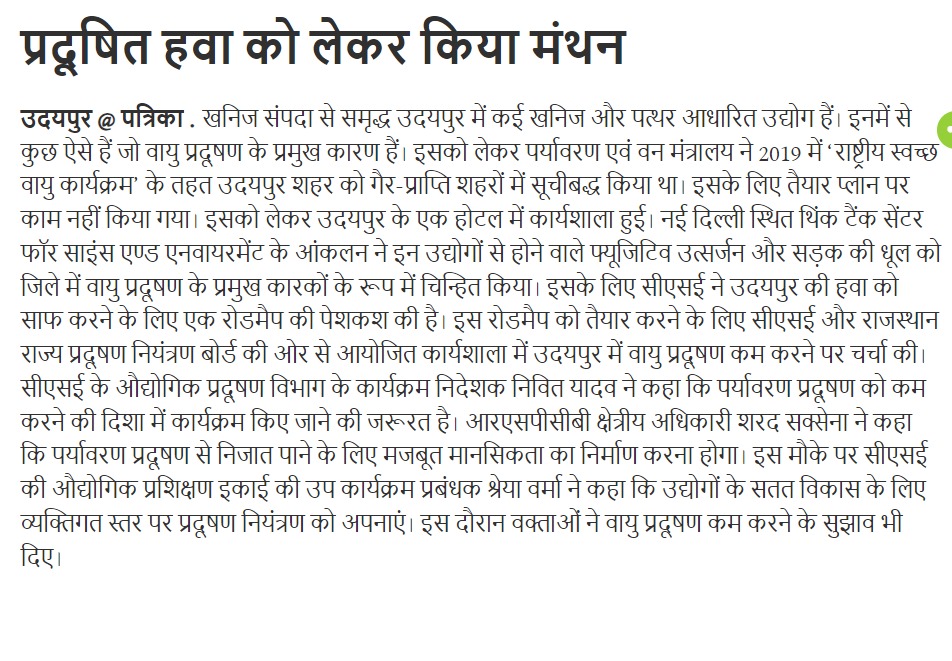
प्रदूषित हवा को लेकर किया मंथन

खनिज संपदा से समृद्ध उदयपुर में कई खनिज और पत्थर आधारित उद्योग हैं। इनमें से कुछ ऐसे हैं जो वायु प्रदूषण के प्रमुख कारण हैं। इसको लेकर पर्यावरण एवं वन मंत्रालय ने 2019 में ‘राष्ट्रीय स्वच्छ वायु कार्यक्रम’ के तहत उदयपुर शहर को गैर-प्राप्ति शहरों में सूचीबद्ध किया था। इसके लिए तैयार प्लान पर काम नहीं किया गया। इसको लेकर उदयपुर के एक होटल में कार्यशाला हुई। नई दिल्ली स्थित थिंक टैंक सेंटर फॉर साइंस एण्ड एनवायरमेंट के आंकलन ने इन उद्योगों से होने वाले फ्यूजिटिव उत्सर्जन और सड़क की धूल को जिले में वायु प्रदूषण के प्रमुख कारकों के रूप में चिन्हित किया। इसके लिए सीएसई ने उदयपुर की हवा को साफ करने के लिए एक रोडमैप की पेशकश की है। इस रोडमैप को तैयार करने के लिए सीएसई और राजस्थान राज्य प्रदूषण नियंत्रण बोर्ड की ओर से आयोजित कार्यशाला में उदयपुर में वायु प्रदूषण कम करने पर चर्चा की। सीएसई के औद्योगिक प्रदूषण विभाग के कार्यक्रम निदेशक निवित यादव ने कहा कि पर्यावरण प्रदूषण को कम करने की दिशा में कार्यक्रम किए जाने की जरूरत है। आरएसपीसीबी क्षेत्रीय अधिकारी शरद सक्सेना ने कहा कि पर्यावरण प्रदूषण से निजात पाने के लिए मजबूत मानसिकता का निर्माण करना होगा। इस मौके पर सीएसई की औद्योगिक प्रशिक्षण इकाई की उप कार्यक्रम प्रबंधक श्रेया वर्मा ने कहा कि उद्योगों के सतत विकास के लिए व्यक्तिगत स्तर पर प्रदूषण नियंत्रण को अपनाएं। इस दौरान वक्ताओं ने वायु प्रदूषण कम करने के सुझाव भी दिए।

How Russia-Ukrain war is killing chapati, mandazi business in Kisumu slums

n 2007, Eunice Atieno ventured into mandazi business at her stall located in Nyalenda, along Ring road. The business paid her bills, covering basic needs like shelter, food and clothing, as well as other secondary needs she needed to make her life aesthetic. Today, Ms Atieno is contemplating closing the business and venturing into other viable businesses. This business is nolonger what it used to be. I barely survive, and I am soon getting out of it She will not be the first one to abandon the venture she once adored. Several other people in her neighbourhood have called it quit. “This business is nolonger what it used to be. I barely survive, and I am soon getting out of it,” she said. When Lake Region Bulletin visited Atieno at her stall, her son Kevin Okoth was assisting her with sales. She said when she began the business, she could cook one and a half bales of flour per day. This translates to 36 kilos of wheat flour. “The rains began beating us three years ago, when the price of wheat flour began to shoot uncontrollably,” she said. High wheat prices Three years ago, she says she bought a bale of wheat flour (24 kilos) at between Sh1, 200 and Sh1, 500. This now goes for over Sh2, 500. This jump in the price of wheat flour has hit Atieno hard. This has been coupled with the hike in the prices of other material used in making mandazi, such as cooking oil, sugar, and baking powder. “A few years ago a kilo of sugar was going for Sh100, now it is over Sh230. The small baking powder which was Sh16 is now Sh35. Cooking oil is now worse,” she says. Due to the hard economic times, sales went down, and today Atieno only cooks six kilos of wheat flour. A few months ago she attempted to hike the price of mandazi from Sh5 to Sh10. It didn’t work. “No one was buying mandazi. And even after reducing the price back to Sh5, the sales have gone down,” she said. Atieno now has to contend with reduced profit margins, and sometimes loses, as the cost of doing business continue to hike while people’s buying power die. Job losses A short distance from her stall is Joseph Oduor who has been selling chapati for the past three years. Just like Atieno, his business is fast dwindling. Two years ago he was consuming two bales of wheat flour per day (48 kilos). He had two young men helping him with the work. But today, he is alone, after relieving the helpers due to low sales and reduced profit margins due to the high cost of production. I know a few friends who abandoned their chapati businesses, and the way things are unfolding, I do not know my fate Joseph Oduor “These days I consume less than 10 kilos of wheat flour per day. The cost of everything has gone up,” he said. “I know a few friends who abandoned their chapati businesses, and the way things are unfolding, I do not know my fate,” he added. The Centre for Science and Environment (CSE) a report titled ‘State of Africa’s Environment 2013’ and published in Down to Earth Magazine suggests that the phenomenon faced by small scale traders like Atieno and Oduor is partly contributed by the ongoing Russia-Ukrain war. The two worrying countries are some of the leading sources of wheat consumed across the globe. In east Africa, where wheat and wheat products accounted for a third of the average cereal consumption, 90 per cent of the wheat imports came from Russia and Ukraine, as per UN’s World Food Programme (WPF) State of Africa’s Environment 2013’ “The Russia-Ukraine war has spiked food prices threatening reversal of decades of progress in poverty alleviation,” the report read in part. According to the report, Russia is the world’s largest wheat exporter while Ukraine is sixth on the list, and that together, the two warring countries produced 12 per cent of all food calories traded globally (in January 2022); controlled 29 per cent of global wheat exports, 19 per cent of maize exports, and 78 per cent of sunflower oil exports,” the report read. “In east Africa, where wheat and wheat products accounted for a third of the average cereal consumption, 90 per cent of the wheat imports came from Russia and Ukraine, as per UN’s World Food Programme (WPF),” read the report. Kenya’s wheat demand Kenya Institute for Public Policy Research and Analysis (KIPPRA) reports that Kenya has a wheat consumption of about 900,000 tonnes per year, but only produces approximately 350,000 tonnes. This leaves the country at a huge deficit which can only be filled by imports. KIPPRA notes that Kenya’s major wheat supplier is Russia, accounting for 31 per cent of total wheat imports in 2020/2021. Other sources of wheat in Kenya are; Argentina (29 per cent), Germany (11 per cent), Poland and Canada (5 per cent), Latvia (4.8 per cent), Ukraine (4.2 per cent), Australia (2.8 per cent), Estonia (2.6 per cent), Lithuania (1.8 per cent) and Czech Republic (1.6 per cent).

Explained: How the climate change is affecting India's economy

Climate change effect on India's economy: Climate change stands as one of the most significant challenges of the 21st century, presenting a multifaceted threat to the environment, human health, food security, and economic development. India, being the seventh most affected country according to the Global Climate Risk Index 2021, grapples with the adverse repercussions of climate change across various sectors of its economy. In the RBI’s report on Currency and Finance 2022-23, the RBI governor has also expressed his concerns about the impacts of Climate change on India’s economy. In the preface of the report, Shaktikanta Das said, “Climate change-induced risks to the macro-financial prospects of the country and the range of policy options available to mitigate climate risks require dedicated research. Such research becomes even more critical in the context of the complexity and non-linearity of the ways in which climate, economy, financial systems and related policies operate.” Here are the sectors in which climate change has a direct and visible effect despite the authorities’ increasing focus on dealing with these challenges. Impact on agriculture Agriculture, a critical sector in India's economy, faces severe disruption due to climate change. Altered temperature and precipitation patterns, increased pest infestations, soil erosion, and extreme weather events like floods and droughts significantly impact crop cycles and yield. According to India’s Centre for Science and Environment (CSE), the country experienced extreme weather events on 314 of 365 days in 2022, which claimed 3,026 lives, affected 1.96 million hectares of crop area and 4,23,249 houses, and killed over 69,899 animals. The RBI’s report also highlights the extreme weather conditions stating the fact that in 2022, India recorded its seventh wettest January since 1901, the hottest February in 2023 since record-keeping began in 1901, and March was the third driest and warmest ever in 121 years. Considering that agriculture is a major source of livelihood in India, extreme weather conditions can lead to reduced agricultural output leading to inflation in urban areas. Challenges in fisheries Climate change causes disruptions in the distribution and behaviour of fish species due to rising sea surface temperatures. According to the United States Environmental Protection Agency, the Sea surface temperature has been consistently higher during the past three decades than at any other time since reliable observations began in 1880.

दिल्ली में हवा हो रही जहरीली, बचने के लिए GRAP का सुरक्षाकवच, जानिए अब तक कितना सफल

नई दिल्ली: दो दिन बाद राजधानी की हवा एक बार फिर साफ हो गई है। एक्सपर्ट के अनुसार हवाओं की दिशा बदलने व तेज होने की वजह से प्रदूषण में यह सुधार आया है। अब 10 अक्टूबर तक प्रदूषण का स्तर सामान्य बना रहेगा। इसके बाद 11 अक्टूबर से इसके एक बार फिर खराब होने की आशंका है। हवा के साफ होने के बावजूद ग्रैप-1 को हटाने पर विचार नहीं किया गया है। सीएक्यूएम (कमिशन फॉर एयर क्वालिटी मैनेजमेंट) की तरफ से इसे लेकर कोई निर्देश जारी नहीं हुए हैं। सीपीसीबी (सेंट्रल पल्युशन कंट्रोल बोर्ड) के एयर बुलेटिन के अनुसार रविवार को राजधानी का एक्यूआई 164 रहा। कुछ जगहों पर हवा का स्तर खराब बना रहा। इनमें शादीपुर का एक्यूआई 260, रोहिणी का 205, वजीरपुर का 241, बवाना का 226, मुंडका का 252 रहा। अन्य जगहों पर यह सामान्य स्थिति में रहा। एक्यूआई जब 101 से 200 के बीच रहे तो उसे प्रदूषण का सामान्य स्तर और जब यह 201 से 300 के बीच रहे तो उसे खराब स्तर कहा जाता है। मौसम विभाग के अनुसार 6 और 7 अक्टूबर को राजधानी में प्रदूषण का स्तर खराब हो गया था। इस दौरान रात के समय हवाओं की गति धीमी हो रही थी। साथ ही नॉर्थ वेस्टर्ली हवाएं चल रही थीं। इसकी वजह से ग्रैप का पहला चरण लागू किया गया। इसकी वजह से स्थिति में कुछ सुधार हुआ। अब 10 अक्टूबर तक प्रदूषण का स्तर सामान्य रह सकता है। इसके बाद 11 अक्टूबर को यह फिर खराब हो सकता है। इसके बाद भी अगले छह दिनों तक यह खराब स्थिति में ही बना रहेगा। 9 अक्टूबर को हवाएं साउथवेस्ट दिशा की तरफ से आएंगी। इसकी वजह से प्रदूषण में कमी आएगी। वहीं 10 अक्टूबर को बूंदाबांदी की संभावना है। 11 अक्टूबर को हवाएं एक बार फिर नॉर्थ वेस्टर्ली हो सकती हैं। सुबह के समय हल्की धुंध देखने को मिल सकती है। क्या राजधानी में अब हॉट स्पॉट की समीक्षा करने का समय आ गया है? मौजूदा 13 हॉट स्पॉट 2017 में बनाए गए थे। इसके बाद से साल दर साल ऐसे कुछ एरिया उभरकर सामने आ रहे हैं जहां प्रदूषण काफी अधिक है। ऐसे में एक्सपर्ट को भी लगता है कि हर दो से तीन सालों में हॉट स्पॉट की समीक्षा की जानी चाहिए। अभी कई हॉट स्पॉट ऐसे हैं जहां प्रदूषण कम हो रहा है, लेकिन ऐसे एरिया भी सामने आ रहे हैं जो हॉट स्पॉट नहीं है लेकिन यहां प्रदूषण बढ़ रहा है। इस साल भी 6 से 8 अक्टूबर के बीच जो इलाके सबसे अधिक प्रदूषित रहे उमें कुछ ऐसे एरिया शामिल रहे जो हॉट स्पॉट नहीं थे। जबकि सबसे प्रदूषित इलाकों में कई हॉट स्पॉट शामिल ही नहीं थे। 6 से 8 अक्टूबर के बीच शादीपुर, एनएसआईटी द्वारका, नॉर्थ कैंपस, पूसा जैसे एरिया सबसे प्रदूषित रहे। उधर आर के पुरम, ओखला, रोहिणी जैसे कई एरिया में प्रदूषण की स्थिति कंट्रोल में रही। सीएसई (सेंटर फॉर साइंस एंड एनवायरमेंट) ने 2021 में एक रिपोर्ट जारी की थी जिसमें उसने राजधानी में 14 नए उभरते हॉट स्पॉट का दावा किया था। इन जगहों पर पीएम 2.5 का औसत स्तर 197 एमजीसीएम से अधिक रहा था। इनमें अलीपुर, डीटीयू, आईटीओ, नेहरू नगर, पटपड़गंज, सोनिया विहार, विवेक विहार के अलावा अन्य स्टेशन एनसीआर के थे। 2022 की सीएसई की रिपोर्ट के अनुसार नॉर्थ और ईस्ट दिल्ली के हॉट स्पॉट सबसे अधिक प्रदूषित रहे हैं। राजधानी का 2022 में सबसे बड़ा हॉट स्पॉट जहांगीरपुरी रहा। यहां अक्टूबर से जनवरी का औसत पीएम 2.5 का स्तर 201 एमजीसीएम रहा। अन्य सबसे प्रदूषित हॉट स्पॉट में आनंद विहार, वजीरपुर, मुंडका, रोहिणी और बवाना रहा। आरके पुरम को छोड़कर राजधानी के सभी हॉट स्पॉट में पिछले तीन सालों से प्रदूषण में कमी आ रही है। वहीं शादीपुर के प्रदूषण स्तर में इस दौरान 34 प्रतिशत, एनएसआईटी के प्रदूषण स्तर में 24 प्रतिशत, नैशनल स्टेडियम में एक प्रतिशत का इजाफा हुआ है। सीएसई की अनुमिता रायचौधरी के अनुसार हॉट स्पॉट की समीक्षा की जरूरत काफी जरूरी है। पुराने हॉट स्पॉट कम होने के साथ यह भी बहुत जरूरी है कि नए हॉट स्पॉट न बनें। यह तभी मुमकिन है जब हॉट स्पॉट की समीक्षा की जाएगी।

Most upscale addresses in city are most polluted too

At 300, the average air quality index at Sector 51, around which lie some of the citys most premium addresses such as Golf Course Road, has been the worst among all the citys monitoring stations since October 1.Data showed that the average AQI at Sector 51 station every day this month was 300, or very poor, while at the other four stations, it was 200 (poor) or lower (moderate).Track the pollution level in your city Officials said on Friday that one of the reasons could be the dust bowls of Golf Course Extension Road that lie in its vicinity. The road is damaged in several portions, and it sees a high volume of heavy vehicles like dumpers, trucks and sand wagons.Within the stations 10km radius are a number of high-rises, hospitals, schools, offices and market complexes, making it one of the busiest regions of the city. This, experts said, could also explain why dust and pollutants dont settle on the surface. The area has multiple under-construction sites where debris is often lying in the open and diesel-operated concrete mixers are frequently used.Nearby sectors 29, 46, 47, 50, 50, 51, 52, 57 and 57 also have a number of vacant plots, which end up as mini-landfill sites due to indiscriminate dumping of garbage. It isnt uncommon to spot open waste burning in these residential areas. The Sector 51 station located at the Gurugram University is near shanties and covers a high population density area. Its zone of influence includes Golf Course Extension Road, which is very polluted because of traffic congestion and damaged roads. The areas near this station are also prone to waste burning and frequent movement of heavy vehicles at night, Sachin Panwar, an expert on air and noise pollution said.High vehicular pollution and road dust are responsible for deterioration of air quality at a hotspot like Sector 51, Anumita Roychowdhury, executive director (research and advocacy) at Centre for Science and Environment, told TOI.Shubhansh Tiwari, research associate at the Amity Center for Air Pollution Control, said the area has rapidly developed over the years, and rampant construction along with high traffic emits pollutants that remain suspended in the atmosphere.He warned that the effect of pollution was likely to worsen as winter sets in and weather conditions coat NCRs skies with toxic haze. These areas also have very little greenery. Even the trees along the roads are covered with dust. The situation is expected to deteriorate further as the temperature drops, he said.Data showed that the Sector 51 stations 24-hour average AQI was 315, 293, 306, 304, 304 and 343 from October 1 to 6.At the Vikas Sadan station, the average AQI was 131, 102, 225, 172, 187 and 165 for the same period. Similarly, the range was between 156 and 251 at the Teri Gram station, while the AQI was 92 on October 1 and 139 on October 5. The readings for Manesar station recorded a low of 36 on October 6 and a high of 167 on October 3.Air quality is better when the AQI value is lower.Asked about the analysis, Haryana State Pollution Control Board (HSPCB) officials admitted that the city centre is a pollution hotspot. The station shows high AQI because of local factors. We have asked authorities to take action to mitigate air pollution, said Kuldeep Singh, regional officer of Gurgaon-HSPCB.But experts also pointed out that just 5 AQI stations in the city as large as Gurgaon may not give granular data and the entire picture on pollution hotspots. TOI had reported last year that based on guidelines, the city should have at least eight monitoring stations if its 2011 population census figures are accounted for.

'Voluntary Carbon Credit Is Not Benefitting People': CSE Report Uncovers Ineffectiveness In Carbon Market

Researchers travelled to 40 villages and towns across India to understand how the market works. It was found that community members were almost never aware that they were working to generate carbon credits, but had no rights of their own over those credits. Voluntary carbon market is not benefitting people or planet, might in fact, be leading to more emissions, according to a new Centre for Science and Environment (CSE) investigation report. While the world waits to discuss — at the Dubai UN climate conference later this year — the issue of regulating the carbon market, the CSE investigation has blown the lid off this extremely furtive, cloaked-in-secrecy world of voluntary trade in carbon credits. Buying and selling of carbon credits is seen as an important way to combat climate change. In this, credits are assigned to projects that can reduce greenhouse gases. These credits, measured in tonne of carbon dioxide-equivalent (CO2e), are then priced and traded. People and businesses that wish to offset the emissions generated by their activities can buy these credits and ‘neutralise’ their carbon footprints. So, you could take a flight that is carbon neutral or buy a luxury bag, where the emissions to manufacture it have been offset; or you could travel for your company or produce oil and show that it has been ’offset’ — all through the purchase of these credits. But the world does not have an official carbon market yet — in fact, this is up for discussion at the UN’s 28th Conference of Parties to be held in Dubai. In the absence of an official mechanism, a voluntary carbon market has blossomed. Steeped in secrecy, beset by flaws, it is this market that CSE and Down To Earth’s six-month long rigorous analysis has focused on and exposed. Releasing the CSE investigative report in the webinar, CSE director general Sunita Narain said: “Carbon markets have the potential to unlock billions of dollars for countries in the Global South that need money to move to a low-carbon energy system and to ensure socio-economic development of their communities. But is today’s voluntary carbon market working for people and the planet? Our investigation shows that it is not.” "The purpose of this market seems to be to serve the interests of project developers, auditors and others who make a profit out of the lucrative carbon business. The carbon market as it exists today is not designed to mitigate emissions — in fact, it might actually be increasing emissions across the world. Buyers could continue to emit and increase their emissions, all the while claiming that they have bought credits and are hence, carbon-neutral!” adds Narain. "Our investigation clearly shows the double jeopardy we are in — these credits are either over-estimated or do not lead to the change that has been claimed,” says Narain, adding, “Our climate-risked world does not need this shady secretive world of creative carbon accounting.” The world has two leading carbon registries — Verra and Global Standard. Together, they have registered 6,481 projects across the world; till May 2023, they has issued 1.4 billion carbon credits, says Avantika Goswami, programme manager, climate change, CSE. India, says the CSE team, is the world’s second largest supplier of carbon offsets and is “at the forefront of carbon investment”. India’s voluntary carbon market is worth over US $1.2 billion, and the country has 1,451 projects listed with the two registries named above. In 2022, three Indian project developers were among the top 15 in the world in generating carbon credits. Indian entities have already earned about US $652 million from carbon credits used to offset emissions. Says Narain: “We wanted to find out if this market was working to benefit people and the planet. What we found was there is much that needs to be done.” “CSE and Down To Earth researchers travelled to 40 villages and towns across India to understand how the market works. At every location, we found that communities, their lands and their labour were central to the business — but community members were almost never aware that they were working to generate carbon credits, but had no rights of their own over those credits." "The projects also raised fundamental concerns about the accounting practices of these transactions and the companies behind them,” says Goswami. For instance, visits to Madhya Pradesh and Karnataka villages where EKI-Energy Services and Greenway Grameen Infra Pvt Ltd had distributed improved cookstoves, seven found a serious problem of overestimation of emissions. Similarly, visits to Araku Valley found that tribals had “signed” away the rights to carbon credit through a local NGO intermediary, Naandi Foundation, acting on behalf of Danone, which were then transferred to the Paris-based Livelihood Fund. Danone’s popular luxury water brand, Evian, then took credits for this sequestration to claim it was carbon-neutral. Michelin Group used it to ‘offset’ emission of its employees’ travel. But as ground reports by Rohini Krishnamurthy and Trishant Dev found in all these cases and many more, local people had no benefits from this business. "Our findings came despite the discouragement that we faced from project developers, who demanded that we sign non-disclosure agreements or simply did not permit us to visit the project areas,” say Rohini and Trishant. What Is The Way Ahead? “The carbon market should be a real market, and not a secret pact between buyer and seller,” says Narain. Ensure transparency: The first step is to ensure transparency in the market. Details of projects should be listed; there should be information about the price that each credit has earned. Pay for real change: The second step is to decide the objectives of the market — voluntary, bilateral or multilateral — and design rules accordingly. Share the proceeds: Currently, the market only seems to work in the interest of the project developers, consultants and auditors. The communities get virtually nothing from the proceeds, and this means that they also have no stake in the emission reduction programme. Keep it simple: There is widespread overestimation of emission re­ductions by project developers. One lesson that must be learnt is to keep the project design simple and not to trust the army of consultants and profiteers in this business.

MCD stalemate delayed work at Ghazipur landfill: Kejriwal

Chief minister Arvind Kejriwal inspected the Ghazipur landfill site on Friday and found that the garbage processing work at the Capital’s largest trash mountain was “unsatisfactory” suggesting that the December 2024 deadline announced by him to clear the mound of garbage is likely to be missed. Citing the reasons for the delay, Kejriwal said the three companies hired for the work at Ghazipur have been “hostile” towards each other, adding that only hiring two more agencies will resolve the problem and speed up the work. However, this cannot be done till the standing committee of the Municipal Corporation of Delhi (MCD) was constituted, following a pending Supreme Court order on the matter, he said. The standing committee is an 18-member decision-making body that effectively manages the corporation, with functions such as providing financial approval to projects, and discussing, finalising, and implementing policies, among others. The Ghazipur landfill site was the last leg of the CM’s visit to the garbage mountains in Delhi in the past week to inspect work progress. He found the work was “progressively satisfactory” at Bhalswa while it was “slow” at the Okhla landfill site. Delhi is sitting on around 27 million tonne of waste across three landfills at Bhalswa, Ghazipur and Okhla. “In the last few days, I have been to Bhalswa and Okhla landfill sites. Today I visited Ghazipur where 80 lakh (8 million) tonne of garbage exist. Progress in the removal of this garbage is significantly slow here. As per the scheduled target, 15 lakh (1.5 million) tonne of garbage should have been removed from the site (by now). But so far, only 5.25 lakh (.52 million) tonne of garbage have been removed,” Kejriwal said. Clearing Delhi’s garbage mountains was the first of the 10 “guarantees” that the Aam Aadmi Party (AAP) had made in the run-up to the civic polls in December 2022. After winning the elections, the AAP-led MCD administration on March 3 this year announced that the project has been expedited, with a target to clear Okhla by December 2023, Bhalswa by March 2024, and Ghazipur by December 2024. “This is a joint venture of three companies, and they have not been on the same page since the beginning of work. We are going to hire two more agencies to speed up the progress. To award any such big project the MCD needs the approval of its standing committee. The issue of alderman is in the Supreme Court. Once the court’s order is received, the committee will be constituted, and two new agencies will be hired. During that period, we will decide whether to persist with the existing three agencies which are hostile towards each other and which are hindering progress. But at the Ghazipur landfill site progress is not satisfactory,” Kejriwal added. The details of the disputes among the three companies were not immediately available. The erstwhile three municipal corporations in July 2019 began an ambitious project to clear the three landfills in Delhi through the process of biomining after the National Green Tribunal (NGT) ordered that the Capital’s legacy waste dumps be cleared within a year. HT had reported on September 24 that four years on, since the AAP government came to power, the process to clear these garbage mountains at Okhla, Bhalswa, and Ghazipur has made little headway—MCD’s latest progress report dated July 31 this year noted that the civic body has been able to clear 8,999,000 tonne of legacy waste—less than a third of the original 28,000,000 tonne of legacy waste. Experts said that the quantity of legacy waste removed from the site should not be the only “indicator” of the remediation process. “The public should be informed about what is happening with the extracted materials to ensure accountability and responsible management practices. Bioremediation and biomining are promising techniques but given the scale of biomining at approximately 20,000 to 25,000 tonne per day (at three sites) it is paramount that the disposal of segregated combustible materials is disposed responsibly,” said Richa Singh, programme manager, solid waste management and circular economy team at Centre for Science and Environment. Meanwhile, Delhi BJP spokesperson Praveen Shankar Kapoor said it was surprising to see that after eight months of power in MCD, Kejriwal was trying to “avoid responsibility”. “AAP leaders have no administrative experience. The truth is they fear that AAP itself is not allowing the formation of MCD Standing Committee despite there being no court stay in this matter,” said Kapoor.

CSE investigative report reveals deep flaws in voluntary carbon credit market

As the world anticipates discussions on regulating the carbon market at the upcoming Dubai UN 28th climate conference, an eye-opening investigation by the India-based Centre for Science and Environment (CSE), has unveiled the murky world of voluntary carbon credits trading. The report, titled "Discredited: The Voluntary Carbon Market in India," was unveiled during a webinar on Thursday, shedding light on the practices and pitfalls within this clandestine market. Carbon credits have long been hailed as a crucial tool in the fight against climate change. These credits are allocated to projects that can effectively reduce greenhouse gas emissions, measured in tonnes of carbon dioxide-equivalent (CO2e). Businesses and individuals can purchase these credits to offset their own carbon footprints, thus contributing to carbon neutrality. However, with no official global carbon market in place yet, a voluntary carbon market has flourished. This market, shrouded in secrecy, is the focal point of CSE's extensive investigation. Sunita Narain, Director General of CSE, emphasised the potential of carbon markets to fund climate-friendly projects but raised significant concerns about the current state of the voluntary carbon market. Narain pointed out the purpose of this market seems to be to serve the interests of project developers, auditors, and others who profit from the lucrative carbon business. “The carbon market as it exists today is not designed to mitigate emissions – in fact, it might actually be increasing emissions across the world,” she said. As per Sunita's statement, purchasers could persist in releasing emissions and even raise their emission levels while asserting that they have acquired credits, thereby presenting themselves as carbon-neutral. The investigation delved into India's role in the voluntary carbon market. India stands as the world's second-largest supplier of carbon offsets, boasting a market worth over US $1.2 billion, with 1,451 projects registered with leading carbon registries Verra and Global Standard. However, the CSE-Down To Earth team discovered concerning issues during visits to project areas, including overestimation of emissions and the exploitation of local communities, who often have no say in the carbon credit transactions. The Climate Change Program Manager at CSE, Avantika Goswami reports that the world's two primary carbon registries, Verra and Global Standard, have collectively recorded 6,481 projects worldwide. As of May 2023, these registries have issued a total of 1.4 billion carbon credits. Goswami explains that CSE and Down To Earth researchers embarked on a journey to 40 villages and towns across India to gain insight into the market's operations. In each place, they discovered that communities, their lands, and their labor played integral roles in the industry. However, it was striking that community members were often unaware that their efforts contributed to the generation of carbon credits, yet they had no ownership or control over these credits. "The projects also raised fundamental concerns about the accounting practices of these transactions and the companies behind them,” he said. CSE team identified a significant issue with the exaggerated estimation of emissions in Madhya Pradesh and Karnataka where EKI-Energy Services and Greenway Grameen Infra Pvt Ltd. had provided enhanced cookstoves. Likewise, during visits to Araku Valley, it was discovered that indigenous communities had effectively relinquished their rights to carbon credits by engaging with a local NGO intermediary, the Naandi Foundation, which was acting on behalf of Danone. These credits were subsequently transferred to the Livelihood Fund based in Paris. Danone, known for its premium water brand Evian, then claimed these credits to portray itself as carbon-neutral. The Michelin Group also utilized these credits to offset the emissions generated by its employees' travel. However, as revealed in field reports by Rohini Krishnamurthy and Trishant Dev, this business practice left local residents without any tangible benefits. Rohini and Trishant's discoveries were made in spite of the resistance they encountered from project developers, who either insisted on non-disclosure agreements or denied access to the project areas. “Our findings came despite the discouragement that we faced from project developers, who demanded that we sign non-disclosure agreements or simply did not permit us to visit the project areas,” said Rohini and Trishant. The CSE-Down To Earth investigative team outlined key recommendations to reform the voluntary carbon market. These recommendations include ensuring transparency in project details and pricing, paying for genuine emission reductions, sharing the proceeds with affected communities, simplifying project designs, and aligning the market with each country's Nationally Determined Contributions (NDCs) to reduce emissions. The investigation highlights the pressing need for transparency, accountability, and fairness in the voluntary carbon market as the world grapples with the urgent challenges of climate change. The findings underscore the importance of addressing these issues during discussions at the upcoming Dubai UN climate conference to ensure a just and effective global approach to carbon trading.

Voluntary carbon market is not benefitting people or planet, might in fact be leading to more emissions: CSE investigation

While the world is expected to discuss the issue relating to regulating the carbon market at COP28 at Dubai later this year, a new investigation by Centre for Science and Environment (CSE) has blown the lid off this extremely furtive, cloaked-in-secrecy world of voluntary trade in carbon credits. Buying and selling of carbon credits is seen as an important way to combat climate change. In this, credits are assigned to projects that can reduce greenhouse gases. These credits, measured in tonne of carbon dioxide-equivalent (CO2e), are then priced and traded. People and businesses that wish to offset the emissions generated by their activities can buy these credits and ‘neutralise’ their carbon footprints. So, you could take a flight that is carbon neutral or buy a luxury bag, where the emissions to manufacture it have been offset; or you could travel for your company or produce oil and show that it has been ‘offset’ – all through the purchase of these credits. But the world does not have an official carbon market yet – in fact, this is up for discussion at the UN’s 28th Conference of Parties to be held in Dubai. In the absence of an official mechanism, a voluntary carbon market has blossomed. Steeped in secrecy, beset by flaws, it is this market that CSE and Down To Earth’s six-month long rigorous analysis has focused on and exposed. Releasing the CSE investigative report on Thursday, CSE director general Sunita Narain said: “Carbon markets have the potential to unlock billions of dollars for countries in the Global South that need money to move to a low-carbon energy system and to ensure socio-economic development of their communities. But is today’s voluntary carbon market working for people and the planet? Our investigation shows that it is not.” “The purpose of this market seems to be to serve the interests of project developers, auditors and others who make a profit out of the lucrative carbon business. The carbon market as it exists today is not designed to mitigate emissions – in fact it might actually be increasing emissions across the world. Buyers could continue to emit and increase their emissions, all the while claiming that they have bought credits and are hence, carbon neutral!” adds Narain. “Our investigation clearly shows the double jeopardy we are in – these credits are either over-estimated or do not lead to the change that has been claimed,” says Narain. The CSE-Down To Earth investigation states the world has two leading carbon registries, together they have registered 6,481 projects across the world; till May 2023, they has issued 1.4 billion carbon credits, says Avantika Goswami, programme manager, climate change, CSE. India, says the CSE team, is the world’s second largest supplier of carbon offsets and is at the forefront of carbon investment. India’s voluntary carbon market is worth over US $1.2 billion, and the country has 1,451 projects listed with the two registries. In 2022, three Indian project developers were among the top 15 in the world in generating carbon credits. Indian entities have already earned about US $652 million from carbon credits used to offset emissions. Says Narain: “We wanted to find out if this market was working to benefit people and the planet. What we found was there is much that needs to be done.” “CSE and Down To Earth researchers travelled to 40 villages and towns across India to understand how the market works. At every location, we found that communities, their lands and their labour were central to the business – but community members were almost never aware that they were working to generate carbon credits, but had no rights of their own over those credits. The projects also raised fundamental concerns about the accounting practices of these transactions and the companies behind them,” says Goswami. “Our findings came despite the discouragement that we faced from project developers, who demanded that we sign non-disclosure agreements or simply did not permit us to visit the project areas,” say Rohini and Trishant. “The carbon market should be a real market, and not a secret pact between buyer and seller,” says Narain. The investigative team puts forward the recommendations: Ensure transparency: The first step is to ensure transparency in the market. Details of projects should be listed; there should be infor­mation about the price that each credit has earned. Pay for real change: The second step is to decide the objectives of the market—voluntary, bilateral or multilateral—and design rules accordingly. If the purpose of the market is to invest in projects that will lead to reduction in emissions in different parts of the world, then the market must be based on paying for the real cost of the projects. Currently, the market pays less than 5 per cent of the costs of a renewable energy project or even a biogas project. The poor are literally subsidising the rich emitters in this market. Share the proceeds: Currently, the market only seems to work in the interest of the project developers, consultants and auditors. The communities get virtually nothing from the proceeds, and this means that they also have no stake in the emis­sion reduction programme. Carbon market must be required to share the proceeds annually with communities in a verifiable manner. Keep it simple: There is widespread overestimation of emission re­ductions by project developers. One lesson that must be learnt is to keep the project design simple and not to trust the army of consult­ants and profiteers in this business. It means keeping their role minimal and to keep the control of the projects with public institutions and people. Countries must account: The voluntary carbon market must work within the confines of the govern­ment’s NDCs. The only exportable credits have to be those that are ex­pensive for the country to do—where there is an advantage for the country as it can transform its emission trajectory.

CSE to Release Inaugural “State of Africa’s Environment Report 2023”

The Centre for Science and Environment (CSE) and its fortnightly magazine, Down To Earth, in association with Media for Environment, Science, Health and Agriculture (MESHA), will release “Africa’s Environment Report 2023” next week in Nairobi, Kenya. Published by the New Delhi-based Down To Earth, this report will be an annual feature from now on, CSE pointed out in a statement. The release function will be followed by a two-day media briefing on some of the key aspects that the report covers.” CSE, a think-tank based in New Delhi, India, which works on some of the key issues and concerns of environment and development in the Global South. Down To Earth is also a fortnightly English magazine that the Centre has been helping publish since the 1990s. A number of writers, subject experts and journalists from Africa regularly contribute articles and opinions in this magazine. One of India’s environmental thinkers and writer Sunita Narain who is also the head of CSE and a member of the COP28 UAE Advisory Committee will preside the inaugural book release event. Free e-copies of the report will be available to African journalists on request from October 1, it was indicated.

India’s Air Quality Crisis: Why Isn’t the CPCB Revising Its Air Quality Standards?

India’s air quality remains a pressing concern. In 2021, the World Health Organization (WHO) revised its air quality guidelines, making them stricter. These revisions came in the wake of growing scientific evidence about the damaging effects of air pollution. In fact, the new WHO Air Quality Guidelines (AQGs), following its last global update in 2005, are aimed at providing a clearer framework for countries to combat and reduce the adverse health impacts of air pollution. While many countries have gone ahead and revised their air quality standards as per WHO guidelines, India has been lagging and still follows the old National Ambient Air Quality Standards (NAAQS) guidelines which was last revised in 2009. India’s air quality has become a focal point of concern, especially when viewed in the context of global health standards. The revised WHO guidelines are not merely an academic exercise. They have the potential to save millions of lives across the globe. Air pollution is insidious. Its effects permeate across age groups, aggravating respiratory ailments, affecting cardiovascular health, and posing an undeniable threat to global public health. While several countries swiftly aligned their national air quality standards with the updated WHO guidelines, India’s silence on the matter is disconcerting. Over a decade has passed since the NAAQS standards were updated, and the landscape of air pollution and its associated challenges has shifted significantly during this period in India. As one of the most populous nations with several cities repeatedly featuring in lists of the world’s most polluted, the stakes for India are particularly high. The outdated standards do not just represent numbers on paper; they translate to real-world consequences for the health of millions of citizens. “We have been advocating for this revision for the past two years. The responsibility to do so lies with the Central Pollution Control Board (CPCB). Air pollution is not just an environmental concern; it’s a public health crisis that’s affecting our lives, economy, and well-being. The CPCB entered into an agreement with IIT Kanpur, with the latter expected to deliver their review of the NAAQS by December 2022. It’s been over eight months, and yet there’s been no progress. Such delays pose a huge risk to public health and India’s air quality is going from bad to worse,” states Avinash Kumar Chanchal, Campaign Manager at Greenpeace. In its updation in 2021, the WHO set more stringent standards for six key pollutants: particulate matter (PM2.5 & PM10), ozone (O₃), nitrogen dioxide (NO₂), sulphur dioxide (SO₂), and carbon monoxide (CO). Studies have revealed that addressing these primary pollutants indirectly mitigates the effects of other harmful contaminants in the air. Of note in these revised guidelines is the adjustment to recommended levels for particulate matter. The WHO now advises that the annual average concentration of PM2.5 (tiny particles with a diameter of 2.5 micrometres or less) should not exceed 5 µg/m³. As for PM10 (particles measuring up to 10 micrometres), the recommended annual average is capped at 15 µg/m³. These revised figures mark a significant decrease from prior levels and highlight the understanding that even minimal concentrations can be detrimental to health. Last year, over 10,000 citizens along with Greenpeace India wrote an open letter to the CPCB seeking revisions of India’s air quality standards. According to IQAir, a Swiss air quality technology company, 35 of the 50 most polluted cities are in India. However, not only has India not updated its air quality standards, but there’s also a pressing issue of lacking the means to measure air pollution accurately. “Across India, not just in Delhi, there’s a noticeable lack of air quality monitoring stations. We still lack the necessary devices to accurately gauge the quality of the air we breathe. Without this essential data, how can we begin to address and remedy the situation? To tackle this, we need both large monitoring stations and low-cost monitoring devices in various localities. In Delhi, according to the CPCB, there are around 40 monitoring stations that provide real-time air quality data. However, given the vast expanse of Delhi, 40 is a severely limited number,” adds Chanchal. The conversation doesn’t end with the availability of monitoring equipment. The underlying standards that dictate action in the realm of India’s air quality are equally vital. Anumita Roychowdhury, Executive Director of Research and Advocacy at the Centre for Science and Environment says, “The CPCB has set up a committee to revise the standards. Standard-making is a process that zeroes in on key pollutants and defines threshold levels to mitigate public health risks. The WHO guidelines are important but nowhere in the world are countries able to meet those standards, but the fact is that the WHO has also proposed interim levels as a path forward”. Roychowdhury provides a comparative analysis of India’s position vis-à-vis WHO’s guidelines. “For pollutants like PM, our standards are more lenient than what the WHO prescribes. Yet, for carbon monoxide, we’ve set a bar higher than WHO’s. Particulate matter pollution is particularly alarming in India. We must tighten our standards and then draft action plans to meet them. Tightening standards isn’t the end. Action plans to meet those standards are crucial. Some states are closer to the benchmark, while others lag behind. Our focus should be ensuring all states strive to achieve these standards.” Last year, over 10,000 citizens along with Greenpeace India wrote an open letter to the CPCB seeking revisions of India’s air quality standards. According to IQAir, a Swiss air quality technology company, 35 of the 50 most polluted cities are in India. However, not only has India not updated its air quality standards, but there’s also a pressing issue of lacking the means to measure air pollution accurately. “Across India, not just in Delhi, there’s a noticeable lack of air quality monitoring stations. We still lack the necessary devices to accurately gauge the quality of the air we breathe. Without this essential data, how can we begin to address and remedy the situation? To tackle this, we need both large monitoring stations and low-cost monitoring devices in various localities. In Delhi, according to the CPCB, there are around 40 monitoring stations that provide real-time air quality data. However, given the vast expanse of Delhi, 40 is a severely limited number,” adds Chanchal. The conversation doesn’t end with the availability of monitoring equipment. The underlying standards that dictate action in the realm of India’s air quality are equally vital. Anumita Roychowdhury, Executive Director of Research and Advocacy at the Centre for Science and Environment says, “The CPCB has set up a committee to revise the standards. Standard-making is a process that zeroes in on key pollutants and defines threshold levels to mitigate public health risks. The WHO guidelines are important but nowhere in the world are countries able to meet those standards, but the fact is that the WHO has also proposed interim levels as a path forward”. Roychowdhury provides a comparative analysis of India’s position vis-à-vis WHO’s guidelines. “For pollutants like PM, our standards are more lenient than what the WHO prescribes. Yet, for carbon monoxide, we’ve set a bar higher than WHO’s. Particulate matter pollution is particularly alarming in India. We must tighten our standards and then draft action plans to meet them. Tightening standards isn’t the end. Action plans to meet those standards are crucial. Some states are closer to the benchmark, while others lag behind. Our focus should be ensuring all states strive to achieve these standards.”

Voluntary carbon market is not benefitting people or planet, might in fact be leading to more emissions – says new CSE investigation

While the world waits to discuss – at the Dubai UN climate conference later this year — the issue of regulating the carbon market, a new investigation by Centre for Science and Environment (CSE) has blown the lid off this extremely furtive, cloaked-in-secrecy world of voluntary trade in carbon credits. The new report, titled Discredited: The voluntary carbon market in India, was released at a webinar today . Buying and selling of carbon credits is seen as an important way to combat climate change. In this, credits are assigned to projects that can reduce greenhouse gases. These credits, measured in tonne of carbon dioxide-equivalent (CO2e), are then priced and traded. People and businesses that wish to offset the emissions generated by their activities can buy these credits and ‘neutralise’ their carbon footprints. So, you could take a flight that is carbon neutral or buy a luxury bag, where the emissions to manufacture it have been offset; or you could travel for your company or produce oil and show that it has been ’offset’ – all through the purchase of these credits. But the world does not have an official carbon market yet – in fact, this is up for discussion at the UN’s 28th Conference of Parties to be held in Dubai. In the absence of an official mechanism, a voluntary carbon market has blossomed. Steeped in secrecy, beset by flaws, it is this market that CSE and Down To Earth’s six-month long rigorous analysis has focused on and exposed. Releasing the CSE investigative report in the webinar, CSE director general Sunita Narain said: “Carbon markets have the potential to unlock billions of dollars for countries in the Global South that need money to move to a low-carbon energy system and to ensure socio-economic development of their communities. But is today’s voluntary carbon market working for people and the planet? Our investigation shows that it is not.” “The purpose of this market seems to be to serve the interests of project developers, auditors and others who make a profit out of the lucrative carbon business. The carbon market as it exists today is not designed to mitigate emissions – in fact, it might actually be increasing emissions across the world. Buyers could continue to emit and increase their emissions, all the while claiming that they have bought credits and are hence, carbon-neutral!” adds Narain. “Our investigation clearly shows the double jeopardy we are in – these credits are either over-estimated or do not lead to the change that has been claimed,” says Narain. “Our climate-risked world does not need this shady secretive world of creative carbon accounting.” The CSE-Down To Earth investigation The world has two leading carbon registries – Verra and Global Standard. Together, they have registered 6,481 projects across the world; till May 2023, they has issued 1.4 billion carbon credits, says Avantika Goswami, programme manager, climate change, CSE. India, says the CSE team, is the world’s second largest supplier of carbon offsets and is “at the forefront of carbon investment”. India’s voluntary carbon market is worth over US $1.2 billion, and the country has 1,451 projects listed with the two registries named above. In 2022, three Indian project developers were among the top 15 in the world in generating carbon credits. Indian entities have already earned about US $652 million from carbon credits used to offset emissions. Says Narain: “We wanted to find out if this market was working to benefit people and the planet. What we found was there is much that needs to be done.” “CSE and Down To Earth researchers travelled to 40 villages and towns across India to understand how the market works. At every location, we found that communities, their lands and their labour were central to the business – but community members were almost never aware that they were working to generate carbon credits, but had no rights of their own over those credits. The projects also raised fundamental concerns about the accounting practices of these transactions and the companies behind them,” says Goswami. For instance, visits to Madhya Pradesh and Karnataka villages where EKI-Energy Services and Greenway Grameen Infra Pvt Ltd had distributed improved cookstoves,7 found a serious problem of overestimation of emissions. Similarly, visits to Araku Valley found that tribals had “signed” away the rights to carbon credit through a local NGO intermediary, Naandi Foundation, acting on behalf of Danone, which were then transferred to the Paris-based Livelihood Fund. Danone’s popular luxury water brand, Evian, then took credits for this sequestration to claim it was carbon-neutral. Michelin Group used it to ‘offset’ emission of its employees’ travel. But as ground reports by Rohini Krishnamurthy and Trishant Dev found in all these cases and many more, local people had no benefits from this business. “Our findings came despite the discouragement that we faced from project developers, who demanded that we sign non-disclosure agreements or simply did not permit us to visit the project areas,” say Rohini and Trishant. What is the way ahead? “The carbon market should be a real market, and not a secret pact between buyer and seller,” says Narain. The CSE-Down To Earth investigative team puts forward the following recommendations: Ensure transparency: The first step is to ensure transparency in the market. Details of projects should be listed; there should be infor­mation about the price that each credit has earned. CSE-DTE researchers met with stiff resistence when they asked for information; even being told of sign Non-Disclosure Agreements (NDA) before visits to project sites; or being told (by Paris-based investor company) that travel in Indian villages was dangerous; or by one of the leading players, EKI Energy Services that the “company is in a silent period”. Pay for real change: The second step is to decide the objectives of the market—voluntary, bilateral or multilateral—and design rules accordingly. If the purpose of the market is to invest in projects that will lead to reduction in emissions in different parts of the world, then the market must be based on paying for the real cost of the projects. Currently, the market pays less than 5 per cent of the costs of a renewable energy project or even a biogas project. The poor are literally subsidising the rich emitters in this market. Share the proceeds: Currently, the market only seems to work in the interest of the project developers, consultants and auditors. The communities get virtually nothing from the proceeds, and this means that they also have no stake in the emis­sion reduction programme. Carbon market must be required to share the proceeds annually with communities in a verifiable manner. Keep it simple: There is widespread overestimation of emission re­ductions by project developers. One lesson that must be learnt is to keep the project design simple and not to trust the army of consult­ants and profiteers in this business. It means keeping their role minimal and to keep the control of the projects with public institutions and people. Countries must account: The voluntary carbon market must work within the confines of the govern­ment’s NDCs. The only “exportable” credits have to be those that are ex­pensive for the country to do—where there is an advantage for the country as it can transform its emission trajectory. The fact is that the current voluntary carbon market is based on cheap options and this means that countries have “sold” off the lowest-hanging fruit—the options of emission reductions that they could afford. They would now be in the bal­ance sheet of foreign entities and governments. This will only mean that countries will not be able to afford to make investments in the hard-to-abate options; and these will contribute to emissions and jeopardise our common future.

India emerges as a voice of Global South

India has tried to use consistently the forum of the United Nations not only in pursuing its foreign policy goals effectively but also in projecting itself as the advocate of the Global South. India’s leadership quality was demonstrated in the 1972 Stockholm Conference on the Human Environment which made it possible for the Stockholm Declaration to embody several principles that protect the interests of the global south. The legacy of Stockholm carries even today when India’s External Affairs Minister S. Jaishankar raised the issue of climate change, mobilising resources for sustainable development goals and reforming multilateral development banks at the 78th session of the UN on 29 September 2023. This has to be seen in the context of the New Delhi Declaration of G20. The declaration set the direction of future negotiations on important economic issues including climate financing which has for the first time put a $5.9 trillion figure to green financing requirements for developing countries, reforms in multilateral development banks, international taxation and sustainable development. Although this new green financing requirement does not generate legal obligations for the developed north, it amounts to underlining very clearly that in the context of urgency of restricting global average temperature below 1.5 degrees as compared to-industrial level, financial needs will have to enhance over and above 100 billion dollar mark. The requirement of mobilising 100 billion dollars per year by 2020 is the obligation on the part of the developed north. India as an Advocate in the Context of Climate Change. One agenda item that India has used to position itself as the advocate of the global south is the issue of climate change. The latter is not only a serious environmental challenge but is also a serious economic and developmental concern, which also directly impinges upon realizing the goals of sustainable development. India’s contribution is least in the creation of climate change but it is placed to bear the brunt likewise of many developing countries more. India used its coalitional reach of the global south that the developed countries are historically responsible for climate change and their per capita emissions of greenhouse gases are very high as compared to developing countries. In addition, the developed north is financially and technologically capable of playing a lead role in dealing with the challenge of climate change. India’s arguments relating to climate change galvanized adequate support of the global south in enshrining a regime of differentiation in the UN Framework Convention on Climate Change (UNFCCC). The idea of differentiation expressed through the principle of common but differentiated responsibilities and respective capabilities (CBDR) has been held responsible for warding off pressure by the developed north that the developing countries should also bear greenhouse gas mitigation obligations. The formulation of the principle of CBDR is being interpreted as an Indian formula that corresponds between the northern advocates of common responsibilities and southern proponents of a main responsibility of the developed north. Although the regime of differentiation has changed as it is reflected in the Paris Agreement on Climate Change 2015, it still guides many aspects of climate change and the environment, especially the transfer of finance and technology from the developed north to the developing south. Mr Jaishankar touched upon lifestyle for the environment in his speech at the UN, which is not rhetoric but is grounded in a reasoned argument. This is an affirmation of Prime Minister Narendra Modi’s introduction of the mission of “LiFE (Lifestyle for the Environment)” at the Conference of the Parties meeting of the UNFCCC. The lifestyle for the environment is aimed at engaging individuals in mitigating the adverse effects of climate change. In other words, it is also about developing long-term environment-friendly habits. India’s lifestyle for environment argument is aimed at curbing and underlining the overconsumption lifestyle more found in the North than in the South. This argument is very close to the argument developed by noted environmentalists Anil Agarwal and Sunita Narain in their research titled Global Warming in an Unequal World. They argued in their work, which constitutes a centrepiece of the argument taken by the global south quite often during climate change negotiations, that there is a need to distinguish between “survival” emissions of developing countries and “luxury” emissions in developed countries. The Energy and Resources Institute (TERI) shows that lower capita GHG emissions in India are not due to poverty alone, but also to more sustainable lifestyles than in developed countries. For example, CO2 emissions from the agricultural sector- from the field to the table- are about 0.1 tons CO2/million calories in India against 1.7-2.2 tons in developed countries, inter alia due to a less meat-based diet. CO2 emissions from transportation per passenger kilometre are 16 grams in India against 118 and 193 grams in the European Union (EU) and the US respectively. This is an era when agriculture systems worldwide are in search of sustainable cropping to deal with existing issues of malnutrition, food insecurity, resource depletion, climate-resilient crops, and environmental problems associated with agriculture, millet is a new tool for India which fits in well with India’s efforts in strengthening its narrative of lifestyle for environment. (The author is a senior Assistant Professor in International Environmental Law at the Indian Society of International Law, New Delhi; views expressed are personal)

Mirzapur News: 25 निकायों के प्रतिनिधियों ने किया मल एवं गाद शोधन संयंत्र का निरीक्षण

अमृत योजना एवं सेंटर फॉर साइंस एंड एनवायरमेंट की तरफ से आए प्रदेश के 25 नगर निकायों के प्रतिनिधियों ने बृहस्पतिवार को नगर क्षेत्र में नमामि गंगे के तहत बनाए गए मल एवं गाद शोधन प्लांट का भ्रमण किया। प्रतिनिधियों से सेंटर फार साइंस एंड एनवायरमेंट के कार्यक्रम अधिकारी मनीष मिश्रा ने प्लांट के संबंध में जरूरी जानकारी व तकनीकी साझा की। सीनियर कार्यक्रम प्रबंधक सुब्रत चक्रवर्ती ने प्लांट के अन्य पहलुओं पर प्रकाश डालते हुए आगंतुकों को उनके निकाय में मल एवं गाद प्रबंधन के लिए अन्य जानकारी दी। इस एक्सपोजर विजिट में संबंधित संस्था के उप कार्यक्रम प्रबंधक हरि प्रकाश हैहयवंशी, कार्यक्रम अधिकारी हर्ष यादव एवं सारिम अंसारी मौजूद रहे। चुनार नगर पालिका परिषद के अधिशासी अधिकारी राजपति बैस ने चुनार में मल एवं गाद प्रबंधन में आने वाले कठिनाइयों के बारे में जानकारी दी। साथ ही मल एवं गाद प्रबंधन प्लांट को सुचारु रूप से चलाने के लिए अपना अनुभव साझा किया। इस दौरान सफाई निरीक्षक लालमणि यादव, अवर अभियंता सौरभ प्रकाश सिंह आदि मौजूद रहे।