
Cse In News

Exploring airshed management as a solution to India’s pollution woes

India’s flagship programme to reduce air pollution has seen slow progress, spurring discussions on airshed-level management for air pollution control. Controlling air pollution beyond city or state lines, and across common airsheds, can help improve monitoring and management in rural areas too, which are left out of the programme, experts say. A new model for airshed governance by the Centre for Policy Research proposes having several “supra-state” institutions for each airshed which aren’t constrained by administrative boundaries, in order to better monitor and control air pollution. As the first phase of India’s National Clean Air Programme for tackling air pollution nears its deadline, with insufficient progress, experts recommend considering air pollution management at an airshed level, as opposed to limiting their actions to political and administrative boundaries. “Emissions from one place can affect people living in another place, but authorities can’t take action if the source of pollution is from across the border,” said Bhargav Krishna, a fellow at the Centre for Policy Research. The think tank recently released a policy brief recommending the airshed level approach where pollution is addressed over a common geographic area, irrespective of state boundaries, where a similar level of pollutants are trapped. “Given the scale and nature of the air pollution crisis in India, urgent systemic reforms that adopt an airshed level approach and facilitate inter-state regional cooperation are essential,” notes the paper, recommending regulatory architecture to address pollution at the airshed level. India’s cities are routinely ranked among the world’s worst when it comes to air pollution management. The country has 39 out of 50 of the world’s most polluted cities, with high 2.5 particulate matter (PM) levels, according to this year’s World Air Quality Report by IQAir, a Swiss air quality technology company. Every Indian, on average, loses 5.3 years of their life, because of air pollution, according to the latest Air Quality Life Index, an annual report by the Energy Policy Institute at the University of Chicago, released this week. A reduced life expectancy from air pollution exceeds threats from cardiovascular disease, high systolic blood pressure, smoking and child and maternal malnutrition. To tackle the problem of air pollution, the government launched the National Clean Air Programme (NCAP) in 2019 for non-attainment cities with the worst air pollution levels, with the aim to improve scientific understanding of air pollution and curb emissions at source. The goal of the NCAP is for non-attainment cities to reduce PM levels by 20-30 percent by 2024, compared to 2017 levels. In September 2022, the central government renewed the NCAP, setting a target of 40 per cent emissions reductions by 2026. So far, progress under the programme has been underwhelming – only 39 out of the 131 cities have done apportionment studies to track down sources of pollution and less than 50 percent of the total funds allocated under the NCAP (Rs 652.61 crores) have been utilised. What is an airshed? An airshed, according to the World Bank, is a “common geographic area where pollutants mix and create similar air quality for everyone.” The World Bank’s analysis suggests the South Asian region has six airsheds, four of them falling in India. These are the west/central Indo-Gangetic Plain (including Punjab (Pakistan), Punjab (India), Haryana, part of Rajasthan, Chandigarh, Delhi, and Uttar Pradesh), the central/eastern Indo-Gangetic Plain (Bihar, West Bengal, Jharkhand, and Bangladesh) middle India 1 (Odisha and Chhattisgarh) and middle India 2 (eastern Gujarat and western Maharashtra). “Air pollution travels long distances within South Asia, crossing municipal, state, and national boundaries, depending on wind, climatology, and cloud chemistry. At any given location, PM2.5 in ambient air originates from several upwind sources extending over several hundred kilometers. This is especially true on and around the IndoGangetic Plain (IGP),” says the World Bank’s report. A 2021 study by researchers from IIT Roorkee found that “while the contributions of local sources (of pollution) were found to dominate in all IGP states, significant contributions were also seen from neighboring IGP states.” Leading contributors to the region were transport (40-50 percent share), industry (5-20 percent) and energy (5-40 percent) with wide variations within each state. “Delineation of an airshed has three basic steps: First, emission quantification to prepare a multi-pollutant emission inventory; second, analysis of meteorological data to evaluate variations and similarities at the local and regional levels; and third, performing air quality modelling to understand the pollution dispersion,” says a report on managing regional air quality by the Centre for Science and Environment. Monitoring air quality beyond cities India has a a network of 438 continuous air quality monitoring systems and another 883 manual stations set up by the Central Pollution Control Board across various cities. In an ideal scenario, India would require “at least 4000 continuous monitoring stations, around 2800 in the urban areas and 1200 in the rural areas, to truly represent the air quality trends,” noted a study from May this year, which proposes improving air quality monitoring for the NCAP through an airshed approach. The study divided 131 non-attainment cities into 104 airsheds, “collectively representing 164 cities and a total population of 295 million.” “These areas are what the city administrators must consider as their immediate vicinity with the potential to influence their air quality the most,” said Sarath Guttikunda, founder of Urban Emissions, a knowledge sharing platform on air pollution, and lead author of the study. Some cities had larger air sheds than others. Delhi, for example, had the largest of all airsheds, while the smallest were in Himachal Pradesh. “If we want to focus on urban air quality, talk to the city officials, and address local centric interventions, then we need to define an urban airshed, which the city administrators can comprehend. Here the city’s actions take center stage. In a regional problem, the states falling within an airshed have to address the problem at broader scales like inter-state cooperation for tackling the regional air pollution problem collaboratively,” Guttikunda added. The study also recommended broadening the scope of monitoring to beyond cities, noting that, “For NCAP to succeed, efforts to monitor and analyse pollution levels must expand to the rural areas.” In absence of requisite funding, the study says India can set up a “hybrid” air monitoring networks, which would include supplementing existing monitoring systems with low cost sensors and combining these readings with satellite measurements. “More monitoring stations mean more data that we have access to understand the problem spatially and temporally. This not only helps in understanding the trends, but also helps in validating the models developed for the city or the region. If we are deviating (from air quality norms), then why, which emission sources are responsible for this, can be studied,” Guttikunda said. Krishna of Centre for Policy Research, while talking to Mongabay India, also commented that air pollution management in India is currently city and urban centric, which leaves out management in rural areas, which are equally affected. “An airshed management approach can improve management in rural areas too,” he said. Airshed governance and its challenges According to the Centre for Science and Environment, before an airshed is designed, “there needs to be collective motivation and incentives to justify the need for airshed air quality management, as it requires a lot of time, resources and planning.” In other words, airshed management involves shared responsibilities across city and state lines. The Commission for Air Quality Management (CAQM), set up for the management of air pollution in the National Capital Region and adjoining areas from neighboring states, monitors air pollution and makes interventions periodically for state pollution control boards to follow. But it is only one such body that acts at a regional scale and is largely urban centric, with only four full time committee members heading it. The Centre for Policy Research has proposed setting up a network of institutions that could support the governance of airsheds in India, in the form of “supra state” committees which would have jurisdiction over each regional airshed. These committees would be in charge of rulemaking and planning, monitoring, and knowledge building for the region, while “implementation and enforcement would continue to remain with the SPCBs, ULBs and other agencies,” says the policy brief, released earlier this month. “This institution isn’t just going to be one that passes orders but will also be a knowledge generating institution, because it also takes in a lot of data to develop insights for state level regulators while working with them to effectively implement some of the policy directions,” explained CPR’s Krishna, who was one of the authors of the policy brief. “Unlike the CAQM, this composition of the committees will be substantially different and more diverse. It includes senior bureaucrats from the union government, chief secretaries of the various states in the region and state departments, local body representatives and experts from science, regulation, and health impacts. All of these stakeholders need to be represented in the leadership.” CPR says such committees don’t need to be constituted through an act of Parliament, as the CAQM was, but can be notified directly under the Air Act 1981 as ‘air pollution control areas’ by state governments. This way the committee’s purpose is aligned with the law. These committees “would be the first port of call to resolve any issue of jurisdiction, regulatory overlap or any other form of dispute relating to planning or regulation relating to air quality in the region,” says the policy brief. In case of violations, CPR proposes the committees refer defaulters to the National Gren Tribunal or the Union environment ministry for further action. The Ministry is empowered to issue binding directions to defaulters under the Environment (Protection) Act of 1986. But some experts say the concept of airsheds still needs to be better understood by governments before designing for their governance. Pratima Singh, senior research scientist at the Center for Study of Science, Technology and Policy (CSTEP), says conversations about airsheds are still very nascent and have arrived at a time when states are designing their own state-level action plans for air pollution management, and learning more about where emissions are coming from. At the moment, most emission inventory studies are at the city level and not at a district, state or regional level. “If, for example, Andhra Pradesh has too much inbound transportation from Karnataka, then what are the solutions Karnataka can propose so that it doesn’t influence Andhra Pradesh? Within cities, departments don’t interact with each other, so how do we make sure governments collaborate on air pollution? Even if an airshed considers multiple states, implementation and coordination between states will be a big challenge,” said Singh.
Environmentalists urge govt to solve sanitation problems in Himalayas

Most Himalayan towns lack sewerage systems; millions of litres of grey water seeps into the clayey, loamy soil, making landslides inevitable The Centre and governments of Himalayan states should focus on sanitation systems in the Himalayas as well besides taking stock of wanton illegal construction and heavy tourist inflow, an analysis by Centre for Science and Environment (CSE), a Delhi-based thinktank, has urged. An analysis of a few destinations with high influx of tourists in Uttarakhand, Himachal Pradesh and Sikkim by CSE shows that most Himalayan towns do not have sewerage systems. For instance, only 31.7 per cent of households in Uttarakhand are connected to the sewerage system; the rest depend on on-site sanitation systems. Most households in the towns analysed also have faulty toilets, from which black water seeps into the ground and also affects springs—the prevalent water source in the region. Similarly, most households and small hotels are adopting soak pits to manage grey water—wastewater from bathrooms and kitchen. In some towns, grey water is allowed to flow in unlined open drains, which in turn seeps into the ground. Each hill town receives 150 litres per capita of water supply and 65-70 per cent of this is converted into wastewater, according to guidelines of Swachh Bharat Mission-Gramin. Millions of litres of grey water are thus forced into the ground, which is feared to further weaken the topsoil. “In most towns analysed by CSE, the soil is clayey, loamy or metamorphosed schists, phyllites and gneiss. All these are either loose soil or weak rocks. As the huge amounts of water and wastewater seep through the ground, it would make the clayey and loamy soil softer and prone to landslides,” said Sushmita Sengupta from CSE. She added that in the fragile Himalayas it is important to understand the soil and rock below to decide on the type of structures required for managing grey water. Areas analysed Type of on-site sanitation system Quantum of sewage/ wastewater generation Actual population Floating Population Status of grey water management in rural areas Type of soil Uttarakhand1,2 Bhimtal nagar panchayat in Nainital town 36% households linked to sewer system; 64% depend on on-site sanitation system (2% have septic tank with soak pit, 4% lined tank with no outlet, 40% open bottom tank and 18% damaged* containment) Faecal sludge and Septage from on-site sanitation system: 5 kiloliters a day Waste water flowing through sewer system (which consists of grey water, faecal sludge, urine, etc.): 1.3 million litres a day 14,882 200,000 per year, with 1,639 per day tourists during peak season that lasts from mid-April to mid-August Grey water in non-sewered areas is discharged into open drains, which ends up in natural waterbodies of the city Loamy clay, rocky Bageshwar municipality Households depend only on on-site sanitation system (6% on septic tanks connected to soak pits, 14% on fully lined tank without any overflow outlet, 40% connected to open bottom tank, and 40% damaged* containment) Faecal sludge and Septage from on-site sanitation system: 12 kilolitres a day Waste water (Grey Water as the town is non-sewered) 3 million litres a day 25,045 2,500 tourists visit per day for 30 days during the peak season of January to participate in Uttrayani Mela No storm water drains in the city. Grey water is disposed of through open drains or soak pits connected with bathroom, kitchens Silt loam, loam, rocky Doiwala municipal council in Dehradun Households depend only on on-site sanitation system (9% households – septic tanks connected to soak pits, 1% have fully lined tank without any overflow outlet, 2% connected to open bottom tank, and 88% damaged containment). Fecal sludge and septage from on-site sanitation system: 26.6 kilolitres a day Waste water (Grey water as the town is non-sewered): 6.6 million litres a day 61,370 Upto 2,000 per day Grey water disposed of through soak pits connected with bathroom and kitchens or open drains, leading to agricultural fields and the Saung river Clay, loamy clay, sandy clay Srinagar nagar palika in Pauri Garhwal district 36% households linked to sewerage system. Of those depending on on-site sanitation system, 30% have containment with septic tank connected to soak pit or drains, 24% have open bottom tank and 10% have fully lined tanks Faecal sludge and septage generated from on-site sanitation system: 11.3 kilolitres a day Wastewater flowing through sewer system: 4.7 million litres a day 44,000 10,000 per day during peak season of Chota Char Dham Yatra that lasts from April to June In non-sewered areas, grey water is discharged into nallahs connected to sewage treatment plants. Those not connected end up in water streams. Some households have connected their septage overflow into drains. Rocky, loamy sand Devprayag nagar palika in Tehri Garhwal district 56% households linked to sewerage system. Of those depending on on-site sanitation system, 26% depend on lined tank with open bottom, 12% on septic tanks, 6% on fully lined tanks. Of Eight public toilets, 4 are functional (2 connected to sewer network, other 2 to septic tanks) and the rest being considered for renovation. All the 13 hotels, resorts and most houses that cater to the pilgrimage tourists are connected to septic tanks Faecal sludge and septage generated: 1 kilolitres a day Wastewater generated: 3.3 million litres a day 3,059 Peak season is May to October, when 2,000 tourists visit per day Almost 55% conveyed to sewage treatment plants; rest through open drains that ends up in river Rocky, loamy Bhowali nagar palika parishad in Nainital 16% HHs depend on septic tanks connected to soak pits. 30% have open bottom tanks with no outlet or overflow, 54% households have damaged containment systems with no outflow. Faecal sludge and septage generated: 3.3 kilolitres a day Wastewater generated: 0.8 million litres a day 8,457 Up to 1,600 on any peak day during April to August Faecal sludge emptied directly into the sewer manhole in Haldwini city, which further enters into Gaula river without treatment. Grey water is disposed-off through open drains leading to the natural water bodies of the city Loamy clay, rocky New Tehri in Tehri nagar palika 89% households have sewerage connections. 8% connected to community septic tanks and 3% have damaged fully lined tanks Faecal sludge and septage: 8 kilolitres a day Wastewater generated-2.2 million litres a day 20,696 902 tourists per day throughout the year Almost 90% households conveyed to STP through sewer lines and no open drains in the town Loamy, silt loamy, rocky Haldwani nagar nigam in Nainital district Around 20% households have sewerage network. 50% depend on septic tanks connected to soak pits. 8 % fully sealed tanks and 12% open bottom circular tanks and 10 percent damaged containment systems Faecal sludge generated: 110 kilolitres a day Wastewater generated: 31 million litres a day 2,80,604 10,000 per day throughout the year. Grey water carrying through open drains and waste water from sewer lines is disposed at Gaula river without treatment. Clay, loamy clay and rocky Dehradun 34% households connected to sewer network. 12% depend on septic tanks connected to soak pits. 11% depend on septic tanks connected with open drains. 10% depend on open bottom tanks. 33% depend on damaged containment systems Fecal sludge and septage generated: 320 kilolitres a day Wastewater generated: 92 million litres a day 804,379 4,500 per day Gray water in most households directed to soak pits directly and few areas are served with nine nullahs and two storm water drains. Gray water is directed to these through small drains following natural gravity Clay, loamy clay, sandy clay HIMACHAL PRADESH Rural areas of Hamirpur district3 Majorly twin pit and septic tanks in rural areas 12.75MLD in Hamirpur4 423,338 (census 2011) Data not available Soak pits and open drains Rocky Kasauli Cantonment5 Sewer systems connected to sewage holding tanks at 1.5-2 km distance. No information available on treatment Not available 3,500 No floating population Soak pit Clay, loamy clay, rocky Shimla district 29% households depend on faulty septic tank that overflow into open drains. 65-70 %- sewer network 59.19MLD6 This is as per the latest estimates given to NGT. However as per the city sanitation plan very less of the collected reaches the treatment plant and is flowing in open polluting the water bodies.7 224,000 76,000 person throughout the year Grey Water flows in open drains to river Clay, loamy clay, rocky. SIKKIM8 Rural areas of Sikkim More 90% households have septic tanks without soak pits (holding tanks). 2-3% depend on twin-pit; The settlement in rural areas are scattered. No faecal sludge treatment plant; deep burial of emptied fecal sludge. 455,962 Majorly soak pits and kitchen garden Loamy and clayey sand and lateritic Urban areas of Sikkim Households in Mangan, Geyzing and Namchi are connected with septic tanks and now shall be connected to sewer lines. Most households in the remaining 3 districts are connected to sewer lines Not available 150,000 About 0.3 million per month with peak months ranging from March to May and October to December Flows through natural open drains to rivers *Damaged toilets: Containments (fully lined tanks, partially lined tanks and pits, and unlined pits) failed, damaged, collapsed or flooded, with no outlet or overflow

Rising climate risks

India must estimate and publicise the large gap between the commitments of developed countries and their fair obligation for mitigation The average global temperatures in June and July 2023 were the highest in recorded history. Forest fires are becoming more widespread, burning nearly twice as much tree cover today as they did 20 years ago. The average global ocean temperature has smashed records for May, June and July. At home, the Centre for Science and Environment has estimated that extreme weather events were reported at some place or the other on 314 out of 365 days in 2022. Clearly, climate risks are not mere future threats. Thirty years of global cooperation for climate risk mitigation has not worked. Between 1990 and 2019, global greenhouse gas emissions (GHG) have gone up from 30 billion tonnes of CO2 equivalent (CO2e) to 48 billion tonnes of CO2e. The increase in GHG emissions is almost entirely attributed to developing countries, which were exempt originally from significant mitigation responsibility. This growing role of developing countries in GHG emissions is not a violation of the UN Framework Convention on Climate Change (UNFCCC). In fact, at the first meeting of the Conference of Parties (COP) of the UNFCCC in 2005, the Berlin mandate recognised the “legitimate needs of the developing countries for the achievement of sustained economic growth and the eradication of poverty”. It also acknowledged that “the largest share of historical and current global emissions of greenhouse gases has originated in developed countries, that the per capita emissions in developing countries are still relatively low, and that the share of global emissions originating in developing countries will grow to meet their social and development needs”. However, a modification is necessary and that is to exclude China’s emissions from the developing country emission estimates. Between 1990 and 2019, China’s per capita emissions shot up from 2.8 to 8.9 tonnes of CO2e, surpassing the per capita emissions of Western Europe in 2019. China’s emissions increase during this period represents 54 per cent of the total global increase in emissions. There is no justification for lumping together China and India, as is commonly done by Western activists, since India’s per capita emissions in 2019 are still lower than what China’s per capita emissions were in 1990. My submission is that the fundamental challenge for climate risk management still is the need for stronger action by developed countries, with just one modification — include China in this group. Between 1990 and 2020, the emissions of GHG of the Annex 1 developed countries did decline by about 2724 million tonnes of CO2e. But it is worth noting that much of this is because Russia and the East European countries, which were part of Annex 1, experienced a massive decline in emissions, not because of climate-friendly policies but because of the collapse of their energy-intensive industries. In fact, their emission reductions account for over 80 per cent of the Annex 1 country emission reductions. Only the Western European countries show a significant fall in emissions, mainly after 2007. The developed countries and China are still the major problem for managing climate risks. The per capita emissions were 12.4 tonnes of CO2e in 2019 for Annex 1 countries, and 8.9 tonnes for China, well above the emissions of 2.5 tonnes of CO2e by India and 4.3 tonnes CO2e by other developing countries. Since climate risks depend on cumulative emissions, one must also note that the liability and responsibility of Annex 1 countries is even greater if one looks at the emissions before 1990. Unfortunately, climate justice has not driven global climate diplomacy and the Paris agreement has shifted the focus of climate diplomacy in two ways — diluting the top-down pressure on mitigation on the developed countries, and including the developing countries in mitigation promises. The neglect of climate justice is also manifest in the net-zero announcements of the high-emitting developing countries. Looking ahead at the future, keeping the global temperature increase below 1.5°C would require the total global emissions to stay below 500 billion tonnes of CO2e, which works out to an average of 1.8 tonnes per capita between now and the target net-zero date. A calculation reported some time ago in this paper shows that the current net-zero dates announced by the major emitters would mean “the emissions of US will amount to 5-7 tonnes, 4-6 tonnes for China, 2-3 tonnes for the EU and UK, 5-8 tonnes for Russia , and 4-5 tonnes for Japan. India is rather better placed to meet this goal as its average per capita per year emissions will be in the 1.5-2.3 tonnes range1”. Please note that this does not involve any liability for historical emissions, which the US and other developed countries have stoutly refused to accept. The possibility that we will not contain the global average temperature increase below 1.5- 2°C is becoming more probable. The threat of climate change leading to the global ecosystem crossing some critical tipping points is now real. We need major changes in production and consumption patterns in both developed and developing countries, which will not be done voluntarily by those with the power to make decisions in governments and corporations. In some ways, the challenge is greater in developed countries, where the present production and consumption patterns enhance climate risks. In developing countries, on the other hand, the main issue is reorienting future development, which is easier than redesigning the already existing patterns of production and consumption. The simple fact is that our dependence on an agreement between national governments to contain climate risks has not worked. The answer lies in promoting a mass movement for climate risk reduction in the developed world and China. One outcome of the past 30 years of climate cooperation is the growth in the number of activist groups, science-based monitoring groups, and legal impact, like the Netherlands court judgments on Shell and on the government enforcing substantial emission reduction obligations. But the most influential non-governmental organisations and research bodies with a global perspective are based in the developed West. They often reflect the biased views of Western powers about who is falling short on commitments and responsible for escalating climate risks. What we need is the broadening of these pressure generating developments with greater global participation by developing country activist groups and research-oriented organisations, particularly in India. Our goal should be not just to publicise what we are doing, but to estimate and project globally the large shortfall in the announced commitments of the US, China, and other developed countries relative to what their obligations should be under a fair distribution of mitigation responsibility. We must shift the focus of global opinion more towards pressure on the Annex 1 countries and China. This is not an excuse for missing out on what we can and should do for climate risk mitigation and adaptation. It is basically a call for incorporating more specific terms about what climate justice requires by way of “common but differentiated responsibility”.

Unplanned development across Kashmir can have serious consequences: MHA

Report calls for more corrective measures to prevent 2014 flood-like disasters The Ministry of Home Affairs (MHA) has stated that unplanned development across Kashmir could have serious consequences. The report of the National Institute of Disaster Management (NIDM), Ministry of Home Affairs, has called for taking more corrective measures to prevent the 2014 flood-like disasters. The report talks at length about the haphazard developmental activities, including economic and infrastructure projects, taking place without sufficient consideration for environmental safety and sustainability. “These activities include mining operations on the floodplains of the River Jhelum, construction of railway lines, and poorly-planned urbanisation,” the NIDM report reads. It states that most of these developmental activities are carried out with little regard for the environmental, geological, geomorphological, and ecological conditions of the region. “The ongoing construction boom, fuelled by indiscriminate mining of sand, gravel, and boulders from riverbeds, weakens the existing flood control infrastructure, making the rivers more susceptible to flash floods,” the report states. According to the report, the rapid urbanisation in Kashmir, encroachment of water bodies in land adjoining river banks, and the disappearance of wetlands have disrupted the natural drainage patterns. While the existing flood control infrastructure in Kashmir was overwhelmed during the 2014 floods, leading to a hazardous situation in the region, the report calls for long-term measures. These measures include the construction of an alternate flood channel from Dogripora to Wullar, improvement of the drainage system in urban areas in the Jhelum basin, restoration of natural drainage, conservation and restoration of degraded wetlands in the Jhelum basin, sewage treatment, and city and town planning that considers flood and earthquake vulnerability, among other structural and non-structural measures. Executive Director, NIDM, Taj Hassan in the foreword of the report says that the 2014 flood caused 287 deaths, adversely affecting around 20 lakh people. “It paralysed Srinagar city for several days. Central government, several states, and union territories came forward to help J&K. The documentation of the 2014 Kashmir flood has drawn lessons for future course of action and for managing similar events in a well-coordinated manner,” he writes. The 2014 floods also severely affected the healthcare system with 102 institutions of the Directorate of Health Services in Kashmir being impacted. After the 2014 devastating floods, an analysis by Centre for Science and Environment (CSE) had said that unprecedented rainfall, unplanned urbanisation and lack of preparedness are the basic reasons behind the floods. “In the last 100 years, more than 50 per cent of the lakes, ponds and wetlands of Srinagar have been encroached upon for constructing buildings and roads. The banks of the Jhelum River have been taken over in a similar manner, vastly reducing the river’s drainage capacity. Naturally, these areas have suffered the most,” the CSE had said. Elaborating on the unpreparedness of J&K in dealing with such events, the CSE officials had said that J&K does not have a flood forecasting system and “its disaster management system is also rudimentary”. “The Kashmir floods are a grim reminder that climate change is now hitting India harder. In the last 10 years, several extreme rainfall events have rocked the country and this is the latest calamity in that series,” the CSE had said.

'Next EV policy to focus on charging infra, making incentives attractive'

NEW DELHI: Transport commissioner Ashish Kundra on Monday said the next EV policy will focus on expanding the charging infrastructure, ramping up demand for two-wheelers and making subsidy schemes more attractive. The current Delhi Electric Vehicle Policy, 2020, which expired August 8, has been extended till a new policy is notified. "We will try to sync the incentives for two-wheelers with the cab aggregator scheme in the next policy," Kundra said during a summit on clean transport, organised by International Council on Clean Transportation and India's G20 Secretariat. The cab aggregator scheme, which is at the stage of inviting suggestions from stakeholders, allows only electric two-wheelers as taxis. According to the EV policy, two-wheelers are eligible for a ₹5,000 subsidy per kWh of battery capacity. Three-wheelers are eligible for a ₹30,000 subsidy, regardless of overall cost or battery capacity. Subsidy for four-wheelers - ₹10,000 per kWh of battery capacity - was available only for the first 1,000 EVs registered under the scheme. Kundra said the government will go for an ambitious electrification target, under which 80% of the bus fleet would be electric by 2025. He said light- and medium-duty trucks or goods vehicles that are into intra-city operations could be targeted in the policy. "For instance, garbage tippers or even school buses could be looked at," he added. The two-wheeler and three-wheeler cargo segments would grow at a fast face, said Kundra. Cars could see a slower trajectory, but if the charging infrastructure expands fast, it could be a game changer, he added. NCRTC MD Vinay Kumar Singh said the USP of this mode of transport system is its speed as people can travel up to 90-100kmph. NCRTC, he added, would create a "network of networks", interlinking different modes of public transport. Anumita Roychowdhury, executive director of research and advocacy, CSE, said combining buses with electricity would not just decarbonise the fleet, but also mass commuting. ICCT India MD Amit Bhatt said, "Through our collaborative endeavours, we are setting the stage for transformative dialogues, nurturing sustainability and cultivating innovative strategies that will chart India's path toward decarbonisation."

बढ़ते तापमान की वजह से शहरों में पक्षियों की विविधता में आ रही गिरावट

शहरों में बढ़ती गर्मी केवल इंसानों के लिए ही खतरा नहीं है। इसका असर दूसरे जीवों पर भी पड़ रहा है। ऐसा ही कुछ पक्षियों के साथ भी देखने को मिला है। कॉर्नेल यूनिवर्सिटी और झेजियांग विश्वविद्यालय के शोधकर्ताओं द्वारा किए नए अध्ययन से पता चला है कि शहरों में बढ़ता तापमान, पक्षियों की विविधता में गिरावट की वजह बन रहा है। इस रिसर्च के नतीजे 14 अगस्त 2023 को जर्नल साइंस ऑफ द टोटल एनवायरनमेंट में प्रकाशित हुए हैं। रिसर्च से पता चला है असहनीय गर्मियों में केवल इंसान ही नहीं पक्षी भी शहरों को छोड़ देते हैं। जब शहर गर्म होते हैं तो पक्षी ठंडे उपनगरों की ओर चले जाते हैं। इसकी वजह से शहरों में पक्षियों के प्रजनन और गैर-प्रजनन सीजन के दौरान उनकी विविधता घट जाती है। हालांकि रिसर्च में यह भी सामने आया है कि यह प्रभाव उस सीजन में ज्यादा देखने को मिलता है जब पक्षी प्रजनन नहीं कर रहे होते हैं। चीन के 336 शहरों में पक्षियों पर किए गए इस अध्ययन में यह निष्कर्ष सामने आए हैं, कि शहरों में बढ़ती इमारतें और कंक्रीट गर्मी को बरकरार रखती हैं, जो सीधे तौर पर पक्षियों की विविधता में गिरावट से जुड़ा है। इस बारे में कॉर्नेल लैब और अध्ययन से जुड़े एक शोधकर्ता फ्रैंक ला सॉर्टे ने प्रेस विज्ञप्ति में जानकारी दी है कि यह अपनी तरह का पहला अध्ययन है जो दर्शाता है कि कैसे अर्बन हीट आइलैंड इफेक्ट विभिन्न मौसमों में सीधे तौर पर पक्षियों की विविधता से जुड़ा है। बता दें कि शहरों में जिन जगहों पर कंक्रीट या पक्की संरचनाएं होती हैं वहां का तापमान दूसरे हरे भरे क्षेत्रों की तुलना में अधिक होता है। ऐसा इसलिए है क्योंकि शहरों में इमारतें, सड़कें और अन्य बुनियादी ढांचे जो कंक्रीट से बने होते हैं वो अन्य प्राकृतिक चीजों जैसे पेड़-पौधों, जल स्रोतों आदि की तुलना में कहीं ज्यादा मात्रा में सूर्य की गर्मी को सोख सकते हैं। चूंकि यह संरचनाएं ठोस कंक्रीट की होती हैं इसलिए यह इस गर्मी को वापस बड़ी मात्रा में उत्सर्जित करती हैं, जिससे उस क्षेत्र में अन्य प्राकृतिक क्षेत्रों की तुलना में तापमान कहीं ज्यादा होता है। इसी को अर्बन हीट आइलैंड इफेक्ट कहा जाता है। वैज्ञानिकों के मुताबिक हीट आइलैंड इफेक्ट शहरी क्षेत्रों में दिन के तापमान को आठ डिग्री सेल्सियस तक बढ़ा सकता है। इसकी वजह से थोड़ी दूरी पर ही तापमान में भारी अंतर देखने को मिल सकता है। चीन ही नहीं भारत सहित पूरी दुनिया में बढ़ती गर्मी से जूझ रहे हैं शहर इस बारे में ला सॉर्टे ने जानकारी दी है कि “अर्बन हीट आइलैंड इफेक्ट केवल चीनी शहरों तक ही सीमित नहीं है।” उनके मुताबिक इस अध्ययन में जो सामने आया है संभवतः ऐसा दुनिया के अन्य बड़े शहरों में भी हो रहा है जहां बहुत ज्यादा सड़कें और इमारतें है साथ ही हरियाली की कमी है। रिसर्च के अनुसार शहर कितना भी बड़ा हो या कहीं पर भी हो, गर्मी के चलते पक्षियों की विविधता कम ही रहती है। भारतीय शहरों में बढ़ती गर्मी को लेकर सेंटर फॉर साइंस एंड एनवायरनमेंट (सीएसई) द्वारा किए एक अध्ययन से पता चला है कि देश में दिल्ली, मुंबई, कोलकाता और हैदराबाद जैसे बड़े शहर हीट आइलैंड प्रभाव के चलते अपने आसपास के बड़े क्षेत्रों की तुलना में बहुत ज्यादा गर्म हैं। यहां अन्य शहरी गतिविधियों के अलावा, यातायात, उद्योग और एयर कंडीशनिंग द्वारा उत्पन्न गर्मी और स्थानीय कचरा हीट आइलैंड प्रभाव को जन्म दे रहा है। अपनी इस रिसर्च में वैज्ञानिकों ने चीन में पक्षियों की विविधता को लेकर चल रहे अध्ययन से मिली जानकारियों का उपयोग किया है। साथ ही इसमें उन्होंने यह भी जानने का प्रयास किया है कि शहर अपने आसपास के उपनगरों की तुलना में कितने अधिक गर्म हैं। वैज्ञानिकों का सोचना था कि जब पक्षी प्रजनन नहीं कर रहे होते हैं तो शहरों में उनकी विविधता अधिक होती है, लेकिन ऐसा नहीं है। इस बारे में अध्ययन और झेजियांग विश्वविद्यालय से जुड़े वैज्ञानिक जियायु वू का कहना है कि “हमें यह जानकर हैरानी हुई कि गैर-प्रजनन मौसम के दौरान पक्षियों की विविधता में कमी और भी अधिक थी।” “हमारा सोचना था कि अर्बन हीट आइलैंड इफेक्ट की वजह से पक्षियों के लिए सर्दियों में, खासकर ठंडे शहरों में गर्म रहना आसान हो सकता है। ऐसे में हमें उम्मीद थी कि इस दौरान पक्षियों की विविधता अधिक होगी।” हालांकि इसके विपरीत चीन के दक्षिण, उत्तर और उत्तर-पश्चिमी हिस्सों में प्रजनन और गैर-प्रजनन दोनों ही सीजन में पक्षियों की विविधता पर अर्बन हीट आइलैंड इफेक्ट ने नकारात्मक प्रभाव डाला था। शोधकर्ताओं का मानना है कि पहाड़ों पर अल्पाइन वातावरण में रहने वाले पक्षियों में अनुकूलन से बढ़ते तापमान के प्रति सहनशीलता बढ़ सकती है, जिससे स्थानीय पक्षी क्षेत्र के शहरी क्षेत्रों में फल-फूल सकते हैं। रिसर्च के अनुसार जिस तरह से जलवायु में बदलाव आ रहे हैं, उसकी वजह से शहरों के और भी अधिक गर्म होने की आशंका है। इसकी वजह से इन शहरी इलाकों में रहने वाले पक्षियों के लिए चुनौतियां बढ़ जाएंगी। यह पक्षी पहले ही बढ़ते प्रदूषण और उजड़ते आवासों जैसे खतरों का सामना कर रहे हैं। हालांकि वैज्ञानिकों का मत है कि पेड़-पौधे शहरों को ठंडा रखने में कुछ हद तक मदद कर सकते हैं। लेकिन अध्ययन में यह भी सामने आया है कि चीन के अधिकांश हिस्सों में यह अर्बन हीट आइलैंड इफेक्ट के प्रभावों की भरपाई करने के लिए पर्याप्त नहीं है। यही वजह है कि चीन के ज्यादातर हिस्सों में पौधों के बावजूद शहरों से निकलने वाली गर्मी पक्षियों के लिए समस्याएं पैदा कर रही है। (downtoearth में ललित मौर्य की रिपोर्ट; साभार)

पूरे कश्मीर में अनियोजित विकास के गंभीर परिणाम हो सकते हैं: गृह मंत्रालय

गृह मंत्रालय (एमएचए) ने कहा है कि पूरे कश्मीर में अनियोजित विकास के गंभीर परिणाम हो सकते हैं। गृह मंत्रालय के राष्ट्रीय आपदा प्रबंधन संस्थान (एनआईडीएम) की रिपोर्ट में 2014 की बाढ़ जैसी आपदाओं को रोकने के लिए और अधिक सुधारात्मक उपाय करने का आह्वान किया गया है। रिपोर्ट पर्यावरण सुरक्षा और स्थिरता के लिए पर्याप्त विचार किए बिना होने वाली आर्थिक और बुनियादी ढांचा परियोजनाओं सहित बेतरतीब विकासात्मक गतिविधियों के बारे में विस्तार से बात करती है। एनआईडीएम रिपोर्ट में कहा गया है, "इन गतिविधियों में झेलम नदी के बाढ़ के मैदानों पर खनन कार्य, रेलवे लाइनों का निर्माण और खराब योजनाबद्ध शहरीकरण शामिल हैं।" इसमें कहा गया है कि इनमें से अधिकांश विकासात्मक गतिविधियाँ क्षेत्र की पर्यावरणीय, भूवैज्ञानिक, भू-आकृति विज्ञान और पारिस्थितिक स्थितियों को ध्यान में रखते हुए की जाती हैं। रिपोर्ट में कहा गया है, "नदी तलों से रेत, बजरी और बोल्डर के अंधाधुंध खनन के कारण चल रहा निर्माण कार्य मौजूदा बाढ़ नियंत्रण बुनियादी ढांचे को कमजोर करता है, जिससे नदियाँ अचानक बाढ़ के प्रति अधिक संवेदनशील हो जाती हैं।" रिपोर्ट के अनुसार, कश्मीर में तेजी से हो रहे शहरीकरण, नदी तटों से लगी भूमि में जल निकायों के अतिक्रमण और आर्द्रभूमि के लुप्त होने से प्राकृतिक जल निकासी पैटर्न बाधित हो गया है। जबकि 2014 की बाढ़ के दौरान कश्मीर में मौजूदा बाढ़ नियंत्रण बुनियादी ढांचा चरमरा गया था, जिससे क्षेत्र में खतरनाक स्थिति पैदा हो गई थी, रिपोर्ट में दीर्घकालिक उपायों की मांग की गई है। इन उपायों में डोगरीपोरा से वुलर तक एक वैकल्पिक बाढ़ चैनल का निर्माण, झेलम बेसिन में शहरी क्षेत्रों में जल निकासी प्रणाली में सुधार, प्राकृतिक जल निकासी की बहाली, झेलम बेसिन में खराब आर्द्रभूमि का संरक्षण और बहाली, सीवेज उपचार और शहर शामिल हैं। नगर नियोजन जो अन्य संरचनात्मक और गैर-संरचनात्मक उपायों के साथ-साथ बाढ़ और भूकंप की संवेदनशीलता पर भी विचार करता है। एनआईडीएम के कार्यकारी निदेशक, ताज हसन ने रिपोर्ट की प्रस्तावना में कहा है कि 2014 की बाढ़ में 287 लोगों की मौत हुई, जिससे लगभग 20 लाख लोगों पर प्रतिकूल प्रभाव पड़ा। “इसने कई दिनों तक श्रीनगर शहर को ठप कर दिया। केंद्र सरकार, कई राज्य और केंद्र शासित प्रदेश जम्मू-कश्मीर की मदद के लिए आगे आए। 2014 की कश्मीर बाढ़ के दस्तावेज़ीकरण ने भविष्य की कार्रवाई और इसी तरह की घटनाओं को अच्छी तरह से समन्वित तरीके से प्रबंधित करने के लिए सबक तैयार किया है, ”वह लिखते हैं। 2014 की बाढ़ ने स्वास्थ्य सेवा प्रणाली को भी बुरी तरह प्रभावित किया और कश्मीर में स्वास्थ्य सेवा निदेशालय के 102 संस्थान प्रभावित हुए। 2014 की विनाशकारी बाढ़ के बाद सेंटर फॉर साइंस एंड एनवायरनमेंट (सीएसई) के एक विश्लेषण में कहा गया था कि अभूतपूर्व वर्षा, अनियोजित शहरीकरण और तैयारियों की कमी बाढ़ के मूल कारण हैं। “पिछले 100 वर्षों में, इमारतों और सड़कों के निर्माण के लिए श्रीनगर की 50 प्रतिशत से अधिक झीलों, तालाबों और आर्द्रभूमि पर अतिक्रमण कर लिया गया है। झेलम नदी के किनारों को भी इसी तरह से कब्ज़ा कर लिया गया है, जिससे नदी की जल निकासी क्षमता काफी कम हो गई है। स्वाभाविक रूप से, इन क्षेत्रों को सबसे अधिक नुकसान हुआ है, ”सीएसई ने कहा था। ऐसी घटनाओं से निपटने में जम्मू-कश्मीर की तैयारी के बारे में विस्तार से बताते हुए, सीएसई अधिकारियों ने कहा था कि जम्मू-कश्मीर में बाढ़ पूर्वानुमान प्रणाली नहीं है और "इसकी आपदा प्रबंधन प्रणाली भी अल्पविकसित है"। “कश्मीर की बाढ़ एक गंभीर अनुस्मारक है कि जलवायु परिवर्तन अब भारत को और अधिक प्रभावित कर रहा है। पिछले 10 वर्षों में, कई अत्यधिक वर्षा की घटनाओं ने देश को हिलाकर रख दिया है और यह उस श्रृंखला में नवीनतम आपदा है, ”सीएसई ने कहा था।

Climate forecast for the Greater Horn of Africa region, focusing on the period from October to December 2023

Climate forecast for the Greater Horn of Africa region, focusing on the period from October to December 2023. Details The Greater Horn of Africa region is predicted to experience heavy rains from October to December 2023. The forecast was released by the Intergovernmental Authority on Development (IGAD) Climate Prediction and Applications Centre (ICPAC) during the 65th Greater Horn of Africa Climate Outlook Forum (GHACOF65). The forecast attributes the wet conditions to El Niño and the developing Indian Ocean Dipole. ICPAC provides climate services to 11 East African countries and is accredited by the World Meteorological Organization (WMO). Forecast Details Wetter-than-usual conditions due to El Niño are expected across most parts of the Greater Horn of Africa. Southern Ethiopia, eastern Kenya, and southern Somalia are likely to experience heavy rainfall. Drier conditions are forecasted for isolated areas of southwestern Uganda and southwestern South Sudan. Below-average rainfall is expected for various areas, including Eritrea, central and northern Ethiopia, Djibouti, Western Kenya, South Sudan, Sudan, and Northern Uganda. The vital rainfall season occurs from October to December and contributes significantly to the annual total rainfall. Regional Variations Early rainfall is anticipated for eastern Kenya, southern Somalia, and eastern Tanzania. Rainfall may be average or delayed in northern Somalia, western Kenya, Uganda, southern South Sudan, Rwanda, Burundi, and north-western Tanzania. Temperature Impact El Niño is predicted to increase temperatures in many parts of the world, including Africa. Potential Blessings and Curses Increased precipitation may contribute to flooding after experiencing heavy rainfall from March to May 2023. While heavy rains can benefit farmers and the agriculture sector, they can also lead to challenges. Desert locusts are proliferating in parts of the region, posing a threat. Extreme weather-led devastation is a possibility, as seen during the 2015-16 El Niño event. Governments and disaster management agencies are advised to prepare for torrential rains-led landslides, flash floods, and other challenges to save lives and livelihoods. About Greater Horn of Africa The Greater Horn of Africa is a geographic region located in the eastern part of the African continent. It encompasses several countries and is characterized by diverse topography, cultures, and climates. This region holds significant geopolitical and environmental importance. Geographical Scope Disclaimer: Copyright infringement not intended. The Greater Horn of Africa region includes countries situated in the northeastern part of Africa. It spans across a vast area, extending from the Red Sea coastline to the Great Lakes region. Countries in the Region The Greater Horn of Africa includes the following countries: Burundi Djibouti Eritrea Ethiopia Kenya Rwanda Somalia South Sudan Sudan Tanzania Uganda Topographical Diversity The region exhibits diverse topography, including highlands, lowlands, plateaus, and rift valleys. It is home to various prominent geographical features such as the Ethiopian Highlands and the East African Rift System. Cultural and Ethnic Diversity The Greater Horn of Africa boasts a rich tapestry of cultures, languages, and ethnic groups. Each country within the region has its own unique cultural heritage and traditions. Climate Variability The region experiences a wide range of climatic conditions due to its diverse geography. Climates range from arid and semi-arid in the lowland areas to temperate and tropical in the highlands and equatorial regions. Socioeconomic Challenges and Opportunities Challenges Poverty: Many countries in the region face high levels of poverty, with limited access to basic services and resources. Political Instability: Some countries have experienced political conflicts and instability, affecting regional peace and development. Food Insecurity: The region's agricultural sector is vulnerable to climate fluctuations, contributing to food insecurity. Health Challenges: Health issues such as disease outbreaks and limited healthcare infrastructure pose challenges to public well-being. Opportunities Natural Resources: The region is rich in natural resources, including minerals, agriculture, and renewable energy potential. Economic Growth: With proper management, these resources can contribute to economic growth and development. Tourism: The diverse landscapes and cultural heritage offer potential for tourism growth. Environmental Considerations Climate Patterns and Variability The region is impacted by various climate phenomena, such as El Niño and the Indian Ocean Dipole, leading to variable rainfall patterns. These patterns influence agriculture, water availability, and livelihoods. Conservation Efforts The Greater Horn of Africa region includes important biodiversity hotspots, prompting conservation efforts to protect unique ecosystems and species. Conservation initiatives address challenges such as habitat loss, poaching, and deforestation. https://www.downtoearth.org.in/news/after-3-years-of-drought-greater-horn-of-africa-to-get-early-heavy-rains-courtesy-el-nino-91403

Africa meets to deliberate on integrating health into climate agenda head of COP28

Lilongwe, Malawi | KIRAN PANDY | Various stakeholders from Africa gathered in Malawi to deliberate on integrating health into the climate agenda ahead of the 28th Conference of Parties (COP28) to the United Nations Framework Convention on Climate Change (UNFCC) to be held in Dubai later this year. On August 22, 2023, the African Group of Negotiators (AGN), ministers and various climate change and health stakeholders from the continent came together to develop a unified African position on health in the UNFCCC negotiations. The need for integrating health and climate change considerations into policies and systems took centre stage on the inaugural day. The three-day Regional Workshop on Climate Change and Health will also contribute to the Africa Climate Summit to be held in Kenya in early September 2023. The discussions centred mainly around the link between climate change and health, particularly in Africa. The speakers explored how these factors intersect and impact one another, underlining the need for coordinated action. The speakers called for engaging communities, ensuring adaptation and facilitating transparent communication as critical strategies for success toward a healthier and resilient future. Dr Githanji Gitahi, CEO of nonprofit AMREF Health Africa and one of the co-hosts of the event, underscored the need for a paradigm shift in addressing climate justice and called for integrating health into climate justice dialogue. While Ephraim Mwepya Shitima, chairperson of AGN, called for charting a course that enhances resilience and sustainable development, Malawi’s health minister, Khumbize Kandodo Chiponda, called for escalated funding to safeguard both the health and the future of communities in the African continent. Moreover, the speakers called for optimising domestic resources and effective allocation to address the vulnerabilities. “Africa has come together to advocate for a common position that transcends boundaries, resonates through diverse sectors and rallies for escalated funding. This funding is the lifeline needed to safeguard both the health and the future of our communities,” Chiponda said in her resounding call to action. Dr Mithika Mwenda, executive director of the Pan African Climate Justice Alliance, echoed the views of the Malawian health minister and flagged the gaps in funding for health. In the global multilateral funding systems, just 0.5 per cent of funding is allocated to the health sector. In addition to this, less than half of the required needs for water, sanitation and hygiene financing are met, he stated. So, there is a need to advocate for more significant funding to bridge these gaps, especially given mitigation, adaptation, loss and damage, especially within the African context, he reminded. With just 100 days left for COP28, the Africa regional meeting is vital since tens of millions of Africans have been bearing the wrath of climate change in the form of heat stress, extreme weather and increased transmission of infectious diseases, alerted the IPCC in its sixth assessment. Around 1,839 climate-related disasters in the continent from 1970-2021 claimed at least 733,585 human lives and caused $43bn in economic losses, according to the World Meteorological Organization. Though countries in the region are highly vulnerable to the negative impacts of climate change and associated health impacts, they are the least prepared to address these crises, according to the World Health Organization. The health sector, significantly affected by climate change, will undoubtedly have far-reaching impacts in amplifying existing health inequalities. This will significantly affect the progress of the 2030 Sustainable Development Goals and the 2063 Africa Agenda as well. The regional meet is, therefore, timely and is expected to help shape policy decisions, drive advocacy efforts and guide collaborative actions. Source: downtoearth.org

On a wind and a prayer: India’s offshore energy plans hit a viability wall

India plans to issue tenders to develop 37 GW of offshore wind energy capacity by 2030 The first tender for developing 4 GW of offshore wind capacity off Tamil Nadu’s coast has seen multiple delays and is yet to take place The country—already late to the offshore wind energy party—is looking to enter the space against the backdrop of offshore wind In July 2022, India’s Ministry of New and Renewable Energy (MNRE) laid out plans for the country’s belated entry into the world of offshore wind energy. Its strategy paper outlined a plan to install 37 GW of offshore wind energy along India’s coastline by 2030. In November of that year, MNRE even put out a draft tender for the lease of seabed sites Charting a course for offshore energy Despite the Indian government introducing its National Offshore Wind Energy Policy back in 2015, progress has been painstakingly slow ever since. In 2018, NIWE came up with guidelines for wind power assessment studies and surveys for offshore. “Nothing much has happened after that. The government is still struggling with the technology and [lack of] confidence from investors as well as buyers of this costly power,” Binit Das, programme manager of the renewable energy unit at New Delhi-based think tank Centre for Science and Environment (CSE), tells The CapTable. That’s not to say that progress has ground to a halt. While the first offshore wind tender has, at least thus far, failed to materialise, the government has taken several policy steps to facilitate the introduction of offshore wind energy. For instance, in April, it implemented subsidies for the laying of undersea cables and the operation of the specialised vehicles required to set up and maintain offshore wind energy infrastructure. The following month, the Ministry of Power widened the scope of its 25-year inter-state transmission fee waiver for renewable energy projects to include offshore wind generation as well. This will apply to all offshore wind energy projects commissioned before 2033. Authorities are also working to iron out the kinks that have held up the tendering for offshore wind energy projects. Earlier this month, MNRE updated its strategy paper to clearly state that infrastructure to transmit offshore wind energy to the mainland would be the responsibility of the Power Grid Corporation of India Ltd (PGCIL) and its subsidiary Central Transmission Utility of India Ltd (CTUIL). This was believed to be a major sticking point between the government and potential bidders for offshore wind projects. The revised strategy also adjusts the government’s offshore wind auction targets. The total capacity the government hopes to auction off by 2030 stands at 37 GW—just over half the 72 GW potential NIWE’s studies have indicated is possible off the coasts of Gujarat and Tamil Nadu—with 4.5 GW expected to be auctioned in the year ending March 2024. While the following fiscal is expected to see projects with a total capacity of 3.5 GW up for tender, the years ending March 2026 and March 2027 will see the auctioned capacity doubling. India’s targets are undoubtedly ambitious. As of July, India’s renewable energy sources had an installed capacity of close to 180 GW, including large hydro. That means the country needs to add a capacity of about 45 GW every year to reach the aforementioned goal of 500 GW of non-fossil fuel-based energy by 2030, including 140 GW from wind energy.

‘If we can land on the moon, can’t we keep air pollution in check?’ Experts wonder

Experts who gathered at the recently concluded India Clean Air Summit-2023 emphasized the need for collective action to arrest the rising levels of air pollution in the city A report released earlier this year by Green Peace India found that in Bengaluru air pollution levels were dangerously high. The air quality was five times worse than WHO standards. Yet another study by the Centre of Science and Environment showed that the city had one of the fastest worsening PM 2.5 levels. Given the alarming situation, experts who gathered at the recently concluded India Clean Air Summit-2023 organised by the Centre for Air Pollution Studies (CAPS) at the Center for Study of Science Technology and Policy (CSTEP), emphasized the need for collective action to arrest the rising levels of air pollution and reverse the downward trend. “This is the only living planet we know of so far. Since we have only one earth, we have to protect it,” said Prof P.G. Diwakar, ISRO Chair Professor, National Institute of Advanced Studies (NIAS), at the summit. “Many cities in India have a very serious problem of air pollution. The world standards are different, and we are quite away from it.” He noted how lockdown showed us the impact we could make. For example, the satellite imageries of Delhi during the period showed even the inroads clearly, which is not the case usually. “It becomes important for us to change the mechanisms by which we live. It Is everybody’s responsibility that we live by standards that don’t pollute the environment. If we could land on the moon, why can not we keep air pollution in check?” he wondered. Importance of technology A pilot project of Geo Artificial Intelligence and Random Forest technologies has been launched in Bengaluru by NIAS to monitor and predict the city’s air quality. Fifty sensors would be procured and put up in educational institutions for monitoring, assessment and prediction of air quality. The importance of technology and accurate data in developing models to improve air quality was one of the points experts brought up repeatedly during the summit. “It is necessary for us to see that we have well distributed and strategically placed observation points so that we get ground observations on the kind of pollution happening on the ground...We also need to bring in weather data. We are working on AI-based models,” Prof Diwakar said. Dr. B. Sengupta, Former Member Secretary, Central Pollution Control Board, echoed similar sentiments. “Technology will lead us towards improving air quality. It is important to follow technology and science-based approach,” he said. Dr. Sengupta, also presented a comprehensive list of suggestions for the state authorities to consider. He emphasized on the need of calibrating the instruments at air quality monitoring stations. While there are about 500 online continuous monitoring stations and around 1,500 manual stations, instruments are often not calibrated. This affects the quality of data generated in turn impacting policy formulation. According to him, it was such flawed data that put Begusarai in Bihar on the list of one of the most polluted cities last year despite the absence of any major polluting industries and relatively low number of vehicles in the city. Dr. Sengupta’s suggestions also included preparing action plans to address the 43 critically polluted areas identified by CPCB, out of which eight are in Karnataka, and control emissions from the 17 categories of highly polluting industries. Use of clean fuels, vehicular emission control, use of electrical vehicles, and decarbonisation of industries were some of the other highlights of his list. Initiatives for improvement State officials too agreed with the experts on the urgency of the situation and highlighted some of the efforts being put in. Eshwar Khandre, Minister for Forest, Ecology, and Environment, noted that our collective survival was at stake due to climate change, and therefore, we have a collective duty to protect what is available for future generations. He added that rapid urbanisation was a boon and a bane simultaneously. “When I became minister, I made a commitment that I will contain environmental degradation, try to reverse it, control pollution, and promote sustainable development in the state. For that I need cooperation and support from all of you,” he said. He pointed at the high pollution levels Delhi experiences in winter and added that measures needed to be taken to stop Bengaluru going down the same path. “Every year during winter New Delhi turns into a gas chamber. Bengaluru can also go down that path before which we should arrest the downward spiral and reverse the trend,” he said, noting that within three months of coming to power the government had ensured planting of 2.5 crore saplings across the state. In June, the minister had announced plans to plan five crore saplings in the state annually with the target of achieving 25 crore saplings within five years. Ecofriendly initiatives Dr. Shanth A. Thimmaiah, chairman of the Karnataka State Pollution Control Board (KSPCB), noted how Karnataka was leading eco-friendly initiatives harvesting of solar energy. “We should all think about how we can reduce the burning of fossil fuel and implement eco-friendly initiatives like renewable energy, solar harvesting and various other alternate power generation means. Karnataka is already generating about 5,300 megawatts of energy through solar,” he said, highlighting various initiatives by KSPCB. Karnataka, for example, is the second state in India to implement the GreenCo rating whereby which industries would be given rating based on their environmental performance indices. The best performers would be identified by CII and the board would recognise and reward them, Dr. Thimmaiah said. KSPCB has also introduced an Institute-Industry-Authority (IIA) model which, according to Dr. Thimmaiah, would look at bridging the gap between research institutions and industries. “We created a resource development (R&D) division in the board because institutes have the capacity to do R&D on a pilot scale. The pollution control board is trying to interlink institutes and industries. The problems faced by industries will be communicated to institutes by the pollution control board. That way the institutes can do research, innovation, and come up with solution which then industries can implement at a larger scale.” Air pollution in rural areas While the narrative on air pollution mostly focuses on cities, there is also the issue of air pollution in rural areas, noted Dr. R. Subramanian, sectoral head - air quality, CSTEP. “People often burn agricultural waste, and there is also residential burning which exposes women and young children to air pollution. So, there’s significant inequity in the pollution loads. How do we address that? That should be part of our Sustainable Development Goals (SDG) - that is access to clean energy in homes and reducing air pollution in those homes,” he said. According to him while schemes like Ujjwala Yojana aiming to make cooking fuel available in BPL households in rural areas, it was equally important to ensure that people stick to the behaviour. “There are also other individual actions we can take like taking the stairs instead of the elevator, minimising the AC use, using public transportation or carpooling and so on. Every little bit helps. At the same time, we do want strong government actions to support those individual actions to make it sustainable for people to make the switch and keep sticking to that switch.

Solution to minimize heatwaves in Urban India

The study conducted by the Centre for Science and Environment (CSE) explores the impact of different urban forms on heat resilience. Key findings and recommendations include: Morphology Influence: Areas with open highrise, open midrise, and compact midrise urban morphologies show lower land surface temperatures (LST), indicating better heat resilience. Low-rise areas with sparse vegetation tend to have higher LST. Blue/Green Infrastructure: Greenery, like trees, shrubs, and grass, enhances microclimates. Effective vegetation cover (EVC) reduces LST; trees with thick foliage are more effective. Floor Space Index (FSI): Higher FSI correlates with lower LST. Increased FSI results in decreased temperatures. Street Orientation: North-south-oriented streets have higher LST due to sun exposure, offering guidelines for urban planning. Cooling Solutions: Different urban forms can have distinct zoning regulations for heat resilience, such as shaded walkways, cool roofs, and high EVC. Adapting Urban Plans: Cities should amend building by-laws and master plans based on factors influencing heat gain. Impact on Energy Consumption: A 1°C temperature decrease can lead to a 2% reduction in the city’s power consumption. https://www.downtoearth.org.in/news/governance/road-to-cool-cities-codes-based-on-unique-urban-form-can-be-helpful-91367#:~:text=Urban%20form%2Dbased%20codes%20can,regulations%20with%20contextual%20cooling%20solutions.

Melting Of Glaciers Has Accelerated Due To Heat Wave In Kashmir, Ladakh

SRINAGAR: In absence of cloud cover, severe heat wave conditions have been consistently reported since the beginning of the summer season in Kashmir and the mercury touched 34.6 degrees Celsius in Srinagar on August 21, could lead for natural disasters in future. According to weather experts, August month was the hottest after 77 years, which is concern for the climate balance in the region. Experts also expressed concerns about the rapid pace at which glaciers are melting. The environmentally fragile region of Kashmir and Ladakh is also not spared from these adverse effects, as rising temperatures caused by climate change have put its glaciers at risk. Glaciers are an important part of our eco-system. These compressed masses of snow are the main source of water. Changes in these glaciers are bound to affect regional water availability and hydrological regimes. Retreating glaciers are putting an estimated 15 million people around the world at risk of destructive flooding events. The Jammu and Kashmir Himalayas hosts some of the largest glaciers in the Hindu Kush region. Scientific studies indicate that Kolahoi, the largest glacier and life line of Kashmir Valley’s Jhelum Basin, is retreating rapidly due to spurt rise in temperature triggered by global warming and extreme pollution. Rapid melting of glaciers in Jammu and Kashmir and Ladakh indicate how global warming coupled with unplanned development and pollution are taking toll on these ‘water towers’. Studies indicate that Kolahoi, the largest glacier of Kashmir valley’s Jhelum Basin, is retreating rapidly due to spurt rise in temperature triggered by global warming and extreme pollution. Glaciologists on the basis of studies state that during the last few years, glacier melting in Kashmir and Ladakh region has been highest as compared to the rest of the Himalaya and the Alps. Kolahai is losing mass at the rate of about 1.0 m water equivalent annually, which is significantly higher than the glaciers in the rest of the Himalayas. Experts fear that mass loss of glaciers is expected to exacerbate in future as a result of projected climate changes. Subsequently this will further diminish the stream flow of trans-boundary rivers emanating from the region. Experts blame unprecedented increase in temperature, deforestation, increasing human activities, constructions in eco-fragile zones and high levels of pollution caused by the emission of greenhouse gases by vehicles and cement plants for retreating of Kolhai Glacier. The glacier has developed several crevasses and cracks over the years. Prominent earth scientists of Kashmir, cautions that given the projected climate change across the Kashmir Himalayan region, “glacier mass loss could enhance with serious implications for regional water availability. Besides glacier recession, the prevailing warming scenario over the Himalaya makes communities and infrastructure more vulnerable to cryosphere-related hazards that were previously not experienced in the past. In the northwestern Himalayan regions of J&K and Ladakh are more exposed to GLOF risk with 180 proglacial lakes most of which are expanding in area. On the basis of extensive scientific studies, two proglacial lakes in the upstream of Vishaw in south Kashmir’s Kulgam district are susceptible to GLOFs that might affect Asthal village downstream. Drang Drung is the largest glacier in Zanskar and one of the fast-receding glaciers in Himalaya since the ice front is emptying into the Proglacial Lake. The lake started forming after 2008, currently spreading over 17 hectares and is projected to expand to 39 hectares. “Sudden glacial lake outburst floods often destroy the downstream infrastructure, resulting in fatalities and affecting livelihoods of mountain communities,” experts said. According to Centre for Science and Environment 2022, here has been a 40 percent increase in water spread area in India, China and Nepal, posing a huge threat to seven Indian states and Union Territories including Jammu and Kashmir, Ladakh, Himachal Pradesh, Sikkim, Assam and Arunachal Pradesh. To prevent disasters in J&K and Ladakh due to melting of glaciers and Glacial Lakes Outburst Flooding, Government must take measures to conserve the fragile environment to protect critical ecological systems including glaciers. It is imperative to monitor these glacial lakes by field and satellite-based studies and assess risk associated with the bursting of these dammed lakes.

Small companies stepping into antibiotics development, face huge challenges

During a global webinar organized on August 24 by the Centre for Science and Environment (CSE), discussions revealed that small and medium-scale biopharmaceutical companies are stepping in to address the research and development gap in new antibiotics, while major pharmaceutical companies are showing reluctance. These smaller companies are, however, encountering substantial challenges of their own. Unless these obstacles are tackled and surmounted, the availability of life-saving antibiotics may continue to decline, exacerbating a critical global situation. The event marked the second installment in a series of webinars initiated by CSE to address the crisis in antibiotic research and development. Sunita Narain, Director General of CSE and a member of the Global Leader’s Group on Antimicrobial Resistance (AMR), emphasized the need for conserving existing antibiotics and developing new ones to combat deadly resistant infections. She noted that smaller pharmaceutical companies are now bearing this responsibility. Antibiotic resistance, described as a silent pandemic, is causing antibiotics to lose their effectiveness, shrinking treatment options, and impacting health, livelihoods, and economies. In 2019 alone, around five million deaths worldwide were linked to antibiotic resistance. The webinar, titled ‘Small and Medium Scale Antibiotic Developers: Challenges they face and the way forward,’ centered on developers based in India. Key stakeholders and experts participating included Vasan Sambandamurthy from Bugworks Research India Pvt Ltd, Jitendra Kumar from Biotechnology Industry Research Assistance Council (BIRAC), Sachin Bhagwat from Wockhardt Research Centre, T S Balganesh from GangaGen Biotechnologies Pvt Ltd, and Amit Khurana from the Sustainable Food Systems Programme at CSE. The session was moderated by Sunita Narain. The webinar series was prompted by a CSE assessment titled ‘A Developing Crisis,’ published in Down To Earth (July 16-31). The assessment revealed the vulnerability of the global antibiotic pipeline at both pre-clinical and clinical development stages. Analysis of the clinical pipeline of 15 high-earning pharmaceutical companies indicated a lack of interest in new antibiotics research by major players. Smaller companies have taken up the mantle, but they face challenges. Facing multiple challenges Amit Khurana from CSE stressed, “Indian small and medium antibiotic developers are facing multiple challenges. They can play an important role in rejuvenating the global pipeline, if their concerns are addressed.” Developers participating in the webinar highlighted challenges related to scientific, financial, and regulatory aspects of drug development. Vasan Sambandamurthy from Bugworks emphasized the need for global regulatory harmonization to facilitate the use of generated data. He also called for open clinical trial testing and accelerated approval pathways in India. Balancing short-term needs and innovation Sachin Bhagwat from Wockhardt, which is working on four traditional antibiotics, stated the importance of striking a balance between supporting viable products for short-term unmet needs and innovative drugs with higher long-term failure risks. CSE researchers, in their assessment, called for critical reforms to stimulate sustainable and equitable antibiotic access. They emphasized the necessity for increased public financing, coordinated government responses, and balanced public-private partnerships for antibiotic development. Narain concluded the webinar by discussing the use of public funding for innovation and drug availability, underscoring the broader agenda beyond funding incentives.

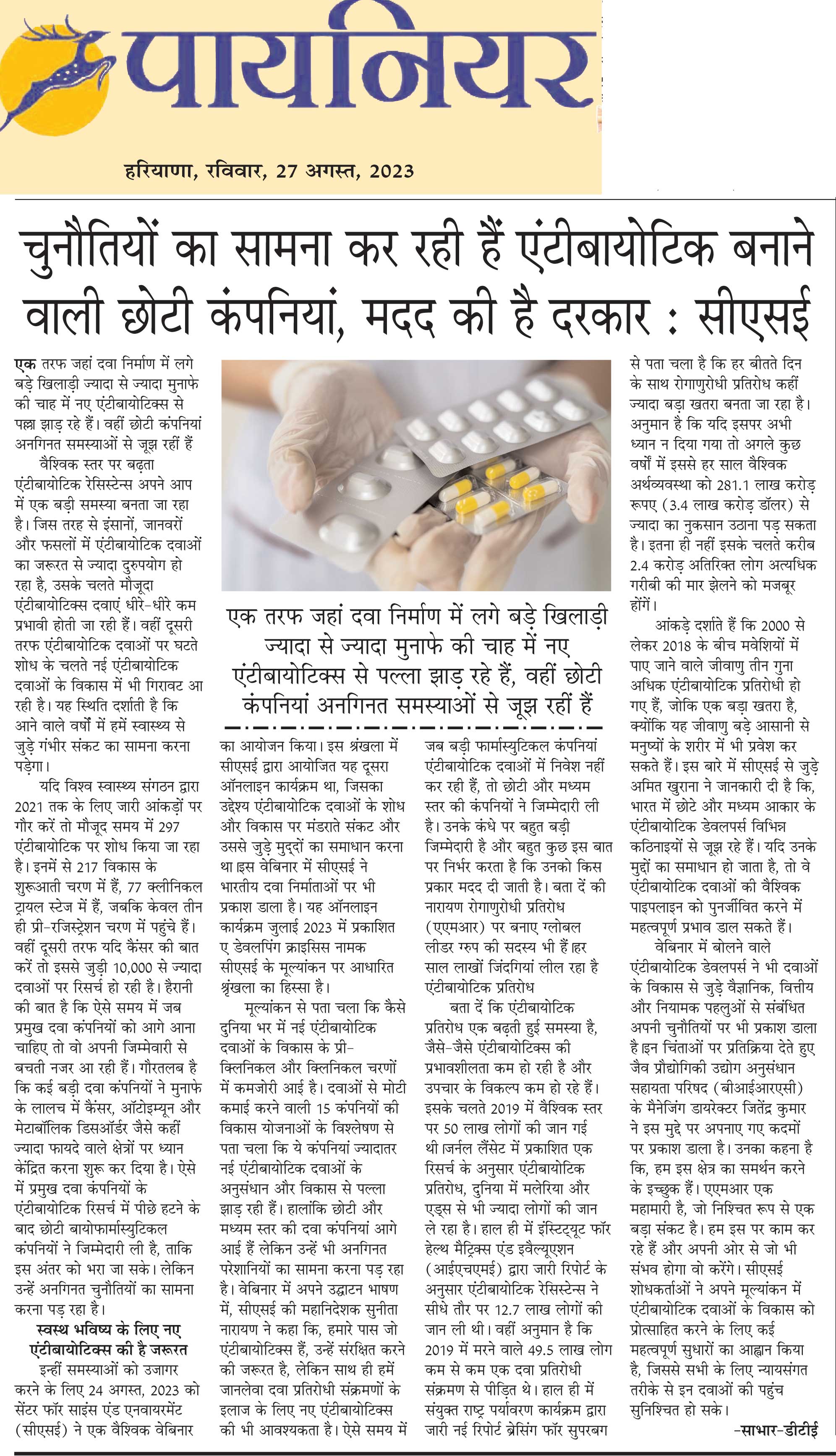
चुनौतियों का सामना कर रही हैं एंटीबायोटिक बनाने वाली छोटी कंपनियां, मदद की है दरकार: सीएसई

एक तरफ जहां दवा निर्माण में लगे बड़े खिलाड़ी ज्यादा से ज्यादा मुनाफे की चाह में नए एंटीबायोटिक्स से पल्ला झाड़ रहे हैं। वहीं छोटी कंपनियां अनगिनत समस्याओं से जूझ रहीं हैं वैश्विक स्तर पर बढ़ता एंटीबायोटिक रेसिस्टेन्स अपने आप में एक बड़ी समस्या बनता जा रहा है। जिस तरह से इंसानों, जानवरों और फसलों में एंटीबायोटिक दवाओं का जरूरत से ज्यादा दुरुपयोग हो रहा है, उसके चलते मौजूदा एंटीबायोटिक्स दवाएं धीरे-धीरे कम प्रभावी होती जा रही हैं। वहीं दूसरी तरफ एंटीबायोटिक दवाओं पर घटते शोध के चलते नई एंटीबायोटिक दवाओं के विकास में भी गिरावट आ रही है। यह स्थिति दर्शाती है कि आने वाले वर्षों में हमें स्वास्थ्य से जुड़े गंभीर संकट का सामना करना पड़ेगा। यदि विश्व स्वास्थ्य संगठन द्वारा 2021 तक के लिए जारी आंकड़ों पर गौर करें तो मौजूद समय में 297 एंटीबायोटिक पर शोध किया जा रहा है। इनमें से 217 विकास के शुरूआती चरण में हैं, 77 क्लीनिकल ट्रायल स्टेज में हैं, जबकि केवल तीन ही प्री-रजिस्ट्रेशन चरण में पहुंचे हैं। वहीं दूसरी तरफ यदि कैंसर की बात करें तो इससे जुड़ी 10,000 से ज्यादा दवाओं पर रिसर्च हो रही है। हैरानी की बात है कि ऐसे समय में जब प्रमुख दवा कंपनियों को आगे आना चाहिए तो वो अपनी जिम्मेवारी से बचती नजर आ रही हैं। गौरतलब है कि कई बड़ी दवा कंपनियों ने मुनाफे के लालच में कैंसर, ऑटोइम्यून और मेटाबॉलिक डिसऑर्डर जैसे कहीं ज्यादा फायदे वाले क्षेत्रों पर ध्यान केंद्रित करना शुरू कर दिया है। ऐसे में प्रमुख दवा कंपनियों के एंटीबायोटिक रिसर्च में पीछे हटने के बाद छोटी बायोफार्मास्युटिकल कंपनियों ने जिम्मेदारी ली है, ताकि इस अंतर को भरा जा सके। लेकिन उन्हें अनगिनत चुनौतियों का सामना करना पड़ रहा है। स्वस्थ भविष्य के लिए नए एंटीबायोटिक्स की है जरूरत इन्हीं समस्याओं को उजागर करने के लिए 24 अगस्त, 2023 को सेंटर फॉर साइंस एंड एनवायरमेंट (सीएसई) ने एक वैश्विक वेबिनार का आयोजन किया। इस श्रंखला में सीएसई द्वारा आयोजित यह दूसरा ऑनलाइन कार्यक्रम था, जिसका उद्देश्य एंटीबायोटिक दवाओं के शोध और विकास पर मंडराते संकट और उससे जुड़े मुद्दों का समाधान करना था। इस वेबिनार में सीएसई ने भारतीय दवा निर्माताओं पर भी प्रकाश डाला है। यह ऑनलाइन कार्यक्रम जुलाई 2023 में डाउन टू अर्थ में प्रकाशित 'ए डेवलपिंग क्राइसिस' नामक सीएसई के मूल्यांकन पर आधारित श्रृंखला का हिस्सा है। मूल्यांकन से पता चला कि कैसे दुनिया भर में नई एंटीबायोटिक दवाओं के विकास के प्री-क्लिनिकल और क्लिनिकल चरणों में कमजोरी आई है। दवाओं से मोटी कमाई करने वाली 15 कंपनियों की विकास योजनाओं के विश्लेषण से पता चला कि ये कंपनियां ज्यादातर नई एंटीबायोटिक दवाओं के अनुसंधान और विकास से पल्ला झाड़ रही हैं। हालांकि छोटी और मध्यम स्तर की दवा कंपनियां आगे आई हैं लेकिन उन्हें भी अनगिनत परेशानियों का सामना करना पड़ रहा है। वेबिनार में अपने उद्घाटन भाषण में, सीएसई की महानिदेशक सुनीता नारायण ने कहा कि, “हमारे पास जो एंटीबायोटिक्स हैं, उन्हें संरक्षित करने की जरूरत है, लेकिन साथ ही हमें जानलेवा दवा प्रतिरोधी संक्रमणों के इलाज के लिए नए एंटीबायोटिक्स की भी आवश्यकता है। ऐसे समय में जब बड़ी फार्मास्युटिकल कंपनियां एंटीबायोटिक दवाओं में निवेश नहीं कर रही हैं, तो छोटी और मध्यम स्तर की कंपनियों ने जिम्मेदारी ली है।" उनके कंधे पर बहुत बड़ी जिम्मेवारी है और बहुत कुछ इस बात पर निर्भर करता है कि उनको किस प्रकार मदद दी जाती है।" बता दें की नारायण रोगाणुरोधी प्रतिरोध (एएमआर) पर बनाए ग्लोबल लीडर ग्रुप की सदस्य भी हैं।