
Cse In News

Meet up with a new flame: LPG crisis shows why India must scale ethanol for cooking

Ethanol burns cleanly, producing primarily CO2 and water vapour, with zero PM2.5, and negligible toxic emissions compared to biomass. Centre for Science and Environment estimates that household cooking emissions in India exceed 350 mn tonnes of CO2 annually, surpassing the entire transport sector. Ethanol clean cooking directly addresses this at scale. Restaurants, hotels and eateries are running out of cooking gas. Indian Hotel & Restaurant Association (AHAR) says 20% of establishments in Mumbai have shut due to disrupted commercial LPG supply, warning that closures could reach 50% if the shortage continues. In Delhi-NCR, commercial cylinders are reportedly selling on the black market for up to ₹1,500. The crunch, of course, stems from the US-Israel war against Iran and the ensuing conflict in West Asia that has disrupted tanker movement through the Hormuz Strait, route for 85-90% of India's LPG imports. Domestic LPG prices have risen by ₹60 in a week, pushing a 14.2 kg cylinder in Delhi to ₹913, the highest since August 2023. With 62% of domestic LPG demand met through imports, this disruption was always a matter of when, not if. The crisis in commercial kitchens, however, is only the visible tip of the iceberg. India's cooking fuel vulnerability runs far deeper. India has made progress under Pradhan Mantri Ujjwala Yojana (PMUY), connecting 32.99 cr households to LPG, including 10.33 cr subsidised connections. Yet, universal clean cooking remains elusive. About 500 mn people - nearly 40% of the population - rely on biomass fuels. Household air pollution from these fuels contributes to an estimated 1.2 mn premature deaths annually. Even within LPG-connected households, the ₹913-a-cylinder price - ₹613 for PMUY beneficiaries - pushes low-income households back to firewood and dung, particularly in rural areas where these fuels are available. To sustain LPG usage among the poorest, GoI has committed ₹12,000 cr in PMUY subsidies for 2025-26, and sanctioned an additional ₹30,000 cr in compensation to IOCL, BPCL and HPCL for under-recoveries on domestic LPG sales. This is the fiscal cost of a system structurally dependent on imported fuel. While India scrambles to secure LPG supply, its ethanol distilleries are operating below full capacity. India's ethanol production capacity has grown to 1,822 cr litres, supported by about 500 distilleries nationwide. The E20 blending programme requires 1,016 cr litres annually, leaving a substantial surplus available for other applications. Critically, cooking applications don't require anhydrous fuel-grade ethanol at 99.9% purity. 90-95% purity suffices, which lowers both production costs and the barrier to scaling. Diverting about 250 cr litres toward cooking would serve nearly 20 mn households without compromising E20 blending targets. The infrastructure to produce, store and move ethanol across India already exists. Ethanol burns cleanly, producing primarily CO2 and water vapour, with zero PM2.5, and negligible toxic emissions compared to biomass. Centre for Science and Environment estimates that household cooking emissions in India exceed 350 mn tonnes of CO2 annually, surpassing the entire transport sector. Ethanol clean cooking directly addresses this at scale. India's 4.5 mn street food vendors represent a compelling entry point for ethanol cooking deployment. These vendors operate in public spaces where LPG use is often restricted due to explosion risk. Ethanol stoves carry no such risk. Transitioning 1.1-1.3 mn urban vendors from biomass or kerosene to ethanol could reduce 3-4 mn tonnes of CO2 annually, while materially improving occupational health and food safety outcomes. The technology is ready, and its effectiveness is not untested. HPCL and IIT Guwahati have developed an ethanol-fuelled cookstove, and HPCL has announced plans for ethanol ATMs at retail outlets to enable household refills. A pilot in the Sundarbans tested ethanol stoves among households entirely dependent on forest wood, demonstrating viability in resource-constrained, off-grid environments. States are in active conversations about district-level pilots, with existing inter-state ethanol logistics. For example, Karnataka alone has an installed capacity of 270 cr litres, providing a ready supply chain. UN's Food and Agriculture Organisation's (FAO) Global Bioenergy Partnership (GBEP) has documented bioethanol clean-cooking programmes. Validated pilots in Ethiopia and Mozambique - both resource-constrained with high biomass dependence - have demonstrated that ethanol cooking is technically viable, socially acceptable and replicable across diverse geographies. India, with its far larger distillery base, superior logistics infrastructure and existing policy frameworks, is better positioned than any of these countries to deploy ethanol cooking at national scale. India's ethanol ecosystem has matured. But the policy framework has not kept pace. Two specific steps are needed: GoI should designate bioethanol as an approved cooking fuel under PMUY, enabling its integration into the existing subsidy and distribution architecture. 3 state-level pilots should be commissioned, drawing on existing distillery capacity, oil marketing companies (OMC) distribution networks, and stove technology validated at scale. The fiscal arithmetic is unambiguous. Sustaining LPG import dependence at 62% costs over ₹42,000 cr annually in subsidies and under-recoveries. It leaves India structurally exposed to geopolitical shocks, as the current West Asian crisis has demonstrated. Bioethanol cooking is not a replacement for LPG. It is a domestically produced, import-independent complement that India's distilleries can supply today. The capacity exists. The technology exists. The crisis to justify urgency is on every front page this week. What is needed now is a policy decision.
Meet up with a new flame: LPG crisis shows why India must scale ethanol for cooking

Ethanol burns cleanly, producing primarily CO2 and water vapour, with zero PM2.5, and negligible toxic emissions compared to biomass. Centre for Science and Environment estimates that household cooking emissions in India exceed 350 mn tonnes of CO2 annually, surpassing the entire transport sector. Ethanol clean cooking directly addresses this at scale. Restaurants, hotels and eateries are running out of cooking gas. Indian Hotel & Restaurant Association (AHAR) says 20% of establishments in Mumbai have shut due to disrupted commercial LPG supply, warning that closures could reach 50% if the shortage continues. In Delhi-NCR, commercial cylinders are reportedly selling on the black market for up to ₹1,500. The crunch, of course, stems from the US-Israel war against Iran and the ensuing conflict in West Asia that has disrupted tanker movement through the Hormuz Strait, route for 85-90% of India's LPG imports. Domestic LPG prices have risen by ₹60 in a week, pushing a 14.2 kg cylinder in Delhi to ₹913, the highest since August 2023. With 62% of domestic LPG demand met through imports, this disruption was always a matter of when, not if. The crisis in commercial kitchens, however, is only the visible tip of the iceberg. India's cooking fuel vulnerability runs far deeper. India has made progress under Pradhan Mantri Ujjwala Yojana (PMUY), connecting 32.99 cr households to LPG, including 10.33 cr subsidised connections. Yet, universal clean cooking remains elusive. About 500 mn people - nearly 40% of the population - rely on biomass fuels. Household air pollution from these fuels contributes to an estimated 1.2 mn premature deaths annually. Even within LPG-connected households, the ₹913-a-cylinder price - ₹613 for PMUY beneficiaries - pushes low-income households back to firewood and dung, particularly in rural areas where these fuels are available. To sustain LPG usage among the poorest, GoI has committed ₹12,000 cr in PMUY subsidies for 2025-26, and sanctioned an additional ₹30,000 cr in compensation to IOCL, BPCL and HPCL for under-recoveries on domestic LPG sales. This is the fiscal cost of a system structurally dependent on imported fuel. While India scrambles to secure LPG supply, its ethanol distilleries are operating below full capacity. India's ethanol production capacity has grown to 1,822 cr litres, supported by about 500 distilleries nationwide. The E20 blending programme requires 1,016 cr litres annually, leaving a substantial surplus available for other applications. Critically, cooking applications don't require anhydrous fuel-grade ethanol at 99.9% purity. 90-95% purity suffices, which lowers both production costs and the barrier to scaling. Diverting about 250 cr litres toward cooking would serve nearly 20 mn households without compromising E20 blending targets. The infrastructure to produce, store and move ethanol across India already exists. Ethanol burns cleanly, producing primarily CO2 and water vapour, with zero PM2.5, and negligible toxic emissions compared to biomass. Centre for Science and Environment estimates that household cooking emissions in India exceed 350 mn tonnes of CO2 annually, surpassing the entire transport sector. Ethanol clean cooking directly addresses this at scale. India's 4.5 mn street food vendors represent a compelling entry point for ethanol cooking deployment. These vendors operate in public spaces where LPG use is often restricted due to explosion risk. Ethanol stoves carry no such risk. Transitioning 1.1-1.3 mn urban vendors from biomass or kerosene to ethanol could reduce 3-4 mn tonnes of CO2 annually, while materially improving occupational health and food safety outcomes. The technology is ready, and its effectiveness is not untested. HPCL and IIT Guwahati have developed an ethanol-fuelled cookstove, and HPCL has announced plans for ethanol ATMs at retail outlets to enable household refills. A pilot in the Sundarbans tested ethanol stoves among households entirely dependent on forest wood, demonstrating viability in resource-constrained, off-grid environments. States are in active conversations about district-level pilots, with existing inter-state ethanol logistics. For example, Karnataka alone has an installed capacity of 270 cr litres, providing a ready supply chain. UN's Food and Agriculture Organisation's (FAO) Global Bioenergy Partnership (GBEP) has documented bioethanol clean-cooking programmes. Validated pilots in Ethiopia and Mozambique - both resource-constrained with high biomass dependence - have demonstrated that ethanol cooking is technically viable, socially acceptable and replicable across diverse geographies. India, with its far larger distillery base, superior logistics infrastructure and existing policy frameworks, is better positioned than any of these countries to deploy ethanol cooking at national scale.

Ground-level ozone emerges as year-round pollution concern in Delhi

Ground-level ozone, considered largely a summer pollutant, is now emerging as a year-round concern in the city. An analysis of Central Pollution Control Board (CPCB) data shows that ozone was the lead pollutant in the daily Air Quality Index (AQI) on 16 of the 28 days this Feb, eight days in March so far and twice this Jan. In comparison, it was the main pollutant on nine days in Feb 2025 and two days in Feb 2024, 2021 and 2020, and once in Feb 2022. It wasn't the dominant pollutant in Feb 2023. While ozone typically peaks during the summer months, especially between April and June, this data suggests that elevated levels are now being recorded in other months as well. For example, in Oct 2025, which was the coolest in three years with a mean maximum temperature of 31.7 degrees Celsius, ozone was the lead pollutant for 11 days. Anumita Roychowdhury, executive director (research and advocacy) of Centre for Science and Environment, said ozone pollution is escalating into a year-round public health concern. "Once a seasonal problem triggered by summer sunlight, toxic ozone levels now persist across all seasons due to high and continuous emissions of gases. Without urgent action to drastically cut gaseous pollutants from vehicles and industries, this highly reactive gas will increase public health risk," she said. A review of hourly ozone data for the month of Feb indicates a worrying trend. The levels of the gas exceeded 101 micrograms per cubic metre for 29 hours in Feb 2026 and 18 hours in Feb 2025. In contrast, the hourly concentration did not cross the 100 micrograms per cubic metre mark in any Feb between 2020 and 2024 even once, according to data analysed by Envirocatalysts, a think tank. Though the national hourly standard for ozone is 180 micrograms per cubic metre, experts said the number of hours showing elevated levels this year is significantly higher than in previous years. Sunil Dahiya, founder and lead analyst at Envirocatalysts, said the average temperatures in Feb in previous years were almost similar, but the ozone levels peaked this Feb. "It means that primary precursors like oxides of nitrogen (NOx) and volatile organic compounds (VOCs) are driving ozone levels, as there is no direct correlation between ozone and temperatures. We have also seen that the gas has started turning into a main pollutant during the winter months and pre-summer months, which was not the case a few years ago," said Dahiya. He added that this needs to be tackled in a systematic manner, with a focus on reducing the emission load of all pollutants.

8th Cities Forum Highlights Circular Economy as Key to Sustainable Urban Growth

Meanwhile, Sunita Narain, Director General of the Centre for Science and Environment (CSE), stressed that implementing a circular economy requires strong public awareness, particularly in waste segregation at the source, alongside coordinated efforts among governments, institutions, and communities. Ethiopia's Environmental Protection Authority Director General, Lelise Neme stressed that implementing a circular economy is critical to ensuring sustainable development, achieving national and continental development goals, and building resilient and clean cities. She made the remarks at the opening of the 8th International Forum on Cities and Circular Economy, which has brought together policymakers, experts, and development partners to address the growing solid waste challenge in rapidly urbanizing cities. A three-day forum, attended by participants from 15 African countries, aims to explore effective waste management solutions and promote experience sharing among member states. Studies indicate that solid waste generation in Sub-Saharan African cities is rising at an alarming rate, creating increasingly complex environmental and urban management challenges. In 2016, cities in the region generated 174 million tons of solid waste, a figure projected to reach 522 million tons by 2050 if effective measures are not implemented. The Forum on Cities and Solid Waste Circular Economy was established as a collaborative platform to tackle these challenges by promoting innovative solutions, strengthening partnerships, and advancing sustainable waste management practices. Speaking at the opening session, Lelise Neme emphasized that the forum provides an important platform to discuss environmental policy, sustainable development, and the future of cities. She noted that the Ethiopian government is pursuing ambitious environmental and development goals through initiatives such as the Climate Resilient Green Economy Strategy, the Ten-Year National Development Plan, and the National Circular Economy Roadmap, launched during the 2024/25 Ethiopian fiscal year. “For Ethiopia, the circular economy is not a distant aspiration; it is an essential pathway for achieving sustainable development, building resilient cities, and advancing both national and continental development goals,” she said. According to her, these frameworks aim to decouple economic growth from resource consumption and environmental degradation through key measures such as strengthening sustainable waste management and recycling systems, including plastics, batteries, and electronic waste. They also focus on promoting eco-industrial parks and extended producer responsibility systems, accelerating the transition to clean energy and green transport, and supporting green entrepreneurship, particularly among youth and women. Also addressing the forum, Fanta Dejene, State Minister of Ministry of Urban and Infrastructure, warned that rapid urbanization is generating large volumes of waste that could pose serious threats to human health, the environment, infrastructure, and natural resources if not properly managed. He noted that the ministry is working to ensure sustainable urban growth by integrating strategies aimed at transforming solid waste into valuable economic resources. The Ambassador of India to Ethiopia, Anil Kumar Rai, highlighted India’s experience in waste recycling and green job creation. He reaffirmed his country’s commitment to supporting member states through technology transfer, knowledge exchange, and capacity-building initiatives. Meanwhile, Sunita Narain, Director General of the Centre for Science and Environment (CSE), stressed that implementing a circular economy requires strong public awareness, particularly in waste segregation at the source, alongside coordinated efforts among governments, institutions, and communities. During the forum, the Addis Ababa City Cleansing Management Agency shared its best practices in waste recycling, riverside development initiatives, and the ongoing Corridor Development Project in Addis Ababa. The event concluded with the signing of a Memorandum of Understanding (MoU) between the Environmental Protection Authority and the Centre for Science and Environment, aimed at strengthening cooperation on circular economy initiatives and sustainable waste management.

8th Cities Forum Highlights Circular Economy as Key to Sustainable Urban Growth

Ethiopia’s Environmental Protection Authority Director General Lelise Neme has underscored the importance of implementing a circular economy to support sustainable development, achieve national and continental development goals, and build resilient, clean cities. Neme made the remarks during the opening of the 8th International Forum on Cities and Circular Economy, in Addis Ababa, Ethiopia, which has convened policymakers, experts and development partners to address the growing challenge of solid waste in rapidly urbanizing cities. The three-day forum, attended by participants from 15 African countries, aims to explore effective waste management solutions and promote the sharing of experiences among member states. Studies show that solid waste generation in Sub-Saharan African cities is increasing at an alarming rate, creating complex environmental and urban management challenges. In 2016, cities in the region generated about 174 million tons of solid waste, a figure projected to rise to 522 million tons by 2050 if effective interventions are not implemented. The Forum on Cities and Solid Waste Circular Economy was established as a collaborative platform to address these challenges by promoting innovative solutions, strengthening partnerships and advancing sustainable waste management practices. Speaking at the opening session, Neme said the forum provides an important platform to discuss environmental policy, sustainable development and the future of cities. She noted that Ethiopia is pursuing ambitious environmental and development goals through initiatives such as the Climate Resilient Green Economy Strategy, the Ten-Year National Development Plan and the National Circular Economy Roadmap launched during the 2024/25 Ethiopian fiscal year. “For Ethiopia, the circular economy is not a distant aspiration; it is an essential pathway for achieving sustainable development, building resilient cities, and advancing both national and continental development goals,” she said. According to Neme, these frameworks seek to decouple economic growth from resource consumption and environmental degradation through measures such as strengthening sustainable waste management and recycling systems, including those for plastics, batteries and electronic waste. They also prioritize the promotion of eco-industrial parks and extended producer responsibility systems, accelerating the transition to clean energy and green transport, and supporting green entrepreneurship, particularly among youth and women. Also speaking at the forum, State Minister of Urban and Infrastructure Fanta Dejene warned that rapid urbanization is generating large volumes of waste that could pose serious risks to human health, the environment, infrastructure and natural resources if not properly managed. He said the ministry is working to ensure sustainable urban growth by integrating strategies aimed at transforming solid waste into valuable economic resources. India’s Ambassador to Ethiopia, Anil Kumar Rai, highlighted India’s experience in waste recycling and the creation of green jobs, reaffirming his country’s commitment to supporting member states through technology transfer, knowledge exchange and capacity-building initiatives. Meanwhile, Sunita Narain, Director General of the Centre for Science and Environment (CSE), stressed that implementing a circular economy requires strong public awareness, particularly in waste segregation at the source, as well as coordinated efforts among governments, institutions and communities. During the forum, the Addis Ababa City Cleansing Management Agency presented its best practices in waste recycling, riverside development initiatives and the ongoing Corridor Development Project in Addis Ababa. On the first day of the event, a Memorandum of Understanding (MoU) was also signed between the Environmental Protection Authority and the Centre for Science and Environment to strengthen cooperation on circular economy initiatives and sustainable waste management.

STATE OF THE ENVIRONMENT IN INDIA, 2026 REPORT

Released by:The Centre for Science and Environment (CSE)à consistently brought out annual reports since 1982. View ofà The environmental challenges the country faces, ranging from floods, extreme weather events, changes in tiger behaviour, to air pollution, among others. Global perspective of climate change and connects it to the Indian context. Increasing of extreme weather events The year 2025 àhighest increase in frequency and impact of extreme weather events in India, including heatwaves, cold waves, and heavy rain, flood, in the last four years. 2025àExtreme weather events happenedà 99% of days in 2025, resulting 4,419 reported deaths and affecting at least 17. 41 million hectares of crop area. 2024àextreme weather events occurred on 88% of days, causing 3393 deaths and impacting 3.61 million ha of crop area. 2023àAbout 89% of days experienced such events, with 3208 deaths and 2.09 million ha of crop damage. Worst-hit states – Himachal Pradesh (267 days), followed by Kerala (173 days), and Madhya Pradesh (162 days). Key policy recommendations to improve the environment India àshould move from post-disaster relief work to pre-disaster resilience. Climate change is not a distant possibilityà it is already shaping our rivers, our cities, and our lives. Future resilience will depend on how quickly we can integrate climate science into everyday planning Nature-based solutionsà emphasizes the need for nature-based solutions such as restoring wetlands, reconnecting rivers to their floodplains, groundwater recharge, rainwater harvesting, and restoration and construction of lakes. Structural InequalityàThe absence of monitoring is not just a gap in information, but it is an example of structural inequality in India’s environmental governance

Ethiopia: 8th Cities Forum Highlights Circular Economy As Key to Sustainable Urban Growth

Ethiopia's Environmental Protection Authority Director General, Lelise Neme stressed that implementing a circular economy is critical to ensuring sustainable development, achieving national and continental development goals, and building resilient and clean cities. She made the remarks at the opening of the 8th International Forum on Cities and Circular Economy, which has brought together policymakers, experts, and development partners to address the growing solid waste challenge in rapidly urbanizing cities. A three-day forum, attended by participants from 15 African countries, aims to explore effective waste management solutions and promote experience sharing among member states. Studies indicate that solid waste generation in Sub-Saharan African cities is rising at an alarming rate, creating increasingly complex environmental and urban management challenges. In 2016, cities in the region generated 174 million tons of solid waste, a figure projected to reach 522 million tons by 2050 if effective measures are not implemented. The Forum on Cities and Solid Waste Circular Economy was established as a collaborative platform to tackle these challenges by promoting innovative solutions, strengthening partnerships, and advancing sustainable waste management practices. Speaking at the opening session, Lelise Neme emphasized that the forum provides an important platform to discuss environmental policy, sustainable development, and the future of cities. She noted that the Ethiopian government is pursuing ambitious environmental and development goals through initiatives such as the Climate Resilient Green Economy Strategy, the Ten-Year National Development Plan, and the National Circular Economy Roadmap, launched during the 2024/25 Ethiopian fiscal year. "For Ethiopia, the circular economy is not a distant aspiration; it is an essential pathway for achieving sustainable development, building resilient cities, and advancing both national and continental development goals," she said. According to her, these frameworks aim to decouple economic growth from resource consumption and environmental degradation through key measures such as strengthening sustainable waste management and recycling systems, including plastics, batteries, and electronic waste. They also focus on promoting eco-industrial parks and extended producer responsibility systems, accelerating the transition to clean energy and green transport, and supporting green entrepreneurship, particularly among youth and women. Also addressing the forum, Fanta Dejene, State Minister of Ministry of Urban and Infrastructure, warned that rapid urbanization is generating large volumes of waste that could pose serious threats to human health, the environment, infrastructure, and natural resources if not properly managed. He noted that the ministry is working to ensure sustainable urban growth by integrating strategies aimed at transforming solid waste into valuable economic resources. The Ambassador of India to Ethiopia, Anil Kumar Rai, highlighted India's experience in waste recycling and green job creation. He reaffirmed his country's commitment to supporting member states through technology transfer, knowledge exchange, and capacity-building initiatives. Meanwhile, Sunita Narain, Director General of the Centre for Science and Environment (CSE), stressed that implementing a circular economy requires strong public awareness, particularly in waste segregation at the source, alongside coordinated efforts among governments, institutions, and communities. During the forum, the Addis Ababa City Cleansing Management Agency shared its best practices in waste recycling, riverside development initiatives, and the ongoing Corridor Development Project in Addis Ababa. The event concluded with the signing of a Memorandum of Understanding (MoU) between the Environmental Protection Authority and the Centre for Science and Environment, aimed at strengthening cooperation on circular economy initiatives and sustainable waste management.

7 ‘good’ air days in 5 years: How coastal Mumbai normalised chronic pollution

What’s more, the pollution burden is not evenly distributed across the city. An analysis by the Centre for Science and Environment's (CSE) Urban Lab for the winter of 2024-25 shows Mumbai's air pollution is intensely localised — neighbourhoods just a few kilometres apart breathe very different air. According to their analysis, while the citywide winter PM2.5 average was 50 µg/m³ (Mumbai's lowest in four years), certain hotspots suffer dramatically worse conditions. Industrial areas like Mahul and Dharavi, which are also home to scores of low-income families, register choking concentrations of SO₂ and PM10, driven by smelting, oil burning, and coal combustion. Right next to the massive Deonar dumping ground, Deonar recorded a winter PM2.5 average of 80 µg/m³. Shivaji Nagar followed closely at 76 µg/m³. In these hotspots, pollution levels are up to 60 percent higher than the citywide baseline.

प्रदूषण का कहर: राजस्थान में साल भर में सिर्फ 20 दिन मिल रही शुद्ध हवा

राजस्थान में बढ़ते वायु प्रदूषण ने अब प्रदेशवासियों की सेहत और उम्र पर सीधा हमला बोल दिया है। सेंटर फॉर साइंस एंड एनवायरमेंट (CSE) की हालिया ‘स्टेट ऑफ इंडियाज एनवायरमेंट-2026’ रिपोर्ट में एक चौंकाने वाला खुलासा हुआ है। रिपोर्ट के अनुसार, जयपुर के नागरिक अपनी औसत उम्र के करीब 3 साल 10 महीने और 24 दिन सिर्फ जहरीली हवा के कारण खो रहे हैं। आलम यह है कि जयपुर के लोगों को साल भर में औसतन 20 दिन भी पूरी तरह शुद्ध हवा नसीब नहीं हो रही है। आंकड़ों पर गौर करें तो 1 जनवरी 2021 से 31 मार्च 2025 के बीच के 1,550 दिनों में से लगभग 450 दिन एक्यूआई (AQI) ‘खराब’ से ‘बहुत खराब’ श्रेणी में रहा। इसका मतलब है कि जयपुर का हर तीसरा दिन प्रदूषण के उस खतरनाक स्तर पर था, जो दिल और फेफड़ों की गंभीर बीमारियों को दावत देता है। पूरे साढ़े चार साल के अंतराल में केवल 81 दिन ही ऐसे थे, जब हवा की गुणवत्ता ‘अच्छी’ श्रेणी में दर्ज की गई।

Rising pollution in Rajasthan cuts lifespan by 3 years:Fine particles affect brain; only 20 days of clean air recorded annually

The Centre for Science and Environment (CSE) released its report, State of India’s Environment-2026, on February 25, 2026. Pollution data (AQI – Air Quality Index) for the state was collected between 2021 and 2025. Rising pollution in Rajasthan is reducing the average lifespan of over 8 crore state residents. In Jaipur, clean air is available for only 20 days a year. Fine particles in toxic air are reaching not only the lungs but also the blood vessels in the brain, increasing the risk of kidney damage. The startling findings come from the latest National Clean Air Program (NCAP) report. According to the report, every resident of Jaipur loses an average of 3 years, 10 months, and 24 days of life due to polluted air. The Centre for Science and Environment (CSE) released its report, State of India’s Environment-2026, on February 25, 2026. Pollution data (AQI – Air Quality Index) for the state was collected between 2021 and 2025. Based on fine particulate matter levels in the air, the report assessed its impact on life expectancy. The findings revealed that toxic air is entering the body through breathing, reducing the average lifespan of every person in Rajasthan by 3 years, 3 months, and 18 days. Greatest impact on Jaipur residents Rajasthan’s population is estimated at 80 million, with the largest concentration in Jaipur. People living in the capital are losing 7 months more of life than the state average, meaning approximately 1,424 days of life are being sacrificed due to pollution. Toxic air for 450 days in four and a half years Between January 1, 2021, and March 31, 2025, Jaipur recorded air quality in the ‘Poor’ to ‘Very Poor’ category for 450 out of 1,550 days, roughly one-third of the time. Prolonged exposure to such levels can lead to respiratory and heart diseases. In contrast, there were only 81 days of ‘Good’ air in this period, averaging less than 20 days per year of completely pure air. Several organs affected The report warns that toxic air is affecting multiple organs. Fine particles reach the brain via the bloodstream, causing brain fog, irritability, and sleep disturbances, and increasing the long-term risk of Alzheimer’s and Parkinson’s. Children are facing rising cases of anemia and low birth weight, while kidney function is being impaired, and the risk of diabetes is increasing. How does pollution shorten life? Smoke from factories, road dust, and burnt waste contain fine particles of varying sizes. PM 2.5 particles are 30 times smaller than a human hair and should not exceed 5 micrograms per cubic meter, according to WHO standards. When above this limit, these particles enter the lungs, causing serious diseases. Similarly, PM 10 particles, present in road dust, vehicle smoke, and burnt fields, should stay under 60 micrograms per cubic meter. Exposure above this standard harms health. In 2025, the Energy Policy Institute at the University of Chicago studied PM 2.5 levels and released the Air Quality Life Index (AQLI) for Rajasthan and Jaipur. The index showed how these microscopic particles reduce life expectancy. Rajasthan’s average life expectancy is 68.5 years.

राजस्थान में प्रदूषण से 3 साल घट रही जिंदगी:दिमाग तक पहुंच रहे बारीक कण, सालभर में 20 दिन ही मिल रही शुद्ध हवा

खराब क्वालिटी की हवा से राजस्थानियों की औसत उम्र 3 साल कम सेंटर फॉर साइंस एंड एनवायरमेंट ने 25 फरवरी 2026 को ‘स्टेट ऑफ इंडियाज एनवायरमेंट-2026’ नाम से एक रिपोर्ट जारी की थी। प्रदेश के लिए वर्ष 2021 से 2025 के बीच प्रदूषण स्तर (AQI- एयर क्वालिटी इंडेक्स) के आंकड़े जुटाए गए। राजस्थान में बढ़ता प्रदूषण 8 करोड़ से ज्यादा प्रदेशवासियों की औसत उम्र घटा रहा है। राजधानी जयपुर में तो साल में 20 दिन ही शुद्ध हवा नसीब हो रही है। जहरीली हवा में मौजूद बारीक कण सिर्फ फेफड़े ही नहीं दिमाग की नसों तक पहुंच रहे हैं। किडनी तक डैमेज होने का खतरा बढ़ रहा है। नेशनल क्लीन एयर प्रोग्राम (NCAP) की ताजा रिपोर्ट में यह चौंकानी वाली जानकारी सामने आई है। रिपोर्ट बताती है कि जयपुर का हर नागरिक अपनी औसत उम्र के 3 साल 10 महीने और 24 दिन सिर्फ जहरीली हवा के कारण कम कर रहा है। मंडे स्पेशल स्टोरी में पढ़िए यह खास रिपोर्ट.... खराब क्वालिटी की हवा से राजस्थानियों की औसत उम्र 3 साल कम सेंटर फॉर साइंस एंड एनवायरमेंट ने 25 फरवरी 2026 को ‘स्टेट ऑफ इंडियाज एनवायरमेंट-2026’ नाम से एक रिपोर्ट जारी की थी। प्रदेश के लिए वर्ष 2021 से 2025 के बीच प्रदूषण स्तर (AQI- एयर क्वालिटी इंडेक्स) के आंकड़े जुटाए गए। फिर प्रदूषित हवा में मौजूद सूक्ष्म कणों की मात्रा के आधार पर आंकलन किया गया कि ये उम्र पर कितना असर डालते हैं। रिपोर्ट में सामने आया कि जहरीली हवा में इतने खतरनाक कण मौजूद हैं, जो सांस से हमारे शरीर में जा रहे हैं। इससे प्रदेश के हर व्यक्ति की उम्र औसतन 3 साल 3 महीने और 18 दिन घट रही है। जयपुर में रहने वालों की उम्र पर सबसे ज्यादा असर प्रदेश की अनुमानित आबादी 8 करोड़ है। सबसे ज्यादा आबादी राजधानी जयपुर में रहती है। जयपुर में रहने वाले लोग औसत से भी 7 महीने ज्यादा उम्र खो रहे हैं। अगर आप जयपुर में रह रहे हैं, तो लगभग 1,424 दिन प्रदूषण की भेंट चढ़ रहे हैं। साढ़े चार साल में 450 दिन रही जहरीली हवा इस संकट की गहराई को समझने के लिए पिछले साढ़े चार साल के डेटा पर नजर डालना जरूरी है। 1 जनवरी 2021 से 31 मार्च 2025 के बीच कुल 1,550 दिनों में से करीब 450 दिन वायु गुणवत्ता (AQI) 'खराब' (Poor) से 'बहुत खराब' (Very Poor) श्रेणी में दर्ज की गई। इसका मतलब यह है कि जयपुर का हर तीसरा दिन प्रदूषण के उस खतरनाक स्तर पर होता है, जिसके संपर्क में लंबे समय तक रहने पर सांस और हार्ट संबंधी रोग हो सकते हैं। इसके विपरीत, पूरे साढ़े चार साल (1550 दिन) में केवल 81 दिन ही ऐसे थे, जब लोगों को 'अच्छी' (Good) हवा नसीब हो सकी। यानी जयपुर वालों को साल में औसत रूप से 20 दिन भी पूरी तरह शुद्ध हवा नसीब नहीं हो रही है।

दिल्ली से सीखें सबक: नए शहरों को ‘अराजकता’ से बचाने के लिए प्रबंधन जरूरी है, लोकलुभावनवाद नहीं

मुझे अपनी दिल्ली के लिए रोना आ रहा है। यह मेरा शहर है जहां मेरे परिवार की कई पीढ़ियां रह चुकी हैं। मैंने यहां अपने पेशेवर जीवन का अधिकांश समय स्वच्छ हवा, पानी और बुनियादी जीवनयापन के लिए आवश्यक हर चीज की वकालत करते हुए बिताया है। आज हर जगह कूड़ा-कचरा है, सड़कों पर गड्ढे हैं, यातायात व्यवस्था बिल्कुल नहीं है, जाम लगता है, अवैध इमारतें बनी हुई हैं और पार्किंग की समस्या है, जिससे सड़क प्रबंधन की व्यवस्था और भी खराब हो जाती है। पानी की आपूर्ति मांग के हिसाब से कम पड़ रही है, यमुना नदी उपेक्षित हो गई है और उसमें बड़ी मात्रा में सीवेज का पानी मिल रहा है। और हां, दिल्ली अब तो सांस लेने लायक भी नहीं रही। मैं और भी बहुत कुछ बता सकती हूं, लेकिन दिल्ली के सभी निवासी तो जानते ही हैं कि हम किस स्थिति से गुजर रहे हैं। इसलिए, हमें यह सवाल पूछना होगा कि क्या शहरी सेवाओं की खामियों को सुधारा जा सकता है, या क्या यह समस्या बहुत बढ़ चुकी है? मैं यह सवाल बुनियादी ढांचे के पतन पर शिकायत के लिए नहीं, बल्कि यह सुनिश्चित करने के लिए पूछ रही हूं कि हम इस अनुभव से सीखें और भारत में एक और दिल्ली जैसी स्थिति न पैदा करें। दूसरे शब्दों में, हम यह सुनिश्चित करें कि मध्य भारत के शहर बढ़ते-बढ़ते बड़े पैमाने पर अव्यवस्था का शिकार न बन जाएं, यहां तक कि चरमरा न जाएं। यह महत्त्वपूर्ण है। हम जानते हैं कि शहरीकरण से उच्च पदों की नौकरियों को बढ़ावा मिलेगा। पश्चिमी देशों में आप्रवासन के दबाव के कारण भारत में युवा, कुशल कामगारों के लिए फलने-फूलने के अपार अवसर हैं। लेकिन उन्हें केवल धन से कहीं अधिक की आवश्यकता है। उन्हें अपने और अपने बच्चों के लिए गुणवत्तापूर्ण जीवन की आवश्यकता है। यह केवल मॉल, रेस्तरां और नाइटलाइफ की बात नहीं, बल्कि बुनियादी जरूरतों की बात है जैसे स्वच्छ जल, स्वच्छ वायु, शिक्षा और आवास जिनकी बदौलत प्रतिभा को आकर्षित किया और उन्हें बनाए रखा जा सकता है। यह रहने लायक शहरों की बात है। इस योजना को सफल बनाने के लिए हमें यह समझना होगा कि क्या नहीं करना चाहिए। शहरों के जनसंख्या आंकड़े पुराने हो चुके हैं, और योजना अभी भी 2011 की जनगणना पर आधारित है। फिर भी, हम शहरों के अपने बाहरी क्षेत्रों में विस्तार के कारण होने वाले पतन को देख सकते हैं। वर्ष 1990 के दशक में दिल्ली के बाहरी इलाके में गुरुग्राम विकसित होना शुरू हुआ। आज, शहरी विस्तार मीलों तक अगल-बगल फैल रहा है और हर दिन बढ़ता जा रहा है। छोटे कस्बे बड़े होते जा रहे हैं, लेकिन बिना योजना या सुविधाओं के। यही असली चुनौती है। क्या किया जाना चाहिए? सबसे पहले शहरों को केवल सड़कों की ही नहीं, बल्कि आवागमन की भी योजना बनानी चाहिए। यह अत्यंत महत्त्वपूर्ण है क्योंकि लोगों का आवागमन किफायती आवास और आजीविका से जुड़ा हुआ है। जैसे-जैसे शहर बढ़ते हैं और जमीन की कीमतें बढ़ती हैं, कई लोग मकान खरीदने में असमर्थ हो जाते हैं। इसका अर्थ यह है कि गरीब लोग, जो शहर के सेवा क्षेत्र के लिए महत्त्वपूर्ण हैं, उन क्षेत्रों में रहने की तलाश करते हैं जिन्हें अवैध क्षेत्र या झुग्गी-झोपड़ी कहा जाता है। त्रासदी यह है कि कई मामलों में ये जमीन शहर के पर्यावरण के लिए महत्त्वपूर्ण होती हैं, जैसे कि हरित क्षेत्र या जल निकायों के संग्रहण क्षेत्र। शहर के बाहरी इलाकों से, जहां आवास सस्ता हो सकता है, आवागमन या तो संभव नहीं होता या पहुंच से बाहर होता है। मध्यम वर्ग भी निजी परिवहन पर निर्भर होकर शहर से बाहर की ओर पलायन करता है, जिससे भीड़भाड़ और बढ़ जाती है। शहर को हर तरह से नुकसान होता है। जैसे-जैसे शहर बढ़ते हैं, नियोजन का सबसे महत्त्वपूर्ण घटक, उसकी रीढ़ माने जाने वाला परिवहन होना चाहिए ताकि बाहरी क्षेत्रों को जोड़ा जा सके और शहर के भीतर आवागमन सुगम हो सके। लोग पैदल चल सकें, साइकल चला सकें, बसों या मेट्रो का उपयोग कर सकें और केवल आवश्यकता पड़ने पर ही कार का इस्तेमाल करें। एक आधुनिक शहर दिल्ली या बेंगलूरु जैसे जाम से ग्रस्त शहरों जैसा नहीं होना चाहिए। इसके अलावा, शिक्षा से लेकर स्वास्थ्य सेवा और स्वच्छ जल तक अन्य बुनियादी सेवाओं की भी आवश्यकता है। ये सभी चीजें शहर के जीवन स्तर को बेहतर बनाएंगी। लेकिन मास्टर प्लान का क्रियान्वयन सबसे महत्त्वपूर्ण है। दिल्ली का मास्टर प्लान पुराना हो चुका है और उससे भी बुरी बात यह है कि इसका उल्लंघन ही हो रहा है। भारत के अधिकांश शहरों में, और विशेष रूप से विकासशील शहरों में भूमि उपयोग योजना का कोई नामोनिशान भी नहीं है, जो सार्वजनिक रूप से उपलब्ध हो ताकि लोगों को पता चले कि क्या स्वीकार्य है और क्या नहीं। पारदर्शिता रोकथाम का पहला कदम है। इस भ्रम से जानबूझकर पैदा हुई अराजकता दिल्ली में स्पष्ट रूप से दिखाई देती है, जहां अवैध अतिक्रमण सड़कों पर कब्जा कर लेते हैं और बुनियादी ढांचे में किया गया सार्वजनिक निवेश व्यर्थ हो जाता है। नई पीढ़ी के शहर को प्रबंधन की आवश्यकता है, न कि लोकलुभावनवाद की, जो अराजकता की ओर ले जाता है। असली चुनौती यहीं है। हमें शहरीकरण के किफायती मॉडल चाहिए, लेकिन आजीविका की रक्षा के नाम पर हर अवैध चीज की अनुमति देने से ये मॉडल नहीं उभरेंगे। इससे केवल अराजकता और घटिया सेवाएं ही सुनिश्चित होंगी। असल मुद्दा शहरी प्रशासन की प्रकृति पर ध्यान केंद्रित करना है। हमारे यहां पूरी तरह से असंगत शहरी शासन प्रणालियां हैं, जहां प्रतिनिधियों को चुना तो जाता है, लेकिन फिर उन्हें निष्क्रिय कर दिया जाता है। वे फिर हर लाभप्रद चीज से खिलवाड़ करते हैं, जिससे अव्यवस्था बढ़ती है। विडंबना यह है कि नई दिल्ली ने, जहां सत्ताधारी अभिजात वर्ग रहता है, यह मान लिया है कि लोकतंत्र उसके लिए कारगर नहीं है, अब अधिकारियों का एक समूह शहर चलाता है। यह तेजी से अन्य नए विकसित शहरों के लिए एक आदर्श बनता जा रहा है। तो फिर, सबसे अच्छा विकल्प क्या है? यही वह प्रश्न है जिससे हमारा आर्थिक भविष्य तय होगा। शहरीकरण का स्वरूप संसाधन-कुशल, समावेशी और आजीविका सुरक्षा तथा जीवन को सार्थक बनाने वाली हर चीज को सुनिश्चित करने में सक्षम होना चाहिए-स्वच्छ जल और स्वच्छ वायु से लेकर खेल के मैदानों और स्कूलों तक। आइए, अतीत की दिल्ली जैसी शहरी कल्पनाओं को त्याग दें और भविष्य को अपनाएं। (ले​खिका सेंटर फॉर साइंस ऐंड एनवायरनमेंट से जुड़ी हैं)

Air Emergency in Rajasthan: Rising Pollution Cuts Lifespan by 3 Years, Only 20 Clean-Air Days a Year

Rising air pollution in Rajasthan is emerging as a major public health crisis, with new findings showing that toxic air is significantly reducing the life expectancy of more than 8 crore residents in the state. According to the Air Emergency in Rajasthan: Rising Pollution Cuts Lifespan by 3 Years, Only 20 Clean-Air Days a Year state is losing around 3 years, 3 months, and 18 days of life due to prolonged exposure to polluted air. The situation is particularly alarming in the capital city Jaipur, where pollution levels are so severe that residents lose nearly 3 years, 10 months, and 24 days of life on average. Data collected between 2021 and 2025 shows that the city experienced ‘Poor’ to ‘Very Poor’ air quality for 450 out of 1,550 days, meaning nearly one-third of the time residents were breathing unhealthy air. In contrast, only 81 days of “Good” air quality were recorded during this period—less than 20 days of clean air each year, highlighting the severity of the crisis. The report also warns that microscopic pollutants such as PM 2.5 and PM 10 particles are entering the human body through breathing and spreading through the bloodstream, affecting multiple organs. These particles are small enough to reach the brain and blood vessels, increasing the risk of neurological problems such as brain fog, irritability, sleep disorders, and even long-term diseases like Alzheimer’s and Parkinson’s. Health experts say the toxic air is also linked to rising cases of asthma, respiratory illness, kidney damage, diabetes, and heart disease. Children and elderly citizens are the most vulnerable, with doctors reporting increasing cases of anemia, weak lung development, and low birth weight among children. According to a separate study by the Energy Policy Institute at the University of Chicago through its Air Quality Life Index,

climate change India | सावधान! पृथ्वी च्यावाढत्या उष्णतेने बिघडली भारताती ऋतूंची गती !

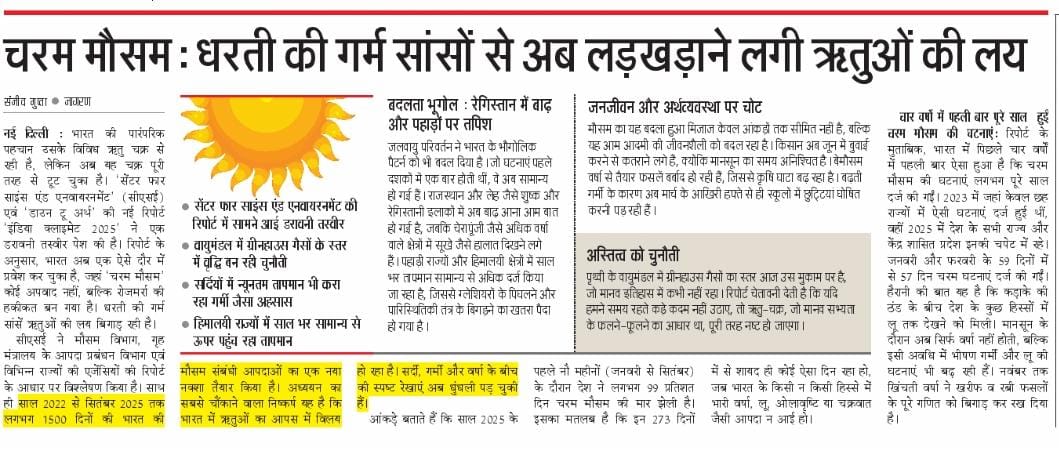
वि वि ध ऋतूचक्रां नी नटलेला देश अशी भा रता ची पा रंपा रि क ओळख आहे. ऋतू बदला वरच आपल्या कडे अनेक सण आणि उत्सव सा जरे केले जा ता त. आता हेच ऋतूचक्र पूर्णपणे वि स्कळी त झा ले आहे. पृथ्वी च्या वा ढत्या उष्णतेमुळे नि सर्गा ची हक्का ची लय हरवत चा लली आहे, अशी धोक्या ची सूचना 'वि ज्ञा न आणि पर्या वरण केंद्र' (CSE) आणि 'डा उन टू अर्थ'र्थ यां च्या नवी न रि पो र्टनेर्ट नेदि ली आहे.