What’s more, the pollution burden is not evenly distributed across the city. An analysis by the Centre for Science and Environment's (CSE) Urban Lab for the winter of 2024-25 shows Mumbai's air pollution is intensely localised — neighbourhoods just a few kilometres apart breathe very different air. According to their analysis, while the citywide winter PM2.5 average was 50 µg/m³ (Mumbai's lowest in four years), certain hotspots suffer dramatically worse conditions. Industrial areas like Mahul and Dharavi, which are also home to scores of low-income families, register choking concentrations of SO₂ and PM10, driven by smelting, oil burning, and coal combustion. Right next to the massive Deonar dumping ground, Deonar recorded a winter PM2.5 average of 80 µg/m³. Shivaji Nagar followed closely at 76 µg/m³. In these hotspots, pollution levels are up to 60 percent higher than the citywide baseline.
राजस्थान में बढ़ते वायु प्रदूषण ने अब प्रदेशवासियों की सेहत और उम्र पर सीधा हमला बोल दिया है। सेंटर फॉर साइंस एंड एनवायरमेंट (CSE) की हालिया ‘स्टेट ऑफ इंडियाज एनवायरमेंट-2026’ रिपोर्ट में एक चौंकाने वाला खुलासा हुआ है। रिपोर्ट के अनुसार, जयपुर के नागरिक अपनी औसत उम्र के करीब 3 साल 10 महीने और 24 दिन सिर्फ जहरीली हवा के कारण खो रहे हैं। आलम यह है कि जयपुर के लोगों को साल भर में औसतन 20 दिन भी पूरी तरह शुद्ध हवा नसीब नहीं हो रही है। आंकड़ों पर गौर करें तो 1 जनवरी 2021 से 31 मार्च 2025 के बीच के 1,550 दिनों में से लगभग 450 दिन एक्यूआई (AQI) ‘खराब’ से ‘बहुत खराब’ श्रेणी में रहा। इसका मतलब है कि जयपुर का हर तीसरा दिन प्रदूषण के उस खतरनाक स्तर पर था, जो दिल और फेफड़ों की गंभीर बीमारियों को दावत देता है। पूरे साढ़े चार साल के अंतराल में केवल 81 दिन ही ऐसे थे, जब हवा की गुणवत्ता ‘अच्छी’ श्रेणी में दर्ज की गई।
The Centre for Science and Environment (CSE) released its report, State of India’s Environment-2026, on February 25, 2026. Pollution data (AQI – Air Quality Index) for the state was collected between 2021 and 2025. Rising pollution in Rajasthan is reducing the average lifespan of over 8 crore state residents. In Jaipur, clean air is available for only 20 days a year. Fine particles in toxic air are reaching not only the lungs but also the blood vessels in the brain, increasing the risk of kidney damage. The startling findings come from the latest National Clean Air Program (NCAP) report. According to the report, every resident of Jaipur loses an average of 3 years, 10 months, and 24 days of life due to polluted air. The Centre for Science and Environment (CSE) released its report, State of India’s Environment-2026, on February 25, 2026. Pollution data (AQI – Air Quality Index) for the state was collected between 2021 and 2025. Based on fine particulate matter levels in the air, the report assessed its impact on life expectancy. The findings revealed that toxic air is entering the body through breathing, reducing the average lifespan of every person in Rajasthan by 3 years, 3 months, and 18 days. Greatest impact on Jaipur residents Rajasthan’s population is estimated at 80 million, with the largest concentration in Jaipur. People living in the capital are losing 7 months more of life than the state average, meaning approximately 1,424 days of life are being sacrificed due to pollution. Toxic air for 450 days in four and a half years Between January 1, 2021, and March 31, 2025, Jaipur recorded air quality in the ‘Poor’ to ‘Very Poor’ category for 450 out of 1,550 days, roughly one-third of the time. Prolonged exposure to such levels can lead to respiratory and heart diseases. In contrast, there were only 81 days of ‘Good’ air in this period, averaging less than 20 days per year of completely pure air. Several organs affected The report warns that toxic air is affecting multiple organs. Fine particles reach the brain via the bloodstream, causing brain fog, irritability, and sleep disturbances, and increasing the long-term risk of Alzheimer’s and Parkinson’s. Children are facing rising cases of anemia and low birth weight, while kidney function is being impaired, and the risk of diabetes is increasing. How does pollution shorten life? Smoke from factories, road dust, and burnt waste contain fine particles of varying sizes. PM 2.5 particles are 30 times smaller than a human hair and should not exceed 5 micrograms per cubic meter, according to WHO standards. When above this limit, these particles enter the lungs, causing serious diseases. Similarly, PM 10 particles, present in road dust, vehicle smoke, and burnt fields, should stay under 60 micrograms per cubic meter. Exposure above this standard harms health. In 2025, the Energy Policy Institute at the University of Chicago studied PM 2.5 levels and released the Air Quality Life Index (AQLI) for Rajasthan and Jaipur. The index showed how these microscopic particles reduce life expectancy. Rajasthan’s average life expectancy is 68.5 years.
खराब क्वालिटी की हवा से राजस्थानियों की औसत उम्र 3 साल कम सेंटर फॉर साइंस एंड एनवायरमेंट ने 25 फरवरी 2026 को ‘स्टेट ऑफ इंडियाज एनवायरमेंट-2026’ नाम से एक रिपोर्ट जारी की थी। प्रदेश के लिए वर्ष 2021 से 2025 के बीच प्रदूषण स्तर (AQI- एयर क्वालिटी इंडेक्स) के आंकड़े जुटाए गए। राजस्थान में बढ़ता प्रदूषण 8 करोड़ से ज्यादा प्रदेशवासियों की औसत उम्र घटा रहा है। राजधानी जयपुर में तो साल में 20 दिन ही शुद्ध हवा नसीब हो रही है। जहरीली हवा में मौजूद बारीक कण सिर्फ फेफड़े ही नहीं दिमाग की नसों तक पहुंच रहे हैं। किडनी तक डैमेज होने का खतरा बढ़ रहा है। नेशनल क्लीन एयर प्रोग्राम (NCAP) की ताजा रिपोर्ट में यह चौंकानी वाली जानकारी सामने आई है। रिपोर्ट बताती है कि जयपुर का हर नागरिक अपनी औसत उम्र के 3 साल 10 महीने और 24 दिन सिर्फ जहरीली हवा के कारण कम कर रहा है। मंडे स्पेशल स्टोरी में पढ़िए यह खास रिपोर्ट.... खराब क्वालिटी की हवा से राजस्थानियों की औसत उम्र 3 साल कम सेंटर फॉर साइंस एंड एनवायरमेंट ने 25 फरवरी 2026 को ‘स्टेट ऑफ इंडियाज एनवायरमेंट-2026’ नाम से एक रिपोर्ट जारी की थी। प्रदेश के लिए वर्ष 2021 से 2025 के बीच प्रदूषण स्तर (AQI- एयर क्वालिटी इंडेक्स) के आंकड़े जुटाए गए। फिर प्रदूषित हवा में मौजूद सूक्ष्म कणों की मात्रा के आधार पर आंकलन किया गया कि ये उम्र पर कितना असर डालते हैं। रिपोर्ट में सामने आया कि जहरीली हवा में इतने खतरनाक कण मौजूद हैं, जो सांस से हमारे शरीर में जा रहे हैं। इससे प्रदेश के हर व्यक्ति की उम्र औसतन 3 साल 3 महीने और 18 दिन घट रही है। जयपुर में रहने वालों की उम्र पर सबसे ज्यादा असर प्रदेश की अनुमानित आबादी 8 करोड़ है। सबसे ज्यादा आबादी राजधानी जयपुर में रहती है। जयपुर में रहने वाले लोग औसत से भी 7 महीने ज्यादा उम्र खो रहे हैं। अगर आप जयपुर में रह रहे हैं, तो लगभग 1,424 दिन प्रदूषण की भेंट चढ़ रहे हैं। साढ़े चार साल में 450 दिन रही जहरीली हवा इस संकट की गहराई को समझने के लिए पिछले साढ़े चार साल के डेटा पर नजर डालना जरूरी है। 1 जनवरी 2021 से 31 मार्च 2025 के बीच कुल 1,550 दिनों में से करीब 450 दिन वायु गुणवत्ता (AQI) 'खराब' (Poor) से 'बहुत खराब' (Very Poor) श्रेणी में दर्ज की गई। इसका मतलब यह है कि जयपुर का हर तीसरा दिन प्रदूषण के उस खतरनाक स्तर पर होता है, जिसके संपर्क में लंबे समय तक रहने पर सांस और हार्ट संबंधी रोग हो सकते हैं। इसके विपरीत, पूरे साढ़े चार साल (1550 दिन) में केवल 81 दिन ही ऐसे थे, जब लोगों को 'अच्छी' (Good) हवा नसीब हो सकी। यानी जयपुर वालों को साल में औसत रूप से 20 दिन भी पूरी तरह शुद्ध हवा नसीब नहीं हो रही है।
मुझे अपनी दिल्ली के लिए रोना आ रहा है। यह मेरा शहर है जहां मेरे परिवार की कई पीढ़ियां रह चुकी हैं। मैंने यहां अपने पेशेवर जीवन का अधिकांश समय स्वच्छ हवा, पानी और बुनियादी जीवनयापन के लिए आवश्यक हर चीज की वकालत करते हुए बिताया है। आज हर जगह कूड़ा-कचरा है, सड़कों पर गड्ढे हैं, यातायात व्यवस्था बिल्कुल नहीं है, जाम लगता है, अवैध इमारतें बनी हुई हैं और पार्किंग की समस्या है, जिससे सड़क प्रबंधन की व्यवस्था और भी खराब हो जाती है। पानी की आपूर्ति मांग के हिसाब से कम पड़ रही है, यमुना नदी उपेक्षित हो गई है और उसमें बड़ी मात्रा में सीवेज का पानी मिल रहा है। और हां, दिल्ली अब तो सांस लेने लायक भी नहीं रही। मैं और भी बहुत कुछ बता सकती हूं, लेकिन दिल्ली के सभी निवासी तो जानते ही हैं कि हम किस स्थिति से गुजर रहे हैं। इसलिए, हमें यह सवाल पूछना होगा कि क्या शहरी सेवाओं की खामियों को सुधारा जा सकता है, या क्या यह समस्या बहुत बढ़ चुकी है? मैं यह सवाल बुनियादी ढांचे के पतन पर शिकायत के लिए नहीं, बल्कि यह सुनिश्चित करने के लिए पूछ रही हूं कि हम इस अनुभव से सीखें और भारत में एक और दिल्ली जैसी स्थिति न पैदा करें। दूसरे शब्दों में, हम यह सुनिश्चित करें कि मध्य भारत के शहर बढ़ते-बढ़ते बड़े पैमाने पर अव्यवस्था का शिकार न बन जाएं, यहां तक कि चरमरा न जाएं। यह महत्त्वपूर्ण है। हम जानते हैं कि शहरीकरण से उच्च पदों की नौकरियों को बढ़ावा मिलेगा। पश्चिमी देशों में आप्रवासन के दबाव के कारण भारत में युवा, कुशल कामगारों के लिए फलने-फूलने के अपार अवसर हैं। लेकिन उन्हें केवल धन से कहीं अधिक की आवश्यकता है। उन्हें अपने और अपने बच्चों के लिए गुणवत्तापूर्ण जीवन की आवश्यकता है। यह केवल मॉल, रेस्तरां और नाइटलाइफ की बात नहीं, बल्कि बुनियादी जरूरतों की बात है जैसे स्वच्छ जल, स्वच्छ वायु, शिक्षा और आवास जिनकी बदौलत प्रतिभा को आकर्षित किया और उन्हें बनाए रखा जा सकता है। यह रहने लायक शहरों की बात है। इस योजना को सफल बनाने के लिए हमें यह समझना होगा कि क्या नहीं करना चाहिए। शहरों के जनसंख्या आंकड़े पुराने हो चुके हैं, और योजना अभी भी 2011 की जनगणना पर आधारित है। फिर भी, हम शहरों के अपने बाहरी क्षेत्रों में विस्तार के कारण होने वाले पतन को देख सकते हैं। वर्ष 1990 के दशक में दिल्ली के बाहरी इलाके में गुरुग्राम विकसित होना शुरू हुआ। आज, शहरी विस्तार मीलों तक अगल-बगल फैल रहा है और हर दिन बढ़ता जा रहा है। छोटे कस्बे बड़े होते जा रहे हैं, लेकिन बिना योजना या सुविधाओं के। यही असली चुनौती है। क्या किया जाना चाहिए? सबसे पहले शहरों को केवल सड़कों की ही नहीं, बल्कि आवागमन की भी योजना बनानी चाहिए। यह अत्यंत महत्त्वपूर्ण है क्योंकि लोगों का आवागमन किफायती आवास और आजीविका से जुड़ा हुआ है। जैसे-जैसे शहर बढ़ते हैं और जमीन की कीमतें बढ़ती हैं, कई लोग मकान खरीदने में असमर्थ हो जाते हैं। इसका अर्थ यह है कि गरीब लोग, जो शहर के सेवा क्षेत्र के लिए महत्त्वपूर्ण हैं, उन क्षेत्रों में रहने की तलाश करते हैं जिन्हें अवैध क्षेत्र या झुग्गी-झोपड़ी कहा जाता है। त्रासदी यह है कि कई मामलों में ये जमीन शहर के पर्यावरण के लिए महत्त्वपूर्ण होती हैं, जैसे कि हरित क्षेत्र या जल निकायों के संग्रहण क्षेत्र। शहर के बाहरी इलाकों से, जहां आवास सस्ता हो सकता है, आवागमन या तो संभव नहीं होता या पहुंच से बाहर होता है। मध्यम वर्ग भी निजी परिवहन पर निर्भर होकर शहर से बाहर की ओर पलायन करता है, जिससे भीड़भाड़ और बढ़ जाती है। शहर को हर तरह से नुकसान होता है। जैसे-जैसे शहर बढ़ते हैं, नियोजन का सबसे महत्त्वपूर्ण घटक, उसकी रीढ़ माने जाने वाला परिवहन होना चाहिए ताकि बाहरी क्षेत्रों को जोड़ा जा सके और शहर के भीतर आवागमन सुगम हो सके। लोग पैदल चल सकें, साइकल चला सकें, बसों या मेट्रो का उपयोग कर सकें और केवल आवश्यकता पड़ने पर ही कार का इस्तेमाल करें। एक आधुनिक शहर दिल्ली या बेंगलूरु जैसे जाम से ग्रस्त शहरों जैसा नहीं होना चाहिए। इसके अलावा, शिक्षा से लेकर स्वास्थ्य सेवा और स्वच्छ जल तक अन्य बुनियादी सेवाओं की भी आवश्यकता है। ये सभी चीजें शहर के जीवन स्तर को बेहतर बनाएंगी। लेकिन मास्टर प्लान का क्रियान्वयन सबसे महत्त्वपूर्ण है। दिल्ली का मास्टर प्लान पुराना हो चुका है और उससे भी बुरी बात यह है कि इसका उल्लंघन ही हो रहा है। भारत के अधिकांश शहरों में, और विशेष रूप से विकासशील शहरों में भूमि उपयोग योजना का कोई नामोनिशान भी नहीं है, जो सार्वजनिक रूप से उपलब्ध हो ताकि लोगों को पता चले कि क्या स्वीकार्य है और क्या नहीं। पारदर्शिता रोकथाम का पहला कदम है। इस भ्रम से जानबूझकर पैदा हुई अराजकता दिल्ली में स्पष्ट रूप से दिखाई देती है, जहां अवैध अतिक्रमण सड़कों पर कब्जा कर लेते हैं और बुनियादी ढांचे में किया गया सार्वजनिक निवेश व्यर्थ हो जाता है। नई पीढ़ी के शहर को प्रबंधन की आवश्यकता है, न कि लोकलुभावनवाद की, जो अराजकता की ओर ले जाता है। असली चुनौती यहीं है। हमें शहरीकरण के किफायती मॉडल चाहिए, लेकिन आजीविका की रक्षा के नाम पर हर अवैध चीज की अनुमति देने से ये मॉडल नहीं उभरेंगे। इससे केवल अराजकता और घटिया सेवाएं ही सुनिश्चित होंगी। असल मुद्दा शहरी प्रशासन की प्रकृति पर ध्यान केंद्रित करना है। हमारे यहां पूरी तरह से असंगत शहरी शासन प्रणालियां हैं, जहां प्रतिनिधियों को चुना तो जाता है, लेकिन फिर उन्हें निष्क्रिय कर दिया जाता है। वे फिर हर लाभप्रद चीज से खिलवाड़ करते हैं, जिससे अव्यवस्था बढ़ती है। विडंबना यह है कि नई दिल्ली ने, जहां सत्ताधारी अभिजात वर्ग रहता है, यह मान लिया है कि लोकतंत्र उसके लिए कारगर नहीं है, अब अधिकारियों का एक समूह शहर चलाता है। यह तेजी से अन्य नए विकसित शहरों के लिए एक आदर्श बनता जा रहा है। तो फिर, सबसे अच्छा विकल्प क्या है? यही वह प्रश्न है जिससे हमारा आर्थिक भविष्य तय होगा। शहरीकरण का स्वरूप संसाधन-कुशल, समावेशी और आजीविका सुरक्षा तथा जीवन को सार्थक बनाने वाली हर चीज को सुनिश्चित करने में सक्षम होना चाहिए-स्वच्छ जल और स्वच्छ वायु से लेकर खेल के मैदानों और स्कूलों तक। आइए, अतीत की दिल्ली जैसी शहरी कल्पनाओं को त्याग दें और भविष्य को अपनाएं। (लेखिका सेंटर फॉर साइंस ऐंड एनवायरनमेंट से जुड़ी हैं)
Rising air pollution in Rajasthan is emerging as a major public health crisis, with new findings showing that toxic air is significantly reducing the life expectancy of more than 8 crore residents in the state. According to the Air Emergency in Rajasthan: Rising Pollution Cuts Lifespan by 3 Years, Only 20 Clean-Air Days a Year state is losing around 3 years, 3 months, and 18 days of life due to prolonged exposure to polluted air. The situation is particularly alarming in the capital city Jaipur, where pollution levels are so severe that residents lose nearly 3 years, 10 months, and 24 days of life on average. Data collected between 2021 and 2025 shows that the city experienced ‘Poor’ to ‘Very Poor’ air quality for 450 out of 1,550 days, meaning nearly one-third of the time residents were breathing unhealthy air. In contrast, only 81 days of “Good” air quality were recorded during this period—less than 20 days of clean air each year, highlighting the severity of the crisis. The report also warns that microscopic pollutants such as PM 2.5 and PM 10 particles are entering the human body through breathing and spreading through the bloodstream, affecting multiple organs. These particles are small enough to reach the brain and blood vessels, increasing the risk of neurological problems such as brain fog, irritability, sleep disorders, and even long-term diseases like Alzheimer’s and Parkinson’s. Health experts say the toxic air is also linked to rising cases of asthma, respiratory illness, kidney damage, diabetes, and heart disease. Children and elderly citizens are the most vulnerable, with doctors reporting increasing cases of anemia, weak lung development, and low birth weight among children. According to a separate study by the Energy Policy Institute at the University of Chicago through its Air Quality Life Index,
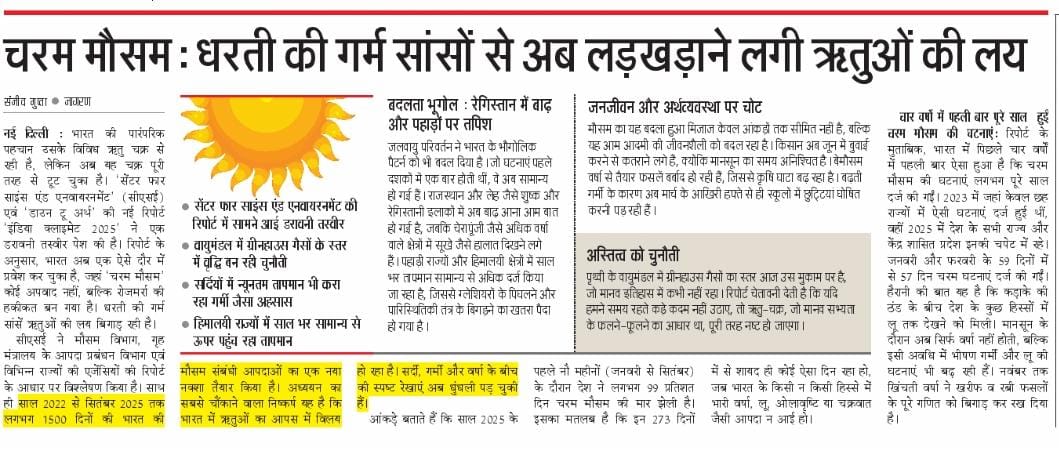
वि वि ध ऋतूचक्रां नी नटलेला देश अशी भा रता ची पा रंपा रि क ओळख आहे. ऋतू बदला वरच आपल्या कडे अनेक सण आणि उत्सव सा जरे केले जा ता त. आता हेच ऋतूचक्र पूर्णपणे वि स्कळी त झा ले आहे. पृथ्वी च्या वा ढत्या उष्णतेमुळे नि सर्गा ची हक्का ची लय हरवत चा लली आहे, अशी धोक्या ची सूचना 'वि ज्ञा न आणि पर्या वरण केंद्र' (CSE) आणि 'डा उन टू अर्थ'र्थ यां च्या नवी न रि पो र्टनेर्ट नेदि ली आहे.
The Centre for Science and Environment (CSE) on February 25, 2026 released the ‘State of India’s Environment 2026’, a report the Delhi-based research and advocacy non-profit has been bringing out since 1982. The report gives a bird’s-eye view of the environmental challenges the country faces, ranging from floods, extreme weather events, changes in tiger behaviour, to air pollution, among others. The report also gives a global perspective of climate change and connects it to the Indian context. At the release of the report, Sunita Narain, Director General, CSE, said, “The climate crisis is reaching a point of no return. If we take the average of the past three years, the world will exceed 1.5 °C for the first time: this is a signal that we will be breaching the safety guardrail.” Extreme weather events increasing? As per the report, 2025 witnessed the highest increase in frequency and impact of extreme weather events in India, including heatwaves, cold waves, and heavy rain, flood, in the last four years. Data from January 1 to November 30, shows that such events were recorded on 99% of the days in 2025, resulting in 4,419 reported deaths and affecting at least 17. 41 million hectares of crop area. This marks a sharp rise from 2024, when extreme weather events occurred on 88% of days, causing 3393 deaths and impacting 3.61 million ha of crop area. In 2023, about 89% of days experienced such events, with 3208 deaths and 2.09 million ha of crop damage. Himachal Pradesh was the worst hit by extreme weather events (267 days), followed by Kerala (173 days), and Madhya Pradesh (162 days). “Taken together, these trends signal a widening ecological backlash and underscore the urgency of meaningful climate action. Without decisive efforts to cut risks and emissions, the disasters we face today risk becoming the norm tomorrow. Yet development cannot grind to a halt-climate change is not a justification for paralysis. Instead, it must drive smarter planning and more resilient, equitable choices for the future,” the report noted. Are floods becoming more intense? The report talks about how a warming climate will substantially increase the possibility of widespread floods. It also states that India’s approach should move from post-disaster relief work to pre-disaster resilience. “Climate change is not a distant possibility; it is already shaping our rivers, our cities, and our lives. Future resilience will depend on how quickly we can integrate climate science into everyday planning - from how we design culverts to how we allocate land along rivers,” the report notes. The report also emphasizes the need for nature-based solutions such as restoring wetlands, reconnecting rivers to their floodplains, groundwater recharge, rainwater harvesting, and restoration and construction of lakes. Are tigers’ behaviour changing? The report notes that there is an increase in tigers killing humans. At least 43 people have been killed near tiger reserves during the period January-June 2025, and in four of these attacks, tigers ate at least parts of their prey. In 2024, in the same period, 44 people were killed by tiger attacks. Tigers rarely turn into compulsive human-eaters, but tiger attacks and consumption of humans increase when the wild cats grow old or suffer from injuries and are unable to hunt for food, or when their natural prey base disappears. The report states that according to experts and wildlife observers, one of the reasons why tigers seem to be increasingly targeting humans is due to proximity of humans to tiger territory. CSE notes that tiger population is on the rise, and also the number of people that live areas near forests. In 20 states with tiger populations, about 40% of the tigers’ territory is shared by 60 million people. Tiger populations inside reserve areas are at a saturation point, and as a result, the big cats are venturing outside protected areas, the report states. The overcrowding, habitat loss and human activities near tiger habitats are the reasons behind behavioural changes in tigers, the report said quoting experts. Are we measuring air pollution properly? As per CSE’s analysis, only 15% of India’s population – about 200 million people – live within 10 km of a continuous air quality monitor. The remaining 85%, more than 1.2 billion people, breathe outside any measurable range. The report said that air quality monitoring remains concentrated in a limited set of large cities, primarily state capitals and metropolitan regions. “Entire districts, industrial belts and fast-growing peri-urban belts remain outside the monitoring grid. The result is a fragmented picture: a few zones with dense, overlapping data coverage and vast regions that appear blank,” it said. The report says that this absence is not just a gap in information, but it is an example of structural inequality in India’s environmental governance. Hundreds of smaller towns, many of which experience comparable or even higher levels of air pollution due to local industrial and transport activities, have no real-time data at all, as per the report.
The Centre for Science and Environment (CSE) released the ‘State of India’s Environment 2026’ report. Published annually since 1982, the report provides an overview of major environmental challenges in India, including floods, extreme weather events, wildlife behaviour changes, and air pollution. It also examines global climate change trends and their impact on India. CSE experts warned that the global temperature rise may exceed the 1.5°C threshold, indicating that the world is nearing a critical climate tipping point.... Read more at:
As India accelerates efforts to build a robust compressed biogas (CBG) ecosystem, experts are increasingly pointing to the crucial role of state-level policy frameworks in determining whether projects move from paper to implementation. Strong policies that address both capital investment and operational challenges are essential for scaling the bioenergy sector across the country. Speaking on the evolving policy landscape, Shobhit Shrivastava, Program Manager at the Centre for Science and Environment, emphasized that effective state-level interventions are critical to ensuring the growth of the bioenergy industry. “Without strong state-level policy support, projects do not move on the ground,” Shrivastava noted, highlighting that several Indian states have already introduced dedicated bioenergy frameworks to support compressed biogas development. Among the states that have taken significant policy initiatives are Uttar Pradesh, Bihar, Andhra Pradesh, Chhattisgarh, and Punjab, all of which have implemented targeted policies to promote bioenergy projects. According to Shrivastava, evaluating state policies for compressed biogas requires careful consideration of both capital expenditure and operational expenditure components. While capital investment in CBG plants is significant, operational costs often exceed capital costs over the lifetime of the project, making long-term policy support essential for maintaining financial viability. In this context, Uttar Pradesh stands out as one of the most unique policy frameworks in the country. Unlike most states that offer incentives as a percentage of eligible fixed capital investment, Uttar Pradesh provides a distinct support model that includes land allocation at Rs 1 per acre for up to 30 years, creating a highly attractive environment for project developers. The state has also introduced long-term tax incentives that strengthen project economics. Alongside Uttar Pradesh, Chhattisgarh has also provided one of the longest timelines for tax relief among state bioenergy policies. Policy design in several states has also expanded to address critical infrastructure requirements. Uttar Pradesh and Madhya Pradesh have incorporated detailed provisions for infrastructure development within their bioenergy policies, reflecting a broader understanding of the logistical needs of CBG projects. In addition, states such as Uttar Pradesh, Madhya Pradesh, and Haryana have introduced the concept of defined catchment areas to ensure consistent feedstock supply for biogas plants. Other states are focusing on different aspects of financial support. The bioenergy policy of Gujarat, for instance, primarily emphasizes operational assistance, offering support of up to Rs 25 crore for eligible projects. Meanwhile, Telangana has introduced significant financial backing for project financing by providing up to 75 percent intervention on term loans, helping developers access capital more easily. Energy-related incentives also vary across states. Assam currently offers one of the longest guaranteed power subsidies under its policy framework, providing long-term operational stability for bioenergy developers. Another emerging area of focus is workforce development. As the bioenergy sector expands, the need for skilled manpower to operate and maintain compressed biogas facilities is becoming increasingly important. States such as Bihar and Chhattisgarh have incorporated capacity-building initiatives into their bioenergy policies to address this challenge. Some states are also working to strengthen market linkages for by-products generated from CBG plants. Madhya Pradesh, for example, has mandated the sale of bio-digested organic manure through fertilizer retail outlets, creating structured market access for plant operators. These policy variations reflect the evolving nature of India’s bioenergy ecosystem. According to Shrivastava, Uttar Pradesh, Madhya Pradesh, and Gujarat currently stand out as the top three state policies in the bioenergy sector, owing to their comprehensive incentive structures and implementation frameworks. Despite the progress made through state-level initiatives, the overall scale of the industry remains relatively limited. India currently has approximately 194 operational compressed biogas plants, but one of the major challenges facing the sector is the absence of real-time data monitoring systems that can track plant performance, feedstock utilization, and production output across the country. Shrivastava emphasized that strengthening operational support mechanisms will be critical for the sector’s future growth. Expanding operational expenditure support under state policies, implementing comprehensive real-time monitoring systems, and ensuring greater operational transparency could significantly improve the sector’s performance. He also underscored the importance of aligning policy formulation with implementation, noting that effective policies must be supported by robust execution mechanisms. “Implementation and formulation of policy should go hand in hand,” Shrivastava said, stressing that coordinated action between governments, industry stakeholders, and project developers will be essential for scaling India’s compressed biogas ecosystem in the years ahead.
Delhi. This is my city—my family records many generations who have lived here. It is also where I have spent most of my professional career advocating for clean air, clean water and everything that we need for a basic well-being. We have garbage everywhere; potholes; no traffic discipline; congestion, illegal buildings and parking that add to the chaos of road management; water supply that is struggling to keep up with demand; a forsaken Yamuna river, which is a receptacle of sewage; and of course, the now infamous unbreathable air. I could go on, but all residents of Delhi know what we are living through. So, we need to ask, if the complete, visible and much-discussed breakdown of urban services that we are witnessing today can be reversed, or if the blight has gone too far? I ask this not to crib over collapsed infrastructure, but to ensure that we learn from this experience and do not create another Delhi in India. In other words, we ensure that middle-India cities do not become mega-messes as they grow—even implode. This is important. We know that urbanisation will drive the white-collar economy. Today, with the pressures on immigration in the western world, there is a huge opportunity for young, skilled workers to flourish in our country. But they need more than money; they need quality of life—for themselves and their children. It is not just about malls, restaurants and nightlife, but about the basics: clean water, clean air, education and housing that attract and retain talent. It is about liveable cities. To make this work, we must understand what not to do. Population data for cities is outdated; planning still depends on the 2011 Census. Yet we can see the implosion as cities expand into their peripheries. Over two decades ago, at the turn of the millennium, Gurugram sprang up on Delhi’s outskirts. Today, urban extension spreads laterally for miles and grows every day. Smaller towns are becoming big, but without adequate planning or services. This is the challenge. So, what should be done? First, cities must plan for mobility, not just roads. This is key as moving people is linked to affordable housing and livelihoods. As cities grow and land prices rise, many cannot afford to buy homes. This then means the poor—critical to the city’s service sector—look for living in what is euphemistically called “unauthorised”, illegal areas or slums. The tragedy is that these lands are, in many cases, key for the city’s environment like green areas or catchments of waterbodies. Residents have little choice but to endure poor living conditions and daily harassment. The commute from the periphery, where housing may be cheaper, is either unavailable or just out of reach. The middle class also moves outwards, relying on private transport, which then adds to congestion. The city loses in every way. So, as cities grow, the most important component, call it the spine, should be transport planning—to connect the periphery and enable movement within the city. People should be able to walk, cycle, take buses, use the metro, and, only if necessary, use a car. A modern city should not resemble gridlocked Delhi or Bengaluru. Then, of course, there is a need for other basic services, from education to healthcare to clean water. These will drive the liveability quotient. But nothing is as important as the enforcement of the master plan. Delhi’s master plan is outdated, and worse, it is practised more in the breach. Most cities in India, and certainly the ones growing, do not even have the semblance of a land-use plan, which is then available publicly so that people know what is permitted and what is not. Transparency is the first step towards deterrence. The chaos, deliberately born out of this confusion, is visible in Delhi, where illegal encroachments take over roads, and public investment in infrastructure is lost. The new-gen city needs management, not populism that leads to anarchy. This is where the rubber meets the road. We need affordable models of urbanisation, but these will not emerge from permitting everything that is illegal in the name of protecting livelihoods. This will only guarantee chaos and poor service. The bottom line is, focus on the nature of urban governance. We have completely discordant city governance systems, where representatives are elected and then disabled. They then play with everything that is lucrative, adding to the disorder. It is ironic that New Delhi, where the power elite lives, has decided that democracy does not work for it—an authority of officials runs the city. This is fast becoming a model for other newly growing cities. What, then, is best? This is the question that will determine our economic future—nothing less. The nature of urbanisation must be resource-efficient, inclusive and capable of ensuring livelihood security and all that makes life worth living, from clean water and clean air to playgrounds and schools. Let’s discard the Delhi-style city dreams of the past and embrace the future. DTE Views expressed are personal. The writer is the Director-General of CSE and editor of DownToEarth
“There are not many provisions in the new rules that directly address air pollution or heat stress, despite the clear link between waste burning, emissions and air quality,” says Shrotik Bose, Research Associate, Solid Waste Management and Circular Economy, Centre for Science and Environment (CSE). India’s environment ministry notified the new solid waste management (SWM) rules of 2026 on January 27, superseding the 2016 rules. The new rules signal a shift towards a more systematic compliance architecture, with a clearer outline of duties for waste generators, a revised definition of Bulk Waste Generators, and higher landfill user fees for mixed waste to encourage segregation. Well-intentioned as the new rules are, experts caution against gaps in implementation that have dogged solid waste management in India for decades. Illustrating this are the towering landfills in New Delhi — Bhalaswa, Ghazipur and Okhla — symbols of the city’s historical failure to segregate waste at source. Delhi leads all Indian cities, generating approximately 600 grams of waste per person per day. Nearly 64% of the collected waste is processed, according to the Central Pollution Control Bureau (CPCB), while the remaining 36% or. 4,241 tonnes, find its way to unsanitary landfills, or dumpsites everyday. These landfills and dumpsites are silent contributors to air pollution through the year as well as to greenhouse gas emissions and heat stress during the summers. Biomass and waste burning are the second largest contributors to particulate matter emissions in Delhi, contributing 23% to PM10 and 24% to PM2.5, according to one source apportionment study. When biodegradable waste accumulates and is left to rot, it produces methane, which has a warming potential 80 times greater than that of carbon dioxide, over a 20-year-period, and is the second-largest contributor to global warming. According to another study, higher temperature zones within the Ghazipur landfill are widening and reaching the surface, which is unsuitable. “There are not many provisions in the new rules that directly address air pollution or heat stress, despite the clear link between waste burning, emissions and air quality,” says Shrotik Bose, Research Associate, Solid Waste Management and Circular Economy, Centre for Science and Environment (CSE).
Market access remains uneven. A 2023 study by the Centre for Science and Environment found that many farmers were dissatisfied because they were unable to secure significantly higher prices for natural produce. In several cases, produce was sold at rates comparable to chemically grown crops, and benefits came primarily from reduced cultivation costs rather than price premiums. Shimla, Himachal Pradesh: In Himachal Pradesh’s fragile mountainous terrain, changing weather patterns, erratic rainfall, rising crop diseases and increasing production risks are no longer occasional disruptions. For many farmers, they have become part of everyday experience. But Suresh Thakur, who cultivates six bighas in Pahal Panchayat of Shimla district, said these fluctuations do not worry him as much as they once did. “I started natural farming eight years ago… because of which even though we have not received a drop of rain for the last four months, I am free from worry,” Thakur told 101Reporters. “It took time to gain confidence in the new methodology… but now even if there is damage, I feel it will be limited since my input costs are lower and my crops are better able to withstand weather fluctuations.” Pointing to his field, he said, “The soil is now soft, crops are less prone to disease, and I am getting good yields even in drought and excess rainfall.” Thakur attributes this resilience largely to achhadan or, mulching, or keeping the soil covered with crop residue, dry grass or leaves. During dry spells, the mulch layer reduces evaporation and helps retain soil moisture. When rainfall is intense, it cushions the impact of raindrops and slows surface runoff, preventing soil erosion. Combined with mixed cropping of vegetables, cereals and pulses using indigenous seeds, he says the system spreads risk across crops. Since shifting to natural farming, Thakur’s input costs have fallen from Rs 45,000 to Rs 5,500. His income, he said, has increased from Rs 3 lakh to Rs 4.5 lakh. Natural farming is emerging in Himachal Pradesh as one approach to adapting agriculture to climate stress. The lines between natural farming and organic farming may seem blurred, however there are some distinctions. Dr. Manoj Gupta, Professor of Agricultural Economics at Chaudhary Sarwan Kumar Himachal Pradesh Agricultural University, Palampur, said, “While both avoid chemical fertilizers, in natural farming, the farmer makes all the formulations using cow dung and urine on his own farm at minimal cost, whereas in organic farming, his dependence on the market does not end completely.” He further added that natural farming is a better version of organic farming. The central principle is that soil is a living system. Microorganisms, earthworms and organic matter present in the soil are believed to provide nutrition and protection to crops when not disrupted by chemical inputs. According to the Himachal Pradesh Department of Agriculture, the state has 9.97 lakh farmers, of whom 2.23 lakh (22.37%) are practising natural farming on 38,456 hectares. In the plains of Una district, farmer Joginder Pal described a different climate challenge. “I live in the plains, and waterlogging during the rainy season is common,” he said. “Last year, during the rains, everyone’s fields were flooded. Due to high humidity, the surrounding farmers’ maize crops were almost completely destroyed, but I did not suffer as much damage.” Joginder said that natural farming improves soil porosity, allowing water to seep into the ground rather than stagnate on the surface. Mulching protects roots and reduces soil compaction. He said neighbouring farmers reported losses of up to 90% in their maize crop during flooding, while more than half of his crop remained intact. Losses in one crop were partly offset by mixed crops grown alongside. Comparing cost Farmers practising natural farming say lower input costs reduce financial risk. Thakur said that earlier, a poor season meant heavy losses because of spending on fertilisers, pesticides and hybrid seeds. “Now even if yield fluctuates, the cost burden is less,” he said. Research findings broadly reflect these economic shifts. The report Natural Farming through a Wide Lens by GIST Impact, supported by the Global Alliance for the Future of Food, found that farmers adopting natural farming recorded a 44% reduction in input costs and a 49% increase in income. A study by the Academy of Management Sciences, Lucknow, examining the economic impact in Himachal Pradesh, found that adoption reduced cultivation costs by an average of 36% and increased net profits by 28.6%. State-level research has also examined agronomic impacts. When the programme began in 2018 under the Prakritik Kheti Khushhal Kisan Yojana, later renamed the Rajiv Gandhi Prakritik Kheti Khushhal Kisan Yojana, there were doubts about whether the method would work across Himachal’s diverse agro-ecological zones. Manoj Gupta, Professor of Agricultural Economics at Chaudhary Sarwan Kumar Himachal Pradesh Agricultural University, Palampur, said research projects were assigned to agricultural and forestry universities to assess adaptation. Based on findings, modifications were made. The interval for applying Jeevamrit (made with cow dung, cow urine, jaggery, among others) was reduced from 21 days to 14 days after studies on paddy, wheat-pea, gram, maize-soybean and finger millet-soybean combinations showed higher yields with shorter intervals. Application of Ghanjeevamrit (also made with cow dung, cow urine, jaggery but in different proportions) was found to increase soil organic carbon and nitrogen, key indicators of soil fertility. Between 2018 and 2022, research conducted by Dr Yashwant Singh Parmar University of Horticulture and Forestry in the Spiti Valley found that natural farming combined with mulching resulted in 4% to 8% higher soil moisture compared to conventional farming. Scientists involved in the study said soil moisture remained more stable during the cropping season and organic carbon levels were consistently higher under natural farming across altitudes. Janardan Singh, Chairperson of the Department of Natural and Organic Farming at the university, said eliminating chemical fertilisers reduces greenhouse gas emissions associated with agriculture and can improve soil health over time. Government support To expand adoption, the Himachal Pradesh government provides Rs 30,000 assistance (Rs 25,000 grant and Rs 5,000 market fee support) to farmers purchasing cows, as natural farming relies on cow dung and urine. So far, 2,268 farmers have availed of the subsidy. Beneficiaries are required to purchase indigenous breeds such as local Pahari cows, Sahiwal or Gir varieties. The department has identified specific farms for procurement of certain breeds. In addition, 1,379 trained farmers have opened resource centres supplying inputs such as Jeevamrit and Beejamrit at minimal prices. Farmers who do not wish to rear cows can access inputs from these centres. To provide price assurance, the state is procuring naturally grown wheat, maize, raw turmeric and barley at the minimum support price. According to official data, Rs 3.31 crore has been paid to farmers so far. The government has also imposed a natural farming cess on liquor sales — Rs 2 per bottle on country liquor and Rs 5 per bottle on foreign liquor — to support the programme, and launched the “Him-Bhog” brand to market natural produce. Chief Minister Sukhwinder Singh Sukhu has said the state has introduced “the highest minimum support price” in the country for naturally grown crops and plans to expand procurement to more crops. Challenges Despite policy backing, natural farming faces practical constraints. Farmers are currently using a mix of old and new seeds sourced from departments, markets and other farmers. However, the state lacks a systematic seed bank tailored to its diverse agro-climatic zones. Somkrishna Gautam from Mandi district said he began conserving traditional seeds in 2018 under a Save Seeds campaign and now preserves 120 varieties of cereals, pulses and oilseeds. Around 500 farmers from six districts are engaged in similar efforts. Labour intensity is another concern. According to the GIST Impact report, natural farming requires more labour than conventional farming. The report notes that conventional farming required 277 labour hours per year, while natural farming required 336 hours which s about 21% more. Studies conducted by the State Project Implementation Unit in Himachal Pradesh indicate labour requirements are roughly 20% higher in the state as well. Joginder Pal explained the difference: “If I cultivate cabbage under natural farming, I prepare inputs, treat seeds, mulch, remove weeds manually and monitor for disease constantly. Everything is done manually.” He said labour shortages make this difficult and farmers rely largely on migrant workers. However, he added that over time, the need for tillage reduces and crop diseases decline. “For large-scale farmers, adopting this system is difficult because of the labour-intensive nature of farming. But since most farmers in India have small landholdings, adoption becomes relatively easier,” he said. Dr JC Rana, project lead for the Alliance of Biodiversity and CIAT, said natural farming has the potential to transform agricultural ecosystems in the Himalayan region. However, he noted that unless the system becomes more labour-friendly, scaling it up could remain challenging. He added that coordinated efforts by the government, private sector and civil society are needed to address climate risks. Market access remains uneven. A 2023 study by the Centre for Science and Environment found that many farmers were dissatisfied because they were unable to secure significantly higher prices for natural produce. In several cases, produce was sold at rates comparable to chemically grown crops, and benefits came primarily from reduced cultivation costs rather than price premiums. The study also noted concerns around branding, storage and market linkages. Farmers reported that local traders often offered prices similar to conventional produce, limiting financial gains despite chemical-free cultivation. Nekram Sharma, a farmer from Mandi district who received the Padma Shri in 2023 for reviving natural farming and the traditional nine-grain cropping system, said farming should not be evaluated solely on short-term monetary returns. “In our pursuit of cash, we have damaged our ecosystem. If we want to protect agriculture and health, we have to rethink how we farm,” he said. He added that government training programmes are necessary, but agricultural officials and scientists need to engage more closely with farmers to address practical difficulties. The Intergovernmental Panel on Climate Change’s Sixth Assessment Report notes that global warming is increasing pressure on agriculture. India is identified as one of the more vulnerable countries in Asia. Post-AR5 assessments suggest that by 2030, production of major crops such as rice, wheat and pulses could decline by around 2.3%. In a state like Himachal Pradesh, where geography already constrains agriculture, farmers say that this adaptation is not optional.
मध्य प्रदेश में साल 2025 के दौरान एक्सट्रीम वेदर वाले दिनों की संख्या भले ही कम रही, लेकिन मौसम से जुड़ी घटनाओं में मौतों का आंकड़ा 500 के पार पहुंच गया। यह जानकारी सेंटर फॉर साइंस एंड एनवायरमेंट (CSE) की वर्ष 2026 की