
Cse In News

How hydropower decline is reinforcing coal’s role as India’s flexible power source

Renewables accounted for a record one-fifth of Indian power generation in July — even as thermal energy led with more than 65% of the 182.52 billion units generated. The outlier was hydropower generation which declined 10.75% year-on-year during the first quarter of FY27 as reservoirs hit their lowest levels since 2023 amid erratic weather conditions. Government data now highlights a strange contrast: surging green capacity is sharing space with persistent coal generation as the 500 GW renewable energy target for 2030 looms. Coal has remained the backbone of energy supply in India — accounting for nearly 79% of the total energy supplied domestically in FY25. Production grew by 4.98% during the same year to reach 1047.52 million tonnes. Non-coking coal retained a dominant share at around 93.65% of the total production during FY25. The situation has not changed significantly in the ensuing months. CEA data for July 2026 shows thermal energy generated 119.36 billion units in July. According to government data cited by Reuters, coal-fired power generation surged to a near-three-year high in June amid increased cooling demand during an ​extended heatwave and below-average monsoon rainfall. The publication calculated daily data from Grid India to report that coal-fired power generation had risen about 14% year-on-year to ​120.20 billion kWh in June — the highest since November 2023. At the same time, data from the government’s Report of the Expert Committee on Energy Statistics contended in July that the “estimated potential for generation of energy from renewable resources reached 4,704 GW by the end of March 2025”. Solar led the list with a staggering growth from 748,990 MW in FY24 to 33,43,378 MW during FY25. Wind Power now stands at 11,63,856 MW while large hydro is at 1,33,410 MW. Coal flexibility as the way forward? India introduced a ‘flexible coal’ policy in January 2023 — mandating all relevant power plants to modify their equipment to run at a minimum technical load of 40% as per a phased plan. The Centre for Science and Environment also contended in a newly released report that coal flexibilisation can help India create an additional 18GW to 34 GW of renewable energy space and potentially to reduce power sector emissions by up to 8.37%. “Enhancing the flexibility of the existing coal fleet can play a role in balancing the system and enabling greater integration of renewable energy. We are not talking about renewable vs coal here. We are talking about renewable and coal, and about how to integrate the two. The task is not to replace coal, but to displace it,” CSE director general Sunita Narain argued during a recent event. But the plan has reportedly been put on hold as India logged its fifth-driest June since 1901 amid strong El Nino conditions. Searing heat has led to a surge in power consumption and correspondingly, a growing demand for coal power. Renewable energy sources remain still somewhat curtailed by a lack of battery storage despite the overall increase in generation. Documents viewed by Reuters indicated recently that the plan had been “pushed back by a year” as regulators
Cookstoves and Carbon Credits: Inside Bengaluru's Carbon Market Boom

In parts of Karnataka, "improved" cookstove projects were rolled out as climate interventions designed to reduce emissions and generate carbon credits. On paper, they promised cleaner cooking and measurable climate benefits. On the ground, the story was far less convincing. A Centre for Science and Environment (CSE) study found that households were often made to pay for the cookstoves themselves. Many were unaware that these projects were part of carbon credit schemes—and no financial returns reached them. More concerning, some households that already had LPG connections didn’t even use the stoves. In 2022, Jyoti Shital Chavan from Yarnaal village in Belagavi district was introduced to "improved" cookstoves at a meeting organized by Shri Kshethra Dharmasthala Rural Development Project, a charitable trust supporting rural communities in Karnataka through micro-credit and infrastructure initiatives. Manufactured by Mumbai-based Greenway Grameen Infra, the stoves were promoted as a way to reduce fuelwood use and cut COP2 emissions. Before this, Chavan already used both an LPG connection and a traditional mud chulha. Under another cookstove project implemented by EKI Energy Services, Shakarya Kalacharantimath from Belagavi's Bidi village received an "improved" cookstove from her daughter three years ago. But she uses it only once a month, continuing to rely mainly on traditional mud chulha and LPG cylinders. “An improved cookstove with a single burner is not practical for a large family,” she told Down to Earth-CSE. Trishant Dev, Deputy Programme Manager at CSE, explains, “What we found was that the community was absolutely not aware of carbon credits... and no money was coming their way.” “Many of them were also not using the cookstoves… in a way, you were encouraging communities to shift back to wood-based cooking,” he adds. India’s Carbon Market Moment India is rapidly positioning itself as a global hub for carbon markets. According to Grand View Research, the carbon credit market in the country generated a revenue of roughly $4 million in 2023. It is projected to cross $49 million by 2030. There are two kinds of carbon credit markets—compliance market and voluntary market. Compliance markets are formed and regulated by regional, national, or international government bodies. They set up legal targets for regulated entities (industries/sectors) to cap emissions. Voluntary markets are national and international markets, where individuals and companies choose to offset emissions by buying credits from projects like biogas plants and improved cookstoves that reduce emissions. As of now, India only functions in voluntary carbon markets. The government is now stepping in with the Carbon Credit Trading Scheme (CCTS) with an aim to formalize the sector and align it with India’s climate goals. But even as the market expands, fundamental questions remain about what it actually delivers.

Warangal’s urban heat index doubled in two decades, finds study

Warangal findings have a striking parallel in Hyderabad. The Centre for Science and Environment’s Urban Heat Stress Tracker Hyderabad, published in 2024, found that Hyderabad’s built-up area more than doubled between 2003 and 2023. Built-up land increased from 298.3 sq km, or 20.6% of the city’s geographical area, in 2003 to 636.58 sq km, or 44%, in 2023.

News from the world of Education: August 28, 2026

Conference on Sustainability Education Mobius Foundation will host the eighth International Conference on Sustainability Education in New Delhi on September 2 and 3, at the India Habitat Centre. Speakers include Sunita Narain, Vibha Dhawan, Kartikeya Sarabhai, Ashok Khosla, Ravi Singh, Erach Bharucha, and international experts from Hungary and Denmark. To register, visit https://tinyurl.com/mrrv9zua

Mumbai’s ‘moderate’ air can hide toxic hotspots; experts push for hyperlocal pollution rules

MUMBAI: A city-wide air quality reading may be giving Mumbaikars a false sense of comfort. Pollution levels can vary dramatically between neighbourhoods, with some parts of Mumbai recording nearly three times the seasonal PM2.5 levels of others, pointing to a growing need for pollution controls that target specific hotspots and sources rather than relying largely on municipal boundaries. A Centre for Science and Environment (CSE) analysis of real-time CPCB data through Jan 31, 2025 found Deonar had Mumbai’s highest seasonal average PM2.5 concentration at 80 micrograms per cubic metre, followed by Shivaji Nagar at 76 and Malad West at 75. Borivali East, in contrast, recorded 29 µg/m³ — about 2.8 times lower than Deonar. “The law supports what needs to be done; application & implementation need to catch-up,” said Justin Bharucha, managing partner, Bharucha & Partners, whose firm prepared the analysis. “We need an AQI data spine with localised data sourcing & dissemination for the MMR. A single AQI number is an effective disservice to the purpose of helping citizens assess and address our quality of air crisis.” The contrast is significant because a single Mumbai or MMR AQI can smooth out such local variations. For residents living close to an industrial cluster, landfill, congested traffic corridor or construction zone, the city-wide number may bear little resemblance to the air they actually breathe. One MMR, many pollution profiles The problem becomes more complicated outside Mumbai's municipal limits. A snapshot cited in the analysis showed Thane, Bhiwandi, Dombivli, Mira Bhayandar and Mumbai at 52 on the US AQI scale at 7.30am on Aug 21, 2026, while Kalyan and Ulhasnagar were at 55, Tarkhad 53, Virar 54 and Badlapur 56 — all in the "Moderate" category. But such town-wide figures can potentially mask spikes around individual industrial clusters. The analysis specifically points to the TTC and Taloja clusters, while cautioning that this is an inference and that a current 2026 station-level breakdown for these clusters was not located.

Pilgrimage or pollution? The waste crisis of Indian faith

According to a new report by the Centre for Science and Environment (CSE), India produces about 19,000 tonnes of plastic waste every day. Of this, 62 percent of plastic is used for packaging, compared to the global average of approximately 40 percent. Plastic packaging consumption is growing at an annual rate of 8 to 9 percent. If this trend continues, plastic packaging consumption, which stood at 1.1 crore tonnes in 2022, could rise to about 2 crore tonnes by 2030.

CSE Report Flags Rigid Power Contracts as Risk to Energy Transition

A new Centre for Science and Environment report warns that outdated thermal power contracts are hindering India's energy transition. These long-term agreements force consumers to pay fixed costs for coal plants even as solar energy use rises, creating financial inefficiencies. The findings highlight the urgent need for contract reforms to improve grid flexibility. The Centre for Science and Environment (CSE) released a report on August 25, 2026, highlighting that outdated power purchase agreements (PPAs) are creating significant challenges for India's transition to renewable energy. These long-term contracts, which define the terms of electricity supply between generators and distribution companies, were created during a period of frequent power shortages and have not kept pace with the current shift toward solar and wind energy. The core issue identified is the rigidity of these contracts. Traditionally, thermal power plants were designed to provide 'baseload' power, meaning they ran constantly to meet a steady demand. Because of this, contracts included fixed payments to ensure the plants could recover their costs. However, as solar energy capacity has grown, the energy grid now requires power plants that can ramp up or down quickly depending on sunlight levels. When solar generation is high, coal plants are often asked to reduce their output. Despite running for fewer hours, these plants are still entitled to their full fixed payments under the old contract terms. This mismatch creates a financial burden. Consumers effectively end up paying higher prices because the fixed costs of coal capacity remain high, even when the actual electricity generated is lower. The CSE report examined data from eight states and found that 6.1 gigawatts (GW) of power capacity is tied to long-term contracts that extend to 2040 and beyond. This 'generational lock-in' restricts the ability of the power sector to adopt more flexible and potentially cheaper energy sources. Distribution companies (DISCOMs), which are responsible for purchasing and distributing power, continue to face financial pressure. These rigid contractual obligations limit their financial flexibility and can prevent them from optimizing their power procurement costs. The report suggests that because many of these assets and distribution companies are government-owned, there is an opportunity to negotiate changes to these agreements rather than relying on legal battles or waiting for the contracts to expire. The CSE study recommends updating the standard power purchase agreement model to incorporate requirements for operational flexibility and performance during different energy demand cycles. It also calls for state-level reviews to ensure that procurement portfolios are aligned with a modern, low-carbon energy system. For investors and energy stakeholders, the key monitorable will be potential regulatory changes or state-level policy updates that could trigger the renegotiation of these legacy contracts. Such reforms would be essential to reducing system-wide costs and improving the financial health of the power distribution sector.

Consultant for Sustainable Industrialization Programme, Centre for Science and Environment, New Delhi

The Centre for Science and Environment (CSE), India’s leading public policy research institution, is looking for candidates for its sustainable industrialization team. The team works on various agendas for improved industrialization like Industrial air pollution, Energy efficiency, Renewable energy, environmental governance and decarbonisation to develop industrial roadmaps and assist the stakeholders in the implementation of various developed strategies. The team is looking to expand their capacity and thus looking for candidates to join their group.

India must integrate renewable and coal-based power sectors for successful energy transition: CSE study

The study, Flex to Fix: Deciphering India's Coal Flexibilisation Challenge for RE Integration, said coal power flexibilisation could help create an additional 18-34 GW of renewable energy space and reduce power-sector emissions by 7.66-8.37 per cent, equivalent to 92-101 million tonnes of carbon dioxide annually. CSE released the report at a national dialogue on coal flexibilisation and reforms in thermal power purchase agreements (PPAs), attended by representatives of the Central Electricity Authority, Central Electricity Regulatory Commission, GRID-India, BHEL, NTPC and Torrent Power, besides experts from think tanks, civil society and academia. CSE Director General Sunita Narain said India's power sector must work towards greater grid flexibility as renewable energy expands. "We are not talking about renewable vs coal here. We are talking about renewable and coal, and about how to integrate the two. The task is not to replace coal, but to displace it," she said. The study noted that India reached 50 per cent non-fossil-based installed power capacity in November 2025, five years ahead of its original 2030 target. However, rapid growth in renewable energy, particularly solar power, has altered the demandsupply balance and increased operational stress on conventional generation.

Scorching summers intensify caste barriers to water in India's Bundelkhand

Carrying three empty plastic buckets, she walked several hundred metres to the nearest handpump in her village in Jalaun district, part of the drought-prone Bundelkhand region of northern India. Temperatures in parts of the region were already climbing above 40°C, reports the BBC. Mamta said taps installed under a government drinking water scheme had remained dry for two years, leaving around 1,000 villagers dependent on a small number of handpumps. It took her hours to collect enough water for her family of 11 and their livestock. But the heat was not her only challenge. Mamta is from the Valmiki community, a Dalit group that was historically considered "untouchable" under India's caste system and continues to face discrimination. She said she waited for members of dominant castes to finish using the handpump before collecting water herself. "If they are standing there, we cannot fill water. We have to wait until they leave," she said. She also said some upper-caste residents poured water over the pump afterwards to "cleanse" it, adding that the practice had continued for decades. Bundelkhand Bundelkhand, a semi-arid region covering districts in Uttar Pradesh and Madhya Pradesh, is known for severe water scarcity. The region experienced several major droughts between 2002 and 2016. Its rocky plateau has limited capacity to retain groundwater, while unpredictable rainfall and rising temperatures have made water access increasingly uncertain despite government and community conservation efforts. A study examining more than a century of weather records found temperatures had increased across almost the entire region. In recent summers, temperatures in parts of Bundelkhand have approached 48°C. Residents and researchers say the worsening heat and water stress are intensifying long-standing caste divisions. As more families compete for increasingly scarce water, Dalits, who have historically faced restrictions in accessing water, are encountering such inequalities more frequently. "Conflict over water is not new," said Mitashi Singh of the Centre for Science and Environment. What is changing, she said, is how hotter summers are making water scarcer and aggravating existing tensions. Local officials reject allegations of water shortages and caste discrimination at public water sources. Dominant-caste residents interviewed by the BBC also denied discriminating against others, though they acknowledged growing pressure on water supplies. Ram Gopal Singh, in his 50s, pointed to several abandoned village wells, saying they had been dry for nearly 20 years. Other water sources had either dried up or become polluted, while unreliable tap connections had driven more families towards handpumps, he added. According to Singh, everyone tries to collect water during cooler morning hours, resulting in disputes over turns and the amount each family could collect. But he denied that caste is a factor in these disputes. Dalit residents, however, described a different situation. They said there is no formal queue at the handpumps and that families instead try to collect water at different times to avoid confrontations. Mamta said she usually goes very early in the morning or late in the afternoon because she fears being targeted. About 50km away in Shahjahanpur, Shiv said members of his community similarly avoid approaching a handpump while dominant-caste families are using it. "No matter how hot it is, even if we have to wait for hours for one bucket of drinking water, we wait because we do not have a choice." His mother, Parmi Devi, alleged that she was assaulted three years ago after an argument with a dominant-caste resident at a village handpump. Devi filed a police complaint, but no arrests have been made. The Dalit Dignity and Justice Centre, a non-profit in Uttar Pradesh, said police registered 113 cases under India's law against caste-based atrocities in the area in 2025. The organisation said most complaints it tracked during May and June involved water, though it has not published a detailed breakdown. District Magistrate Rajesh Kumar Pandey's office rejected the allegations, saying there is no instance of caste discrimination over water access. Efforts to address water shortages include the government's Jal Jeevan Mission, restoration of ponds and groundwater recharge initiatives. Traditional water bodies have also been revived, while women-led Jal Saheli groups monitor supplies and promote conservation. Researcher Mukul Sharma said increasing water supplies alone will not resolve the problem. Climate change, he said, is "not the origin of these injustices, but a threat multiplier." Unless caste inequalities over water access are addressed, he said, more water will not solve the problem.

India’s cities aren’t just fighting the rain. They’re fighting their own infrastructure

The Centre for Science and Environment has previously documented how Chennai's natural drainage network was damaged by encroachment and construction. Its analysis noted that Pallikaranai, once around 5,000 hectares, had shrunk to roughly 600 hectares around 2010-11. The consequences are predictable. When wetlands, lakes and channels disappear, the water does not disappear with them. It simply has fewer places to go. A 2026 study on Pallikaranai similarly found that rapid urbanisation, expansion of impervious surfaces and wetland encroachment have altered the marsh's hydrological functions and increased flood risks.

LATIKA M BOURKE: Coal will get a boost from geopolitical shocks, International Energy Agency head says

Sunita Narain from the Delhi-based Centre for Science and Environment said the energy shocks could not be divorced from the effects of climate change which she said were experienced daily in India. “We have two wars happening, we have a physical war which we’re talking about, the Iran war, the Ukraine war, but we also have a war with nature, which is happening and they’re both happening together,” she said. “And the revenge of the war with nature is playing with the complete disruption that we are seeing on the energy system.”

ऊर्जा परिवर्तन पर CSE की रिपोर्ट: पुराने पावर कॉन्ट्रैक्ट्स बन रहे हैं बड़ी रुकावट

सेंटर फॉर साइंस एंड एनवायरनमेंट (CSE) की नई रिपोर्ट ने आगाह किया है कि भारत में पुराने थर्मल पावर कॉन्ट्रैक्ट्स रिन्यूएबल एनर्जी की ओर बढ़ने की राह में बाधा बन रहे हैं। इन लंबी अवधि के समझौतों के कारण, भले ही सौर ऊर्जा का इस्तेमाल बढ़ रहा है, उपभोक्ताओं को कोयला संयंत्रों के लिए फिक्स्ड कॉस्ट का भुगतान करना पड़ रहा है, जिससे वित्तीय नुकसान हो रहा है। यह रिपोर्ट ग्रिड की फ्लेक्सिबिलिटी (लचीलापन) को बेहतर बनाने के लिए कॉन्ट्रैक्ट सुधारों की तत्काल आवश्यकता पर जोर देती है। पुराने पावर परचेज एग्रीमेंट्स (PPAs) की कहानी सेंटर फॉर साइंस एंड एनवायरनमेंट (CSE) ने 25 अगस्त, 2026 को जारी अपनी रिपोर्ट में बताया है कि भारत के रिन्यूएबल एनर्जी की ओर बढ़ने की राह में पुराने पावर परचेज एग्रीमेंट्स (PPAs) बड़ी मुश्किलें पैदा कर रहे हैं। ये लंबी अवधि के कॉन्ट्रैक्ट, जो बिजली उत्पादकों और वितरण कंपनियों के बीच बिजली आपूर्ति की शर्तों को तय करते हैं, उस दौर में बनाए गए थे जब बिजली की भारी कमी हुआ करती थी। अब ये, सौर और पवन ऊर्जा की ओर बढ़ते मौजूदा रुझान के साथ तालमेल नहीं बिठा पा रहे हैं। कॉन्ट्रैक्ट्स की कड़ाई है मुख्य समस्या रिपोर्ट के अनुसार, इन कॉन्ट्रैक्ट्स की सबसे बड़ी समस्या इनकी कड़ाई है। पहले, थर्मल पावर प्लांट्स को 'बेसलोड' पावर प्रदान करने के लिए डिज़ाइन किया गया था, यानी वे लगातार एक निश्चित मांग को पूरा करने के लिए चलते थे। इसलिए, कॉन्ट्रैक्ट्स में यह सुनिश्चित करने के लिए फिक्स्ड पेमेंट (निश्चित भुगतान) शामिल थे कि प्लांट्स अपनी लागत वसूल सकें। लेकिन, जैसे-जैसे सौर ऊर्जा की क्षमता बढ़ी है, ग्रिड को ऐसी पावर प्लांट्स की जरूरत है जो धूप के स्तर के आधार पर जल्दी से उत्पादन बढ़ा या घटा सकें। जब सौर ऊर्जा का उत्पादन अधिक होता है, तो कोयला संयंत्रों को अक्सर अपना उत्पादन कम करने के लिए कहा जाता है। कम घंटों तक चलने के बावजूद, इन प्लांट्स को पुराने कॉन्ट्रैक्ट शर्तों के तहत पूरा फिक्स्ड पेमेंट पाने का अधिकार है। वित्तीय बोझ और 'जनरेशन लॉक-इन' यह असंतुलन एक वित्तीय बोझ पैदा करता है। उपभोक्ताओं को अंततः उच्च कीमतों का भुगतान करना पड़ता है क्योंकि कोयला क्षमता की फिक्स्ड कॉस्ट अधिक बनी रहती है, भले ही उत्पन्न वास्तविक बिजली कम हो। CSE की रिपोर्ट ने आठ राज्यों के डेटा का विश्लेषण किया और पाया कि 6.1 गीगावाट (GW) पावर क्षमता ऐसे दीर्घकालिक कॉन्ट्रैक्ट्स से बंधी है जो 2040 और उसके बाद तक चलते हैं। यह 'जनरेशन लॉक-इन' (पीढ़ीगत बंधन) पावर सेक्टर की अधिक लचीली और संभावित रूप से सस्ती ऊर्जा स्रोतों को अपनाने की क्षमता को सीमित करता है। DISCOMs पर वित्तीय दबाव वितरण कंपनियां (DISCOMs), जो बिजली खरीदने और वितरित करने के लिए जिम्मेदार हैं, वित्तीय दबाव का सामना करना जारी रखती हैं। ये सख्त कॉन्ट्रैक्टुअल दायित्व उनकी वित्तीय लचीलेपन को सीमित करते हैं और उन्हें अपनी बिजली खरीद लागत को अनुकूलित करने से रोक सकते हैं। रिपोर्ट का सुझाव है कि चूंकि ये अधिकांश संपत्ति और वितरण कंपनियाँ सरकार के स्वामित्व वाली हैं, इसलिए कॉन्ट्रैक्ट्स के समाप्त होने का इंतजार करने या कानूनी लड़ाई पर भरोसा करने के बजाय इन समझौतों में बदलाव पर बातचीत करने का अवसर है। आगे क्या? CSE का अध्ययन मानक पावर परचेज एग्रीमेंट मॉडल को अपडेट करने की सिफारिश करता है ताकि विभिन्न ऊर्जा मांग चक्रों के दौरान परिचालन लचीलेपन और प्रदर्शन के लिए आवश्यकताओं को शामिल किया जा सके। यह राज्य-स्तरीय समीक्षाओं का भी आह्वान करता है ताकि यह सुनिश्चित किया जा सके कि खरीद पोर्टफोलियो एक आधुनिक, कम-कार्बन ऊर्जा प्रणाली के साथ संरेखित हों। निवेशकों और ऊर्जा हितधारकों के लिए, मुख्य निगरानी योग्य बिंदु संभावित नियामक परिवर्तन या राज्य-स्तरीय नीति अपडेट होंगे जो इन पुराने कॉन्ट्रैक्ट्स पर फिर से बातचीत को ट्रिगर कर सकते हैं। इस तरह के सुधार सिस्टम-व्यापी लागत को कम करने और पावर वितरण क्षेत्र के वित्तीय स्वास्थ्य में सुधार के लिए आवश्यक होंगे।

Odisha Urban Conclave: Experts Call For ‘Treat, Reuse And Recover’ Model For Wastewater

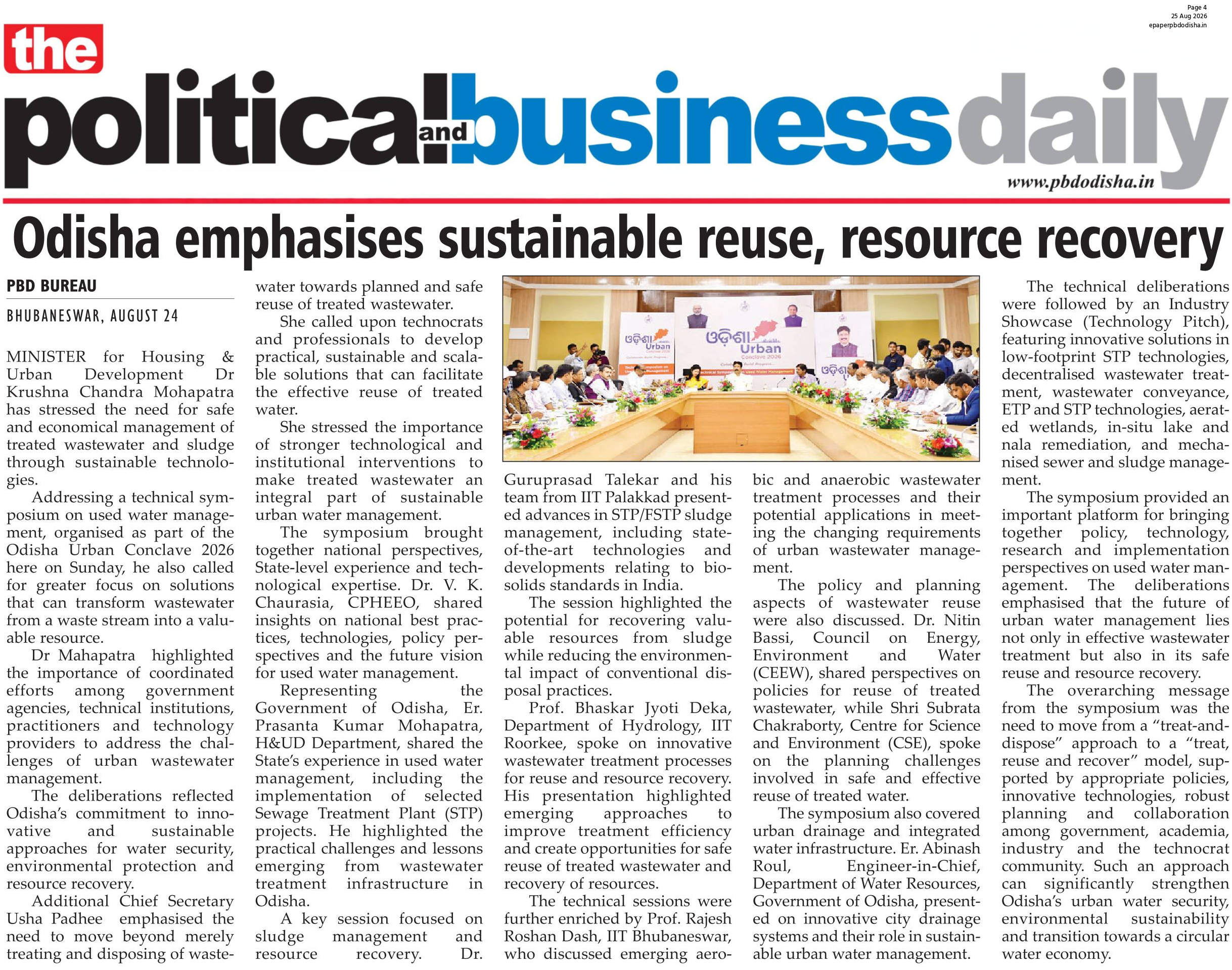
Policy and planning issues related to wastewater reuse also featured prominently during the discussions. Dr Nitin Bassi of the Council on Energy, Environment and Water (CEEW) shared perspectives on policies for treated wastewater reuse, while Subrata Chakraborty of the Centre for Science and Environment (CSE) highlighted planning challenges associated with safe and effective reuse. The Technical Symposium on Used Water Management, held as part of the Odisha Urban Conclave 2026 at Lok Seva Bhawan here on Sunday, called for a shift from the conventional “treat-and-dispose” approach to a “treat, reuse and recover” model for sustainable urban water management. Housing and Urban Development Minister Dr Krushna Chandra Mahapatra, who attended the symposium as the Chief Guest, stressed the need for safe, economical and sustainable management of treated wastewater and sludge. He said wastewater should increasingly be viewed as a resource rather than merely a waste stream. The Minister emphasised coordinated efforts among government agencies, technical institutions, practitioners and technology providers to address the growing challenges of wastewater management in rapidly urbanising areas. H&UD Department Additional Chief Secretary Usha Padhee called for moving beyond simply treating and disposing of wastewater and focusing on its planned and safe reuse. She urged technocrats and professionals to develop practical, sustainable and scalable solutions to promote the reuse of treated water. The symposium brought together government officials, engineers, policymakers, academics, technocrats and industry representatives to discuss wastewater treatment, reuse, sludge management, resource recovery and urban drainage. Dr V. K. Chaurasia of CPHEEO shared national perspectives on best practices, technologies and policy frameworks for used water management. Representing the Odisha government, Er Prasanta Kumar Mohapatra of the H&UD Department spoke about the State’s experience in implementing selected Sewage Treatment Plant (STP) projects and highlighted challenges in wastewater treatment infrastructure. Experts from leading institutions also discussed emerging technologies and solutions. Dr Guruprasad Talekar and his team from IIT Palakkad presented developments in STP/FSTP sludge management and biosolids standards, while Prof Bhaskar Jyoti Deka of IIT Roorkee spoke on innovative wastewater treatment processes aimed at reuse and resource recovery. Prof Rajesh Roshan Dash of IIT Bhubaneswar discussed emerging aerobic and anaerobic wastewater treatment technologies and their potential applications in urban areas. Policy and planning issues related to wastewater reuse also featured prominently during the discussions. Dr Nitin Bassi of the Council on Energy, Environment and Water (CEEW) shared perspectives on policies for treated wastewater reuse, while Subrata Chakraborty of the Centre for Science and Environment (CSE) highlighted planning challenges associated with safe and effective reuse.