
Cse In News

Delhi Pollution: दिल्ली-NCR की हवा बन रही खतरनाक, CSE ने चेतावनियां

दिल्ली-NCR में सर्दियों की शुरुआत होते ही शहर की हवा लगातार जहरीली होती जा रही है। हर साल इस प्रदूषण का जिम्मेदार पराली जलाने को ठहराया जाता था, लेकिन इस बार पराली की घटनाएं 71 प्रतिशत कम हुईं। फिर भी AQI बहुत ही खराब हालात में नजर आ रहा है। सेंटर फॉर साइंस एंड एनवायरमेंट (CSE) की नई रिपोर्ट में सामने आया कि असली वजह स्थानीय सोर्स हैं। गाड़ियां, फैक्ट्रियां, कचरा जलाना और धूल, वैज्ञानिक कारण? ठंडी हवा में प्रदूषक फंस जाते हैं, जो सांस की बीमारियां पैदा करते हैं। क्या कहती है रिपोर्ट? इस साल पंजाब-हरियाणा में बाढ़ आने की वजह से पराली जलाने की संख्या कम हुई। CPCB के डेटा के अनुसार, 12 से 13 नवंबर, 2025 को सिर्फ 22 प्रतिशत योगदान और बाकी दिन 5 प्रतिशत से कम रहा। फिर भी नवंबर में PM 2.5 औसत 174 माइक्रोग्राम/घन मीटर रहा, जो WHO स्टैंडर्ड से 35 गुना ज्यादा है। वैज्ञानिक कारण को देखे तो PM 2.5 बारीक कण हैं जो फेफड़ों में जाकर सूजन पैदा करते हैं। रिपोर्ट कहती है कि स्थानीय स्रोर्स 80 प्रतिशत जिम्मेदार है। दिए गए ये सुझाव रिपोर्ट कहती है छोटे-छोटे कदम काम नहीं आएंगे। उत्सर्जन कम करने से AQI 50 प्रतिशत गिर सकता है। इसके साथ ही कुछ सुझाव दिया कि गाड़ियों को इलेक्ट्रिक बनाओ, पुरानी स्क्रैप करो। पब्लिक ट्रांसपोर्ट बढ़ाओ, साइकिल-वॉकिंग पाथ बनाओ। पार्किंग लिमिट, कंजेशन टैक्स लगाओ। फैक्ट्रियों में क्लीन फ्यूल, पावर प्लांट्स पर सख्त स्टैंडर्ड। कचरा अलग करो, रिसाइकल करो, जलाना बंद करें। कंस्ट्रक्शन वेस्ट रिसाइकल, धूल कंट्रोल मॉनिटरिंग। घरों में क्लीन कुकिंग गैस, पराली को बायो-मेथेनेशन से एथेनॉल बनाओ।
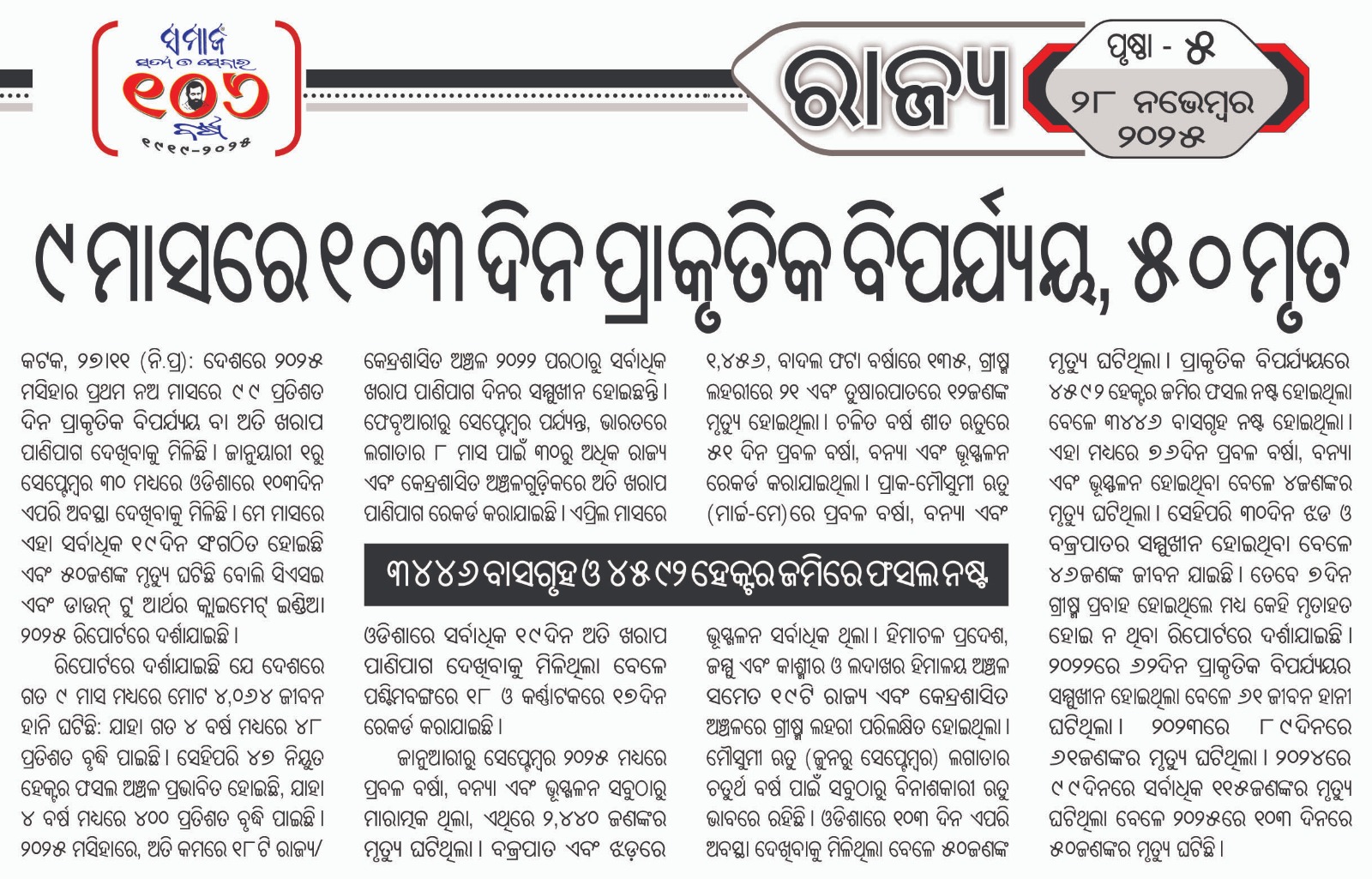
How India faces more intense, frequent extreme weather

Cloudbursts in exceptional geographies like Chennai and Andhra Pradesh or a drought in Northeast India—these freak weather incidents are now becoming a daily reality. In fact, almost every day, one or the other part of the country is experiencing extreme weather, finds the Centre for Science and Environment (CSE) and Down To Earth's Climate India 2025 report, an annual assessment of extreme weather events. To put this in perspective, India experienced extreme weather events on 99 per cent of the days in the first nine months (January to September) of 2025, marked by heat and cold waves, lightning and storms, heavy rain, floods and landslides. The year 2025 also broke several climate records. January was India's fifth driest since 1901 while February became the warmest in 124 years. In September, India recorded its seventh-highest mean temperature for the month.

Clean fuel use & curbs on farm fires among actions suggested

New Delhi: Centre for Science and Environment (CSE) has released a seven-point agenda titled "Our Right to Clean Air is Non-Negotiable", demanding action for Delhi-NCR. The plan urges measures such as replacing the commercial vehicle fleet, reducing personal vehicles, promoting clean fuel in industries, incentivising farmers to sell crop residue, preventing waste burning, enforcing regulations in power plants, brick kilns, stone crushers and construction sites, and acting with speed and scale throughout the year. Highlighting vehicular pollution, CSE stated that 500 cars and 1,500 two-wheelers are registered daily in Delhi. "Over the years, fuel quality improved drastically as the sulphur content in BSVI fuel fell from 10,000 ppm to less than 10 ppm. Even emission standards in vehicles are more stringent under BSVI, with heavy-duty vehicles such as trucks emitting 90% less than they did under BSIV. Taxis, buses and autorickshaws run on CNG, which emits fewer particulates than petrol and diesel," said CSE. The first agenda point calls for replacing old commercial vehicles, with scrappage incentivised for trucks, taxis, autos and para-transit vehicles, including a shift to electric models. To reduce private vehicle use, the plan advocates better public transport, last-mile connectivity and congestion charges. CSE also warned against waste burning, noting that household segregation programmes exist but are poorly implemented. "Waste is often dumped, sent to landfills or burnt, worsening pollution," it said. Urging authorities to learn from the successful CNG transition, which converted 1 lakh vehicles to gas in two years, CSE said the Clean Air Action Plan (CAP) was finalised in 2018 and then re-finalised in 2022-23, but it is still not being implemented. Anumita Roychowdhury, executive director, research and advocacy, CSE, said, "We need to leapfrog the way we did with CNG about 20 years ago. Small steps will not meet clean air targets. We need access to clean fuels, zero-emission vehicles, strong public transport, waste segregation and recycling, strict enforcement in industries and power plants and an end to farm fires."

Delhi marks second-longest streak of ‘very poor’ air days

Officials said the prolonged run this year is being driven by a combination of stagnant winds and falling temperatures. Forecasts by the Air Quality Early Warning System (AQEWS) indicate that the situation is unlikely to improve in the next six days, with wind speeds expected to remain low. Delhi’s air quality index (AQI) remained above 300 for the 23rd consecutive day, the second-longest spell of ‘very poor’ or worse air days since 2019, according to Central Pollution Control Board (CPCB) data. At 4pm, when the CPCB releases its daily national bulletin, the Capital’s average AQI registered at 369. The current streak began on November 6, and has included three days of “severe” air between November 11 and 13. The longest streak came last year, when Delhi logged 32 consecutive days of ‘very poor’ or worse air between October 30 and November 30, including a peak of 494 (severe) on November 18. The CPCB classifies air as ‘good’ when AQI is 50 or lower; ‘satisfactory’ between 51 and 100; ‘moderate’ between 101 and 200; ‘poor’ between 201 and 300; ‘very poor’ between 301 and 400; and ‘severe’ when it exceeds 400. Officials said the prolonged run this year is being driven by a combination of stagnant winds and falling temperatures. Forecasts by the Air Quality Early Warning System (AQEWS) indicate that the situation is unlikely to improve in the next six days, with wind speeds expected to remain low. Despite this, the Commission for Air Quality Management (CAQM) this week rolled back measures under Stage 3 of the Graded Response Action Plan (GRAP), allowing an end to the ‘Work from Home’ mandate and hybrid classes for classes 5 and lower, as well as the resumption of construction activities. Experts say that the prolonged streak exposes systemic failures in pollution control. ‘Tackle local emissions round the year’ Calling it a “public health emergency”, a Centre for Science and Environment (CSE) report warned that residents are breathing toxic pollution through the year, not just during the peak season. Its latest ‘Agenda for Action for Delhi-NCR’, released on November 27, said transport alone contributes 39%, the maximum, to Delhi’s PM2.5 load, with industry and construction making up 20%, and road dust accounting for 18%.

How India faces more intense, frequent extreme weather

Cloudbursts in exceptional geographies like Chennai and Andhra Pradesh or a drought in Northeast India—these freak weather incidents are now becoming a daily reality. In fact, almost every day, one or the other part of the country is experiencing extreme weather, finds the Centre for Science and Environment (CSE) and Down To Earth’s Climate India 2025 report, an annual assessment of extreme weather events. To put this in perspective, India experienced extreme weather events on 99 per cent of the days in the first nine months (January to September) of 2025, marked by heat and cold waves, lightning and storms, heavy rain, floods and landslides. The year 2025 also broke several climate records. January was India’s fifth driest since 1901 while February became the warmest in 124 years. In September, India recorded its seventh-highest mean temperature for the month.

Delhi Faces Dual Crisis: Air and Water Quality Deteriorate

Relief Possible if Systemic Flaws Are Addressed Experts opine that the persistent poor air quality in Delhi is not merely a seasonal issue but a consequence of systemic flaws. A recent report by CSE (Centre for Science and Environment) has termed it a 'public health crisis'. According to CSE, the primary sources of PM2.5 in Delhi are local. Transportation contributes 39%, industries and construction units contribute 20%, and dust on roads accounts for 18%. Experts point out that while stubble burning has an impact in November, local sources are consistently responsible for the rise in pollution in Delhi.

Air quality monitoring stations unevenly distributed in Delhi-NCR

Delhi has 39 continuous air quality monitoring stations (CAAQMS), the most for an Indian city. However, their distribution across an area of 1,483 square kilometres is uneven, with very few stations in southwest, northwest and peripheral areas of Delhi. A report released by Centre for Science and Environment (CSE) has found that the monitoring network covers only 26% of the city's area within a 2-km radius, leaving a 74% data shadow. If we consider a 5-km radius, 25% of the city's area is beyond the network. Due to the same skewed distribution pattern in 29 other NCR cities, 21 have one station each, despite experts emphasising the need for multi-dimensional monitoring systems that integrate air quality sensors and satellite-based monitoring alongside such stations. Though there is no rule specifying how much the coverage radius of a station should be, official guidelines tie the number to the size of population. Towns with fewer than 1 lakh inhabitants require a minimum of four stations to monitor particulate matter (PM), three to keep a tab on sulphur dioxide (SO2), four to monitor nitrogen dioxide (NO2) and one for carbon monoxide (CO) and oxidants like surface ozone. A city with a population between 1 lakh and 1 million ideally needs 2,417 PM monitors, 1,863 SO2 monitors, 2,417 NO2 monitors, and 525 for CO and surface ozone each, according to CSE, which analysed the guidelines of ‘Indian Standard 5182', used to measure air pollution. Out of 39 stations in Delhi, most of them are in its south and central parts. A total of six stations have been proposed at JNU and IGNOU in south Delhi, Netaji Subhash University (west campus) in west Delhi, ISRO earth station in Central Ridge, Delhi cantonment and the Commonwealth Games Sports Complex in east Delhi. "Delhi is one of India's few regions meeting or exceeding its target number of stations, but the widening gap between demand and actual monitoring infrastructure underlines the urgent need to expand or redistribute them more equitably. The city's outer zones are home to rapidly expanding populations and carry high-exposure risks but remain largely invisible in the monitoring network," stated a CSE report titled ‘Air quality monitoring: addressing data shadow regions.' Among NCR cities, Noida, Gurgaon and Faridabad have the highest number of stations at four each, followed by Meerut at three. Greater Noida, Bhiwadi and Baghpat have two each. Anumita Roychowdhury, executive director (research and advocacy) of Centre for Science and Environment, said the regulatory CAAQM network also needs to be representative of land-use patterns and background air quality to provide reliable data for risk assessment, policy making and compliance reporting. "But a high-density network can be very expensive. So, it's necessary to support regulatory monitoring with a multilayered system, including satellite-based pollution mapping and sensor-based local assessment of exposure," she said. Sunil Dahiya, founder and lead analyst of the think tank EnviroCatalysts, said the uneven distribution of the stations leaves most cities in NCR as blind spots. "Having only one station also makes it susceptible to practices like sprinkling of water to alter air quality reading. We need a robust network of regulator-grade stations coupled with low-cost sensors to give granular data for cities and rural areas," he added.

Why vast parts of Delhi still lack reliable pollution data - and how ‘data shadow’ leaves millions in city uncounted

A new analysis has exposed significant gaps in Delhi’s air quality monitoring network, revealing that despite having the most continuous monitoring stations of any Indian city, vast areas remain in a "data shadow," leaving pollution exposure for millions unaccounted for. The report, from the Centre for Science and Environment (CSE), underscores a critical challenge for effective pollution control policy across the National Capital Region (NCR). According to the CSE report, Delhi’s 39 Continuous Ambient Air Quality Monitoring Stations (CAAQMS) are concentrated in the city’s south and central parts. This skewed distribution means that within a 2-kilometre radius of the existing stations, only 26% of the city’s 1,483-square-kilometre area is effectively covered. The problem, as detailed in the CSE’s report ‘Air quality monitoring: addressing data shadow regions,’ extends beyond Delhi’s borders. An analysis of 29 other NCR cities found a similar pattern of uneven distribution. Twenty-one of these cities possess just a single monitoring station each, despite official guidelines recommending a multi-faceted monitoring system. "Delhi is one of India's few regions meeting or exceeding its target number of stations, but the widening gap between demand and actual monitoring infrastructure underlines the urgent need to expand or redistribute them more equitably," the CSE report stated. "The city's outer zones are home to rapidly expanding populations and carry high-exposure risks but remain largely invisible in the monitoring network." Official guidelines, based on the Indian Standard 5182, stipulate the number of monitors required based on population size. For a city with a population between 100,000 and one million, the ideal network would include thousands of monitors for various pollutants. The CSE analysis found that towns with fewer than 100,000 people require a minimum of four stations for particulate matter (PM) alone. Experts argue that the current sparse network is inadequate for reliable risk assessment and policy-making. Anumita Roychowdhury, executive director of research and advocacy at CSE, emphasised that the regulatory network must be representative of diverse land-use patterns. "But a high-density network can be very expensive. So, it's necessary to support regulatory monitoring with a multilayered system, including satellite-based pollution mapping and sensor-based local assessment of exposure," Roychowdhury was quoted as saying by TOI. This vulnerability of a limited network was highlighted by Sunil Dahiya, founder of the think tank EnviroCatalysts. He pointed out that having only one station in many NCR cities leaves them as "blind spots" and makes readings susceptible to localised manipulation, such as the sprinkling of water to temporarily alter air quality data. "We need a robust network of regulator-grade stations coupled with low-cost sensors to give granular data for cities and rural areas," Dahiya added, as cited by TOI. While six new stations have been proposed for locations including JNU, IGNOU and the Delhi cantonment, the findings present a stark picture: the world’s most polluted capital city is still largely flying blind when it comes to understanding the full scope of the toxic air its residents breathe.

Dip in farm fires in Punjab & Haryana, overall share to AQI below 5%, but air still very poor

The stubble burning season is almost over and satellite data shows that Uttar Pradesh and Madhya Pradesh have surpassed the cases recorded in Punjab this year. MP, UP and Rajasthan have actually logged their highest number of farm fires in the past six years. In contrast, Punjab, which witnessed floods, and Haryana recorded their lowest numbers in the same period, with 5,101 and 642 cases, respectively, reported between Sept 15 and Nov 26. MP reported 15,501 incidents, followed by UP at 6,284. Rajasthan recorded 2,867 cases, according to the satellite data compiled by Indian Agricultural Research Institute. Meanwhile, the contribution of stubble burning to Delhi's PM2.5 has been less this season. Its share surpassed 10% on just eight days and 20% on only one day. The contribution never surpassed 30% and, on most days, remained below 5%. The share of stubble burning was above 20% on 14 days last year, shows the Decision Support System data. From Sept 15 to Nov 26, MP recorded 15,501 cases in 2025, up from 15,261 in 2024 and 13,947 in 2022. UP followed a similar upward trend, with 3,737 cases in 2023, increasing to 5,248 in 2024 and 6,284 in 2025. Rajasthan also saw a rise — from 1,769 in 2023 to 2,709 in 2024 and now to 2,867. In contrast, Punjab has reported 5,101 cases — a sharp drop from 10,780 in 2024 and 36,614 in 2023. For Haryana, the number stood at 642, down from 1,358 in 2024 and 2,284 in 2023. The city's air quality is mainly impacted due to northwesterly winds, which bring pollutants from stubble burning sites in Punjab, Haryana, Rajasthan and west Uttar Pradesh to Delhi. In winter, northwesterly winds are predominant in Delhi. "The stubble burning in MP does not impact Delhi's air quality due to two reasons: wind direction and distance. As the aerial distance between MP and Delhi is huge, plumes cannot travel so far and die on the way. However, farm fires in MP would impact the air quality of neighbouring areas," said Gufran Beig, founder of System of Air Quality and Weather Forecasting and Research and chair professor at National Institute of Advanced Studies. However, the plumes from farm fires in eastern UP affect Delhi's air quality on some days. "When a western disturbance impacts the region, the wind direction changes to easterly, and on those days, some parts of east UP contribute to the capital's air quality," Beig clarified. Stubble intrusion also depends on the speed of transport-level and local winds. If the transport-level wind speed is slow, the emissions from burning sites will not be transferred to Delhi; if the local wind in the city is calm, it will further aggravate the impact of farm fires. However, if strong winds are blowing in Delhi, they can minimise the effect of stubble burning by dispersing the pollutants. Anumita Roychowdhury, executive director of research and advocacy at Centre for Science and Environment, said, "Even when the contribution of farm fires to the overall air quality of Delhi-NCR has reduced, the pollution levels have spiked to the very poor to severe levels, indicating a high impact of local pollution sources. This region cannot hide behind the farm smoke any more."

‘Feels like Covid’: Kiran Bedi flags Delhi-NCR pollution crisis, urges PMO action; claims AQI hit 587 in Indirapuram

Former IPS officer Kiran Bedi has once again raised alarm over Delhi’s deteriorating air quality, sharing multiple posts on X (formerly Twitter) highlighting the city’s hazardous pollution levels. In her latest update, she revealed that the Delhi Air Quality Index (AQI) currently stands at 458, classifying the air as hazardous. The main pollutants recorded were PM10: 339.92, PM2.5: 378.56, NO2: 97.67, SO2: 22.23, O3: 9.95, and CO: 120.53. Bedi also reposted a cartoon from Down To Earth magazine, showing two patients in a hospital—one wearing an oxygen mask with AQI 700, the other injured after demanding clean air—underscoring the human impact of worsening pollution. She further described in a post on November 27 the conditions in her own area, Indirapuram, where the AQI has reached 587, explaining that she has kept her child home from school despite teachers’ requests and has written to the principal to protect her family. In previous posts, dated November 25, Bedi detailed how Delhi’s pollution has severely affected her health, causing sneezing, chest congestion, and restricted mobility, while preventing her from enjoying outdoor activities like walks in Lodhi Garden or Nehru Park. "It’s Agonising. And depressing. Sir please intervene proactively. I live in Indirapuram, and the AQI is 587 right now. I have not sent my child to school inspite of teachers messages. I have written a firm mail to the principal. Whatever is in my area of control I will do that." Asked about her social media post seeking the Prime Minister’s Office (PMO) intervention to address Delhi’s air pollution crisis, former Puducherry Lt Governor and ex-IPS officer Kiran Bedi says," I have requested the honourable Prime Minister’s leadership because, at present, a retired civil servant is heading the commission and supervising the matter. Committees and groups have been formed, but the strong political weight that is needed at this moment is missing. This is essentially a coordination issue involving multiple states - Haryana, Rajasthan, Uttar Pradesh, Delhi, and Punjab. Since it is an inter-state matter, it cannot be left solely to a retired civil servant. Whether it is construction, sanitation, or developmental regulations, enforcement requires powerful, coordinated, and effective leadership." — PTI_News (@PTI_News) She adds,"This situation is similar to Covid. I personally witnessed how the Prime Minister guided, inspired, and united the country during that crisis. When coordination is required across states and regions, especially with existing political challenges, no one is better at it than him. If the Prime Minister does not wish to intervene directly, the commission can at least be placed under a Group of Ministers, because this issue concerns multiple states and impacts public health. Air pollution may appear to subside but keeps returning, and it is harming every Delhi resident, from children to the elderly. That is why strong leadership from the PMO is essential.”

Citizens Not Government Is Responsible For Pollution, Traffic And Garbage

Anumita Roychowdhury, executive director, Centre for Science and Environment (CSE), explained that urban transportation was the largest contributor of pollution in the capital. “The emission inventory studies for Delhi done by IIT Kanpur in 2015, TERI-ARAI in 2018, and Safar, also in 2018, have determined the transport sector’s contribution to PM2.5 to be, respectively, 20%, 39% and 41%. Every time the country faces a crisis, the blame goes to the government in power. Whether the topic is traffic violations or rising pollution, the first reaction goes towards questioning the ruling party. Do we, as citizens, ever take the blame for these hazards? A simple answer is no. Whenever the air becomes unbreathable, we blame the authorities; if there is a rise in accidents, we find fault in the enforcement of rules; the instances are too many, and the conclusion comes down to only one thing: shifting the blame towards the government alone. However, as uncomfortable as it may feel, the truth remains unchanged. A majority of these problems stem from everyday choices made by us as citizens, the ones we pretend we don’t hold accountability for. The Rise Of Crisis Every year, especially around winter, as Delhi drowns in dense grey, polluted air that makes it difficult to breathe, protests around the issue start to take place. Or, when Bengaluru or Mumbai sees a heavy traffic congestion, we witness jokes, tweets, and growing frustration across the country about how flawed the country’s urban planning is. However, data show a different story. A huge portion of the blame we impose on the centre is actually ours to bear. It is the citizens of the country who are equally responsible for the faltering systems we so religiously complain about. According to the Economic Survey Delhi 2023-24, almost 79 lakh vehicles, along with 6.5 lakh new vehicles, were registered in the year 2023-2024. This shows a growing trend in the possession of personal vehicles by the general public, leading to increased use and, gradually, more pollution. On top of that, about 1.1 million vehicles made their entries and exits in the city every day. These vehicles, growing at a rate of a whopping 15% contributed almost 81% of nitrogen oxide emissions into the environment. These emissions aren’t just from government vehicles, but from cars and other modes of transport owned and used by the common people.

GRAP III Revoked: How Delhi's ‘Daily Average AQI’ Masks Toxic Pollution Hotspots

"The AQI levels in the city will remain high and variable throughout winters. So you might see 'very poor' today, and then 'severe' two days later, and again it can come down to 'poor' if the wind speed improves," Anumita Roychowdary, Executive Director, Research and Advocacy, Centre for Science and Environment, tells The Quint. "Parents are more confused and angrier than ever," environmentalist Bhavreen Kandhari tells The Quint, a day after the Centre’s Commission for Air Quality Management (CAQM) revoked the stringent Stage III restrictions under the Graded Response Action Plan (GRAP) across Delhi. "Parents have spent weeks seeking advisory to restrict outdoor activity to protect their children. Closing schools damaged their learning, but reopening or shifting rules without clarity has disrupted their lives and reopened the risk for health and pollution exposure," adds Kandhari, who's the co-founder of WarriorMoms, a collective of Indian mothers demanding clean air for children. GRAP, which was first introduced in 2017, is a graded and pre-determined emergency response mechanism based on AQI levels of Delhi. "The AQI levels in the city will remain high and variable throughout winters. So you might see 'very poor' today, and then 'severe' two days later, and again it can come down to 'poor' if the wind speed improves," Anumita Roychowdary, Executive Director, Research and Advocacy, Centre for Science and Environment, tells The Quint.