“The largest historic polluter has exited the Paris Agreement,” said Avantika Goswami, who leads the climate program at the Centre for Science and Environment, a research group based in New Delhi. “We are seeing China be a leader.”
The environmental challenges arising from climate change today threaten not just ecosystems but the very existence of human civilization. Climate change is no longer a distant scientific hypothesis; it has become an immediate, lived reality. Its severity is starkly revealed in the Climate India 2025 report by the Centre for Science and Environment (CSE) and Down To Earth. From January to September 2025, India faced some form of extreme weather—floods, droughts, heavy rainfall, storms, cold waves, or deadly heat—on 99 percent of the days. In the same period, 4,064 lives were lost, 9.47 million hectares of crops destroyed, 58,982 livestock perished, and 99,533 houses collapsed. Agriculture has suffered the deepest wounds, as rising temperatures and erratic rainfall directly disrupt crops, soil moisture, and farming cycles. Rural economies are reeling under unprecedented stress. In Himachal Pradesh alone, extreme weather struck on 257 days, while Madhya Pradesh recorded 532 deaths and Maharashtra saw 8.4 million hectares of crops damaged. Clearly, this is not merely an environmental concern—it is a grave crisis impacting human life, health, economic stability, and national prosperity. At least 18 states and Union Territories recorded their highest number of extreme-weather days since 2022. From February to September 2025, for eight consecutive months, 30 or more states witnessed uninterrupted extreme weather events. What India is facing today mirrors the global situation. The years 2023, 2024, and 2025 have been among the hottest ever recorded. Europe’s unending heatwaves, famine in Africa’s Sahel region, wildfires in the Amazon and Australia, violent cyclones across the Pacific and Atlantic, and rapidly melting glaciers—all point to a planet hurtling toward a dangerous tipping point. Disrupted weather cycles, rising sea levels, sudden temperature spikes, and unpredictable rainfall are not only intensifying natural disasters but also rendering human life increasingly unsafe. The core cause behind this planetary disturbance is human behaviour: unchecked industrialization, dependence on fossil fuels, deforestation, pollution, unplanned cities, and reckless consumption. These actions have pushed greenhouse gas concentrations to perilous levels, overheating the Earth and destabilizing its climate system. The consequences now touch every sphere of life. Health risks are rising sharply; heatwaves are claiming more lives, pollution-induced diseases are increasing, and new viruses are emerging. Water resources are depleting as rivers and groundwater dry up. Food security is under threat as crop failures grow, pushing up prices of essential grains and vegetables. Economies are staggering under the weight of repeated natural disasters, millions are being displaced, and inequality is widening. If the world fails to limit global warming to 1.5°C, the next three decades could see erratic Himalayan rivers, sinking coastal cities, and widespread human distress. Another alarming warning comes from The Lancet Countdown on Health and Climate Change 2025. According to its findings, climate-related factors caused a 66% decline in agricultural productivity and a 20% loss in the construction sector last year. Excessive heat alone resulted in an estimated $194 billion loss in potential earnings. The report, prepared by 128 international experts from 71 academic institutions and UN agencies, offers the most comprehensive assessment yet of the links between climate change and human health. It highlights that between 2020 and 2024; India recorded an average of 10,000 deaths annually linked to wildfire-generated PM2.5 pollution—a 28% increase compared to 2003–2012. These figures should shake our collective conscience. Yet, in spite of such alarming warnings, the global response remains inadequate. Developed nations continue to evade their historical responsibility. In recent years, the irresponsible stance of leaders like U.S.A. President Donald Trump—who repeatedly undermined global climate commitments—has further weakened international efforts. Many rich countries are openly disregarding the Paris Agreement and its essential recommendations. Sunita Narain, Director General of CSE, rightly observed that India must now focus not merely on counting disasters but on understanding the scale at which climate change is unfolding. She stressed the urgent need for global emission reductions, emphasizing that no amount of adaptation can match the magnitude of these rapidly multiplying disasters. CSE Programme Director Kiran Pandey warned that rising temperatures during the monsoon could trigger even more intense and unpredictable weather events. Richard Mahapatra, Managing Editor of Down To Earth, cautioned that without decisive mitigation, today’s disasters will soon become “the new normal.” In such times, responsibility cannot be left to governments and international bodies alone. Every citizen must become a participant in environmental protection. We must reshape our lifestyles to align with nature. Simple, everyday actions—saving energy, using water responsibly, reducing plastic use, planting trees, segregating waste, and recycling—can create transformative results. Rainwater harvesting, solar power, composting, and minimizing unnecessary consumption strengthen environmental resilience. Choosing public transport, reducing vehicle use, walking, and cycling are powerful steps toward combating climate change. However, technological solutions alone are not enough. A deeper environmental consciousness must take root—respect for nature, restrained use of resources, and a commitment to safeguarding the Earth for future generations. If society embraces this mindset—that protecting nature is the foundation of life, prosperity, and peace—change will naturally follow. Education, awareness, and community participation are our strongest tools. Teaching children’s environmental values at home and in school will secure the planet’s future. The climate crisis will not resolve itself—it demands determination, collective effort, and a commitment to sustainable living. We have only one Earth, and there is no substitute. The message of our times is clear: ignoring nature’s warnings will make tomorrow far more perilous for humanity. But if each individual shoulders their share of responsibility, we can still alter the course of climate change and restore balance, peace, and stability to our planet.
Only 40 days remain before the year ends. However, at least 4,064 people have already fallen victim to extreme weather in 2025. The number of weather-related deaths has increased by nearly 40% compared to the previous year, 2024. Such alarming information has been revealed in a report by the Centre for Science and Environment (CSE), an organisation working on environment and climate issues. In October, devastating rains swept away vast areas of North Bengal. The extent of damage has not yet been fully calculated. It is estimated that the disaster caused losses of at least 1,200 to 1,400 crore rupees. However, it's not just Bengal – other states in the country have also witnessed the fury of this year's weather. According to CSE's report, Maharashtra has suffered the most agricultural damage due to the weather in 2025 so far. In that state, 84 lakh hectares of crops have been destroyed due to drought or excessive rainfall. From March this year, severe heatwaves began in various areas of Maharashtra. When the monsoon finally came later, different areas of the entire state repeatedly faced unprecedented rainfall. On one hand, intense heat and lack of rain, and on the other hand, excessive rainfall – crops on agricultural land could not cope with both these challenges. Based on reports from the disaster management departments of various states, it has been found that Madhya Pradesh recorded the highest number of deaths due to extreme weather in the country this year, at least two and a half thousand. Also Read | Tejas fighter jet crashes during Dubai air show demo, IAF confirms pilot's death The meteorologists and environmental scientists who prepared the report have stated that this report has been compiled based on information received from various non-governmental organisations working on weather and climate, and the disaster management departments of states. Experts believe the actual picture is much more grim than what the report shows. They report that at least three thousand people lost their lives to extreme weather in 2024. At least 32 lakh hectares of crops were damaged. This year, the death toll has increased to 4,064. A total of 94 lakh hectares of crops have been destroyed. This report, prepared based on data collected from every state in the country from January 1 to October 31, shows that out of the first 273 days of the year, 270 days – that is, 99% of the days – experienced extreme weather somewhere. During this time period, 2,414 people lost their lives in weather-related disasters in the country during just the four months of the monsoon. At least 1,456 people died due to lightning and storms.
देश में जलवायु संकट गहराया है और 2025 (जनवरी से सितंबर) में 99 फीसदी दिन किसी न किसी चरम मौसमी घटना की चपेट में रहे। देश ने लू, शीत लहर, बिजली, तूफान, भारी बारिश, बाढ़ और भूस्खलन जैसी घटनाओं का सामना किया। इस भयावह स्थिति का मानवीय और आर्थिक दोनों तरह से भारी खामियाजा चुकाना पड़ा है। सेंटर फॉर साइंस एंड एन्वायरनमेंट (सीएसई) और डाउन टू अर्थ की वार्षिक क्लाइमेट इंडिया 2025 रिपोर्ट में यह दावा किया गया है। रिपोर्ट के मुताबिक इन नौ महीनों में, चरम मौसमी घटनाओं ने 4,064 लोगों की जान ली, जो पिछले चार वर्षों की तुलना में 48 फीसदी की वृद्धि है। कृषि क्षेत्र सबसे ज्यादा प्रभावित हुआ, जिसमें 9.47 मिलियन हेक्टेयर (करीब 47 मिलियन एकड़) फसल क्षेत्र प्रभावित हुआ, जो चार वर्षों में 400 फीसदी की भारी वृद्धि को दर्शाता है। इसके अलावा, 99,533 घर नष्ट हुए और लगभग 58,982 जानवरों की मौत हुई। 2025 में, कम से कम 18 राज्यों और केंद्र शासित प्रदेशों में 2022 के बाद से सबसे अधिक चरम मौसमी दिन दर्ज किए गए। फरवरी से सितंबर 2025 तक, लगातार आठ महीनों तक देश के 30 या उससे अधिक राज्यों और केंद्र शासित प्रदेशों में चरम मौसम की घटनाएं रिकॉर्ड की गईं। हिमाचल में सबसे अधिक 257 चरम मौसमी दिन रहे हिमाचल प्रदेश (257 दिन) में देश में सबसे अधिक चरम मौसमी दिन रहे, जबकि मध्य प्रदेश में सबसे अधिक 532 मौतें दर्ज की गईं। रिपोर्ट बताती है कि मॉनसून का मौसम सबसे अधिक विनाशकारी रहा। लगातार चौथे वर्ष, जून से सितंबर तक के सभी 122 मॉनसून दिन चरम मौसम से प्रभावित रहे, जिससे 3,007 मौतें हुईं। कुल 4,064 मौतों में, भारी बारिश, बाढ़ और भूस्खलन सबसे घातक रहे, जिनसे 2,440 मौतें हुईं, इसके बाद बिजली और तूफान से 1,456 मौतें हुईं। 2025 में जलवायु के कई रिकॉर्ड टूटे रिपोर्ट के मुताबिक वर्ष 2025 ने कई जलवायु रिकॉर्ड तोड़े। जनवरी 1901 के बाद पांचवां सबसे शुष्क महीना था, जबकि फरवरी 124 वर्षों में सबसे गर्म रहा। सितंबर में देश का सातवां सबसे अधिक औसत तापमान दर्ज किया गया। महाराष्ट्र 84 लाख हेक्टेयर के साथ फसल क्षेत्र के नुकसान के मामले में सबसे बुरी तरह प्रभावित राज्य था। क्षेत्रीय रूप से, उत्तर-पश्चिम क्षेत्र में घटनाओं की सबसे अधिक आवृत्ति दर्ज की गई, जबकि मध्य क्षेत्र में 1,093 लोगों की मौतें हुईं। जलवायु परिवर्तन का पैमाना समझना होगा : सुनीता रिपोर्ट जारी करते हुए, सीएसई की महानिदेशक सुनिता नारायण ने कहा, देश को अब सिर्फ आपदाओं को गिनने की जरूरत नहीं है, बल्कि उस पैमाने को समझने की जरूरत है जिस पर जलवायु परिवर्तन हो रहा है। उन्होंने वैश्विक स्तर पर उत्सर्जन कटौती की तत्काल आवश्यकता पर जोर दिया, क्योंकि इतने बड़े पैमाने की आपदाओं के लिए कोई भी अनुकूलन संभव नहीं होगा। सीएसई के कार्यक्रम निदेशक किरन पांडे ने मानसून के दौरान बढ़ते तापमान को चिंताजनक बताया, जो अनियमित और चरम मौसमी घटनाओं को ट्रिगर कर सकता है। डाउन टू अर्थ के प्रबंध संपादक रिचर्ड महापात्रा ने कहा कि यह रिपोर्ट एक आवश्यक चेतावनी है और बिना निर्णायक शमन प्रयासों के आज की आपदाएं कल का नया सामान्य बन जाएंगी।
Telangana has witnessed one extreme weather event almost every five days on an average during the first nine months of 2025, as reported by a study from the Centre for Science and Environment (CSE).
Kochi: In the first nine months of this year, Kerala witnessed extreme weather on 147 days, across winter, summer, and the southwest monsoon seasons. As many as 114 people lost their lives and more than 5,352 houses were fully or partially damaged, according to a new report by the Centre for Science and Environment (CSE), Delhi. The assessment examined weather patterns across India from Jan 1 to Sept 30, 2025. The report, "Climate India 2025: An Assessment of Extreme Weather Events", states that the country experienced extreme weather on 270 out of 273 days—meaning almost 99% of the year's first nine months saw at least one extreme event somewhere in India. The year also broke several climate records. Jan 2025 was India's fifth driest Jan since 1901 and Feb became the warmest in 124 years. In March, the country's mean maximum temperature was 1.02°C above normal, even after IMD revised its temperature baseline from the 1981–2010 average to the warmer 1991–2020 period. This shift means today's "normal" temperatures are already elevated. Sept 2025 continued the trend, recording the seventh-highest mean temperature for the month, with the fifth-highest minimum temperature on record. The south peninsular region recorded extreme weather on 205 of the 273 days, resulting in 745 deaths and damage to 67,321 hectares of crops. Kerala alone recorded extreme weather on 147 days—including heavy rainfall, flooding, thunderstorms, and lightning—based on IMD's orange and red alert indicators. The CSE report sourced its data from two key govt bodies: IMD and the disaster management division under the Union ministry of home affairs. It also relied on media reports, especially during the pre-monsoon period when official documentation is limited.
India recorded an extreme weather event nearly every day between January 2025 and September 2025, an annual study released by the Centre for Science and Environment and Down To Earth magazine has said. The study, titled “Climate India 2025: An Assessment of Extreme Weather Events”, stated that the country recorded extreme weather events on 270 of the 273 days from January 1, 2025 to September 30, 2025. “This means that for almost 99% of the first nine months of this year, India had an extreme weather event breaking in one or more parts of the country,” it said. These included heat and cold waves, lightning and storms, heavy rain, floods and landslides, it added. The United Nations Intergovernmental Panel on Climate Change defines extreme weather events as occurrences that are “rare at a particular place and time of year”. India does not have an official definition of the term. However, the India Meteorological Department, in its annual “Statement of Climate of India” reports, classifies lightning and thunderstorms, heavy to very heavy, and extremely heavy rainfall, landslides and floods, coldwaves, heatwaves, cyclones, snowfall, dust and sandstorms, squalls, hailstorms and gales as extreme weather events. The study stated that India experienced extreme weather events every day for seven of the nine months: February, April, May, June, July, August and September. “Thirty states/UTs recorded extreme weather events for eight consecutive months – February to September 2025,” it added. These events claimed 4,064 lives, affected 9.47 million hectares of crops, destroyed 99,533 houses, and killed approximately 58,982 animals, it said, adding that the reported damage was likely an underestimate due to incomplete data collection on event-specific losses. The study also stated that Himachal Pradesh experienced extreme weather on almost 80% of the 273 days in the first nine months of 2025, which was the most in the country. “However, Madhya Pradesh recorded the highest fatalities at 532, followed by Andhra Pradesh (484 deaths) and Jharkhand (478 deaths),” it added. Regionally, the northwest experienced the highest frequency of extreme weather events in 2025, with 257 event days, followed by the east and northeast at 229 days, the study said. The year 2025 also broke several climate records, with January being India’s fifth driest since 1901 and February being the warmest in 124 years. “These record-breaking statistics are a stark reminder of climate change’s intensifying grip,” the study said. “Events that once occurred once in a century are now happening every few years.” The frequency is overwhelming India’s most vulnerable populations, who lack the resources to recover from the unending cycle of loss and damage, it added. The study stated that the findings underscored the urgent need for systems that record the full extent of these losses, both economic and human, to give a clearer picture of climate change’s true impact. “The findings also signal a crucial shift needed in India’s approach: from disaster response to risk reduction and resilience-building,” it said. “Flood management, for instance, requires more than contingency plans – it demands robust drainage and water-recharge infrastructure, along with the restoration of green spaces and forests that can act as natural water buffers in future storms.” The study added: “Climate models are unequivocal: extreme weather events will only become more frequent and severe. This is no longer a projection – it is today’s reality.” The assessment used data from several government sources and media reports to assess the frequency of such extreme events.
ഒന്നുകിൽ തീവ്രമഴ, അല്ലെങ്കിൽ മണ്ണിടിച്ചിൽ, ഇതൊന്നും അല്ലെങ്കിൽ കഠിനമായ വേനൽ. മിതമായ കാലാവസ്ഥ ഇന്ത്യക...
India was hammered by extreme weather on 99 per cent of the days between January and September 2025, the highest ever recorded, a new assessment by the Centre for Science and Environment (CSE) and Down To Earth shows. The unrelenting mix of heatwaves, lightning strikes, storms, floods, landslides and cloudbursts killed 4,064 people, damaged 9.47 million hectares of crops, destroyed 99,533 homes, and left nearly 59,000 animals dead — a toll unmatched in recent years. The year 2025 also smashed multiple 124-year climate records. January was the fifth driest since 1901; February was the warmest ever. September recorded the seventh-highest mean temperature, with minimum temperatures ranking fifth-highest since records began. At least 18 states and UTs saw their highest number of extreme weather days in four years. The seasonal pattern was equally alarming. Winter — despite being dry — saw 51 incidents of heavy rain, floods and landslides, along with the earliest heatwave days since 2022. The pre-monsoon season flipped its long-term trend: heavy rain and floods replaced hailstorms as the dominant extreme event. Heatwaves gripped 19 states, including Himalayan regions such as Himachal Pradesh, Jammu & Kashmir and Ladakh. The monsoon was the most punishing, with extreme weather recorded on all 122 days for the fourth consecutive year, covering 35 states and UTs. State-level impact was severe. Himachal Pradesh faced extreme events on 80% of the 273 days studied — the highest in India — while Madhya Pradesh recorded the most deaths (532), followed by Andhra Pradesh (484) and Jharkhand (478). Maharashtra emerged as the biggest agricultural casualty, with 8.4 million hectares of crop damage — more than 30 times Punjab’s loss. Regionally, the northwest was hit hardest with 257 extreme weather days and 1,342 deaths, followed by central India, which endured 200 days, 1,093 deaths, and 8.42 million hectares of crop loss. The east and northeast recorded 229 days of extreme conditions. Between January and September, floods, heavy rain and landslides were the deadliest, killing 2,440 people, followed by lightning and storms, which claimed 1,456 lives. Cloudbursts led to 135 deaths, while heatwaves and even snowfall added to the toll.
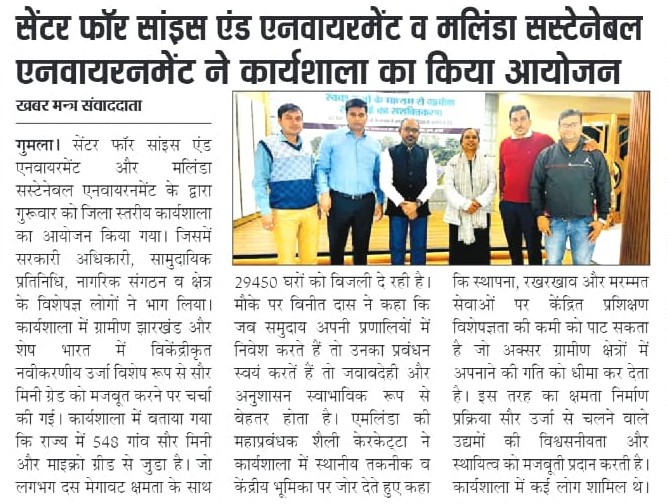
गुमला संवाददाता सेंटर फॉर साइंस एंड एनवायरनमेंट (सीएसई) और मलिंडा सस्टेनेबल एनवायरनमेंट प्रालि. द्वारा गुरूवार को जिला मुख्यालय में सौर मिनी-ग्रिड को अधिक प्रभावी,टिकाऊ और जनोपयोगी बनाने को लेकर जिला स्तरीय कार्यशाला आयोजित की गई। कार्यक्रम में जिले अधिकारियों, सामाजिक संगठनों, समुदाय प्रतिनिधियों,तकनीकी विशेषज्ञों और उर्जा क्षेत्र से जुड़े कर्मियों ने भाग लिया। कार्यशाला का उद्देश्य ग्रामीण विद्युतीकरण में उपयोग हो रहे सौर मिनी-ग्रिड की चुनौतियों और संभावनाओं पर मंथन करना था। कार्यशाला में बताया गया कि झारखंड में वर्तमान में 548 गांव सोलर मिनी और माइक्रो ग्रिड से जुड़े हुए हैं। जिनसे 29 हजार से अधिक घरों को बिजली मिल रही है। राज्य सरकार की नई सौर नीति में इस दायरे को और बढ़ाने का लक्ष्य तय किया गया है। इसी पृष्ठभूमि में कार्यशाला में जमीनी स्तर पर आने वाली दिक्कतों,खासकर संचालन,रख-रखाव और सामुदायिक सहभागिता की स्थिति पर जोर दिया गया। सीएसई के कार्यक्रम प्रबंधक बिनीत दास ने कहा कि सामुदायिक भागीदारी सौर मिनी-ग्रिड की सफलता की रीढ़ है। जहां ग्रामीण स्वंय निवेश करते हैं या सामूहिक रूप से संचालन संभालते हैं,वहां अनधिकृत कनेक्शन कम होते हैं और सिस्टम की जवाबदेही बढ़ती है। उन्होंने झारखंड के महिला नेतृत्व वाले उर्जा मंडल मॉडल को देश में सबसे प्रभावी उदाहरण बताया। कार्यशाला में यह भी सामने आया कि किसान उत्पादक संगठन (एफपीओ) सौर मिनी-ग्रिड के बड़े और लाभकारी उपयोगकर्ता बन सकते हैं। बिजली मिलने पर किसान गांव में ही मिलिंग,सुखाने, भंडारण और उत्पादों की ब्रांडिंग कर सकते हैं। इससे न केवल किसानों की आमदनी बढ़ेगी,बल्कि ग्रामीण क्षेत्रों में छोटे उद्यमों को बढ़ावा मिलेगा। मलिंडा सस्टेनेबल एनवायरनमेंट प्राइवेट लिमिटेड के वित्त एवं संचालन प्रबंधक प्रणव भारती साह ने कहा कि मिनी-ग्रिड के संचालन के लिए सिर्फ पूंजी निवेश पर्याप्त नहीं है। उपकरणों की उपलब्धता, बाजार से जुड़ाव और नियमित राजस्व व्यवस्था अनिवार्य है। वहीं मलिंडा चैरिटेबल ट्रस्ट की महाप्रबंधक शैली केरकेट्टा ने स्थानीय युवाओं को तकनीकी प्रशिक्षण देने पर जोर दिया। उन्होंने कहा कि अगर इंस्टालेशन,मरम्मत और रख-रखाव का काम स्थानीय युवा संभालें, तो सिस्टम अधिक समय तक चल सकेगा और ग्रामीणों को रोजगार भी मिलेगा।
स्विस एयर क्वालिटी मॉनिटरिंग कंपनी ने बुधवार सुबह 7 बजे दिल्ली में AQI 506 रिकॉर्ड किया, जबकि भारत के सेंट्रल पॉल्यूशन कंट्रोल बोर्ड (CPCB) ने 399 से कम की रीडिंग बताई। दोनों आंकड़ों के बीच इतने बड़े अंतर ने सभी को हैरान कर दिया। इस अंतर से एक बड़ा सवाल उठता है: इंडिपेंडेंट मॉनिटर और ऑफिशियल AQI रीडिंग में इतना बड़ा अंतर क्यों है? दूसरा सवाल यह है कि जनता को किसके डेटा पर भरोसा करना चाहिए? इसलिए 500 से ऊपर के AQI को खतरनाक नहीं माना जाता है NDTV की एक रिपोर्ट में, नेशनल इंस्टीट्यूट ऑफ एडवांस्ड स्टडीज (NIAS) के चेयर प्रोफेसर डॉ. गुफरान बेग ने कहा, "400 से ऊपर का AQI खतरनाक माना जाता है। ऐसा माना जाता है कि 500 और 900 के AQI का हेल्थ पर एक जैसा असर होता है, तो ज़्यादा नंबर बताकर पैनिक क्यों पैदा किया जाए?" लेकिन, एनवायरोकैटालिस्ट्स के फाउंडर और लीड एनालिस्ट सुनील दहिया ने कहा कि ज़्यादा वैल्यू कैलकुलेट करने की काबिलियत के बावजूद, AQI को 500 पर कैप करने का कोई साइंटिफिक कारण नहीं है। इसलिए, अगर एक्सपर्ट्स की मानें, तो दोनों रीडिंग सही हैं, लेकिन अलग-अलग वजहों से। आइए AQI की पूरी कहानी समझते हैं। अब समझते हैं कि AQI क्या है अब समझते हैं कि AQI क्या है। AQI एक ऐसा टूल है जो लोगों को आसान शब्दों में एयर पॉल्यूशन का मौजूदा लेवल बताता है। यह उन पार्टिकल्स पर आधारित है जो पॉल्यूशन फैलाते हैं। इनमें आठ पॉल्यूटेंट शामिल हैं: PM 10, PM 2.5, ओजोन, सल्फर डाइऑक्साइड, नाइट्रोजन डाइऑक्साइड, वगैरह। इसलिए, किसी एरिया के लिए AQI कैलकुलेट करते समय, इन आठ पैरामीटर्स को बेसिस के तौर पर इस्तेमाल किया जाएगा। पॉल्यूशन लेवल को कलर कोड के आधार पर मापा जाता है सेंटर फॉर साइंस एंड एनवायरनमेंट के कंसल्टेंट मोहन जॉर्ज ने बताया कि AQI मापने के अलग-अलग क्राइटेरिया हैं। AQI के अलग-अलग कलर कोड होते हैं, जो किसी इलाके की एयर क्वालिटी बताते हैं, चाहे वह अच्छी हो या बहुत खराब। उदाहरण के लिए, 401 और 500 के बीच या 'गंभीर' कैटेगरी में AQI, स्वस्थ लोगों के लिए भी खतरनाक है। CPCB और WHO के प्रदूषण स्टैंडर्ड में काफी अंतर है दिल्ली में लगे एयर क्वालिटी मॉनिटरिंग स्टेशन प्रदूषण फैलाने वाले कणों और गैसों की मात्रा को प्राथमिकता देते हैं। जॉर्ज ने बताया कि सही हालात में, वे AQI मापने के लिए पिछले 24 घंटों के डेटा का इस्तेमाल करते हैं। CPCB का डेटा 24 घंटे के औसत के लिए PM2.5 के 60 माइक्रोग्राम प्रति क्यूबिक मीटर को सुरक्षित मानता है। हालांकि, वर्ल्ड हेल्थ ऑर्गनाइज़ेशन (WHO) ने 15 माइक्रोग्राम की बहुत सख्त लिमिट तय की है।
स्विस एयर क्वालिटी मॉनिटरिंग कंपनी ने बुधवार सुबह 7 बजे दिल्ली में AQI 506 दर्ज किया, जबकि इसी समय भारत के सेंट्रल पॉल्यूशन कंट्रोल बोर्ड (CPCB) ने 399 से कम का आंकड़ा दिखाया। दोनों के आंकड़ों में इतने अंतर ने सबको चौंका दिया। इस अंतर ने सबसे बड़ा सवाल पैदा किया- आखिर इंडिपेंडेंट मॉनिटर और ऑफिशियल AQI रीडर में इतना बड़ा अंतर क्यों आ रहा है? दूसरा सवाल यह कि जनता किसके आंकड़ों पर विश्वास करे? इसलिए 500 से ज्यादा नहीं दिखाई देता AQI एनडीटीवी की रिपोर्ट में नेशनल इंस्टीट्यूट ऑफ एडवांस्ड स्टडीज (NIAS) के चेयर प्रोफेसर डॉ. गुफरान बेग ने बताया, "400 से ज़्यादा AQI खतरनाक होता है। यह माना जाता है कि AQI 500 और AQI 900 पर सेहत पर असर एक जैसा होता है, तो ज़्यादा नंबर दिखाकर लोगों में पैनिक क्यों पैदा किया जाए।" हालांकि, एनवायरोकैटेलिस्ट्स के फाउंडर और लीड एनालिस्ट सुनील दहिया ने कहा कि ज़्यादा वैल्यू कैलकुलेट करने की क्षमता के बावजूद AQI को 500 पर कैप करने का कोई साइंटिफिक कारण नहीं है। इस तरह अगर विशेषज्ञों की मानें तो दोनों रीडिंग ठीक हैं, लेकिन अलग-अलग वजहों से। अब आगे समझिए AQI की पूरी कहानी। अब समझिए AQI क्या होता है? अब समझिए कि आखिर ये AQI क्या चीज है? AQI एक ऐसा टूल है, जो जनता को आसान भाषा में समझाता है कि अभी हवा में पलूशन का स्तर क्या है। इसके लिए प्रदूषण फैलान वाले कणों को आधार बनाया गया है। इसमें आट पॉल्यूटेंट शामिल हैं। PM 10, PM2.5, ओजोन, सल्फर डाईऑक्साइड, नाइट्रोजन डाइऑक्साइड आदि। इस तरह अगर किसी इलाके का AQI निकाला जाएगा, तो इन्हीं तरह के 8 पैरामीटर को आधार बनाया जाएगा। कलर कोड के आधार पर बताता पलूशन का स्तर सेंटर फॉर साइंस एंड एनवायरनमेंट के कंसल्टेंट मोहन जॉर्ज ने बताया कि इस AQI को मापने के लिए अलग-अलग आधार हैं। AQI में अलग-अलग रेंज के कलर कोड हैं, जो बताते हैं कि इलाके की हवा का स्तर कैसा है, यानी ठीक ठाक है या फिर बहुत खराब। उदाहरण के लिए, 401 और 500 के बीच या 'गंभीर' कैटेगरी में AQI सेहतमंद लोगों के लिए भी खतरनाक होती है। CPCB और WHO के पलूशन मानक में है बड़ा अंतर दिल्ली में लगाए गए एयर क्वालिटी मॉनिटरिंग स्टेशन, प्रदूषण फैलाने वाले कणों और गैसों की मात्रा को तरजीह देते हैं। जॉर्ज ने बताया- आदर्श परिस्थिति में देखें, तो बीते 24 घंटे के डाटा को AQI नापने में इस्तेमाल करते हैं। CPCB के आंकड़ों को देखें, तो 24 घंटे के औसत के लिए PM2.5 के 60 माइक्रोग्राम प्रति क्यूबिक मीटर को सुरक्षित मानता है। हालांकि, वर्ल्ड हेल्थ ऑर्गनाइज़ेशन (WHO) ने 15 माइक्रोग्राम की बहुत सख्त सीमा तय की है।
मध्य प्रदेश में चरम मौसमी घटनाओं पर सीएसई की रिपोर्ट सीएसई (सेंटर फॉर साइंस एंड एनवायरनमेंट) डाउन टू अर्थ की रिपोर्ट में खुलासा हुआ कि जनवरी से सितंबर 2025 तक, मध्य प्रदेश में चरम मौसमी घटनाओं (जैसे बाढ़, ओलावृष्टि, बिजली गिरना) के कारण देश में सबसे ज्यादा 532 मौतें हुईं। राज्य ने 273 दिनों में से 144 दिन अत्यधिक मौसम का सामना किया। भारी बारिश, बाढ़ और भूस्खलन के कारण 348 मौतें हुईं, जबकि बिजली गिरने से 183 मौतें हुईं। इसके अलावा, 12,000 हेक्टेयर फसल और 489 घरों का नुकसान हुआ। यह रिपोर्ट दर्शाती है कि मध्य प्रदेश का मौसमी परिदृश्य अप्रत्याशित बन रहा है और यह राज्य पिछले कुछ सालों से एक्सट्रीम वेदर इवेंट्स के मामले में टॉप पर रहा है।
India is facing one of its most alarming climate years on record, with the latest national assessment revealing that extreme weather gripped 99% of days in India during the first nine months of 2025. The “Climate India 2025” research, published by the Centre for Science and Environment (CSE) and Down To Earth magazine, demonstrates that the country is experiencing unprecedented weather instability due to rapidly worsening climate change, driven by the steepest global CO2 rise since 1957. India saw extreme weather on 270 out of 273 days between January and September alone. Heatwaves, floods, storms, and landslides occurred virtually continuously throughout the country. Unprecedented Frequency Across States and Seasons Extreme weather gripped 99% of days in India, according to the evaluation, demonstrating how profoundly climate disruption has affected day-to-day living. Key findings include: Extreme weather in 7 of 9 months: Every day in February, April, May, June, July, August, and September saw extreme incidents. All 36 states and UTs impacted: This is the first occasion in four years that intense events occurred nationwide at the same time. Severe anomalies: Severe abnormalities included heat waves, cold waves, lightning, snowfall, dust storms, squalls, torrential rainfall, floods, and landslides. The most extended period of impact: 8 months in a row of harsh weather were experienced across 30 states and UTs. The analysis, which shows a broad and consistent pattern rather than individual spikes, is based on official databases and nearly real-time event tracking. Such catastrophes are considered “rare occurrences” in a normal climate cycle, according to the IPCC, but they have grown frighteningly familiar in India. Also Read: EU Rejected Claims CBAM Is Unilateral, Urges Discipline On Baku Finance Deal Regional Hotspots and State-Level Impact Region-wise trends reveal deep vulnerabilities, further proving that extreme weather gripped 99% of days in India during the assessment period. Key regional patterns include: Northwest India is the worst affected: Out of 273 extreme weather days, 257 occurred in this region, which includes Delhi, Haryana, Himachal Pradesh, Ladakh, J&K, Punjab, Rajasthan, Uttar Pradesh, and Uttarakhand. Himachal Pradesh is most impacted: Most affected, with 217 days of extreme weather, which is indicative of the increasing fragility of Himalayan ecosystems. Kerala and Madhya Pradesh were also heavily affected: Severely impacted, with storm occurrences and heavy rainfall patterns for 147 and 144 days, respectively. Unusual geographies hit: Several first-time or uncommon events occurred in areas typically not vulnerable to harsh conditions, demonstrating the expanding geographic distribution.