
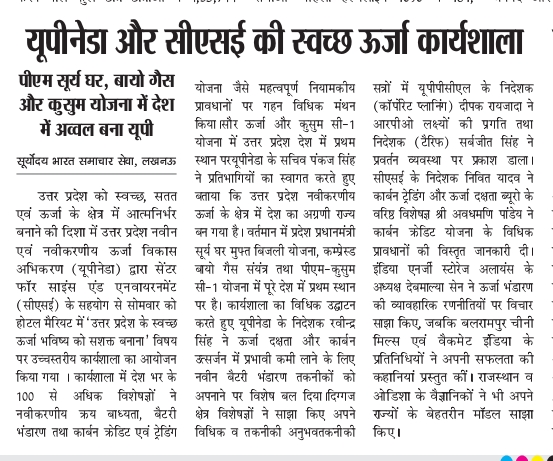
उत्तर प्रदेश को स्वच्छ, सतत एवं ऊर्जा के क्षेत्र में आत्मनिर्भर बनाने की दिशा में उत्तर प्रदेश नवीन एवं नवीकरणीय ऊर्जा विकास अभिकरण (यूपीनेडा) द्वारा सेंटर फॉर साइंस एंड एनवायरनमेंट (सीएसई) के सहयोग से सोमवार को होटल मैरियट, लखनऊ में ‘उत्तर प्रदेश के स्वच्छ ऊर्जा भविष्य को सशक्त बनाना’ विषय पर कार्यशाला का आयोजन किया गया। कार्यशाला में नवीकरणीय क्रय बाध्यता (आरपीओ), नवीकरणीय उपभोग बाध्यता (आरसीओ), ऊर्जा भंडारण बाध्यता (ईएसओ), बैटरी भंडारण तथा कार्बन क्रेडिट एवं ट्रेडिंग योजना (सीसीटीएस) जैसे महत्वपूर्ण विषयों पर विशेषज्ञों ने विचार-विमर्श किया। इसमें प्रदेश भर के सरकारी विभागों, संबंधित बाध्यकारी संस्थाओं, सौर ऊर्जा उत्पादकों, ओपन एक्सेस एवं कैप्टिव विद्युत उपभोक्ताओं सहित 100 से अधिक प्रतिभागियों ने हिस्सा लिया। उत्तर प्रदेश स्वच्छ ऊर्जा के क्षेत्र में स्थापित कर रहा नई पहचान कार्यशाला में यूपीनेडा के सचिव पंकज सिंह ने प्रतिभागियों का स्वागत करते हुए आयोजन के उद्देश्यों एवं प्रासंगिकता पर प्रकाश डाला। उन्होंने कहा कि उत्तर प्रदेश नवीकरणीय ऊर्जा के क्षेत्र में निरंतर उल्लेखनीय प्रगति कर रहा है। प्रदेश प्रधानमंत्री सूर्य घर मुफ्त बिजली योजना, कम्प्रेस्ड बायो गैस संयंत्र तथा पीएम-कुसुम सी-1 योजना में देश में प्रथम स्थान पर है। उन्होंने स्वच्छ ऊर्जा के विस्तार के साथ-साथ निर्धारित लक्ष्यों के प्रभावी अनुपालन, ऊर्जा भंडारण और नवीन तकनीकों को अपनाने की आवश्यकता पर बल दिया। कार्यशाला का उद्घाटन यूपीनेडा के निदेशक रवीन्द्र सिंह ने किया। उन्होंने कहा कि ऊर्जा की बढ़ती मांग नवीकरणीय ऊर्जा के विस्तार को गति दे रही है, लेकिन इसके साथ ऊर्जा दक्षता पर ध्यान देना भी अत्यंत आवश्यक है। ऊर्जा दक्षता के माध्यम से कार्बन उत्सर्जन में प्रभावी कमी लाई जा सकती है। हालांकि, इसके वास्तविक प्रभाव का आकलन करना कई बार चुनौतीपूर्ण होता है। उन्होंने विश्वास व्यक्त किया कि कार्यशाला से प्रतिभागियों को बैटरी भंडारण, कार्बन क्रेडिट एवं ट्रेडिंग योजना तथा नवीकरणीय ऊर्जा से जुड़े नवीनतम नियामकीय प्रावधानों की जानकारी प्राप्त होगी, जिससे प्रदेश में स्वच्छ ऊर्जा संबंधी पहलों को और प्रभावी बनाया जा सकेगा। आरपीओ अनुपालन, बैटरी भंडारण और कार्बन क्रेडिट ट्रेडिंग पर विशेषज्ञों ने साझा किए अनुभव कार्यशाला में यूपीपीसीएल के निदेशक (कॉर्पोरेट प्लानिंग) दीपक रायजादा ने नवीकरणीय क्रय बाध्यता (आरपीओ) के निर्धारित लक्ष्य हासिल करने की दिशा में यूपीपीसीएल की प्रगति तथा इस दौरान सामने आने वाली चुनौतियों की जानकारी दी। सेंटर फॉर साइंस एंड एनवायरनमेंट के निदेशक निवित यादव ने सीएसई की भूमिका, संचालित पहलों और आरपीओ अनुपालन के क्षेत्र में प्राप्त उपलब्धियों पर प्रकाश डाला। निदेशक (टैरिफ) सर्बजीत सिंह ने आरपीओ अनुपालन सुनिश्चित करने के लिए प्रवर्तन व्यवस्था एवं शिकायत निवारण से संबंधित महत्वपूर्ण पहलुओं की जानकारी दी। भारत सरकार के ऊर्जा दक्षता ब्यूरो के वरिष्ठ सेक्टर विशेषज्ञ अवधमणि पांडेय ने कार्बन क्रेडिट एवं ट्रेडिंग योजना के विभिन्न प्रावधानों तथा इसके अंतर्गत शामिल क्षेत्रों के बारे में विस्तार से बताया। इंडिया एनर्जी स्टोरेज अलायंस के अध्यक्ष देबमाल्या सेन ने ऊर्जा भंडारण बाध्यता, बैटरी भंडारण की उपयोगिता तथा बैटरी प्रबंधन से जुड़े विषयों पर विचार साझा किए। वहीं, बलरामपुर चीनी मिल्स एवं वैकमेट इंडिया के प्रतिनिधियों ने आरपीओ अनुपालन के संबंध में अपने अनुभव और सफलता की कहानियां प्रस्तुत कीं। राजस्थान एवं ओडिशा के क्षेत्र विशेषज्ञों ने अपने-अपने राज्यों में नवीकरणीय ऊर्जा संबंधी विनियमों और उनके अनुपालन की व्यवस्थाओं पर जानकारी साझा की। उन्होंने इन राज्यों में अपनाई जा रही प्रक्रियाओं एवं अनुभवों के आधार पर उत्तर प्रदेश में नवीकरणीय ऊर्जा लक्ष्यों की प्राप्ति और अनुपालन व्यवस्था को अधिक प्रभावी बनाने की संभावनाओं पर भी चर्चा की। निगरानी, रिपोर्टिंग और बेहतर अनुपालन व्यवस्था पर रहा विशेष जोर कार्यशाला में आरपीओ पोर्टल, नवीकरणीय ऊर्जा की खरीद, ऊर्जा भंडारण बाध्यता, नवीकरणीय उपभोग बाध्यता तथा कार्बन क्रेडिट ट्रेडिंग योजना के प्रभावी क्रियान्वयन पर विशेष ध्यान दिया गया। प्रतिभागियों ने अनुपालन से संबंधित व्यावहारिक चुनौतियों, निगरानी एवं रिपोर्टिंग तंत्र को मजबूत बनाने और उद्योगों में अपनाई जा रही सर्वोत्तम पद्धतियों पर विचार-विमर्श किया। इन चर्चाओं का उद्देश्य प्रदेश में नवीकरणीय ऊर्जा के उपयोग को बढ़ावा देने के साथ-साथ संबंधित संस्थाओं को नियामकीय प्रावधानों के अनुपालन के लिए सक्षम बनाना रहा। यूपीनेडा के वरिष्ठ ऊर्जा सलाहकार गिरीश कुमार ने कार्यशाला का संचालन किया और आरपीओ पोर्टल पर विस्तृत प्रस्तुति दी। यूपीनेडा के वरिष्ठ परियोजना अधिकारी राकेश अग्रवाल ने कार्यशाला में उपस्थित वरिष्ठ अधिकारियों, विशेषज्ञों एवं प्रतिभागियों के प्रति आभार व्यक्त किया।
As I write this, over 1,410 lives have been confirmed lost and many thousands are still missing in the floods in Nepal, as the mighty Himalayas came down as rubble. This is an enormous and painful human tragedy, but it is also about wilful actions and inactions of humans. This tragedy is really about our mindset, the belief that we, as humans, can re-engineer everything; that we are in control of the universe and all things in it. We are the supreme beings who can weather climate change, because, after all, it is only about a small and insignificant matter of weather. This is on us. Let me break this down. First comes the question of what happened in Nepal on August 26. The images that all of us would have seen are of the mountain coming down — just collapsing — as the flash flood and massive quantity of debris buried everything in its path, taking with it the huge building of the Chinese immigration office. It is a frightening visual, straight out of a science-fiction movie. We know now that this flash flood was not caused by an extreme cloudburst. It was triggered by the collapse of a high-altitude glacier near the Langtang Lirung peak. An estimated 142 million cubic metres of ice and rocks were dislodged, creating a 5.2 magnitude seismic event. This then led to the formation of natural dams, behind which water and moraine accumulated, and when the dams broke, they unleashed even more devastating floods downstream. The second question is: Why? There is no single headline reason, but two events have greatly contributed to this and other such tragedies in this region. One is the well-documented warming caused by climate change. It is literally weakening the Himalayas — the temperature rise melts glaciers; this, in turn, corrodes the moraine slopes. It is a ticking bomb, which implodes as it did in Nepal. In addition, climate change is leading to an increased frequency and intensity of extreme weather events, which, in turn, bring flood and landslide catastrophes, like those seen in Himachal Pradesh in 2025, in Sikkim in 2024, and in Chamoli in 2021. We are complicit in this; all of us, but particularly the countries that have contributed the most to the stock of greenhouse emission in the atmosphere, which, in turn, is driving up temperatures and causing runaway devastations. This is about the past, the present and the future. There is no getting away from the historical responsibility of the richest and most developed countries for this loss of lives. And even as the death toll was rising in Nepal, we got the news that the world was no longer even on an illusionary track to stay below the guardrail of 1.5° Celsius temperature rise since the industrial period of 1870. The United Nations Environment Programme estimates that the world will overshoot this threshold within a few years. Scientists know that beyond 1.5° Celsius, the impacts would be cascading and even more devastating — from the collapse of ice sheets to disruption in ocean currents like the Atlantic Meridional Overtaking Circulation (AMOC), and much more. The intense heat, fires and other weather abnormalities we saw this summer were only a preview of what awaits us. Yet, we seem to be sanguine about this breakdown in our Earth’s system. Today, we are so distracted by economic and livelihood concerns brought on by deliberate human misdeeds like senseless wars that this enormous and existential crisis seems distant and insignificant. We are merely tinkering with emission, not transforming it to live within nature’s bounds. Let’s get back to the Himalayas. We know that the climate-change ticking bomb has been exacerbated by the “nature” of development in these ecological hotspots. We talk ad nauseam about adaptation and about how we must take the changing climate into account, but we never do. We really believe that we can continue to do what we do, without consequences. Take, for example, the hydroelectric projects being constructed by damming narrow rivers. As I have said in the past, and will repeat it, this is not about dam development but about the recklessness with which they are being developed. In the Indian Himalayas, project after project is coming up — literally back-to-back — so that the Ganga is re-engineered. It will cease to flow naturally because these projects will regulate its water, taking it to generate electricity and then releasing it back. Then we are tunnelling into the mountains and building roads, often without provision for slope management.I can go on. But the fact is we are not hearing the message that nature is giving us, loud and clear: Change your mindset; your thinking that you can dominate me and bring me to my knees will not work. “Change or perish” is the message. The question is if we can hear it amid the cacophony of our distractions. The writer is at the Centre for Science and Environment. sunita@cseindia.org. X: @sunitanar
उत्तर प्रदेश को स्वच्छ, सतत और ऊर्जा क्षेत्र में आत्मनिर्भर बनाने के संकल्प के तहत उत्तर प्रदेश नवीन एवं नवीकरणीय ऊर्जा विकास अभिकरण यूपीनेडा ने सेंटर फॉर साइंस एंड एनवायरनमेंट सीएसई के सहयोग से सोमवार को लखनऊ के होटल मैरियट में उत्तर प्रदेश के स्वच्छ ऊर्जा भविष्य को सशक्त बनाना विषय पर एक दिवसीय कार्यशाला का आयोजन किया। इसमें सरकारी विभागों, सौर ऊर्जा उत्पादकों, ओपन एक्सेस उपभोक्ताओं और ऊर्जा विशेषज्ञों सहित 100 से अधिक प्रतिभागियों ने हिस्सा लिया। पीएम सूर्य घर और कम्प्रेस्ड बायो गैस में यूपी नंबर-1 कार्यशाला में यूपीनेडा के सचिव पंकज सिंह ने बताया कि उत्तर प्रदेश नवीकरणीय ऊर्जा के क्षेत्र में नए कीर्तिमान स्थापित कर रहा है। राज्य प्रधानमंत्री सूर्य घर मुफ्त बिजली योजना, कम्प्रेस्ड बायो गैस सीबीजी संयंत्रों की स्थापना और ‘पीएम-कुसुम सी-1 योजना’ के क्रियान्वयन में पूरे देश में शीर्ष स्थान पर पहुंच चुका है। उन्होंने स्वच्छ ऊर्जा के विस्तार के साथ-साथ बैटरी स्टोरेज और आधुनिक तकनीकों को तेजी से अपनाने पर जोर दिया। ऊर्जा दक्षता और कार्बन उत्सर्जन में कमी पर जोर कार्यशाला का शुभारंभ करते हुए यूपीनेडा के निदेशक रवीन्द्र सिंह ने कहा कि ऊर्जा की तेजी से बढ़ती मांग के बीच नवीकरणीय ऊर्जा के साथ-साथ ऊर्जा दक्षता पर ध्यान देना आवश्यक है, ताकि कार्बन उत्सर्जन में ठोस कमी लाई जा सके। उन्होंने विश्वास जताया कि कार्यशाला से प्रतिभागियों को बैटरी भंडारण, कार्बन क्रेडिट एवं ट्रेडिंग योजना सीसीटीएस और नए नियामकीय प्रावधानों की स्पष्ट जानकारी मिलेगी। आरपीओ अनुपालन और अंतर-राज्यीय अनुभवों पर मंथन कार्यक्रम में यूपीपीसीएल के निदेशक कॉर्पोरेट प्लानिंग दीपक रायजादा ने नवीकरणीय क्रय बाध्यता आरपीओ के लक्ष्यों और चुनौतियों को साझा किया। ब्यूरो ऑफ एनर्जी एफिशिएंसी के वरिष्ठ विशेषज्ञ अवधमणि पांडेय ने कार्बन क्रेडिट ट्रेडिंग और इंडिया एनर्जी स्टोरेज अलायंस के अध्यक्ष देबमाल्या सेन ने बैटरी प्रबंधन पर विचार रखे। इसके अलावा ओडिशा और राजस्थान के विशेषज्ञों ने भी अपने राज्यों के सफल मॉडल प्रस्तुत किए। यूपीनेडा के वरिष्ठ सलाहकार गिरीश कुमार ने आरपीओ पोर्टल पर प्रस्तुति दी और वरिष्ठ परियोजना अधिकारी राकेश अग्रवाल ने धन्यवाद ज्ञापित किया।
In response, agencies are introducing stricter rules to limit reverse osmosis purifiers and encourage low-cost, solar-powered disinfection units that kill bacteria in local wells without wasting a single drop. According to Sunita Narain of the Centre for Science and Environment, true water security relies on putting decentralized management technologies directly into the hands of local communities. This shift also requires addressing “bad tech” habits. For years, households relied on home RO purifiers, which can waste up to 75% of the water that enters the machine.
उत्तर प्रदेश को स्वच्छ, सतत एवं ऊर्जा के क्षेत्र में आत्मनिर्भर बनाने की दिशा में उत्तर प्रदेश नवीन एवं नवीकरणीय ऊर्जा विकास अभिकरण (यूपीनेडा) द्वारा सेंटर फॉर साइंस एंड एनवायरनमेंट (सीएसई) के सहयोग से सोमवार को होटल मैरियट, लखनऊ में ‘उत्तर प्रदेश के स्वच्छ ऊर्जा भविष्य को सशक्त बनाना’ विषय पर कार्यशाला का आयोजन किया गया। कार्यशाला में नवीकरणीय क्रय बाध्यता (आरपीओ), नवीकरणीय उपभोग बाध्यता (आरसीओ), ऊर्जा भंडारण बाध्यता (ईएसओ), बैटरी भंडारण तथा कार्बन क्रेडिट एवं ट्रेडिंग योजना (सीसीटीएस) जैसे महत्वपूर्ण विषयों पर विशेषज्ञों ने विचार-विमर्श किया। इसमें प्रदेश भर के सरकारी विभागों, संबंधित बाध्यकारी संस्थाओं, सौर ऊर्जा उत्पादकों, ओपन एक्सेस एवं कैप्टिव विद्युत उपभोक्ताओं सहित 100 से अधिक प्रतिभागियों ने हिस्सा लिया।
उत्तर प्रदेश को स्वच्छ, सतत एवं ऊर्जा के क्षेत्र में आत्मनिर्भर बनाने की दिशा में उत्तर प्रदेश नवीन एवं नवीकरणीय ऊर्जा विकास अभिकरण (यूपीनेडा) द्वारा सेंटर फॉर साइंस एंड एनवायरनमेंट (सीएसई) के सहयोग से सोमवार को होटल मैरियट, लखनऊ में ‘उत्तर प्रदेश के स्वच्छ ऊर्जा भविष्य को सशक्त बनाना’ विषय पर कार्यशाला का आयोजन किया गया। कार्यशाला में नवीकरणीय क्रय बाध्यता (आरपीओ), नवीकरणीय उपभोग बाध्यता (आरसीओ), ऊर्जा भंडारण बाध्यता (ईएसओ), बैटरी भंडारण तथा कार्बन क्रेडिट एवं ट्रेडिंग योजना (सीसीटीएस) जैसे महत्वपूर्ण विषयों पर विशेषज्ञों ने विचार-विमर्श किया। इसमें प्रदेश भर के सरकारी विभागों, संबंधित बाध्यकारी संस्थाओं, सौर ऊर्जा उत्पादकों, ओपन एक्सेस एवं कैप्टिव विद्युत उपभोक्ताओं सहित 100 से अधिक प्रतिभागियों ने हिस्सा लिया। उत्तर प्रदेश स्वच्छ ऊर्जा के क्षेत्र में स्थापित कर रहा नई पहचान कार्यशाला में यूपीनेडा के सचिव पंकज सिंह ने प्रतिभागियों का स्वागत करते हुए आयोजन के उद्देश्यों एवं प्रासंगिकता पर प्रकाश डाला। उन्होंने कहा कि उत्तर प्रदेश नवीकरणीय ऊर्जा के क्षेत्र में निरंतर उल्लेखनीय प्रगति कर रहा है। प्रदेश प्रधानमंत्री सूर्य घर मुफ्त बिजली योजना, कम्प्रेस्ड बायो गैस संयंत्र तथा पीएम-कुसुम सी-1 योजना में देश में प्रथम स्थान पर है। उन्होंने स्वच्छ ऊर्जा के विस्तार के साथ-साथ निर्धारित लक्ष्यों के प्रभावी अनुपालन, ऊर्जा भंडारण और नवीन तकनीकों को अपनाने की आवश्यकता पर बल दिया।
आप इस बात की कल्पना कीजिए कि लगभग हर सुबह की शुरुआत किसी ना किसी प्राकृतिक आपदा की खबर से हो. कहीं भीषण गर्मी, कहीं तूफान, कहीं बाढ़ तो कहीं भूस्खलन. भारत के लिए साल 2025 में यह कल्पना नहीं, बल्कि सच्चाई बन चुकी थी. सेंटर फॉर साइंस एंड एनवायरनमेंट (CSE) और पत्रिका डाउन टू अर्थ के आंकड़ों के अनुसार, जनवरी से नवंबर 2025 के बीच 334 में से 331 दिन ऐसे रहे, जब देश के किसी ना किसी हिस्से में अत्यधिक मौसमीय घटना (Extreme Weather Event) दर्ज की गई. यानी पूरे साल का लगभग 99 प्रतिशत समय. अगर 2024 से तुलना करें तो पिछले साल यह आंकड़ा 295 दिनों का था. इन आपदाओं में 4400 से अधिक लोगों की जान गई और करीब 1.74 करोड़ हेक्टेयर फसल बर्बाद हो गई, जो बदलते जलवायु संकट की भयावह तस्वीर पेश करती है। साल 2025 में मौसम संबंधी घटनाओं की वजह से मध्यप्रदेश में 537 लोगों की मौत हुई। पर्यावरण और विकास के मुद्दों पर काम करने वाले संगठन सेंटर फॉर साइंस एंड एनवायरनमेंट की ओर से यह रिपोर्ट जारी की गई है।कहीं गर्मी, कहीं बारिश, कहीं सूखा तो कई जगहों पर भूजल और बोरवेल का दबाव लोगों के सामने चुनौती बनकर आया है। इसका असर लोगों की आजीविका और कमाई पर भी पड़ा है।अलग-अलग इलाकों की अपनी समस्याएं हैं। ऐसे में वहां की जरूरत के हिसाब से तैयारी भी जरूरी है।इसी को समझने के लिए वर्ल्ड रिसोर्सेज इंस्टीट्यूट (WRI) ने मध्यप्रदेश में जलवायु जोखिमों का अध्ययन किया और उनसे निपटने के उपायों पर रिपोर्ट तैयार की है। कंक्रीट और बदलता मौसम पैटर्न WRI की रिसर्च में सबसे अहम बात यह सामने आई है। दावा किया गया है कि मध्यप्रदेश में जलवायु जोखिम एक जैसा नहीं है। शहरों में बढ़ती गर्मी और कंक्रीट का विस्तार चुनौती बन रहा है। वहीं ग्रामीण इलाकों में बारिश का बदलता पैटर्न, सूखा, पानी की उपलब्धता और खेती की बदलती परिस्थितियां बड़ा जोखिम हैं। जंगल वाले क्षेत्रों में आग, पानी और वन आधारित आजीविका पर असर पड़ रहा है। इसी वजह से WRI की रिसर्च में जगह के हिसाब से जोखिम की पहचान और उसी के अनुसार समाधान तैयार करने पर जोर दिया गया है। 5 बड़े शहरों के हाल जानें 1. भोपाल : शहर एक, अंदर 4 से 6 डिग्री तक का अंतर WRI की नई हीट रिसर्च में भोपाल का उदाहरण बताता है कि गर्मी का असर शहर के हर हिस्से में एक जैसा नहीं है। झीलों और हरित क्षेत्रों के कारण कई हिस्सों को प्राकृतिक ठंडक मिलती है, लेकिन घनी बसाहट और कम छायादार इलाकों में हालात बदल जाते हैं। यहां तापमान आसपास के रिहायशी क्षेत्रों की तुलना में 4 से 6 डिग्री सेल्सियस तक ज्यादा पाया गया। यानी शहर में रहने की जगह और आसपास की हरियाली यह तय करने लगी है कि एक ही गर्मी में किस व्यक्ति को कितनी गर्मी झेलनी पड़ेगी। 2. इंदौर : कंक्रीट और कामकाजी आबादी पर दबाव इंदौर में तेजी से बढ़ता शहरी क्षेत्र, बढ़ती निर्माण गतिविधियां और घनी होती बसाहट गर्मी के जोखिम को बढ़ा रही हैं। WRI ने खास तौर पर औद्योगिक और कामकाजी क्षेत्रों में बाहर काम करने वाले लोगों के लंबे समय तक गर्मी के संपर्क में रहने को जोखिम से जोड़ा है। यानी गर्मी का असर सिर्फ तापमान के आंकड़े तक सीमित नहीं है। इसका असर काम के घंटों, उत्पादकता और परिवार की आय तक पहुंच सकता है। 3. ग्वालियर : शहर का घना हिस्सा ज्यादा गर्म ग्वालियर में WRI ने शहर के घने निर्मित हिस्से को गर्मी रोकने वाले क्षेत्र के रूप में चिन्हित किया है। घनी इमारतें, सड़कें और कम खुले स्थान गर्मी को लंबे समय तक बनाए रखते हैं। इससे शहर के मध्य हिस्से में गर्मी का संपर्क ज्यादा देर तक बना रह सकता है। यहां भी जोखिम पूरे शहर में बराबर नहीं है। 4. जबलपुर : आधी आबादी को हरियाली का लाभ नहीं जबलपुर की स्थिति कुछ अलग है। यहां जंगल, खुले क्षेत्र और जलस्रोत शहर को गर्मी से प्राकृतिक राहत देते हैं। इसके बावजूद WRI के मुताबिक करीब 49 प्रतिशत आबादी के आसपास गर्मी से राहत देने वाली पर्याप्त हरियाली उपलब्ध नहीं है। इसका मतलब यह है कि प्राकृतिक संसाधन मौजूद होने के बावजूद शहर के हर हिस्से तक उनका फायदा नहीं पहुंच रहा है। 5. उज्जैन : बाहर रहने वालों का जोखिम ज्यादा उज्जैन में धार्मिक पर्यटन के कारण बड़ी संख्या में लोग खुले स्थानों में समय बिताते हैं। WRI ने शिप्रा के रामघाट जैसे पर्यटन क्षेत्रों का उदाहरण दिया है, जहां छाया सीमित है। ऐसे स्थानों पर बढ़ती गर्मी का सीधा असर स्थानीय लोगों के साथ बाहर से आने वाले श्रद्धालुओं और पर्यटकों पर पड़ता है। गांवों में बारिश बदली तो खेती और पानी दोनों प्रभावित WRI की ग्रामीण रिसर्च के मुताबिक किसान पानी की कमी से ही नहीं, गर्मी और अनियमित बारिश से भी परेशान हैं। बेमौसम बारिश से फसल में फूल आने की प्रक्रिया प्रभावित होती है, दाना कमजोर बन सकता है और कीटों का प्रकोप बढ़ सकता है। वहीं मानसून में देरी से भूजल रिचार्ज कम होता है, जिससे गर्मियों में ग्रामीण इलाकों में पानी की समस्या बढ़ सकती है। बड़वानी : जमीन-पानी बचाने से जुड़ी ग्रामीण आय – WRI ने बड़वानी में जलवायु जोखिम को सिर्फ खेती के नुकसान तक सीमित नहीं माना है। अध्ययन में बताया गया है कि जमीन और पानी की स्थिति सीधे ग्रामीण परिवारों की आय पर असर डालती है। इसलिए स्थानीय लोगों की भागीदारी से जमीन और प्राकृतिक संसाधनों को बहाल करने पर जोर दिया गया है। सीधी : जमीन की खराब होती स्थिति भी जलवायु जोखिम – सीधी में WRI ने जमीन, पानी और खेती को ग्रामीण आजीविका से जोड़कर देखा है। जमीन की गुणवत्ता या पानी की उपलब्धता प्रभावित होने पर खेती और परिवार की कमाई पर भी असर पड़ता है। इसलिए जलवायु से निपटने की योजना में मौसम के साथ जमीन और प्राकृतिक संसाधनों को बचाना भी जरूरी बताया गया है। एक ही जिले में अलग-अलग जोखिम बैतूल WRI की रिसर्च में इस बदलाव को समझने का एक जमीनी मॉडल है। अध्ययन में जिले के दो ब्लॉकों में अलग-अलग जलवायु जोखिम सामने आए। कहीं पानी की कमी और गिरता भूजल चिंता है, तो कहीं तेज बारिश, फ्लैश फ्लड और भूस्खलन का खतरा है। अध्ययन में मक्का और धान जैसी ज्यादा पानी वाली फसलों और मल्टीपल क्रॉपिंग का भी उल्लेख है। इससे जलस्रोतों पर दबाव बढ़ सकता है। WRI ने भूजल की स्थिति के अनुसार खेती की योजना बनाने, पानी का रिचार्ज बढ़ाने और आय के दूसरे साधन विकसित करने पर जोर दिया है। लगातार आपदाओं का रहा साल 2025 में भारत का कोई भी कोना सुरक्षित नहीं रहा. 36 के 36 राज्य और केंद्र शासित प्रदेश किसी ना किसी समय चरम मौसम की चपेट में आए. फरवरी से ही हीट वेव्स ने दस्तक दे दी तो नवंबर तक कई इलाकों में बाढ़ और भारी बारिश जारी रही. उत्तर-पश्चिम भारत सबसे अधिक प्रभावित क्षेत्र रहा, जहां 311 दिन अत्यधिक मौसमीय घटनाएं दर्ज की गईं. वहीं हिमाचल प्रदेश में इसकी सबसे अधिक आवृत्ति रही, जहां करीब 80 प्रतिशत दिनों में कोई ना कोई आपदा आती रही। आकाशीय बिजली और आंधी-तूफान से 1500 मौत मॉनसून बाढ़ से 2707 लोगों की जान गई. आंध्र प्रदेश में सबसे अधिक 608 मौतें, जबकि मध्य प्रदेश में 537 लोगों की जान गई. प्री-मॉनसून महीनों में ही 990 मौतें हुईं, जो 2022 की तुलना में लगभग 3 गुना थीं. अगस्त में आई बाढ़ के बाद पंजाब के कई जिलों में खेत पूरी तरह तबाह हो गए। इन आंकड़ों के पीछे मानवीय त्रासदी और आर्थिक नुकसान दर्दनाक मानवीय कहानियां छिपी हैं. झारखंड में भूस्खलन से कई सारे परिवारों का सब कुछ खत्म हो गया. गुजरात में करीब 44 लाख हेक्टेयर फसल पानी में डूब गई. महाराष्ट्र को सबसे बड़ा झटका लगा, जहां 84 लाख हेक्टेयर फसल नष्ट हुई, जो 2022 की तुलना में लगभग 9 गुना अधिक नुकसान है। इन नुकसानों का मतलब है- खाली पड़ी थालियां, उजड़े रोजगार और वे समुदाय जिन्हें फिर से शून्य से शुरुआत करनी पड़ी. ग्रामीण गरीबों पर इसका सबसे ज्यादा असर पड़ा, क्योंकि उनके पास ना तो बचत है और ना ही आपदा के बाद उबरने के पर्याप्त संसाधन ही बचे हैं। इस तबाही के पीछे जलवायु कारण विशेषज्ञों के अनुसार, इस संकट की जड़ में मानव-जनित जलवायु परिवर्तन (Anthropogenic Climate Change) है. 1990 के दशक की शुरुआत से भारत का औसत तापमान 0.89 डिग्री सेल्सियस बढ़ चुका है. भारत की 70% कृषि व्यवस्था के लिए जरूरी दक्षिण-पश्चिम मानसून कई इलाकों में 0.5 से 1.5 मिमी प्रति दशक प्रति दिन की दर से कमजोर पड़ा है. खासतौर पर गंगा-सिंधु-ब्रह्मपुत्र के मैदानी इलाकों में। इसके बावजूद बारिश की अत्यधिक घटनाएं बढ़ रही हैं. उदाहरण के लिए तटीय गुजरात में कम समय में बहुत तेज बारिश देखने को मिल रही है. महासागरों का तापमान 0.12 डिग्री सेल्सियस प्रति दशक बढ़ा है. इसके कारण अरब सागर में चक्रवात 1980 के दशक की तुलना में 40% अधिक शक्तिशाली हो गए हैं। समुद्र स्तर हर साल 3.3 मिमी की दर से बढ़ रहा है. सूखे और लंबे होते जा रहे हैं. मौसम की पारंपरिक लय टूट चुकी है. सर्दियों में गर्मी के थपेड़े और सूखे मौसम में बाढ़ की घटनाएं अब आम हो रही हैं। आगे क्या और क्या करना होगा? यदि उत्सर्जन में तेजी से कटौती नहीं हुई, तो स्थिति और भयावह हो सकती है. जलवायु के मौजूदा मॉडल बताते हैं कि सदी के मध्य तक वैश्विक तापमान 1.2 से 1.3 डिग्री सेल्सियस और बढ़ सकता है. मॉनसून की कुल बारिश 6–8% बढ़ेगी, लेकिन उतार-चढ़ाव बेहद अस्थिर होगा. हीटवेव 1–2 महीने तक लंबी हो सकती हैं। समुद्री हीटवेव साल में 200 दिन तक पहुंच सकती है. तटीय इलाकों में अत्यधिक समुद्र स्तर हर साल की घटना बन सकता है. सन् 2100 तक हिमालयी ग्लेशियर 30% से 50% तक सिकुड़ सकते हैं, जिससे करोड़ों लोगों का जल-स्रोत खतरे में पड़ जाएगा। समाधान अभी भी संभव है विशेषज्ञों का कहना है कि अभी भी समय है, लेकिन बेहद कम. इसके उपायों में जलवायु-सहनीय खेती (Resilient Farming) को बढ़ावा देना. मजबूत अर्ली वार्निंग सिस्टम विकसित करना. संयुक्त राष्ट्र जलवायु सम्मेलन (COP) जैसे वैश्विक समझौतों को ईमानदारी से लागू करना. बड़े स्तर पर उत्सर्जन में कटौती और न्यायपूर्ण अनुकूलन (Equitable Adaptation) शामिल है। भारत के पास ज्यादा समय नहीं भारत के पास इंतजार का वक्त नहीं बचा है. जलवायु संकट की घड़ी लगातार टिक-टिक कर रही है. 2025 की घटनाओं ने भी यह साफ कर दिया है कि बेहतरी की दिशा में कदम उठाया जाना बहुत जरूरी है. अब कार्रवाई को टालने की कोई गुंजाइश नहीं बची है।
More than three months after the government issued operational guidelines under the PM E-DRIVE scheme, not one zero-emission ambulance has been registered, with limited model availability raising questions about what it will take to kick-start adoption. Anumita Roychowdhury, executive director, Research and Advocacy, at the Centre for Science and Environment. That means incentives will need to be ...
India faces an intense environmental challenge, with roughly 600 million people experiencing high to extreme water stress. For decades, the traditional response centered on massive, centralized infrastructure projects like giant dams and transmission pipelines. While important, these large projects are expensive, slow to build, and often fail to reach vulnerable communities. Meanwhile, groundwater is being pumped out much faster than rain can refill it. To bridge these gaps, decentralized water technology is gaining ground by focusing on capturing, treating and managing water locally. The most immediate solution is modern rainwater harvesting. In urban centers like Bengaluru and Chennai, local laws require new buildings to install rooftop harvesting systems. Today, these are paired with Internet-of-Things (IoT) monitors. These smart devices track water levels and quality in real time, alerting leaders via smartphone apps when filters need maintenance. The most immediate and affordable decentralized solution is modern rainwater harvesting. While collecting rain is an ancient practice, new technology has made it far more efficient. In major urban centers like Bengaluru and Chennai, local laws now require new buildings to install rooftop rainwater harvesting systems. On a larger scale, communities use digital mapping to build small check dams and percolation pits across fields. These structures slow down rushing monsoon rainwater, giving it time to naturally refill underground aquifers. Communities are also changing how wastewater is treated by utilizing engineered wetlands and bio-filtration systems right inside neighborhoods. They use specific plants, sand and natural bacteria to clean greywater without harsh chemicals, allowing it to be safely reused to water crops or flush toilets. In response, agencies are introducing stricter rules to limit Reverse Osmosis (RO) purifiers and encourage low-cost, solar-powered disinfection units that kill bacteria in local wells without wasting a single drop. In response, agencies are introducing stricter rules to limit RO use and encourage low-cost, solar-powered disinfection units that kill bacteria in local wells without wasting a single drop. According to Sunita Narain of the Centre for Science and Environment, true water security relies on putting decentralized management technologies directly into the hands of local communities. This shift also requires addressing “bad tech” habits. For years, households relied on home RO purifiers, which can waste up to 75 percent of the water that enters the machine. Everyday people can change how they use water by setting up gutters and storage tanks to catch rain, which significantly lowers municipal bills. Citizens can also join grassroots groups to clean up polluted local lakes, transforming neglected areas back into vibrant water basins.
In response, agencies are introducing stricter rules to limit Reverse Osmosis (RO) purifiers and encourage low-cost, solar-powered disinfection units that kill bacteria in local wells without wasting a single drop. In response, agencies are introducing stricter rules to limit RO use and encourage low-cost, solar-powered disinfection units that kill bacteria in local wells without wasting a single drop. According to Sunita Narain of the Centre for Science and Environment, true water security relies on putting decentralized management technologies directly into the hands of local communities. This shift also requires addressing “bad tech” habits. For years, households relied on home RO purifiers, which can waste up to 75 percent of the water that enters the machine.
Approved in 2023, India’s ambitious PM-eBus Sewa programme aims to deploy 10,000 air-conditioned electric buses (e-buses) across 115 cities in 20 states and 6 union territories. An allocation of INR 576.130 billion supports this effort, with 4,330 buses contracted in 53 cities and services already operational in Guwahati, Bhavnagar, Nagpur, and Chandigarh. However, these numbers don’t inspire confidence when read against India’s existing bus deficit. A recent Centre for Science and Environment (CSE) study shows that of the 14.5 lakh registered buses across the country, about 65,000 operate as organised urban buses. This provides 13.3-13.8 buses per lakh of urban population, 70 percent less than the government norm of 44 buses per lakh citizens. More than 400 cities have no organised bus service. Other research also shows that most Indian cities do not meet the per-lakh-population standard set by the Ministry of Housing & Urban Affairs (MoHUA). The 10,000 e-buses under PM-eBus Sewa will only cover a small part of this gap. The real question, therefore, is whether India is creating a fleet without building a better public transport system.
India faces an intense environmental challenge, with roughly 600 million people experiencing high to extreme water stress. For decades, the traditional response centered on massive, centralized infrastructure projects like giant dams and transmission pipelines. While important, these large projects are expensive, slow to build, and often fail to reach vulnerable communities. Meanwhile, groundwater is being pumped out much faster than rain can refill it. To bridge these gaps, decentralized water technology is gaining ground by focusing on capturing, treating and managing water locally. The most immediate solution is modern rainwater harvesting. In urban centers like Bengaluru and Chennai, local laws require new buildings to install rooftop harvesting systems. Today, these are paired with Internet-of-Things (IoT) monitors. These smart devices track water levels and quality in real time, alerting leaders via smartphone apps when filters need maintenance. The most immediate and affordable decentralized solution is modern rainwater harvesting. While collecting rain is an ancient practice, new technology has made it far more efficient. In major urban centers like Bengaluru and Chennai, local laws now require new buildings to install rooftop rainwater harvesting systems. On a larger scale, communities use digital mapping to build small check dams and percolation pits across fields. These structures slow down rushing monsoon rainwater, giving it time to naturally refill underground aquifers. Communities are also changing how wastewater is treated by utilizing engineered wetlands and bio-filtration systems right inside neighborhoods. They use specific plants, sand and natural bacteria to clean greywater without harsh chemicals, allowing it to be safely reused to water crops or flush toilets. In response, agencies are introducing stricter rules to limit Reverse Osmosis (RO) purifiers and encourage low-cost, solar-powered disinfection units that kill bacteria in local wells without wasting a single drop. In response, agencies are introducing stricter rules to limit RO use and encourage low-cost, solar-powered disinfection units that kill bacteria in local wells without wasting a single drop. According to Sunita Narain of the Centre for Science and Environment, true water security relies on putting decentralized management technologies directly into the hands of local communities. This shift also requires addressing “bad tech” habits. For years, households relied on home RO purifiers, which can waste up to 75 percent of the water that enters the machine. Everyday people can change how they use water by setting up gutters and storage tanks to catch rain, which significantly lowers municipal bills. Citizens can also join grassroots groups to clean up polluted local lakes, transforming neglected areas back into vibrant water basins.
As many as 537 people died in Madhya Pradesh in 2025 due to weather-related events, according to a report released by the Centre for Science and Environment (CSE), an organisation working on environmental and development issues. While heat has emerged as a challenge in some areas, others have been affected by rain and drought, with pressure on groundwater and borewells also creating difficulties for people in several places and affecting their livelihoods and incomes. Different areas have different problems. Therefore, preparations also need to be made according to local requirements. To understand this, the World Resources Institute (WRI) conducted a study of climate risks in Madhya Pradesh and prepared a report on measures to tackle them.
A CSE report records 537 weather-related deaths in MP in 2025. WRI research highlights urban heat, water stress and climate risks across districts. Madhya Pradesh faces a range of climate-related challenges, from rising temperatures in urban areas to irregular rainfall and water shortages in rural districts. A report released by the Centre for Science and Environment (CSE) states that 537 people died in the state due to weather-related events in 2025. A separate study by the World Resources Institute (WRI) examines how climate risks differ across the state. Its findings point to the need for location-specific preparedness, as the problems facing a densely built city may be very different from those affecting farming communities and forest-dependent households. Concrete Expansion Is Increasing Urban Heat Risks WRI’s research identifies rising heat and expanding concrete infrastructure as major concerns in cities. Buildings, paved roads and limited open spaces can contribute to heat retention, while access to trees, lakes and other green spaces can influence how much heat residents experience.
.jpeg)