The allowable Biochemical Oxygen Demand (BOD)4 a key indicator of organic pollution, in treated effluent was tightened to 10 mg/litre (from the earlier 30 mg/litre) to account for the Yamuna’s low flow and assimilative capacity (Centre for Science and Environment, 2025). Delhi’s 22-km stretch of the Yamuna river remains notoriously polluted despite decades of cleanup efforts and though it constitutes only 2% of the river’s total length, it contributes up to 76-80% of its total pollution load. The river is effectively “dead” by the time it exits the city; dissolved oxygen is zero, and faecal coliform counts exceed 1.5 million MPN/100 ml1 (the safe limit is 500) (Central Pollution Control Board, 2022-23). Despite nearly Rs. 8,000 crore spent since 1993 on various action plans, the Yamuna continues to be a foaming, toxic drain. The reasons lie not in technical shortcomings, but in persistent governance and institutional failures. The Yamuna Action Plan (YAP), launched in 1993 with support from the Japan International Cooperation Agency (JICA), has been one of India’s largest river restoration programmes. Across three phases, JICA extended loans of about Rs. 4,245 crore. In the first two phases (1993-2013), Rs. 1,514 crore was spent to build sewage treatment plants, lay sewer lines, and create a treatment capacity of around 942 million litres per day. Yet, many new sewage treatment plants were underutilised or dysfunctional as the existing sewer network could not channel sewage to them. Industries and unauthorised colonies carried on with the practice of discharging waste directly into drains leading to the river. Even as of 2025, over 500 unauthorised colonies and 160 villages in Delhi remain unconnected to the sewage grid (Primus Partners, 2023). YAP Phase III, approved in 2011 with a Rs. 1,656 crore budget, aimed to construct new sewage treatment plants (including a plant at Okhla with a capacity of 546 million litres per day), rehabilitate older units, and build interceptor drains (JICA, 2017). Despite JICA’s additional Rs. 2,000 crore investment, delays in land acquisition, contractor mobilisation, and the Covid-19 pandemic stalled progress. By 2025, over Rs. 1,000 crore has been spent under this phase, yet the river remains heavily polluted. Out of Delhi’s 37 sewage treatment plants, 16-19 were recently found violating effluent norms2 and some discharged water with faecal coliform levels 10 times higher than the safe limit (CPCB, 2021-22). Crucial works like interceptors3 for the Najafgarh and Shahdara drains are still incomplete; 22 major drains continue to carry raw sewage directly into the Yamuna. Systemic sewage management gaps Delhi generates about 3,600 million litres daily (792 million gallons per day) of sewage, however only 565 million gallons per day is actually treated; over 220 million gallons per day flows untreated into open drains (Economic Survey of Delhi, 2024). The city’s installed sewage treatment plant capacity is around 3,033 million litres daily (667 million gallons per day), but a large portion of this remains underutilised. This is primarily attributable to unsewered areas such as informal settlements, unauthorised colonies, and peri-urban villages. The Najafgarh drain, Delhi’s largest, carries around 65% of the city’s sewage. Combined with the Shahdara drain, these account for roughly 84% of the Yamuna’s pollution load within the city. Without intercepting these flows or treating them adequately, cleaning the river is nearly impossible. Even when sewage reaches treatment plants, performance is an issue. A 2024 review found that only 14 of 37 sewage treatment plants met the revised effluent discharge standards. Several sewage treatment plants suffer from poor maintenance, intermittent electricity supply, and outdated infrastructure. The Delhi Pollution Control Committee recorded faecal coliform levels as high as 2,400 MPN/100 ml in treated water from the sewage treatment plant at Ghitorni. Some Okhla units have been non-operational for months. A critical factor here is outdated or poorly maintained equipment, coupled with more stringent standards introduced for Delhi in recent years. The allowable Biochemical Oxygen Demand (BOD)4 a key indicator of organic pollution, in treated effluent was tightened to 10 mg/litre (from the earlier 30 mg/litre) to account for the Yamuna’s low flow and assimilative capacity (Centre for Science and Environment, 2025). However, many older sewage treatment plants cannot meet these stricter norms without upgrades, which have proceeded slowly. Utilisation levels remain low despite the large capital outlay, reflecting the misalignment between infrastructure and service delivery. Fragmented governance and weak enforcement One of the root causes of Yamuna’s ongoing pollution is institutional fragmentation. Multiple agencies hold overlapping responsibilities: (i) Delhi Jal Board manages sewage treatment plants and sewerage, (ii) Municipal Corporations maintain many stormwater drains, (iii) Delhi Development Authority controls riverfront land, (iv) Delhi Pollution Control Committee and Central Pollution Control Board regulate effluent compliance, and (v) The Upper Yamuna River Board oversees upstream water-sharing. This institutional maze has resulted in poor coordination and limited accountability. The Delhi Jal Board may build sewage treatment plants, but if sewer lines remain disconnected or storm drains continue to carry raw sewage, those efforts are nullified. Regulatory action is also limited in scope and continuity. Environmental authorities have penalised plants run by Delhi Jal Board for non-compliance, but enforcement rarely leads to long-term systemic correction. Regulation of industrial pollution is similarly ineffective. A 2020 study of the Central Pollution Control Board found that all 10 common effluent treatment plants in Delhi’s industrial clusters failed to meet pollution norms; 14 of the 22 major drains entering the Yamuna were found carrying untreated sewage or industrial waste. Toxic foam, high ammonia levels, and dangerously high bacterial counts are visible outcomes and despite repeated directives to upgrade common these plants and penalise violations, little has changed on the ground. Penalties have been few, and compliance monitoring remains inconsistent. Laws exist, but their enforcement has been sporadic and non-deterrent. A flawed investment logic Between 2017 and 2022, over Rs. 6,857 crore was spent on Yamuna-related projects, including under the Namami Gange programme. Yet water quality has not improved. Much of the spending has focused on building new infrastructure (such as sewage treatment plants, pipelines, and riverfront amenities) while ignoring longstanding systemic weaknesses in the form of inadequate sewer coverage, non-functional existing plants, and lax monitoring. This approach of ‘infrastructure without governance’ has defined Delhi’s river restoration story. Time and again, capital-intensive projects have taken precedence over maintenance, staff training, enforcement, or community engagement. Public relations efforts have often overshadowed actual environmental outcomes. Policy priorities for a cleaner Yamuna If the Yamuna is to be revived meaningfully, Delhi’s approach must shift from hardware expansion to systemic reform. Five key priorities emerge: Upgrade existing sewage treatment plants First and foremost, Delhi’s 37 existing sewage treatment plants must operate at full capacity and meet the latest effluent norms. Many require urgent repairs, staff training, and better operational budgets. Utilising this infrastructure should precede any new construction. Regular third-party audits and public disclosure of performance data can build accountability. Ensure universal sewer connectivity All colonies including unauthorised and slum areas must be linked to the sewerage grid. Where full connectivity is not feasible, decentralised solutions like faecal sludge treatment units or small-scale sewage treatment plants should be explored. Completion of the delayed interceptor drain network is critical. Simply capturing sewage from Najafgarh and Shahdara drains would dramatically reduce pollution. Enforce pollution norms strictly Industrial units discharging untreated effluents must face meaningful penalties, including closure. Common effluent treatment plants must be upgraded or shut down if they continue to underperform. Real-time sensors on major drains can aid surveillance and publishing pollution data online can help build citizen pressure and political accountability. Rationalise institutional responsibility A single, empowered Yamuna River Authority should be constituted, with control over planning, sewage treatment, and enforcement across departments. Alternatively, a high-powered task force with legal and financial autonomy could ensure cross-agency coordination. Without such reform, accountability will remain elusive. Promote civic engagement Citizen groups should be engaged in waste management, local monitoring, and awareness drives. This idea has been repeated many times – from school essays to government plans – but it will only make a difference when it is actually put into practice. Involving the public more closely with the river can instill a sense of civic responsibility. Further, highlighting the Yamuna’s cultural and religious value can help people feel more responsible for keeping it clean. Way forward Policymakers are beginning to acknowledge the challenges. Under Namami Gange, Rs. 4,400 crore has been sanctioned for Yamuna basin projects since 2015, aiming to create or rehabilitate treatment capacity of 1,837 million litres daily (Press Information Bureau, 2022). In early 2025, the central government launched a “mission-mode” initiative to make the water of the Yamuna bathing-quality, with decentralised sewage treatment plants and real-time monitoring. The Delhi government’s 2025-26 Budget earmarked Rs. 9,000 crore for water and sewerage infrastructure, including Rs. 500 crore for upgradation of sewage treatment plants. While promising, these moves must be backed by institutional accountability and sustained enforcement. The Yamuna’s pollution is not an infrastructure problem – it is a governance problem. Its revival depends on political will, administrative reform, and collective public action. The views expressed in this post are solely those of the author and do not necessarily reflect those of the I4I Editorial Board. Notes: MPN stands for Most Probable Number, a standard method for estimating microbial concentration in water samples.Effluent norms refer to standard limits for pollutants in treated wastewater, typically including Biochemical Oxygen Demand (BOD), Total Suspended Solids (TSS), and faecal coliforms.Interceptor drains are constructed to divert sewage and polluted water from open drains to nearby sewage treatment plants, preventing untreated waste from directly entering the river.Biochemical Oxygen Demand (BOD) measures the amount of dissolved oxygen needed by micro-organisms to break down organic matter in water. Further Reading Centre for Science and Environment (2025), ‘Yamuna: The Agenda for Cleaning the River’. Central Pollution Control Board (2021), ‘Annual Report 2021-22’. Central Pollution Control Board (2023), ‘Annual Report 2022-23’. Government of National Capital Territory of Delhi (2024), ‘Economic Survey of Delhi 2023-24’, Planning Department. Japan International Cooperation Agency (2017), ‘Projects in India’. Press Information Bureau (2022), ‘Cleaning of River Ganga, Yamuna and Godavari’. Primus Partners (2023), ‘Beyond the Froth: 22 Kilometres of Crisis, Over 20 Million Reasons to Revive Yamuna’.
Anumita Roychowdhury, executive director of research and advocacy at the Centre for Science and Environment (CSE), said: "The air quality during the monsoon months is substantially cleaner primarily because of the washout and cleansing eect of the rains and strong winds. Monsoon months are generally the cleanest in Delhi as favourable meteorological conditions, including rain and strong winds, help in settling pollutants down. During the monsoon last year, Delhi saw 27 consecutive days of satisfactory air quality, from July 28 to Aug 23. The city experienced 13 such days in a row in the monsoon of 2023, 11 days in 2022, and 20 days in Anumita Roychowdhury, executive director of research and advocacy at the Centre for Science and Environment (CSE), said: "The air quality during the monsoon months is substantially cleaner primarily because of the washout and cleansing eect of the rains and strong winds. The level of particulate matter reduces substantially and as a result, the toxic gaseous pollutants like ozone become the lead pollutant in the city." She added that the cleaner air quality that is achieved due to the climatic and atmospheric conditions needs to be achieved yearround with the help of clean air action.
Flowing 22-kilometres through New Delhi, the Yamua's stretch in the national capital accounts for over 80% of the river's pollution despite being just 2% of its length, says the Centre for Science and Environment (CSE), a New Delhi-based research and advocacy organisation. From lovers' whispers to tearful adieus, the Seine in Paris saw it all, even as it flowed lifeless for a hundred years. Dismissed as too poisonous to swim in, and too polluted even to touch, the Seine, which once had a "poop problem", woke to new life after a century. It welcomed swimmers with open arms last weekend, a year after athletes from the world swam in it during the 2024 Summer Olympics. The Seine's revival has a message for Indians. And it holds up a mirror to New Delhi and its own polluted and dying river, the Yamuna. Will Delhiites ever get to swim in the Yamuna like the Parisians are doing? If Paris could revive the Seine, and Beijing could clear its skies with bold moves, what is stopping Delhi from reclaiming the sacred Yamuna – the very river that gave the national capital its identity and existence? Delhi can't afford to lose the river on whose banks the journey of Indraprastha was believed to have begun 3,000 years ago. And the truth is, it doesn't need a miracle. Just three things: Treat every drop. Enforce the rules. And, sustain the flow. PARIS' SEINE WELCOMES SWIMMERS AFTER A CENTURY AFTER 1.4-BILLION EURO CLEAN-UP The transformation of the Seine, which was plagued by untreated sewage, has now emerged as a victory of persistent efforts and pinpointed investment of time and resources. For decades, untreated sewage and industrial waste rendered the river toxic, leading to a swimming ban in 1923. Paris's clean-up began in earnest in the 1990s, with a 1.4 billion investment in sewage treatment plants, stricter industrial regulations, and real-time water quality monitoring. That's roughly Rs 1,405 crore in Indian currency. By 2024, ahead of the Paris Olympics, Paris intensified efforts. It deployed advanced filtration systems and built green infrastructure like wetlands and filtered pollutants along the river's course. The result? Last weekend, Parisians swam in the Seine for the first time in 100 years. Paris Deputy Mayor Pierre Rabadan said water from the Seine was tested daily to confirm its safety. Although French environmental authorities confirmed that bacteria levels in the Seine were well below official thresholds for safe swimming, a BBC report noted that some bacteria, including E coli, persisted due to rainfall. But still, the Seine's successful revival highlights the possibility of restoring polluted rivers. It is a challenging yet hopeful reminder for Delhi in its struggle to clean the Yamuna. Paris Mayor Anne Hidalgo, who promised the Seine would be clean, took a dip in it in 2024 to prove that the promise had been fulfilled. Meanwhile, in Delhi, the challenge of taking a dip in the Yamuna turned into a political dare. In October 2024, Delhi BJP chief Virendra Sachdeva landed in hospital with itching and breathing trouble, just two days after he took a dip in the filth-laden Yamuna to call out the Aam Aadmi Party (AAP) government's failure to clean it. YAMUNA: CHOKED, DEAD, AND FORGOTTEN The Yamuna, which for centuries served as Delhi's lifeline, is now so far from swimmable. Even a dip in the Yamuna could be dangerous. BJP's Sachdeva experienced it first-hand. Even the vegetation along the Yamuna River's floodplains in Delhi and the underlying groundwater are turning toxic due to the river's severe pollution, with heavy metals and contaminants from untreated sewage and industrial effluents seeping into the soil and water table. That's a recipe for both agriculture and public health disasters. Flowing 22-kilometres through New Delhi, the Yamua's stretch in the national capital accounts for over 80% of the river's pollution despite being just 2% of its length, says the Centre for Science and Environment (CSE), a New Delhi-based research and advocacy organisation. The river's biochemical oxygen demand (BOD) is 70 mg/l, far exceeding the safe limit of 3 mg/l, according to a January 2025 Delhi Pollution Control Committee report. A higher BOD indicates higher levels of pollution by microorganisms, which consume more oxygen, denying it to aquatic species. Faecal coliform levels in March reached 84,00,000 MPN/100 ml, against a desirable 500, and the fundamental parameter of dissolved oxygen is virtually zero, rendering the river biologically dead. Yamuna's dire condition mostly made it to the front-pages during Chhath Puja, with photos of devotees performing rituals in layers of toxic foam cover. Political attention has, predictably, followed the ritual.
सेंटर फॉर साइंस एंड एनवायरनमेंट (CSE) की रिपोर्ट बताती है कि दिल्ली, मुंबई, कानपुर जैसे बड़े शहरों में पीएम2.5 का लेवल, डब्ल्यूएचओ (WHO) के मानकों से 6-8 गुना ज्यादा है। हर साल 11 जुलाई को विश्व जनसंख्या दिवस 2025 (World Population Day 2025) मनाया जाता है, ताकि जनसंख्या बढ़ने से जुड़े मुद्दों पर लोगों का ध्यान खींचा जा सके। साल 2025 में यह मुद्दा और भी गंभीर होता जा रहा है, खासकर जब बात आती है सांस की बीमारियों (Respiratory Diseases) की। डॉक्टर्स और पर्यावरण विशेषज्ञों का मानना है कि बढ़ती जनसंख्या केवल संसाधनों पर बोझ नहीं डाल रही, बल्कि यह वायु गुणवत्ता को भी तेजी से प्रभावित कर रही है। लखनऊ के पल्स हॉर्ट सेंटर के कॉर्डियोलॉजिस्ट डॉ अभिषेक शुक्ला ने बताया कि घनी आबादी वाले शहरों में वाहनों की संख्या बढ़ी है, निर्माण कार्य ज्यादा हो रहे हैं, औद्योगिक कचरा बढ़ा है और हरियाली घट रही है। इन सभी कारणों से वायु प्रदूषण (Air Pollution) का लेवल खतरनाक रूप से बढ़ा है। इसके नतीजतन दमा (Asthma), क्रॉनिक ऑब्सट्रक्टिव पल्मोनरी डिजीज (COPD), ब्रोंकाइटिस और एलर्जी जनित सांस की बीमारियां तेजी से फैल रही हैं। बच्चे, बुज़ुर्ग और पहले से बीमार लोग इसकी चपेट में सबसे पहले आते हैं। इस लेख में हम जानेंगे कि कैसे बढ़ती आबादी सांस की बीमारियों को बढ़ावा दे रही है और इस पर डॉक्टर्स की क्या राय है। यूएन पॉपुलेशन डिविजन के मुताबिक, 2025 तक विश्व की आबादी 8.2 बिलियन को पार कर जाएगी, जिसमें भारत का योगदान सबसे ज्यादा है। भारत पहले ही 2023 में चीन को पीछे छोड़कर सबसे ज्यादा जनसंख्या वाला देश बन चुका है और अब यहां की शहरी आबादी तेजी से बढ़ रही है। सेंटर फॉर साइंस एंड एनवायरनमेंट (CSE) की रिपोर्ट बताती है कि दिल्ली, मुंबई, कानपुर जैसे बड़े शहरों में पीएम2.5 का लेवल, डब्ल्यूएचओ (WHO) के मानकों से 6-8 गुना ज्यादा है। एक अनुमान के मुताबिक, भारत में हर साल लगभग 16 लाख लोग वायु प्रदूषण के कारण जान गंवाते हैं, जिनमें से ज्यादातर मौतें फेफड़ों से जुड़ी बीमारियों की वजह से होती हैं। बच्चों में अस्थमा के मामले 20 % तक बढ़े हैं और हर 10 में से 3 बच्चों को सांस लेने में तकलीफ की शिकायत रहती है। इन आंकड़ों से साफ है कि अगर आबादी को कंट्रोल नहीं किया गया और वायु गुणवत्ता में सुधार नहीं हुआ, तो आने वाले समय में यह एक सार्वजनिक स्वास्थ्य आपदा बन सकती है।
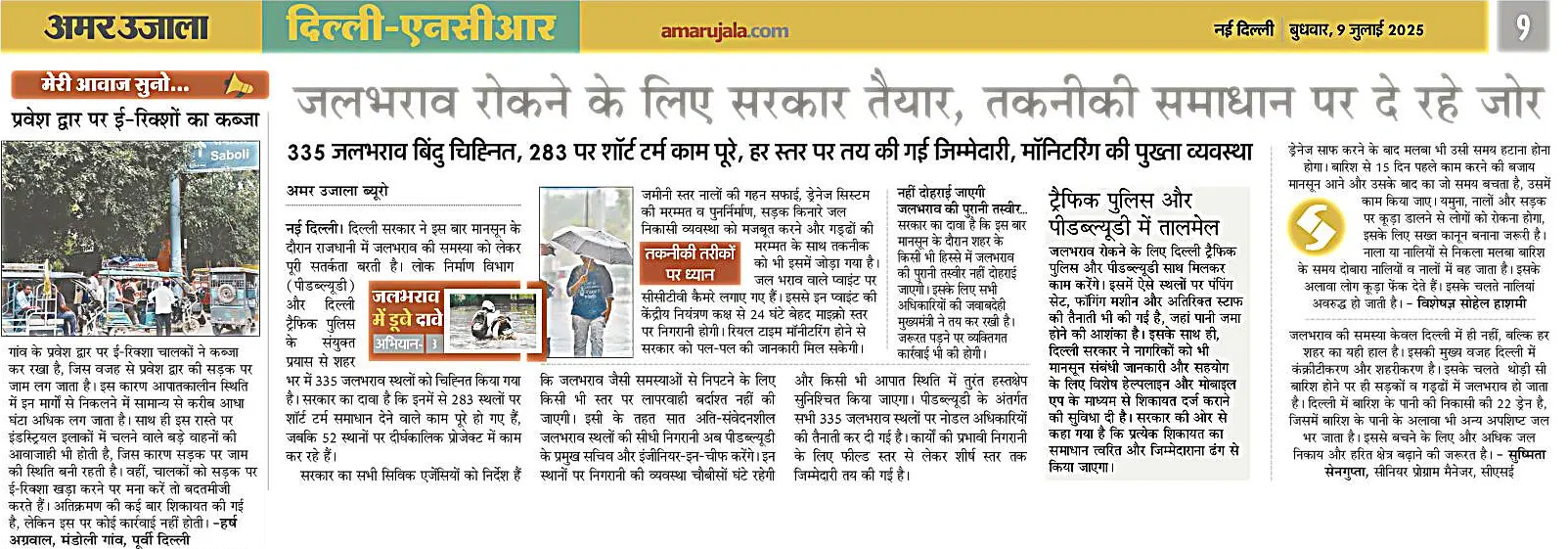
सेंटर फॉर साइंस एंड एनवायरनमेंट (सीएसई) के अध्ययन के अनुसार, राजधानी के ड्रेनेज सिस्टम का डिजाइन पुराना है और यह आधुनिक शहरीकरण और जलवायु परिवर्तन के कारण होने वाली तीव्र बारिश का सामना नहीं कर पाता। भारी बारिश के बाद राजधानी की सड़कों पर पानी का जमाव, ट्रैफिक जाम और जनजीवन का ठप होना हर साल की कहानी बन चुका है। शहरी नियोजकों और विशेषज्ञों के अनुसार, पुराना ड्रेनेज सिस्टम अनियोजित शहरीकरण और नालों की खराब स्थिति इसकी प्रमुख वजहें हैं। दिल्ली का ड्रेनेज सिस्टम करीब 50 साल पुराना है, जिसे 1986 में 50 मिमी बारिश को ध्यान में रखकर बनाया गया था। मौजूदा समय दिल्ली की आबादी 2 करोड़ से अधिक है और 2024 में 64 मिमी तक बारिश दर्ज की गई, जो सिस्टम की क्षमता से कहीं ज्यादा है। लोक निर्माण विभाग (पीडब्ल्यूडी) 2064.08 किलोमीटर छोटे-बड़े नालों का प्रबंधन करता है, जो शहर के कुल जल निकासी नेटवर्क का 55 फीसदी है, लेकिन यह भारी बारिश में नाकाम साबित होता रहा है। सेंटर फॉर साइंस एंड एनवायरनमेंट (सीएसई) के अध्ययन के अनुसार, राजधानी के ड्रेनेज सिस्टम का डिजाइन पुराना है और यह आधुनिक शहरीकरण और जलवायु परिवर्तन के कारण होने वाली तीव्र बारिश का सामना नहीं कर पाता। अनियोजित निर्माण और प्राकृतिक जल निकायों पर अतिक्रमण ने स्थिति को और जटिल किया है। विशेषज्ञों का कहना है कि नया ड्रेनेज मास्टर प्लान जरूरी है, लेकिन इसे अभी तक मंजूरी नहीं मिली है। राजधानी में जलभराव की समस्या का एक रोचक पहलू यह भी है कि 1970 के दशक में जब बसों के लिए सड़कों को ऊंचा किया गया था, इससे निचले इलाकों में पानी का जमाव शुरू हुआ, जो धीरे-धीरे एक बड़ी समस्या बन गया। शहरी नियोजक बताते हैं कि सड़कों के डिजाइन में जल निकासी को प्राथमिकता नहीं दी गई, जिसके परिणामस्वरूप नालों का पानी सड़कों पर फैलने लगा। नया ड्रेनेज सिस्टम इसलिए है जरूरी दिल्ली सरकार ने हाल ही में जल बोर्ड को स्वायत्तता प्रदान की है और यमुना की सफाई व नालों के उपचार के लिए कदम उठाए हैं। मुख्यमंत्री रेखा गुप्ता ने मानसून से पहले नालों की सफाई के लिए सख्त निर्देश दिए हैं। हालांकि, विशेषज्ञों का कहना है कि जब तक पुराने ड्रेनेज सिस्टम को पूरी तरह से अपग्रेड नहीं किया जाता, तब तक समस्या का स्थायी समाधान संभव नहीं है। दिल्ली का जलभराव संकट पुराने ड्रेनेज सिस्टम, अनियोजित शहरीकरण और प्राकृतिक जल निकायों के क्षरण का परिणाम है। विशेषज्ञों और सीएसई जैसे संगठनों के अध्ययन इस बात पर जोर देते हैं कि आधुनिक ड्रेनेज सिस्टम, रेनवाटर हार्वेस्टिंग और बेहतर शहरी नियोजन ही इस समस्या का समाधान हो सकता है। सरकार के ताजा प्रयास उम्मीद जगाते हैं, लेकिन जमीनी स्तर पर अमल और समयबद्ध कार्यान्वयन ही दिल्ली को जलभराव से मुक्ति दिला सकता है। सीएसई के विशेषज्ञों का कहना है कि नालों की सफाई के साथ-साथ टिकाऊ शहरी ड्रेनेज सिस्टम जैसे उपायों की जरूरत है। लंदन और न्यूयॉर्क जैसे शहरों में रेन गार्डन्स और परमिएबल सतहों का उपयोग कर बाढ़ को प्रभावी ढंग से नियंत्रित किया जाता है। दिल्ली में ऐसी प्रणालियों को लागू करने की दिशा में अभी बहुत काम बाकी है। शहर की जल निकासी प्रणाली को दुरुस्त करने की जरूरत है। दिल्ली का ड्रेनेज सिस्टम पुराना है। इसे ठीक करने के साथ ही नालियों पर अतिक्रमण को हटाया जाए और इसकी सफाई ठीक तरह से हो। नालियों में सीवेज व कोई ठोस अपशिष्ट जाने की अनुमति न हो और बरसाती पानी सीवर सिस्टम में नहीं बहाया जाना चाहिए। यमुना नदी के बाढ़ क्षेत्र पर भी अतिक्रमण है। सभी जल निकासी के चैनल एक बॉटलनेक हो गए हैं।
According to a report by the Centre for Science and Environment (CSE), up to 30% of traffic congestion in Indian cities is caused by vehicles searching for parking. This figure may seem surprising until one experiences the frantic loops around Connaught Place in Delhi or the MG Road stretch in Pune during rush hours. It’s a problem hiding in plain sight, yet one that continues to drain people of time, energy, and mental peace. In urban India, where rapid urbanization collides with inadequate infrastructure, parking has become a daily battlefield. From the honking chaos of Delhi to the cramped lanes of Mumbai and the bustling bylanes of Bangalore, finding a parking spot in crowded areas is more than just a logistical hassle—it’s a major source of stress for millions of citizens. The Everyday Parking Struggle For most people living in metro cities, the hunt for parking space is a routine ordeal. Office-goers spend precious minutes circling blocks. Shoppers abandon visits to their favourite markets due to fear of not finding a spot. Residents park their cars far from home, constantly worried about theft or damage. According to a report by the Centre for Science and Environment (CSE), up to 30% of traffic congestion in Indian cities is caused by vehicles searching for parking. This figure may seem surprising until one experiences the frantic loops around Connaught Place in Delhi or the MG Road stretch in Pune during rush hours. It’s a problem hiding in plain sight, yet one that continues to drain people of time, energy, and mental peace. Mental Health: The Invisible Toll While the physical consequences of poor parking infrastructure are widely discussed—like traffic jams and air pollution—the psychological impact is often overlooked. A 2021 study by ResearchGate on urban stress factors found that urban residents exposed to daily traffic and parking stressors report 27% higher anxiety levels than those with smoother commuting experiences. Waiting, uncertainty, and confrontations over parking spaces often lead to heightened cortisol (stress hormone) levels. Over time, this affects mood, sleep, and even interpersonal relationships. Imagine starting your day with a heated altercation over a wrongly parked vehicle or ending it with a tow notice despite parking “just for five minutes.” These small but repeated stressors accumulate, affecting overall mental well-being. Parents dropping children to school, senior citizens visiting hospitals, and small business owners trying to reach clients—all face these daily micro-stress events. In essence, parking is no longer just about space; it’s about dignity, convenience, and emotional bandwidth. The Time Drain The Boston Consulting Group (BCG), in a 2018 report on urban mobility, estimated that drivers in Indian metro cities spend up to 20 minutes per trip looking for parking. Cumulatively, that amounts to 7.5 days per year spent in search of a parking spot! When this lost time is multiplied across millions of drivers daily, the economic and personal cost becomes staggering. For a working professional, this could mean missed meetings. For a delivery executive, it could mean lower earnings. For a parent, it could mean less time with their child. In a society where time is increasingly equated with productivity and success, parking chaos has silently emerged as one of the most time-consuming, non-productive activities in a person’s day. Who Is Most Affected? Middle-class car owners: They often live in buildings without designated parking, facing nightly uncertainty and arguments with neighbors. Women drivers: Safety concerns compound the parking problem, especially during late hours in isolated areas. Gig workers: Cab drivers, delivery agents, and ride-sharing partners often face fines or lose customers due to poor parking availability. Emergency services: Even ambulances and fire engines are frequently delayed due to blocked or congested lanes. Possible Solutions and Tech Interventions Cities around the world have adopted smart parking technologies. Singapore uses real-time parking availability apps, while Tokyo has implemented strict regulations requiring proof of parking before car purchase. In India, startups and civic bodies are beginning to explore digital parking solutions. For example, apps like ParkMate are providing tech-driven solutions for real-time parking space discovery and booking. Municipal corporations in cities like Hyderabad and Indore have piloted smart meters and digital ticketing systems. But these innovations need scale, government backing, and public adoption to make a real difference. A Call for Urban Empathy As cities continue to expand, the importance of inclusive, intelligent urban planning becomes critical. Parking is not a luxury—it’s an essential component of urban life. Solutions must consider not only vehicle volume but also human experience. Multi-level parking systems, community parking bays, digitized mapping, and incentives for off-peak travel can all contribute to easing this urban menace. Most importantly, policymakers and citizens must recognize that parking stress is not trivial. It is a contributor to urban anxiety, lost productivity, and social conflict. The parking crisis in crowded urban areas is far more than just an infrastructure gap—it’s a mental health and time management issue that affects millions daily. As we build smarter cities, we must also aim for emotionally healthier ones. Solving parking problems isn’t just about creating more space—it’s about giving people back peace of mind and the valuable time they deserve.
Gurgaon: Scores of industrial units are operating in the city without environmental permits as authorities struggle to control unchecked pollution in areas already burdened by sewage overflows and encroachment. The Haryana State Pollution Control Board (HSPCB) said in a July 2 right to information (RTI) reply that 281 industrial units in Gurgaon have been granted mandatory environmental consent to operate. Activists allege there are hundreds more industrial units that have been functioning without any approvals. These illegal factories are clustered in and around Basai, Kankrola, Badshapur and Dhanwapur. They operate without basic pollution controls such as effluent treatment systems. "Though the official number is 281, ground reality is far more alarming. In areas like Basai and Kankrola, there are several unauthorised industrial units. These are hotspots of unregulated pollution," said Delhi-based activist Varun Gulati. Most of these units are involved in manufacturing garment and textile, milk packaging, snacks, rubber parts, sealants and synthetic glues. Some of them handle metal scrap, or dismantle electronic waste too. "Many of these industries are ghost operators that don't follow basic rules like effluent treatment. When complaints are filed, they can't be traced," Gulati, who tracks violations in the district, said. The unauthorised units often operate in zones not designated for industry or on the fringes of residential areas, worsening health risks for those living nearby. "Pollution stress in these areas is no longer a hidden issue. It's visible in the water, in the air, and in the rising health risks to nearby communities," said Vivek Kamboj, an environmentalist. Despite multiple complaints, action by pollution control authorities has remained limited to show-cause notices or temporary shutdowns. There is no database to track illegal or unregistered units across the district. "The biggest failure is in enforcement. Pollution control isn't just about paperwork, it's about actually going into these industrial pockets and shutting down operations that poison the environment," said said Shubhansh Tiwari, a research associate at the Centre for Science and Environment. Activists demand that district authorities need to carry out ground-level surveys, satellite-based mapping and real-time inspection systems to track compliance in the rapidly growing city. A senior HSPCB official acknowledged the problem and said the board is aware of illegal units in Basai and Kankrola. "Enforcement drives are being intensified, and action will be taken against units operating without valid consent. No industry has the right to pollute unchecked," the official said.
In today’s Finshots, we tell you why the Central Drugs Standard Control Organisation (CDSCO) wants to ban the manufacture and sale of cosmetics that contain mercury and how, despite existing rules, this toxic metal still sneaks its way into your makeup bag. But before we begin, if you’re someone who loves to keep tabs on what’s happening in the world of business and finance, then hit subscribe if you haven’t already. If you’re already a subscriber or you’re reading this on the app, you can just go ahead and read the story. The Story Back in 2014, the Centre for Science and Environment (CSE) decided to peek into what really goes into our favourite cosmetics. So they tested a bunch of products for heavy metals. And what they found was startling! Out of 32 fairness creams tested for both men and women, 14 of them or about 44%, contained mercury. And 4 had extremely high levels, way beyond what’s allowed under the Indian law today. For context, India actually banned the manufacture and import of any cosmetics containing mercury way back in 1978. A small exception for eye-area products was added in 1982 (like eyeliners and mascaras, where mercury acts as a preservative to prevent microbial growth around a sensitive area). Yet, despite all this, CSE still found mercury lurking in nearly half the creams they tested. More specific limits were only clearly spelled out in 2020 under the Cosmetics Rules. If a product is meant just for use around the eyes, it can have mercury as a preservative, but the level shouldn’t go above 70 parts per million (ppm). For everything else, mercury is banned outright, except for trace amounts that can’t exceed 1 ppm. And even that has to be unintentional. Sidenote: ppm stands for parts per million — so 1 ppm means 1 part of mercury in a million parts of a product. Now, 4 out of 32 products containing high levels of mercury might not sound catastrophic, until you hear the brands’ names. We’re talking about biggies like Ponds White Beauty, Lotus Herbals Cocofair Cream, Olay Natural White and Aroma Magic Fair Lotion. The kind of brands you’ve probably seen on TV, endorsed by big Bollywood celebrities. Fast forward nearly a decade, and it’s actually hard to tell if things have really improved because CSE hasn’t re-tested these same products. But in 2021, another study by Toxics Link tested 15 skin-whitening creams sold in India. A third of them, all imported from Pakistan, still had mercury levels way above safe limits. The good news though is that none of the Indian made creams in this batch contained mercury. But the not so great news? These were mostly different brands altogether — names like Lotus Herbals White Glow, L’Oréal Paris, VLCC, VCare, Jovees and Himalaya Herbals. So we still don’t really know if those old creams are cleaner now or not, and we probably never will, because mercury doesn’t exactly pop up on a product’s ingredients list. Which makes you wonder — despite all the rules and bans, how do these creams still find their way into your local beauty store and, eventually, your dressing table? Well, before we get to that, let’s shine some light on why manufacturers even bother putting mercury in cosmetics and why traders keep importing them. See, mercury is a weird metal. It behaves like a liquid at room temperature. You’ve probably seen it in those good old thermometers. Once upon a time, it was also used in mirrors and silver fillings in your teeth. Some dentists might still use it today, but the general trend is to phase it out. That’s why modern mirrors are mercury-free, and we mostly use digital thermometers now. The reason is simple. Mercury can be toxic if you get too much of it in your system. And how much is too much? Well, that’s where health authorities step in with something called an Acceptable Daily Intake (ADI). It’s basically the maximum amount of a toxin you can be exposed to every day, over a lifetime, without it messing up your health. But the thing is, we’re already exposed to mercury in other ways like burning coal for electricity, heating or cooking with coal or even eating certain fish. Food standards help keep that in check. To put things in perspective, the FSSAI has set a limit of 0.25 mg/kg for mercury in food products, while the Prevention of Food Adulteration Act caps it at 0.5 ppm in fish and 1 ppm in other foods. But here’s the catch. Some skin whitening creams alone can make up more than 50% of your safe mercury limit. So if you’re slathering them on every day, you could easily cross that line. And once mercury enters your system, it’s bad news. Inorganic mercury in fairness creams can damage your kidneys, cause rashes, skin discolouration or even permanent scarring. It’s also linked to anxiety, depression and nervous system damage. Okay… So if it’s so dangerous, why use it at all? Well, mercury acts as a bleaching agent. It blocks melanin production, making skin look lighter. It’s also used as a preservative in some eye makeup, body lotions and other personal care products. Plus, mercury is cheaper than many safer alternatives. Add to that India’s obsession with fair skin and the massive demand for quick fix whitening products, and you can see why some manufacturers cut corners. Sourcing mercury isn’t rocket science either. You can find chemical suppliers pretty easily, especially in states or regions where checks are weak. So if you’re trying to squeeze out every rupee in profit, using mercury can look pretty tempting. And it’s not just a local problem. Imported products play a big role too. See, the CDSCO (Central Drugs Standard Control Organisation) doesn’t inspect every single batch of cosmetics coming into India. Brands have to register and self-declare their ingredients and toxicity test results. But that’s about it. After that, samples are only randomly checked or if there are complaints. And shopkeepers rarely lose sleep over stocking these products because in an industry worth over $20 billion, the penalty for selling unsafe cosmetics is just ₹20,000 or up to a year in jail. And even that’s rarely enforced. So why worry? Add the boom in e-commerce to the mix, and it’s even easier for shady sellers to deliver banned or unregulated products straight to your doorstep. The Drugs and Cosmetics Act, in its current form, doesn’t even properly cover online cosmetics sales. So there’s a big, convenient loophole for illegal products to slip through. But now, the Drugs Controller General of India (DCGI) — who heads the CDSCO, wants to crack down on this mess once and for all. He wants to enforce strict limits and finally ban the manufacture, sale and import of any cosmetics containing more than 1 ppm of mercury. And, if you’re wondering why the urgency now, it’s because of something we didn’t tell you earlier. India signed an international treaty called the Minamata Convention on Mercury back in 2017. It’s meant to protect human health and the environment from human-caused mercury emissions and releases. And under the agreement, countries had until the end of 2020 to ban these products. But India asked for a five-year extension till 2025. And well… we’re already halfway through 2025, and things still aren’t quite on track. And repeating the same old rules and bans may not fix the problem this time either. So what could actually work? For starters, we could do with better monitoring. Since authorities already know that contaminated products often come from neighbours like Pakistan, Bangladesh and China, why not test them more often?
It’s been a surreal few months; my (our) world is spinning like a top and seems completely out of control. Nothing seems to make sense anymore. It is a strange time, and I say this particularly for the half-a-century people like me who grew up in the post-colonial era and witnessed a world order that was intensely inequitable but still seemed capable of reform. Maybe it was the age of innocence. But we had hope in the global rule of law, even if it was led by powerful global players; we believed that voices of reason would prevail. The United Nations (UN) had a role — even though the Security Council, then and now, was a body that mirrored an inequitable and unfair global power order — but it still stood with the right, against the wrong. There was something to hold on to; something to believe in. As I write this today — forgive me for sounding so dejected — it feels as though the ground has collapsed beneath our feet, and we are lost. Certainly, I cannot comprehend this world order, where countries can take unilateral action to bomb another, regardless of the provocation, and the world stands by, helpless and silent. We hear talk of regime change in another country and brush it off as normal; we ignore large-scale starvation and the massacre of entire peoples. At best, we change the channel because we cannot bear to see it anymore. Our helplessness is complete. This attack on Iran is not just about the rightness or wrongness of the United States (US) or Israel, but about the future of a world order built on rules — agreed upon by the community of nations and then enforced through global institutions. In this case, Iran is a signatory to the Nuclear Non-Proliferation Treaty (NPT), an international agreement against nuclear armaments. The treaty, which came into force in 1970, is widely viewed as a success, with 191 countries as parties accepting that “the proliferation of nuclear weapons would seriously enhance the danger of nuclear war”. As a signatory, Iran is banned from acquiring nuclear weapons. The Vienna-based International Atomic Energy Agency (IAEA) is mandated to ensure compliance with these rules. Iran was under the IAEA’s safeguard system — in fact, given the geopolitics of the region, it had what is widely regarded as the most stringent inspection regime. Under the NPT —and you can argue that this is discriminatory — there are five states recognised as nuclear weapon nations: The US, Russia, the United Kingdom, France, and China. All of them are also permanent members of the UN Security Council. India and Pakistan have declared their nuclear-weapon capability and not signed the NPT, while North Korea has walked out. But what makes this situation even more “surreal” is that Israel, which has called Iran’s nuclear ambitions an existential threat to itself, has never signed the NPT. It is also widely accepted that Israel has a covert nuclear-weapon programme. So, here is one country that is bound by global rules, being attacked by another that openly shuns global rules and institutions. What then does this say for the future of multilateralism or a world order built on order, not disorder? In the IAEA report on Iran in May, its director-general flagged concerns of his inspectors on certain issues, including what it describes as the “rapid accumulation of enriched uranium”. But nowhere does the report say it has evidence that Iran possesses nuclear weapons — those which require countries to enrich uranium to 90-95 per cent. The next step should have been to hold discussions with the party involved and, if necessary, take this matter to the UN Security Council. It cannot be to bomb the country’s nuclear power and other sites, to the extent of jeopardising catastrophic leaks. In all this, we have to ask: Where does this leave the credibility of the IAEA? How can it play the role of ensuring safeguards are maintained across all countries? If all it takes is to use might and brute power to bomb another, then why should countries bother maintaining the niceties of rule of law? The role of the UN and its secretary general is in tatters — reduced to issuing press releases and advice that nobody listens to. We really need to ask why these institutions are not standing their ground and pushing back. Are they so compromised, or have they given up in the face of the aggressive behaviour of some? This is not the way forward for an interdependent world order. I ask this because there is much more at stake here. We know that the threat of climate change is real, and it requires the world to act together. It is a true crisis of the commons — it cannot be solved without the participation of all, and it requires a consensus and trust. A broken world order, with decimated and tarnished global institutions, will not work towards finding a resolution to this and other such global issues. We know that currently might is right, but this macho and belligerent world disorder will not make peace with humans or nature — not one that lasts. The author is at the Centre for Science and Environment. sunita@cseindia.org. X: @sunitanar
Anumita Roychowdhury from CSE joins us to talk about Delhi’s fuel ban, the science behind retiring older vehicles, and whether this policy truly balances public health with everyday realities on the ground. From July 1st onwards, Delhi started enforcing a fuel ban on End-of-Life Vehicles or ELVs. In Delhi, this means diesel vehicles older than 10 years and petrol vehicles older than 15 years. This enforcement drive followed an order from the Commission for Air Quality Management (CAQM) stipulating no fuel for ELVs from July 1. But now, following a public outcry, the Delhi government has written to CAQM asking for this fuel ban to be put on hold “with immediate effect”. The reasons it has cited include “critical operational and infrastructural challenges” and ‘public discontent and outcry”. While the enforcement drive raising a public outcry is understandable, it cannot be denied that Delhi’s air quality has become a year-round emergency which needs counter-measures. How was this decision to ban 10-year-old diesel cars and 15-year-old petrol cars arrived at? Is this a practical policy in a poor country like India where for many, their vehicle is linked to their livelihood? Are there better ways to weed out polluting vehicles? What about retro-fitting older vehicles to make them less polluting? Guest: Anumita Roychowdhury, Executive Director, Research and Advocacy, Centre for Science and Environment, Delhi. Host: G Sampath, Social Affairs Editor, The Hindu Produced and Edited by: Jude Francis Weston Camera & Post-Production Assistance: Manushree Swami
India’s ambitious stride towards a comprehensive National Marine Litter Policy is gaining crucial momentum, yet a recent workshop hosted by the Centre for Science and Environment (CSE) underscored a critical imperative: the policy must decisively address the rampant flow of plastic waste from inland sources into the nation’s waterways. Convening officials from urban development departments, marine researchers, and global plastic experts from June 24-26, 2025, the Coalition of Coastal Cities workshop highlighted that the battle against marine litter must begin far from the coastlines, within India’s cities and rivers, to truly foster zero net carbon, eco-friendly, and equitable urban landscapes. The pervasive challenge of marine litter, overwhelmingly dominated by plastics, was a consistent theme throughout the deliberations. Global characterisation studies estimate plastics constitute 60-80 percent of marine litter, and India is a significant contributor. While discussions explored the nuances between marine litter and marine pollution, the core understanding reaffirmed that mismanaged municipal solid waste, alongside contributions from shipping, industries, tourism, and fishing, are primary conduits for plastic entering the aquatic environment. This necessitates a holistic approach that integrates robust waste management practices across various sectors, extending the focus beyond coastal zones to the very heart of the country’s waste generation. A stark case study from Agra city in Uttar Pradesh vividly illustrated the alarming scale of plastic leakage into inland water bodies. An examination of macro- and microplastic pollution in the Yamuna River revealed how banned single-use plastic items and multilayered packaging, particularly polypropylene, contribute significantly to riverine contamination. The study further exposed critical inefficiencies in existing infrastructure, such as basic iron meshes, which allow massive volumes of plastic debris to flow unimpeded into the Yamuna, especially during periods of high river flow. This underscores the dire need for immediate infrastructural upgrades and more stringent enforcement of plastic waste regulations in urban areas. The Agra study presented a replicable methodology for local governments to establish baselines and monitor the quantum of mismanaged plastic waste entering natural ecosystems via urban drainage networks. Participants advocated for the integration of marine litter indicators into national frameworks like Swachh Survekshan and pressed for the institutionalisation of periodic leakage audits to meticulously track plastic flow into water bodies. The microplastic analysis further complicated the picture, identifying packaging waste, textiles, and tyre wear as dominant sources of microplastic pollution in the Yamuna, stressing the complex and diverse origins of plastic contamination in inland riverine systems. The concluding day of the workshop shifted to the economic dimensions of managing plastic waste, particularly plastic packaging, which accounts for approximately 46 percent of the total plastic waste stream. Discussions scrutinised India’s Extended Producer Responsibility (EPR) framework, focusing on the Central Pollution Control Board’s centralised EPR portal and compliance mechanisms for producers, importers, and brand owners. Concerns were raised regarding the efficacy of certificate-based compliance under EPR, highlighting gaps in ground-level implementation. A detailed cost analysis across varied geographies – plains, coastal zones, islands, and mountainous regions – further revealed how regional characteristics critically influence the logistics and economic viability of effective plastic waste management, demanding tailored policy solutions. The Coalition of Coastal Cities workshop successfully underscored that a comprehensive National Marine Litter Policy for India must intrinsically link coastal protection with inland waste management. It provided a holistic view, from the identification of plastic sources and pathways to the ultimate sinks of mismanaged waste in the marine environment. While significant strides have been made in understanding this multifaceted problem, the collective recognition from the workshop was clear: robust, government-supported data, coupled with sustained inter-sectoral collaboration and a firm commitment to infrastructural enhancement, are not merely desirable but absolutely essential to forge a truly effective policy for a cleaner, healthier, and more sustainable India.
Starting July 1, refuelling of old vehicles (15-year-old petrol and 10-year-old diesel models) has been banned in Delhi to implement the mandate from the Commission for Air Quality Management. However, in the face of public fury, the Delhi government has put this programme on hold, citing “operational and infrastructural challenges”. While the fate of 62 lakh overage vehicles remains uncertain, questions have emerged around the purpose and the method of enforcing such measures for clean air. Why is it necessary to phase out old vehicles — especially old private vehicles? And is a sweeping age-based ban the only answer? Why ageing eets are a concern There is a reasonably strong case for replacing older vehicles with clean and near-zero emissions vehicles. The older vintages were designed under signicantly weaker emission norms and emit far more pollution than those complying with the current Bharat Stage VI (BS VI) emissions standards. For instance, a BS III diesel car — over a decade old in Delhi — emits up to 11 times more particulate matter (PM) than a BS VI vehicle. A very old heavyduty diesel truck meeting BS I norms can spew 36 times more PM than one meeting BS VI norms. Wear and tear only worsen these emissions. This is not fully captured by the current Pollution Under Control (PUC) certication system which relies on idle engine emissions. This method fails to measure pollutants under varied real-world conditions such as acceleration or variable speed of driving. Evidence also shows that a small fraction of vehicles is responsible for a disproportionate share of emissions. For instance, a national estimate by the International Council on Clean Transportation shows that pre-2003 vehicles constituted less than 20% of total vehicles but accounted for nearly half of all vehicular particulate emissions and a third of nitrogen oxide emissions in 2011. The accumulating old eet can thus lock in enormous pollution. A rigorous emissions monitoring system should target such vehicles. That said, even newer vehicles can become high emitters if poorly maintained or malfunctioning. These too must be identied and addressed. There are also material benets to retiring End-ofLife Vehicles (ELVs). A joint report by theInternational Energy Agency and NITI Aayog found that recycling ELVs and recovering critical materials can reduce raw material costs by up to 40%. However, Indiaʼs current recovery rate stands at 70- 75%, well below the global benchmark of 85-95%. Moving beyond age-based bans While the clean-air benets of eet renewal are clear, a standalone and a blanket age-based ban is not a scalable and sustainable strategy. A more eective strategy would combine vehicle age with other indicators such as tness, maintenance, and emissions performance. This can be complemented by targeted age-based bans as needed. The 2021 scrappage policy by the ministry of road transport and highways (MoRTH) denes ELVs as those without valid registration or deemed unt through Automated Testing Stations (ATS). While all commercial vehicles have been mandated to undergo tness tests only in the ATS nationwide, the deadline has been extended. But Delhi can lead by enforcing ATS testing for commercial vehicles. However, stricter ELV criteria and better emissions tracking are also needed for private vehicles. More advanced on-road monitoring, like remote sensing, is needed to go beyond the PUC programme. Emission monitoring machines placed by the roadside can eciently identify the worst polluters. Central rules need to be notied immediately to implement this. The scrappage policy can start with the worst polluters — like old diesel trucks and commercial vehicles — and gradually include other ELVs. To make this work, nancial incentives will be required. The MoRTH policy allows for tax concessions, which states like Delhi have begun using. These can be strengthened with manufacturer buyback schemes and linked to cleaner or electric vehicle purchases to maximise emission gains. It is, however, clear that if tness testing, emissions performance, selective bans with nancial incentives are to serve as viable alternatives to blanket age-based bans, then emissions monitoring must be both advanced and stringent to identify ELVs eectively. Smart on-road monitoring and disclosure mechanisms must be part of the solution. Currently, it is evident from the VAHAN database of MoRTH, that as of July, out of 8.7 lakh vehicles tested in the ATS nationally, only 304 vehicles have been ocially declared as ELVs. Finally, the public outcry over age-based bans also reects a deeper issue: the lack of adequate mass transport options. Delhi needs massive augmentation of public transport and mobility systems, along with vehicle restraint measures like parking management area plans with increased parking pricing, to restrain personal vehicle usage. Roychowdhury is executive director, research and advocacy, Centre for Science and Environment
दिल्ली में एयर पॉल्यूशन का मुद्दा हमेशा से उठता रहा है। यही वजह है कि सरकार और प्रशासन लगातार साफ हवा के लिए जरूरी कदम उठाते रहे हैं। ऐसा ही फैसला लिया गया कि एक जुलाई, 2025 से 15 साल पुरानी पेट्रोल और 10 साल पुरानी डीजल गाड़ियों को पेट्रोल नहीं मिलेगा। हालांकि, अब इस फैसले को होल्ड किया गया है। अनुमिता रॉयचौधरी दिल्ली में पुरानी गाड़ियों पर लगने वाला बैन फिलहाल टल गया है। लेकिन हवा को साफ करने के लिए पुरानी गाड़ियों को हटाने का मुद्दा अभी भी चर्चा का विषय बना हुआ है। एक जुलाई 2025 से दिल्ली में 15 साल पुरानी पेट्रोल और 10 साल पुरानी डीजल गाड़ियों में फ्यूल भरवाने पर रोक लगने वाली थी। यह फैसला कमीशन फॉर एयर क्वालिटी मैनेजमेंट (CAQM) के आदेश पर लिया गया था। हालांकि, लोगों के विरोध को देखते हुए दिल्ली सरकार ने इस फैसले पर फिलहाल रोक लगा दी है। सरकार का कहना है कि अभी इसे लागू करने में दिक्कतें हैं। अभी यह तय नहीं है कि 62 लाख पुरानी गाड़ियों का क्या होगा। लेकिन, इस बात पर सवाल उठ रहे हैं कि क्या पुरानी गाड़ियों को हटाने का यह तरीका सही है? क्या सिर्फ गाड़ियों की उम्र देखकर उन्हें बैन कर देना ही सही है? क्या सिर्फ पुरानी गाड़ियों को हटाने से ही हवा साफ हो जाएगी? पुरानी गाड़ियां क्यों हैं चिंता का विषय? पुरानी गाड़ियों को हटाने और उनकी जगह नई गाड़ियां लाने की बात इसलिए हो रही है क्योंकि पुरानी गाड़ियां ज्यादा प्रदूषण करती हैं। पुराने मॉडल की गाड़ियां जब बनी थीं, तब प्रदूषण के नियम उतने सख्त नहीं थे। ऐसे में वे आज के Bharat Stage VI (BSVI) मानकों वाली गाड़ियों से ज्यादा धुआं छोड़ती हैं। उदाहरण के लिए, एक BS III डीजल कार (जो दिल्ली में 10 साल से ज्यादा पुरानी है) BS-VI गाड़ी के मुकाबले 11 गुना ज्यादा पार्टिकुलेट मैटर (PM) छोड़ती है। PM हवा में मौजूद छोटे-छोटे कण होते हैं जो सांस लेने में दिक्कत करते हैं। इसी तरह एक बहुत पुराना डीजल ट्रक BS-I मानकों का है, वह BS-VI ट्रक के मुकाबले 36 गुना ज्यादा PM छोड़ सकता है। पुरानी गाड़ियों के इंजन कमजोर हो जाते हैं, जिससे वे और भी ज्यादा प्रदूषण करने लगते हैं। गाड़ियों से पॉल्यूशन पर कितना असर अभी जो पॉल्यूशन अंडर कंट्रोल (PUC) सर्टिफिकेट मिलता है, उससे यह सही पता नहीं चल पाता कि गाड़ी कितना प्रदूषण कर रही है। PUC टेस्ट में सिर्फ यह देखा जाता है कि गाड़ी का इंजन धीरे-धीरे चलने पर कितना धुआं छोड़ रहा है। इससे यह पता नहीं चलता कि गाड़ी चलाते समय, जैसे कि तेज रफ्तार में या अलग-अलग स्पीड पर, वह कितना प्रदूषण करती है। किन गाड़ियों पर हो एक्शन कुछ गाड़ियां बहुत ज्यादा प्रदूषण करती हैं। इंटरनेशनल काउंसिल ऑन क्लीन ट्रांसपोर्टेशन के एक अनुमान पर गौर करें तो 2003 से पहले की गाड़ियां कुल गाड़ियों का 20 फीसदी से भी कम थीं। हालांकि, उनसे 2011 में लगभग आधा पार्टिकुलेट मैटर (PM) और एक तिहाई नाइट्रोजन ऑक्साइड का उत्सर्जन होता था। इसलिए पुरानी गाड़ियां ज्यादा प्रदूषण का एक कारण बन सकती हैं। ऐसा नहीं हो इसके लिए एक अच्छा सिस्टम होना चाहिए जो ऐसी गाड़ियों को पहचान सके। यह भी सच है कि नई गाड़ियों की ठीक से मेंटेनेंस नहीं की जाए तो ये भी ज्यादा प्रदूषण कर सकती हैं। खास तौर पर उस समय जब उनकी देखभाल ठीक से न की जाए या उनमें कोई खराबी आ जाए। ऐसी गाड़ियों को भी पहचानना और ठीक करना जरूरी है। पुरानी गाड़ियों को हटाने के फायदे जो गाड़ियां बेकार हो चुकी हैं, ऐसी गाड़ियों स्क्रैप करने से कई फायदे हैं। इंटरनेशनल एनर्जी एजेंसी और नीति आयोग की एक रिपोर्ट के अनुसार, पुरानी गाड़ियों को रीसायकल करके और उनमें से जरूरी चीजें निकालकर कच्चे माल की लागत को 40 फीसदी तक कम किया जा सकता है। हालांकि, भारत में अभी सिर्फ 70-75 फीसदी पुरानी गाड़ियां ही रीसायकल होती हैं, जबकि दुनिया में यह आंकड़ा 85-95 फीसदी है। सिर्फ उम्र के आधार पर बैन लगाना सही नहीं पुरानी गाड़ियों को बदलने से हवा साफ होती है, लेकिन सिर्फ उम्र देखकर गाड़ियों पर बैन लगाना सही नहीं है। यह एक अच्छा तरीका नहीं है। एक बेहतर तरीका यह होगा कि गाड़ी की उम्र के साथ-साथ उसकी फिटनेस, मेंटेनेंस और प्रदूषण की जांच भी की जाए। इसके साथ ही, जरूरत पड़ने पर कुछ खास गाड़ियों पर उम्र के आधार पर बैन लगाया जा सकता है। 2021 में मंत्रालय ने बनाई स्क्रैपेज पॉलिसी 2021 में सड़क परिवहन और राजमार्ग मंत्रालय (MoRTH) ने एक स्क्रैपेज पॉलिसी बनाई थी। इस पॉलिसी के अनुसार, End-of-Life व्हीकल्स (ELV) वे हैं जिनका रजिस्ट्रेशन नहीं है या जो ऑटोमेटेड टेस्टिंग स्टेशन (ATS) में अनफिट पाई जाती हैं। अभी सभी कमर्शियल गाड़ियों को ATS में फिटनेस टेस्ट कराना जरूरी है, लेकिन इसकी आखिरी तारीख आगे बढ़ा दी गई है। दिल्ली सरकार कमर्शियल गाड़ियों के लिए ATS टेस्टिंग को लागू करके इसकी शुरुआत कर सकती है। प्राइवेट गाड़ियों के लिए भी ELV के नियम सख्त होने चाहिए और प्रदूषण की निगरानी बेहतर होनी चाहिए। सरकार को कुछ सख्त कदम उठाना जरूरी PUC प्रोग्राम के अलावा, सड़कों पर चलने वाली गाड़ियों की निगरानी के लिए और भी बेहतर तरीके होने चाहिए। इसके लिए रिमोट सेंसिंग जैसी तकनीक का इस्तेमाल किया जा सकता है। सड़क के किनारे प्रदूषण की जांच वाली मशीनें लगाकर भी ज्यादा पॉल्यूशन करने वाली गाड़ियों को आसानी से पकड़ा जा सकता है। सरकार को इसके लिए जल्द ही नियम बनाने चाहिए। ऐसे शुरू हो गाड़ियों पर बैन की कार्रवाई स्क्रैपेज पॉलिसी की शुरुआत सबसे ज्यादा प्रदूषण करने वाली गाड़ियों से की जा सकती है, जैसे कि पुराने डीजल ट्रक और कमर्शियल गाड़ियां। धीरे-धीरे इसमें दूसरी End-of-Life व्हीकल्स (ELV) को भी शामिल किया जा सकता है। इसे सफल बनाने के लिए लोगों को पैसे देने होंगे। MoRTH की पॉलिसी में टैक्स छूट देने की बात कही गई है, जिसका इस्तेमाल दिल्ली जैसे राज्य कर रहे हैं। इसके साथ ही, गाड़ी बनाने वाली कंपनियां भी पुरानी गाड़ियों को वापस खरीद सकती हैं और नई गाड़ियां खरीदने पर छूट दे सकती हैं। इससे प्रदूषण को कम करने में मदद मिलेगी। स्मार्ट तरीके से व्हीकल्स की निगरानी जरूरी अगर फिटनेस टेस्टिंग, प्रदूषण की जांच और कुछ खास गाड़ियों पर बैन लगाने जैसे तरीकों को अपनाना है, तो प्रदूषण की निगरानी को बेहतर और सख्त करना होगा। ELV को पहचानने के लिए सड़कों पर चलने वाली गाड़ियों की स्मार्ट तरीके से निगरानी करनी होगी और इसकी जानकारी लोगों को देनी होगी। MoRTH के VAHAN डेटाबेस के अनुसार, जुलाई 2025 तक ATS में 8.7 लाख गाड़ियों का टेस्ट हुआ, जिनमें से सिर्फ 304 गाड़ियों को ही ELV घोषित किया गया। गाड़ी बैन पर लोगों का विरोध क्यों? उम्र के आधार पर गाड़ियों पर बैन लगाने का लोग विरोध कर रहे हैं, क्योंकि उनके पास पब्लिक ट्रांसपोर्ट के अच्छे विकल्प नहीं हैं। दिल्ली में पब्लिक ट्रांसपोर्ट को बेहतर बनाना होगा। इसके लिए ज्यादा गाड़ियां चलाने की जरूरत है। इसके साथ ही, पार्किंग की व्यवस्था को भी ठीक करना होगा और पार्किंग की फीस बढ़ानी होगी, ताकि लोग अपनी गाड़ियों का इस्तेमाल कम करें। (अनुमिता रॉयचौधरी, कार्यकारी निदेशक, अनुसंधान और वकालत, सेंटर फॉर साइंस एंड एनवायरनमेंट)
The ambitious Air Pollution Mitigation Plan 2025 launched last month by the BJP-led Delhi government in one of the world’s most polluted cities may fall short on several parameters despite some redeeming features, says a leading environmental activist. Reflecting on the putting on 'hold’ the fuel ban on end-of-life vehicles amid public pressure, which came into effect this week, Shambhavi Shukla of the Centre for Science and Environment (CSE) told this reporter: “In its decades-long campaign on the right to clean air, CSE has never recommended the phase-out of personal vehicles based on age. Instead, we have recommended the improvement of fuel and emission standards for vehicles – from BS-0 in the mid-1990s to BS-6 introduction in 2020.” Of the multi-pollutants that have turned the national capital into a living hell, vehicular pollution is right at the top. The Delhi government said that only BS-VI vehicles, CNG vehicles, and electric vehicles will be allowed entry into the Union territory after November 1, 2025. This feature will not apply to vehicles already registered in Delhi, but would apply to commercial vehicles—large, medium, and heavy goods vehicles.
The ambitious Air Pollution Mitigation Plan 2025 launched last month by the BJP-led Delhi government in one of the world's most polluted cities may fall short on several parameters despite some redeeming features, says a leading environmental activist. Reflecting on the putting on 'hold' the fuel ban on end-of-life vehicles amid public pressure, which came into effect this week, Shambhavi Shukla of the Centre for Science and Environment (CSE) told this reporter:“In its decades-long campaign on the right to clean air, CSE has never recommended the phase-out of personal vehicles based on age. Instead, we have recommended the improvement of fuel and emission standards for vehicles – from BS-0 in the mid-1990s to BS-6 introduction in 2020.”