
Cse In News

Delhi Govt's BIG Decision To Mitigate Air Pollution: Anti-Smog Guns Now Mandatory For High-Rise Buildings, Hotels, Malls

Delhi Chief Minister Rekha Gupta on Tuesday launched Air Pollution Mitigation Plan 2025 and announced major steps to mitigate air pollution - mandating installation of anti-smog guns on high-rise commercial buildings in the capital - particularly those above 3,000 metres like malls, hotels, and office complexes. The government also directed for mist sprayers to be installed in 13 air pollution hotspots in the capital, along with the entry of only BS-VI, EVs, CNG vehicles from November 1. Cameras to detect end-of-life vehicles Chief Minister Rekha Gupta added that the government plans to install ANPR (Automatic Number Plate Recognition) cameras at all entry points to Delhi, and petrol pumps to detect end-of-life vehicles contributing to pollution. Also Read | Delhi CM Rekha Gupta announces stricter pollution control measures The ANPR cameras will automatically identify such vehicles, enabling authorities to take immediate action to trace and stop them from operating within the capital. Delhi's air pollution woes Delhi consistently ranks among the most polluted cities in the world , with PM2.5 levels often exceeding safe limits, especially during winter. New Delhi, May 23 (ANI): An anti-smog gun on a multi-purpose vehicle sprays water droplets to curb air pollution, at South block on Raisina Hills in New Delhi on Friday. (ANI Photo/Jitender Gupta) Also Read | Delhi Air Pollution: CAQM invokes Stage I of GRAP with immediate effect According to a report by the Centre for Science and Environment (CSE), Delhi experienced approximately 121 days where the air quality met the national standards, a decline from 152 days in 2023. Delhi to have first artificial rain through cloud seeding As part of the Air Pollution Mitigation Plan 2025, Delhi CM further announced that the government will collaborate with leading scientific institutions to combat pollution using cutting-edge technologies.

City cyclists urge CM to lift ban on cycling

Cyclists in Kolkata rallied behind chief minister Mamata Banerjee, hailing her visionary Sabuj Sathi scheme that distributed over 1.15 crore bicycles to girl students across Bengal. In a heartfelt open letter, cycling enthusiasts and advocacy groups appealed to the CM to go a step further by lifting restrictions on bicycle use across city roads and formally recognising cycles as a legitimate, non-polluting mode of transport in the urban mobility landscape. The appeal comes amidst growing concern over police-imposed restrictions that prohibit cyclists from using several arterial roads in Kolkata. These curbs, according to the letter jointly signed by organisations, including Kolkata Cycle Samaj, BYCS, Cyclology India, Nagarik Mancha, and Sabuj Mancha, run counter to the spirit of Sabuj Sathi, a scheme globally recognised for its environmental and social impact. "Bicycles are not a problem—they are the solution," reads the letter. "The ban on cycles contradicts the CM's pioneering vision, and it disproportionately harms livelihood cyclists who rely on this humble, sustainable vehicle to support their families." Recent studies back the cyclists' claim. A speed-mapping analysis found cycles outperforming motor vehicles on 60% of Kolkata's congested corridors. In high-traffic zones like Tollygunge Phari, cycles matched or exceeded the average bus and car speeds during peak hours. Health and mobility experts are echoing the urgency of policy change. "Kolkata has already made strides by integrating non-motorised transport into its mobility plans," said Anumita Roychowdhury, a mobility expert from CSE. "The next big leap is implementation—designing our cities for people, not just cars." The Sabuj Sathi initiative, implemented by the West Bengal SC/ST Development and Finance Corporation, not only empowered students but also made a substantial dent in the state's carbon footprint. According to data from the West Bengal Pollution Control Board, Sabuj Sathi cyclists saved nearly 8.4 million tonnes of CO₂ between 2013 and 2022—valued at over Rs 750 crore in climate benefits. Despite having one of the highest rates of walking and cycling commutes among Indian cities, Kolkata lags in infrastructure. Cycle parking at metro hubs, protected bike lanes, and designated corridors are either missing or inadequate. "Kolkata's compact layout makes it ideal for cycling," said Satanjib Gupta, bicycle mayor of Kolkata. "It's time we stop penalising cyclists and instead invest in making streets safer and more inclusive." Christopher Gerber, Ajay Mittal, Inspector Prosenjit Chakraborty of Kolkata Police, and others pointed to promising examples across Indian cities like Chennai, where 40% of streets are earmarked for walking and cycling, with Rs 200 crore allocated for NMT in 2025. Pune, where 15% of the transport budget is for NMT, integrates public bicycle sharing with bus networks. Bengaluru, where Safe School Zones and dedicated cycle corridors are underway.Advocates say Kolkata now stands at a crossroads—quite literally. "This is a choice between choking in traffic or moving towards a healthier, accessible, and more breathable city," said Sanjiv Gopal from Asar. "Cycling must no longer be treated as an afterthought in policy and planning."

अंबिकापुर बना भारत का पहला ज़ीरो डंपसाइट शहर…वायु प्रदूषण नियंत्रण में पेश की नई मिसाल…

राष्ट्रीय स्वच्छ वायु कार्यक्रम (NCAP) के तहत सेंटर फॉर साइंस एंड एनवायरनमेंट (CSE) द्वारा की गई ताज़ा समीक्षा रिपोर्ट में अंबिकापुर शहर को एक बेहतरीन उदाहरण के रूप में प्रस्तुत किया गया है, जिसने ठोस अपशिष्ट प्रबंधन के जरिए न केवल पर्यावरणीय बल्कि सामाजिक और आर्थिक सुधार भी हासिल किए हैं। छत्तीसगढ़ के सरगुजा ज़िले का मुख्यालय अंबिकापुर, जिसकी आबादी 2.25 लाख से अधिक है, आज देश का पहला “ज़ीरो डंपसाइट” शहर बन गया (Ambikapur Waste Management Model)है। कभी कचरे के ढेर, जलते डंपसाइट और खुले में कचरा फेंकने की समस्याओं से जूझने वाला यह शहर, अब अपने सुदृढ़ और समुदाय-आधारित अपशिष्ट प्रबंधन मॉडल के लिए पूरे देश में जाना जाता है।

सार्वजनिक स्वास्थ्य और उपभोक्ता संगठनों ने चीनी, नमक की अधिकता वाले खाद्य उत्पादों पर चेतावनी लेबल लगाने का किया आह्वान

भारत के 29 प्रमुख सार्वजनिक स्वास्थ्य और उपभोक्ता संगठनों के गठबंधन ने मंगलवार को केंद्र सरकार से चीनी, नमक और संतृप्त वसा (HFSS) की अधिकता वाले पहले से पैक किए गए खाद्य और पेय उत्पादों पर पैक के सामने चेतावनी लेबल लगाने का आग्रह किया। प्रमुख सार्वजनिक स्वास्थ्य नेताओं ने HFSS और अल्ट्रा-प्रोसेस्ड फूड (UPF) उत्पादों से उत्पन्न स्वास्थ्य जोखिमों के बढ़ते सबूतों पर प्रतिक्रिया व्यक्त करते हुए चेतावनी लेबल लगाने का आह्वान किया। भारत के सार्वजनिक स्वास्थ्य परिदृश्य में लंबे समय से आवाज़ उठाने वाले पब्लिक हेल्थ फाउंडेशन ऑफ इंडिया (PHFI) के मानद प्रतिष्ठित प्रोफेसर और सद्भावना राजदूत प्रोफेसर के. श्रीनाथ रेड्डी ने कहा, भारत गैर-संचारी रोगों (NCD) के बढ़ने और बच्चों के विपणन लक्ष्य बनने तक इंतज़ार नहीं कर सकता। उन्होंने कहा, चेतावनी लेबल सरल, प्रभावी और साक्ष्य-आधारित हैं। न्यूट्रिशन एडवोकेसी इन पब्लिक इंटरेस्ट (एनएपीआई) द्वारा शुरू किए गए नीति वक्तव्य को पीएचएफआई, सेंटर फॉर साइंस एंड एनवायरनमेंट (सीएसई), इंडियन पब्लिक हेल्थ एसोसिएशन (आईपीएचए), कंज्यूमर वॉयस और डायबिटीज इंडिया सहित 28 संगठनों द्वारा समर्थन दिया गया है। किडनी वॉरियर्स जैसे रोगी समूहों ने भी इस वक्तव्य का समर्थन किया है। स्वतंत्र चिकित्सा विशेषज्ञों, बाल रोग विशेषज्ञों और पोषण विशेषज्ञों से मिलकर बने पोषण पर एक राष्ट्रीय थिंक-टैंक एनएपीआई के संयोजक डॉ. अरुण गुप्ता ने कहा, अनिवार्य चेतावनी लेबल के बिना, जनता अंधेरे में रहती है। उद्योग के हितों को बच्चों के स्वास्थ्य के अधिकार पर हावी नहीं होना चाहिए। आर्थिक सर्वेक्षण का हवाला देते हुए उन्होंने कहा, विश्व स्तर पर, स्व-नियमन अप्रभावी रहा है। सख्त फ्रंट-ऑफ-पैक लेबलिंग नियमों की आवश्यकता है और उन्हें लागू किया जाना चाहिए। सुप्रीम कोर्ट ने भी हाल ही में भ्रामक और अपर्याप्त खाद्य लेबलिंग प्रथाओं पर चिंता व्यक्त की है। अप्रैल में अपने आदेश में सर्वोच्च न्यायालय ने केंद्र को तीन महीने के भीतर 2022 के मसौदा विनियमन में संशोधन करने का निर्देश दिया था, जिसमें कहा गया था कि खाद्य पैकेटों पर “कोई जानकारी नहीं है। भारतीय आयुर्विज्ञान अनुसंधान परिषद-राष्ट्रीय पोषण संस्थान (ICMR-NIN) के दिशा-निर्देशों के अनुसार, 2024 HFSS खाद्य पदार्थों को ऐसे खाद्य पदार्थों या आहार के रूप में परिभाषित किया गया है, जो अतिरिक्त वसा, चीनी या नमक के लिए अनुशंसित सीमा से अधिक हैं। बयान में कहा गया है कि, ये खाद्य पदार्थ आमतौर पर ऊर्जा से भरपूर होते हैं, सूक्ष्म पोषक तत्वों और फाइबर में कम होते हैं, और मोटापे, मधुमेह, उच्च रक्तचाप और हृदय रोग जैसे एनसीडी के बढ़ते जोखिम से जुड़े होते हैं। एनएपीआई ने आगे कहा कि, प्रधानमंत्री नरेंद्र मोदी ने अपने मन की बात संबोधन में बच्चों के बीच चीनी की खपत, वे कितना खा रहे हैं और उन्हें आदर्श रूप से क्या खाना चाहिए, इस बारे में जागरूकता बढ़ाने की महत्वपूर्ण आवश्यकता पर जोर दिया। इस साल की शुरुआत में भी, प्रधान मंत्री ने भारत में मोटापे के संकट से निपटने के लिए वसा की खपत को कम करने पर जोर दिया था। उन्होंने सुझाव दिया था कि इस तरह की जागरूकता उन्हें स्वस्थ विकल्पों की ओर ले जाएगी। उन्होंने कहा कि, HFSS उत्पादों पर चेतावनी लेबल बिल्कुल यही करते हैं। सार्वजनिक स्वास्थ्य संगठनों ने कहा कि, HFSS खाद्य उत्पादों पर चेतावनी लेबल समय की मांग है क्योंकि भारत में गैर-संचारी रोगों और उनसे संबंधित असामयिक मौतों में खतरनाक वृद्धि देखी जा रही है। राष्ट्रीय आंकड़ों के अनुसार, 28% वयस्क अधिक वजन वाले या मोटे हैं, जबकि चार में से एक वयस्क मधुमेह या प्री-डायबिटिक है। चिंताजनक रूप से, 10-19 वर्ष के 10% बच्चे प्री-डायबिटिक हैं। नीति वक्तव्य में कहा गया है की, बच्चे चीनी और नमक से भरपूर पैकेज्ड खाद्य पदार्थों का अधिक मात्रा में सेवन कर रहे हैं, जिससे बचपन में मोटापा बढ़ रहा है। सभी मौतों में से 54% अस्वास्थ्यकर आहार से जुड़ी हैं। वरिष्ठ संवैधानिक विशेषज्ञ, सुप्रीम कोर्ट के वरिष्ठ अधिवक्ता राजीव धवन ने कहा, सभी प्री-पैकेज्ड खाद्य उत्पादों पर उचित और सटीक लेबलिंग न केवल उपभोक्ता संरक्षण और जानने का अधिकार है, बल्कि यह स्वास्थ्य और जीवन के अधिकार का हिस्सा है।

Good Practices In Clean Air Action

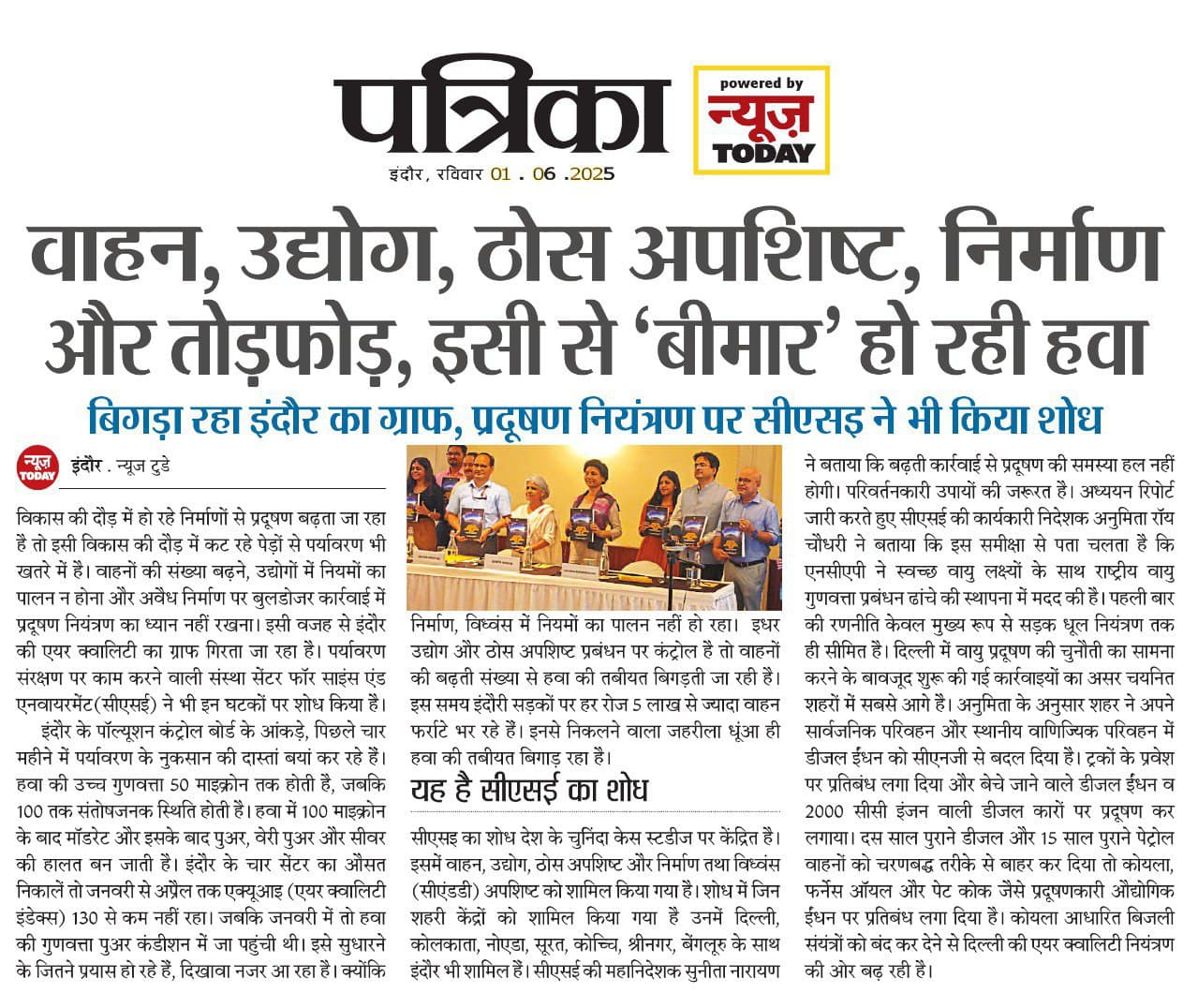
More than five years since the launch of its National Clean Air Programme (NCAP), a new review by the Centre for Science and Environment (CSE) has noted progress as well as persistent gaps in the country’s fight against air pollution menace. CSE’s latest report, Driving Clean Air Action under NCAP, released today, on May 29, at a national conference in New Delhi, evaluates the on-ground implementation of clean air measures in various Indian cities. Focusing on vehicles, industries, solid waste, and construction and demolition (C&D) waste, the report uses case studies from cities including Delhi, Kolkata, Noida, Surat, Indore, Kochi, Srinagar and Bengaluru. "Clean air action needs to be taken sector by sector and within each sector, we need game changers," saidSunitaNarain, Director General of CSE, addressing the conference. “Incremental action will not solve the pollution problem. We need transformational measures," Narain added.

A Gap Too Loud: Damaged Barriers Fail To Screen Noise, Turn Eyesore

Experts point out that it's a serious pollution issue too. Vivek Chattopadhyay, principal programme manager (Clean air and sustainable mobility), Centre for Science and Environment, said, "For all public infrastructure, SOPs, responsibility and action taken reports should be part of the regular activity. So, noise barrier installation must be addressed on a priority basis because persistent traffic noise is a major pollution issue and affects residential areas, schools, hospitals and even other commuters. Creating and installing them should always be accompanied by an SOP and maintenance protocol along with accountable agencies." To protect people living along the flyovers on Outer Ring Road from the constant noise of passing traffic, particularly at night when heavy trucks rumble along this route, noise barriers were installed a few years back. Due to lack of maintenance, huge gaps are now visible in what was supposed to be an impregnable wall that would block the sound. Sections have either disappeared or are damaged. Besides being an eyesore, these barriers are no longer serving their purpose. If any visitor to the city drives down this route, after landing at Delhi airport, the experience can hardly be pleasing to the senses. His cab will cross a series of flyovers that have these fractured noise barriers installed on both sides looking quite grim. The Rao Tula Ram, Munirka and Africa Avenue flyovers now have empty frames at many places and sheets that are coming off, flapping dangerously when the wind blows. Installing these barriers along both sides of the flyover had, according to one estimate, cost around Rs 40–50 lakh, said a PWD source. "Theft is the biggest problem. People steal the sheets and railings, anything they can sell. Storms too inflict a lot of damage. We try to replace them when we can. PWD is always keen on maintaining aesthetics and we will undertake repairs on this stretch soon," said the source. Residents say they have been waiting for this to happen. "It's not just the noise. If you're driving from the airport at night, the headlights from the RTR flyover, which is at a height, shine straight into your eyes," said Jaspreet, a Vasant Vihar resident. "Our homes shake when heavy trucks pass by. It's like sleeping on a railway track," added Suresh Goel of the Vasant Vihar Federation of RWAs. Another resident added: "The sound levels are high and cause noise pollution. Opening windows is impossible and using open areas at our home not feasible." Dr Nasim Akhtar, chief scientist at Central Road Research Institute (CRRI), says the so-called "noise barriers" are mostly just "view-cutters" and don't do the job of reducing noise anyway. "These are not proper barriers," he says. "For a noise barrier to be effective, you need two things: strong columns or posts that can hold the structure, much like a photo frame, and high-quality panels (which is the photo itself) that can absorb or reflect sound. If the columns are weak, the barriers can't last. That's why you see them breaking so often. Even when they are installed, they don't reduce noise properly, which means high maintenance costs." He added that CRRI had provided the design for noise barriers on five flyovers (Madhuban Chowk to Mukarba Chowk, Mangolpuri to Mukarba Chowk, Prembari to Azadpur, Vikaspuri to Meera Bagh and Vasant Vihar) which guarantees that the structure would remain in place for at least 20 years. "But that hasn't been implemented yet. The focus should be on proper design," he emphasized. Dr Akhtar pointed out that PWD uses multiwall polycarbonate sheets for the barriers. While this material is often used for soundproofing walls, it's not the best choice. The ideal material, according to him, is PMMA (polymethyl methacrylate), which is stronger, more durable and better at blocking noise. PMMA is a transparent plastic commonly used for sound barriers installed along roads, railway tracks and airports. Experts point out that it's a serious pollution issue too. Vivek Chattopadhyay, principal programme manager (Clean air and sustainable mobility), Centre for Science and Environment, said, "For all public infrastructure, SOPs, responsibility and action taken reports should be part of the regular activity. So, noise barrier installation must be addressed on a priority basis because persistent traffic noise is a major pollution issue and affects residential areas, schools, hospitals and even other commuters. Creating and installing them should always be accompanied by an SOP and maintenance protocol along with accountable agencies." He added, "Further, in consultation with CRRI, even more advanced sound-absorbing features, materials and designs should be considered. Also, there should be no unnecessary, habitual honking. Perhaps even noise meters with public displays should be installed at strategic points to make people aware of the safe limits and by how much these are being exceeded; like colour-coded AQI helps people to understand severity."

Climate Colonialism: How the Global South Pays for the North’s Pollution

Sunita Narain, a leading environmentalist from India, in a C2G Talk interview, articulated that climate change is a great equalizer and we have to work together. Floods in Pakistan, heat waves in India, and rising sea levels swallowing Pacific islands are not just natural disasters; they are consequences of a global climate crisis based on centuries of exploitation. The Global North profited from industrialization, but the Global South pays the price. The Global North comprises the world’s wealthier, industrialized countries, predominantly located in North America and Western Europe. The Global South encompasses the developing countries situated throughout Africa, Asia, Latin America, and the Pacific Islands. Although these terms are not strictly geographic, they point to significant economic and political inequalities. Climate colonialism has indeed occurred. It is high time that we start discussing the environmental weaponization in geopolitical conflicts because the climate crisis isn't just environmental anymore; it has become political and more. What is Climate Colonialism? Climate colonialism, a term coined by activists and scholars, refers to the way former colonial powers continue to impose environmental and economic burdens on the Global South. It’s not just about emissions. It’s about who suffers, who profits, and who gets to decide what happens next. The Carbon Brief reports that the U.S. accounts for more than 20% of all carbon emissions up until 1850. The European Union adds another 17% to that total. Most at-risk countries from climate change like Bangladesh, Mozambique, and the Philippines have each contributed less than 1% of the total emissions. The Global North's industrialization was based on resource extraction from colonized territories: coal from India, rubber from the Congo, and oil from the Middle East. These raw materials fueled Western development while leaving the colonies impoverished and with polluted environments. Now, as the climate crisis deepens, formerly colonized nations are being told to cut their emissions, usually without financial or technological support to do so. Sunita Narain, a leading environmentalist from India, in a C2G Talk interview, articulated that climate change is a great equalizer and we have to work together. This is one issue on which the rich cannot bully the poor, and it is also one issue on which the poor cannot not cooperate; so we need both sides. She further added, 'If I look at the costs of why nature-based solutions are becoming so prominent in the mitigation options and in net zero, it is because everybody thinks that there is a huge amount of land available in countries of the developing world, whether it is Africa or India, where you can plant trees at negative cost or at minimal cost. You look at the ranges coming out of Europe which say it is going to be so expensive to plant trees there, but you can do that in Africa. But that African land belongs to somebody, it belongs to some community that needs to get livelihood security from the use of that land. They need to benefit from it. So I think, we are not putting our money where our mouth is.'

Meet The Man Who Quit His Job to Clean the Yamuna River

The scale of the challenge is staggering. In Delhi alone, just two percent of the Yamuna’s stretch accounts for 80 percent of its pollution, largely due to heavily contaminated drains like Najafgarh and Shahdara, according to the Centre for Science and Environment. Every Sunday morning, as the city slows down for the weekend, Pankaj Kumar and his team head to the banks of the Yamuna River at Kalindi Kunj Ghat in Delhi. Gloves on, driven by quiet resolve, they begin their weekly ritual — removing heaps of waste, plastic, and debris from one of India’s most polluted rivers. But for them, this isn’t just about cleaning up garbage — it’s about reviving a dying river. A former corporate professional, Pankaj made a bold choice: he quit his job to dedicate himself full-time to cleaning India’s rivers. He founded ‘Earth Warriors’, a volunteer-driven initiative that not only leads clean-up drives but also investigates the systems responsible for river pollution. What fuels their commitment? The numbers speak for themselves. India generates an estimated 73 billion litres of sewage every day — yet only 28 percent of it is treated. The rest flows untreated into rivers like the Yamuna, polluting the very water bodies that sustain our cities and communities. Realising that clean-ups alone wouldn’t solve the crisis, Earth Warriors expanded their mission. They began inspecting sewage treatment plants across 12 states, filing legal complaints, and pushing civic bodies for accountability. They believe in prevention before cure — highlighting the urgent need to fix broken systems that allow untreated waste to choke our rivers. The scale of the challenge is staggering. In Delhi alone, just two percent of the Yamuna’s stretch accounts for 80 percent of its pollution, largely due to heavily contaminated drains like Najafgarh and Shahdara, according to the Centre for Science and Environment. In cities like Gurugram, unchecked industrial waste from dyeing and chemical units continues to pour into water bodies. Even existing sewage treatment plants often fail to meet basic safety standards.

North Chennai residents fight against proposed waste plant in Kodungaiyur

A report by the Centre for Science and Environment (CSE) in 2018 said that the calorific value of waste in Indian cities ranges from 1,411 kcal/kg to 2,150 kcal/kg, with high moisture content. In contrast, countries such as Sweden, Norway, Germany and the United States have waste with calorific values ranging between 1,900 kcal/kg and 3,800 kcal/kg. Tension is simmering in North Chennai, as the Greater Chennai Corporation refuses to budge on its proposed Waste to Energy plant in Kodungaiyur despite stiff opposition from the residents. This is the first time coordinated protests have taken place against the project, with 8,000 people hitting the streets. The Federation of North Chennai Residents Welfare Association (FNCRWA) has been formed in the backdrop of opposing this project. The residents staged a human chain protest on May 25 against the Greater Chennai Corporation’s (GCC) proposal to build a waste-to-energy plant in Kodungaiyur, a residential area and wetland. The 4.5 km human chain, which stretched from Ezhil Nagar to the Dr Ambedkar Arts College, was organised by civil society organisations, including FNCRWA, Vyasai Thozhargal, Chennai Climate Action Group, and others. The protest also featured GCC councillors from political parties, including the Communist Party of India, Communist Party of India (Marxist), Marumalarchi Dravida Munnetra Kazhagam, Congress, and Viduthalai Chiruthaigal Katchi. Prominent citizens such as S Janakarajan, the president of the South Asia Consortium for Interdisciplinary Water Resources Studies, Carnatic musician and activist TM Krishna and others also took part in the protest. The protesters signed a declaration calling on the government to uphold Article 21 of the Constitution (right to life), citing a threat to public health due to toxins, dioxins, and furans that burning waste at the dumpyard will release. Around 352 acres of land is currently being used for dumping waste in Kodungaiyur. The GCC has proposed a waste-to-energy (WTE) plant here, which will burn a total of 2,100 tonnes of waste and produce 300 MT of fly ash, according to the corporation. However, Chythenyen DK, a researcher on WTE incineration projects, told TNM that the facility would generate an estimated 500-800 MT of ash. The release of toxic gases from the plant is another significant concern for the protestors. “The next generation is growing up with breathing issues, skin disease, and heart issues. My father suffers from asthma. At least the next generation should be protected,” said M Selvi, a resident of Kannadasan Nagar in Kodungaiyur. Even though segregation of waste at the source is a mandatory practice as per GCC’s 2019 Solid Waste Management By-Laws and the Solid Waste Management Rules of 2016, the practice is often lax in the city. Over 7,600 tonnes of garbage is produced every day within GCC limits, of which the Kodungaiyur and Perungudi dumpyards see more than 5,300 tonnes. The waste in these yards is a mixture of household, medical, and construction waste. Currently, the project is in its initial stages. The contract for the project has not been awarded yet, but two bidders – Delhi MSW Solutions and Brij Gopal Construction Co. Private Limited – have expressed interest. According to Chythenyen, the lowest bidder has been identified as Delhi MSW Solutions, a subsidiary company of Ramky Enviro Engineers Limited. The company’s WTE plant in Narela had been fined by the Delhi PCB for excess cancer-causing dioxins and other chemical components. Similarly, Chythenyen says a report filed by the Central Pollution Control Board (CPCB) to the National Green Tribunal (NGT) on April 15, 2024, flags violations in the WTE plant set up by Ramky in the Jawahar Nagar dumping yard in Hyderabad. In fact, in 2021, three of the four WTE plants in Delhi had been fined for gross violation of emission norms. There are also questions of practicality in the setting up of the plant. Waste must have a high calorific value and little moisture for it to be suitable for WTE processing. A report by the Centre for Science and Environment (CSE) in 2018 said that the calorific value of waste in Indian cities ranges from 1,411 kcal/kg to 2,150 kcal/kg, with high moisture content. In contrast, countries such as Sweden, Norway, Germany and the United States have waste with calorific values ranging between 1,900 kcal/kg and 3,800 kcal/kg. An article in the India Development Report (IDR) titled “Waste to energy: Smokescreen or solution?” stated that bottom ash produced as a by-product of the burning could be as high as 30-40% of the total feed of waste burnt. Questions persist regarding the means of disposal of this by-product, as bottom ash often ends up in dump sites, polluting groundwater and soil. Organisations on the ground are well aware of this and have raised the slogan “Kodungaiyur kuppamedum vendam, engale kollum erivilayum vendam.” (We don't want the Kodungaiyur dumpyard or the incinerator.) Why are companies still opening these plants despite such operational difficulties? The IDR report pointed to profit as the main reason. The report said that there are “substantial tipping fees” paid by governments to contractors based on the weight of the waste handled. This means that the companies also prioritise unsegregated waste, which is heavier than segregated waste. “For example, in Indore, the tipping fee is Rs 1,080 per tonne, while in Delhi it is Rs 2,000–2,700. Consider a scenario where a city provides nearly 6,000 tonnes of waste to three private parties daily. Even at Rs 2,000 per tonne per day, this amounts to approximately Rs 1.2 crore. This could be why Delhi, for example, operates four WTE plants, burning close to 5,600 tonnes of waste a day, when only 1,100 tonnes are fit for incineration,” the report observed. An unsegregated waste dump such as Kodungaiyur could well turn out to be lucrative for the contracting companies if the plan goes through. The question of Kodungaiyur is further complicated by its location in a marshland and the waste already dumped there. Sarath, founder of Vyasai Thozhargal, one of the organisations heading the protest, says that the dumpsite was a marshland that lost its characteristics due to 40 years of constant waste dumping. The Captain Cotton Canal, Buckingham Canal, and Otteri Nullah all flow through the region. These water bodies, which join the sea near Ennore, take rainwater away from the city during floods. During high tides, when the sea pushes back, the wetlands take in the water and replenish the groundwater. Therefore, dealing with the dumpyard is a necessity if Chennai is to deal with its flooding problems. “The government is asking us to deal with a ghost by bringing in a bigger demon,” said Sarath. Kodungaiyur is an area with a high flooding probability, and the plan to set up the WTE plant goes against the GCC’s Climate Action Plan directive that waste management facilities are to be set up in low flooding areas. A climate action plan report by the Poovulagin Nanmargal, an environmental civil society organisation, stated that land surface temperatures are the second highest at the waste disposal sites at the Perungudi and Kodungaiyur dump yards after the Chennai airport.

India, a major user of coal power, is making large gains in clean energy adoption. Here is how

The share of solar, wind, small hydro power and biomass in India's electricity generation mix stood at 12%, double what it was in 2014 but still lower than expectations by this time, according to a report by New Delhi-based think-tank, the Centre for Science and Environment. One of the most carbon-polluting countries, India is also making huge efforts to harness the power of the sun, wind and other clean energy sources. Most of the electricity in India, the world's most populous nation, still comes from coal, one of the dirtiest forms of energy. But coal's dominance is dropping, going from 60% of installed power capacity 11 years ago to less than 50% today, according to India's power ministry. At the same time, India had its largest ever addition of clean power in the fiscal year between April 2024 and April of this year, adding 30 gigawatts—enough to power nearly 18 million Indian homes. With a growing middle class and skyrocketing energy needs, how fast India can move away from coal and other fossil fuels, such as gasoline and oil, could have a large impact on global efforts to confront climate change. Here is a snapshot of India's clean energy transition and some of the challenges. Renewable energy is now the most economical option Solar is now half the cost of power from new coal-powered plants. Availability of cheap components and many sunny days each year in India are some reasons experts say installed solar power increased 30 times in the last decade. "Solar power is the cheapest it's ever been," said Ruchita Shah, an energy analyst at climate think-tank Ember. Shah added that dropping costs for energy storage, in the form of batteries, means that renewable power will be the "new normal," even when the sun doesn't shine or the wind doesn't blow. India has nearly 170 gigawatts of renewable energy projects in the pipeline, which are expected to be completed in the next few years. "I have no doubt that India will reach its target of 500 gigawatts by 2030," said Raghav Pachouri, an energy expert at Vasudha Foundation, a New Delhi-based think-tank. Government policies and private investments push renewables Experts say the growth in renewables is being spurred by India's plans to add approximately 50 gigawatts of non-fossil fuel power capacity every year for the next five years and for clean power to provide 50% of the nation's energy by the decade. When burned, fossil fuels let off greenhouse gases like carbon dioxide, the main driver of climate change. A 2022 law that made electricity cheaper for companies choosing to buy clean power, the federal government's recommendation that state utilities buy more renewable power and a 2023 government plan to invest $452 million have all catalyzed investments in renewables. India has the fourth highest amount of clean power installed in the world and government officials said $81 billion has been invested in the renewable energy sector in the last decade. Multiple large-scale renewable power projects have begun operations or are under construction, including one of the world's largest wind and solar power farms. "We've seen domestic manufacturing capacity, at least when it comes to modules for solar panels, increasing," said Madhura Joshi, a senior energy analyst at the European think-tank E3G. Still, renewables are underutilized Despite the rapid growth, challenges persist. While non-fossil fuel sources now comprise 45% of India's total installed capacity, their share in actual electricity generation stood at 24% last year. Coal remains the dominant source, accounting for 75% of electricity generation. The share of solar, wind, small hydro power and biomass in India's electricity generation mix stood at 12%, double what it was in 2014 but still lower than expectations by this time, according to a report by New Delhi-based think-tank, the Centre for Science and Environment. Installed capacity is growing, but power generation from renewables needs to be optimized and integrated effectively into the grid, the report found. At a clean energy crossroads A recent report by the nonprofit clean energy think-tank, RMI, found that electricity demand is expected to triple by 2050—driven by more electric vehicles, air conditioners and industrial growth. Acquiring land for clean energy projects remains a challenge. India also needs to rapidly build robust electricity transmission infrastructure and energy storage facilities to continue increasing clean power capacity. "India is expected to become the world's third-largest economy in a few years, and I think we will need to adopt renewable energy to do this. There is no option for us because fossil fuels can't keep pace" with energy needs, said Deepak Thakur, chief executive officer of Mumbai-based renewable energy company, Mahindra Susten.

India, a major user of coal power, is making large gains in clean energy adoption. Here is how

The share of solar, wind, small hydro power and biomass in India’s electricity generation mix stood at 12%, double what it was in 2014 but still lower than expectations by this time, according to a report by New Delhi-based think-tank, the Centre for Science and Environment. One of the most carbon-polluting countries, India is also making huge efforts to harness the power of the sun, wind and other clean energy sources. Most of the electricity in India, the world’s most populous nation, still comes from coal, one of the dirtiest forms of energy. But coal’s dominance is dropping, going from 60% of installed power capacity 11 years ago to less than 50% today, according to India’s power ministry. At the same time, India had its largest ever addition of clean power in the fiscal year between April 2024 and April of this year, adding 30 gigawatts — enough to power nearly 18 million Indian homes. With a growing middle class and skyrocketing energy needs, how fast India can move away from coal and other fossil fuels, such as gasoline and oil, could have a large impact on global efforts to confront climate change. Here is a snapshot of India’s clean energy transition and some of the challenges. Renewable energy is now the most economical option Employees work on a wind turbine blade at the Adani New Industries Limited in the port town of Mundra in Western India’s Gujarat state, India, Sept. 20, 2023. (AP Photo/Rafiq Maqbool, File) Solar is now half the cost of power from new coal-powered plants. Availability of cheap components and many sunny days each year in India are some reasons experts say installed solar power increased 30 times in the last decade. “Solar power is the cheapest it’s ever been,” said Ruchita Shah, an energy analyst at climate think-tank Ember. Shah added that dropping costs for energy storage, in the form of batteries, means that renewable power will be the “new normal,” even when the sun doesn’t shine or the wind doesn’t blow. Stay up to date with similar stories by signing up to our WhatsApp channel. India has nearly 170 gigawatts of renewable energy projects in the pipeline, which are expected to be completed in the next few years. “I have no doubt that India will reach its target of 500 gigawatts by 2030,” said Raghav Pachouri, an energy expert at Vasudha Foundation, a New Delhi-based think-tank. Government policies and private investments push renewables A car gets charged at an electric vehicle charging station at a residential building parking area in Mumbai, India, July 23, 2024. (AP Photo/Rajanish Kakade, File) Experts say the growth in renewables is being spurred by India’s plans to add approximately 50 gigawatts of non-fossil fuel power capacity every year for the next five years and for clean power to provide 50% of the nation’s energy by the decade. When burned, fossil fuels let off greenhouse gases like carbon dioxide, the main driver of climate change. A 2022 law that made electricity cheaper for companies choosing to buy clean power, the federal government’s recommendation that state utilities buy more renewable power and a 2023 government plan to invest $452 million have all catalyzed investments in renewables. India has the fourth highest amount of clean power installed in the world and government officials said $81 billion has been invested in the renewable energy sector in the last decade. Multiple large-scale renewable power projects have begun operations or are under construction, including one of the world’s largest wind and solar power farms. “We’ve seen domestic manufacturing capacity, at least when it comes to modules for solar panels, increasing,” said Madhura Joshi, a senior energy analyst at the European think-tank E3G. Still, renewables are underutilized Workers of Solar Square carry a panel on the rooftop of a residence in Gurugram on the outskirts of New Delhi, India, Feb. 20, 2024. (AP Photo/Manish Swarup, File) Despite the rapid growth, challenges persist. While non-fossil fuel sources now comprise 45% of India’s total installed capacity, their share in actual electricity generation stood at 24% last year. Coal remains the dominant source, accounting for 75% of electricity generation. The share of solar, wind, small hydro power and biomass in India’s electricity generation mix stood at 12%, double what it was in 2014 but still lower than expectations by this time, according to a report by New Delhi-based think-tank, the Centre for Science and Environment. Installed capacity is growing, but power generation from renewables needs to be optimized and integrated effectively into the grid, the report found. At a clean energy crossroads A recent report by the nonprofit clean energy think-tank, RMI, found that electricity demand is expected to triple by 2050 — driven by more electric vehicles, air conditioners and industrial growth. Acquiring land for clean energy projects remains a challenge. India also needs to rapidly build robust electricity transmission infrastructure and energy storage facilities to continue increasing clean power capacity. “India is expected to become the world’s third-largest economy in a few years, and I think we will need to adopt renewable energy to do this. There is no option for us because fossil fuels can’t keep pace” with energy needs, said Deepak Thakur, chief executive officer of Mumbai-based renewable energy company, Mahindra Susten.

India, a major user of coal power, is making large gains in clean energy adoption. Here is how

The share of solar, wind, small hydro power and biomass in India’s electricity generation mix stood at 12%, double what it was in 2014 but still lower than expectations by this time, according to a report by New Delhi-based think-tank, the Centre for Science and Environment. One of the most carbon-polluting countries, India is also making huge efforts to harness the power of the sun, wind and other clean energy sources. Most of the electricity in India, the world’s most populous nation, still comes from coal, one of the dirtiest forms of energy. But coal’s dominance is dropping, going from 60% of installed power capacity 11 years ago to less than 50% today, according to India’s power ministry. At the same time, India had its largest ever addition of clean power in the fiscal year between April 2024 and April of this year, adding 30 gigawatts — enough to power nearly 18 million Indian homes. With a growing middle class and skyrocketing energy needs, how fast India can move away from coal and other fossil fuels, such as gasoline and oil, could have a large impact on global efforts to confront climate change. Here is a snapshot of India’s clean energy transition and some of the challenges. Solar power is the cheapest it’s ever been,” said Ruchita Shah, an energy analyst at climate think-tank Ember. Shah added that dropping costs for energy storage, in the form of batteries, means that renewable power will be the “new normal,” even when the sun doesn’t shine or the wind doesn’t blow. India has nearly 170 gigawatts of renewable energy projects in the pipeline, which are expected to be completed in the next few years. “I have no doubt that India will reach its target of 500 gigawatts by 2030,” said Raghav Pachouri, an energy expert at Vasudha Foundation, a New Delhi-based think-tank. Experts say the growth in renewables is being spurred by India’s plans to add approximately 50 gigawatts of non-fossil fuel power capacity every year for the next five years and for clean power to provide 50% of the nation’s energy by the decade. When burned, fossil fuels let off greenhouse gases like carbon dioxide, the main driver of climate change. A 2022 law that made electricity cheaper for companies choosing to buy clean power, the federal government’s recommendation that state utilities buy more renewable power and a 2023 government plan to invest $452 million have all catalyzed investments in renewables. India has the fourth highest amount of clean power installed in the world and government officials said $81 billion has been invested in the renewable energy sector in the last decade. Multiple large-scale renewable power projects have begun operations or are under construction, including one of the world’s largest wind and solar power farms. “We’ve seen domestic manufacturing capacity, at least when it comes to modules for solar panels, increasing,” said Madhura Joshi, a senior energy analyst at the European think-tank E3G. The share of solar, wind, small hydro power and biomass in India’s electricity generation mix stood at 12%, double what it was in 2014 but still lower than expectations by this time, according to a report by New Delhi-based think-tank, the Centre for Science and Environment.

India, a major user of coal power, is making large gains in clean energy adoption. Here is how

India — One of the most carbon-polluting countries, India is also making huge efforts to harness the power of the sun, wind and other clean energy sources. Most of the electricity in India, the world’s most populous nation, still comes from coal , one of the dirtiest forms of energy. But coal’s dominance is dropping, going from 60% of installed power capacity 11 years ago to less than 50% today, according to India’s power ministry.

India, a major user of coal power, is making large gains in clean energy adoption. Here is how

The share of solar, wind, small hydro power and biomass in India's electricity generation mix stood at 12%, double what it was in 2014 but still lower than expectations by this time, according to a report by New Delhi-based think-tank, the Centre for Science and Environment. One of the most carbon-polluting countries, India is also making huge efforts to harness the power of the sun, wind and other clean energy sources. Most of the electricity in India, the world's most populous nation, still comes from coal, one of the dirtiest forms of energy. But coal's dominance is dropping, going from 60% of installed power capacity 11 years ago to less than 50% today, according to India's power ministry.