Cse In News

Climate Change and the Future of Farming in Meghalaya

A recent article by Anna Notsu titled ‘A Rain of Blessings’: Rethinking our Future with Water’, brought to light the very intimate connection that rains have to the landscape of Meghalaya and the culture of its people. She mentioned the unprecedented hailstorms in Shillong to the unusually prolonged dry, hot days in East Jaintia and how water, whether too little or too much, has become a topic of everyday conversations in the state. She asks the pertinent question: what will happen if the situation repeats in the future, possibly worsening in the coming years? Looking at the weather pattern of the last few years, it seems her fears are coming true a little too soon. On June 17, 2022, Mawsynram recorded 1,003.6 mm of rainfall in a day, breaking the record it had held since 1940. On the same day, Sohra, also known as Cherrapunjee, recorded the maximum daily rainfall of 972 mm—the highest in 27 years. I accompanied a team from The Wire, a national publication, to Sohrarim on the day these records were broken, documenting the agricultural practices of the Khasis living on the watershed dividing Sohra from Khat-ar Shnong. Strong winds almost blew me off the cliff as I struggled with my umbrella while trying to climb down 3000 steps to the village where the community was waiting for us. Innumerable waterfalls had begun streaming down the steep walls of the watershed, making the entire landscape appear like something out of a movie depicting a magical scene in the Amazon, in search of a lost city or hidden civilization. However, the heavy rainfall had a devastating impact especially on the potato crops elsewhere. Over the next weeks, as I travelled to the different villages on the plateau, I heard the same story repeated by the farmers—crops being destroyed by the strong winds and heavy rainfall. The following year, 2023, was also extreme—but in the opposite direction. Besides the monsoon season (June to September), Meghalaya receives substantial rainfall during the pre-monsoon season, from April to late May. Rainfall during these months is comparable to the monsoon season and is vital for vegetable crops like beans. Any delay in rainfall could have adverse effects on the farmers who are looking to harvest these crops and prepare the field for planting new crops. That year, however, the rains were uncharacteristically very late. I had gone for a workshop with the farmers in West Khasi Hills. But while I waited with my colleagues for the farmers, someone informed us that the farmers could not attend the program. The evening before, the rains had finally arrived, and they immediately went to the fields to prepare the land for sowing crops. Any delay and the entire year could have gone to waste. I learned this lesson again during a visit to a village in Ri Bhoi last month. Around the same time that Anna’s article was published, I accompanied a photographer from National Geographic who was working on a story for Nature’s ‘Where I work’ series. During our interaction with the farmers, they pointed out the dried-up leaves and the widespread pest attacks affecting the bean plants. The delay in rainfall slowed the maturing of the crop and the farmers could not harvest them. Soil temperature was also quite high, delaying the planting of ginger, which is one of the most important cash crops for the community in this village. Near to the village is Bhoirymbong, which is the largest wholesale market for ginger, bringing traders from inside and outside the state. So, any impact on the ginger crop could have had a devastating effect on the local economy and lives of the farmers. Fortunately, rainfall arrived soon afterward, saving the farmers, at least temporarily. The delay in rainfall also has the effect of raising the temperature, whose impact can go beyond desiccating the crops and delay the planting season. In 2023, the temperatures rose sharply and many parts of the state started experiencing heat waves. The temperatures in Garo Hills reached almost 40 degree Celsius, forcing the closure of educational institutes in many parts of the state. I’m already planning to buy a fan for the summer months—something I never imagined would be necessary in Shillong. As an organisation which is working with the revitalisation and strengthening of the Indigenous Peoples Food Systems, NESFAS (North East Society for Agroecology Support) is very concerned with the impact that climate change can have on indigenous peoples. They contributed a case study to the 2024 CSE (Centre for Science and Environment) publication First Food: Future of Taste. In the chapter titled Solace in Diversity, written by NESFAS, farmers in West Khasi Hills reported a trend of decreasing summer rainfall coupled with rising winter temperatures, sparking concerns about potential rice harvest failures in the future. A similar situation is being faced by farmers in Ri Bhoi as well. In Sohra, areas where jhum cultivation is practiced have seen a decline in the yield of jaiing, or black mustard. The central uplands where bun is practised are also experiencing extreme weather, which are affecting the yield of vegetables like cabbages and cauliflower. Farmers in Jaintia Hills have also seen the yield of tuber crops like potato, taro, and especially sohphlang, a local nitrogen-fixing perennial herb, being severely affected by the changing weather. In fact, in 2021 the yield of both potato and sohphlang failed completely in some villages of West Khasi Hills, leaving the farmers with no seeds to plant for the next season. Farmers had to source seeds, either by borrowing or buying them with cash, from neighbouring villages that still had some seeds to spare. The changing climate has also affected foods that the local indigenous community harvests in the forest. Wild vegetables like jamyrdoh (Houttuynia cordata), and jatira (Oenanthe linearis) are an integral part of the local dishes and are highly rich in micronutrients, especially Vitamin K. These are now becoming difficult to find. This appears to be true for wild fruits as well. In the past, people found wild fruits like sohphie (Myrica esculenta) abundantly during April. But now its fruiting season has been getting delayed by more than a month, i.e., May, which coincides with heavy rainfall. This result in a lot of fruits getting damaged, reducing the amount of fruits people can collect. The community is concerned that if this continues, they may not harvest sohphie anymore in the future. Last year, I participated in a stakeholder meeting organized by a firm appointed by the Government of Meghalaya to discuss the ‘Meghalaya Climate Emergency & Green Growth Framework’. According to their press release the government appears to have already prepared the draft, which will eventually become law. I’m unsure if the Assembly passed such a bill. But considering the challenges that the farming community is facing and will face in the coming years because of climate change, such legislation is the need of the hour. All of us will therefore look forward when the discussion happens on such a bill in the Assembly. The time to act is already overdue, and any further delay could have devastating consequences for our farmers. (The views expressed in the article are those of the author and do not reflect in any way his affiliation to any organisation or institution)
Yamuna Needs More Than Money

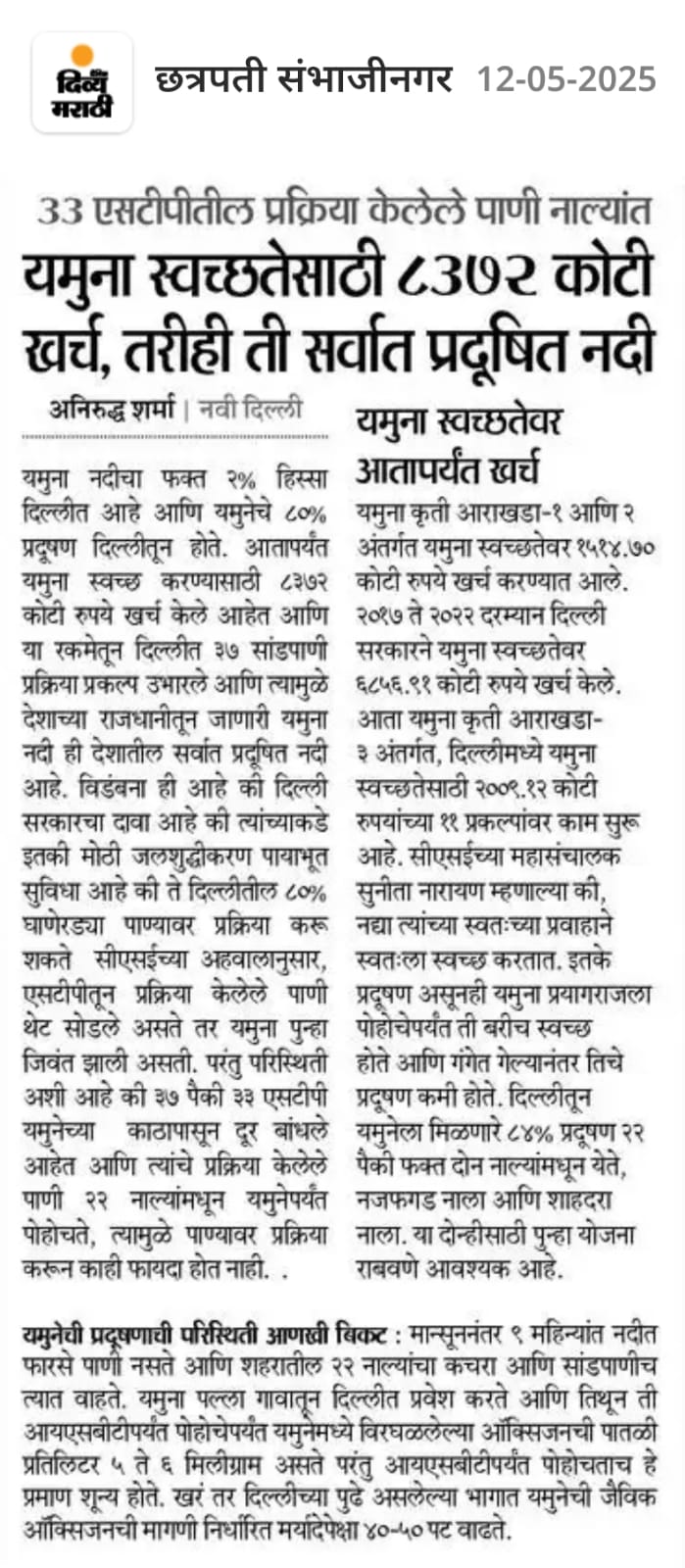
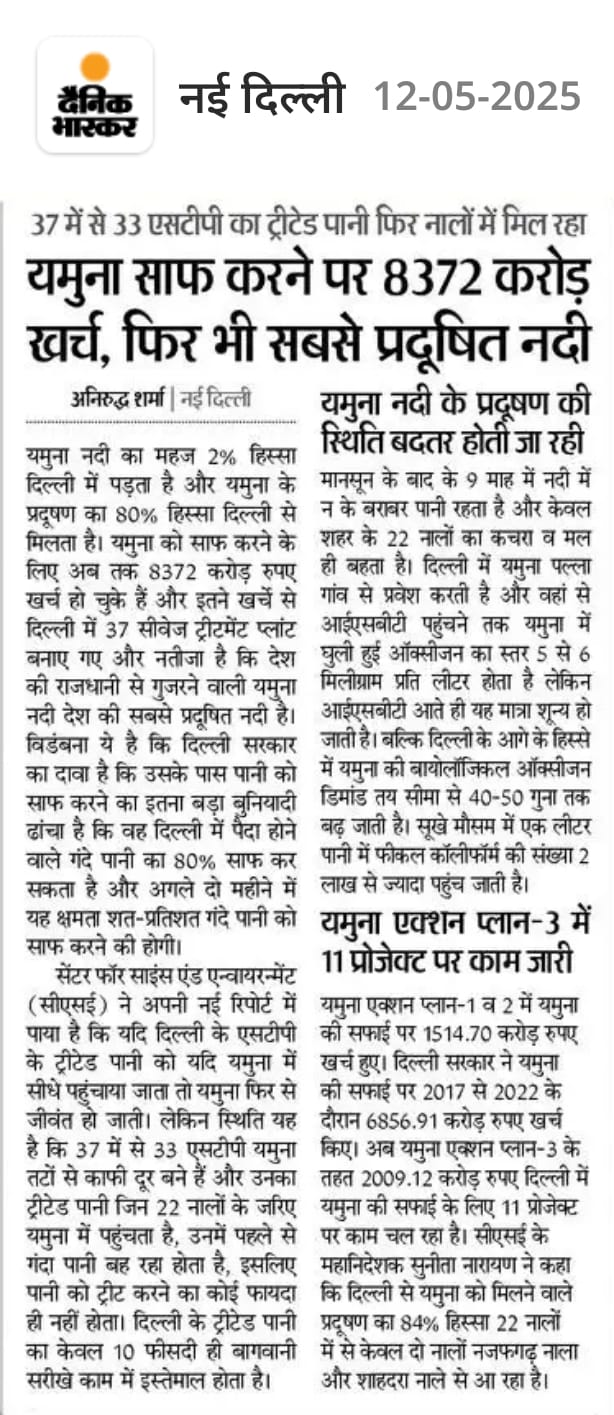
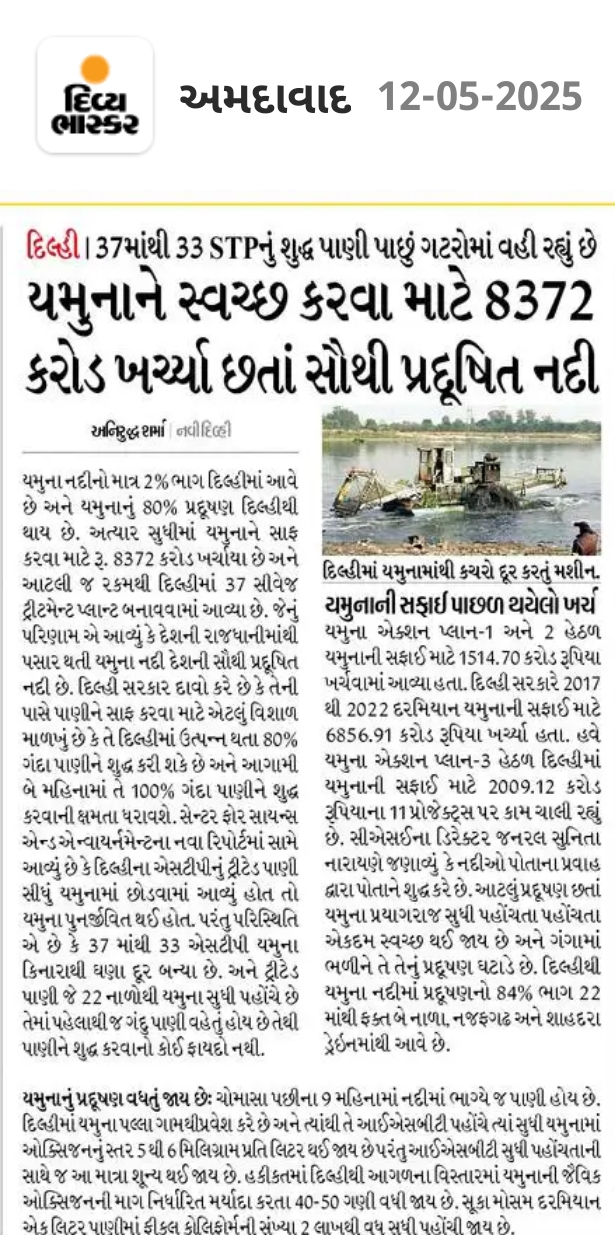
Elections for the Delhi Legislative Assembly have concluded and there is a new party in power. This is the dance of democracy, but this time there was one key difference. When pollsters asked people why they voted against the party in power, the answers threw up issues that we know matter but do not make it to the list. Pollution in the river Yamuna—the 22 km stretch that passes through Delhi—was on top; then came toxic air pollution and garbage. Till now, environmental issues have made it to the manifestos of parties, but this time voters have spoken and hopefully this will make a difference. As the new government gets down to the business of cleaning the Yamuna it must be clear on a few things. One, it is not that the last state government or even the government before the last were not serious about cleaning the Yamuna. All governments have had the intention to clean the river that has become a sewage canal. Huge funds have been spent—both by the Union and state governments. According to an official estimate, Rs 6,500 crore were spent in the four years between 2017 and 2021. This is a massive amount. But it may even be an underestimation, since the funds to clean the river come from different sources and account heads. So, it is not about commitment or funds. Two, there is a plan for cleaning the river and because this is about Delhi, just about every court—from the apex court to National Green Tribunal—has active cases to review this action plan. Every month, a report is prepared diligently by the state government; every month it is filed in court. So it should not be assumed, as the new government takes charge, that nothing has been done or that nobody cared. That rhetoric is good for the pre-election time when parties need to score points. But it is not conducive for the critical and considered steps that are needed now. What needs to be deliberated is that despite this money, the attention and the action plan, nothing has visibly improved in the state of the river. The monthly reports filed by the Delhi Pollution Control Committee show that in most months, the river’s water quality, as it enters the city at Palla or where it draws its water from at Wazirabad, is fairly good. But within a few kilometres of its 22 km journey through Delhi, it dies. By the time water quality is checked at the next monitoring point of Interstate Bus Terminal (ISBT), the dissolved oxygen has gone from the mandated standard of 5 mg/litre to 0; and faecal coliform counts have risen many times. It is important to note that lack of oxygen means that the water has no life. So, we can say the river in Delhi is dead, even if it has not been officially cremated. The fact is, the action plan needs to be re-worked so that it can be impactful. We are not doing things right. This is what needs to be understood. So, what should be the agenda for cleaning the Yamuna? First, there should be focus not just on tracking the building of sewage treatment plants (STPs) but also on the amount of sewage that is in-tercepted and taken for treatment. This means accepting that large areas of Delhi are not connected to underground sewerage systems—the current plan only pays lip service to this. But this ignores the sheer scale of the city that is unconnected to official underground sewerage systems. Here, people have no option but to depend on desludging tankers for septage management. The good news is people are managers of their own sewage. This means, the state does not have to invest in building and refurbishing sewage pipelines and extending them to unconnected areas—whose numbers are growing as cities expand. The key step is to ensure that all desludging tankers are registered; have GPS installed; and a control room is set up to monitor the tanker movement. In addition, it is important that the desludged material is taken to treatment points so that the used water and sludge can be reused. Second, the plan must ensure that “treated” wastewater is not discharged into drains, where it gets mixed with untreated wastewater from un-official areas. The treated effluents need to be completely reused and recycled. Currently, according to the Delhi Economic Survey, less than 10 per cent of treated wastewater is reused. Most STPs are not located at the river front and so, the treated wastewater is discharged into the same drains that carry the untreated sewage to the river. It is no surprise then that there is no real impact on the quality of the water. The action plan must focus on the 22 drains of the city; pollution management is about estimating the quality not only through standards like biological oxygen demand (BOD), but also through the quantum of wastewater. Delhi has to ensure that it has a plan for each drain; and the plan is to reduce the pollution load by intercepting untreated sewage, by not adding treated sewage and finally by treating the remaining wastewater in the drain as close to where it is discharged into the river as possible. Currently, Delhi takes water from the Yamuna and returns sewage to it. Now it must take water and also return water to the river. Only then can the river flow.

Growing human-wildlife conflict calls for strict habitat management measures

Synopsis: There must be a total halt on further destruction of wildlife habitat due to so-called development projects such as dams, railways, multilane highways, power lines, etc., that continue to degrade forest habitat and cut off wildlife corridors and avenues of movement. The forest degradation is mainly due to the rapid expansion of existing metropolises. A trumpeting wild elephant charged at me from 50 yards while I was walking on a track in my coffee plantation in Karnataka’s Kodagu district a mid-morning in November 2020. To escape, I dove for the cover of the coffee bushes to my right and tried to run, but stumbled and fell. As I lay in a fetal position, I could hear the fast-approaching elephant. He could not see me on the ground with his head above the coffee bushes. Trampling my leg, he rushed away with a strange squeak. I felt no pain at the moment. That would come later. With a titanium rod hammered into the bone between ankle and knee, the recovery of the broken leg has been complete, but the scars on the mind will remain. I am now just another statistic under the ‘injured’ column in the data on human-wildlife conflict. But it is only those few of us who have survived a wild animal attack who know the true meaning of ‘conflict’. A few years ago, India celebrated 50 years of Project Tiger. Conservation efforts have boosted the tiger population across the country. But it has also endangered human life. In Kodagu alone, there have been 10 tiger attacks with eight deaths in the past few years. Meanwhile, cattle kills by tigers in Kodagu have exceeded the 300 mark. While an encounter with wild animals is traumatic for humans, it is equally traumatic for wildlife to face attempts to capture them. The process of migration through large areas of human habitation that were once traditional corridors of movement is also extremely stressful, especially for elephants. Wanted: A coordinated effort The only way the species can sustain itself is by migrating to greener pastures during summer for water and fodder through high-risk human zones, crossing high-speed highways, and railway tracks. It is to be understood that elephants under stress are more likely to be aggressive. The Nilgiris Biosphere Reserve and the adjoining elephant reserves of South India cover an area of 12587 square kilometres and have a population of about 11,000 elephants. It is the largest population of Asian elephants in the wild. These forests also have sizable numbers of gaurs, leopards, sloth bears, and tigers that are increasingly coming into conflict with humans. There is a need for a coordinated effort by three states, Karnataka, Kerala, and Tamil Nadu, to draw up a roadmap for improved habitat management of this landscape. Development and degradation of habitats While the elephant population has marginally increased since 1978, there has been a drastic disintegration of elephant habitat and corridors. Hydroelectric projects and dams have swallowed and decimated elephant habitats soon after independence. Subsequently, linear infrastructure projects such as roads, railways, and transmission lines, and a large number of tourist resorts have become major impediments to the easy migration of elephant herds through a landscape that is a mosaic of disconnected forests and agricultural lands. Human fatalities caused by elephants have steadily increased in India, with 545 in 2021-22, 605 in 2022-23, and 629 in 2023-24, as per the analysis by Rajit Sengupta and Kiran Pandey from the Centre for Science and Environment. Meanwhile, the figure for elephant deaths due to electrocution, poisoning, and railway track deaths has exceeded 500 during the past five years. Human-wildlife conflict, more commonly known as human-animal conflict (HAC), is growing by the day. While Kodagu, Hassan, Chickamagalur, and Tumkur are hotspots of conflict in Karnataka, the problem is also acute further south in Kerala and Tamil Nadu. It extends to Maharashtra, Chhattisgarh, Odisha, Assam, and to the foothills of the Himalayas in Uttarakhand, where Down to Earth has reported that several villages in the Pauri district are turning into ‘ghost villages’ after being abandoned by their residents. Many villagers are migrating to urban areas after increased sightings and attacks by leopards. Meanwhile, wild animals are snared, shot, electrocuted, poisoned, and targeted with explosives, causing agonising pain, injury, and death. During the past two decades, HAC has continued to escalate despite continued efforts to mitigate the problem. Why so? The reason is not hard to find.

वैश्विक व्यापार व्यवस्था में अमीरों का प्रतिशोध

अमेरिका के राष्ट्रपति Donald Trump ने इन दिनों वैश्विक वस्तुओं के व्यापार को जोखिम में डाल दिया है। इस वैश्विक व्यापार व्यवस्था में लाए जा रहे नए बदलावों के परिणाम के बारे में बताना असंभव है, जिसके अपने अंतर्संबंधों में ही बेहद जटिलता है। इसे किसी भी देश की आर्थिक वृद्धि और समृद्धि के एकमात्र रणनीतिक खेल के रूप में स्थापित किया गया है। लेकिन यह समझना महत्त्वपूर्ण है कि यह क्यों हुआ, इससे हमारी दुनिया में क्या बदलाव आया है और आगे का रास्ता क्या हो सकता है? सबसे पहले, अतीत पर नजर डालते हैं। यह विचार 1990 के दशक की शुरुआत में आकार लेने लगा, जब उस दुनिया (जिन जगहों पर बड़े पैमाने पर औद्योगीकरण हो रहा था) ने जनरल एग्रीमेंट ऑन टैरिफ ऐंड ट्रेड (गैट) को एक औपचारिक वैश्विक संस्था, विश्व व्यापार संगठन (डब्ल्यूटीओ) के रूप में बदलने का फैसला किया। विचार यह था कि इससे वैश्विक व्यापार को एक मुक्त क्षेत्र में लाया जा सकेगा और व्यापार नियमों का पालन करने की शर्तें सभी पर लागू होंगी। ऐसे में दुनिया एक हो जाएगी। इसका एक और उद्देश्य था जिसने आज की औद्योगिक दुनिया को परेशान कर दिया है। इस बात को समझ लिया गया कि औद्योगीकरण को बढ़ावा देने वाले इन देशों में विनिर्माण की लागत अधिक थी। इसके अलावा, श्रम महंगा था और पर्यावरणीय नियमों की सख्ती की अलग लागत थी। यह वह समय था, जब पहले से ही औद्योगिक विकास करने वाले देशों को स्थानीय वायु प्रदूषण और जल प्रदूषण की समस्या से जूझना पड़ रहा था जिसमें बारिश का पानी अम्लीयता से भरपूर होने के साथ ही नदियों में विषाक्त पदार्थों की समस्या भी बढ़ रही थी। इन देशों को सार्वजनिक स्तर पर व्यापक आक्रोश का सामना करना पड़ा रहा था और ऐसे में उन्होंने वैश्विक व्यापार के नाम पर क्लासिक ‘नॉट इन माय बैकयार्ड’ (निंबी) सिद्धांत लागू किया जो अपने यहां नुकसान पहुंचाने वाले उद्योनगों का विरोध कर दूसरे जगह इसको बढ़ावा देने के सिद्धांत से जुड़ा है। मशहूर अमेरिकी अर्थशास्त्री लैरी समर्स 1992 में विश्व बैंक में थे और वर्ष 2001 में हार्वर्ड विश्वविद्यालय के अध्यक्ष बने। उन्होंने उन दिनों एक आंतरिक टिप्पणी में लिखा, ‘सबसे कम मजदूरी वाले देश में जहरीले कचरे को डंप करना आर्थिक रूप से बेहद तर्कपूर्ण है।’ द इकॉनमिस्ट ने एक शानदार रिपोर्ट ने इसे स्पष्ट रूप रेखांकित करते हुए कहा कि समर्स ने कहा है, ‘प्रदूषण को उनकी खुराक बन जाने दो।’ उनका यह तर्क अनूठा था कि जिन देशों में कम मजदूरी है और जहां नियमन भी कम है उनके साथ व्यापार करना सस्ता पड़ेगा। समर्स ने लिखा कि आप जितने अमीर होंगे, अपने पर्यावरण को उतना ही साफ रखना चाहेंगे और ऐसे में लागत अधिक बढ़ेगी। उन देशों में जहरीले तत्वों के बारे में अधिक सार्वजनिक चिंता जताई जाएगी जहां लोगों का जीवन काल लंबा है और लोगों को प्रोस्टेट कैंसर की संभावना उन देशों की तुलना में ज्यादा होगी जहां पांच साल से कम उम्र में मृत्यु दर प्रत्येक 1000 लोगों में से 200 है। समर्स ने काफी कटु शब्दों का इस्तेमाल किया लेकिन उन्होंने जो कहा वह आर्थिक और व्यापार वैश्वीकरण का प्रमुख कारक था। डब्ल्यूटीओ 1995 में बना और 2001 में चीन इसमें शामिल हुआ। तब से पीछे मुड़कर नहीं देखा गया। असलियत यह है कि वैश्विक विनिर्माण पूरी तरह से औद्योगिक दुनिया के देशों से चीन जैसे देशों और फिर वियतनाम, बांग्लादेश और कंबोडिया में स्थानांतरित हो गया। दरअसल यह पूरी तरह से सबसे कम लागत खोजने की प्रक्रिया रही है यानी जैसे-जैसे नियमन और श्रम की लागत बढ़ती है वैसे ही उद्योग उन नई जगहों की तलाश में जुट जाता है जहां उसे लागत के लिहाज से फायदा हो और सख्त नियमन की दिक्कतें न आएं। हम इसे भारत में भी देखते हैं यानी जैसे ही प्रदूषण नियामक शिकंजा कसता है, उद्योग किसी अनधिकृत बस्ती वाले क्षेत्रों में कामकाज चलाने लगते हैं। इस मुक्त-बाजार वाली दुनिया में, बाजार में प्रतिस्पर्धी बने रहने के लिए श्रम और पर्यावरण की लागत कम करके आंकना पड़ता है। ऐसे में श्रम अधिकारों (बाल श्रम अधिकारों सहित) या पर्यावरण की रक्षा की जरूरत जैसे किसी भी नैतिक बात को छोड़ दें। यह बिल्कुल सही नहीं है। इस वैश्विक व्यापार व्यवस्था के लगभग 25 वर्षों में अब नए विजेता और पराजित देश हैं। 1990 के दशक की शुरुआत में जब डब्ल्यूटीओ के लिए आर्थर डंकल के मसौदा प्रस्ताव को आगे बढ़ाया जा रहा था तब विकासशील देश इसके विरोध में खड़े हो गए थे। उदाहरण के तौर पर भारत में निर्बाध वैश्विक व्यापार के विचार के खिलाफ विरोध प्रदर्शन हुए क्योंकि ऐसा महसूस किया गया था कि इससे सबसे गरीब लोगों, विशेष रूप से किसानों की आजीविका खत्म होगी और इन्हें पश्चिम के औद्योगीकृत बड़े खेतों से आने वाले खाने-पीने के सस्ते सामानों की डंपिंग का सामना करना पड़ेगा। 1999 में जब कई देशों के मंत्री इस नई वैश्विक अर्थव्यवस्था का जश्न मनाने के लिए सिएटल में जुटे तब इस अनियंत्रित वैश्वीकरण के खिलाफ व्यापक रोष देखा गया था। वहां अमीर देशों के प्रदर्शनकारी भी आए थे जो विनिर्माण के पलायन और बेरोजगारी की समस्या से जूझ रहे थे। इसके कारण जलवायु परिवर्तन दूसरी सबसे बड़ी समस्या बनी है। सच तो यह है कि पश्चिमी देशों में उत्सर्जन वास्तव में कभी कम नहीं हुआ बल्कि यह नए उत्पादन स्थलों पर स्थानांतरित हो गया। लेकिन इससे फायदा पाने वालों ने यह सुनिश्चित किया कि इन सभी बातों को छिपा दिया जाए। पश्चिमी देशों की कंपनियां कम आय वाले देशों में जाने लगीं और इन्होंने खूब मुनाफा कमाया। इन देशों में उपभोक्ता (हम सभी) सस्ते सामानों के कारण खुश थे। इन सबके बीच सेवा और प्रौद्योगिकी क्षेत्र में काफी तेजी आई, बैंकों और वित्तीय बाजारों ने खूब पैसा कमाया लेकिन खराब आमदनी-वितरण की नीतियों के कारण लोगों के बीच असमानताएं ज्यादा बढ़ीं। इसका बुलबुला तब फूटा जब ब्रेक्सिट प्रकरण हुआ क्योंकि यह मामला रोजगार से जुड़ा था और जैसा कि मैंने उस वक्त लिखा था यह अमीरों का बदला था। ट्रंप ने अपने पहले कार्यकाल में भी आज जैसी ही संरक्षणवादी और टैरिफ की बातें की लेकिन कोविड की बाधाओं के बीच यह दब गया। अब, जोरदार तरीके से फिर से इसकी वापसी हो गई है। बेशक, वैश्विक व्यापार प्रणाली ने हम सभी को फंसा रखा है। कम मजदूरी वाले देशों को वैश्विक व्यापार से आर्थिक लाभ हुआ है। व्यापार, सेवाओं और वित्त के कारण आपस में जुड़ी इस दुनिया में अलग होने की भारी कीमत चुकानी पड़ेगी। लेकिन यह स्पष्ट है कि कुछ तो बदलना होगा। यह नई व्यापार प्रणाली जो भी स्वरूप लेती है उसके कारण हमारी दुनिया के अधिकांश हिस्सों में सकारात्मक बदलाव आएगा या उसमें गड़बड़ियां होंगी। आगे हम इसका विश्लेषण करते रहेंगे। (लेखिका सेंटर फॉर साइंस ऐंड एन्वायरनमेंट से जुड़ी हैं)

Delhi-NCR में सरकारी गाड़ियों को स्वच्छ ईंधन पर लाने लिए CAQM ने दिया निर्देश, नीति बनाने के लिए भी कहा

इलेक्ट्रिक और हाइब्रिड वाहन, डीजल और पेट्रोल वाहनों की तुलना में बेहतर हैं क्योंकि उनमें स्थानीय प्रदूषण का कारक नहीं होता है। ऐसे वाहनों का अधिक प्रभाव डालने के लिए बदलाव की आवश्यकता है, केवल कुछ वाहन लाने से अधिक प्रभाव नहीं होगा। चीन, अमेरिका और यूरोप में ऐसे वाहन पर्यावरण की बेहतरी में अहम भूमिका निभा रहे हैं। - सुनीता नारायण, महानिदेशक, सेंटर फार साइंस एंड एन्वायरनमेंट (सीएसई) राष्ट्रीय राजधानी क्षेत्र (NCR) में प्रदूषण की रोकथाम के लिए वायु गुणवत्ता प्रबंधन आयोग (CAQM) अब सरकारी महकमों में इस्तेमाल होने वाहनों पर भी ध्यान दे रहा है। CAQM ने सभी एनसीआर के राज्यों की सरकारों को इस संबंध में पुख्ता नीति बनाने का परामर्श दिया है। आयोग ने कहा है कि स्वच्छ ईंधन वाले वाहनों की खरीद अनिवार्य होनी चाहिए। दिल्ली-एनसीआर को देश ही नहीं बल्कि दुनिया के सबसे ज्यादा प्रदूषित हिस्से में शामिल किया जाता है। यहां के प्रदूषण में सबसे बड़ी हिस्सेदारी वाहनों से निकलने वाले उत्सर्जन की होती है। आयोग द्वारा जारी परामर्श में कहा गया है कि सरकार के विभागों, संस्थानों व सार्वजनिक उपक्रमों को ही इसकी पहल लेनी चाहिए। इस बाबत नीति बनानी चाहिए और इसे क्रियान्वित करने के उपाय किए जाने चाहिए। स्वच्छ परिवहन समय की जरूरत सीएक्यूएम ने कहा कि दिल्ली-एनसीआर में वाहनों की संख्या बहुत ज्यादा है। इसे ध्यान में रखते हुए यह समय की जरूरत बन गई है कि परिवहन के स्वच्छ साधनों के उपयोग को बढ़ावा दिया जाए।

Rs 6,857 crore spent to clean 22-km stretch in four years, but Yamuna still a ‘dead’ river in Delhi

Yamuna is the largest tributary of River Ganga. It originates from Bandarpunch glacier in Uttarkashi district of Uttarakhand and travels 1,376 kilometres (kms) before joining Ganga at Sangam (meeting point of two rivers) in Uttar Pradesh. During its course, the river also flows through the country’s capital Delhi where it turns into a ‘dead’ river. The 22-km stretch of the Yamuna in Delhi is barely two per cent of the total length of the river basin, but it contributes over 80 per cent of the pollution load in the entire river (see map: The Journey of Yamuna). There is no water in the river for virtually nine months. The city impounds the river’s water at a barrage in Wazirabad where the river enters Delhi. What flows in the river subsequently is just sewage and waste from Delhi’s 22 drains. This is a grim testimony of Yamuna in Delhi, which has been published in a recent assessment report, Yamuna: The Agenda For Cleaning The River, which was released by New Delhi-based environmental research group Centre for Science and Environment (CSE). The 32-page briefing document points out that at least Rs 6,857 crore have been spent in four years between 2017-2022 to clean the river, but the river is still polluted and there is no evidence that this investment is making a difference in the quality of river’s water. CSE’s report assesses key reasons for high pollution load in the river and offers an agenda for action. “The problem of cleaning the Yamuna is not a new one; huge amounts of money have been spent over the years, plans have been initiated and carried out,” said Sunita Narain, CSE’s director general during the press briefing on May 8. “The agenda for cleaning the river is critical as a ‘dead Yamuna’ is not just a matter of shame for the city and for us—it also adds to the burden of providing clean water to Delhi as well as to the cities downstream,” she added. “We must realise that cleaning the Yamuna will require much more than money. It will need a reworked plan which will guide us towards thinking and acting differently,” said Narain. Sewage Treatment Plants: The Compliance Challenge CSE’s new assessment report points out that Delhi has the capacity to treat 100 per cent of the sewage it generates. The national capital generates about 3,600 million litres daily (MLD) sewage and the installed capacity of its 37 sewage treatment plants (STPs) is 3,033 MLD, which is likely to increase to 3,652 MLD by June this year. But despite this there is no visible improvement in river quality. There is also a question mark on the credibility of data on sewage generation. When Yamuna enters Delhi at Palla, it is alive and dissolved oxygen (DO) is close to standard prescribed. But, by the time it reaches the first monitoring station at ISBT (Inter-State Bus Terminus), it is ‘dead’, as DO level falls to zero. According to CSE, this is confirmed in the April 2025 report of Delhi Pollution Control Committee (DPCC). Aquatic species need DO to survive and thrive. DPCC has more worrisome data to share. For instance, its 2024 records show that dissolved oxygen in midstream and downstream areas of the river was nil even during monsoon periods. Further, the biochemical oxygen demand (BOD) was 40-50 times higher than the permissible limit at these points; and the faecal coliform counts reached over two lakh in the downstream point during dry spells (see graphs: How polluted is the Yamuna). According to CSE, despite the 37 STPs in the city, the river remains polluted because only 14 sewage treatment plants meet the standards prescribed by CPCB/DPCC, and the rest 23 STPs are not compliant. The reason being that the standards have been revised since these treatment plants were set up. The new effluent discharge standards are much more stringent for Delhi. As per these standards, the BOD and total suspended solids (TSS) norm is now 10 milligram per litre (mg/l), which is much lower than the national standard of 30 mg/litre. This is presumably being done because of the lack of assimilative capacity in Yamuna, notes CSE in its report. This tightening of effluent standards has meant that the existing plants now need to be refurbished so that they become compliant.

Fiery grill: Why Delhi’s ‘feels like’ temperature is more than just a feeling

Over the past four years, Delhi’s summers have gone from merely hot to alarmingly oppressive. While actual air temperatures have remained high, it is the “feels like” temperature—or heat index—that has left the city’s residents reeling. This growing gap between recorded and perceived heat has become a hallmark of Delhi’s climate crisis, driven by humidity, shrinking green spaces, unchecked urbanisation, and climate change. According to the India Meteorological Department (IMD), May and June in particular have seen a sharp rise in heat stress. In May 2021, Delhi recorded a maximum temperature of 41.2°C. However, the discomfort felt by residents was far greater, with the heat index touching 45°C. In June 2021, even though the temperature dropped slightly to 40.7°C, the oppressive heat persisted due to urban heat trapping, pollution, and high humidity. A four-year trend of heat discomfort The pattern continued into 2022. While May saw a dip in maximum temperatures to 39.5°C, the perceived temperature remained high at around 42°C due to increased solar radiation and reduced vegetation. In June 2022, actual temperatures fell further to 35.7°C, yet the heat index hovered near 38°C, amplified by unrelenting humidity and air pollution. In 2023, air temperatures dropped again—May peaked at 35.8°C and June at 34.2°C. However, “feels like” values remained elevated at 39°C and 37°C, respectively, due to persistent construction, loss of green cover, and humidity. The summer of 2024 marked a turning point. May saw temperatures spike to 41.4°C, with a heat index of 45°C. In June, Delhi broke records with a temperature of 41.95°C and a heat index of 46°C—the highest in recent years. Why Delhi feels hotter than it is Humidity plays a key role. When moisture in the air is high, the body struggles to cool itself via sweat evaporation. “Sweat fails to evaporate effectively under humid conditions, causing the body to retain heat. That’s why even a 38°C day can feel like 45°C,” said Dr Meenakshi Pawar, Assistant Professor at Indira Gandhi Delhi Technical University for Women. According to the Centre for Science and Environment (CSE), Delhi’s relative humidity increased by 8% between 2001 and 2023. This has contributed to a rise of over 3°C in perceived temperatures.

Kol rank soars on killer heat-humidity punch

Kolkata: The city has emerged as India's most humid metro in summer, according to a recent study by the Centre for Science and Environment (CSE) In a comprehensive study spanning 2001 to 2023, the Delhi-based think tank CSE examined the twin forces of land surface temperature (LST) and relative humidity across six major Indian metro cities — Delhi, Mumbai, Bengaluru, Chennai, Hyderabad, and Kolkata — and four smaller cities. The analysis focused on average relative humidity during the summer months of March to May, and revealed a troubling rise in urban heat stress, particularly in cities with already high baseline humidity, like Kolkata and Mumbai

प्लास्टिक पर बैन के 3 साल... अभी ही खुलेआम हो रहा इस्तेमाल, देश की राजधानी में ही बुरा हाल

सिंगल यूज प्लास्टिक (SUP) पर बैन लगे लगभग तीन साल हो गए हैं। लेकिन अब भी इस इस्तेमाल राष्ट्रीय राजधानी दिल्ली समेत देश के ज्यादातर शहरों में खुलेआम हो रहा है। रेहड़ी-पटरियों, मंडियों के अलावा दुकानों, शोरूमों और रेस्टोरेंट्स में भी इन्हें देखा जा सकता है। जुलाई 2022 में लगे बैन के बाद कुछ महीनों तक इसका हल्का असर दिखा था, लेकिन अब एक बार फिर पहले वाली स्थिति नजर आ रही है। प्लास्टिक स्टिक वाले ईयर बड, बलून की प्लास्टिक स्टिक, कैंडी की प्लास्टिक स्टिक, कटलरी जैसे चम्मच, ग्लास, स्ट्रॉ आदि समेत 19 आइटम बैन हुए थे। पूनम गौड़ की स्पेशल रिपोर्ट: दिल्ली के करोल बाग, सरोजनी नगर, लाजपत नगर, राजौरी गार्डन, कनॉट प्लेस, चांदनी चौक से लेकर लोकल मार्केट तक में इन प्रतिबंधित सामानों को इस्तेमाल होते देखा जा सकता है। एक्सपर्ट के अनुसार, न तो SUP के प्रतिबंधित आइटम पर बैन लागू हो रहा है, न ही इनके प्रोडक्शन पर प्रभावी रोक लगी है। छोटे व्यापारियों के लिए बैन हुए आइटम के सस्ते विकल्प भी अब तक उपलब्ध नहीं हैं। पॉलिथीन को छोड़ भी दें तो इन मार्केट में प्रतिबंधित सिंगल यूज प्लास्टिक की कटलरी तक बड़ी संख्या में नजर आ रही है। बैन के बाद क्या हुई कार्रवाई? राजधानी में अर्बन लोकल बॉडी और DPCC (दिल्ली प्रदूषण कंट्रोल बोर्ड) इस बैन को एनफोर्स कर रहा है। एक अधिकारी के अनुसार, मार्च 2023 से मई 2024 तक प्रतिबंधित SUP के सामानों के इस्तेमाल के लिए 449 चालान किए गए। यह चालान लोकल अर्बन बॉडी ने किए। इसके तहत 14.16 लाख रुपये का जुर्माना लगाया गया। DPCC की टीमों ने इस दौरान रूल तोड़ने वालों पर 1.49 करोड़ का जुर्माना लगाया गया। इसमें 48 SUP मैनुफैक्चरर्स भी शामिल हैं। इस दौरान टीमों ने करीब 4540 यूनिट्स का निरीक्षण किया। इंडस्ट्रियल एरिया में जांच के आदेश एसयूपी को लेकर एनजीटी ने सभी अथॉरिटीज को नरेला इंडस्ट्रियल एरिया और इंडस्ट्रीज के निरीक्षण के आदेश दिए हैं। उन इंडस्ट्रीज को सील करने को कहा गया है, जो प्रतिबंधित SUP के आइटम बना रही हैं। साथ ही इसकी स्टेटस रिपोर्ट भी चार हफ्ते में सब्मिट करने को कहा है। टॉक्सिक लिंक की एक रिपोर्ट के अनुसार, प्रतिबंधित SUP के आइटम का इस्तेमाल राजधानी के 88 प्रतिशत स्टोर्स और मार्केट में हो रहा है। यह स्टडी पांच शहरों दिल्ली के अलावा बेंगलुरु, मुंबई, ग्वालियर और गुवाहाटी में की गई थी। क्या कहते हैं एक्सपर्ट इंडिपेंडेंट रिसर्चर प्रीति महेश के अनुसार, प्रतिबंधित SUP के जब तक सस्ते विकल्प नहीं आएंगे, इनकी डिमांड बनी रहेगी। सड़क किनारे सामान बेचने वाले वेंडर प्रतिबंधित आइटमों का पूरा इस्तेमाल कर रहे हैं। सीएसई (सेंटर फॉर साइंस एंड एनवायरनमेंट) के प्रोग्राम मैनेजर सिद्धार्थ घनश्याम सिंह ने बताया कि प्लास्टिक को लेकर जिस तरह के पैकेजिंग नियम हैं, उससे पूरे प्लास्टिक को खत्म कर पाना काफी मुश्किल है। प्लास्टिक को रिसाइकल करने के लिए यह सबसे बड़ी अड़चन है। नॉर्वे से लेना चाहिए सबक एक्सपर्ट के अनुसार, इन मामले में नॉर्वे ने मिसाल कायम की है। नॉर्वे में सरकार की तरफ से प्लास्टिक और पैकेजिंग पर कोई रोक नहीं है। अगर वहां इस तरह के प्रोडक्ट रिसाइकल नहीं होते तो कंपनियों को बहुत भारी भरकम टैक्स देना होता है। इससे बचने के लिए खुद ही कंपनियों ने प्लास्टिक पैकेजिंग स्टैंडर्ड तय कर लिए हैं। कंपनियों का ग्रुप है और जो उस ग्रुप का हिस्सा नहीं है, वह बड़ा टैक्स दे रहा है। इसलिए 99 प्रतिशत कंपनियां इस स्टैंडर्ड को अपना रही हैं और एक ही तरह का प्लास्टिक और कलर में पैकेजिंग तैयार हो रही है।

74 of the world’s 100 most polluted cities are in India. Can the country clear its bad air?

At the age of four months, Anvi landed in intensive care. Her parents had rushed her to hospital on the advice of a clinic doctor who noticed her chest pain upon examination. She was not the only infant in the ward, which was filled with the coughs and cries of other children, including older ones, struggling to breathe. The culprit? The thick smog choking India’s capital territory. “Delhi’s pollution is very bad. We’re older, and it isn’t affecting us as much,” said Anvi’s father, Amrit. “But my daughter is four months old. Her immune system is very weak. It’s very difficult for her.” Delhi now has the dubious honour of being the world’s most polluted capital or capital territory for six consecutive years, according to the annual World Air Quality Report by Swiss air quality monitoring firm IQAir. In November, the city’s Air Quality Index (AQI) soared to 795, almost eight times the threshold value of 100, when air quality becomes unhealthy. In some areas, the AQI even reached 1,185. But the pollution is not confined to Delhi. Six of the world’s 10 most polluted cities last year — and 74 of the 100 most polluted cities — were in India, according to IQAir. A report released last year by the US-based Health Effects Institute, in partnership with UNICEF, also found that air pollution caused 2.1 million deaths in India in 2021. This included 169,400 children aged under five — the highest number globally. “Pollution and the health risk are now quite uniformly spread (across India),” said Anumita Roychowdhury, the executive director of research and advocacy at the Centre for Science and Environment.

Revenge of the rich: Time to rethink and rewrite the global trade script

United States President Donald Trump has put global trade in goods on the hot burner. It is impossible to predict the outcome of this reset in the world trade order, which is extremely complex in its interrelationships and has established itself as the only game in town for any country’s economic growth and prosperity. But it is important to take a step back and understand why it came about, what it has done to our world, and what can possibly be the way ahead. First, let’s peek into the past. This idea took shape in the early 1990s, when the world (largely the industrialised part) decided to replace the General Agreement on Tariffs and Trade (Gatt) with a formal global institution, the World Trade Organization (WTO). The idea was that this would bring world trade to a free zone — trade rules would be applied to all with assured compliance. The world would be one. There was another objective that has come to bite the industrialised world today. It was well understood that the cost of manufacturing was high in this world. Plus, labour was expensive and the cost of environmental regulations was prohibitive. This was the time when the already industrialised countries were feeling the pain of local air and water pollution — from acid rain to toxins in rivers. They were facing huge public outrages and so, the classic “not in my backyard” (Nimby) principle came to be applied in the name of global trade. Renowned American economist Larry Summers, who was with the World Bank in 1992 and went on to become president of Harvard University in 2001, wrote in an internal memo: “There is an economic logic to dump toxic waste in the lowest-wage country”. A report in The Economist put it bluntly — “‘let them eat pollution,’ says Summers”. The argument was brilliant; it would be cheaper to do business in low-wage countries, with minimal regulation. The richer you are, wrote Mr Summers, the more you want your environment to be clean and so the costs are higher. Public concern about toxic agents that have a one-in-a-million chance to cause prostate cancer would be high in countries where people survive to get prostate cancer, as compared to countries where under-five mortality is 200 per 1,000 people. Harsh words, which Mr Summers tried to squirm out of — but what he said was the absolute driver for economic and trade globalisation. The WTO was born in 1995, and in 2001, China joined this body. There has been no looking back since. The fact is, global manufacturing moved lock, stock, and barrel from the industrial world to countries like China and then to Vietnam, Bangladesh, and Cambodia. It has been a game of finding the bottom: As costs of regulation and labour increase, so does the flight of industry in search of new greener pastures. We see this in India as well — as soon as the pollution regulator cracks the whip, industry moves out to “dark” unauthorised settlement areas. In this free-market world, the cost of labour and environment has to be discounted to stay competitive. Let’s not beat around any moral talk about the need to protect labour rights (including rights of child labourers) or the environment. It does not wash. In the 25-odd years of this global trade order, there are now new losers and winners. In the early 1990s, when Arthur Dunkel’s draft proposal for the WTO was being pushed, the developing world was up in arms. There were protests in India, for instance, against the idea of unfettered global trade because, it was felt, it would destroy livelihoods of the poorest, particularly farmers, who faced the prospect of cheap food being dumped from the industrialised mega farms of the West. By 1999, when the ministers met in Seattle to celebrate the new world order, there was widespread and growing anger against “untamed globalisation”. Protesters also came from the richer world, which was seeing the flight of manufacturing and pain of unemployment. Climate change has been the other big casualty. The fact is, emission in the West never really reduced; it just moved to new production sites. But all this was covered up: The winners made sure of this. Western companies moved to lower-income countries and made profits; consumers (all of us) were happy because of cheaper goods. In all this, the services and technology sectors boomed; banks and financial markets made money and with poor income-distribution policies, disparities sharpened. The bubble burst when Brexit happened — it was about jobs and, as I wrote then, the revenge of the rich. Mr Trump, in his first term, made the same protectionist and tariff noise of today. But, it was buried under the disruption of Covid. Now, it is back with a bang. Of course, the global trading system has us all hooked. Low-wage countries have economically benefited from global trade. In this interconnected world of trade, services, and finance, disengagement will come at huge costs. But it is clear that something’s got to give. How this new trading system is designed would make or break much of our world. Let’s continue to examine this. The author is at the Centre for Science and Environment sunita@cseindia.org, X: @sunitanar

Mumbai Residents Challenge Incinerator Over Health Fears

Mumbai’s sprawling Deonar dumping ground has ignited a fierce wave of opposition from the residents of neighbouring Govandi, a community already grappling with significant environmental vulnerabilities. Citing grave concerns over potential health hazards and alleged breaches of environmental regulations, residents have initiated a determined legal challenge to halt the project’s advancement. Advocate Sayyed Abid Abbas Sayyed, representing the concerned citizens, has served a comprehensive legal notice to key administrative bodies, including the municipal commissioner, the Chief Secretary of Maharashtra, and the Union Ministry of Environment, Forest and Climate Change. The legal representation demands an immediate cessation of all activities related to the project, pending a thorough and inclusive Environmental Impact Assessment (EIA) conducted in active consultation with local stakeholders. Furthermore, the petition calls for the formation of a Judicial Commission or a Special Investigation Team to meticulously examine the process by which the project received sanction, despite alleged transgressions of fundamental constitutional rights, environmental safeguards, and public health norms. “Should this unconstitutional and perilous project proceed,” Advocate Sayyed asserted, “we will be left with no alternative but to seek judicial intervention through a Public Interest Litigation.” This resolute stance underscores the depth of the community’s apprehension and their determination to protect their well-being and the local environment. The Brihanmumbai Municipal Corporation (BMC) has been strongly urged to refrain from entering into any Public-Private Partnership (PPP) agreements or concessionaire arrangements for the WtE plant until all pertinent legal and environmental stipulations are unequivocally satisfied. The legal notice also mandates the undertaking of a comprehensive medical and environmental epidemiological study within Govandi to rigorously assess the existing and potential impacts of pollution emanating from the long-standing Deonar dumping ground. The ambitious first phase of the contentious project envisions the daily incineration of 600 tonnes of municipal solid waste, with a projected escalation to 1,800 tonnes per day (TPD) by the year 2030. This scale of operation is particularly concerning to residents, especially considering that Mumbai currently generates approximately 6,500 TPD of solid waste, raising questions about the overall sustainability and environmental implications of such a large-scale incineration initiative concentrated in one area. Residents vehemently contend that the proposed WtE plant infringes upon their fundamental rights as enshrined under Articles 14 (equality before the law) and 21 (protection of life and personal liberty) of the Indian Constitution. 1 “This project,” stated Shaikh Fayyaz Alam of the Govandi Citizens Welfare Forum, “threatens to exacerbate the existing pollution burden, introduce new dangers, and perpetuate environmental injustice. It offers no tangible benefits in terms of job creation, electricity generation for the local community, or any discernible relief from the city’s waste management challenges.” Critics of the incineration technology argue that the unsegregated nature of Mumbai’s waste stream at Deonar, which includes a heterogeneous mix of organic matter, plastics, biomedical waste, and construction debris, renders it unsuitable for efficient and environmentally sound incineration. They cite a 2018 report by the Centre for Science and Environment, which cautioned that Indian municipal waste typically lacks the requisite calorific value for effective energy production through incineration, potentially leading to incomplete combustion and the release of harmful pollutants. A significant point of contention raised by the residents is the alleged lack of meaningful public consultation throughout the project planning and approval stages. “Land designated for public utility,” alleged local activist Shaikh, “was surreptitiously reclassified as an industrial zone without any transparent process of informing elected representatives or conducting public hearings to solicit community feedback and address concerns.” Drawing parallels with the contentious waste-to-energy plant in Okhla, Delhi, resident Nafees Ansari voiced fears of “fraudulent expansion and a consequent worsening of emissions, which would render our living conditions unbearable.” This apprehension reflects a broader concern about the long-term environmental and health consequences of deploying incineration technology in densely populated urban areas. Activist Ateeque Ahmed Khan affirmed that a coordinated campaign of protests and further legal action is being planned to challenge what they perceive as a “top-down and undemocratic” decision-making process. The residents argue that the WtE model, as proposed, contravenes the fundamental environmental law principles of precaution, polluter pays, and sustainable development, all implicitly guaranteed under Article 21 of the Constitution. They further assert that the project runs counter to Mumbai’s own Climate Action Plan goals and the Solid Waste Management Rules, 2016, which explicitly advocate for waste segregation at source, scientific and decentralised waste disposal methods, and the minimisation of waste sent to landfills. Local communities also express grave concerns about the project’s location within a known methane-active zone, raising the spectre of serious fire hazards, particularly given the history of fires at the Deonar dumping ground. Furthermore, they question the rationale behind a project that will generate electricity without any clear commitment to providing benefits to the immediately surrounding community, which bears the brunt of the associated environmental burdens. As the groundswell of opposition intensifies, BMC officials have reportedly stated that they are unaware of the formal legal representation, while Chennai MSW Ltd, the company contracted to build the waste-to-energy plant, has remained unresponsive to media inquiries, further fueling public distrust and anxiety. The unfolding situation in Govandi underscores the critical need for transparent, participatory, and environmentally sound approaches to urban waste management, particularly in densely populated and ecologically sensitive urban environments.