
Cse In News

Scanner on end-of-life vehicles entering Delhi

The Delhi government plans to install cameras at all border points and issue warnings via text messages to owners of overage vehicles registered outside the national capital, environment minister Manjinder Singh Sirsa said In a bid to regulate entry of end-of-life vehicles in the Capital, the Delhi government plans to install cameras at all border points and issue warnings via text messages to owners of such vehicles registered outside the national capital, environment minister Manjinder Singh Sirsa said on Wednesday. The cameras, Sirsa told HT, will be connected to VAHAN database under the Centre’s ministry of road transport and highways. The cameras will identify overage vehicles, while LED boards will display and flash numbers of such vehicles, the minister added. Additionally, an SMS will be sent in advance, alerting these vehicles that their entry is illegal in the capital, he said. “The goal is to eventually issue automatic online challans to such cars,” Sirsa said. The state government has sought a database from VAHAN of all overage vehicles registered in other states. A meeting is scheduled on Thursday at the Delhi secretariat with officials of the transport department and the Delhi Pollution Control Committee (DPCC) to discuss modalities for the same, Sirsa said. Petrol vehicles older than 15 years and diesel vehicles older than 10 years are considered as end-of-life vehicles. Delhi has around 6 million such vehicles, according to transport department estimates. The planned measures are part of the Delhi government’s strict stance on plying of end-of-life vehicles. The vehicular sector is among the highest contributors to air pollution in the Capital — a November 2024 assessment by the Centre for Science and Environment (CSE) found that among local sources, the vehicular sector contributes around 51% to the total pollution load in the city.

ओजोन का बढ़ता प्रदूषण पैदा कर सकता है खाद्यान्न संकट, फसलों को पहुंचाता है भारी नुकसान

नई दिल्ली, विवेक तिवारी। गर्मियों का मौसम शुरू हो चुका है। ऐसे में दिल्ली सहित देश के कई हिस्सों में हवा में ओजोन का प्रदूषण तेजी से बढ़ने लगा है। ओजोन का ये बढ़ता प्रदूषण आने वाले समय में खाद्यान्न संकट की स्थिति पैदा कर सकता है। आईआईटी खड़गपुर से जुड़े शोधकर्ताओं की ओर से किए गए एक अध्ययन में पाया गया कि ओजोन के प्रदूषण के चलते भारत में गेहूं, धान और मक्का की पैदावार में गिरावट देखी जा सकती है। वैज्ञानिकों के मुताबिक अगर ओजोन के प्रदूषण को नियंत्रित नहीं किया गया तो 2050 तक गेहूं की पैदावार में 20 फीसदी और धान और मक्के की फसल में सात फीसदी तक की कमी दर्ज की जा सकती है। आईआईटी खड़गपुर के वैज्ञानिकों ने जलवायु मॉडल (सीएमआइपी6) से मिले आंकड़ों का इस्तेमाल कर ये अध्ययन किया है। साथ ही इस अध्ययन में उन्होंने ये जानने का प्रयास किया है कि अगर ओजोन का प्रदूषण बढ़ता है तो इसका भारत में प्रमुख खाद्यान फसलों पर कितना असर पड़ेगा। वायु प्रदूषण पर लम्बे समय से काम कर रहे सेंटर फॉर साइंस एंड एनवायरमेंट के वैज्ञानिका विवेक चटोपाध्याय कहते हैं कि ओजोन एक ऑक्सीडेंट है। ये पौधों की पत्तियों और ऊतकों को नुकसान पहुंचाता है। इसके प्रभाव के चलते हरे पत्ते पीले पड़ जाते हैं। पौधे की पत्तियों को दो चरणों में नुकसान पहुंचता है पहला चरण है क्लोरोसिस जिसमें पत्ते पीले पड़ जाते हैं। वहीं दूसरा चरण है मैक्रोसिस जिसमें पत्तों की सेल डैमेज हो जाती है। वहीं पत्ते की निचली सहत जिसे स्टोमेटा कहते हैं और पत्ते जिसके जरिए गैसों का आदान प्रदान करते हैं उसको भी ओजोन नुकसान पहुंचाता है। गर्मियों के मौसम में गाड़ियों और पावर प्लांट से निकलने वाला प्रदूषण धुआं जिसमें नाइट्रोजन डाई ऑक्साइड रहता है ये सूरज की गर्मी की वजह से क्रिया कर ऑक्सीजन बनाता है। गौरतलब है कि ओजोन बेहद घातक प्रदूषक गैस है। ये एक ग्रीनहाउस गैस भी है जो क्लाइमेट चेंज को बढ़ावा देती है। ओजोन के प्रदूषण को नियंत्रित करने के लिए हमें गाड़ियों और पावर प्लांट से होने वाले प्रदूषण पर लगाम लगानी होगी। इसके साथ ही पेट्रोल पम्प पर पेट्रोल डालते समय हवा में उड़ने वाले पेट्रोल के वाष्प को रोकने के लिए भी तकनीक का इस्तेमाल करना होगा। भारत ही नहीं आज दुनिया के कई देशों में ओजोन का प्रदूषण एक बड़ी समस्या बन रहा है। ओजोन के प्रदूषण से फसलों के उत्पादन पर कितना असर होगा इसके कई अध्ययन चल रहे हैं। भारत सरकार की संस्था इंडियन काउंसिल फॅार एग्रीकल्चर रिसर्च के वैज्ञानिक डॉक्टर नरेश कुमार कहते हैं कि हवा में ओजोन का स्तर 40ppb से ज्यादा होने पर पौधों को नुकसान पहुंचता है। ओजोन पौधे की फोटोसिंथेसिस की प्रक्रिया को बाधित कर देता है। इससे पौधा कमजोर होता है और उत्पादन पर असर पड़ता है। खेतों में डाली जाने वाली यूरिया और अन्य खाद भी तेज गर्मी में ओजोन बनने का कारण होती हैं। लेकिन ओजोन से फसल को कितना नुकसान होता है इस पर अभी कुछ कहना जल्दबाजी होगी। ओजोन के अलावा जलवायु परिवर्तन सहित कई अन्य कारण भी हैं जिनसे पौधों की सेहत और उत्पादकता पर असर पड़ता है। सेंटर फॉर साइंस एंड एनवायरमेंट की कुछ समय पहले आई एक रिपोर्ट में दावा किया गया है कि देश के कई शहरों में ओजोन के प्रदूषण के स्तर में चिंताजनक तौर पर वृद्धि हुई है। सीएसई में वायु प्रदूषण पर लम्बे समय से काम कर रहे डॉक्टर विवेक चटोपाध्याय कहते हैं कि हमने अपने अध्ययन में पाया कि पहले जहां ओजोन के प्रदूषण की समस सिर्फ गर्मियों में होती थी वहीं अब ये पूरे साल की समस्या बन गई है। खास तौर पर दक्षिण और पश्चिमी तटीय महानगरीय इलाकों में ये समस्या काफी बढ़ चुकी है। सामान्य तौर पर जब सूरज की रौशनी हो, गर्मी ज्यादा हो और गाड़ियों के धुएं का प्रदूषण हवा में मौजूद हो तो ही ओजोन के प्रदूषण में वृद्धि देखी जाती है। लेकिन हमने अध्ययन में पाया कि महानगरों में सूर्यास्त के बाद भी हवा में ओजोन का स्तर बढ़ा हुआ रहता है। ओजोन के प्रदूषण की खास बात ये है कि ये गैस के रूप में होती है। ऐसे में दिल्ली का ओजोन प्रदूषण हवा के साथ आसपास के ऐसे इलाके में पहुंच सकता है जहां प्रदूषण का कोई स्रोत न हो। ऐसे में इसके प्रदूषण की चपेट में काफी बड़े इलाके के लोग आ जाते हैं।

Construction, decimation of green cover turningKol into urban heatisland: Study

Kolkata: The soaring summer heat is linked to shrinking green cover and rising built-up areas, according to a report by the Centre for Science and Environment (CSE). Summers in Kolkata are becoming increasingly unbearable, not just because of rising mercury but due to the city's rapidly transforming landscape. The report highlights that unchecked urban expansion, shrinking green space and diminishing water bodies are altering the city's natural ability to stay cool, turning it into a heat trap. CSE, a Delhi-based environmental think tank, conducted a study from 2001 to 2023, analysing land surface temperatures and humidity trends across six megacities — Delhi, Mumbai, Kolkata, Hyderabad, Bengaluru, Chennai — and four smaller cities — Chandigarh, Jaipur, Lucknow and Pune. The ndings reveal a disturbing trend: urban areas are becoming heat zones, with heatwaves growing more intense. In Kolkata, the study found that the built-up area, which includes concrete infrastructure and roads, rose sharply from 70% in 2001 to 80.1% in 2023. In contrast, green cover, crucial for temperature regulation, slightly declined from 15.2% to 14.5%. Alarmingly, scrubland and barren land, which earlier acted as buer zones, plummeted from 9.8% to 3.4%, and water bodies reduced by more than half — from 5.1% to 1.9%. These changes are key contributors to the Urban Heat Island (UHI) eect, where densely built-up urban areas retain more heat than their surroundings. With less vegetation and water to moderate temperatures, heat lingers well into the night, increasing public health risks, particularly during summer and monsoon months. What makes Kolkata's heat even more punishing is its high humidity. The CSE report underscores that humidity has become a major driver of urban heat stress, particularly in coastal cities like Kolkata and Mumbai. The Heat Index — a measure of how hot it feels when relative humidity is factored in — has skyrocketed. In cities like Chennai, humidity added nearly 7°C to the perceived temperature. Kolkata, with its already high humidity levels, now frequently crosses thresholds that cause extreme heat stress. CSE's analysis utilised satellite data from Landsat 7 and 8, focusing on the Normalised Dierence Vegetation Index (NDVI) to assess green cover during India's hottest months — April to June. NDVI readings showed a consistent decline in vegetation, particularly during heatwave periods, correlating directly with the city's rising thermal stress. The reduced green cover means the city has lost its natural heat-mitigation shield, accelerating the impact of climate change at a hyperlocal level. The CSE report makes it clear: India's cities are becoming hotter, wetter, and more dangerous, particularly for vulnerable populations. Without a clear and immediate shi in urban planning — focused on restoring green cover, conserving water bodies, and limiting unplanned construction — the situation is set to worsen.

Earth’s Rights, Our Responsibilities

In 2005, I gave a lecture at the University of Wisconsin-Madison on the 35th anniversary of Earth Day. I noted how the imagery and discourse of the Earth had changed since the photographs from the Apollo missions conditioned Americans to see the planet as a unified space, maintained by biogeochemical systems that science could study and technology could manage for the benefit of humankind. The 1987 report of the United Nations Commission on Environment and Development, Our Common Future, called this moment akin to “the Copernican revolution of the 16th century, which upset the human self-image by revealing that the Earth is not the centre of the universe.” But was this revolution complete, I wondered. Had we, as citizens of the world, “become a single imagined community, a global community, with respect to our stewardship of the Earth”? If not, I asked back then, “what are the prospects for a truly global environmentalism in the next 10, 20, 35 years?” nstead of leading the global effort to reduce emissions, US policy is aiming to ramp up the country’s fossil fuel production in the name of increasing consumer choice for Americans. Twenty years later, the outlook for global unity looks decidedly unpromising. The United States, one of the world’s largest carbon emitters, both per capita and absolutely, has opted out. In January 2025, the US government under President Donald Trump withdrew from the Paris Agreement for the second time, joining Iran, Libya and Yemen as holdouts against a global climate accord. Not content with this display of proud independence, the Trump administration began dismantling its predecessor’s major achievements in climate law and policy, ending the Green New Deal, the electric vehicle mandate, and calculation of the “social cost of carbon.” Instead of leading the global effort to reduce emissions, US policy is aiming to ramp up the country’s fossil fuel production in the name of increasing consumer choice for Americans. On Easter Monday 2025, the cause of global environmentalism suffered another grave loss. Pope Francis, one of the most eloquent public voices urging a communal response to the climate crisis, died after months of illness. Among his papacy’s signature achievements was the 2015 encyclical, Laudato si’ (Praise be), urging care for Earth as “our common home.” Francis called on the global north to repay its “ecological debt” to the global south. Massive imbalances of extraction, consumption and pollution, he noted, had unduly burdened the poorer regions of the world. This message was not new, though it was unusual to hear such a detailed articulation of the case for climate justice from a northern source. A quarter century earlier, two then little known environmentalists from India, Anil Agarwal and Sunita Narain, made an ethical argument for a differentiated approach to greenhouse gas regulation based on the nature of the activities that produced the emissions. In their 1991 report, Global Warming in an Unequal World, Agarwal and Narain attacked the false equivalence between the “luxury emissions” of the rich, with their high-consumption lifestyles, and the ”subsistence emissions” of the poor, who were merely eking out a living doing necessary things. In time, Agarwal and Narain became prominent environmental leaders, known worldwide for their work, but the northern-dominated climate policy discourse never took up the moral implications of their 1991 report. Today, the talk of climate justice has veered toward recognizing the rights of nature. Today, the talk of climate justice has veered toward recognizing the rights of nature. It is more exciting to discuss the novel idea that a river or glacier or forest can have standing to sue than to harp on the shopworn theme that some countries and industries are more responsible for climate change than others. COP28 in 2023 operationalized a fund for climate-related loss and damage, but participants took pains to ensure that this did not mean an admission of legal liability or willingness to compensate. And the $750 million in initial pledges fell far short of the hundreds of billions in estimated damages from climate disruptions by the end of this decade. Since the first Earth Day, science, religion and social justice have spoken the same common truths, if in different voices. The Earth is one and finite. Humanity has put that common home at risk, to the point where the poor and vulnerable are defenseless against extreme events—floods, drought, wildfires—that are all but certain to upend their lives. These truths are self-evident, but what if power is deaf and cannot hear? In the United States, one man grew unimaginably rich from selling luxury electric cars to the small slice of humanity that could afford to feel good about how much they consume. Handed the keys to unlimited state power, this man demolished in a few weeks the small US government agency dedicated to helping the world’s poor. In Laudato si’ Pope Francis called this the “technocratic paradigm,” whose “ironclad logic” turns technology into profit for remarkably few hands. To break free, we need to recover the logic of nature and the soul of Earth Day, where “everything is interconnected, and this invites us to develop a spirituality of … global solidarity.” We need once again to feel, to care, and to mobilize.

Why is Delhi turning into a hot furnace at night? Know its terrible effect on people

Delhi has been reeling under severe heat wave. On Thursday, Delhi's minimum temperature was recorded at 25.7 degrees Celsius while on Friday it was 25.6 degrees Celsius. Earlier, there were also hot nights on April 9 and 10. Then the minimum temperature was recorded at 25.6 and 25.9 degrees Celsius. Experts say that high temperatures at night have a worse effect on health. High night temperatures are more harmful than day temperatures. Mitashi Singh, program manager at the Center for Science and Environment (CSE), said that high temperatures are not just caused by the weather. It is also caused by poor planning, lack of greenery, reduced water sources and waste management. Experts said that heat at night causes health as well as economic losses. According to a CSE report, India will lose 5.8% of working hours in 2030. This is equivalent to 34 million full-time jobs due to global warming. This means that people will be able to work less due to heat, which will cause economic loss to the country. Hot nights lead to the need to run ACs asrelease more heat. But that heat also releases, which leads to the need to run more ACs. This also increases the demand for electricity. But there are solutions to this. According to a report by the International Water Association, water sources and greenery help reduce heat. In June last year, the Safdarjung weather station recorded a temperature of 35.2 degrees Celsius. According to Dr Prasun Singh, Fellow at TERI's Centre for Climate Change Research, night temperatures in the city are still high, but people are not facing much discomfort due to low humidity. Dr Prasun Singh said, 'The temperature remains very high continuously during the day and there is no cooling, so the heat persists till the next day. Night heat is harmful, even more than day heat, because the body needs rest and the environment needs to be cool. The lower temperature at night gives rest to the body and we feel better.

1.4L electric vehicles fight over 763 public charging stations

Kolkata: Rapid growth in electric vehicle (EV) use notwithstanding, a critical gap in accessible, functional and well-publicised charging stations in Bengal threatens to derail Bengal's transition to e-mobility, shows a recent study by the Centre for Science and Environment (CSE). According to data from the Central Electricity Authority, Union ministry of heavy industries and Bureau of Energy Eciency Currently, 1.43 lakh are registered in Bengal with 763 public charging stations. But more than 80% EV owners rely on private charging setups—either at home or at work—largely because of inadequate information on the location of charging stations and also, many of the facilities don't function. A planned mobile application by the state power department to map all public charging points has so far failed to materialise, compounding the problem. "My car's battery was down and I started looking for an EV charging station. When I managed to locate one, I found it was shut. At another spot, the plug point didn't match my vehicle's plug, " said Arindam Ghosh, an EV user. Another owner, Dipankar Mukherjee, echoed him: "Public charging stations are supposed to be like fuel pumps for conventional cars. If they don't function or can't be located, it's a disaster for long drives." To strengthen the EV infrastructure, the Union ministry of power revised its guidelines and standards in Sept 2024, ensuring a single-part EV tari for public chargers, capped at the average cost of supply (ACoS) till March 2028. While such policy measures aimed at improving aordability and accessibility, their impact remained limited unless ground-level infrastructure was made more visible and functional, the CSE report said Experts asserted that EVs were essential for reducing both greenhouse gas emissions and urban air pollution, particularly in megacities, such as Kolkata. Delaying EV adoption would be a missed opportunity to curb urban pollution, they pointed out. While Kolkata was seeing encouraging growth in EV numbers, especially in commercial and three-wheeler segments, the vision of a clean, electried transport system could stall in the absence of working and accessible, experts added. "The govt must include EV charging stations in the road signage. So far, there is none. The govt should also prepare a map, pointing out the locations of charging stations. I went to a charging station in New Town, where the tari was too high. There must be some regulation on the operators of the charging stations as well, " said Samik Dhar, an EV owner.

Citizen groups and experts discuss gaps in delhi air pollution control at rwa bhagidari conclave 2024

New Delhi: Citizen groups held an RWA Bhagidari Conclave 2024 on Saturday, discussing the issue of air pollution in the city and the gaps faced in implementing their control measures. The representatives of RWA held the conclave under URJAUnited Residents Joint Action along with experts from the Centre for Science and Environment (CSE) and MCD, among others, to discuss the gaps in the implementation of measures taken under the Graded Response Action Plan (GRAP). "We discussed the state of aairs in Delhi aer the formation of the new govt led by Rekha Gupta, who is not showing any signs of working towards the most problematic issue of pollution that involves dust, emissions, waste management, congestion and mobility on roads, and city infrastructure, etc., and the role of citizen participation so far, " stated a statement from URJA. It stated that three demands were raised for the state govt, which include xing accountability on the pollution control measures and involving RWAs. "The state govt shall develop a mechanism and a model for the role of RWAs in Assembly and Ward Level Development that involves active citizen participation for structured democratic accountability, transparency, and ownership, " demanded RWAs. It pressed that the govt must recognise the RWAs by bringing a special RWA Act other than the Societies Registration Act of 1860 under which they are presently registered. "To meet the clean air standards, Delhi needs to accelerate stringent action to upscale public transport strategy and eet electrication, eliminate dirty fuels from all types of industries, achieve 100 per cent waste collection, segregation, processing for material recovery and remediation of legacy waste, and clean energy access in all low-income households. , " said Anumita Roychowdhury.

Water crisis in urban India: As taps and borewell dry up, it’s the return of water tanker raj

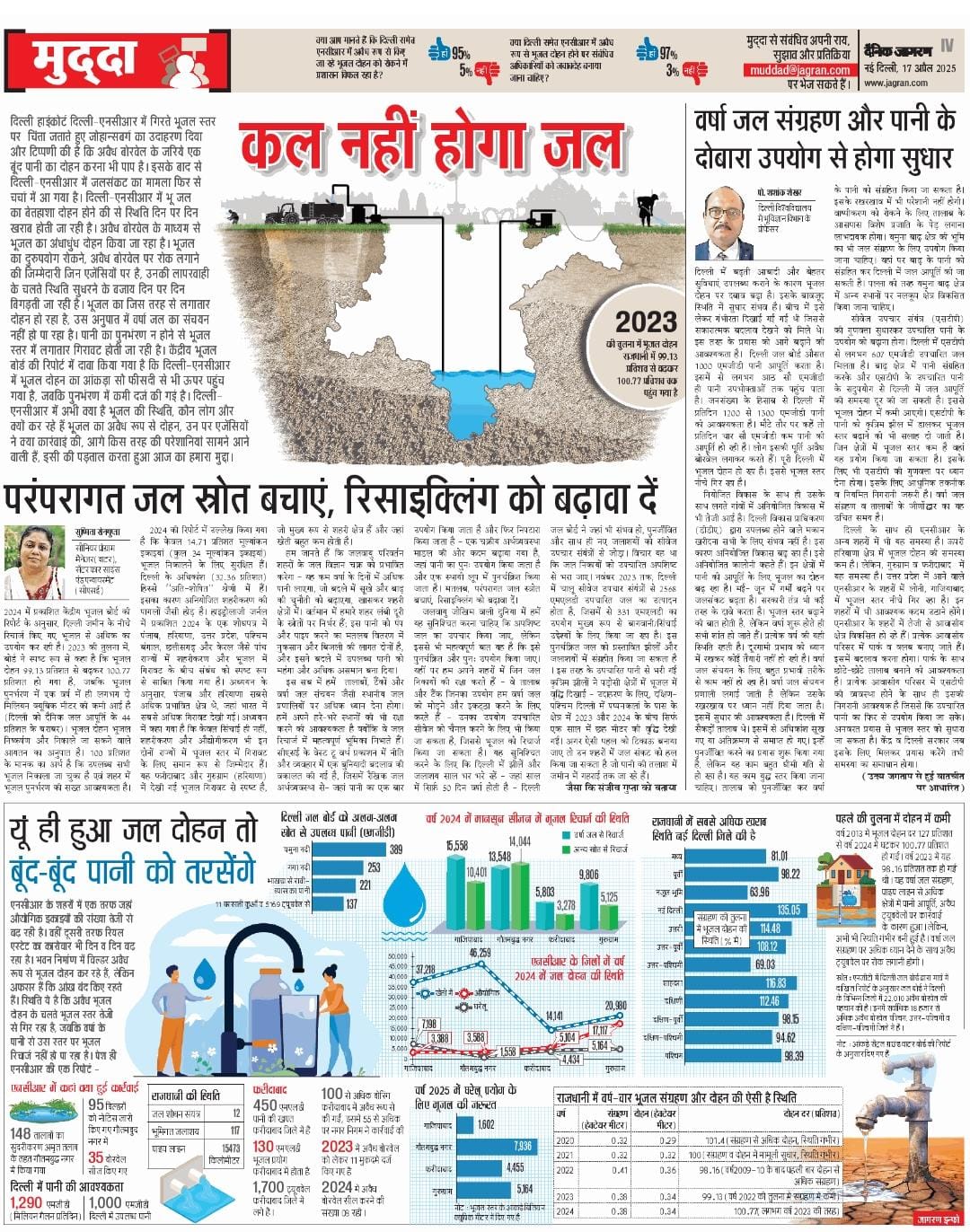
Urmila Devi’s vigil began at noon. She hurriedly finished feeding her children, picked up the empty gallon drum to line up on the main road. At 2.30pm, there was still no sign of the elusive water tanker. This is not a slum on the outskirts of Delhi but Sanjay Camp in the heart of Chanakyapuri. It is mid-April and the water connection that Urmila shares with 8-9 other “Every day is a struggle. We wait for hours in line because there is no fixed time. Sometimes the boys and men in our family have to take the day off to climb on the tanker and carry large drums back into the house, ” she says, keeping a hawk eye on her drum in the ‘ water line’. It is a race no one wins. About 50 km away, a parched Gurugram braces for another scorching summer as the annual water crisis has come early. For Amit Mudgil, president of the Emaar Palm Hills RWA, summer is a logistical nightmare. The 1,500-family condominium consumes 1.2 million litres per day (MLD), with the water sourced from two borewells — until summer dries them up. With no municipal connection, Mudgil coordinates 2-3 daily tankers, each carrying 25,000 litres a day, at a staggering cost of Rs 2 lakh per month. In Mumbai’s Andheri, meanwhile, Kanakia Rainforest housing society spends up to Rs 6 lakh a month on tankers, says secretary Dhiresh Poojary. Welcome to water tanker raj. Whether it is residents of a tony apartment building in Bengaluru’s Whitefield or Gurugram’s lush condos, everyone is Earlier this month, the water tanker association went on strike in Mumbai. The ostensible reason: they found the licensing renewal conditions too restrictive. The strike was called off four days in, after authorities invoked the Disaster Management Act 2005. But not before residents of affected areas were brought to their knees, forced to buy drinking water, work from home and, in some cases, even move home to tide over the crisis. Profit rises, table dips Subrata Chakraborty, director of the water programme at the Centre for Science and Environment, says that groundwater usage has increased significantly over the years. “Unplanned expansion of cities far exceeds the pace of new creation of water-sewage infrastructure, leading to a perpetually increasing gap, ” he says.

Why Delhi Feels Like Oven At Night

As city residents endure persistent heat stress even after sunset and minimum temperatures soar consistently, experts suggest that warmer nights have health and economic repercussions. With the nights not cool enough to provide comfort, April has already recorded two warm nights. Thursday recorded a minimum temperature of 25.7 degrees Celsius, followed by Friday at 25.6 degrees Celsius. The last time the city recorded warm night conditions was on April 9 and 10, when the minimum temperatures were 25.6 and 25.9 degrees Celsius, respectively. Experts pointed out that the health impact of high night temperature was worse than high daytime mercury levels. Mitashi Singh, programme manager for sustainable habitat programme at the Centre for Science and Environment (CSE), said the reason for high temperatures was not limited to meteorology but also poorly designed or un-upgraded localities, poor green cover, diminishing water bodies, bad urban planning and waste management, among others. "Our cities, which were once able to cool themselves off during the nighttime, cannot do so anymore. Among the major reasons are concretisation, loss of green cover and fewer water bodies. The heat sinks are gone. We keep on trapping radiation throughout the day and releasing it at night. That precisely is the urban heat island effect," said Mitashi. She said that more paved surfaces and the use of poor materials like tin sheets or galvanised iron sheets as roofing material also contribute to the night-time heat. "There is a global pattern. Bigger cities mean more population, cars and buildings. Thus, anthropogenic activities are the bigger factors contributing to heat in the cities. This is also in line with the fact that approximately 70% of greenhouse gases come from cities. Issues like more car-centric mobility, urban waste landfills, air pollution and buildings are prevalent. Delhi has these issues; there are three landfills too," she said. She added that the use of indigenous methods or insulated bricks for construction, the use of cool roof techniques, and planning low-rise residences like 5-6 floors with canopy trees. Experts pointed out that besides health impacts, the heat stress during nighttime has other economic consequences as well. "India is projected to lose 5.8% of working hours in 2030, a productivity loss that is equivalent to 34 million full-time jobs due to global warming," a CSE report pointed out. The heat also leads to a vicious circle where warmer nights lead to cooling requirements like the use of ACs, which emit more heat that gets trapped, prompting more cooling requirements. This causes high power demand as well. However, there are fixes as well. According to a report by the International Water Association, water bodies and greenery have an impact on heat. Last June, the higher temperature at the base weather station at Safdarjung itself recorded 35.2 degrees. According to Dr Prasoon Singh, a fellow at the Centre for Climate Change Research at TERI, while the city is still seeing high night temperatures, low humidity levels have so far stopped high stress levels from unleashing havoc on residents, for now. "Since the temperatures in the daytime are very high consistently and there is no cooling taking place, the heat is cascading to the next day. Night heat is harmful, even more than the daytime, since the body needs comfort with the cooling of the environment."

Hot after hours: Why Delhi won’t chill at night anymore

Residents of the national capital are nding no relief even after sunset, with nighttime temperatures soaring and turning the city into what experts are calling a classic case of the urban heatisland eect, ToI reported. This April has already recorded two unusually warm nights. On Thursday, the minimum temperature was 25.7 degrees Celsius, while Friday followed closely at 25.6 degrees. Earlier in the month, on April 9 and 10, the city saw similar conditions with minimums at 25.6 and 25.9 degrees, respectively. Experts believe the intensity of heat during the night is proving more harmful than high daytime temperatures. Mitashi Singh, programme manager for the sustainable habitat programme at the Centre for Science and Environment (CSE), told ToI the causes go beyond weather patterns. She linked it to poor urban planning, shrinking green spaces, vanishing water bodies, and materials used in construction. “Our cities, which were once able to cool themselves o during the nighttime, cannot do so anymore. Among the major reasons are concretisation, loss of green cover and fewer water bodies. The heat sinks are gone. We keep on trapping radiation throughout the day and releasing it at night. That precisely is the urban heat island eect,” she said. According to her, Delhi’s ever-increasing concrete footprint and the use of thermally poor materials like tin sheets or galvanised iron for roong have compounded the situation. She added, “There is a global pattern. Bigger cities mean more population, cars and buildings. Thus, anthropogenic activities are the bigger factors contributing to heat in the cities. This is also in line with the fact that approximately 70% of greenhouse gases come from cities. Issues like more carcentric mobility, urban waste landlls, air pollution and buildings are prevalent. Delhi has these issues; there are three landlls too.” Mitashi recommended adopting indigenous building methods such as insulated bricks, cool roof techniques, and constructing low-rise residences with canopy trees to bring some respite. The damage from these warm nights is not only to the body but also to the economy. A CSE report pointed out that “India is projected to lose 5.8% of working hours in 2030, a productivity loss that is equivalent to 34 million full-time jobs due to global warming.” High night-time heat pushes people to use more cooling equipment like air conditioners, which in turn release more heat, thus feeding into a vicious cycle of rising power demand and rising temperature. According to a report by the International Water Association, water bodies and green spaces can make a noticeable dierence in reducing this heat load. However, as those vanish from the city, the consequences worsen. Dr Prasoon Singh, a fellow at the Centre for Climate Change Research at TERI, pointed to the lack of respite. Last June, Safdarjung’s base weather station recorded a night temperature of 35.2 degrees Celsius. “Since the temperatures in the daytime are very high consistently and there is no cooling taking place, the heat is cascading to the next day. Night heat is harmful, even more than the daytime, since the body needs comfort with the cooling of the environment,” said Singh. For now, he said, low humidity has kept the worst impacts at bay, but the high temperatures continue unabated

Why is Delhi turning into a hot furnace at night? Know its terrible effect on people, it’s affecting people’s budget due to…

According to a CSE report, India will lose 5.8% of working hours in 2030. This is equivalent to 34 million full-time jobs due to global warming. Delhi has been reeling under severe heat wave. On Thursday, Delhi’s minimum temperature was recorded at 25.7 degrees Celsius while on Friday it was 25.6 degrees Celsius. Earlier, there were also hot nights on April 9 and 10. Then the minimum temperature was recorded at 25.6 and 25.9 degrees Celsius. Home NewsWhy is Delhi turning into a hot furnace at night? Know its terrible effect on people, it’s affecting people’s budget due to… Why is Delhi turning into a hot furnace at night? Know its terrible effect on people, it’s affecting people’s budget due to… According to a CSE report, India will lose 5.8% of working hours in 2030. This is equivalent to 34 million full-time jobs due to global warming. Updated: April 19, 2025 8:47 PM IST By Nivedita Dash |Edited by Nivedita Dash Follow Us Why is Delhi turning into a hot furnace at night? Know its terrible effect on people Delhi has been reeling under severe heat wave. On Thursday, Delhi’s minimum temperature was recorded at 25.7 degrees Celsius while on Friday it was 25.6 degrees Celsius. Earlier, there were also hot nights on April 9 and 10. Then the minimum temperature was recorded at 25.6 and 25.9 degrees Celsius. Experts say that high temperatures at night have a worse effect on health. High night temperatures are more harmful than day temperatures. Mitashi Singh, program manager at the Center for Science and Environment (CSE), said that high temperatures are not just caused by the weather. It is also caused by poor planning, lack of greenery, reduced water sources and waste management.

Let there be light, where the grid cannot go

On a balmy February morning, white clouds hung over Pherlin Ripnar’s farmland spread across two hectares of land in Patharkhmah village of Ri-Bhoi district in Meghalaya. Inside one of the polyhouses, Ripnar carefully looked at his mushroom cultivation—most of the mushrooms had emerged from the substrate. “These will be ready to be sold in the market in the next 2-3 days,” Ripnar says. In Ripnar’s village, there are frequent power cuts, but he has been able to continue farming thanks to the solar panels installed on his farmland. Ripnar learned the ropes of farming from his father when he was young. Growing up with 13 siblings, he had to contribute as an extra hand to support his parents. After finishing class 12 as an arts student, he opened a small paan shop in his village to earn a living. When he was around 28 years old, he met the founders of MOSONiE—a non-profit that works in the Ri-Bhoi district of Meghalaya—who encouraged and motivated Ripnar to adopt sustainable solutions for livelihoods. With the help of MOSONiE and Selco Foundation—a large solar non-profit—Ripnar started a small solar-powered photocopy and printing business in the same place where he used to run his paan shop. “Electricity is a big problem in our village. We are sometimes without it for days,” the now 38-year-old Ripnar says. (MOSONiE and Selco Foundation have also been key to helping Pherlin and his peers access devices like solar panels and solar-powered rice hullers.) Also read: No monkeying around on this kiwi farm Ripnar’s interest has always been agriculture, so he continued to practice organic farming at home on his land. In 2023, he bought his current land from his cousin sister on lease, to begin working on a larger scale. As Ripnar has been using solar technology for about a decade now, he knows how solar panels can help him and his farm compensate for days without electricity. Ripnar explains that the solar panels give the farm an uninterrupted electricity supply. He also does not have to use torchlights, mobile phones and candles at night to check on his farm. As the farm is isolated, Ripnar installed three street lights on the uphill pathway that leads to it in 2023. The solar panels ensure that these street lights also operate throughout the night. “Solar-powered lighting can better protect farms from wild animal attacks and thefts,” Ripnar notes. It also means Ripnar and the caretaker in his room have more consistent electricity. This helps them have a good night's sleep after a hard day at work. “We feel comfortable,” he says. Solar innovations The farmer has also been using solar dryers to dry vegetables, grains and fish. “We grow a lot of ginger and turmeric here to make pickles, or to sell in the market. I used the dryer mainly to dry ginger and turmeric,” he says. Solar dryers help preserve agricultural products for longer periods, reducing the risk of spoilage and waste post-harvest. MOSONiE, run by a group of women from northeast India, has been linking farmers with banks and other lenders, such as non-banking financial companies, for financial assistance in purchasing solar panels and other solar-powered machines. Pherlin Ripnar at his farmland in Patharkhmah village of Ribhoi district in Meghalaya With the help of MOSONiE, Ripnar took a loan from the Meghalaya Rural Bank (MRB) in 2019, which he has now repaid, to install the solar panels in his farm. “I was also able to purchase solar batteries (which can help store sunlight during the day),” Ripnar adds. On his farm, Ripnar grows local brown maize, paddy, and three varieties of pumpkins, yams, mushrooms, tomatoes, lettuce, cabbage and other vegetables. He said that with support from the Government of Meghalaya’s Horticulture Department, he is also growing orchids inside the polyhouses, which has been profitable. Also read: This farmer builds his own tools—and upskills others, too Solar-powered nooks Solar is a fast-growing, useful and cost-effective option for addressing electricity challenges, especially in Meghalaya's remote, hilly and forested areas, where the electricity supply can be erratic. “Solar energy can help farmers in various ways by powering their farm equipment and appliances,” says Ringbila Pungding, one of the co-founders of MOSONiE. “We support farmers like Pherlin by identifying their needs and challenges, and tailoring solutions to meet their specific energy requirements,” Pungding adds. Ioanis Kurbah from Nartap village in the Ri-Bhoi district of Meghalaya is another case. Kurbah has been using a solar-powered rice huller machine since 2022. These machines are capable of cleaning, husking, polishing, grading and managing rice and its by-products. “Earlier, I was involved in cultivating paddy, bamboo and broom grass. But now I have moved on to managing the rice huller machine in my village,” says Kurbah. Rice huller machine Every household in Nartap village is engaged in paddy farming, and most of the farmers were using the old machine, which ran on diesel, required more water and wasn’t eco-friendly, Kurbah noted. “It is also very costly, makes a lot of noise, produces dust, and affects the health of those who operate the machines. Besides, the machine could simply grind the paddy—it could not separate the husk from the rice. Farmers need to return home and remove the husk from the rice, which requires about 3 to 4 hours,” Kurbah explains. Out of 92 households, about 85 families now get their rice processed through Kurbah’s solar-powered rice huller machine. “The farmers are absolutely happy, and I, too, can support my family now,” Kurbah says. Kurbah adds that even to run his poultry farm, “We need constant electricity. Our area is extremely prone to frequent power cuts. During summer, electricity is gone for a week or so. Solar panels help us manage the poultry farm, which needs to be cleaned regularly, and chickens need to be fed food and medicines.” He said that his poultry farm now runs entirely with the help of two solar panels, which have been a lifesaver for him. Also read: One Odisha woman’s mission to preserve taste, tradition through seeds Nagesh Rao, a senior programme manager at Selco Foundation, explains how many farmers post-harvest depend on selling the raw materials directly in the market. “Sometimes, if they don’t have the means to process the raw material, they give it at a throwaway price. With the solar-enabled rice huller machines, they can process the paddy and sell it at a higher margin. The machine helps them access energy at their doorstep without depending on other sources for electricity.” According to Binit Das, programme manager, renewable energy unit at the Centre for Science and Environment in New Delhi, solar technology could help farmers from the effects of climate change in mountainous states like Meghalaya. “When it comes to electricity, people staying far away from cities and towns face many transmission and distribution challenges. In case of extreme weather events like landslides and heavy rainfall, the centralised available sources of power will get affected, which will then impact the day-to-day lives of farmers and their families,” Das says, adding that decentralised renewable energy (DRE) can be a game changer for communities who live in remote areas. “If DRE is made available for communities, then there will be less impact from extreme weather events.” In Patharkhmah village, when asked what kind of facilities might help farmers in Meghalaya, Ripnar laments how there are no review meetings that farmers can have with the government’s agriculture and horticulture departments and banks regarding loans, schemes and subsidies. “If the government can conduct monthly review meetings with our farmers to share grievances, especially for those in remote areas of the state, it could benefit us.” But, for now, Ripnar says he is just thankful that he and his farm have constant access to lighting.

Delhi records more poor air quality days this April compared to last year

New Delhi: This April has already turned out to be more polluted than last year. This year, nine poor days were recorded till April 16 against only seven such days in the entire month in 2024, shows an analysis of Central Pollution Control Board's data. Of the total 16 days so far, Delhi experienced seven moderate and nine poor days, including a streak of ve consecutive poor days from April 6 to 10. However, rain and gusty winds on the evening of April 10 improved the air quality for a few days. No good or satisfactory day was recorded in April till now. Anumita Roychowdhury, executive director of research and advocacy at Centre for Science and Environment, said this was a combined impact of the intensication of summer conditions, including growing heat and high levels of emissions in the region. "This requires upscaled and stringent implementation of priority measures in the key sectors of pollution—vehicles, transport, waste and household pollution. Ensuring onground change is critical for clean air, " said Roychowdhury. Sunil Dahiya, founder and lead analyst at thinktank Envirocatalysts, said the combination of PM2.5, PM10 and ozone this year resulted in more poor air quality days in April compared to the past year. "It shows the complexity of air pollution as a problem demanding solutions across multiple sectors, including the combustion of fossil fuels, coarser dust generation and resuspension due to dry weather, Dahiya said. "While some promising steps are taken to curb emissions at the source, the problem needs ambitious and comprehensive targeted actions in the larger airshed for Delhi, " he emphasised. Graded Response Action Plan's stage I for poor air quality is in force since April 2. The measures under stage I are preventive and focus on the stringent enforcement of the existing guidelines. Delhi's air quality index (https://timesondia.indiatimes.com/topic/delhi-airpollution) was poor at 220 on Wednesday, but it is likely to turn moderate on Thursday. The air quality is likely to stay moderate till Saturday. "The outlook for the subsequent six days from April 19 is that the air quality is likely to be in the moderate to poor category, " said Air Quality Early Warning System for Delhi, which is the forecasting body under the Union ministry of earth sciences. CPCB classies AQI between 0-50 as good, between 51 and 100 as satisfactory, between 101 and 200 as moderate, between 201 and 300 as poor, between 301 and 400 as very poor, and over 400 as severe.

Punjab: Sahnewal school awarded for best green practices

The School of Eminence, Sahnewal, was recently declared the ‘Best Green School’ in the region after it successfully cracked a rigorous on-campus audit. The audit was spearheaded by the Centre for Science and Environment (CSE) and facilitated by the Punjab... The School of Eminence, Sahnewal, was recently declared the ‘Best Green School’ in the region after it successfully cracked a rigorous on-campus audit. The audit was spearheaded by the Centre for Science and Environment (CSE) and facilitated by the Punjab State Council for Science and Technology (PSCST) and the Department of Science, Technology and Environment, Punjab. The audit comprised of six key subject areas, including air, energy, food, land and water. School of Eminence principal Mandeep Kaur said they never knew that the sustainable practices exercised in the school would one day fetch them recognition at the highest level. “Reducing carbon emissions by use of bicycles or travelling to school by foot by students, banning of packed food, promoting sustainable eating habits, adopting energy-efficient lighting and maintaining green cover — these practices have been adopted by the school. With the recent recognition, we would double our efforts in this direction,” she said with a sense of attainment. The school won the award on the basis of the audit conducted by the CSE to measure the efficacy of resource management and green practices, apart from empowering the schools to adopt eco-friendly practices, reduce environmental footprints and optimise resource management. The principal proudly added that one of the best practices adopted by the school is that in the morning assembly, the students are educated about an environmental issue with the motive to train them to adopt eco-friendly habits in school as well as at home. “In the school canteen, junk food is not allowed and as far as mid-day meal is concerned, I make it a point to first taste it and then distribute it among the students. There can be no compromise as far as the health of the kids is concerned. Waste management is practiced both inside and out of the class. Senior students serve food to the juniors in a way that there is minimum wastage. Teachers have been appointed to see to it that the students are served as per their requirement. They can ask for more, but wastage is not allowed,” she said. “Efforts are made to reduce dry waste too. Tearing, wasting or misuse of paper is not allowed in the school. The students are educated about the correlation between paper and trees,” the principal added. “The building is ventilated to the extent that in hot sultry weather, the students can sit comfortably in their classes even if power plays truant,” she shared. “Out of 600 students in the school, 10 to 15 use bikes to reach school. All others come on bicycles or by foot. The school staff also prefer to either pool vehicle or use public transport. Out of 30 teachers, only five come to the school by cars. The ones residing in Sahnewal walk their way to school. The students are exhorted to fight against all kinds of pollution and maintain cleanliness on the campus. They are warned against receding water table and the scrupulous use of water in daily life. The teachers keep a tab on the number of times the water tank is filled during the day and the quantity of water used during the day. No drop of water goes waste in the school,” Mandeep added. “The students are taught to completely shun single use plastic from their daily life and are motivated to plant trees. The plantation drive is not reduced to an official formality. It is a move in which we seek the support of each and every student. It is the duty of each and every student and teacher to adopt a sapling and keep a close watch on its growth till it becomes self-sustaining,” avowed the principal. “The coordinator of the eco club Lovepreet Sharma, along with his colleagues Lovedeep Kaur and Gurpreet Singh, gift each student a sapling on his or her birthday. Last week, the students of senior secondary class had their practical exam in the subject of agriculture and they were asked to bring a sapling each and share it with junior appointing him as a guardian of the plant with a promise that when they revisit, their sapling would greet them as a plant,” she shared.