Cse In News

Let there be light, where the grid cannot go

On a balmy February morning, white clouds hung over Pherlin Ripnar’s farmland spread across two hectares of land in Patharkhmah village of Ri-Bhoi district in Meghalaya. Inside one of the polyhouses, Ripnar carefully looked at his mushroom cultivation—most of the mushrooms had emerged from the substrate. “These will be ready to be sold in the market in the next 2-3 days,” Ripnar says. In Ripnar’s village, there are frequent power cuts, but he has been able to continue farming thanks to the solar panels installed on his farmland. Ripnar learned the ropes of farming from his father when he was young. Growing up with 13 siblings, he had to contribute as an extra hand to support his parents. After finishing class 12 as an arts student, he opened a small paan shop in his village to earn a living. When he was around 28 years old, he met the founders of MOSONiE—a non-profit that works in the Ri-Bhoi district of Meghalaya—who encouraged and motivated Ripnar to adopt sustainable solutions for livelihoods. With the help of MOSONiE and Selco Foundation—a large solar non-profit—Ripnar started a small solar-powered photocopy and printing business in the same place where he used to run his paan shop. “Electricity is a big problem in our village. We are sometimes without it for days,” the now 38-year-old Ripnar says. (MOSONiE and Selco Foundation have also been key to helping Pherlin and his peers access devices like solar panels and solar-powered rice hullers.) Also read: No monkeying around on this kiwi farm Ripnar’s interest has always been agriculture, so he continued to practice organic farming at home on his land. In 2023, he bought his current land from his cousin sister on lease, to begin working on a larger scale. As Ripnar has been using solar technology for about a decade now, he knows how solar panels can help him and his farm compensate for days without electricity. Ripnar explains that the solar panels give the farm an uninterrupted electricity supply. He also does not have to use torchlights, mobile phones and candles at night to check on his farm. As the farm is isolated, Ripnar installed three street lights on the uphill pathway that leads to it in 2023. The solar panels ensure that these street lights also operate throughout the night. “Solar-powered lighting can better protect farms from wild animal attacks and thefts,” Ripnar notes. It also means Ripnar and the caretaker in his room have more consistent electricity. This helps them have a good night's sleep after a hard day at work. “We feel comfortable,” he says. Solar innovations The farmer has also been using solar dryers to dry vegetables, grains and fish. “We grow a lot of ginger and turmeric here to make pickles, or to sell in the market. I used the dryer mainly to dry ginger and turmeric,” he says. Solar dryers help preserve agricultural products for longer periods, reducing the risk of spoilage and waste post-harvest. MOSONiE, run by a group of women from northeast India, has been linking farmers with banks and other lenders, such as non-banking financial companies, for financial assistance in purchasing solar panels and other solar-powered machines. Pherlin Ripnar at his farmland in Patharkhmah village of Ribhoi district in Meghalaya With the help of MOSONiE, Ripnar took a loan from the Meghalaya Rural Bank (MRB) in 2019, which he has now repaid, to install the solar panels in his farm. “I was also able to purchase solar batteries (which can help store sunlight during the day),” Ripnar adds. On his farm, Ripnar grows local brown maize, paddy, and three varieties of pumpkins, yams, mushrooms, tomatoes, lettuce, cabbage and other vegetables. He said that with support from the Government of Meghalaya’s Horticulture Department, he is also growing orchids inside the polyhouses, which has been profitable. Also read: This farmer builds his own tools—and upskills others, too Solar-powered nooks Solar is a fast-growing, useful and cost-effective option for addressing electricity challenges, especially in Meghalaya's remote, hilly and forested areas, where the electricity supply can be erratic. “Solar energy can help farmers in various ways by powering their farm equipment and appliances,” says Ringbila Pungding, one of the co-founders of MOSONiE. “We support farmers like Pherlin by identifying their needs and challenges, and tailoring solutions to meet their specific energy requirements,” Pungding adds. Ioanis Kurbah from Nartap village in the Ri-Bhoi district of Meghalaya is another case. Kurbah has been using a solar-powered rice huller machine since 2022. These machines are capable of cleaning, husking, polishing, grading and managing rice and its by-products. “Earlier, I was involved in cultivating paddy, bamboo and broom grass. But now I have moved on to managing the rice huller machine in my village,” says Kurbah. Rice huller machine Every household in Nartap village is engaged in paddy farming, and most of the farmers were using the old machine, which ran on diesel, required more water and wasn’t eco-friendly, Kurbah noted. “It is also very costly, makes a lot of noise, produces dust, and affects the health of those who operate the machines. Besides, the machine could simply grind the paddy—it could not separate the husk from the rice. Farmers need to return home and remove the husk from the rice, which requires about 3 to 4 hours,” Kurbah explains. Out of 92 households, about 85 families now get their rice processed through Kurbah’s solar-powered rice huller machine. “The farmers are absolutely happy, and I, too, can support my family now,” Kurbah says. Kurbah adds that even to run his poultry farm, “We need constant electricity. Our area is extremely prone to frequent power cuts. During summer, electricity is gone for a week or so. Solar panels help us manage the poultry farm, which needs to be cleaned regularly, and chickens need to be fed food and medicines.” He said that his poultry farm now runs entirely with the help of two solar panels, which have been a lifesaver for him. Also read: One Odisha woman’s mission to preserve taste, tradition through seeds Nagesh Rao, a senior programme manager at Selco Foundation, explains how many farmers post-harvest depend on selling the raw materials directly in the market. “Sometimes, if they don’t have the means to process the raw material, they give it at a throwaway price. With the solar-enabled rice huller machines, they can process the paddy and sell it at a higher margin. The machine helps them access energy at their doorstep without depending on other sources for electricity.” According to Binit Das, programme manager, renewable energy unit at the Centre for Science and Environment in New Delhi, solar technology could help farmers from the effects of climate change in mountainous states like Meghalaya. “When it comes to electricity, people staying far away from cities and towns face many transmission and distribution challenges. In case of extreme weather events like landslides and heavy rainfall, the centralised available sources of power will get affected, which will then impact the day-to-day lives of farmers and their families,” Das says, adding that decentralised renewable energy (DRE) can be a game changer for communities who live in remote areas. “If DRE is made available for communities, then there will be less impact from extreme weather events.” In Patharkhmah village, when asked what kind of facilities might help farmers in Meghalaya, Ripnar laments how there are no review meetings that farmers can have with the government’s agriculture and horticulture departments and banks regarding loans, schemes and subsidies. “If the government can conduct monthly review meetings with our farmers to share grievances, especially for those in remote areas of the state, it could benefit us.” But, for now, Ripnar says he is just thankful that he and his farm have constant access to lighting.

Delhi records more poor air quality days this April compared to last year

New Delhi: This April has already turned out to be more polluted than last year. This year, nine poor days were recorded till April 16 against only seven such days in the entire month in 2024, shows an analysis of Central Pollution Control Board's data. Of the total 16 days so far, Delhi experienced seven moderate and nine poor days, including a streak of ve consecutive poor days from April 6 to 10. However, rain and gusty winds on the evening of April 10 improved the air quality for a few days. No good or satisfactory day was recorded in April till now. Anumita Roychowdhury, executive director of research and advocacy at Centre for Science and Environment, said this was a combined impact of the intensication of summer conditions, including growing heat and high levels of emissions in the region. "This requires upscaled and stringent implementation of priority measures in the key sectors of pollution—vehicles, transport, waste and household pollution. Ensuring onground change is critical for clean air, " said Roychowdhury. Sunil Dahiya, founder and lead analyst at thinktank Envirocatalysts, said the combination of PM2.5, PM10 and ozone this year resulted in more poor air quality days in April compared to the past year. "It shows the complexity of air pollution as a problem demanding solutions across multiple sectors, including the combustion of fossil fuels, coarser dust generation and resuspension due to dry weather, Dahiya said. "While some promising steps are taken to curb emissions at the source, the problem needs ambitious and comprehensive targeted actions in the larger airshed for Delhi, " he emphasised. Graded Response Action Plan's stage I for poor air quality is in force since April 2. The measures under stage I are preventive and focus on the stringent enforcement of the existing guidelines. Delhi's air quality index (https://timesondia.indiatimes.com/topic/delhi-airpollution) was poor at 220 on Wednesday, but it is likely to turn moderate on Thursday. The air quality is likely to stay moderate till Saturday. "The outlook for the subsequent six days from April 19 is that the air quality is likely to be in the moderate to poor category, " said Air Quality Early Warning System for Delhi, which is the forecasting body under the Union ministry of earth sciences. CPCB classies AQI between 0-50 as good, between 51 and 100 as satisfactory, between 101 and 200 as moderate, between 201 and 300 as poor, between 301 and 400 as very poor, and over 400 as severe.

Punjab: Sahnewal school awarded for best green practices

The School of Eminence, Sahnewal, was recently declared the ‘Best Green School’ in the region after it successfully cracked a rigorous on-campus audit. The audit was spearheaded by the Centre for Science and Environment (CSE) and facilitated by the Punjab... The School of Eminence, Sahnewal, was recently declared the ‘Best Green School’ in the region after it successfully cracked a rigorous on-campus audit. The audit was spearheaded by the Centre for Science and Environment (CSE) and facilitated by the Punjab State Council for Science and Technology (PSCST) and the Department of Science, Technology and Environment, Punjab. The audit comprised of six key subject areas, including air, energy, food, land and water. School of Eminence principal Mandeep Kaur said they never knew that the sustainable practices exercised in the school would one day fetch them recognition at the highest level. “Reducing carbon emissions by use of bicycles or travelling to school by foot by students, banning of packed food, promoting sustainable eating habits, adopting energy-efficient lighting and maintaining green cover — these practices have been adopted by the school. With the recent recognition, we would double our efforts in this direction,” she said with a sense of attainment. The school won the award on the basis of the audit conducted by the CSE to measure the efficacy of resource management and green practices, apart from empowering the schools to adopt eco-friendly practices, reduce environmental footprints and optimise resource management. The principal proudly added that one of the best practices adopted by the school is that in the morning assembly, the students are educated about an environmental issue with the motive to train them to adopt eco-friendly habits in school as well as at home. “In the school canteen, junk food is not allowed and as far as mid-day meal is concerned, I make it a point to first taste it and then distribute it among the students. There can be no compromise as far as the health of the kids is concerned. Waste management is practiced both inside and out of the class. Senior students serve food to the juniors in a way that there is minimum wastage. Teachers have been appointed to see to it that the students are served as per their requirement. They can ask for more, but wastage is not allowed,” she said. “Efforts are made to reduce dry waste too. Tearing, wasting or misuse of paper is not allowed in the school. The students are educated about the correlation between paper and trees,” the principal added. “The building is ventilated to the extent that in hot sultry weather, the students can sit comfortably in their classes even if power plays truant,” she shared. “Out of 600 students in the school, 10 to 15 use bikes to reach school. All others come on bicycles or by foot. The school staff also prefer to either pool vehicle or use public transport. Out of 30 teachers, only five come to the school by cars. The ones residing in Sahnewal walk their way to school. The students are exhorted to fight against all kinds of pollution and maintain cleanliness on the campus. They are warned against receding water table and the scrupulous use of water in daily life. The teachers keep a tab on the number of times the water tank is filled during the day and the quantity of water used during the day. No drop of water goes waste in the school,” Mandeep added. “The students are taught to completely shun single use plastic from their daily life and are motivated to plant trees. The plantation drive is not reduced to an official formality. It is a move in which we seek the support of each and every student. It is the duty of each and every student and teacher to adopt a sapling and keep a close watch on its growth till it becomes self-sustaining,” avowed the principal. “The coordinator of the eco club Lovepreet Sharma, along with his colleagues Lovedeep Kaur and Gurpreet Singh, gift each student a sapling on his or her birthday. Last week, the students of senior secondary class had their practical exam in the subject of agriculture and they were asked to bring a sapling each and share it with junior appointing him as a guardian of the plant with a promise that when they revisit, their sapling would greet them as a plant,” she shared.

साहनेवाल स्कूल को सर्वोत्तम हरित प्रथाओं के लिए सम्मानित किया गया

स्कूल ऑफ एमिनेंस, साहनेवाल को हाल ही में इस क्षेत्र का ‘बेस्ट ग्रीन स्कूल’ घोषित किया गया, क्योंकि इसने कैंपस में कठोर ऑडिट में सफलता प्राप्त की। इस ऑडिट का नेतृत्व सेंटर फॉर साइंस एंड एनवायरनमेंट (सीएसई) ने किया और पंजाब स्टेट काउंसिल फॉर साइंस एंड टेक्नोलॉजी (पीएससीएसटी) तथा पंजाब के विज्ञान, प्रौद्योगिकी और पर्यावरण विभाग ने इसमें सहयोग किया। उन्होंने कहा, "छात्रों द्वारा साइकिल का उपयोग या पैदल स्कूल जाने से कार्बन उत्सर्जन में कमी लाना, पैक किए गए भोजन पर प्रतिबंध लगाना, स्थायी खाने की आदतों को बढ़ावा देना, ऊर्जा-कुशल प्रकाश व्यवस्था को अपनाना और हरियाली बनाए रखना - इन प्रथाओं को स्कूल ने अपनाया है।

Authority seeks collaboration to improve water infrastructure in Nairobi

Senior officials from the National Water Harvesting and Storage Authority, together with members of the Water and Sanitation Committee, have agreed on modalities under which the authority can collaborate with the county to improve water infrastructure. The officials who made a rare appearance at the Water committee explained how the county can benefit from some of its services. Led by the body's Chief Executive Officer Julius Mugun, the officials shared various areas to explore, among them flood control and drainage management, rainwater harvesting, drilling of boreholes and rehabilitation of existing ones. The CEO explained that counties have the constitutional mandate to offer water services, which means national government agencies must collaborate with devolved units. "The Water Act 2016 and the 2010 Constitution assign responsibility for water supply and sanitation to the 47 county governments, and the Water Act 2016 provides the legal framework for their implementation," he said The Authority has implemented several water for schools’ projects in Nairobi and is seeking to tap into the Nairobi situation where flooding is common, while water harvesting is hardly practised. The authority is seeking to formulate strategies for sustainable development and maintenance of water systems,a joint venture to explore measures to mitigate flooding and improve drainage systems and advocacy for adoption of environmentally sustainable rainwater harvesting practices. It is also seeking collaboration on projects to advance access to reliable water sources through borehole initiatives. Committee Chairman Kennedy Oyugi welcomed the initiative and promised to arrange for more meetings that will involve officials from the county, Nairobi and Athi Water agencies respectively. According to a report by the Centre for Science and Environment (CSE), Kenya faces a national water crisis with more than 16 million of the Kenyan population relying on untreated and unsafe water sources. Rural families spend approximately $38 per month on water, while urban households with piped systems in cities like Nairobi spend only $4.46.

India–Norway Marine Pollution Initiative

The India–Norway Marine Pollution Initiative (INMPI) has helped Agra improve waste circularity and reduce plastic leakage into the Yamuna River, with successful interventions in managing petha and footwear waste. What it is? A bilateral collaboration between the Government of India and Government of Norway to address marine litter, especially microplastics (MPs) and macroplastics from land-based sources. Launched In: 2019, under the India–Norway Ocean Dialogue. Aims: Reduce plastic and microplastic pollution in aquatic ecosystems. Support circular economy in waste management. Promote policy reform, local action, and scientific research. Assist municipalities in evidence-based plastic leakage reduction. Key Features: Technical support to Indian cities by leading environmental organisations (e.g., Centre for Science and Environment – CSE). Pilot projects in riverine cities like Agra. Studies on pre-consumer industrial waste, plastic drainage leakage, and microplastic load. Use of brand audits, polymer categorisation, and scientific sampling for policy impact.

Climate change sidelined as America pivots to fossil-fuel-heavy future

“This is not the time for energy transition, this is the time for energy addition,” said United States (US) Energy Secretary Chris Wright to cheering applause. He was speaking at one of the largest energy conferences, CERAWeek, in Houston last month, and the room was overflowing with heads of energy companies and other experts. Attending the week-long conference, it was clear to me that our world had changed. Still, it is important to understand what and why this complete rejection of climate-change policies is happening in a world that is warming rapidly with catastrophic weather impacts. This is not the time to bury our heads in the sand and think that the Donald Trump administration’s energy policy will not lead to massive changes in their world and ours. What is its reasoning for this shift? First, the gross national debt of the US has reached $36 trillion; interest payments are larger than what the country spends on defence. So, the answer is to “re-industrialise” and not “deindustrialise”, in the words of the US energy secretary. This thrust on onshore manufacturing will require more energy and more energy infrastructure. Second, China has taken the lead in many new areas, from supply chains and manufacturing electric vehicles to solar. The Trump administration says it must not lose the artificial Intelligence (AI) race to China. This means building energy-intensive data centres at a pace not seen before. The country has some 5,000 data centres, which consume 3 per cent of its grid-based electricity. This is expected to exponentially increase, and data centres are projected to consume 8-12 per cent of electricity by the end of the decade. All of this means more power generation. Till now, as the country had reached its peak growth levels, electricity demand had more or less stagnated. Now it is expected to increase. Then, what will be the source of this “new” power generation? The Trump administration says it cannot depend on renewables to supply this electricity. Mr Wright told the audience that renewables met only 3 per cent of US energy demand in spite of the huge investment, and so the energy transition is not real. This, of course, is misleading because in terms of electricity generation, renewables have now overtaken coal in the US, contributing to 15-17 per cent of the electricity in the past year. But if all energy is taken as the measure — including the consumption of oil in transport and industry — the share of renewables in the energy mix decreases. But this is not semantics for the Trump administration. It is convinced that there is a need for reversing the previous administration’s energy policies, which were “myopically focused on climate change”. It also says this has led to an increased cost of electricity, adding to the burden of households (again, there is no data on this but then the game is about perception and persuasion). So, energy growth will be from natural gas, a fossil fuel (and bringing back coal), and the US administration is fast-tracking all that is needed to increase its production and generation. This will add to emissions of greenhouse gases, but as the energy secretary said, carbon dioxide, unlike carbon monoxide, is not a pollutant. Climate change is just a footnote in the US’ plans. This is not to say that climate change is completely out of the door. In the US’ view, the export of natural gas, which is being pushed hard by the current administration, will displace coal in places like India because it is less polluting. There is also some talk of investment in mitigating methane emission from natural gas production and consumption — but less seriously, because there is really no driver for climate action left in this administration. The focus is now on nuclear power, particularly on small modular plants that could supply captive electricity to data centres. China (and Russia) is building hundreds of gigawatts of nuclear plants and it is “hoped” that the US will catch up, with either fusion or fission technology. But what is clear is that the promise of green hydrogen power is dead in the water. So, it’s back to brown energy and this time, with no apologies for the responsibility of the US in taking the world to climate jeopardy. This is really where the rubber hits the road. Instead of its proposed 50 per cent reduction in greenhouse gas emission by 2030, in all likelihood, the country will increase its emission. The fact is the US has already overused its share of the global carbon budget; now it will gobble up more. What, then, happens to the rest of the world, particularly countries like India or the continent of Africa, which needs more energy for development? The plan was that countries like the US would decrease their share by making the transition out of fossil fuels. Now that the US is back with a vengeance, the guardrail of keeping the world below 1.5° centigrade temperature rise looks nearly impossible. I am writing all this not to depress you but to make it clear that we must not live in a fool’s paradise. This new brown-energy policy of the world’s largest historical polluter and second-highest greenhouse gas emitter annually will have horrendous ramifications. What should we do? Let’s continue to discuss this. The author is at the Centre for Science and Environment sunita@cseindia.org, X: @sunitanar

Gurgaon only NCR city in red zone, air ‘very poor’

Gurgaon: Air quality in Gurgaon was the worst, and the only one to exceed the 300-mark, According to the Central Pollution Control Board's bulletin on Sunday, Gurgaon's 24-hour average air quality index (AQI) scaled to 317, in the ʻ very poor' category. Siwan, in Bihar, ranked second, at 281 (poor). The city outdid all its NCR neighbours in air pollution. Delhi's AQI was 178, Greater Noida's 132, Noida's 158 and Ghaziabad's 128 – all of them in the ʻmoderate' category on Sunday. Experts pointed out that the key pollutant was ozone, overtaking the usual culprits – particulate matter (PM2.5 and PM10) and carbon monoxide (CO). Data from the Gwalpahari air quality monitoring station showed that 8-hour average of ozone concentration touched 318ug/m3 on April 11 and 313ug/m3 on Sunday — more than triple of India's safety limit, 100 micrograms per cubic metres, and the worst among three stations in the city. Ozone (O3) is generated closer to land when sunlight reacts with nitrogen oxides, released from diesel and CNG vehicles, and volatile organic compounds (VOCs) such as gasoline used in industries. Experts said the increase in temperature and sunny days was the major reason for ozone formation over PM2.5 and PM10 during the summer months . High ozone concentration in Gwal Pahari could be a result of its proximity to the Aravali hills, which trap pollutants and prevent dispersion. The area is also close to industrial zones and highways, where emission of gases that react to form ozone can be higher, they said. "We expect cleaner air in April, but it's hard to breathe even now. Govt needs to act—trac management, industrial emissions… something must change, " said Piyush Verma, a resident of Sector 56. Experts, too, said the region's air quality crisis wasn't just a winter problem anymore. "Ozone is a warning sign of unchecked emissions from vehicles and industries. We need year-round pollution control measures, not just seasonal xes, " said Shubhansh Tiwari, a associate at the Centre for Sceince and Environment

Ggn only NCR city in red zone, air 'very poor'

Air quality in Gurgaon was the worst, and the only one to exceed the 300-mark, among all 211 cities for which data was available from across India on Sunday. According to the Central Pollution Control Board's bulletin on Sunday, Gurgaon's 24-hour average air quality index (AQI) scaled to 317, in the 'very poor' category. Siwan, in Bihar, ranked second, at 281 (poor). The city outdid all its NCR neighbours in air pollution. Delhi's AQI was 178, Greater Noida's 132, Noida's 158 and Ghaziabad's 128 - all of them in the 'moderate' category on Sunday. Experts pointed out that the key pollutant was ozone, overtaking the usual culprits - particulate matter (PM2.5 and PM10) and carbon monoxide (CO). Data from the Gwalpahari air quality monitoring station showed that 8-hour average of ozone concentration touched 318ug/m3 on April 11 and 313ug/m3 on Sunday - more than triple of India's safety limit, 100 micrograms per cubic metres, and the worst among three stations in the city. O3 concentration was also double that of the safety limit at Sector 51 station (201ug/m3 on April 11, and 196 ug/m3 on Sunday), and the lowest, though still above the maximum safe standard at Teri Gram station (120ug/m3 and 111ug/m3). Data was not available for April 12, and from the Vikas Sadan station. Ozone (O3) is generated closer to land when sunlight reacts with nitrogen oxides, released from diesel and CNG vehicles, and volatile organic compounds (VOCs) such as gasoline used in industries. Experts said the increase in temperature and sunny days was the major reason for ozone formation over PM2.5 and PM10 during the summer months . High ozone concentration in Gwal Pahari could be a result of its proximity to the Aravali hills, which trap pollutants and prevent dispersion. The area is also close to industrial zones and highways, where emission of gases that react to form ozone can be higher, they said. "Ozone inflames and damages the lining of the respiratory tract, causing symptoms such as coughing, throat irritation, shortness of breath and chest pain. For individuals with asthma, bronchitis or other respiratory diseases, exposure can trigger severe attacks. Even in healthy individuals, long-term exposure can lead to reduced lung function and increased susceptibility to respiratory infections. It can also potentially worsen cardiovascular conditions," said Dr Arunesh Kumar, senior consultant for respiratory medicine at Paras Health in Gurgaon. "We expect cleaner air in April, but it's hard to breathe even now. Govt needs to act-traffic management, industrial emissions... something must change," said Piyush Verma, a resident of Sector 56. Experts, too, said the region's air quality crisis wasn't just a winter problem anymore. "Ozone is a warning sign of unchecked emissions from vehicles and industries. We need year-round pollution control measures, not just seasonal fixes," said Shubhansh Tiwari, a research associate at the Centre for Science and Environment. "Reducing precursors is critical to addressing the most prominent summertime pollutant-ground-level ozone. This makes it imperative to target major precursor sources such as power plants, vehicles, industrial emissions and waste," said Manoj Kumar, an analyst at the Centre for Research on Energy and Clean Air (CREA).

Delhi’s Pollution Crackdown: Over 31,000 Vehicles Fined During GRAP Restrictions In NCR

Old vehicles are among the biggest contributors to Delhi’s air pollution, and during the winter months, restrictions under the Graded Response Action Plan (GRAP) hit these vehicle owners the hardest. The Delhi Pollution Control Committee (DPCC) revealed that over 31,000 challans were issued to vehicles that violated GRAP norms this winter. Every year, as pollution levels rise in Delhi, especially during winter, the government enforces stricter pollution control measures. Under GRAP Stage 3 and 4, BS-III petrol and BS-IV diesel vehicles are not allowed to operate on city roads. These norms are triggered when the Air Quality Index (AQI) crosses 350 and 400, respectively. The DPCC report stated that GRAP was in force for 42 days this winter, 13 days under Stage 3, and 29 days under Stage 4. During this period, officials cracked down on older vehicles, issuing challans to those caught violating the ban. From January to December 2024, over 4.5 lakh vehicles were checked for compliance. Among them were nearly 50,000 trucks that had no business entering Delhi but attempted to pass through. These were turned away at the city’s borders. Environmental expert Anumita Roy Chowdhury from the Centre for Science and Environment (CSE) believes the long-term solution lies not just in vehicle bans but in improving Delhi’s public transport. She noted that if reliable public transport is available, people will naturally reduce the use of private vehicles, which would help cut down pollution more effectively.

Rework The Economics

India should not take action to combat climate change. As I said this to a group of climate change envoys from various European countries, I could notice signs of confusion on their faces. I explained to them my reasons. Development is the most significant challenge that a country like India faces. We know today that this growth should also be inclusive and sustainable. And if we achieve this, we hit a sweet spot—our actions to reduce local pollution and to drive green livelihoods will also reduce greenhouse gas emissions. In this way, our Nationally Determined Contribution (NDC), which puts together the package of actions to reduce emissions, would be based on co-benefits; development, if done right, will also address the urgent crisis of climate change. We know that it is in our interest to achieve this twin goal. We are vulnerable to climate change impacts. But if we do development differently, it would help us avoid the pitfalls of marginalising actions designed solely for climate change. It would help us deepen the public acceptability for taking steps that may not be easy or convenient. I am not sure if I convinced the group of hardened climate negotiators, as their world is narrowly focused on counting greenhouse gases. But let me explain this to you. India, like many other countries, has to ensure growth. This means providing millions with employment, healthcare, education and housing, and increasing energy supply. This has to be our development priority. But development will require taking action that meets the needs of all. So this calls for a change in strategy. We cannot afford a capital and resource-intensive pathway that adds to environmental degradation and inequity in society. We have learnt over the past decades that we cannot adopt the Western countries’ approach to first pollute and then clean up. We just do not have the financial wherewithal to keep repairing the damage. We have to reinvent growth, and this is what many policies in India have done: they have built inclusive sustainability as an outcome of the development policy. This is a unique opportunity for countries like India—not to pit development against climate action but to subsume it within policies designed for growth. For instance, we know we cannot “fix” air pollution without redesigning mobility because personal vehicles, however clean, take up road space and add to pollution and congestion. The Western world has taken the path to subsidise and electrify personal vehicles, which is leading to disruption in industries as they strive to rework supply chains and re-deploy labour for electric cars. We have the opportunity to think of another route—one that reinvents mobility so that we can move people and not cars. This means investing in electric buses and affordable transport like paratransit and two-wheelers. India’s NDC must be about upscaling and integrating low-carbon public transport, and not just counting electric cars. The policy is driven by cleaning up local air but has the added benefit of combating climate change. It is the same with the hard-to-abate industries. We know from experience that our industry will invest in technology that saves costs and increases competitiveness. The cement industry, for instance, switched to using fly ash, not to decarbonise but to use waste as raw material, substitute limestone and reduce the costs of energy. The future of low-carbon industrialisation lies in similar win-win solutions, such as the reuse of waste materials from iron ore slag to biomass to refuse-derived fuel from municipal garbage—all designed to reduce the use of coal and other fossil fuels and to improve efficiency. Most importantly, we must re-engineer the idea and design of a green economy. We cannot afford to mouth platitudes of green employment, knowing fully well that the renewable energy or electric vehicle transition, per se, does not mean more livelihoods. In fact, recent news shows that thousands of jobs have been lost in the UK because of the shift from blast to electric arc furnaces. This is why we see the pushback in Western countries, where much has been said without substance, and this has prompted people, worried as they are about climate change, to care more about livelihoods. India’s opportunity is in the reworking of its economy so that local resources can be used for local livelihoods. If we do this, we can sequester carbon in trees and soil, build resilience in society, withstand extreme weather shocks and also stem migration. We cannot afford an economy that is driven only by the gross domestic product (GDP), which extracts and exports produce, and not by gross nature product (GNP), which invests in natural resources for livelihoods locally. Our plan for climate change is the one that works for people and the Planet. DTE

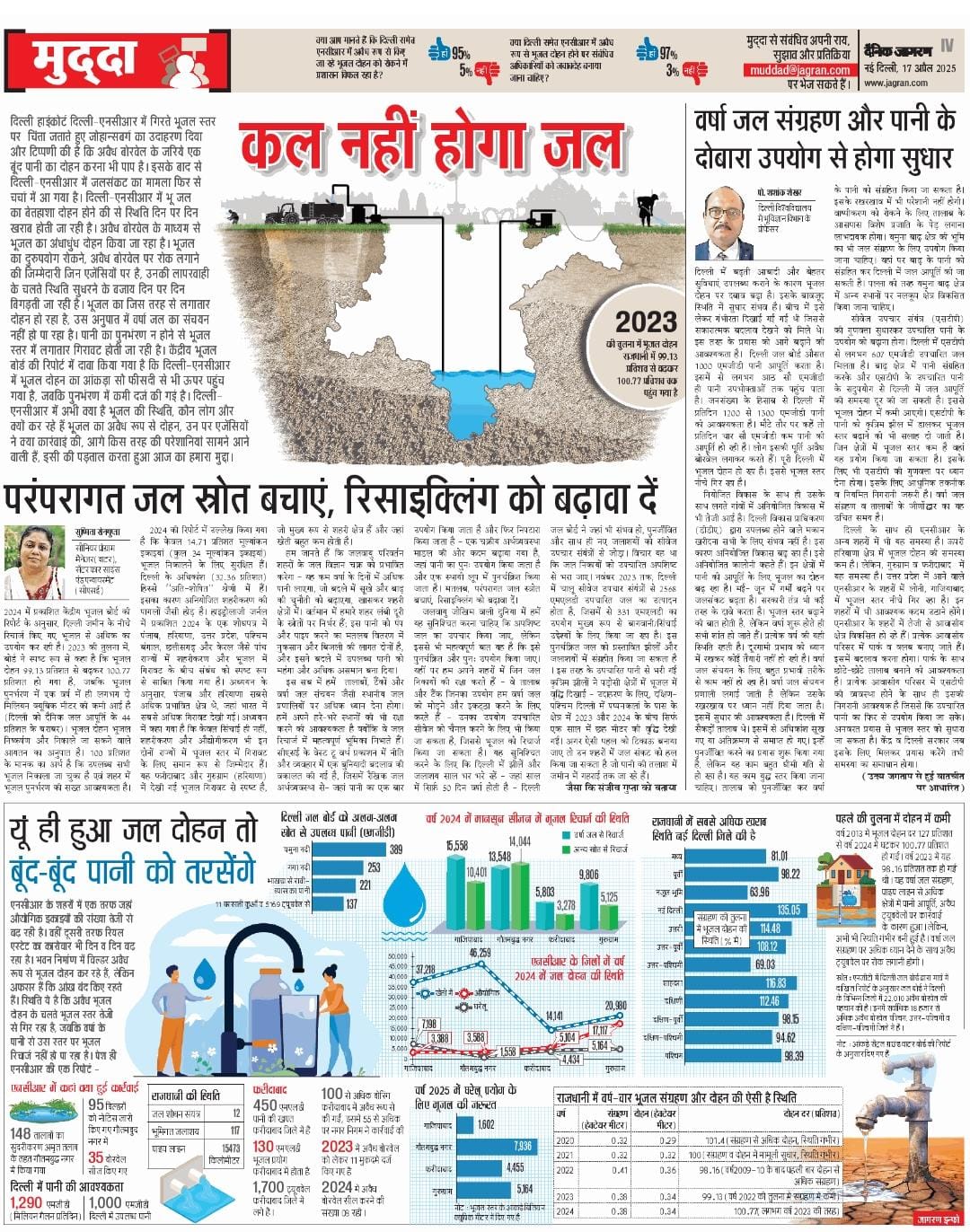
दिल्ली के वायु प्रदूषण से इन वाहन मालिकों को ज्यादा नुकसान, काटे गए 31 हजार से अधिक चालान

राज्य ब्यूरो, नई दिल्ली। राजधानी में प्रदूषण के कई कारण हो सकते हैं, लेकिन इसका सबसे बड़ा असर पुराने वाहनों पर पड़ रहा है। ग्रेडेड रिस्पांस एक्शन प्लान (ग्रेप) के तीसरे और चौथे चरण के प्रतिबंध लगते ही बीएस तीन मानकों वाले पेट्रोल से चलने वाले वाहन और बीएस चार मानकों वाले डीजल से चलने वाले वाहनों पर रोक लग जाती है। अगर ये सड़कों पर नजर आते हैं तो इनके खिलाफ कार्रवाई की जाती है। आमतौर पर मानसून को छोड़कर, दिल्ली में प्रदूषण का स्तर ज्यादातर दिनों में सामान्य से ज्यादा रहता है। लेकिन, सर्दियों के दौरान स्थिति और भी खराब हो जाती है। इससे निपटने के लिए राष्ट्रीय राजधानी क्षेत्र में प्रदूषण को रोकने के लिए GRAP प्रतिबंध लगाए जाते हैं। AQI के 350 से ऊपर होने पर GRAP 3 प्रतिबंध लगाए जाते हैं और 400 से ऊपर होने पर GRAP 4 प्रतिबंध लगाए जाते हैं। इस दौरान पुराने वाहन मालिकों को काफी परेशानियों का सामना करना पड़ता है। दिल्ली प्रदूषण नियंत्रण समिति (डीपीसीसी) की हाल ही में जारी रिपोर्ट से पता चलता है कि सर्दियों के दौरान जीआरएपी प्रतिबंधों के मद्देनजर कितने वाहनों को निशाना बनाया गया। सेंटर फॉर साइंस एंड एनवायरनमेंट (सीएसई) की कार्यकारी निदेशक अनुमिता रॉय चौधरी का कहना है कि वाहनों पर प्रतिबंध लगाने के बजाय दिल्ली की खराब परिवहन व्यवस्था को सुधारना बेहतर होगा। अगर ऐसा संभव हुआ तो दिल्लीवासी निजी वाहनों का इस्तेमाल वैसे भी कम कर देंगे। डीपीसीसी की रिपोर्ट के मुताबिक सर्दी के मौसम में कुल 42 दिन तक ग्रैप प्रतिबंध लगाए गए। 13 दिन तक ग्रैप 3 प्रतिबंध लगाए गए, जबकि 29 दिन तक ग्रैप 4 प्रतिबंध लगाए गए। इसके चलते पुराने इंजन वाली गाड़ियों को भी प्रतिबंधों का सामना करना पड़ा। इस दौरान कुल 31 हजार 209 वाहनों का चालान किया गया। वर्ष 2024 में जनवरी से दिसंबर के बीच कुल चार लाख 52 हजार 833 वाहनों की जांच की गई। 49 हजार 484 ऐसे मालवाहक वाहन थे, जिनका गंतव्य दिल्ली नहीं था, लेकिन वे यहां से गुजरना चाहते थे। ऐसे वाहनों को बाहर से ही वापस कर दिया गया।

Environmentalists, activists, and opposition slam the AAP government for pro-industry pollution law ahead of Ludhiana bypoll.

The Bhagwant Mann-led Aam Aadmi Party (AAP) government’s decision to adopt the Centre’s Water (Prevention and Control of Pollution) Amendment Act, 2024 in Punjab—allowing industries to discharge pollutants into water bodies in exchange for financial penalties—has ignited a political and environmental firestorm in the agrarian and river-rich state. The controversy revolves around the state’s recent adoption of the amendment, which replaces provisions of the landmark 1974 law. The Punjab Vidhan Sabha passed a resolution last month to adopt the Water (Prevention and Control of Pollution) Amendment Act, 2024, enacted by the Centre. Critics have labelled the amendment a “license to kill,” warning it could irreversibly damage Punjab’s fragile river and groundwater ecosystems. While the original Act included stringent jail terms of up to six years for violators, the amended version replaces criminal penalties with monetary fines ranging from Rs10,000 to Rs 15 lakh. The Punjab Cabinet approved the amended law on February 27, making Punjab the 19th state to adopt it. The move has drawn sharp criticism from environmentalists and opposition leaders, who questioned the need to amend a law that had been in force for 50 years. They accused the AAP-led state government of yielding to industrial and corporate pressure at the cost of Punjab’s water health—especially ahead of the crucial Ludhiana West by-election, where industrial interests are dominant, and AAP faces a litmus test. Jaskirat Singh, a water activist associated with the “Kale Pani Da Morcha”—a movement protesting water contamination in the Buddha Nallah of Ludhiana—called the amendment a “license to kill” Punjab’s rivers. “This government has shown loyalty to the big corporate houses facing action under the previous Act. The timing of this amendment, ahead of the Ludhiana West bypoll, shows the government is under pressure from industrialists,” he said. Jaskirat, who is leading protests against the amendment in Ludhiana, also accused the AAP government of failing to implement the earlier Act, which mandated strict punishments. “There are around 50 big industrialists accused of violating Section 33A of the Water Act, 1974. This amendment will allow them to escape by paying penalties,” he added. Another activist, Colonel Jasjit Singh Gill (Retd), warned the new law would allow industries to pollute with impunity. “March 28 will be marked as a black day for making Punjab waters black permanently. Shame on such lawmakers who sacrificed Punjab’s right to reject black laws,” he said. While the Act was enacted by the Centre and left optional for states to adopt, environmentalists argue that it is ill-suited for Punjab’s water resources and agriculture. AAP’s Rajya Sabha MP and prominent water activist Balbir Singh Seechewal—who had previously been a vocal critic of the state’s failure to enforce the 1974 Water Act—faced criticism for remaining silent on the issue. However, in the Rajya Sabha, Seechewal expressed dismay, calling the amendment “pro-industry” and emphasised the need to strengthen the original Act and reinstate punitive provisions. He urged the government to at least impose the highest penalties consistently to deter violators. The state government has yet to issue an official response to the backlash. However, when the cabinet approved the amendment on February 27, it defended the move by highlighting that Punjab became the 19th state to adopt the Centre’s law, which is already in force in Himachal Pradesh, Rajasthan and Union Territories. One of the most contentious aspects of the amended law is the shift in control from the state to the Centre. Under the new provisions, the Centre will appoint adjudicating officers to impose penalties, and appeals will go to the National Green Tribunal, with 10% of the penalty amount to be deposited in advance. This shift has raised concerns about the erosion of federal powers, as the state’s role in nominating the chairperson of the State Pollution Control Board has also been removed. Environmental experts say the timing of the amendment couldn’t be worse. The State of the Environment Report 2023, released by the Centre for Science and Environment (CSE) and Down to Earth, revealed that 46% of India’s rivers are already contaminated. Punjab has faced severe criticism over river water pollution and remains under NGT scrutiny due to its failing sewage treatment systems and deteriorating groundwater quality. Social activist and advocate Kamal Anand criticised AAP, stating, “They won the last election on the promise of saving Punjab’s rivers. Now, they’re following the same path as previous governments. Adopting this amendment shows the AAP government has no real concern for Punjab’s water or the health of its people.” Passed by Parliament in February last year, the Water (Prevention and Control of Pollution) Amendment Bill, 2024, amends the original Water (Prevention and Control of Pollution) Act, 1974. The Act establishes the Central and State Pollution Control Boards (CPCB and SPCBs) to prevent and control water pollution. The amendment decriminalises several violations, replacing criminal penalties with monetary fines. Initially, the amended law was implemented in Himachal Pradesh, Rajasthan, and the Union Territories, while other states were given the option to adopt it by passing resolutions.