
Cse In News

पर्यावरण के अनुकूल प्रथाओं को अपनाने के लिए किया प्रेरित

पीएमश्री राजकीय वरिष्ठ माध्यमिक पाठशाला बाल हमीरपुर में वीरवार को ग्रीन स्कूल कार्यक्रम पर कार्यशाला का आयोजन किया गया। कार्यशाला प्रदेश विज्ञान, प्रौद्योगिकी एवं पर्यावरण परिषद (हिमकोस्टे) व प्रारंभिक शिक्षा विभाग हमीरपुर के सहयोग से आयोजित हुई। कार्यशाला का शुभारंभ प्रारंभिक शिक्षा विभाग हमीरपुर के उपनिदेशक कमल किशोर भारती ने किया। कार्यशाला में हमीरपुर जिले के 30 इको क्लब प्रभारी शिक्षकों ने भाग लिया। प्रशिक्षण सत्रों का नेतृत्व नई दिल्ली स्थित सेंटर फॉर साइंस एंड एनवायरनमेंट से विषय विशेषज्ञ नीरज कुमार ने किया। उन्होंने कहा कि ग्रीन स्कूल कार्यक्रम स्कूलों को पर्यावरण के अनुकूल प्रथाओं को अपनाने और स्थिरता को बढ़ावा देने के लिए प्रेरित करता है। कार्यशाला में विशेष रूप से डिप्टी डीईओ वंदना धीमान, सुपरिंटेंडेंट ग्रेड वन कश्मीर सिंह, जिला विज्ञान पर्यवेक्षक हमीरपुर राजेश गौतम, प्रधानाचार्य मुश्ताक मोहम्मद, वरिष्ठ वैज्ञानिक सहायक रिशव राणा व विज्ञान संघ के जिला प्रधान विकेश कौशल शामिल रहे। कार्यशाला में जीवन के मुख्य घटकों जैसे भूमि, जल, ऊर्जा और खाद्य पदार्थों का संरक्षण पर ध्यान केंद्रित किया गया। विषय विशेषज्ञ ने शिक्षकों और छात्रों को पर्यावरण संरक्षण से संबंधित क्रियाशील योजनाओं में शामिल होने और अपनी क्षमताओं पर ध्यान केंद्रित कर राष्ट्रीय स्तर पर प्रतिस्पर्धा करने के तरीकों पर जानकारी उपलब्ध करवाई।
US is back with a vengeance

THIS IS not the time for energy transition, this is the time for energy addition,” said the US energy secretary Chris Wright to cheering applause. He was speaking at one of the largest energy conferences, ceraweek, at Houston last month, and the room was overowing with energy company heads and other experts. Attending the week-long conference, it was clear to me that our world has changed. Still, it is important to understand what and why this complete rejection of climate change policies is happening in a world that is warming rapidly with catastrophic weather impacts. This is not the time to bury our heads in the sand and think that the Donald Trump administration’s energy policy will not lead to massive changes in their world and ours. What is its reasoning for this shift? First, the gross national debt of the US has reached $36 trillion; interest payments are larger than what the country spends in defence. So, the answer is to “re-industrialize” and not “deindustrialize”, in the words of the US energy secretary. This thrust on onshore manufacturing will require more energy and more energy infrastructure. Second, China has taken the lead in many new areas, from supply chains and manufacturing of electric vehicles to solar. The Trump administration says it must not lose the Articial Intelligence (AI) race to China. This means building energy-intensive data centres at a pace not seen before. The country has some 5,000 data centres today which consume 3 per cent of its grid-based electricity. This is expected to increase exponentially, and data centres are projected to consume 8-12 per cent of the electricity by the end of the decade. All of this means more generation of electricity. Till now, as the country had reached its peak growth levels, electricity demand had more or less stagnated. Now it is expected to increase. Then, what will be the source of this “new” power generation? The Trump administration says it cannot depend on renewables to supply this electricity. Wright told the audience that renewables only met 3 per cent of US energy demand in spite of the huge investment, and so energy transition is not real. This, of course, is misleading because in terms of electricity generation, renewables have now overtaken coal in the US, contributing to 15-17 per cent of the electricity in the past year. But if total energy is taken as the measure, including the consumption of oil in transport and industry, the share of renewables in the energy mix decreases. But this is not semantics for the Trump administration. It is convinced that there is a need for reversing the previous administration’s energy policies that were “myopically focused on climate change”. It also says this has led to increased cost of electricity, adding to the burden of households (again, there is no data on this but then the game is about perception and persuasion). So energy growth will be from the fossil fuel natural gas (there is even talk of coal) and the US administration is fast-tracking all that is needed to increase its production and generation. This will add to emissions of greenhouse gases, but as the energy secretary said, carbon dioxide, unlike carbon monoxide, is not a pollutant. Climate change is just a footnote in the US' plans I am writing all this not to depress you, but to make it clear that we must not live in a fool’s paradise. This new brown-energy policy of the world’s largest historical polluter and second highest greenhouse gas emitter annually will have horrendous ramications. What should we do? Let’s continue to discuss this. DTE @sunitanar

Circular economy key to sustainability

Industrial waste circularity can make a huge difference to the way we manage waste and reduce carbon emissions. By 2030, it can help reuse 750 million tonnes of industrial waste; conserve over 450 million tonnes of natural resources; and reduce 50-60 million tonne of carbon dioxide equivalent New Delhi: Building and practising a circular economy is not just about managing waste efficiently – it has a potential to lead to substantial conservation of natural resources as well as reduction in carbon emissions, says a new report on industrial waste circularity by Centre for Science and Environment (CSE). A circular economy an economic system based on the reuse and regeneration of materials or products, especially as a means of continuing production in a sustainable or environmentally friendly way. The report – Good Practices in Industrial Waste Circularity -- has estimated the potential of circularity of different industrial wastes in various applications by 2030 and the associated benefits in terms of natural resource conservation, reduction in carbon emissions and cost economics. According to it, there is a potential for utilising about 750 million tonne (MT) of various types of wastes in industries (steel slag, RDF, flyash, red mud, biomass, hazardous waste etc). Circularity can also help conserve more than 450 MT of natural resources like coal and gypsum, while the potential of reduction in carbon dioxide equivalent (CO2e) lies in the range of 50-90 MT. Speaking at a National Dialogue based on the CSE report on the subject here today, CSE director general Sunita Narain said: “Industries contribute over 30 per cent of India’s GDP, and are significant consumers of natural resources and generators of waste. They are also major sources of pollution and carbon emissions. Circularity has emerged as a critical focus area globally and nationally, emphasising on the principle that waste is not merely waste, but a valuable resource. This model promotes the sharing, leasing, reusing, repairing, refurbishing, and recycling of existing materials and products to extend their lifecycle. Narain went on to say: “A new approach is needed in management of industrial waste. We must avoid simply transferring toxins from one place to another. Instead, waste from one industry should become a resource for another. Industrial activity should not contribute to pollution but instead follow a path of responsible circularity. CSE’s work in this field highlights that it can be a game-changer, making a significant impact on resource use in the country.” The Dialogue has been organised to explore how circularity can serve as a tool not only for effective waste management but also for achieving co-benefits such as decarbonisation, cleaner air, resource conservation, and cost optimisation. Presenting the findings of the CSE study, Shobhit Srivastava, programme manager, industrial pollution, CSE said: “Many Indian industries are already taking steps to improve circularity – they have a number of good practices that need to be scaled up. States like Gujarat, Goa and Karnataka have taken initiatives towards circularity, but more states need to follow their example.” Highlighting the circularity potential of industrial wastes, the CSE report says that out of 52.5 MT of steel slag estimated to be generated by 2030, about 35.3-41 MT can be used in cement making. Similarly, out of 437 MT of fly ash expected to be generated by 2030, roughly 208-231 MT can be used in the cement sector. Using refuse-derived fuel (RDF) in cement industries and co-firing biomass in thermal power plants can help reduce CO2 emissions in the range of 46.6 to 85.6 MT of CO2e by 2030, says the report.

इस साल पड़ने वाली गर्मी पर आई बड़ी खबर, खतरे में आ सकती हैं फसलें!

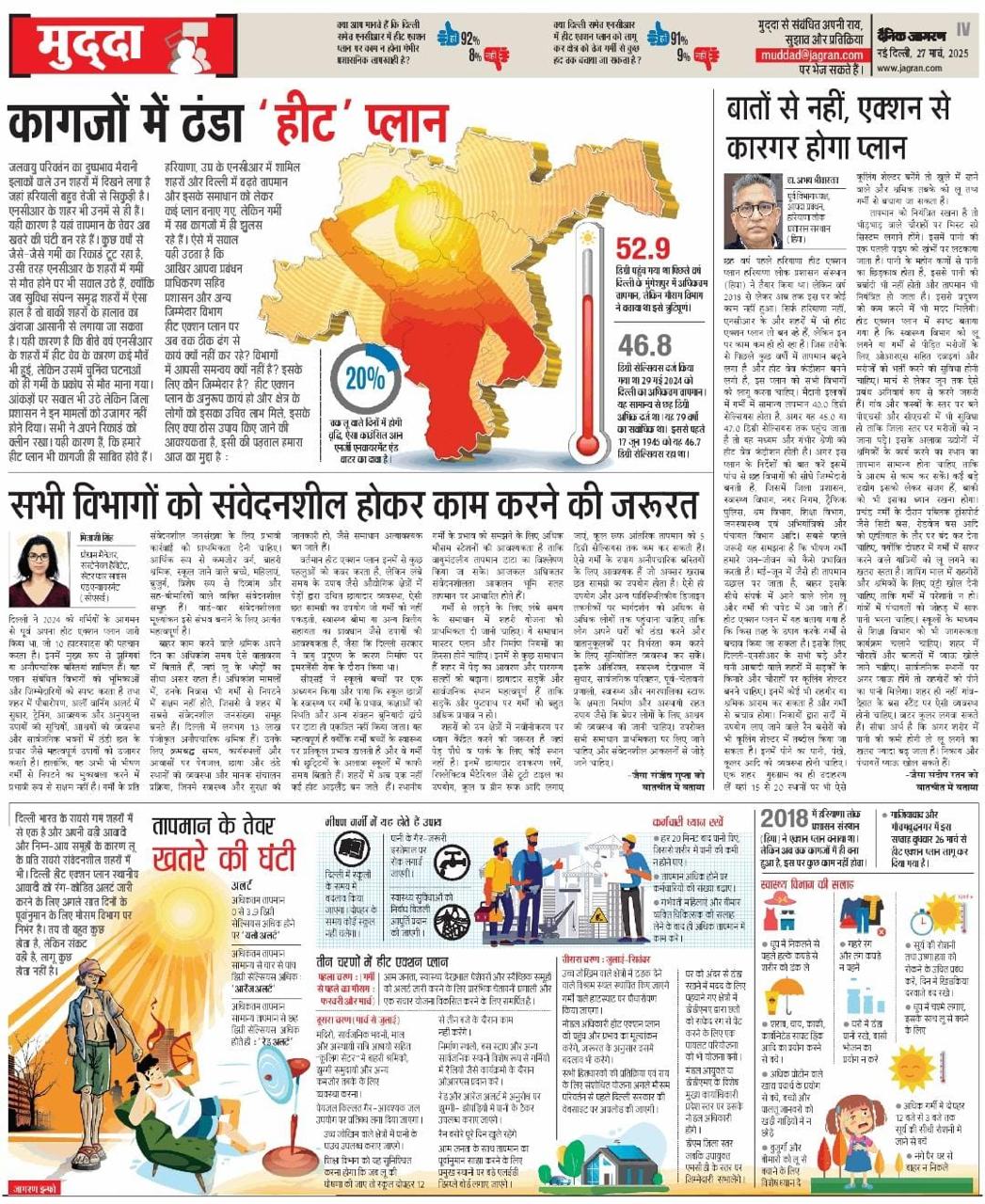
देश में गर्मी की शुरुआत ही हुई है और अभी से कई राज्यों में तापमान आसमान छू गया है. मौजूदा समय में कई जगहों पर दिन में हीटवेव (Heatwave Alert) के साथ-साथ रात के तापमान में भी काफी बढ़ोतरी देखी गई है. इस बीच मौसम विभाग ने आने वाले दिनों में पारा चढ़ने का अनुमान लगाया है. न राज्यों में दिखा प्रकोप भारत में आमतौर पर मार्च से मई के बीच गर्मी का मौसम माना जाता है. लेकिन इस साल गोवा और महाराष्ट्र में गर्मी के मौसम ने फरवरी के आखिरी दिनों में ही दस्तक दे दी थी. ऐसा पहली बार हुआ है. यह फरवरी 125 सालों में सबसे गर्म रही है. मौसम विभाग के अनुसार, जब मैदानी इलाकों में अधिकतम तापमान कम से कम 40 डिग्री सेल्सियस या सामान्य से 5 डिग्री ज्यादा होता है, तो उसे हीटवेव मान लिया जाता है. ओडिशा, झारखंड, गुजरात, महाराष्ट्र और तेलंगाना के कुछ हिस्सों ने मार्च महीने के दौरान हीटवेव का सामना किया है. सेंटर फॉर साइंस एंड एनवायरनमेंट के अनुसार, 11-23 फरवरी के दौरान 22 राज्यों में कम से कम एक बार रात का तापमान सामान्य से 3-5 डिग्री ज्यादा रहा. आगे कैसा रहेगा तापमान? मौसम विभाग के मुताबिक, इस गर्मी में देश के ज्यादातर हिस्सों को सामान्य से ज्यादा हीटवेव का सामना करना पड़ सकता है. रात का तापमान भी सामान्य से ज्यादा रहने की उम्मीद है. हालांकि, रिपोर्ट में यह नहीं बताया गया है कि 2025 की गर्मियां 2024 से ज्यादा खराब होंगी या नहीं, जो 1901 के बाद से रिकॉर्ड की गई सबसे ज्यादा गर्मी थी.

Delhi Budget 2025: Subsidies for solar panels; cables to go underground

Delhi chief minister Rekha Gupta, while presenting the Delhi budget on Tuesday, announced a state-level extension of the PM Surya Ghar: Free Electricity Scheme, aimed at promoting domestic solar panel installations through subsidies. The initiative aligns with the government’s push for 24x7 power supply, particularly from renewable sources. Gupta also unveiled a ₹100-crore pilot project to shift overhead power cables underground. The budget allocated ₹3,843 crore for the power sector in 2025-26, an increase from ₹3,353 crore in 2024-25 revised estimates. An outlay of ₹3,183 crore was made for the sector in 2024-25 budget. The CM said her government is in the process of signing a Memorandum of Understanding (MoU) with the Union government for the implementation of the PM Surya Ghar: Free Electricity Scheme. A state-level extension of the same scheme aims to cover 230,000 rooftops with solar panels in Delhi over the next three years. “A subsidy of up to ₹78,000 will be provided to residential consumers,” Gupta said. Further, the Delhi government plans to shift all overhead cables underground. “Overhead electricity wires not only deface the beauty of the city but are also risky from a security point of view. Therefore, my government has proposed shifting of high-tension and low-tension power lines, for which ₹100 crore has been allocated,” she said. Ninit Das, programme manager for renewable energy at the Centre for Science and Environment (CSE), hailed Delhi’s solar initiatives. “Allocating ₹50 crore under the new PM Surya Ghar scheme is a positive step toward equipping 230,000 rooftops with solar energy and advancing clean energy adoption,” he said.

अब बिजली के तारों से बदरंग नहीं दिखेगी दिल्ली, बजट में मुख्यमंत्री रेखा गुप्ता ने किया ऐलान

नई दिल्ली: दिल्लीवालों के लिए एक बड़ी खुशखबरी। दिल्ली की मुख्यमंत्री रेखा गुप्ता ने मंगलवार को दिल्ली बजट 2025 में राजधानी को सौर ऊर्जा से रोशन करने की घोषणा की है। यह महज घोषणा नहीं है, बल्कि इस योजना के तहत सरकार ने PM सूर्या घर: फ्री इलेक्ट्रिसिटी योजना को राज्य स्तर पर लागू करने का फैसला किया है, जिससे दिल्ली के लाखों घरों को न सिर्फ किफायती बल्कि हरित और स्वच्छ ऊर्जा मिलेगी। इस योजना के तहत, अगले तीन वर्षों में दिल्ली के 2.3 लाख घरों की छतों पर सोलर पैनल लगाए जाएंगे और इसके लिए ₹78,000 तक की सब्सिडी दी जाएगी। इस पहल का मकसद दिल्ली को 24x7 बिजली आपूर्ति देने के साथ-साथ पर्यावरण संरक्षण को बढ़ावा देना भी है। बिजली तारों से मिलेगी मुक्ति, ₹100 करोड़ का अंडरग्राउंड केबल प्रोजेक्ट दिल्ली की गलियों में लटकती बिजली की तारें अब बीते जमाने की बात होने वाली हैं। मुख्यमंत्री गुप्ता ने ₹100 करोड़ के एक पायलट प्रोजेक्ट की घोषणा की है, जिसके तहत ऊपर लटक रही हाई-टेंशन और लो-टेंशन बिजली लाइनों को अंडरग्राउंड किया जाएगा। सरकार का मानना है कि यह कदम दिल्ली की सुंदरता में इजाफा करेगा और बिजली से जुड़ी दुर्घटनाओं को रोकेगा। मुख्यमंत्री ने कहा, “ओवरहेड बिजली के तार न केवल शहर की सुंदरता को बिगाड़ते हैं, बल्कि सुरक्षा के दृष्टिकोण से भी जोखिम भरे हैं। इसलिए, मेरी सरकार ने हाई-टेंशन और लो-टेंशन बिजली केबल्स को स्थानांतरित करने का प्रस्ताव रखा है, जिसके लिए ₹100 करोड़ आवंटित किए गए हैं।” इससे दिल्ली की ना सिर्फ सुंदरता बढ़ेगी बल्कि बिजली के तारों को जमीन के नीचे डालने से सुरक्षा बढ़ेगी और बिजली आपूर्ति भी अधिक स्थिर होगी। बिजली क्षेत्र के लिए बढ़ा बजट दिल्ली सरकार ने बिजली क्षेत्र के लिए इस साल ₹3,843 करोड़ का बजट निर्धारित किया है, जो पिछले साल के ₹3,353 करोड़ की तुलना में अधिक है। सरकार ने केंद्र सरकार के साथ MoU (समझौता ज्ञापन) पर हस्ताक्षर करने की प्रक्रिया भी शुरू कर दी है, ताकि PM सूर्या घर योजना को पूरी तरह से लागू किया जा सके। दिल्ली में स्वच्छ ऊर्जा को लेकर यह पहल पर्यावरणविदों और विशेषज्ञों के बीच चर्चा का विषय बन गई है। सेंटर फॉर साइंस एंड एनवायरनमेंट (CSE) के नीनित दास ने इस योजना की सराहना करते हुए कहा, " ₹50 करोड़ का बजट सोलर एनर्जी के लिए रखना एक सकारात्मक कदम है। इससे दिल्ली के हजारों घरों में स्वच्छ ऊर्जा पहुंचेगी और कार्बन उत्सर्जन भी घटेगा।" अगर आप दिल्ली में रहते हैं, तो अब आप भी इस योजना का लाभ उठा सकते हैं। सरकार 2.3 लाख घरों में सोलर पैनल लगाने की योजना बना रही है, जिससे बिजली बिल कम होगा और अतिरिक्त बिजली बेचकर आमदनी भी की जा सकेगी।

माइक्रोप्लास्टिक बन रहा सेहत के लिए खतरा

माइक्रो प्लास्टिक हमारे जीवन के लिए बड़ा खतरा बनता जा रहा है। हाल ही में वैज्ञानिकों को पता चला है कि प्लास्टिक के इन महीन कणों के संपर्क में आने से बैक्टीरिया एंटीबायोटिक दवाओं के प्रति कहीं अधिक प्रतिरोधी हो सकते हैं। दरअसल प्लास्टिक के बड़े टुकड़े टूटकर जब छोटे कणों में बदल जाते हैं तो उसे माइक्रोप्लास्टिक कहते हैं। साथ ही कपड़ों और अन्य वस्तुओं के माइक्रोफाइबर के टूटने पर भी माइक्रोप्लास्टिक्स बनते हैं। प्लास्टिक के एक माइक्रोमीटर से पांच मिलीमीटर के टुकड़े को माइक्रोप्लास्टिक कहा जाता है। प्लास्टिक के यह महीन कण आज धरती पर करीब.करीब हर जगह मौजूद हैं। अंटार्कटिका की बर्फ से महासागरों की अथाह गहराइयों में भी इनकी मौजूदगी पाई गई है। यह कण बादलोंए पहाड़ोंए मिट्टी यहां तक की जिस हवा में में भी मौजूद हैं। हमारा खाना.पानी भी इनसे अनछुआ नहीं है। माइक्रोप्लास्टिक मानव रक्त, फेफड़ों, दिमाग सहित अन्य महत्वपूर्ण अंगों तक में अपनी पैठ बना चुके हैं। जानिए क्या है रोगाणुरोधी प्रतिरोध और माइक्रोप्लास्टिक के बीच संबंध बैक्टीरिया कई कारणों से प्रतिरोध विकसित करते हैंए जिसमें एंटीबायोटिक दवाओं का बढ़ता दुरुपयोग और बेतहाशा होता उपयोग शामिल है। इसके साथ ही प्रतिरोध को बढ़ावा देने का एक प्रमुख कारक उनका माइक्रोएनवायरनमेंट है, जहां वे बढ़ते अपनी प्रतिकृति बनाते और फैलते हैं।बोस्टन विश्वविद्यालय में शोधकर्ताओं ने परीक्षण किया है कि नियंत्रित वातावरण में माइक्रोप्लास्टिक के संपर्क में आने पर एक सामान्य बैक्टीरिया ई कोली कैसे प्रतिक्रिया करता है। विश्व बैंक द्वारा जारी एक रिपोर्ट के मुताबिक रोगाणुरोधी प्रतिरोध के इलाज में 2030 तक और 2ण्4 करोड़ लोग गरीब बन सकते हैं। दुनिया में रोगाणुरोधी प्रतिरोधी एक गंभीर समस्या बन चुका है जो हर साल करीब 49.5 लाख जानें ले रहा है। यदि इससे निपटा न गया तो और 2.4 करोड़ लोग बेहद गरीबी की मार झेलने को मजबूर होंगे। इतना ही नहीं आशंका है कि अगले 25 वर्षों में रोगाणुरोधी प्रतिरोध से मरने वालों का आंकड़ा बढ़कर दोगुणा हो जाएगा। मतलब की 2050 तक यह एक करोड़ से ज्यादा लोगों की मौत की वजह बन सकता है। सेंटर फॉर साइंस एंड एनवायरमेंट ;सीएसईद्ध ने भी अपनी रिपोर्ट ष्वन हेल्थ एक्शन टू प्रिवेंट एंड कंटेन एएमआर इन इंडियन स्टेट्स एंड यूनियन टेरीटोरिसष् में एएमआर को एक महामारी बताया है जो इंसानों और मवेशियों के स्वास्थ्य के साथ.साथ खाद्य सुरक्षा और विकास को भी गंभीर रूप से प्रभावित कर रही है। मानव के मस्तिष्क में तेजी से बढ़ रहा माइक्रोप्लास्टिक बोस्टन विश्वविद्यालय से जुड़े शोधकर्ताओं को एक चौंकाने वाले अध्ययन में पता चला है कि माइक्रोप्लास्टिक के संपर्क में आने वाले बैक्टीरिया कई प्रकार की एंटीबायोटिक दवाओं के प्रति प्रतिरोधी हो गए हैं। इन दवाओं का उपयोग आमतौर पर संक्रमण के इलाज में किया जाता है। शोधकर्ताओं के मुताबिक यह शरणार्थी शिविरों जैसे भीड़भाड़ और आर्थिक रूप से कमजोर क्षेत्रों के लिए विशेष रूप से चिंता का विषय है। इन क्षेत्रों में अक्सर प्लास्टिक कचरे के ढेर लगे होते हैं और संक्रमण आसानी से फैलता है। इस अध्ययन के नतीजे जर्नल एप्लाइड एंड एनवायरनमेंटल माइक्रोबायोलॉजी में प्रकाशित हुए हैं। बोस्टन विश्वविद्यालय में बायोमेडिकल इंजीनियरिंग के प्रोफेसर और अध्ययन से जुड़े शोधकर्ता मुहम्मद जमान ने इस चिंता को उजागर करते हुए कहा ‘मारे चारों ओर हर जगह माइक्रोप्लास्टिक मौजूद हैए खास तौर पर वे स्थान जो आर्थिक रूप से कमजोर हैं और जहां साफ सफाई की पर्याप्त व्यवस्था नहीं हैए वहां इनकी मौजूदगी कहीं ज्यादा है। इससे वंचित समुदायों के स्वास्थ्य पर खतरा बढ़ सकता है।‘ जानिए किस तरह माइक्रोप्लाटिक करता है काम प्लास्टिक बैक्टीरिया को चिपकने और पनपने के लिए एक सतह देता है। सतह पर चिपकने के बादए बैक्टीरिया एक बायोफिल्म बनाते हैं यह चिपचिपा पदार्थ एक ढाल की तरह काम करता है और बैक्टीरिया को आक्रमणकारियों से बचाता है। भले ही बैक्टीरिया किसी भी सतह पर बायोफिल्म विकसित कर सकते हैं लेकिन माइक्रोप्लास्टिक उन्हें और भी मजबूत बनाता है। रिसर्च से पता चला है कि माइक्रोप्लास्टिक ने बैक्टीरिया की बायोफिल्म को इतना अधिक सुपरचार्ज कर दिया कि जब एंटीबायोटिक्स इसके संपर्क में आए तो इस ढाल को नहीं भेद पाए।प्लास्टिक की मौजूदगी बैक्टीरिया को चिपकने के लिए सिर्फ सतह प्रदान करने से कहीं ज्यादा काम कर रही हैए वास्तव में यह प्रतिरोधी जीवों के विकास में मदद कर रहा है। उनके अनुसार शरणार्थियों और विस्थापित लोगों को भीड़.भाड़ वाले शिविरों और सीमित स्वास्थ्य सेवा के कारण पहले ही दवा.प्रतिरोधी संक्रमणों का खतरा अधिक रहता है। जर्नल ऑफ हैजर्डस मैटेरियल्स लेटर्स में प्रकाशित एक अन्य अध्ययन से पता चला है कि माइक्रोप्लास्टिक्सए बैक्टीरिया में रोगाणुरोधी प्रतिरोध को 30 गुना तक बढ़ा सकते हैं। अनुमान है कि चार लाख लोगों के वेस्ट वाटर को साफ करने की क्षमता वाला एक प्लांट हर दिन माइक्रोप्लास्टिक के करीब 20 लाख कण पर्यावरण में मुक्त कर सकता है जोकि पर्यावरण और स्वास्थ्य के लिए बढ़ा खतरा बन सकते हैं।

Budget misses the bus to slash Air Pollution

As new BJP government presented its first Budget on Tuesday, there was scarcely any hint that India’s capital city has repeatedly ranked as the one with the highest air pollution—six times in the last eight years. The most recent ranking, by an IQAir report, was just a fortnight ago. Chief Minister Rekha Gupta, who presented the budget as finance minister, mentions the menace of air pollution. However, there’s little or no aggressive push to cut pollution at source. It does not consider some key studies, particularly transport, by experts, within or outside the government. While a fair part of Delhi’s pollution, depending on factors like climate and other sources, can be from outside the capital’s jurisdiction, the Budget could do far more to cut pollution sources inside Delhi. Perhaps the single biggest missed chance is confident, brave policy steps to reduce the number of fossil-fuelled vehicles in the capital. These account for about half of Delhi’s pollution, according to a study by the Centre for Science and Environment. Even the Commission for Air Quality Management (CAQM), a body set up by the BJP-led Union government, called for a lot more buses. In a report three years ago to curb Delhi and its neighbourhood’s air pollution, the CAQM spelt out that “more buses are the key to reducing pollution; metro may not be effective”. So, what would it take to reduce private fossil fuel transport and incentivise users to switch to public transit? In the 2022 report, the CAQM pointed out that over seven in 10 people don’t use private transport but “sustainable modes” like public transport, walking, cycling, autos, and trains an opportunity it said for clean air. However, as the saying goes, the more things change, the more they remain the same. The Budget makes the right noises about public transit, promising “seamless connectivity” and “a new era of public transport.” However, details are sketchy. The number of electric buses promised seems to have remained unchanged. The Budget promises a little over 7,100 electric buses (7,152 to be exact) by the next financial year. The previous AAP government had promised that 80% of total fleet of 11,000 would be EVs, which is about 8,800. The Budget was coincidentally announced on the same day the WHO began its second international conference on air quality. Delhi and India have dominated the rankings for places with the highest pollution in the last couple of years. Within India, Delhi punches above its weight, given the attention, money and power it has as the national capital. The new government’s budget could have been a great starting point to demonstrate it was serious about slashing air pollution. Perhaps it could consider a policy mantra for political and pollution wins: Pedestrian First and Public Transit First.

Sustainable Living For Climate Action: How Consumer Choices Of Green Products Can Help Save Planet

The population on Earth is increasing, but natural resources are depleting. According to the United Nations, the global population is expected to reach 9.8 billion by 2050. An estimate suggests that if every person in the world adopts the lifestyle of an average person in Western Europe, it would require the resources of three Earths to meet everyone's needs. Considering this, the theme for this year’s World Consumer Rights Day (March 15) was: "A Just Transition to Sustainable Lifestyles". The objective is to make sustainable living accessible for all. More than 40 per cent of the world's population, i.e., over 3 billion people, cannot afford a healthy diet, while nearly 800 million people are facing a severe hunger crisis. On the other hand, 931 million tons of food are wasted every year. Food waste is a sign of consumption beyond necessity. Nearly one-third of greenhouse gas emissions come from the food system, which is also responsible for over 80 per cent of biodiversity loss. Experts say that to change this, it is necessary to develop technology and infrastructure along with appropriate policies and to educate people. The next challenge is to use resources more efficiently. The 12th goal of the Sustainable Development Goals (SDGs) is to ensure sustainable consumption and production practices. This is essential to secure the livelihoods of both present and future generations. Consumers can become a powerful force in the fight against climate change. By changing their consumption patterns, they can also pressure companies to adopt sustainable practices. Studies indicate that modifying consumption patterns can reduce greenhouse gas emissions by up to 70 per cent. The Role of Sustainable Consumption When asked about the role of sustainable consumption in controlling climate change, biodiversity loss, and pollution, Kunal Jagdale, Senior Associate for Climate, Environment and Sustainability at the Center for Study of Science, Technology, and Policy (CSTEP), tells Jagran Prime: "Consumption is a key link in the cause-and-effect chain that drives climate change. Every product we use requires natural resources, and its entire value chain generates emissions. Sustainable consumption means using products and services responsibly, based on basic needs. This helps reduce emissions and minimizes resource wastage, ultimately improving the quality of life. He says, "By choosing eco-friendly and sustainably produced products, consumers can contribute to combating climate change. For example, by purchasing locally made products and reducing the consumption of single-use plastic, consumers can lower emissions and help protect the ecosystem." Fellow and Director of Strategic Partnerships, Council on Energy, Environment, and Water (CEEW), Karthik Ganesan says; "The impact on the environment is not limited to greenhouse gas emissions alone. We depend on wood, water, minerals and other natural resources for all our needs. Sustainable consumption means that we limit the exploitation of these resources so that forests and water sources can perform their role in the ecosystem without disruption. This will also reduce energy consumption and lower greenhouse gas emissions." Challenges in Adopting a Sustainable Lifestyle According to Ganesan, the biggest challenge is our behavior. For example, owning a car has become a symbol of social and economic success. However, this increases private ownership and reduces the use of public transportation, leading to higher pollution. Therefore, it is necessary to redefine socio-economic progress. According to Jagdale, "Sustainable living is not a new concept for India; rather, it is a return to old traditions. India has a long-standing tradition of living in harmony with nature. However, despite this, there are several challenges in broadly adopting a sustainable lifestyle today. He considers the major obstacles to be the culture of convenience, lack of awareness, insufficient infrastructure and accessibility, greenwashing, expensive alternatives, and cultural shifts." sustainableproduct The 'Conspiracy' to Reduce Product Lifespan Siddharth Ghanshyam Singh, Program Manager for Solid Waste Management and Circular Economy at the Centre for Science and Environment (CSE), highlights the concept of "planned obsolescence". This means that the product you are using will soon become obsolete and no longer serve its purpose. He says, "Over time, the lifespan of electrical and electronic products is decreasing. Earlier, a laptop would last for seven to eight years, but now it only works for four to five years. After that, many of its functions stop working. Some might argue that with such mass production, a slight drop in quality is expected, but that’s not the case. The reality is that it is a conspiracy against nature and consumers. Companies that manufacture and sell such products are well aware of this scheme.

Byrnihatin Meghalaya ranked the most polluted town in the world : IQAir !

The 2024 World Air Quality Report by equipment manufacturer IQAir reveals that 35 Indian cities, including Delhi, Noida, Faridabad, Ghaziabad, Muzaarpur, Patna, and others, have been ranked among the 50 most polluted cities globally, with Byrnihat in Meghalaya leading the list. What is even more concerning is that 16 of these cities have received nearly ₹1000 crore over the past 8 years to combat air pollution, yet the situation remains dire. This alarming revelation has put India’s National Clean Air Program (NCAP) under intense scrutiny. As the most expensive air pollution control initiative ever undertaken in India—and one of the largest globally—NCAP was expected to bring signicant improvements. However, its impact seems virtually absent in 19 of the Indian cities that feature among the world’s 50 most polluted. The study was conducted by IQAir, a Swiss air quality technology company, using PM2.5 data gathered from over 40,000 air quality monitoring stations across 138 countries. A deeper analysis of the results reveals that 10 out of the 35 Indian cities listed among the world’s 50 most polluted are designated as both NCAP and smart cities. This raises serious concerns about the effectiveness of urban development plans, which are expected to tackle pollution while simultaneously enhancing infrastructure promised under the Smart Cities initiative. When the NCAP was launched in 2019, its goal was to reduce PM2.5 levels by 20 to 30% by 2024, compared to 2017 levels. However, in 2022, the timeline was extended to 2026, with the target increased to a 40% reduction. Despite this extension, many cities remain significantly distant from meeting these targets. According to the IQAir report, India’s average PM2.5 concentration declined from 54.4 micrograms per cubic meter in 2023 to 50.6 micrograms per cubic meter in 2024—a 7% reduction. Despite this improvement, India remains the 5 most polluted country in the world. According to data from the PRANA portal, which tracks NCAP’s performance, a staggering ₹11,541 crore had been disbursed as of March 14 to cities classified as non-attainment areas— those with persistent pollution issues. However, many of these cities have utilized only a small portion of their allocated funds. Byrnihat in Meghalaya, the world’s most polluted city in 2024, used just 54% of its ₹8 crore budget, while Delhi spent only 32% of its approved budget. Some cities have struggled to curb pollution despite significant spending. Patna and Chandigarh, both part of the NCAP and Smart Cities initiatives, serve as key examples. Patna allocated ₹233 crore for pollution control under NCAP between 2017 and 2018, utilizing 78% of its budget. However, air quality worsened, with PM10 levels rising by 3% in 2023-24 compared to 2017-18. Similarly, Chandigarh spent nearly ₹30 crore—93% of its allocated budget—yet pollution levels still increased by 2% during the same period. Experts have emphasized the urgent need for a revision of the NCAP. Sunil Dahiya, an air pollution expert, suggested that the program should expand to include more cities and adopt a systematic, time-bound approach to reducing emissions Anumita Roychowdhury, an expert from the Centre for Science and Environment, pointed out that two-thirds of the allocated funds have been spent on dust control, while more critical sources of pollution, such as ultrafine particles from burning biomass and solid waste, remain largely unaddressed.

Hyd trapped in heat island, sizzles at night

Hyderabad: The Telangana Socio-Economic Outlook (SCO) 2025 report highlights an increasing trend of heat stress in the core city of Hyderabad during nighttime, particularly from March to August, compared to daytime temperatures. This rise is attributed to the urban heat island (UHI) effect, which causes the urban centre to be 1.9°C warmer at night than the surrounding peri-urban and outer city regions. This situation raises concerns not only for climate conditions but also for public health, as hot nights hinder recovery from daytime heat, leading to extended physical stress. Interestingly, the report notes that during the day, the core of Hyderabad is 0.7°C cooler than the peri-urban areas. The peri-urban region serves as a transitional zone between rural and core urban areas, while the outer city consists of less densely built-up areas that are almost adjacent to rural areas. The SCO said that the state govt is banking on its Clean and Green Energy Policy 2025 to build cooler and greener cities. doctors suggest an interdisciplinary collaboration between builders, healthcare professionals, and community experts. "Dark/tar roads, which we have across Hyderabad, radiate more heat at night because they absorb more radiation from the sun during the day and then release it as heat. This heat radiation at night contributes to the urban heat island effect. It can lead to disturbances in sleep and fatigue," said Dr Dasari Anusha, senior consultant, of internal and functional medicine at AIG Hospital, told TOI. Doctors also suggest that the UHI can lead to multiple health-related issues such as rampant heat exhaustion and strokes, cardiovascular stress, skin issues, and other ailments. "As there is less green cover in multi-story buildings and high rises, the humidity level also decreases. It leads to more penetration of heat inside the structure. This can cause heat exhaustion and strokes, dehydration, cardiac and kidney impacts, especially in the elderly, children, and people with pre-existing health conditions. Prolonged heat exposure increases pro-inflammatory cytokines leading to immune dysfunction and chronic fatigue," Dr Anusha explained. Not just the physical stress UHI can also take a toll on mental health, according to doctors. GFX The report, ‘urban heat stress tracker-Hyderabad', was published by the Centre for Science and Environment (CSE). The findings state that in April 2024, Hyderabad experienced temperatures around 1°C higher than the average of the previous decade. The gap between daytime and night-time temperatures has dropped from an average of 13.2⁰ C in 2001-10 to 11.5⁰ C in 2014-23, about a 13% reduction in cooling.

Delhi's air quality worsens but stays 'moderate' for sixth day, AQI at 183

Delhi’s air quality worsened but remained in the ‘moderate’ category for the sixth consecutive day on Monday morning. The Air Quality Index (AQI) was recorded at 183 at 8 am on March 24, according to the Central Pollution Control Board (CPCB). AQI across Delhi-NCR Air quality across Delhi-National Capital Region (NCR) remained in the ‘moderate’ or ‘poor’ category. Delhi’s 24-hour average AQI stood at 194 at 4 pm on March 23. Gurugram in Haryana reported an AQI of 142, while Noida and Greater Noida in Uttar Pradesh recorded AQIs of 111 and 100, respectively. Ghaziabad’s AQI dropped to 273, remaining in the ‘poor’ category. Measures to tackle pollution After a report by the Centre for Science and Environment (CSE) cited the national capital’s air as the ‘dirtiest’ among all mega cities, Delhi chief minister Rekha Gupta announced a major campaign to tackle air pollution, focusing on dust reduction, traffic management, and enhanced public transport. The government is committed to implementing sustainable solutions for a cleaner, healthier city. Delhi weather update Delhi residents woke up to clear skies and pleasant weather on Monday morning. The temperature remained lower than usual at night, offering much-needed relief. Recently, the mercury has spiked, crossing 35 degrees Celsius on some days. The India Meteorological Department (IMD) has also predicted rainfall accompanied by thunderstorms, with Western Disturbances expected to make a comeback. Monday’s forecast indicates a minimum temperature of 17 degrees Celsius and a maximum of 34 degrees Celsius. Relative humidity is at 7 per cent, with wind speed at 7 km/h.