आजकल की भागदौड़ भरी जिंदगी में लोगों के पास समय की भारी कमी होती जा रही है। ऐसे में बढ़ते होटल और रेस्तरां में खाने की प्रवृत्ति तेज़ी से बढ़ रही है। खासतौर पर युवाओं को तब तक संतुष्टि नहीं मिलती जब तक वे बाहर का भोजन न कर लें। इसी कारण पैकेटबंद खाद्य पदार्थों का उपयोग अप्रत्याशित रूप से बढ़ रहा है। हाल ही में यूनिसेफ (UNICEF) की एक रिपोर्ट में भारत समेत 97 देशों में किए गए अध्ययन के अनुसार, पिछले 15 वर्षों में पैकेटबंद खाद्य पदार्थों के सेवन में 11% की वृद्धि हुई है। इसका असर न केवल लोगों के बजट पर पड़ा है, बल्कि स्वास्थ्य पर भी नकारात्मक प्रभाव देखने को मिला है। बीते कुछ वर्षों में बड़े ब्रांडों के रेस्तरां और फूड आउटलेट्स के खुलने के बाद ये जगहें लोगों के लिए मनोरंजन और आराम करने के केंद्र बन गए हैं। इसी के चलते बच्चों में मोटापा और महिलाओं में खून की कमी जैसी समस्याएं अधिक पाई गई हैं, क्योंकि ये दोनों वर्ग तुलनात्मक रूप से इनका अधिक सेवन करते हैं। जिन राज्यों में ज्यादा फूड आउटलेट्स खोले गए हैं, वहां यह समस्या अधिक देखने को मिलती है। पैक्ड फूड खाने की बढ़ती लत नेचर फूड पत्रिका के विश्लेषण के अनुसार, सुपरमार्केट से तरल और तले-भुने खाद्य पदार्थ, जैसे कोल्ड ड्रिंक्स, चिप्स, कुरकुरे आदि की खपत भारत, बांग्लादेश, अमेरिका और सिंगापुर जैसे देशों में 11% तक बढ़ी है। खाद्य पदार्थों के व्यापार से जुड़ी एक एजेंसी यूरोमॉनिटर की रिपोर्ट के अनुसार, भारत में अल्ट्रा-प्रोसेस्ड फूड की प्रति व्यक्ति वार्षिक खपत 2010 में 2 किलोग्राम थी, जो 2019 में बढ़कर 6 किलोग्राम हो गई और 2024 में यह 8 किलोग्राम तक पहुंच गई है। हेल्थ पर पड़ने वाले दुष्प्रभाव सेंटर फॉर साइंस एंड एनवायरनमेंट के अनुसार, भारत में पैकेटबंद और जंक फूड के बढ़ते उपयोग के कारण मधुमेह, उच्च रक्तचाप और हृदय रोग तेजी से फैल रहे हैं। इसी खतरे को देखते हुए भारत सरकार ने अल्ट्रा-प्रोसेस्ड फूड पर अधिक कर (टैक्स) लगाने की सिफारिश की है। पैकेटबंद खाद्य पदार्थों का बढ़ता उपयोग स्वास्थ्य के लिए गंभीर खतरा बनता जा रहा है। यह न केवल मोटापा, मधुमेह और हृदय रोगों को बढ़ावा देता है, बल्कि पोषण की कमी और आर्थिक बोझ भी बढ़ाता है। ऐसे में स्वस्थ जीवनशैली अपनाने के लिए संतुलित आहार, ताजे और घर के बने भोजन को प्राथमिकता देना आवश्यक है।
Despite being one of the most-polluted cities in the world, Delhi has not seen environmental issues dominate voters’ concerns. However, the recently concluded Assembly elections signaled a pivotal shift, with voters, for the first time, prioritising environmental concerns, demanding a clean Yamuna and improved air quality. “Post-elections, when people were asked the reasons why they voted out the then ruling party – for the first time they said pollution in Yamuna, toxic air and the garbage on the streets. This means that we have reached a stage, where these issues have become poll issues. There is huge environmental consciousness, and we must recognise that," said Sunita Narain, Director-General, Centre for Science and Environment (CSE), citing the latest Centre for the Study of Developing Societies (CSDS)- post-poll survey. In an exclusive interview to CNN-News18, the noted environmentalist said the voters have now made their voices heard, and it is now up to the new government to make sure that these issues are prioritised. Delhi continues to breathe toxic air year after year reducing the life expectancy of its 33 million population, and rendering them susceptible to multiple illnesses. The Yamuna, which flows through much of its territory, has also remained highly-polluted, with large amounts of sewage being dumped into it. The latest data from monitoring stations shows that its Dissolved Oxygen (DO) – an indicator of life in the river – plummets to ‘zero’ at multiple points from ISBT to Okhla from where it finally exits the city. While thousands of crores have been spent in cleaning the river in the past, it has only got more polluted over the years. “We must not forget that these issues were also part of previous governments’ agendas and manifestoes. However, despite all the action, we have not succeeded. So, this is a moment of reflection. The new government must take this challenge of acting differently," she emphasised, while speaking to CNN-News18 on the sidelines of the Anil Aggarwal Dialogue (AED) 2025.
New Delhi: Strong and cool northwesterly winds, which blew in the city on Wednesday, helped Delhiites inhale clean air. The city recorded an air quality index (AQI) of 119 in the lower end of the moderate category. The last time Delhi recorded a lower AQI was on Sept 29, 2024, at 76, in the satisfactory category. Wednesday was the fifth consecutive moderate day. Anumita Roychowdhury, executive director of research and advocacy at Centre for Science and Environment, said, "This has been possible primarily because of strong breeze and relatively lower impact of wind-blown dust haze as we normally see during summer. Pollution has dispersed faster than usual." However, she pointed out, "This is only a temporary reprieve. We need deeper and round the year action to meet the clean air benchmark." According to India Meteorological Department, strong surface wind conditions from west with 25-35kmph speed prevailed during the past 24 hours. Strong winds aid in dispersion of pollutants while calm winds lead to their accumulation. Met department has predicted that strong surface winds at the speed of 20-30kmph are likely to prevail till Thursday noon. Air Quality Early Warning System for Delhi, the forecasting body under the Union ministry of earth sciences, the air quality is likely to stay moderate till Saturday. "The outlook for the subsequent six days is that the air quality is likely to be in the moderate to poor category," it added. Meanwhile, the maximum temperature is likely to rise from Thursday and it may reach 33 degrees Celsius by March 10. Strong winds caused the day temperature to dip on Wednesday. The maximum temperature was 25 degrees Celsius, two degrees below normal, at Safdarjung, the city's base station. The minimum temperature settled at 11.8 degrees Celsius, two degrees below normal. It was 3.8 degrees lower than Tuesday's minimum temperature. IMD has predicted that the maximum temperature may remain in the range of 28-30 degrees Celsius on Thursday, but is likely to surpass 30 degrees Celsius by Saturday. It is predicted to reach in the range of 31-33 degrees Celsius by March 10.
Industrial Waste: भारत में उद्योगों से निकलने वाले कचरे को लेकर सेंटर फॉर साइंस एंड एनवायरनमेंट (CSE) की रिपोर्ट में तेजी से बढ़ते उत्सर्जन पर कंट्रोल का बताया तरीका। भारत में उद्योगों से निकलने वाले करीब 75 करोड़ टन कचरे का दोबारा इस्तेमाल किया जा सकता है। इसमें स्टील स्लैग, कचरे से पैदा ईंधन (RDF), फ्लाई ऐश, रेड मड, बायोमास आदि शामिल हैं। इससे प्राकृतिक संसाधनों पर बढ़ते दबाव को कम करने में मदद मिलेगी। तेजी से बढ़ते उत्सर्जन पर भी लगाम लगाई जा सकेगी। सेंटर फॉर साइंस एंड एनवायरनमेंट (CSE) की रिपोर्ट में यह बात कही गई। बचेगा प्राकृतिक संसाधन ‘गुड प्रैक्टिस इन इंडस्ट्रियल वेस्ट सर्कुलेरिटी’ नाम की रिपोर्ट के मुताबिक औद्योगिक कचरे के दोबारा इस्तेमाल से कोयला, जिप्सम जैसे 45 करोड़ टन प्राकृतिक संसाधनों को बचाया जा सकेगा और पांच से नौ करोड़ टन कार्बन उत्सर्जन रोका जा सकेगा। सीएसई के औद्योगिक प्रदूषण कार्यक्रम के प्रबंधक शोभित श्रीवास्तव ने कहा, कई भारतीय उद्योगों ने इस दिशा में बेहतर काम किए हैं। इन्हें आगे बढ़ाने की जरूरत है। स्टील स्लैग से सीमेंट रिपोर्ट के मुताबिक 2030 तक भारत में करीब 5.25 करोड़ टन स्टील स्लैग पैदा हो सकता है। इसमें से 3.53 से 4.1 करोड़ टन का इस्तेमाल सीमेंट बनाने में किया जा सकता है। इसी तरह 43.7 करोड़ टन फ्लाई ऐश में से 20.8 से 23.1 करोड़ टन का इस्तेमाल सीमेंट उद्योग में किया जा सकता है। मूल्यवान संसाधन सीएसई की महानिदेशक सुनीता नारायण का कहना है कि उद्योग भारत के सकल घरेलू उत्पाद में 30 फीसदी से ज्यादा का योगदान देते हैं। ये बड़ी मात्रा में प्राकृतिक संसाधनों का इस्तेमाल कर रहे हैं। कचरे के साथ बड़ी मात्रा में उत्सर्जन भी कर रहे हैं। अपशिष्ट मूल्यवान संसाधन हो सकता है। सर्कुलरिटी से कार्बन उत्सर्जन कम सीएसई में औद्योगिक प्रदूषण कार्यक्रम के निदेशक निवित यादव ने बताया कि “इस बात पर प्रकाश डाला है कि कैसे सर्कुलरिटी अपशिष्ट प्रबंधन में सुधार ला सकती है, साथ ही कार्बन उत्सर्जन को कम कर सकती है। यह संसाधनों की बचत के साथ-साथ लागत में भी कटौती कर सकती है।“ सरकारी नीतियों की जरुरत सीएसई रिपोर्ट में भारत में औद्योगिक कचरे को ट्रैक और रिकॉर्ड करने की आवश्यकता पर जोर दिया गया है। सर्कुलरिटी को बढ़ावा देने के लिए, उद्योगों को प्रोत्साहन दिया जाना चाहिए। साथ ही सरकार को विभिन्न क्षेत्रों के लिए कचरे के पुनर्चक्रण से जुड़ी नीतियां बनानी चाहिए।
India has 42 of the 50 most polluted cities in the worlda stark failure of municipal governance, India’s G20 Sherpa Amitabh Kant has said at the Anil Agarwal Dialogue 2025, an event organised by the Centre for Science and Environment (CSE) in Rajasthan. Kant emphasised that waste mismanagement is not just a governance issue but also a failure of citizen responsibility. “People do not take responsibility for separating their waste at the household level,” he said. “If we continue down this path, we will become a country of filth.” WHY WASTE SEGREGATION Segregation is the practice of essentially not mixing waste and slotting different kinds of garbage separately at the household/ source level and giving it separately to the garbage collector in different packages. Experts say it is extremely fundamental to addressing the challenges of waste management in India. “Segregation is the single-biggest factor that can save Delhi or any other city from turning into a dump-yard,” Atin Biswas, programme director for solid waste management and circular economy at CSE, told INDIA TODAY on the sidelines of the Anil Agarwal Dialogue 2025. “In fact, it can solve at least half of the [waste] problem.” HOW TO SEGREGATE AT HOME Household waste can broadly be divided into two large sectionswet and dry. Each kind of waste requires a different type of facility to manage it. However, if both wet and dry waste get mixed, which happens in most households today, half the battle is already lost, said Biswas. The main reason is that when mixed, wet waste (such as vegetable peels, which have 70 per cent water) contaminates dry waste. As a result, the value of dry waste reduces. That’s essentially because dry waste includes a wide spectrum of materialspaper, metal, glass, plastic, discarded medicines, broken thermometers, electronic waste, sanitary napkins and diapers, to name a few. All of these contain chemicals that don’t react unless exposed to moisture or liquid. Experts say that if segregated, both these wastes can be treated for making money, something that forms the ethos of a circular economy, wherein nothing goes to landfill but is circulated back into the system. For instance, wet waste gets converted into biogas, bio-CNG or compost.
India has 42 of the 50 most polluted cities in the worlda stark failure of municipal governance, India's G20 Sherpa Amitabh Kant has said at the Anil Agarwal Dialogue 2025, an event organised by the Centre for Science and Environment (CSE) in Rajasthan. Kant emphasised that waste mismanagement is not just a governance issue but also a failure of citizen responsibility. "People do not take responsibility for separating their waste at the household level," he said. "If we continue down this path, we will become a country of filth." WHY WASTE SEGREGATION Segregation is the practice of essentially not mixing waste and slotting different kinds of garbage separately at the household/ source level and giving it separately to the garbage collector in different packages. Experts say it is extremely fundamental to addressing the challenges of waste management in India. "Segregation is the single-biggest factor that can save Delhi or any other city from turning into a dump-yard," Atin Biswas, programme director for solid waste management and circular economy at CSE, told INDIA TODAY on the sidelines of the Anil Agarwal Dialogue 2025. "In fact, it can solve at least half of the [waste] problem." HOW TO SEGREGATE AT HOME Household waste can broadly be divided into two large sectionswet and dry. Each kind of waste requires a different type of facility to manage it. However, if both wet and dry waste get mixed, which happens in most households today, half the battle is already lost, said Biswas.
The Economic Times will launch the fourth edition of its prestigious annual even .. Sunita Narain, Director General, Center for Science and Environment; and Rajnath ..
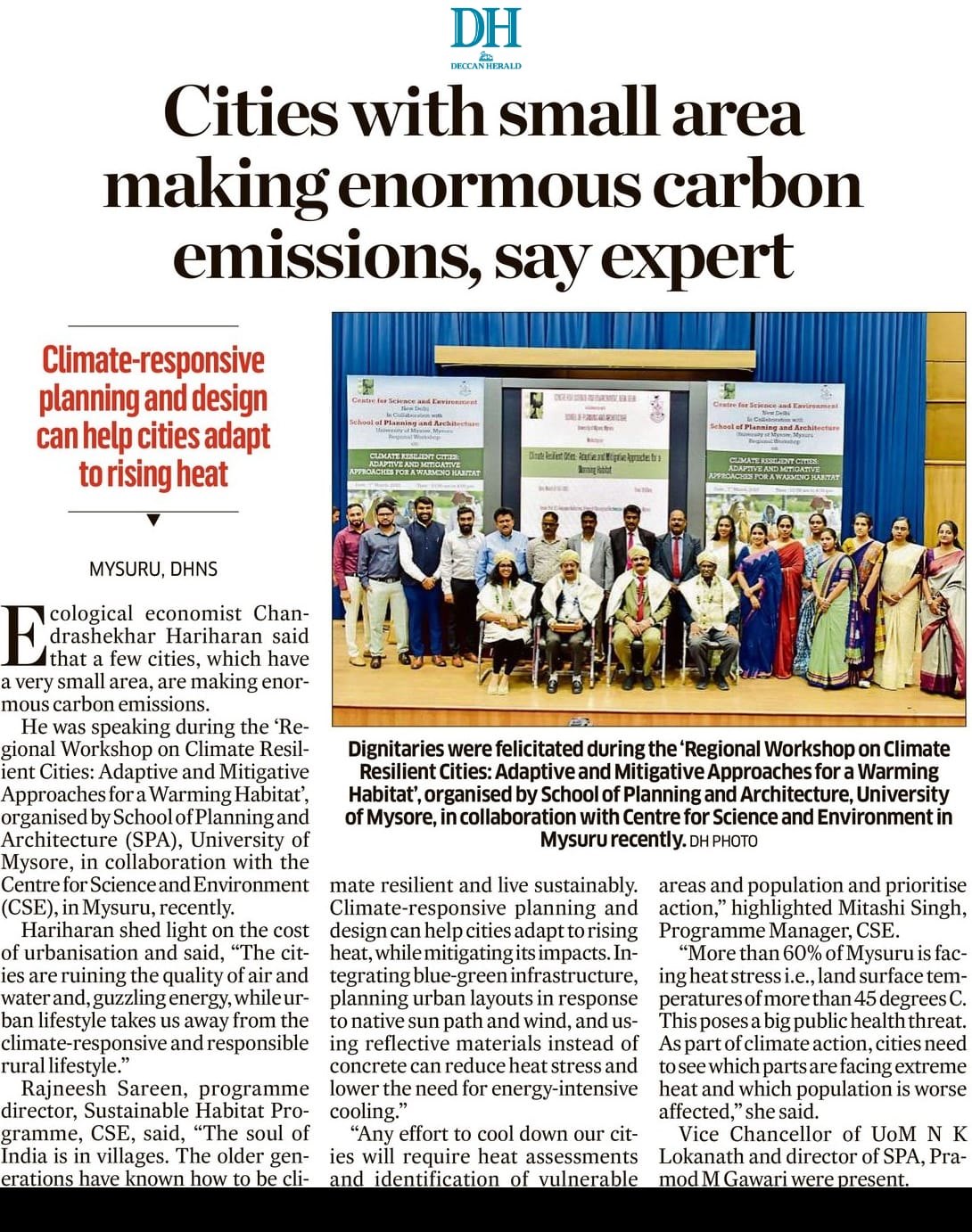
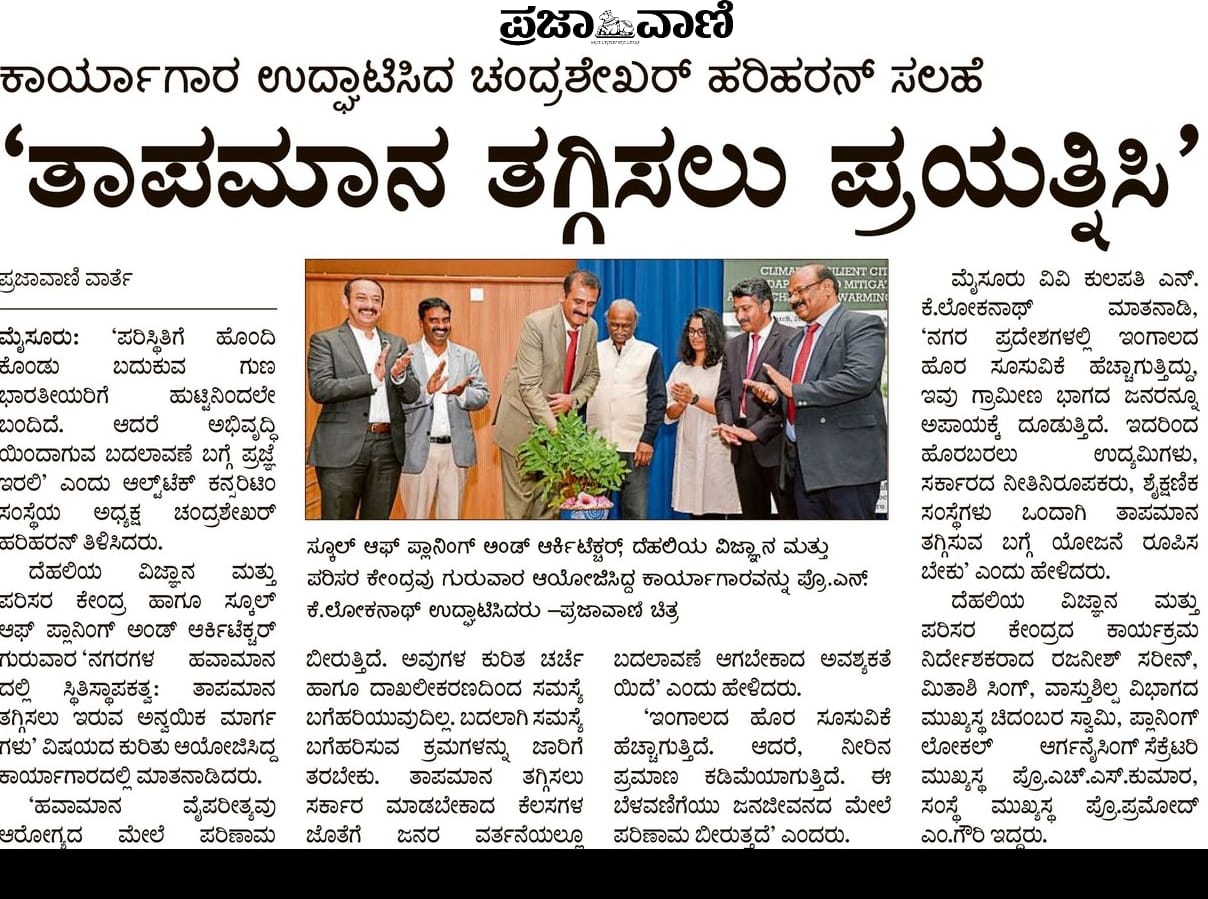
Regional workshop on Climate Resilient Cities: Adaptive and Mitigative Approaches for a Warming Habitat, Prof. N.K. Lokanath, Vice-Chancellor, University of Mysore, inaugurates; Rajneesh Sareen, Programme Director for Sustainable Building and Habitat Programme, Centre for Science and Environment, New Delhi, chief guest; Dr. Chandrashekar Hariharan, Chairman, AltTech Consortium, Bengaluru, delivers keynote address; Mitashi Singh, Programme Manager, Sustainable Building and Habitat Programme at Centre for Science and Environment, New Delhi and M.K. Savitha, UoM Registrar, guests of honour, Prof. K.S. Rangappa Auditorium, School of Planning and Architecture, Manasagangothri, 12 noon.
Circularity is the answer to India’s rising industrial waste and carbon missions. The country could reuse up to 750 million tonnes (MT) of industrial waste, such as steel slag and fly ash, by 2030. It can also reduce carbon dioxide emissions by 50-90 million tonnes (MT), according to a Centre for Science and Environment (CSE) report. “Circularity has emerged as a critical focus area globally and nationally, emphasising on the principle that waste is not merely waste, but a valuable resource,” Sunita Narain, the director general at the Centre for Science and Environment (CSE), said in a press release. Circularity is the sustainable use of waste material from a production process by reusing it in various forms, ensuring that any economic process is circular and not linear, limiting waste production. There has been a renewed focus in India on circularity, which Finance Minister Nirmala Sitharaman mentioned in the 2025 Budget speech. Over the last decade, Swacch Bharat Abhiyan, the 2022 ban on single-use plastic, and the E-Waste Management Rules that India passed in 2022 are all geared towards a more circular economy. According to the CSE report, India’s material industrial consumption will likely double from seven billion tonnes in 2015 to 14.2 billion tonnes by 2030. In Europe, the quantum of goods recycled is as high as 70 percent, but the goods India recycles is a mere 20 percent. Globally, there is a big gap in overall circularity, with only 7.2 percent of the global economy being circular. “Many Indian industries are already taking steps to improve circularity—they have a number of good practices that need to be scaled up. States like Gujarat, Goa and Karnataka have taken initiatives towards circularity, but more states need to follow their example,” Shobhit Srivastava, the industrial pollution programme manager at CSE, said in the press release. Challenges to circularity The CSE report comes at an opportune time. Currently, the state leaders are meeting in Jaipur for the 12th edition of the Regional 3R and Circular Economy Forum in Asia and the Pacific. Inaugurated by Union Minister of Housing and Urban Affairs Manohar Lal Khattar, the forum focuses on global strategies and collaboration for reducing waste and promoting sustainability. Over 500 representatives from over 20 countries in the Asia Pacific region and the United Nations will be participating in the forum, slated to pass a Jaipur Declaration on 5 March 2025, stating goals for a more resource-efficient economy. The large-scale generation of industrial and hazardous waste, along with improper handling and mismanagement, has, in several cases, resulted in environmental accidents, such as the 1984 Bhopal Gas Tragedy. Waste poses risks to local communities, wildlife, and vegetation, with the CSE report stressing the need to shift towards a circular economy. Circularity conserves resources—for instance, alternative fuels and raw materials derived from industrial waste, such as biomass, can reduce coal consumption in India.
Chennai and Tamil Nadu are grappling with an intensifying heat stress as maximum temperatures are climbing above normal. As per the temperature forecast by the regional meteorological centre here, there will be a gradual rise in day time temperature by 2°C during next 5 days and maximum temperature is likely to be 2-3 degrees above normal in isolated pockets of Tamil Nadu. Tirupattur recorded the highest temperature in the state at 38.8°C. This comes amid warnings of an unusually harsh summer ahead. On March 3, maximum temperatures ranged between 34 - 39°C across the plains of North Interior Tamil Nadu, 33-34 degrees in South Interior Tamil Nadu, and 30-35 degrees along the coastal areas, including Chennai, Puducherry and Karaikal. Nighttime conditions offered little respite, with districts like Dharmapuri (3.8 degrees above normal), Ooty (3.6 C), Coimbatore (3 C), and Chennai (2.2 C) recording unusually high minimum temperatures. Although, on Tuesday, the mercury dropped slightly, the majority of districts continued to record above normal temperatures. A recent report by the Centre for Science and Environment (CSE) - Urban Heat Stress Tracker: Chennai - highlights a decadal rise in summertime average ambient air temperature of 0.4°C - from 30.3°C (2001-2010) to 30.7°C (2014-2023) - coupled with a 5% increase in relative humidity. This combination has driven a 5% rise in Chennai’s Heat Index (HI), with days exceeding the dangerous HI threshold of 41°C tripling since the early 2000s. Last year, March-April temperatures were 1°C hotter than the 2014-2023 average, a trend continuing into 2025. Experts attribute this escalation to the urban heat island effect, worsened by Chennai’s rapid urban expansion.
Building and practising a circular economy is not just about managing waste efficiently – it has a potential to lead to substantial conservation of natural resources as well as reduction in carbon emissions, says a new report on industrial waste circularity by Centre for Science and Environment (CSE). The report – Good Practices in Industrial Waste Circularity — has estimated the potential of circularity of different industrial wastes in various applications by 2030 and the associated benefits in terms of natural resource conservation, reduction in carbon emissions and cost economics. According to it, there is a potential for utilising about 750 million tonne (MT) of various types of wastes in industries (steel slag, RDF, flyash, red mud, biomass, hazardous waste etc). Circularity can also help conserve more than 450 MT of natural resources like coal and gypsum, while the potential of reduction in carbon dioxide equivalent (CO 2 e) lies in the range of 50-90 MT . Speaking at a National Dialogue based on the CSE report on the subject here today, CSE director general Sunita Narain said: “Industries contribute over 30 per cent of India’s GDP, and are significant consumers of natural resources and generators of waste. They are also major sources of pollution and carbon emissions. Circularity has emerged as a critical focus area globally and nationally, emphasising on the principle that waste is not merely waste, but a valuable resource. This model promotes the sharing, leasing, reusing, repairing, refurbishing, and recycling of existing materials and products to extend their lifecycle.” Narain went on to say: “A new approach is needed in management of industrial waste. We must avoid simply transferring toxins from one place to another. Instead, waste from one industry should become a resource for another. Industrial activity should not contribute to pollution but instead follow a path of responsible circularity. CSE’s work in this field highlights that it can be a game-changer, making a significant impact on resource use in the country.” Nivit K Yadav, programme director, industrial pollution, CSE said: “The Dialogue has been organised to explore how circularity can serve as a tool not only for effective waste management but also for achieving co-benefits such as decarbonisation, cleaner air, resource conservation, and cost optimisation. The event has highlighted the current state of industrial waste management, showcased the best practices, and outlined a future vision for industrial waste circularity in India.” The other speakers at the Dialogue included K Murugesan, member secretary, Orissa Pollution Control Board; S Ramarao, chief operating officer of Adani Cement; Satish Upadhyay, mission director, National Mission on Use of Biomass in Power Plants and Ulhas Palikar, director, Material Recycling Association of India (MRAI). Presenting the findings of the CSE study, Shobhit Srivastava, programme manager, industrial pollution, CSE said: “Many Indian industries are already taking steps to improve circularity – they have a number of good practices that need to be scaled up. States like Gujarat, Goa and Karnataka have taken initiatives towards circularity, but more states need to follow their example.” Highlighting the circularity potential of industrial wastes, the CSE report says that out of 52.5 MT of steel slag estimated to be generated by 2030, about 35.3-41 MT can be used in cement making. Similarly, out of 437 MT of fly ash expected to be generated by 2030, roughly 208-231 MT can be used in the cement sector. Using refuse-derived fuel (RDF) in cement industries and co-firing biomass in thermal power plants can help reduce CO 2 emissions in the range of 46.6 to 85.6 MT of CO 2 e by 2030, says the report. Says Srivastava: “Biomass co-firing in thermal power plants has the potential to be one of the key pathways for decarbonisation. Both RDF and biomass circularity in industries is expected to be improved with the recently introduced notification for Solid Waste Management Rules, 2024.” Pointing to the challenges, K Murugesan from Odisha said: “One of the biggest roadblocks towards scaling up industrial circularity practices is the absence of attractive taxation policies for industries utilising waste.” According to Satish Upadhyay, “we need a strong economic case to drive funding and make circularity viable. A ‘push’ strategy is ineffective for circularity – we need a ‘pull’ strategy. Demand must drive the market, ensuring maximum utilisation of resources to achieve full circularity.” Yadav points out: “There is an urgent need for India to have a national vision and mission towards industrial waste circularity. A national circular economy action plan is the need of the hour, and it should include sectoral action plans for industries.” The CSE report says it is critical that India maps and inventorises the industrial waste generated in the country. Incentivisation for industries is another pathway to enhance and encourage the practice of circularity of waste — government should come up with circularity-driven policies or industrial waste for different industries.
Union ministers Nitin Gadkari and Pralhad Joshi on Tuesday flagged off the first-ever trials of hydrogen-powered heavy-duty trucks launched by Tata Motors to assess their viability for long haul transportation solutions. Gadkari, the road transport and highways minister, complimented the company for taking the lead in this significant step towards enabling hydrogen-powered green and smart transportation, “Hydrogen is the fuel of the future with immense potential to transform India’s transportation sector by reducing emissions and enhancing energy self-reliance. Such Initiatives will accelerate the transition to sustainable mobility in heavy-duty trucking, and move us closer to an efficient, low-carbon future,” he said. Tata Motors was awarded the tender for this trial, which is funded by the ministry of new and renewable energy under the National Green Hydrogen Mission. The trial phase will continue for up to 24 months and involves deployment of 16 advanced hydrogen-powered vehicles with different configurations and payload capacities. These trucks, equipped with new age Hydrogen Internal Combustion Engines (H2-ICE) and Fuel Cell (H2-FCEV) technologies, will be tested on India’s most prominent freight routes, including those around Mumbai, Pune, Delhi-NCR, Surat, Vadodara, Jamshedpur and Kalinganagar, a government statement said. The first batch of three hydrogen-powered heavy-duty trucks will operate on the Faridabad–Delhi NCR and Ahmedabad–Surat–Vadodara routes. Joshi, the new and renewable energy minister, said hydrogen was an important fuel for India’s transition to a sustainable and zero-carbon future. The launch of hydrogen-powered truck trials mark a radical shift in India’s mobility sector, reducing dependence on fossil fuels and enhancing energy security, he said. Vehicular pollution is a significant contributor to PM 2.5 levels in urban areas. Diesel vehicles, a major chunk of which are heavy vehicles, in particular, are known to be major sources of PM 2.5 emissions due to their higher levels of particulate matter compared to petrol vehicles and other relatively cleaner fuels such as CNG. A 2016 study by Centre for Science and Environment and Shakti Foundation had found across India, trucks contribute about 66% of PM (particulate matter) pollution and 62% of NOx emissions.
चेन्नई और तमिलनाडु में गर्मी का प्रकोप बढ़ता जा रहा है, क्योंकि अधिकतम तापमान सामान्य से ऊपर चढ़ रहा है। यहां क्षेत्रीय मौसम विज्ञान केंद्र द्वारा तापमान पूर्वानुमान के अनुसार, अगले 5 दिनों के दौरान दिन के तापमान में धीरे-धीरे 2 डिग्री सेल्सियस की वृद्धि होगी और तमिलनाडु के अलग-अलग इलाकों में अधिकतम तापमान सामान्य से 2-3 डिग्री अधिक रहने की संभावना है। तिरुपत्तूर में राज्य में सबसे अधिक तापमान 38.8 डिग्री सेल्सियस दर्ज किया गया। यह असामान्य रूप से कठोर गर्मी की चेतावनी के बीच आया है। 3 मार्च को, उत्तरी आंतरिक तमिलनाडु के मैदानी इलाकों में अधिकतम तापमान 34 - 39 डिग्री सेल्सियस, दक्षिणी आंतरिक तमिलनाडु में 33-34 डिग्री और चेन्नई, पुडुचेरी और कराईकल सहित तटीय क्षेत्रों में 30-35 डिग्री के बीच रहा। रात के समय की स्थितियों ने थोड़ी राहत दी, धर्मपुरी (सामान्य से 3.8 डिग्री अधिक), ऊटी (3.6 डिग्री सेल्सियस), कोयंबटूर (3 डिग्री सेल्सियस) और चेन्नई (2.2 डिग्री सेल्सियस) जैसे जिलों में असामान्य रूप से उच्च न्यूनतम तापमान दर्ज किया गया। हालांकि, मंगलवार को पारा थोड़ा कम हुआ, लेकिन अधिकांश जिलों में सामान्य से अधिक तापमान दर्ज किया गया। सेंटर फॉर साइंस एंड एनवायरनमेंट (सीएसई) की एक हालिया रिपोर्ट - अर्बन हीट स्ट्रेस ट्रैकर: चेन्नई - गर्मियों के औसत परिवेशी वायु तापमान में दशक भर में 0.4 डिग्री सेल्सियस की वृद्धि को उजागर करती है - 30.3 डिग्री सेल्सियस (2001-2010) से 30.7 डिग्री सेल्सियस (2014-2023) तक - साथ ही सापेक्ष आर्द्रता में 5% की वृद्धि हुई है।