Cse In News

No fuel for overage vehicles after March 31, announces new Delhi government

In a move aimed at combating air pollution, the Delhi government announced on Saturday that from April 1, fuel pumps in the national capital will not provide petrol and diesel to vehicles older than 15 and 10 years, respectively. Fuel pumps would be equipped with devices to identify overage vehicles and restrict fuel supply to them, Delhi Environment Minister Manjinder Singh Sirsa said after a high-level meeting with officials to discuss anti-pollution measures. The move aims to curb vehicular emissions and put a check on air pollution in the city which remains a persistent challenge for the residents. Talking to reporters, the minister said the Delhi government would inform the Ministry of Petroleum and Natural Gas about the decision and the ministry would, in turn, notify the fuel pump owners. The city has around 500 petrol-diesel stations. “We are setting up gadgets at our petrol pumps that will identify vehicles older than 15 years. They will not be provided fuel,” Sirsa said. A senior official of the Delhi government told PTI that diesel-run vehicles older than 10 years will also be denied fuel after March 31. According to rough estimates, there are around 55 lakh overage vehicles, 66 per cent of which are two-wheelers and 54 per cent four-wheelers, the officer said. Giving more details about the implementation of new rules, the officer said many fuel stations in Delhi have already installed AI-enabled cameras to check violations of pollution under control (PUC) certificate rules. “These cameras currently detect vehicles which do not have PUC certificate and the fuel pump staff deny fuel to such vehicles. We can also use these AI-enabled cameras to detect the age of particular vehicles. For this, we need to upgrade our system,” the officer added. He said the fuel pumps which currently do not have such devices will have them installed soon. Moreover, the Delhi government will deploy teams to identify overage vehicles and ensure they are either prevented from entering the city or removed if already present. The government’s decision aligns with a 2018 Supreme Court ruling that banned diesel vehicles older than 10 years and petrol vehicles older than 15 years in Delhi. A 2014 National Green Tribunal order prohibits parking of vehicles aged over 15 years in public areas. The government also plans to phase out nearly 90 per cent of CNG-driven public transport buses in Delhi by December 2025, replacing them with electric buses to promote cleaner and more sustainable transport. According to the Delhi government, 11,000 buses, including around 8,000 e-buses, will be procured by 2026. Sirsa said procurement of 3,680 e-buses will be completed by September this year to encourage people to avail public transport for their daily commute. During the meeting, the minister was informed that around 7,600 buses, including 2002 e-buses, are plying in Delhi, another official said.In November, the Centre for Science and Environment said in its report that vehicular emission is the top contributor to Delhi’s pollution during winters — more than stubble burning, road dust or bursting of firecrackers — with over 50 per cent of pollution from local sources linked to the city’s fragmented transportation system.Nischal Singhania, the president of the Delhi Petrol Dealers Association, welcomed the move and said, “Vehicles older than 15 years are already banned in Delhi by the Supreme Court.” “We already have apparatus to detect vehicles without pollution under control (PUC) certificates. I think those can be used to detect vehicles older than 15 years,” he said. Bhavreen Kandhari, an environmentalist, said there is no scientific study that proves only vehicles older than 15 years are responsible for air pollution. (PTI)
India’s Environment Report: Will India meet its vehicle electrification target by 2030?

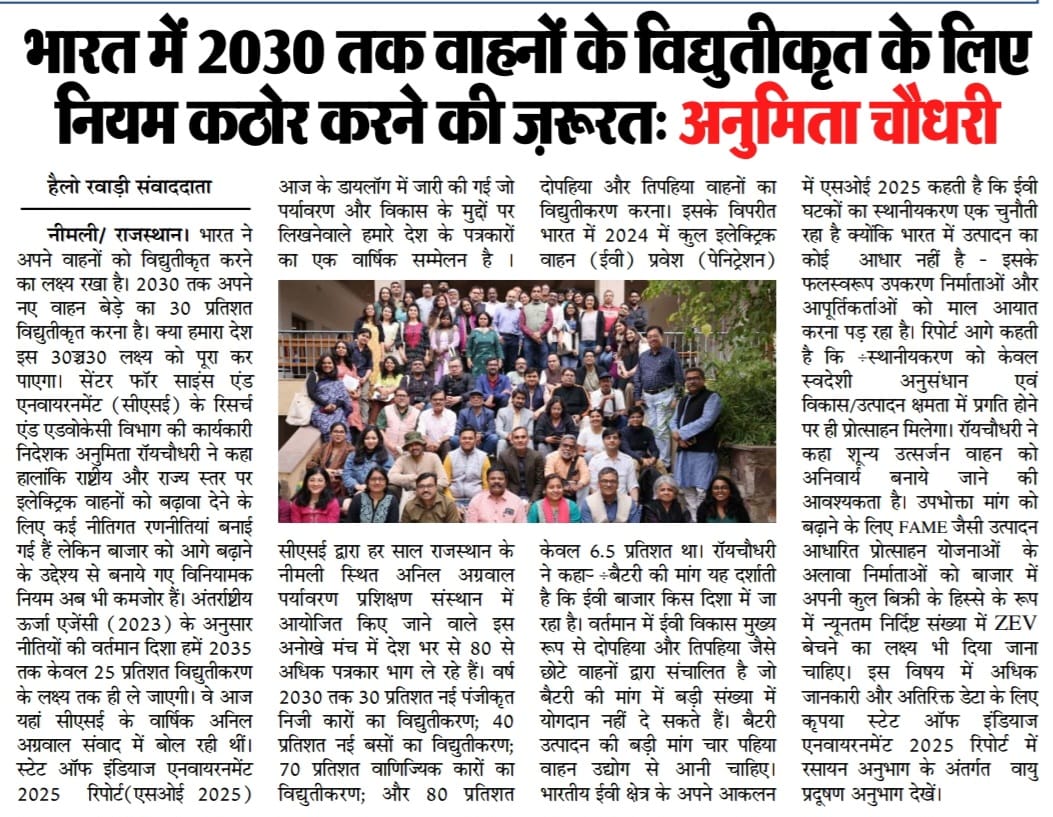
India’s Environment Report: India has set itself a target for electrifying its vehicles – 30 per cent electrification of its new vehicle fleet by 2030. Will the country meet this 30@30 target? “While several policy strategies have taken shape to promote electric vehicles at the national and state levels, regulatory levers to propel the market have remained weak. According to the International Energy Agency (2023), the current direction of policies will lead to only 25 per cent electrification by 2035,” said Anumita Roychowdhury, executive director, research and advocacy, Centre for Science and Environment (CSE). She was speaking at CSE’s annual Anil Agarwal Dialogue here. The State of India’s Environment 2025 (SOE 2025) report was released at the Dialogue, which is an annual conclave of journalists from India who write on environment and development issues. Over 80 journalists from across the country are participating in this one-of-its-kind platform, organised every year by CSE at its facility, the Anil Agarwal Environment Training Institute, located in Nimli, Rajasthan.

Average AQI ‘poor’, but this Feb was the cleanest Gurgaon had since 2020

Gurgaon: This Feb logged the best air quality since 2020 even as the city's average air quality index (AQI) in the month stood at 186 (poor), down from 201 (poor) during the same period last year. The average index for the month was 237 in 2020, 226 in 2021, 210 in 2022, 231 in 2023. It is the second best air since 2017 when the AQI count began. AQI of Gurgaon in 2019 was 167, it was 215 in 2018 and 231 in 2017, according to Central Pollution Control Board (CPCB) data. Though CPCB started to keep data for the city from 2016, in Feb, Gurgaon data was only mentioned for two days, so it can't be taken into consideration. Experts say the region witnessed a rise in wind speed, frequent change in wind direction and weaker western disturbances this Feb, which led to better dispersion of pollutants in the atmosphere. The city, however, hasn't witnessed any ‘satisfactory' or ‘good' air days this Feb, the same for the last three years. Shubhansh Tiwari, a research associate at Centre for Science and Environment, said, "The average wind speed was 18km/hour this Feb, which was not the case in the past few years. Earlier, it was less than 8km/hour. Also, the wind direction changed very frequently which also helped in making the wind cleaner from easterly to northerly and vice-versa." Meanwhile, Haryana State Pollution Control Board (HSPCB) officials said the suspension of road dust due to vehicular traffic and waste burning are of particular concern in the city. An HSPCB officer said, "Over the years, highly polluting industries have moved out of NCR. We have modified rules regarding DG sets and implemented a ban on biomass burning. These have shown results, but we still need to strengthen the public transportation system and control construction and demolition waste and road dust." Friday's air quality index (AQI) slightly improved but remained in the ‘moderate' range at 128, from 167 the day before. The level of PM2.5 — a toxic particulate matter that reaches the blood via the lungs — was the highest in Sector 51 (354 µg/m³), followed by Gwalpahari (312 µg/m³), Teri Gram (267 µg/m³) and Vikas Sadan (234 µg/m³). Teri Gram recorded the highest levels of PM10 in the city at 330 µg/m³. It was followed by Sector 51 (321 µg/m³) and Gwalpahari (243 µg/m³). This data was not recorded at Vikas Sadan. CPCB's annual permissible limits are 60µg/m³ for PM2.5 and 100 µg/m³ for PM10. Every year, Delhi-NCR witnesses heavy smog and deterioration of air quality levels during winter. The Graded Response Action Plan (GRAP) is implemented every year as a result. Guidelines issued by CPCB say ‘poor'AQI can cause breathing discomfort to most people on prolonged exposure.

India Might Not Meet Its 30% Vehicle Electrification Target By 2030: Challenges, Possible Solutions

India's electric vehicle (EV) adoption rate has been on an incline, growing at an annual rate of around 200 basis points (bps) between FY21 and FY24. However, it might not be enough for the country to achieve its ambitious EV 30@30 target-- 30 per cent EV adoption by 2030. The 2025 State of India's Environment (SOE) report, published by the Centre for Science and Environment (CSE) and Down To Earth magazine at this year's Anil Agarwal Dialogue, calls it unlikely for the country to meet its vehicle electrification target by 2030. This sits in line with an earlier FICCI-Yes Bank report, which claimed that India needs almost double the adoption rate (380 bps) to achieve the EV30@30 target. EV Adoption in India: Current State and Projected Rate India’s 2030 vehicle electrification target is driven by the country’s support of the global EV30@30 campaign. By 2030, the campaign aims to achieve the electrification of: 30 per cent of newly registered private cars 40 per cent of new buses 70 per cent of commercial cars 80 per cent of two- and three-wheelers The overall EV penetration in 2024 in India reportedly stood at only 6.5 per cent. According to the International Energy Agency, the current direction of policies will lead to only 25 per cent electrification by 2035, said Anumita Roychowdhury, executive director, research and advocacy, CSE. “While several policy strategies have taken shape to promote electric vehicles at the national and state levels, regulatory levers to propel the market have remained weak," she said. EV Adoption: Challenges and Possible Solutions Roychowdhury mentioned that the demand for batteries indicates the direction of the EV market. She explained that the growth of electric vehicles is primarily driven by smaller vehicles like two- and three-wheelers, which do not contribute significantly to the overall battery demand. "The larger demand for battery development has to come from four-wheelers," she added. She mentioned that one of the deterrents to scaling up EV sales in India has been the high purchase cost of EVs compared to internal combustion engine vehicles. She emphasised that the localisation of EVs is critical in achieving economies of scale and reducing costs. The programs to support EVs will not succeed if they do not support localised manufacturing, she added. In its assessment of the Indian EV sector, the 2025 SOE report highlighted the absence of a manufacturing base in India, which would have otherwise helped the EV component localisation. "Localisation will get an impetus only with advances in indigenous research and development capacity," the report said. Roychowdhury highlighted the need for a zero-emissions vehicle (ZEV) mandate. "In addition to demand incentives like the FAME schemes to build consumer demand, manufacturers also need to be given a target to sell a minimum specified number of ZEVs as a share of their overall sales in the market," she said.

Trapped in Traffic, Trapped in Pollution: The Hidden Danger Inside Your Car

For millions of Indians, daily commutes have become more than just a test of patience—they are a silent battle against toxic air pollution. As cities expand and vehicles multiply, air quality continues to plummet, turning roads into invisible gas chambers. While we often discuss outdoor pollution, a bigger, lesser-known threat looms inside our cars. A 2023 study by the Centre for Science and Environment (CSE) found that pollution levels inside vehicles can be 5 to 10 times higher than outside. Harmful pollutants such as PM2.5, carbon monoxide (CO), nitrogen oxides (NOx), and volatile organic compounds (VOCs) seep into car cabins through ventilation systems, leaving passengers exposed for hours each day. Many commuters believe that keeping the windows closed protects them from pollution, but research proves otherwise. Fine particulate matter and toxic fumes from surrounding vehicles get trapped inside, turning cars into enclosed spaces filled with contaminated air. This can lead to respiratory problems, headaches, fatigue, and long-term health risks like asthma and lung diseases—a reality that many urban dwellers experience firsthand. Can Car Air Purifiers Be the Answer? With in-car pollution rising, car air purifiers have transitioned from luxury to necessity. Over the past few years, the Indian market has seen a surge in air purifiers, but very few offer a comprehensive solution. While Philips has long been considered the industry benchmark, a new player—Staywell Car Air Purifier—is quickly setting standards with its advanced features.

राष्ट्रीय स्वच्छ वायु कार्यक्रम: धूल में मिलते लक्ष्य, मुख्य प्रदूषकों की अनदेखी

सेंटर फॉर साइंस एंड एनवायरनमेंट (सीएसई) की एक रिपोर्ट से पता चलता है कि राष्ट्रीय स्वच्छ वायु कार्यक्रम के फंड का बड़ा हिस्सा धूल से निपटने पर खर्च किया गया है। वायु प्रदूषण के खतरनाक स्तर की रिपोर्ट करने वाले शहरों की संख्या बढ़ रही है। यह औद्योगिक गतिविधियों, कचरे को जलाने और परिवहन से होने वाले प्रदूषण पर ध्यान देने की जरूरत की ओर इशारा कर रहा है। कार्यक्रम की प्रगति का निर्धारण कई मैट्रिक्स और रैंकिंग प्रणालियों की वजह से जटिल हो जाता है क्योंकि ये एक-दूसरे के साथ तालमेल नहीं रखती हैं। साल 2019 में जब राष्ट्रीय स्वच्छ वायु कार्यक्रम या नेशनल क्लीन एयर प्रोग्राम शुरू किया गया था, तो इसने भारत के कुछ सबसे प्रदूषित शहरों के लिए बड़े लक्ष्य निर्धारित किए थे। वायु प्रदूषण की सांद्रता को कम करना, वायु प्रदूषण की निगरानी और पूर्वानुमान को बढ़ाना और प्रदूषण स्रोत का पता लगाने के लिए अध्ययन करना इसके कुछ लक्ष्य थे। लेकिन पांच साल से ज़्यादा समय बीत जाने के बाद भी, न सिर्फ कई शहर अपने लक्ष्यों को पूरा करने में पीछे हैं, बल्कि इस दौरान ये शहर वायु प्रदूषण को कम करने के ज्यादातर उपाय, जहरीली गैसें उत्सर्जित करने के लिए जिम्मेदार उद्योगों और संस्थाओं को भी इन सालों में अनदेखा करते रहे हैं। सेंटर फॉर साइंस एंड एनवायरनमेंट (सीएसई) की एक रिपोर्ट से पता चला है कि कार्यक्रम के तहत फंड का बड़ा हिस्सा धूल से निपटने के लिए किए गए कार्यों पर खर्च किया गया। इन कार्यों में सड़कें बनाना, गड्ढों को ढकना, मैकेनिकल स्वीपर और पानी के छिड़काव करने वाले यंत्रों का इस्तेमाल आदि शामिल है। उद्योगों से होने वाले जहरीले उत्सर्जन को नियंत्रित करने पर एक प्रतिशत से भी कम खर्च किया गया और 10,566.47 करोड़ रूपए में से लगभग 40 प्रतिशत फंड का इस्तेमाल नहीं हो सका है। “ब्रीदिंग हियर इज इंजूरियस टू योर हेल्थ” किताब की लेखिका और वायु प्रदूषण के बारे में जागरूकता फैलाने वाले गैर-लाभकारी संगठन केयर फॉर एयर की सह-संस्थापक ज्योति पांडे लवकारे ने कहा, “इसका मतलब है कि समस्या से निपटने के लिए कोई गंभीरता नहीं है।” वह आगे कहती हैं, “सिर्फ धूल-मिट्टी हटाने पर पैसा खर्च करना और प्रदूषण फैलाने वालों पर कार्रवाई न करना- मतलब साफ है कि प्रदूषण को कम करने के लिए कोई ईमानदार प्रयास नहीं किया गया है। धूल कुछ ही घंटों में हवा में वापस आ जाती है; यह जनता के पैसे की पूरी बर्बादी है, बिल्कुल स्मॉग टावरों की तरह।” राष्ट्रीय स्वच्छ वायु कार्यक्रम (एनसीएपी) के तहत जिन 131 शहरों को शामिल किया गया था, वे 2011 से 2015 के बीच लगातार पांच साल तक राष्ट्रीय वायु गुणवत्ता मानकों को पूरा नहीं कर पाए थे। पांच साल बाद भी, इनमें से ज्यादातर शहर 2017 के स्तर की तुलना में वायु प्रदूषण की सांद्रता को 20-30% कम करने के एनसीएपी के लक्ष्य को पूरा करने में नाकाम रहे हैं। हाल ही में किए गए एक अध्ययन में पाया गया कि 2014 से 2021 तक वायु प्रदूषण में आई अधिकांश कमी तेज हवाओं और मौसम संबंधी अन्य कारकों के कारण हुई है।

6500 करोड़ खर्च, फिर भी गंदी क्यों है यमुना? CSE की रिपोर्ट में बड़ा खुलासा!

Yamuna Pollution In Delhi: राजधानी दिल्ली में यमुना की सफाई पर हजारों करोड़ रुपए खर्च किए जाने के बावजूद नदी की हालत बदतर बनी हुई है। सेंटर फॉर साइंस एंड एनवायरमेंट (CSE) की रिपोर्ट के मुताबिक, यमुना का 22 किलोमीटर का दिल्ली वाला हिस्सा सबसे ज्यादा प्रदूषित है। सवाल उठता है कि आखिर क्यों इतने पैसों के बावजूद यमुना साफ नहीं हो रही? CSE की वॉटर एंड वेस्टवॉटर प्रोग्राम मैनेजर सुष्मिता सेनगुप्ता ने इस मुद्दे पर एक रिपोर्ट पेश की। उन्होंने बताया कि दिल्ली में निकलने वाले गंदे पानी (सीवेज) का सही आंकड़ा ही उपलब्ध नहीं है। आमतौर पर, जितना पानी सप्लाई होता है, उसका 80% गंदे पानी के रूप में वापस आता है, लेकिन दिल्ली की सटीक आबादी और उसके पानी की खपत के सही आंकड़े नहीं होने से गड़बड़ी हो रही है। लोकसभा में दी गई जानकारी के अनुसार, 2017 से 2021 के बीच दिल्ली में यमुना की सफाई पर 6500 करोड़ रुपये खर्च हुए। बावजूद इसके, यमुना में अब भी बड़े नाले गिर रहे हैं और सीवेज ट्रीटमेंट प्लांट (STP) भी पूरी क्षमता से काम नहीं कर रहे।

करोड़ों खर्च करने के बाद भी दिल्ली में यमुना क्यों है प्रदूषित? जानें क्या है वजह

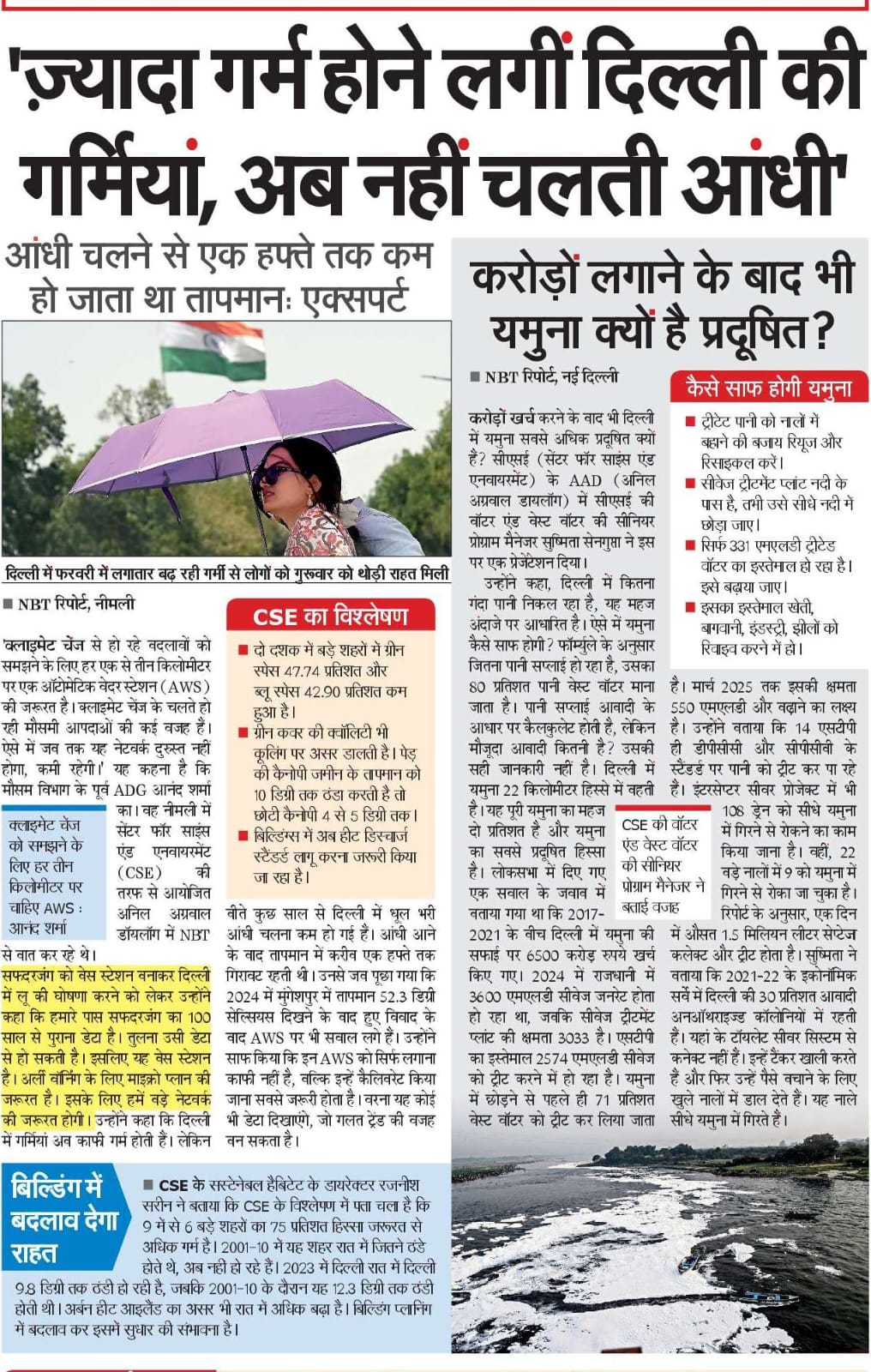
नई दिल्ली: करोड़ों खर्च करने के बाद भी दिल्ली में यमुना सबसे अधिक प्रदूषित क्यों हैं? सीएसई (सेंटर फॉर साइंस एंड एनवायरमेंट) के AAD (अनिल अग्रवाल डायलॉग) में सीएसई की वॉटर एंड वेस्ट वॉटर की सीनियर प्रोग्राम मैनेजर सुष्मिता सेनगुप्ता ने इस पर एक प्रेजेंटेशन दिया।

दिल्ली में 75 साल में सबसे गर्म फरवरी की रात, पारा 19.5 डिग्री

दिल्ली में गुरुवार की रात फरवरी महीने की सबसे गर्म रात रही। यह 75 साल में सबसे गर्म फरवरी की रात थी। न्यूनतम तापमान 19.5 डिग्री दर्ज किया गया, जो सामान्य से 7 डिग्री ज्यादा है। पूरे देश में गर्मी बढ़ रही है। भारत में फरवरी का औसत न्यूनतम तापमान 1901 के बाद से सबसे ज्यादा दर्ज किया गया है। मौसम विभाग के आंकड़ों के अनुसार, दिल्ली में असामान्य रूप से गर्म रात ने 25 फरवरी, 2015 को 19 डिग्री के पिछले फरवरी रेकॉर्ड को तोड़ दिया है। इस फरवरी 1 से 28 फरवरी का औसत न्यूनतम तापमान 19.5 डिग्री रहा। यह 2015 के बाद से अब तक सबसे गर्म है। 2017 में फरवरी का औसत न्यूनतम तापमान 11.7 डिग्री रहा। वहीं, औसत अधिकतम तापमान 2025 में 26.7 डिग्री रहा। 2023 में फरवरी का औसत अधिकतम तापमान 28.2 डिग्री रहा था। 'क्लाइमेट चेंज से हो रहे बदलावों को समझने के लिए हर एक से तीन किलोमीटर पर एक ऑटोमेटिक वेदर स्टेशन (AWS) की जरूरत है। क्लाइमेट चेंज के चलते हो रही मौसमी आपदाओं की कई वजह हैं। ऐसे में जब तक यह नेटवर्क दुरुस्त नहीं होगा, कमी रहेगी।' यह कहना है कि मौसम विभाग के पूर्व ADG आनंद शर्मा का। वह नीमली में सेंटर फॉर साइंस एंड एनवायरमेंट (CSE) की तरफ से आयोजित अनिल अग्रवाल डॉयलॉग में NBT से बात कर रहे थे। सफदरजंग को बेस स्टेशन बनाकर दिल्ली में लू की घोषणा करने को लेकर उन्होंने कहा कि हमारे पास सफदरजंग का 100 साल से पुराना डेटा है। तुलना उसी डेटा से हो सकती है। इसलिए यह बेस स्टेशन है। अर्ली वार्निंग के लिए माइक्रो प्लान की जरूरत है। इसके लिए हमें बड़े नेटवर्क की जरूरत होगी। क्लाइमेट चेंज की वजह से तीव्र घटनाएं बढ़ी है, लेकिन वह एक छोटे एरिया में हो रही हैं। उन्होंने कहा कि दिल्ली में गर्मियां अब काफी गर्म होती हैं। लेकिन बीते कुछ साल से दिल्ली में धूल भरी आंधी चलना कम हो गई हैं। इन आंधियों की वजह से गर्मी में राजधानी को बड़ी राहत मिलती थी। आंधी आने के बाद तापमान में करीब एक हफ्ते तक गिरावट रहती थी। उनसे जब पूछा गया कि 2024 में मुंगेशपुर में तापमान 52.3 डिग्री सेल्सियस दिखने के बाद हुए विवाद के बाद AWS पर भी सवाल लगे हैं। उन्होंने साफ किया कि इन AWS को सिर्फ लगाना काफी नहीं है, बल्कि इन्हें कैलिबरेट किया जाना सबसे जरूरी होता है। वरना यह कोई भी डेटा दिखाएंगे, जो गलत ट्रेंड की वजह बन सकता है। AWS का एनुअल मेंटिनेंस कॉन्ट्रैक्ट करना होगा। इससे यह सात साल के लिए सिक्योर हो जाएंगे। कंपनियों पर ही इन्हें ठीक करने की जिम्मेदारी होगी। CSE के सस्टेनेबल हैबिटेट के डायरेक्टर रजनीश सरीन ने बताया कि CSE के विश्लेषण में पता चला है कि 9 में से 6 बड़े शहरों का 75 प्रतिशत हिस्सा जरूरत से अधिक गर्म है। इनमें पुणे, दिल्ली, चेन्नै, अहमदाबाद, नागपुर और जयपुर शामिल हैं। 2001-10 में यह शहर रात में जितने ठंडे होते थे, अब नहीं हो रहे हैं। 2023 में दिल्ली रात में दिल्ली 9.8 डिग्री तक ठंडी हो रही है, जबकि 2001-10 के दौरान यह 12.3 डिग्री तक ठंडी होती थी। अर्बन हीट आइलैंड का असर भी रात में अधिक बढ़ा है। बिल्डिंग प्लानिंग में बदलाव कर इसमें सुधार की संभावना है। दिल्ली की बिल्डिंगों में 32 प्रतिशत मोनोलिथिक कंक्रीट, 15 प्रतिशत फ्लाइ ऐश, 21 प्रतिशत लाल ईंट का इस्तेमाल हो रहा है। तेलंगाना की तरह अगर हम इन सामानों को बदलकर कंक्रीट ब्लॉक को फ्लाई एश में बदल दें तो गर्मी 40 प्रतिशत तक कम हो सकती है। गर्मी की वजह से बिल्डिंगों में इलेक्ट्रिसिटी की खपत करीब 30 प्रतिशत बढ़ गई है। ग्लोबल इलेक्ट्रिसिटी डिमांड में सबसे अधिक डिमांड कूलिंग के लिए हो रही है। कूलिंग की डिमांड बढ़ने से इसकी वजह से होने वाला इमिशन 2030 तक बढ़कर दोगुना हो जाएगा। ग्रीन कवर की क्वॉलिटी भी कूलिंग पर असर डालती है। पेड़ की कैनोपी जमीन के तापमान को 10 डिग्री तक ठंडा करती है तो छोटी कैनोपी 4 से 5 डिग्री तक।

No place is safe: Chemical pollution pervades every corner of planet, warns report

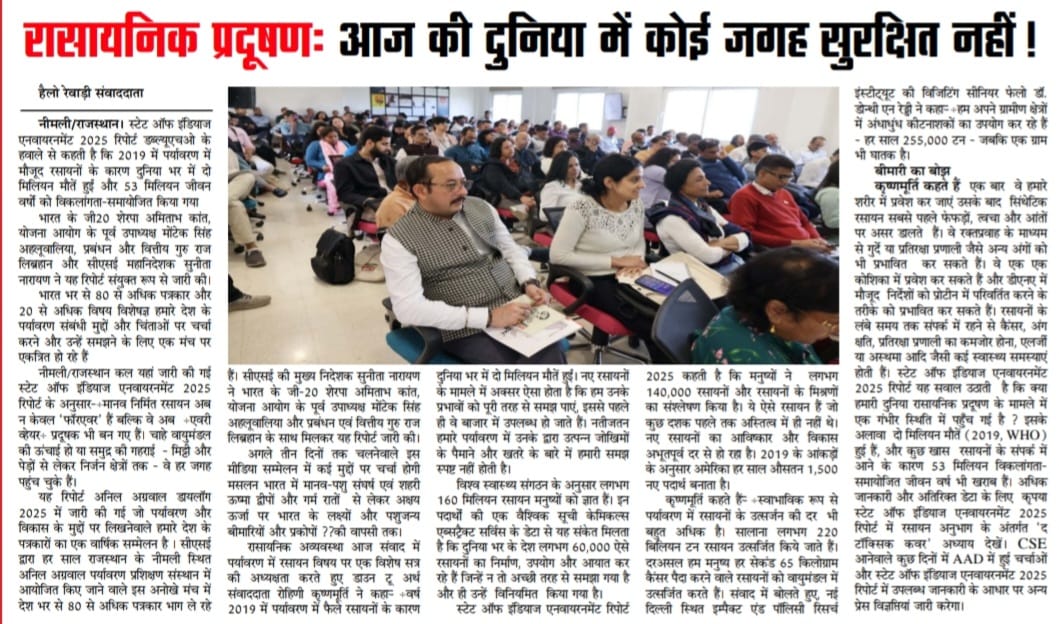
ALWAR: From the deepest oceans to the highest reaches of the atmosphere, human-made chemicals have infiltrated every part of the planet, warns the State of India’s Environment 2025 report. Released on Wednesday at the Anil Agarwal Dialogue 2025, an annual gathering of environmental journalists, the report highlights the alarming spread of synthetic chemicals and their consequences. “In the Anthropocene age, human-made chemicals are not only ‘forever’ but have also become ‘everywhere’ pollutants,” the report states. With millions of substances in circulation, many of which are poorly understood and inadequately regulated, the scale of chemical pollution is reaching critical levels. A Rising Threat to Human Health At a special session on Chemicals in the Environment during the dialogue, Rohini Krishnamurthy of the Centre for Science and Environment (CSE) underscored the deadly impact of chemical pollution. “In 2019, chemicals in the environment reportedly accounted for two million deaths worldwide. New chemicals often enter the market before their risks are fully assessed, leaving significant gaps in our understanding of their long-term effects,” she said. According to the World Health Organization (WHO), humans have identified around 160 million chemicals, while the Chemicals Abstracts Service estimates that 60,000 substances currently in circulation remain inadequately studied or regulated. The report also reveals that humans have synthesized approximately 140,000 new chemicals in recent decades, with countries like the U.S. producing an average of 1,500 new substances each year. The consequences of this unchecked expansion are severe. In addition to the two million deaths linked to chemical exposure in 2019, WHO data shows that 53 million disability-adjusted life years have been lost due to chemical-related health issues. An Overwhelming Chemical Burden The report further highlights the staggering volume of chemicals released into the environment. “Annually, some 220 billion tonnes of chemicals enter the environment, with humans pumping 65 kg of cancer-causing substances into the atmosphere every second,” said Krishnamurthy. In rural India, indiscriminate pesticide use is particularly concerning. “We are using 255,000 tonnes of pesticides every year, despite the fact that even a single gram can be lethal,” warned Dr. Donthi N. Reddy, a visiting senior fellow at the Impact and Policy Research Institute, New Delhi. Once these chemicals enter the body, they interact with vital organs. “Synthetic chemicals first encounter the lungs, skin, and gut, but they can also travel through the bloodstream, affecting organs like the kidneys and immune system. They can even alter DNA instructions, leading to long-term health issues such as cancer, organ damage, immune system weakening, and respiratory diseases,” Krishnamurthy explained. A Call for Urgent Action The State of India’s Environment 2025 report raises urgent questions about whether the world has reached a tipping point in chemical pollution. With rising health risks and environmental contamination, experts at the conclave emphasized the need for stronger regulations, better monitoring, and increased public awareness. The report was officially released by CSE Director General Sunita Narain, alongside India’s G20 Sherpa Amitabh Kant, former Planning Commission Deputy Chairperson Montek Singh Ahluwalia, and financial expert Raj Liberhan. Hosted annually by CSE at the Anil Agarwal Environment Training Institute in Nimli, Rajasthan, the Anil Agarwal Dialogue serves as a crucial platform for discussions on pressing environmental issues. This year’s findings serve as a stark reminder that in today’s world, no place is truly safe from chemical pollution.

Technological leapfrog will transform India, says Kant

A technological leapfrog will transform India and the country must seize the opportunity to lead in clean-tech manufacturing amid global disruptions, India’s G20 Sherpa and former NITI Aayog CEO Amitabh Kant has said. In an interview on the sidelines of the Centre for Science and Environment’s annual Anil Agarwal Dialogue, Kant also acknowledged that the lack of financial support from developed nations, historically responsible for climate change, could impact developing countries’ new climate targets.

करोड़ों खर्च करने के बाद भी दिल्ली में यमुना क्यों है प्रदूषित? जानें क्या है वजह

करोड़ों खर्च करने के बाद भी दिल्ली में यमुना सबसे अधिक प्रदूषित क्यों हैं? सीएसई (सेंटर फॉर साइंस एंड एनवायरमेंट) के AAD (अनिल अग्रवाल डायलॉग) में सीएसई की वॉटर एंड वेस्ट वॉटर की सीनियर प्रोग्राम मैनेजर सुष्मिता सेनगुप्ता ने इस पर एक प्रेजेंटेशन दिया। उन्होंने कहा, दिल्ली में कितना गंदा पानी निकल रहा है, यह महज अंदाजे पर आधारित है। ऐसे में यमुना कैसे साफ होगी? फॉर्म्युले के अनुसार जितना पानी सप्लाई हो रहा है, उसका 80 प्रतिशत पानी वेस्ट वॉटर माना जाता है। पानी सप्लाई आबादी के आधार पर कैलकुलेट होती है, लेकिन मौजूदा आबादी कितनी है? उसकी सही जानकारी नहीं है। दिल्ली में यमुना 22 किलोमीटर हिस्से में बहती है। यह पूरी यमुना का महज दो प्रतिशत है और यमुना का सबसे प्रदूषित हिस्सा है। लोकसभा में दिए गए एक सवाल के जवाब में बताया गया था कि 2017-2021 के बीच दिल्ली में यमुना की सफाई पर 6500 करोड़ रुपये खर्च किए गए। 2024 में राजधानी में 3600 एमएलडी सीवेज जनरेट होता हो रहा था, जबकि सीवेज ट्रीटमेंट प्लांट की क्षमता 3033 है। एसटीपी का इस्तेमाल 2574 एमएलडी सीवेज को ट्रीट करने में हो रहा है। यमुना में छोड़ने से पहले ही 71 प्रतिशत वेस्ट वॉटर को ट्रीट कर लिया जाता है। मार्च 2025 तक इसकी क्षमता 550 एमएलडी और बढ़ाने का लक्ष्य है। उन्होंने बताया कि 14 एसटीपी ही डीपीसीसी और सीपीसीबी के स्टैंडर्ड पर पानी को ट्रीट कर पा रहे हैं। इंटरसेप्टर सीवर प्रोजेक्ट में भी 108 ड्रेन को सीधे यमुना में गिरने से रोकने का काम किया जाना है। वहीं, 22 बड़े नालों में 9 को यमुना में गिरने से रोका जा चुका है। दो नाले दिल्ली गेट और सेन नर्सिंग होम आंशिक रूप से अब भी यमुना में गंदगी लेकर जा रहे हैं। क्या कहती है रिपोर्ट? रिपोर्ट के अनुसार, एक दिन में औसत 1.5 मिलियन लीटर सेप्टेज कलेक्ट और ट्रीट होता है। सुष्मिता ने बताया कि 2021-22 के इकोनॉमिक सर्वे में दिल्ली की 30 प्रतिशत आबादी अनऑथराइज्ड कॉलोनियों में रहती हैं। यहां के टॉयलेट सीवर सिस्टम से कनेक्ट नहीं हैं। इन्हें टैंकर खाली करते हैं और फिर उन्हें पैसे बचाने के लिए खुले नालों में डाल देते हैं। यह नाले सीधे यमुना में गिरते हैं। कैसे साफ होगी यमुना ट्रीटेट पानी को नालों में बहाने की बजाय रियूज और रिसाइकल करें। सीवेज ट्रीटमेंट प्लांट नदी के पास है, तभी उसे सीधे नदी में छोड़ा जाए। सिर्फ 331 एमएलडी ट्रीटेड वॉटर का इस्तेमाल हो रहा है। इसे बढ़ाया जाए। इसका इस्तेमाल खेती, बागवानी, इंडस्ट्री, झीलों को रिवाइव करने में हो।

India’s SDG Struggle: Uneven and slow progress casts shadow on 2030 deadline

India is falling short in nine of 16 Sustainable Development Goals (SDGs), trailing global averages and ranking 109th out of 167 countries, according to the Centre for Science and Environment’s (CSE) State of States: Are We on Track to Achieve Sustainable Development Goals 2030, released this week at the Anil Agarwal Dialogue 2025. The report, drawing from the Sustainable Development Report 2024 by Dublin University, NITI Aayog’s SDG India Index 2023-24, and the Report of the Technical Group on Population Projections 2011-2036 by the National Commission on Population, paints a mixed picture for the nation of over 1.4 billion. Tamil Nadu shines at third place with a score of 78 but lags in 19 of 108 indicators — 18% — across 12 SDGs, reflecting India’s broader battle to meet the 2030 deadline. Nationally, India’s SDG score rose from 66 in 2020-21 to 71 in 2023-24, showing some progress. Yet, the CSE report flags stagnation since 2020 in SDG 2 (Zero Hunger), SDG 11 (Sustainable Cities and Communities), SDG 14 (Life Below Water), and SDG 15 (Life on Land). SDG 1 (No Poverty) is the lone bright spot, with multidimensional poverty — covering health, education, and living standards — down to 14.96%. Still, Bihar (34) and Arunachal Pradesh (below 50) lagged, eight states like UP scored 50-64, and a key measure — extreme poverty below $1.25 daily — was dropped in 2023-24, leaving gaps in the data. The report warns that, globally, no SDG will be met by 2030 at this pace, with India’s 2019-2022 decline only slightly offset in 2023. Advertisements Tamil Nadu, projected to exceed 76 million people by 2036, ranks third behind Kerala and Uttarakhand. Its score of 78 beats the national 71, earning ‘front runner’ status (65-99) in 13 of 17 SDGs. The state leads SDG 1 with a 2.2% poverty rate — far below India’s 14.96%— thanks to robust welfare schemes. It scores 100 in SDG 7 (Affordable and Clean Energy), ensuring every home has electricity, and lifts SDG 13 (Climate Action) to 67 with 25% forest cover to curb climate change. However, Tamil Nadu stumbles in 19 of 108 indicators (18%), spread across 12 SDGs, notably SDG 5 (Gender Equality), SDG 3 (Good Health and Well-being), SDG 4 (Quality Education), and SDG 9 (Industry, Innovation, and Infrastructure). In SDG 5, it scores 50-64, with a sex ratio of 929 females per 1,000 males matching the national figure. SDG 14 (Life Below Water) also hits 50-64, with 43% of its coastline eroding, while SDG 11 and SDG 15 fall below the national average due to urban strain and weak afforestation data. Across India, state scores range from 57 (Bihar) to 79 (Kerala and Uttarakhand), with Union Territories at 65-77. Kerala excels in SDG 3 (82) for health and SDG 4 (80) for education, while Bihar trails in SDG 1 (34) and SDG 2 (40). Tamil Nadu’s 78 outpaces Uttar Pradesh (64) and Gujarat (67), where 30-43% of indicators lag below 50. India performs well in four SDGs — SDG 3, SDG 6 (Clean Water and Sanitation), SDG 7, and SDG 8 (Decent Work and Economic Growth) — with all 36 states and UTs hitting at least half their targets. SDG 7’s strong showing, with most states above 65 except Meghalaya, Nagaland, and Daman and Diu, stems from tracking just electricity and clean cooking fuel access, skipping global metrics like CO2 emissions. SDG 5, however, is a national low point, with 14 states below 50 and 17 at 50-64. India’s sex ratio is 929, 29.2% of married women face spousal violence, and only 13.96% of landholdings are female-owned, underscoring gender inequality.