Gurgaon: In the past 48 hours, ozone has emerged as the most significant pollutant in the city, according to the data from the Central Pollution Control Board (CPCB). Typically, particulate matter (PM) 2.5, PM10, and occasionally carbon monoxide (CO) are the primary pollutants that impact the city's air quality index (AQI). According to CPCB data, however, the eight-hour ozone threshold of 100 micrograms per cubic metre (ug/m3) was violated in the past two days, making it the major pollutant for this period. On Friday, the ozone level was 112 ug/m3 at the Teri Gram air monitoring station. On Thursday, it was 108 ug/m3. Experts said high levels of ground-level ozone can cause inflammation and damage to airways, increase the susceptibility of lungs to infections, and exacerbate conditions such as asthma, emphysema, and chronic bronchitis. This phenomenon predominantly occurs during daylight hours in areas with traffic congestion or where multiple industries are operational, they said. Ozone is generated through the intricate interaction between nitrogen oxides (NOx) and volatile organic compounds (VOCs), which are emitted from vehicles, power plants, factories, and other combustible sources. The rising temperatures are also leading to a rise in ozone levels, experts said. "High temperatures and road congestion are leading to increased ground-level ozone concentrations in cities. Ozone is formed due to chemical reactions between precursor pollutants like NOx and VOCs present in the atmosphere in the presence of heat and sunlight. High levels of ozone are particularly harmful to those suffering from asthma and respiratory diseases," said Shubhansh Tiwari, a research associate at the Centre for Science and Environment (CSE). "Ozone formation takes place in the presence of sunlight only. High temperature and high-pressure combustion of diesel and CNG produces higher amounts of NOx. Higher use of various solvents, including gasoline, are the causes of VOCs in the atmosphere," said Dr Dipankar Saha, former head at CPCB. According to a CSE study, between Jan 1 and July 18 — a period of 200 days — Delhi-NCR recorded 176 days of ground-level ozone exceedance. The second highest was 138 days each, in Mumbai-MMR and Pune, followed by Jaipur, at 126 days. CSE used data from official stations under CPCB's Continuous Ambient Air Quality Monitoring System. Meanwhile, the HSPCB officials said they have directed civic bodies to take all required measures to reduce road dust and garbage burning incidents.
புதுடெல்லி: இந்தியாவில் காற்றாலை மின் உற்பத்தியில் தமிழ்நாடு முன்னிலையில் இருக்கிறது. ஆனாலும் காற்றாலை ஆற்றல் திறனை அதிகரிப்பதில் கடுமையான சவால்களை எதிர்கொள்கிறது. இதில் அதன் சொந்த காற்றாலை ஆற்றல் மறுசீரமைப்பு கொள்கையே முக்கிய தடை மற்றும் சவாலாக உள்ளது என்று புதுடெல்லியில் உள்ள அறிவியல் மற்றும் சுற்றுச்சூழல் மையத்தின் (சிஎஸ்இ) சமீபத்திய அறிக்கை கூறுகிறது. இது தொடர்பாக சிஎஸ்இ-ன் தொழில்துறை மற்றும் புதுப்பிக்கத்தக்க எரிசக்தி குழுக்களின் திட்ட இயக்குநர் நிவித் கே யாதவ் கூறுகையில், "தமிழகத்தின் மொத்த மின் உற்பத்தி திறனில் காற்றாலை மின்சாரம் கிட்டத்தட்ட 30 சதவீதம் ஆகும். ஆனால், தமிழகமானது காலாவதியான காற்றாலை கருவிகளை கொண்டிருப்பதால் காற்றாலை ஆற்றலின் பங்களிப்பை மாநிலத்தின் மின் உற்பத்தியில் வெறும் 15 சதவீதமாகக் குறைத்துள்ளது. மேலும், தமிழ்நாட்டின் காற்றாலை ஆற்றல் மறுசீரமைப்பு கொள்கை குறைபாடுகள் மற்றும் கட்டுப்பாடுகள் மாநிலத்தை அதன் உண்மையான எரிசக்தி ஆற்றலை அடைவதைத் தடுத்துள்ளன. காற்றாலை மின் உற்பத்திக்கான இந்தியாவின் ஒட்டுமொத்த சாத்தியம் 25.4 ஜிகாவாட். இதில் தமிழ்நாட்டின் பங்களிப்பு மட்டும் 7.3 ஜிகாவாட் என சிஎஸ்இ அறிக்கை சுட்டிக்காட்டுகிறது. காற்றாலை ஆற்றல் உற்பத்தியை அதிகரிப்பதற்கு இந்த மீட்டுருவாக்க திறனை மேம்படுத்துவது மிகவும் முக்கியமானது. இது மாநிலம் புதுப்பிக்கத்தக்க எரிசக்தியை நோக்கி நகர்வதில் முக்கிய அங்கமாக உள்ளது." என்றார். "தமிழ்நாட்டில் காற்றாலை மறுசீரமைப்பை துரிதப்படுத்துதல்" என்ற தலைப்பில் ஆய்வறிக்கையானது சென்னையில் இன்று நடைபெற்ற பயிற்சிப் பட்டறையில் வெளியிடப்பட்டது. இது தொடர்பாக சிஎஸ்இ-ன் புதுப்பிக்கத்தக்க ஆற்றல் திட்ட மேலாளர் பினித் தாஸ் கூறுகையில், "மீட்டுருவாக்கம் என்பது தமிழ்நாட்டின் பழைய காற்றாலைகளை மிகவும் மேம்பட்ட, திறனுடைய மாடல்களாக மாற்றுவதாகும். இது மாநிலத்தின் திறன் பயன்பாட்டு காரணியை (சியுஎஃப்) மூன்று மடங்காக அதிகரிக்கக்கூடும். இதையும் படிங்க: திருப்பதி லட்டு விவகாரம்: "தெலுங்கு தேசம் மத விஷயங்களை அரசியலாக்குகிறது": ஜெகன்மோகன் ரெட்டி குற்றச்சாட்டு! மேலும், ஆற்றல் செயல்திறனை மேம்படுத்தி, தற்போதைய பாதுகாப்பு அபாயங்கள் மற்றும் இடர்களை நிவர்த்தி செய்யும். எங்களது அறிக்கை மாநிலத்தில் காற்றாலை மீட்டுருவாக்கம் செய்யப்படுவதற்கான சாத்தியக்கூறுகளை ஆய்வு செய்துள்ளது. மேலும், மாநிலத்தின் சமீபத்திய மறுசீரமைப்புக் கொள்கையை விமர்சன ரீதியாக ஆராய்கிறது. இது கொள்கை கட்டமைப்பை வலுப்படுத்த முக்கிய தகவல்கள் மற்றும் பரிந்துரைகளை வழங்குகிறது. இதனால் தமிழ்நாடு அதன் காற்றாலை ஆற்றல் திறனை அதிகரிக்க வழி வகை கிடைக்கும். தமிழக அரசின் காற்றாலை ஆற்றல் மறுசீரமைப்பு கொள்கையில் இடம்பெற்றுள்ள முக்கிய குறைபாடுகள்: உள்கட்டமைப்பு சவால்: தற்போதைய கொள்கையானது, காற்றாலையை நிர்வகிப்பவர்கள் காலாவதியான காற்றாலையை மேம்படுத்துவதற்கு ஊக்கமளிக்கவில்லை. ஏனெனில் அதிகரித்த மின்சார உற்பத்தியை மறுசீரமைப்பிற்குப் பிறகு கையாளுவதில் குறிப்பிடத்தக்க உள்கட்டமைப்பு இடைவெளிகள் உள்ளன. 2024 ஜூன் நிலவரப்படி 10.7 ஜிகாவாட் திறன் கொண்ட காற்றாலை ஆற்றல் தமிழ்நாட்டின் புதுப்பிக்கத்தக்க மின்சக்தியின் முதுகெலும்பாகும். மறுசீரமைப்பு திட்டங்கள் கூடுதலாக 7.3 ஜிகாவாட் மின் உற்பத்தியை அதிகரிக்கும் திறனை கொண்டுள்ளன. இதன் விளைவாக மின் உற்பத்தி மூன்று மடங்கு அதிகரிக்கும். இது உபரி ஆற்றலை சேகரிக்கும் திறன் மற்றும் அதைக் கையாளும் கட்டமைப்பின் தயார்நிலை குறித்த முக்கியமான கவலைகளை எழுப்புகிறது. மின் விநியோக உள்கட்டமைப்பு பற்றாக்குறை: மேம்படுத்தப்பட்ட மின் விநியோக உள்கட்டமைப்பின் தேவையை பூர்த்தி செய்வதில் இக்கொள்கை தவறுகிறது. குறிப்பாக மறுசீரமைக்கப்பட்ட காற்றாலைகளுக்கு 11 கிலோ வாட்ஸ் லைன்கள் மேம்பாடு போதுமானதாக இல்லை மற்றும் நிலையற்ற, அடிக்கடி இடையூறு விளைவிப்பதாக உள்ளது. நிர்வகிப்பவர்களுக்கு கூடுதல் செலவு: ஒரு மெகாவாட்டிற்கு கணிசமான உள்கட்டமைப்பு மேம்பாட்டுக் கட்டணமாக ரூ.30 லட்சம் செலுத்தினாலும், அவற்றை நிர்வகிப்பவர்கள், துணை மின் நிலையங்களை மேம்படுத்துவதற்கும், மாற்று மின் விநியோக கட்டமைப்புக்கும் கூடுதல் செலவுகளை எதிர்கொள்கின்றனர். தமிழ்நாடு மத்திய மின்மாற்றி பயன்பாட்டு (சிடியு) காற்றாலை திட்டங்களுக்கு ஒரு மெகாவாட்டிற்கு ரூ. 50 லட்சம் என்ற ஆதாரக் கட்டணத்தை விதித்துள்ளது. இதனால் நிர்வகிப்பவர்கள் மத்திய கட்டமைப்புடன் இணைப்பது குறைவான விருப்பத்தையே ஏற்படுத்துகிறது. காற்றாலை வங்கி விதிகள் கட்டுப்பாடு: மறுசீரமைப்பு கொள்கையானது காற்றாலை வங்கியை புதிய திட்டங்களுக்கான மாதாந்திர வங்கியாக வரம்பிடுகிறது. மேலும் அதிக தேவை இல்லாத நேரங்களுக்கு பயன்படுத்துவதை கட்டுப்படுத்துகிறது. இது மறுசீரமைப்புக்குப் பின்னர், காற்றாலையை நிர்வகிப்பவர்கள் கூடுதல் உற்பத்தியை என்ன செய்ய வேண்டும் என்பதில் தெளிவில்லாத நிலை உள்ளது. பிளவுபட்ட உரிமை: சிஎஸ்இ-ன் பரிந்துரைப்படி, காற்றாலைகளின் பிளவுபட்ட உரிமையானது, முந்தைய மறுசீரமைப்பு முயற்சிகளில் குறிப்பிடத்தக்க தடையாக இருந்தது. தற்போதைய கொள்கையில் இதை நிவர்த்தி செய்ய போதுமான நடவடிக்கைகள் இல்லை. தனியார் தரப்பில் ஒவ்வொருவரும் குறைந்த எண்ணிக்கையிலான காற்றாலைகளை வைத்திருப்பதால், நிலம் மற்றும் விசையாழிகளை மீண்டும் சக்தியூட்டுவதற்கு ஒருங்கிணைப்பது மிகவும் சிக்கலாக உள்ளது. இதனால், நிலப் பயன்பாட்டை மேம்படுத்துவதற்கும், விசையாழிகளை மேம்படுத்துவதற்கும் இடையூறாக உள்ளது. சிஎஸ்இ-ன் பொருளாதார பகுப்பாய்வின்படி, தமிழகத்தில் காற்றாலைகளை மீண்டும் இயக்குவதற்கும், புதிய கிரீன்ஃபீல்ட் திட்டங்களுக்கும் இடையேயான செலவின இடைவெளியைக் குறைக்க கூடுதலாக 6,336 கோடி ரூபாய் தேவைப்படும் என்பதை வெளிப்படுத்துகிறது. இந்த முதலீடு மீள்சக்தியை பொருளாதார ரீதியாக சாத்தியமானதாக மாற்றுவதற்கு மிகவும் முக்கியமானது என்று சிஎஸ்இ-ன் நிவித் கே யாதவ் சுட்டிக்காட்டியள்ளார். மேலும், சிஎஸ்இ-ன் அறிக்கை, மாநிலத்தின் மறுசீரமைப்புக் கொள்கையை மேம்படுத்த சில நடவடிக்கைகளை முன்மொழிந்துள்ளது. மின்சாரம் வெளியேற்றும் உள்கட்டமைப்பை மேம்படுத்துதல்: 11 kV லைன்களை குறைந்தபட்சம் 33 kV க்கு உடனடியாக மேம்படுத்துதல். பசுமை ஆற்றல் திறந்த அணுகல்: பசுமை ஆற்றல் திறந்த அணுகல் போன்ற கொள்கைகள் மூலம் சரியான நேரத்தில் பணம் செலுத்துதல் மற்றும் நிதி ஊக்கத்தொகையை உறுதி செய்தல் ஆகியவை திட்ட நம்பகத்தன்மையை மேம்படுத்தலாம். நிலம் மாற்றும் திட்டம் மற்றும் கூட்டுரிமை: பிளவுபட்ட உரிமையின் சவாலை எதிர்கொள்ள, சிறிய விசையாழிகளுக்கு பதிலாக மிகவும் திறமையான, பெரிய மாதிரிகளை அறிமுகப்படுத்தலாம். உருவாக்குபவர்களுக்கு நிதிச் சலுகைகளை வழங்குதல்: தலைமுறை அடிப்படையிலான ஊக்கத்தொகைகள், அரசாங்கத்தால் ஆதரிக்கப்படும் கடன் உத்தரவாதங்கள் மற்றும் ஃபீட்-இன் கட்டணங்கள் ஆகியவை நிதி ரீதியாக சாத்தியமானதாக மாற்றும். இது தொடர்பாக சிஎஸ்இ-ன் புதுப்பிக்கத்தக்க ஆற்றல் திட்ட மேலாளர் பினித் தாஸ் கூறுகையில், ''தமிழ்நாட்டின் பழைய விசையாழிகளில் பெரும்பாலானவை காற்றின் வேகத்தை சந்திக்கும் பெரிய நிலப்பரப்புகளை கொண்ட நல்ல இடங்களில் அமைந்துள்ளன. மாநில அரசு தொழில்முனைவோர்களுடன் இணைந்து செயல்படுவதும், அவர்களை ஊக்குவிக்கும் கொள்கையை உருவாக்குவதும் இன்றியமையாதது. தமிழகத்தின் பரந்த காற்றாலை ஆற்றலைத் திறப்பதற்கும், பொருளாதார வளர்ச்சியை மேம்படுத்துவதற்கும், இந்தியாவின் தூய்மையான எரிசக்தி மாற்றத்தில் தமிழகத்தை முன்னணியில் நிறுத்துவதற்கும் வலுவான மறுசீரமைப்புக் கொள்கைக் கட்டமைப்பு முக்கியமானது. தெரிந்துகொண்ட சவால்களை எதிர்கொள்வதிலும், எங்கள் பரிந்துரைகளை ஏற்றுக்கொள்வதிலும் உறுதியான நடவடிக்கை எடுக்குமாறு தமிழக அரசை சிஎஸ்இ வலியுறுத்துகிறது. '' என இவ்வாறு பினித் தாஸ் கூறியுள்ளார்.
Chennai चेन्नई : सेंटर फॉर साइंस एंड एनवायरनमेंट (सीएसई) ने गुरुवार को एक बैठक में तमिलनाडु में पवन ऊर्जा को तेजी से बढ़ाने के शीर्षक से एक नई रिपोर्ट जारी की, जिसमें कहा गया, "राज्य की पवन ऊर्जा क्षमता को अधिकतम करने के लिए तमिलनाडु की पवन ऊर्जा नीति में सुधार की आवश्यकता है।" रिपोर्ट में हाल की पवन ऊर्जा नीति की कमियों पर जोर दिया गया है, विशेष रूप से बेहतर बिजली निकासी बुनियादी ढांचे की आवश्यकता को संबोधित करने में इसकी विफलता। इसमें मौजूदा 11-केवी बिजली लाइनों को अपग्रेड करने का आह्वान किया गया है, जो अपर्याप्त और अक्सर अस्थिर हैं, बेहतर टर्बाइनों से बेहतर बिजली निकासी के लिए कम से कम 33 केवी तक। राज्य के विभिन्न हिस्सों से पवन ऊर्जा उत्पादकों ने बैठक में भाग लिया और विपणन रणनीतियों, अद्यतन टर्बाइनों, नई प्रौद्योगिकियों, बैंकिंग सुविधाओं और बिजली निकासी बुनियादी ढांचे जैसे विषयों पर चर्चा की। सीएसई के कार्यक्रम निदेशक निवित के यादव ने कहा, "पवन ऊर्जा तमिलनाडु की कुल स्थापित क्षमता का लगभग 30% योगदान देती है, लेकिन पुरानी टर्बाइनों ने पवन ऊर्जा की हिस्सेदारी को राज्य के बिजली उत्पादन में केवल 15% तक कम कर दिया है। इन पुरानी टर्बाइनों को नई तकनीकों से बदलने का यह सही समय है। कई डेवलपर्स ने नीति के बारे में चिंता व्यक्त की, जिसमें कहा गया कि जून 2024 तक 10,700 मेगावाट की क्षमता वाली पवन ऊर्जा तमिलनाडु की अक्षय ऊर्जा की रीढ़ बनी हुई है। हालांकि, मौजूदा नीति पुराने टर्बाइनों को अपग्रेड करने को प्रोत्साहित नहीं करती है क्योंकि रीपावरिंग के बाद बढ़े हुए बिजली उत्पादन को संभालने में महत्वपूर्ण बुनियादी ढाँचे की कमी है।डेवलपर्स ने इसमें शामिल उच्च लागतों की ओर भी इशारा किया। बुनियादी ढाँचे के विकास के लिए 30 लाख रुपये प्रति मेगावाट का भुगतान करने के बावजूद, उन्हें सबस्टेशनों को अपग्रेड करने और बिजली निकासी की व्यवस्था करने के लिए अतिरिक्त खर्चों का सामना करना पड़ता है। उन्होंने केंद्रीय ट्रांसमिशन यूटिलिटी पवन परियोजनाओं पर राज्य के 50 लाख रुपये प्रति मेगावाट संसाधन शुल्क पर निराशा व्यक्त की, जो केंद्रीय ग्रिड से जुड़ने को हतोत्साहित करता है, जिससे डेवलपर्स राज्य ग्रिड की ओर बढ़ते हैं। पैनल ने बैंकिंग चुनौतियों पर भी चर्चा की, जिसमें कहा गया कि मौजूदा नीति के तहत, पवन ऊर्जा जनरेटर से बैंकिंग पवन ऊर्जा के लिए 14% शुल्क लिया जाता है। इसके अतिरिक्त, नीति नई परियोजनाओं को प्रतिबंधित करती है और उपयोग को गैर-पीक घंटों तक सीमित करती है, जिससे डेवलपर्स को यह अनिश्चितता रहती है कि अतिरिक्त उत्पादन का प्रबंधन कैसे किया जाए। देश में पवन ऊर्जा फार्मों को पुनः ऊर्जा प्रदान करने की कुल क्षमता 25,400 मेगावाट है, जिसमें अकेले तमिलनाडु का योगदान 7,300 मेगावाट है। सीएसई के आर्थिक विश्लेषण से पता चलता है कि तमिलनाडु में पवन ऊर्जा फार्मों को पुनः ऊर्जा प्रदान करने के लिए अतिरिक्त 6,336 करोड़ रुपये की आवश्यकता होगी, ताकि पुनः ऊर्जा प्रदान करने और नई ग्रीन फील्ड परियोजनाओं के बीच लागत के अंतर को पाटा जा सके। सीएसई के निदेशक यादव ने कहा, "पुनः ऊर्जा प्रदान करने को आर्थिक रूप से व्यवहार्य बनाने के लिए यह निवेश महत्वपूर्ण है
CHENNAI: Center for Science and Environment (CSE) released a fresh report titled ‘Accelerating Wind Repowering in Tamil Nadu at a meeting on Thursday, saying, “Tamil Nadu’s wind repowering policy needs to be improved for maximising the state’s wind energy capacity.” The report emphasised shortcomings of the recent wind repowering policy, particularly its failure to address the need for improved power evacuation infrastructure. It called for upgrading the existing 11-kV power lines, which are insufficient and often unstable, to at least 33 kV for better power evacuation from upgraded turbines. Wind energy producers from different parts of the state attended the meeting and discussed topics such as marketing strategies, updated turbines, new technologies, banking facilities and power evacuation infrastructure. CSE’s programme director Nivit K Yadav said, “Wind power contributes nearly 30% of Tamil Nadu’s total installed capacity, but outdated turbines have reduced wind energy’s share to just 15% of the state’s power generation. This is the right time to replace these old turbines with newer technologies.” Several developers voiced concern about the policy, stating that wind energy, with a capacity of 10,700 MW as of June 2024, remains the backbone of Tamil Nadu’s renewable power. However, the current policy does not encourage upgrading aging turbines due to significant infrastructure gaps in handling increased power output after repowering. Developers also pointed out the high costs involved. Despite paying Rs 30 lakh per MW for infrastructure development, they face additional expenses for upgrading substations and arranging power evacuation. They expressed frustration over the state’s Rs 50 lakh per MW resource charge on central transmission utility wind projects which discourages connecting to the central grid, pushing developers toward the state grid.The panel also discussed banking challenges, stating that under the current policy, wind energy generators are charged 14% for banking wind power. Additionally, the policy restricts new projects and limits usage to non-peak hours, leaving developers uncertain about how to manage excess generation. The country’s overall potential for wind farm repowering is 25,400 MW with Tamil Nadu alone contributing 7,300 MW. The CSE’s economic analysis reveals that repowering wind farms in Tamil Nadu would require an additional Rs 6,336 crore to bridge the cost gap between repowering and new green field projects. CSE’s director Yadav said, “This investment is critical for making repowering economically viable.” Wind energy producers discuss strategies, issues Wind energy producers from different parts of the state attended a meeting and discussed marketing strategies, updated turbines, new technologies, banking facilities and power evacuation.
CHENNAI: A month after the state cabinet approved the Wind Repowering Policy 2024 to increase generation capacity, the New Delhi-based think tank, Centre of Science and Environment (CSE) said Tamil Nadu faces serious challenges in maximising its wind energy capacity and one of the key obstacles and challenges has been thrown up by its wind energy repowering policy. Releasing its report ‘Accelerating Wind Repowering in Tamil Nadu: CSE Proposal’ here, the CSE said Tamil Nadu, with a current installed wind turbine capacity of 10,700 MW including 2,400 MW of low-generation capacity old turbines, generates 16,900 million units. By repowering 2,400 MW of older with new and efficient turbines of 7,300 MW capacity the state could nearly double its wind energy generation to 30,000 million units. Nivit K Yadav, programme director of CSE’s industry and renewable energy teams says, “Wind power makes up nearly 30 per cent of Tamil Nadu’s total installed power capacity. However, the state struggles with its outdated turbines, which have significantly reduced the contribution of wind energy to just 15 per cent of the state’s power generation. To add to this, the shortfalls and limitations of Tamil Nadu’s wind energy repowering policy have stopped the state from achieving its true potential.” The report authored by Binit Das, programme manager, renewable energy, CSE said the current policy does not encourage developers to upgrade their ageing turbines due to the significant infrastructural gaps in handling the increased energy generation post-repowering. It also criticised the state for the developers to bear additional costs for upgrading substations and arranging alternative power evacuation after collecting Rs 30 lakh per MW as an infrastructure development charge. Also imposing Rs 50 lakh per MW as a resource charge on Central Transmission Utility wind projects.
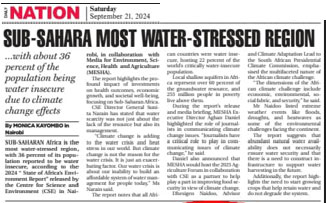
Nairobi: Across Africa, the incidences of violence over water resources increased by around 34 per cent during 2022-23: there were at least 71 such incidents recorded in 2023 compared to 53 in 2022. In 2023, Africa reported the highest number of water-related conflicts and disputes since 2019 – says the 2024 State of Africa’s Environment report, released here today at a media briefing. The briefing was jointly organised by New Delhi-based Centre for Science and Environment (CSE) and Media for Science, Environment, Health and Agriculture (MESHA). The report is prepared and brought out every year by CSE and Down To Earth, a fortnightly magazine the Centre helps publish. The inaugural edition of the report was launched in 2023 in Nairobi. With its central theme as water, the report covers a wide gamut of related subjects, ranging from water security, urban water poverty, and water-related migration and conflicts, to the disease burden, climate change-induced water scarcity, and the potential of rainwater harvesting to eradicate water poverty in Africa. Speaking at the launch of the report, noted Indian environmental writer and activist and director general of CSE, Sunita Narain, said: “The scarcity of water that is being faced by Africa and other regions of the world is as much about the lack of the resource as its mismanagement. Climate change is adding to the water crisis and heat stress in our world. But climate change is not the reason for the water crisis – it is just an exacerbating factor. Our water crisis is about our inability to build an affordable system of water management for people today.”
दिल्ली में प्रदूषण की रोकथाम को लेकरGRAP को इस बार बदलाव के साथ करीब 10 दिन पहले ही लागू कर दिया गया है। एक्सपर्ट्स के अनुसार, GRAP (ग्रेडेड रिस्पांस एक्शन प्लान) को समय से पहले लागू किया जाना अच्छा है। अभी प्रदूषण का सीजन आने में करीब एक महीने का समय है। ऐसे में इस दौरान एजेंसियों को अपनी कमियों को सुधारने का मौका मिला है। इसके साथ ही GRAP में पावर प्लांट से होने वाले प्रदूषण के प्रति रुख कमजोर है। इसे सख्त करने की जरूरत एक्सपर्ट महसूस कर रहे हैं। सीएसई (सेंटर फॉर साइंस एंड एनवायरमेंट) की अनुमिता रायचौधरी के अनुसार, GRAP में इस साल जो बदलाव किए गए हैं, उनमें मुख्य रूप से ट्रांसपोर्ट सेक्टर में ही बदलाव किया गया है। दिल्ली-एनसीआर में प्रदूषण की मुख्य वजह भी ट्रांसपोर्ट सेक्टर है और प्रदूषण के पीक सीजन में इन पर रोक लगाने से प्रदूषण से राहत मिल सकती है। वहीं, इस बार GRAP के विभिन्न चरणों को तीन दिन के पूर्वानुमान के आधार पर लागू करने का निर्णय लिया गया है। बीते कुछ सालों से पूर्वानुमान में गलती की वजह से GRAP को लेकर कई परेशानियां दिख रही थीं। सीएक्यूएम GRAP को लागू करती थी, फिर उसे दिल्ली और विभिन्न शहर अपने यहां लागू करते थे। ऐसे में जब यह लागू होते थे, तब तक प्रदूषण कम हो चुका होता था। हालांकि पूर्वानुमान को बेहतर करने की जरूरत है। कंस्ट्रक्शन वर्क में नियमों को किया आसान एनवायरमेंटलिस्ट सुनील दहिया के मुताबिक, सर्दियों का प्रदूषण शुरू होने में अभी करीब एक महीने का समय है। ऐसे में GRAP को जल्दी लागू करने से प्रशासन को तैयारियों का समय मिल गया है। ट्रांसपोर्ट सेक्टर में जो नए बदलाव हुए हैं, उनसे आम लोगों को परेशानी न हो, इसके इंतजाम किए जा सकते हैं। कंस्ट्रक्शन वर्क में भी कुछ बदलाव किए गए हैं। छोटे-मोटे कामों को राहत दी गई है। कंस्ट्रक्शन की पाबंदियों को लागू करने में GRAP विफल रहा था, अब नियम में क्लैरिटी की वजह से यह प्रशासन के लिए थोड़ा आसान हो जाएगा। आम लोगों को भी थोड़ी राहत मिली है। वहीं GRAP का यह रिवाइज्ड रूप भी एनसीआर के पावर प्लांटों से हो रहे प्रदूषण को लेकर कमजोर दिख रहा है। GRAP में बिजली एनसीआर के बाहर के पावर प्लांट से लेने या फिर उन पावर प्लांट से लेने के, जो प्रदूषण के मानकों का पूरी तरह पालन कर रहे हों, जैसे नियम होने चाहिए। इस साल पराली पर काफी काम हुआ है। ऐसे में संभावना है कि इस सीजन में पराली का प्रदूषण काफी कम रहेगा।
Residents living around Nduba landfill in Gasabo District, Kigali City, have been looking for relocation and compensation as they are affected by waste including toilet waste dumped in the landfill. To prevent related health risks affecting the residents, their properties were valued in 2021 with a pledge to be expropriated in the same year but it is yet to be done. On June 9, 2022, Water and Sanitation Corporation (WASAC) signed an agreement with Lake Victoria Basin Commission (LVBC) of the East African Community (EAC) to construct Kigali Faecal Sludge Treatment Plant in Masaka Sector, Kicukiro District, which will be receiving the 200 cubic metres of fecal matter per day. Fecal sludge management (FSM) is the collection, transport, and treatment of fecal sludge from pit latrines, septic tanks or other onsite sanitation systems. However, the project is yet to bear fruits. Sch poor faecal sludge management and sanitation in African cities like Kigali City are causing 115 deaths per hour from excretarelated diseases in Africa, according to a joint study by the UN Environment Programme and the International Water Management Institute, an international research organisation. The poor faecal sludge management and sanitation was highlighted in State of Africa’s Environment 2024 report by the Centre for Science and Environment (CSE) which was released this week, in Nairobi, Kenya, in partnership with Media for Environment, Science, Health and Agriculture (MESHA). Faecal sludge is a mixture of human excreta, water and solid substances such as toilet paper or other cleansing materials as well as menstrual hygiene materials that are disposed of in pits, tanks or vaults of on-site sanitation systems. Faecal sludge contains a high number of microorganisms originating from faeces, many of which are pathogenic. Direct and indirect contact with untreated faecal sludge poses a significant health risk. Some 300 million of the two billion people lacking basic sanitation facilities globally live in Africa according to the report. “Access to sanitation facilities remains a challenge for urban populations in many Sub-Saharan African cities, particularly for people living in poor peri-urban areas,” it says. The report noted that poor faecal sludge management also contributed to huge economic losses in Africa. The analysis found that sustainably managing faecal sludge in Africa was hindered by a number of factors. These included population growth and urbanisation, over-reliance on financial aid for construction of treatment plants, low revenue generation from users of treatment facilities, poor operation and maintenance and inefficient institutional arrangements for faecal sludge management. It also said African countries should make direct investments to very poor households, in order to achieve the UN mandated Sustainable Development Goal (SDG) 6: Water and sanitation for all by 2030. African women and children are bearing the brunt of the continent’s sluggish pace in sanitation, with health, nutrition, education, gender equality and poverty reduction being at stake. The scenario is no better in East Africa where over half the people in informal settlements live in unsanitary conditions. “At present, in this region there is no country with more than 68 per cent access to adequate sanitation. Rwanda appears to be the only one to achieve this percentage and above. Despite commitments by several governments and the United Nations’ recognition of sanitation as a basic human right, it still remains neglected,” the report shows. Faecal sludge treatment plant project in 2 phases The first phase is the immediate action which was supposed to be financed by the Government of Rwanda and WASAC Ltd to recruit the firm to establish the treatment plant. The second phase of the project, after the plant is complete, is expected to receive 1000 cubic metres of fecal sludge on a daily basis. Currently, Kigali is inhabited by 1.6m residents and they are set to increase to 3.8 million by 2050, triggering the increase of waste. This means that 450 tonnes of waste including fecal sludge are collected from 1.6 million people currently every day and it could double in 2050. Kigali Faecal Sludge Treatment Plant project is also in line with the National Integrated Water Supply and Sanitation Master Plans that WASAC has completed in May 2022. The Master Plan is aligned with Rwanda’s Vision 2050 and intends to ensure sustainable water supply and sanitation services to the population. The Construction of the plant will be completed by the end of 2025.
SINCE the beginning of this year, the number of cholera cases reported by World Health Organisation (WHO) regional office for Africa as of June 30 was 104, 038 and 1, 732 respectively, with a case fatality ratio of 1.7 percent, it has been revealed. According to the AFRO monthly bulletin for July, 2024 issue, Comoros, Democratic Republic of Congo (DRC), Zambia, and Zimbabwe account for 85.7 percent (89, 208) of the total cases and 91.2 percent (1, 580) of total deaths reported by June 30, 2024. And the “State of Africa’s Environment 2024,” report released by Centre for Science and Environment (CSE) on September 16, this year in collaboration with Media for Environment, Science, Health and Agriculture (MESHA) states that the repeated outbreaks of cholera and CLICK HERE TO READ MORE
What you need to know: In June, this year, scientists from World Weather Attribution said climate change contributed to the disastrous heavy downpours and warned that such would become more frequent if nothing was done. The government promised financial assistance to help families build a new life away from the riparian land. It’s a Sunday morning and Tereza Atieno and her husband Wycliffe Miller are standing on the banks of the Nairobi River, cradling their five-month-old twins. Five months ago, this scene would have unfolded inside what used to be their humble iron-sheet rental house. A few metres away from where we are standing flows the river, now reduced to a sluggish, murky trickle—a far cry from the force that once flooded their home in Mathare’s informal settlement, a place they called home for nearly four years The contrast between past and present is stark, as the couple stare at the sluggishly moving water, heavy with silt and pollution. A faint, stale smell lingered in the air, carried by the sluggish current, as if the water itself had grown weary of its journey. Flies buzzed over the garbage-lined banks, adding to the stench. The last time they stood there, the river had overflowed, submerging their compound and leaving them homeless. “The night we first experienced the heavy rainfall, my twin babies were just three days old. About three weeks later, a heavy downpour flooded the whole compound and water got inside our house. My husband helped our children and me to vacate the house to a neighbouring school for our safety and health,” Ms Tereza tells Climate Action. That night, while the rain hammered on their tin roof, she had retired to bed, unaware of the looming disaster until her husband, who had been out watching an English Premier League match, rushed in shouting. By the time they were being evacuated to a nearby school, their house had been reduced to a waterlogged shell, with most of their belongings destroyed or swept away. What was supposed to be a temporary shelter became their home for nearly two months. They survived the ordeal, but the experience took a toll on the young family. She remembers battling hunger and poor sanitation at the shelter. "We only had one meal a day. It wasn’t enough for me as a lactating mother or my babies. Without proper nutrition and clean water, my health deteriorated, and my children suffered from skin rashes. I had constant diarrhoea,” she says. For two months, they shared cramped classrooms with other flood victims. When schools reopened, they were forced to leave, but to where? She asks rhetorically. A friend offered them temporary accommodation, but the emotional and financial scars remained. “Our life by the river was never easy, but the flood took everything—our belongings, our security," says Wycliffe. "We saved nothing but our lives.” In June, this year, scientists from World Weather Attribution said climate change contributed to the disastrous heavy downpours and warned that such would become more frequent if nothing was done. The government promised financial assistance to help families build a new life away from the riparian land. “We didn’t receive it,” she says. Last month, the couple and their children moved to a new rental house, far from the river and on the third floor of a brick building. “Every day is a battle to survive,” she says. In Busia County, far from Nairobi, 36-year-old Lilian Ajiambo shares a similar story of displacement and hardship. While pregnant during the floods that hit the region in 2023, Lilian fled her rural home with her children and husband, seeking refuge at a local school. “Life at the camp was difficult because, in one classroom, we used to stay with six different families. Whenever I needed antenatal clinic services, I had to cross the lake using a boat to reach a health facility,” Ms Ajiambo tells Climate Action. Before the flood, Lilian’s family lived off farming and selling fish, but the disaster washed away her livelihood. "When we returned home, our house had collapsed, and the farm was swamped. Now, I work on other people’s farms to survive," she laments. Back in Nairobi’s Mathare settlement, Patrick Mwanzia, another flood victim, recounts how difficult it has been to rebuild his life. After receiving a government payout of Sh10,000, he managed to rent a house, but his troubles are far from over. "I didn’t pay rent before the floods. Now, I pay Sh4,000 a month. I lost my bathroom and water business when the flood swept everything away, including my tank. I used to guard a nearby school at night, but the school is gone too,” he offers. With scientific data suggesting that 200 million people could be displaced by climate change by 2030, the outlook is grim. According to Teresa Anderson, Climate Justice Lead at ActionAid, the current flow of climate financing is skewed. "Too much money is fuelling climate destruction, while too little is invested in solutions. This deepens inequality and traps economies in a vicious cycle." Dr Francis Oremo, senior programme manager at the Institute for Law and Environmental Governance, points to inadequate infrastructure as a major contributor to the crisis. "We live in a country where scientific advice is ignored, and flood management plans are non-existent. The result? Chaotic evictions, displaced communities, and mismanaged funds." According to Sunita Narain, Director-general at the Centre for Science and Environment, there is a need to echo the urgency for better flood management. "Climate change is intensifying water and heat stress globally. We’re seeing more rain, but in fewer days, leading to both floods and droughts. Governments must adopt water harvesting and flood control strategies as urban populations grow." For Tereza Atieno and other families, the trauma of displacement lingers, heightened by the constant threat of future floods. Professor Sean Holman, an expert in climate journalism, warns that survivors are often left vulnerable long after the floodwaters recede. "Post-traumatic stress from such events can resurface at any moment, especially with looming flood warnings. The emotional toll on survivors is immense, yet governments that fail to help only deepen their suffering." The families are uncertain of the future but thankful for their survival. For now, that has to be enough
With the winter just a few months away, the Graded Response Action Plan (GRAP), which comes into force once the air quality index crosses 200, has been revised with three more restrictive actions added in stage III, when AQI turns severe. Actions under stages II to IV of GRAP will also be enforced three days in advance based on the forecast that high AQI levels are likely to remain for a longer period of at least three days. Apart from the existing restrictions like the ban on BS-III petrol and BS-IV diesel four-wheelers and construction activity under stage III, the Commission for Air Quality Management (CAQM) in the national capital region (NCR) and adjoining areas has added a prohibition on interstate buses running on non-cleaner fuels, BS-III or below diesel-operated light commercial vehicles, and heavy goods vehicles in Delhi. This is the first time when the commission has decided to implement GRAP depending on the higher projected AQI levels for longer periods. The restrictions will consider AQI and the forecast by India Meteorological Department and Indian Institute of Tropical Meteorology. "Actions under stages II, III and IV of GRAP will be invoked in advance of AQI reaching the projected levels of that stage and also provided that the higher projected AQI levels are likely to sustain for longer periods (say three days or more)," CAQM stated. "While this is increasing the degree of stringency, its implementation will require preparedness and a strategy," pointed out Anumita Roychowdhury, executive director of research and advocacy at Centre for Science and Environment. Since construction and demolition activities in the entire NCR are banned in stage III when AQI is between 400 and 450, the revised GRAP clarifies that among the dust-generating activities, which will continue to be prohibited, are major welding and gas-cutting operations; cement, plaster or other coatings, except for minor indoor repairs/maintenance; cutting or grinding and fixing of tiles, stones and other flooring materials, except for minor indoor repairs; and waterproofing work and transfer, loading or unloading of dust-generating materials like cement, fly ash, bricks, sand, murram, pebbles, crushed stone, etc., anywhere within or outside the project sites. However, on the lines of previous years, linear public projects, emergency projects, sanitation, national importance, ancillary activities and non-dust generating activities will be exempted under stage III. Besides, under stage II of GRAP, when AQI is between 300 and 400, there will be no restriction on diesel generator sets of 62kV to less than 800kV, which are running on dual-fuel mode or retro-fitted emission-control devices through certified agencies. "CAQM announces a revised GRAP schedule to further strengthen measures to combat sudden or anticipated deterioration of air quality in Delhi-NCR during the upcoming winter season. GRAP has been formulated after careful consideration of scientific data, stakeholder inputs and expert recommendations along with field experience and learnings in the past years," the commission stated. GRAP is an emergency response mechanism for the entire NCR, based on average AQI levels in Delhi, which brings together multiple stakeholders, implementing agencies and authorities to respond to the situations of deteriorating air quality in Delhi-NCR. "The revised GRAP schedule will come into force in the entire NCR now and different stages will be imposed accordingly through specific orders issued from time to time as per the air quality conditions of the region. It shall serve as a tool towards abatement of adverse air quality in NCR generally witnessed during the peak winter months," said CAQM.
All African nations are water insecure and host 22 per cent of the world’s critically water insecure population, a new report has revealed. The State of Africa’s Environment 2024 report by Centre for Science and Environment (CSE), India, shows only 201 million people in the 54 Africa countries have access to safely managed drinking water with more than 411 million others lacking basic drinking water service. “Most of African countries have abundant freshwater resources. However, abundant natural water availability does not necessarily ensure water security. The reason is most Africa has the lowest levels of safe Water, Sanitation and Hygiene (WASH) services, undermining water security,” reads part of the report. Speaking at the report launch in Nairobi, CSE director general Sunita Narain said water scarcity in Africa is not due to a lack of resources but rather poor management. Abundant freshwater She highlighted that, despite the availability of abundant freshwater in many regions, ineffective policies and inadequate infrastructure are major contributors to the water crisis, particularly in the areas of WASH. Climate change is also exacerbating the already fragile water systems across the continent. “Only a fraction of the continent’s water endowment is effectively used. In some of the driest regions, like sub-Saharan Africa, overexploitation of groundwater and inadequate investment in water infrastructure have left millions without reliable access to clean water,” she said. According to the report, apart from poor water management another two major discontinuities in water governance have emerged: the shift from community-based management to state control and the growing dependence on surface and groundwater sources, while traditional methods like rainwater harvesting are underutilized. This is why revival of rainwater harvesting, paired with modern scientific innovations, could significantly alleviate the water stress in Africa. “If nothing is done, Africa is expected to experience the most significant decline in per capita renewable water resources by 2100. If all water use was to be met from rivers and groundwater systems, riverine ecosystems and groundwater resources will come under extreme stress, as is already being noticed across the continent,” she said. According to the report, the earlier reliance on rainwater and floodwater has declined, even though rainwater and floodwater are available in much greater abundance than river water or groundwater. Theoretically, the potential of water harvesting in meeting household needs is enormous. Even in an arid area with an annual rainfall level of only 100 mm, one hectare of land can theoretically capture as much as one million litres of water. As there is a synergy between population density and rainfall levels, less land is required in more densely populated areas to capture the same amount of rainwater. And in such areas, there is usually more built-up area like roof-tops which have improved runoff efficiency. Rainwater harvesting can not only provide a source of water to increase water supplies but also involve the public in water management, making water management everybody’s business. “It will also reduce the current demand on government institutions to meet water needs, reduce the need for government subsidies, and help everyone to internalise the full costs of their water requirements, thus encouraging the public to be more conserving in its water demand. In rural areas water harvesting will also be an integral part of an integrated programme for sustainable development of land and water resources on a watershed basis whose objective is to improve total biomass output,” reveals the report Water harvesting According to Sunita, water harvesting and integrated land-water management is not new to the Africa continent, or to many other parts of the developing world. The art and science of “collecting water where it falls” is ancient but this “dying wisdom” needs to be revived to meet modern freshwater needs adequately, equitably and sustainably and modernised with inputs from science and technology. In human terms, rainwater harvesting means making water everybody’s business. Every household becomes involved both in the provision of water and in the protection of water sources. It means making water the subject of a people’s movement, re-establishing the relationship between people and their environment and turning water into a sacred element of nature. It means the empowerment of urban and rural communities to manage their own affairs with the state playing a critical supportive role and the civil society playing a critical role in encouraging equity and sustainability in the use of water. It means a role for everybody with respect to water.
Cholera, commonly known as a "disease of poverty," continues to claim 115 lives deaths per hour among marginalized communities in Africa that lack access to clean water, sanitation, and healthcare. Unsafe sanitation practices and behaviours are resulting in greater water pollution, disease outbreaks, and rising mortality rates across Africa, the 2024 State of Africa’s Environment report on water said. The report released by the Indian-Based Centre for Science and Environment highlights that death rates from unsafe water sources in Africa are alarmingly high, reaching 50 deaths per 100,000 people—1,000 times higher than in developed countries. Nigeria experienced one of the largest cholera outbreaks, affecting 32 of its 36 states, with around 90,000 people falling ill and over 3,000 deaths reported by the end of 2021. In 2023, Zimbabwe faced one of its most severe cholera outbreaks in recent years, spreading to all 10 provinces. By May 2024, the country had recorded more than 30,000 cholera cases and 600 deaths in the first four months of the year. In Ethiopia, limited access to safe water and sanitation has contributed to cholera becoming endemic. Since the outbreak began in August 2022, the country reported 44,044 cases and 571 deaths by May 2024. Additionally, between 2019 and 2021, Ethiopia documented a total of 15,515 suspected cholera cases. “Three-fourths of the cases were reported from the drought-affected regions of Oromia, Somali and Southern Nations, Nationalities and Peoples Region.” According to the Ethiopia Public Health Institute, as mentioned in the report, over 15.9 million Ethiopians, about 15 percent of the total population, reside in areas with a history of recurring cholera outbreaks. National cholera surveillance data from the past nine years (2015-2023) indicate that the country has experienced cholera outbreaks annually. In Malawi, the cholera outbreak began in early 2022 and persisted into 2023-2024, with over 36,000 cases and 600 deaths recorded by early May 2024. The report notes that Malawi has not been cholera-free since 1973. According to a CSE report, in the last 11 months of 2022, more than 950 Malawians died, and approximately 29,000 cholera cases were reported during that time. “For Africa, it has been a scourge for the last 53 years. For the second driest continent of the world with high level of inequality in access to safe water and sanitation, the disease burden is too high. Various studies estimate that at least 40 million people live in cholera-endemic areas in Africa with a risk of frequent outbreaks,” the report said. The report indicated that in January 2023, the WHO categorized the global increase in cholera as a Grade 3 Emergency, the highest classification for a health crisis necessitating a thorough response. One year later, over 30 countries reported cholera cases, with the African region ranking second after the Eastern Mediterranean Region. “From January 1 to May 16, 2024, some 194,897 cholera cases and 1,932 deaths were reported worldwide. The region with the highest reported case count was the Eastern Mediterranean Region, followed by the African Region, the Region of the Americas, the Southeast Asia Region, and the European Region.” According to the WHO Africa Region’s Monthly Regional Cholera Bulletin dated June 30, 2024, cholera outbreaks were reported in 14 countries across the continent. It was classified as a “crisis” in Comoros, the Democratic Republic of the Congo, and Ethiopia. “Since the beginning of the year 2024, the number of cholera cases and deaths reported to the WHO Regional Office for Africa (afro) as of 30 June was 104, 038 and 1, 732 respectively, with a case fatality ratio of 1.7 per cent. Comoros, Ethiopia, Congo, Zambia, and Zimbabwe account for 85.7 per cent (89,208) of the total cases and 91.2 per cent (1,580) of total deaths reported till June 30, 2024,” the report quoted the afro’s monthly bulletin released in July 2024. Unsafe water and poor sanitation 2021 figures in the report show that Africa accounted for nearly half (44%) of the global deaths attributed to unsafe water and poor sanitation, totaling 533,276.79 deaths out of 1,215,365.13. Nigeria accounted for 28.04% representing 149,811 deaths, Ethiopia 8.28% (44,212 deaths), Chad 5.49% (29,262 deaths), and Ghana 1.55% (8,271 deaths). Sao Tome and Principe, Libya, and Tunisia recorded the lowest figures of 0.01%, 0.02%, and 0.03%, respectively. The report highlights that the decline in groundwater quality is an emerging challenge that exacerbates the disease burden. It notes that, although much of the economy in Sub-Saharan Africa relies on groundwater, insufficient attention is given to its quality. “Due to geological formations several African countries have higher concentrations of fluorides, arsenic and chlorides. These also make groundwater unfit for drinking without treatment.” A 2020 study by CSE found high concentrations of iron, magnesium, and chlorides in Uganda's groundwater, attributed to natural mineralization. Fluoride levels also exceeded WHO drinking water guidelines due to volcanic deposits. These conditions, CSE says, can lead to various health issues, such as fluorosis, while high iron levels contribute to unpleasant odors and tastes, and manganese can damage plumbing fixtures and laundry. In Tanzania, the CSE study identified that groundwater is contaminated with nitrates and sulfates. The mining of these resources, along with the hazardous dumping of waste, leads to pollution in water bodies, increasing their salt and mineral content and affecting their pH levels (acidity or basicity). "The community should either have community-level water supply systems which treat the groundwater before supply to households or there should be mechanisms where the groundwater supplies are treated before supply to households, which again can be a costly affair for the rural households,” CSE recommended.
With winter approaching, the Graded Response Action Plan (GRAP) in DelhiNCR has been revised, introducing three additional restrictive measures for stage III, which applies when the air quality index (AQI) exceeds 200 and reaches severe levels, reported TOI. to IV will be implemented three days in advance if forecasts indicate prolonged high AQI levels. In addition to existing restrictions, the Commission for Air Quality Management (CAQM) has now prohibited interstate buses running on nonclean fuels, as well as BS-III diesel-operated light commercial vehicles and heavy goods vehicles in Delhi, noted the TOI report. Earlier, a ban was placed on BS-III petrol and BS-IV diesel four-wheelers and construction activities during stage III. This marks the first time the commission will apply GRAP based on projected AQI levels expected to persist over extended periods. Restrictions will be guided by both AQI data and forecasts from the India Meteorological Department and the Indian Institute of Tropical Meteorology. “Actions under stages II, III and IV of GRAP will be invoked in advance of AQI reaching the projected levels of that stage and also provided that the higher projected AQI levels are likely to sustain for longer periods (say three days or more)” stated CAQM. Anumita Roychowdhury, executive director of research and advocacy at the Centre for Science and Environment, told TOI that while these measures Under stage III, when AQI is between 400 and 450, construction and demolition activities will be completely banned. Prohibited dust-generating activities include major welding and gas-cutting, plastering and coatings (except minor indoor repairs), cutting or grinding of flooring materials (except minor indoor work), waterproofing, and the transfer, loading, or unloading of dust-producing materials like cement and bricks. However, as in previous years, linear public projects, emergency initiatives, sanitation, national importance projects, and non-dust-generating activities will remain exempt during stage III. Under stage II, when AQI is between 300 and 400, there will be no restrictions on diesel generator sets between 62 kV and 800 kV using dual-fuel mode or retrofitted emission-control devices certified by authorised agencies. "CAQM announces a revised GRAP schedule to further strengthen measures to combat sudden or anticipated deterioration of air quality in Delhi-NCR during the upcoming winter season. GRAP has been formulated after careful consideration of scientific data, stakeholder inputs and expert recommendations along with field experience and learnings in the past years," the commission stated. GRAP serves as an emergency response mechanism across the NCR, relying on average AQI levels in Delhi to coordinate actions among various stakeholders and authorities to address deteriorating air quality. "The revised GRAP schedule will come into force in the entire NCR now and different stages will be imposed accordingly through specific orders issued from time to time as per the air quality conditions of the region. It shall serve as a tool towards abatement of adverse air quality in NCR generally witnessed during the peak winter months," CAQM further said.
The Indian-Based Centre for Science and Environment is cautioning that several African countries may face an impending groundwater crisis due to excessive use of water extraction systems for various needs. Countries like Tanzania and Uganda, despite being rich in water resources, are experiencing water scarcity. In Tanzania, for example, freshwater resources are essential for hydroelectric power and the extensive wetlands, spanning over 85,000 hectares, support both the economy. The country also hosts about 5.7% of its land area covered by Lake Victoria, Lake Tanganyika, and Lake Nyasa, along with several smaller lakes. Nevertheless, a significant portion of its rural population still struggles with limited access to water sources. “Despite being home to approximately 25 per cent of the world's freshwater resources, it could see a water-stressed future. The country manages its water demand through its rivers Pangani, Wami, Ruvu, Rufiji and Ruvuma; lakes Nyasa, Rukwa, Tanganyika and Victoria; and internal drainage basins of Lake Eyasi, Lake Manyara and the Bubu depression; and its southern coast. The rivers are largely perennial barring a few that are intermittent and ephemeral,” the report said. According to the 2024 State of Africa Environment report, released yesterday in Nairobi, Tanzania is entirely dependent on rainfall for its water supply. All of its rivers are rain-fed, and both surface and groundwater sources rely on rainwater. “More than 70 per cent of the population live in rural areas and depend to a large extent on groundwater reserves, mostly rainwater seeping into aquifers. In addition, groundwater is used for domestic purposes in peri-urban and urban areas, where there is no distribution network. While urban areas depend on borewells, rain-fed shallow wells are common in most of the country. Almost 65 per cent of the groundwater is used for domestic supplies,” it stated. The report identifies population growth, industrial and agricultural activities, and rapid urbanization as major challenges driving increased water demand in Tanzania. This has led to excessive groundwater extraction, raising concerns about the sustainability and yield of groundwater sources, particularly in hard-rock areas with low recharge rates. For instance, in the Dodoma region, many local government areas have non-functional taps, reflecting the low sustainability of available water sources. Rainfall distribution in Tanzania is highly variable with the southern regions receiving the majority of their rainfall over two to three months each year. For the rest of the year, they rely heavily on groundwater, which is often challenging to access. "Rainfall pattern is also highly variable. The highlands in southwest Tanzania receive 1,200 mm per year of rainfall while the internal drainage basin receives less than 600 mm per year of rainfall." Similar to Tanzania, the primary source of water for rural Uganda is spring water, supplemented by boreholes and shallow wells with hand pumps. In Uganda, 61% of the country's water is derived from groundwater sources, accessed primarily through springs and boreholes located around Lake Victoria and in the southwestern region. According to the report, groundwater is the primary source of water supply in rural Uganda, including in semi-arid and arid regions. It is typically found in weathered or fractured basement rocks and has a yield ranging from 0.5 to 80 cubic meters per hour. “There has been groundwater use since the 1930s through the construction of deep boreholes, shallow wells and protected springs. On average, 1,200 tubewells and 900 shallow wells are constructed annually in Uganda. Approximately 40,000 deep boreholes, 16,000 shallow wells and 30,000 protected springs have been constructed in the country mainly for rural domestic water supply. Boreholes and shallow wells are normally installed with handpumps,” it explained. The situation in Uganda mirrors that of Tanzania, with high population growth and agricultural and industrial expansion leading to unplanned groundwater development and usage. This has raised concerns about the future yield and sustainability of groundwater in certain areas, particularly in the north-eastern and south-western regions, where natural groundwater recharge is lower compared to other parts of the country. “There are reports of poor-quality groundwater mainly due to inadequate sanitation facilities—in many areas high nitrate and bacteriological contamination of groundwater have been reported. High fluoride and iron and manganese above permissible limits have also been found in the groundwater due to natural reasons, impacting public health and the economy of Uganda,” the report statement. Why rainwater harvesting system? The report is advocating for rainwater harvesting and recharging the groundwater sources to improve both quality and quantity of reserves in African countries. “Rural areas need to implement groundwater recharge structures efficiently as more than 90 per cent of Tanzania’s rural water schemes are dependent on groundwater.” The report presents an intriguing argument that modern water supply systems for villages may be more costly compared to traditional water-harvesting methods still widely used in rural areas for both irrigation and drinking water. It clarifies that "traditional systems" do not imply outdated or dilapidated structures but rather refer to approaches distinct from large, capital-intensive, government-managed systems. In addition to their high financial costs, modern systems often impose significant ecological costs and may conflict with fundamental principles of sound agroclimatic planning. Conversely, traditional community-based structures not only support sustainable water use but also enhance social cohesion. “The responsibility of taking decisions and action should be left to individuals, groups and local communities working together, encouraging economic independence and optimization of local resources at the micro-level. Traditional systems use low-cost, user-friendly techniques and are easily kept in good operational condition by local communities.” Potential of rainwater harvesting Further analysis in the report examines the typical rainwater potential of a small plot of land by using a hectare that receives 100 mm of rainfall annually. It highlights that this amount of rainwater can yield up to 1 million liters, which is sufficient to satisfy the drinking and cooking water needs of 182 people, assuming a generous daily requirement of 15 liters per person. “Even if you are not able to capture all that water — this would depend on the nature of rainfall events and type of runoff surface, among other factors — you could still, even with rudimentary technology, capture at least half-a-million litres a year.” According to calculations by CSE, Sub-Saharan Africa has a rainwater harvesting potential of 13,365,000 million cubic meters. To put this into perspective, this is nearly 44,550 times the daily volume of water that flows through the Nile River. Other studies, including those by the UN Environment Programme (UNEP) and the World Agroforestry Centre, support this view, indicating that African countries experiencing water shortages due to climate change have significant rainwater harvesting potential. Countries like Ethiopia and Kenya, for example, have the capacity to meet the needs of six to seven times their current populations through rainwater harvesting. Per the study, the total amount of rain falling across Africa is sufficient to meet the needs of 9 billion people, which is one and a half times the current global population. Additionally, around a third of the continent is considered suitable for rainwater harvesting if the threshold for effective collection is set at 200 millimeters of rainfall—a relatively low measure. This indicates that Africa is not water-scarce; in fact, the rainfall is more than adequate to meet the needs of the current population multiple times over. The study further explains that Africa's water crisis is more an issue of economic investment rather than physical scarcity. It uses Kenya as an example, suggesting that if rainwater harvesting were factored in, Kenya would not be classified as a 'water-stressed country.' This highlights that the challenges are more about inadequate investment and infrastructure rather than a fundamental lack of water resources. Ethiopia's national rainwater harvesting initiative, known as "My Dam at My Door," along with Tanzania’s MKUKUTA and WSDP policies, and similar projects in Zimbabwe and Malawi, are focused on promoting the sustainable and efficient use of rainwater. These policies, designed to address the escalating impacts of climate change, involve governments, private sectors, and individuals in various efforts to enhance rainwater harvesting. Initiatives include constructing large-scale reservoirs in public institutions such as schools and hospitals, training local communities, and offering subsidies for rainwater harvesting equipment. In Malawi, for example, the Rainwater Harvesting Association of Malawi (RHAM) has implemented over 200 "calabash" rainwater harvesting systems since 2021. These systems are engineered to capture and store rainwater during the rainy season, providing a reliable water source for agriculture and domestic use throughout the entire year.