
Cse In News

Delhi Water Woes: Your jeans may be t behind Delhi's 'blue' water

In southeast Delhi, near the DelhiMumbai expressway, illegal denim dyeing units in Meethapur village are significantly impacting local water bodies with untreated toxic chemicals. These unauthorized operations are causing severe environmental damage and posing health risks to residents, with polluted water flowing into the Yamuna River. EnvironmentalImpact and Health Risks The process of dyeing denim, while creating popular garments, is highly environmentally damaging. Experts explain that synthetic indigo dye does not dissolve in water and requires chemicals to penetrate and color the denim fibers. Despite regulations that restrict such operations to industrial zones, numerous illegal dyeing units are scattered throughout non-conforming areas like Meethapur. These units discharge toxic waste into local drains, which eventually flows Pollution and Regulatory Challenges Nivit Yadav, program director of the industrial pollution unit at the Centre for Science and Environment, detailed the situation: “These units discharge untreated chemical waste into the sewer, which flows to sewage treatment plants (STPs). However, STPs lack the capacity to treat chemical waste, allowing toxic material to enter the Yamuna. These units use substances like hydrochloric acid, hydrogen peroxide, sulfuric acid, formic acid, caustic soda, agents, detergents, and salts. Since they don’t have effluent treatment plants, the discharge of chemical waste can be harmful to both humans and aquatic life.”
Concrete Jungles Fuel India's Heatwave Crisis

With over 140 deaths and more than 40,000 hospitalisations for heatstroke, according to the Health Ministry's National Centre for Disease Control (NCDC), summer 2024 has seen the most dramatic heatwave yet. It is no longer metaphorical. The heat is actually killing us. And even as extreme climate events become normalised, it is also becoming evident that the impacts of a rapidly warming planet are not faced equally by all. Cities, for example, often face the brunt of a heatwave. This can be squarely attributed to the Urban Heat Island (UHI) Effect, which is when urban areas have a significant temperature difference from surrounding rural areas due to a lack of green cover and addition of waste heat generated by energy usage into the urban environment. The geometry and structure of urban areas, in addition to use of materials like concrete only worsen the problem. An Australian study, for example, has shown that use of asphalt concrete in roads and pavements, results in surface temperatures touching 60°C on hot summer days. A universal response to these high temperatures has been increasing reliance on artificial space cooling through air conditioning. India’s air conditioner market, for instance, has seen an explosion in sales and revenue, and is only projected to keep increasing. But increased AC usage comes with a catch, a phenomenon that the Centre for Science and Environment (CSE) has aptly called a "Midsummer Nightmare". More AC usage generates not just more greenhouse gas (GHG) emissions but also throws out waste heat into the immediate environment, further warming it. Sanjay Seth, Senior Director, Sustainable Infrastructure Programme, TERI says that "ACs are not the sole cause for UHI, but taking into account factors like installation location, usage hours and efficiency, can paint a better picture of the role they play. For example, rooftop AC units installed in direct sunlight and in close proximity to each other can reduce system efficiency and exacerbate the Urban Heat Island effect." The UHI effect is not directly responsible for climate change. But, it plays a significant enough role in personal thermal discomfort; that it becomes necessary to evaluate the role our built environment may be playing in creating conditions which have a human cost.

Need for time-bound action on AMR

Come September, the UN General Assembly will be hosting a High-Level Meeting in New York on Antimicrobial Resistance (AMR) -- member states are already negotiating on the draft political declaration which is expected to be adopted at the meeting. According to WHO, antimicrobial resistance (AMR) occurs when bacteria, viruses, fungi and parasites change over time and no longer respond to medicines. As a result of drug resistance, antibiotics and other antimicrobial medicines become ineffective and infections become difficult or impossible to treat, increasing the risk of disease spread, severe illness, disability and death. It is estimated that bacterial AMR was directly responsible for 1.27 million global deaths in 2019 and contributed to 4.95 million deaths. Centre for Science and Environment (CSE), which has been closely monitoring and contributing to the strategies for global action on AMR, has been advocating that priorities and needs of low- and middle-income countries (LMICs) must be recognised and acknowledged in the draft declaration. “It is critical that the ongoing discussions around the draft political declaration are adequately informed about the priorities of LMICs, which clearly have different challenges and possibilities compared to other countries,” says Amit Khurana, Director, Sustainable Food Systems Programme, CSE.

Delhi's Blue Water Woes: How illegal denim dyeing is damaging Delhi’s water and health

Close to the Delhi-Mumbai expressway in southeast Delhi, four laborers unload piles of jeans from a vehicle. These jeans are taken to Meethapur village, where they are dyed blue in illegal dyeing units. The untreated toxic chemicals used in the dyeing process flow into nearby gutters, turning them deep blue. In Meethapur, the main gates of these illegal units are often locked, but freshly dyed jeans can be seen drying on terraces. Numerous drains crisscross the area, carrying chemical-laced water that converges on the local pond, Bhatte Johad, which is easily recognizable by its blue color and surrounding garbage. Environmental Impact and Health Risks The process of dyeing denim, while creating much sought-after garments, is environmentally unsustainable. According to experts, synthetic indigo dye does not dissolve in water and requires chemicals to penetrate and color the denim fibers. These dyeing and denim washing units are not allowed outside industrial zones, yet many operate in non-conforming areas like Meethapur. Eco-activists warn that the toxic waste from these units flows through drains into the Yamuna River, harming the aquatic ecosystem and contributing to frothing in some river stretches. Soil and groundwater are also contaminated by improper disposal of chemical waste. Residents of Meethapur report health issues due to the contamination. Jagdish Chand Sharma said, “A foul smell emanates from the drains. In 2006, some of these units were shut down. But since then, many new units have come up. I have written to all agencies to act against them without anything happening.” Another resident, who wished to remain anonymous, described how recent rains inundated roads with ink-like water, adding, “These units run in rented premises and the landlords earn hefty rents from them.” Pollution and Regulatory Challenges Nivit Yadav, program director of the industrial pollution unit at the Centre for Science and Environment, explained that the dyeing units discharge untreated chemical waste into the sewer, which flows to sewage treatment plants (STPs). However, STPs lack the capacity to treat chemical waste, allowing toxic material to enter the Yamuna. “These units use substances like hydrochloric acid, hydrogen peroxide, sulfuric acid, formic acid, caustic soda, agents, detergents, and salts. Since they don’t have effluent treatment plants, the discharge of chemical waste can be harmful to both humans and aquatic life,” Yadav stated. Activist Varun Gulati has taken legal action against these units, filing a plea with the National Green Tribunal (NGT). He submitted video footage and geo-coordinates of 22 illegal dyeing units in Khyala and Meethapur. On July 23, the NGT asked a joint committee of the Delhi Pollution Control Committee (DPCC) and the Central Pollution Control Board (CPCB) to inspect the areas and report on actions taken.

India: Heat and sickness march together as climate shifts

Indians are no strangers to scorching summers, but this year's hottest months — from April to June — felt unbearably hot and agonizingly deadly. Temperatures shot past 50 degrees Celsius (122 Fahrenheit) in New Delhi and the northern states of Rajasthan and Uttar Pradesh. The country faced its worst heat wave in over a decade, with hundreds dying and thousands others having their health severely impacted by extreme weather conditions. Then came the monsoon season and the heat broke. This month, however, torrential rain triggered flood and landslides in India's north and northeast, killing scores of people and affecting hundreds of thousands. And both heat and flooding are exacerbating an even deadlier problem — the spread of disease. 'Beyond human tolerance' In India, experts say, climate change is boosting the spread of malaria, dengue, yellow fever, cholera, and chikungunya, as well as chronic diseases, particularly among the millions of people who already experience poor sanitation, pollution, malnutrition, and a shortage of drinking water. In India's urban centres "temperatures are rising beyond human tolerance, humidity is increasing, and so is the night-time heat," Sunita Narain, head of Centre for Science and Environment (CSE), a New Delhi-based public interest research and advocacy organization, told DW. Recent studies have shown that temperature rising a few degrees above our body heat levels have an array of harmful effects on mental and physical capabilities. Women working in heat-sensitive jobs such as agriculture or construction are at risk for pregnancy-related complications. Narain warns that cholera, a disease thought to be virtually eradicated was now "back again with a vengeance." At the same time, she says there is more to the problem than rising temperatures. "It is not climate change that is bringing cholera. The fact is, it is the mismanagement of the environment," Narain said.

GLOBAL SOUTH CAN MINIMISE THE CBAM IMPACT. NEW REPORT SHOWS HOW.

Unilateral policies like the Carbon Border Adjustment Mechanism (CBAM) are emerging and shifting the burden of the transition on the poor world as trade and climate change become more and more intertwined. To quickly set the scene, CBAM levies taxes on imports of commodities such iron and steel, cement, aluminium, fertilisers, power, and hydrogen based on how much of these things are produced with greenhouse gas emissions. Announced in 2022 by the European Union (EU), CBAM is one among several policy tools that have been initiated in this decade, that appear to further the cause of climate protection, but carry with them telltale signs of trade protectionism and economic nationalism, a new report said. The report by the Centre for Science and Environment (CSE) estimated that at a rate of €100 (or US $106) per tonne of carbon dioxide equivalent, CBAM would impose an average tax burden of 25% annually over and above the value of CBAM-covered goods exported to the EU by India. The report recommended ways in which Global South can respond to a changing trade regime in the era of climate change. Recommendations for developing countries The report shared recommendations on how developing countries can proactively take steps to mitigate CBAM’s liability, while also transforming their manufacturing sectors to shift towards low-carbon processes. In line with their demand for financing, developing countries must have sectoral mitigation plans in place outlining specific measures and targets for emissions reductions in key emitting sectors of their economies, the report suggested. In order to lessen the effects of paying the tax to the EU (or any other nation enforcing a similar mechanism), developing nations should tax their exports domestically and reinvest the proceeds into a decarbonisation fund under government management, the report recommended. This strategy does not interfere with fair trading conditions with the EU and satisfies the EU’s demand for the establishment of a domestic carbon pricing system, in this case, a carbon tax. Additionally, it keeps the money in the developing nation. The report suggested that emerging nations take into consideration varied production techniques for various markets and trade partners as a stopgap strategy. Using green production methods for products going to areas with CBAMs may be a temporary measure while the nation’s manufacturing sector progressively becomes less carbon-intensive. The report said that if climate policies are to permeate trade agreements, climate justice must be at the core of this development. This requires considering the burden-sharing aspect of climate policy in trade as well. In this light, the report proposed a system where developing countries could impose a ‘historical polluter tax’ on trade partners to fund their own decarbonization efforts. Trade partners who have contributed a specific amount to the total historical CO2 emissions since the pre-industrial era may be subject to this tax. Recommendations for the European Union According to the report, the EU should set aside revenue from CBAM to aid the decarbonisation of manufacturing in developing countries as a necessary step. Shifting to low-carbon processes demands substantial financial resources and technological advancements – which many developing countries currently lack. In addition, it will boost total climate funding flows to poor nations and exempt the most vulnerable from paying taxes, the report emphasised. Need to maintain equity and justice “Global trade rules need to be overhauled for a climate-risked world, but not at the cost of climate justice,” said Sunita Narain, director general, CSE. The report said that CBAM raises costs and hurts trade competitiveness in the Global South, violating the principle of common but differentiated responsibilities (CBDR). According to Faten Aggad, executive director, African Future Policies Hub, the economic impact on Africa would result in a US $25 billion loss per year. “To put it in perspective”, he said, “the entire continent receives just under US $30 billion per annum in climate finance, which is far below what is required for a solid response to the climate challenge. Essentially, we are losing US $25 billion that isn’t being compensated. Of course, there is the issue of justice and burden-shifting as Africa’s historical contribution stands under 4% of global GHG emissions”. Because industrialised countries have relatively stronger domestic climate rules than certain developing countries, they have been driving many of these policies in reaction to perceived risks of de-industrialisation and carbon leakage. The purpose of CBAM is to protect EU companies from rivals who can produce goods more affordably in nations that do not impose a carbon price. The report also stated that in order to avoid impeding the development process in the Global South, the effects of policies such as CBAM must be avoided. This may be done by implementing low-carbon, climate-resilient pathways with sufficient financial and technological support from wealthier nations.

India needs to adapt to heat “beyond human tolerance”

Experts say climate change in India is increasing the spread of chronic diseases including malaria, dengue fever, yellow fever, cholera and chikungunya, especially among millions of people who already face problems of sanitation, pollution, malnutrition and lack of potable water. “Temperatures in urban centers are rising beyond human tolerance, humidity is increasing, as is night heat,” Sunita Narain, head of the Centre for Science and Environment (CSE), a research and advocacy organization, told DW in New Delhi.

India: Heat and sickness march together as climate shifts

Indians are no strangers to scorching summers, but this year’s hottest months – from April to June – felt unbearably hot and agonizingly deadly. Temperatures shot past 50 degrees Celsius (122 Fahrenheit) in New Delhi and the northern states of Rajasthan and Uttar Pradesh. The country faced its worst heat wave in over a decade, with hundreds dying and thousands others having their health severely impacted by extreme weather conditions. Then came the monsoon season and the heat broke. This month, however, torrential rain triggered flood and landslides in India’s north and northeast, killing scores of people and affecting hundreds of thousands. And both heat and flooding are exacerbating an even deadlier problem – the spread of disease. ‘Beyond human tolerance’ In India, experts say, climate change is boosting the spread of malaria, dengue, yellow fever, cholera, and chikungunya, as well as chronic diseases, particularly among the millions of people who already experience poor sanitation, pollution, malnutrition, and a shortage of drinking water. In India’s urban centres ‘temperatures are rising beyond human tolerance, humidity is increasing, and so is the night-time heat’, Sunita Narain, head of Centre for Science and Environment (CSE), a New Delhi-based public interest research and advocacy organisation, told DW. Recent studies have shown that temperature rising a few degrees above our body heat levels have an array of harmful effects on mental and physical capabilities. Women working in heat-sensitive jobs such as agriculture or construction are at risk for pregnancy-related complications. Narain warns that cholera, a disease thought to be virtually eradicated was now ‘back again with a vengeance’. At the same time, she says there is more to the problem than rising temperatures. “It is not climate change that is bringing cholera. The fact is, it is the mismanagement of the environment,” Narain said. Attributed to other causes Experts warn that heat waves may be deadlier than we realise, as many heat deaths are attributed to other factors on the death certificate. “Most people dying during heat waves are not recorded as connected to the heat. There needs to be a proper formulation of heat action plans for cities and towns,” Dileep Mavalankar, former head of the Indian Institute of Public Health, told DW. “The government needs to implement long-term strategies to minimise vulnerability and inequalities across communities especially when heat waves are getting deadlier with every passing year,” he added. A rise in diseases Climate-sensitive diseases are rising in India, with some of them showing a clear link to the monsoon rainfall and heat. The government is also aware of the link between mortality and heat, and has listed detailed objectives to build up its capacities and prepare India’s medical system to mitigate risks. However, experts trying to plan and ameliorate these issues often face a fundamental problem – a lack of data. “This is the first hurdle that we need to work on if we are to save lives,” climate scientist Roxy Mathew Koll from the Indian Institute of Tropical Meteorology told DW. “Most of the data is not available. Some cities and districts have annual or monthly aggregates, and for a short time, which are insufficient. Hence, it is possible for us to prepare early warning systems that can inform and save lives and livelihoods if data is available. Basically, the health departments do not share the data that they have.” adds Koll. Focus on ‘resilient’ crops Children and the poorest segments of India are believed to be bearing the brunt of health risks associated with changing climate. A recent study showcased by Indian officials explored the association between climate parameters and infectious diseases in a three-year study involving 461 children under 16 in the northern city of Varanasi. The researchers established that climate parameters like temperature, humidity, rainfall, solar radiation, and wind speed were significantly associated with the infectious diseases like gastrointestinal diseases, respiratory diseases, vector-borne diseases, and skin diseases in the children. Chandra Bhushan, head of the Delhi-based International Forum for Environment, Sustainability & Technology, told DW that building resilience of the health infrastructure is crucial to deal with climate extremes. This year, for instance, the Delhi government asked hospitals to initiate a heat-relief action plan and ensure preparedness to deal with Heat Related Incidents (HRIs). In May, there was an increase of between 10% and 15% of heat-related patients coming in OPD and about 10% in the emergency department. “In Delhi, hospitals were asked to quickly setup new cooling wards to deal with patients will heat related illnesses. Many other cities faced similar challenges,” said Bhushan. According to the veteran activist, the impact on nutrition and health due to climate crisis is also now being studied. This is also expected to impact India’s agriculture. “Thus, there is now a greater focus on climate resilient crops and in the latest budget the government has announced to release over a hundred new climate resilient crops.” With climate change extracting a heavy toll on people’s health, the researcher says India will have to ‘adapt and invest’ to boost its resilient health infrastructure.

India needs to adapt to heat “beyond human tolerance”

Experts say climate change in India is increasing the spread of chronic diseases including malaria, dengue fever, yellow fever, cholera and chikungunya, especially among millions of people who already face problems of sanitation, pollution, malnutrition and lack of potable water. “Temperatures in urban centers are rising beyond human tolerance, humidity is increasing, as is night heat,” Sunita Narain, head of the Centre for Science and Environment (CSE), a research and advocacy organization, told DW in New Delhi. Recent studies have shown that raising the temperature even a few degrees above our body’s heat level has a number of harmful effects on human physical and mental abilities. For example, women who work in heat-sensitive jobs such as farming or construction are at risk for pregnancy-related complications. Narayan warns that cholera, a disease thought to be nearly eradicated, is now “back with a vengeance.” At the same time, she says, the problem extends far beyond rising temperatures. He highlighted, “It is not climate change that is causing cholera. The fact is that it is poor management of the environment.”

No respite from heat for workers in India

In June, as the India Meteorological Department (IMD) warned of ‘severe heatwave conditions’ sixty-year-old Mohd Zaffer fed fuel to the fire. Zaffer, a master craftsman with three decades of experience making perfumes, was heating large metal pots called deghs, used in the production of Shamama Attar, a rare, traditional scent made in the city of Kannauj, the perfume capital of India. Despite temperatures reaching 45?C outside, a sweat-drenched Zaffer maintained his focus. The scent-making process involves a simple distillation method. Ingredients are added to a metal pot to simmer on a small furnace, from which steam travels through a wooden pipe to another pot or receiver, which is kept in water to condense the steam. Artisans must simultaneously control the heat and adjust the hot receiver, working perilously close to the furnace and exposing themselves to dangerous levels of heat. Summers are especially difficult to work here. The entire area is filled with smoke and black soot. Mohd Zaffer, master craftsman “Our job requires us to keep an eye on these deghs to keep the heat in control. If it needs more heat, we add wood to the furnace. Once the steam is collected in the receiver pot or bhapka, the water around it gets extremely hot. And that’s the time we have to adjust it (receiver) with our bare hands,” explains Zaffer, detailing the traditional degh-bhapka method. Zaffer works dangerously close to the furnace for over 10 hours without any protective gear, wearing only loose shorts and a vest to let the sweat dry quickly. Even when changing the hot receiver, his only protection is a damp cotton cloth. The heat from the furnace is not the only danger. Zaffer works in a closed estate with a large tin-covered compound in the middle housing 20 such deghs and furnaces. “Summers are especially difficult to work here. The entire area is filled with smoke and black soot. Others can’t even stand here for even 10 minutes,” he says. “We have gotten used to this heat and smoke now. But yes, winters are more bearable here.” According to the latest global report on health and safety in a changing climate by the International Labour Organisation (ILO), “Workers across different sectors are exposed to these hazards but some workers, such as agricultural workers and other outdoor workers carrying out heavy labour in hot climates, may be particularly at risk.” There is no consolidated data on heat deaths due to labour conditions in India, even if newspapers sometimes report them. man pouring water over furnace fire Sixty-year-old craftsman Mohd Zaffer pouring water to control the furnace fire inside the perfumery (Image: Tej Prakash Bhardwaj) The perfumery where Zaffer works employs about 15 workers. Their work exposes them to various hazards, like high ambient temperatures and radiant heat from furnaces. These workers operate in poorly ventilated home-based industries and small factories, classified under the micro, small and medium enterprises (MSME) category. In the state of Uttar Pradesh, where Kannauj is located, the MSME sector employs about 11 million workers, while across India, the sector employs over 123 million people, accounting for 20% of the entire workforce. While not all MSMEs engage in extreme heat-related activities, most MSME employees are exposed to heat hazards due to the informal nature of their work. Avikal Somvanshi, head of the Urban Lab programme at the Centre for Science and Environment (CSE), says: “Anyone working in medium and small-scale industries, factories, which are not insulated, or do not have any kind of air conditioning or even fans to cool people down are highly vulnerable to heat.” He notes that these buildings are cramped withoutventilation, with tin roofs that fail to block out the heat, especially during extreme temperatures such as those experienced in May and June.

एफएसएसएम में अग्रणी रहे झांसी में आई इथियोपिया की टीम

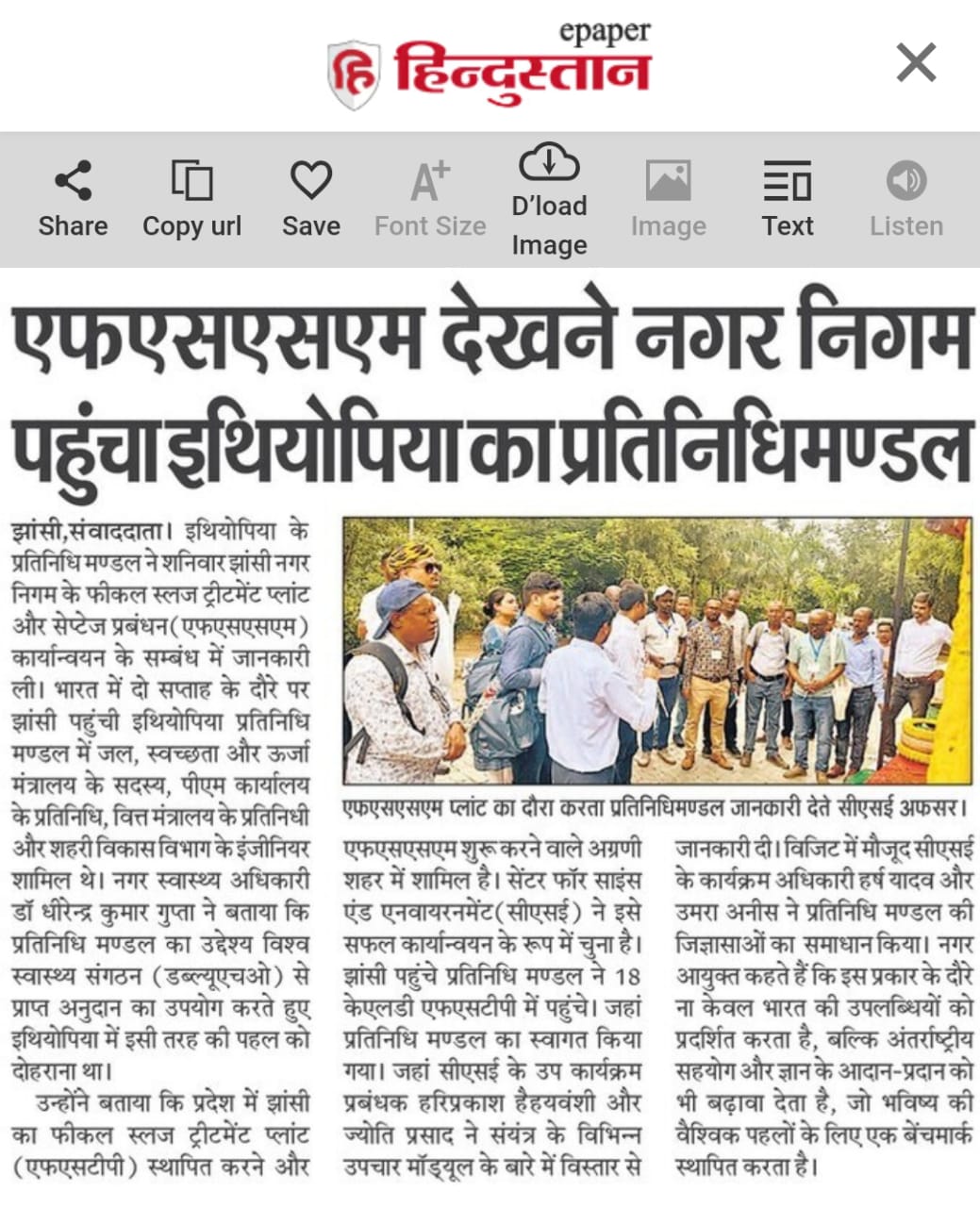
झांसी 27 जुलाई। फिकल स्लज ट्रीटमेंट प्लांट (एफटीपी) स्थापित करने के लिए और सलज और सेपटेज प्रबंधन (एफएसएसएम) शुरू करने में अग्रणी माने जाने वाले उत्तर प्रदेश के झांसी में शनिवार को इथियोपिया की प्रतिष्ठित टीम ने एक्स्पोज़र विजिट की। यह एक्सपोजर विजिट सेंटर फॉर साइंस एवं एनवायरमेंट ने शहरी विकास विभाग उत्तर प्रदेश सरकार और झांसी नगर निगम की सहायता से आयोजित की।इस टीम में इथियोपिया के जल स्वच्छता और ऊर्जा मंत्रालय के प्रतिनिधि और शहरी विकास विभाग के इंजीनियर शामिल थे। इस विजिट का उद्देश्य झांसी के एफटीपी प्लांट के बारे में जानकारी प्राप्त करके इथियोपिया में इस पहल को दोहराना था। इथियोपिया प्रतिनिधियों ने दिल्ली लखनऊ रायबरेली वाराणसी और चुनार के उन्नत जल अपशिष्ट जल और एफएसएसएम व्यवस्थाओं का भी पता लगाया। इथियोपिया की टीम इथियोपिया की टीम ने विजिट के बाद नगर के आयुक्त सत्य प्रकाश से मुलाकात की जिन्होंने उन्हें एफएसएसएम मॉडल लागू करने की चुनौतियों और सफलताओं के बारे में बताया इसके बाद विजिटिंग टीम ने नगर निगम द्वारा आयोजित झांसी के किले का दौरा किया और शाम को जल और प्रकाश शो का आनंद लिया जिसमें क्षेत्र की संस्कृति समृद्धि को दर्शाया गया। यह दौरा अंतरराष्ट्रीय सहयोग और ज्ञान के आदान-प्रदान को बढ़ावा देता है।

The Economic Survey, the Budget and more...

Should the EU face a historical polluter tax? The EU is on a mission to hit climate neutrality by 2050, and it's shaking things up with its Emissions Trading System (ETS) and the Carbon Border Adjustment Mechanism (CBAM). It's all about making big polluters pay. But this has created a new set of problems for countries like India. And an independent think tank, the Centre for Science and Environment (CSE) suggests that that countries like India, or particularly those that haven't historically contributed much to climate change, should, in turn, impose a "historical polluter tax" on these more affluent economies like the EU. If that makes you curious, find out what's happening in our Monday's newsletter. The Economic Survey 2024 Explained This week the Finance Minister Nirmala Sitharaman tabled the annual Economic Survey in the Lok Sabha. And this year’s survey has its fair share of interesting observations. So we had to write about it in our Tuesday's newsletter. You can read it here. The Budget 2024 explained In Wednesday's newsletter we covered the important highlights of the Budget that the Finance Minister rolled out this week. Didn't have the time to catch up on it? No problem! You can click here to catch up on the updates that matter most from this Budget. The escalating K-Pop crisis Kakao Corp's founder, Kim Beom-soo, was arrested this week for allegedly rigging stock prices in the K-pop industry, stirring up a major scandal. Kakao, a major player in South Korea's social media and entertainment scene, recently invested in SM Entertainment, a top K-pop agency. Now, Kim is accused of artificially boosting SM Entertainment's stock to fend off rival HYBE Corporation. And this controversy isn't just affecting Kakao's stock price, but could also worsen the already struggling K-pop market. What are we talking about. Head over to our Thursday's newsletter to find out. The great Indian Chinese conundrum India is at a crossroads, facing tough questions outlined in the latest Economic Survey. Can the country boost manufacturing without relying heavily on China? With the “Atmanirbhar Bharat” initiative pushing for self-reliance, India is trying to reduce its dependence on Chinese imports. But the reality is more complex. Is there a way to solve this problem, though? That's what we wrote about in Friday's newsletter. You can read it here.

After Intense Heat, Monsoons Add Torment of High Humidity for Indian Prisoners

The country has recorded an unprecedented number of 40,000 suspected cases of heatstroke with over 100 deaths between March 1 to June 18 as per statistics recorded by the National Centre for Disease Control, under India’s Union health ministry. Many parts of North and West India have been crippled by severe and intense heatwaves, peaking at nearly 50 degree Celsius. As per the Indian Metrological Department (IMD), heatwaves are periods of unusually high temperature compared to what is normally expected over a region. A heatwave is defined as a departure of 4.5 degree Celsius or more from a place’s ‘normal’ (based on historical records) temperature for two consecutive days. The criteria must be met in at least two stations in a meteorological sub-division. A heatwave is declared on the second consecutive day. As per an analysis of the temperature trends for India from January 2015 to May 2022 by Delhi-based environmental think tank Centre for Science and Environment (CSE), heatstrokes are the second most deadly force of nature in India. They have killed over 20,615 people in just two decades from 2000 to 2020. The country has recorded an unprecedented number of 40,000 suspected cases of heatstroke with over 100 deaths between March 1 to June 18 as per statistics recorded by the National Centre for Disease Control, under India’s Union health ministry. The National Crime Record Bureau (NCRB) records accidental deaths, including those from climatic stress, in its annual Accidental Deaths and Suicides in India. As per an analysis of the report by CSE, between 2015 and 2020, 2,137 people had reportedly died due to excess environmental heat. Another crucial aspect of the report is that dry heatwaves, as are being experienced currently, are less hazardous compared to humid heatwaves which could be experienced at the onset of monsoon. As per the analysis, high humidity can exponentially increase the public health risk posed by hot air temperatures. It even affects fit people acclimatised to work outside because it makes it difficult for the body to regulate temperature. It should be noted that the IMD does not account for the impact of relative humidity while computing heatwave conditions. The Leaflet spoke to Avikal Somvanshi, head of the Urban lab at CSE, which carried out the analysis. Somvanshi highlighted the “significant impact” of heat on indoor temperatures. Explaining his statement, he said that traditionally, buildings had thicker walls and were made of mud and stones, which meant that they could absorb more heat. Less heat was transferred indoors. In places where the temperature dropped at night, the absorbed heat would dissipate. Somvanshi added that the walls of buildings have become thin now and they are not even capable of storing heat for a day. He added that in places such as Delhi, the indoor temperature in the evening is probably much higher than the outdoor temperature. Indoor temperatures become more dangerous in such conditions, especially when accompanied with a lack of proper ventilation. Importantly, the CSE analysis states that there is a strong possibility that most of the deaths due to heat stress go unreported as such deaths may officially be attributed to other comorbidities. As public health expert Dileep Mavalankar has explained, “The first step is to analyse temperature and related it to the all-cause mortality data.” In other words, to have a better estimate of deaths due to heat waves, it is important to see if there has been a significant bump in the number of deaths during a heatwave and then analyse whether heat stress could be a factor in some of those deaths, even if the official cause of death is recorded as something else.

जौनपुर नगर पालिका परिषद में अमृत मित्र योजना के तहत महिलाओं को दिया गया फीकल स्लज ट्रीटमेंट प्लांट के ओ एंड एम का प्रशिक्षण

जौनपुर: जौनपुर नगर पालिका परिषद में अमृत मित्र योजना के तहत स्वयं सहायता समूह की महिलाओं को फीकल स्लज ट्रीटमेंट प्लांट के संचालन और रखरखाव के लिए प्रशिक्षण दिया गया। इस प्रशिक्षण कार्यक्रम में सुपरवाइजर अपर्णा साहू, माली रुकमीना, तथा सफाई मित्र प्रभावती और मंत्रा ने भाग लिया। नगर पालिका परिषद के अधिशासी अधिकारी पवन कुमार ने महिलाओं को प्रोत्साहित करते हुए उनके कार्यों की सराहना की। प्रशिक्षण में सेंटर फॉर साइंस एंड एनवायरमेंट (CSE) से कार्यक्रम अधिकारी अलका कुमारी ने महिलाओं को फीकल स्लज प्रबंधन के बारे में जानकारी दी, जिसमें सेनिटेशन वैल्यू चेन को आधार बनाया गया। महिलाओं को ऑपरेशन एवं मेंटेनेंस से संबंधित व्यक्तिगत सुरक्षा उपकरणों का उपयोग और प्लांट पर ध्यान रखने वाली बातों के बारे में भी बताया गया। CSE के कार्यक्रम अधिकारी और अभियंता मनीष मिश्रा ने शोधन संयंत्र के सभी घटकों के संचालन एवं मेंटेनेंस के बारे में तकनीकी जानकारी दी। प्रशिक्षण कार्यक्रम में नगर पालिका परिषद से सफाई एवं खाद्य निरीक्षक हरिश्चंद्र यादव, अवधेश कुमार, जलकल से अरविंद यादव, स्वच्छ भारत मिशन से खुशबू यादव, और अमृत योजना से यू आई एस घनश्याम मौजूद रहे। डूडा से सी एम एम जितेंद्र कुमार ने एस एच जी महिलाओं को व्यक्तिगत सुरक्षा के महत्व के बारे में जानकारी दी। प्रशिक्षण के उपरांत सी एस ई की टीम ने महिलाओं के साथ प्लांट भ्रमण भी किया। इस प्रशिक्षण कार्यक्रम का उद्देश्य महिलाओं को सशक्त बनाना और स्वच्छता एवं पर्यावरण संरक्षण में उनकी भूमिका को बढ़ावा देना है। इस पहल से जौनपुर नगर पालिका परिषद में स्वच्छता सेवाओं की गुणवत्ता में सुधार की उम्मीद है।