
Cse In News

India Faces Impact of EU's Carbon Border Tax With Potential Countermeasures

The European Union's Carbon Border Adjustment Mechanism (CBAM) will impose a 25% tax on carbon-intensive goods exported from India to the EU, according to a new report released on Wednesday. The report also recommends that India impose a counter-tax on wealthy countries historically responsible for climate change. CBAM targets energy-intensive products like iron, steel, cement, fertilizers, and aluminium imported from countries such as India and China. This additional tax would cost India approximately 0.05% of its GDP, as per the report titled 'The Global South's Response to a Changing Trade Regime in the Era of Climate Change' by the Centre for Science and Environment (CSE). The EU argues that CBAM ensures a level playing field for domestic products, which follow stricter environmental standards, while reducing emissions from imports. However, developing countries fear the economic stress and trade barriers this mechanism could create. The move has sparked debate at forums like UN climate conferences, where developing nations argue that such rules should not dictate emission reduction methods for other countries.
India to lose 0.05 pc of GDP due to CBAM should impose 'historical polluter tax' on EU Report

The European Union's Carbon Border Adjustment Mechanism (CBAM) will impose an additional 25 per cent tax on carbon-intensive goods exported from India to the EU, a new report said on Wednesday and recommended a counter-tax on rich countries historically responsible for climate change. CBAM is the EU's proposed tax on energy-intensive products, such as iron, steel, cement, fertilizers and aluminium imported from countries like India and China. This tax burden would represent 0.05 per cent of India's GDP, according to the report titled "The Global South's response to a changing trade regime in the era of climate change" by an independent think tank -- Centre for Science and Environment (CSE). These findings are based on data from the past three years (2021-22, 2022-23, and 2023-24). The tax is based on the carbon emissions generated during the production of these goods. The EU argues that this mechanism creates a level playing field for domestically manufactured goods, which must adhere to stricter environmental standards, and helps reduce emissions from imports. But other nations, particularly developing countries, are worried this would harm their economies and make it too expensive to trade with the bloc. The move has also sparked debate at multilateral forums, including UN climate conferences, with developing countries arguing that under UN climate change rules countries cannot dictate how others should reduce emissions. Trishant Dev, Programme Officer (Climate Change) at CSE, said that India's CBAM-covered goods exports to the EU accounted for 9.91 per cent of its total goods exports to the bloc in 2022-23. He said 26 per cent of India's aluminium and 28 per cent of its iron and steel exports were destined for the EU in 2022-23. These sectors dominate the basket of CBAM-covered goods shipped from India to the EU. In 2022-23, the exports of CBAM-covered goods to the EU made up about one-fourth (25.7 per cent) of India's total such goods exported globally, which is significant for the industries operating in these sectors. Currently, hydrogen and electricity are not exported from India to the EU. Of India's total goods exported worldwide, CBAM-covered goods exports to the EU constitute only about 1.64 per cent. The report recommended a counter-tax on rich countries historically responsible for climate change. Countries that have not historically contributed to the climate crisis may consider imposing a 'historical polluter tax' on trade partners to fund their own decarbonisation efforts, the report said. This tax could be levied on trade partners responsible for a significant share of cumulative historical carbon dioxide emissions since the pre-industrial period, Avantika Goswami, who leads CSE's climate change programme and the report's co-author, said. Historical trends indicate that carbon-intensive production has shifted from developed to developing countries, creating disparities in emissions intensity between nations. Today's differences in emissions intensity are also tied to historical emissions, as the Global North utilised fossil fuels like coal during the early stages of the Industrial Revolution which enabled it to amass wealth and grow its economies. The imposition of a CBAM overlooks this historical context and unfairly penalises the Global South. It is not retaliation, but rather a necessary course correction for the South to impose costs on the North for years of cheap polluting energy use, offshoring, and reliance on inexpensive offsets, Goswami said. The CSE report also recommended collecting a carbon tax domestically to avoid being taxed in Europe. Countries like India could institute their own carbon tax on exports of CBAM products destined for the EU or any country imposing a carbon border tax. Revenues generated from a domestic carbon tax could be directed into a government-managed fund to support the decarbonisation efforts of Indian industries. By collecting a carbon tax domestically, they said India can exert greater control over its mitigation strategies and achieve decarbonization more effectively.

Biogas innovators honoured at awards ceremony

The winners of this year’s Anaerobic Digestion and Biogas Industry awards were recently announced during the World Biogas Expo and Summit 2024 at Birmingham NEC. Winning the Health and Safety category was Marches Biogas with Dmr Cymru Welsh Water (DCWW) being highly commended. The Women in Biogas category, sponsored by Shell Energy, was won by Katrin Pütz at (B)energy with Alex Dragonetti, Christine Mapp, Deanna Martin, Helen Edwards and Mantopi Martina de Porres Lebofa highly commended. The AD Hero of the Year, sponsored by Future Biogas, went to Christopher Kellner, while Marches Biogas collected Best Anaerobic Digestion/Biogas Support. Winner of Net Zero Circular Solutions (sponsored by Hexagon Agility) was Madrid City Council’s AD Complex, the Centre for Science and Environment (CSE) collected the Education Campaign of the Year award for advancing CBG and biomethane projects, while Electrochaea’s Biomethanation Technology received the Research and Innovation award. Fylde Fresh and Fabulous AD facility was honoured for having the Best Biogas Plant Below 1MWe and Cocal Energia won the corresponding award for over 1MWe. O Biodigestor Sertanejo won the Micro AD Initiative and David Payne from Zebra EM was nominated AD Rising Star. AG Image for 355436015 The awards were co-organised by the Anaerobic Digestion and Bioresources Association (ADBA) in partnership with World Biogas Association (WBA). WBA Chief Executive Charlotte Morton OBE said each nominee has demonstrated pioneering advancements, operational excellence and a commitment to sustainability, setting new benchmarks in the biogas industry. “Their contributions underscore the dynamic progress and potential of AD and biogas technologies in addressing global energy and environmental challenges. This year’s shortlist not only reflects the industry’s current achievements but also its promising future,” she said. During the ceremony, host Chris Hines MBE, sustainability pioneer and co-founder of Surfers Against Sewage, spoke about his decades campaigning for sustainable wastewater management and praised the AD and biogas industry for creating sustainable solutions, supporting healthy rivers and seas. His message resonated strongly with fellow guest speaker and avid surfer Clark Dearson, the 11-year-old Child Prime Minister of the UK Children’s Parliament, who spoke passionately about his own love of the sea and “inspiring power” that AD and biogas solutions provide.

A paradoxical turn

Why are Europe’s young voters moving towards right-wing parties? I ask this because it is the young who are angry about inaction on climate change, and yet they are voting for parties that are most in denial of this action. Why this paradox? What does it mean for our increasingly warm and at-risk Planet? In the June 2024 European Parliament elections, voters under 30 years gave their support to what are termed far-right parties, like the Alternative Fur Deutschland (AfD) in Germany, National Rally in France, Vox in Spain, the Brothers of Italy, Enough in Portugal, Vlaams Belang in Belgium, Finns Party in Finland and others. In many instances, it was a swing from the green vote in the 2019 elections to the far-right vote in 2024. Does this mean that there is less appetite for climate action among the European youth? Or does it mean that other concerns like unemployment and migration are taking precedence? Or, is it because the youth in Europe believe that far-right parties will still stay the course on climate action? The fact is, Europe is equally impacted by extreme weather events. And its action is not on track to reduce emissions and limit the global temperature rise to the guardrail of 1.5 degrees Celsius above pre-industrial levels. So, the youth, who will inherit this increasingly warmer and catastrophic world are bound to be concerned—in fact, anguished and worried about their future. Climate change is no longer the exclusive domain of the green and left parties. But when you consider far-right parties’ positions on climate change, there is a clear shift in emphasis if not a downright denial. This suggests that there will be greater resistance against measures that are inconvenient and drastic—the kind that are necessary to bend the curve of Planet-destroying emissions. The Dutch Party for Freedom in its manifesto says it should be the people’s choice to eat meat, take a plane or drive a petrol or diesel car—not of the officials in Brussels (where the EU headquarters is located). It goes on to say that people are suffering because of high energy prices, suggesting a rollback on fossil fuel taxes. Other far-right parties have been vocal against the transition from combustion engines or the shift to renewable energy sources, even arguing that this is “unaffordable madness”. Then, there is the movement of European farmers against the use of pesticides or reduction in livestock or the emotive issue of meat consumption that is bringing these parties together. Already, the ambitious Green Deal has been weakened; policies that drive national industrial interests—not climate action—are gaining traction. So, the question is if the young voters will support tough actions on climate change or opt for the so-called win-win solutions—actions that do not impinge on the cost of living or price of fuel or take away choices on their preferred mode of travel. Sadly, hesitant answers are not going to work, given the sheer urgency of the climate crisis and the fact that rich countries, including Europe, have not reduced emissions at the needed scale and pace. What, then, does this mean for our warming world; for Europe’s leadership on climate action? There is another paradox in today’s Europe, one that is resonating across the old industrial world. It is argued that the young are worried about the prospect of immigrants taking over local jobs and culture. They are shifting to the right because these parties say they will stop immigrants from crossing over; they are openly racist in some cases; and they want to maintain the “white” cultural and religious identity of their countries. But the fact is, Europe cannot do without the immigrants that service its economy. It needs the labour that comes from the “other” world to harvest its crops, run its trains and factories, and clean its cities. The “World Migration Report 2024” finds that in 2020, some 87 million international migrants lived in Europe, an increase of 16 per cent over 2015. It says the many wars in our world are adding to this flight of human beings—by the end of 2022, the largest number of migrants into Europe were from war-torn Syria and Ukraine. Then there are the illegal migrants, whose numbers are difficult to estimate but have become evocative symbols of the hordes arriving to displace original inhabitants. The same report points out that slow-onset events because of climate change cause displacement, which is a greater contributor to the reasons people migrate. In other words, if Europe weakens its resolve to take climate action, it will increase the impoverishment of people already crippled by extreme events and losing ability to cope. Remember, this is not a conundrum faced only by Europe. In Donald Trump’s world—there is a prospect that he could win US’ November elections—climate action and immigration are favourite hate-targets. Our world is in trouble, in more than one way. The writer is the Director-General of CSE and editor of DownToEarth. Views expressed are personal

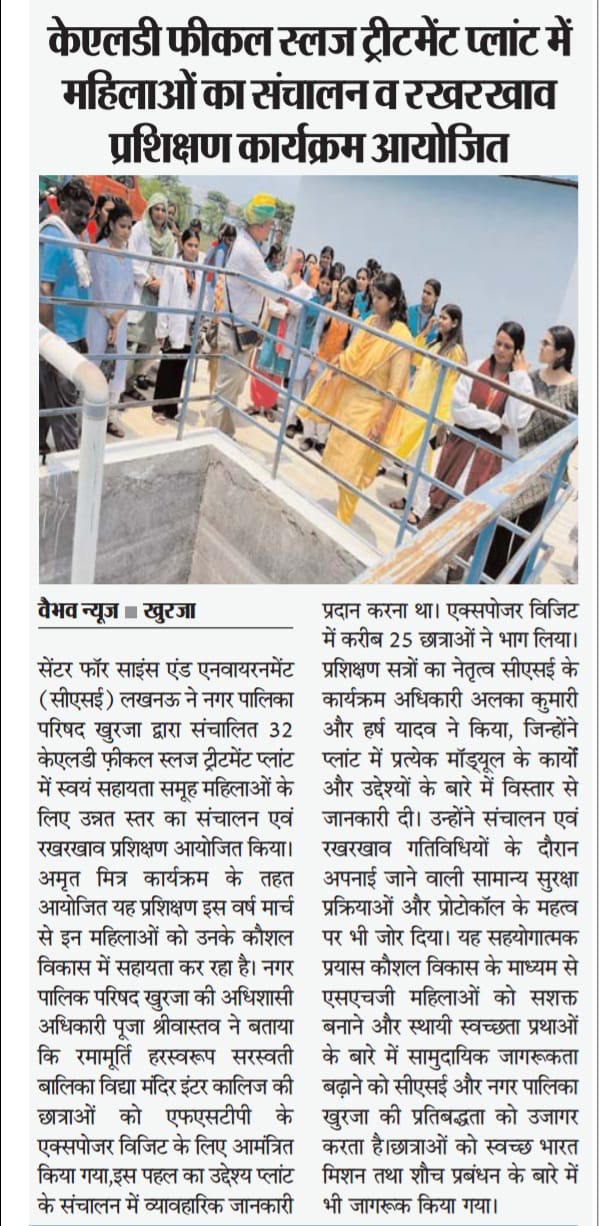
एफएसटीपी का संचालन शुरू, स्वयं सहायता समूह करेगा संचालित

स्वयं सहायत समूह की महिलाएं अब सेप्टिक टैंक सेनिकलनेवालेमलबेका निस्तारण कर खाद बनाएंगी एं । महिलाओं को सेंटर फॉर साइंस एवं एनवायरमेंट की टीम नेप्रशिक्षण दिया। प्रशिक्षण के बाद मंगलवार को महिलाओं नेविधिवत रूप सेकाम करना शुरू किया है।

Rejuvenated lakes & ponds drown irrigation worries, recharge groundwater

Pune: Some rejuvenated rainwater-dependent water bodies in the state have replenished groundwater, turning around peopleʼs lives, The centreʼs nationwide survey is documented in a book called ʻBack from the brink: Rejuvenating Indiaʼs lakes, ponds and tanks—A compendium of success storiesʼ. It looked at 250 lakes, ponds and tanks rejuvenated by central and state govt schemes to know what works so that the best features can become guidelines for future projects.The book was released on June 26.

Ahmedabad faces 85 days ofʻextreme cautionʼ heatin a year,finds study

A recent study by CSE shows Ahmedabad enduring 85 days of 'extreme caution' heat levels annually, the highest among major Indian cities. Rising temperatures and humidity levels pose a serious challenge to urban areas across India. The root cause lies in poorly planned development and vanishing green spaces, impacting public health and the urban poor Dwindling green spaces and expanding heat-trapping infrastructure has the city grappling with a new threat: Urban discomfort. A recent study revealed that Ahmedabad endures 85 days of ʻextreme cautionʼ heat levels annually, the highest among nine major Indian cities. This combination of heat and humidity, known as the ʻfeel-like temperatureʼ , is pushing Ahmedabad and other metropolises to the brink The study, by Centre for Science and Environment (CSE), which examined nine major Indian cities in 2023, paints a grim picture of rising temperatures and humidity Chennai faces 54 days of ʻdangerousʼ thermal discomfort, Kolkata and Bhubaneswar 41 days and Delhi faces 13 days. The research, spanning a decade, from 2014 to 2023, paints a grim picture of the escalating heat crisis in Delhi, Jaipur, Kolkata, Bhubaneswar, Nagpur, Pune, Ahmedabad, Hyderabad and Chennai. “Both temperatures and humidity are increasing across India. It is not just about heatwaves anymore, but the accompanying rise of humidity as well, ” warns Rajneesh Sareen, Mitashi Singh and Nimish Gupta of CSE, Delhi. The root cause of this urban heat crisis lies in poorly planned development and rapidly vanishing green spaces. The findings of the CSE study are stark: Five of the nine cities had over 80% of their area trapped in extreme heat for more than six of the 10 years studied. Nagpur tops the list with a staggering 97.79% of its area affected, followed closely by Ahmedabad (92.25%), Chennai (88.51%), Jaipur (79.23%)

Businesses crucial in supporting government efforts to mitigate climate change challenges

However, many forward-thinking companies are not waiting for regulations to catch up—they are already taking action. Globally, influential companies leverage opportunities by using renewable energy, deploying innovative low-carbon technologies, sustainably sourcing resources, and developing transformative solutions. These initiatives highlight the proactive steps businesses can take to address climate change. According to an assessment of the Solid Waste Management Ecosystem in Tanzania by the Swedish International Development Agency (SIDA) and the Centre for Science and Environment, industries and commercial areas contribute nearly 20 per cent of solid waste, second only to households, which contribute 75 per cent. The report shows that over 70 percent of this waste—including garden, wood, food, and ash—is biodegradable. This indicates a substantial opportunity for businesses to innovate and lead in the low-carbon transition, securing a sustainable future. Sustainable development and climate change are two sides of the same coin. Business is key in addressing climate change challenges as the world’s most powerful economic force, responsible for spending, wealth creation, and investment. Where businesses lead, others will follow. Innovative business initiatives are part of a global shift that unlocks large-scale opportunities to combat climate change and improve lives. In Tanzania, a quiet revolution is underway, demonstrating the potential for businesses to mitigate the effects of climate change. Despite its small contribution to global emissions, Tanzania has committed to robust climate change mitigation goals. For years, individual businesses have been embracing environmentally friendly technologies. Climate change poses a significant threat to living things, and human activities have induced rapid changes, leading to social challenges and significant environmental impacts. This shift has brought new expectations for organisations from governments, investors, and society. Tanzania has made notable efforts to promote sustainable practices such as the adoption of the United Nations Sustainable Development Goals (SDGs), which include tackling climate change, providing clean water and sanitation, supplying affordable and clean energy, and building sustainable cities and communities. For businesses, we are starting to see a shift whereby corporate success is now measured beyond financial performance and takes into consideration sustainability which tracks performance on economic, social and environmental (ESG) parameters. Businesses in Tanzania are launching initiatives to complement government efforts to mitigate the effects of climate change. Through the CEO Roundtable of Tanzania (CEOrt), businesses are working on cultivating sustainable practices by equipping leaders and stakeholders to adapt, mitigate, and transition to sustainable business operations. The CEOrt’s Business and Sustainability Agenda, funded by the International Union for Conservation of Nature (IUCN), achieves its goals through capacity building, driving awareness, partnership and collaboration, and knowledge-sharing. This agenda builds a business case showcasing how sustainable practices improve business performance. “Many businesses are still on the journey to understanding the risks posed by climate change and how these risks will impact their activities. We aim to bridge this information gap by utilising resources and expertise to organize knowledge-sharing sessions to enhance awareness and develop pathways towards becoming a sustainable business,” said Santina Benson, Executive Director of the CEOrt. The programme supports building capacity within member organisations through training and development sessions to enhance the technical skills and internal expertise needed for effective climate action measures. Under the CEOrt’s Business and Sustainability agenda, priority areas of focus will be on enhancing sustainable practices within Tanzanian businesses and supporting the government’s climate goal of reducing Nationally Determined Contributions (NDCs) from 10-20 per cent to 30-35 per cent by 2030. For several years, CEOrt members have recognised the importance of adopting practices that positively impact the environment and society. Devang Vussonji, Chairman of the Business and Sustainability Committee at the CEOrt, noted that climate change is among the factors affecting businesses. However, he also sees it as an opportunity for businesses to tap into areas such as the green economy. "Facilitating dialogues, developing policies, and creating guidelines are essential steps in transitioning to sustainable business practices. By partnering and collaborating with key stakeholders and experts, we can collectively contribute to the climate agenda and drive meaningful impact," Vussonji added. This collaborative effort between businesses and government highlights the critical role businesses can play in climate action, ensuring a sustainable future for Tanzania and beyond.

‘Climate politics began with equity and justice — we now face evasion, migration and wars’

Sunita Narain is director general of the Centre for Science and Environment (CSE). Speaking to Srijana Mitra Das at Times Evoke, she discusses the long ark of climate politics: What are some key turning points in the global trajectory of climate politics? ■ This discussion began in 1991. Global warming came onto the world stage as an issue when the UN Framework Convention on Climate Change was being negotiated. Right at the start, there was concern about what this meant in terms of development for the Global South. The first big flashpoint came when a report was published just before the 1992 Rio Conference when the Framework Convention was being negotiated. Until then, there was a lot of disquiet in developing nations about global warming but things were still simmering — suddenly, this report basically stated the developing world was a cause of climate change. It showed data about rising methane emissions and said if you took the contribution of the developing world, it matched that of countries like the United States. Therefore, it suggested, everyone had to act. Anil Agarwal and I then worked on a report titled ‘Global Warming in an Unequal World: A Case of Environmental Colonialism’. The real sleight of hand the earlier report had done was to allocate a share of the global commons based on the contribution of emissions. Human beings emit because of fossil fuel-driven growth but nature has its own assimilative capacity to clean up through carbon sinks like the oceans. That report was saying that if the United States emits, say, 10x, then it also gets a 10x share of global sinks. We argued this was completely wrong and global sinks had to be allocated on the basis of principles. We found reallocating these on the basis of per capita changed the entire calculation.

Interview: अचानक नहीं बढ़ी दिल्ली में गर्मी, पिछले चार दशक से हो रहा इजाफा, पर्यावरणविद् सुनीता नारायण ने दी बड़ी चेतावनी

आने वाले समय में और तेजी से बढ़ेगा जलवायु परिवर्तन का असर। ग्लोबल नहीं लोकल भी दिख रहा है जलवायु परिवर्तन का असर। जलवायु परिवर्तन की वजह से रात के तापमान में हो रहा इजाफा। देश-दुनिया से लेकर स्थानीय स्तर पर लोग इन दिनों चरम पर मौसमी घटनाओं को करीब से महसूस कर रहे हैं। जलवायु परिवर्तन के कारण यह बदलाव जब हमारे-आपके जीवन को सीधे प्रभावित करने लगा है, तो 1980 के दौर में, यानी 44 साल पहले पर्यावरण बचाने व जलवायु परिवर्तन की बात करने वाली एक लड़की का चेहरा याद आता है। यह चेहरा देश के उन गिने-चुने पर्यावरणविदों में शामिल था, जो वैश्विक स्तर पर इस मुद्दे को लेकर जागरूकता फैलाने की कोशिश कर रहे थे। इस लंबी अवधि में उन्होंने पर्यावरण बचाव की अपनी मुहिम को न कभी धीमा पड़ने दिया, न ही कभी अपने तथ्य-कथ्य से पीछे हटीं। वह आज भी कहती हैं आने वाले समय में और तेजी से बढ़ेगा जलवायु परिवर्तन का असर। सचेत होने की जरूरत है। केंद्र सरकार और दिल्ली को आपसी लड़ाई बंद कर कागजी एक्शन प्लान बनाने के बजाय मैदानी स्तर पर काम करना चाहिए। यह हैं सेंटर फॉर साइंस एंड एन्वायरमेंट (सीएसई) की महानिदेशक व पद्मश्री से सम्मानित पर्यावरणविद् सुनीता नारायण। मौसम की चुनौतियों से कैसे निपटा जाए, भविष्य को लेकर क्या प्लानिंग की जाए, इन्हीं बिंदुओं पर दिल्ली राज्य ब्यूरो के प्रमुख संवाददाता संजीव गुप्ता ने उनसे बातचीत की। प्रस्तुत है प्रमुख अंशः सवाल: भारत विश्व की तीसरी अर्थव्यवस्था बनने जा रहा है, लेकिन इसकी राजधानी दिल्ली एक दिन की वर्षा भी नहीं झेल पाती। क्या कहेंगी इस पर? जवाब: निश्चित तौर पर यह एक चिंताजनक पहलू है। हर साल मानसून के दौरान दिल्ली की ऐसी ही तस्वीर देखने को मिलती है, लेकिन न कोई पुख्ता एक्शन प्लान बन पाता है और न ही पूर्व वर्षों की पुनरावृत्ति रोकने की दिशा में कुछ ठोस उपाय किए जाते हैं। इस बार भी यही देखने को मिला। न यमुना की गाद निकाली जाती है, न समय पर नाले साफ होते हैं और न जलभराव रोकने की तैयारी होती है। दिल्ली और केंद्र सरकार आपस में लड़ती रहती हैं तो पिसती इन सबमें जनता है। सवाल: दिल्ली सरकार का कहना है कि मानसून के पहले ही दिन रिकॉर्ड वर्षा हो गई, इसीलिए ऐसी स्थिति बनी? सवाल: समर एक्शन प्लान इस बार बहुत देरी से बना। हीट एक्शन प्लान कागजी रह गया है और क्लाइमेट एक्शन प्लान तो बना ही नहीं है। इस पर क्या कहेंगी? जवाब: समर एक्शन प्लान आधा-अधूरा है। यह वायु प्रदूषण के तात्कालिक कारणों का शमन करने के लिए, भविष्य के लिए नहीं। केवल धूल विरोधी अभियान सीधे वायु गुणवत्ता में सुधार को लक्षित करता है। बहुत से कार्य बिंदु जैसे ठोस अपशिष्ट प्रबंधन, हरित आवरण बढ़ाना और खुले में जलने से रोकना, पहले से ही राष्ट्रीय स्वच्छ वायु कार्यक्रम (एनसीएपी) के अभिन्न अंग हैं और मौसमी क्रियान्वयन के लिए नई रणनीतियां नहीं, बल्कि चल रही प्रथाएं होनी चाहिए। वृक्षारोपण और नगर वनों के विकास जैसी पहल, पर्यावरण की दृष्टि से प्रभावी होते हुए भी तत्काल वायु गुणवत्ता में सुधार नहीं लाती है। इसके चलते दीर्घकालिक पर्यावरणीय लक्ष्यों पर फोकस करना चाहिए। सवाल: क्या हीट एक्शन प्लान कागजी साबित हो रहा है? जवाब: बिल्कुल। दिल्ली आपदा प्रबंधन प्राधिकरण (डीडीएमए) द्वारा तैयार यह प्लान अभी भी एक कागजी दस्तावेज ही है। मई-जून में भयंकर लू में भी दिल्ली वासियों को राहत देने के लिए कहीं कोई कदम नहीं उठाए गए। यहां तक कि एलजी ने इस प्लान के आधार पर श्रमिकों को दोपहर 12 से तीन बजे तक ब्रेक देने के आदेश का भी ज्यादातर जगहों पर पालन नहीं ही हुआ। हीट एक्शन प्लान बनाने से पहले न इसके प्रभाव का आकलन किया गया, न कोई अलर्ट सिस्टम विकसित हुआ। हॉटस्पॉट में मुंगेशपुर का नाम तक शामिल नहीं और प्लान के लिए फंड का भी प्रविधान नहीं है। सवाल: इस साल गर्मी कुछ ज्यादा ही नहीं पड़ी? आप इसके पीछे क्या वजह मानती हैं? जवाब: बिल्कुल पड़ी है, लेकिन राजधानी में गर्मी इसी साल एकाएक नहीं बढ़ी है, बल्कि पिछले चार दशकों के दौरान इसमें निरंतर इजाफा हो रहा है। जलवायु परिवर्तन के चलते मौसम तेजी से बदल रहा है। तापमान ही नहीं, वातावरण में मौजूद नमी में भी तेजी से इजाफा हो रहा है। जलवायु परिवर्तन ने शहर को पहले के मुकाबले कहीं ज्यादा गर्म और नम बना दिया है। इसीलिए दिल्ली में गर्मी के सीजन में बदलाव का अनुभव हो रहा है। दरअसल, पिछले चार देशों में दिल्ली में कंक्रीट का जंगल भी बढ़ा है, जो अर्बन हीट आइलैंड प्रभाव में भी इजाफा कर रहा है। सन 2000 के बाद दिल्ली में तेजी से विकास कार्य हुए हैं। निर्माण कार्यों में इजाफा हुआ। खाली पड़ी जमीन पर फ्लैटों का निर्माण हुआ है तो हरित क्षेत्र बढ़ाने के नाम पर भी झाड़ियां ज्यादा लगाई गईं, वृक्ष कम। सार्वजनिक परिवहन सेवा बेहतर न होने के कारण सड़कों पर वाहनों की संख्या भी काफी बढ़ गई है। शोधकर्ताओं के मुताबिक इसी के चलते शहर की खुद को ठंडा कर पाने की क्षमता में 12 से 21 प्रतिशत की कमी आई है। सवाल: क्या घर की बनावट और शहर की डिजाइनिंग में बदलाव भी इस स्थिति में फायदेमंद है? जवाब: शहर की भौगोलिक स्थिति और स्थानीय मौसम को भी ध्यान में रखना जरूरी है। खिड़कियों को ओपन स्पेस की तरफ बनाना चाहिए। बिल्डिंग को इस तरह से डिजाइन किया जाना जाए कि अधिक से अधिक फ्लैटों को ओपन स्पेस की तरफ खिड़कियां मिलें। खिड़कियों के साइज भी कमरों के साइज के हिसाब से तय करने होंगे, ताकि कमरों के अंदर की हवा ताजी हवा से बदल सके। सवाल: दिन तो दिन, अब रातों का तापमान भी तेजी से बढ़ रहा है, क्यों? जवाब: इसमें भी जलवायु परिवर्तन की बड़ी भूमिका है, क्योंकि वैश्विक तापमान में लगातार वृद्धि के चलते हवा का तापमान भी बढ़ा है, जिसका दिन और रात के तापमान पर असर पड़ा है। साफ आसमान से रात ठंडी होने का रास्ता भी साफ होता है, लेकिन प्रदूषण में बढ़ोत्तरी या आसमान में बदली छा जाने के कारण लांग वेव रेडिएशन के रूप में धरती द्वारा निकाली जा रही ऊर्जा बादलों और भूतल के बीच फंस जाती है, जिससे तापमान में और भी वृद्धि होती है। सवाल: आपको नहीं लगता कि मानसून की वर्षा का पैटर्न बदल गया है और मौसम चक्र भी धीरे-धीरे बदल रहा है? जवाब: जलवायु परिवर्तन का असर तेजी से देखने को मिल रहा है। मानसून का पैटर्न भी इसीलिए बदल रहा है। एनसीआर सहित देश भर में लंबे समय से मानसून के मौसम में वर्षा वाले दिनों की संख्या घट रही है। कुछ ही दिनों में रुक-रुक कर भारी से अत्यंत भारी वर्षा हो जाती है। यह पैटर्न बीते कुछ वर्षों से लगातार मजबूत हो रहा है। ग्लोबल वार्मिंग के कारण हवा में नमी अब अधिक रहने लगी है। महासागर भी गर्म है। दक्षिण -पश्चिम मानसून अपने साथ अतिरिक्त नमी ला रहा है। एक अन्य अहम पहलू यह कि बढ़ते तापमान के साथ, हवा में नमी धारण करने की क्षमता भी बढ़ जाती है। चूंकि गर्म हवा लंबे समय तक नमी को धारण नहीं रख सकती, ऐसे में जब भी वर्षा होती है तो सारी नमी कुछ घंटों या कुछ दिनों के अंतराल में बरस जाती है। यही वजह है कि इतने कम समय में इतनी भारी बरसात हो रही है। सवाल: क्या भविष्य में इन सबमें कमी की उम्मीद की जा सकती है या फिर इसमें और इजाफा होगा? जवाब: जलवायु विसंगतियों के प्रभाव से प्रतिकूल मौसम की ऐसी परिस्थितियां बढ़ ही रही हैं। हम इसका व्यापक असर दिल्ली में भी देख रहे हैं। जैसे-जैसे जलवायु परिवर्तन और तीव्र होगा, बाढ़, लू और चक्रवात जैसी चरम घटनाएं और गंभीर हो जाएंगी। इन घटनाओं से बढ़ते जोखिमों से निपटने के लिए तत्काल जलवायु कार्रवाई, अनुकूलन उपाय और वैश्विक ग्रीनहाउस गैस कटौती पर सहयोग आवश्यक है। सवाल: ऐसे में बिना पुख्ता प्लानिंग के तो वर्षा का जल भी बर्बाद होता जाएगा। क्या करना चाहिए? जवाब: मानसून के पैटर्न में बदलाव को देखते हुए ज्यादा से ज्यादा तालाब और झील विकसित करने चाहिए। इससे दिल्ली और बेंगलुरु जैसे जल संकट वाले शहरों में वर्षा जल संचयन हो सकेगा और वर्षा का पानी नाली और सड़कों पर बहने से भी बचेगा। जलवायु-परिवर्तन के इस दौर में अच्छी वर्षा तो होगी, लेकिन कम दिनों में। इसका मतलब है कि बाढ़ का प्रबंधन करने की क्षमता महत्वपूर्ण होगी। लंबे समय तक सूखे का सामना भी करना पड़ेगा। यह वही है जो आप आज दिल्ली में देख रहे हैं, जिसका मतलब यह कि जल आपूर्ति प्रणाली को ठीक करना होगा। इस बारे में सोचें कि वर्षा कहां और कब होती है, इसके पानी को कैसे बचाएं। वर्षा जल संचयन पर वापस जाएं। हमें जल निकायों, झीलों, टैंकों और पोखरों की कला को फिर से सीखने की जरूरत है। खासकर आज के जलवायु परिवर्तन के समय में। हमें स्थानीय जल प्रणालियों में निवेश करने के लिए अपने काम को बढ़ाने की जरूरत है, ताकि बारिश की हर बूंद को इकट्ठा किया जा सके। हमें अपनी झीलों और पोखरों को पुनर्जीवित करने की जरूरत है। इसी तरह से जल पुनर्भरण बढ़ेगा। सवाल: क्या कारण है कि देश और दिल्ली में वायु प्रदूषण बढ़ता ही जा रहा है? जवाब: ऐसा नहीं कहा जा सकता कि वायु प्रदूषण बढ़ता ही जा रहा है। पहले से कम भी हुआ है। बढ़ वहीं रहा है जहां ईमानदारी से काम नहीं किया जा रहा। समस्या क्या है कि प्रदूषण समाप्त करने के लिए शब्द और चिट्ठियां नहीं, बल्कि सख्ती चाहिए। मसलन, ग्रेडेड रिस्पांस एक्शन प्लान (ग्रेप) एक अस्थायी व्यवस्था है। सर्दियों में जब मौसमी वजह से प्रदूषण बहुत अधिक हो जाता है तो उस पर नियंत्रण की प्रक्रिया है, लेकिन अगर उस दौरान स्कूल बंद करने की नौबत आती है तो साल भर ऐसे उपाय करने चाहिए, जिससे कि दोबारा वह हालात नहीं बनें। सवाल: क्या प्रदूषण बढ़ने में भी मौसम की भूमिका है? जवाब: वायु प्रदूषण का स्तर वर्ष भर बढ़ा हुआ रहने के लिए दो प्रमुख कारण हैं। बिगड़ती मौसम की स्थिति, जो मानव नियंत्रण से परे है और संकट से निपटने की धीमी रफ्तार। इस सर्दी में दिल्ली सहित उत्तर-पश्चिम भारत में वर्षा नहीं हुई। वर्षा की कमी पश्चिमी विक्षोभ को प्रभावित करने वाले आर्कटिक जेट स्ट्रीम में बदलाव के कारण है, जो अधिक अनियमित हो रही है और उत्तर की ओर बढ़ रही है। इसके कारण पहाड़ों पर कम बर्फबारी हुई और दिल्ली में कम बारिश हुई, जिसके परिणामस्वरूप प्रदूषण का स्तर बढ़ गया। दूसरी बात 2021 तक की गई सभी कार्रवाइयों के बाद, हम उस गति से कार्रवाई नहीं कर रहे हैं जो संकट से निपटने के लिए आवश्यक है। दिल्ली में बस बेड़े का आखिरी बड़ा विस्तार मुख्यमंत्री शीला दीक्षित के कार्यकाल के दौरान राष्ट्रमंडल खेलों के आसपास हुआ था। तब से, कई बसों को प्रतिस्थापित नहीं किया गया है, जिससे बस सवारियों में गिरावट आई है। बस प्रणाली को प्रभावी बनाने के लिए मेट्रो सिस्टम और पार्किंग सुविधाओं के साथ एकीकृत करने की आवश्यकता है। सवाल: आंकड़ों की बाजीगरी छोड़ दें तो क्या वाकई दिल्ली की स्थिति में सुधार कहा जा सकता है? जवाब: हां, बिल्कुल, सुधार नजर आता है। सर्दी छोड़कर बाकी के दिनों में प्रदूषण कम हो रहा है। संतोषजनक और मध्यम श्रेणी के दिनों की संख्या बढ़ रही है, गंभीर और बहुत खराब श्रेणी वाले दिन घट रहे हैं। अब अगर मौसमी कारणों से एक्यूआइ बढ़ता है तो उसमें वाकई कुछ नहीं किया जा सकता, लेकिन हमें अपनी प्लानिंग इसी तरह बनानी चाहिए कि प्रतिकूल मौसम में हालात अनुकूल ही बने रहें। सवाल: आपको क्या लगता है कि राज्य और केंद्र सरकार वायु प्रदूषण की रोकथाम के लिए वाकई गंभीर हैं? जवाब: बिल्कुल, राज्य और केंद्र सरकार प्रदूषण की रोकथाम के लिए आज गंभीर तो हैं, इसमें कोई शक नहीं। इसी के तहत ई वाहनों पर फोकस किया जा रहा है और पराली प्रबंधन पर भी लगातार काम हो रहा है। सवाल: आपके हिसाब से क्या करना चाहिए प्रदूषण की रोकथाम के लिए? जवाब: प्रयास हो रहे हैं, लेकिन उन्हें लगातार करने की जरूरत है। प्रदूषण बढ़ने पर ही नहीं, प्रदूषण न बढ़े, इसके लिए भी कदम उठाए जाने चाहिए। प्रदूषण के स्रोत पता करने के लिए अध्ययन करने या कराने की बात कहना भी बहानेबाजी है। स्रोत सभी का पता हैं, इसमें कोई विज्ञान नहीं है। सार्वजनिक परिवहन को विश्वसनीय बनाना होगा। पराली का समाधान इसे राजनीतिक मुददा बनाए बगैर करना होगा। इसके अलावा राजनीतिक दलों को वायु प्रदूषण का मुददा भी अपने एजेंडे में शामिल करना चाहिए।

India: Extreme weather fuels migration-related challenges

Faced with extreme weather events, people living in parts of India are "losing the ability to cope" and are forced to flee their homes, experts warn. Weather-related disasters such as extreme heat, droughts and massive flooding are increasing in frequency and intensity in India. While the suffering they cause is immense and wide-reaching, it usually vulnerable, impoverished communities that suffer the most. A study conducted by the Centre for Science and Environment (CSE), a New Delhi-based public interest research and advocacy organization, tracked extreme weather events that occurred in India last year and found that the country, overall, experienced such events on 314 out of the 365 days. The CSE said 2,923 people died, almost two million hectares of crops were ruined, 80,000 homes were destroyed, and more than 92,000 animals were killed. But these numbers could be even higher because the data was not complete, according to the organization. The environmental crisis is also causing displacement and forcing people to migrate to already overcrowded megacities, Sunita Narain, head of the CSE, told DW. She said human-induced climate change is impoverishing farmers and others in the agricultural sector. "With increasing frequency of extreme weather events, people are losing the ability to cope and have no alternative but to migrate. The challenge is for all countries, particularly the rich, to take climate change targets seriously," Narain stressed.

India’s Humidity Is Dangerously High, And Increasing

50°C (122°F) is a staggeringly high temperature. Yet Avikal Somvanshi can just about live with 50°C heat in Delhi (where a dedicated heatstroke clinic opened in May amidst a brutal heatwave). What Somvanshi can’t handle is increased humidity, when “Delhi turns into a sauna.” “You can’t really do anything,” he says. “You just have to sit in front of a fan and wait for it to pass.” However, media attention peaks not with the highest humidity, in July and August, but with the highest temperatures, in May and June. This is a grave mistake, warns Somvanshi, who leads the Urban Lab at the Centre for Science and Environment (CSE), a Delhi-based research organization. When people are somewhat acclimatized to very high temperatures already, “going to 50 is more of a psychological shock” than a physiological one, Somvanshi believes. But “the humidity shock to the body is very intense.” Yet humidity remains under-researched and under-appreciated. This is a troubling gap, given that humid heat is more dangerous than dry heat.