
Cse In News

भारत के हर दूसरे घर में पहुंच गई है कोल्ड ड्रिंक, हाल ही में आई रिपोर्ट में आए चौंकाने वाले आंकड़े

क्या आप भी गर्मी में कोल्ड ड्रिंक पीने के शौकीन हैं? तो यह रिपोर्ट आपको जरूर पढ़नी चाहिए। हाल ही में आई एक रिपोर्ट के मुताबिक पिछले 2 साल में सॉफ्ट ड्रिंक्स की खपत लगभग 50% तक बढ़ गई है। रिपोर्ट की मानें तो पिछले 2 साल में पैकेज्ड सॉफ्ट ड्रिंक्स की खपत में 250 मिलीलीटर की औसत बढ़ोत्तरी हुई है। कांतार FMCG पल्स की रिपोर्ट की मानें तो इस बढ़ती गर्मी में इस खपत के और भी बढ़ने की संभावना है। जानलेवा है कोल्ड ड्रिंक्स का अधिक इस्तेमाल ‘सेंटर फॉर साइंस एंड एनवायरमेंट’ द्वारा जारी एक एक शोध के आंकड़ों के अनुसार दुनिया भर में 1,84,000 मौत का कारण कोल्ड ड्रिंक बन रही है। क्योंकि कोल्ड ड्रिंक में शुगर में भरपूर मात्रा पाई जाती है, जो लोगों को डायबिटीज का शिकार बना रही है। वहीं डायबिटीज के कारण लगभग 1,33,000 लोग हर साल मौत का शिकार हो रहे हैं।
पुराने जलस्रोत फिर पानीदार हो रहे: सी एस ई

भारत के जल निकायों में बदलाव आ रहा है: कई जलाशय जो पिछले कुछ वर्षों में बुरी तरह प्रदूषित या अतिक्रमणग्रस्त थे या सूख गए थे, अब पुनर्जीवित और कायाकल्प हो रहे हैं, और ऐसा सरकारी योजनाओं के साथ-साथ निजी और सामुदायिक पहलों की बदौलत हो रहा है - सेंटर फॉर साइंस एंड एनवायरनमेंट (सीएसई) के शोधकर्ताओं द्वारा किए गए एक नए राष्ट्रव्यापी सर्वेक्षण में यह बात सामने आई है। सर्वेक्षण के निष्कर्षों को 'बैक फ्रॉम द ब्रिंक: रिजुवेनेटिंग इंडियाज लेक्स, पोंड्स एंड टैंक्स - ए कम्पेंडियम ऑफ सक्सेस स्टोरीज' नामक पुस्तक में संकलित किया गया है, जिसे आज यहां एक राष्ट्रीय संगोष्ठी में जारी किया गया। कार्यक्रम में बोलते हुए, सीएसई की महानिदेशक सुनीता नारायण ने कहा: “हमें जल निकायों, झीलों, टैंकों और पोखरों की कला को फिर से सीखने की जरूरत है। यह हमारे लिए एक अवसर है - हम भारत की जल कहानी को बदल सकते हैं, खासकर आज के जलवायु परिवर्तन के समय में; सीएसई की यह पुस्तक हमें यही बताती है। लेकिन अभी भी बहुत कुछ किया जाना बाकी है। हमें स्थानीय जल प्रणालियों में निवेश करने के लिए अपने काम को बढ़ाने की जरूरत है ताकि बारिश की हर बूंद को इकट्ठा किया जा सके ताकि हम सूखे के खिलाफ स्थानीय लचीलापन बना सकें। हमारे शहरों में, हमें अपनी झीलों और पोखरों को पुनर्जीवित करने की जरूरत है, जो स्पंज हैं जो हमें बारिश-बाढ़ को इकट्ठा करने और यह सुनिश्चित करने की अनुमति देंगे कि यह पानी बर्बाद न हो। हमें अपने जंगलों और हरे भरे स्थानों की रक्षा करने की जरूरत है क्योंकि इसी तरह से जल पुनर्भरण बढ़ेगा।” नारायण ने कहा कि "जल संकट के इस समय में यह सुनिश्चित करना भी महत्वपूर्ण है कि अपशिष्ट जल - सीवेज - का न केवल उपचार किया जाए, बल्कि इसे रीसाइकिल करके पुनः उपयोग किया जाए। यहीं पर हमारे शहरों में संरक्षित जल निकाय, वही तालाब और टैंक जिनका उपयोग हम वर्षा जल को मोड़ने और संचय करने के लिए करते हैं, उनका उपयोग उपचारित सीवेज को चैनलाइज़ करने और बदले में भूजल को रिचार्ज करने के लिए किया जा सकता है।" सीएसई सर्वेक्षण : सीएसई की टीम ने लगभग एक वर्ष की अवधि में भारत के चार अलग-अलग पारिस्थितिक क्षेत्रों में 22 राज्य स्तरीय कार्यक्रमों और पांच केंद्रीय योजनाओं के तहत बनाए गए और/या बहाल किए गए 250 जलाशयों की समीक्षा की: सिंधु-गंगा के मैदान, रेगिस्तान, तटीय मैदान और दक्कन का पठार। जिन योजनाओं और कार्यक्रमों को शामिल किया गया है, उनमें मिशन अमृत सरोवर, अमृत 2.0, दिल्ली में झीलों का शहर परियोजना और तमिलनाडु की अनाइथु ग्राम अन्ना मरुमलार्ची थिट्टम ​​(एजीएएमटी) योजना शामिल हैं। समीक्षा किए गए 250 जलाशयों में से लगभग 140 सबसे अच्छे मामले थे। सीएसई के जल कार्यक्रम के कार्यक्रम निदेशक दीपिंदर एस कपूर ने कहा: "पिछले साल प्रकाशित देश की पहली जल संसाधन जनगणना के अनुसार भारत में 2,424,540 जल निकाय हैं। इनमें से 97 प्रतिशत से ज़्यादा ग्रामीण इलाकों में स्थित हैं। ये जल निकाय, उनके जलग्रहण क्षेत्र और उनके फीडर चैनल महत्वपूर्ण भूजल पुनर्भरण क्षेत्रों के रूप में कार्य करते हैं, बाढ़ को नियंत्रित करते हैं और अद्वितीय जैव विविधता का घर हैं।" उन्होंने आगे कहा: "सीएसई सर्वेक्षण और उसके परिणामस्वरूप प्रकाशित - केस स्टडीज़ का हमारा संग्रह - इन जलाशयों में से उन झीलों, तालाबों और टैंकों पर केंद्रित है जिनका उपयोग समुदायों द्वारा किया जाता है। यह एक दस्तावेज है, इन जलाशयों के सफल पुनरुद्धार का उत्सव है - कि क्या काम किया है, क्या नहीं किया है, और क्या और किया जा सकता है।" सीएसई के जल कार्यक्रम की वरिष्ठ कार्यक्रम प्रबंधक और बैक फ्रॉम द ब्रिंक की मुख्य लेखिका सुष्मिता सेनगुप्ता ने कहा: "हमने पाया है कि राजनीतिक और नौकरशाही-प्रशासनिक इच्छाशक्ति के साथ-साथ सामुदायिक भागीदारी ने जलाशयों के सफल पुनरुद्धार में महत्वपूर्ण भूमिका निभाई है। कुछ बेहतरीन बहाली कार्य वहीं हुए हैं, जहां जिला कलेक्टरों या स्थानीय राजनीतिक नेताओं ने विशेष रुचि दिखाई है।" उन्होंने कहा कि"कार्यक्रमों और योजनाओं में से, मिशन अमृत सरोवर ने निश्चित रूप से स्थिति को बदल दिया है, जबकि राज्य स्तरीय परियोजनाओं ने भी महत्वपूर्ण भूमिका निभाई है। गिरावट को रोकने के लिए एक शुरुआत की गई है - लेकिन गति को बनाए रखने की आवश्यकता है। सीएसई सर्वेक्षण और हमारे प्रकाशन ने भी ऐसा करने के लिए सिफारिशों का एक सेट प्रस्तावित किया है।" आगे का रास्ता क्या है? जल निकायों में प्रवेश करने से पहले अपशिष्ट जल का उपचार करें: ज़्यादातर मामलों में झीलें और जलाशय अनुपचारित अपशिष्ट जल और सीवेज के लिए पात्र बन गए हैं। इसका समाधान अपशिष्ट जल को जल निकायों में प्रवेश करने से पहले उपचारित करना और इस तरह से ट्रैक करना है कि कोई मलजल जल निकायों में न जाए। कपूर कहते हैं: " अटल मिशन फॉर रिजुवेनेशन एंड अर्बन ट्रांसफॉर्मेशन (AMRUT) 2.0 में जल निकायों के कायाकल्प के साथ-साथ अपशिष्ट जल के पुनर्चक्रण और पुनः उपयोग का प्रावधान है। इस मिशन के तहत निधियों का उपयोग सभी राज्यों द्वारा जल निकायों को बहाल करने के लिए प्रभावी ढंग से किया जा सकता है।" हर जल निकाय को समग्र रूप से देखें : जल निकाय, जलग्रहण क्षेत्र और उसके पोषक चैनलों को पुनर्जीवन के लिए एक साथ उपचारित किया जाना चाहिए। जलग्रहण क्षेत्र, जल निकाय और पोषक चैनलों की वास्तविक सीमाओं का मानचित्रण किया जाना चाहिए। क्षेत्रीय और स्थानीय स्तर पर जलभृत मानचित्रण से भूजल स्तर को बढ़ाने और बाढ़ को कम करने के लिए वैज्ञानिक बहाली सुनिश्चित करने की आवश्यकताओं को समझने में मदद मिलेगी। डेटाबेस बनाएं, जलाशयों की पहचान करें: भारत में शहर या जिला स्तर के प्रशासन को शायद ही कभी पता हो कि उनके पास कितने जलाशय हैं। शहर अक्सर अतिक्रमण और गाद से भरे जलाशयों को सूची से बाहर कर देते हैं। जलाशयों के जीर्णोद्धार की योजना बनाने के लिए, प्रत्येक राज्य के लिए अपनी सीमाओं के भीतर झीलों और जलाशयों की कुल संख्या की पहचान करना, रिकॉर्ड करना और संकलित करना अनिवार्य होना चाहिए। प्रौद्योगिकियों की एक सूची विकसित करें: इसे अपशिष्ट जल के उपचार और जल निकायों में प्रदूषण के उपशमन के लिए उपलब्ध कराया जाना चाहिए। रखरखाव और निगरानी सुनिश्चित करें : उदाहरण के लिए, 15 वें वित्त आयोग (एफएफसी) के तहत एमजीएनआरईजीएस फंड और वित्त का उपयोग पुनरुद्धार परियोजनाओं की स्थिरता सुनिश्चित करने के लिए किया जा सकता है। सेनगुप्ता कहते हैं: "ग्राम पंचायतें तालाबों के रखरखाव के लिए एफएफसी फंड का एक हिस्सा इस्तेमाल कर सकती हैं। किसी भी कायाकल्प या जीर्णोद्धार परियोजना की स्थिरता के लिए, रखरखाव और निगरानी को परियोजना का एक अभिन्न अंग बनाया जाना चाहिए - फंडिंग का एक हिस्सा केवल इसके लिए ही रोका जाना चाहिए।" सीएसई संगोष्ठी में कई लोग एकत्रित हुए - जल निकाय प्रबंधक, परियोजना प्रस्तावक, आरंभकर्ता और चालक - जो भारत के जल निकायों को पुनर्जीवित करने के इस मिशन में सबसे आगे रहे हैं। चर्चाओं का समापन करते हुए नारायण ने कहा: "हमें झीलों को जल सुरक्षा के एक प्रमुख स्रोत के रूप में एक बार फिर से देखना चाहिए, साथ ही बाढ़ शमन और सूखे प्रबंधन के लिए भी। यदि हमारे सीवेज का प्रबंधन नहीं किया जाता है तो झीलों को बचाया नहीं जा सकता है - इसलिए, सीवेज प्रबंधन प्रणाली का पुनर्निर्माण आवश्यक है, खासकर जब शहरी जल निकायों की बात आती है। हमें जमीनी स्तर पर उन अनुभवों से सीखने की ज़रूरत है जहाँ कार्यक्रम और योजनाएँ काम कर रही हैं, और कैसे और क्यों। हमें सीखना चाहिए क्योंकि जलवायु परिवर्तन के इस युग में अधिक बारिश होगी - लेकिन अगर हम बारिश का संचयन नहीं करते हैं तो बाढ़ और सूखे भी अधिक होगा।

जौनपुर में 32 केएलडी फीकल स्लज ट्री टमेंट प्लांट का निरीक्षण और महत्वपूर्ण बैठक संपन्न

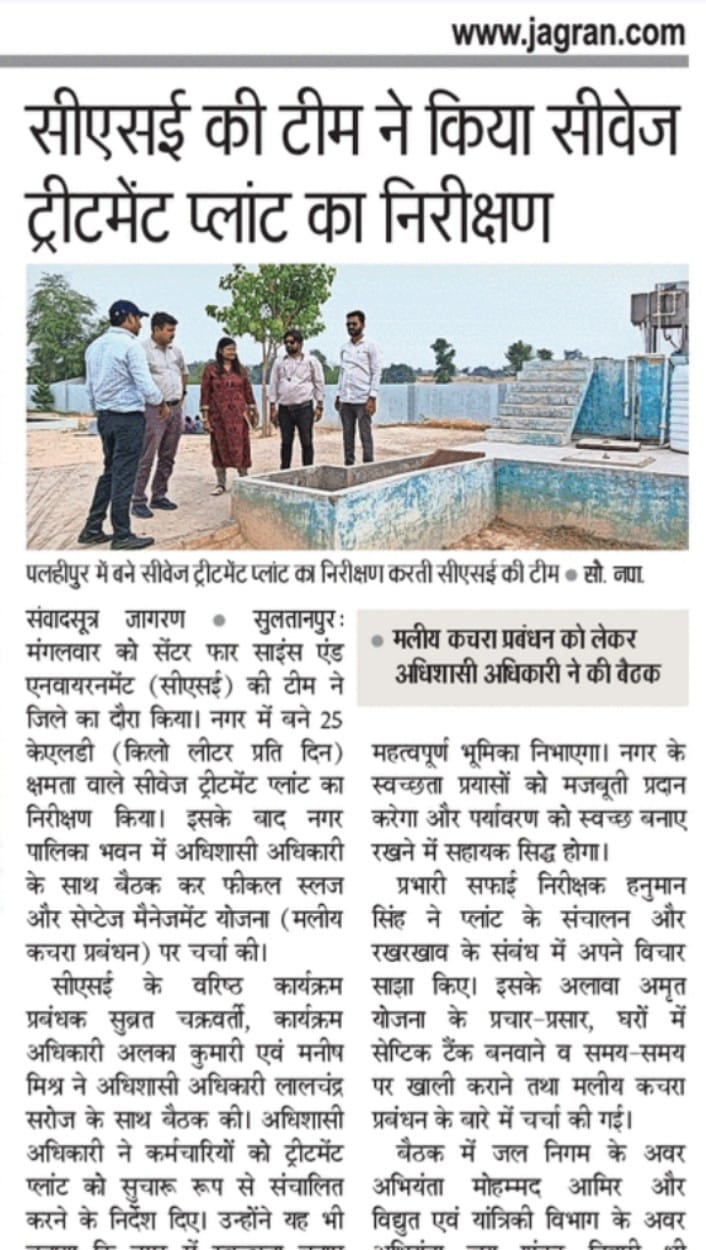
जौनपुर, 26 जून 2024: सेंटर फॉर साइंस एंड एनवायरमेंट के कार्यक्रम अधिकारी ईo मनीष मिश्रा ,अलका कुमारी , वरिष्ठ कार्यक्रम प्रबंधक सुब्रत चक्रवर्ती ने 26 जून 2024 को जौनपुर जिले का दौरा किया। इस दौरे का उद्देश्य 32 केएलडी (किलो लीटर प्रति दिन) क्षमता वाले फीकल स्लज ट्री टमेंट प्लांट का निरीक्षण और नगर पालिका में एफएसएसएम (फीकल स्लज और सेप्टेज मैनेजमेंट) योजनाओं पर चर्चा करना था। इस प्लांट का रखरखाव अमृत मित्र योजना के अंतर्गत महिलाओं द्वारा किया जा रहा है, जिनका आंकलन अलका कुमारी ने प्लांट विजिट के दौरान किया। जौनपुर नगर पालिका परिषद में आयोजित बैठक में निम्नलिखित बिंदुओं पर चर्चा और मार्गदर्शन दिया गया: 1. एफएसएसएम बाईलॉज जो की बोर्ड बैठक में स्वीकृत किया जा चुका है उसे समाचार पत्र में प्रकाशित करने के उपरांत गजट हेतु प्रेषित किया जाए 2. संस्थागत शेड्यूल डीस्लजिंग प्लान की तैयारी। 3. सभी निजी सेप्टिक टैंक डीस्लजिंग ऑपरेटरों के पंजीकरण पर चर्चा और निर्देश दिए। 4. सभी जनमानस को अपने घरों के सेप्टिक टैंक को प्रत्येक 3 वर्ष में खाली करने के संबंध में चर्चा। 5. अमृत योजना के अंतर्गत जन जागरूकता अभियान चलाने के लिए रणनीति बनाई गई। बैठक में जौनपुर नगर पालिका परिषद के अधिशासी अधिकारी पवन कुमार ने अपने स्टाफ को फीकल स्लज ट्री टमेंट प्लांट को सुचारू रूप से संचालित करने के निर्देश दिए। उन्होंनेन्हों नेयह भी बताया कि नगर में स्वच्छता बनाए रखने के लिए यह प्लांट एक महत्वपूर्ण भूमिका निभाएगा। जलकल के अवर अभियंता रागिनी मौर्या, सफाई एवं खाद्य निरीक्षक अवधेश कुमार, यूआईएस घनश्याम, डीपीएम एसबीएम खुशबू,डूडा सीएमएम जितेंद्र तथा अरविंद सिंह (एसबीएम) ने भी अपने विचार साझा किए और प्लांट के संचालन और रखरखाव के संबंध में महत्वपूर्ण सुझाव दिए। इस बैठक में उठाए गए कदम नगर के स्वच्छता और स्वास्थ्य में सुधार की दिशा में महत्वपूर्ण साबित होंगेहों गे। यह फीकल स्लज ट्री टमेंट प्लांट जौनपुर नगर के स्वच्छता प्रयासों को मजबूती प्रदान करेगा और पर्यावरण को स्वच्छ बनाए रखने में सहायक सिद्ध होगा।

Uttar Pradesh leads the nation in compressed biogas potential, but challenges persist: say experts at CSE-UPNEDA joint symposium

New Delhi-based think tank Centre for Science and Environment (CSE) and the Uttar Pradesh New and Renewable Energy Development Agency (UPNEDA) jointly organise a symposium in Muzaffarnagar to discuss the challenges facing the compressed biogas (CBG) industry in the state, and the way ahead Uttar Pradesh accounts for 24 per cent of the total compressed biogas (CBG) generation potential in India. According to CSE’s latest report, UP alone can install 1,000 CBG projects out of the 5,000 plants envisioned nationwide under the Sustainable Alternative Towards Affordable Transportation (SATAT) scheme, if a mere 20 per cent of its surplus feedstock is tapped Western UP (especially Muzaffarnagar, Meerut, Saharanpur, Bijnor, Bulandshahar and Aligarh) leads in feedstock availability as well as maximum number of functional and upcoming CBG plants in the state Despite leading the way in bioenergy sector in India, UP faces several challenges — from limited offtake of the bioslurry generated during production of CBG, to lack of trained personnel See CSE’s report on CBG in Uttar Pradesh: https://www.cseindia.org/compressed-biogas-landscape-in-uttar-pradesh-12120 For the symposium proceedings, please visit: https://www.cseindia.org/compressed-biogas-cbg-the-case-of-western-uttar-pradesh-12216 Muzaffarnagar (Uttar Pradesh), June 22, 2024:“Compressed biogas (CBG) offers a multitude of benefits for India: it can help enhance waste management, promote local clean energy solutions, and bring down our dependence on imported compressed natural gas (CNG). And Uttar Pradesh – especially its western districts of Muzaffarnagar, Meerut, Saharanpur, Bijnor, Bulandshahar and Aligarh — leads the nation in the potential to generate compressed biogas: it accounts for a sizable 24 per cent of the country’s total potential”: said researchers from New Delhi-based think tank Centre for Science and Environment (CSE) here today. They were speaking at a one-day symposium on CBG in western Uttar Pradesh; the symposium was jointly organised by CSE and the Uttar Pradesh New and Renewable Energy Development Agency (UPNEDA). Compressed biogas is made from various feedstocks, including municipal solid waste, agricultural waste, press-mud, and animal wastes. It is a purified version of biogas, and is also referred to as bio-CNG. Over 90 per cent of CBG, which is produced from anaerobic digestion from organic waste or biomass, constitutes of methane. Speaking at the symposium, Nivit Kumar Yadav, programme director, industrial pollution, CSE said: “Among Indian states, Uttar Pradesh has taken the lead in this sector with its ambitious bioenergy policy, allocating Rs 750 crore (2022-27) for CBG, while providing subsidies, land for lease and other incentives. This symposium has been organised to discuss the challenges faced by CBG producers, share successful practices, highlight opportunities for start-ups, raise awareness among district-level bioenergy committees, and educate farmer-producer bodies on the potential of bioenergy.” Echoing Yadav’s comments on the state government’s strides in the sector, Pankaj Singh, secretary/CPO, UPNEDA, said: “Uttar Pradesh has the most advanced bioenergy policy in India and leads in the number of upcoming CBG projects. Of the 128 CBG projects, 15 are operational, while the remaining 113 are in various stages of construction.” What are the challenges faced by the sector Limited offtake of by-products/bioslurry/fermented organic manure (FOM): CBG plants generate bioslurry, which can be a used as a fertiliser. However, there are no takers for the bioslurry produced by CBG plants. Says Dr Rahul Jain, deputy programme manager, renewable energy, CSE and the author of CSE’s report on CBG: “Instead of being considered a potential revenue source, bioslurry is perceived as a disposal challenge. Plant owners are either providing it for free to nearby farmers or disposing of it on vacant lands. There is a lack of awareness about the characteristics of bioslurry, appropriate application methods and potential benefits.” Partial gas offtake by oil and gas marketing companies: These companies acquire gas from CBG plants on a ‘best-endeavour’ basis, depending on market demand. This exposes plant owners to the risk of being unable to sell their entire gas production. Some plants are operating below their capacity because they cannot fully offload their gas. The absence of CNG gas pipelines near plant locations is another challenge faced by these facilities. It has been noted that gas transport through cascades is a viable option for plants with capacities below 5 tonne per day (TPD); for anything above this threshold, the most effective offtake model is through gas pipelines. Shortage of skilled technical humanpower: Operational challenges frequently confront functioning plants, resulting in issues like gas leakage, inefficiency and operating below optimal capacity. This arises from a lack of skilled personnel who have adequate understanding of biogas production systems and plant operations. Financing issues: Banks rarely show any interest in financing CBG projects – their concerns revolve around risks, low margins and the non-standardised nature of the industry. Banks commonly require high collateral as a standard practice, and interest rates start at a minimum of 11.5 per cent. Moreover, lending institutions lack the capacity to evaluate CBG proposals, which hampers the decision-making process. Jain points out:“Due to the lack of proper planning on both the upstream and downstream sides, most CBG plants are running below their actual designed capacity. On the upstream side, the plants are not able to source enough quantity of feedstock to run the plant. It is advisable to plan for the availability of surplus feedstock over and above the amount required in the plant annually. This requires plant operators to work with the suppliers (farmers, sugarcane mill owners and city municipalities) to get the feedstock. On the downstream side, the sale of gas is a big challenge due to the low CNG infrastructure presence near the CBG plant. It is critical to set up the plant either near CNG gas grids or where there is a high CNG demand for industrial or transport applications.” What CSE recommends Involve the farmers as shareholders: Encourage farmer-producer organisations through awareness campaigns to assume the role of feedstock aggregators, replacing third-party private entities. This ensures their active participation as project partners, fostering overall profit sharing in bioenergy projects. Ensure complete gas offtake by gas marketing companies: To achieve this, a strategic plan should be formulated to expand gas pipeline infrastructure near CBG plant locations. To stimulate demand in rural regions, introduce incentives for conversion of tractors and two-wheelers to run on CNG, or advocate the adoption of CNG-powered agricultural machinery. Incentivise/sensitise farmers to use bioslurry/FOM: Farmers should be made aware about the potential benefits of using carbon-rich FOM. The possibility of institutionalising incentive programmes for farmers for utilisation of FOM can be explored. To amplify awareness among farmers about the positive effects of FOM, Krishi Vigyan Kendras (KVKs) can play a pivotal role in education and outreach efforts. Address the challenges in bank loan procurement: Says Yadav: “A practical approach here would be to initiate a government-backed guarantee programme to mitigate collateral requirements, thereby encouraging financial institutions to extend loans more readily.” To enhance transparency and efficiency in the loan application process, the Reserve Bank of India (RBI) should oversee and monitor CBG project applications through a centralised online portal, implementing fixed deadlines for streamlined progress tracking. Establish CBG training centres: There is a need to train people to operate the CBG projects. The training centres shall be set up with short-term CBG courses to prepare skilled personnel. Broaden the feedstock variety: Jain says that “while 80 per cent of CBG plants currently rely on pressmud, there is a need to diversify the sources.” In addition to solid organic waste, efforts should be directed towards utilising liquid effluents such as spent wash from distilleries, industrial discharges from paper and pulp manufacturing, and other liquid industrial waste. Appreciating CSE’s inputs,Pankaj Singh, UPNEDA said: “All identified challenges and policy recommendations are noted and will be addressed through effective policy modifications and additions by our department.”

Uttar Pradesh Leads India in Compressed Biogas Production

Uttar Pradesh is a big player in India’s renewable energy market, especially when it comes to making compressed biogas (CBG). The Center for Science and Environment (CSE) released an important report that showed Uttar Pradesh could create 24% of India’s CBG. This was revealed at a symposium in Muzaffarnagar put together by CSE and the Uttar Pradesh New and Renewable Energy Development Agency (UPNEDA). The meeting was about improving waste management, finding local clean energy solutions, and lowering reliance on compressed natural gas (CNG) imports. Strategic Importance of Western Uttar Pradesh Western Uttar Pradesh, including towns like Muzaffarnagar, Meerut, and Saharanpur, is a key area for making CBG because it has a lot of feedstock. Most of the state’s current and future CBG plants are in this area. Uttar Pradesh could probably complete 1,000 of the 5,000 CBG projects planned across the country under the Sustainable Alternative Towards Affordable Transportation scheme with just a fifth of the extra fuel it has on hand. State’s Bioenergy Policy and Support Uttar Pradesh is a leader with its ambitious bioenergy policy. It calls for funding of Rs. 750 crore for CBG projects from 2022 to 2027, along with subsidies and leasing choices. The policy aims to help CBG producers deal with common problems, improve good practices, open up new business possibilities, and teach local groups about the advantages of bioenergy. Challenges Hindering CBG Adoption Even though the outlook is positive, the CBG sector faces many problems: Bioslurry Management: Bioslurry disposal is hard because it is often seen as trash instead of a useful by-product. There needs to be education about how useful it is as organic waste. Inconsistent Gas Offtake: CBG plants often use only some of their available gas because oil and gas companies don’t always buy it and there aren’t any close CNG pipelines. Skilled Personnel Shortage: The world needs highly trained people to run biogas systems, so specialized training centers should be set up. Financial Barriers: Banks are unwilling to lend money to CBG projects because they see them as risky. The government might have to back the projects with guarantees to get banks to lend money. Solutions and Strategic Measures To lessen these problems, changes to policies are being thought about. Some of the ideas being considered are using a variety of feedstocks to make the process more sustainable and making farmers partners in local bioenergy projects so that they directly benefit from them. Getting help from the government and making the payment system more clear are also important steps forward.

Weather: भारत जलवायु के मुद्दे पर और बड़ी भूमिका निभा सकता है, 2028 में COP की मेजबानी करे’, सुनीता नारायण बोलीं

सेंटर फॉर साइंस एंड एनवायरमेंट (सीएसई) की महानिदेशक नारायण ने कहा कि जलवायु परिवर्तन पर संयुक्त राष्ट्र रूपरेखा संधि के तहत पार्टियों का सम्मेलन एकमात्र ऐसा मंच है, जहां जलवायु परिवर्तन से पैदा हुईं चुनौतियों से निपटने के लिए बहुपक्षीय निर्णय लिए जा सकते हैं। हमारे सामने चुनौतियां हैं उन्होंने कहा, ‘दक्षिण के देशों के लिए खड़े होने वाले देश के रूप में हम और भी बड़ी भूमिका निभा सकते हैं। हमारे सामने चुनौतियां हैं। हम अपनी चुनौतियों के बारे में बात कर सकते हैं, उन्हें दबा नहीं सकते। हम दुनिया को आगे बढ़ने का बेहतर रास्ता खोजने में मदद कर सकते हैं। हम नेतृत्व की भूमिका निभा सकते हैं। पीएम मोदी ने दुबई में पार्टियों के सम्मेलन (सीओपी-28) में अपने संबोधन में 2028 में भारत में जलवायु सम्मेलन की मेजबानी करने की पेशकश की थी। सीओपी की अध्यक्षता बारी-बारी से सभी देश करेंगे। भारत के लिए अगला अवसर 2028 में होगा, जब एशिया को अपनी बारी मिलेगी। उस समूह के सभी देशों को मोदी की दावेदारी पर सर्वसम्मति से सहमत होना होगा, तभी इसकी पुष्टि होगी। हमें सीओपी की मेजबानी करनी चाहिए नारायण ने कहा कि हमें सीओपी की मेजबानी करनी चाहिए और बिल्कुल हमें बात करनी चाहिए। देखिए, जलवायु परिवर्तन दुनिया की एक बड़ी समस्या है। इसका द्विपक्षीय स्तर पर समाधान नहीं किया जा सकता है। यह एक बहुपक्षीय मुद्दा है। उन्होंने आगे कहा कि जलवायु परिवर्तन समाजवाद को पुनः सीखने का एक तरीका है, क्योंकि यह एक साझा वातावरण के बारे में है, जहां देशों को एक साथ रहना सीखना होगा, चाहे वे इसे पसंद करें या नहीं।

UP leads in compressed biogas potential, but challenges persist

“Compressed biogas (CBG) offers a multitude of benefits for India: it can help enhance waste management, promote local clean energy solutions, and bring down our dependence on imported compressed natural gas (CNG). And Uttar Pradesh – especially its western districts of Muzaffarnagar, Meerut, Saharanpur, Bijnor, Bulandshahar and Aligarh — leads the nation in the potential to generate compressed biogas: it accounts for a sizable 24 per cent of the country’s total potential”: said researchers from New Delhi-based think tank Centre for Science and Environment (CSE) in Muzaffarnagar. They were speaking at a one-day symposium on CBG in western Uttar Pradesh; the symposium was jointly organised by CSE and the Uttar Pradesh New and Renewable Energy Development Agency (UPNEDA). Compressed biogas is made from various feedstocks, including municipal solid waste, agricultural waste, press-mud, and animal wastes. It is a purified version of biogas, and is also referred to as bio-CNG. Over 90 per cent of CBG, which is produced from anaerobic digestion from organic waste or biomass, constitutes of methane. Speaking at the symposium, Nivit Kumar Yadav, programme director, industrial pollution, CSE said: “Among Indian states, Uttar Pradesh has taken the lead in this sector with its ambitious bioenergy policy, allocating Rs 750 crore (2022-27) for CBG, while providing subsidies, land for lease and other incentives. This symposium has been organised to discuss the challenges faced by CBG producers, share successful practices, highlight opportunities for start-ups, raise awareness among district-level bioenergy committees, and educate farmer-producer bodies on the potential of bioenergy.” Echoing Yadav’s comments on the state government’s strides in the sector, Pankaj Singh, secretary/CPO, UPNEDA, said: “Uttar Pradesh has the most advanced bioenergy policy in India and leads in the number of upcoming CBG projects. Of the 128 CBG projects, 15 are operational, while the remaining 113 are in various stages of construction.”

Delhi Minister Stages Hunger Strike for More Water to City Amid Extreme Heat

A Delhi city minister has started an indefinite hunger strike to demand more drinking water for India's capital, where taps in some of its poorest neighbourhoods are running nearly dry in the middle of searing heat. "There are 2.8 million people in the city who are aching for just a drop of water," Delhi Water Minister Atishi said on Monday, the fourth day of her fast. Millions of Indians face water shortages every summer when water demand rises in farms, offices and homes against a limited supply, but a prolonged heatwave this year has worsened the shortfall, including in Delhi and the southern tech hub of Bengaluru. Delhi, a city of 20 million people, is one of the world's most densely populated capitals, where upscale neighbourhoods and manicured lawns are just a few miles away from unplanned working-class areas and slums. But, in contrast to growing unplanned development over the years, the city's water allocation from rivers has remained unchanged since 1994, said Depinder Kapur, the director of water programme at think tank Centre for Science and Environment. "What was true 10-15 years ago is not true anymore. So, there is a situation of crisis and it's a distribution issue," he said.

Uttar Pradesh leads the nation in compressed biogas potential, but challenges persist: say experts at CSE-UPNEDA joint symposium

“Compressed biogas (CBG) offers a multitude of benefits for India: it can help enhance waste management, promote local clean energy solutions, and bring down our dependence on imported compressed natural gas (CNG). And Uttar Pradesh – especially its western districts of Muzaffarnagar, Meerut, Saharanpur, Bijnor, Bulandshahar and Aligarh — leads the nation in the potential to generate compressed biogas: it accounts for a sizable 24 per cent of the country’s total potential”: said researchers from New Delhi-based think tank Centre for Science and Environment (CSE) here today. They were speaking at a one-day symposium on CBG in western Uttar Pradesh; the symposium was jointly organised by CSE and the Uttar Pradesh New and Renewable Energy Development Agency (UPNEDA). Compressed biogas is made from various feedstocks, including municipal solid waste, agricultural waste, press-mud, and animal wastes. It is a purified version of biogas, and is also referred to as bio-CNG. Over 90 per cent of CBG, which is produced from anaerobic digestion from organic waste or biomass, constitutes of methane. Speaking at the symposium, Nivit Kumar Yadav, programme director, industrial pollution, CSE said: “Among Indian states, Uttar Pradesh has taken the lead in this sector with its ambitious bioenergy policy, allocating Rs 750 crore (2022-27) for CBG, while providing subsidies, land for lease and other incentives. This symposium has been organised to discuss the challenges faced by CBG producers, share successful practices, highlight opportunities for start-ups, raise awareness among district-level bioenergy committees, and educate farmer-producer bodies on the potential of bioenergy.” Echoing Yadav’s comments on the state government’s strides in the sector, Pankaj Singh, secretary/CPO, UPNEDA, said: “Uttar Pradesh has the most advanced bioenergy policy in India and leads in the number of upcoming CBG projects. Of the 128 CBG projects, 15 are operational, while the remaining 113 are in various stages of construction.” What are the challenges faced by the sector Limited offtake of by-products/bioslurry/fermented organic manure (FOM): CBG plants generate bioslurry, which can be a used as a fertiliser. However, there are no takers for the bioslurry produced by CBG plants. Says Dr Rahul Jain, deputy programme manager, renewable energy, CSE and the author of CSE’s report on CBG: “Instead of being considered a potential revenue source, bioslurry is perceived as a disposal challenge. Plant owners are either providing it for free to nearby farmers or disposing of it on vacant lands. There is a lack of awareness about the characteristics of bioslurry, appropriate application methods and potential benefits.”

https://english.jagran.com/india/water-crisis-hits-indian-cities-60-crore-indians-facing-water-scarcity-situation-likely-to-worsen-10169218

Delhi is in a dire situation due to the ongoing water crisis. The situation has deteriorated to the extent that long queues for water tankers are seen in many areas of Delhi, including Kusumpur Pahadi, Okhla, Sangam Vihar and Vivekananda Camp, while NDMC has managed to supply water once in VIP areas.The IT hub of India, Bengaluru, is currently facing a daily shortfall of 200 million litres of water. A report by the Centre for Science and Environment suggests that an estimated 484.2 billion cubic metres, equivalnet to 48.42 billion one-litre water bottles, are wasted every day. Sunita Narain, Director of the Centre for Science and Environment and an environmentalist, says that the water crisis emerging in Bengaluru this year should be a matter of concern for the entire country. Our cities will remain livable only when even the poorest resident has access to clean drinking water. Bengaluru received adequate rainfall, and it has lakes that can collect this rainwater and recharge the groundwater. These lakes also prevent flooding during heavy rains. Every drop of water in cities can be used for the future.

Delhi minister stages hunger strike for more water to city amid extreme heat

A Delhi city minister has started an indefinite hunger strike to demand more drinking water for India’s capital, where taps in some of its poorest neighbourhoods are running nearly dry in the middle of searing heat. “There are 2.8 million people in the city who are aching for just a drop of water,” Delhi Water Minister Atishi said on Monday, the fourth day of her fast. Millions of Indians face water shortages every summer when water demand rises in farms, offices and homes against a limited supply, but a prolonged heatwave this year has worsened the shortfall, including in Delhi and the southern tech hub of Bengaluru. Atishi blamed the neighbouring farming state of Haryana for guzzling up a large share of river water. Haryana’s government responded that it was Delhi’s mismanagement that was causing water shortages. Experts said a federal-level review of decades-old water sharing pacts was needed to accommodate population growth. Delhi, a city of 20 million people, is one of the world’s most densely populated capitals, where upscale neighbourhoods and manicured lawns are just a few miles away from unplanned working-class areas and slums. But, in contrast to growing unplanned development over the years, the city’s water allocation from rivers has remained unchanged since 1994, said Depinder Kapur, the director of water programme at think tank Centre for Science and Environment. “What was true 10-15 years ago is not true anymore. So, there is a situation of crisis and it’s a distribution issue,” he said.

Excessive heat: Delhi minister on hunger strike to demand water for city

A Delhi municipal minister has declared an indefinite hunger strike to demand more drinking water for India's capital, where taps in some of the poorest neighbourhoods are virtually dry in the sweltering heat, according to Reuters. "There are 2.8 million people in the city who are aching for just a drop of water," Delhi Water Minister Atishi stated on Monday, the fourth day of her fast. Every summer, millions of Indians confront water shortages as demand grows in fields, businesses, and homes against a limited supply, but this year's protracted heatwave has exacerbated the problem, particularly in Delhi and the southern tech powerhouse of Bengaluru. The majority of Delhi's water needs are met by the Yamuna River, which slows down during the dry summer months, generating shortages that spark demonstrations and requests for increased water conservation. Atishi criticized the nearby farming state of Haryana for consuming a considerable amount of river water. Delhi, a city of 20 million people, is one of the world's most densely inhabited capitals, with posh suburbs and groomed lawns only a few miles apart from unmanaged working-class areas and slums. However, despite increasing unplanned construction, the city's river water allocation has stayed constant since 1994, according to Depinder Kapur, director of the water programme at the think tank Centre for Science and Environment. "What was true 10 or 15 years ago is no longer true. So, there is a dilemma, and it is a distribution issue," he explained.

Delhi Water Woes: Minister On Hunger Strike Against Haryana

A Delhi city minister has started an indefinite hunger strike to demand more drinking water for India’s capital, where taps in some of its poorest neighborhoods are running nearly dry in the middle of searing heat. “There are 2.8 million people in the city who are aching for just a drop of water,” Delhi Water Minister Atishi said on June 24, the fourth day of her fast. Millions of Indians face water shortages every summer when water demand rises in farms, offices and homes against a limited supply, but a prolonged heatwave this year has worsened the shortfall, including in Delhi and Bengaluru. Delhi relies on the Yamuna River that runs through the capital for most of its water needs but the river slows down during dry summer months, causing shortages that lead to protests and calls for better water conservation. Atishi blamed the neighboring farming state of Haryana for guzzling up a large share of river water. Delhi, a city of 20 million people, is one of the world’s most densely populated. The city’s water allocation from rivers has remained unchanged since 1994, said Depinder Kapur, the director of the water program at the think tank Centre for Science and Environment. The Delhi government is working on plans to improve the groundwater table by reviving lakes and storing water overflow from the Yamuna during the seasonal monsoon rains, but officials say the summer shortfall is difficult to tackle by these measures alone. The politics surrounding the current situation has exacerbated the crisis.

Are solar rooftop installations in India and Pakistan an answer to the climate crisis?

Delhi, India In India, Delhi's state government announced a New Solar Policy 2024 in January 2024. It gives consumers installing solar rooftops a subsidy of INR10,000 (USD 119). All sectors residential, commercial or industrial, also get production-based incentive of up to INR 3/kWh. This is in addition to the 40% subsidy already provided by the central government for up to 3 kW and a 20 percent subsidy for 4-10 kW. The new solar policy mandates all government buildings with areas of 500 square metres or larger to install solar panels in the next three years. It also promotes community-based solar systems – residents of multi-story buildings can jointly install rooftop solar and save money. “But not all the families in the building are ready for this,” said retired teacher Omprakash Raikwar and his wife, pensioners who live on the second floor of a five-story building in Delhi's Badarpur area. In its 2016 policy, Delhi's state government had set a target of achieving 1000 MW of electricity from solar rooftops by the year 2020. However, it met only 230 MW of this target by the end of 2023. The state government’s welfare scheme gives 200 units of electricity in Delhi free in the electricity bill – two out of five families in this building say their monthly expenditure is already low. They say it will take longer for them to recover the cost of installing solar energy. Even after the free 200 units, the price of electricity is higher in areas around Delhi. In Faridabad, Haryana, after using 250 units of electricity, consumers pay INR 6.5 per unit. The cost in Delhi is only INR 4.5 per unit. Economics, rather than the environment, become the deciding factor. Delhi has several private discoms. or distribution companies,  that are responsible for distributing electricity to consumers. The companies buy electricity from producers and then sell it to consumers. This makes net metering more time consuming compared to other cities, says Nishi Chandra, marketing head of Loom Solar, a manufacturer of solar panels and lithium batteries based in Faridabad, Haryana. “On top of that, electricity is already cheaper in Delhi due to government subsidies, so the demand for domestic rooftop solar installation is also less,” Chandra told Sapan News. The higher upfront cost for domestic consumers, delayed disbursement of rooftop solar subsidies, and the Discoms’ loss of revenue with the rise of solar consumers in the city are the main hurdles in popularising solar power, says Binit Das, deputy program manager renewable energy at the Center for Science and Environment (CSE), a Delhi-based public interest research organisation. But the high pollution levels and energy surge in Delhi makes this investment all the more relevant, says Amit Bajaj. “When you invest in solar, you tend to keep an eye on any wastage parallelism, because you always want to make the best of what you have invested and believed in,” he told Sapan News. Read more at: https://southasiamonitor.org/medley/are-solar-rooftop-installations-india-and-pakistan-answer-climate-crisis

Reimagining old agenda

The agenda for the next government is the old one, but with a fundamental difference. The fact is that the list of priority action areas remains the same. We have unfinished business when it comes to virtually everything—from energy to water and sanitation to food and nutrition to, of course, health and education. We know that the government has schemes in place and budgets allocated for all these issues. We also know that ensuring the welfare and well-being of people is a work in progress. During this election, as journalists fanned out to listen to the opinions of voters—perhaps the only time when their opinions count—we heard that unemployment is a major concern; lack of clean drinking water and sanitation tops the agenda; the energy crisis is still wicked as the price of the LPG cylinder is unaffordable and electricity unreliable. Farmers are still distressed. So, a lot of work still needs to be done, and in areas that the last government said it had checked off in its to-do list.