Cse In News

Delhi Minister Stages Hunger Strike for More Water to City Amid Extreme Heat

A Delhi city minister has started an indefinite hunger strike to demand more drinking water for India's capital, where taps in some of its poorest neighbourhoods are running nearly dry in the middle of searing heat. "There are 2.8 million people in the city who are aching for just a drop of water," Delhi Water Minister Atishi said on Monday, the fourth day of her fast. Millions of Indians face water shortages every summer when water demand rises in farms, offices and homes against a limited supply, but a prolonged heatwave this year has worsened the shortfall, including in Delhi and the southern tech hub of Bengaluru. Delhi, a city of 20 million people, is one of the world's most densely populated capitals, where upscale neighbourhoods and manicured lawns are just a few miles away from unplanned working-class areas and slums. But, in contrast to growing unplanned development over the years, the city's water allocation from rivers has remained unchanged since 1994, said Depinder Kapur, the director of water programme at think tank Centre for Science and Environment. "What was true 10-15 years ago is not true anymore. So, there is a situation of crisis and it's a distribution issue," he said.
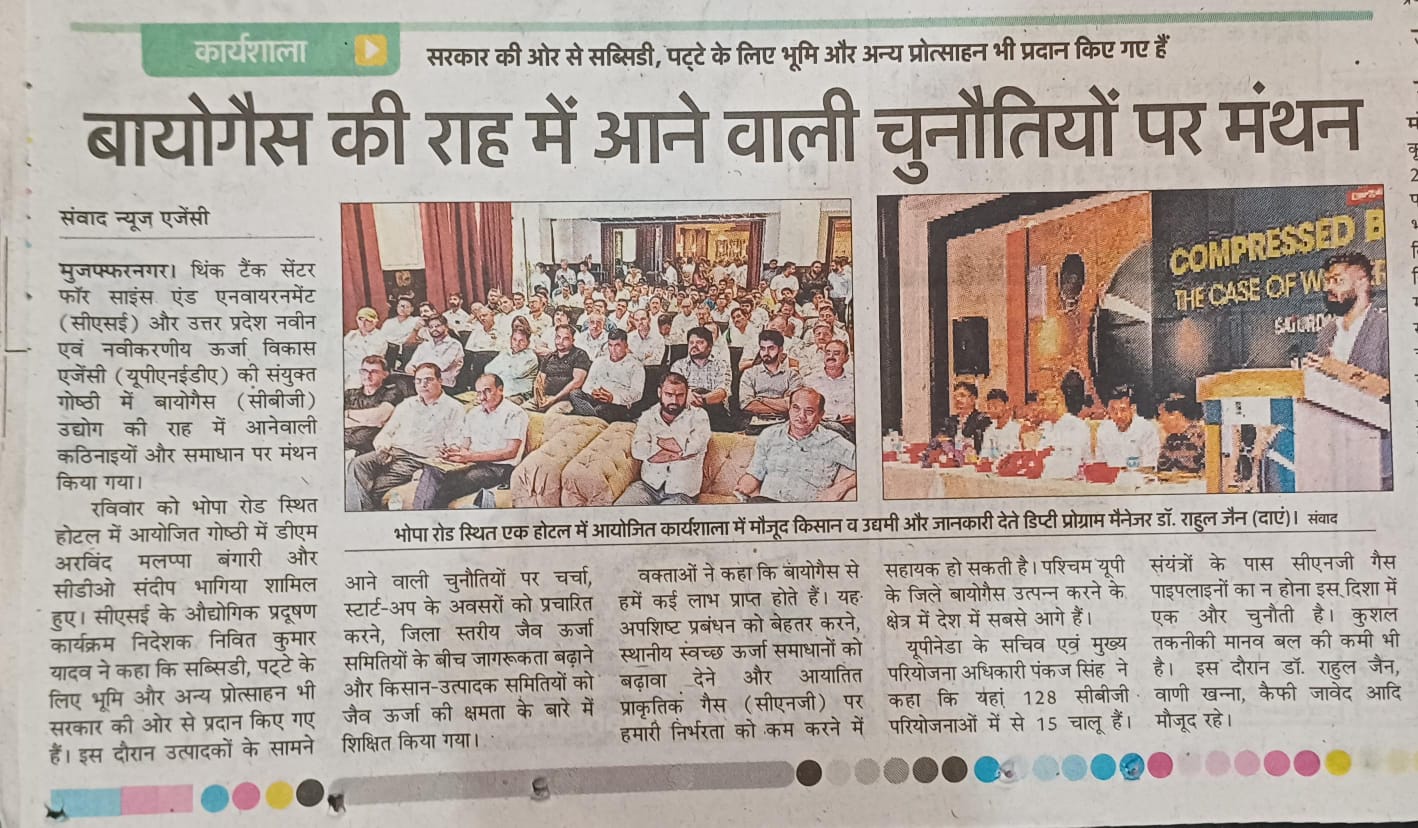
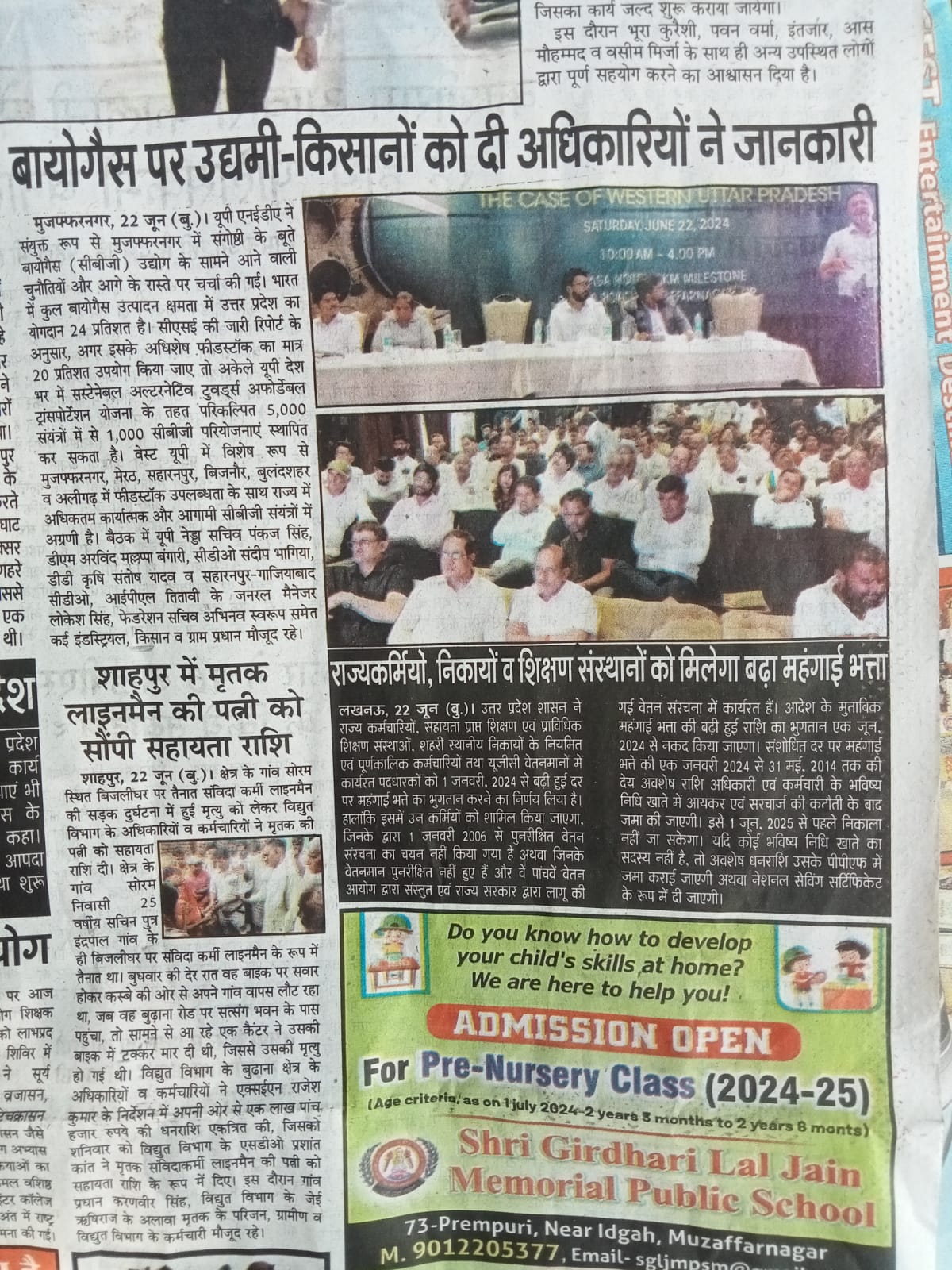
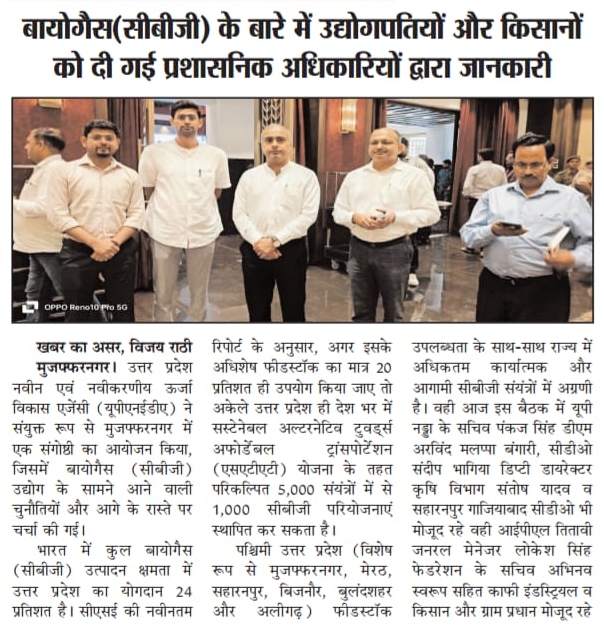
Uttar Pradesh leads the nation in compressed biogas potential, but challenges persist: say experts at CSE-UPNEDA joint symposium

“Compressed biogas (CBG) offers a multitude of benefits for India: it can help enhance waste management, promote local clean energy solutions, and bring down our dependence on imported compressed natural gas (CNG). And Uttar Pradesh – especially its western districts of Muzaffarnagar, Meerut, Saharanpur, Bijnor, Bulandshahar and Aligarh — leads the nation in the potential to generate compressed biogas: it accounts for a sizable 24 per cent of the country’s total potential”: said researchers from New Delhi-based think tank Centre for Science and Environment (CSE) here today. They were speaking at a one-day symposium on CBG in western Uttar Pradesh; the symposium was jointly organised by CSE and the Uttar Pradesh New and Renewable Energy Development Agency (UPNEDA). Compressed biogas is made from various feedstocks, including municipal solid waste, agricultural waste, press-mud, and animal wastes. It is a purified version of biogas, and is also referred to as bio-CNG. Over 90 per cent of CBG, which is produced from anaerobic digestion from organic waste or biomass, constitutes of methane. Speaking at the symposium, Nivit Kumar Yadav, programme director, industrial pollution, CSE said: “Among Indian states, Uttar Pradesh has taken the lead in this sector with its ambitious bioenergy policy, allocating Rs 750 crore (2022-27) for CBG, while providing subsidies, land for lease and other incentives. This symposium has been organised to discuss the challenges faced by CBG producers, share successful practices, highlight opportunities for start-ups, raise awareness among district-level bioenergy committees, and educate farmer-producer bodies on the potential of bioenergy.” Echoing Yadav’s comments on the state government’s strides in the sector, Pankaj Singh, secretary/CPO, UPNEDA, said: “Uttar Pradesh has the most advanced bioenergy policy in India and leads in the number of upcoming CBG projects. Of the 128 CBG projects, 15 are operational, while the remaining 113 are in various stages of construction.” What are the challenges faced by the sector Limited offtake of by-products/bioslurry/fermented organic manure (FOM): CBG plants generate bioslurry, which can be a used as a fertiliser. However, there are no takers for the bioslurry produced by CBG plants. Says Dr Rahul Jain, deputy programme manager, renewable energy, CSE and the author of CSE’s report on CBG: “Instead of being considered a potential revenue source, bioslurry is perceived as a disposal challenge. Plant owners are either providing it for free to nearby farmers or disposing of it on vacant lands. There is a lack of awareness about the characteristics of bioslurry, appropriate application methods and potential benefits.”

https://english.jagran.com/india/water-crisis-hits-indian-cities-60-crore-indians-facing-water-scarcity-situation-likely-to-worsen-10169218

Delhi is in a dire situation due to the ongoing water crisis. The situation has deteriorated to the extent that long queues for water tankers are seen in many areas of Delhi, including Kusumpur Pahadi, Okhla, Sangam Vihar and Vivekananda Camp, while NDMC has managed to supply water once in VIP areas.The IT hub of India, Bengaluru, is currently facing a daily shortfall of 200 million litres of water. A report by the Centre for Science and Environment suggests that an estimated 484.2 billion cubic metres, equivalnet to 48.42 billion one-litre water bottles, are wasted every day. Sunita Narain, Director of the Centre for Science and Environment and an environmentalist, says that the water crisis emerging in Bengaluru this year should be a matter of concern for the entire country. Our cities will remain livable only when even the poorest resident has access to clean drinking water. Bengaluru received adequate rainfall, and it has lakes that can collect this rainwater and recharge the groundwater. These lakes also prevent flooding during heavy rains. Every drop of water in cities can be used for the future.

Delhi minister stages hunger strike for more water to city amid extreme heat

A Delhi city minister has started an indefinite hunger strike to demand more drinking water for India’s capital, where taps in some of its poorest neighbourhoods are running nearly dry in the middle of searing heat. “There are 2.8 million people in the city who are aching for just a drop of water,” Delhi Water Minister Atishi said on Monday, the fourth day of her fast. Millions of Indians face water shortages every summer when water demand rises in farms, offices and homes against a limited supply, but a prolonged heatwave this year has worsened the shortfall, including in Delhi and the southern tech hub of Bengaluru. Atishi blamed the neighbouring farming state of Haryana for guzzling up a large share of river water. Haryana’s government responded that it was Delhi’s mismanagement that was causing water shortages. Experts said a federal-level review of decades-old water sharing pacts was needed to accommodate population growth. Delhi, a city of 20 million people, is one of the world’s most densely populated capitals, where upscale neighbourhoods and manicured lawns are just a few miles away from unplanned working-class areas and slums. But, in contrast to growing unplanned development over the years, the city’s water allocation from rivers has remained unchanged since 1994, said Depinder Kapur, the director of water programme at think tank Centre for Science and Environment. “What was true 10-15 years ago is not true anymore. So, there is a situation of crisis and it’s a distribution issue,” he said.

Excessive heat: Delhi minister on hunger strike to demand water for city

A Delhi municipal minister has declared an indefinite hunger strike to demand more drinking water for India's capital, where taps in some of the poorest neighbourhoods are virtually dry in the sweltering heat, according to Reuters. "There are 2.8 million people in the city who are aching for just a drop of water," Delhi Water Minister Atishi stated on Monday, the fourth day of her fast. Every summer, millions of Indians confront water shortages as demand grows in fields, businesses, and homes against a limited supply, but this year's protracted heatwave has exacerbated the problem, particularly in Delhi and the southern tech powerhouse of Bengaluru. The majority of Delhi's water needs are met by the Yamuna River, which slows down during the dry summer months, generating shortages that spark demonstrations and requests for increased water conservation. Atishi criticized the nearby farming state of Haryana for consuming a considerable amount of river water. Delhi, a city of 20 million people, is one of the world's most densely inhabited capitals, with posh suburbs and groomed lawns only a few miles apart from unmanaged working-class areas and slums. However, despite increasing unplanned construction, the city's river water allocation has stayed constant since 1994, according to Depinder Kapur, director of the water programme at the think tank Centre for Science and Environment. "What was true 10 or 15 years ago is no longer true. So, there is a dilemma, and it is a distribution issue," he explained.

Delhi Water Woes: Minister On Hunger Strike Against Haryana

A Delhi city minister has started an indefinite hunger strike to demand more drinking water for India’s capital, where taps in some of its poorest neighborhoods are running nearly dry in the middle of searing heat. “There are 2.8 million people in the city who are aching for just a drop of water,” Delhi Water Minister Atishi said on June 24, the fourth day of her fast. Millions of Indians face water shortages every summer when water demand rises in farms, offices and homes against a limited supply, but a prolonged heatwave this year has worsened the shortfall, including in Delhi and Bengaluru. Delhi relies on the Yamuna River that runs through the capital for most of its water needs but the river slows down during dry summer months, causing shortages that lead to protests and calls for better water conservation. Atishi blamed the neighboring farming state of Haryana for guzzling up a large share of river water. Delhi, a city of 20 million people, is one of the world’s most densely populated. The city’s water allocation from rivers has remained unchanged since 1994, said Depinder Kapur, the director of the water program at the think tank Centre for Science and Environment. The Delhi government is working on plans to improve the groundwater table by reviving lakes and storing water overflow from the Yamuna during the seasonal monsoon rains, but officials say the summer shortfall is difficult to tackle by these measures alone. The politics surrounding the current situation has exacerbated the crisis.

Are solar rooftop installations in India and Pakistan an answer to the climate crisis?

Delhi, India In India, Delhi's state government announced a New Solar Policy 2024 in January 2024. It gives consumers installing solar rooftops a subsidy of INR10,000 (USD 119). All sectors residential, commercial or industrial, also get production-based incentive of up to INR 3/kWh. This is in addition to the 40% subsidy already provided by the central government for up to 3 kW and a 20 percent subsidy for 4-10 kW. The new solar policy mandates all government buildings with areas of 500 square metres or larger to install solar panels in the next three years. It also promotes community-based solar systems – residents of multi-story buildings can jointly install rooftop solar and save money. “But not all the families in the building are ready for this,” said retired teacher Omprakash Raikwar and his wife, pensioners who live on the second floor of a five-story building in Delhi's Badarpur area. In its 2016 policy, Delhi's state government had set a target of achieving 1000 MW of electricity from solar rooftops by the year 2020. However, it met only 230 MW of this target by the end of 2023. The state government’s welfare scheme gives 200 units of electricity in Delhi free in the electricity bill – two out of five families in this building say their monthly expenditure is already low. They say it will take longer for them to recover the cost of installing solar energy. Even after the free 200 units, the price of electricity is higher in areas around Delhi. In Faridabad, Haryana, after using 250 units of electricity, consumers pay INR 6.5 per unit. The cost in Delhi is only INR 4.5 per unit. Economics, rather than the environment, become the deciding factor. Delhi has several private discoms. or distribution companies,  that are responsible for distributing electricity to consumers. The companies buy electricity from producers and then sell it to consumers. This makes net metering more time consuming compared to other cities, says Nishi Chandra, marketing head of Loom Solar, a manufacturer of solar panels and lithium batteries based in Faridabad, Haryana. “On top of that, electricity is already cheaper in Delhi due to government subsidies, so the demand for domestic rooftop solar installation is also less,” Chandra told Sapan News. The higher upfront cost for domestic consumers, delayed disbursement of rooftop solar subsidies, and the Discoms’ loss of revenue with the rise of solar consumers in the city are the main hurdles in popularising solar power, says Binit Das, deputy program manager renewable energy at the Center for Science and Environment (CSE), a Delhi-based public interest research organisation. But the high pollution levels and energy surge in Delhi makes this investment all the more relevant, says Amit Bajaj. “When you invest in solar, you tend to keep an eye on any wastage parallelism, because you always want to make the best of what you have invested and believed in,” he told Sapan News. Read more at: https://southasiamonitor.org/medley/are-solar-rooftop-installations-india-and-pakistan-answer-climate-crisis

Reimagining old agenda

The agenda for the next government is the old one, but with a fundamental difference. The fact is that the list of priority action areas remains the same. We have unfinished business when it comes to virtually everything—from energy to water and sanitation to food and nutrition to, of course, health and education. We know that the government has schemes in place and budgets allocated for all these issues. We also know that ensuring the welfare and well-being of people is a work in progress. During this election, as journalists fanned out to listen to the opinions of voters—perhaps the only time when their opinions count—we heard that unemployment is a major concern; lack of clean drinking water and sanitation tops the agenda; the energy crisis is still wicked as the price of the LPG cylinder is unaffordable and electricity unreliable. Farmers are still distressed. So, a lot of work still needs to be done, and in areas that the last government said it had checked off in its to-do list.

The tell-tale signs of urban heat stress

Tap water is boiling hot and air conditioners are not having the desired effect. Such is the severity of the Indian summer this year, that even at night, cities in the northern plains are not cooling down. The relentless heat wave, with little to no rainfall, is exacerbated by the Urban Heat Island phenomena, a byproduct of climate change and excessive urban infrastructure. A recent study by the Centre for Science and Environment (CSE) titled ‘Decoding the Urban Heat Stress among Indian cities’, tracked data in 6 major cities - Bengaluru, Chennai, Delhi, Hyderabad, Kolkata and Mumbai – and suggested urgent measures to protect public health. While a heat index of 41° C is considered dangerous for human health, temperatures in Delhi have been hovering over that for most part of this season, rendering the Urban Heat Island phenomena stronger at night. “Hot nights are as dangerous as mid-day peak temperatures. People get little chance to recover from day-time heat if temperatures remain high overnight. A study published in the Lancet Planetary Health has noted that the risk of death from excessively hot nights would increase nearly six-fold in future,” said Avikal Somvanshi, Senior Programme Manager, Urban Lab, CSE. Deadly combo The heat stress is not just about rising temperatures. It is a deadly combination of air temperature, land surface temperature and relative humidity that leads to acute thermal discomfort and heat stress in cities, according to the CSE report. With exception of Bengaluru, in all five cities studied by CSE, rising humidity levels have worsened the heat stress. a heat index of 41°C is considered dangerous for human health a heat index of 41°C is considered dangerous for human health | Photo Credit: ANINDITO MUKHERJEE Trends in heat stress will further worsen in cities with climate change, according to the Intergovernmental Panel on Climate Change (IPCC), Working Group-I, Sixth Assessment Report (AR6 WG-I). This is due to reduced ventilation, heat trapping by closely spaced tall buildings, heat generated directly from human activities, heat-absorbing properties of concrete and urban building materials, and limited vegetation.  Action plans According to CSE, heat management action plans are urgently needed to expand green areas and waterbodies, reduce thermal load on buildings and improve thermal comfort, and implement emergency measures during heat wave episodes to protect public health.  India is not the only country facing the brunt of a severe heatwave. Leading athletes, Olympic champions and scientists in a report called ‘Rings of Fire’, have warned that intense heat at the Paris Olympics 2024 could pose a serious threat to the well-being of participants.

Climate change: Volcanic eruption of heatwaves

This summer has seen among the longest prolonged heatwave periods in India’s meteorological history. Soaring temperatures of 45-50°C - some places reported over 50°C - continued for over a month in May and June in the Northwest region. Multiple fire accidents during the same period added to the distress, severely taking its toll on the health and medical infrastructure of the country. The record breaking spell of excess heatwaves created a domino effect and a perfect storm for a series of disasters. It all began with the massive wildfires in Uttarakhand and Himachal Pradesh, affecting the quality of air and increasing the heat-trapping greenhouse gases. Frequent incidents of fire in hospitals and high rises followed, leading to unfortunate loss of lives. The demand for electricity to run cooling equipment shot up like never before. And Delhi is witnessing an unprecedented drinking water crisis. Urban heat island The rise in the number of migrant populations in urban areas led to an increase in unplanned urbanisation. Buildings came up in encroached forest areas and water bodies, which are essential for regulating heat in urban areas. For instance, in the 1970s, there were over 200 water bodies in Delhi and its surrounding areas. Now, only 20 such lakes exist. Consequently, cities have turned into urban heat islands where buildings, roads and other infrastructures absorb and re-emit heat, making the urban jungle several degrees hotter than the surrounding rural areas. Health emergency Recent visuals of unclaimed bodies bound in white and polybags strewn outside hospitals in Delhi-NCR due to lack of space in mortuaries captured the plight of the marginalised lot. Reports suggest that the relentless spell of heatwaves claimed multiple lives of the destitute and the homeless. The videos went viral on social media and evoked strong reactions. “Our body is not prepared for such a level of warming in this unprecedented summer heat,” says well known environmentalist Sunita Narain, Director General of the Centre for Science and Environment.