
Cse In News

India's 'heat trap' cities make summers worse, says government official

Indian cities have become "heat traps" due to their unbalanced growth devouring water bodies and increasing greenhouse emissions, a senior government official said on Monday, as a scorching summer killed dozens in some parts of the country. The India Meteorological Department (IMD) has forecast above-normal temperatures for June in the northwest and central parts of the country including Delhi, making it one of the longest heatwave spells. The highest daily temperatures in the capital have stayed above 40 degrees Celsius (104 Fahrenheit) since May 12 and are forecast to fall below that mark only on June 26. The IMD's heatwave criteria, opens new tab start with 40 degrees in the plains and 30 degrees for hills where it is generally cooler because of elevation. Delhi, which is also facing a water shortage, recorded about 44 degrees late Monday afternoon but the IMD said it felt like 49.2 degrees. "Climate change plays an important role," Krishna S. Vatsa, a member of the National Disaster Management Authority, told Reuters. Unbalanced urban growth, which has reduced wetlands and water bodies, was another factor, Vatsa said. "The emission of greenhouse gases has gone up. The permeable spaces have gone down considerably. The cities actually have become heat traps." As a result, he said, nights are nearly as uncomfortable as days. According to a study by the Centre for Science and Environment (CSE) published last month, opens new tab, land surface temperatures in the summers of 2001 to 2010 in cities such as Delhi, Hyderabad, Kolkata and Mumbai used to drop by up to 13.2 degrees during the night from their day-time peak. Between 2014 and 2023 they were only cooling off by up to 11.5 degrees. "Hot nights are as dangerous as mid-day peak temperatures," the Centre's report said. "People get little chance to recover from day-time heat if temperatures remain high overnight."
The burning capital: What's driving Delhi's extreme heatwave?

Delhiites have been grappling with an unrelenting and harsh summer as the schorching heat in the capital shows no signs of abating. The oppressive heatwave conditions and warm nights continue to persist in Delhi and its neighbouring areas, making it difficult for residents to find respite from the blistering temperatures. The India Meteorological Department (IMD) has issued a series of alerts for heatwaves in the region. Urban heat island phenomena The urban heat island phenomenon also plays a significant role in exacerbating the heat in Delhi. As a densely populated metropolis with a vast urban sprawl, Delhi's buildings, concrete pavements, and asphalt roads absorb and retain heat from the sun more efficiently than natural landscapes. This phenomenon can significantly increase temperatures within the city compared to surrounding rural areas, according to an analysis by the Centre for Science and Environment (CSE).

‘Heat trap’ cities making summers worse: official

Indian cities have become “heat traps” due to their unbalanced growth devouring water bodies and increasing greenhouse emissions, a senior government official said yesterday, as a scorching summer killed dozens in some parts of the country. The India Meteorological Department (IMD) has forecast above-normal temperatures for June in the northwest and central parts of the country including Delhi, making it one of the longest heatwave spells. The highest daily temperatures in the capital have stayed above 40 degrees Celsius since May 12 and are forecast to fall below that mark only on June 26. The IMD’s heatwave criteria start with 40C in the plains and 30C for hills where it is generally cooler because of elevation. Delhi, which is also facing a water shortage, recorded about 44C late yesterday afternoon but the IMD said it felt like 49.2C. “Climate change plays an important role,” Krishna S Vatsa, a member of the National Disaster Management Authority, said. Unbalanced urban growth, which has reduced wetlands and water bodies, was another factor, Vatsa said. “The emission of greenhouse gases has gone up. The permeable spaces have gone down considerably. The cities actually have become heat traps.” As a result, he said, nights are nearly as uncomfortable as days. According to a study by the Centre for Science and Environment (CSE) published last month, land surface temperatures in the summers of 2001-2010 in cities such as Delhi, Hyderabad, Kolkata and Mumbai used to drop by up to 13.2C during the night from their day-time peak. Between 2014 and 2023 they were only cooling off by up to 11.5C. “Hot nights are as dangerous as mid-day peak temperatures,” the Centre’s report said. “People get little chance to recover from day-time heat if temperatures remain high overnight.” Vatsa said most Indian states were implementing heat action plans that include provisioning drinking water and better medical facilities, as well as rescheduling outdoor work and school vacations. But Anumita Roychowdhury, CSE’s executive director, said there was no clear mandate to implement long-term strategies. Delhi’s long-term plan includes increasing heat insulation of buildings, developing shelters for urban poor and slum dwellers, and investing in cooling water bodies.

Hottest among mega cities, Chennai faces increasing heat stress: study

“This summer was worse than ever” is a sentiment familiar to every resident of the city, either spoken out aloud or silently acknowledged every year between April and June. Supporting this observation, an analysis conducted by the Centre for Science and Environment (CSE) finds that Chennai not only stands out as the hottest mega city in India, but shows a threefold increase in days where the heat index (what the temperature feels like to the human body when relative humidity is combined with the air temperature) exceeds 41°C, marking the danger zone, over the past two decades. As a part of the study, the CSE compared summer temperatures from 2001 to 2011 with those from 2014 to 2023 in Delhi, Mumbai, Kolkata, Hyderabad, Bengaluru, and Chennai. The study finds that average relative humidity has significantly increased in the last 10 summers compared to the 2001-10 average, with the decadal summertime average ambient temperature rising by about 0.5°C in Chennai.

No one prepared for unprecedented heat endured this summer: Sunita Narain

India is grappling with unprecedented heat this summer and no one is prepared for the level of warming being experienced, leading environmentalist Sunita Narain has said, emphasising the need for a heat index and a complete overhaul of the way modern cities are designed. In an interaction with PTI editors here, Narain, the Director General of the Centre for Science and Environment (CSE), said the brutal heat scorching swathes of India is a result of naturally occurring El Nino phenomenon -- an unusual warming of the ocean surface in the central and eastern tropical Pacific Ocean -- and climate change. "Nobody is prepared. Let's be very clear. 2023 was globally the hottest year on record. We have broken every record in the last 45 days with an unbroken (streak of) temperatures above 40 degrees. This is climate change. It is compounded this year by the waning of the (2023-24) El Nino. This means we really need to get our act together. We need to ensure that vulnerable communities are less affected," she said. Narain stressed the need to develop a heat index, which measures how the temperature feels to the human body when relative humidity is combined with air temperature. "We need a heat index similar to the air quality index we have on our phones. AQI tells you the level of air pollution and its impact on your health. This linkage is essential to know what actions need to be taken. Remember, heat is not only about temperature, it is also about humidity," she said. The India Meteorological Department began issuing an experimental heat index for different parts of the country in April last year. The IMD officials said India will soon come up with its system now, a multi-parameter product called 'heat hazard score', which along with temperature and humidity will also integrate other parameters such as wind and duration. Narain noted that heatwaves are turning modern glass buildings into furnaces, overheating the occupants and emphasized the need for new architectural science to address this heat. "Your biggest challenge today is how to rebuild the cities. Look at Gurugram - it's all glass facades. Those glass buildings are the worst thing you could have for a heating climate," she said. India experienced multiple intense and prolonged heatwaves in April and May, testing the limits of human endurance and the country's disaster preparedness, as many states, including Uttar Pradesh, Bihar and Odisha, reported heatwave-related deaths. According to the IMD data, 14 of the 36 sub-divisions in the country recorded over 15 heatwave days (when the maximum temperature is at least 40 degrees Celsius and 4.5 degrees above normal) from March 1 to June 9. Studies show that rapid urbanization has exacerbated warming in the urban areas, with outdoor workers and low-income households bearing the brunt of the impact. Low-income households have limited capacity to adapt to extreme heat because of poor access to water and electricity. The design and construction of informal houses often mean there is poor ventilation and little shelter from extreme heat. The heatwave in May saw several places across the country, including the hills of Assam, Uttarakhand, Himachal Pradesh and Arunachal Pradesh, recording all-time high temperatures. The mercury breached 50 degrees Celsius in Rajasthan and neared this mark in Delhi and Haryana. Similar heatwaves, which once occurred every 30 years, have become about 45 times more likely due to climate change, according to 'World Weather Attribution', a group of leading climate scientists. There are concerns that heatwaves in April and May played a role in the lower-than-usual voter turnout during the seven-phase general elections in India which began on April 19 and ended on June 1, the second longest after the 1951-52 parliamentary elections. The intense heat has already driven India's power demand to a record 246 gigawatts, with air conditioners and coolers in homes and offices running at full capacity. According to the Central Water Commission, water storage in 150 major reservoirs in India dropped to just 22 per cent of their live storage last week, exacerbating water shortages in many states and significantly affecting hydropower generation.

उफ्फ ये धूप: इस साल के तापमान ने तोड़ा रिकॉर्ड, पर्यावरण विशेषज्ञ बोलीं- इतनी भीषण गर्मी के लिए कोई तैयार नहीं

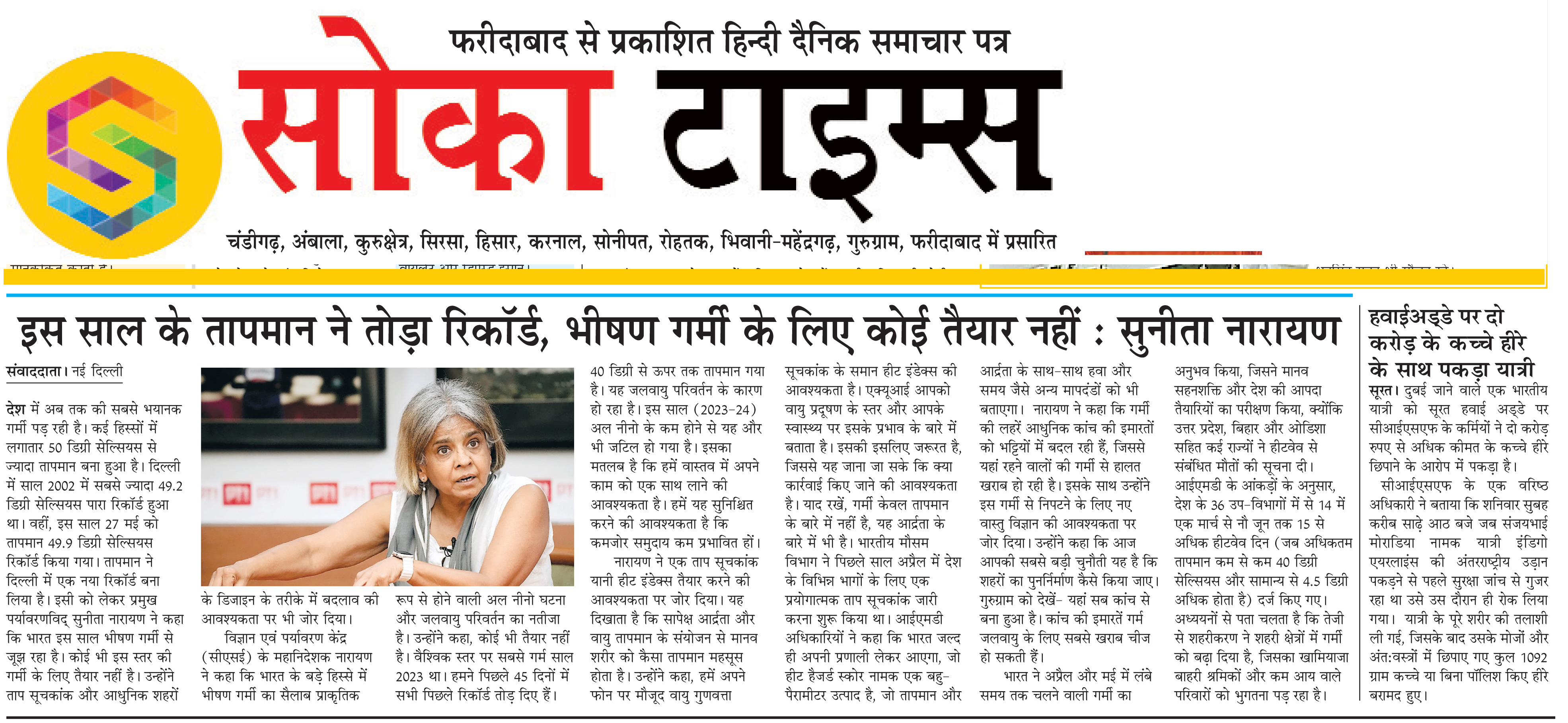
देश में अब तक की सबसे भयानक गर्मी पड़ रही है। कई हिस्सों में लगातार 50 डिग्री सेल्सियस से ज्यादा तापमान बना हुआ है। दिल्ली में साल 2002 में सबसे ज्यादा 49.2 डिग्री सेल्सियस पारा रिकॉर्ड हुआ था। वहीं, इस साल 27 मई को तापमान 49.9 डिग्री सेल्सियस रिकॉर्ड किया गया। तापमान ने दिल्ली में एक नया रिकॉर्ड बना लिया है। इसी को लेकर प्रमुख पर्यावरणविद् सुनीता नारायण ने कहा कि भारत इस साल भीषण गर्मी से जूझ रहा है। कोई भी इस स्तर की गर्मी के लिए तैयार नहीं है। उन्होंने ताप सूचकांक और आधुनिक शहरों के डिजाइन के तरीके में बदलाव की आवश्यकता पर भी जोर दिया। विज्ञान एवं पर्यावरण केंद्र (सीएसई) के महानिदेशक नारायण ने कहा कि भारत के बड़े हिस्से में भीषण गर्मी का सैलाब प्राकृतिक रूप से होने वाली अल नीनो घटना और जलवायु परिवर्तन का नतीजा है। कोई भी तैयार नहीं उन्होंने कहा, 'कोई भी तैयार नहीं है। वैश्विक स्तर पर सबसे गर्म साल 2023 था। हमने पिछले 45 दिनों में सभी पिछले रिकॉर्ड तोड़ दिए हैं। 40 डिग्री से ऊपर तक तापमान गया है। यह जलवायु परिवर्तन के कारण हो रहा है। इस साल (2023-24) अल नीनो के कम होने से यह और भी जटिल हो गया है। इसका मतलब है कि हमें वास्तव में अपने काम को एक साथ लाने की आवश्यकता है। हमें यह सुनिश्चित करने की आवश्यकता है कि कमजोर समुदाय कम प्रभावित हों।' नारायण ने एक ताप सूचकांक यानी हीट इंडेक्स तैयार करने की आवश्यकता पर जोर दिया। यह दिखाता है कि सापेक्ष आर्द्रता और वायु तापमान के संयोजन से मानव शरीर को कैसा तापमान महसूस होता है। उन्होंने कहा, 'हमें अपने फोन पर मौजूद वायु गुणवत्ता सूचकांक के समान हीट इंडेक्स की आवश्यकता है। एक्यूआई आपको वायु प्रदूषण के स्तर और आपके स्वास्थ्य पर इसके प्रभाव के बारे में बताता है। इसकी इसलिए जरूरत है, जिससे यह जाना जा सके कि क्या कार्रवाई किए जाने की आवश्यकता है। याद रखें, गर्मी केवल तापमान के बारे में नहीं है, यह आर्द्रता के बारे में भी है।' भारतीय मौसम विभाग ने पिछले साल अप्रैल में देश के विभिन्न भागों के लिए एक प्रयोगात्मक ताप सूचकांक जारी करना शुरू किया था। आईएमडी अधिकारियों ने कहा कि भारत जल्द ही अपनी प्रणाली लेकर आएगा, जो 'हीट हैजर्ड स्कोर' नामक एक बहु-पैरामीटर उत्पाद है, जो तापमान और आर्द्रता के साथ-साथ हवा और समय जैसे अन्य मापदंडों को भी बताएगा। कांच की इमारतें भट्टियों में बदल रहीं नारायण ने कहा कि गर्मी की लहरें आधुनिक कांच की इमारतों को भट्टियों में बदल रही हैं, जिससे यहां रहने वालों की गर्मी से हालत खराब हो रही है। इसके साथ उन्होंने इस गर्मी से निपटने के लिए नए वास्तु विज्ञान की आवश्यकता पर जोर दिया। उन्होंने कहा कि आज आपकी सबसे बड़ी चुनौती यह है कि शहरों का पुनर्निर्माण कैसे किया जाए। गुरुग्राम को देखें- यहां सब कांच से बना हुआ है। कांच की इमारतें गर्म जलवायु के लिए सबसे खराब चीज हो सकती हैं। हीटवेव से हो रहीं मौतें भारत ने अप्रैल और मई में लंबे समय तक चलने वाली गर्मी का अनुभव किया, जिसने मानव सहनशक्ति और देश की आपदा तैयारियों का परीक्षण किया, क्योंकि उत्तर प्रदेश, बिहार और ओडिशा सहित कई राज्यों ने हीटवेव से संबंधित मौतों की सूचना दी। आईएमडी के आंकड़ों के अनुसार, देश के 36 उप-विभागों में से 14 में एक मार्च से नौ जून तक 15 से अधिक हीटवेव दिन (जब अधिकतम तापमान कम से कम 40 डिग्री सेल्सियस और सामान्य से 4.5 डिग्री अधिक होता है) दर्ज किए गए। अध्ययनों से पता चलता है कि तेजी से शहरीकरण ने शहरी क्षेत्रों में गर्मी को बढ़ा दिया है, जिसका खामियाजा बाहरी श्रमिकों और कम आय वाले परिवारों को भुगतना पड़ रहा है।

कोई भी इस तरह की अभूतपूर्व गर्मी के लिए तैयार नहीं है: सुनीता नारायण

जानीमानी पर्यावरणविद सुनीता नारायण ने कहा है कि भारत गर्मी के इस मौसम में अभूतपूर्व तपिश से जूझ रहा है और कोई भी इस स्तर की गर्मी के लिए तैयार नहीं है। नारायण ने एक ताप सूचकांक और आधुनिक शहरों के डिजाइन के तरीके में पूर्ण बदलाव की आवश्यकता पर भी बल दिया। विज्ञान एवं पर्यावरण केंद्र (सीएसई) की महानिदेशक नारायण ने यहां ‘पीटीआई- संपादकों’ के साथ बातचीत में कहा कि भारत के बड़े हिस्से में भीषण गर्मी प्राकृतिक रूप से घटित होने वाली अल नीनो घटना और जलवायु परिवर्तन का परिणाम है। PlayUnmute Fullscreen उन्होंने कहा कि मध्य और पूर्वी उष्णकटिबंधीय प्रशांत महासागर में समुद्री सतह असामान्य रूप से गर्म होने को अल नीनो कहते हैं। उन्होंने कहा, ‘‘कोई भी तैयार नहीं है। हमें बहुत स्पष्ट रहना चाहिए। वर्ष 2023 वैश्विक स्तर पर सबसे गर्म वर्ष था। हमने पिछले 45 दिनों में 40 डिग्री से ऊपर के तापमान के साथ हर रिकॉर्ड तोड़ दिया है। यह जलवायु परिवर्तन है। इस साल (2023-24) अल नीनो के कम होने से यह और भी जटिल हो गया है। इसका मतलब है कि हमें वास्तव में अपने कृत्यों को व्यवस्थित करने की आवश्यकता है। हमें यह सुनिश्चित करने की आवश्यकता है कि जोखिम वाले समुदाय कम प्रभावित हों।’ नारायण ने एक ताप सूचकांक विकसित करने की आवश्यकता पर बल दिया, जो मापता है कि सापेक्ष आर्द्रता को हवा के तापमान के साथ मिलाने पर मानव शरीर को कैसा तापमान महसूस होता है। उन्होंने कहा, ‘‘हमें अपने फोन पर मौजूद वायु गुणवत्ता सूचकांक के समान ताप सूचकांक की आवश्यकता है। एक्यूआई आपको वायु प्रदूषण के स्तर और आपके स्वास्थ्य पर इसके प्रभाव के बारे में बताता है। यह जुड़ाव यह जानने के लिए आवश्यक है कि क्या कार्रवाई की जानी चाहिए। याद रखें, गर्मी केवल तापमान के बारे में नहीं है, यह आर्द्रता के बारे में भी है।’ भारत मौसम विज्ञान विभाग (आईएमडी) ने पिछले साल अप्रैल में देश के विभिन्न हिस्सों के लिए एक प्रायोगिक ताप सूचकांक जारी करना शुरू किया था। आईएमडी अधिकारियों ने कहा कि भारत जल्द ही अपनी प्रणाली लेकर आएगा, जिसे ‘हीट हैजर्ड स्कोर’ नाम दिया गया है, जो तापमान और आर्द्रता के साथ-साथ हवा और अवधि जैसे अन्य मापदंडों को भी एकीकृत करेगा। नारायण ने कहा कि भीषण गर्मी आधुनिक कांच की इमारतों को भट्टियों में बदल रही है, जिससे रहने वालों को गर्मी लग रही है और इस गर्मी से निपटने के लिए नए वास्तुशिल्प विज्ञान की आवश्यकता पर जोर दिया। उन्होंने कहा, ‘आज आपकी सबसे बड़ी चुनौती यह है कि शहरों का पुनर्निर्माण कैसे किया जाए। गुरुग्राम को देखें – (इमारतों के अग्रभाग) कांच से बने हैं। कांच की इमारतें गर्म जलवायु के लिए सबसे खराब चीज हो सकती हैं।’ अप्रैल और मई में भारत ने कई तीव्र और लंबे समय तक चलने वाली गर्मी का अनुभव किया, जिसने मानव सहनशक्ति और देश की आपदा तैयारियों की सीमाओं का परीक्षण किया, क्योंकि उत्तर प्रदेश, बिहार और ओडिशा सहित कई राज्यों में भीषण गर्मी से संबंधित मौतों की सूचना आयी। आईएमडी के आंकड़ों के अनुसार, देश के 36 उप-मंडलों में से 14 में एक मार्च से 9 जून तक 15 से अधिक भीषण गर्मी वाले दिन (जब अधिकतम तापमान कम से कम 40 डिग्री सेल्सियस और सामान्य से 4.5 डिग्री अधिक होता है) दर्ज किए। अध्ययनों से पता चलता है कि तेजी से शहरीकरण ने शहरी क्षेत्रों में गर्मी को बढ़ा दिया है, जिसका खामियाजा बाहरी श्रमिकों और कम आय वाले परिवारों को भुगतना पड़ रहा है।

No one ready for unprecedented heat endured this summer: Sunita Narain

India is grappling with unprecedented heat this summer and no one is prepared for the level of warming being experienced, leading environmentalist Sunita Narain has said, emphasizing the need for a heat index and a complete overhaul of the way modern cities are designed. In an interaction with PTI editors here, Narain, the Director General of the Centre for Science and Environment (CSE), said the brutal heat scorching swathes of India is a result of naturally occurring El Nino phenomenon — an unusual warming of the ocean surface in the central and eastern tropical Pacific Ocean — and climate change. “Nobody is prepared. Let’s be very clear. 2023 was globally the hottest year on record. We have broken every record in the last 45 days with an unbroken (streak of) temperatures above 40 degrees. This is climate change. It is compounded this year by the waning of the (2023-24) El Nino. This means we really need to get our act together. We need to ensure that vulnerable communities are less affected,” she said. Narain stressed the need to develop a heat index, which measures how the temperature feels to the human body when relative humidity is combined with air temperature. “We need a heat index similar to the air quality index we have on our phones. AQI tells you the level of air pollution and its impact on your health. This linkage is essential to know what actions need to be taken. Remember, heat is not only about temperature, it is also about humidity,” she said. The India Meteorological Department began issuing an experimental heat index for different parts of the country in April last year. The IMD officials said India will soon come up with its system now, a multi-parameter product called ‘heat hazard score’, which along with temperature and humidity will also integrate other parameters such as wind and duration. Narain noted that heatwaves are turning modern glass buildings into furnaces, overheating the occupants and emphasized the need for new architectural science to address this heat. “Your biggest challenge today is how to rebuild the cities. Look at Gurugram – it’s all glass facades. Those glass buildings are the worst thing you could have for a heating climate,” she said. India experienced multiple intense and prolonged heatwaves in April and May, testing the limits of human endurance and the country’s disaster preparedness, as many states, including Uttar Pradesh, Bihar and Odisha, reported heatwave-related deaths. According to the IMD data, 14 of the 36 sub-divisions in the country recorded over 15 heatwave days (when the maximum temperature is at least 40 degrees Celsius and 4.5 degrees above normal) from March 1 to June 9. Studies show that rapid urbanization has exacerbated warming in the urban areas, with outdoor workers and low-income households bearing the brunt of the impact. Low-income households have limited capacity to adapt to extreme heat because of poor access to water and electricity. The design and construction of informal houses often mean there is poor ventilation and little shelter from extreme heat. The heatwave in May saw several places across the country, including the hills of Assam, Uttarakhand, Himachal Pradesh and Arunachal Pradesh, recording all-time high temperatures. The mercury breached 50 degrees Celsius in Rajasthan and neared this mark in Delhi and Haryana. Similar heatwaves, which once occurred every 30 years, have become about 45 times more likely due to climate change, according to ‘World Weather Attribution’, a group of leading climate scientists. There are concerns that heatwaves in April and May played a role in the lower-than-usual voter turnout during the seven-phase general elections in India which began on April 19 and ended on June 1, the second longest after the 1951-52 parliamentary elections. The intense heat has already driven India’s power demand to a record 246 gigawatts, with air conditioners and coolers in homes and offices running at full capacity. According to the Central Water Commission, water storage in 150 major reservoirs in India dropped to just 22 per cent of their live storage last week, exacerbating water shortages in many states and significantly affecting hydropower generation. India recorded nearly 25,000 suspected heat stroke cases and 56 deaths due to heat-related illnesses from March to May, PTI reported earlier, citing data from the health ministry. According to data compiled by the National Centre for Disease Control (NCDC), 46 of these deaths were recorded in May alone (till May 30). Between May 1 and 30, 19,189 suspected heat stroke cases were reported in the country. The data does not include deaths from Uttar Pradesh, Bihar and Delhi, and could just be the tip of the iceberg, officials said. PTI GVS AS AS

In the focus on Delhi, the air pollution crisis in Kolkata is being overlooked

A 2020 media report, citing West Bengal’s transport department records, found that more than 3.3 million vehicles in Kolkata and the surrounding area were run on diesel. The Centre for Science and Environment had previously called Kolkata the “diesel capital” of the world, with diesel constituting 45% of total oil consumption by car users in the city. The Centre for Science and Environment reported noted that 65% of new cars in Kolkata were diesel, as were 99% of commercial vehicles in the city. The Centre for Science and Environment warned that black carbon emissions from diesel-run vehicles, with higher carbon content than vehicles run by petrol, were “several times more heat trapping than CO2”.

गर्मी का 45 परसेंट ज्यादा टॉर्चर, क्या बदलना पड़ जाएगा शहरों का नक्शा? हर जगह मचा कोहराम

Heatwave in India: इस बीच जानीमानी पर्यावरणविद सुनीता नारायण ने कहा है कि भारत गर्मी के इस मौसम में अभूतपूर्व तपिश से जूझ रहा है और कोई भी इस स्तर की गर्मी के लिए तैयार नहीं है. नारायण ने एक हीट इंडक्स और आधुनिक शहरों के डिजाइन के तरीके में पूरी तरह बदलाव की जरूरत पर जोर दिया. इस बीच जानीमानी पर्यावरणविद सुनीता नारायण ने कहा है कि भारत गर्मी के इस मौसम में अभूतपूर्व तपिश से जूझ रहा है और कोई भी इस स्तर की गर्मी के लिए तैयार नहीं है. नारायण ने एक हीट इंडक्स और आधुनिक शहरों के डिजाइन के तरीके में पूरी तरह बदलाव की जरूरत पर जोर दिया. गर्मी ने हाल बेहाल किया हुआ है. इतना ही नहीं निचले पहाड़ी इलाकों में भी अब तो लोगों को गर्मी से राहत नहीं मिल रही है. लू की चपेट में आकर विभिन्न राज्यों में लोग अपनी जान तक गंवा चुके हैं. एक तरफ गर्मी ने कोहराम मचाया हुआ है तो वहीं राजधानी दिल्ली में लोग पानी के लिए तरस रहे हैं. दिल्ली में रविवार को न्यूनतम तापमान 33.2 डिग्री सेल्सियस दर्ज किया गया, जो इस मौसम के औसत तापमान से 5.7 डिग्री ज्यादा है. अन्य राज्यों में तो रिकॉर्डतोड़ गर्मी पड़ रही है. इस बीच जानीमानी पर्यावरणविद सुनीता नारायण ने कहा है कि भारत गर्मी के इस मौसम में अभूतपूर्व तपिश से जूझ रहा है और कोई भी इस स्तर की गर्मी के लिए तैयार नहीं है. नारायण ने एक हीट इंडक्स और आधुनिक शहरों के डिजाइन के तरीके में पूरी तरह बदलाव की जरूरत पर जोर दिया.सेंटर फॉर साइंस एंड एनवायरनमेंट की डायरेक्टर जनरल नारायण ने कहा कि भारत के बड़े हिस्से में भीषण गर्मी प्राकृतिक रूप से घटने वाली अल नीनो घटना और जलवायु परिवर्तन का नतीजा है. उन्होंने कहा, 'कोई भी तैयार नहीं है. हमें बहुत साफ रहना चाहिए. साल 2023 वैश्विक स्तर पर सबसे गर्म साल था. हमने पिछले 45 दिनों में 40 डिग्री से ऊपर के तापमान के साथ हर रिकॉर्ड तोड़ दिया है. यह जलवायु परिवर्तन है. इस साल अल नीनो के कम होने से यह और भी मुश्किल हो गया है. इसका मतलब है कि हमें असल में अपने कामों को सिस्टमैटिक करने की जरूरत है. हमें यह सुनिश्चित करने की जरूरत है कि जोखिम वाले समुदाय कम प्रभावित हों. अप्रैल और मई में भारत में तेज और लंबे समय तक चलने वाली गर्मी देखने के मिली, जिसने इंसानी सहनशक्ति और देश की आपदा तैयारियों की सीमाओं को पार कर गईं. इस दौरान उत्तर प्रदेश, बिहार और ओडिशा समेत कई राज्यों में भीषण गर्मी से संबंधित मौतों की सूचना आई.आईएमडी के आंकड़ों के अनुसार, देश के 36 सब-डिविजन में से 14 में एक मार्च से 9 जून तक 15 से अधिक भीषण गर्मी वाले दिन दर्ज किए.

कोई भी ऐसी अभूतपूर्वगर्मी के लिए तैयार नहीं : सुनीता नारायण

पर्यावरणविद सुनीता नारायण नेकहा हैकि भारत गर्मी के इस मौसम मेंअभूतपूर्वतपिश सेजूझ रहा है। कोई भी इस स्तर की गर्मी के लिए तैयार नहीं है। नारायण...

कोई भी ऐसी अभूतपूर्व गर्मी के लिए तैयार नहीं : सुनीता नारायण

- पर्यावरणविद ने कहा, हमें वायु गुणवत्ता सूचकांक के समान ताप सूचकांक की आवश्यकता नई दिल्ली, एजेंसी। पर्यावरणविद सुनीता नारायण ने कहा है कि भारत गर्मी के इस मौसम में अभूतपूर्व तपिश से जूझ रहा है। कोई भी इस स्तर की गर्मी के लिए तैयार नहीं है। नारायण ने एक ताप सूचकांक और आधुनिक शहरों के डिजाइन के तरीके में पूर्ण बदलाव की आवश्यकता पर भी बल दिया। विज्ञान एवं पर्यावरण केंद्र (सीएसई) की महानिदेशक नारायण ने यहां एक समाचार एजेंसी से बातचीत में कहा, भारत के बड़े हिस्से में भीषण गर्मी प्राकृतिक रूप से घटित होने वाली अल नीनो घटना और जलवायु परिवर्तन का परिणाम है। उन्होंने कहा कि मध्य और पूर्वी उष्णकटिबंधीय प्रशांत महासागर में समुद्री सतह असामान्य रूप से गर्म होने को अल नीनो कहते हैं। उन्होंने कहा, कोई भी तैयार नहीं है। हमें बहुत स्पष्ट रहना चाहिए। वर्ष 2023 वैश्विक स्तर पर सबसे गर्म वर्ष था। हमने पिछले 45 दिनों में 40 डिग्री से ऊपर के तापमान के साथ हर रिकॉर्ड तोड़ दिया है। यह जलवायु परिवर्तन है। इस साल (2023-24) अल नीनो के कम होने से यह और भी जटिल हो गया है। इसका मतलब है कि हमें वास्तव में अपने कृत्यों को व्यवस्थित करने की आवश्यकता है। नारायण ने एक ताप सूचकांक विकसित करने की आवश्यकता पर बल दिया, जो मापता है कि सापेक्ष आर्द्रता को हवा के तापमान के साथ मिलाने पर मानव शरीर को कैसा तापमान महसूस होता है। उन्होंने कहा, हमें अपने फोन पर मौजूद वायु गुणवत्ता सूचकांक के समान ताप सूचकांक की आवश्यकता है। एक्यूआई आपको वायु प्रदूषण के स्तर और आपके स्वास्थ्य पर इसके प्रभाव के बारे में बताता है। यह जुड़ाव यह जानने के लिए आवश्यक है कि क्या कार्रवाई की जानी चाहिए। याद रखें, गर्मी केवल तापमान के बारे में नहीं है, यह आर्द्रता के बारे में भी है। भारत मौसम विज्ञान विभाग ने पिछले साल अप्रैल में देश के विभिन्न हिस्सों के लिए एक प्रायोगिक ताप सूचकांक जारी करना शुरू किया था। कांच की इमारतें गर्म जलवायु के लिए खतरनाक नारायण ने कहा, आज आपकी सबसे बड़ी चुनौती यह है कि शहरों का पुनर्निर्माण कैसे किया जाए। गुरुग्राम को देखें (इमारतों का अगला हिस्सा) कांच से बने हैं। कांच की इमारतें गर्म जलवायु के लिए सबसे खराब चीज हो सकती हैं। मालूम हो कि अप्रैल और मई में भारत ने कई तीव्र और लंबे समय तक चलने वाली गर्मी का अनुभव किया है। आईएमडी के आंकड़ों के अनुसार, देश के 36 उप-मंडलों में से 14 में एक मार्च से 9 जून तक 15 से अधिक भीषण गर्मी वाले दिन (जब अधिकतम तापमान कम से कम 40 डिग्री सेल्सियस और सामान्य से 4.5 डिग्री अधिक होता है) दर्ज किए। अध्ययनों से पता चलता है कि तेजी से शहरीकरण ने शहरी क्षेत्रों में गर्मी को बढ़ा दिया है, जिसका खामियाजा बाहरी श्रमिकों और कम आय वाले परिवारों को भुगतना पड़ रहा है। प्रमुख जलवायु वैज्ञानिकों के एक समूह वर्ल्ड वेदर एट्रिब्यूशन के अनुसार, ऐसी गर्मी, जो कभी हर 30 साल में आती थी, जलवायु परिवर्तन के कारण लगभग 45 गुना अधिक होने लगी है। भीषण गर्मी की वजह से भारत की बिजली की मांग रिकॉर्ड 246 गीगावाट तक पहुंच गई है, घरों और दफ्तरों में एयर कंडीशनर और कूलर पूरी क्षमता से चल रहे हैं। केंद्रीय जल आयोग के अनुसार, पिछले सप्ताह भारत के 150 प्रमुख जलाशयों में जल भंडारण 22 प्रतिशत रह गया।

Bonn climate meet: Countries make little progress on financing issues

Countries made little progress in finding common ground on the crucial issue of climate finance at the mid-year UN climate talks in Bonn, Germany, even as floods, extreme rains, and brutal heatwaves upended lives and livelihoods in several nations. Negotiators will now have to work exceptionally hard to achieve success at the UN climate conference (COP29) in Baku, Azerbaijan, where the world will reach the deadline to agree on the New Collective Quantified Goal (NCQG). The NCQG is the new amount that developed nations must mobilize annually starting in 2025 to support climate action in developing countries. Some wealthy nations argue that countries with high emissions and higher economic capacities, such as China and petro-states that classify themselves as developing countries under the Paris Agreement, should also contribute to climate finance. Developing countries, however, cite Article 9 of the Paris Agreement, which states that climate finance should flow from developed to developing nations. Developed countries want the funds to prioritize nations most vulnerable to climate impacts, such as the least developed countries and small island developing states. Developing countries assert that they all deserve support. Developing nations also demand clarity on what constitutes climate finance, insisting that development finance should not be counted as climate finance and that funds should not be provided as loans, as has happened in the past. Climate policy experts at the think tank E3G said the Bonn talks have left a steep path ahead, and an escalation in political dialogue will be crucial for achieving a breakthrough in negotiations. The independent think tank Centre for Science and Environment said differences between developed and developing countries on the NCQG have deepened instead of converging, signaling a long and arduous path to an agreement at Baku. Developing countries made clear demands for grant-based and concessional financing for climate action and highlighted that the financial system creates a 'disenabling' environment for finance to flow to them. The G77 and China bloc remained united in its demands and upped the ante in its statement at the closing plenary, saying they "cannot go beyond COP29 without defining the NCQG" and that there is a need to "move from conceptual to concrete discussions". However, developed countries chose to focus on distractions such as the expansion of the contributor base for the NCQG. "Several developed countries continued to call for the provision of climate finance to be extended beyond just developed countries to include certain developing countries as well, arguing that this would have the new climate finance goal reflect 'new economic realities'," said Sehr Raheja, programme officer for climate change at CSE, who attended the Bonn talks. Regarding the "quantum" of the NCQG, the Like-Minded Developing Countries, Arab Group, and African Group have suggested amounts ranging from USD 1.1 to 1.3 trillion per year. However, developed countries did not engage meaningfully on the issue of quantum, nor did they propose their own amounts. Tasneem Essop, Executive Director of Climate Action Network International, said the outcome of the Bonn climate talks reflects a decades-old fight to get rich nations to meet their obligations and support developing countries in taking action to address the climate crisis. "Until that deadlock is broken, all other issues (such as mitigation and adaptation) will be held hostage," she said. Developing countries have put proposals for the new climate finance goal on the table, but developed countries have refused to engage on how much public money they are willing to provide. This is despite climate finance being key to staving off climate catastrophe and a legal obligation under the Paris Agreement and the UN Framework Convention on Climate Change, said Mariana Paoli, Global Advocacy Lead at NGO Christian Aid. "This failure by rich countries is a symptom of their lack of political leadership. The poorest and most vulnerable and marginalized people need financial support today," she said. Sindra Sharma, Senior Policy Advisor at the Pacific Islands Climate Action Network, said finance is a critical enabler of ambitious climate action. "Achieving the implementation of 1.5 degree-aligned Nationally Determined Contributions (NDCs) requires trillions in public finance from developed to developing countries," she said. Countries are required to submit their third round of NDCs 9 to 12 months before the UN climate talks in Brazil next year. NDCs are national climate plans to achieve the goals set out in the 2015 Paris Agreement, including limiting global warming to well below 2 degrees Celsius and preferably to 1.5 degrees Celsius compared to the 1850-1900 average.

Humidity and heat cocktail makes Kolkata second worst among metro cities, shows CSE report

Kolkata’s summer-time heat index — the temperature felt on the human body owing to the combined effect of air temperature and relative humidity — was only second to Chennai in 2023 among all metro cities, according to a study carried out by a premier environmental research organisation. The culprit — high relative humidity. The study carried out by the Centre for Science and Environment (CSE) in six metro cities considering database from 2001 to 2023 points out that a high level of concretisation and low proportion of green cover in Kolkata — 80.1 and 14.5 percent respectively — are responsible for rising summer heat index in the city. Both the figures are the worst among the metro cities, as recorded in 2023. Kolkata, which is suffering from another round of hot spell after April, has been affected by high humidity, confirmed the experts of the Indian Meteorological Department. “The high humidity this month is mainly responsible for the rise in heat-related discomfort. The temperature was much higher last April but the humidity was comparatively less,” said a senior official of IMD, Alipore, on Thursday. “With rain in north Bengal and moisture in the air of south Bengal, humidity is increasing and pushing up the real feel of heat,” the official added. Experts predict a bleaker future. “There is a high probability of increase in heat in July as well once monsoon sets in properly and humidity increases, pushing up the heat index values,” said Krishna Achuta Rao of Centre for Atmospheric Sciences, IIT Delhi during a heatwave-related meeting in Chennai organised by Climate Trends. Core Kolkata 1.8ºC warmer than periphery on summer days Kolkata’s average summertime temperature has risen by 0.2 degree Celsius during the last decade compared to 2001-10, behind the 0.5 degree Celsius rise recorded in Mumbai, Bengaluru and Chennai; but relative humidity has increased significantly. “Kolkata’s summer has registered insignificant change in decadal average ambient air temperatures but the relative humidity has increased by 5 per cent between 2001 and 2010 and between 2014 and 2023,” reads the study anchored by environmentalist Anumita Roy Choudhury from CSE. The report says that in city “decadal heat index has risen by 3.5 per cent on an average (and) days with daily heat index exceeding 41 degree C (danger mark) have trebled compared to 2001-10,” further pointing out that monsoons in the city are turning out to be “thermally uncomfortable than pre-monsoons” with higher heat index. “We have found that during daytime, core Kolkata is 1.8 degree warmer than its peripheries, while the difference, at night, is only 1.2 degree, a tell-tale evidence of urban heat island effects,” explained Roy Choudhury. Urban heat islands are areas that experience higher temperatures than outlying areas as structures such as buildings, roads and other infrastructure absorb and re-emit the sun’s heat more than natural landscapes such as greeneries and water bodies.