
Cse In News

UN climate talks in Bonn must push for greater ambition on climate finance – CSE

Indian-Based Centre for Science and Environment (CSE), is urging the UN climate talks in Bonn to prioritise increased climate finance ambition ahead of the 29th Conference of Parties (CoP) later this year. The mid-year climate conference, also known as the 60th meeting of the Subsidiary Bodies (SB60), will take place in Bonn, Germany from June 3-13, 2024, bringing together countries that are signatories to the United Nations Framework Convention on Climate Change (UNFCCC). The meeting will serve as a crucial midpoint between the 28th CoP in Dubai and CoP29 in Azerbaijan, and its outcomes will set the stage for the next phase of global climate negotiations. Speaking during a virtual talk show on May 17, Programme Manager for CSE Avantika Goswami, said this year is poised to be a pivotal year for climate finance. He said it is expected to be a year of significant negotiations, as the global community works towards agreeing on a new collective quantified goal for climate finance, a crucial step forward in addressing the climate crisis. “And the Bonn climate talks, scheduled to begin on June 3, are expected to lead up to that goal,” Mr Goswami said. According to CSE, the recent discussions on the New Collective Quantified Goal (NCQG) in Cartagena in April revealed significant disagreements between developed and developing country groups. Programme Officer for Climate Change at CSE Sehr Raheja stated that developing countries emphasised the numerous challenges that hinder their access to climate finance, including exorbitant capital costs for transitioning to low-carbon economies, crushing debt burdens, and the existing uneven distribution of climate finance resources, which disproportionately favor certain regions. These challenges create a disabling environment that impedes their ability to address climate change effectively. “Developed countries called for an expansion of the contributor base, and some even suggested that the NCQG may be “voluntary” for contributors”, Mr Raheja said. Climate finance and global stocktake Talks in Bonn, aims to bridge the gaps and finds common ground on the contentious issues. The ultimate objective is to produce a draft negotiating text, which will serve as the foundation for further deliberations at the 29th Conference of Parties (CoP29), where countries will work towards reaching a consensus on the New Collective Quantified Goal (NCQG) for climate finance. Raheja stresses that developing countries must present a united front and clearly articulate their demands for a substantial and adequate amount of climate finance that aligns with their needs, specific targets for different climate objectives, and financing mechanisms that don't lead to debt accumulation. He states that, this unity and clarity are vital to ensure their demands are heard and met. “It is crucial that developing countries remain united and clear in their demands for an ambitious quantum of money in line with needs, clear sub-goals for various climate purposes and a focus on non-debt creating finance flows”. The upcoming SB60 meeting will feature the inaugural Annual Global Stocktake (GST) Dialogue, building on the momentum from CoP28, which concluded with a historic first-ever GST assessment urging countries to phase out fossil fuels. According to Avantika, the GST Dialogue aims to foster a sharing of effective strategies and lessons learned on how countries are incorporating the GST outcomes into their Nationally Determined Contributions (NDCs), promoting collaborative learning and progress towards achieving the Paris Agreement's goals. Bonn to tackle outstanding carbon market questions Unresolved issues from CoP28, specifically regarding carbon market mechanisms (Articles 6.2 and 6.4), will be revisited in Bonn. The outstanding matters include: Dual eligibility for emission reduction projects in Article 6.2 and 6.4 markets, Streamlining the authorization process and clarification on corresponding adjustments for Article 6.2. These lingering issues, CSE says, will be re-examined in Bonn to reach a consensus and drive progress in carbon market mechanisms. According to Programme Officer for Climate Change at CSE, Trishant Dev, as countries gather to establish guidelines, it's crucial that any agreement on implementation avoids repeating the mistakes of the past, such as those seen in the Clean Development Mechanism (CDM) or voluntary carbon market. Instead, it should prioritize essential values like integrity, transparency, and robust safeguards to protect impacted communities. “As Parties come together to agree on specific guidelines, it is important to ensure that any agreement on operationalisation must steer clear of replicating the pitfalls observed in the past in the Clean Development Mechanism (CDM) or the voluntary carbon market. It must also prioritise integrity, transparency, and appropriate safeguards for affected communities.” Developed Countries Must Lead in Climate Action According to Avantika, developed countries must engage in the Mitigation Work Programme (MWP) with sincerity, recognizing their role in historical emissions and their obligation to lead in reducing emissions and transitioning to a low-carbon economy. He says they must prioritize providing support to developing countries through concrete channels and partnerships, enabling them to benefit from the MWP and receive assistance for their domestic emission reduction efforts, including access to non-debt-creating finance, technology transfer, and capacity building." “Developed countries must participate in MWP in good faith, acknowledging their responsibility for historical emissions and their duty to take the lead in mitigation and decarbonisation. Means of implementation from developed to developing countries must be prioritised, with specific channels and partnerships determined for developing countries to benefit from the MWP and receive support for their domestic mitigation pathways, whether in the form of non-debt creating finance, technology, or capacity building.” The upcoming SB60 meeting will feature the third edition of the Mitigation Work Programme's (MWP) global dialogue and investment-focused event, with a fresh focus on 'Cities, buildings, and urban systems'. The event aims to create a productive platform for countries to explore ways to boost their climate action plans (NDCs) and address the challenges and opportunities in scaling up their mitigation efforts.
Curtain-raiser to the Bonn Climate Talks (June 3-13) Pay your dues, says CSE

“In the global negotiations on climate change, this will be the year of climate finance – a year when the world will try and agree to what is being called the ‘new collective quantified goal’ for climate finance, the prime agenda at the 29th Conference of Parties (CoP) to be held later this year. And the Bonn climate talks, scheduled to begin on June 3, are expected to lead up to that goal,” says Avantika Goswami, Programme Manager, Climate Change, Centre for Science and Environment (CSE). Goswami was speaking at a live online talk show organised by CSE today. Countries that are signatories to the United Nations Framework Convention on Climate Change (UNFCCC) will be convening in Bonn, Germany for the mid-year climate conference, also known as the 60th meeting of the Subsidiary Bodies (SB60), from June 3-13, 2024. SB60 serves as a midpoint in the journey from the 28th CoP in Dubai to CoP29 in Azerbaijan. On climate finance The latest round of discussions on the New Collective Quantified Goal (NCQG) at Cartagena in April ended with clear divergence between the developed and developing country groups. “Developing countries highlighted the ‘disabling’ environment that prevents access to climate finance, such as high costs of capital for low-carbon transitions, high debt burdens, and existing imbalance in geographical concentration of climate finance. Developed countries called for an expansion of the contributor base, and some even suggested that the NCQG may be “voluntary” for contributors”, says Sehr Raheja, Programme Officer, Climate Change at CSE. Discussions are expected to continue in Bonn where the effort would be to converge on these issues. The goal is the preparation of the draft negotiating text that will then be debated at CoP29. Raheja points out that “it is crucial that developing countries remain united and clear in their demands for an ambitious quantum of money in line with needs, clear sub-goals for various climate purposes, and a focus on non-debt creating finance flows”. On the Global Stocktake SB60 will convene the first Annual Global Stocktake (GST) Dialogue. CoP28 had ended on a hopeful note, with the first ever GST – an assessment of the progress of countries towards the Paris Agreement’s goals – raising a call for countries to “transition away from fossil fuels”. Explains Goswami: “The GST Dialogue would aim to facilitate exchange of best practices and learnings on how the outcomes of the GST are informing the Nationally Determined Contributions (NDCs) of countries.” On carbon market mechanisms At CoP28, discussions on carbon market mechanisms (Articles 6.2 and 6.4) were inconclusive. At Bonn, items that could not be agreed upon will be taken up, including whether emission avoidance activities qualify for both 6.2 and 6.4 markets, the authorization process, and more guidance on corresponding adjustment for Article 6.2. Says Trishant Dev, Programme Officer, Climate Change, CSE: “As Parties come together to agree on specific guidelines, it is important to ensure that any agreement on operationalisation must steer clear of replicating the pitfalls observed in the past in the Clean Development Mechanism (CDM) or the voluntary carbon market. It must also prioritise integrity, transparency, and appropriate safeguards for affected communities.” On mitigation SB60 will also host the third instalment of the global dialogue and investment-focused event for the Mitigation Work Programme (MWP), with a new theme of ‘Cities, buildings, and urban systems’. This event is expected to provide a constructive space for Parties to discuss the opportunities and barriers to scaling up mitigation ambition in their NDCs. Goswami says: “Developed countries must participate in MWP in good faith, acknowledging their responsibility for historical emissions and their duty to take the lead in mitigation and decarbonisation. Means of implementation from developed to developing countries must be prioritised, with specific channels and partnerships determined for developing countries to benefit from the MWP and receive support for their domestic mitigation pathways, whether in the form of non-debt creating finance, technology, or capacity building.”

What a waste! Voters question parties’ failure to clean up sanitation mess

At New Friends Colony in southeast Delhi, RWA president Chitra Jain, with evident distaste, talks of the filthy Taimur Nagar drain that has defied all efforts at a clean-up. “There has been little progress here,” she says. In northeast Delhi’s Sri Ram Colony, private firm employee Abrar says despondently, “Every day, we struggle with clogged drains and overflowing garbage.” In the slums of Shakur Basti, daily wage earner Amir Aslam says resignedly, “Water is scarce in our area and there are no public toilets.” Even in better placed Kamla Nagar in north Delhi, trader Sanjay Bansal complains about the poor quality of tap water, the overflowing sewers and the decrepit stormwater drains that cause regular waterlogging. While the mountains of garbage at Okhla, Bhalswa, and Ghazipur landfills have been emblematic of the capital’s sanitation woes, people across the city complain of daily struggles with civic hygiene and sanitary infrastructure. The reassurance given by political leaders and poll contestants, even incumbent govts, have always eventually let the people. So, when Delhiites go to the polling stations on May 25 to elect their seven parliamentary representatives, sanitation will indeed be an important factor in their EVM decisions. The overused landfills — Ghazipur in East Delhi parliamentary constituency, Okhla is in South Delhi and Bhalswa in North West Delhi — are dark spots. Despite hundreds of crores being sanctioned and spent under various schemes for flattening these mounds, and despite PM Narendra Modi himself assuring in October 2021 that the Ghazipur landfill would be brought down, the landfills continue to be metaphors for poor management of the capital’s municipal solid waste. In December 2022, Gautam Gambhir, East Delhi MP, visited Ghazipur site and asked for three years’ time to flatten the notorious mountain. Then CM Arvind Kejriwal visited Bhalswa landfill in March 2023 and asked for a year's time to do the same there. At the same time, LG VK Saxena, as head of the high-level MSW monitoring committee, visited all three landfills and reviewed the flattening process. Despite these, very little has changed on the ground. The localities around the landfills are badly affected. The poor sanitary conditions are worsened by stench and polluted groundwater. In many other places too, voters have a grouse about sanitation. “The last municipal election was actually fought on the issue of garbage collection and landfills and voters were promised an action plan to bring down the mountains of trash. But we have not seen those promises being translated into action,” pointed out BS Vohra of East Delhi RWAs. “No political party has announced plans for the landfill sites because unlike municipal or assembly elections, voting by residents living around these areas will not have much impact on the outcome of parliamentary elections.” Merely making announcements won’t provide results unless they are backed by a robust system with proper analysis and intensive audit, asserted Ravi Agarwal, founder, Toxics Link, an NGO dealing with environmental poisoning. “It is important to check seepage into groundwater at the landfills and resolve them. This should be followed by tough measures like imposing fines on people not segregating their household waste,” said Agarwal. Even the Supreme Court recently flagged concerns about the landfills and noted the non-compliance with the Solid Waste Management Rules of 2019 which call for 100% waste segregation at source. Delhi Pollution Control Committee reported recently that only 353 colonies had implemented the segregation norms. The city generates 11,300 tonnes of waste every day. At the limited compacting stations and the 156 material recovery facilities, it is impossible to segregate and process this entire waste. The four waste-to-energy plants can consume only 7,400 tonnes daily, leaving the rest for the landfills. Experts stated that the infrastructure and resources required to manage 100% of the waste generated is missing in Delhi. “Unless there is recovery and recycling of reusable waste, including wet and dry, the burden on landfills will not reduce. Also, we need to understand the difference between managing the waste and getting rid of it,” said Anumita Roychowdhury, executive director, research and advocacy, Centre for Science and Environment. These incomplete efforts are reflected in Delhi’s performance in the Swachh Sarvekshan, where the capital’s civic bodies, especially the Municipal Corporation of Delhi, haven’t fared as well as they should for the country’s top city. Voters want a clean, hygienic and beautiful city. Will the political parties understand their sentiments?

Did GMC divert fund for checking air pollution to repair roads, drains?

Ghaziabad: A city-based environmentalist has filed a PIL in the Delhi high court alleging Ghaziabad Municipal Corporation (GMC) diverted funds received under the 15th Finance Commission to check air pollution in the city for the construction of drains, RCC roads and interlocking tiles. Under the National Clean Air Programme, the central govt allocates funds to non-attainment cities, which includes Ghaziabad, for taking up work and projects to reduce air pollution. It has been alleged in the PIL that funds were misused, which has not led to any significant improvement in the city's overall air quality. Cities are declared non-attainment if, over a five-year period, they consistently do not meet the National Ambient Air Quality Standards (NAAQS) for PM 10 or NO2. Petitioner Sushil Raghav said he filed an RTI query on the allocation of the NCAP funds by the GMC. “The query revealed that in the 2020-21 financial year (FY), the civic body received Rs 121 crore in two tranches under Ambient Air Quality grants for pollution abatement measures. Of this sum, Rs 39.8 crore was spent by the GMC on the construction and maintenance of roads and drains, supply of ornamental trees, construction of park walls and interlocking tiles among other things. This violates the micro-action plan submitted by GMC,” Raghav said. In the PIL, filed in Delhi HC on May 8, Raghav urged the court that records of funds sanctioned by the Union finance ministry to GMC under the National Clean Air Programme from FY 2020-21 to FY 2023-24 be presented before it to ascertain whether the funds have been used for air pollution abatement or not. In the 500-page petition, Raghav submitted that Ghaziabad city is one of the regions of NCR which is severely affected by air pollution. Of 56 cities in North India, for which data on PM 2.5 levels in 2021 were considered in a study by the Centre for Science and Environment (CSE), Ghaziabad was found to be the most polluted, followed by Delhi, Faridabad, and Noida, the plea stated. “Since the funds are allocated by the Union finance ministry under the NCAP for non-attainment cities, I have made the ministry of finance through finance secretary and secretary (expenditure), CPCB, CAQMS, NCR Planning Board, UPPCB and GMC as respondents,” the petitioner said. A senior GMC official, who did not wish to be named, told TOI they were unaware of the PIL. “The PIL states that the corporation spent the central govt grant meant for pollution abatement, on constructing roads. Don’t well-paved roads reduce dust pollution?” the official said. The petitioner said the RTI query revealed GMC in FY 2020-21 carried out 113 works and spent Rs 39.8 crore. “Of them, works for plastering boundary wall, constructing footpath and painting a park in front of ward 55 cost the GMC Rs 4.8 lakh. How do works of this nature have any difference in bringing down the pollution level?” The Delhi HC is expected to take up the matter soon. On Wednesday, the city’s air quality index (AQI) was recorded at 218 (poor), as per CPCB data.

India’s solar power subsidies for homes face scepticism

Lakshmi Narayan was one of the first to see the light: in 2020 the engineer put solar panels on his roof in India’s Bhopal city, becoming a clean energy pioneer because of his desire to help his country move away from planet-heating fossil fuels. “I understand the importance of renewable energy and thought that everyone should adopt it,” said Narayan, 60, whose action inspired many others to do the same in the capital of Madhya Pradesh state in central India. Now, a new government scheme — unveiled before voting began in nationwide elections in April — aims to encourage more people to install solar panels on their roofs as part of India’s commitment to triple renewable capacity by 2030. The new programme, launched in February, provides Rs75bn ($9bn) in subsidies to install grid-connected rooftop solar systems on around 10mn homes, allowing consumers to reduce their electricity bills when the sun shines and sell extra units to the grid to earn some money. It is expected to create 30 gigawatts (GW) of solar capacity in homes, leading to a reduction of 720mn tonnes of CO2 equivalent planet-heating emissions over the 25-year lifespan of the rooftop systems. “I want three things. Every household’s power bill should be zero; we should sell surplus electricity and earn money; and I want to make India self-reliant in the energy sector as we transition to the era of electric vehicles,” Prime Minister Narendra Modi said in a televised interview in late April. The process, which was previously complicated and fragmented, has been simplified with the creation of a one-stop online portal to smooth applications and facilitate installations. Subsidies are deposited directly into people’s bank accounts. India overtook Japan to become the third-largest solar power generator in 2023, providing 5.9% of global growth in solar, a report by think tank Ember said on May 8. But Ember noted that wind, solar and other low-carbon sources are not yet growing fast enough to meet India’s rising electricity demand. The new rooftop solar programme is meant to boost that growth but Narayan’s experience offers a cautionary tale. He says the new online portal will provide answers to a lot of the bureaucratic headaches that used to bedevil the process but, in his experience, the bigger challenge is getting the electricity distribution companies, or DISCOMs, on board. A December 2023 study by the Centre for Science and Environment (CSE), a Delhi-based think-tank, said DISCOMs were supposed to provide seamless access and connectivity for rooftop solar systems to the national grid but that this was sometimes “in direct conflict with business interests of the companies”. Narayan said that although he saved up to Rs250,000 ($2,996) in electricity bills over three years thanks to his 6 kilowatt (KW) solar system, selling excess electricity to the grid proved to be problematic with debt-ridden DISCOMs proving ineffective partners. “The electricity distribution company charges me 8 rupees for each unit that I consume from the grid, but for the surplus solar electricity that I sell back to the grid, they pay me Rs1.5 per unit. How is that fair?” And he said that the distribution company added a fixed charge of Rs500 to his monthly bill after he installed the panels. “They said that this is the minimum amount we will charge you even if your bill is zero,” he said, adding that he got no answer when he enquired about the reason for the new tariff. The pledge to cut electricity bills by boosting the solar power sector was a key election promise from Modi’s ruling Bharatiya Janata Party and reflects India’s long-term commitment to boost renewables. In 2015, India promised to install 40GW of rooftop solar capacity by 2022 but progress has been slow. By the end of 2023, it had only installed 11GW, including 3GW in homes with the rest in commercial or industrial properties. That original commitment has now been revised to 100GW of rooftop solar installations by 2026, 40GW of which would come from the residential sector alone. Energy experts say India’s solar drive is hampered by fears of DISCOMs losing income, a shortage of skilled workers to make, install and service solar panels, and the proliferation of substandard products. Danish Ali, who has installed a 4KW solar system on his roof in Lucknow in northern India, said another problem arose from the fact that the grid-connected solar systems cannot deliver power during outages unless they have a separate battery to operate them. “In areas where there are long power cuts, grid-connected systems will not work because they do not provide any power back-up,” the 50-year-old said. Ali has to endure up to two hours of power outages a few times a week during peak summer months when temperatures regularly rise above 40C (104F). He said that adding a battery to the grid-connected system could solve the problem, but the government subsidy does not cover the installation of such hybrid systems. Shreya Mishra, CEO of Mumbai-based SolarSquare Energy, which installs solar panels and is one of India’s largest rooftop solar companies, said the industry could be on the brink of a boom; in 2023, 150,000 rooftop systems were installed and there are plans to target 2.5mn houses this year, she said. “The programme has turned rooftop solar into a dinner table conversation that has turbocharged the consumer interest,” she said. But more training is needed for workers in these new green jobs and domestic manufacture of solar panels must also be ramped up, she added. The government says the new solar programme will create around 1.7mn direct jobs across various sectors, including manufacturing, logistics, sales, installation, operation, maintenance, and other services. An expert with a solar consultancy, who did not wish to be named, said that the relatively limited growth of home solar systems had already caused friction with DISCOMs. “Imagine millions of homes being hooked up to the grid and injecting their excess electricity in a system that is already facing so many technical losses,” the expert said, referring to losses caused by, for example, damage to transmission lines or electricity theft. For Narayan, solving distribution issues will be central to encouraging more people to switch to solar and install panels on their rooftops. “If the government can enable people to truly earn some money, not for show but justified money, with these rooftop systems, it will be a hit among customers. Who would not want it?” he said. — Thomson Reuters Foundation

How India’s weak international stand on plastic pollution harms Indians

Asha’s family’s house has an unenviable location. Around 100 metres to the north is a petrochemical refinery of the Indian Oil Corporation, or IOCL. To the east runs a railway line, primarily used by trains that ply crude oil and oil products to and from the refinery. The refinery and the railway line both stand on land that the Central government acquired in Bohli, a village in Haryana’s Panipat district. But land that belongs to around 15 families, including Asha’s, was not acquired, leaving them enclosed in a triangular settlement now known as Bazigar Basti. The refinery complex was commissioned in 1998, and processes crude oil to manufacture products like LPG, diesel, ethanol and sulphur, along with polypropylene and naphtha, both commonly used to make plastic products. Data from the company’s website shows that indeed, products such as purified terephthalic acid and polypropylene, which are raw materials in the manufacture of plastic goods like PET bottles, dominate the factory’s output. Local residents and employees that Scroll spoke with noted that the plant also made “plastic daana”, or granules that serve as raw material for plastic products. One afternoon in late April, Asha explained that living near the refinery had taken a toll on her family’s health. “In the morning when we wake up, the throat feels dry and scratchy,” said 34-year-old Asha, who goes by only her first name, and is also a member of the Bohli panchayat. “My two children are always coughing, and we often get typhoid.” She added that when they consult a doctor about their ailments, he tells them not to drink borewell water because it is most likely contaminated. “There is one illness after another over here,” she said. Indeed, in 2018, a joint team consisting of officers from the Central Pollution Control Board and its Haryana counterpart inspected the refinery and its surroundings and found that it was responsible for significant air and water pollution. The inspection was ordered by the National Green Tribunal after a sarpanch of an impacted village in Panipat filed a case against the refinery. In 2020, in the same case, the tribunal slapped a Rs 25-crore fine on Indian Oil as a penalty for the refinery’s violation of environmental norms. Even as Asha was explaining her family’s struggles with health, tens of thousands of kilometres away, preparations were underway in Ottawa, Canada, for negotiations of an Intergovernmental Negotiating Committee, under the aegis of the United Nations Environment Programme, towards arriving at the Global Plastics Treaty. The negotiations, which were held between April 23 and April 29, were conducted between 192 countries. The UN Environment Assembly aims to finalise a common treaty by the end of this year, as an international legally binding instrument that will contribute significantly towards ending plastic pollution. The treaty will seek to address problems pertaining to the full life cycle of plastic. This life cycle begins with the “upstream stage”, or the extraction of oil and gas, its processing into raw materials used to make plastic, and the manufacture of plastic goods. Finally, the life cycle ends with the “downstream stage”, which refers to the disposal of plastic, and the management of plastic waste. But Asha and other residents of Bohli may not have reason to hold out hope that the negotiations will lead to improvements in their lives. India, as well as countries like Saudi Arabia, Russia, and Japan, which have major petrochemical sectors, are seeking to limit the restrictions that the treaty will lay down. These countries are arguing that provisions should chiefly focus on downstream stages of plastic pollution, and have been suggesting text in the treaty that potentially dilutes the proposed provisions to restrict the manufacture and trade of plastics. Experts note that limiting the focus of the treaty in such a manner would mean failing to control a major part of the pollution that results from plastic. “Most of the greenhouse gas emissions happen at the production stage of plastic,” said Om Prakash, an independent researcher and advisor to the Centre for Financial Accountability. Estimates by the Centre for International Environmental Law suggest that globally in 2015, the extraction and refining of fossil fuel for plastic – work at refineries like the one in Panipat falls under the latter category – led to the release of 1,085 “metric tonnes of carbon dioxide equivalent” of greenhouse gases. (A metric tonne of carbon dioxide equivalent is a standard unit used to measure greenhouse gas emissions.) Manufacturing, meanwhile, was responsible for 535 million metric tonnes of carbon dioxide equivalent of such gases, much higher than the 161 million tonnes released at the management phase.

Feeling hot, hot, hot? How India's cities can keep the mercury at bay

In January this year, data from two leading global organisations told us what we already sort of knew — that 2023 was the hottest year on record, and 2024 could potentially be worse. America’s National Aeronautics and Space Administration (NASA) and Europe’s Copernicus Climate Service simultaneously published data that should alarm the most hardline of global warming sceptics. Two months later, the World Meteorological Organization (WMO) published its independent study that confirmed the NASA and Copernicus conclusions. NASA said global temperatures last year were around 1.2 degrees Celsius above the average for its baseline period (1951-1980). Copernicus told us that 2023 marks the first time on record that every day within a year has exceeded 1°C above the 1850-1900 pre-industrial level. Close to 50% of days were more than 1.5°C warmer than the 1850-1900 level, and two days in November were, for the first time, more than 2°C warmer. Meanwhile, the WMO report confirmed that 2023 saw the global average near-surface temperature at 1.45 °Celsius above the pre-industrial baseline. It was the warmest ten-year period on record. The Centre for Science and Environment, which has been publishing the ‘State of India’s Environment’ report annually since 2014, said in its 2024 report that India witnessed its warmest ever August and September in 122 years, as per the Indian Meteorological Department (IMD). February 2023 was also the warmest ever February on record since 1901. On September 12 last year, Srinagar recorded its second hottest day in September in 132 years. More than 3200 people died directly as a result of heat waves, and around two million hectares of cropland were damaged. This year so far has not been any different. Urban agglomerations are grappling with extreme heat, raising questions about whether these temperature increases are due to local influences and global climate change. It is not a simple answer, but if we have to understand urban heat and mitigate its effects to a certain degree, then we ought to understand what really contributes to you and me sweating more. Our grandparents were essentially right in cribbing about every year being hotter than the previous one. While the worldwide impact brings warm spells of air from the ocean currents, the intensity of heat depends on microclimatic conditions within the city. What drives these changes, then? Is it global factors, or local anthropogenic activities such as emissions? Policymakers need to understand underlying causes behind increasing urban temperatures, only then will they be able to formulate effective mitigation measures. This knowledge also empowers us, the citizens, as our actions can significantly influence local anthropogenic activities.

India General Election: Is a Climate Agenda on the Cards?

Between April and June 2024, nearly one billion people will be eligible to vote in the world’s largest democratic exercise. India’s general election unfolds against a backdrop of extreme drought, melting glaciers, forest fires, deadly floods, and prolonged heatwaves. Since voting began, parts of the country have been battling with scorching heat. But while hot weather is the norm for the 1.4 billion people living in India, the intensity and frequency of heatwaves are on the rise, partly fuelled by climate change. This begs the question: Is climate change on Indian voters’ radar? — India’s Climate Manifesto Climate change appeared in the election manifestos of major national parties for the first time in 2019. In the 2024 election manifesto, both India’s ruling party – the Bharatiya Janata Party (BJP) – and the opposition Congress Party have included several pledges across different sectors that could be filed under green policies, renewable energy targets, and pollution-free mandates. However, the word “climate” is hardly mentioned in either manifesto. As per its manifesto, the BJP – the party of India’s current Prime minister Narendra Modi – is striving to achieve energy independence by 2047; meet the 500GW target for renewable energy by 2030; and establish India as a global manufacturing hub for wind, solar, and green hydrogen technologies. The party’s strategy to achieve these ambitious targets includes reducing petroleum imports, focusing on electric mobility, expanding charging stations, increasing renewable energy production, and enhancing energy efficiency. The party also announced it will launch a National Atmospheric Mission to make India “weather-ready” and “climate-smart.” According to its manifesto, on the other hand, the Congress Party plans to set up two specialized funds: a green transition fund to finance the clean energy transition and a Green New Deal investment programme that focuses on renewable energy, sustainable infrastructure, and the creation of green jobs. The party also promises to bring on an “independent” Environment Protection and Climate Change Authority to monitor and enforce environmental standards at the national and state level. Transitioning from the National Action Plan on Climate Change to a National Climate Resilience Development Mission, the party says, will help integrate climate-positive actions in all sectors of development. India’s leadership at the G20 and prominence in international forums such as the UN Conference of the Parties (COP) influence the domestic political narrative and national policies towards India’s own climate goals. However, even though both parties have included climate issues in their Manifestos, they both failed to promote their climate pledges as a central issue in the stump speeches and rallies throughout the campaign season. Climate Change in India For years, India has been battling with the devastating consequences of anthropogenic climate change and currently ranks ninth out of the world’s top-50 states most at risk from climate change hazards. According to the National Centre for Science and Environment’s 2023 climate breakdown, India had its warmest-ever August and September in 122 years. The country also suffered an extreme weather event on 318 days last year, which claimed a total of 3,287 lives, affected 2.21 million hectares of crop area, damaged 86,432 houses, and killed nearly 125,000 animals. All 36 states and Union territories were affected, with Himachal Pradesh recording the highest number of extreme weather events (149), followed by Madhya Pradesh (141). Kerala and Uttar Pradesh were next with 119 days each. The country also saw 208 of floods and landslides triggered by heavy rains and heatwaves lasting for a total of 49 days. Eastern parts of the country were also battered by Cyclone Michaung in December, which killed at least nine and submerged parts of Chennai. Another study published last year also pointed out that extreme weather events have led to precarious and informal work conditions, domestic violence, child marriages, and further inequality in low-income groups. In Ahmedabad, a city in western India, people living in slums and informal housing face greater exposure to extreme temperatures, inequalities, and an increase in several heat-related deaths. Bangalore, India’s Silicon Valley, is battling with widespread water shortages, after receiving little rainfall the past year due to climate change and rampant urbanization. In 2021, the country was also among the world’s most polluted in the world, with an annual average PM2.5 level of about 58.1 µg/m³.

Temperature expected to reach 44C by weekend, air quality deteriorates to poor

New Delhi: The city saw a hot and humid day on Monday even as the weather department predicted light rain with gusty winds for the day. The weather department expects the maximum temperature to see a rising trend from Tuesday onwards, reaching 44 degrees Celsius by Friday. However, an officer said, no heat waves have been forecast for now. “There was some cloud formation in the region on Monday, but not much impact was seen on Delhi. The city will see clear skies from Tuesday onwards, which will lead to a trend of rising temperatures. No western disturbances are predicted, which means that the region will also not see rain for the next six days,” said an official at the India Meteorological Department (IMD). The city has experienced a 96% deficit in rainfall this month. So far, the city has recorded net 0.4mm of rainfall for May, while in May 2023 Safdarjung recorded 111 mm of rainfall. On Monday, the city recorded 40.2 degrees Celsius, a notch above normal, against 39.8 degrees Celsius a day earlier. The minimum temperature was 27.5 degrees Celsius, two notches below normal, against 25.8 degrees Celsius a day earlier. At 43.3 degrees Celsius, Najafgarh was the warmest area in the region. IMD expects the maximum temperature to hover around 41 degrees on Tuesday. Meanwhile, the city’s air quality deteriorated to the ‘poor’ category with an Air Quality Index of 227 on Monday. Chandni Chowk and Shadipur stations experienced ‘very poor’ air as the AQI crossed 300. The Central Pollution Control Board data shows that Delhi has so far had seven ‘poor’ and one ‘very poor’ air day in May. Dipankar Saha, former head of CPCB’s air laboratory, said, “The air quality has worsened due to dust. Ozone is also one of the pollutants during the daytime." According to the Air Quality Early Warning System, the air quality is likely to stay in the 'moderate' category on Tuesday and Wednesday, but may deteriorate to the 'poor' category on Thursday. We also published the following articles recently Dust Control In Focus As Air Turns Very PoorDelhi's air quality deteriorated to very poor with an AQI of 302. The Commission for Air Quality Management decided not to impose GRAP measures, instead focusing on intensifying dust control. Anumita Roychowdhury highlighted high dust levels in the air.109929624 4 Days In A Row! Air Poor, GRAP MissingNew Delhi's air quality remains poor with AQI at 247. EWS predicts poor air till May 9. Experts highlight reasons for high pollution in the summer, stressing the need for a systematic approach and emergency measures.

Mumbai Dust Storm : उफ्फ! ऐसी आंधी, धूल के ऐसे गुबार, आखिर मुंबई की ऐसी हालत हो क्यों गई?

मुंबई: देश की आर्थिक राजधानी मुंबई में सोमवार को अचानक मौसम ने करवट ली. धूल के गुबार के साथ चली तेज हवा ने मुंबई वासियों को खासा परेशान किया. मुंबई के उपनगर ठाणे, अबंरनाथ, बदलापुर, कल्याण और उल्लासनगर में करीब 60 किलोमीटर प्रति घंटे की रफ्तार से हवा चली. धूल भरी आंधी और बारिश से दिन में ही अंधेरा सा होने लगा. मुंबई एयरपोर्ट पर ऑपरेशन अगले आदेश तक बंद कर दिया गया. कई नेशनल और इंटरनेशनल फ्लाइट्स डायवर्ट की गई हैं. लोगों को भी घरों में रहने की हिदायद दी गई है. वाहनों से निकलता धुआं और सड़कों से उड़ती धूल मुंबई में प्रदूषण के सबसे बड़े कारण, स्टडी में चौंकाने वाले खुलासेमुंबई की एयर क्वालिटी खराब होने की कई वजहें हैं. लेकिन सबसे बड़ी वजह कंस्ट्रक्शन वर्क्स को माना जा रहा है. 'टाइम्स ऑफ इंडिया' की एक रिपोर्ट के मुताबिक, मुंबई में बहुत से कंस्ट्रक्शन प्रोजेक्ट्स चल रहे हैं. ये वास्तव में धूल भरे प्रदूषण का सबसे बड़ा कारण है. BMC ने बीते साल 20 अक्टूबर को एक बयान में कहा था,"वर्तमान में मुंबई में 6000 लोकेशन पर कंस्ट्रक्शन का काम चल रहा है. विशेषज्ञों का कहना है कि यह दूसरा साल है, जब मुंबई में एयर पॉल्यूशन का लेवल बढ़ा हो. सेंटर फॉर साइंस एंड एनवायरमेंट में एग्जिक्यूटिव डायरेक्टर रिसर्च एंड एडवोकेसी अनुमिता रॉय चौधरी के मुताबिक,"मुंबई में इस महीने की शुरुआत में दर्ज किया गया पॉल्यूशन लेवल पिछले साल के इसी समय की तुलना में बहुत ज्यादा था. प्रदूषण मुंबई के लोगों के लिए सबसे बड़ी समस्या बनता जा रहा है. यह शहर के लिए एक चेतावनी है.

जमीनी हकीकत: अर्थव्यवस्था भले हो नई, आदतें वही पुरानी

दुनिया तेजी से हरित अर्थव्यवस्था (Green Economy) की ओर बढ़ रही है। अब यह सौर और पवन जैसे नवीकरणीय ऊर्जा की तरफ बढ़ रही है, ताकि ऊर्जा प्रणाली से कोयला और गैस को हटाया जा सके; इलेक्ट्रिक वाहनों की तरफ बढ़ रही है ताकि परिवहन से तेल की जरूरत को खत्म किया जाए; हाइड्रोजन की तरफ बढ़ रही है ताकि उद्योगों और ऊर्जा में जीवाश्म ईंधन की जरूरत को खत्म किया जाए। ये ऐसे तीन बड़े बदलाव हैं जो कि एक ऐसी दुनिया में उत्सर्जन में कमी ला सकते हैं जो तेजी से गर्म हो रही है और जिसमें बड़े नतीजे वाली मौसम संबंधी आपदाएं देखी जा रही हैं। इसमें कोई संदेह नहीं कि दुनिया को काफी गति और बड़े पैमाने पर आगे बढ़ने की जरूरत है। लेकिन वह कारोबारी मॉडल क्या होगा, जिसे हम नई हरित दुनिया में ले जाएंगे? मैं यह सवाल इसलिए पूछ रही हूं कि संसाधनों के उपयोग के पुराने मॉडल के साथ अंतर्निहित समस्याएं हैं और इससे सामाजिक और पर्यावरणीय दुष्परिणाम भी जुड़े हैं। अब खनिज दोहन का ही मामला देख लें- चाहे कोयला हो, लौह अयस्क या एल्युमीनियम। ऊर्जा और उद्योग की जरूरतों के लिए इन कच्चे माल के खनन से पर्यावरण को भारी नुकसान हुआ है। भारत में, जैसा कि हमने दर्दनाक रूप से पाया है, इस तरह की खनिज संपदाएं अक्सर वनों, वन्यजीव पर्यावास और जनजातियों की बस्तियों के पास पाई जाती हैं। इसी वजह से हमारा कहना है कि संसाधन का यह अभिशाप समृद्ध भूमि और गरीब लोगों के बारे में है। तथ्य यह भी है कि हमारी अर्थव्यवस्था के लिए आवश्यक खनिजों को प्राप्त करने के लिए हमें जंगलों को काटना पड़ा और स्थानीय समुदायों को विस्थापित करना पड़ा, जो इस पर्यावास में रहते थे। इस निष्कर्षण और राजस्व पैदा करने वाले आर्थिक मॉडल की त्रासदी यह रही है कि इन जमीनों पर रहने वाले लोगों को संसाधनों से शायद ही कोई लाभ हुआ हो। यही वह मूल बात है जो हमारी दुनिया में गलत हो रहा है, न कि केवल उद्योगों से उत्सर्जन जो हमें विनाशकारी जलवायु परिवर्तन की ओेर ले गया। मै यह सवाल इसलिए उठाती हूं कि नई हरित अर्थव्यवस्था में भी दुनिया को खनिजों की जरूरत होगी, भले ही कुछ अलग तरह के- जैसे लीथियम, निकल, कॉपर, कोबाल्ट, ग्रेफाइट- और वे भी जंगलों में ही पाए जाते हैं, हमेशा सबसे हाशिये के लोगों की भूमि पर। यह न सिर्फ भारत बल्कि पूरी दुनिया के लिए सच है। न्यूयॉर्क मुख्यालय वाले बाजार सलाहकार एमएससीआई की रिपोर्ट के अनुसार अमेरिका में निकल का 97 फीसदी, तांबे का 89 फीसदी, लीथियम का 79 फीसदी और कोबाल्ट का 68 फीसदी भंडार उस महज 55 किलोमीटर के दायरे में सीमित है जो मूल अमेरिकी लोगों के लिए आरक्षित क्षेत्र है। मध्य अमेरिका से लेकर अफ्रीका और एशिया तक, दूसरे क्षेत्रों का भी यही हाल है। हरित अर्थव्यवस्था की ओर बढ़ने का मतलब यह है कि इन खनिज संसाधनों की जरूरत में कई गुना बढ़त होगी। तो क्या हमारी धरती और उसके लोगों के साथ आचरण करने के तरीके में कोई अंतर होगा? लड़ाई तो पहले से ही लड़ी जा रही है। उदाहरण के लिए, अमेरिका के एरिजोना में खनन की दिग्गज कंपनियों रियो टिंटो और बीएचपी बिलिटन की रिजोल्यूशन तांबा खदान मूल निवासी समुदायों के गुस्से की चपेट में हैं क्योंकि खुदाई उनकी पवित्र भूमि पर होनी है। पूरी दुनिया में जहां कहीं भी नए सोने की होड़ है वहां की यही कहानी है, इस धंधे के कोई नए नियम-कायदे नहीं हैं। भारत में हमने खनिज दोहन को पर्यावरण और सामाजिक रूप से न्यायसंगत बनाने के लिए लंबा प्रयास किया है- लेकिन दुर्भाग्य से कोई कारगर समाधान नहीं निकल पाया है। वर्षों पहले सर्वोच्च न्यायालय ने समता फैसले के तहत यह आदेश दिया था कि जनजातीय समुदाय की भागीदारी के बिना आदिवासी भूमि पर कोई खनन नहीं हो सकता है। इसका मतलब यह है कि जनजातीय लोगों को कम से कम किसी कारोबार में बराबर का हिस्सेदार बनाना होगा। लेकिन इसे नकार दिया गया। इसके बाद यह प्रयास किया गया कि खनन से होने वाले राजस्व का हिस्सा स्थानीय समुदायों को दिलाया जाए। जिला खनिज फाउंडेशन (डीएमएफ) बनने का पहला मसौदा स्थानीय समुदायों को कारोबारों में भागीदार बनाने के लिए ही था, लेकिन इसे भी हल्का कर दिया गया। मुनाफे का हिस्सा देने या खनिज विकास में लोगों को साझेदार बनाने के महान विचार को महज खनिजों पर अतिरिक्त उपकर लगाने तक सीमित कर दिया गया। इस उपकर को डीएमएफ के पास जमा किया जाता है और सरकार द्वारा इसका इस्तेमाल खनिज संसाधनों वाली भूमि पर रहने वाले लोगों की अधिक भागीदारी के बिना ऐसे कार्यों के वित्तपोषण के लिए किया जाता है, जिसे वह विकास मानती है। पर्यावरण और वन संबंधी मंजूरियों के मामले में भी कुछ ऐसे ही स्थिति है। इसका उद्देश्य यह सुनिश्चित करना था कि इन समुदायों के पास परियोजनाओं के लिए सहमति देने का अधिकार हो; नए वन भूमि पर किसी परियोजना के मामले में उनकी आपत्तियों को पूरा वजन दिया जाए। लेकिन विकास के नाम पर इस संरक्षण को भी छीना जा रहा है, जबकि इससे सामाजिक रूप से समावेशी और पूर्ण हरित भविष्य के निर्माण में मदद मिलती। पुरानी अर्थव्यवस्था में हमेशा विवाद का विषय बनने वाला एक और मसला होता था परियोजनाओें का स्थान- तापीय बिजली संयंत्रों से लेकर लौह भट्ठियों तक- क्योंकि स्थानीय समुदायों को इस बात की आशंका रहती थी कि प्रदूषण उनके जीवन और आजीविका को खतरे में डाल देगा। अब पवन चक्कियों और सौर ऊर्जा परियोजनाओं के बारे में भी ऐसे ही सवाल उठाए जा रहे हैं- कि वे ऐसे इलाकों में लगाए जा रहे हैं जहां लोगों या वन्यजीवों की बसावट है। अब इसमें फिर से वही सवाल उठता है: सपने दिखाने वाली हमारी हरित अर्थव्यवस्था में क्या सरकारें ऐसे नियम-कायदे बनाएंगी जिनसे टकरावों का समाधान इस तरीके से निकलेगा कि स्थानीय समुदायों और उनके पर्यावरण का भला हो, या इस बदलाव की ओर दौड़ का मतलब वही पुराने या उससे भी बदतर तरीके होंगे? तथ्य यह है कि पुरानी अर्थव्यवस्था में संपदा सृजन का वास्तव में गरीबों को कोई लाभ नहीं हुआ। जिन जगहों पर कोयला खनन होता है और ऊर्जा उत्पादन होता है, वे अब भी अंधेरे में हैं। क्या नई अर्थव्यवस्था में यह सुनिश्चित किया जा सकेगा कि वह समावेशी हो? अगर ऐसा हुआ तो ही वह टिकाऊ हो सकती है। अगर ऐसा नहीं होता है, तो नई अर्थव्यवस्था को न तो नई कहना सही होगा और न ही हरित।

Modi govt's new solar scheme has three big hurdles

2020 the engineer put solar panels on his roof in India's Bhopal city, becoming a clean energy pioneer becaus of his desire to help his country move away from planet-heating fossil fuels. "I understand the importance of renewable energy and thought that everyone should adopt it," said Narayan, 60, whose action inspired many others to do the same in the capital of Madhya Pradesh state in central India. Now, a new government scheme - unveiled before voting began in nationwide elections in April - aims to encourage more people to install solar panels on their roofs as part of India's commitment to triple renewable capacity by 2030. The new programme, launched in February, provides 75 billion rupees ($9 billion) in subsidies to install grid-connected rooftop solar systems o around 10 million homes, allowing consumers to reduce their electricity bills when the sun shines and sell extra units to the grid to earn some money. It is expected to create 30 gigawatts (GW) of solar capacity in homes, leading to a reduction of 720 million tonnes of CO2 equivalent planetheating emissions over the 25-year lifespan of the rooftop systems. "I want three things. Every household's power bill should be zero; we should sell surplus electricity and earn money; and I want to make India self-reliant in the energy sector as we transition to the era of electric vehicles," Prime Minister Narendra Modi said in a televised interview in late April. The process, which was previously complicated and fragmented, has been simplified with the creation of a one-stop online portal to smooth applications and facilitate installations. Subsidies are deposited directly into people's bank accounts. India overtook Japan to become the third-largest solar power generator in 2023, providing 5.9% of global growth in solar, a report by think tank Ember said on May 8. But Ember noted that wind, solar and other low-carbon sources are not yet growing fast enough to meet India's rising electricity demand. The new rooftop solar programme is meant to boost that growth but Narayan's experience offers a cautionary tale. He says the new online portal will provide answers to a lot of the bureaucratic headaches that used to bedevil the process but, in his experience, the bigger challenge is getting the electricity distribution companies, or DISCOMs, on board. A December 2023 study by the Centre for Science and Environment (CSE), a Delhi-based think tank, said DISCOMs were supposed to provide seamless access and connectivity for rooftop solar systems to th national grid but that this was sometimes "in direct conflict with business interests of the companies". Narayan said that although he saved up to 250,000 rupees ($2,996) in electricity bills over three years thanks to his 6 kilowatt (KW) solar system, selling excess electricity to the grid proved to be problematic with debt-ridden DISCOMs proving ineffective partners. "The electricity distribution company charges me 8 rupees for each unit that I consume from the grid, but for the surplus solar electricity that I

New economy, old habits

The world is fast-tracking the transition to a green economy. It is moving towards renewables, like solar and wind, to replace coal and gas in energy systems; towards electric vehicles to replace oil for transportation; and towards hydrogen to replace fossil fuels in industry and energy. These are the three big changes expected to drive reduction in emission in a world that is fast heating up, and with hugely consequential weather disasters. There is no doubt that the world needs to move with speed and at scale. But what will be the business model that we take to the new green world? I ask this as there are inherent problems with the old model of resource utilisation and its social and environmental fallouts. Take the issue of mineral extraction — be it coal, iron ore, or aluminium. The mining of these raw materials, needed for energy and industry, have led to massive environmental fallouts. In India, as we have painfully found out, this mineral wealth is often in forests, wildlife habitats, and, of course, tribal homes. This is why we say this resource curse is about rich lands and poor people. The fact also is that to get to the minerals we need for the economy, we have had to cut forests and displace local communities that had lived in this habitat. The tragedy of this extractive and revenue-generating economic model has been that the people who live on these lands have hardly benefited from the resources. This is the core of what is wrong in our world, not just emission from these industries that then led us to catastrophic climate change. I ask this because in the new green economy, the world will still need minerals, though, different ones — lithium, nickel, copper, cobalt, graphite — but still those that are found in forests and, invariably, on the lands of the most marginalised. This is true of not just India but the world. New York-based market consultancy MSCI reports that 97 per cent of nickel, 89 per cent of copper, 79 per cent of lithium, and 68 per cent of cobalt reserves in the US are within 55 km of Native American reservations. It is the same in other regions — from Central America to Africa to Asia. The green transition will mean exponential growth in the need for these minerals. Will there be a difference in the way we conduct business with Earth and its people? Battles are already being waged. In the US, for instance, mining majors Rio Tinto and BHP Billiton’s Resolution Copper mine in Arizona has come under fire from indigenous communities because the digging will have to happen on lands held sacred. The story is the same wherever the new gold rush is, across the world, with no new rules of engagement. In India, we have had a long tryst with making mineral extraction environmentally and socially just — sadly without solutions that work. Years ago, the Supreme Court had ruled in the Samata judgment that no mining could happen on tribal lands without the participation of the tribal people. It meant that, at the least, the tribal people would need to be equal shareholders in the business. But this was negated. Then came the effort to share the revenue from mining with these communities. In fact, the first draft of what then became the District Mineral Foundation (DMF) was to make the communities partners in the business. But this, too, got diluted. The grand idea of sharing benefits or making people partners in mineral development got reduced to an additional cess on minerals. This tax is deposited with the DMF and gratuitously used by the government to fund what it would like to see as development, without much participation of the people who live on the land where the minerals are found. The situation is the same with the environment and forest clearances. The objective at one time was to ensure that communities had the right to consent to these projects; that clearance would give weight to their objections to projects in greenfield forestlands. But this protection is being whittled away in the name of growth. It could have helped build a socially inclusive and just green future. The other issue that always led to contests in the old economy was the location of the project — from thermal power to iron smelters — because communities feared that pollution would jeopardise their life and livelihood. The same question is now being raised about the location of windmills and solar projects — that they are in areas inhabited by people or wildlife. The question, again, is this: In our promised green economy, will governments make rules that resolve the conflict in ways that improve local communities and their environment, or will the rush for transition mean more of the same old ways, or even worse? The fact is that the poor never really benefited from the wealth generated in the old economy. The lands where coal was mined and energy produced still remain without electricity. Will the new economy make sure it is inclusive? Only then can it be sustainable. And if not, the new economy is not new, or green. The writer is at the Centre for Science and Environment sunita@cseindia.org, X: @sunitanar

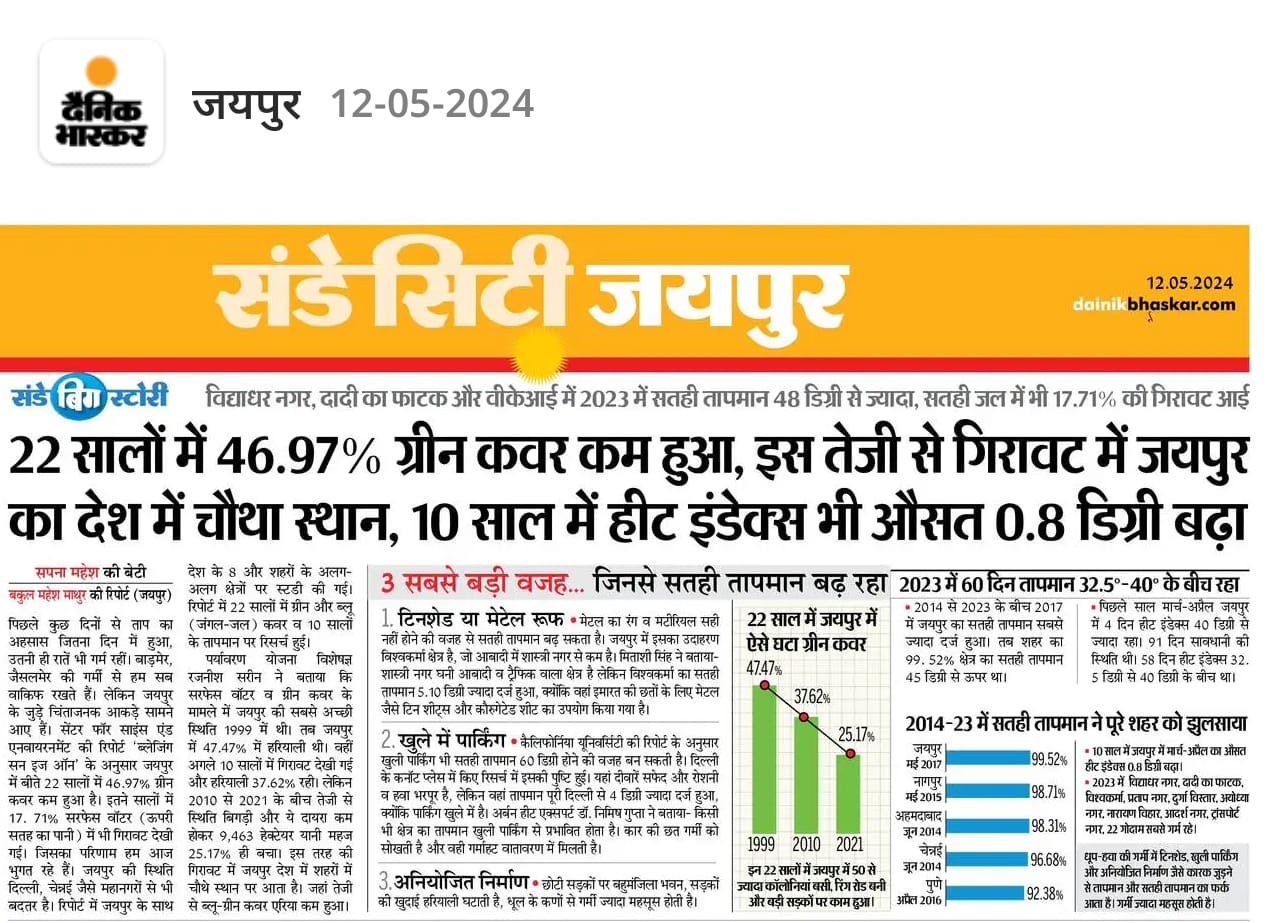
सेंटर फॉर साइंस एंड एनवायरनमेंट की रिपोर्ट, दिल्ली-चेन्नई जैसे महानगरों से भी बदतर स्थिति जयपुर की !

जयपुरः दिल्ली-चेन्नई जैसे महानगरों से भी बदतर स्थिति अब जयपुर की हो गई है. ये कोई और नहीं सामने आईसेंटर फॉर साइंस एंड एनवायरनमेंट की रिपोर्ट कह रही है. कि गर्मी का अहसास जितना दिन में, उतनी ही रातें भी गर्म होने लगी है. ऐसे में जयपुर से जुड़े चिंताजनक आंकड़े सामने आए है. ब्लेजिंग सन इज ऑन' के अनुसार बीते 22 सालों में 46.97% ग्रीन कवर कम हुआ है. इतने सालों में 17.71% सरफेस वॉटर में भी गिरावट देखी गई है. इस तेजी से गिरावट में जयपुर का देश में चौथा स्थान है. 10 साल में हीट इंडेक्स भी औसत 0.8 डिग्री बढ़ा है. रिपोर्ट में जयपुर के साथ देश के 8 बड़े शहरों का अध्ययन किया गया है.