Cse In News

Deepening water crisis in Indian cities

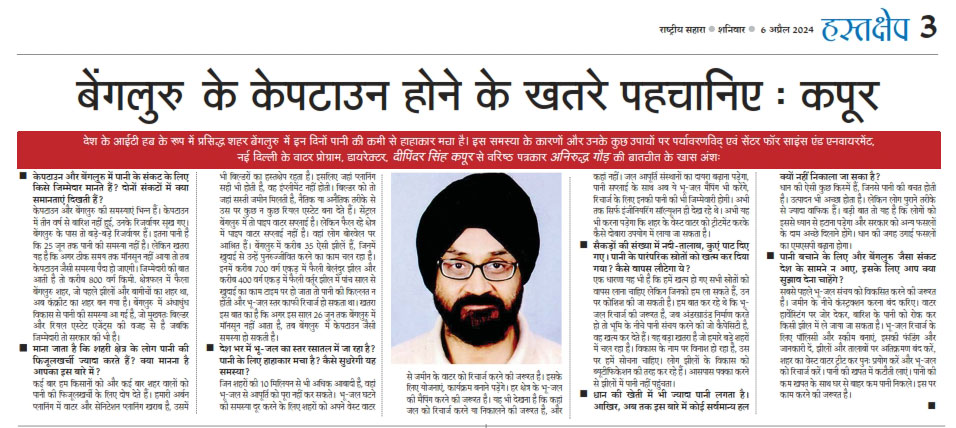
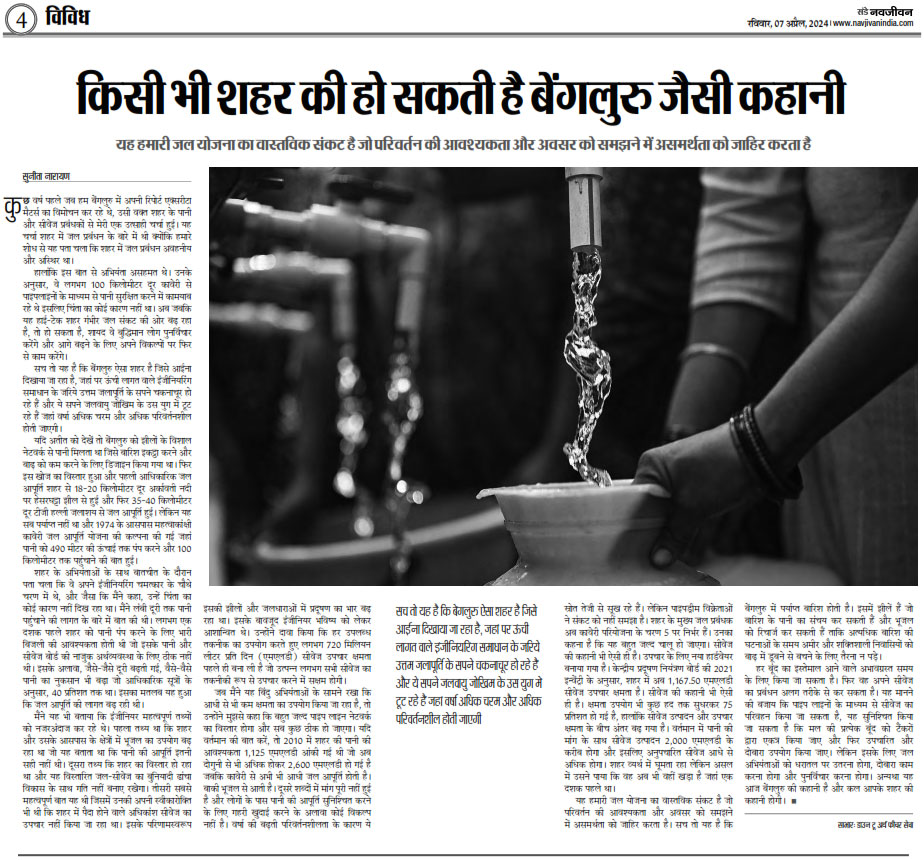
Acute scarcity of drinking water in Bengaluru has attracted national and international attention. It is facing the worst crisis in decades. The Silicon Valley of India, the IT capital is being compared with Cape Town which was declared a, zero water city. It did manage to survive with some drastic measures. The situation, however, may not be that dire in Bengaluru, well, as yet. There are ominous signals of impending crisis in several Indian cities and urban centres. There is excessive dependence on groundwater and that has clearly compounded the problem of adequate supply of fresh water. The Centre for Science and Environment finds that 48% urban water supply comes from groundwater. What is disturbing is that in 7 out of the 10 most populous cities the groundwater table is receding for the last two decades. As per a Niti Aayog report 21 cities run the risk of running out of groundwater, even at great depths of the earth’s crust. Borewells have run dry, as in Bengaluru and other places. The state government has responded with an idea of drilling more borewells in summer months. Lakes have either dried up or have been usurped by unplanned, unbridled urban development. Out of 1,700 lakes in Bengaluru, just about 200 remain, some of them too have gone dry. This is the same story in every other city in India. According to a Niti Aayog report of 2018, 40 per cent of the population will have no access to drinking water. Global warming, climate change, weak monsoons et al, have contributed to the crisis in several cities. Unplanned, unregulated growth too has played its part. For example, from a population level of 96 lakhs or less in Bengaluru in 2011, the number has now touched 1.42 crore in a short span of time. Deficit in piped water has led to flourishing trade for packaged drinking water (PDW) in most urban areas. A recent study found that 38% of the households in Kolkata and 70% in Chennai depended on 20 litre water jars for their daily needs which is now developing as an alternative mode (to piped supply). They depend upon independent but groundwater sources. With little or no regulation, the efficacy of the model is a suspect. More problematic is the issue of quality standards. In a decentralized system, there is no way of ascertaining whether water is treated or otherwise. There are players that include multinational companies along with local operators at various levels of extraction and transportation. The model scores on quick response which is vital in a resource like water. Water mafias have erupted in several cities. There are reports of sudden spurt in demand for water tankers at the level of manufacturers. Quality concerns exist in the case of piped water systems, too. Samples collected from 21 cities last year did not meet the quality standards. According to Niti Aayog nearly 70% of the water supplied to households is contaminated. Worse, Jal Pey Survekhshan revealed last month that just 10% of Indian cities meet the drinking water standards. Old and leaky pipelines that run close to sewage pipes are a common problem in several cities. Fixing the water crisis problem needs a multipronged approach. Reuse of treated water is already done in cites. More needs to be done. For example, several industrial units can do with treated water. Accurate and reliable information needs to be given by authorities, even suggesting ways and means of using such water. In agriculture too, nearly 80% of the requirement is met by fresh water, suggesting the enormous scope for saving precious fresh water. Singapore is already using treated water for drinking purposes, of course, after due processing, testing and certification. ‘Ah! Drinking sewage water’-is the common refrain in India as we are not psychologically tuned to the idea nor is the level of general awareness good enough. Secondly, every effort must be made to conserve water. Various studies and reports suggest how a huge quantity of water is wasted. Water is a finite resource. Incentives for conservation and penalties for excessive usage have to be put in place. Free or near free electricity in rural areas in several states is the root cause of depleting groundwater resources. Governments and major political parties must come to terms and refrain from competitive populism. Farmers will resist and they have shown their collective ability in blocking roads and mobilizing mass support. But they may be compensated differently, say by factoring it in MSP or cash transfers by other means. Thirdly, pricing of water needs an overhaul. Presently, there is a huge gap in cost and price charged by government agencies. In several urban centres, water is fetched from distances as far as 100 kms, as in Bengaluru. Pricing based on costs incurred will encourage savings. Cost recovery will improve finances that can be used for enhancing efficiency. Fourthly, it is time for establishing a water regulatory authority on the lines of power or electricity. Due to political compulsions, state governments will be averse to taking hard pricing decisions. An independent regulatory authority will view the issue holistically and act in a sustainable manner. Finally, it boils down to urban planning, proper regulation and sustainable development. Patently illegal constructions put pressure on water consumption. There is a suggestion that apartment buyers obtain some sort of a water bond from the builder to secure their requirement. But the buck does not stop there; if there is no water, no bond or surety will come to rescue. There are enough powers already in the hands of municipal and local bodies to deny permission for construction where no thought is given to source and supply of water to the occupants. Till such time that the water infrastructure is improved to tide over rain deficit periods, the state should adopt a calibrated approach to granting of new licences and permits. The author has four decades of experience in higher education teaching and research. He is the former first vice-chancellor of ISBM University, Chhattisgarh.
Minimum temperature in most of Bengal has increased in past 50 years

The minimum temperature in most of Bengal has increased in the past 50 years, an analysis of daily temperatures recorded in the state between 1969 and 2020 has shown. The “preliminary analysis” by scientists at Indian Statistical Institute (ISI) Kolkata also showed a rise in temperatures recorded in Alipore and Dum Dum, two weather stations in Kolkata. Discussions around global warming are not new but this is the first time that a reliable dataset has been analysed and it has emerged that Bengal, and Kolkata, have also warmed in the 50-year period. The scientists associated with the analysis said the actual degree of rise in temperatures would be published later. They did not want to divulge it immediately. The Intergovernmental Panel on Climate Change (IPCC), a United Nations panel, said in its sixth assessment report (AR6 Synthesis Report) published last year that “human activities, principally through emissions of greenhouse gases, have unequivocally caused global warming, with global surface temperature reaching 1.1°C above 1850–1900 in 2011–2020”. The report said: “Global surface temperature has increased faster since 1970 than in any other 50-year period over at least the last 2000 years.” For the study on Bengal, the temperature dataset was sourced from the India Meteorological Department. It was procured as part of preparations to make a climate action plan for the state. The ISI has sorted and analysed the data to provide indicators to the state environment department, which will prepare the climate action plan. The impact of a temperature rise will be felt in multiple sectors, including agriculture, energy, fisheries and forests, said scientists. “We have analysed the daily temperature recorded across 32 weather stations in Bengal between 1969 and 2020. The results showed an increase in minimum temperature for most of Bengal, barring the saline coastal zone,” said ISI professor Debasis Sengupta. The ISI and state environment department teams divided Bengal into seven agro-climatic zones. These are the Himalayan mountains, Sub-Himalayan plains, Barind zone, Rarh plains, Western plateau, Gangetic Alluvial zone and Saline Coastal Zone. “We plotted the temperatures recorded on a straight line and found that the line is going up, which shows that there has been a rise in the minimum temperature recorded,” he said. “The maximum and minimum temperatures recorded in Dum Dum and Alipore have also recorded a rise in this period,” he said. Sengupta sorted and analysed the dataset with fellow professor Debashis Paul and ISI research scholar Urmisha Chatterjee. The state environment department had procured rainfall data from 1901 to 2020. The temperature and rainfall datasets have been analysed for indicators of climate change. The Telegraph had earlier reported that the analysis of south Bengal’s rainfall figures over 60 years from 1961 shows a clear decline in the amount of rain in early monsoon and an increase in rain in the latter part of the season, often stretching into October. The decline in the volume of rain in June and an increase in September and October can seriously impact agriculture, hitting both kharif (monsoon) and rabi (winter) crops, said scientists. “Rainfall and temperature are the basic climatic parameters to be examined for any indications of climate change. The findings for Bengal are consistent with regional and global trends,” said Anumita Roy Chowdhury, executive director of the New Delhi-based Center for Science and Environment. Harjeet Singh, an advocate for the cause of developing countries in the annual UN climate change conference, said there was now evidence proving “direct connection between increase in temperatures and rise in climate events like floods, cyclones and droughts”. “The findings on Bengal and Kolkata send a clear message that we need to step up adaptation and mitigation measures,” said Singh, co-founder of Satat Sampada, a social enterprise promoting environmental solutions. The AR6 Synthesis Report also said human influence has likely increased the chance of extreme events since the 1950s, including increase in the frequency of concurrent heatwaves and droughts. Climate change has reduced food security and affected water security. Threat to public health has also increased manyfold. “In all regions increases in extreme heat events have resulted in human mortality and morbidity..... The occurrence of climate-related food-borne and water-borne diseases... and the incidence of vector-borne diseases... have increased,” the report said. The vector-borne disease dengue leads to mortality and illness in Bengal every year, especially during late monsoon and the few months after that.

कार्यक्रम अधिकारी सेंटर फॉर साइंस द्वारा किया गया fstp प्लांट खुर्जा का निरक्षण

आज श्री हर्ष यादव कार्यक्रम अधिकारी (सी॰एस॰ई) द्वारा बुलंदशहर की नगर निकाय खुर्जा में स्थिति FSTP का निरक्षण किया गया तथा स्वयं सहायता समूह की महिलाओं द्वारा किये जा रहे कार्यों की प्रशंसा की श्री हर्ष यादव द्वारा बताया FSSM हेतू सभी शहरवासियों को अपनी भूमिका निभानी होगी एवं सभी को प्रत्येक तीन साल में सेप्टिक टैंक ख़ाली करवाना होगा ।

Lack of scientific debate and involvement of all stakeholders will not help Project Tiger succeed

As we envision the next 50 years of Project Tiger, it is imperative to build on the lessons learned and address the gaps identified In 2023, India commemorated the 50th anniversary of Project Tiger, a landmark initiative in wildlife conservation that has long been touted to have bold and visionary measures. Its success stories, frequently highlighted by conservation stalwarts, have become a source of national pride. However, the narrative around Project Tiger needs a deeper, more nuanced understanding. Despite its early accolades, some observations suggest that the changes in tiger populations and their habitats over the past two decades have perhaps been more modest than often claimed. This discrepancy between public narrative and on-ground reality calls for a critical assessment of Project Tiger’s strategies and outcomes. The reported growth in tiger numbers from 1,411 in 2006 to 3,682 in 2022 demands careful examination in light of ecological principles and methodological discrepancies. Each assessment has seemingly led to unreliable conclusions, casting doubt on the monitoring programme’s efficacy and its success narratives. The national tiger monitoring initiative is underpinned by “model-based inference” as defined by scientists. Following the prohibition of the pugmark census method in 2004—due to its failure to detect the disappearance of tigers in Sariska and later in Panna—India’s official tiger population monitoring strategy changed course to involve the application of photographic capture-recapture methods in key areas (reserves) and index-based assessments (such as tigers, prey and human-related signs), synthesised together with a straightforward model to generate population estimates at the state and national levels. The credibility of population estimates is contingent upon the robustness of the model. However, specialists in quantitative and tiger ecology have over time demonstrated severe instability in the model being used. When these issues are acknowledged, the reported rise in tiger numbers is called into question until adjustments are made. Consider the analogy of a car in New Delhi’s heavy traffic with a speedometer reading of 200 km per hour. One would not accept this reading without question; similarly, the reported tiger numbers should not be accepted until the data has been re-evaluated. It is equally important to understand that the essence of tiger conservation extends beyond mere reporting of tiger numbers. It involves a deep understanding of tiger population ecology and the mechanisms to necessitate their conservation. The concept of the occupancy-abundance relationship, crucial in ecology, has to be invoked so that as a species’ population naturally grows, its required habitat also expands correspondingly. However, the focus in India, especially in recent times, has disproportionately been on increasing tiger numbers within confined reserves, often by neglecting the simultaneous need to expand tiger habitat in a corresponding manner. Such a scientifically counterintuitive approach has reportedly led to unnatural habitat modifications within confined reserves (such as increased view lines and creation of grasslands specifically targeting chital population rise) without making sufficient room for tigers and prey and potentially leading to increased human-wildlife conflicts, beyond natural levels. It has also brought into discussion the previously unnecessary need to manage tigers between functionally disconnected reserves. CLARIFY HUMAN IMPACT ON TIGER CONSERVATION Tiger populations face various threats that can lead to their decline, such as elimination of their prey, direct killing, and encroachment and conversion of tiger habitats for other uses such as agriculture or industrial activities. It is crucial to understand that from the tiger’s perspective, the identity of the perpetrator is irrelevant. Whether it is a local village resident hunting for sustenance or as a pastime, or a poacher from a larger, organised illegal wildlife trade network, the impact on the tiger depends entirely on how many of the big cats or prey are being removed from a local population. Likewise, whether forests are cleared for agriculture, or industrial purposes, the detrimental effect on tiger habitats is simply a function of the area lost. However, discussions within tiger conservation circles often focus more on who is causing the damage rather than the extent of the harm. This perspective has been costly for conservation efforts for big cats globally. Currently, wildlife conservation discourse often divides stakeholders into two broad categories: local communities and the forest department. This bipartite division can be counterproductive. A more effective approach would be to recognise just one category: people. All people, irrespective of their background, should collaborate on unified policies to save wildlife. This simplifies negotiations and strategies for tiger and habitat conservation. In an ideal scenario, especially in a country like India, individuals interested in wildlife conservation should be encouraged and enabled to contribute, regardless of their background. Similarly, local community members seeking opportunities in urban areas should be supported. There is a valid argument that current tiger conservation practices, largely managed by the forest department, could benefit from involving more stakeholders and refining existing practices. NEED FOR CRITICAL, SCIENCE-BASED APPROACH Despite widespread belief that the tiger is a very well-studied species, the reality is that our understanding of their ecology is surprisingly shallow. Significant funds are allocated to tiger conservation science, particularly for periodic population monitoring, yet the insights yielded often muddy our understanding rather than clarify it. For instance, we are encountering paradoxical trends such as the inverted relationship between tiger occupancy and abundance. Moreover, alongside growing evidence of inbreeding in certain populations, there is an increase in their numbers within the same habitats, a complex scenario to untangle. Such contradictory conclusions could misguide future conservation efforts if used as a basis for policy decisions. Furthermore, the lack of vibrant scientific debate and questioning within the Indian conservation and scientific community is a significant concern. Unlike other scientific fields, where progress is marked by constant questioning and re-evaluation, the progress of tiger conservation in India has seen little of this dynamic. The prevailing acceptance of increasing tiger numbers, without substantial discussion, points to a need for a more robust scientific discourse in the field. Tigers, being a globally important species, have traditionally attracted the involvement of several large international non-governmental organisations (NGOs) in conservation efforts. Many of these organisations also have a presence in India. It is crucial for these NGOs to actively shape and guide the scientific discourse. However, a major issue arises when these large institutions refrain from criticising or show support to the existing tiger conservation narratives in India even when the scientific findings suggest the contrary. This scenario often leaves little room for robust scientific debate, essential for effective conservation and may dissuade smaller institutions from contributing to the debate. In such circumstances, it might be more prudent for international NGOs involved in tiger conservation and operating in India to reconsider whether and how they can contribute meaningfully to the scientific discourse. As we envision the next 50 years of Project Tiger, it is imperative to build on the lessons learned and address the gaps identified. The project must evolve to incorporate advanced scientific methodologies, foster a culture of critical inquiry, and ensure that conservation strategies are responsive to ecological realities. There must be a sound scientific basis for tiger conservation, which can be modelled along the lines of other rigorous programmes in India, for example, space research. Arjun M Gopalaswamy is founder and scientist at Carnassials Global, Bengaluru, a science advisory firm This was first published in the State of India’s Environment 2024 published by Centre for Science and Environment and Down To Earth Magazine https://www.downtoearth.org.in/news/wildlife-biodiversity/lack-of-scientific-debate-and-involvement-of-all-stakeholders-will-not-help-project-tiger-succeed-95368

Heimang, Heiribob, Yaipan of Manipur make it to India’s 100+ recipes

Manipur’s cherry-like tiny tree fruit, Heimang, Heiribob, a citrus fruit and even Yaipan, a funnel-shaped wildflower, besides Awa-Phadigom, a flavouring agent, were listed among the various plants that make India’s 100+ recipes. These plants sourced from local biodiversity were categorically and beautifully described in a recently released book, ‘First Food: Future of Taste', published by the Centre for Science and Environment (CSE), a New Delhi-based public interest research organisation. “This book is a primer for surviving food shortages brought on by the uncertainties of extreme weather events. Many of the plants that make the recipes featured in the book are still found in our backyards or can be grown and harvested for food,” says Director General Sunita Narain of CSE. “India is one of the 17 mega-diverse countries and has 11 percent of the world’s plant species. It is only when this biodiversity is lived that it will live.” In fact, Heimang (Rhus chinensis), a deep red cherry-like, tiny spherical tree fruit, has a citrus-like tartness and is packed with nutrients such as polyphenols, flavonoids and antioxidants. This fruit is useful for indigestion,stomach ulcers,kidney diseases and urinary stones. Traditionally in Manipur, Heimang (Rhus chinensis) is used for gastrointestinal problems like diarrhoea and dysentery, according to a write-up in the book by Vibha Varshney, consulting editor of Down to Earth magazine. Stating that locals prepare herbal shampoo (Chinghi) out of Heimang leaves after boiling them with rice water in Manipur, she wrote, “In ancient China, certain communities used to add the fruit to food for its salty taste.” Thus, the promotion of such traditional products will provide livelihood opportunities to communities with access to the tree, which grows in warm temperatures, she felt. On the other hand, Yaipan (Curcuma angustifolia), a funnel-shaped wildflower with shades of deep purple, blue, pink and white, is a favourite kitchen item in Manipur. In a write-up by Chitra Balasubramaniam in the book, it is used in Ayurveda for its healing properties and is believed to cure tuberculosis, asthma, cough and burning sensations in the body, says a 2015 paper published in the Journal of Pharmacology and Phytochemistry.

Yaipan, Heimang, Heiribob among listed plants that make India’s 100+recipes

Manipur’s cherry like tiny tree fruit Heimang, Heiribob-a citrus fruit and even Yaipan-a funnel shaped wildflower besides Awa-Phadigom-a flavouring agent, were listed among the various plants that make India’s 100+recipes. These plants sourced from local biodiversity were categorically and beautifully described in a recently released ‘First Food: Future of taste’ -a book published by Centre for Science and Environment (CSE), a New Delhi based public interest research organisation. “This book is a primer to survive food shortages brought in by uncertainties of extreme weather events. Many of the plants that make the recipes featured in the book are still found in our backyards or can be grown and harvested for food,” says Director General Sunita Narain of CSE.”India is one of the 17 megadiverse countries and has 11 percent of the world’s plant species. It is only when this biodiversity is lived that it will live.” In fact, Heimang(rhus chinensis) -a deep red cherry like tiny spherical tree fruit has a citrus like tartness and is packed with nutrients such as polyphenols, flavonoids and antioxidants. This fruit is useful for indigestion, stomach ulcer, kidney diseases and urinary stones. Traditionally in Manipur, Heimang (rhus chinensis)is used for gastrointestinal problems like diarrhoea and dysentery, according to a write up in the book by Vibha Varshney, consulting editor of Down to Earth magazine. Stating that locals prepare herbal shampoo (Chinghi) out of Heimang leaves after boiling with rice water in Manipur, she wrote, “In ancient China, certain communities used to add the fruit to food for its salty taste.” Thus, the promotion of such traditional products will provide livelihood opportunities to communities with access to the tree which grows in warm temperatures, she felt. On the other hand Yaipan (curcuma angustifolia)-a funnel shaped wildflower with shades of deep purple, blue, pink and white is favourite kitchen item in Manipur. In a write-up by Chitra Balasubramaniam in the book, it is used in Ayurveda for its healing properties and believed to cure tuberculosis, asthma, cough & burning sensation in the body, says a 2015 paper published in Journal of Pharmacology and Phytochemistry. Also known as tikhur in hindi,keturi haoldi in Bengali and tavakeera in Marathi and East Indian Arrowroot in English,pakoda and chutney of Yaipan which smells of turmeric when eaten raw, are popular side-dishes in Northeast. A sun-dried candy made from Heiribob (citrus macroptera),a citrus fruit found in Manipur also prominently mentioned in the book. Similarly, Awa-Phadigom (eryngium foetidum)-Wild coriander which is a popular flavouring agent in Manipuri kitchens particularly in meat and vegetable dishes. This wild aromatic plant which has small leaves spiked at the edges, can also be used as medicine for constipation and epilepsy. It can tolerate heat, drought and has potential to increase marginal farmers’ climate resilience. Serious efforts to cultivate it(Awa-Phadigom) on a large scale can increase income of growers and sellers, according to another write-up of Chitra Balasubramaniam in the book. Interestingly tasty rice kheer made from Manipur’s black rice ‘Chak-hao’ which bagged Geographical Indication tag in 2020, is also slowly coming up as a well-known dessert in the Indian cities.

UoM School Of Planning And Architecture Signs MoU With CSE

University of Mysore and Centre for Science and Environment (CSE), New Delhi, have signed a Memorandum of Understanding (MoU) for knowledge exchange and capacity building on sustainable habitat. CSE, a Delhi-based environment research and advocacy organisation and SPA have extended their two-year old engagement to mainstream sustainability in the built environment, Energy Efficiency, Circular Economy, Clean and Low Carbon Strategies etc. UoM Vice-Chancellor, Prof. N.K. Lokanath and V.R. Shylaja, Registrar, Prof. Nagaraj, PMEB Director, Prof. Pramod M. Gawari, Director, SPA and Dr. H.S. Kumara, HoD and Associate Professor, SPA were present from UoM. Rajneesh Sareen, Programme-Director, Sustainable Building and Habitat programme, CSE, New Delhi represented in the signing ceremony. The purpose of this engagement is to sensitise the faculty and students on rising environmental challenges and the need to incorporate climate action in education and professions such as planning, architecture, engineering and other sciences. Following the signing of MoU, CSE and SPA organised a special lecture themed at ‘Heat Resilience Planning and Governess”. About 40 faculty members and 150 students from Planning and Architecture Departments of the University participated. The theme of the programme focused on heat resilience planning and governess as cities are getting warmer every year and the rainfall is becoming erratic due to the urban heat island effect, stated a press release from the Director, School of Planning and Architecture, Manasagangothri.

MUZAFFARNAGAR-तकनीकी टीम ने किया एफएसटीपी का निरीक्षण, मिली कई खामियां

यूरोपियन देशों के सहयोग से फीकल स्टज ट्री टमेंट के लिए अमृत भारत योजना के अन्तर्गत तैयार 25 केएलडी प्लां ट बिना तकनीकी जांच के ही बड़ी खामियों के बावजूद नगरपालिका परिषद् को हैंडओवर कर दिया। आधी-अधूरी तैयारियों वाले इस एफएसटीपी के संचालन के लिए पालिका प्रशासन ने छह कर्मचारियों की तैनाती कर पूरी तैयारी भी कर ली थी, लेकिन जब प्लांट खामियों के कारण नहीं चल पाया तो शासन ने संज्ञान लेकर यहां पर विशेष तकनीकी टीम भेजकर इसके निर्माण की जांच कराई, जिसमें अनेक खामियां पाये जाने पर टीम ने मौके पर ही कार्यदायी संस्था जल निगम के अधिकारियों को तलब किया और समाने आई खामियों को तत्काल दूर कराकर नियमित प्रक्रिया के साथ पालिका प्रशासन को हैंडओवर करने के निर्देश दिये। टीम अपनी जांच रिपोर्ट शासन को सौंपेसौं पेगी। वहीं पालिका ईओ प्रज्ञा सिंह ने स्पष्ट कर दिया है कि प्लांट में खामियां दूर होने से पहले पालिका इसको हस्तगत नहीं करेगा। केन्द्र सरकार की अमृत योजना के अन्तर्गत यूपी के सभी जिलों में यूरोपियन तकनीकी सहयोग के तहत फीकल स्टज ट्री टमेंट प्लां ट (एफएसटीपी) का निर्माण किया गया है। इसी कड़ी में जनपद में भी नगरपालिका परिषद् की मौहल्ला किदवईनगर में स्थित भूमि पर 25 (केएलडी) किलोलीटर प्रतिदिन की क्षमता वाला एफएसटीपी बनाया गया। इसके निर्माण के लिए कार्यदायी संस्था सीएण्डडीएस जल निगम उत्तर प्रदेश (नगरीय) रही। इसके निर्माण पर अमृत योजना के तहत करीब 85 लाख रुपये का बजट तैयार किया गया है। प्लांट के संचालन से शहर के निजी और सार्वजनिक शौचालयों के सेप्टिक टैंक की गंदगी का निस्तारण होने के साथ ही जैविक खाद बनाने की योजना है। इस खाद को कृषि कार्यों के लिए बेचकर पालिका प्रशा सन की आय बढ़ाने और प्रदूषण से निस्तारण का उद्देश्य लेकर काम किया जा रहा है। इतना ही नहीं सेप्टिक टैंक से मल के साथ निकले वाले गंदे पानी का ट्री टमेंट भी प्लांट में करने की सुविधा है। ताकि इस पानी से भी खेतों की सिंचाई का कार्य किया जा सके। पालिका के इस एफएसटीपी का संचालन नहीं होने की जानकारी मिलने पर नगरीय निकाय निदेशालय लखनऊ से सेंटर फाॅर साइंस एण्ड एनवायरमेंट की दो सदस्यीय टीम ने पालिका की ईओ प्रज्ञा सिंह के साथ प्लांट का स्थलीय निरीक्षण कर व्यवस्था को तकनीकी पैमाने पर परखा। इसमें यह प्लांट फेल साबित हुआ। जांच टीम के अधिकारियों में शामिल वरिष्ठ कार्यक्रम प्रबंधक सुब्रोतो चक्रवर्ती और उप कार्यक्रम प्रबंधक हर्ष यादव ने पूरे प्लांट का भ्रमण कर एक एक व्यवस्था को तकनीकी स्तर पर परखने का काम किया तो कई खामियां पाई गई। इस दौरान ईओ प्रज्ञा सिंह को टीम के अधिकारियों ने जब इन खामियों के बारे में बताया तो उन्होंनेन्हों नेआधी अधूरी तैयारी के बीच ही जल निगम द्वारा प्लां ट पालिका को हैंडओवर करने पर नाराजगी जताई। इसके बाद जांच टीम के अधिकारियों ने सीएण्डडीएस जल निगम नगरीय के अधिकारियों को मौके पर ही तलब किया। परियोजना प्रबंधक आबू जैद और अवर अभियंता एनके पाल कुछ ही देर में वहां पहुंचे तो टीम की नाराजगी का सामना करना पड़ा।

तकनीकी खामियों के कारण नहीं चला ट्रीटमेंट प्लांट

मुजफ्फरनगर। अमृत योजना में बना नगर पालिका का ट्रीटमेंट प्लांट नहीं चल पाया है। शासन के निर्देश पर लखनऊ से आई टीम ने प्लांट की जांच की। मौके पर ही कार्यदायी संस्था जल निगम के अधिकारियों को तलब किया और सामने आई खामियों को तत्काल दूर कराकर नियमित प्रक्रिया के साथ पालिका प्रशासन को हैंडओवर करने के निर्देश दिए। केंद्र सरकार की अमृत योजना के अंतर्गत किदवईनगर में स्थित भूमि पर 25 (केएलडी) किलोलीटर प्रतिदिन की क्षमता वाला एफएसटीपी बनाया गया। इसके निर्माण के लिए कार्यदायी संस्था सी एंड डीएस जल निगम उत्तर प्रदेश (नगरीय) रही। प्लांट के संचालन से शहर के निजी और सार्वजनिक शौचालयों के सेप्टिक टैंक की गंदगी का निस्तारण होने के साथ ही जैविक खाद बनाने की योजना है। इस खाद को कृषि कार्यों के लिए बेचकर पालिका प्रशासन की आय बढ़ाने और प्रदूषण से निस्तारण का उद्देश्य लेकर काम किया जा रहा है। पालिका के इस एफएसटीपी का संचालन नहीं होने की जानकारी मिलने पर नगरीय निकाय निदेशालय लखनऊ से सेंटर फॉर साइंस एंड एनवायरमेंट की दो सदस्यीय टीम ने पालिका की ईओ प्रज्ञा सिंह के साथ प्लांट का स्थलीय निरीक्षण कर व्यवस्था को तकनीकी पैमाने पर परखा। इसमें यह प्लांट फेल साबित हुआ। जांच टीम के अधिकारियों में शामिल वरिष्ठ कार्यक्रम प्रबंधक सुब्रोतो चक्रवर्ती और उप कार्यक्रम प्रबंधक हर्ष यादव ने पूरे प्लांट का भ्रमण कर एक एक व्यवस्था को तकनीकी स्तर पर परखने का काम किया तो कई खामियां पाई गईं। इस दौरान ईओ प्रज्ञा सिंह को टीम के अधिकारियों ने जब इन खामियों के बारे में बताया तो उन्होंने आधी अधूरी तैयारी के बीच ही जल निगम ने प्लांट पालिका को हैंडओवर करने पर नाराजगी जताई। जांच टीम के अधिकारियों ने सी एंड डीएस जल निगम नगरीय के अधिकारियों को मौके पर ही तलब किया। परियोजना प्रबंधक आबू जैद और अवर अभियंता एनके पाल के सामने नाराजगी जताई।