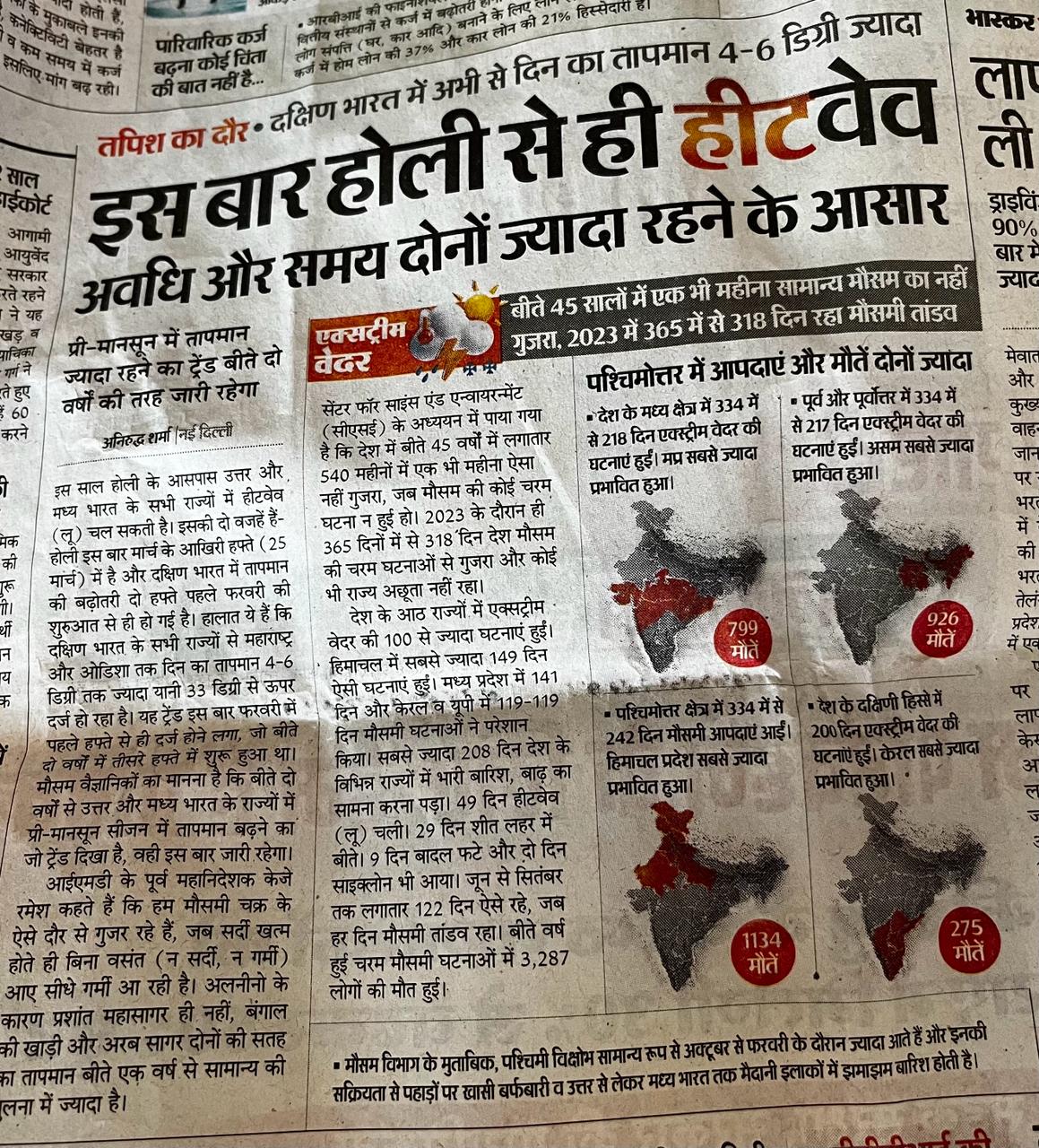
A chilling revelation has emerged as India faced a relentless onslaught of extreme weather events throughout 2023, leaving no state or union territory untouched by its devastating impact. The Centre for Science and Environment's "State of Environment 2024" report has painted a grim picture, indicating a disturbing trend of climatic disruptions persisting for approximately 318 out of 365 days, driven by the ominous specter of climate change. The report said the climate-vulnerable country had extreme weather on 86 per cent of days from January to September.
ALWAR (RAJASTHAN): Year 2023 was categorized to be one of the warmest years on record which was 1.48 degree C warmer than the average temperature recorded from 1850-1900. Previous warmest year record of 2016 was breached by 0.17 Degree Celsius. The rise in temperature has been attributed to the El Nino effect which is likely to trigger heat wave spells even this summer as it gradually fades out by May. Keeping under consideration the possible heat wave conditions that will prevail, weather experts have expressed concern over the impact it can have when the Lok Sabha Election process is underway. Professor at Indian Institute of Tropical Meteorology (IITM) Pune, Roxy Mathew Koll shared a detailed study here on Wednesday to predict heat wave conditions beginning as early as March and continuing through May, when at one hand the El-Nino effect will subside giving way to La-Nina effect. “Though El-Nino is the hot marine streams that warms up the environment, La-Nina theoretically brings in a cooling effect with cold streams but the overall impact does not quantitatively mitigate the heating effect of El-Nino,” he said. Citing the example of Maharashtra Bhushan award ceremony of April 16, 2023 when as many as 13 people attending the mammoth gathering at Khargarh in Navi Mumbai died of heat stroke, Koll said that the temperature that day was between 34-38 degree Celsius. “It was not the temperature alone but the associated relative humidity of over 45% that was the culprit and did not allow the bodies of the victims to regulate its internal temperature via sweating. “Though the heat is blamed, it is the lack of basic precautions that led to the casualty,” he said, further issuing a caution that during 2024 electioneering such precautions must be in place. Corroborating the findings of IITM Pune, former director general of India Meteorological department, Dr KJ Ramesh who was speaking on the topic of ‘Heat waves: their prediction and current trends’ at the annual Anil Agrawal Dialogue (AAD-2024) organized by Centre for Science and Environment (CSE) said that higher humidity in coastal areas adds to the morbidity factor. “We have noticed unexplained death of newborns in the hospitals of Telengana during 2023 summers, where the maternity ward was located on the top floor. After observing the trend all hospitals were asked to shift their maternity wards,” he said, admitting that there must be precautionary measures in place before the campaign and election process for Lok Sabha election begins. The IITM Pune has released a set of advisory to this effect asking election commission and local administration to make adequate arrangements. “All campaigns and rallies should be planned with the heat impacts factored in. IMD will disseminate heat wave forecasts that should be followed, awareness campaigns, shaded waiting areas, hydration stations, cooling centres, healthcare facilities, flexible attire guidelines, transportation arrangements and outreach to vulnerable communities must be prioritised,” he said. Koll further added that on voting day, extended voting hours could be an option in localities where heatwave is forecasted, Polling booths should ensure that people standing in queues for long hours have access to shade water and toilets.
The Himalayan region, known for its majestic peaks and serene landscapes, has become a hotspot for natural disasters, accounting for 44% of all such events in India between 2013 and 2022, according to the latest State of India’s Environment 2024’ report, released by the Centre for Science and Environment (CSE). A staggering 192 incidents, including floods, landslides, and thunderstorms, have ravaged the region, with the recent cloudbursts and torrential rains of 2023 serving as a grim prelude to a more turbulent future. Kiran Pandey, head of CSE’s Environment Resources Unit, notes an alarming trend in the data, “Disasters are not only becoming more frequent but also increasingly severe, leading to significant loss of life and property.” In just one year, from April 2021 to April 2022, 41 landslide incidents were reported, with the majority occurring in the Himalayan states.
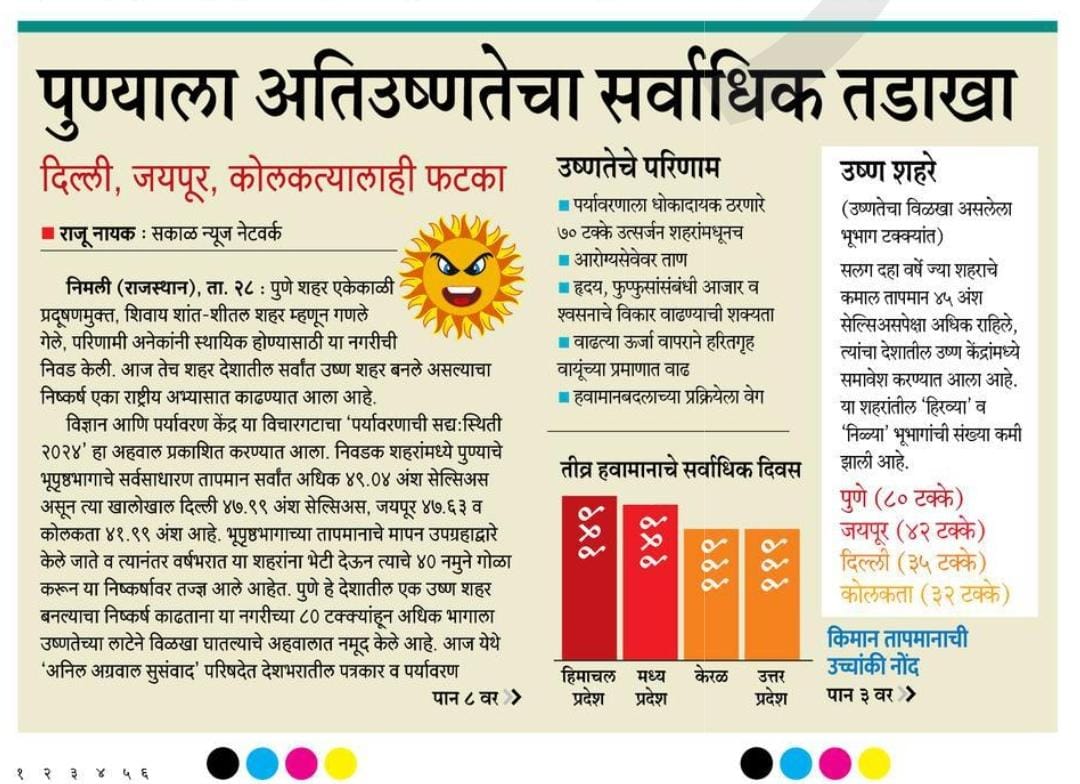
The year 2023 has been the warmest year on record in the history of the Earth – 1.48 degrees warmer than the 1850-1900 period (pre-industrial average); the year also had the highest number of days with global mean temperatures above 1.5oC. Centre for Science and Environment’s (CSE’s) annual Anil Agarwal Dialogue, a national conclave of environment and development journalists, started off here today with these dire assessments of the year gone by. This and other data feature in the State of India’s Environment 2024 report, which was released at this Dialogue by economist Nitin Desai, senior journalist T N Ninan, and CSE director general Sunita Narain. The report is collated and published annually by Down To Earth magazine. The report presents data that says about 109 nations suffered losses due to extreme weather events in 2023, with countries in Africa, Europe and West Asia taking up the lion’s share: 59 countries in this region were impacted and the highest number of deaths from these events happened in this region. Indonesia had the maximum number of affected people (almost 19 million), while Libya suffered the most deaths. In India, 2023 saw its warmest ever August and September in 122 years. Through the year, the country witnessed an extreme weather event almost every day – over the 365 days between January 1 and December 31, such events happened on 318 days. They claimed 3,287 human lives, affected 2.21 million hectare (ha) of crop area, damaged 86,432 houses and caused 124,813 animal deaths. All 36 states and Union territories were affected. Himachal Pradesh recorded the highest number of extreme weather events, with 149 days, followed by Madhya Pradesh with 141 days. Kerala and Uttar Pradesh were next with 119 days each
India faced a staggering 318 days of extreme weather events in 2023, impacting all states and union territories. Heavy rains, floods, landslides, and other destructive phenomena wreaked havoc, resulting in significant loss of lives and damage to crops and livestock. Consequences of Extreme Weather Events The consequences of the extreme weather events in 2023 were devastating, with thousands of lives lost, extensive damage to crops, and a significant impact on livestock. The report highlights the urgent need for comprehensive action to mitigate the risks associated with such events and build resilience for the future. Call for Action Sunita Narain emphasized the importance of addressing the environmental challenges posed by the extreme weather events of 2023. Strengthening regulatory institutions and moving beyond mere technological solutions are crucial steps towards ensuring environmental sustainability and combating climate change. India witnessed an alarming escalation of extreme weather events in 2023, according to a new report by the Centre for Science and Environment (CSE). The report, titled "State of India Environment 2024," reveals that the country experienced such extreme events on a staggering 318 out of 365 days, impacting all states and union territories (yep, every single one of them). https://weather.com/en-IN/india/news/news/2024-02-29-india-experienced-extreme-weather-nearly-every-day-in-2023
ndia recorded extreme weather events on 318 of the 365 days in the year 2023, with all states and Union territories experiencing such events on at least one day, according to a new report released on Wednesday. These extreme weather events resulted in 3,287 human deaths, 1.24 lakh animal deaths, and damage to 2.21 million hectares of crop area, a report by independent think tank the Centre for Sc Himachal Pradesh recorded the highest number of days with extreme weather at 149, followed by Madhya Pradesh with 141, and Kerala and Uttar Pradesh with 119 each. Eight states recorded more than 100 days of extreme weather, the report said. Heavy rains, floods and landslides were recorded on 208 days in 2023. Lightning and storms occurred on 202 days, heatwaves on 49 days, cold waves on 29 days
From effectively segregating and managing waste to harvesting rainwater, creating a green cover and installing solar panels, winners of awards under the Centre for Science and Environment’s (CSE) Green Schools Programme have been trying to do their bit for the environment. The Centre for Science and Environment, a non-profit organisation working on environment protection and management, launched the Green School Programme in 2005. Under it, schools register with the non-profit and work towards becoming “resource efficient”. The resources include usage of water, air, fuel or energy. A coordinator from each school works with a team of 60 students and takes part in the evaluation and audit. Details of resource consumption are uploaded on the CSE portal. The CSE team analyses the data and accordingly awards ratings to schools. Those who have done the most outstanding work are awarded. Five green schools did the best in five categories – waste, water, land, energy, and air – and were awarded. Apart from these, two schools won ‘Changemaker Awards’ and another 12 ‘Sterling School Awards’. The former have improved their rating to green and the latter have been rated green for five consecutive years or more. Waste Warrior BK Birla Public School, Kalyan, Thane, Maharashtra The school had applied last year. “Some of our practices include segregating waste in seven different categories. Even the affluents from the chemistry and biology labs are treated separately and purified. We have our own sewage treatment plant. So wastewater is treated and reused for plants and restrooms,” said Vikas Zunjarrao, the school coordinator. “We also have a special weekly drive where students from different houses collect plastic from their homes and neighbouring areas. Whichever house collects the most gets extra points. This plastic is also segregated. It is then given to a government-recognised plastic recycler which, after every 300kg, provides a garden bench for the school park,” he said. The school has thus far collected 2,500kg of plastic. Further, plastic and packaged food is banned on the campus. Land Manager Zila Parishad High School, Gandaboyana Palli, Annamayya, Andhra Pradesh “Our best practices include planting 3,000 saplings over half an acre – four plants per square metre,” said J Kishore Kumar, the school coordinator. The plants include red sandalwood, teak, lemon grass, acacia, neem, bryophyllum, and cassava. This initiative was supported by the Andhra Pradesh Mahila Sadhikara Samstha which has contributed Rs 7,00,000, he said. Students are at the heart of the school’s push for sustainability. “We’ve engaged them on topics such as biodiversity, environmental safety, and the plight of endangered animals. Our initiatives also extend to the use of natural fertilisers such as cow dung, sheep dung, and dry leaves. This holistic approach to cultivation not only nurtures the soil but also aligns with our ethos of sustainable and eco-friendly practices,” he added. Water Wise Lake Montfort School, Bengaluru, Karnataka The school has received a green school award for several years in a row and has also received the Changemaker Award for three years. “We have been carrying out drives on awareness and eco-friendly practices. We started implementing such practices through school assemblies, using solar panels, developing gardens in the school with fruits, and using natural manure and compost. We also have two wells 2 lakh litres capacity each to harvest rainwater. This water is purified and used in piped water, drip irrigation and sprinklers. We have never drawn groundwater,” explained Gnanasekar Y, the coordinator. Air Action PM SHRI Kendriya Vidyalaya AFS Akkulam, Thiruvananthapuram, Kerala This was the school’s first GSP award. The school campaigned to promote non-polluting modes of transport which resulted in a 133% jump in students and staff abandoning private transport for other modes. “The school strictly avoids use of diesel and petrol. The school also has 48% green area coverage within its premises. Last academic year, the school introduced solar energy as a sustainable power source. Other initiatives include a two and three-bin system, eliminating the use of mixed or single bins, recycling its wet and dry waste, and prohibiting any kind of packaged food within the school campus,” said E Xavier Raj, biology teacher and school coordinator.
Alwar's battle with air pollution, primarily stemming from its mineral- and stone-based industries, has prompted an urgent call for action. Recognized as a 'non-attainment city' under the National Clean Air Programme (NCAP) by the Union Ministry of Environment, Forest and Climate Change in 2019, Alwar has been the focus of a recent assessment by the Centre for Science and Environment (CSE). This assessment identifies fugitive emissions, industrial waste dumping, and burning as major contributors to the district's deteriorating air quality. In response, a strategic workshop titled "Improving Environmental Performance of Industries in Alwar" was conducted, aiming to devise a comprehensive roadmap for mitigating air pollution. The Pollution Predicament According to the CSE's findings, approximately 1,200 air-polluting industries operate within Alwar, with a significant number contributing to fugitive emissions and excessive fuel consumption. These include 300 mineral-grinding units and 45 stone crushers, highlighting the magnitude of the problem. Fugitive emissions, in particular, have been identified as a pervasive issue, leading to severe air quality degradation and posing health risks to the local population. The workshop brought together various stakeholders, including representatives from the Rajasthan State Pollution Control Board (RSPCB), industrial associations, and environmental experts, to address these challenges head-on. Collaborative Efforts for Cleaner Air The workshop underscored the importance of compliance with environmental regulations and the adoption of pollution control measures. Nivit Yadav, Programme Director of Industrial Pollution at CSE, emphasized the need for industries to adhere to strict environmental guidelines to reduce emissions. Additionally, the absence of adequate industrial waste management infrastructure was highlighted as a contributing factor to Alwar's pollution woes. Recommendations from the workshop include ensuring all mineral grinding and stone crusher units comply with RSPCB guidelines and improving waste management practices within industrial zones. Path Forward: Recommendations and Actions Key recommendations from the workshop include the strict enforcement of environmental guidelines, the installation of well-maintained pollution control equipment, and withholding consent to operate for non-compliant industries. These measures aim to significantly reduce fugitive emissions and improve air quality in Alwar. Moreover, establishing a robust industrial waste management infrastructure is deemed essential for the long-term sustainability of the district's environment. The collaboration between CSE and RSPCB represents a positive step towards addressing Alwar's air pollution crisis, with the potential to serve as a model for other regions facing similar challenges. As Alwar embarks on this crucial journey towards cleaner air, the collective efforts of government bodies, industries, and the community will be pivotal in achieving lasting environmental improvements. The roadmap laid out in the workshop not only addresses the immediate concerns but also sets the foundation for a sustainable future, ensuring Alwar's rich mineral heritage does not come at the expense of its environmental health.
In its pursuit to gauge the efficacy of how municipal bye-laws are being used by Indian cities to effectively enforce legal measures towards circular economy in solid waste management (SWM), Delhi-based think tank Centre for Science and Environment (CSE) initiated a national scale study encompassing 37 cities from the cross-sections of east, west, north and south India. While selecting the states, population and other demographic factors like hilly cities, cities on the coast, riverine cities, etc. were considered as much as possible. Data collected during the study looked into three different aspects of municipal bye-laws and its implementation on the ground. In order to analyse the current state of municipal bye-laws as a public policy, the methodology considered the assessment of bye-laws as a legal and enforceable instrument at the disposal of urban local bodies (ULB). The cities were asked specific questions on the state of implementation according to their own provisions of the bye-laws, which were further triangulated during field visits and interactions with the stakeholders. Citizens were asked specific questions to evaluate the state of implementation of various elements of bye-laws according to their observations and experiences as recipients of the service. An analysis of 37 municipal bye-laws across India has led to the understanding that all the relevant components of municipal bye-laws for SWM have found their place in the respective bye-laws. Source segregation of waste, door-to-door waste collection, prohibitions for open dumping, user charge collection and penal provisions for contravention have been found in almost all the bye-laws studied. Prevalence of various components in various bye-laws studied by CSE Urban India generates nearly 160,000 tonnes of waste per day. As per Central Pollution Control Board report 2020-21, only 50 per cent of the collected waste gets processed and 18 per cent of the collected waste gets dumped 31 per cent remains unaccounted. It gets piled up in various places, causing air land and water pollution and contaminating marine ecosystems by finding its way to the oceans through the land to see pathways. Field level findings suggested that even this estimation is overrated, as heaps of waste are still a common sight in cities. Despite strong mandates, fresh waste is still being dumped conveniently next to sites where old dumpsites are being remediated under the flagship Swachh Bharat Mission 2.0. During the study, CSE also found that proper implementation and enforcement of certain provisions in the bye-laws could have brought desired changes in waste management practices. The colossal growth in population coupled with migration to cities has increased the challenge of urban SWM manifold. The bye-laws from various cities have strict mandates to promote and adopt the 3R principle, including a range of strong enforcement measures like 100 per cent source segregation, on-time door-to-door collection, IT systems based monitoring of waste management operations, etc. Bye-laws also called for behaviour change drives to inform the citizens about the provisions of the bye-laws and enhance community participation. It also spoke of the compliance by bulk waste generators (BWG). Some of the bye-laws mandate the integration of informal waste workers into the mainstream waste management value chain and includes provisions to treatment and processing of waste going to the landfill. Bye-laws have also been found emphasising decentralised waste management, strengthening penal provisions for open dumping, burning, littering and not segregating at source. In some cities, bye-laws were found to be critical in recovering fines and collecting user fees from citizens against waste management services. In its study, CSE did a three-fold analysis of some components of the bye-laws. First are the components available in the respective bye-laws. It then checked with the sample cities about the implementation status of the same, and then again, it did an opinion poll with the citizens to validate the data. The results showed that the implementation status of the municipal bye-laws on SWM requires a lot of attention to strengthen. Some highlights of the study findings are summarised below, along with an interpretation of the collected data. SOURCE SEGREGATION All bye-laws studied have the provision for mandating source segregation — 59 per cent cities claimed that they were enforcing and practicing source-segregation using the bye-law, but only 32 per cent citizens agreed with the cities’ claims.
Ajay Sood: We have witnessed consistent growth in India’s overall science and technology (S&T) spending. However, in terms of international comparability we are stagnant at 0.7% of GERD to GDP ratio. This clearly indicates that we need to increase our budgetary commitments to S&T. The private sector contribution to India’s GERD is still at the level of 36% whereas the remaining 64% is from public sources. This pattern is contrary to what we see in advanced economies where a majority share of GERD is from the private sector. While the Indian government has committed to increase the public investments into research and innovation activities significantly with the recent initiatives and announcements, the private sector stakeholders including foreign MNCs should seize this opportunity and increase their commitment to research and innovation. The provisions of the Anusandhan National Research Foundation (ANRF) Act have been brought into force on 5 February 2024. With a few more administrative steps, this year we can expect some programme level activities. NI: What is the focus of India’s science and research right now? AS: India is working to strengthen its scientific enterprise – from semiconductor fabrication set-ups to exporting green hydrogen and decarbonization of the steel and allied sectors. India has reached its goal of achieving 50% energy from renewable sources before the targeted date of 2030 and it is on track for reaching net zero emissions by 2070. The country is recognised as a hub of startups. The Startup India initiative designed to invigorate the startup ecosystem has a good mix of IT services, healthcare and life sciences, education, agriculture and other professional and commercial services. We are assisting start-ups with tax incentives, simple regulations and intellectual property rights. NI: What is your vision for science in India? AS: Using science and its applications for societal and planetary good. Science and technology must have tangible, real-world applications. We have created a platform called ‘Manthan’ where industry and research come together to create technology-centred roadmaps that we finance and facilitate. To meet the United Nations' (UN) Sustainable Development Goals (SDG), we are prioritising clean energy initiatives such as incentives for electric vehicles and the ‘waste to wealth’ programme and national missions around hydrogen, quantum physics. A National Research Foundation is being put in place to aid research and innovation with participation from private parties. During India’s G-20 presidency in 2023, we also organised a Chief Science Advisors Roundtable (CSAR) affirming the commitment for collective leadership on global science advice. NI: India’s space sector made waves with historic launches in 2023. Are there plans to bolster this sector further? AS: Space technology entails high-end research and sound technical knowledge. Therefore, we are upskilling the sector with dedicated research programmes for young scientists. Since 2014, we have witnessed an increase in the frequency of India’s space missions. So far, 45 spacecraft missions, 43 launch vehicle missions and 5 technology demonstrators, have been successfully realized, including the Mars Orbiter Mission, the PSLV C37 with a record 104 satellites, a Small Satellite Launch Vehicle (SSLV – D2), Chandrayaan and Aditya L1 missions. The government made reforms in the space domain in 2020, which envisages the private sector to act as a co-traveler in the exploration of outer space and also in providingspace-based services on Earth. An independent nodal agency under the Department of Space, IN-SPACe, was created to promote and regulate space activities from India by non-government entities. There were more than 150 space start-ups in the country in 2022. India authorized the first privately built suborbital launch vehicle VIKRAM-S to M/s. Skyroot. IN-SPACe also facilitated the launch of Thybolt 1.0 and 2.0 nanosatellites to Low Earth Orbit (LEO). NI: Which areas of India’s science offer scope for improvement? AS: We need to bolster the partnership between academia, industry and the government to boost the global expenditure on research and development. For most Indian municipalities, construction waste management is a major concern because of its long-term environmental hazards. In a linear economy, this waste is treated as low value material, ending up in landfills causing environmental degradation and damage to public health. According to the Centre for Science and Environment (CSE), India recycles only 1% of this waste. The Construction and Demolition Waste Rules and Regulations, 2016 have mandated the reuse of recycled material. One of the approaches to reduce waste could be to design buildings and structures with modular components that can be easily disassembled and reused, and explore innovative construction techniques, such as 3D printing and prefabrication, that can reduce material wastage and improve efficiency. Considering India’s soaring population and energy demands, what does the country need to do for an energy secure future? NI: A recent sharp rise in import expenditure must be reduced to achieve energy security. AS: Currently, coal is India’s main energy source with a share of 46%, followed by oil (24%) and biomass (20%), natural gas covers 5% and primary electricity (hydro, nuclear, solar, and wind) 4%. By 2030, India needs 800 GW of installed renewable energy capacity to achieve 50% continuous generation from non-fossil fuel sources. This means that the country needs to add 80 GW-100 GW per year. The country needs investment in research and development of new and improved renewable energy technologies that can lead to higher efficiency and cost reductions. This could include advancements in solar panel efficiency, wind turbine design, and energy storage technologies. The focus has mainly been on first-generation biofuel. The biomass diversity in India can be utilized for producing second-generation and third-generation biofuel by developing scalable technologies which as of now has been primarily at lab scale. Apart from power generation, the power distribution system is also grappling with the lack of modern transmission infrastructure at affordable tariffs.