KANHANGAD: There’s a hint of pride in Sarada BK’s voice when she says that her eight-year-old daughter Alvisha manages to call her ‘amma’ ( Malayalam for mother). But as she goes on to describe her daughter’s traits, the pride is quickly swallowed by a deep sense of pain. The suspicions transformed into an agitation in the late 1990s against the PCK and its use of endosulfan as scientific tests conducted on samples of water from rivers and wells confirmed the presence of the deadly chemical. In February 2001, the Centre for Science and Environment (CSE) in the magazine Down to Earth published a damning report showing the presence of the chemical in everything from the region’s water and soil to samples of human blood and breast milk. The report said, “The laboratory results strengthen the suspicion that the Padre residents are subsidising the government’s cashew production with their lives. One woman’s blood showed 900 times the amount of endosulfan that is permitted in water – CSE could not find any permissible limit for blood, meaning that it is unlikely that there is a minimum level at which the pesticide would not harm the human body. The woman’s elder son Kittanna (21) has cerebral palsy; the younger son Sridhar (16) is mentally retarded.”
City residents whose “end-of-life” vehicles have been impounded by authorities for violating environmental norms can now get them released after paying a fine – ₹10,000 for cars, and ₹5,000 for two-wheelers – and giving an undertaking that they will not be driven on city roads, and that the owners have a personal parking space, according to new government guidelines issued on Tuesday. The rules, issued by the transport department, direct officials in the handling of thousands of so-called end-of-life vehicles (ELVs), that are either illegally plying on city roads or parked in public spaces, fixing detailed rules for initiating action against such vehicle users and allowing them to sell them off in states where restrictions on old vehicles do not exist, senior transport department officials aware of the matter said. No vehicle which is older than 15 years is allowed to operate on Delhi roads, according to orders issued by the National Green Tribunal (2015) and the Supreme Court (2018). For diesel vehicles, this time period is 10 years. These rules are meant to cut down on the number of vehicles on the city’s roads with dated emission standards. The officials said that the department has uploaded the “Guidelines for Handling End of Life Vehicle (ELV) in Public Place 2024” on its website on Tuesday, and added that the rules were framed in compliance of the Delhi high court orders issued in August 2023. Between March 29 and August 22 last year, the transport department conducted a drive against the use of ELVs which were being used or parked in public places. The drive was halted by the transport department on August 22, on the day the Delhi high court, dealing with a clutch of petitions against impounding of ELVs, directed their release provided the owners submit an undertaking that they will park ELVs in private spaces, or will not use them in Delhi. During the drive, 14,500 vehicles such as cars, bikes and others were impounded from different parts of the city. About 150 of the impounded vehicles were released after the owners submitted the undertaking, and the rest of the vehicles were scrapped by registered vehicle scrappers, transport department officials said. According to the guidelines, the owner of vehicles which will be impounded in subsequent drives now can get them released after paying a penalty and giving an undertaking that they will not be used in Delhi or left parked on public land. However, if the vehicle owner violates the conditions, and the vehicle gets impounded again, ELV will not be released again. Officials said the drive against ELVs will not be relaunched before June, allowing the owners to apply for a No-Objection Certificate (NOC), which can be used to register the vehicle again in select states. “We have kept a three months window from today (February 20) to allow people who want to take NOC from the transport department to move their vehicles out of Delhi-NCR. All vehicles regardless of when they hit ELV status, can apply for NOC. After the window closes, we will run awareness campaigns for at least two weeks and finally in June we plan to launch drive against ELVs,” said an official, who asked not to be named. The guidelines, however, said that vehicles which have completed one year after hitting ELV status will not be given NOC after May 20, 2024. According to the guidelines, signed by a transport department special commissioner, said a four-wheeler owner will have to pay a penalty of ₹10,000, along with towing charge and parking fee as notified in Parking Rules 2019 before getting it releasing from the department. In case of a two-wheeler, a penalty of ₹5,000 will be charged. The document said that a parking space allotted to the owner inside a residential complex will be considered as a private parking space. To ensure that the such vehicles are not parked on public land, the owner will have to furnish a proof of private parking space. The proof can be an allotment letter from the RWA or any authority concerned, whichever is applicable, the guidelines said. Delhi’s motor licensing officers issue NOCs for vehicles that are either above 15 years old, or above 10 years if it is a diesel variant. The vehicles cannot be used in Delhi, but these NOCs can be used in select states to get the vehicle re-registered there. It is illegal to drive any such vehicle without re-registration in that state. States where such vehicles are allowed to be sold and re-registered include Rajasthan and Meghalaya (all districts), Bihar (18 districts), Maharashtra (26 districts), Uttar Pradesh (33) and West Bengal (all districts but only BS-IV vehicles). Delhi transport minister Kailash Gahlot did not immediately respond to requests for comment. An official said issuance of guidelines does not require gazette notification and can be done with the approval of the minister. “It is issued with prior approval of minister of transport of Delhi government,” the guidelines said. According to the document, the guidelines were required for effective implementation of various directions of National Green Tribunal and for improvement of air quality in Delhi. Further, a large number of junk vehicles can be found abandoned on public place which needs to be disposed of in an environment-friendly manner. As on March 31, 2023, Delhi has 7.9 million registered motor vehicles; and between 2021 to 2023 (march) 5.49 million vehicles have been deregistered because they had hit end-of-life period, according to transport department data. Sachin Gupta, founding member of Citizens Action Group, said the vehicle scrapping rules are illogical and the organisation will protest when the drive is launched again. “De-registration rules for 10- to 15-year-old vehicles are not based on any empirical research. Vehicular emissions should be checked, but scrapping the vehicles is wrong. The rules are illogical,” said Gupta, who along with dozens of people protested against impounding of vehicles last year. An official, who did not want to be named, said the drive against ELVs will not be started immediately. “We have opened a three months window from today (Feb 20) to allow people who want to take NOC from the transport department to move their vehicles out of Delhi-NCR. All vehicles regardless of when they hit the ELV status can apply for NOC. After the window closes, we will run awareness campaigns for at least two weeks and finally in June we plan to launch drive against ELVs,” the official said. “The guidelines will be submitted before the high court during the next hearing,” said an official. Anumita Roychowdhury, executive director (research and advocacy) at Centre for Science and Environment (CSE), said: “Stringent monitoring of vehicular emissions is important because vehicles are among the top contributors to Delhi’s air quality. The vehicles which have expired their registration period tend to have dangerous emissions levels. At the same time, 100% compliance with basic PUC norms also requires credible and properly conducted PUC tests.”
India C&D Waste Challenge: भारत में कंस्ट्रक्शन एंड डेमोलिशन (सीएंडडी) वेस्ट का 77 फीसदी हिस्सा ही रिसाइकल किया जा रहा है। बाकि 23 फीसदी को खुले स्थानों या फिर लैंडफिल में छोड़ दिया जाता है जोकि वायु और जल को प्रदूषित कर रहा है। भारत सरकार के आवास एवं शहरी कार्य मंत्रालय के अनुसार देश में हर साल कंस्ट्रक्शन एंड डेमोलिशन (C&D) से जुड़ा करीब 50 करोड़ टन कचरा उत्पन्न होता है। जबकि केंद्रीय मंत्री हरदीप सिंह पुरी के अनुसार करीब 38.5 करोड़ टन सीएंडडी वेस्ट (India C&D Waste Challenge) रिसाइकल हो रहा है। जोकि उत्पन्न हो रहे वेस्ट के 77 फीसदी के बराबर है। इसका मतलब ये हुआ कि 11.5 करोड़ टन सीएंडडी वेस्ट हमारी हवा और पानी में जहर घोल रहा है। आवास एवं शहरी कार्य और पेट्रोलियम एवं प्राकृतिक गैस मंत्री हरदीप सिंह पुरी के अनुसार ठोस अपशिष्ट प्रबंधन की क्षमता में वर्ष 2014 में मात्र 17 प्रतिशत से 2024 में 77 प्रतिशत से अधिक की उल्लेखनीय वृद्धि देखी गई है। यानी इन 10 सालों में देश में सीएंडडी वेस्ट (India C&D Waste Challenge) की रीसाइक्लिंग क्षमता में 4 गुना से अधिक की वृद्धि हुई है। सेंटर फॉर साइंस एंड इवारमेंट की एक रिपोर्ट (CSE Report) के अनुसार 2017 तक 53 शहरों में कंस्ट्रक्शन एंड डेमोलिशन वेस्ट को रीसाइक्लिंग करने के लिए प्लांट स्थापित करने की योजना थी, लेकिन 2020 तक केवल 13 शहरों ने ऐसा किया है। जबकि यदि निर्माण सामग्री की बात करें तो पत्थर, रेत, लौहा, एल्यूमीनियम और लकड़ी की मांग लगातार बढ़ती जा रही है, ऐसे में इस कचरे (India C&D Waste Challenge) को रीसाइक्लिंग के बिना ऐसे ही फेंक देना सही नहीं है। स्वच्छ भारत मिशन ने भी सीएंडडीएस कचरा प्रबंधन की आवश्यकता को मान्यता दी है। स्वच्छ सर्वेक्षण 2021 के लिए भी सीएंडडी वेस्ट प्रबंधन (India C&D Waste Challenge) के लिए रैंकिंग के 100 अंकों को दोगुना कर दिया था। वहीं स्वच्छ सर्वेक्षण 2023 में सॉलिड वेस्ट प्रोसेसिंग को वेटेज दिया गया। इसका असर यह हुआ कि शहरों को जगह-जगह सीएंडडी वेस्ट कलेक्शन सिस्टम लगाना पड़ा। इससे इसके रीसाइक्लिंग क्षमता में वृद्धि हुई।
छत्तीसगढ़ विधानसभा में एक बार फिर डीएमएफ को लेकर सवाल उठा। आखिर ये डीएमएफ क्या बला है और इसको लेकर अक्सर घपले घोटाले की बात क्यों जुड़ती है, इसे समझना होगा। कांग्रेस विधायक लखेश्वर बघेल ने सदन में इस फंड से बस्तर में स्वीकृत कार्यों की जानकारी मांगी। मुख्यमंत्री से जुड़े इस विभाग का जवाब देते हुए मंत्री ओपी चौधरी ने जानकारी दी कि 34 करोड़ के काम बस्तर में स्वीकृत किए गए हैं। दरअसल भारत के खनिज समृद्ध जिलों के साथ विडंबना यह है कि यहाँ भारत का सबसे गरीब तबका निवासरत है। देश का एक प्रमुख खनिज राज्य होने के बाद भी छत्तीसगढ़ पर गहरी आर्थिक और सामाजिक असमानता थोप दी गई है। भारत सरकार के नवीनतम गरीबी अनुमान के मुताबिक, छत्तीसगढ़ के ग्रामीण क्षेत्रों में 45 प्रतिशत लोग गरीबी रेखा से नीचे निवास करते हैं, जो राष्ट्रीय औसत 26 प्रतिशत की तुलना में काफी अधिक है। इसके अलावा योजना आयोग ने राज्य के 15 जिलों की पहचान पिछड़े जिले के रूप में की है। इन क्षेत्रों में जनजातीय आबादी की स्थिति और भी बदतर है, क्योंकि उनमें से लगभग 55 प्रतिशत गरीबी रेखा से नीचे निवास करते हैं। भारतीय लोकतंत्र के लिए, यह असमानता अन्धकार का विषय बना हुआ है। वर्ष 2008 में, सेंटर फॉर साइंस एंड इन्वायरॉन्मेंट ने ‘रिच लैंड, पूअर पीपुल: इज ससटेनेबल माइनिंग पॉसिबलÓ शीर्षक से एक नागरिक रिपोर्ट प्रकाशित की, जिसमें खनन प्रभावित क्षेत्रों में असमानता के बोझ के प्रति ध्यान आकर्षित करने के लिए एक नए सामाजिक और पर्यावरण संबंधी अनुबंध की सिफारिश की गई है। एक दशक तक विभिन्न प्लेटफार्मों के माध्यम से इसको लेकर चर्चाओं और वार्ताओं का दौर चला। अंत में वर्ष 2015 में खान और खनिज (विकास और विनियमन) अधिनियम 1957 में संशोधन किया गया और इसके तहत जिला खनिज फाउंडेशन (डीएमएफ) का गठन किया गया। छत्तीसगढ़ में इस बार भाजपा की सरकार बनने के बाद डीएमएफ राशि के दुरुपयोग पर रोक लगाने की कवायद शुरू की गई है। सरकार ने अपनी नई पॉलिसी के तहत डीएमएफ के ऐसे सारे काम रोक दिए जिसकी राशि मंजूर थी, लेकिन काम शुरू नहीं हुआ हो पाया था। साथ ही वित्त विभाग ने बड़े प्रोजेक्ट्स के फंड पर फिर अप्रूवल लेने के लिए कहा। शासन की ओर से जारी आदेश में सभी विभागों को खर्च कम करने के निर्देश दिए गए। पिछले वर्ष दिसंबर में जारी एक आदेश के मुताबिक डीएमएफ के पैसों से होने वाले काम जो अब तक शुरू नहीं हुए हैं, उनकी फिर से मंजूरी लेनी होगी। मंजूरी लेने के लिए डीएमएफ परिषद नए सिरे से बनाई जाएगी। सरकार ने यह भी स्पष्ट किया कि जिले के सभी नवनिर्वाचित विधानसभा सदस्य, डीएमएफ शासी परिषद के पदेन सदस्य होंगे। साथ ही यह भी कहा गया कि तीन साल तक की अवधि पूरी करने वाले जनप्रतिनिधियों और सदस्यों के स्थान पर नए सदस्यों के नामांकन किये जाएंगे। दरअसल, पिछले करीब पांच सालों में यह देखने को मिला कि प्रदेश के रायपुर, बिलासपुर, दुर्ग-भिलाई, बलौदाबाजार, कोरबा, रायगढ़, बस्तर समेत सरगुजा इलाको में डीएमएफ की राशि में सबसे ज्यादा फर्जीवाड़ा हुआ है। इन सभी जिलों में खनिज उत्खनन से प्राप्त होने वाली राशि के लिए जिला खनिज न्यास निधि माध्यम से शिक्षा और स्वास्थ्य के क्षेत्र में जमकर खर्च किया गया। इसके साथ ही स्थानीय मंडई मेलों में भी इस राशि का मनमाना उपयोग किया गया था। वहीं, स्थानीय जनप्रतिनिधि और कई कलेक्टरो ने इस फंड की राशि का अपने क्षेत्रों में छोटे-छोटे विकास कार्यों के नाम पर करते रहे हैं। इस सम्बन्ध में भी लगातार शिकायतें सामने आती रही हैं। प्रदेश में भाजपा की सरकार बनने के बाद डीएमएफ को लेकर एंटी करप्शन ब्यूरो यानि एसीबी एक्टिव हो गयी है। एसीबी ने डिस्ट्रिक्ट मिनरल फंड यानि डीएमएफ में घोटाले में एफआईआर के साथ जांच शुरू कर दी है। छत्तीसगढ़ ऐसा राज्य है जहां खनिज की प्रचुर मात्रा है इसलिए यहां माइंस की भरमार हैं। इसके एक छोटी सी राशि राज्य सरकार के खजाने में जाती है जो अलग-अलग जिलों में निर्धारित विकास कार्यों के लिए खर्च होती है। इन्हीं पैसों पर लूटमार के आरोप हैं। इस बीच, छत्तीसगढ़ राज्य विधानसभा में डीएमएफ का मुद्दा आज फिर गरमाया रहा। कांग्रेस विधायक लखेश्वर बघेल का आरोप था कि डीएमएफ के स्वीकृत कार्यों को सरकार द्वारा रोका गया है। वहीं, नेता प्रतिपक्ष ने कहा कि जनप्रतिनिधियों की उपेक्षा ठीक नहीं है। मुख्यमंत्री की ओर से प्रश्न का जवाब देते हुए वित्त मंत्री ओ पी चौधरी ने कहा कि डीएमएफ फंड का उपयोग साशी न्यास के माध्यम से किया जाता है। किसी जनप्रतिनिधि की उपेक्षा नहीं की जाती, जरूरत के अनुसार कार्य स्वीकृत किए जाते हैं। सदन में यह जानकारी भी मांगी गई कि बस्तर विधनासभा क्षेत्र में डीएमएफ के अंर्तगत ग्रामीण इलाकों से 2021 से 2024 में खनिजों से कितनी राशि प्राप्त हुई? साथ ही उस राशि से ग्रामीण इलाकों में निर्माण और अन्य कामो में कितनी राशि आवंटित की गई? मंत्री ओपी चौधरी ने बताया कि बस्तर विधानसभा क्षेत्र में डीएमएफ के अंतर्गत आने वाले ग्रामीण इलाकों में साल 2021 से जनवरी 2024 तक 204 करोड़ 754 लाख रुपए डीएमएफ मद में प्राप्त हुए। इस समय मे दंतेवाड़ा जिला खनिज न्यास से बस्तर जिला को 43056.69 लाख रुपए प्राप्त हुआ। जो भी राशि प्राप्त हुई है उसमें से ग्रामीण इलाकों में निर्माण और अन्य कामो के लिए 3406.006 लाख रुपए की स्वीकृति भी की गई है। खनिज न्यास जिलों से प्राप्त डीएमएफ राशि में से 70 प्रतिशत राशि उन्ही इलाकों में खर्च करने का प्रावधान है। इसके लिए जिला खनिज न्यास नियम 2015 में जरूरी संशोधन की कार्यवाही भी चल रही है। डीएमएफ के संबंध में राज्यों की समीक्षा से सामने आया कि डीएमएफ का पैसा खर्च तो किया जा रहा है, लेकिन कुछ मूलभूत दायित्वों की पूर्ति अभी भी नहीं हो रही। इस फंड के खर्च में प्रभावित इलाकों के लोगों की भागीदारी काफी कम है। इस योजना को निगरानी करने वाली संस्था में सांसद, विधायक और जिले के अधिकारी ही ज्यादातर शामिल होते हैं। छत्तीसगढ़ एकलौता राज्य है, जहां ग्राम सभा का सदस्य अगस्त 2019 में कानून में बदलाव की वजह से इस निगरानी तंत्र का हिस्सा होता है।
On February 13, Indian Prime Minister Narendra Modi announced the launch of a rooftop solar scheme that aims to power 10 million households across India. Rooftop solar systems are essentially small-scale systems meant to provide electricity for individual houses and commercial or industrial buildings for their own use, effectively reducing or null.. https://the-captable.com/2024/02/subsidies-alone-cannot-fix-sluggish-rooftop-solar-scheme/
Nikhil Kamath, also known as the ‘Wonder Boy of New India,’ hosts a podcast called ‘WTF is?’ where he discusses important topics. Despite dropping out of school, he has become a successful investor and is often referred to as India’s Warren Buffett. In his latest podcast, ‘WTF is Climate Change?’, Nikhil collaborates with prominent climate experts such as Sunita Narain, director-general for Delhi-based think tank Centre for Science and Environment, actor Bhumi Pednekar, climate researcher Navroz Dubash, and sustainability collaborator Mirik Gogri to explore the impact of climate change. They discuss the consequences of a significant rise in carbon dioxide levels and the looming threat of a 3-degree temperature increase. Nikhil’s journey is a true inspiration, and his podcast sheds light on crucial issues affecting our planet. Nikhil Kamath asked in the podcast, What did we do right with the ozone issue? Ozone was like this world-ending issue many years ago. To this Sunita Narain, director-general for Delhi-based think tank Centre for Science and Environment, responded saying: “Agreed, I mean it’s a very simple story but a very clear story, it does not have the lessons for climate change. so this is something we need to start and understand very clearly. what has happened with ozone not only does not work with climate change. But we may have exactly as Navroz says we may have derailed the climate change action because of the action so what happened in the ozone we had a chemical made by a multinational that was destroying the world’s ozone layer. that same multinational came up with an alternative that only made sure that the ozone layer was less destroyed . but there was an alternative technology available from the same multinational and many more such companies that came on Dupont and many others that came up. The global consensus around it was we need to do something because the ozone layer is being damaged we need to repair it or we need to phase out this technology and to phase out this technology we need to phase in the new technology which now is being held also on proprietary grounds by the same company which made the first technology. So what was the deal was the money would be put in to buy the technology which was in proprietary hands and public money would be used and that technology would then be given to countries that had a 10-year lead time to catch up. You had a problem that was created by a company that company was not held to account.” Continuing the same, Nikhil Kamath asked: Which company? To this, Sunita responded to the same saying: “Dupont, they were not held to ICICI and Dupont. They were not held to account. They were not told that they damaged the Ozone layer polluter pay should operate they should be asked to pay for it in fact the global agreement was that now that you have found the new technology we will buy that from you and replace your old technology with it. We have gone through four variations of this now by the line we reached today. Today HFC134 coming which now are coming.” The next question came in from Nikhil saying, What if HF? Replying to this, Sunita added, “HF each one of them are new chemicals which are b you start with chlor fluorocarbons were the original ones then you had CFCs, then hydro. So each one has been a substitute to the other companies that have made a profit laughing themselves to the bank is also a twist. The public sector has paid for those technologies. Countries like us have been told that if we operative mechanism was that either you join we give you 10 years more to do the reduction not possible at the differences emissions from there and the emissions we need to increase more than that what we have done is to basically Not the mean to me the story was by the rich producers, the rich consumer’s poor poor consumers producers and if you don’t do this we will beat you. Can I have this where is the Rivers can any of the essential chemical carbon foil burning is the core of the Industrial Revolution? Human development has evolved with. It’s everything we do around us, all the time, the nature and the scoop. The change is just so much so much that in fact and I think this is where the shift in mindset is important with climate change.” Commenting on the same, sustainability collaborator Narvoz. said, “It is a global collective action problem in the sense that you know we have to you can free ride and you can choose not to act and wait for somebody else to act and so forth but I think the way we are thinking about it more and more is can you shift your economies in the base that makes sense for your economy and have the effect of climate that shift is not possible is in Hindu religion. Very interesting.” While the podcast saw different opinions coming in from the guests, Nikhil asked actor Bhumi Pednekar “Why doesn’t Bollywood make movies around climate change” and on the fact that Hollywood made smoking cool, diamond expensive and defined attractive things beyond cematric way, to which the actress responded,” Responding to the same, Bhumi Pednekar said, “I think it comes from the fact that a lot of people feel that they are not going to be affected by it because we feel that we are protected by the wealth that we have and there will be some elite institution that is going to come and solve all of this. But that’s not the case. As rightly pointed out by Ma’am (Sunita Narain) that climate change is going to be a great equaliser and there will be only enough narrative around which I really feel is missing, especially in the industry that I am from because people feel it’s not going to affect them. We live in our bubble and it gives us a lot of comfort, like we have access to the best of things. I think the narrative will only shift when we are truly affected by it. I am trying to get as many people like me to start talking about it. It needs to become popular culture. That’s the impact that media or films have. I want climate change and all the effects and need people to be fearful in many ways and I really hope that there are many more films that are made. In fact, there was such a phenomenal film made called ‘Kadwi Hawa’ but it didn’t really do well and didn’t reach a large audience because people have sort of ostrich mentality where they behave that everything is pretty and okay around us and believe that someone will get us out of this situation.” Nikhil is a remarkable investor who has made it to the Forbes Billionaires List twice, in 2020 and 2023, and also the Self-Made Rich List in 2022. He is committed to philanthropic investments on a large scale, and recently made history by becoming the youngest Indian to pledge a majority of his wealth to the Bill and Melinda Gates Foundation. In doing so, he has not only become the fourth person to do so but has also demonstrated his dedication to making a positive impact on the world.
The Indian insurance sector is composed of 34 general insurance (often known as non-life insurance) companies and 24 life insurance companies. Among the life insurers, Life Insurance Corporation of India (LIC) is the only Public Sector Enterprise (PSE). There are six PSEs in the general insurance segment. In addition, there is a sole national re-insurer, known as General Insurance Corporation of India (GIC Re). Underinsured India However, India is a hugely underinsured country, compared to global peers. At only 4%, the insurance penetration (premium as a percentage of Gross Domestic Product-GDP) in India was significantly below the global average of 6.8%. Similarly, insurance density (per capita premium paid) was $92 in India, while the global average was $853. The US remained the largest insurance market in the world, with total premia, non-life and life, of $3 trillion in 2022, followed by China and the UK. The three markets together accounted for over 55% of the global premia. India was in 10th position with a premium value of $131 billion with only 1.9% global market share. India is projected to become the sixth-largest insurance market by 2032 as it is one of the fastest-growing markets in the world. Unexplored Marketing Opportunity Most of the life insurance products sold in India are savings-linked, with just a small protection component. That means households remain exposed to a significant financing gap in the event of the premature death of the primary breadwinner. Moreover, 93% of exposures in respect of natural disasters were uninsured in India. The NITI Aayog in its report in 2021 confessed that even among the non-poor, 40 crore individuals in India lacked any form of financial protection for health. Also, over 90% of the present-day workforce in India does not have any social security. This segment is termed as “missing middle” because they are not poor enough to be covered by Government subsidized insurance, and at the same time, they are not rich enough to buy insurance. A well-designed, appropriately priced, voluntary, and contributory insurance product catering to this segment will contribute to achieve the goal of “insurance for all” by 2047. Proposed Reforms Against this backdrop, the Standing Committee on Finance of the Parliament (hereafter, the Committee) headed by Jayant Sinha tabled its report entitled, “Performance Review and Regulation of Insurance Sector” in the recent Budget Session of the Parliament which created vibration to the insurance sector in the country. Overall, the recommendations of the Committee are laudable from the insurance industry and the customer perspectives. The government should hold deliberations, maybe through a Working Group to be set by the Insurance Regulatory and Development Authority of India (IRDAI), with all concerned stakeholders to find solutions to the issues that need to be resolved in an effort to provide an appropriate policy framework. The following are some of such salient issues: Composite licensing for all insurance segments: The Committee recommended that insurance companies should be allowed composite licensing which will enable an insurer to offer both life and non-life insurance products under one entity. So far the regulations of the IRDAI do not allow composite licensing for an insurer to undertake life and non-life insurance products under one entity. A composite license can cut costs and compliance difficulties for insurance firms, and as expected by the Committee such a proactive reform “can offer customers more choice and value, such as a single policy that covers life, health, and savings.” If materialized, the customers can get all-in-one insurance from one provider, with lower premiums and easier claims. Open architecture for insurance agents: The Committee recommended the introduction of an open architecture concept for insurance agents so as to facilitate a larger outreach of insurance products and a stronger distribution infrastructure in the country. Such a reform would pave the way for insurance agents to associate with multiple insurance companies so as to serve the specific needs of the customers. At present, an insurance agent can associate with one life, one non-life, and one health insurance company for the distribution of insurance products. High time to lessen GST rates: Insurance is not a mere commercial product; in fact, it is also a societal service! The insurance industry along with the experts have been arguing for a reduction in high rates of Goods and Services Tax (GST) for a long time. Financial services, including premiums for health insurance, term insurance plans and unit-linked insurance plans attract 18% GST. The Committee observed that a high rate of GST results in a high premium burden, which acts as a deterrent to the penetration of insurance in India. To make insurance an affordable product to the common man, the Committee recommended for the reduction of the GST rate to all insurance products, particularly health insurance retail policies for senior citizens and micro-insurance policies up to limits prescribed under Pradhan Mantri Jan Aarogya Yojana - PMJAY (presently Rs.5 lakh), and term policies. Ensuring level-playing field: The Committee further noted that the PSEs in the insurance sector have to mandatorily participate in government-run insurance schemes which impact their profitability. The Committee, with a view to ensuring a level playing field, recommended that such provisions be uniformly applied to all players. In addition, the Committee took note of an anomaly of the Tax Deducted at Source (TDS) on GST that is applicable only to public sector insurance companies. As these PSEs are included in Section 51 of the Central Goods and Services (CGST) Act, TDS at the rate of 2% is required to be deducted from the payment made or credited to the supplier of taxable goods or services or both, where the total value of such supply exceeds Rs.2.50 lakh. Catastrophe insurance for disaster-prone areas: Natural catastrophes in India led to uninsured economic losses of $32.94 billion (Rs.2,73,500 crore) during the five-year period of 2018-22, indicating the low insurance penetration in the country, Swiss Re noted. India has been ranked third after the US and China in recording the highest number of natural disasters since 1900. India witnessed natural disasters almost every day in the first nine months of 2022, from heat and cold waves, cyclones and lightning to heavy rains, floods, and landslides. These calamities claimed over 2,700 lives, damaged 1.8 million hectares of crop area, destroyed over 4.16 lakh houses, and killed almost 70,000 livestock, according to a report of the Centre for Science and Environment (CSE) and Down to Earth journal. Therefore, it is high time to explore how to make catastrophe insurance possible to insure homes and properties, especially those of economically vulnerable groups such as farming communities and those working in the Micro, Small and Medium Enterprises (MSMEs) in areas susceptible to catastrophic damages with the aid of Public-Private Partnerships (PPP). The successful global examples of risk management pools such as the California Earthquake Authority, Australia’s Household Resilience Program, and the Turkish Catastrophe Insurance Pool provide required inputs regarding how to run non-profit establishments that collect funds from insured firms with funding from government and private insurers, helping in managing risk up to a pre-decided limit. India should start working on the creation of such risk management pools to address the risks faced across the country. To start with, a specialized insurance business may be set up by one of the PSE general insurance companies with a subsidised premium for disaster-prone areas. Addressing the road accidents: The Ministry of Roads Transport and Highways (MoRTH), Government of India intended to introduce cashless medical treatment to all injured road accident victims across the nation in a couple of months. India has a dubious record of the highest number of road accident deaths in the world. Road accidents claim 19 lives every hour in India, according to a government report. In 2022, there were 4.61 lakh road accidents across the country, out of which 1.68 lakh people were killed. It is in this context the Committee found that a large number of vehicles, particularly commercial vehicles are plying on the Indian roads without any insurance cover, which poses a risk to the owners and third parties in case of road accidents and damages. As per the Motor Annual Report of the Insurance Information Bureau of India (IIB), of the over 25.33 crore vehicles on Indian roads as of March 2020, the proportion of uninsured vehicles was almost 56%. Many innocent victims suffer due to accidents caused by commercial vehicles. There is no proper insurance coverage that can be identified after the accident. Accordingly, the Committee recommended the implementation of eChallan enforcement across States by leveraging data integration by IIB, mParivahan, and National Informatics Centre (NIC) data. Need to Strengthen Four General Insurance-PSEs: The Committee advocated that the Reserve Bank of India (RBI), on behalf of the government, can issue “on-tap” bonds of various maturities to meet the capital requirements of the insurance industry to the tune of Rs.40,000-50,000 crore. An appropriate strategic roadmap is needed of the hour to improve the competitiveness and the culture of efficiency, effectiveness and innovation in the management of these PSEs, and enable them to attract sufficient capital and talent. Indians Spend Higher Out-Of-Pocket Expenditure (OOPE) on Health A study conducted by the World Health Organization (WHO) in 2022 found that high OOPE on health deprives 55 million Indians, annually. The government estimates further exposed a sorry-state-of-affairs, and according to it, over 63 million Indians are faced with poverty every year due to health costs alone. OOPE includes expenses borne directly by a patient when insurance does not cover the full cost of the health good or service. In India, OOPE on health (48.2%) was more than the government’s expenditure on health (40.6%), as confessed by the government in its Economic Survey 2022. While OOPE is generally high in India, it is more so in economically weaker States. For example, in UP, the patients’ OOPE was 71%, followed by Bengal and Kerala (68% each) implying the prevalence of wide inequalities across the States in people’s access to affordable healthcare services. While five States of Maharashtra, Karnataka, Tamil Nadu, Gujarat and Delhi contributed almost two-thirds of total health insurance premiums in 2022-23, the rest of the States contributed just one-third. India cannot achieve its laudable goal of universal health coverage and delivery of quality health services for every Indian at affordable cost as envisioned by the National Health Policy 2017, without addressing this pertinent issue. (Disclaimer: The opinions expressed here are those of the author)
In 2024, we must rework trade rules for a different kind of globalisation. This is important both for the economies in the Global South and the fight against climate change. Many yesterdays ago, when the world was discussing the possibility of a climate crisis, it was also negotiating a new trade agreement. In early 1990, when the UN Framework Convention on Climate Change was agreed at the Rio Summit, the World Trade Organization (WTO) was also set up and global rules to facilitate free trade between nations were signed on. The deal was simple: the cost of manufacturing would come down when goods were produced in countries with lower labour costs and environmental standards. The export-economies would drive prosperity in the still-developing world, but most importantly in the rich world where consumers would benefit from cheaper goods and the boom in services. The tectonic shift came in 2001, with the acceptance of China into WTO. China had massive workforce; no trade unions; little environmental safeguards; and an authoritarian government. After joining WTO, China’s share of global CO2 emissions rose from 5 per cent in 1990 to 21 per cent in 2019. Trade boomed but the age of global prosperity did not come, and an increased trade meant that CO2 emission increased. In 20 years, this idea of globalisation has soured—the proponents of the grand scheme are turning their backs to the idea of unfettered global trade, which was designed to be without distortions of subsidy and support by national governments. The question is how will these new globalisation rules take shape in a climate-risked and war-torn world? Today the most hyped issue is US’ position against China. This is being talked about as the fight against autocratic and undemocratic regimes (which is true). But the real reason is to gain control over resources and technologies needed for the future, including the green economy that the world so desperately needs. China today dominates the supply chains for batteries; it processes over half of the world’s lithium, cobalt and graphite; and it is an established leader in solar energy. To fight this “enemy”, the US has decided to give up all its ideological qualms about subsidies; the Inflation Reduction Act (IRA) is providing finance to companies to manufacture low-carbon products in the US. The issue is if the western world’s mission to break this stranglehold will lead to higher costs of the green transition and even delay it? Or will it be successful in doing the impossible—securing access to rare minerals and rebuilding its manufacturing industry, despite the higher costs of labour and environmental standards. This could lead to de-globalisation or localisation as more countries decide to maximise their advantage as holders of natural resources, and technology and the knowledge that goes with it. It is also a possibility that there are new breakthroughs in technology, which would make the China-dominated supply chain redundant. For instance, there is talk about sodiumion batteries that could take down the need for lithium batteries. De-globalisation could equally mean that the pace of green transition is disrupted. For instance, the US, through IRA, is providing support to local manufacturing of electric vehicles. It has notified that electric vehicles that include Chinese-made battery components will not be eligible for full subsidies. It goes on to say that these vehicles will not qualify for IRA if they have “significant” ties to the Chinese government or are produced with a licensing agreement with a China-based or -controlled operator. Given the near-complete control of China in the raw mineral and battery manufacturing segment, this disengagement may delay the electric vehicle transition or make it more expensive. The Chinese electric car manufacturer, BYD, has already overtaken Elon Musk’s Tesla. According to the Financial Times, in the fourth quarter of 2023, BYD sold a record 526,000 battery-only electric vehicles, as compared to Tesla’s 484,000. Therefore, managing the twin objectives of localisation and a speedy green transition in today’s China-dominated world could be a challenge. It is the same in India. We have decided—and rightly so—to invest in local capacity for solar industry. The Indian government has announced fiscal incentives for solar cell and module manufacture and imposed higher import duties on Chinese products. It is difficult to say, as yet, if this will impede India’s ambitious renewable programme, as domestic production may not be able to keep pace or be cost-competitive. On the other hand, there is an obvious advantage in building our industry. The gradual closing of the free-trade world will also have implications for Indian industry’s exports. All in all, there is a new game in town and we need to see if this time around the rules of trade will work for or against the people and the Planet. (The writer is Director General of CSE and editor of Down To Earth, an environmentalist who pushes for changes in policies, practices and mindsets)
Renowned to be as ‘Wonder Boy of New India’, Nikhil Kamath has been distinctively bringing the most crucial subjects into a discussion with his podcast 'WTF is? From being a school dropout to being called India’s Warren Buffett in the making, Nikhil Kamath’s self-made journey is nothing short of inspiring. Leading his way as the brightest investor in India, Nikhil in collaboration with leading climate pioneers such as Sunita Narain, director-general for Delhi-based think tank Centre for Science and Environment, actor Bhumi Pednekar, Climate researcher Navroz Dubash, and sustainability collaborator Mirik Gogri on his new podcast titled 'WTF is Climate Change? explored the impacts of climate change and the implications of a dramatic increase in carbon dioxide levels, as well as the looming threat of a 3-degree temperature rise. Nikhil Kamath asked in the podcast, What did we do right with the ozone issue? Ozone was like this world-ending issue many years ago. To this Sunita Narain, director-general for Delhi-based think tank Centre for Science and Environment, responded saying: "Agreed, I mean it's a very simple story but a very clear story, it does not have the lessons for climate change. so this is something we need to start and understand very clearly. what has happened with ozone not only does not work with climate change. But we may have exactly as Navroz says we may have derailed the climate change action because of the action so what happened in the ozone we had a chemical made by a multinational that was destroying the world's ozone layer. that same multinational came up with an alternative that only made sure that the ozone layer was less destroyed . but there was an alternative technology available from the same multinational and many more such companies that came on Dupont and many others that came up. The global consensus around it was we need to do something because the ozone layer is being damaged we need to repair it or we need to phase out this technology and to phase out this technology we need to phase in the new technology which now is being held also on proprietary grounds by the same company which made the first technology. So what was the deal was the money would be put in to buy the technology which was in proprietary hands and public money would be used and that technology would then be given to countries that had a 10-year lead time to catch up. You had a problem that was created by a company that company was not held to account." Continuing the same, Nikhil Kamath asked: Which company? To this, Sunita responded to the same saying: "Dupont, they were not held to ICICI and Dupont. They were not held to account. They were not told that they damaged the Ozone layer polluter pay should operate they should be asked to pay for it in fact the global agreement was that now that you have found the new technology we will buy that from you and replace your old technology with it. We have gone through four variations of this now by the line we reached today. Today HFC134 coming which now are coming." The next question came in from Nikhil saying, What if HF? Replying to this, Sunita added, "HF each one of them are new chemicals which are b you start with chlor fluorocarbons were the original ones then you had CFCs, then hydro. So each one has been a substitute to the other companies that have made a profit laughing themselves to the bank is also a twist. The public sector has paid for those technologies. Countries like us have been told that if we operative mechanism was that either you join we give you 10 years more to do the reduction not possible at the differences emissions from there and the emissions we need to increase more than that what we have done is to basically Not the mean to me the story was by the rich producers, the rich consumer's poor poor consumers producers and if you don’t do this we will beat you. Can I have this where is the Rivers can any of the essential chemical carbon foil burning is the core of the Industrial Revolution? Human development has evolved with. It’s everything we do around us, all the time, the nature and the scoop. The change is just so much so much that in fact and I think this is where the shift in mindset is important with climate change." Commenting on the same, sustainability collaborator Narvoz. said, "It is a global collective action problem in the sense that you know we have to you can free ride and you can choose not to act and wait for somebody else to act and so forth but I think the way we are thinking about it more and more is can you shift your economies in the base that makes sense for your economy and have the effect of climate that shift is not possible is in Hindu religion. Very interesting." While the podcast saw different opinions coming in from the guests, Nikhil asked actor Bhumi Pednekar "Why doesn't Bollywood make movies around climate change" and on the fact that Hollywood made smoking cool, diamond expensive and defined attractive things beyond cematric way, to which the actress responded, " Responding to the same, Bhumi Pednekar said, “I think it comes from the fact that a lot of people feel that they are not going to be affected by it because we feel that we are protected by the wealth that we have and there will be some elite institution that is going to come and solve all of this. But that’s not the case. As rightly pointed out by Ma'am (Sunita Narain) that climate change is going to be a great equaliser and there will be only enough narrative around which I really feel is missing, especially in the industry that I am from because people feel it’s not going to affect them. We live in our bubble and it gives us a lot of comfort, like we have access to the best of things. I think the narrative will only shift when we are truly affected by it. I am trying to get as many people like me to start talking about it. It needs to become popular culture. That’s the impact that media or films have. I want climate change and all the effects and need people to be fearful in many ways and I really hope that there are many more films that are made. In fact, there was such a phenomenal film made called ‘Kadwi Hawa’ but it didn’t really do well and didn’t reach a large audience because people have sort of ostrich mentality where they behave that everything is pretty and okay around us and believe that someone will get us out of this situation.” Nikhil became a part of the Forbes Billionaires List 2020 & 2023 and the Self-Made Rich List 2022. Nikhil continues to be the path-breaking investor he is with his dedication to investment in philanthropy at a large scale. He recently became not only just the 4th but also the youngest Indian to pledge a majority of his wealth through the Bill Gates and Melinda Gates charity foundation.
n the heart of an ever-warming planet, India stands on the precipice of a climatic challenge that threatens to redefine the very fabric of its society. As we navigate through the complexities of environmental conservation and economic development, a new study casts a stark light on the impending peril of heatwaves, urging immediate action for adaptive planning and mitigation strategies. The narrative of India's struggle with rising temperatures is not just a tale of climate change but a clarion call for a collective response to a looming crisis. Heatwaves: A Looming Threat to India's Heartland With global temperatures on an inexorable rise, India finds itself at the forefront of an escalating crisis. The country's diverse regions, already grappling with socio-economic challenges, now face an increased risk of severe heatwaves. The use of CMIP5 models and the RCP8.5 pathway for future projections paint a dire picture, predicting significant temperature rises. This is not merely a statistic but a harbinger of widespread health emergencies and socio-economic disruptions that could ensue if immediate action is not taken. The evidence is clear: to mitigate the impacts of these heatwaves, India must formulate policies grounded in scientific research and data. Strategies for Adaptation and Mitigation The call for action is loud and clear. It's not just about understanding the risk but actively engaging in creating solutions that can safeguard the future of millions. Adaptive planning and mitigation strategies are paramount. This entails not just a governmental response but a societal movement towards resilience. From urban planning that incorporates heat-resistant infrastructure to community awareness programs that educate on heatwave preparedness, every step counts. The urgency to act is underscored by the potential consequences of inaction: compromised health of vulnerable populations, strained public health systems, and a significant hit to the economy. The Role of Policy and Evidence in Shaping the Future The Centre for Science and Environment (CSE), a beacon of environmental advocacy in India, has long championed the cause of sustainable and equitable development. Since the publication of The Citizens' First Report on the State of India's Environment in 1982, CSE has been at the forefront of pushing for policies that align with environmental conservation goals. The forthcoming 11th edition of the State of India's Environment (SOE) report, set to be launched at the Anil Agarwal Dialogue 2024, promises to be a pivotal moment in this ongoing journey. The report, enriched by the insights of CSE's Green Educators' Network (GEN), is not just a compilation of data but a roadmap for the future, offering evidence-based strategies to combat the heatwave crisis. As we stand on the brink of a climatic abyss, the role of informed policy-making has never been more critical. It's about charting a course that navigates the perilous waters of climate change, ensuring the safety and prosperity of generations to come. ADVERTISEMENT In conclusion, the narrative of rising global temperatures and their impact on India is a complex tapestry of challenges and opportunities. The increasing risk of heatwaves poses a significant threat to the nation's health and socio-economic stability. However, it also presents a chance to galvanize action, to innovate, and to forge a path towards resilience and sustainability. The evidence provided by scientific models and the forthcoming SOE report underscores the urgency of this task. As we look towards the future, the importance of adaptive planning, mitigation strategies, and evidence-based policy formulation cannot be overstated. The time to act is now, lest we find ourselves unprepared for the trials that lie ahead.
The Municipal Corporation of Delhi has developed a 1.75 acre green cover in northwest Delhi's Wazirpur locality, a heavily industrialised region and among the top pollution hotspots in the capital, to mitigate the impact of the local sources of air pollution in the area. The civic body planted a total of 16,000 saplings of indigenous varieties on a vacant land that had turned into a garbage dumping point to develop a mini forest in the region using the Miyawaki technique, an official aware of the development told PTI. ''The Horticulture department of the MCD in collaboration with an NGO converted the vacant land used for garbage dumping to create a mini forest in the area that will help in improving the air quality levels in the region. We have utilised 1 acre of land for plantation and the rest of the land is used to develop pedestal crossing, install swings, and benches,'' he said. Wazirpur is among the 13 identified pollution hotspots in the national capital that contribute to the higher pollution levels in the city in comparison to other states. Delhi-NCR recorded the longest spell of 'very poor' or 'worse' air quality including maximum number of smog episodes between November and December in 2023 when compared to the last six years, according to a report by the Centre for Science and Environment. To mitigate the effect of air pollutants on the residents in such areas, the MCD is working on increasing the green cover in the city and develop parks and vacant lands into mini forests. The civic body also plans to create a green fence around the periphery of Bhalswa landfill site, one of the three garbage dumping points in Delhi, by clearing five to 10 metres of land and plant around 50 native species of plants. ''We have got the permission to start the work by next month. An MoU has been signed between the MCD and the Green Yatra Trust to carry out the work. This will help improving the ground water level, enhance biodiversity, and mitigate dust in the neighbouring area along with covering the garbage mountain with a green belt,'' the official said. Report Ad Species such as pipal, babul, pilkhan, banyan, jamun, neem, among others will be used for plantation at the landfill site. The Miyawaki method of forestation helps in creating green belts in urban areas in a shorter span of time as compared to the time consumed to conventional forests.
lfred Nobel’s will (excerpt) (Paris, 27 November 1895) stipulates that the peace prize is to be awarded to the person who shall have done the most or the best work for fraternity between nations, for the abolition or reduction of standing armies and for the holding and promotion of peace congresses. The nomination processes start in September each year and nominations must be submitted before 1 February of the year in which the prize is awarded. The Norwegian Nobel Committee is responsible for selecting the Nobel Peace Prize laureates. Among those eligible to submit nominations, I have done so several times in the past. From February to October, the committee scrutinises the list of candidates and progressively whittles it down, culminating in the announcement of the prize in early October and the award ceremony in Oslo in early December. Inexplicably, none of my nominees won the prize. Rumour mills speculated that some came pretty close, but in the end no cigar. Disheartened, I discontinued my submissions. Last year I did consider nominating some of the world’s leading organisations and individuals engaged in fighting the Covid lockdowns, mask, and vaccine mandates over 2020–23. Because of my 100 percent perfect track record of failure, I decided this could be the kiss of death and in the end abandoned the idea. Nonetheless, I hope some of them have been nominated by others. Let me explain why, in the context of the history of this prize, they would be deserving candidates – but unlikely winners. The Peace Prize Has Often Departed from Nobel’s Explicit Criteria The strict criteria are sometimes put forward as the explanation for why Mahatma Gandhi was not awarded the prize. Be that as it may, after the Second World War, the Norwegian committee’s definition of peace grew increasingly more expansive and flexible, embracing fields as diverse as environmental activism, indigenous rights, food security, and human rights. It gradually acquired the overtones of a political act or message with a messianic element of hope to nudge the world towards striving for the broader conception of peace favoured by the committee. In relation to the founder’s will, this produced some strange choices. There have been many eyebrow-raising laureates: those who waged war, others tainted with terrorism, and still others whose contributions to peace were tenuous (planting millions of trees), laudable though their campaigns were in their own right. The 1973 joint recipients were North Vietnam’s Le Duc Tho and US Secretary of State Henry Kissinger for ending the Vietnam War. In 1994 Yasser Arafat got the prize (jointly with Yitzhak Rabin and Shimon Peres) for efforts ‘to create peace in the Middle East.’ Yes, truly. The 1970 laureate was Norman Borlaug for his role in the green revolution. In 2007 Al Gore and the IPCC were selected for their role in spreading awareness about ‘man-made climate change’ (yes, the committee used this gendered language). It is the many awards in relation to human rights, freedoms, and democracy promotion that are most relevant to why the committee should give careful consideration to the heroes of the Covid resistance. Last year’s Nobel Peace Prize was awarded to Nargis Mohammadi of Iran ‘for her fight against the oppression of women in Iran and her fight to promote human rights and freedom for all.’ The three 2022 laureates from Belarus, Russia, and Ukraine were recognised for their promotion of ‘the right to criticise power and protect the fundamental rights of citizens. They have made an outstanding effort to document war crimes, human right abuses and the abuse of power.’ In 2021, the joint winners from the Philippines and Russia were lauded ‘for their efforts to safeguard freedom of expression.’ In 2014, Pakistani Malala Yousafzai and India’s Kailash Satyarthi (even the Nobel committee was hyphenating India and Pakistan!) received commendations ‘for their struggle against the suppression of children and young people and for the right of all children to education.’ The 2010 winner was China’s Liu Xiabo ‘for his long and nonviolent struggle for fundamental human rights in China.’ In 2003, Iran’s Shirin Ebadi got the nod ‘for her efforts for democracy and human rights. She has focused especially on the struggle for the rights of women and children.’ The 1991 laureate was Myanmar’s Aung San Suu Kyi for her ‘struggle for democracy and human rights.’ In 1983, the committee awarded the prize to Lech Walesa for his ‘struggle for free trade unions and human rights in Poland.’ In the 1970s, the recipients included Amnesty International (1977) and Ireland’s Sean MacBride (1974) for promoting and defending human rights around the world. The 2009 award to newly elected US President Barack Obama ‘for his extraordinary efforts to strengthen international diplomacy and cooperation between peoples’ was one of the strangest selections in the history of the peace prize. Reacting to Obama’s award, I wrote at the time: ‘The Nobel Committee has embarrassed itself, patronized Barack Obama, and demeaned the Peace Prize. In choosing activism, it risks setbacks to pet causes it champions.” (Ottawa Citizen, 14 October 2009). With the award to Obama, the prize crossed the line from dubious or questionable to risible. Premature doesn’t even begin to cover it. Remember, Obama was sworn in on 20 January 2009. So the individuals and organisations that nominated him between September 2008 and 31 January 2009 would have justified their choice with reference to his deeds and words almost entirely before he became president. The prize was ‘for awesomeness,’ for yes he can, not yes he did. As Hendrik Hertzberg wrote in the New Yorker (12 October): At least at the Olympics the judges wait till after the race to give you the gold medal. They don’t force it on you while you’re still waiting for the bus to take you to the stadium. Gasps of incredulity intermingled with snorts of derision, including among Obama admirers and supporters beginning to fret over his compromises on core promises and values. It devalued the work of most previous laureates and mocked the efforts of all who put in time, thought, and care in nominating over 200 individuals and institutions, many no doubt deserving of the prize. It turned the prize itself into a joke, provided handy ammunition to Obama’s domestic opponents while embarrassing many supporters, and risked making progress on several of his worthwhile initiatives more difficult. It also risked the perverse consequence of forcing Obama to brandish his public hawk credentials instead of releasing his inner dove. Ironically, Obama was awarded the prize at the very time that, kowtowing to the rising power that must not be offended, he became the first US president in almost two decades to refuse to meet the Dalai Lama (so he was willing to meet with the enemies but not the advocates of freedom?), a worthy previous laureate (1989). The Covid Resistance is Worthy of Serious Consideration Many previous laureates have thus been chosen for their advocacy and struggles for human, women’s, and children’s rights, including education. Few readers of this site will disagree with the claim that lockdowns, mask edicts, and vaccine mandates amounted to the most egregious assaults on human rights, children’s rights, civil liberties, personal and business freedoms, and democratic practices, affecting the biggest number of human beings in history. The boundary between liberal democracy and draconian dictatorship quickly disappeared. The right to peaceful protest, a hallmark of democracy, was criminalised. In the Cambridge Freshfields Law Lecture on 27 October 2020, Lord Jonathan Sumption, the recently retired UK Supreme Court Justice, said: During the Covid-19 pandemic, the British state has exercised coercive powers over its citizens on a scale never previously attempted…It has been the most significant interference with personal freedom in the history of our country. We have never sought to do such a thing before, even in wartime and even when faced with health crises far more serious than this one. People were told when they could shop, the hours during which they could shop, what they could purchase, how close they could get to others, and which direction they could move in by following arrows on the floor. We experienced the wholesale house arrest of healthy populations; violations of bodily integrity, ‘my body my choice,’ and informed consent principles; the spread of the surveillance, administrative, and biosecurity state; the treatment of people as germ-ridden disease carriers and biohazards; the sheer dehumanisation of people who just asked to be left alone; the cruelty of denying final goodbyes to dying parents and grandparents and the emotional closure of full service funerals; joyful celebrations of weddings and birthdays; state diktats of whom we could meet (and sleep) with, how many, where and for how long; what we could buy, during which hours and from where; and the theft of children’s education and economic security by loading them with debt decades into the future. All institutional checks on overreach and abuse of executive power, from legislatures to the judiciary, human rights machinery, professional associations, trade unions, the Church, and the media, turned out to be not fit for purpose and folded just when they were most needed. In January 2022, Unicef reported on the devastating setbacks to children’s education. Robert Jenkins, Unicef Chief of Education, said ‘we are looking at a nearly insurmountable scale of loss to children’s schooling.’ There was a two-decade reversal in children’s educational progress in the US. Japan experienced a jump in suicides by more than 8,000 between March 2020 and June 2022 compared to pre-pandemic numbers, mostly among women in their teens and 20s. By February 2021, lockdowns had forced an estimated 500 million children around the world out of school, more than half of them in India. Dr Sunita Narain, Director General of the Centre for Science and Environment, said that similarly, more than half the world’s additional 115 million people were pushed back into extreme poverty living in South Asia. India, she said, was all set to usher in a 375-million strong pandemic generation of children who were at risk of suffering long-lasting impacts like increased child mortality, being underweight and stunted, and educational and work-productivity reversals. In October 2020, Sweden decided to lift all remaining ‘recommended’ restrictions on over-70s. Health Minister Lena Hallengren explained that months of social isolation had meant loneliness and misery and a ‘decline in mental health likely to worsen the longer the recommendations remain in place.’ Part of the emotional stress load on the elderly caused by lockdowns resulted from the destruction of family life, the fundamental unit of human society. The forced separation of loved ones took an enormous toll on mental well-being, with measurable consequences for physical health. From the UK we had stories of elderly people refusing to go into rest homes. They’d rather die in pain surrounded by family at home, than face a lonely death cut off completely from family after leaving home. Then came the vaccine mandates, for injections rushed to market under emergency use authorisation with limited trial safety and efficacy data. The efficacy rapidly waned, the risk-benefits equation for other than the elderly and the comorbid was always highly suspect, and their contributions to persistent all-cause excess deaths remains unexamined. Yet, people were manipulated and coerced into being jabbed on pain of dismissal from many jobs and excluded from public spaces. In Australia, there was pervasive police surveillance of social media and public spaces, state control of economic activities, suspension of parliament to rule by executive diktat, instant heavy fines on police officers’ whims, and martial law masquerading as medical law. Thousands of Australians remain stranded abroad, unable to come home because of government limits on daily arrivals. Returnees Sarah and Moe Haidar were not allowed to see or touch their 9-week premature baby in a Brisbane hospital, instead relying on FaceTime, until quarantine period was over. A fully vaccinated Sydney grandmother was denied a permit to go to Melbourne to help care for her grandchildren while her daughter battled advanced breast cancer. In a country town, a pregnant woman posting on Facebook to support a peaceful protest against Victoria’s lockdown was handcuffed and arrested in her house in the early morning, still in her pyjamas, in the presence of her family. A mother from across the border in New South Wales lost her baby after being denied treatment in Brisbane because Queensland hospitals were only for Queenslanders. As I said, previous recipients of the peace prize have typically paid a heavy personal price for their defence of human, women’s, and children’s rights. Most of them demonstrated exceptional courage of conviction in their struggles. I was in the fortunate position of not having to pay any personal price for my opposition to Covid edicts but I know many people who suffered but courageously kept to their principled opposition to the biggest state-sponsored campaign against well-established rights and freedoms. Some set up alternative news and commentary sites that created and grew new communities to share findings and thoughts and overcome the sense of isolation. Others spoke out despite threats, often carried out, of severe repercussions to jobs and lives. New organisations sprang up to counter the all-pervasive propaganda and censorship through the collusion of the state, the pharmaceutical industry, legacy and social media, and tech platforms. Canadian truckers organised a freedom convoy to Ottawa that captured world attention but petrified Justin Trudeau into harsh authoritarian countermeasures. There should be no shortage of potential candidates for the peace prize to recognise their brave efforts to keep the flame of freedom flying through these dark times. Why This is Probably a False Hope In the context of the history of the Nobel Peace Prize since the 1970s, then, individuals and groups that have resisted the assault on people’s rights are worthy of the prize this year. But the same history also shows that to the committee, dissidents against regimes and governments disliked by the West receive the recognition: China, Iran, Myanmar, Pakistan, Russia. Not so Western dissidents resisting their own governments. Call me cynical, but if Julian Assange or Edward Snowden had exposed the same wrongdoings on the part of China, Russia, or Iran instead of the US, their chances of a Nobel Peace Prize would have been as steeply higher as the chance of an elderly person is of dying from Covid compared to that of a health teenager. Writing in the Daily Mail in 2022, Andrew Neil , former editor of the Sunday Times (1983–94) and current chairman of the Spectator magazine, commented that Assange’s Wikileaks had revealed: War crimes covered up. Torture. Brutality. The rendition and incarceration of suspects without due process. The corruption of inquiries trying to hold it to account. The bribery of foreign officials to look the other way when America did bad things. All this by the self-styled greatest democracy in the world. Assange went to considerable trouble to redact material that could endanger any individual and no credible evidence has ever been produced to show that any individual was in fact harmed. Yet that remains the most commonly levelled charge against him, that he recklessly and knowingly put the lives of US personnel in danger. His prosecution by US authorities is clearly political, not criminal, meaning that it amounts to persecution. It’s hard to see the Norwegian Nobel Committee defying the suffocating Covid narrative that took over the Western world, with a very few honourable exceptions. Of course if they were to do so, that would really stir things up and help to dismantle the narrative. One can but hope for the best while expecting otherwise.
The Municipal Corporation of Delhi has developed a 1.75 acre green cover in northwest Delhi's Wazirpur locality, a heavily industrialised region and among the top pollution hotspots in the capital, to mitigate the impact of the local sources of air p... Delhi-NCR recorded the longest spell of 'very poor' or 'worse' air quality including maximum number of smog episodes between November and December in 2023 when compared to the last six years, according to a report by the Centre for Science and Environment.
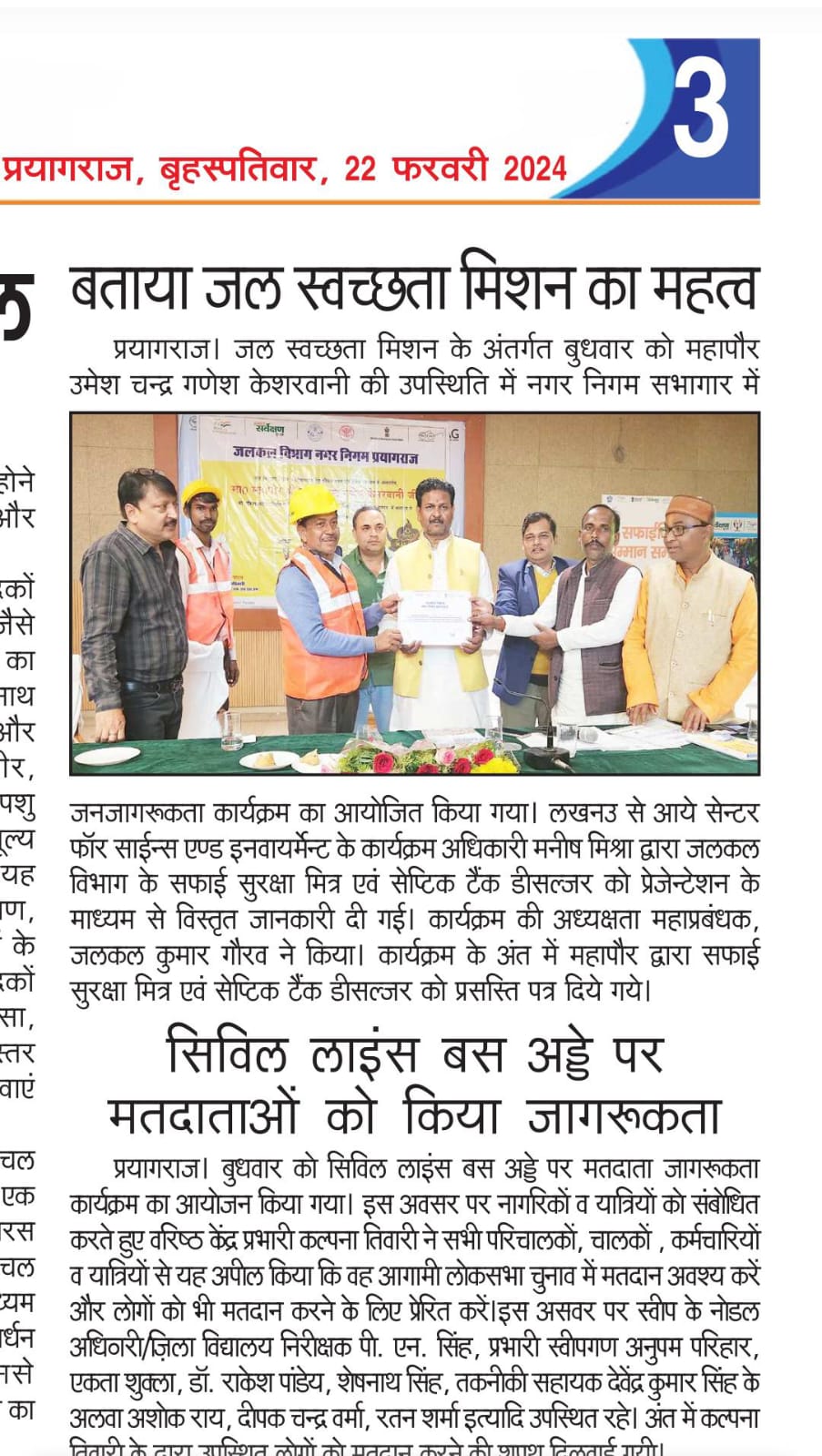
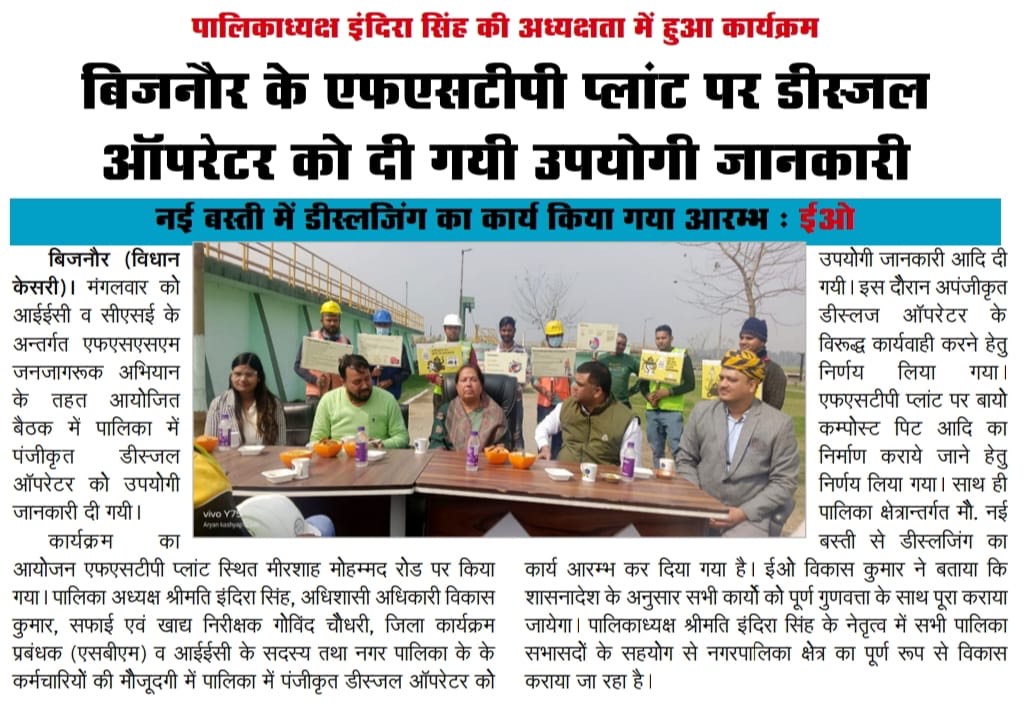
अमरोहा नगर पालिका शहर में मल टैंक की सफाई का अभियान चलाएगी। जिसके जरिए शहर के मल टैंकों की सफाई की जाएगी। इसके लिए सफाई नायकों को प्रतिदिन 5 मल टैंकों के पंजीकरण का लक्ष्य दिया है। साथ ही तीन साल से अधिक समय से मल टैंक की सफाई नही कराने वालों से पालिका जुर्माना भी वसूलेगी। अमरोहा से इकरामुद्दीन मलिक की रिपोर्ट CNB News : अमरोहा नगर पालिका शहर को स्वच्छ बनाने के लिए कदम आगे बढ़ा रही है। नगर पालिका अब शहर में अभियान चलाकर मल टैंक के मलबे को परिष्कृत करेगी। जिसका वैज्ञानिक विधि से निस्तारण किया जाएगा। ऐसा करने से शहर की आबोहवा साफ सुथरी होगी और वायु व जल प्रदूषण से भी निजात मिलेगी। शुक्रवार को नगर पालिका सभागार मे शहरी स्वच्छता समिति की बैठक का आयोजन किया गया। चेयरपर्सन शशि जैन ने कहा कि शहर को स्वच्छ बनाने को लेकर पालिका द्वारा ड़ाईडेरा मे एफएसटीपी का निर्माण किया गया हैं। पूर्णतया सौर ऊर्जा पर आधारित उक्त प्लांट मे घरेलु एवं व्यावसायिक प्रतिष्ठानों के के मल टैंक के मलबा को स्टोर कर उसे परिषकृत किया जायेगा। चेयरपर्सन शशि जैन ने कहा कि शहर में इस अत्याधुनिक प्लांट लगाए जाने के बाद घरेलु एवं व्यवसायिक मल खाद का वैज्ञानिक विधि से निस्तारण हो पाएगा। और वायु, जल प्रदूषण से भी निजात मिलेगी। उन्होंने शहर के लोगों से अपने आवास के टैंक की सफाई कराने की अपील की। सुधरेगी शहर की आबोहवा सेंटर फॉर साइंस एंड इन्वायरमेंट संस्था से आए हर्ष यादव ने बताया कि शहर में एसएफटीपी के निर्माण से घरेलू शौच टैंक के मलबे को नदी, तालाब, पोखर, नाले आदि मे डाल देने से कई हानिकारक प्रभाव होते है। इसको परिष्कृत करने से इन प्रभावों से बचा जा सकेगा। टैंक की सफाई नही कराने पर जुर्माना वसूलेगी पालिका नगर पालिका अधिशासी अधिकारी व उप नगर आयुक्त डा.बृजेश कुमार ने बताया कि सफाई नायकों को प्रतिदिन 5 मल टैंकों की सफाई के लिए पंजीकरण करने का लक्ष्य दिया गया। इसमें लापरवाही पर कार्रवाई की चेतावनी दी है। उन्होंने बताया कि जिन शौच टैंकों की सफाई को तीन वर्ष से अधिक हो गए है, उन शौच टैंकों की सफाई अनिवार्य रूप से की जाएगी। इसके अलावा यदि पालिका क्षेत्र मे ऐसे शौच टेंक जिनकी सफाई को तीन वर्ष से अधिक का समय बीत हो चुका हैं और सफाई नही कराई गई है। ऐसे टैंकों भी चिन्हित किया जाएगा। साथ ही सम्बंधित भवन स्वामी से टैंक की सफाई नही कराने पर पांच हज़ार रूपये जुर्माना वसूला जाएगा। ये लोग बैठक रहे मौजूद बैठक मे पालिका अध्यक्ष शशि जैन, अधिशासी अधिकारी डा. बृजेश कुमार, स्वच्छ भारत मिशन शहरी के जिला कार्यक्रम प्रबंधक नदीम अख्तर, पालिका सफाई निरीक्षक श्मोहम्मद इलतेजा, वैशाली सोती, जगत सिंह, वरिष्ठ लिपिक छवि शर्मा, साजिद जिया सहित समस्त पालिका सफाई नायक एवं सफाई कर्मचारी उपस्थित रहे।