
Cse In News

भौंट स्कूल बना शिमला का पहला ग्रीन स्कूल

राजकीय वरिष्ठ माध्यमिक स्कूल भौंट शिमला का पहला ग्रीन स्कूल बना है। सेंटर फॉर साइंस एंड एनवायरमेंट दिल्ली ने नेशनल ग्रीन स्कूल प्रोग्राम के तहत भौंट स्कूल को ग्रीन स्कूल के रूप में सम्मानित किया है। शिमला के निजी और सरकारी स्कूलों को पछाड़ते हुए भौंट स्कूल ने सीएसई दिल्ली में वाहवाही बटोरी। इस मौके पर प्रधानाचार्य शीतल चौहान, इको क्लब इंचार्ज ललिता शर्मा, प्राथमिक शिक्षा उप निदेशालय से डीएसएस पंकज शर्मा, पर्यावरणविद डॉ. सुनीता नारायण मौजूद रहे।
Incentives and awareness will help India achieve solar energy goals, say experts

Delhi Chief Minister Arvind Kejriwal has announced a consumer-friendly Solar Policy 2024. It promises zero electricity bills for those who get solar panels installed on their rooftops. This follows Prime Minister Narendra Modi’s announcement of the Pradhan Mantri Suryoday Yojana, which envisages rooftop solar panels for 1 crore homes. At present, nearly 70% of India’s energy is derived from burning coal. The solar thrust is in sync with the PM’s vision of a greener future. Generating clean power through solar energy, an abundant resource in India, the objective is to generate 50 gigawatts of renewable energy for the next five years. Not only is it a step towards making India energy self-reliant, but it will also help those below the poverty line and the middle class to bring down their electricity expenses. The fact that both central and state governments are promoting renewable energy consumption is very heartening, said Kartik Sachdeva, MD, Energific Solar Pvt Ltd in conversation with News9 Plus Editor Sandeep Unnithan on The News 9 Plus Show. “The user-friendly policies will increase the capacity of solar power in India,” he stated. A prime example of the success of solar missions is Gujarat’s Modhera village. Powered by 24/7 solar energy, the village has witnessed slashed electricity bills and also a new income stream. The surplus power generated in the village is sold to the government grid. But can the same model work across India? Aiming for the sun By 2030, India hopes to surpass the initial objective of 125 gigawatts of renewable energy by achieving 500 gigawatts. While there was some initial doubt about lowering the nation’s reliance on coal, advancements over the last five years have allowed it to surpass 80 gigawatts. As part of the discussion, Binit Das, Programme Manager, Renewable Energy, Centre for Science and Environment, noted, “India’s solar rooftop installed capacity has reached 11 gigawatts, which is just 28% of the announced target. But if look at the ground-mounted large solar PV, the target has been nearly achieved, which is 57 gigawatts as opposed to 60 gigawatts.” Increasing momentum and resolving concerns with solar panel availability and pricing are the main challenges to greater adoption of clean energy. But the future appears bright. “In terms of the value chain, panel costs have substantially decreased. It has dropped by 20% to 30% in the past year, making solar installation increasingly viable. As a result, the pace of adoption has increased, and with the help of state and federal legislation, the use of solar energy will grow exponentially,” added Sachdeva. Government subsidies are necessary to encourage widespread adoption, as is public awareness. Overcoming these obstacles and building a strong ecosystem for sustainable energy practices are critical to the accomplishment of India’s renewable energy ambition.

Incentives and awareness will help India meet its solar energy goals, say experts

Delhi Chief Minister Arvind Kejriwal has announced a consumer-friendly Solar Policy 2024. It promises zero electricity bills for those who install solar panels on their roofs. This follows Prime Minister Narendra Modi’s announcement of the Pradhan Mantri Suryoday Yojana, which envisages installing rooftop solar panels for 1 million homes. Currently, about 70% of India’s energy comes from burning coal. Solar energy is in line with the prime minister’s vision of a green future. India’s goal of producing clean energy through solar energy, an abundant resource, is to generate 50 gigawatts of renewable energy over the next five years. This is not only a step towards India’s energy self-sufficiency, but also helps lower the cost of electricity to the below poverty line and middle class. - Advertisement - It is very encouraging that the central and state governments are promoting renewable energy consumption, said Karthik Sachdeva, MD, Energific Solar Pvt Ltd, on The News 9 Plus Show with News9 Plus Editor Sandeep Unnithan. “User-friendly policies will increase solar capacity in India,” he said. A shining example of the success of solar missions is the village of Modhera in Gujarat. The 24/7 solar powered village has seen reduced electricity bills as well as a new revenue stream. Surplus energy produced in the village is sold to the state grid. But can the same model work across India? Ad purpose the sun By 2030, India hopes to exceed its initial target of 125 gigawatts of renewable energy by reaching 500 gigawatts. Although there were initial doubts about reducing the country’s dependence on coal, progress over the past five years has allowed it to exceed 80 gigawatts. As part of the discussion, Binit Das, Renewable Energy Program Manager at the Center for Science and Environment, noted, “India’s installed rooftop solar capacity has reached 11 gigawatts, which is only 28 percent of the announced target. But if you look at large ground-mounted solar PV, the goal is almost met, which is 57 gigawatts as opposed to 60 gigawatts. Addressing issues related to increasing speed and the availability and cost of solar panels are key challenges to the wider adoption of clean energy. But the future looks bright. “From a value chain perspective, panel costs have come down significantly. Last year, it decreased from 20% to 30%, making solar installations more efficient. As a result, the rate of adoption has increased and with the help of state and federal laws, the use of solar energy will grow exponentially,” added Sachdeva. Government subsidies are needed to encourage widespread adoption, as is public awareness. Addressing these barriers and building a strong ecosystem for sustainable energy practices is critical to realizing India’s renewable energy ambitions.

Incentives and awareness will help India meet its solar energy goals, say experts

New Delhi: Delhi Chief Minister Arvind Kejriwal has announced a consumer-friendly Solar Policy 2024. It promises zero electricity bills for those who install solar panels on their roofs. This follows Prime Minister Narendra Modi’s announcement of the Pradhan Mantri Suryoday Yojana, which envisages installing rooftop solar panels for 1 million homes. Currently, about 70% of India’s energy comes from burning coal. Solar energy is in line with the prime minister’s vision of a green future. India’s goal of producing clean energy through solar energy, an abundant resource, is to generate 50 gigawatts of renewable energy over the next five years. This is not only a step towards India’s energy self-sufficiency, but also helps lower the cost of electricity to the below poverty line and middle class. It is very encouraging that the central and state governments are promoting renewable energy consumption, said Karthik Sachdeva, MD, Energific Solar Pvt Ltd, on The News 9 Plus Show with News9 Plus Editor Sandeep Unnithan. “User-friendly policies will increase solar capacity in India,” he said. A shining example of the success of solar missions is the village of Modhera in Gujarat. The 24/7 solar powered village has seen reduced electricity bills as well as a new revenue stream. Surplus energy produced in the village is sold to the state grid. But can the same model work across India? Ad purpose the sun By 2030, India hopes to exceed its initial target of 125 gigawatts of renewable energy by reaching 500 gigawatts. Although there were initial doubts about reducing the country’s dependence on coal, progress over the past five years has allowed it to exceed 80 gigawatts. As part of the discussion, Binit Das, Renewable Energy Program Manager at the Center for Science and Environment, noted, “India’s installed rooftop solar capacity has reached 11 gigawatts, which is only 28 percent of the announced target. But if you look at large ground-mounted solar PV, the goal is almost met, which is 57 gigawatts as opposed to 60 gigawatts. Addressing issues related to increasing speed and the availability and cost of solar panels are key challenges to the wider adoption of clean energy. But the future looks bright. “From a value chain perspective, panel costs have come down significantly. Last year, it decreased from 20% to 30%, making solar installations more efficient. As a result, the rate of adoption has increased and with the help of state and federal laws, the use of solar energy will grow exponentially,” added Sachdeva. Government subsidies are needed to encourage widespread adoption, as is public awareness. Addressing these barriers and building a strong ecosystem for sustainable energy practices is critical to realizing India’s renewable energy ambitions.

Green promises, grey realities

The Government of India released Crop Residue Management (CRM) operational guidelines 2023-24 for Uttar Pradesh, Haryana, Punjab, Madhya Pradesh and the national capital territory of Delhi in July 2023. The main objectives of the CRM guideline are to reduce the amount of pollution generated when stubble is burnt and to encourage more industry-farmer participation in the agri-residue supply chain to support bioenergy plants. Burning one tonne of paddy straw releases 3 kilogramme particulate matter, 60 kg CO, 1,460 kg CO2, 199 kg ash and 2 kg SO2 into the environment. The CRM initiative can help avoid this pollution through the establishment of an agri-residue biomass supply chain from the farmers to the bioenergy industry like power generation units, compressed biogas (CBG) plants, 2G ethanol factories, which could strengthen their feedstock supply chain and benefit the biofuel industry as a whole. Under the scheme, the machinery required for biomass aggregation that includes tractors, balers, rakers, among others would need a 65 per cent investment from the government, 25 per cent from the industry and the remaining 10 per cent from the farmer-producer organisation. According to the guidelines, the indicative expenditure for setting up the paddy straw supply chain machinery comes up to around Rs 1 crore (for 3,000 tonnes paddy straw per season) and Rs 1.8 crore (for 4,500 tonnes paddy straw per season), out of which the government will give subsidy on the rounded off amount of Rs 1.5 crore. The Department of Agriculture & Farmers Welfare (DA&FW) and State Agricultural Departments have been chosen as the central regulatory bodies for this scheme. The scheme aims to collect 1.5 million tonnes of paddy straw in the next three years by establishment of 333 collection centres with a total financial assistance of Rs 600 crore. The farmers and the industry both benefit from this scheme, as it becomes an extra source of income for the farmers and provides the industry with suppliers of feedstock. The supply chain that can be built through this project will help the farmers and the industry identify one another and work together while gaining financially. Add to this the fact that this helps produce green energy, and it sounds like a win-win situation. However, this CRM guidelines document was released in July, and the project still does not have a given timeline, making it difficult to gauge the urgency with which the government wants to begin implementation. The Union Ministry of Petroleum and Natural Gas also posted on the microblogging platform X (formerly Twitter) on January 22, 2024 that the Centre has approved financial assistance of Rs 564.75 crore from FY 2023-24 to FY 2026-27 for compressed biogas producers to buy biomass machinery aiding biomass collection, with a subsidy cap of 50 per cent on the procurement cost. The scheme is expected to support 100 CBG plants in the first phase. However, the details of the scheme have not yet been shared and it is unclear whether this applies to the Crop Residue Management project as well, or if the two are linked in any way. Additionally, while the document is a progressive development from the last crop residue management initiative, some things could be clarified to help farmers and the industry execute this on the ground level. The authors of the document noted that the farmers or the farmer-producer organisations (FPO) will get their subsidised amounts through direct beneficiary transfer, but there isn’t any clarity on whether the transfer will happen to the equipment supplier after deducting the subsidy amount (which will then be credited to the equipment supplier’s account), or if the farmers will have to pay the entire required amount in advance to the equipment supplier, and then avail the subsidy amount. If it is the latter, it might be difficult for farmers to procure machinery even while contributing only 10 per cent of the share, as the required machinery for this project will be expensive and could be out-of-budget for most farmers intending to participate. The farmers or the FPOs are also directed to identify and bargain with the industry independently. This would require the farmers to have adequate knowledge of the bioenergy industry in their area and the correct market price for their produce. Since the industry is just taking off, it is unfair to assume that the farmers would have this information already. Putting this much onus on the farmers might hinder the process of the scheme taking off as this would require a substantial amount of time and energy from the farmers. The equipment purchased by the beneficiaries (farmer-producer organisations) and the industry will only be in use three months out of 12. Its utilisation and revenue-sharing model on the remaining nine months and the responsibilities of the industry and the beneficiaries respectively need to be laid out clearly in the guidelines document. However, the CRM 2023-24 document, when compared with the CRM 2020-21 document, also showed the government’s efforts in making the scheme more effective. The 2020-21 document focused solely on management of crop residue through custom hiring centres, while the 2023-24 document talked extensively about the use of this biomass in the bioenergy industry. The system is now more decentralised, making it easier for states and nodal agencies to establish a supply chain and focus on areas that need the most attention. The bioenergy industry has been struggling with issues of financing, and identifying sources for procurement of feedstock. They have also been struggling as the prices of different kinds of feedstock increase. The CRM project ensures that the industry has suppliers (farmers) of feedstock while also supporting them financially. Farmers are also active shareholders in the bioenergy ecosystem rather than just raw material providers. While the implementation of these guidelines may face some roadblocks due to the challenges one faces on ground, the scheme overall is a positive step in the direction of adoption of bioenergy in India. The aspect of decentralisation and involvement of all stakeholders will make it easier to make decisions and implement them on the ground level when one is not left waiting for approvals from the Centre. This change also benefits the farmers directly financially and in terms of capacity building. The early stages of the intervention may be a challenge, but this can bear good results in the long term. DTE

How India can reduce thermal power emissions

New Delhi: India is the largest emitter of SO2 in the world. Thermal power plants account for 45 per cent of total industrial emissions of SO2 in the country. FGD (flue gas desulphurization) systems in thermal power plants can reduce SO2 emissions from them by 80 per cent. FGD gypsum, the by-product in the FGD process, can help India meet some of the shortfall in its output of gypsum. A study by Centre of Science and Environment (CSE) recommends setting up guidelines on handling, storage, transportation, quality control etc of limestone and gypsum. It also offers suggestions on use of FGD gypsum in sectors such as cement production and high end gypsum products like wall boards and plaster boards. To meet India’s new emission norms by 2022, a large number of coal-based thermal power plants have to install FGD systems. Limestone is a key raw material in most FGD systems for controlling sulphur dioxide (SO2) emissions. Flue gas desulphurization – limestone availability and gypsum use, as the CSE report is titled, attempts to examine the issue of availability of limestone for FGD. Said Sunita Narain, director general, CSE: “Many thermal power companies have been raising various concerns regarding FGD installation; one of these is about the availability of limestone, and the use or disposal of FGD gypsum, a by-product of the FGD operation. This report attempts to address both these key issues.” Say CSE researchers behind the report: “The coal-based power sector would require only seven to 10 million tonnes of limestone annually for operating FGD systems. This is less than 3 per cent of India’s present limestone consumption. For use in FGD, high-quality limestone (CaCO3 > 90 per cent) with minimal impurities is desirable. Industry experts believe that producing additional high-quality limestone would not be a challenge given our large reserves. Moreover, regional distribution of limestone reserves shows that access will not be a problem as a majority of power plants are located within 200 km of a limestone mine.” Gypsum is a scarce resource in India. The quality of FGD gypsum is at par or even better than mineral gypsum and it has become a substitute for mineral gypsum across the world. CSE estimates that by adopting FGD, India’s power plants would produce around 12-17 million tonnes of gypsum which can easily meet the domestic shortfall and reduce the import burden. The cost of limestone, says CSE, will not be significant as it can be offset by selling FGD gypsum. While the use of FGD gypsum in the cement industry should be encouraged, it is also necessary to provide incentives to the manufacturers of high-end gypsum products like wall boards and plasterboards. The agriculture sector can also become a valuable consumer of FGD gypsum. In the long term, power plants should be directed to use all the FGD gypsum that is produced; however, the short-term disposal guidelines can be issued. Said Narain: “India is the largest emitter of SO2 in the world, contributing more than 15 per cent of global anthropogenic emissions. FGD systems in thermal power plants can reduce SO2 emissions from them by 80 per cent, points out this CSE report.”

CSE Urges African Countries To Strengthen Environmental Audit Systems

The Indian Centre for Science and Environment (CSE), a New Delhi-based global science and environment thinktank organization, urged African Countries to strengthen their Environmental Audit Systems (EAS). The Centre has released “a Pan-Africa” Environmental Impact Assessment (EIA) report today in Dar es Salam, Tanzania, on existing environmental audit systems in eight African countries after reviewing their legislation and environmental audit reports. Environmental regulators from 15 African countries participate in the release-cum-orientation programme. According to CSE statement sent to African Demysti

Webinar on investigative climate journalism

ournalists interested in investigative climate reporting can register for this free webinar. The Global Investigative Journalism Network (GIJN) is hosting an online panel discussion "The Investigative Agenda for Climate Change Journalism" on Feb. 6 to share perspectives on the top priorities for investigative journalism on climate change. GIJN has recently published a report on a one-day meeting of 80 climate change journalists and experts from 35 countries to discuss the role of investigative journalism in climate crisis reporting, convened at the GIJN’s most recent global conference. The panel will feature Matthew Green, global investigations editor at DeSmog; Sunita Narain, the director general of the Centre for Science and Environment (CSE); and Amy Westervelt, an award-winning investigative journalist and executive producer of the independent podcast production company Critical Frequency. The discussion will be moderated by Sheila Coronel, professor of journalism and director of the Stabile Center for Investigative Journalism at Columbia University’s Graduate School of Journalism in New York.

Alarming loss of nutrients, rise in toxins seen in rice, wheat over 50 yrs

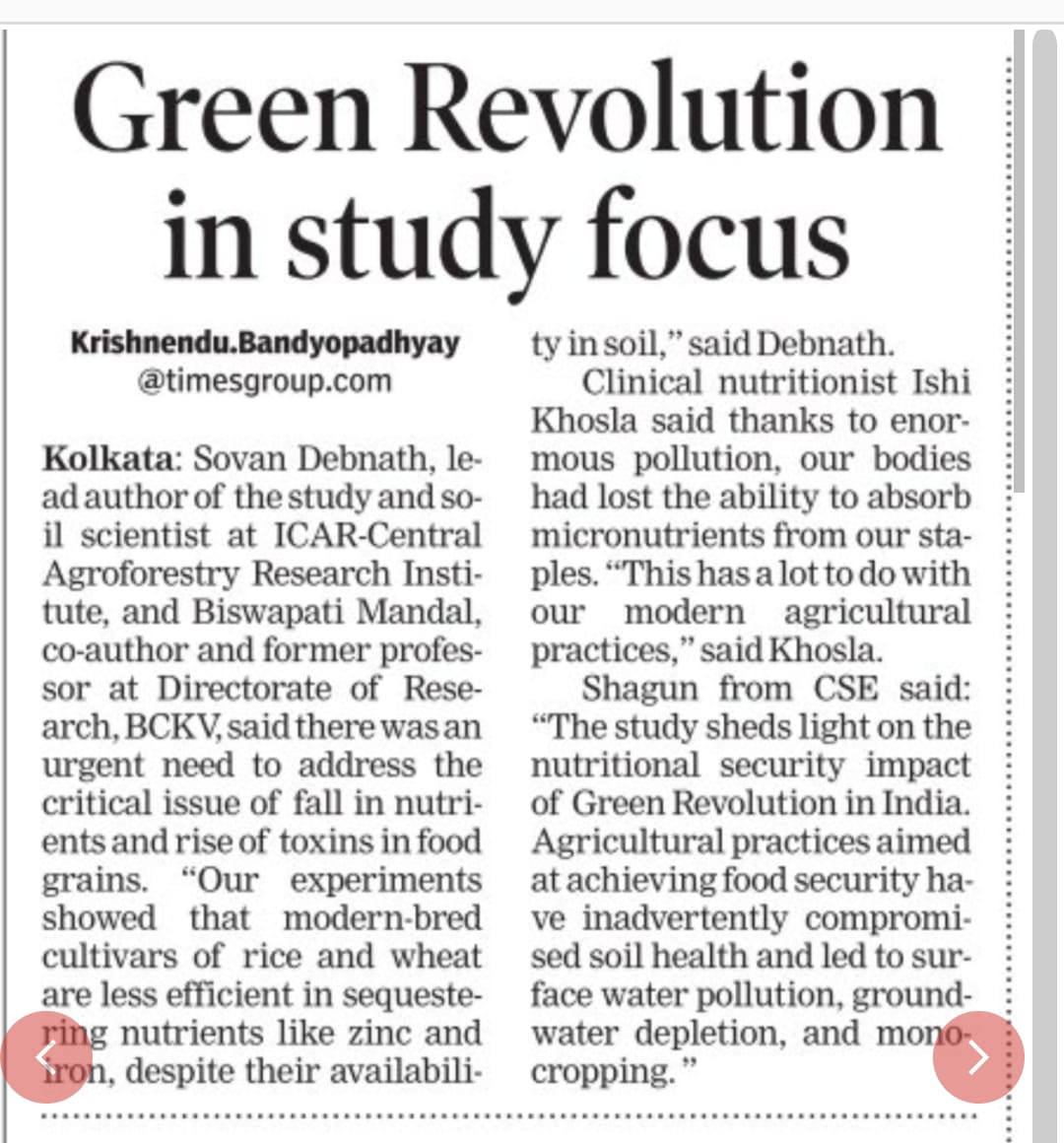
KOLKATA: The nutritional quality of rice and wheat, the most common staples in Indian households, has dipped alarmingly over the past five decades even as toxin levels have risen dangerously, a study led by scientists at Bidhan Chandra Krishi Viswavidyalaya, Mohanpur, has revealed. This is particularly true of high-yield varieties that have replaced traditional varieties, says the study that has been tracking the nutritional content of rice and wheat over the past 50 years. It shows micronutrients like zinc and iron in food grain that form the dietary foundation for a large section of the population have declined significantly in the past 50 years. For rice, zinc and iron concentrations have dipped 33% and 27% respectively while for wheat the decline is 30% and 19% respectively. Decades The study also detected a perilous 1,493% increase in arsenic concentration in rice and a substantial rise in other hazardous elements like barium, strontium and chromium. The study funded by the Indian Council of Agricultural Research (ICAR) was presented at a webinar by Centre for Science & Environment on Tuesday. Health experts say the "historical shift" in the nutrient profiles of rice and wheat could exacerbate India's burden of non-communicable diseases. Iron deficiencies lead to anaemia, weakened immune systems, maternal deaths, low birth weight, and premature deliveries, while zinc deficiency is associated with diarrhoea, weak immune systems, dwarfism, child mortality and pneumonia. According to scientists, continuous genetic tampering and modern breeding programmes have stripped plants of their natural evolutionary defence mechanisms against toxins. Sovan Debnath, lead author of the study and soil scientist at ICAR-Central Agroforestry Research Institute, and Biswapati Mandal, co-author and former professor at Directorate of Research, BCKV, said there was an urgent need to address the critical issue of fall in nutrients and rise of toxins in food grains. “Our experiments showed that modern-bred cultivars of rice and wheat are less efficient in sequestering nutrients like zinc and iron, despite their availability in soil,” said Debnath. Clinical nutritionist Ishi Khosla said thanks to enormous pollution, our bodies had lost the ability to absorb micronutrients from our staples. “This has a lot to do with our modern agricultural practices,” said Khosla. Shagun from CSE said: “The study sheds light on the nutritional security impact of Green Revolution in India. Agricultural practices aimed at achieving food security have inadvertently compromised soil health and led to surface water pollution, groundwater depletion, and monocropping. ”

Indians might be eating rice and wheat that are not only low in food value, but also high on toxins

The rice and wheat that Indians are eating today might actually be of low nutritional value, says a latest report by Down To Earth magazine citing a recent study led by scientists from the Indian Council of Agricultural Research (ICAR). “For the past 50 years, India has been introducing high-yielding rice and wheat varieties at breakneck speed to achieve food security. The ICAR-led study has examined the food value of these modern grains and reports that breeding programmes focused on developing high-yielding varieties have altered the nutrient profiles of rice and wheat — to the extent that their dietary and nutritional value has gone down,” says the magazine. The study has gone ahead to assess the health impact of this “historical shift” in nutrient profiles of rice and wheat, and warns that the impoverished staple grains could worsen the country’s growing burden of non-communicable diseases (NCDs). Down To Earth and Centre for Science and Environment (CSE, which helps publish the magazine) organised a webinar here today to discuss the magazine’s coverage of the new study. Panellists included Sovan Debnath, Soil Scientist, ICAR-Central Agroforestry Research Institute, Jhansi and the lead author of the study; Biswapati Mandal, former Professor, Directorate of Research, Bidhan Chandra Krishi Viswavidyalaya, Kalyani and the study’s co-author; Ishi Khosla, Clinical Nutritionist, Consultant and Writer, and Shagun, Senior Correspondent, Down To Earth. When the Green Revolution began in India, the aim was to feed the rapidly growing population and to become self-sufficient in food production. Hence, the main motive of agricultural scientists was to improve yield. Speaking at the webinar, Dr Mandal said: “After the 1980s, the focus of breeders shifted to developing varieties that were resistant to pests and diseases and tolerant to stresses such as salinity, moisture and drought. They did not have the luxury of thinking whether the plants were taking in nutrients from the soil or not. Hence, over a period of time, what we are seeing is that plants have lost their capacity to take up nutrients from the soil.” The 2023 study is an extension of another study that scientists from ICAR and Bidhan Chandra Krishi Viswavidyalaya conducted in 2021. The study explored the reasons for zinc and iron deficiency in populations dependent on a cereal diet — high-yielding cultivars of rice and wheat, when tested, revealed a downward trend in grain density of zinc and iron. Says Debnath, who was one of the scientists behind the 2021 study as well: “Our experiments showed that modern-bred cultivars of rice and wheat are less efficient in sequestering nutrients like zinc and iron, despite their availability in soil.” The 2021 study also showed that the increase in the proportion of the global population suffering from zinc and iron deficiency over the last four decades coincided with the global expansion of high-yielding, input-responsive cereal cultivars released in the post-Green Revolution era. Reporting on the study, Down To Earth says that in the past 50 years, the concentration of essential nutrients like zinc and iron has decreased by 33 per cent and 27 per cent in rice, and by 30 per cent and 19 per cent in wheat, respectively. What’s worse, the concentration of arsenic, a toxic element, in rice has increased by 1,493 per cent. “In other words, our staple foodgrains are not only less nutritious, but also harmful to health. Amid continuous genetic tampering under the modern breeding programme, the plants have also lost their natural evolutionary defence mechanisms against toxins,” says the Down To Earth report. Depleted concentration of essential nutrients in staple grains could result in higher prevalence of diseases related to neurological, reproductive and musculoskeletal systems. Speaking at the webinar, Shagun of Down To Earth pointed out that “agricultural practices that the Green Revolution shaped have often been criticised for their impact on environment and food systems. But discussions have rarely moved beyond the impact on soil degradation, surface water pollution, groundwater depletion and mono-cropping. This study has put the spotlight on the impact of the Green Revolution on the nutritional security of India.” What is India doing to bolster nutrition Significant efforts are being made in the country to improve the nutritional profile of foodgrains. Agricultural scientists have turned to landraces and wild species of cultivated varieties for answers. Under a special project on bio-fortification, launched by the Union government, scientists at ICAR and other agriculture universities have undertaken germplasm exploration to find donor varieties that are high in nutritional content. So far, institutes under ICAR have developed 142 bio-fortified varieties. “However,” says Shagun, “these varieties are far from being popularised and adopted by farmers on a large scale.” Scientists Down To Earth spoke to say bio-fortification of other essential elements like manganese, copper and calcium will take some time as breeding and releasing any variety is a long and arduous task. Says Shagun: “Rice and wheat are staple foods for the majority of India’s population. Our report is significant in the context of the health impacts the impoverished grains can lead to.”

Rice and Wheat low in Food Value, High on Toxins, Shows Study

Rice and wheat, the staple diet of people in India, are low in food value and high in toxins, according to a recent study led by scientists from the Indian Council of Agricultural Research (ICAR) and reported by New Delhi-based CSE's Down To Earth magazine. It may shock many, but ICAR scientists pointed out that high-yield varieties of foodgrains show a drastic decline in the concentration of essential micronutrients like zinc and iron. Scientists also found very high concentrations of arsenic in rice. "For the past 50 years, India has been introducing high-yielding rice and wheat varieties at breakneck speed to achieve food security. The ICAR-led study has examined the food value of these modern grains and reports that breeding programmes focused on developing high-yielding varieties have altered the nutrient profiles of rice and wheat -- to the extent that their dietary and nutritional value has gone down," said the magazine. The study has assessed the health impact of this "historical shift" in the nutrient profiles of rice and wheat. It warned that the impoverished staple grains could worsen the country's growing burden of non-communicable diseases (NCDs). Addressing a webinar organised by the magazine in New Delhi on Tuesday, Biswapati Mandal, former Professor, Directorate of Research, Bidhan Chandra Krishi Viswavidyalaya, West Bengal, said when the Green Revolution began in India, the aim was to feed the rapidly growing population and become self-sufficient in food production. Hence, the main motive of agricultural scientists was to improve yield. "After the 1980s, the focus of breeders shifted to developing varieties that were resistant to pests and diseases and tolerant to stresses such as salinity, moisture and drought. They did not have the luxury of thinking whether the plants were taking in nutrients from the soil or not. Hence, over a period of time, what we are seeing is that plants have lost their capacity to take up nutrients from the soil," said Mandal, the study's co-author. The 2023 study is an extension of another study that scientists from ICAR and Bidhan Chandra Krishi Viswavidyalaya conducted in 2021. The study explored the reasons for zinc and iron deficiency in populations dependent on a cereal diet -- high-yielding cultivars of rice and wheat, when tested, revealed a downward trend in grain density of zinc and iron. Sovan Debnath, Soil Scientist, ICAR-Central Agroforestry Research Institute, Jhansi, and the lead author of the study, said, "Our experiments showed that modern-bred cultivars of rice and wheat are less efficient in sequestering nutrients like zinc and iron, despite their availability in soil." The 2021 study also showed that the increase in the proportion of the global population suffering from zinc and iron deficiency over the last four decades coincided with the global expansion of high-yielding, input-responsive cereal cultivars released in the post-Green Revolution era. The magazine's report highlighted that in the past 50 years, the concentration of essential nutrients like zinc and iron has decreased by 33% and 27% in rice, and by 30% and 19% in wheat, respectively. Further, the concentration of arsenic, a toxic element in rice, has increased by 1,493%. "In other words, our staple foodgrains are not only less nutritious but also harmful to health. Amid continuous genetic tampering under the modern breeding programme, the plants have also lost their natural evolutionary defence mechanisms against toxins," said the magazine. Shagun of the magazine said that a depleted concentration of essential nutrients in staple grains could result in a higher prevalence of diseases related to neurological, reproductive and musculoskeletal systems. She further said, "Agricultural practices that the Green Revolution shaped have often been criticised for their impact on environment and food systems. But discussions have rarely moved beyond the impact on soil degradation, surface water pollution, groundwater depletion and mono-cropping. This study has put the spotlight on the impact of the Green Revolution on the nutritional security of India." According to a report in the magazine, significant efforts are being made in the country to improve the nutritional profile of food grains. Agricultural scientists have turned to landraces and wild species of cultivated varieties for answers. Under a special project on bio-fortification, launched by the Union government, scientists at ICAR and other agriculture universities have undertaken germplasm exploration to find donor varieties high in nutritional content. So far, institutes under ICAR have developed 142 bio-fortified varieties.

Indians Eating Empty Calories? Study Finds Rice and Wheat Low in Nutrients, High in Toxins

The staple diet of millions of Indians – rice and wheat – may be surprisingly lacking in essential nutrients and even harboring harmful toxins, according to a new study by the Indian Council of Agricultural Research (ICAR). The findings, presented in a recent webinar hosted by Down To Earth magazine and the Centre for Science and Environment (CSE), raise concerns about the long-term nutritional security of India's population. Nutrient Loss from High-Yielding Crops: The study, led by ICAR soil scientist Sovan Debnath, examined the food value of modern rice and wheat varieties. It found that decades of focus on boosting yields through breeding programs have inadvertently reduced the nutrient content of these grains. Over the past 50 years, zinc and iron concentrations have plummeted by 33% and 27% in rice, and 30% and 19% in wheat, respectively. Green Revolution's Unforeseen Consequences: The Green Revolution, India's ambitious agricultural program launched in the 1960s, aimed to achieve food self-sufficiency by prioritizing high yields. This led breeders to prioritize factors like pest resistance and stress tolerance over nutrient uptake. As co-author Biswapati Mandal explained, "Scientists didn't have the luxury of considering nutrient absorption back then." A Bleak Future for Food Value: The study estimates that rice and wheat, which provide over half of the daily calorie intake for Indians, have lost up to 45% of their nutritional value in the past 50 years. This trend, if unchecked, could render these staples inadequate for human consumption by 2040,

NEMC YASHIRIKIANA NA KITUO CHA SAYANSI NA MAZINGIRA INDIA KUTOA MAFUNZO YA UKAGUZI MAZINGIRA

BARAZA la Taifa la Hifadhi na Usimamizi wa Mazingira (NEMC) limefanya warsha Maalumu kwa Kushirikiana na kituo Cha Sayansi na Mazingira kutoka India (CSE India) yenye lengo la kutambua namna ya mfumo wa ukaguzi wa mazingira unavyofanya kazi pamoja na kupeana uzoefu katika Usimamizi na Uhifadhi wa mazingira. Akizungumza na waandishi wahabari leo Januari 25,2024, Afisa Mazingira Mwandamizi kutoka NEMC Bw. Novatus Mushi amesema kuwa mchakato wa usimamizi na Uhifadhi wa mazingira unahitaji uelewa mpana zaidi na taaluma mbalimbali ili kufanya ubobevu mkubwa katika ukaguzi huo. "Ukaguzi wa mazingira lazima uhusishe wataalamu mbalimbali ili uweze kuzipata taarifa zote kwa ujumla wake ambazo utazihitaji kukuongoza katika ukaguzi wa mazingira ". Amesema Bw.Novatus. Amesema kuwa NEMC wataendelea kujifunza kwa wageni wa mataifa mengine kwa kubeba mazuri ambayo wanayo na kuboresha katika huduma zao wanazotoa. Kwa Upande wake Mkurugenzi wa Program ya Kupambana na Uchafuzi kutoka Viwandani Bw.Nivit Kumar wa Kituo Cha Sayansi na Mazingira India (CSE india) amesema kuwa anafikiri ni wakati sahihi kwa Mamlaka za Udhibiti wa Mazingira katika nchi za kiafrika kutumia ubunifu kuhifadhi mazingira ya nchi zao. Aidha ameeleza kuwa walipofanya utafiti waligundua ripoti za ukaguzi zilikuwa zikifanyika hazikuwa vizuri, hivyo wamejitahidi kuweka maelekezo vizuri jinsi ya kuchukua taarifa hizo. Naye Mkurugenzi Mtendaji wa Taasisi ya (ECI) kutoka Kenya Bw. Gerphas Opondo amesema kuwa changamoto ya uchafuzi zilizopo Kenya na Tanzania ni zilezile, ijapokuwa Sheria za Uhifadhi zipo lakini watu bado wanakiuka taratibu hizo. Warsha hiyo itafanyika kwa siku tatu na imejumuisha wadau mbalimbali kutoka mamlaka zinazosimamia mazingira kwenye mataifa

NEMC YASHIRIKIANA NA KITUO CHA SAYANSI NA MAZINGIRA INDIA KUTOA MAFUNZO YA UKAGUZI MAZINGIRA

BARAZA la Taifa la Hifadhi na Usimamizi wa Mazingira (NEMC) limefanya warsha Maalumu kwa Kushirikiana na kituo Cha Sayansi na Mazingira kutoka India (CSE India) yenye lengo la kutambua namna ya mfumo wa ukaguzi wa mazingira unavyofanya kazi pamoja na kupeana uzoefu katika Usimamizi na Uhifadhi wa mazingira. Akizungumza na waandishi wahabari leo Januari 25,2024, Afisa Mazingira Mwandamizi kutoka NEMC Bw. Novatus Mushi amesema kuwa mchakato wa usimamizi na Uhifadhi wa mazingira unahitaji uelewa mpana zaidi na taaluma mbalimbali ili kufanya ubobevu mkubwa katika ukaguzi huo. "Ukaguzi wa mazingira lazima uhusishe wataalamu mbalimbali ili uweze kuzipata taarifa zote kwa ujumla wake ambazo utazihitaji kukuongoza katika ukaguzi wa mazingira ". Amesema Bw.Novatus. Amesema kuwa NEMC wataendelea kujifunza kwa wageni wa mataifa mengine kwa kubeba mazuri ambayo wanayo na kuboresha katika huduma zao wanazotoa. Kwa Upande wake Mkurugenzi wa Program ya Kupambana na Uchafuzi kutoka Viwandani Bw.Nivit Kumar wa Kituo Cha Sayansi na Mazingira India (CSE india) amesema kuwa anafikiri ni wakati sahihi kwa Mamlaka za Udhibiti wa Mazingira katika nchi za kiafrika kutumia ubunifu kuhifadhi mazingira ya nchi zao. Aidha ameeleza kuwa walipofanya utafiti waligundua ripoti za ukaguzi zilikuwa zikifanyika hazikuwa vizuri, hivyo wamejitahidi kuweka maelekezo vizuri jinsi ya kuchukua taarifa hizo. Naye Mkurugenzi Mtendaji wa Taasisi ya (ECI) kutoka Kenya Bw. Gerphas Opondo amesema kuwa changamoto ya uchafuzi zilizopo Kenya na Tanzania ni zilezile, ijapokuwa Sheria za Uhifadhi zipo lakini watu bado wanakiuka taratibu hizo. Warsha hiyo itafanyika kwa siku tatu na imejumuisha wadau mbalimbali kutoka mamlaka zinazosimamia mazingira kwenye mataifa mengine ya Afrika.