
Cse In News

पराली, गाड़ी का धुआं, कंस्ट्रक्शन डस्ट... दिल्ली में जहरीले नवंबर के ये हैं तीन गुनहगार

इस बार सितंबर में ही प्रदूषण बढ़ना शुरू हो गया था। सांस और दिल के मरीजों को परेशानियां अक्टूबर में ही होने लगी थी। नवंबर आते आते दिल्ली ऐसी घुटी की प्रदूषण ने पिछले कई सालों का रेकॉर्ड तोड़ दिया। एक्सपर्ट के अनुसार इस बार अस्पतालों से जो रिपोर्ट आ रही है, उससे पता चल रहा है कि दिवाली से काफी पहले ही लोग प्रदूषण से जुड़ी समस्याएं लेकर अस्पताल पहुंचने लगे थे। इस सीजन में प्रदूषण की तीन मुख्य वजह गाड़ियों का धुआं, कंस्ट्रक्शन डस्ट और पराली का धुआं बताया गया है। गाड़ियों के धुएं, इंडस्ट्री और अन्य प्रदूषण की वजह से पीएम 2.5 का स्तर काफी तेजी से बढ़ा है। नवंबर के स्मॉग एपिसोड में पीएम10 का स्तर पीएम 2.5 से कम रहा। सीएसई (सेंटर फॉर साइंस एंड एनवायरमेंट) के अनुसार इस बार पीएम10 में पीएम 2.5 की हिस्सेदारी करीब 50 प्रतिशत रही। प्रदूषण में धुएं की हिस्सेदारी अधिक है। सीएसई की अनुमिता राय चौधरी के अनुसार नवंबर सबसे अधिक प्रदूषित महीना रहता है। इस महीने में तापमान कम होता है, हवा में नमी बढ़ जाती है और हवाओं की गति कमजोर होती है। इस सूरत में पंजाब और हरियाणा से पराली का धुआं जब दिल्ली पहुंचता है, तो वह स्थिति को जानलेवा स्तर तक पहुंचा देता है। पराली की वजह से 2009 के बाद बढ़ा प्रदूषण सेफ (सोशल एक्शन फॉर फॉरेस्ट एंड एनवायरमेंट) के फाउंडर विक्रांत तोंगड़ के अनुसार पंजाब सरकार ने 2009 में पंजाब प्रिजर्वेशन ऑफ सबसॉइल वॉटर एक्ट लागू किया। इसके तहत धान की बिजाई के समय को तय कर दिया गया। एक अनुमान के मुताबिक यदि धान की बिजाई अप्रैल-मई में होती है, तो एक किलो चावल लगाने के लिए करीब 4500 लीटर पानी की जरूरत होती है, लेकिन यदि इसकी बिजाई जून के मध्य में होती है, तो इसके लिए 1500 से 2000 लीटर पानी की जरूरत पड़ती है। इसी को देखते हुए पांजाब में 15 मई से पहले नर्सरी में धान की बिजाई और 15 जून से पहले खेतों में रोपाई करने पर रोक लगा दी गई। इससे पहले किसान अप्रैल और मई में ही धान की बिजाई करते थे। बिजाई लेट होने की वजह से उसकी कटाई भी लेट होने लगी। कटाई अक्टूबर में होती थी अब पूरे नवंबर चलती है। एक्सपर्ट के आकलन के अनुसार 2 नवंबर को इस बार पराली का प्रदूषण 25 प्रतिशत को पार कर गया था। पिछले हफ्ते यह 10 से 20 प्रतिशत के आसपास रहा। 2022 में यह 40 प्रतिशत तक गया था। सीएसई की एक रिपोर्ट के अनुसार एनओ-2 के औसत स्तर में गाड़ियों के धुएं की हिस्सेदारी 2022 में करीब 60 प्रतिशत रही। यह आंकलन 2022 अक्टूबर के पहले हफ्ते का है। यदि पराली के धुएं से होने वाले प्रदूषण को सालाना स्तर पर देखा जाए तो यह महज तीन प्रतिशत है। ऐसा इसलिए क्योंकि यह 15 सितंबर से 30 नवंबर के दौरान कुछ दिनों तक ही अधिक होता है। जबकि सालाना स्तर में गाड़ियों की हिस्सेदारी अधिक है।
High levels of black carbon emission sets off alarm bells in Guwahati

A large chunk of the population in Assam is breathing toxic air, with Guwahati topping the chart of the highest polluted cities in the state and also having one of the highest black carbon emissions in the country. The idea of clear blue skies and clean air in this part of the country is in danger as a result of the ongoing problem of air pollution in Assam and other northeastern states, according to a new warning from the Delhi-based Centre of Science and Environment. Assam's five non-attainment cities -- Guwahati, Nagaon, Silchar, Sivasagar and Nalbari -- have been identified by the National Air Quality Monitoring Programme (NAMP). These cities' pollution levels are higher than the recommended air quality guidelines. Accordingly, the National Clean Air Programme (NCAP) has been initiated to develop action plans to bring down the fine particulate matter (like PM10 and PM2.5) by 20-30 per cent within a stipulated time frame. An emission inventory study has been initiated for Guwahati city, wherein the contribution of pollutants from different sectors like commercial, transportation, domestic and industrial sources shall be estimated. Black carbon is just next to carbon dioxide in global warming potential and has an effect on global climate. Rajarshi Sharma, a research scholar of the Air & Noise Research Lab of IIT Guwahati headed by Prof. Sharad Gokhale, studied emission levels of black carbon and found that fossil fuel burning (from transportation, industries, kerosene lamps for lighting in residential use) is responsible for about 60 per cent of black carbon emission, while biomass burning (from firewood for residential use, cropland burning, forest fires, slash burning) contribute to about 40 per cent. The total emission of black carbon is about 19.38 Gigagram (Gg) during 2018-19, of which 3.38 Gg is from Kamrup Metropolitan district only, which is also the highest black carbon emitting district. The unplanned and open burning of solid waste disposal within the municipal boundary is the other factor hurting Guwahati. The quantity of harmful chemicals and black carbon released by burning waste materials is something that most people are unaware of. According to a state government official, Guwahati has one of the highest levels of black carbon pollution in the world, which is concerning. In a study conducted close to Guwahati's metropolitan highways, Ardhendu Shekhar Chaudhury, another researcher from IIT-G, discovered that the average amount of black carbon present at the breathing level during the winter is roughly 32 micrograms per cubic meter. Prof Gokhale told IANS that the air pollution scenario in Assam is not as grave as Delhi today but is certainly alarming as the levels of fine particles are rising. “There is a need for public awareness of its harmful health effects and practically adaptable solutions to reduce the particle levels and minimize the damage to human health as well as the climate of the region,” he added. In the hills and valleys of the northeastern states, the high levels of air pollution brought on by widespread motorization, traffic jams, and the usage of solid fuel are creating a public health emergency. Even worse, despite a slow worsening in air quality, little public attention has been drawn to it as of yet. The wintertime air pollution in Guwahati is on par with that of several other Uttar Pradesh cities. Even smaller cities have substantial levels of pollution. According to Parthankar Choudhury, a professor of ecology and environmental science at Assam University in Silchar, the amount of particle matter in the ambient air has been increasing over time. “More research projects need to be carried out on the respiratory distress and other health ailments caused due to air pollution,” he added. In the present scenario, various construction works are going on in and around Guwahati, which may be responsible for the increase in concentrations of PM10. However, this increase is temporary in nature because, after the completion of the construction works, e.g., a flyover, the vehicle flow will be smooth with less congestion which will eventually lead to lesser pollutant levels in the long run.

Assam: Guwahati Among Cities With Highest Levels Of Black Carbon Emissions In India, Warns Delhi-Based Advocacy Group

A large chunk of the population in Assam is breathing toxic air, with Guwahati topping the chart of the highest polluted cities in the state and also having one of the highest black carbon emissions in the country. The idea of clear blue skies and clean air in this part of the country is in danger as a result of the ongoing problem of air pollution in Assam and other northeastern states, according to a new warning from the Delhi-based Centre of Science and Environment. Assam's five cities' pollution levels stand highest Assam's five non-attainment cities, Guwahati, Nagaon, Silchar, Sivasagar and Nalbari, have been identified by the National Air Quality Monitoring Programme (NAMP). These cities' pollution levels are higher than the recommended air quality guidelines. Accordingly, the National Clean Air Programme (NCAP) has been initiated to develop action plans to bring down the fine particulate matter (like PM10 and PM2.5) by 20-30 per cent within a stipulated time frame. An emission inventory study has been initiated for Guwahati city, wherein the contribution of pollutants from different sectors like commercial, transportation, domestic and industrial sources shall be estimated. Black carbon is just next to carbon dioxide in global warming potential and affects global climate. Rajarshi Sharma, a research scholar of the Air & Noise Research Lab of IIT Guwahati headed by Prof Sharad Gokhale, studied emission levels of black carbon and found that fossil fuel burning (from transportation, industries, kerosene lamps for lighting in residential use) is responsible for about 60 per cent of black carbon emission, while biomass burning (from firewood for residential use, cropland burning, forest fires, slash burning) contribute to about 40 per cent. The total emission of black carbon is about 19.38 Gigagram (Gg) during 2018-19, of which 3.38 Gg is from Kamrup Metropolitan district only, which is also the highest black carbon emitting district. The unplanned and open burning of solid waste disposal within the municipal boundary is the other factor hurting Guwahati. Guwahati has the highest levels of black carbon pollution in the world The quantity of harmful chemicals and black carbon released by burning waste materials is something that most people are unaware of. According to a state government official, Guwahati has one of the highest levels of black carbon pollution in the world, which is concerning. In a study conducted close to Guwahati's metropolitan highways, Ardhendu Shekhar Chaudhury, another researcher from IIT-G, discovered that the average amount of black carbon present at the breathing level during the winter is roughly 32 micrograms per cubic meter. Prof Gokhale told IANS that the air pollution scenario in Assam is not as grave as Delhi today but is certainly alarming as the levels of fine particles are rising. "There is a need for public awareness of its harmful health effects and practically adaptable solutions to reduce the particle levels and minimize the damage to human health and the region's climate," he added. Particle matter in the air has increased over time In the hills and valleys of the northeastern states, the high levels of air pollution brought on by widespread motorization, traffic jams, and the usage of solid fuel are creating a public health emergency. Even worse, despite a slow worsening in air quality, little public attention has been drawn to it as of yet. The wintertime air pollution in Guwahati is on par with that of several other Uttar Pradesh cities. Even smaller cities have substantial levels of pollution. According to Parthankar Choudhury, a professor of ecology and environmental science at Assam University in Silchar, the amount of particle matter in the ambient air has increased over time. "More research projects need to be carried out on the respiratory distress and other health ailments caused due to air pollution," he added. In the present scenario, various construction works are going on in and around Guwahati, which may be responsible for the increase in concentrations of PM10. However, this increase is temporary in nature because, after the completion of the construction works, e.g., a flyover, the vehicle flow will be smooth with less congestion, which will eventually lead to lesser pollutant levels in the long run.

How winds determine share of stubble burning in capital’s air

NEW DELHI: It is wind that transports the pollutants created by rice harvest remnant burning in the neighbouring states to the capital. Wind direction and wind speed are, therefore, major factors that determine the air quality in Delhi in winter. An analysis of the data of System of Air Quality and Weather Forecasting and Research, or SAFAR, shows that when the stubble fires in north India numbered 5,300 on November 5, 2019, the share of the pollutants of the farm fires in Delhi’s PM2.5 was only 9%. This was due to the unfavourable wind direction prevailing then. In contrast, almost half the number of field fires, 2,190, on November 5, 2018, contributed 58% to the city’s PM2.5, all because wind direction and speed caused the maximum carbon intrusion into Delhi’s air quality. How winds determine share of stubble burning in capital’s air Anumita Roychowdhury, executive director, research and advocacy, Centre for Science and Environment, confirmed this when she said, "The impact of crop residue burning on Delhi’s air depends on direction and speed of transport winds. The estimates from SAFAR show that the daily contribution of crop residue burning can vary from 4% to 30% or more. This variability is influenced by speed and direction of wind.” Gufran Beig, chair professor, National Institute of Advanced Studies and founder of SAFAR, also said, “More farm fires do not mean that there will be higher intrusion of stubble in air quality. If the transport level wind is light, the smoke will not reach Delhi. Only transport level winds of 10-15 kmph are able to bring pollutants from the north-northwest direction to Delhi.” It is also true the other way round. If the winds blowing in Delhi are strong, experts said this would cause dispersion of pollutants and create better air in the city. Calm wind conditions would lead to accumulation of pollutants. SAFAR’s data shows that the peak single day component of stubble burning in Delhi’s PM2.5 was 34% in 2022, 48% in 2021, 42% in 2020, 44% in 2019 and 58% in 2018. Though SAFAR has stopped sharing this data this year, the Decision Support System (DSS), the forecasting body under the Union ministry of earth sciences, is sharing the contribution of biomass burning to the PM2.5 after synchronising the information between the two systems. According to DSS, the highest single day share of paddy residue burning in PM2.5 this year was 35.4% on November 3. The lowest this season was on November 17 at 3%. The share of stubble burning in the total tiny, respirable pollutants in Delhi on Sunday has been predicted by DSS to be 2.4% and 4.8% on Monday.

Linguistic Diversity Helps Defeat Totalitarian Regimes: GN Devy Tells JNU

Prof. Devy delivered the 10th Sunil Memorial Lecture on November 17 at JNU’s School of Arts and Aesthetics Auditorium, titled 'Language Diversity and the Making of India,' in which he briefly analysed the history of the Indian subcontinent through major linguistic changes, and how they shaped the country that we live in. Noted linguist, literary critic and cultural activist GN Devy told a packed auditorium in the Jawaharlal Nehru University that preserving the linguistic diversity of India and the World was key to resist the erosion of democracy and the accompanying loss of courage through an illusion of order. Prof. Devy delivered the 10th Sunil Memorial Lecture on November 17 at JNU’s School of Arts and Aesthetics Auditorium, titled “Language Diversity and the Making of India,” in which he briefly analysed the history of the Indian subcontinent through major linguistic changes, and how they shaped the country that we live in. In a session chaired by Prof. Asha Sarangi, from JNU’s Centre for Political Studies, Devy – who has just returned after a tour of United States to promote his recent book “Indians: a History of Civilisations” (co-edited with Tony Joseph and Ravi Korisettar) – attempted to reconstruct history from the linguistic perspective. He explained that languages formed wherever pre-historic humans ( hunter-gatherers) arriving in the subcontinent stayed put in large numbers and formed a ‘population knot.’ Since India – just like other linguistically rich countries like Papua New Guinea, Indonesia or Nigeria – had an abundance of food at the time, it became home to among the largest number of languages in the world (1,652 mother tongues according to the 1961 census). However, major historic shifts deeply affected the linguistic diversity: firstly the advent of agriculture, and then the arrival of languages from the Indo-European family, that changed the landscape not just in terms of words, but also the thought. Devy argued that India was “made” several times through its languages, transforming again after 1,000 AD as the influences of the Middle East and the saint-poets again democratised language, as translations of literature were carried out for the first time, and “God became approachable”. The next major shift, according to Devy, came with colonialism and exposure to the West, and most of India’s knowledge and literature was trashed as “oral.” However, upon independence, India’s makers chose to establish it as a multilingual nation, even though the European concept of nation was monolingual. The linguist stressed that the two nations in Europe that experienced the most aggressive linguistic nationalism – Italy and Germany – eventually turned fascist, and therefore urged the audience to take threats associated with India’s loss of languages seriously. In the 2011 census, the country was left with 1,369 mother-tongues, signalling the loss of around 280 languages in 50 years. Devy, who has advocated the rights of the denotified tribes for years, insisted that these marginalised communities – unjustly dubbed criminals – were being rendered voiceless by the killing of their languages, along with coastal communities such as Gujarat’s Kharwas and Adivasis in general. Summing up, he linked the loss of languages with the societies’ alienation from ecology and the shrinking democratic space, and urged the students and youth to find a way to preserve the linguistic diversity, and thereby the nation. The annual lecture is held in the memory of Sunil, a JNU alumnus who left his research at the university midway in the 1980s to become a full-time political activist in Madhya Pradesh, championing the rights of the marginalised, especially the Adivasis. Spending around 30-years in a tiny tribal hamlet in MP’s Hoshangabad (now Narmadapuram) district before his untimely death in 2014, he led successful struggles for the locals’ right to natural resources and helped establish a cooperative fisheries federation for the Adivasi communities displaced by the Tawa reservoir. Sunil was a key leader of Samajwadi Jan Parishad, a socialist party that emerged out of people’s movements in the 1990s, apart from a regular contributor on economics and other issues in Hindi dailies and wrote dozens of booklets explaining socio-economic contradictions of the system for the common people, from a socialist perspective. The trust has been established mainly by Sunil’s former professors, contemporaries in JNU and other similar-minded people, many of whom had taken active part in student politics on campus along with the activist in the early 1980s. It aims to bring a grassroot perspective to academic and political discourse, in line with Sunil’s life and thought. In the past, the Sunil Memorial Lecture has been delivered by eminent speakers across fields such as Shekhar Pathak, Sunita Narain, Ramachandra Guha, Gopalkrishna Gandhi, Amit Bhaduri, Ravish Kumar, Dr. Mathew Varghese, Madan Lokur and P. Sainath.

沦为全球空气污染最严重城市,印度首都怎么了?

11月12日~11月16日,印度迎来了本年度最盛大的节日——排灯节。节日期间,家家户户都会点亮蜡烛或油灯,还会燃放烟花爆竹,人们期望光明驱逐黑暗、善良战胜邪恶、智慧击败无知。 然而,在节庆的狂欢之下,印度本就严峻的空气质量问题,雪上加霜。 12日当天晚上,浓浓的烟雾笼罩着首都新德里,午夜过后,仍不时传来烟花爆竹响声,空气中弥漫着厚重的硝烟味。 追踪空气质量的瑞士组织IQAir的数据显示,印度首都新德里的空气质量指数在11月13日一度达惊人的420点,位列全球十大空气污染最严重的城市之首。 除了新德里,还有两座印度城市在排灯节期间跻身这个榜单。分别是印度金融中心孟买(排名第六,AQI为157),东部的加尔各答(排名第七,AQI为154)。 用印度媒体的话形容,这里的空气质量“已经上升到威胁人类健康的程度”。 美国芝加哥大学能源政策研究所(EPIC)的研究也表明,自2013年以来,全球空气污染中的增量,近6成来源于印度。 当地的医疗工作者们表示,每天在这样的空气中生活,相当于吸25-30支香烟。人长时间暴露在高浓度污染物中会刺激皮肤和眼睛,可能导致严重的神经、心血管和呼吸系统疾病,增加死亡风险。 印度政府有何解决办法呢? “空气末日” 雾霾给印度首都镀上了一层灰蒙蒙的褐色滤镜。 玛卡一家在新德里已经居住了十几年,她见证了这座城市的空气状况是如何越来越糟的。 “每到这个季节,整座城市都被黑暗的雾气笼罩,”玛卡说,“那场景仿佛时刻提醒我们,正生活在空气末日之中。” 一名孕妇干脆用胶带封住了家中所有窗缝,并全天开启空气净化器;一位父亲想为孩子寻找空气净化器,但整座城市都在缺货。 据路透社报道,一位花店的店主说,这段时间室内绿植的销量翻了一番。 拥有3300万多万人口的新德里,近年来连续4次被评为全球污染最严重的首都。根据IQAir提供的数据,全球100个污染最严重的城市有63个在印度。 由于当地风速小、降水少,车辆尾气、工业生产、建筑粉尘、焚烧农作物残渣所带来的污染物难以散去,新德里常年处于严重污染水平,PM2.5浓度也一度为安全上限的7倍。 印度中央污染控制委员会称,新德里今年10月份的污染水平,是2020年以来最严重的。芝加哥大学能源政策研究所发布的报告还指出,新德里居民由于空气质量问题,寿命可能会缩短11.9年。 尽管印度政府早早就劝导民众在排灯节期间不要燃放演化爆竹,同时也下令取缔贩卖爆竹的摊贩,但不少民众仍然无视这一禁令。 排灯节傍晚,新德里街头就传出爆竹声响,入夜后更加密集,夜空也不时被烟火照亮,还有民众自制的小型天灯,空气弥漫硝烟味。 据新德里当地的消防局通报,排灯节以来,一晚上就接获208通火警报案电话,其中至少有22件与民众燃放爆竹与烟火有关。 许多民众表示失望,他们认为当地执法部门未严格执行烟花禁令。 玛卡的邻居计划明年举家搬迁,因为孩子不能适应这里的空气环境,已经出现呼吸苦难的症状。“这里的空气污染不只危险和可怕,我认为留在这里,对我们孩子的未来而言,并不公平。”邻居说。 政府出手 为了解决空气问题,印度政府出台了一系列政策,但到目前为止,这些措施效果有限。 在这一次排灯节来临之前,新德里市政府从11月3日开始就要求全市所有小学停课,同时还要求建筑工地停工,私家车实施单双号限行,并多次呼吁民众不要燃放烟花爆竹。 印度最高法院也于11月7日宣布,禁止新德里周边各邦农民焚烧农作物秸秆。 然而,这些举措似乎没有什么用,仍有不少民众无视政府的禁令,在空气污染严重的情况下,继续燃点烟火及蜡烛等庆祝。 据当地媒体报道,一些印度教徒对排灯节禁令感到不满,认为这是试图干扰他们庆祝宗教节日。 医护人员也在抱怨,他们表示,大批市民患上哮喘等呼吸道疾病,更有甚者有生命危险。 新德里一间医院的高级顾问迪帕克表示:“医院内的病人正在遭受痛苦。作为一个社会,我们还不了解清洁空气的价值。”在他看来,排灯节期间空气质量只会比平时更糟糕,燃烧烟花所产生的烟雾,可能会导致眼睛发痒和喉咙发炎。 为了治理空气,新德里有两座“烟雾塔”,每座耗资200多万美元。所谓“烟雾塔”即带有巨型风扇的空气净化系统,每秒可过滤1000立方米的空气,但研究表明,它们只能净化周围几百米内的空气,对整座城市来说基本没有什么效果。 印度政府甚至想用人工降雨来解决空气问题。 据《印度斯坦时报》报道,新德里政府已经考虑引入人工降雨技术,带走笼罩在首都上空的颗粒物。他们计划在多云的情况下撒播碘化银,借此催化云层中的冷水滴,凝固成冰晶,最后滴落成雨。 目前,这个人工降雨方案已经提交给印度最高法院,如若通过且天气条件允许,将在11月20日或21日实施。 但科学家们对于该方案的有效性仍存在疑问。在不少专家看来,如果不切断污染源,人工降雨的方案治标不治本。 “这根本不是一种解决方案,而只是一种暂时的缓解措施。”新德里科学与环境中心研究员阿维卡尔说。 很多观点认为,新德里的空气污染与周边农民燃烧农作物有关系,但专家们认为,还有不少其它污染源一直得不到足够的重视。 阿维卡尔表示,即使在空气最糟糕的日子里,农作物燃烧产生的烟雾也只占首都污染的三分之一左右。停止农田焚烧并不能使烟雾消失,因为周边地区还有其它污染活动,包括燃煤发电、砖窑、垃圾焚烧、家庭使用木材和木炭做饭等等。 印度能源和清洁空气研究中心的分析师达希亚也表示,其实在过去五年里,新德里周边地区燃烧麦秆的情况已大幅减少,但由于人口增长,包括建筑施工和低效炉灶在内的其他污染源正变得更加严重。 达希亚举例称,新德里周边运营的发电厂本应安装污染控制装置,但由于执行不力,大多数发电厂根本没有安装。 早在2019年,印度政府就启动国家清洁空气计划,提出到2024年,将102个空气质量不达标城市的空气污染水平,在2017年基础上降低20%至30%。 但从目前的情况来看,由于缺乏更好的监管和规划,印度首都及其周边的空气状况看不到任何明显改善。 “我最担心的是,有生之年再也看不到一个没有雾霾的首都了。”阿维卡尔说。 本文来自微信公众号:时代周报 (ID:timeweekly),作者:马欢 本内容为作者独立观点,不代表虎嗅立场。未经允许不得转载,授权事宜请联系 hezuo@huxiu.com 如对本稿件有异议或投诉,请联系tougao@huxiu.com

چین در مبارزه با آلودگی هوا از هند پیشی گرفت/ هندی‌ها کجای راه را اشتباه رفتند؟

آنا گزارش می‌دهد؛ چین در مبارزه با آلودگی هوا از هند پیشی گرفت/ هندی‌ها کجای راه را اشتباه رفتند؟ در حالی که با آغاز زمستان، هند و چین هر دو با آلودگی هوایی که شهر‌های بزرگ آن‌ها را پوشانده، دست و پنجه نرم می‌کنند، فقط یک کشور در حل این مشکل موفق بوده است. کد خبر: ۸۸۴۰۵۶ تاریخ: ۱۹ آذر ۱۴۰۲ - ۱۱:۱۹ به گزارش خبرگزاری علم و فناوری آنا از ژاپن تایمز، چین موفق شده است در پاکسازی هوای کثیف که هر ساله در شهر‌های بزرگی مانند پکن و شهرک‌های صنعتی در سراسر این کشور به یک امر بدیهی تبدیل شده، گام‌های مهمی بردارد. این در حالی است که بخش‌های عظیمی از شمال هند همچنان در ابر‌های هوای آلوده خفه می‌شوند؛ آلودگی‌ای که در طول زمستان با کاهش دما، ناپدید شدن باد‌ها و آتش زدن مزارع کشاورزان در سراسر منطقه به اوج خود می‌رسد. بر اساس آمار ردیاب کیفیت هوا (IQAir) در ۳۰ روز منتهی به نهم نوامبر (۱۸ آذرماه) سطوح ریزذرات خطرناک موسوم به PM۲.۵ در دهلی نو به طور متوسط ۱۴ برابر بیشتر از پکن بوده است. تصویر در خارج از دو پایتخت حتی واضح‌تر است. بر اساس گزارش IQAir، در فهرست ۱۰۰ شهر آلوده دنیا در سال گذشته، ۶۵ شهر در هند بود، در حالی که چین تنها ۱۶ شهر در این فهرست داشت. پیش از این، چین بیشترین شهر‌های آلوده دنیا را داشت؛ در سال ۲۰۱۷، حدود سه‌چهارم از آلوده‌ترین شهر‌های جهان معرفی شده توسط IQAir در چین و ۱۷ شهر در هند بود. بحران آلودگی هند به طور آشکاری در جاه‌طلبی‌های آب و هوایی و زیست محیطی آن چه در صحنه جهانی و چه در داخل کشور دیده نمی‌شود. این موضوعات همچنین از دستور کار انتخابات ملی آتی این کشور نیز دور است. ناظران به طور گسترده انتظار دارند «مودی» در این انتخابات به دور سوم وارد شود. اپیدمی آلودگی هوا نه تنها برای سلامت یک میلیارد و ۴۰۰ میلیون هندی (پرجمعیت‌ترین کشور دنیا) بلکه برای اقتصاد آن که در حال حاضر سریع‌ترین رشد را بین کشور‌های بزرگ دارد، مشکل جدی تلقی می‌شود. بانک جهانی در گزارش ماه ژوئن خود تخمین زد افزایش سالانه آلودگی ذرات ریز در هند به دلیل کاهش بهره وری کارگران و تشکیل سرمایه، هرساله ۰.۵۶ درصد از رشد تولید ناخالص داخلی سالانه آن را کاهش می‌دهد. همچنین بر اساس گزارشی صندوق هوای پاک در سال ۲۰۲۱، آلودگی هوا در هند، بهره وری طیف وسیعی از دارایی‌های تجاری را نیز کاهش می‌دهد مانند مسدود کردن نور خورشید از صفحات خورشیدی، تخریب مدار‌های الکترونیکی و کاهش محصولات کشاورزی. «کارتیک گانسان» (Karthik Ganesan) مدیر هماهنگی تحقیقات در اندیشکده شورای انرژی، محیط زیست و آب در دهلی، گفت: این بزرگ‌ترین چالشی است که امروز شهر‌های هند با آن مواجه اند. در واقع، این امر «سود جمعیتی» را به یک بلای بزرگ تبدیل می‌کند؛ چراکه مجبوریم از همه افراد بی پول و بیچاره‌ای که در دهه ۵۰ یا ۶۰ زندگی خود هستند مراقبت کنیم. یک دهه پیش، چین به دلیل رشد سرسام آور و انتشار گاز‌های گلخانه‌ای ناشی از وسایل نقلیه، صنایع سنگین و نیروگاه‌های برقی که زغال سنگ می‌سوزاندند با آلودگی هوا در سطح بحرانی در شهر‌های بزرگ خود مواجه شد. این موضوع توجه بین‌المللی را به خود جلب کرد؛ زیرا سفارت آمریکا در پکن (یکی از معدود منابع معتبر داده‌های آلودگی هوا در پایتخت این کشور) به طور منظم خوانش‌های سطح بحران را منتشر می‌کرد. انتشار این آمار و ارقام به بروز اعتراضاتی تبدیل شد که به سراسر چین گسترش یافت. در ابتدا، چین در برابر این اعتراض‌ها عقب نشینی کرد و از سفارت‌های خارجی خواست تا انتشار داده‌های آلودگی هوا را متوقف کنند. اما دولت در نهایت به دلیل افزایش سطح آلودگی به رکورد‌های جدید، تسلیم شد. در سال ۲۰۱۴، «شی جین پینگ» رئیس جمهور چین، اعتراف کرد آلودگی هوا «مهم‌ترین مشکل» پیش روی پکن است و این کشور با یک طرح ملی برای کاهش آن با بودجه صندوق جنگ به رقم ۲۷۰ میلیارد دلار، به حل این چالش پرداخت. بر اساس اعلام مؤسسه سیاست انرژی در دانشگاه شیکاگو (EPIC)، چین در سال‌های پس از آن، تعداد خودرو‌ها را در جاده‌های شهر‌هایی مانند پکن، شانگ‌های و گوانگژو محدود کرد، ظرفیت صنایع آهن و فولاد سنگین این کشور را کاهش داد و راه اندازی نیروگاه‌های جدید زغال سنگ در برخی مناطق را ممنوع کرد. طبق گزارش این موسسه، آلودگی هوا بین سال‌های ۲۰۱۳ تا ۲۰۲۱ به میزان ۴۲.۳ درصد کاهش یافته و تلاش‌های چین تنها دلیل کاهش متوسط سطح آلودگی جهانی در آن دوره بوده است. در همین حال، در دهلی پایتخت هند، آلودگی شدید هوا همچنان یک واقعیت زندگی است به ویژه برای بسیاری از افرادی که در فضای باز کار می‌کنند و به راه حل‌های لوکس مانند تصفیه کننده هوا و ماسک‌های موثر دسترسی ندارند. «سوباش شارما» (Subash Sharma) راننده ۵۰ ساله ریکشا در حالی که در یک بعد از ظهر مه‌آلود اخیر در مرکز دهلی نو منتظر مسافران بود، گفت: این آلودگی دائمی است. وقتی به خانه می‌روم، لایه‌ای از آلودگی روی صورتم وجود دارد. شارما که بیش از یک دهه است اغلب هفت روز در هفته با یک ریکشا (وسیله نقلیه سه چرخ و در باز که در سراسر هند وجود دارد) رانندگی می‌کند، گفت: دُز ثابت آلودگی هوا او را به مشکلات تنفسی و تغییر رنگ سیاه سرسخت در صورتش مبتلا کرده است. وی افزود: اما زیاد به اثرات طولانی مدت قرار گرفتن مداوم در معرض هوای سمی فکر نمی‌کنم. ما ممکن است پنج سال، ۱۰ سال زندگی کنیم، چه کسی می‌داند؟ تو از فردا چیزی نمی‌دانی، پس چرا به آن فکر کنی. چنین پذیرشی که در میان اهالی دهلی نو غیر معمول نیست، ممکن است یکی از دلایلی باشد که چرا بحران آلودگی به شدت در سیاست ملی کشور به چشم نمی‌خورد. در حالی که کیفیت هوای دهلی نو در ماه گذشته به سطوح بحرانی رسید، بریجش گویال، رئیس اتاق بازرگانی و صنعت در دهلی، از «مودی» خواست تا یک نشست اضطراری با مقامات ایالت‌های شمالی این کشور برگزار کند تا در مورد بحران آلودگی هوا گفت‌وگو کنند. گویال گفت: تا به امروز، بدنه صنعت پاسخی دریافت نکرده است. در عوض، مسائلی مانند بیکاری، فساد، و برنامه ملی هندو‌های مودی و حزبش بر گفتمان سیاسی در آستانه انتخابات سال آینده مسلط هستند. «پارثا بوسو» «Parthaa Bosu» مدیر اجرایی «EPIC India» گفت: ارقامی که از اسناد انتخاباتی بیرون بیاد آن چیزی است که مردم خواهان آن هستند. اگر مردم درخواست هوای پاک داشته باشند، در آنجا مشخص می‌شود. با این حال به نظر می‌رسد ما به عنوان شهروندان کاملا به این امر متعهد نیستیم. مطمئناً مقامات هندی در سال‌های اخیر پیشرفت‌هایی در مقابله با آلودگی هوا داشته اند. در سال ۲۰۱۹، دولت برنامه ملی هوای پاک را با پرداخت بودجه به شهر‌های سراسر کشور برای کمک به پاکسازی هوای کشور راه اندازی کرد. در سایر زمینه‌ها پیشرفت در سطح محلی بوده که شامل گزینه‌های حمل و نقل عمومی گسترده در دهلی نو، مقرراتی که اتوبوس‌های شهری را ملزم به استفاده از گاز طبیعی می‌کند و محدودیت‌هایی در آتش سوزی مزارع که منجر به کاهش تعداد آن‌ها در سال‌های اخیر شده، هستند. بر اساس داده‌های جمع‌آوری شده توسط گروه تحقیقاتی «مرکز علم و محیط زیست» (CSE) در دهلی نو، سطح آلاینده‌های ریز PM ۲.۵ (آلاینده‌های میکروسکوپی سرطان زا که به اعماق ریه‌ها می‌روند) در طول سه سال تا سال ۲۰۲۳ به طور متوسط ۹۸ بوده که ۲۸ درصد از دوره سه ساله منتهی به سال ۲۰۱۷ کاهش یافته است. با این حال، سرعت بهبود در سال‌های اخیر کند شده و برخی اقدامات جدید، مانند «برج‌های دود» در فضای باز، کمک چندانی به تمیز کردن هوای کثیف نمی‌کنند. پیشرفت‌های بیشتر در مبارزه با آلودگی هوا مستلزم تغییرات گسترده تری مانند خروج تعداد زیادی از خودرو‌ها از خیابان‌های پرترافیک دهلی است. به گفته کارشناسان، تغییر الگوی کشاورزی به طوریکه کشاورزان هندی دیگر مجبور نباشند مزارع خود را به آتش بکشند نیز می‌تواند به کاهش آلودگی هوا در این کشور کمک کند. «آویکال سوموانشی» «Avikal Somvanshi»، مدیر ارشد CSE، گفت: تراژدی اینجاست که همه کار‌هایی که تا کنون صورت گرفته آسان بوده و اکنون ضروری است که کار‌های دشوارتری برای مبارزه با آلودگی هوا انجام شود.

Q&A: What is the ‘global stocktake’ and could it accelerate climate action?

As nations gather at the COP28 climate summit in Dubai, top of the agenda will be the culmination of a process known as the “global stocktake”. This core component of the Paris Agreement involves an exhaustive appraisal of how far the world has come in tackling climate change and how far it still has to go. Over the past two years, governments, scientists and civil society groups have submitted thousands of documents into this process and spent hundreds of hours debating their contents. The main technical conclusions emerging from the stocktake are not new. Nations are not cutting emissions fast enough, they are not sufficiently prepared for climate hazards and developed countries are not providing enough support to developing countries, But the stocktake is more than just a review of progress. It is a key part of the Paris Agreement’s “ratchet mechanism”, which encourages countries to scale up their climate ambitions over time so as to avoid dangerous warming. Governments have submitted proposals for how the main, political outcome of the stocktake could accelerate climate action. Ideas include phasing out fossil fuels, tripling renewable energy capacity and raising climate finance to the trillions that developing countries need. At COP28, countries will negotiate which elements make it into the final outcome, which will help determine the pace of change in the coming years. However, one expert tells Carbon Brief that, with so much on the table, the global stocktake risks becoming a “dumping ground” for “politically thorny discussions”, which may hamper its ability to drive meaningful change. What is the global stocktake? The global stocktake (GST) is a five-yearly temperature check that is a vital part of the Paris Agreement, housed under Article 14. Nations that signed on to the agreement in 2015 also agreed to monitor, assess and periodically review collective progress towards meeting the Paris long-term temperature goal and to take stock of their climate actions. The GST is meant to help countries collectively assess where they are, where they want to go and how to get there in terms of climate action and to identify gaps to course correct. It is meant to be an assessment of mitigation and adaptation actions so far, as well as climate finance provided and technology transferred from developed to developing countries, “in the light of equity and the best available science”, per the Paris Agreement. The GST is split into three phases: an information collection phase to gather inputs from all parties and non-parties, a technical assessment phase of these inputs and other evidence, and a “consideration of outputs” phase, for countries to decide what to collectively take away from the process. The final, political phase is scheduled to conclude at COP28, to inform the next round of submissions of countries’ climate pledges in 2024-2025 and to “enhanc[e] international cooperation for international climate action”. Back to top What is the scope of the stocktake? The information feeding into the GST comprised more than 170,000 pages of documents from governments, business and civil society groups, supported by over 252 hours of meetings and discussions. These submissions were categorised into three main areas of climate action, which were decided back in 2018 at COP24 in Katowice, Poland. Nations agreed to evaluate progress on mitigation – cutting emissions – as well as adaptation to climate hazards and “means of implementation and support”. The latter point refers to how much finance has been raised to help developing countries take climate action. It also covers nations sharing low-carbon technologies and increasing their capacities to deal with the challenges ahead. Parties specified numerous “sources of input”, including greenhouse gas inventories, assessments of national climate plans and analysis of adaptation projects. They also agreed that the stocktake “may take into account, as appropriate” two more major topics. These were the unavoidable loss and damage resulting from climate change and “response measures”, which includes the social and economic consequences of climate action, for example on people working in the fossil-fuel industry. In the final synthesis report that emerged from the technical phase of the stocktake, which will inform political decisions taken at COP28, loss and damage was included as part of the section on adaptation. Response measures were filed under mitigation. However, in the draft GST text that has been prepared ahead of COP28, these issues are separated out under their own subheads. Civil society groups have emphasised the importance of ensuring loss and damage, in particular, is prominent in proceedings. How has the stocktake progressed so far? The GST began after COP26 in 2021, with a period of data collection that continued until March 2023. Prior to this, parties had negotiated the rules of the stocktake process and what kind of “inputs” would feed into it. During this period, country reports, scientific studies and other documents were submitted into the stocktake process for consideration. The second phase – the technical assessment – began in June 2022. This consisted of three “dialogues” that took place at the UN intersessional talks in Bonn in 2022 and 2023, and at COP27 in Sharm el-Sheikh. These sessions provided time for evidence to be discussed by country representatives, civil society groups and climate experts. The dialogues proceeded relatively smoothly within the UN talks but, as Carbon Brief has reported, familiar issues emerged within them. Examples include disputes between developed and developing countries over historical responsibility for climate change and civil society groups highlighting the role of fossil-fuel lobbyists in the discussions. The outcomes of each technical dialogue were recorded in summary reports released a few months after the close of each session. These were followed by a 46-page synthesis report prepared by the stocktake’s co-facilitators, with the assistance of the UN Climate Change secretariat. This serves as a “comprehensive overview” of all the inputs and discussions. The evidence laid out in this report will serve as the basis for the political part of the GST at COP28. Nations have already submitted documents to the UN outlining how they interpret the synthesis report’s findings and the stocktake-related outcomes they would like to see emerge from the COP28 summit. How could the global stocktake accelerate climate action? The GST synthesis report concludes that there is a “rapidly narrowing window to raise ambition and implement existing commitments in order to limit warming to 1.5C”. Achieving the 1.5C target, or even the “well below 2C” goal, requires nations to fill the extensive “implementation gaps” between their climate strategies and real-world action. It would also require them to come forward with new strategies that are Paris Agreement-aligned. According to the synthesis report, existing pledges would result in warming of 2.4-2.6C, with the possibility of cutting this to 1.7-2.1C if long-term net-zero targets are fully implemented. As part of the Paris Agreement’s “ratchet mechanism”, the stocktake is explicitly intended to encourage such raising of ambition. There are several ways in which governments and civil society groups are proposing it could achieve this. Much of the focus is on signalling to countries what they should submit in their new, enhanced climate plans, known as nationally determined contributions (NDCs). Nations are obliged to submit NDCs every five years and the next round is due in 2025. The synthesis report notes that “more ambitious mitigation targets in NDCs are needed to reduce emissions more rapidly”. Greater ambition could involve new targets for both 2030 and 2035, and NDCs that cover emissions from entire national economies, not just parts of them. It could also involve NDCs based on absolute emissions reductions rather than cuts in emissions intensity. (Many nations have targets based on reducing emissions per unit of GDP, even as their overall emissions increase.) Article 4.4 of the Paris text says that developed countries should “tak[e] the lead” with “economy-wide absolute emission reduction targets”, whereas developing countries were “encouraged” to move towards “economy-wide emission reduction or limitation targets”. As it stands, many developing countries with high emissions, including China, India and Saudi Arabia, have less comprehensive NDCs, as Tom Evans, a policy advisor on climate diplomacy at E3G, tells Carbon Brief: “There [was] this agreement that developed countries would set economy-wide targets from the get go, and the developing countries would move towards setting them over time… Many of the developed countries – the EU and the US – [say] ‘over time’ is now.” At COP26, nations were “requested” to come forward with more ambitious plans in 2022, but this was largely ignored. The 2025 deadline for new NDCs, on the other hand, is part of the original Paris Agreement and is therefore widely accepted. In their suggestions for the GST outcome, some have made a point of emphasising that new NDCs should be submitted as early as possible – either “well ahead of” or up to a year before COP30, at the end of 2025. Perhaps the most high-profile elements being considered for inclusion in the final stocktake outcome are sector-specific proposals, including targets for phasing out fossil fuels, tripling renewable energy capacity and doubling energy efficiency around the world. (For more on these ideas, and others, see: What are countries and blocs expecting from the stocktake?) Another priority for some is ensuring that, beyond simply committing to global goals, countries use their new NDCs to explain how exactly they would contribute to such targets. Evans tells Carbon Brief that while there is a lot of focus on “flashy” topics such as fossil fuel phaseout, NDCs remain the main mechanism for making the Paris Agreement work. “The NDCs are what you can actually hold everyone accountable to. It’s the agreed terrain,” he says. Alongside measures to cut emissions, developing nations in particular would like to see the GST usher in greater ambition around climate adaptation. The synthesis report concludes that progress on both adaptation and loss and damage “must undergo a step change in fulfilling the ambition set out in the Paris Agreement”. Negotiations over a “global goal on adaptation” (GGA) will still be on-going at COP28. As a result, this component in the international effort to make countries more resilient to climate change will not feed into the stocktake. However, Sandeep Chamling Rai, a global advisor on adaptation policy at WWF, tells Carbon Brief that the stocktake could still work to inform and reinforce the GGA: “For this first round of the GST, parties might create a concrete link with the GGA and might have more concrete links established for the second global stocktake cycle.” A key element of adaptation and mitigation efforts for many developing countries will be assurances that adequate climate finance is provided after the first stocktake. Groups such as the Like-Minded Developing Countries (LMDCs) have made it clear that, from their perspective, any scaling up of mitigation ambition needs to go hand-in-hand with scaling up climate finance. Avantika Goswami, a climate policy researcher at the Centre for Science and Environment in India, tells Carbon Brief: “Without dedicated efforts to ramp up finance, you’re not going to achieve the triple [renewable] energy target, so that’s definitely something that needs to be reckoned with in the global stocktake outcome.” The synthesis report concludes that “accelerated action is required to scale up climate finance from a wide variety of sources, instruments and channels, noting the significant role of public funds”. More broadly, the report also says it is “essential to unlock and redeploy trillions of dollars to meet global investment needs” and make global financial flows consistent with Paris Agreement goals. Countries must finalise a “new collective quantified goal” (NCQG) for developing country climate finance in 2024. Developing countries want to see a goal that is more ambitious and based on an assessment of their needs – rather than picked arbitrarily, as with the previous “$100bn by 2020” target. Many have stated they want to see the analysis from the stocktake inform this new goal. Alongside finance, developing countries have also pushed for the GST outcome to include language that encourages developed countries to share their climate technologies and provide more support for capacity building in developing countries. Back to top What are countries and blocs expecting from the stocktake? From “keeping 1.5C alive” and fossil fuel phase-down language, to addressing unkept climate finance promises, countries’ expectations from the GST are varied. Submissions made this year against the backdrop of increasing climate impacts reveal growing divergence between developed and developing countries. “Without dedicated efforts to ramp up finance, you’re not going to achieve the triple [renewable] energy target, so that’s definitely something that needs to be reckoned with in the global stocktake outcome.” The synthesis report concludes that “accelerated action is required to scale up climate finance from a wide variety of sources, instruments and channels, noting the significant role of public funds”. More broadly, the report also says it is “essential to unlock and redeploy trillions of dollars to meet global investment needs” and make global financial flows consistent with Paris Agreement goals.

Kolkata’s noise, air pollution levels soar on Diwali

Kolkata was once known as a model for controlling noise pollution. This year, the city of joy had a blast, literally, on Diwali night on November 12, 2023, violating Supreme Court of India’s orders on bursting polluting firecrackers. Data, accessed from the Central Pollution Control Board and West Bengal Pollution Control Board (PCB), confirmed that the blasting started to shoot up after 10 pm and reached a crescendo around midnight. It continued till wee hours of November 13, triggering high noise and air pollution. It took about 10 hours for the air pollution to come back to pre-cracker bursting period level, the data showed. Environmentalists alleged the administration did not take action despite the violations. The Supreme Court in 2018 had allowed the use of only green crackers from 8 pm to 10 pm on Diwali night. However, these directions were violated with impunity this year. State PCB officials accepted there were large-scale firework violations on Diwali night, with blasting increasing after the Supreme Court declared the 10 pm deadline. However, they tried to shift the onus on police for action and on people for awareness. Pollution peaked at midnight Both the air and noise pollution peaked close to midnight and only started to settle down around 3 am, showed the official data. The concentrations of PM 2.5, the most toxic ultrafine particulate mattter, had shot up dramatically from evening to midnight. Overall, PM 2.5 took nearly 10 hours to return to the level of the pre-cracker bursting period, showed data generated under the National Clean Air Plan (NCAP) set up by the Union Ministry of Environment, Forest and Climate Change. The data, analysed by think tank Climate Trends, showed an average of PM 2.5 was 82.8 μg/m3 at 8 pm on Diwali night in the city. The levels started to peak from 9 pm — 152.3 μg/m3 — surged to 358 μg/m3 at around 2 am on Monday and then dipped to 79 μg/m3 at 6 am. The national limit for PM 2.5 is 60 μg/m3. Abhijeet Chatterjee, an air pollution expert from Bose Institute and NCAP advisor, pointed out the situation could have been far worse, if the meteorological conditions this Diwali were not favourable. “Firstly, the wind speed was at least 1 metre per second faster than earlier November Diwali evenings, which facilitated the quicker dispersion of the pollutant. Moreover, the planetary boundary layer was also on average 150 metres higher compared to the earlier November Diwali nights, which further facilitated the quicker vertical dispersion of the pollutants,” explained Chatterjee. Pollutants remain confined in the planetary boundary layer and come closer to the surface during the winter, maximising the impact of pollution on humans. “This sudden surge, around four times, has a significant bearing on people, both those already affected and others, increasing heightened ailments, hospitalisations and long-term health problems,” opined Anumita Roy Chowdhury, executive director for clean air and sustainable mobility at the Delhi-based think tank Centre for Science and Environment. Most of the stations also recorded very high noise pollution levels at midnight — much higher compared to national limits. For several stations, the noise levels were higher or similar to those around 10 pm. Bagbazar, in north Calcutta, recorded 88.9 decibels at about 12.30 am, while the level was 76 decibels at about 10 pm. Similarly, Patuli, a residential area off E M Bypass, rose to 68.1 decibels after midnight, while the level was 29 decibels at 10 pm. The limit for residential areas during the night after 10 pm is 45 decibels and a 10 decibel increase in noise doubles the pressure on human ears. At midnight, New Market and Tollygunge — both commercial locations with nearby residential areas — recorded 84.8 and 84.5 decibels, respectively, at 12.30 am. The national limit is 55 decibels. Hospitals — designated silent areas where there is blanket ban on any firework bursting in a 100 metre radius — were not spared either. Noise levels ranging from 52 to 63 decibels were recorded near them even after midnight, against a national night-time limit of 40 decibels. The trend of complaints received by the state pollution control board and green platform Sabuj Mancha also corroborated the data, with more than 50 per cent complaints filed after 10 pm. Illegal fireworks dominated Illegal fireworks were being sold openly within bazi bazaars (firecracker markets) set up by the state government, found experts from Sabuj Mancha. While green crackers have logos and quick-response (QR) codes to verify their green status, the illegal ones manufactured with barium had fake QR codes. Most of the fireworks were brought from Sivakashi, Tamil Nadu as local production was minimal. “If illegal crackers were sold in markets set up by the government, one can imagine the state of the retail shops around the city and other districts, where there was hardly any monitoring,” alleged green activist Naba Dutta from Sabuj Mancha. “In Siliguri, we found fireworks with fake QR codes were sold everywhere,” said Animesh Bose from the non-profit Himalayan Nature and Adventure Foundation. The Sabuj Mancha team also found that some students at the Nil Ratan Sircar Medical College and Hospital were bursting fireworks within the hospital campus, most of which were illegal. High-rises hotbeds On Diwali night, the Sabuj Mancha team discovered that high-rises were the hotspot for violation. “We found that mainly shell fireworks have been burnt from the rooftops of high-rises,” said an activist. “The comparative high cost of green fireworks and the relative non-availability of local fireworks mean the affluent section of society was mainly responsible,” alleged a PCB official. “In my area, the violations mostly happened in high-rises,” admitted a senior police official from a south Kolkata police station. Slums, habitual violators, largely remained silent this year. As the violations increased over the Diwali evening — both the firework bursting and blaring loudspeakers — the administration was largely ineffectual. The police were not found to act on the ground to nab the violators, even in and around hospitals. The state PCB had several mobile teams on the ground and flew three drones in the city to identify the violators, but the exercise remained largely theoretical. “West Bengal used to have a 90 decibel maximum limit compared to 125 decibels in the rest of the country,” said Biswajit Mukherjee, former chief law officer of state PCB. “However, state PCB recently increased the maximum noise level to 125 decibels, so the message has gone across that the administration is no more serious about containing the noise and the violators got encouraged, resulting in both noise and air pollution.” We are a voice to you; you have been a support to us. Together we build journalism that is independent, credible and fearless. You can further help us by making a donation. This will mean a lot for our ability to bring you news, perspectives and analysis from the ground so that we can make change together. https://www.downtoearth.org.in/news/pollution/fake-qr-codes-on-illegal-firecrackers-celebrations-till-midnight-kolkata-s-noise-air-pollution-levels-soar-on-diwali-92826

FG seeks more collaboration as 48 million Nigerians still engage in open defecation

The Federal government has called for more collective efforts among Nigerians to end open defecation as the number of Nigerians engage in the practice still remains at 48 million. The Minister of Water Resources and Sanitation, Prof. Joseph Utsev and his counterpart in the Environment, Mallam Balarabe Abbas made the call at a joint press briefing on thursday in Abuja to commemorate the 2023 world toilet day. They noted with regret that in Nigeria about 100 million persons lack access to basic sanitation,” while an estimated 48 million practice open defecation which put the country among the countries with the highest number of people involved in this practice.” According to water and sanitation Minister the practice of open defecation which is mostly due to the lack of sanitation facilities has a direct correlation with sanitation-related diseases, and also leading to poor educational outcomes and loss of productivity in the country. To tackle this water and sanitation crisis, Prof. Utsev said the government has initiated several interventions through the Water, Sanitation and Hygiene (WASH) programmes and projects targeted at accelerating progress towards national targets within the context of our global commitment in this Sector. The Minister listed some of the initiatives to include, the launch of the national action plan for the revitalization of the Sector and the Presidential declaration of a state of emergency in the sector. He said: “There is also the Partnership for Expanded Water, Sanitation and Hygiene (PEWASH) programme, the ‘Clean Nigeria: Use the Toilet’ Campaign and the Sustainable Urban and Rural Water, Sanitation and Hygiene Programme were also initiated.” Prof. Utsev who pointed out that access to adequate water, sanitation and hygiene (WASH) services is a critical factor for the socio-economic development of the country, besides the many other negative consequences such as the concomitant lack of dignity, inconvenience and violence experienced by women and girls, when practicing open defecation. While the environment Minister on his part also disclosed that, “The sanitation crisis poses a threat to our natural environment and the health of citizens, particularly women, girls and other vulnerable groups.” Mallam Abbas explained further that, “One of the major consequences of poor excreta and sewage disposal is the high rate of diarrhea disease which is the second cause of high morbidity and mortality rates among children under the age of five. “The persistent re-occurrence of annual incidences of cholera outbreaks in some of our states are also manifestations of inadequate toilet facilities. Yet this could also be prevented through safe excreta disposal by every individual.” According to environment Minister, in order to strengthen the capacity of the environmental health officers in the country , the Ministry has renewed a Memorandum of Understanding with the Centre for Science and Environment (CSE), India on technology transfer, technical assistance, capacity building and research development in areas of water, sanitation and environmental management.

New Delhi think tank partners with Uttar Pradesh government for safe sanitation on World Toilet Day

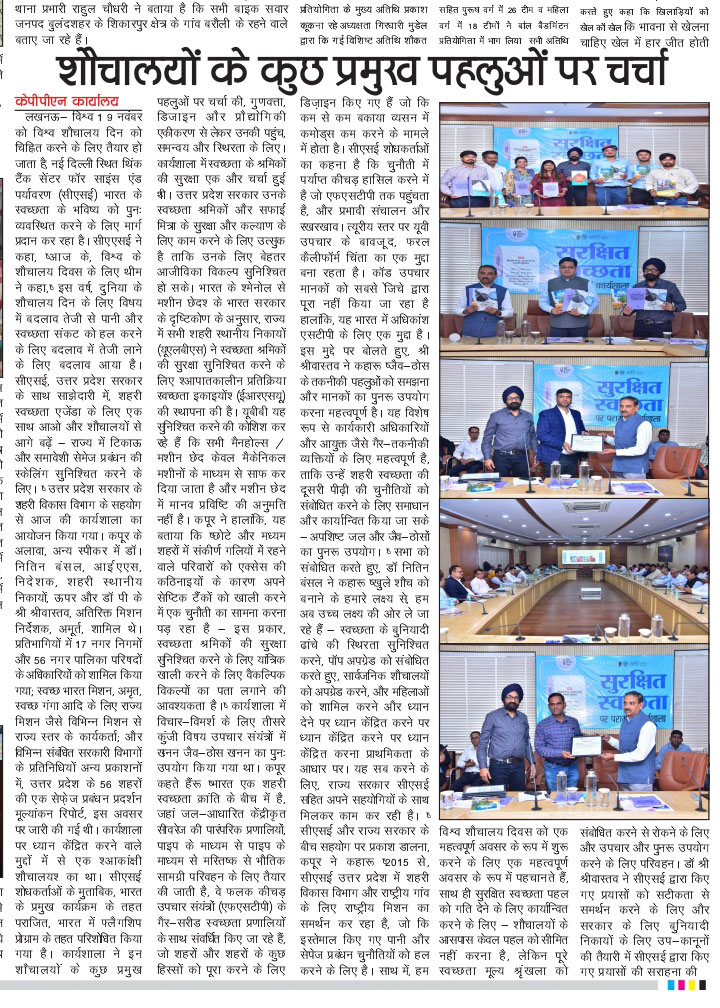
As the global community gears up to observe World Toilet Day on November 19, the Centre for Science and Environment (CSE), a prominent New Delhi-based think tank, took a stride towards reshaping India's sanitation landscape. In collaboration with the Department of Urban Development of the Uttar Pradesh government, CSE organised a workshop today aimed at advancing the urban sanitation agenda and promoting sustainable and inclusive septage management in the state. Depinder Singh Kapur, the Program Director for Water at CSE, said at the gathering during the workshop, emphasising the need to move beyond conventional toilets and focus on scaling up comprehensive septage management. The event, conducted in partnership with the Uttar Pradesh government, featured notable speakers such as Nitin Bansal, Director of Urban Local Bodies, UP, and P K Srivastava, Additional Mission Director, AMRUT, UP. Attended by officials from 17 municipal corporations, 56 Nagar Palika Parishads, and representatives from various government departments and missions, the workshop delved into critical issues surrounding sanitation. Among the publications unveiled on this occasion was the Septage Management Performance Assessment report covering 56 towns in Uttar Pradesh. A key focus of the workshop was the concept of 'aspirational toilets,' a facet introduced under India's Swachh Bharat Mission 2.0. These toilets aim to elevate standards in terms of cleanliness, hygiene, and user-friendliness. Discussions at the workshop ranged from quality and design to technology integration, accessibility, inclusivity, and sustainability. Safety for sanitation workers took centre stage, with the Uttar Pradesh government expressing its commitment to enhancing the well-being of its workforce. The implementation of 'Emergency Response Sanitation Units' in urban local bodies, aligning with the vision of 'manhole to machine hole,' aims to ensure the safety of sanitation workers. However, Kapur highlighted the challenge faced by households in smaller towns with narrow lanes, emphasizing the need to explore alternative options for mechanical emptying to ensure worker safety. The workshop also addressed the crucial issue of reusing bio-solids from treatment plants. CSE researchers stressed the importance of resource recovery to avoid exponential growth in bio-solids, which could lead to contamination and management issues. The results of a study analyzing sludge samples from 47 treatment plants, including those in Uttar Pradesh, were presented and discussed. Srivastava emphasized the importance of understanding the technical aspects of bio-solids and reuse standards, especially for non-technical personnel, to address the challenges of urban sanitation effectively. Nitin Bansal highlighted Uttar Pradesh's transition from achieving open defecation-free status to addressing broader goals, including sustainability of sanitation infrastructure, septage management, and the inclusion of women and marginalised communities. Depinder Singh Kapur commended the collaboration between CSE and the Uttar Pradesh government, dating back to 2015, and acknowledged World Toilet Day as a crucial occasion to accelerate safe sanitation initiatives throughout the entire sanitation value chain. Srivastava applauded CSE's efforts in supporting the state government in operationalising Faecal Sludge Treatment Plants (FSTPs) and in preparing bye-laws for urban local bodies, marking a significant step towards addressing the challenges of urban sanitation in Uttar Pradesh.

Move beyond toilets towards inclusive sanitation, says CSE on eve of World Toilet Day

As the world gets ready to mark World Toilet Day on November 19, New Delhi-based think tank Centre for Science and Environment (CSE) is offering a pathway towards reimagining India’s sanitation future. Speaking at a workshop on safe sanitation organised here today, Depinder Singh Kapur, programme director, water, CSE said: “This year, the theme for the World Toilet Day is accelerating change to solve the water and sanitation crisis. CSE, in partnership with the Uttar Pradesh government, come together for urban sanitation agenda forward and move beyond toilets – towards ensuring scaling up of sustainable and inclusive septage management in the state.” CSE organised today’s workshop in collaboration with the Uttar Pradesh government’s Department of Urban Development. Besides Kapur, the other speakers included Dr Nitin Bansal, IAS, director, Urban Local Bodies, UP and Dr P K Srivastava, additional mission director, AMRUT, UP. Participants included officials from 17 municipal corporations and 56 nagar palika parishads; state-level functionaries from various missions such as Swachh Bharat Mission, AMRUT, State Mission for Clean Ganga etc; and representatives from various related government departments. Among other publications, a Septage Management Performance Assessment report of 56 towns of Uttar Pradesh, was released on the occasion. One of the issues that the workshop focused on was that of ‘aspirational toilets’. Envisaged under India’s flagship programme, the Swachh Bharat Mission (SBM) 2.0, aspirational toilet is all about “raising the standards and aspirations regarding toilet facilities, aiming for higher levels of cleanliness, hygiene, and user-friendliness”, according to CSE researchers. The workshop discussed some key aspects of these toilets, ranging from quality, design and technology integration, to their accessibility, inclusivity and sustainability. Safety of sanitation workers was another discussion point at the workshop. The Uttar Pradesh government is keen to work on the safety and well-being of its sanitation workers and Safai Mitras to ensure improved livelihood options for them. In line with the Government of India’s vision of ‘manhole to machine hole’, all urban local bodies (ULBs) in the state have set up ‘Emergency Response Sanitation Units’ (ERSU) for ensuring safety of sanitation workers. ULBs are trying to ensure that all manholes/machine holes are cleaned only through mechanical machines and human entry in machine hole is not permitted. Kapur, however, pointed out that “households living in narrow lanes in small and medium towns are facing a challenge in emptying their septic tanks due to difficulties of access — there is, thus, a need to explore alternative options for mechanical emptying to ensure safety of sanitation workers.” The third key subject for deliberations at the workshop was reuse of bio-solids mined in treatment plants. Says Kapur: “India is in the midst of an urban sanitation revolution, where conventional systems of water-based centralised sewerage, designed to transport faecal material from homes through pipes to sewage treatment plants, are being augmented with non-sewered sanitation systems of faecal sludge treatment plants (FSTPs), that are designed to cater to towns and parts of cities where sewerage systems don’t exist.” The challenge is to ensure resource recovery from the faecal sludge or bio-solids in the treatment plants. CSE researchers point out that if this is not done, “the quantity of bio-solids will grow exponentially and will add to problems of contamination and management in the plants”. Working towards finding an answer to the challenge, CSE has collected and analysed sludge samples from 47 FSTPs and co-treatment STPs in seven states, including Uttar Pradesh. The results of the analysis were also discussed at the workshop. The CSE study results showed that FSTPs perform as effectively as conventional STPs, in terms of reducing BOD levels in treated wastewater, meeting the standards. CSE researchers say the challenge is in securing adequate sludge reaching the FSTPs, and effective operations and maintenance. Faecal coliform remains an issue of concern, despite UV treatment at the tertiary level. COD treatment standards are not being met by most FSTPs. However, this is an issue for most STPs in India. Speaking on the issue, Dr Srivastava said: “It is important to understand the technical aspects of bio-solids and reuse standards. This is especially critical for non-technical persons like executive officers and commissioners to enable them to advocate for and implement solutions for addressing second generation challenges of urban sanitation – the reuse of wastewater and bio-solids.” Addressing the gathering, Dr Nitin Bansal said: “From our target of making UP open defecation free, we have now moved towards higher goals – ranging from ensuring sustainability of sanitation infrastructure, addressing septage management, upgrading public toilets, and focusing on inclusion of women and marginalised communities on a priority basis. To do all this, the state government is working together with its partners, including CSE.” Throwing light on the collaboration between CSE and the state government, Kapur said: “Since 2015, CSE has been supporting the Department of Urban Development in Uttar Pradesh and the National Mission for Clean Ganga to address the used water and septage management challenges in UP. Together, we recognises World Toilet Day as an important occasion for initiating as well as culminating actions for accelerating safe sanitation initiatives — not limiting to only to only initiatives around toilets but addressing the whole sanitation value chain, from containments to emptying and transportation to treatment and reuse.” Dr Srivastava commended the efforts made by CSE to support the state government in operationalising the FSTPs and in preparation of the bye-laws for urban local bodies.

NO2 levels nearly 3X higher than safe limit this mth so far, says CPCB data

Gurgaon: The concentration of nitrous dioxide (NO2) in the city’s air has seen an increase between November 1 and 16 with the rise in pollution, breaching the permissible limit at some spots in the city several times. With civic agencies focussing mitigation measures on cutting PM2.5 and PM10 (ultrafine particles) emissions, the concentration of nitrogen oxides (NOx) such as NO2 in the city’s air has largely gone under the radar, despite their levels being nearly thrice the global safe standards, according to data from the Central Pollution Control Board’s (CPCB) pollution monitoring stations across the city. The CPCB has set an annual average limit of 40 µg/m³ for NO2 in the country, while the WHO’s safe limit for NO2 is 25 µg/m³. But at the Sector 51 air monitoring station, the average NO2 concentration at ground-level or tropospheric ozone was 87 µg/m³ on November 1, 97µg/m³ on November 2, 115 µg/m³ on November 3, 162 µg/m³ on November 5 and 87 µg/m³ on November 15. At Gwalpahari station, it was recorded at 115 µg/m³ on November 8 and 114 µg/m³ on November 12. The NO2 levels at Vikas Sadan and Teri Gram were within the safe limit (see graphic). Long-term exposure to high levels of nitrogen dioxide can cause chronic lung disease. It may also affect the senses, for example, by reducing a person's ability to smell an odour. High levels of nitrogen dioxide are also harmful to vegetation. According to experts, vehicular emissions are the primary source of NO2 in the city. The Sector 51 station covers the most polluted localities in Gurgaon even in terms of the average AQI, PM2.5 and PM10 levels, apart from NO2, primarily due to the large number of housing societies, vehicular congestion, urban slums, broken roads and construction dust. NO2 and other NOx react with other chemicals in the air to form both particulate matter and ozone. The reactions can also lead to the formation of acid rain, which can harm sensitive ecosystems such as lakes and forests, experts said. The major sources of NO2 are on-road transportation, coal-based energy production and industrial processes. “The high NO2 levels in the city are mainly due to vehicular emissions. Old vehicles and traffic congestion are the key sources of NO2 here. It has been observed that during winter, the air quality oscillates between ‘very poor’ and ‘severe’ as the condensation of fine particulate matter in the lower layer of the atmosphere,” said Shubhansh Tiwari, a research associate at the Centre for Science and Environment. Asked if the authorities are taking any steps to reduce NO2 emissions, the Haryana State Pollution Control Board (HSPCB) said all agencies are actively taking steps to ensure traffic congestion doesn’t occur in the city. “We have also given NOC to a private firm in Manesar to scrap old vehicles. This aims to remove polluting vehicles from the city roads," said Vijay Chaudhary, HSPCB regional officer (Gurgaon). Experts warned that long-term exposure to high NO2 levels causes asthma and increases susceptibility to respiratory infections. People with asthma, as well as children and the elderly are generally at greater risk. “Nitrogen is present in the air in the forms of nitrous oxide, nitric oxide and nitrogen dioxide. Chronic exposure to high concentrations of NO2 can cause alterations to lung metabolism, structure and function, inflammation and increased susceptibility to pulmonary infections and subsequent development of COPD,” said Dr Tushar Tayal, lead consultant (internal medicine) at CK Birla Hospital.

WFH, odd-even: Highest pollution curbs in place in Delhi, no measures on ground

Letting public, municipal and private offices work on 50% strength and the rest to work from home; closure of colleges and “non-emergency commercial activities,”; allowing vehicles to run on odd-even basis — it has been 11 days since Stage IV of the Graded Response Action Plan (GRAP) was imposed, but these measures are yet to be enforced. This, even as Delhi’s air quality deteriorated further on Thursday — the AQI was 440 (‘severe’) at 10 pm. This is also the longest stretch for which the most extreme restrictions under the plan have been suggested, at least from 2021 onwards. Last year, Stage IV — which comes into force when AQI levels are over 450 or the ‘severe plus’ category — was invoked by the Commission for Air Quality Management (CAQM) on November 3 and revoked three days later. In 2021, it was invoked on November 3 and revoked on November 7. The Act that constituted the CAQM for the NCR was passed in 2021. While it takes decisions on imposing stages of GRAP in the NCR, the steps are to be implemented by state governments. While the odd-even scheme has not been implemented in the city after an attempt in 2019, work-from-home for 50% of Delhi government staff was announced in November last year. The Delhi government had earlier announced that the odd-even scheme would kick in from November 13 to 20, only to defer it after the Supreme Court had referred to it as “optics.” When contacted for a comment, the office of Environment Minister Gopal Rai said measures such as the odd-even scheme and 50% work from home in private and government offices are under consideration for implementation subject to the AQI reaching the ‘severe plus’ (more than 450) category. The transport sector, meanwhile, continues to remain a large contributor to PM 2.5 levels in the city, going by data from IIT-Kanpur’s real-time source apportionment study. At 38%, it was the single largest contributor to PM 2.5 levels in the city on Wednesday, followed by 30% from secondary aerosols, and 23% from biomass burning. Anumita Roychowdhury, Executive Director, Research and Advocacy, Centre for Science and Environment (CSE), said, “Evidently, restrictions are applied keeping in mind public reaction. On some measures, there is hesitation to implement action more aggressively. Some restrictions are in place, but keep in mind that at this moment, vehicles are the major contributor to pollution, so when you do have a smog episode, reducing the sheer volume of vehicles on the road is critical. That needs to be addressed during a severe smog episode, and they would have to find ways of dealing with it and implement measures that have already been included.” Meanwhile, Rai Thursday said a six-member special task force, including officials of the environment department, Traffic Police, MCD and PWD, has been constituted to implement GRAP-related restrictions.