
Cse In News

Can anything stop the toxic smog of New Delhi?

A man blows cascades of bubbles near the India Gate in New Delhi, hoping to lure children, or at least their parents, to buy his bubble blowing kits. Visitors usually flock to see the giant arch, a war memorial, that towers over a sweeping pedestrian boulevard in the city center. But on a recent November day, visitors are thin. There's not much to see: The India Gate is a hazy outline in gray, smudgy smog. Bubble blower Gajender Kohli shakes his head. The bad air is bad for business, he says, and it makes him feel rotten. "It makes me sick. It makes the kids sick," he says. Visitor Prateek Dabhi says he can't wait to leave the city. He's on a leg-stretch stopover during a days-long bus trip to the Himalayas. "We're already losing years of our life," he says, because of pollution in his hometown in southeast India. "If we lived in this pollution, we'd lose even more." Air pollution is likely costing residents of New Delhi an average of about 12 years of life compared with their expected lifespan if the region met World Health Organization air quality standards, according to a September report by the Air Quality Life Index at the Energy Policy Institute at the University of Chicago. Situated in the worst-polluted area of South Asia, a sweeping plain straddling northern India and adjacent areas of neighboring Pakistan, New Delhi is considered the world's most polluted megacity. More than a half-billion residents make their homes in the region. New Delhi's air pollution problem becomes acutely visible in cooler months, when the air settles and allows smog to build up. During these months, it is often hazardous to breathe. In November, many schools were shuttered for nearly two weeks so children and teachers could stay home and avoid the outdoors. New Delhi officials have been trying for years to dent pollution levels, from incentivizing electric vehicle purchases to building a sprawling mass transit system. "And yet, it's not enough at all," says clean air advocate Anumita Roychowdhury, the executive directorof research and advocacy at the Centre for Science and Environment. Roychowdhury lists some of the efforts the New Delhi government has undertaken over some 20 years, from shuttering four coal power plants surrounding the city to ordering large industrial units to switch to less-polluting natural gas. The public bus fleet, which was switched over to natural gas, is now being swapped out for EVs. To monitor air pollution levels, – and what kind of emissions are contributing to them, — the city has installed more than 40 real-time monitoring stations. Residents get cash back if they buy two- or three-wheeled EVs – scooters and rickshaws, which are the main ways people get around in New Delhi. "As of today, roughly about 12% of the new vehicles sold in Delhi are electric vehicles," Roychowdhury says. "These are not small measures. No other city in India has implemented all of them together like Delhi has." Roychowdhury says all those measures have bent the upward curve – but the city's efforts are "overwhelmed, swamped and undercut simply by the sheer volume and numbers" of growth and new pollution. Within three years, New Delhi's population is expected to reach 39 million people – roughly the population of California, but a fraction of the size. New Delhi's sprawl extends so far that many residents don't actually live within city limits – they technically live in four neighboring states. "The problem is not Delhi's. The problem is a regional problem," says Jasmine Shah of the Aam Aadami Party, which governs New Delhi. But, he adds, "there is no coordinated action plan." Shah blames the rival, ruling federal governing party, the BJP, led by prime minister Narendra Modi. The same party also governs the states around New Delhi. "They seem to be politicking about this matter all the time." BJP state and federal officials declined to comment for this story. Roychowdhury says surrounding state and federal governments are taking action, "but it's not adding up." The federal government has made a series of moves, from strengthening fuel emissions standards and expanding renewable energy to providing incentives for electric vehicle sales. It provides extra cash to cities that reduce their air pollution, with mixed success. In 2021, the government created a commission to help manage air quality in New Delhi and the surrounding regions. It can "direct states to take very specific actions that reduce adaptation," says Bhargav Krishna, an expert on air pollution and health. "But it's chosen not to utilize the full range of its powers." Krishna says the tepid support for cleaning up India's deadly air can be explained by the bind the country is in:. India is "a developing country that rapidly needs to pull millions and millions of people out of poverty," he says. "You need to rapidly industrialize ... You need to provide electricity to all of these households." In northern India, that is still done chiefly through coal. "Air pollution is a really inconvenient problem to have,." Krishna says, and for now, "it's seen as an elite issue." New Delhi's experience underscores this perception. It is where elites — activists and the judiciary — have kept pressure on the local government to tackle the problem. Being the capital, it has also received more attention than other cities and regions. Activists say it's harder to mobilize people to pressure the government to do more because the most severe harm from air pollution isn't immediately noticeable. Some of the worst impacts come from the tiny particles in smog, known as PM2.5, about 30 times smaller than the diameter of a human hair. When you breathe them in, "they can go into your bloodstream and all over your body and act as a toxin," says Christa Hasenkopf of the Energy Policy Institute. "It causes strokes and heart attacks. It can cause even things like cognitive decline and certainly issues with fertility," Hasenkopf says. "It's hard to viscerally understand and connect that someone's illness is caused by, or exacerbated by, pollution. I think that's made it very, very difficult to develop policy and enforce policies to get rid of it." So New Delhi's residents keep paying the price. Take the children of Bhavreen Kandhari, a clean air activist: "My children hadn't seen a blue sky," she says, until the pandemic halted industry and kept cars off the road in New Delhi. At New Delhi's Safdarjung Hospital, Razia Begum waits for a doctor to see her three children, aged 10 years to 10 months. They've all got chesty coughs, she sighs. "It could be the cold, or the pollution," Begum says. "If the air was cleaner, my children wouldn't get so sick." For now, she says, the pollution keeps her running to the hospitals. On a nearby busy road, 35-year-old Baljeet Singh says he's recently learned that pollution is a danger (many people assume it's a normal winter fog). He's about to get on a motorbike. He wraps a handkerchief around his face to protect him from pollution, which experts say can help but is not sufficient. He laughs and asks: "Do you have a better idea?"
सुप्रीम कोर्ट ने प्रमुख भारतीय ब्रांडों द्वारा शहद में चीनी सिरप की मिलावट का आरोप लगाने वाली जनहित याचिका खारिज की

सुप्रीम कोर्ट ने सोमवार (04.12.2023) को वह जनहित याचिका (पीआईएल) खारिज कर दी, जिसमें विभिन्न रिपोर्टों के कारण बाजार में बेचे जाने वाले शहद के कई ब्रांडों की शुद्धता परीक्षण की मांग की गई थी। इस याचिका में दावा किया गया कि शहद बेचने वाले कई प्रमुख ब्रांड मिलावट में लिप्त हैं। जस्टिस विक्रम नाथ और जस्टिस राजेश बिंदल की खंडपीठ ने अपने आदेश में दर्ज किया, 'हम भारत के संविधान के अनुच्छेद 32 के तहत दायर इस याचिका पर विचार करने के इच्छुक नहीं हैं। तदनुसार, रिट याचिका खारिज कर दी गई।' यह जनहित याचिका 'एंटी करप्शन काउंसिल ऑफ इंडिया ट्रस्ट' नाम के एनजीओ ने दायर की थी। अप्रैल 2021 में सुप्रीम कोर्ट ने इस मामले में गृह मंत्रालय को नोटिस जारी किया था। याचिकाकर्ता ने दावा किया कि भारतीय बाजारों में बिकने वाले अधिकांश शहद में चीनी सिरप की मिलावट होती है। याचिकाकर्ता ने बताया कि चीनी की बढ़ती खपत से आबादी में स्वास्थ्य समस्याएं पैदा होंगी। याचिका में सेंटर फॉर साइंस एंड एनवायरनमेंट की एक रिपोर्ट का हवाला दिया गया, जिसमें दावा किया गया कि भारतीय ब्रांड चीन से आयातित संशोधित चीनी का उपयोग कर रहे हैं, जो देश में मिलावट परीक्षणों को बायपास करने में मदद कर रहा है। याचिकाकर्ता ने हाल के वर्षों में चीन से भारत में फ्रुक्टोज सिरप के आयात में वृद्धि को उजागर करके इस दावे का समर्थन किया।

GLG members urge focus on prevention and global cooperation to address AMR

The members of Global Leaders Group for antimicrobial resistance (GLG) underscored the critical interconnection of the issue of antimicrobial resistance (AMR) to the triple planetary challenges of climate change, biodiversity and nature loss, pollution and waste. The discussion on December 3, 2023 took place as a part of the Science-Policy Day, held as one of the ongoing activities by United Nations Environment Programme (UNEP) during the 28th Conference of Parties (COP28) to the UN Framework Convention on Climate Change. The COP28 summit is taking place from November 30 to December 12, 2023, at Expo City, Dubai, United Arab Emirates. Panelists and GLG members, Sunita Narain, director-general of Delhi-based think tank Centre for Science and Environment in India and Beatrice Atim Odwong Anywar, Minister of State for Environment in Uganda, participated in this event. AMR contributes to nearly 5 million deaths annually , primarily in low- and middle-income countries. The threats posed by AMR extend across human, animal, plant, and environmental health, also affecting food safety, security, development and pandemic prevention preparedness and response, as drug-resistant bacteria can circulate through food and the environment. Narain emphasised the importance of cost-effective solutions to tackle the issue of pharmaceutical waste. She highlighted the larger issue of our production systems and pointed out that the focus should shift from ‘mitigation’ to ‘prevention’ and that the incorporation of prevention into national action plans is required, particularly in agriculture, livestock and other food-producing systems. “The idea of prevention needs to be hardwired into our system with good guidance,” she said. Narain highlighted the need for improved diagnostics and alternative therapies as viable options before we move to last-resort antibiotics. Narain also stated the linkages between AMR, biodiversity and climate need to be well understood. In this respect, agriculture is the core of climate change, livelihood, economy and AMR. Anywar emphasised the importance of collaborative efforts through the One Health framework, in which we must care for the health of humans, animals and the environment all at the same time. She highlighted Uganda’s policies in place for environment and a unique provision requiring government ministries to obtain a certificate of no objection from the Ministry of Environment for their actions related to climate and environment. The minister also expressed readiness to network with other nations to address the AMR crisis. The discussion aligned with UNEP’s publication Bracing for Superbugs and focused on preparing for the UN General Assembly High-level Meeting on AMR in 2024. We are a voice to you; you have been a support to us. Together we build journalism that is independent, credible and fearless. You can further help us by making a donation. This will mean a lot for our ability to bring you news, perspectives and analysis from the ground so that we can make change together.

CIVIL SOCIETY LEADERS DEEPLY CONCERNED OVER INADEQUATE COP PROGRESS AS WEEK ONE CONCLUDES

At a press briefing by Climate Action Network (CAN), civil society leaders expressed their deep concern at the pace of climate negotiations and called for the COP28 presidency to step up leadership. Liane Schalatek, Associate Director, Heinrich Böll Foundation Washington, DC, said: “Without a significant increase in climate finance commitments here in Dubai there will be no trust, no ambition, no implementation going forward and certainly no climate justice delivered. “What we need to see here is a ratcheting up of finance provision by developed countries but what we are seeing and hearing across the finance negotiation rooms is that developed countries are continuing to downplay, if not deny, their historical responsibilities and obligations. “What we have seen here is a lack of ambition in finance pledges. Where we need trillions and billions what we have got so far is millions which is inadequate, unjust and it is an insult to the communities in the global south who need support now and not eventually. Delaying delivery will cost lives and livelihoods.” Pratishtha Singh, Senior International Policy Analyst, Climate Action Network – Réseau action climat Canada said the lack of progress in agreeing a global goal on adaptation is ‘deeply concerning’. She said: “Adaptation is a cornerstone in achieving the goals of the Paris Agreement but has been almost invisible in announcements and financial pledges but its delivery, through action and support, is important to build trust for collaboration. “There has been a continued lack of sufficient political attention which is unacceptable. Developed nations, particularly, need to do their part and lead talks whilst respecting the principles of equity, historical responsibility and climate justice. “Adaptation and mitigation must be pursued with equal force and commitment. Overall we need urgent attention and political leadership from the COP presidency to work with the developed and developing countries to make it happen.” Avantika Goswami, Programme Manager, Climate Change, Centre for Science and Environment, said: “Within Global Stocktake discussions many disagreements remain particularly over mitigation ambition, finance and fossil fuel phase out which is a contentious topic with many disagreements. “There is language in the text on a global fossil fuel phase out but it is not accompanied by a clear timeline for this target or differentiation of schedules between developed and developing countries. “We would also like to see language on tripling of renewable energy and doubling of energy efficiency alongside a just phase out of all fossil fuels for an ambitious GST outcome.”

शहद में चीनी की मिलावट के आरोपों की जांच की मांग वाली याचिका खारिज

सुप्रीम कोर्ट नेउस जनहित याचिका को सिरेसेखारिज कर दिया है, जिसमेंकई नामी कंपनियों पर मिलावटी शहद बेचनेका आरोप लगातेहुए, उसकी शुद्धता की जांच करने की मांग की थी। वर्ष 2021 मेंदाखिल याचिका मेंकई रिपोर्टों का हवाला देतेहुए कहा गया था कि बाजार मेंकई नामी कंपनियों की शहद मेंमिलावट है। जस्टिस विक्रम नाथ और राजेश बिंदल की पीठ नेकहा कि हम संविधान के अनुच्छेद 32 के तहत दाखिल याचिका पर विचार करनेके इच्छुक नहीं है, ऐसेमेंइसेखारिज किया जाता है। इस मामलेमेंअप्रैल 2021 मेंपीठ नेकेंद्रीय गृहगृ मंत्रालय को नोटिस जारी किया था। गैर सरकारी संगठन द्वारा दाखिल याचिका मेंकहा गया था कि बाजार में बिक रही अधिकांश कंपनियों के शहद मेंचाशनी मिली हुई है। याचिका मेंकहा गया था कि शहद मेंचीनी की मिलावट होनेसेलोगों के स्वास्थ्य पर बुरा प्रभाव पड़ सकता है। शीर्षअदालत मेंदाखिल याचिका मेंकहा गया था कि सेंटर फॉर साइंस एंडएं एनवायरनमेंट की रिपोर्ट का हवाला देतेहुए कहा गया था कि भारतीय कंपनी शहद मेंचीन से आयातित संशोधित चीनी का उपयोग कर रहेथेजो देश मेंमिलावट परीक्षणों को बायपास करनेमेंमदद कर रहा था। याचिका मेंकहा गया था कि हाल के वर्षों मेंचीन से भारत मेंफ्रुक्टोज सिरप के आयात मेंबढ़ोतरी हुई, जो शहद मेंचीनी मिलावट के दावेका समर्थन करता है। यह हिन्दुस्तान अखबार की ऑटेमेटेड न्यूज फीड है, इसेलाइव हिन्दुस्तान की टीम नेसंपादित नहीं किया है

बढ़ते तापमान को रोकने उपाय करना जरूरी : रजनीश सरीन

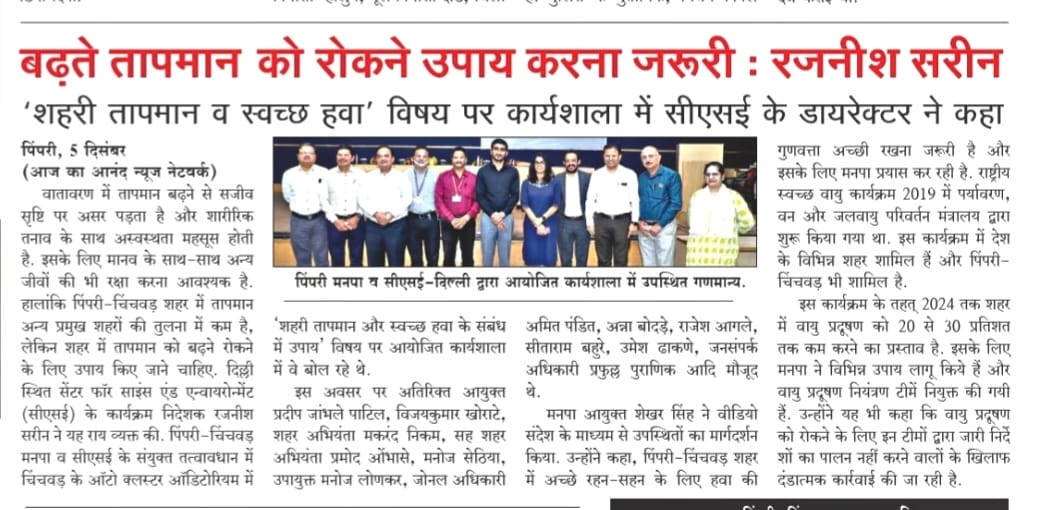
वातावरण में तापमान बढ़ने से सजीव सृष्टि पर असर पड़ता है और शारीरिक तनाव के साथ अस्वस्थता महसूस होती है. इसके लिए मानव के साथ-साथ अन्य जीवों की भी रक्षा करना आवश्यक है. हालांकि पिंपरी-चिंचवड़ शहर में तापमान अन्य प्रमुख शहरों की तुलना में कम है, लेकिन शहर में तापमान को बढ़ने रोकने के लिए उपाय किए जाने चाहिए. दिल्ली स्थित सेंटर फॉर साइंस एंड एन्वायरोन्मेंट (सीएसई) के कार्यक्रम निदेशक रजनीश सरीन ने यह राय व्यक्त की. पिंपरी-चिंचवड़ मनपा व सीएसई के संयुक्त तत्वावधान में चिंचवड़ के ऑटो क्लस्टर ऑडिटोरियम में ‌‘शहरी तापमान और स्वच्छ हवा के संबंध में उपाय' विषय पर आयोजित कार्यशाला में वे बोल रहे थे.   इस अवसर पर अतिरिक्त आयुक्त प्रदीप जांभले पाटिल, विजयकुमार खोराटे, शहर अभियंता मकरंद निकम, सह शहर अभियंता प्रमोद ओंभासे, मनोज सेठिया, उपायुक्त मनोज लोणकर, जोनल अधिकारी अमित पंडित, अन्ना बोदड़े, राजेश आगले, सीताराम बहुरे, उमेश ढाकणे, जनसंपर्क अधिकारी प्रफुल्ल पुराणिक आदि मौजूद थे. मनपा आयुक्त शेखर सिंह ने वीडियो संदेश के माध्यम से उपस्थितों का मार्गदर्शन किया. उन्होंने कहा, पिंपरी-चिंचवड़ शहर में अच्छे रहन-सहन के लिए हवा की गुणवत्ता अच्छी रखना जरूरी है और इसके लिए मनपा प्रयास कर रही है. राष्ट्रीय स्वच्छ वायु कार्यक्रम 2019 में पर्यावरण, वन और जलवायु परिवर्तन मंत्रालय द्वारा शुरू किया गया था. इस कार्यक्रम में देश के विभिन्न शहर शामिल हैं और पिंपरीचिंचव ड भी शामिल है. इस कार्यक्रम के तहत्‌‍ 2024 तक शहर में वायु प्रदूषण को 20 से 30 प्रतिशत तक कम करने का प्रस्ताव है. इसके लिए मनपा ने विभिन्न उपाय लागू किये हैं और वायु प्रदूषण नियंत्रण टीमें नियुक्त की गयी हैं. उन्होंने यह भी कहा कि वायु प्रदूषण को रोकने के लिए इन टीमों द्वारा जारी निर्दे शों का पालन नहीं करने वालों के खिलाफ दंडात्मक कार्रवाई की जा रही है.

Air improves slightly as wind speed picks up, but stays ‘poor’

Gurgaon: The city’s air quality index (AQI) on Monday remained in the poor category. The index was recorded at 224, slightly improved from Sunday’s 242 as the wind speed went up to 10kmph. According to CPCB’s 24-hour average, the monitoring station in Sector 51 recorded the city’s worst AQI, at 311 whereas other stations including Gwalpahari, Teri Gram and Vikas Sadan recorded AQIs of 193, 197 and 156, respectively. As for the PM2.5 and PM10 levels, they were above the permissible limit, indicating pollutants from local sources such as vehicular emissions and dust. The PM2.5 level was highest in Sector 51 (305µg/m³), followed by Gwalpahari (195µg/m³), Teri Gram (156µg/m³), and Vikas Sadan (113µg/m³ ), as per the CPCB data. PM10 reading at the first three stations was 301µg/m³, 167µg/m³, and 189µg/m³, respectively. Vikas Sadan does not record PM10 data. According to the CPCB, the annual average permissible limits for PM2.5 and PM10 are 60µg/m³ and 100µg/m³. The central government’s System of Air Quality and Weather Forecasting and Research (SAFAR) said the AQI could slip back to a very poor category. “The predominant surface wind is likely to be calmer during morning and evening hours, from Northwest directions in Delhi-NCR with a speed of up to 4 mph,” it stated. “Throughout the year, the region has been witnessing poor to very poor air and it will aggravate in the coming days because we are yet to enter the peak winter phase. As the temperature will go down, the dispersion of pollutants will be slower that is likely to lead to more accumulation close to the earth’s surface,” said Shubhansh Tiwari, a research associate at the Centre for Science and Environment. The AQI in Delhi was in the very poor category — at 310, whereas Faridabad (273), Ghaziabad (216) and Noida (243) were all in the poor category. According to guidelines issued by the Central Pollution Control Board, when the AQI is moderate, patients with asthma, lung and heart ailments are likely to face breathing discomfort. In poor AQI, breathing discomfort can be felt by most people on prolonged exposure. Health experts said that patients with existing respiratory or medical conditions are at more risk now as the region is entering the winter cycle. “Patients are experiencing a heavier voice and exacerbated breathing problems. It is concerning to observe these respiratory challenges not only in individuals with pre-existing conditions like asthma or other lung diseases but also in those who have never encountered such issues before. Moreover, the uptick in flu cases within our OPD further emphasizes the pronounced impact of winter pollution on overall respiratory health. These concerns require awareness and collaborative efforts to mitigate the effects of seasonal air quality challenges on our community’s health,” said Dr Nikhil Modi, senior consultant, pulmonology/ respiratory medicine, Indraprastha Apollo Hospital, Delhi. The city’s maximum temperature on Monday was recorded at 23.8 degrees Celsius while the minimum temperature was 13.2 degrees Celsius. The India Meteorological Department (IMD) predicted dense fog at isolated places on Tuesday. Yellow alert has been issued in the city for Tuesday.

"Who Has Sponsered You?" Asks Supreme Court While Dismissing PIL Alleging Adulteration In Honey Sold By Some Companies

The Supreme Court today dismissed a Public Interest Litigation (PIL) that sought criminal action and a ban on all industries and companies allegedly engaged in the unauthorized production of adulterated honey. The PIL also sought test reports of various honey brands to be submitted before the Court to ensure the authenticity of honey products sold in the Indian markets. On April 19, 2021, the Court issued a notice in this matter to the Central government and all the States. Today, the Petitioner apprised the Bench of Justice Vikram Nath and Justice Rajesh Bindal that out of all 40 Respondents, only the State of Tamil Nadu filed its response. "The Notice was issued to all the Respondents but only one, the 13th Respondent, State of Tamil Nadu has filed its response", submitted the counsel. However, expressing disclination in entertaining the matter, Justice Nath remarked, "Why should we not dismiss all these petitions with cost now?". Justice Nath asked the counsel, "Dabur, Patanjali, Zandu... they are all adulterating honey with sugar syrup?" and further remarked, "But sponsored by whom? Who has sponsored you? Baidyanath? Baidyanath is not there... Baidyanth must have sponsored you." Expressing doubts on the merits of the Petition, Justice Bindal also commented, "You are for a particular brand." Accordingly, the Bench dismissed the Petition. Justice Nath stated, "Adulteration... go to the authority concerned. Make a complaint." The PIL, filed by the Anti-Corruption Council of India through Advocate-on-Record Manju Jetley, asserted that news reports on various online portals indicated an ongoing investigation by the Centre for Science and Environment (CSE) revealing that honey sold by several brands, including Dabur, Patanjali, and Zandu, was found to be adulterated with sugar syrup. The PIL submitted that this situation posed a significant health risk as individuals, unknowingly consuming more sugar instead of genuine honey, were increasing their vulnerability to COVID-19. "Therefore, instead of honey people are eating more sugar which will add to the risk of Covid-19. Sugar ingestion is direct to obesity, and obese people are more vulnerable to threatening infections" stated the PIL. It was further submitted in the PIL that, "According to researchers from the Centre for Science and Environment, major Indian Honey brands are mixing honey with a modified sugar from China which bypasses some basic tests used to detect the adulteration in honey. The Centre for Science and Environment (CSE) alleged that Chinese companies were exporting sugar syrup as 'fructose syrup' to India with claims that it could bypass the basic test specified for selling honey in the Indian market." Cause Title: Anti Corruption Council Of India Trust v. Ministry Of Home Affairs & Ors. [Diary No.- 7912 - 2021]

Blame game that sabotages fight against climate change

The politics of responsibility for carbon emissions complicate the response of both aid and trade Please use the sharing tools found via the share button at the top or side of articles. Copying articles to share with others is a breach of FT.com T&Cs and Copyright Policy. Email licensing@ft.com to buy additional rights. Subscribers may share up to 10 or 20 articles per month using the gift article service. More information can be found at https://www.ft.com/tour. https://www.ft.com/content/015100bc-e84c-4f08-827d-aa36fc8b1ea7 Welcome to Trade Secrets. The big COP28 climate change meeting is under way in Dubai, initially overshadowed by stories about the hosts allegedly using the event to buy influence and sell oil and gas. Seriously, if you’re going to greenwash, do it properly. Still, amid the PR facepalms was some modestly positive news about the launch of a “loss and damage fund” to compensate lower-income countries for the effects of climate change. Today’s main pieces address how the jockeying for political position around such initiatives holds back progress on climate action, and the implication for carbon border measures. Charted waters is on falling inflation in the eurozone. Please use the sharing tools found via the share button at the top or side of articles. Copying articles to share with others is a breach of FT.com T&Cs and Copyright Policy. Email licensing@ft.com to buy additional rights. Subscribers may share up to 10 or 20 articles per month using the gift article service. More information can be found at https://www.ft.com/tour. https://www.ft.com/content/015100bc-e84c-4f08-827d-aa36fc8b1ea7 Controlling the past and future narrative Before cracking open crates of champagne for the victory party of the loss and damage fund, let’s first hydrate ourselves by drinking deep from the well of perspective. The numbers involved at the outset are pretty feeble, and the politics is very tricky. The rationale for spending money, the institution that gets to spend it, even the name the pot of money gets given: all are pulled different ways by competing narratives. The US and particularly Congress is not a fan of multilateral funds it doesn’t get to control. It’s notable that one of the most impressive US aid efforts of recent decades, George W Bush’s President’s Emergency Plan For Aids Relief (Pepfar) to combat HIV in Africa, was an American-badged and American-run project. The compromise is to have the loss and damage fund housed, at least for now, at the World Bank, the president of which the US traditionally supplies. Even so, Washington still doesn’t like the term “loss and damage”, an expression its climate envoy John Kerry notably did not use when the announcement was made, and nor has it given the fund much money. The term, redolent of tort law, implies compensation (some might say reparations) paid by polluters to their victims, suggesting an ongoing liability. To be fair, that’s not an unreasonable way of looking at climate change. Current carbon levels reflect past emissions by countries that got rich through polluting. See this graphic from a report by the Indian research and advocacy organisation the Centre for Science and Environment, about the “global stocktake” of how the world is performing on climate change since the Paris Agreement of 2015. Crudely speaking, it shows which countries think we should focus on past versus future emissions. Even a sceptic (like me) of the concept of a united “Global South” of developing countries can’t deny the divide between rich nations and poorer ones. Please use the sharing tools found via the share button at the top or side of articles. Copying articles to share with others is a breach of FT.com T&Cs and Copyright Policy. Email licensing@ft.com to buy additional rights. Subscribers may share up to 10 or 20 articles per month using the gift article service. More information can be found at https://www.ft.com/tour. https://www.ft.com/content/015100bc-e84c-4f08-827d-aa36fc8b1ea7 But establishing the principle that climate change is essentially about the polluters of the past correcting their wrongs isn’t going to get consensus, or indeed control emissions from the newer industrialisers such as India and China. Hence the attempts by rich countries to insist the better-off middle-income nations also pay into these adjustment funds. As Ian Bremmer of GZERO Media points out, developing countries shouldering a lot of the burden of cutting emissions is unfair, but necessary. To adapt Harry S Truman’s attributed saying that it’s amazing what you can accomplish if you don’t mind who gets the credit, it’s sadly striking how little happens if you can’t agree who takes the blame. Of course, there’s always the idea of dancing neatly round this stand-off by attracting private finance, the principle behind the COP28 hosts’ proposed $30bn development fund. But vague promises of leveraging up relatively small amounts of official money into a big investment effort have frequently been made in other contexts and need to be treated with scepticism. The carbon border tariff bind At least in the area of aid and finance to help countries adapt and mitigate the effects of climate change, rich governments can redistribute to poor. With regard to trade, border measures that work directly on carbon content pretty much by definition have to focus on the product rather than the general state of the country from which it came. As I wrote last week, in the absence of any serious negotiations over trade and climate change, the main initiative in this area is the EU’s carbon border adjustment mechanism (CBAM). Both in logic and in legality it can only focus on current emissions. If the aim is to prevent carbon leakage, it needs to be directed against imports that are being made right now. And if it’s going to survive legal challenges at the WTO, it’s got to be precisely focused on achieving a particular aim and must treat identical products the same way. There were media reports earlier this year that India was preparing some kind of national carbon pricing mechanism that took previous emissions into account, but it’s very hard to see how that’s either practical or legal, certainly in international trade terms. The only real way indirectly to gesture towards historic emissions would be to give passes on the CBAM to poorer countries. But, as I also noted last week, the EU says that would defeat the object of the measure and also potentially leave it open to WTO challenge. You can see the technocratic and legal argument for what the EU is doing. Then again, if you’re a middle-income former colony whose manufacturing industry was devastated in earlier centuries by competition from a European imperial power, you can also see how incredibly maddening it is for that power or similar countries to suddenly slap tariffs on your exports for doing what their producers did for centuries without getting taxed for it. Charted waters Inflation is falling across most of the advanced economies, including as shown here in the eurozone, suggesting that interest rates may have peaked. Please use the sharing tools found via the share button at the top or side of articles. Copying articles to share with others is a breach of FT.com T&Cs and Copyright Policy. Email licensing@ft.com to buy additional rights. Subscribers may share up to 10 or 20 articles per month using the gift article service. More information can be found at https://www.ft.com/tour. https://www.ft.com/content/015100bc-e84c-4f08-827d-aa36fc8b1ea7 The implications for trade are clear. So far we’ve seen a pretty normal cyclical downturn in goods trade to accompany the slowing of global growth. If the world economy turns around, trade will be very likely to turn with it and another alleged threat to globalisation will recede. Trade links I did say there wasn’t a great chance of success, and the idea of getting the revision of the EU-Mercosur deal done before Javier Milei takes office in Argentina on December 10 has essentially disappeared. Speaking of trade talks going badly, Brussels’ negotiations with India are also struggling to bridge the two sides’ disparate views, an outcome that could not have been predicted except by anyone with the slightest familiarity with the subject. Inu Manak at the Council on Foreign Relations asks whether Washington’s reversal of its previous enthusiasm for far-reaching digital rules in trade deals could be reversed again. Belgian prime minister Alexander de Croo, representing sceptics of EU industrial policy being run by and for the countries with the deepest pockets, says the EU should concentrate on improving the single market rather than doling out state subsidies to address climate change. A paper for UK In A Changing Europe, a network of academics and researchers, says the British government’s recent white paper on development shows a constructive approach but is unlikely to restore the cuts in aid made since 2010.

G7 countries agree to phase out coal by 2030, announces French President Emmanuel Macron

Over $12 billion pledged for Green Climate Fund; 118 countries commit to tripling renewable and double energy efficiency by 2030 The 28th Conference of Parties (COP28) to the United Nations Framework Convention on Climate Change in Dubai, United Arab Emirates (UAE), began November 30, 2023. Here’s a look at what happened on the third day of COP28. FRANCE ANNOUNCEMENTS France would completely phase out coal by 2027, French President Emmanuel Macron announced in a press conference at COP28. Other G7 countries have also agreed on phasing out coal by 2030, he added, urging G20 countries to also agree on it. France would double its energy efficiency target and triple its renewable energy capacity by 2030, Macron stated. The country will also triple its nuclear energy capacity by 2050. On Loss and Damage, Macron highlighted the $109 million that France has committed to the L&D Fund and also the 1.2 billion Euros contract with Bangladesh, calling it a ‘sort of’ a L&D Fund as well. He also called for a complete reform of the Bretton Woods system of international finance, as many countries have been left out of it. Macron highlighted his work alongside Brazilian President Lula da Silva on new mechanisms of international taxation that would bring in money to address climate change impacts and support climate action. He also announced a water and oceans summit in Nice to be held in 2025 along with Kazakhstan. GLOBAL STOCKTAKE The draft text on the Global Stocktake is still being negotiated, with little agreement from countries on key themes of mitigation, adaptation and means of implementation, including finance. L&D and response measures remain to be discussed. So far, under the GST, there have been proposals for three new entities: A Work Programme for Article 2.1c, a Technology Implementation Programme and a Capacity Building Fund. METHANE In a summit on methane and other greenhouse gases, COP28 President-Designate Sultan Al Jaber urged nations to commit economy-wide Nationally Determined Contributions (NDC) that cover all greenhouse gasses, including methane, by 2035. Al Jaber noted that the United Arab Emirates has committed to channelling $100 million to the World Bank’s Global Flaring and Methane Reduction Trust Fund, a multi-donor trust fund aiming to end routine gas flaring at oil production sites across the world. The methane finance sprint, a funding campaign to cut methane emissions in line with the Global Methane Pledge, has mobilised $1 billion in new grant funding. The Global Methane Pledge is an initiative launched at COP26 to reduce the 2020 methane levels by 30 per cent by 2030. SUSTAINABLE COOLING COP28 presidency, along with the UN Environment Programme and Cool Coalition, launched the Global Cooling Pledge to improve energy efficiency and climate friendly approaches, while also increasing access to sustainable cooling for the most vulnerable. More than 50 countries have endorsed the cooling pledge DECARBONISATION The COP28 presidency launched the Global Decarbonisation Accelerator to activate decarbonisation in the industry, energy and transport sectors by facilitating access to policymaking and standards, financing, infrastructure and technology. Al Jaber said it addresses the demand and supply of energy at the same time and aligns more countries and companies to keep 1.5 degrees Celsius within reach. Some 118 countries have signed a global pledge to triple renewable and double energy efficiency by 2030. India is believed to have not signed on to this target. Al Jaber said the pledge will help the world transition away from unabated coal. Ursula von der Leyen, President of the EU Commission, pledged 2.3 billion Euros over the next two years to support this energy transition. COP28 presidency, UN Climate Change and Bloomberg philanthropies launched an Industrial Transition Accelerator to speed up decarbonisation across heavy-emitting sectors, including energy, industry, and transportation, and accelerate the delivery of Paris-aligned targets. GREEN CLIMATE FUND REPLENISHMENT The United States announced a $3 billion pledge to the Green Climate Fund (GCF). Together with pledges from Italy, Switzerland, Portugal and Estonia, it brings the total raised in the latest GCF replenishment round to $12.7 billion. ARTICLE 6 Article 6.2: Draft guidance on cooperative approaches under Article 6.2 was released, taking on topics like the definition of a cooperative approach and authorisation process details. Parties engaged in informal discussions, asking for more time to work on the 33-page-long document and proposing streamlining for more efficient negotiations focused on the minimum guidance necessary for implementing cooperative approaches. Article 6.4: Informal consultations took place to discuss supervisory body recommendations on removal activities, methodologies and other matters. Some groups expressed support for the recommendations, while others stressed the necessity for additional work before adoption. Various groups and countries shared views on the recommendations related to removal activities. Concerns were raised about potential environmental and social impacts, reversals, monitoring periods, and the broad definition of removals. Some emphasised the need for further work and improvements to ensure environmental integrity, human rights, and a robust carbon market. Informal consultation will continue on December 3. MITIGATION WORK PROGRAMME During the Mitigation Work Programme meeting, China expressed dissatisfaction with the informal note, emphasising the absence of a mandate for its production. Various countries, including the Alliance of Small Island States, Zimbabwe, Colombia, Saudi Arabia and Switzerland, provided input on the global dialogues. Some parties raised points on how the work programme can ensure no duplication with the Global Stocktake negotiations stream. Informal consultations would continue today. A pavilion event on operationalising carbon markets for achieving energy Transition goals by the Shakti Foundation saw speakers from Delhi-based think tank Centre for Science and Environment (CSE), research institute The Energy and Resources Institute, think tank Council on Energy, Environment and Water, nonprofit World Resources Institute and green consultant Perspectives Climate Group. Speakers discussed current issues with the voluntary carbon market, India’s role in Article 6.2 and ways in which carbon markets can accelerate finance. CSE presented its new paper Discredited, which focuses on the voluntary carbon market in India. SUBNATIONAL FINANCE, MDB REFORM FOR LOCAL CLIMATE ACTION Two panel discussions on day two of COP28 brought the focus of finance to the subnational and local levels. Mayors of cities from different countries and representatives of international financial institutions, including multilateral development banks (MDBs) discussed ways to improve climate finance and ambition at the city level. The key points that emerged included: Need to address issues of access to climate finance for cities. MDBs currently engaged with national governments of countries, several city mayors called for direct access to climate funding to cities instead. Call for MDBs to shift from ‘project mode’ of operation to ‘programmatic mode’, going beyond individual project assistance and including support to cities, which have smaller projects that are often not considered profitable enough Need to better understand how to address sovereign guarantees role (which are issued by central governments for cities) as blocker of finance for cities, which seemed to be a common issue highlighted by many mayors. For MDBs and cities to work on city-level climate action plans. The representative of the European Bank for Reconstruction and Development highlighted their Green City Action Plans that are part of the Green City Programme in this regard. We are a voice to you; you have been a support to us. Together we build journalism that is independent, credible and fearless. You can further help us by making a donation. This will mean a lot for our ability to bring you news, perspectives and analysis from the ground so that we can make change together. https://www.downtoearth.org.in/news/climate-change/cop28-diary-december-2-g7-countries-agree-to-phase-out-coal-by-2030-announces-french-president-emmanuel-macron-93136

COP28: To save the planet, we need a just and fair renewable energy revolution

As the two-week UN climate conference underway in Dubai’s Expo City reached its midway point, attendees stressed that the move towards clean energy sources must involve careful consideration of the concerns of people and communities who will be most affected by this transition. As most of government ministers and world leaders have wrapped up their events, a sense of urgency is building around the iconic domed venue as COP28 climate negotiators ramp up the intense climate diplomacy necessary for a successful sprint to the finish line next Tuesday, when the conference is expected to wrap up. These negotiations are mainly focused on three key issues: phasing out or reducing the use of fossil fuels, building resilience to climate impacts, and financial support for vulnerable countries coping with a climate catastrophe they played little to no role in causing. We at UN News saw – and heard – ample support for these demands on Tuesday morning as we made our way to the media center at Expo City’s sprawling campus. Protests, albeit subdued Large scale protests, often seen as a key feature of annual UN climate talks have largely been missing in Dubai, the largest city in the United Arab Emirates, but following the relative quiet of conference’s early days, demonstrators are slowly but surely beginning to make their voices heard. On Tuesday, a small group of demonstrators in the UN-managed Blue Zone area enthusiastically chanted slogans over the presence of oil and gas fossil companies and the participation of lobbyists, whom, they argued, have been given an undue platform in climate negotiations. The protestors’ call, albeit subdued compared to other COPs, has echoed with phrases such as “1.5-degree goal”, “NDCs”, “Net-Zero” and “just transition”, which is on Tuesday’s agenda for discussion. What is a just transition? Broadly speaking, ‘just transition’ means that after decades of economic growth fueled by oil and gas, as the global economy now embarks on decarbonization, it needs to do so in a way that ensures workers and communities that are reliant on fossil fuels are not left behind. Their futures and job security must be protected in a net-zero world – which entails cutting greenhouse gas emissions to as close to zero as possible. But Ms. Sunita Narain, an Indian environmental expert and Director General of the Center for Science and Environment, believes that the term is being used in a very short-sighted way. Transition through a ‘myopic lens’ Speaking to UN News she said, “it is very important to have just transition for coal labour, for miners, for thermal power point workers. But that’s not just transition.” “It is about the fact that we need a global transition and that … our part of the world is going to have to move to the cleaner sources of energy.” “The rich, the industrialized world needs to reduce its use of [fossil fuel] energy and in that transition, we must make sure that it is fair. And that is how we must interpret just transition,” she explained. “The transition [needed to create] a sustainable world has to be fair and just.” Such differences over even the definition of just transition, signal the complexities involved and the possible uphill battle ahead for negotiators. Meanwhile, the effects of climate change continue to spread, reaching the far corners of the world. Even to communities that played little role in causing crisis but are now bearing the brunt of it. Climate justice Climate justice, on the agenda nearly every day in one form or another at COP28, calls for more equity and human rights at the core of decision-making and action on climate change. Even among those affected, some groups and communities are the more impacted, namely women, and disabled and indigenous peoples. Some representatives of these groups, including from indigenous communities, are taking part in the side events and discissions today.

Air 'poor' for 2 days in a row, may worsen as wind slows down

GURGAON: The city's air quality index (AQI) remained in the 'poor' category for the second day. On Sunday, the AQI was 242, marginally better than the 258 logged a day ago as wind speed picked up to 7kmph, flushing pollutants a little faster. According to the CPCB's 24-hour average, the monitoring station in Sector 51 recorded the worst AQI of 348, while it hovered in the lower level of the 'poor' category at Gwal Pahari (245), Teri Gram at 215 and Vikas Sadan (205). Both PM2.5 and 10 levels were also recorded above the permissible limit, indicating pollutants from local sources, including vehicular emissions and dust. The PM2.5 level was highest in Sector 51 (315 g/m³), followed by Gwalpahari (276 g/m³), 256 g/m³ in Teri Gram, and 213 g/m³ in Vikas Sadan, as per the CPCB data. Air ‘poor’ for 2 days in a row, may worsen as wind slows down The level of PM10 was the highest at Sector 51 (308 g/m³), followed by Teri Gram (254 g/m³) and Gwalpahari (232 g/m³). Vikas Sadan doesn't record PM10 data. According to the CPCB, the annual average permissible limits for PM2.5 and PM10 are 60g/m³ and 100 g/m³, respectively. The central government's System of Air Quality and Weather Forecasting and Research (Safar) said AQI could slip back to the 'very poor' category as wind speed was unlikely to improve till December 6 - blowing from the northwest direction at 6 to 8 kmph. It was, however, unlikely to plummet further. "This is a yearly phenomenon. Every year, during winter, the region witnesses slow dispersion of pollutants that leads to their accumulation close to the earth's surface," said Shubhansh Tiwari, a research associate at the Centre for Science and Environment. While Delhi's air quality saw a marginal dip, reading 314 against 353 a day earlier, the neighbouring areas saw 'poor' air quality - the AQI in Ghaziabad was 240, Greater Noida was 298, Noida was 277 and Faridabad was 295. While Delhi clocked "very poor" air quality index, the neighbouring areas saw "poor" air quality. The AQI in Faridabad was 295, Ghaziabad was 240, Greater Noida was 298, Noida was 277 and Gurgaon was 242. No significant change is expected in Delhi's air quality for the next few days. According to the Air Quality Early Warning System for Delhi, the quality is likely to remain "very poor" till December 6. The outlook for the subsequent six days from then on is that the air quality is likely to remain in the "very poor" category.