
Cse In News

Hunger crisis in Africa shows no signs of abating, optimism steadily diminishing – Report

In a sobering revelation, the inaugural edition of the State of Africa's Environment 2023 report, released by the Centre for Science and Environment (CSE) in association with Media for Environment, Science, Health and Agriculture (MESHA-Kenya), has exposed the grim reality of Africa's ongoing hunger crisis. With little hope for rainfall during the January to March dry season and forecasts suggesting below-average rainfall in the coming months, the report paints a bleak picture of a continent in distress. “There is no end in sight for the hunger crisis and hope is slowly fizzling out as families enter the January to March dry season with little hope for rainfall. Estimates show that the March to May 2023 rainfall will also be below average, leading to a dramatic increase in the number of people in need of emergency food aid,” State of Africa’s Environment report has revealed. The report, unveiled at a media briefing in Nairobi, highlights the devastating impact of climate change on Africa, where extreme weather events, droughts, and flooding have taken a disproportionate toll on its vulnerable population. Startling statistics from the report reveal that every third death caused by extreme weather or climate-related issues over the last 50 years occurred in Africa, accounting for a staggering 35 percent of global fatalities. The climate crisis is not just a looming threat; it's already a harsh reality for millions of Africans. The "Provisional State of the Global Climate 2022" report from the World Meteorological Organization (WMO), cited in the document, emphasizes the severe impact of contrasting and deadly weather events across the continent. The climate crisis has become an existential threat, especially for those who have endured the wrath of nature for years without respite. Agriculture-dependent nations like Ghana, Chad, and Mauritania are feeling the brunt of climate change as they witness the close connection between agricultural production and its impact on the environment. The report warns that the continent's youth is deeply concerned about the future of agriculture, while in Europe, climate change often remains an issue ignored until its repercussions are felt elsewhere. One of the most alarming findings in the report is the significant increase in temperature across all five African regions. The rise in temperature is projected to worsen in the coming decades, exacerbating the decline in precipitation and further increasing food insecurity. Desertification, affecting between 30 percent of land in western countries like Ghana and Nigeria to a staggering 80 percent in eastern nations like Ethiopia and Kenya, poses a significant threat to the continent's natural resources and food supply. “Weather and climate extremes and their induced impacts are also exacerbated by rising global surface and sea temperatures. In East Africa, rainfall has been below average for four consecutive wet seasons, the longest sequence in 40 years. Across the region, under the effects of the drought and other shocks, an estimated 18.4-19.3 million people were facing acute food insecurity.” Despite having 65 percent of the world's arable land left uncultivated, Africa imports a shocking 85 percent of its food from outside the continent. This trade imbalance further exposes the vulnerability of the continent's food security. Air pollution is another major concern, with 1.1 million people in Africa dying annually due to its effects. Developed economies are contributing to this problem by using the continent as a dumping ground for used vehicles, worsening the air quality in African cities. The report does offer some glimmers of hope, noting that Africa is making strides in the transition to renewable energy, with enormous untapped potential for generating clean energy. It also highlights the urgent need for providing clean cooking fuels to some 130 million Africans, as 0.7 million people lost their lives in 2019 due to the lack of access to clean cooking fuels. Mamo Bor Mamo, Director General of the National Environment Management Authority (NEMA) in Kenya, emphasized the collective responsibility to manage the environment properly and underscored the report's importance in guiding Africa's position in future climate negotiations. “We have a collective responsibility to manage our environment well. The report will give us direction on the position we will take during COP28.” Sunita Narain, Director General of CSE, reiterated the significance of the report, stating, the report will enable the continent to understand the different aspects of the environment by putting together a comprehensive picture that makes the links clearer between environment and development. “Environment and development are two sides of the same coin,” she said. The report, compiled by over 100 researchers and journalists from across the African continent, offers a comprehensive view of Africa's environmental challenges and emphasizes the urgency of addressing the climate crisis. As millions of Africans grapple with hunger, displacement, and despair, the report stands as a crucial call to action for governments, organizations, and individuals to address the continent's pressing environmental issues.
CSE’s first State of Africa’s Environment 2023 report officially released in Nairobi

Centre for Science and Environment (CSE), the India-based think tank, in association with Media for Environment, Science, Health and Agriculture (MESHA-Kenya), released the inaugural edition of the State of Africa’s Environment 2023 report here yesterday at a media briefing attended by about 50 journalists from Kenya and some other countries from Africa. The report has been put together by India-based science, development and environment fortnightly Down To Earth, with contributions from a large number of African journalists, researchers and environmental experts. Mamo Bor Mamo, Director General, National Environment Management Authority (NEMA), Kenya released the report along with Sunita Narain, Director General, CSE. Explaining the rationale behind the report, Narain said: “We can read and get the immediate story today, but often we do not get the big picture. The report will help us get that big picture. It will enable us to understand the different aspects of environment by putting together a comprehensive picture that makes the links clearer between environment and development. Environment and development are two sides of the same coin.” Speaking at the inaugural, Mamo Bor Mamo said: “Issues raised in this report are important and pertinent to our environment in Africa. We have a collective responsibility to manage our environment well. The report will give us direction on the position we will take during COP28.” Said Richard Mahapatra, Managing Editor, Down To Earth and head of the Editorial Board behind the report: “A team of over 100 researchers and journalists from across the continent have brought in country-wise assessments, which have been analysed to get a continental perspective. The report covers climate change, wildlife and biodiversity, agriculture and land degradation, water and hygiene situations and emerging waste management issues.” Some key highlights from the report The inaugural edition of the State of Africa’s Environment 2023 report emphasises on the “centrality of environmental well-being in the overall sustainable development of the continent”. Africa’s prosperity and economy is deeply linked to its enormously rich natural resources endowment, or its natural capital. Africa’s natural capital is estimated at US $6.2 trillion in 2018, thus making the continent richest in term of resources. This is nearly three times the economy of the entire continent. If natural capital degrades, development in future will not be sustainable – more people will have to fight for limited resources. Per capita natural capital is declining in Africa: from US $4,374 in 1995 to US $2,877 in 2018. Various estimates suggest that African countries could see a 10 per cent drop in GDP by 2030 and by 2050, and some 1.2 billion Africans could face higher water pollution; 1.5 billion people could face increased food insecurity, while millions would be exposed to coastal erosion risks. Climate change has been more rapid in Africa than the rest of the world. Says Narain: “This is a disproportionate impact given that Africa hardly contributes to global warming.” Over the past 15 years, several studies have warned of climate change and environmental stressors intensifying and aggravating regional, ethnic and resources-driven conflicts. However, African countries, in terms of committing to reduce emission and on steps to fight the global crisis are ahead of most of the countries in the world. The world’s second largest and second most populous continent hosts a quarter of the planet’s animal and plant species. But the species extinction rate in the continent is higher than the rest of the world. Here as well, African countries have some of the pioneering conservation models that put community at the centre. If Africa protects its biodiversity, the world gains from it. Protected areas in Africa if sustainably used can eradicate poverty and bring peace. Africa imported about 85 per cent of its food from outside the continent. This is when it has 65 per cent of the world’s arable lands that are yet to be cultivated. Desertification affects 45 per cent of the continent. Nevertheless, the continent’s joint efforts to restore degradation and build up natural capital are examples of modern time planetary efforts to save it. Air pollution kills 1.1 million people annually in the continent. Developed economies treat the continent as their dump yard for used vehicles adding to the woes of air pollution. Some countries are already taking policy initiatives that have potential for curbing this menace. Every year, some 130 million Africans have to be provided clean cooking fuels to meet the universal access target in 2030. This is the biggest development challenge as some 0.7 million people died in 2019 due to lack of clean cooking fuels. But Africa is leaping to the renewable energy world. It has a renewable energy potential of 9,000 GW with about 60 per cent of it concentrated in the Sub-Saharan region. Life expectancy in Africa has increased to 56 years in 2019 from 64 years in 2000. In Africa, 47 countries have already eliminated at least one neglected tropical disease. There are signs of progress in the continent meeting its health goals but challenges remain. Due to climate change, in eastern and southern Africa, an additional 75.9 million people will be at risk from 10-12 months’ exposure to malaria by 2080. How Africa manages its water resources will define how water-secure the world would be. Africa’s aquifers hold 0.66 million KM3 of water. This is more than 100 times the annual renewable freshwater resources stored in dams and rivers. Waste generation in Sub-Saharan Africa will increase 300 per cent by the year 2050. Sub-Saharan Africa manages to collect only 55 per cent of the waste it generates. Of this, only 19 per cent is managed in controlled facilities.

Africa’s Environment 2023 report

CSE’s first State of Africa’s Environment 2023 report officially released in Nairobi India-based think tank Centre for Science and Environment (CSE), in association with Media for Environment, Science, Health and Agriculture (MESHA-Kenya), release the inaugural edition of the report NEMA (National Environment Management Authority) Director General Mamo Bor Mamo and CSE Director General Sunita Narain unveil the report at a media briefing Over 100 journalists, researchers and experts from across Africa have contributed to the preparation of this annual publication Nairobi, October 12, 2023: Centre for Science and Environment (CSE), the India-based think tank, in association with Media for Environment, Science, Health and Agriculture (MESHA-Kenya), released the inaugural edition of the State of Africa’s Environment 2023 report here yesterday at a media briefing attended by about 50 journalists from Kenya and some other countries from Africa. The report has been put together by India-based science, development and environment fortnightly Down To Earth, with contributions from a large number of African journalists, researchers and environmental experts. Mamo Bor Mamo, Director General, National Environment Management Authority (NEMA), Kenya released the report along with Sunita Narain, Director General, CSE. Explaining the rationale behind the report, Narain said: “We can read and get the immediate story today, but often we do not get the big picture. The report will help us get that big picture. It will enable us to understand the different aspects of environment by putting together a comprehensive picture that makes the links clearer between environment and development. Environment and development are two sides of the same coin.” Speaking at the inaugural, Mamo Bor Mamo said: “Issues raised in this report are important and pertinent to our environment in Africa. We have a collective responsibility to manage our environment well. The report will give us direction on the position we will take during COP28.” Said Richard Mahapatra, Managing Editor, Down To Earth and head of the Editorial Board behind the report: “A team of over 100 researchers and journalists from across the continent have brought in country-wise assessments, which have been analysed to get a continental perspective. The report covers climate change, wildlife and biodiversity, agriculture and land degradation, water and hygiene situations and emerging waste management issues.” Some key highlights from the report The inaugural edition of the State of Africa’s Environment 2023 report emphasises on the “centrality of environmental well-being in the overall sustainable development of the continent”. Africa’s prosperity and economy is deeply linked to its enormously rich natural resources endowment, or its natural capital. Africa’s natural capital is estimated at US $6.2 trillion in 2018, thus making the continent richest in term of resources. This is nearly three times the economy of the entire continent. If natural capital degrades, development in future will not be sustainable – more people will have to fight for limited resources. Per capita natural capital is declining in Africa: from US $4,374 in 1995 to US $2,877 in 2018. Various estimates suggest that African countries could see a 10 per cent drop in GDP by 2030 and by 2050, and some 1.2 billion Africans could face higher water pollution; 1.5 billion people could face increased food insecurity, while millions would be exposed to coastal erosion risks. Climate change has been more rapid in Africa than the rest of the world. Says Narain: “This is a disproportionate impact given that Africa hardly contributes to global warming.” Over the past 15 years, several studies have warned of climate change and environmental stressors intensifying and aggravating regional, ethnic and resources-driven conflicts. However, African countries, in terms of committing to reduce emission and on steps to fight the global crisis are ahead of most of the countries in the world. The world’s second largest and second most populous continent hosts a quarter of the planet’s animal and plant species. But the species extinction rate in the continent is higher than the rest of the world. Here as well, African countries have some of the pioneering conservation models that put community at the centre. If Africa protects its biodiversity, the world gains from it. Protected areas in Africa if sustainably used can eradicate poverty and bring peace. Africa imported about 85 per cent of its food from outside the continent. This is when it has 65 per cent of the world’s arable lands that are yet to be cultivated. Desertification affects 45 per cent of the continent. Nevertheless, the continent’s joint efforts to restore degradation and build up natural capital are examples of modern time planetary efforts to save it. Air pollution kills 1.1 million people annually in the continent. Developed economies treat the continent as their dump yard for used vehicles adding to the woes of air pollution. Some countries are already taking policy initiatives that have potential for curbing this menace. Every year, some 130 million Africans have to be provided clean cooking fuels to meet the universal access target in 2030. This is the biggest development challenge as some 0.7 million people died in 2019 due to lack of clean cooking fuels. But Africa is leaping to the renewable energy world. It has a renewable energy potential of 9,000 GW with about 60 per cent of it concentrated in the Sub-Saharan region. Life expectancy in Africa has increased to 56 years in 2019 from 64 years in 2000. In Africa, 47 countries have already eliminated at least one neglected tropical disease. There are signs of progress in the continent meeting its health goals but challenges remain. Due to climate change, in eastern and southern Africa, an additional 75.9 million people will be at risk from 10-12 months’ exposure to malaria by 2080. How Africa manages its water resources will define how water-secure the world would be. Africa’s aquifers hold 0.66 million KM3 of water. This is more than 100 times the annual renewable freshwater resources stored in dams and rivers. Waste generation in Sub-Saharan Africa will increase 300 per cent by the year 2050. Sub-Saharan Africa manages to collect only 55 per cent of the waste it generates. Of this, only 19 per cent is managed in controlled facilities.

CSE, MESHA-Kenya release State of Africa’s Environment 2023 report

Centre for Science and Environment (CSE), the India-based think tank, in association with Media for Environment, Science, Health and Agriculture (MESHA-Kenya), released the inaugural edition of the “State of Africa’s Environment 2023 report” in Nairobi on Wednesday, October 11, at a media briefing attended by about 50 journalists from Kenya and some other countries from Africa. The report has been put together by India-based science, development and environment fortnightly Down To Earth, with contributions from a large number of African journalists, researchers and environmental experts. Mamo Bor Mamo, Director General, National Environment Management Authority (NEMA), Kenya released the report along with Sunita Narain, Director General, CSE. Explaining the rationale behind the report, Narain said: “We can read and get the immediate story today, but often we do not get the big picture. The report will help us get that big picture. It will enable us to understand the different aspects of environment by putting together a comprehensive picture that makes the links clearer between environment and development. Environment and development are two sides of the same coin.” Speaking at the inaugural, Mamo Bor Mamo said: “Issues raised in this report are important and pertinent to our environment in Africa. We have a collective responsibility to manage our environment well. The report will give us direction on the position we will take during COP28.” Said Richard Mahapatra, Managing Editor, Down To Earth and head of the Editorial Board behind the report: “A team of over 100 researchers and journalists from across the continent have brought in country-wise assessments, which have been analysed to get a continental perspective. The report covers climate change, wildlife and biodiversity, agriculture and land degradation, water and hygiene situations and emerging waste management issues.” Some key highlights from the report The inaugural edition of the State of Africa’s Environment 2023 report emphasises on the “centrality of environmental well-being in the overall sustainable development of the continent”. Africa’s prosperity and economy is deeply linked to its enormously rich natural resources endowment, or its natural capital. Africa’s natural capital is estimated at $6.2 trillion in 2018, thus making the continent richest in term of resources. This is nearly three times the economy of the entire continent. If natural capital degrades, development in future will not be sustainable – more people will have to fight for limited resources. Per capita natural capital is declining in Africa: from $4,374 in 1995 to $2,877 in 2018. Various estimates suggest that African countries could see a 10 per cent drop in GDP by 2030 and by 2050, and some 1.2 billion Africans could face higher water pollution; 1.5 billion people could face increased food insecurity, while millions would be exposed to coastal erosion risks. Climate change has been more rapid in Africa than the rest of the world. Says Narain: “This is a disproportionate impact given that Africa hardly contributes to global warming.” Over the past 15 years, several studies have warned of climate change and environmental stressors intensifying and aggravating regional, ethnic and resources-driven conflicts. However, African countries, in terms of committing to reduce emission and on steps to fight the global crisis are ahead of most of the countries in the world. The world’s second largest and second most populous continent hosts a quarter of the planet’s animal and plant species. But the species extinction rate in the continent is higher than the rest of the world. Here as well, African countries have some of the pioneering conservation models that put community at the centre. If Africa protects its biodiversity, the world gains from it. Protected areas in Africa if sustainably used can eradicate poverty and bring peace. Africa imported about 85 per cent of its food from outside the continent. This is when it has 65 per cent of the world’s arable lands that are yet to be cultivated. Desertification affects 45 per cent of the continent. Nevertheless, the continent’s joint efforts to restore degradation and build up natural capital are examples of modern time planetary efforts to save it. Air pollution kills 1.1 million people annually in the continent. Developed economies treat the continent as their dump yard for used vehicles adding to the woes of air pollution. Some countries are already taking policy initiatives that have potential for curbing this menace. Every year, some 130 million Africans have to be provided clean cooking fuels to meet the universal access target in 2030. This is the biggest development challenge as some 0.7 million people died in 2019 due to lack of clean cooking fuels. But Africa is leaping to the renewable energy world. It has a renewable energy potential of 9,000 GW with about 60 per cent of it concentrated in the Sub-Saharan region. Life expectancy in Africa has increased to 56 years in 2019 from 64 years in 2000. In Africa, 47 countries have already eliminated at least one neglected tropical disease. There are signs of progress in the continent meeting its health goals, but challenges remain. Due to climate change, in eastern and southern Africa, an additional 75.9 million people will be at risk from 10-12 months’ exposure to malaria by 2080. How Africa manages its water resources will define how water-secure the world would be. Africa’s aquifers hold 0.66 million KM3 of water. This is more than 100 times the annual renewable freshwater resources stored in dams and rivers. Waste generation in Sub-Saharan Africa will increase 300 per cent by the year 2050. Sub-Saharan Africa manages to collect only 55 per cent of the waste it generates. Of this, only 19 per cent is managed in controlled facilities.

Kenya pledges action as report exposes Climate Change realities

Kenya has featured prominently in a report which has painted a grim picture of Africa state of environment. The report titled ‘State of Africa’s Environment Report 2023’ analysed critical areas of environment in the continent, including; Climate, Biodiversity, Land and Agriculture, Mobility, Energy, Health, Water and Waste. The report was released during the 2023 African Science Journalists’ Congress held in Nairobi between October 11 to 13, and hosted by Media for Science, Health and Agriculture (MESHA). MESHA is an association of journalists and communicators who are specialized in environmental, agriculture, health, technology and development reporting. According to the report from a study conducted by the India-based Centre for Science and Environment (CSE) and Down to Earth Magazine, Africa remains extremely vulnerable to, and bears the brunt of drought, flooding, cyclones and other climate change-led weather events. The report notes that globally, one in every three deaths from extreme weather, climate or water stress in the last 50 years was in Africa. SOURCE: CSE Long droughts Kenya and its East African partners, according to the report, had by end of 2022 recorded five consecutive deficit rainy seasons. The report pointed out that the exceptional weather situation was attributed to La Niña, a natural large-scale cooling of ocean surface temperature in the central and eastern equatorial Pacific Ocean, which causes dry weather and high temperatures in East Africa. While many factors continue to influence climate, the report noted that scientists partly blame human activities for having become the dominant force responsible for most of the warming observed over the past 50 years. WILD ANIMALS NOW ROAM HERE FREELY. YOU CAN HARDLY WALK A KILOMETRE BEFORE SEEING ONE OR TWO. I JUST SURVIVED AN ELEPHANT ATTACK A WEEK AGO AND HAVE LOST LIVESTOCK TO WILD ANIMALS David Leiyan As captured in the report, Human-Wildlife Conflicts are reported to have escalated as impacts of Climate Change ravage the area, with Kenya adversely mentioned as a victim. David Leiyan, a 41-year-old local from Samburu East in northern Kenya, is quoted by the report describing the sad state of affairs in the area. “Wild animals now roam here freely. You can hardly walk a kilometre before seeing one or two. I just survived an elephant attack a week ago and have lost livestock to wild animals,” Leiyan is quoted in the report. The report also records that cases of lions or leopards wandering into residential areas in Nairobi and counties around protected areas like Nairobi National Park or Tsavo National Park have become common, with experts citing a lack of enough food and water in the wild for animals courtesy of biting drought. African Perspective Sunita Narain, the CSE Director General noted that the report shares Africa’s perspectives of environment which has been missing in many forums. She noted that African countries have continued to experience extreme weather events such as drought, floods, cold, and pest attacks among others, hindering people’s ability to cope. These phenomena have not only impacted on the lives of people but also biodiversity. “Environment and development are two sides of a coin, and this report links the two,” she said during the launch of the report. “The African climate is a natural incubator of many tropical diseases, such as malaria, cholera, Rift Valley Fever (RVF), meningitis, yellow fever, dengue and chikungunya. These diseases are caused by pathogens that are temperature sensitive. It is predicted that the frequency of these anomalous events will increase as the planet becomes warmer,” read the report. NEMA Director General Mamo Bor Mamo Kenya’s National Environmental Management Authority (NEMA) Director General Mamo Bor Mamo who presided over the launch of the report said its content will be domesticated to help the country with strategies to deal with Climate Change. He noted that despite Kenya having a pro-conservation constitution supported by eight other regulations, the biggest challenge to dealing with conservation issues has been enforcement. “This report is very timely and will build into NEMA report and policies,” said Mamo. MESHA CEO Daniel Agan underscored the need for collaboration between stakeholders in the climate sector and the media so as to promote knowledge sharing for maximum impact on the people. “Our collaboration with CSE and other partners have seen improved quality and intensity in the coverage of science-related stories, for example the concepts covered in this report,” he said. Head of Down to Earth Magazine Richard Mahapatra said the report was a contribution of journalists and experts.

50 hotspots mapped in city to curb pollution, checks to be ramped up

Gurgaon: The Delhi-Gurgaon Expressway near Ambience mall, area next to the Millennium City metro station, Hero Honda Chowk, IFFCO Chowk, Sohna Road and the Dwarka Expressway – are among the 50 pollution hotspots identified in the city for authorities to keep a close eye on. The assessment was made by Haryana State Pollution Control Board to prepare for winter peak pollution season. After considering five parameters – road dust, solid waste, traffic congestion, industrial emissions, and construction and demolition waste – district administration told agencies in the city to monitor and take measures to ensure pollution is mitigated at these spots. For example, the HSPCB will carry out inspections to ensure cleaner fuels are being used by industries. Municipalities will need to check if the ban on diesel generator sets is being followed. Similarly, traffic police will have to ensure smooth movement of traffic. And MCG will have to monitor storage, collection, transportation and processing of C&D waste. Kuldeep Singh, regional officer (Gurgaon) HSPCB, said, “All agencies and stakeholders are directed to ensure mitigation of air pollution in their respective areas. The agencies will also carry out night patrolling.” NCR states and Delhi have been gearing up for air quality to worsen as the weather turns colder, allowing pollutants to remain suspended in the air. By October-end last year, the region was enveloped in toxic haze as governments and experts advised people to remain indoors. Officials said they have planned continuous interventions for hotspots identified in the city. Some of the other prominent hotspots in the list are -- Genpact Chowk in Sector 54, sector road from 82 to 93, sector road from 58 to 57, Vikas Sadan parking area, Sector 10 Chowk to Gadoli village, Vatika Chowk, Hero Honda Chowk to Basai, Rajeev Chowk, Sector-37, IMT Manesar and Udyog Vihar 1 to 5. According to the board’s assessment, unpaved and damaged roads, traffic and illegal waste dumping and burning are key reasons for high pollution levels at these locations. Along with enforcement of the Graded Response Action Plan (GRAP), the state pollution board has also readied an action plan to curb air pollution. It includes sprinkling of water, mechanical sweeping of roads, and work to repair roads and drains. “Regular inspections of industries and construction sites are being carried out by our teams. Inspections are being carried out from time to time and challans issued for garbage dumping and burning,” an HSPCB official said. According to experts, keeping a check on air pollution in Gurgaon will be a more complex process. “Major highways cross the district such as NH-8, Dwarka Expressway and Sohna highway. These, and local sources like traffic congestion and C&D waste, are key reasons for air pollution in Gurgaon. Long-range transportation of pollutants from Punjab and dust storms in Thar desert are contributors as well,” said Shubhansh Tiwari, research associate at Amity Centre for Air Pollution Control. For a lasting solution, experts said, the district needs to increase its green cover. “We need to plant more trees to increase the green cover, which can act as a protective barrier. Air quality can improve if we aim to increase dust absorption green patches,” said Anumita Roychowdhury, executive director of research and advocacy at the Centre for Science and Environment (CSE).

One year after ban, Delhi poor in junking single-use plastic: Survey

Around 88% of stores and markets in Delhi banned use single use plastic (SUP) items, more than a year after the prohibition came into effect, a survey of five Indian cities has found, making the national capital the worst in terms of the implementation of rules among the assessed cities. Bengaluru, on the other hand, was the best city in terms of compliance, with banned SUPs found in only 55% of the locations surveyed. The other cities surveyed were Gwalior (84%), Mumbai (71%) and Guwahati (77%). The findings, part of the report titled ‘Single Use Plastic Ban in India’, were carried out by a non-governmental organisation Toxics Link, and released on Tuesday. On July 1, 2022, the Centre banned use of 19 SUPs across all Indian states and Union territories owing to the adverse environmental impact of such items. The banned SUP items include ear buds with plastic sticks, plastic sticks for balloons, plastic flags, candy sticks, ice cream sticks made of plastic, thermocol, plastic cutlery, plastic cigarette packs, plastic stirrers and PVC banners less than 100 microns in thickness. Other banned items also include plastic films around invitation cards and plastic- wrapping or packing films around sweet boxes and plastic bags that are less than 120 microns in thickness. The assessment of the prevalence and use of the banned SUP items found that more than 50% of the location surveyed in Delhi were using plastic cups and cutlery. Meanwhile, 100% of the surveyed vegetable shops, wholesale markets and snack shops were found to be using restricted plastic carry bags (less than 120 microns). The report also found that out of the 19 banned items, 16 were found across the capital. The only banned SUP items not found were ice creams with plastic sticks, plastic flags and plastic stirrers. For the study, carried out between February 16 and April 15 this year, a total of 415 different survey points were covered, including vegetable shops, markets, grocery shops, malls, tourist spots, roadside joints, sweet shops, ice cream parlours and party decoration shops. “The survey results indicate that the ban has not been very effective, as most location types in Delhi continue to use and provide these items. Whether it was weekly markets or grocery shops, street food vendors or small restaurants, SUPs are available in all these locations,” said the report, stating that the fact that 100% of the surveyed vegetable shops, wholesale markets and chaat shops were still providing the banned plastic bags was worrying. “Plastic cups, cutlery and plates are commonly available at food stalls, local markets, bus depots and most party decoration shops. The only location type where no SUPs could be observed are malls and ice-cream parlours,” the report added. The survey across Delhi found banned plastic carry bags at 64% of the points, plastic cutlery at 45% points, plastic cups at 54%, plastic plates at 43%, plastic straws at 45%, plastic earbuds at 90%, balloons with plastic sticks at 92% and thermocol for decoration at 100% of the points. The report said over 70% of party decoration shops continue to sell plastic cutlery. The report added that factors like better implementation of the ban, better response from the public and easier availability of alternatives are some of the main reasons that have helped Bengaluru, in comparison to the other cities. “SUPs are the major contributor to the plastic pollution crisis, and the study results indicate huge gaps in the enforcement of the ban in India, especially in the informal economy,” said Priti Banthia Mahesh, Chief Programme Coordinator, Toxics Link, stating these banned items were also being sold openly on e-commerce sites. Atin Biswas, programme director of the municipal solid waste sector at the Centre for Science and Environment (CSE), said that on-ground enforcement of the ban has been weak. “At the same time, the absence of alternatives is another driving factor in the availability of these banned SUP items. What we also need is a blanket ban on carry bags, as it is impossible to judge the thickness of plastic bags and how many microns they are, without having the required machines,” he said.

First State of Africa’s Environment Report launched

Centre for Science and Environment (CSE) and Down To Earth magazine, in association with Media for Environment, Science, Health and Agriculture (MESHA) have launched an inaugural report analysing the state of Africa’s environment and how the continent now suffers disproportionate stress due to climate change. The State of Africa’s Environment Report 2023 was released here on Wednesday with experts hailing the report as a valuable tool that provided insights into the challenges and opportunities that face the continent. Renowned environmental activist and writer Sunita Narain, who heads CSE and is a member of the COP28 UAE Advisory Committee said: “The State of Africa’s Environment 2023 Report is about understanding the possibilities of change. “lts about learning what is working, why and whay we need to do. This report is expected to stimulate valueable dialogue and debate about ways and means of advancing climate action and green growth on the continent. Narain said the report was an important resource for global south climate actors ahead of the United Nations Framework Convention on Climate Change (UNFCCC) annual Conference of Parties (COP) 28 in Dubai next month. The report highlights the environmental challenges facing the African continent, presenting comprehensive data, analysis, and recommendations that will contribute to informed decision-making in African countries are looking for strategies to advance their climate agendas and push for stronger global action on climate change. “A report like this means a lot for us,” said Narain. “We do not understand the bigger picture – how is this happening across the continent, what does it mean for us. ” A report such as this one helps us understand different aspects of the state of environment in Africa and how they are connected and interrelated.” This inaugural report, she said, will help build environmental consciousness on the continent. “We need to understand what we need to do to fix the problems we are facing,” Narain said. “This is a collaborative project and we honoured that it involves many researchers and journalists from across the continent.” Speaking at the same event, Mamo Bor Mamo, director general of Kenya’s National Environmental Management Authority said issues raised in the report were pertinent to the challenges facing Africa as a whole

Science journalists converge in Nairobi for the release Africa’s Environment Report

African science journalists with support from The Centre for Science and Environment (CSE) and Down To Earth magazine with the Media for Environment, Science, Health and Agriculture (MESHA) converge in Nairobi next week for a conference whose highlight will be launching of the inaugural edition of State of Africa’s Environment Report 2023. The launch is part of The Africa Network Media Cafe, a new initiative under the partnership of MESHA and CSE designed for series of media briefings on some of the most critical and current survival questions that are dogging the Global South. This release event aims to shed light on the environmental challenges facing the African continent, presenting comprehensive data, analysis, and recommendations that will contribute to informed decision-making in the region. “The State of Africa’s Environment is not a report of bad news only — it has a lot of silver lining as well, it provides us with a lot of reasons to celebrate as well,” Sunita Narain, director general, CSE, stated in a press briefing. A cursory look at the report reveals that the first chapter underscores the rapid pace of climate change in Africa, highlighting its consequences on internal displacement, water resources, food security, and the economy. It discusses the issue of mass extinction in Chapter 2 and explores the potential to alleviate poverty through sustainable wildlife trade. The third chapter delves into food insecurity, the impact of global conflicts on food systems, and the spread of desertification. Chapter 4 talks about the growing problem of air pollution, the need to transition to zero-emission electric vehicles, and the role of African countries in adopting such policies. In Chapter 5, the report discusses Africa’s rising energy demand, the gas exploration boom, and the critical importance of renewable energy for future growth. Chapter 6 assesses the complex relationship between climate change and health, addressing neglected tropical diseases, the long-term impacts of the COVID-19 pandemic, and antimicrobial resistance. Chapter 7 notes the challenges of water scarcity and its connection to poverty and disease, brought about by the climate emergency. Lastly, Chapter 8 focuses on the alarming increase in waste generation in Africa and the need for improved waste collection practices. The “State of Africa’s Environment Report 2023” promises to be a valuable resource for policymakers, researchers, and journalists interested in the environment and sustainability. In his welcome note to the participants, MESHA Chairman, Mr Bozo Jenje said that it is great to have the many journalists from as far as Madagascar, Gambia, Ghana, Nigeria, South Africa, Egypt, Zimbabwe and Zambia join their East African colleagues to discuss the state of our environment just a few weeks to the UN COP28 due in Dubai. MESHA share a long-standing and successful association with Centre for Science and Environment working together to build the capacity and understanding of journalists in Africa on issues of the environment and development. The partnership has resulted in a number of pan-Africa briefings and training programs over the past several years.

Centre Releases “ State of Africa’s Environment Report 2023”

(October 11, 2023, Nairobi, Kenya) – India’s Centre for Science and Environment (CSE) today has released “State of Africa’s Environment Report 2023”. CSE’s release that has come ahead of the 2023 United Nations Climate Change Conference or Conference of the Parties of the UNFCCC, COP28, happened through the department of its fortnightly magazine, Down To Earth, and in association with Kenya’s Media for Environment, Science, Health and Agriculture (MESHA). CSE Director General Sunita Narain who was present at the launching event highlighted that the report is a comprehensive document filing major issues of Africa’s environment from climate change to biodiversity, land & agriculture to air pollution to mobility, energy to health as well as water to waste. The Director General who is also a member of the COP28 UAE Advisory Committee said: “It is an inclusive environment report that cracks the linkage between various extreme weather events or climate change and its environmental impacts on the lives of Africans rather than simply looking the issues of climate change broadly without its explanation.” She recalled that her center started to publish the yearly State of India’s Environment Report in 1985 and the present inaugural State of Africa’s Environment Report 2023 report will continue to be an annual publication of her center and will play its own role in creating awareness and providing tangible information on the position of the continent’s environment. The impact of climate change on the African is very huge while the continent is almost responsible for the causes and yet its environmental challenges and human sufferings are under-reported as compared to the western world, Sunita indicated, adding that documenting all these environmental constituents and their linkages in the annual report is necessary. According to her, it is also imperative how Africa is also coping with the various environmental challenges with workable models of conservation, for example, she added that Africa has proven its capability of pandemic controlling during the COVID19 incidents registering low number of deaths as compared to Europe and America. Director General of the Kenyan National Environment Management Authority (NEMA)Mamo Boru Mamo who was also present as a guest of honor at the launch event indicated that CSE’s State of Africa’s Environment report is an addition to Kenya’s efforts of climate protection Mr. Mamo further said that the reports would also help in informing policy decisions and creating awareness among stakeholders. At the occasion, he urged all Kenyans and Africans to do their level best individually and take responsibility to ensure the protection environment and bring about better living standards and change challenges into opportunities. For instance, he said as 65 % of Kenya’s waste is organic, it could be converted to biodegradable material and into natural fertilizers. CEO of Media for Environment, Science, Health and Agriculture (MESHA) , a network of Kenyan environmental journalists, Aghan Daniel, on his part says that MESHA shares a long-standing and successful association with Centre for Science and Environment working together to build the capacity and understanding of journalists in Africa on issues of the environment and development. He also expressed his conviction that the partnership has resulted in a number of pan-Africa briefings and training programs over the past several years will also continue in the years to come. Primarily, the report features the alarming nature of climate change in Africa and its consequences on internal displacement, water resources, food security, and the economy and therefore it reflects the issue of biodiversity looses and explores the potential to alleviate poverty through sustainable wildlife trade. It also discusses the growing problem of air pollution, the need to transition to zero-emission electric vehicles and the role of African countries in adopting such policies. Food insecurity, the impact of global conflicts on food systems, and the spread of desertification are also dealt with in depth while Africa’s rising energy demand, the gas exploration boom, and the critical importance of renewable energy for future growth are covered in it The report states that waste generation in Africa is on the rise and it reports the need for improved waste collection practices and the challenges of water scarcity, its connection to poverty and disease and brought about by the climate emergency. It also narrates the complex relationship between climate change and health, addressing neglected tropical diseases, the long-term impacts of the COVID-19 pandemic and antimicrobial resistance. “The release function will also be followed by a two-day media briefing on some of the key aspects that the report covers.” Centre for Science and Environment is a think-tank based in New Delhi, India, which works on some of the key issues and concerns of environment and development in the Global South. Down To Earth is also a fortnightly English magazine that the Centre has been helping publish since the 1990s. A number of writers, subject experts and journalists from Africa regularly contribute articles and opinions in this magazine. The 28th United Nations Climate Change Conference, COP28 is expected to be held from November 30 until December 12, 2023, at the Expo City, Dubai, UAE.

उदयपुर में खनन गतिविधियों के कारण बढ़ रहा है वायु प्रदूषण

सेंटर फॉर साइंस एंड एनवायरमेंट और प्रदूषण नियंत्रण मंडल की संयुक्त कार्यशाला में उभर के आयी बड़ी समस्या उदयपुर,(एआर लाइव न्यूज)। सेंटर फॉर साइंस एंड एनवायरनमेंट (CSE), नई दिल्ली और राजस्थान प्रदूषण नियंत्रण मंडल (RSPCB) की “इम्प्रूविंग एनवायर्नमेंटल परफॉरमेंस ऑफ इंडस्ट्रीज” विषय पर उदयपुर में संयुक्त कार्यशाला हुई है। कार्यशाला के दौरान विशेषज्ञों ने उदयपुर में बढ़ रहे वायु प्रदूषण के मुख्य कारकों और समाधान को लेकर चर्चा की। सीएसई की औद्योगिक प्रदूषण इकाई की उप कार्यक्रम प्रबंधक श्रेया वर्मा ने कहा कि सीएसई के अब तक किए गए आंकलन के अनुसार उदयपुर में होने वाली अत्यधिक खनन गतिविधियां, खनन उद्योगों से होने वाले फ्यूजिटिव उत्सर्जन और सड़क की धूल वायु प्रदूषण के बढ़ने का मुख्य कारण है। केंद्रीय पर्यावरण, वन और जलवायु परिवर्तन मंत्रालय ने 2019 में शुरू किए गए राष्ट्रीय स्वच्छ वायु कार्यक्रम एनसीएपी द्वारा उदयपुर को गैर-प्राप्ति शहर के रूप में सूचीबद्ध किया गया है। सीएसई ने उदयपुर की हवा को साफ करने के लिए एक रोडमैप की भी पेशकश की है। रोडमैप का फोकस उद्योगों के पर्यावरणीय प्रदर्शन में सुधार और औद्योगिक क्षेत्रों में बेहतर बुनियादी ढांचा प्रदान करने पर है। कार्यशाला में राजस्थान राज्य औद्योगिक विकास और निवेश निगम, जिला उद्योग केंद्र, उद्योगों, परामर्शदाताओं और औद्योगिक संघों के प्रतिनिधियों सहित प्रमुख हितधारधारकों ने हिस्सा लिया। जिले में 885 वायु प्रदूषणकारी उद्योग आरएसपीसीबी द्वारा उपलब्ध कराए गए आंकड़ों के अनुसार, उदयपुर में लगभग 1207 उद्योग है, जिनमें से 885 की पहचान वायु प्रदूषणकारी उद्योगों के रूप में की गई है। वहीं 446 ऐसे उद्योग हैं जो फ्यूजिटिव उत्सर्जन के लिए जिम्मेदार हैं और 439 ईंधन खपत वाले उद्योग हैं। इन 446 फ्यूजिटिव उत्सर्जन वाले उद्योगों में से 366 खनिज पीसने वाली इकाइया हैं, जबकि 80 स्टोन क्रशर संयंत्र हैं। सीएसई के औद्योगिक प्रदूषण विभाग के कार्यक्रम निदेशक निवित यादव कहते हैं ये उद्योग भारी मात्रा में धूल और उत्सर्जन उत्पन्न करते हैं और उनके उत्सर्जन को कम करने के लिए सख्त पर्यावरणीय दिशानिर्देशों का पालन करने की आवश्यकता है। इन क्षेत्रों से निकलने वाली धूल आस पास के आवासीय क्षेत्रों के लिए एक बड़ी चिंता का विषय है, इसलिए इस क्षेत्र पर प्राथमिकता से ध्यान देने की आवश्यकता है। प्रदूषण नियंत्रण के प्रति एक मजबूत मानसिकता का निर्माण करना होगा प्रदूषण नियंत्रण मंडल, उदयपुर के क्षेत्रीय अधिकारी शरद सक्सेना ने कहा RSPCB और उद्योगों को जमीनी स्तर पर दिशानिर्देशों के कार्यान्वयन को सुनिश्चित करने के लिए मिलकर काम करना चाहिए। प्रदूषण नियंत्रण के प्रति एक मजबूत मानसिकता का निर्माण करना होगा। उदयपुर में उद्योग बड़े पैमाने पर कोयला, लकड़ी या तरल ईंधन का उपयोग कर रहे थे। इन ईंधन खपत करने वाले उद्योगों से कणिकीय पदार्थ प्रदूषण भार 148 टन प्रति वर्ष था, सल्फर डाइऑक्साइड भार 200 टन प्रति वर्ष था, जबकि नाइट्रोजन ऑक्साइड भार 162 टन प्रति वर्ष था। निकट भविष्य में उदयपुर में उद्योगों की संख्या में वृद्धि को देखते हुए यह सिफारिश की जाती है कि शहर में उद्योगों को स्वच्छ ईंधन के प्रयोग की और अग्रसर होना चाहिए। सड़कों की स्थिति असंतोषजनक है : CSE सीएसई की ओर से यह बात भी रखी गयी कि उदयपुर औद्योगिक क्षेत्रों में सड़कों की स्थिति असंतोषजनक है। यह सुनिश्चित किया जाना चाहिए कि सभी सड़कों और फुटपाथों की मरम्मत और पक्कीकरण किया जाए। औद्योगिक क्षेत्रों में ब्लेकटॉप वाली पक्की सड़कें होनी चाहिए, जिसमें रोड शोल्डर का फुटपाथ भी शामिल है। अच्छी गुणवत्ता वाली ऐसी सीमेंट कंक्रीट सड़कें बनायी जाएँ जो लंबे समय तक भारी वाहन की आवाजाही को सहन कर सके। सड़कों की नियमित सफाई भी महत्वपूर्ण है।

Inaugural State of Africa’s Environment Report to be launched this week

The Centre for Science and Environment (CSE) and Down To Earth magazine, in association with Media for Environment, Science, Health and Agriculture (MESHA) will release the first edition of the State of Africa’s Environment Report 2023 this week in Nairobi ahead of the United Nations Framework Convention on Climate Change (UNFCCC) annual Conference of Parties (COP) 28 in Dubai next month. The report is expected to highlight the environmental challenges facing the African continent, presenting comprehensive data, analysis, and recommendations that will contribute to informed decision-making in the region at the climate change conference. This report will be released at a time when African countries are looking for strategies to advance their climate agendas and push for stronger global action on climate change. Renowned environmental activist and writer Sunita Narain, who heads CSE and is a member of the COP28 UAE Advisory Committee, will present at the launch. CSE said the release function will be followed by a two-day media briefing on some of the key aspects that the report covers. Published by the New Delhi-based fortnightly, Down To Earth, this report will be an annual feature from now into the future.

A winning tactic?

The climate change crisis has now reached every country; extreme weather events are costing all economies. It is clear that the world is failing by many marks to reduce greenhouse gas emissions. So, the idea that is gaining traction, once again, is to build a carbon market that will allow countries and companies to buy credits by doing all things good—from planting trees to distributing clean cookstoves to investing in renewable energy. This market would put a price on every tonne of carbon dioxide or the equivalent greenhouse gas avoided, reduced or sequestered, which can then be used to offset emissions of companies and countries. It is simple in some ways; complicated in others. Because of this carbon market, you will be able to pick up a luxury bag that is labelled “carbon-neutral”; or take a flight that has “offset” your emissions; or even read about an oil or food company that has declared a “net-carbon footprint”. You may wonder how. These items and companies become carbon-neutral by “buying” credits—these credits are issued against activities that either reduce greenhouse gas emissions (like building a solar plant or using an efficient cookstove) or remove greenhouse gases from the atmosphere (for instance, by planting trees). The management of this “market” of buyers and sellers is done through a paraphernalia of registries, project developers, validators, verifiers and carbon exchanges. The idea of carbon credit began in the first decade of the 2000s, after the Kyoto Protocol, set up under the UN Framework Convention on Climate Change (UNFCCC), entered into force. Countries agreed to set up the Clean Development Mechanism (CDM) for the purchase of carbon credits from developing countries. But with the end of the Kyoto Protocol, this market dried up. It was replaced by an unregulated global market of buyers and sellers, called the voluntary carbon market. It is hoped that soon there will be an internationally negotiated agreement for an official carbon market. At the next Conference of the Parties (COP28) to the UNFCCC to be held from November 30 to December 12, discussion on the Article on creating the rules for the carbon market (Article 6 of the Paris Agreement of 2015) is top billed. Once these rules are finalised, there will be a public registry of all projects and countries will be allowed to trade either bilaterally (under Article 6.2) or through a global programme like what existed earlier under CDM (under Article 6.4). This is an important way to move ahead. Countries, including India, need financing to transition to a low-carbon energy system, and the buying and selling of carbon credits will provide that investment. Communities—often impoverished and also the worst victims of climate change—could also benefit greatly from these financial transfers. Imagine these communities planting trees and getting paid for their land and labour through carbon credits for the carbon dioxide these trees would store! It is a win-win scenario. The question is if the voluntary carbon market, run today by the private industry, is working for people and for the planet. My colleagues at Down To Earth and the Centre for Science and Environment examine this and find there is much that needs to be done to set this market in order. In fact, it is a can of worms. This is not what we need in this time of existential crisis. DTE The writer is the Director-General of CSE and editor of DownToEarth. Views expressed are personal

स्वैच्छिक कार्बन बाजार से आमजन को लाभ नहीं : रिपोर्ट

स्वैच्छिक कार्बन बाजार से लोगों को फायदा नहीं हो रहा है। बल्कि यह धरती पर अधिक उत्सर्जन का कारण बन सकता है। यह बात सेंटर फॉर साइंस एंड एनवायरमेंट (सीएसई) और डाउन टू अर्थ की छह माह की गहन जांच के बाद सामाने आया है। निष्कर्ष कहता है कि हमारी जलवायु-जोखिम वाली दुनिया को रचनात्मक कार्बन लेखांकन के इस व्यवसाय की आवश्यकता नहीं है। ध्यान रहे कि दुनिया इस साल के अंत में दुबई में होने वाले संयुक्त राष्ट्र जलवायु सम्मेलन (कॉप-28) में कार्बन बाजार को विनियमित करने के मुद्दे पर चर्चा का इंतजार कर रही है, ऐसे समय में सीएसई ने अपनी इस नई जांच इस बात का खुलासा कर दिया है कि स्वैक्षिक कार्बन बाजार से आमजन को लाभ नहीं पहुंच रहा है। जलवायु परिवर्तन से निपटने के लिए कार्बन क्रेडिट की खरीद और बिक्री को एक महत्वपूर्ण तरीके के रूप में देखा जाता है। इसमें उन परियोजनाओं को क्रेडिट दिया जाता है जो ग्रीनहाउस गैसों को कम कर सकते हैं। लेकिन दुनिया में अभी तक कोई आधिकारिक कार्बन बाजार नहीं है। वास्तव में इस पर दुबई में होने वाले संयुक्त राष्ट्र के 28वें सम्मेलन में चर्चा की जाएगी। ध्यान रहे कि आधिकारिक तंत्र के अभाव में स्वैच्छिक कार्बन बाजार फल-फूल रहा है। यह खामियों से घिरा वह बाजार है जिस पर सीएसई और डाउन टू अर्थ ने पिछले छह महीने तक जांच की और उसका विश्लेषण कर उसकी सच्चाई जानी। जांच रिपोर्ट जारी करते हुए सीएसई की महानिदेशक सुनीता नारायण ने कहा, “कार्बन बाजार में दक्षिण गोलार्ध के देशों के लिए अरबों डॉलर हासिल करने की क्षमता है, जिन्हें कम कार्बन ऊर्जा प्रणाली में सामाजिकता को सुनिश्चित करने के लिए धन की आवश्यकता है। लेकिन यहां सवाल है कि क्या आज का स्वैच्छिक कार्बन बाजार, लोगों और हमारे ग्रह के लिए काम कर रहा है? हमारी जांच से पता चलता है कि ऐसा नहीं है।” नारायण कहती हैं कि इस बाजार का उद्देश्य परियोजना डेवलपर्स, लेखा परीक्षकों और अन्य लोगों के हितों की सेवा करना प्रतीत होता है जो आकर्षक कार्बन व्यवसाय से लाभ कमाते हैं। आज मौजूद कार्बन बाजार उत्सर्जन को कम करने के लिए नहीं बनाया गया है, इससे वास्तव में दुनिया भर में उत्सर्जन बढ़ सकता है। खरीदार अपने उत्सर्जन को जारी रख सकते हैं और बढ़ा सकते हैं, जबकि यह दावा करते हुए कि उन्होंने क्रेडिट खरीदा है। जांच से स्पष्ट रूप से पता चलता है कि हम दोहरे खतरे में हैं, ये क्रेडिट या तो अधिक अनुमानित हैं या उस परिवर्तन का कारण नहीं हैं, जिसका दावा किया गया है। हमारी जलवायु-जोखिम वाली दुनिया को रचनात्मक कार्बन लेखांकन की इस शैडो (गुप्त) दुनिया की आवश्यकता नहीं है। सीएसई टीम का कहना है कि भारत दुनिया में कार्बन ऑफसेट का दूसरा सबसे बड़ा आपूर्तिकर्ता है और कार्बन निवेश में सबसे आगे है। भारत का स्वैच्छिक कार्बन बाजार 1.2 बिलियन अमेरिकी डॉलर से अधिक का है और देश में 1,451 परियोजनाएं सूचीबद्ध हैं। 2022 में तीन भारतीय परियोजना डेवलपर कार्बन क्रेडिट उत्पन्न करने में दुनिया के शीर्ष 15 में शामिल थे। ये भारतीय संस्थाएं पहले ही उत्सर्जन की भरपाई के लिए उपयोग किए जाने वाले कार्बन क्रेडिट से लगभग 652 मिलियन अमेरिकी डॉलर कमा चुकी हैं। नारायण कहती हैं कि हम यह पता लगाना चाहते थे कि क्या यह बाजार लोगों और हमारे इस ग्रह को लाभ पहुंचाने के लिए काम कर रहा है। हमने पाया कि अभी बहुत कुछ करने की जरूरत है। सीएसई और डाउन टू अर्थ के शोधकर्ताओं ने यह समझने के लिए कि बाजार कैसे काम करता है, भारत भर के 40 गांवों और कस्बों की यात्रा की। प्रत्येक स्थान पर हमने पाया कि समुदाय, उनकी भूमि और उनका श्रम व्यवसाय के केंद्र में थे लेकिन समुदाय के सदस्यों को लगभग कभी पता नहीं था कि वे कार्बन क्रेडिट उत्पन्न करने के लिए काम कर रहे थे, लेकिन उन क्रेडिट पर उनका अपना कोई अधिकार नहीं था। नारायण कहती हैं कि कार्बन बाजार एक वास्तविक बाजार होना चाहिए, न कि खरीदार और विक्रेता के बीच कोई गुप्त समझौता। क्रेडिट : downtoearth.

प्रदूषित हवा को लेकर किया मंथन

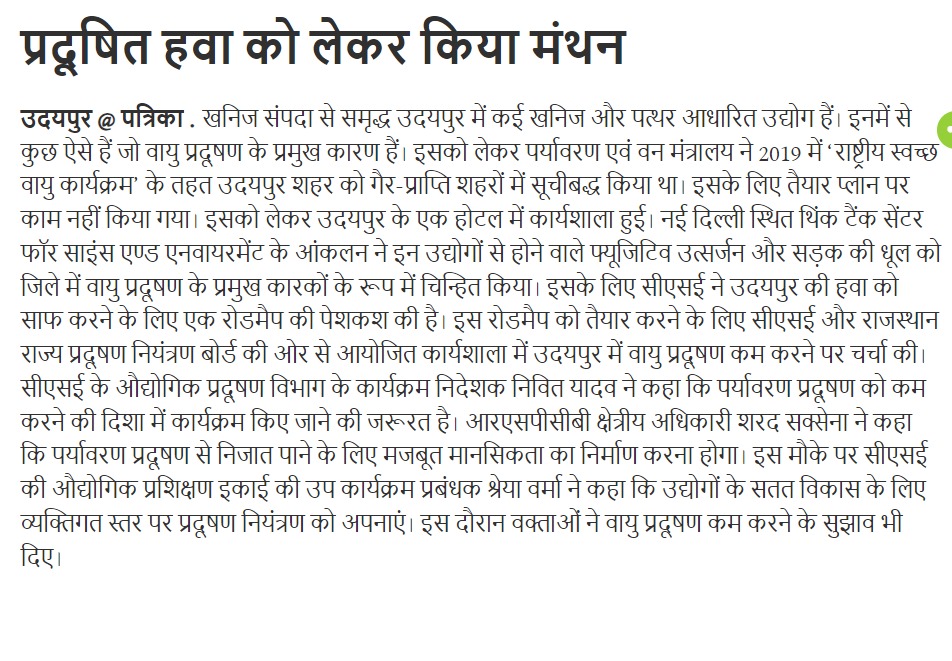
खनिज संपदा से समृद्ध उदयपुर में कई खनिज और पत्थर आधारित उद्योग हैं। इनमें से कुछ ऐसे हैं जो वायु प्रदूषण के प्रमुख कारण हैं। इसको लेकर पर्यावरण एवं वन मंत्रालय ने 2019 में ‘राष्ट्रीय स्वच्छ वायु कार्यक्रम’ के तहत उदयपुर शहर को गैर-प्राप्ति शहरों में सूचीबद्ध किया था। इसके लिए तैयार प्लान पर काम नहीं किया गया। इसको लेकर उदयपुर के एक होटल में कार्यशाला हुई। नई दिल्ली स्थित थिंक टैंक सेंटर फॉर साइंस एण्ड एनवायरमेंट के आंकलन ने इन उद्योगों से होने वाले फ्यूजिटिव उत्सर्जन और सड़क की धूल को जिले में वायु प्रदूषण के प्रमुख कारकों के रूप में चिन्हित किया। इसके लिए सीएसई ने उदयपुर की हवा को साफ करने के लिए एक रोडमैप की पेशकश की है। इस रोडमैप को तैयार करने के लिए सीएसई और राजस्थान राज्य प्रदूषण नियंत्रण बोर्ड की ओर से आयोजित कार्यशाला में उदयपुर में वायु प्रदूषण कम करने पर चर्चा की। सीएसई के औद्योगिक प्रदूषण विभाग के कार्यक्रम निदेशक निवित यादव ने कहा कि पर्यावरण प्रदूषण को कम करने की दिशा में कार्यक्रम किए जाने की जरूरत है। आरएसपीसीबी क्षेत्रीय अधिकारी शरद सक्सेना ने कहा कि पर्यावरण प्रदूषण से निजात पाने के लिए मजबूत मानसिकता का निर्माण करना होगा। इस मौके पर सीएसई की औद्योगिक प्रशिक्षण इकाई की उप कार्यक्रम प्रबंधक श्रेया वर्मा ने कहा कि उद्योगों के सतत विकास के लिए व्यक्तिगत स्तर पर प्रदूषण नियंत्रण को अपनाएं। इस दौरान वक्ताओं ने वायु प्रदूषण कम करने के सुझाव भी दिए।

How Russia-Ukrain war is killing chapati, mandazi business in Kisumu slums

n 2007, Eunice Atieno ventured into mandazi business at her stall located in Nyalenda, along Ring road. The business paid her bills, covering basic needs like shelter, food and clothing, as well as other secondary needs she needed to make her life aesthetic. Today, Ms Atieno is contemplating closing the business and venturing into other viable businesses. This business is nolonger what it used to be. I barely survive, and I am soon getting out of it She will not be the first one to abandon the venture she once adored. Several other people in her neighbourhood have called it quit. “This business is nolonger what it used to be. I barely survive, and I am soon getting out of it,” she said. When Lake Region Bulletin visited Atieno at her stall, her son Kevin Okoth was assisting her with sales. She said when she began the business, she could cook one and a half bales of flour per day. This translates to 36 kilos of wheat flour. “The rains began beating us three years ago, when the price of wheat flour began to shoot uncontrollably,” she said. High wheat prices Three years ago, she says she bought a bale of wheat flour (24 kilos) at between Sh1, 200 and Sh1, 500. This now goes for over Sh2, 500. This jump in the price of wheat flour has hit Atieno hard. This has been coupled with the hike in the prices of other material used in making mandazi, such as cooking oil, sugar, and baking powder. “A few years ago a kilo of sugar was going for Sh100, now it is over Sh230. The small baking powder which was Sh16 is now Sh35. Cooking oil is now worse,” she says. Due to the hard economic times, sales went down, and today Atieno only cooks six kilos of wheat flour. A few months ago she attempted to hike the price of mandazi from Sh5 to Sh10. It didn’t work. “No one was buying mandazi. And even after reducing the price back to Sh5, the sales have gone down,” she said. Atieno now has to contend with reduced profit margins, and sometimes loses, as the cost of doing business continue to hike while people’s buying power die. Job losses A short distance from her stall is Joseph Oduor who has been selling chapati for the past three years. Just like Atieno, his business is fast dwindling. Two years ago he was consuming two bales of wheat flour per day (48 kilos). He had two young men helping him with the work. But today, he is alone, after relieving the helpers due to low sales and reduced profit margins due to the high cost of production. I know a few friends who abandoned their chapati businesses, and the way things are unfolding, I do not know my fate Joseph Oduor “These days I consume less than 10 kilos of wheat flour per day. The cost of everything has gone up,” he said. “I know a few friends who abandoned their chapati businesses, and the way things are unfolding, I do not know my fate,” he added. The Centre for Science and Environment (CSE) a report titled ‘State of Africa’s Environment 2013’ and published in Down to Earth Magazine suggests that the phenomenon faced by small scale traders like Atieno and Oduor is partly contributed by the ongoing Russia-Ukrain war. The two worrying countries are some of the leading sources of wheat consumed across the globe. In east Africa, where wheat and wheat products accounted for a third of the average cereal consumption, 90 per cent of the wheat imports came from Russia and Ukraine, as per UN’s World Food Programme (WPF) State of Africa’s Environment 2013’ “The Russia-Ukraine war has spiked food prices threatening reversal of decades of progress in poverty alleviation,” the report read in part. According to the report, Russia is the world’s largest wheat exporter while Ukraine is sixth on the list, and that together, the two warring countries produced 12 per cent of all food calories traded globally (in January 2022); controlled 29 per cent of global wheat exports, 19 per cent of maize exports, and 78 per cent of sunflower oil exports,” the report read. “In east Africa, where wheat and wheat products accounted for a third of the average cereal consumption, 90 per cent of the wheat imports came from Russia and Ukraine, as per UN’s World Food Programme (WPF),” read the report. Kenya’s wheat demand Kenya Institute for Public Policy Research and Analysis (KIPPRA) reports that Kenya has a wheat consumption of about 900,000 tonnes per year, but only produces approximately 350,000 tonnes. This leaves the country at a huge deficit which can only be filled by imports. KIPPRA notes that Kenya’s major wheat supplier is Russia, accounting for 31 per cent of total wheat imports in 2020/2021. Other sources of wheat in Kenya are; Argentina (29 per cent), Germany (11 per cent), Poland and Canada (5 per cent), Latvia (4.8 per cent), Ukraine (4.2 per cent), Australia (2.8 per cent), Estonia (2.6 per cent), Lithuania (1.8 per cent) and Czech Republic (1.6 per cent).