
Cse In News

'Next EV policy to focus on charging infra, making incentives attractive'

NEW DELHI: Transport commissioner Ashish Kundra on Monday said the next EV policy will focus on expanding the charging infrastructure, ramping up demand for two-wheelers and making subsidy schemes more attractive. The current Delhi Electric Vehicle Policy, 2020, which expired August 8, has been extended till a new policy is notified. "We will try to sync the incentives for two-wheelers with the cab aggregator scheme in the next policy," Kundra said during a summit on clean transport, organised by International Council on Clean Transportation and India's G20 Secretariat. The cab aggregator scheme, which is at the stage of inviting suggestions from stakeholders, allows only electric two-wheelers as taxis. According to the EV policy, two-wheelers are eligible for a ₹5,000 subsidy per kWh of battery capacity. Three-wheelers are eligible for a ₹30,000 subsidy, regardless of overall cost or battery capacity. Subsidy for four-wheelers - ₹10,000 per kWh of battery capacity - was available only for the first 1,000 EVs registered under the scheme. Kundra said the government will go for an ambitious electrification target, under which 80% of the bus fleet would be electric by 2025. He said light- and medium-duty trucks or goods vehicles that are into intra-city operations could be targeted in the policy. "For instance, garbage tippers or even school buses could be looked at," he added. The two-wheeler and three-wheeler cargo segments would grow at a fast face, said Kundra. Cars could see a slower trajectory, but if the charging infrastructure expands fast, it could be a game changer, he added. NCRTC MD Vinay Kumar Singh said the USP of this mode of transport system is its speed as people can travel up to 90-100kmph. NCRTC, he added, would create a "network of networks", interlinking different modes of public transport. Anumita Roychowdhury, executive director of research and advocacy, CSE, said combining buses with electricity would not just decarbonise the fleet, but also mass commuting. ICCT India MD Amit Bhatt said, "Through our collaborative endeavours, we are setting the stage for transformative dialogues, nurturing sustainability and cultivating innovative strategies that will chart India's path toward decarbonisation."
बढ़ते तापमान की वजह से शहरों में पक्षियों की विविधता में आ रही गिरावट

शहरों में बढ़ती गर्मी केवल इंसानों के लिए ही खतरा नहीं है। इसका असर दूसरे जीवों पर भी पड़ रहा है। ऐसा ही कुछ पक्षियों के साथ भी देखने को मिला है। कॉर्नेल यूनिवर्सिटी और झेजियांग विश्वविद्यालय के शोधकर्ताओं द्वारा किए नए अध्ययन से पता चला है कि शहरों में बढ़ता तापमान, पक्षियों की विविधता में गिरावट की वजह बन रहा है। इस रिसर्च के नतीजे 14 अगस्त 2023 को जर्नल साइंस ऑफ द टोटल एनवायरनमेंट में प्रकाशित हुए हैं। रिसर्च से पता चला है असहनीय गर्मियों में केवल इंसान ही नहीं पक्षी भी शहरों को छोड़ देते हैं। जब शहर गर्म होते हैं तो पक्षी ठंडे उपनगरों की ओर चले जाते हैं। इसकी वजह से शहरों में पक्षियों के प्रजनन और गैर-प्रजनन सीजन के दौरान उनकी विविधता घट जाती है। हालांकि रिसर्च में यह भी सामने आया है कि यह प्रभाव उस सीजन में ज्यादा देखने को मिलता है जब पक्षी प्रजनन नहीं कर रहे होते हैं। चीन के 336 शहरों में पक्षियों पर किए गए इस अध्ययन में यह निष्कर्ष सामने आए हैं, कि शहरों में बढ़ती इमारतें और कंक्रीट गर्मी को बरकरार रखती हैं, जो सीधे तौर पर पक्षियों की विविधता में गिरावट से जुड़ा है। इस बारे में कॉर्नेल लैब और अध्ययन से जुड़े एक शोधकर्ता फ्रैंक ला सॉर्टे ने प्रेस विज्ञप्ति में जानकारी दी है कि यह अपनी तरह का पहला अध्ययन है जो दर्शाता है कि कैसे अर्बन हीट आइलैंड इफेक्ट विभिन्न मौसमों में सीधे तौर पर पक्षियों की विविधता से जुड़ा है। बता दें कि शहरों में जिन जगहों पर कंक्रीट या पक्की संरचनाएं होती हैं वहां का तापमान दूसरे हरे भरे क्षेत्रों की तुलना में अधिक होता है। ऐसा इसलिए है क्योंकि शहरों में इमारतें, सड़कें और अन्य बुनियादी ढांचे जो कंक्रीट से बने होते हैं वो अन्य प्राकृतिक चीजों जैसे पेड़-पौधों, जल स्रोतों आदि की तुलना में कहीं ज्यादा मात्रा में सूर्य की गर्मी को सोख सकते हैं। चूंकि यह संरचनाएं ठोस कंक्रीट की होती हैं इसलिए यह इस गर्मी को वापस बड़ी मात्रा में उत्सर्जित करती हैं, जिससे उस क्षेत्र में अन्य प्राकृतिक क्षेत्रों की तुलना में तापमान कहीं ज्यादा होता है। इसी को अर्बन हीट आइलैंड इफेक्ट कहा जाता है। वैज्ञानिकों के मुताबिक हीट आइलैंड इफेक्ट शहरी क्षेत्रों में दिन के तापमान को आठ डिग्री सेल्सियस तक बढ़ा सकता है। इसकी वजह से थोड़ी दूरी पर ही तापमान में भारी अंतर देखने को मिल सकता है। चीन ही नहीं भारत सहित पूरी दुनिया में बढ़ती गर्मी से जूझ रहे हैं शहर इस बारे में ला सॉर्टे ने जानकारी दी है कि “अर्बन हीट आइलैंड इफेक्ट केवल चीनी शहरों तक ही सीमित नहीं है।” उनके मुताबिक इस अध्ययन में जो सामने आया है संभवतः ऐसा दुनिया के अन्य बड़े शहरों में भी हो रहा है जहां बहुत ज्यादा सड़कें और इमारतें है साथ ही हरियाली की कमी है। रिसर्च के अनुसार शहर कितना भी बड़ा हो या कहीं पर भी हो, गर्मी के चलते पक्षियों की विविधता कम ही रहती है। भारतीय शहरों में बढ़ती गर्मी को लेकर सेंटर फॉर साइंस एंड एनवायरनमेंट (सीएसई) द्वारा किए एक अध्ययन से पता चला है कि देश में दिल्ली, मुंबई, कोलकाता और हैदराबाद जैसे बड़े शहर हीट आइलैंड प्रभाव के चलते अपने आसपास के बड़े क्षेत्रों की तुलना में बहुत ज्यादा गर्म हैं। यहां अन्य शहरी गतिविधियों के अलावा, यातायात, उद्योग और एयर कंडीशनिंग द्वारा उत्पन्न गर्मी और स्थानीय कचरा हीट आइलैंड प्रभाव को जन्म दे रहा है। अपनी इस रिसर्च में वैज्ञानिकों ने चीन में पक्षियों की विविधता को लेकर चल रहे अध्ययन से मिली जानकारियों का उपयोग किया है। साथ ही इसमें उन्होंने यह भी जानने का प्रयास किया है कि शहर अपने आसपास के उपनगरों की तुलना में कितने अधिक गर्म हैं। वैज्ञानिकों का सोचना था कि जब पक्षी प्रजनन नहीं कर रहे होते हैं तो शहरों में उनकी विविधता अधिक होती है, लेकिन ऐसा नहीं है। इस बारे में अध्ययन और झेजियांग विश्वविद्यालय से जुड़े वैज्ञानिक जियायु वू का कहना है कि “हमें यह जानकर हैरानी हुई कि गैर-प्रजनन मौसम के दौरान पक्षियों की विविधता में कमी और भी अधिक थी।” “हमारा सोचना था कि अर्बन हीट आइलैंड इफेक्ट की वजह से पक्षियों के लिए सर्दियों में, खासकर ठंडे शहरों में गर्म रहना आसान हो सकता है। ऐसे में हमें उम्मीद थी कि इस दौरान पक्षियों की विविधता अधिक होगी।” हालांकि इसके विपरीत चीन के दक्षिण, उत्तर और उत्तर-पश्चिमी हिस्सों में प्रजनन और गैर-प्रजनन दोनों ही सीजन में पक्षियों की विविधता पर अर्बन हीट आइलैंड इफेक्ट ने नकारात्मक प्रभाव डाला था। शोधकर्ताओं का मानना है कि पहाड़ों पर अल्पाइन वातावरण में रहने वाले पक्षियों में अनुकूलन से बढ़ते तापमान के प्रति सहनशीलता बढ़ सकती है, जिससे स्थानीय पक्षी क्षेत्र के शहरी क्षेत्रों में फल-फूल सकते हैं। रिसर्च के अनुसार जिस तरह से जलवायु में बदलाव आ रहे हैं, उसकी वजह से शहरों के और भी अधिक गर्म होने की आशंका है। इसकी वजह से इन शहरी इलाकों में रहने वाले पक्षियों के लिए चुनौतियां बढ़ जाएंगी। यह पक्षी पहले ही बढ़ते प्रदूषण और उजड़ते आवासों जैसे खतरों का सामना कर रहे हैं। हालांकि वैज्ञानिकों का मत है कि पेड़-पौधे शहरों को ठंडा रखने में कुछ हद तक मदद कर सकते हैं। लेकिन अध्ययन में यह भी सामने आया है कि चीन के अधिकांश हिस्सों में यह अर्बन हीट आइलैंड इफेक्ट के प्रभावों की भरपाई करने के लिए पर्याप्त नहीं है। यही वजह है कि चीन के ज्यादातर हिस्सों में पौधों के बावजूद शहरों से निकलने वाली गर्मी पक्षियों के लिए समस्याएं पैदा कर रही है। (downtoearth में ललित मौर्य की रिपोर्ट; साभार)

पूरे कश्मीर में अनियोजित विकास के गंभीर परिणाम हो सकते हैं: गृह मंत्रालय

गृह मंत्रालय (एमएचए) ने कहा है कि पूरे कश्मीर में अनियोजित विकास के गंभीर परिणाम हो सकते हैं। गृह मंत्रालय के राष्ट्रीय आपदा प्रबंधन संस्थान (एनआईडीएम) की रिपोर्ट में 2014 की बाढ़ जैसी आपदाओं को रोकने के लिए और अधिक सुधारात्मक उपाय करने का आह्वान किया गया है। रिपोर्ट पर्यावरण सुरक्षा और स्थिरता के लिए पर्याप्त विचार किए बिना होने वाली आर्थिक और बुनियादी ढांचा परियोजनाओं सहित बेतरतीब विकासात्मक गतिविधियों के बारे में विस्तार से बात करती है। एनआईडीएम रिपोर्ट में कहा गया है, "इन गतिविधियों में झेलम नदी के बाढ़ के मैदानों पर खनन कार्य, रेलवे लाइनों का निर्माण और खराब योजनाबद्ध शहरीकरण शामिल हैं।" इसमें कहा गया है कि इनमें से अधिकांश विकासात्मक गतिविधियाँ क्षेत्र की पर्यावरणीय, भूवैज्ञानिक, भू-आकृति विज्ञान और पारिस्थितिक स्थितियों को ध्यान में रखते हुए की जाती हैं। रिपोर्ट में कहा गया है, "नदी तलों से रेत, बजरी और बोल्डर के अंधाधुंध खनन के कारण चल रहा निर्माण कार्य मौजूदा बाढ़ नियंत्रण बुनियादी ढांचे को कमजोर करता है, जिससे नदियाँ अचानक बाढ़ के प्रति अधिक संवेदनशील हो जाती हैं।" रिपोर्ट के अनुसार, कश्मीर में तेजी से हो रहे शहरीकरण, नदी तटों से लगी भूमि में जल निकायों के अतिक्रमण और आर्द्रभूमि के लुप्त होने से प्राकृतिक जल निकासी पैटर्न बाधित हो गया है। जबकि 2014 की बाढ़ के दौरान कश्मीर में मौजूदा बाढ़ नियंत्रण बुनियादी ढांचा चरमरा गया था, जिससे क्षेत्र में खतरनाक स्थिति पैदा हो गई थी, रिपोर्ट में दीर्घकालिक उपायों की मांग की गई है। इन उपायों में डोगरीपोरा से वुलर तक एक वैकल्पिक बाढ़ चैनल का निर्माण, झेलम बेसिन में शहरी क्षेत्रों में जल निकासी प्रणाली में सुधार, प्राकृतिक जल निकासी की बहाली, झेलम बेसिन में खराब आर्द्रभूमि का संरक्षण और बहाली, सीवेज उपचार और शहर शामिल हैं। नगर नियोजन जो अन्य संरचनात्मक और गैर-संरचनात्मक उपायों के साथ-साथ बाढ़ और भूकंप की संवेदनशीलता पर भी विचार करता है। एनआईडीएम के कार्यकारी निदेशक, ताज हसन ने रिपोर्ट की प्रस्तावना में कहा है कि 2014 की बाढ़ में 287 लोगों की मौत हुई, जिससे लगभग 20 लाख लोगों पर प्रतिकूल प्रभाव पड़ा। “इसने कई दिनों तक श्रीनगर शहर को ठप कर दिया। केंद्र सरकार, कई राज्य और केंद्र शासित प्रदेश जम्मू-कश्मीर की मदद के लिए आगे आए। 2014 की कश्मीर बाढ़ के दस्तावेज़ीकरण ने भविष्य की कार्रवाई और इसी तरह की घटनाओं को अच्छी तरह से समन्वित तरीके से प्रबंधित करने के लिए सबक तैयार किया है, ”वह लिखते हैं। 2014 की बाढ़ ने स्वास्थ्य सेवा प्रणाली को भी बुरी तरह प्रभावित किया और कश्मीर में स्वास्थ्य सेवा निदेशालय के 102 संस्थान प्रभावित हुए। 2014 की विनाशकारी बाढ़ के बाद सेंटर फॉर साइंस एंड एनवायरनमेंट (सीएसई) के एक विश्लेषण में कहा गया था कि अभूतपूर्व वर्षा, अनियोजित शहरीकरण और तैयारियों की कमी बाढ़ के मूल कारण हैं। “पिछले 100 वर्षों में, इमारतों और सड़कों के निर्माण के लिए श्रीनगर की 50 प्रतिशत से अधिक झीलों, तालाबों और आर्द्रभूमि पर अतिक्रमण कर लिया गया है। झेलम नदी के किनारों को भी इसी तरह से कब्ज़ा कर लिया गया है, जिससे नदी की जल निकासी क्षमता काफी कम हो गई है। स्वाभाविक रूप से, इन क्षेत्रों को सबसे अधिक नुकसान हुआ है, ”सीएसई ने कहा था। ऐसी घटनाओं से निपटने में जम्मू-कश्मीर की तैयारी के बारे में विस्तार से बताते हुए, सीएसई अधिकारियों ने कहा था कि जम्मू-कश्मीर में बाढ़ पूर्वानुमान प्रणाली नहीं है और "इसकी आपदा प्रबंधन प्रणाली भी अल्पविकसित है"। “कश्मीर की बाढ़ एक गंभीर अनुस्मारक है कि जलवायु परिवर्तन अब भारत को और अधिक प्रभावित कर रहा है। पिछले 10 वर्षों में, कई अत्यधिक वर्षा की घटनाओं ने देश को हिलाकर रख दिया है और यह उस श्रृंखला में नवीनतम आपदा है, ”सीएसई ने कहा था।

Climate forecast for the Greater Horn of Africa region, focusing on the period from October to December 2023

Climate forecast for the Greater Horn of Africa region, focusing on the period from October to December 2023. Details The Greater Horn of Africa region is predicted to experience heavy rains from October to December 2023. The forecast was released by the Intergovernmental Authority on Development (IGAD) Climate Prediction and Applications Centre (ICPAC) during the 65th Greater Horn of Africa Climate Outlook Forum (GHACOF65). The forecast attributes the wet conditions to El Niño and the developing Indian Ocean Dipole. ICPAC provides climate services to 11 East African countries and is accredited by the World Meteorological Organization (WMO). Forecast Details Wetter-than-usual conditions due to El Niño are expected across most parts of the Greater Horn of Africa. Southern Ethiopia, eastern Kenya, and southern Somalia are likely to experience heavy rainfall. Drier conditions are forecasted for isolated areas of southwestern Uganda and southwestern South Sudan. Below-average rainfall is expected for various areas, including Eritrea, central and northern Ethiopia, Djibouti, Western Kenya, South Sudan, Sudan, and Northern Uganda. The vital rainfall season occurs from October to December and contributes significantly to the annual total rainfall. Regional Variations Early rainfall is anticipated for eastern Kenya, southern Somalia, and eastern Tanzania. Rainfall may be average or delayed in northern Somalia, western Kenya, Uganda, southern South Sudan, Rwanda, Burundi, and north-western Tanzania. Temperature Impact El Niño is predicted to increase temperatures in many parts of the world, including Africa. Potential Blessings and Curses Increased precipitation may contribute to flooding after experiencing heavy rainfall from March to May 2023. While heavy rains can benefit farmers and the agriculture sector, they can also lead to challenges. Desert locusts are proliferating in parts of the region, posing a threat. Extreme weather-led devastation is a possibility, as seen during the 2015-16 El Niño event. Governments and disaster management agencies are advised to prepare for torrential rains-led landslides, flash floods, and other challenges to save lives and livelihoods. About Greater Horn of Africa The Greater Horn of Africa is a geographic region located in the eastern part of the African continent. It encompasses several countries and is characterized by diverse topography, cultures, and climates. This region holds significant geopolitical and environmental importance. Geographical Scope Disclaimer: Copyright infringement not intended. The Greater Horn of Africa region includes countries situated in the northeastern part of Africa. It spans across a vast area, extending from the Red Sea coastline to the Great Lakes region. Countries in the Region The Greater Horn of Africa includes the following countries: Burundi Djibouti Eritrea Ethiopia Kenya Rwanda Somalia South Sudan Sudan Tanzania Uganda Topographical Diversity The region exhibits diverse topography, including highlands, lowlands, plateaus, and rift valleys. It is home to various prominent geographical features such as the Ethiopian Highlands and the East African Rift System. Cultural and Ethnic Diversity The Greater Horn of Africa boasts a rich tapestry of cultures, languages, and ethnic groups. Each country within the region has its own unique cultural heritage and traditions. Climate Variability The region experiences a wide range of climatic conditions due to its diverse geography. Climates range from arid and semi-arid in the lowland areas to temperate and tropical in the highlands and equatorial regions. Socioeconomic Challenges and Opportunities Challenges Poverty: Many countries in the region face high levels of poverty, with limited access to basic services and resources. Political Instability: Some countries have experienced political conflicts and instability, affecting regional peace and development. Food Insecurity: The region's agricultural sector is vulnerable to climate fluctuations, contributing to food insecurity. Health Challenges: Health issues such as disease outbreaks and limited healthcare infrastructure pose challenges to public well-being. Opportunities Natural Resources: The region is rich in natural resources, including minerals, agriculture, and renewable energy potential. Economic Growth: With proper management, these resources can contribute to economic growth and development. Tourism: The diverse landscapes and cultural heritage offer potential for tourism growth. Environmental Considerations Climate Patterns and Variability The region is impacted by various climate phenomena, such as El Niño and the Indian Ocean Dipole, leading to variable rainfall patterns. These patterns influence agriculture, water availability, and livelihoods. Conservation Efforts The Greater Horn of Africa region includes important biodiversity hotspots, prompting conservation efforts to protect unique ecosystems and species. Conservation initiatives address challenges such as habitat loss, poaching, and deforestation. https://www.downtoearth.org.in/news/after-3-years-of-drought-greater-horn-of-africa-to-get-early-heavy-rains-courtesy-el-nino-91403

Africa meets to deliberate on integrating health into climate agenda head of COP28

Lilongwe, Malawi | KIRAN PANDY | Various stakeholders from Africa gathered in Malawi to deliberate on integrating health into the climate agenda ahead of the 28th Conference of Parties (COP28) to the United Nations Framework Convention on Climate Change (UNFCC) to be held in Dubai later this year. On August 22, 2023, the African Group of Negotiators (AGN), ministers and various climate change and health stakeholders from the continent came together to develop a unified African position on health in the UNFCCC negotiations. The need for integrating health and climate change considerations into policies and systems took centre stage on the inaugural day. The three-day Regional Workshop on Climate Change and Health will also contribute to the Africa Climate Summit to be held in Kenya in early September 2023. The discussions centred mainly around the link between climate change and health, particularly in Africa. The speakers explored how these factors intersect and impact one another, underlining the need for coordinated action. The speakers called for engaging communities, ensuring adaptation and facilitating transparent communication as critical strategies for success toward a healthier and resilient future. Dr Githanji Gitahi, CEO of nonprofit AMREF Health Africa and one of the co-hosts of the event, underscored the need for a paradigm shift in addressing climate justice and called for integrating health into climate justice dialogue. While Ephraim Mwepya Shitima, chairperson of AGN, called for charting a course that enhances resilience and sustainable development, Malawi’s health minister, Khumbize Kandodo Chiponda, called for escalated funding to safeguard both the health and the future of communities in the African continent. Moreover, the speakers called for optimising domestic resources and effective allocation to address the vulnerabilities. “Africa has come together to advocate for a common position that transcends boundaries, resonates through diverse sectors and rallies for escalated funding. This funding is the lifeline needed to safeguard both the health and the future of our communities,” Chiponda said in her resounding call to action. Dr Mithika Mwenda, executive director of the Pan African Climate Justice Alliance, echoed the views of the Malawian health minister and flagged the gaps in funding for health. In the global multilateral funding systems, just 0.5 per cent of funding is allocated to the health sector. In addition to this, less than half of the required needs for water, sanitation and hygiene financing are met, he stated. So, there is a need to advocate for more significant funding to bridge these gaps, especially given mitigation, adaptation, loss and damage, especially within the African context, he reminded. With just 100 days left for COP28, the Africa regional meeting is vital since tens of millions of Africans have been bearing the wrath of climate change in the form of heat stress, extreme weather and increased transmission of infectious diseases, alerted the IPCC in its sixth assessment. Around 1,839 climate-related disasters in the continent from 1970-2021 claimed at least 733,585 human lives and caused $43bn in economic losses, according to the World Meteorological Organization. Though countries in the region are highly vulnerable to the negative impacts of climate change and associated health impacts, they are the least prepared to address these crises, according to the World Health Organization. The health sector, significantly affected by climate change, will undoubtedly have far-reaching impacts in amplifying existing health inequalities. This will significantly affect the progress of the 2030 Sustainable Development Goals and the 2063 Africa Agenda as well. The regional meet is, therefore, timely and is expected to help shape policy decisions, drive advocacy efforts and guide collaborative actions. Source: downtoearth.org

On a wind and a prayer: India’s offshore energy plans hit a viability wall

India plans to issue tenders to develop 37 GW of offshore wind energy capacity by 2030 The first tender for developing 4 GW of offshore wind capacity off Tamil Nadu’s coast has seen multiple delays and is yet to take place The country—already late to the offshore wind energy party—is looking to enter the space against the backdrop of offshore wind In July 2022, India’s Ministry of New and Renewable Energy (MNRE) laid out plans for the country’s belated entry into the world of offshore wind energy. Its strategy paper outlined a plan to install 37 GW of offshore wind energy along India’s coastline by 2030. In November of that year, MNRE even put out a draft tender for the lease of seabed sites Charting a course for offshore energy Despite the Indian government introducing its National Offshore Wind Energy Policy back in 2015, progress has been painstakingly slow ever since. In 2018, NIWE came up with guidelines for wind power assessment studies and surveys for offshore. “Nothing much has happened after that. The government is still struggling with the technology and [lack of] confidence from investors as well as buyers of this costly power,” Binit Das, programme manager of the renewable energy unit at New Delhi-based think tank Centre for Science and Environment (CSE), tells The CapTable. That’s not to say that progress has ground to a halt. While the first offshore wind tender has, at least thus far, failed to materialise, the government has taken several policy steps to facilitate the introduction of offshore wind energy. For instance, in April, it implemented subsidies for the laying of undersea cables and the operation of the specialised vehicles required to set up and maintain offshore wind energy infrastructure. The following month, the Ministry of Power widened the scope of its 25-year inter-state transmission fee waiver for renewable energy projects to include offshore wind generation as well. This will apply to all offshore wind energy projects commissioned before 2033. Authorities are also working to iron out the kinks that have held up the tendering for offshore wind energy projects. Earlier this month, MNRE updated its strategy paper to clearly state that infrastructure to transmit offshore wind energy to the mainland would be the responsibility of the Power Grid Corporation of India Ltd (PGCIL) and its subsidiary Central Transmission Utility of India Ltd (CTUIL). This was believed to be a major sticking point between the government and potential bidders for offshore wind projects. The revised strategy also adjusts the government’s offshore wind auction targets. The total capacity the government hopes to auction off by 2030 stands at 37 GW—just over half the 72 GW potential NIWE’s studies have indicated is possible off the coasts of Gujarat and Tamil Nadu—with 4.5 GW expected to be auctioned in the year ending March 2024. While the following fiscal is expected to see projects with a total capacity of 3.5 GW up for tender, the years ending March 2026 and March 2027 will see the auctioned capacity doubling. India’s targets are undoubtedly ambitious. As of July, India’s renewable energy sources had an installed capacity of close to 180 GW, including large hydro. That means the country needs to add a capacity of about 45 GW every year to reach the aforementioned goal of 500 GW of non-fossil fuel-based energy by 2030, including 140 GW from wind energy.

‘If we can land on the moon, can’t we keep air pollution in check?’ Experts wonder

Experts who gathered at the recently concluded India Clean Air Summit-2023 emphasized the need for collective action to arrest the rising levels of air pollution in the city A report released earlier this year by Green Peace India found that in Bengaluru air pollution levels were dangerously high. The air quality was five times worse than WHO standards. Yet another study by the Centre of Science and Environment showed that the city had one of the fastest worsening PM 2.5 levels. Given the alarming situation, experts who gathered at the recently concluded India Clean Air Summit-2023 organised by the Centre for Air Pollution Studies (CAPS) at the Center for Study of Science Technology and Policy (CSTEP), emphasized the need for collective action to arrest the rising levels of air pollution and reverse the downward trend. “This is the only living planet we know of so far. Since we have only one earth, we have to protect it,” said Prof P.G. Diwakar, ISRO Chair Professor, National Institute of Advanced Studies (NIAS), at the summit. “Many cities in India have a very serious problem of air pollution. The world standards are different, and we are quite away from it.” He noted how lockdown showed us the impact we could make. For example, the satellite imageries of Delhi during the period showed even the inroads clearly, which is not the case usually. “It becomes important for us to change the mechanisms by which we live. It Is everybody’s responsibility that we live by standards that don’t pollute the environment. If we could land on the moon, why can not we keep air pollution in check?” he wondered. Importance of technology A pilot project of Geo Artificial Intelligence and Random Forest technologies has been launched in Bengaluru by NIAS to monitor and predict the city’s air quality. Fifty sensors would be procured and put up in educational institutions for monitoring, assessment and prediction of air quality. The importance of technology and accurate data in developing models to improve air quality was one of the points experts brought up repeatedly during the summit. “It is necessary for us to see that we have well distributed and strategically placed observation points so that we get ground observations on the kind of pollution happening on the ground...We also need to bring in weather data. We are working on AI-based models,” Prof Diwakar said. Dr. B. Sengupta, Former Member Secretary, Central Pollution Control Board, echoed similar sentiments. “Technology will lead us towards improving air quality. It is important to follow technology and science-based approach,” he said. Dr. Sengupta, also presented a comprehensive list of suggestions for the state authorities to consider. He emphasized on the need of calibrating the instruments at air quality monitoring stations. While there are about 500 online continuous monitoring stations and around 1,500 manual stations, instruments are often not calibrated. This affects the quality of data generated in turn impacting policy formulation. According to him, it was such flawed data that put Begusarai in Bihar on the list of one of the most polluted cities last year despite the absence of any major polluting industries and relatively low number of vehicles in the city. Dr. Sengupta’s suggestions also included preparing action plans to address the 43 critically polluted areas identified by CPCB, out of which eight are in Karnataka, and control emissions from the 17 categories of highly polluting industries. Use of clean fuels, vehicular emission control, use of electrical vehicles, and decarbonisation of industries were some of the other highlights of his list. Initiatives for improvement State officials too agreed with the experts on the urgency of the situation and highlighted some of the efforts being put in. Eshwar Khandre, Minister for Forest, Ecology, and Environment, noted that our collective survival was at stake due to climate change, and therefore, we have a collective duty to protect what is available for future generations. He added that rapid urbanisation was a boon and a bane simultaneously. “When I became minister, I made a commitment that I will contain environmental degradation, try to reverse it, control pollution, and promote sustainable development in the state. For that I need cooperation and support from all of you,” he said. He pointed at the high pollution levels Delhi experiences in winter and added that measures needed to be taken to stop Bengaluru going down the same path. “Every year during winter New Delhi turns into a gas chamber. Bengaluru can also go down that path before which we should arrest the downward spiral and reverse the trend,” he said, noting that within three months of coming to power the government had ensured planting of 2.5 crore saplings across the state. In June, the minister had announced plans to plan five crore saplings in the state annually with the target of achieving 25 crore saplings within five years. Ecofriendly initiatives Dr. Shanth A. Thimmaiah, chairman of the Karnataka State Pollution Control Board (KSPCB), noted how Karnataka was leading eco-friendly initiatives harvesting of solar energy. “We should all think about how we can reduce the burning of fossil fuel and implement eco-friendly initiatives like renewable energy, solar harvesting and various other alternate power generation means. Karnataka is already generating about 5,300 megawatts of energy through solar,” he said, highlighting various initiatives by KSPCB. Karnataka, for example, is the second state in India to implement the GreenCo rating whereby which industries would be given rating based on their environmental performance indices. The best performers would be identified by CII and the board would recognise and reward them, Dr. Thimmaiah said. KSPCB has also introduced an Institute-Industry-Authority (IIA) model which, according to Dr. Thimmaiah, would look at bridging the gap between research institutions and industries. “We created a resource development (R&D) division in the board because institutes have the capacity to do R&D on a pilot scale. The pollution control board is trying to interlink institutes and industries. The problems faced by industries will be communicated to institutes by the pollution control board. That way the institutes can do research, innovation, and come up with solution which then industries can implement at a larger scale.” Air pollution in rural areas While the narrative on air pollution mostly focuses on cities, there is also the issue of air pollution in rural areas, noted Dr. R. Subramanian, sectoral head - air quality, CSTEP. “People often burn agricultural waste, and there is also residential burning which exposes women and young children to air pollution. So, there’s significant inequity in the pollution loads. How do we address that? That should be part of our Sustainable Development Goals (SDG) - that is access to clean energy in homes and reducing air pollution in those homes,” he said. According to him while schemes like Ujjwala Yojana aiming to make cooking fuel available in BPL households in rural areas, it was equally important to ensure that people stick to the behaviour. “There are also other individual actions we can take like taking the stairs instead of the elevator, minimising the AC use, using public transportation or carpooling and so on. Every little bit helps. At the same time, we do want strong government actions to support those individual actions to make it sustainable for people to make the switch and keep sticking to that switch.

Solution to minimize heatwaves in Urban India

The study conducted by the Centre for Science and Environment (CSE) explores the impact of different urban forms on heat resilience. Key findings and recommendations include: Morphology Influence: Areas with open highrise, open midrise, and compact midrise urban morphologies show lower land surface temperatures (LST), indicating better heat resilience. Low-rise areas with sparse vegetation tend to have higher LST. Blue/Green Infrastructure: Greenery, like trees, shrubs, and grass, enhances microclimates. Effective vegetation cover (EVC) reduces LST; trees with thick foliage are more effective. Floor Space Index (FSI): Higher FSI correlates with lower LST. Increased FSI results in decreased temperatures. Street Orientation: North-south-oriented streets have higher LST due to sun exposure, offering guidelines for urban planning. Cooling Solutions: Different urban forms can have distinct zoning regulations for heat resilience, such as shaded walkways, cool roofs, and high EVC. Adapting Urban Plans: Cities should amend building by-laws and master plans based on factors influencing heat gain. Impact on Energy Consumption: A 1°C temperature decrease can lead to a 2% reduction in the city’s power consumption. https://www.downtoearth.org.in/news/governance/road-to-cool-cities-codes-based-on-unique-urban-form-can-be-helpful-91367#:~:text=Urban%20form%2Dbased%20codes%20can,regulations%20with%20contextual%20cooling%20solutions.

Melting Of Glaciers Has Accelerated Due To Heat Wave In Kashmir, Ladakh

SRINAGAR: In absence of cloud cover, severe heat wave conditions have been consistently reported since the beginning of the summer season in Kashmir and the mercury touched 34.6 degrees Celsius in Srinagar on August 21, could lead for natural disasters in future. According to weather experts, August month was the hottest after 77 years, which is concern for the climate balance in the region. Experts also expressed concerns about the rapid pace at which glaciers are melting. The environmentally fragile region of Kashmir and Ladakh is also not spared from these adverse effects, as rising temperatures caused by climate change have put its glaciers at risk. Glaciers are an important part of our eco-system. These compressed masses of snow are the main source of water. Changes in these glaciers are bound to affect regional water availability and hydrological regimes. Retreating glaciers are putting an estimated 15 million people around the world at risk of destructive flooding events. The Jammu and Kashmir Himalayas hosts some of the largest glaciers in the Hindu Kush region. Scientific studies indicate that Kolahoi, the largest glacier and life line of Kashmir Valley’s Jhelum Basin, is retreating rapidly due to spurt rise in temperature triggered by global warming and extreme pollution. Rapid melting of glaciers in Jammu and Kashmir and Ladakh indicate how global warming coupled with unplanned development and pollution are taking toll on these ‘water towers’. Studies indicate that Kolahoi, the largest glacier of Kashmir valley’s Jhelum Basin, is retreating rapidly due to spurt rise in temperature triggered by global warming and extreme pollution. Glaciologists on the basis of studies state that during the last few years, glacier melting in Kashmir and Ladakh region has been highest as compared to the rest of the Himalaya and the Alps. Kolahai is losing mass at the rate of about 1.0 m water equivalent annually, which is significantly higher than the glaciers in the rest of the Himalayas. Experts fear that mass loss of glaciers is expected to exacerbate in future as a result of projected climate changes. Subsequently this will further diminish the stream flow of trans-boundary rivers emanating from the region. Experts blame unprecedented increase in temperature, deforestation, increasing human activities, constructions in eco-fragile zones and high levels of pollution caused by the emission of greenhouse gases by vehicles and cement plants for retreating of Kolhai Glacier. The glacier has developed several crevasses and cracks over the years. Prominent earth scientists of Kashmir, cautions that given the projected climate change across the Kashmir Himalayan region, “glacier mass loss could enhance with serious implications for regional water availability. Besides glacier recession, the prevailing warming scenario over the Himalaya makes communities and infrastructure more vulnerable to cryosphere-related hazards that were previously not experienced in the past. In the northwestern Himalayan regions of J&K and Ladakh are more exposed to GLOF risk with 180 proglacial lakes most of which are expanding in area. On the basis of extensive scientific studies, two proglacial lakes in the upstream of Vishaw in south Kashmir’s Kulgam district are susceptible to GLOFs that might affect Asthal village downstream. Drang Drung is the largest glacier in Zanskar and one of the fast-receding glaciers in Himalaya since the ice front is emptying into the Proglacial Lake. The lake started forming after 2008, currently spreading over 17 hectares and is projected to expand to 39 hectares. “Sudden glacial lake outburst floods often destroy the downstream infrastructure, resulting in fatalities and affecting livelihoods of mountain communities,” experts said. According to Centre for Science and Environment 2022, here has been a 40 percent increase in water spread area in India, China and Nepal, posing a huge threat to seven Indian states and Union Territories including Jammu and Kashmir, Ladakh, Himachal Pradesh, Sikkim, Assam and Arunachal Pradesh. To prevent disasters in J&K and Ladakh due to melting of glaciers and Glacial Lakes Outburst Flooding, Government must take measures to conserve the fragile environment to protect critical ecological systems including glaciers. It is imperative to monitor these glacial lakes by field and satellite-based studies and assess risk associated with the bursting of these dammed lakes.

Small companies stepping into antibiotics development, face huge challenges

During a global webinar organized on August 24 by the Centre for Science and Environment (CSE), discussions revealed that small and medium-scale biopharmaceutical companies are stepping in to address the research and development gap in new antibiotics, while major pharmaceutical companies are showing reluctance. These smaller companies are, however, encountering substantial challenges of their own. Unless these obstacles are tackled and surmounted, the availability of life-saving antibiotics may continue to decline, exacerbating a critical global situation. The event marked the second installment in a series of webinars initiated by CSE to address the crisis in antibiotic research and development. Sunita Narain, Director General of CSE and a member of the Global Leader’s Group on Antimicrobial Resistance (AMR), emphasized the need for conserving existing antibiotics and developing new ones to combat deadly resistant infections. She noted that smaller pharmaceutical companies are now bearing this responsibility. Antibiotic resistance, described as a silent pandemic, is causing antibiotics to lose their effectiveness, shrinking treatment options, and impacting health, livelihoods, and economies. In 2019 alone, around five million deaths worldwide were linked to antibiotic resistance. The webinar, titled ‘Small and Medium Scale Antibiotic Developers: Challenges they face and the way forward,’ centered on developers based in India. Key stakeholders and experts participating included Vasan Sambandamurthy from Bugworks Research India Pvt Ltd, Jitendra Kumar from Biotechnology Industry Research Assistance Council (BIRAC), Sachin Bhagwat from Wockhardt Research Centre, T S Balganesh from GangaGen Biotechnologies Pvt Ltd, and Amit Khurana from the Sustainable Food Systems Programme at CSE. The session was moderated by Sunita Narain. The webinar series was prompted by a CSE assessment titled ‘A Developing Crisis,’ published in Down To Earth (July 16-31). The assessment revealed the vulnerability of the global antibiotic pipeline at both pre-clinical and clinical development stages. Analysis of the clinical pipeline of 15 high-earning pharmaceutical companies indicated a lack of interest in new antibiotics research by major players. Smaller companies have taken up the mantle, but they face challenges. Facing multiple challenges Amit Khurana from CSE stressed, “Indian small and medium antibiotic developers are facing multiple challenges. They can play an important role in rejuvenating the global pipeline, if their concerns are addressed.” Developers participating in the webinar highlighted challenges related to scientific, financial, and regulatory aspects of drug development. Vasan Sambandamurthy from Bugworks emphasized the need for global regulatory harmonization to facilitate the use of generated data. He also called for open clinical trial testing and accelerated approval pathways in India. Balancing short-term needs and innovation Sachin Bhagwat from Wockhardt, which is working on four traditional antibiotics, stated the importance of striking a balance between supporting viable products for short-term unmet needs and innovative drugs with higher long-term failure risks. CSE researchers, in their assessment, called for critical reforms to stimulate sustainable and equitable antibiotic access. They emphasized the necessity for increased public financing, coordinated government responses, and balanced public-private partnerships for antibiotic development. Narain concluded the webinar by discussing the use of public funding for innovation and drug availability, underscoring the broader agenda beyond funding incentives.

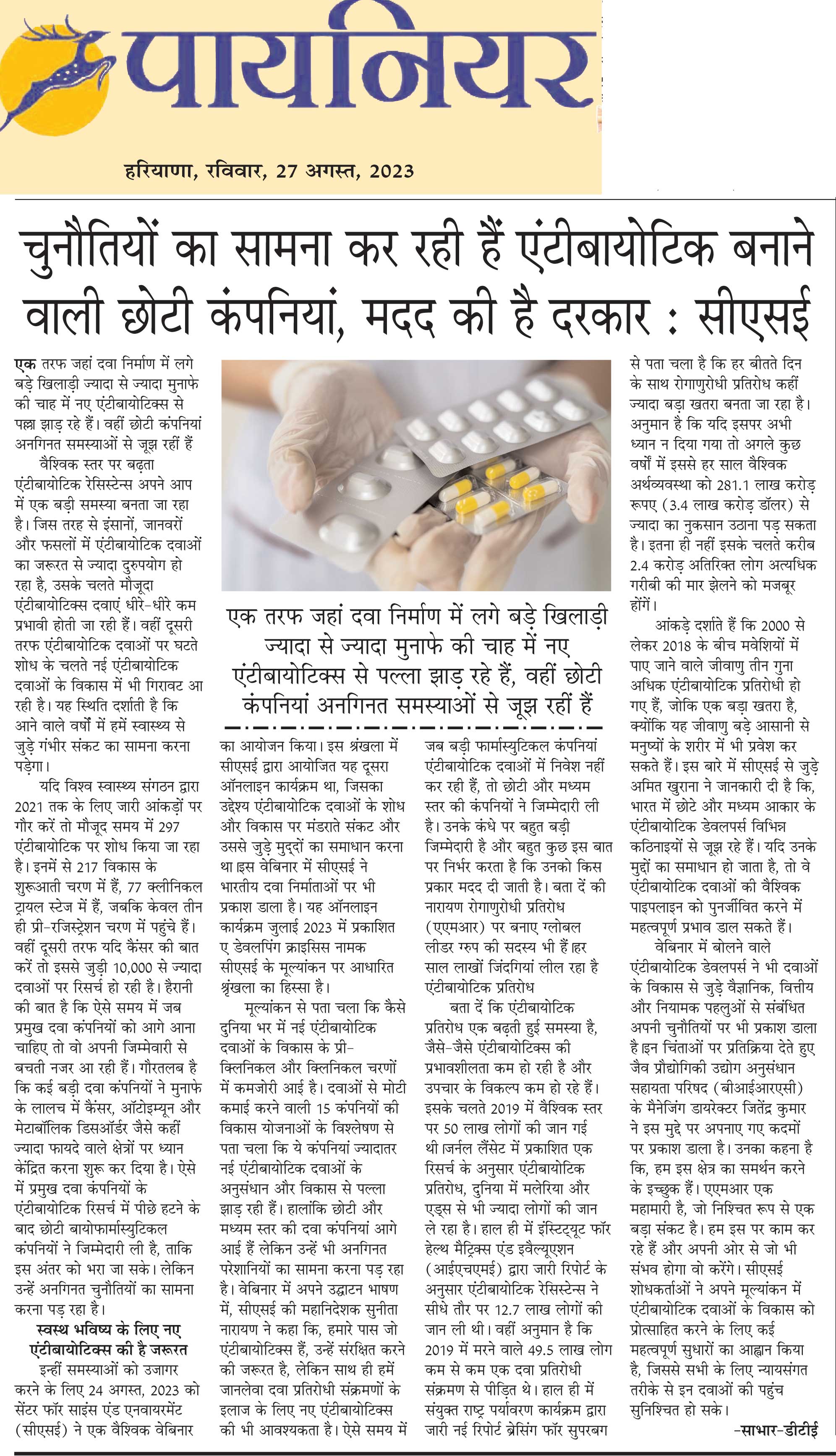
चुनौतियों का सामना कर रही हैं एंटीबायोटिक बनाने वाली छोटी कंपनियां, मदद की है दरकार: सीएसई

एक तरफ जहां दवा निर्माण में लगे बड़े खिलाड़ी ज्यादा से ज्यादा मुनाफे की चाह में नए एंटीबायोटिक्स से पल्ला झाड़ रहे हैं। वहीं छोटी कंपनियां अनगिनत समस्याओं से जूझ रहीं हैं वैश्विक स्तर पर बढ़ता एंटीबायोटिक रेसिस्टेन्स अपने आप में एक बड़ी समस्या बनता जा रहा है। जिस तरह से इंसानों, जानवरों और फसलों में एंटीबायोटिक दवाओं का जरूरत से ज्यादा दुरुपयोग हो रहा है, उसके चलते मौजूदा एंटीबायोटिक्स दवाएं धीरे-धीरे कम प्रभावी होती जा रही हैं। वहीं दूसरी तरफ एंटीबायोटिक दवाओं पर घटते शोध के चलते नई एंटीबायोटिक दवाओं के विकास में भी गिरावट आ रही है। यह स्थिति दर्शाती है कि आने वाले वर्षों में हमें स्वास्थ्य से जुड़े गंभीर संकट का सामना करना पड़ेगा। यदि विश्व स्वास्थ्य संगठन द्वारा 2021 तक के लिए जारी आंकड़ों पर गौर करें तो मौजूद समय में 297 एंटीबायोटिक पर शोध किया जा रहा है। इनमें से 217 विकास के शुरूआती चरण में हैं, 77 क्लीनिकल ट्रायल स्टेज में हैं, जबकि केवल तीन ही प्री-रजिस्ट्रेशन चरण में पहुंचे हैं। वहीं दूसरी तरफ यदि कैंसर की बात करें तो इससे जुड़ी 10,000 से ज्यादा दवाओं पर रिसर्च हो रही है। हैरानी की बात है कि ऐसे समय में जब प्रमुख दवा कंपनियों को आगे आना चाहिए तो वो अपनी जिम्मेवारी से बचती नजर आ रही हैं। गौरतलब है कि कई बड़ी दवा कंपनियों ने मुनाफे के लालच में कैंसर, ऑटोइम्यून और मेटाबॉलिक डिसऑर्डर जैसे कहीं ज्यादा फायदे वाले क्षेत्रों पर ध्यान केंद्रित करना शुरू कर दिया है। ऐसे में प्रमुख दवा कंपनियों के एंटीबायोटिक रिसर्च में पीछे हटने के बाद छोटी बायोफार्मास्युटिकल कंपनियों ने जिम्मेदारी ली है, ताकि इस अंतर को भरा जा सके। लेकिन उन्हें अनगिनत चुनौतियों का सामना करना पड़ रहा है। स्वस्थ भविष्य के लिए नए एंटीबायोटिक्स की है जरूरत इन्हीं समस्याओं को उजागर करने के लिए 24 अगस्त, 2023 को सेंटर फॉर साइंस एंड एनवायरमेंट (सीएसई) ने एक वैश्विक वेबिनार का आयोजन किया। इस श्रंखला में सीएसई द्वारा आयोजित यह दूसरा ऑनलाइन कार्यक्रम था, जिसका उद्देश्य एंटीबायोटिक दवाओं के शोध और विकास पर मंडराते संकट और उससे जुड़े मुद्दों का समाधान करना था। इस वेबिनार में सीएसई ने भारतीय दवा निर्माताओं पर भी प्रकाश डाला है। यह ऑनलाइन कार्यक्रम जुलाई 2023 में डाउन टू अर्थ में प्रकाशित 'ए डेवलपिंग क्राइसिस' नामक सीएसई के मूल्यांकन पर आधारित श्रृंखला का हिस्सा है। मूल्यांकन से पता चला कि कैसे दुनिया भर में नई एंटीबायोटिक दवाओं के विकास के प्री-क्लिनिकल और क्लिनिकल चरणों में कमजोरी आई है। दवाओं से मोटी कमाई करने वाली 15 कंपनियों की विकास योजनाओं के विश्लेषण से पता चला कि ये कंपनियां ज्यादातर नई एंटीबायोटिक दवाओं के अनुसंधान और विकास से पल्ला झाड़ रही हैं। हालांकि छोटी और मध्यम स्तर की दवा कंपनियां आगे आई हैं लेकिन उन्हें भी अनगिनत परेशानियों का सामना करना पड़ रहा है। वेबिनार में अपने उद्घाटन भाषण में, सीएसई की महानिदेशक सुनीता नारायण ने कहा कि, “हमारे पास जो एंटीबायोटिक्स हैं, उन्हें संरक्षित करने की जरूरत है, लेकिन साथ ही हमें जानलेवा दवा प्रतिरोधी संक्रमणों के इलाज के लिए नए एंटीबायोटिक्स की भी आवश्यकता है। ऐसे समय में जब बड़ी फार्मास्युटिकल कंपनियां एंटीबायोटिक दवाओं में निवेश नहीं कर रही हैं, तो छोटी और मध्यम स्तर की कंपनियों ने जिम्मेदारी ली है।" उनके कंधे पर बहुत बड़ी जिम्मेवारी है और बहुत कुछ इस बात पर निर्भर करता है कि उनको किस प्रकार मदद दी जाती है।" बता दें की नारायण रोगाणुरोधी प्रतिरोध (एएमआर) पर बनाए ग्लोबल लीडर ग्रुप की सदस्य भी हैं।

Govt to add 2,026 e-buses by end of December 2025

Delhiites are likely to breathe easy and experience less pollution in the coming winter months as the national Capital is witnessing a rapid rise in the share of electric buses. The State Government intends to add a total of 2,026 electric buses by the end of December 2025. Currently Delhi is the leader in the faster adoption of e-mobility in public transport. Earlier this month the Union Cabinet approved the decision on deploying 10,000 electric buses worth Rs 57,613 crore. This will reduce CO2 emissions to a large extent and help India move towards its commitment on Net Zero. Delhi will also get a decent share of this number which will further help curb the pollution level. According to an analysis by New Delhi-based non-profit Centre for Science and Environment, the winter of 2022-2023 was the cleanest for Delhi-National Capital Region (NCR) since 2018, when large-scale air quality monitoring started. The city-wide winter average for Delhi stood at 160 µg/m³ for October-January. The national capital’s pollution levels peaked at 401 µg/m³ on November 3, 2022. This was 26 per cent lower than the highest recorded winter peak — 546 µg/m³ in the winter of 2019-20. Downward trend is a shot in the arm for the government but more efforts are needed to sustain the momentum, according to the study. “Incidentally, each electric bus saves around 2.4 kg of CO2 per km. Electric buses have been running in the national capital since May 2022, roughly for over 1.5 years and have saved almost 50,000 tons of CO2 in this period”, says Anil Sharma, Director, CCSL Consulting, a Sustainability and CSR consulting firm based in New Delhi.

Small and medium companies stepping into antibiotics development, face huge challenges

At a time when big pharma is shying away from research and development on new antibiotics, it is the small and medium scale biopharmaceutical companies that have taken up the cudgels for filling this gap. But these companies are faced with enormous challenges of their own. Until these challenges are addressed and overcome, the world will continue to be in a dire predicament in which it will see its basket of life-saving antibiotics rapidly becoming smaller and smaller. This emerged from the deliberations at a global webinar organised on August 24 by Centre for Science and Environment (CSE). This was the second webinar in a series being conducted by CSE to discuss the crisis in antibiotic research and development. In her opening speech in the webinar, CSE director general Sunita Narain said: “We need to conserve the antibiotics that we have, but we also need new antibiotics to treat deadly resistant infections. While the big pharmaceutical companies are no longer keen, it’s the small and medium scale companies which have taken up the responsibility. They have a huge task at hand and a lot depends on how they are supported.” Narain is a member of the Global Leader’s Group on Antimicrobial Resistance (AMR). Antibiotic resistance is a silent pandemic. Antibiotics are becoming ineffective and treatment options are reducing — impacting health, livelihoods and economies. Worldwide, in 2019, about five million deaths were associated with it. Moderated by Narain, the webinar – ‘Small and Medium Scale Antibiotic Developers: Challenges they face and the way forward’, focused on developers based in India and brought together key stakeholders and experts including Vasan Sambandamurthy, senior vice president, Global Operations, Bugworks Research India Pvt Ltd; Jitendra Kumar, managing director, Biotechnology Industry Research Assistance Council (BIRAC), Department of Biotechnology, Government of India; Sachin Bhagwat, senior vice president, Drug Discovery, Wockhardt Research Centre; T S Balganesh, president, GangaGen Biotechnologies Pvt Ltd; and Amit Khurana, director, Sustainable Food Systems Programme, CSE. The webinar series is based on a CSE assessment – ‘A Developing Crisis’, — published in Down To Earth (July 16-31). The assessment had showed how the global antibiotic pipeline is weak across the pre-clinical and clinical development stages. Analysis of the clinical pipeline of 15 high-earning pharmaceutical companies to understand their R&D focus showed that most big pharmaceutical companies have all but quit the R&D of new antibiotics. It is the small and medium scale pharmaceutical companies have taken up the responsibility, but they are facing challenges. “Indian small and medium antibiotic developers are facing multiple challenges. They can play an important role in rejuvenating the global pipeline, if their concerns are addressed,” said Amit Khurana from CSE. The antibiotic developers who spoke at the webinar clearly highlighted their challenges related to scientific, financial and regulatory aspects of drug development. “In addition to the big funding for antibiotic innovators, there is need for regulatory harmonisation at the global level so that the innovators can well use the data generated,” said Vasan Sambandamurthy from Bugworks, a biopharmaceutical company engaged in developing two traditional antibacterial agents. “We need to open up clinical trial testing for innovator drugs in India. We also need accelerated approval pathways so that it is clear how a life-saving antibiotics can qualify. It will spur a lot of innovation and help companies across the discovery space,” he added. “It is important to strike a right balance while selecting a project to be supported — between a viable and well differentiated product for the unmet need in the short term and an innovative drug carrying more failure risk for the longer term,” said Sachin Bhagwat from Wockhardt, which is developing four traditional antibiotics. “There has to be emphasis on nurturing the discovery talent. If the current situation continues, we won’t be able to do much even if we put in all resources,” he cautioned. Highlighting a real problem of sourcing funds, T S Balganesh of GangaGen said: “The level of resistance in pathogens may vary in India and the western world; western interests would not be keen to fund if it is not a major problem there. This makes us completely dependent on Indian sources or sources from neighbouring countries.” GangaGen Biotechnologies is a biologics company focusing on non-traditional therapies such as protein antibacterials and bacteriophages for treating serious bacterial infections. “The problem of commercialisation is different from the problem of development. There are problems at several levels. We need to break it down and address each of them,” he added. Responding to the concerns, Jitendra Kumar of BIRAC highlighted several initiatives that have been adopted. “We are keen to support this area as AMR is a pandemic and definitely a crisis. We have been working on it and will do whatever is possible from our side,” he assured. CSE researchers, in their assessment, had called for critical reforms to stimulate the antibiotic R&D ecosystem for a sustainable and equitable antibiotic access. There is a need for greater public financing, a coordinated response from national governments and striking the right balance in public-private partnership for antibiotic development. They had highlighted that antibiotics have attributes of a ‘global public good’ despite not fitting into the strictest definition. “We need to see how public funding is used not just for innovation but also to make sure to get these drugs out on the table. This is where we will need to look at our priorities, target what we need and see if we are able to use it for the rest of the world,” said Narain. “But it is not just a debate of push and pull incentives. It is a question of what more can be done. It is very clear that there is an agenda beyond just talking about funding,” she said while concluding the webinar. Key data findings from the DTE story: ‘A Developing Crisis’ Global antibiotic pipeline weak WHO database updated until late 2021 shows that of the 297 antibiotic candidates under consideration, 217 are in pre-clinical development, 77 in clinical trial, and only three are in pre-registration stage. This 77 in clinical development is miniscule compared to 10,000+ for cancer, 1800+ for neuropsychiatric conditions and about 1500 for endocrine, blood and immune disorders. Of the 77 products in clinical development, 45 are traditional antibiotic candidates and 32 are non-traditional candidates. Twenty eight out of 45 traditional candidates target WHO priority pathogens. In 2017, 12 pathogens out of which most were Gram-negative were categorised into critical, high and medium priority pathogens to guide global R&D by the WHO. Out of 77, only nine traditional small molecules are in phase 3 of clinical development. There is none for M. tuberculosis. Only two target WHO’s critical priority pathogens. Among the non-traditional antibiotic candidates, only five are in phase 3. For M. tuberculosis, there is only one product, that too in phase 1. The pipeline of antibacterial products in preclinical development shows that out of 217, only 3 have their Investigative New Drug (IND) application submitted while 31 are in clinical trial application/IND-enabling studies. This is too less a pool to feed into the clinical development stages. Big Exodus Analysis of clinical pipeline of 15 high-earning companies revealed that of the total 1007 candidates, only 13 are antibacterials which are developed by four companies. 400+ were for cancer, about 150 were for immunology, allergy, inflammation or respiratory diseases, and 84 were for cardiology, metabolism or renal. These are developed by most of these companies. Collectively, the 2022 revenue was about $711 billion, 17.5 per cent of which ($124 billion) was total investment in research and development. Out of these 15, GlaxoSmithKline, Roche, Pfizer and AbbVie are currently developing antibiotics. GSK is developing 8 out of 13 candidates. Few major companies with clinical pipelines focusing on other profitable areas but not on antibiotics are AstraZeneca, Novartis, Johnson and Johnson, Sanofi, Merck and Co, Bristol-Myers Squibb, Eli Lilly and Company, Gilead Sciences, Amgen, Biogen and Viatris. Sanofi, Pfizer, Johnson and Johnson, Merck and Company and GSK have bacterial vaccines under ddevelopment.

Small and medium-scale Biopharmaceutical companies venturing into antibiotics development facing challenges

Small and medium-sized biopharmaceutical companies that have embraced the responsibility of addressing the gap in life-saving antibiotics are encountering significant obstacles. Prominent figures in the sector emphasized that if these challenges are not adequately addressed and overcome, the world will remain trapped in a critical scenario where its pool of vital antibiotics, essential for preserving life, will gradually diminish, leading to a significant reduction. These conclusions were drawn from a global online seminar held on August 24 by the Centre for Science and Environment (CSE) as part of a series aimed at tackling the crisis in antibiotic research and development to mark the second in a series initiated by CSE to address the antibiotic research and development crisis. Antibiotic resistance, an insidious pandemic, is rendering treatments ineffective and reducing options, consequently affecting health, livelihoods, and economies. In 2019 alone, approximately five million deaths were linked to this phenomenon. The webinar, titled ‘Small and Medium Scale Antibiotic Developers: Challenges they face and the way forward,’ zoomed in on developers situated in India. It fostered a gathering of influential stakeholders and experts, including Vasan Sambandamurthy, Senior Vice President of Global Operations at Bugworks Research India Pvt Ltd; Jitendra Kumar, Managing Director of the Biotechnology Industry Research Assistance Council (BIRAC) under the Department of Biotechnology, Government of India; Sachin Bhagwat, Senior Vice President of Drug Discovery at Wockhardt Research Centre; T S Balganesh, President of GangaGen Biotechnologies Pvt Ltd; and Amit Khurana, Director of the Sustainable Food Systems Programme at CSE. Director General of CSE, Sunita Narain emphasised the necessity of conserving existing antibiotics while simultaneously producing new ones to combat formidable drug-resistant infections. She said while the larger pharmaceutical entities have retreated, smaller companies have stepped into the breach, assuming a pivotal role. Narain, who is also a member of the Global Leader’s Group on Antimicrobial Resistance (AMR), remarked, “They [small and medium-scale companies] have a huge task at hand and a lot depends on how they are supported.” This webinar series stems from a CSE assessment titled ‘A Developing Crisis,’ published in Down To Earth (July 16-31). The evaluation revealed the fragility of the global antibiotic pipeline across pre-clinical and clinical development stages. Among the findings, an analysis of 15 high-revenue pharmaceutical companies’ clinical pipelines unveiled that major entities have largely forsaken new antibiotic R&D. In response, small and medium-scale pharmaceutical companies have risen to the occasion, albeit with a range of challenges. Amit Khurana from CSE highlighted the myriad challenges faced by Indian small and medium antibiotic developers. “They can play an important role in rejuvenating the global pipeline, if their concerns are addressed,” he indicated. During the webinar, antibiotic developers candidly articulated their challenges across scientific, financial, and regulatory dimensions of drug development. Vasan Sambandamurthy of Bugworks, a biopharmaceutical firm working on traditional antibacterial agents, underscored the need for harmonized global regulatory measures to facilitate innovators’ utilization of generated data, augmenting the funding allocated to antibiotic innovators. Sambandamurthy proposed opening clinical trials for innovator drugs in India and advocated for accelerated approval pathways, enhancing clarity on the qualification of life-saving antibiotics. He emphasized how this step could drive innovation and invigorate the discovery space. “We also need accelerated approval pathways so that it is clear how a life-saving antibiotics can qualify. It will spur a lot of innovation and help companies across the discovery space,” he said. Sachin Bhagwat of Wockhardt, engaged in the development of four traditional antibiotics, stressed the significance of striking a balance between immediate unmet needs and long-term innovative projects. He emphasized the importance of nurturing discovery talent and the imperative of breaking down problems into solvable components. “There has to be emphasis on nurturing the discovery talent. If the current situation continues, we won’t be able to do much even if we put in all resources,” he cautioned. T.S Balganesh of GangaGen Biotechnologies, specializing in non-traditional therapies like protein antibacterials and bacteriophages, highlighted the challenge of sourcing funds and the dependence on Indian and neighboring countries for support due to varying pathogen resistance levels. “The problem of commercialisation is different from the problem of development. There are problems at several levels. We need to break it down and address each of them,” he stated. Addressing concerns, Jitendra Kumar of BIRAC detailed initiatives aimed at supporting the field, recognizing AMR as a pandemic and a crisis. He assured that they are committed to deploying every possible resource to address the issue. “We have been working on it and will do whatever is possible from our side,” he assured CSE’s assessment called for critical reforms to stimulate a sustainable and equitable antibiotic R&D ecosystem. A call for greater public financing, coordinated national responses, and balanced public-private partnerships resonated. Despite not fitting the strictest definition, antibiotics possess attributes of a ‘global public good,’ reinforcing the need to optimize public funding for both innovation and equitable global accessibility.

India landslides: Video shows moment buildings destroyed

Many parts of Himachal Pradesh have been on high alert for heavy rainfall, leading authorities to move residents out of the area after it was deemed unsafe. A severe landslide in northern India has destroyed several buildings. Video from the state of Himachal Pradesh shows buildings collapsing during a massive mudslide. It's the latest in a series of disasters to hit the Himalayan region, which have killed hundreds of people this month. Elsewhere in the region, 12 people were killed on Wednesday. India's national disaster response force is investigating the collapsed building site in the Kullu region, but there are thought to be no casualties. Many parts of the province have been on high alert for heavy rainfall, leading authorities to move residents out of the area after it was deemed unsafe. "The administration had identified the risk and successfully evacuated the building two days prior," the state's chief minister, Sukhvinder Singh Sukhu, said. A total of eight buildings were completely levelled, and another two were partially damaged. Unusually heavy monsoon rain, cloudbursts and melting glaciers have brought deadly flash floods to the mountains of India. More than 250 people have died and at least 40 are missing in rain-related incidents in Himachal Pradesh alone, which authorities say has cost the state almost £1bn ($1.2bn). Disasters caused by landslides and floods are common during the June-September monsoon season in India. But this year has seen a surplus of almost 60% rainfall in the northwestern states. In contrast, many central and southern states have seen almost 40% less rain. Scientists are also warning that flash flooding could become more frequent as global warming contributes to the melting of glaciers. A 2022 report by the UN Intergovernmental Panel on Climate Change said the mountains in the Himalayan region have lost close to 40% of their ice. An assessment by the Centre of Science and Environment last year also showed that 314 of the 365 days in 2022 experienced severe weather events affecting at least one region of the country. Unpredictable weather patterns across India could affect the livelihoods of up to 1.4 billion people involved with agriculture.