
Cse In News

Ghaziabad chokes as AQI hits 600 on Delhi-Meerut expressway

Ghaziabad is among the most densely populated districts in the national capital region with a population of 3,700 every one square kilometre. For this episode of Aaj Ka AQI, we visited the Delhi-Meerut expressway in Ghaziabad, where the AQI was around 600, or in the hazardous category. In 2020, a report by the Centre for Science and Environment stated that the reason for hazardous air quality in the district is the presence of 146 industrial units – 80 percent of them textile units – running on coal.
Experts Flag Pollution, Pigeon Droppings As Threats to Children’s Respiratory Health

Nagpur: Pollution-driven respiratory illnesses in children and silent lung damage caused by pigeon droppings dominated scientific deliberations at the 37th Annual Conference of the IAP National Respiratory Chapter. The conference concluded on Sunday with a strong call to protect the "lungs of the future generation". The conference was inaugurated by chief guest Dr Anumita Roychowdhury and guest of honour Dr Vasant Khalatkar. It featured eight international faculty members, making it one of the most academically intensive meetings in recent years. Leading global experts discussed emerging threats to paediatric respiratory health. Dr Sneha Verki (CMC, Vellore) and Dr Eitan Kerem (Israel) highlighted the under-recognised burden of cystic fibrosis in India, noting that only six centres in the country currently test for the condition, resulting in delayed diagnosis and preventable disease progression. Dr SK Kabra (AIIMS, Delhi) warned about hypersensitivity pneumonitis linked to pigeon droppings, stressing that soaring pigeon populations near high-rise buildings are exposing both children and adults to a type of pneumonia that is often misdiagnosed. Dr Sejal Saglani (UK) presented breakthrough research on under-five wheezing, a rapidly emerging concern. Dr Jane Lucas addressed new insights on primary ciliary dyskinesia. A recurring theme throughout the conference was the severe impact of environmental pollution on young lungs. Speakers cautioned that children exposed to polluted air are likely to develop COPD as early as 30-40 years of age. Construction-related dust, uncontrolled vehicular emissions, and firecrackers' pollution were called out as major triggers. Data from a recent study presented by Dr Sandeep Salvi showed that smoke from a single cracker like ‘phuljhadi or anar' equals exposure to 500 cigarettes, prompting renewed appeals for responsible celebrations. Experts emphasised that protecting children requires both policy-level interventions and public behavioural change — from curbing construction dust to switching from wood stoves to clean cooking energy and improving indoor ventilation. Another misconception addressed was about asthma therapy. Paediatric pulmonologists clarified that inhalation therapy is far safer and more effective than oral cough syrups, yet many families still insist on syrups due to myths and unfamiliarity. Wrapping up the meet, speakers underscored the theme "Breathing Better Future," urging that unless indoor and outdoor pollution are tackled with urgency, India risks raising "a generation with permanently compromised lungs."

Traffic police issue 87,000 challans in a month to curb pollution

Delhi Traffic Police has issued 87,457 challans over the past month for a wide range of violations aimed at curbing air pollution. Data from Oct 14 to Nov 18 shows that 84,981 challans were handed out to motorists who were found driving without a valid Pollution Under Control (PUC) certificate. Also, 2,030 challans were issued to vehicles visibly emitting excessive smoke or contributing to pollution because of poor maintenance, while another 446 vehicles were penalised for transporting construction and demolition waste without covering the material. Dinesh Gupta, additional commissioner of police (traffic), said that the cops deployed personnel at 126 border points, including major and minor entry routes. At 13 border points, joint teams of the transport department and traffic police conducted vehicle checks. "These teams are responsible for ensuring compliance with the Graded Response Action Plan (GRAP) guidelines, particularly during periods when pollution control measures are intensified," he said. The traffic police also diverted 4,708 non-destined trucks approaching Delhi via the Eastern and Western Peripheral Expressways. The personnel inspected over 5,900 interstate buses at the border. Of these, 5,538 were allowed entry, whereas 442 buses were stopped for failing to comply with norms. Anil Chhikara, former deputy transport commissioner of Delhi, pointed out that the city has over 90 lakh vehicles on the road, yet less than half of them have a valid PUC certificate. He said that many vehicle owners do not take the documents seriously and tend to obtain them only when enforcement drives are announced. "People usually go for the pollution certificate only when orders are issued for rigorous checks. Owners should regularly check for visible emissions from their tailpipes and ensure their PUCC is renewed periodically," he added. Various studies in the past have highlighted the significant contribution of vehicles to overall pollution levels. Last year, a study by the Centre for Science and Environment said that, despite technical measures to curb emissions, vehicular emission was the top pollution cause in the city, accounting for 51.1% of it. The emission inventory studies for Delhi done by IIT-Kanpur in 2015, TERI-ARAI in 2018, and SAFAR in 2018 also point out that the transport sector's contribution to PM2.5 is 20%, 39%, and 41%, respectively.

Dharitri Youth Conclave 2025: Sunita Narain advocates for environmental justice

Sunita Narain is a leading Indian environmentalist, currently serving as the Director General of the Centre for Science and Environment (CSE) and the editor of its fortnightly magazine, Down To Earth. With over four decades of experience, she has been at the forefront of advocating for sustainable development, climate justice, and the environmental concerns of the Global South. Sunita will attend the fifth edition of the Dharitri Youth Conclave as the chief speaker and address the next generation of environmental leaders on the urgent need for action on climate change. Sunita’s work focuses on integrating environmental issues with social justice, particularly in marginalised communities. She has contributed extensively to air pollution control, water management, sanitation, and climate change, using research and public advocacy to push for transformative and inclusive policies. Her works in India, especially on rainwater harvesting, river conservation, and air quality improvement, have influenced national policies and led to real-world changes such as the switch from diesel to natural gas in New Delhi’s public transport system. Sunita’s contributions have earned her numerous accolades, including the Padma Shri, the Stockholm Water Prize, and inclusion in TIME 100 (2016) as one of the world’s most influential people. Her advocacy for climate justice has been recognised globally, and she continues to champion the cause of environmental policies that prioritise both equity and sustainability.

Jaipur Emerges as India’s Third Most Polluted City

It is in a sharp disclosure that highlights the intensifying air pollution crisis affecting the whole of India, that Jaipur has shot up to third most polluted city in the country, only after the smog-afflicted Delhi-NCR region and the industrial-hotspot of Byrnihat, on the Assam-Meghalaya border. As the recent data of the Central Pollution Control Board (CPCB) and supported by independent monitoring organizations such as IQAir show, the city of Jaipur, which used to be prided on its architectural beauty and cultural energy, finds itself on the bad list along with other long-term polluters this November with the Air Quality Index (AQI) of slightly less than 300 micrograms of PM2.5 per square meter, which the World Health Organization (WHO) considers dangerous. Delhi-NCR, which has long been associated with poisonous winter air, registered an average of AQI of 450 on November 22 due to crop residue fire in the driver states and vehicles. According to the 2024 World Air Quality Report released by IQAir earlier this year, Byrnihat, a small town with cement factories and lax regulation, leads the national rankings with an average concentration of PM2.5 of 128.2 μg/m 3 per year. For advertisement on our platform, do call at +91 6377460764 or email us at contact@thephilox.com. The fact that Jaipur has been able to rise to third place in a rapid promotion, with spikes of AQI of 380 this week, is indicative of a troubling pattern: pollution is no longer restricted to limited areas of northern industrial belts, but is rapidly spreading into the tourist destination of Rajasthan, jeopardizing the health and economic well-being of its people.The reasons behind the pollution explosion in Jaipur are complex, based on a poisonous combination of urban growth, seasonal changes, and structural lapses. The climate of Rajasthan is arid and thus increases dust storms but the Diwali festivities in November have worsened the situation. Cracks and cracks of firecracker that actually should not be burst, but the state-wide ban was disregarded, dispersed hazy clouds of particulate matter, and the process of stubble burning in Punjab, Haryana, and blanketed the city under a hazy cover. Traffic vehicles are also in the villainous role: the heavy traffic on the roads of Jaipur with more than 2.5 million registered vehicles produces harmful fumes due to the old engines and low fuel quality. The city is experiencing a boom in real estate construction which has contributed to fine particles due to construction dust as well as industrial effluents that settle in the deep parts of the lungs. The outer areas of Jaipur are home to more than 1,200 small-scale manufacturing units such as textile dyeing and marble processing units, which emit untreated effluents without proper scrubbers. In Greater Jaipur, the report by the Centre of Science and Environment (CSE), recently pointed at volatile organic compounds in these factories as the cause of a 152 percent increase in excessive-ozone days per year in 2023-2024. Designed to serve as a natural protective barrier, the Aravalli hills are worn out by the illegal mining process, which has not reduced pollutants to stagnation, says Dr. Anjali Singh, an environmental scientist, at the Rajasthan University. This is mixed with low wind speeds this month -average of only 5 km/h -the air has become a soup of carcinogens.The human price is gruesome and direct. The health professionals warn that there is a chance of five-years reduction in life expectancy in an affected area due to long-term exposure to such levels, which is also reflected in the global study by the Health Effects Institute. Hospitals in Jaipur alone were reporting a 40 percent outbreak in respiratory cases last week with children and the elderly taking the brunt. Asthma attacks have been on the increase and cases of chronic obstructive pulmonary disease (COPD) are flooding the public clinics. Meera Devi, a Jaipur resident of Vaishali Nagar, where AQI topped 410 yesterday, shared the story about her son who now coughs at night, although he is only eight years old. We can not even open windows anymore. Air pollution is the leading cause of premature death to more than 1.6 million people every year in the country and the cost associated with the issue is estimated at 1.36 lakh crore annually in terms of healthcare and productivity loss, which is not unique to Jaipur, but rather a national epidemic. India boasts 13 of the 20 most polluted cities in the world according to the results of IQAir, with Begusarai, Greater Noida, and Bhiwadi close behind. The notorious smog season in Delhi has lengthened to November and even schools are closing and odd-even car rationing taking place. The situation of Byrnihat can be attributed to the independent nature of industries, a warning to the peripheral factories in Jaipur. According to the statements of environmental activist Vimlendu Jha of Think5 Media, pollution knows no borders. The reaction of the government has been both hasty and inefficient. On November 20, Chief Minister of Rajasthan Bhajan Lal Sharma announced a 500-crore anti-pollution package, which comprised 1,000 electric-powered buses for Jaipur and maximum enforcement of the firecracker ban. The CPCB also switched on Stage II of the Graded Response Action Plan (GRAP) in Delhi-NCR and banned coal combustion and inter-state trucking, which may also spread to Jaipur in case the AQI deteriorates. The National Clean Air Programme (NCAP) targets to reduce PM by 40 percent by 2026 nationally but efforts are hampered by a lack of coordination, with most of the funds that have been owed over the years still not disbursed in Rajasthan.However, this has been criticized by experts who claim that the piecemeal approach is not working. “It will not be enough to ban but a multi-pronged approach is required as proposed by Sumit Sharma, director of the TERI School of Advanced Studies in Delhi. Create a policy of encouragement of public transport, standards on industrial emissions through real-time monitoring and rehabilitate the Aravalli green belt with 1.35 billion native trees as suggested in the Great Green Wall project. Community campaigns are picking up: Jaipur is developing its own Green Jaipur campaign led by local NGOs with 50,000 saplings planted in the city this monsoon and schools are also incorporating air quality lessons in the curriculum. It is not merely a statistic that Jaipur made it to the polluted podium, but an omen of a systemic change. People are attracted to its forts to experience the heritage, and locals suffocate to breathe clean air in the splendor. Sharma pleads Our city of pink walls does merit blue skies. As it is projected to have no wind by December, it is up to the policymakers to the industries and citizens to take decisive actions. There is no such thing as failure, it is already claimed lives. The situation in Jaipur can be the first step towards bringing a long-overdue clean air revolution in India, or even another dark episode in an ugly history.

COP30 Concludes A Mixed Bag: India Wins Some But Little Headway On Finance

Yet another annual global climate conference ended with little to show as progress, with countries failing to even mention a phase-out of earth-warming fossil fuels in the final text. The Belém package, named after the Brazilian city where the conference was held, also did little to raise ambition on climate finance and adaptation goals while maintaining the need to keep the world from overshooting the 1.5 degrees Celsius temperature ceiling set by the Paris Agreement. India’s pursuit of discouraging unilateral trade measures found mention in the final text. The European Union’s Carbon Border Adjustment Mechanism essentially functions like a tariff based on carbon emissions for goods, which will be implemented from January 2026, as IndiaSpend reported this week. India had repeatedly called on parties to uphold the principles of common but differentiated responsibilities, scale up adaptation finance and prevent trade protectionism. “It will take nothing less than a global collective effort to increase climate finance to the levels articulated in the Baku to Belém Roadmap to $1.3 trillion,” Union minister Bhupender Yadav had said in Belem earlier in the week. The conference also adopted to establish a two-year work programme on climate finance, including in the context of Article 9 of the Paris Agreement as a whole, something that India had pushed for. The Global Goal on Adaptation has called for efforts to at least triple adaptation finance by 2035. At the time of going to press, countries including Colombia had objected to various aspects of the conference process pertaining to the text on Global Goal on Adaptation and Mitigation Work Program. However, all the texts were gaveled later and it was decided that these countries could take up their concerns at a later conference. The final text from Belém ended up with the COP President setting up two separate roadmaps, one on halting and reverting deforestation and another to transition away from fossil fuels. However, these did not find mention in the final text and are therefore, not binding. “The goal of tripling adaptation finance remains vague with no specific accountability of contributors; the work programme on Article 9 could provide a critical space for developing countries to scrutinize finance flows, while new dialogues on trade measures can elevate the issue of unilateral measures like EU CBAM within the COP process,” said Avantika Goswami, programme manager at the Centre for Science and Environment in a press release. “Elsewhere the just transition mechanism is a win for civil society and developing countries. Beyond talk shops however, this COP has delivered little else.”

ITPI meet deliberates on urban planning challenges

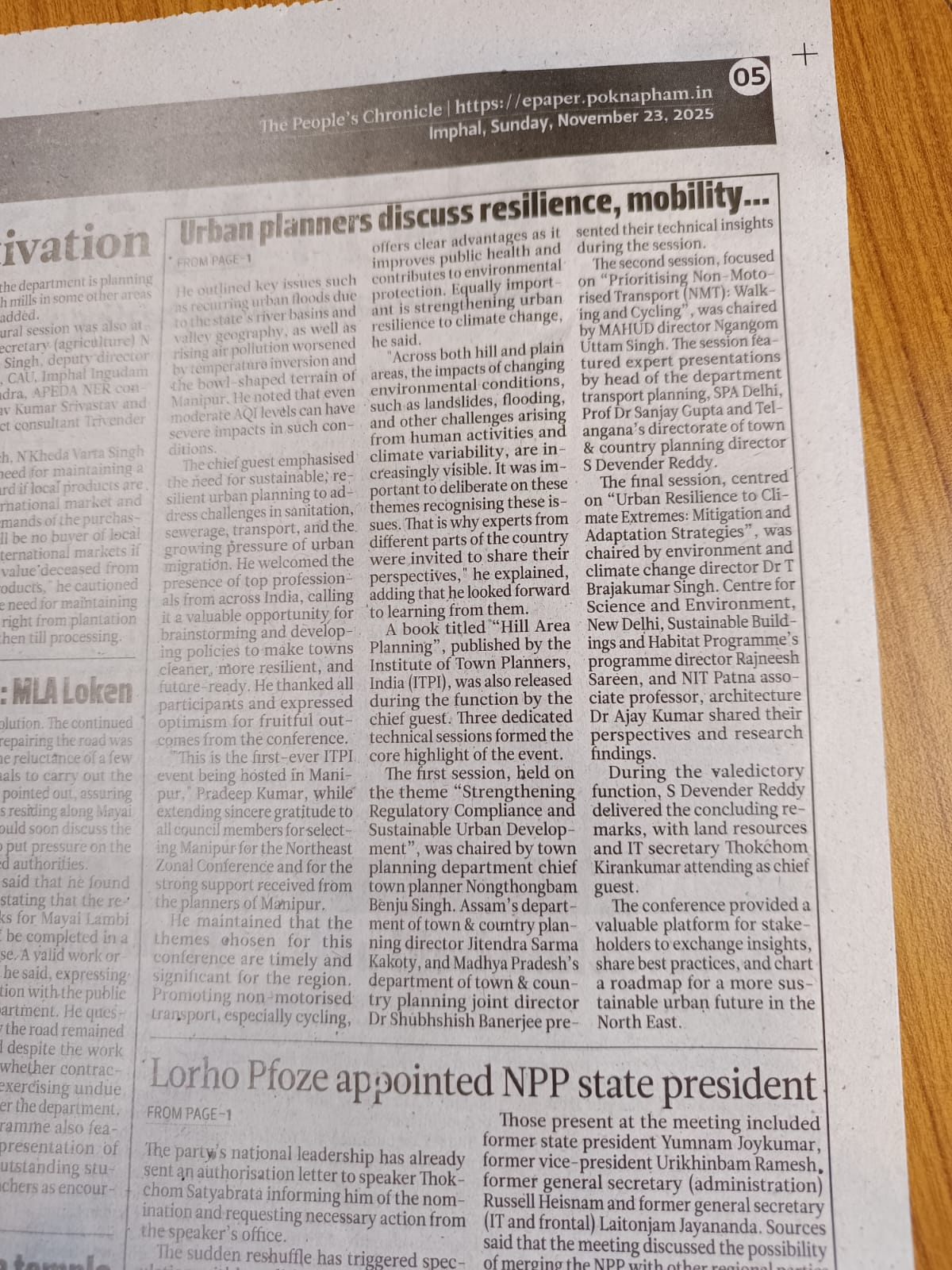
Contem-porary issues and emerging challenges in urban and regional planning across the North Eastern Region were deliberated at a North East Zonal Conference, organised by the Institute of Town Planners, India (ITPI) at Hotel Classic Grande here today. The conference focused on achieving sustainable, inclusive and resilient urban development, with special emphasis on three key themes viz; Strengthening Regulatory Compliance and Sustainable Urban Development; Prioritizing Non-Motorized Transport (NMT): Walking and Cycling and Urban Resilience to Climate Extremes: Mitigation and Adaptation Strategies. RK Dinesh Singh, Principal Secretary (MAHUD) graced the conference as the chief Guest. He was joined on the dais by Tpr Pradeep Kumar, president, ITPI, New Delhi; Tpr S Devender Reddy, vice president, ITPI, New Delhi; Tpr Jitendra L Bhople, secretary general, ITPI, New Delhi; and Tpr Nepram Gitkumar Singh, Council Member, ITPI. RK Dinesh addressed the gathering of town planners, policymakers, and experts from across the country, expressing gratitude to the organizers, the Town Planning Department, and ITPI India. He highlighted that although Manipur is a small State, it faces major challenges, making it an ideal testing ground for policies that could later be implemented elsewhere in India. He outlined key issues such as recurring urban floods due to the State’s river basins and valley geography, as well as rising air pollution worsened by temperature inversion and the bowl-shaped terrain of Manipur. He noted that even moderate AQI levels can have severe impacts in such conditions. The chief guest emphasized the need for sustain- able, resilient urban planning to address challenges in sanitation, sewerage, transport, and the growing pressure of urban migration. He welcomed the presence of top professionals from across India, calling it a valuable opportunity for brainstorming and developing policies to make towns cleaner, more resilient, and future-ready. He concluded by thanking all participants and expressing optimism for fruitful outcomes from the conference. Tpr. Pradeep Kumar mentioned that this is the first-ever ITPI event being hosted in Manipur, and extended his sincere gratitude to all council members for selecting Manipur for the Northeast Zonal Conference, and for the strong support received from the planners of Manipur. The ITPI president remarked that the themes chosen for this conference are timely and significant for the region. Promoting non-motorized transport, especially cycling offers clear advantages as it improves public health and contributes to environmental protection. Equally important is strengthening urban resilience to climate change, he said. “Across both hill and plain areas, we are witnessing the impacts of changing environmental conditions like landslides, flooding, and other challenges arising from human activities and climate variability”, Pradeep Kumar said. He further stated that it was important to deliberate on these themes. A book titled “Hill Area Planning”, published by the Institute of Town Planners, India (ITPI), was also released during the function by the chief guest. Three dedicated technical sessions formed the core highlight of the event. The first session, held on the theme “Strengthening Regulatory Compliance and Sustainable Urban Development,” was chaired by Nongthombam Benju Singh, Chief Town Planner, Town Planning Department, Government of Manipur. Tpr Jitendra Sarma Kakoty, Director, Department of Town & Country Planning, Government of Assam, and Dr Shubahshish Banerjee, Joint Director, Department of Town & Country Planning, Government of Madhya Pradesh, presented their technical insights during the session. The second session, focused on “Prioritizing Non-Motorized Transport (NMT): Walking and Cycling,” was chaired by Ngangom Uttam Singh, Director MAHUD. The session featured expert presentations by Prof Dr Sanjay Gupta, Head of Department, Transport Planning, SPA Delhi and Tpr S Devender Reddy, Director, Directorate of Town & Country Planning, Government of Telangana. The final session, centred on “Urban Resilience to Climate Extremes: Mitigation and Adaptation Strategies,” was chaired by Dr T Brajakumar Singh, Director, Environment and Climate Change, Government of Manipur. Tpr Rajneesh Sareen, Programme Director, Sustainable Buildings and Habitat Programme, Centre for Science and Environment, New Delhi, and Dr Ajay Kumar, Associate Professor, Architecture, NIT Patna, shared their perspectives and research findings.

Karnataka warned of looming power crisis despite renewable surplus

A detailed communication addressed to senior officials in the Karnataka government and the Union Ministries of Power and New and Renewable Energy has warned that the state is entering a phase of structural power imbalance in which annual energy surplus coexists with rising peak-time shortages. The letter, written by Shankar Sharma, a power and climate policy analyst and former power-sector professional from Sagara in the Western Ghats, draws attention to what he describes as Karnataka’s “renewable paradox”: a projected surplus of 5,300 million units (MU) in 2027, alongside a forecast deficit of nearly 500 hours during peak demand in the same period. Citing a recent report in Down To Earth magazine, he argues that this mismatch is becoming increasingly common across states and could create significant financial and operational stress for the national power sector.

भारत में जलवायु संकट-स्वास्थ्य एवं समृद्धि पर कहर

जलवायु परिवर्तन से उपजी पर्यावरणीय चुनौतियाँ आज मानव सभ्यता के अस्तित्व तक को प्रभावित कर रही हैं। जलवायु परिवर्तन अब कोई दूर का वैज्ञानिक विचार नहीं, बल्कि तत्काल अनुभव किया जाने वाला यथार्थ है, जिसकी भयावहता का प्रमाण सीएसई और डाउन टू अर्थ की क्लाइमेट इंडिया 2025 की रिपोर्ट में स्पष्ट दिखाई देता है। जनवरी से सितंबर 2025 तक भारत ने अपने 99 प्रतिशत दिनों में किसी न किसी चरम मौसमी घटना-बाढ़, सूखा, भारी बारिश, तूफान, ठंड-लहर, अथवा भीषण गर्मी का सामना किया। इसी अवधि में 4,064 लोगों की मौत, 9.47 मिलियन हेक्टेयर फसल का नष्ट होना, लगभग 58,982 जानवरों की मृत्यु और 99,533 घरों का ढहना इस संकट की गहराई को दर्शाते हैं। कृषि क्षेत्र इन घटनाओं का सबसे बड़ा शिकार बना, क्योंकि जलवायु असंतुलन ने खेतों, मौसम चक्र और पैदावार को सीधे प्रभावित किया। बढ़ते तापमान और असामान्य वर्षा ने ग्रामीण अर्थव्यवस्था को गहरी चोट पहुंचाई है। दुनिया के सबसे बड़ी आबादी वाले देश के सामने ये मुश्किलें सबसे बड़ी हैं। हिमाचल प्रदेश में 257 दिनों का चरम मौसम, मध्य प्रदेश में 532 मौतें और महाराष्ट्र में 84 लाख हेक्टेयर फसल का नुकसान बताता है कि यह सिर्फ पर्यावरणीय विषय नहीं, बल्कि मानव जीवन, स्वास्थ्य और अर्थव्यवस्था का संकट है।

उत्तराखंड में सबसे ज्यादा दिख रहा जलवायु परिवर्तन का असर

उत्तराखंड में जलवायु परिवर्तन का प्रभाव दिन-प्रतिदिन बढ़ता जा रहा है. बदलता मौसम, अनियमित वर्षा और तापमान में उतार-चढ़ाव के कारण राज्य की जैव विविधता गंभीर रूप से प्रभावित हो रही है. हिमालयी क्षेत्र में स्थित होने के कारण उत्तराखंड का पर्यावरण हमेशा संवेदनशील रहा है लेकिन हाल के वर्षों में यहां प्राकृतिक संतुलन तेजी से बिगड़ रहा है. उत्तराखंड के ग्लेशियर तेजी से पिघल रहे हैं, जिससे नदियों के जलस्तर में अस्थिरता देखने को मिल रही है. यह न सिर्फ पानी की उपलब्धता को प्रभावित कर रहा है बल्कि इससे अचानक बाढ़ और भूस्खलन की घटनाएं भी बढ़ रही हैं.जलवायु परिवर्तन पर रिसर्च करने वाली कंपनी ट्राई इंपेक्ट ग्लोबल के सीईओ ने बताया कि उत्तराखंड के ग्लेशियर के पास होने के कारण यहां क्लाइमेट चेंज का सबसे ज्यादा असर पड़ रहा है. गंगोत्री और पिंडारी ग्लेशियरों के आकार में तेजी से कमी आ रही है, जो भविष्य में जल संकट का संकेत दे रही है. राज्य में जलवायु परिवर्तन का असर खेती पर भी दिख रहा है. पारंपरिक फसलें जैसे- झंगोरा, चौलाई और मंडुवा का उत्पादन घट रहा है. वहीं सेब और अन्य फलों की फसलें भी प्रभावित हो रही हैं, जिससे किसानों को आर्थिक नुकसान उठाना पड़ रहा है. प्राकृतिक जल स्रोतों का जलस्तर भी गिर रहा है, जिससे स्थानीय लोगों को पानी की समस्या का सामना करना पड़ रहा है. हिमालय की गोद दिन प्रतिदिन बढ़ती दैवीय आपदाओं के कारण असुरक्षित होती जा रही है। पहाड़ी क्षेत्रों में भयंकर भूकंप, भूस्खलन की संभावना रहती है। इसके अतिरिक्त प्रदेश पर बाढ़, जंगल की आग, ओलावृष्टि, आकाशीय बिजली, सड़क दुर्घटना आदि आपदाओं का खतरा मंडराता रहता है। इन आपदाओं से मानव जीवन, बुनियादी ढांचे, संपत्ति और अन्य संसाधनों को भारी नुकसान पहुंचता है। जलवायु परिवर्तन से उपजी पर्यावरणीय चुनौतियाँ आज मानव सभ्यता के अस्तित्व तक को प्रभावित कर रही हैं। जलवायु परिवर्तन अब कोई दूर का वैज्ञानिक विचार नहीं, बल्कि तत्काल अनुभव किया जाने वाला यथार्थ है, जिसकी भयावहता का प्रमाण सीएसई और डाउन टू अर्थ की क्लाइमेट इंडिया 2025 की रिपोर्ट में स्पष्ट दिखाई देता है। जनवरी से सितंबर 2025 तक भारत ने अपने 99 प्रतिशत दिनों में किसी न किसी चरम मौसमी घटना-बाढ़, सूखा, भारी बारिश, तूफान, ठंड-लहर, अथवा भीषण गर्मी का सामना किया। इसी अवधि में 4,064 लोगों की मौत, 9.47 मिलियन हेक्टेयर फसल का नष्ट होना, लगभग 58,982 जानवरों की मृत्यु और 99,533 घरों का ढहना इस संकट की गहराई को दर्शाते हैं। कृषि क्षेत्र इन घटनाओं का सबसे बड़ा शिकार बना, क्योंकि जलवायु असंतुलन ने खेतों, मौसम चक्र और पैदावार को सीधे प्रभावित किया। बढ़ते तापमान और असामान्य वर्षा ने ग्रामीण अर्थव्यवस्था को गहरी चोट पहुंचाई है। दुनिया के सबसे बड़ी आबादी वाले देश के सामने ये मुश्किलें सबसे बड़ी हैं। हिमाचल प्रदेश में 257 दिनों का चरम मौसम, मध्य प्रदेश में 532 मौतें और महाराष्ट्र में 84 लाख हेक्टेयर फसल का नुकसान बताता है कि यह सिर्फ पर्यावरणीय विषय नहीं, बल्कि मानव जीवन, स्वास्थ्य और अर्थव्यवस्था का संकट है।2025 में, कम से कम 18 राज्यों और केंद्र शासित प्रदेशों में 2022 के बाद से सबसे अधिक चरम मौसमी दिन दर्ज किए गए। फरवरी से सितंबर 2025 तक, लगातार आठ महीनों तक देश के 30 या उससे अधिक राज्यों और केंद्र शासित प्रदेशों में चरम मौसम की घटनाएं रिकॉर्ड की गईं। भारत में जैसे हालात हैं, वही स्थिति पूरे विश्व में भी फैलती जा रही है। वर्ष 2023, 2024 और 2025 दुनिया के सबसे गर्म वर्षों में शामिल रहे। यूरोप की निरंतर हीटवेव, अफ्रीका के साहेल क्षेत्र का अकाल, अमेज़न और ऑस्ट्रेलिया के जंगलों में लगी आग, प्रशांत और अटलांटिक महासागरों में उग्र तूफान, और ग्लेशियरों के तेज़ी से पिघलने की घटनाएँ यह संकेत दे रही हैं कि पृथ्वी एक खतरनाक मोड़ की ओर बढ़ रही है। मौसम चक्रों का असंतुलन, समुद्र स्तर में वृद्धि, तापमान का अचानक बढ़ना और वर्षा का अनियमित होना, प्राकृतिक आपदाओं को न सिर्फ अधिक सघन बना रहा है बल्कि मानव जीवन को असुरक्षित भी। जलवायु परिवर्तन की सबसे बड़ी वजह मनुष्य की अनियंत्रित गतिविधियाँ हैं-जीवाश्म ईंधनों पर निर्भरता, वनों की कटाई, प्रदूषण, अनियोजित शहरीकरण और अत्यधिक उपभोग ने वातावरण में ग्रीनहाउस गैसों को खतरनाक स्तर तक बढ़ा दिया है, जिसका परिणाम है पृथ्वी का असामान्य रूप से गर्म होना।इन परिस्थितियों का असर जीवन के हर क्षेत्र पर दिखाई दे रहा है। स्वास्थ्य पर प्रभाव बढ़ रहा है, हीटवेव के कारण मौतें बढ़ रही हैं, नए वायरस और प्रदूषण से उत्पन्न बीमारियों की आवृत्ति बढ़ी है। जल संसाधन खतरे में हैं और कई क्षेत्रों में नदियाँ व भूजल तेजी से सूख रहे हैं। खाद्य संकट गहराता जा रहा है क्योंकि फसलें असफल हो रही हैं, जिससे अनाज और सब्जियों की कीमतें बढ़ रही हैं। प्राकृतिक आपदाओं से आर्थिक ढाँचा भी डगमगा रहा है, लाखों लोग विस्थापित हो रहे हैं और असमानता तेज़ी से बढ़ रही है। यदि दुनिया ने तापमान को 1.5 डिग्री सेल्सियस से नीचे रखने का लक्ष्य पूरा नहीं किया, तो आने वाले तीन दशकों में हिमालयी नदियों का प्रवाह अनिश्चित हो जाएगा, तटीय शहर खतरे में पड़ेंगे और मानव जीवन मुश्किल होता चला जाएगा।जलवायु परिवर्तन के दुष्प्रभाव को दर्शाती एक ओर रिपोर्ट पिछले दिनों ‘द लांसेट काउंटडाउन ऑन हेल्थ एंड क्लाइमेट चेंज 2025’ के अनुसार पिछले साल जलवायु परिर्वतन के कारकों से कृषि क्षेत्र में 66 फीसदी और निर्माण क्षेत्र में बीस फीसदी का नुकसान हुआ। यह रिपोर्ट इशारा करती है कि अत्यधिक गर्मी के कारण श्रम क्षमता में कमी के कारण 194 अरब डॉलर की संभावित आय का नुकसान हुआ। उल्लेखनीय है कि यह रिपोर्ट विश्व के 71 शैक्षणिक संस्थानों और संयुक्त राष्ट्र की एजेंसियों के 128 अंतर्राष्ट्रीय विशेषज्ञों ने तैयार की, जिसका कुशल नेतृत्व यूनिवर्सिटी कालेज लंदन ने किया। इस रिपोर्ट में जलवायु परिवर्तन और स्वास्थ्य के बीच संबंधों का अब तक सबसे व्यापक आकलन किया गया है। रिपोर्ट बताती है कि साल 2020 से 2024 के बीच भारत में औसतन हर साल दस हजार मौतें जंगल की आग से उत्पन्न पीएम 2.5 प्रदूषण से जुड़ी थीं। चिंता की बात यह है कि यह वृद्धि 2003 से 2012 की तुलना में 28 फीसदी अधिक है, जो हमारी गंभीर चिंता का विषय होना चाहिए। विडंबना यह है कि ‘द लांसेट’ की रिपोर्ट में सामने आए गंभीर तथ्यों के बावजूद अंतर्राष्ट्रीय स्तर पर इस संकट से मिलकर जूझने की ईमानदार कोशिश होती नजर नहीं आती। यह निर्विवाद तथ्य है कि दुनिया के विकसित देश अपनी जिम्मेदारी से लगातार बचने के प्रयास कर रहे हैं। खासकर हाल के वर्षों में अमेरिकी राष्ट्रपति ने जलवायु परिवर्तन को लेकर जो गैरजिम्मेदाराना रवैया अख्तियार किया है, उससे नहीं लगता कि वैश्विक स्तर पर इस संकट से निपटने की कोई गंभीर साझा पहल निकट भविष्य में सिरे चढ़ेगी। विकसित देश इस दिशा में मानक पेरिस समझौते की संस्तुतियों को नजरअंदाज करते नजर आते हैं। सीएसई और डाउन टू अर्थ की क्लाइमेट इंडिया और द लांसेट काउंटडाउन ऑन हेल्थ एंड क्लाइमेट चेंज 2025 रिपोर्टों में उजागर तथ्य हमारी आंख खोलने वाले व सचेतकहैं।इन्हीं चिन्ताजनक रिपोर्टों पर सीएसई की महानिदेशक ने कहा, देश को अब सिर्फ आपदाओं को गिनने की जरूरत नहीं है, बल्कि उस पैमाने को समझने की जरूरत है जिस पर जलवायु परिवर्तन हो रहा है। उन्होंने वैश्विक स्तर पर उत्सर्जन कटौती की तत्काल आवश्यकता पर जोर दिया, क्योंकि इतने बड़े पैमाने की आपदाओं के लिए कोई भी अनुकूलन संभव नहीं होगा। सीएसई के कार्यक्रम निदेशक ने मानसून के दौरान बढ़ते तापमान को चिंताजनक बताया, जो अनियमित और चरम मौसमी घटनाओं को ट्रिगर कर सकता है। डाउन टू अर्थ के प्रबंध संपादक ने कहा कि यह रिपोर्ट एक आवश्यक चेतावनी है और बिना निर्णायक शमन प्रयासों के आज की आपदाएं कल का नया सामान्य बन जाएंगी। ऐसे समय में सिर्फ सरकारों और अंतरराष्ट्रीय संस्थाओं की जिम्मेदारी नहीं है, बल्कि हर आम नागरिक को भी पर्यावरण संरक्षण का सहभागी बनना होगा। सबसे पहले जीवनशैली को प्रकृति के अनुकूल बनाना जरूरी है, ऊर्जा की बचत, जल का सीमित और शिक्षा, जागरूकता और जनभागीदारी इस लड़ाई के सबसे महत्वपूर्ण हथियार हैं। स्कूलों और घरों में बच्चों को पर्यावरणीय मूल्यों का प्रशिक्षण देना भविष्य के लिए अत्यंत उपयोगी होगा। जलवायु संकट अपने आप नहीं थमेगा; इसे रोकने के लिए संकल्प, संयुक्त प्रयास और सतत विकास को जीवन की प्राथमिकता बनाना आवश्यक है। पृथ्वी हमारे पास केवल एक है और उसका कोई विकल्प नहीं। समय का यही संदेश है कि यदि हम प्रकृति की चेतावनियों को गंभीरता से नहीं लेंगे, तो आने वाला समय मानवता के लिए और भी कठिन हो जाएगा। लेकिन यदि हर मनुष्य अपने हिस्से की जिम्मेदारी निभाए, तो जलवायु परिवर्तन की दिशा को बदला जा सकता है और धरती को संतुलन, शांति और स्थायित्व प्रदान किया जा सकता है। बाढ, भूकम्प, भूस्खलन, हिमस्खलन जैसी प्राकृतिक घटनाएं युगों-युगों से होती रही हैं। लेकिन अब इनकी आवृति बढ़ती जा रही है। इनसे बचाव का एक ही रास्ता है कि हम प्रकृति के साथ जीना सीखें। हालांकि इस साल प्रकृति का कहर उत्तराखंड की तुलना में हिमाचल पर अधिक बरसा है लेकिन देखा जाय तो उत्तराखंड की स्थिति कहीं ज्यादा संवेदनशील है। मसूरी और नैनीताल सहित उत्तराखंड का कोई पहाड़ी नगर ऐसा नहीं जो कि भूस्खलन जैसी आपदाओं से सुरक्षित हो। राज्य के 400 से अधिक गांव पहले ही संवेदनशील घोषित किये जा चुके हैं।इसरो और रिमोट सेंसिंग के नवीनतम भूस्खलन संवेदनशीलता एटलस पर गौर करें तो उत्तराखंड की स्थिति बेहद चिन्ताजनक है। भूस्खलन की दृष्टि से देश के सर्वाधिक संवेदनशील जिलों में उत्तराखंड के रुद्रप्रयाग और टिहरी जिले हैं, जिन्हें नम्बर एक और दो पर रखा गया है। जोशीमठ हमारे सामने शिमला से भी ज्वलंत उदाहरण बन कर सामने आ गया था। इसरो और रिमोट सेंसिंग ऐजेंसी द्वारा इसी साल फरवरी में भूस्खलन की दृष्टि से भारत के जिन 147 जिलों का एटलस जारी किया है उनमें 108 जिले केवल हिमालयी राज्यों के हैं जिनमें सभी 13 जिले उत्तराखंड के तथा 12 में से 10 जिले हिमाचल प्रदेश के हैं। जलवायु परिवर्तन के प्रभाव को कम करने के लिए वनों का संरक्षण, जल संसाधनों का प्रबंधन और कार्बन उत्सर्जन को नियंत्रित करने की जरूरत है. इसके अलावा पारंपरिक खेती को बढ़ावा देकर पर्यावरण अनुकूल कृषि अपनाने पर जोर देना होगा. उत्तराखंड की जैव विविधता और पर्यावरण को बचाने के लिए सरकार और आम जनता दोनों को मिलकर प्रयास करने की जरूरत है. यदि समय रहते कदम नहीं उठाए गए, तो आने वाले वर्षों में यह समस्या और विकराल रूप ले सकती है. । *लेखक विज्ञान व तकनीकी विषयों के जानकार दून विश्वविद्यालय में कार्यरत हैं*

Extreme Weather Kills 1,439 in MP Since 2022, What’s Driving This Surge?

Since January 2022, Madhya Pradesh has faced extreme weather on 598 days nearly one in every three days, a new analysis shows. In that time, 1,439 people have died from lightning, floods, heatwaves and storms. Crops on at least 82,170 hectares have been ruined, though the real loss is much higher. Over 20,000 homes were damaged or destroyed, and close to 6,000 livestock perished. The figures come from four annual climate reports by the Centre for Science and Environment (CSE) and Down To Earth magazine. Groundreport.in studied the data from 2022 to 2025 to reveal how relentless weather is pushing India’s central state into a deepening crisis. The data reveals a state where extreme weather has become the default condition rather than the exception.The central Indian state recorded 140 dangerous days in 2022, then 138 in 2023, then 176 in 2024, then 144 in the first nine months of 2025 alone. Nearly every other day now brings floods, lightning, storms or heat. Death Toll Tells Real Story But frequency tells only part of the story. The death toll shows the real shift. Madhya Pradesh recorded 301 deaths in 2022, dropped to 253 in 2023, jumped to 353 in 2024, then surged to 532 in just nine months of 2025. The state now leads India in climate fatalities, surpassing all other regions. This year closed out September with a grim distinction. The 532 deaths through September made Madhya Pradesh the deadliest state for extreme weather in India. Floods drowned 348 people. Lightning killed 183. Heat claimed one life. The toll comes from the 2025 report tracking conditions from January through September, which found dangerous weather on 270 of 273 days nationwide. Madhya Pradesh faced threats on 144 of those days. The four-year analysis reveals patterns of escalating violence in weather events, collapsing seasonal boundaries, and government data so inconsistent it obscures the true scale of destruction. This is not a story about numbers climbing in neat progressions. It is about systems breaking under sustained assault. It is about a state where lightning strikes with grim regularity while floods triple their death toll, where winter brings rain instead of cold, and where farmers can no longer predict which season will bring which threat. When Lightning Kills Lightning has struck Madhya Pradesh on between 81 and 103 days every year since 2022. In 2022, lightning killed 164 people across 97 dangerous days. The next year brought 152 deaths over 81 days. In 2024, the count rose to 180 deaths across 103 days. Through September 2025, 183 people have died on 91 lightning days. The victims follow a pattern. Most die in fields during sudden storms. Farming does not stop for darkening clouds. Workers caught on open ground run for shelter that does not exist. In some areas, the same lightning strikes that kill farmers also destroy livestock and storage structures, compounding immediate loss with long-term economic damage. The consistency of lightning deaths across four years stands in stark contrast to everything else. While floods and storms have grown more chaotic and deadly, lightning maintains its grim regularity, roughly 160 to 180 deaths annually regardless of other weather patterns. This baseline of death has become background noise in a state facing far worse escalations elsewhere. Flood Surge That Changed Everything Heavy rain and floods killed 112 people in 2022 across 85 dangerous days. The next year saw 95 deaths over 82 days. In 2024, deaths jumped to 160 across 89 days. Through September 2025, floods have killed 348 people on just 88 days. The frequency barely changed. The impact more than tripled. Farmers describe what changed: rain now falls in concentrated, violent bursts instead of steady monsoon patterns. A single afternoon downpour converts fields to standing water deep enough to drown livestock. Mud houses collapse when walls become saturated within hours. Small streams that families waded across for generations now transform into fast-moving torrents. The monsoon arrived in different forms between June and September this year. Madhya Pradesh faced extreme weather every single day during those 122 days. Heavy rain and floods occurred daily. Lightning and storms struck 104 times. Cloudbursts hit 17 times. The relentless pace gave communities no recovery time between disasters. Families living near riverbanks now evacuate multiple times each monsoon season. In many villages, floodwater returns before people finish rebuilding from the previous episode. July brought rainfall 21.9 percent above normal this year. September surged 43.7 percent above average. These surpluses sound manageable in percentage terms. On the ground, they mean walls of water moving through populated areas with deadly force. The Heatwave Puzzle Heatwave data presents contradictions. Madhya Pradesh saw heatwaves on 38 days in 2022 with zero recorded deaths. The next year brought only 12 heatwave days but 4 deaths. In 2024, heatwaves lasted 28 days and killed 13 people. Through September 2025, 13 heatwave days have produced one death. Temperature records reveal what raw heatwave counts conceal. February 2025 became India’s warmest February in 124 years of record-keeping, according to the India Meteorological Department. The national mean temperature hit 22.04 degrees Celsius, 1.34 degrees above normal. Central India, which includes Madhya Pradesh, recorded temperatures 1.88 degrees Celsius above normal. March continued the pattern with central India logging its eighth-highest mean temperature at 28.04 degrees Celsius. Then May delivered a jarring reversal, Madhya Pradesh recorded its second-lowest maximum temperature for May in more than a century, falling 2.63 degrees below normal.

मेंटर बन आगरा जल संरक्षण में करेगा दूसरे शहरों की मदद

शहर में जल संरक्षण और शहरी प्रबंधन को मजबूत करने के उद्देश्य से शुक्रवार को स्मार्ट सिटी सभागार में कार्यशाला का आयोजन किया गया। सेंटर फॉर साइंस एंड एनवायरनमेंट एवं नेशनल मिशन फॉर क्लीन गंगा के संयुक्त तत्वावधान में आयोजित कार्यशाला में देशभर के शहरी स्थानीय निकायों के प्रतिनिधियों ने हिस्सा लिया। कार्यशाला में विशेषज्ञों ने बताया कि ट्रीट किए गए व साफ पानी के बेहतर प्रबंधन से जल संकट को कम करने के साथ पर्यावरणीय स्थिरता और संसाधन दक्षता को बढ़ावा देने में मदद मिलेगी। बैठक में स्वच्छ शहर जोड़ी पहल में आगरा को देश में मेंटर सिटी के रूप में चयनित किया गया। आगरा के अधिकारी अब देशभर के अन्य शहरों को जल संरक्षण व शहरी प्रबंधन में मदद करेगा। नगर निगम के पर्यावरण अभियंता पंकज भूषण ने बताया कि शहर में उपचारित जल का उपयोग लगातार बढ़ाया जा रहा है। वर्तमान में इसका उपयोग औद्योगिक संस्थानों, पार्कों, हरित क्षेत्र की सिंचाई में, निर्माण कार्यों, झीलों और जलाशयों के पुनर्जीवन में किया जा रहा है, जिससे पेयजल पर दबाव कम हुआ है और जल संरक्षण को नई दिशा मिली है। इस मौके पर ज्योति दधीच, उमरा अनीस, सुदेश यादव, केके पांडे, अनिरूद्ध कुमार, धीरज कुमार, शुभम सक्सेना, प्रभाकर शर्मा आदि मौजूद रहे।

Kohima tops India in warm monsoon days

Kohima recorded the highest number of warmer-than-usual days during the monsoon season this year, according to an assessment released by the Centre for Science and Environment (CSE) and Down to Earth. The report noted that in 16 of the 34 capitals studied, minimum temperatures were above normal on more than 50% of monsoon days. Kohima recorded higher-than-normal minimum temperatures on 98% of monsoon days between June and September, the highest among all capitals assessed. Kohima was followed by Diu in Dadra and Nagar Haveli and Daman and Diu (91%), Srinagar in Jammu and Kashmir (78%), Patna in Bihar and Lucknow in Uttar Pradesh (70%), and Imphal in Manipur and Shimla in Himachal Pradesh (65%). “The rise in temperature during the monsoon is particularly concerning, as it disrupts the core dynamics of the monsoon system. This can trigger erratic and extreme weather events — from floods to droughts — while threatening agriculture, food security and public health,” the report stated. Nagaland recorded 53 days of extreme weather events between January 1 and September 30, 2025. During this period, the state reported eight deaths, the loss of 76 animals, damage to 1,774 houses, and crop loss across 586 hectares. Nationally, India experienced extreme weather events on 270 of 273 days (99%) in the same nine-month period. These events caused 4,064 deaths, affected 9.47 million hectares of crops, killed 58,982 animals and damaged 99,533 houses.

CSE Report: 4064 Extreme Weather Deaths Devastate India

Extreme weather events claimed 4,064 lives across India from January to September 2025, with incidents occurring on 270 of 273 days, as detailed in the Centre for Science and Environment (CSE) report released on November 19. The assessment, drawing from India Meteorological Department (IMD) data and Union Home Ministry records, highlights floods and heavy rain as primary killers. All 36 states and union territories faced impacts, underscoring a nationwide crisis driven by climate anomalies. This surge in CSE report 4064 extreme weather deaths India marks a 48% rise from 2,755 fatalities in 2022, amplifying vulnerabilities in South Asia’s most populous nation. The report reveals how erratic monsoons and heatwaves disrupt agriculture and livelihoods, threatening food security for over 1.4 billion people. In a region where South Asian countries share similar monsoon dependencies, India’s experience signals broader risks of cross-border migration and economic strain from intensified disasters. Surge in Extreme Weather Frequency India extreme weather 99% days CSE gripped the country relentlessly in 2025. The CSE analysis shows events on 270 days, up from 255 in 2024. This near-daily occurrence spans heatwaves, cold waves, lightning, storms, floods, landslides, cloudbursts, and snowfall. IMD classifies these as rare anomalies, yet they dominated the calendar. Winter (January-February) saw 57 of 59 days affected, with 64 deaths. Pre-monsoon (March-May) recorded 91 of 92 days, claiming 993 lives. Monsoon (June-September) hit all 122 days, the fourth straight year of unbroken extremes. Sunita Narain, CSE director general, stated during the report launch: “Given the intensity and frequency of extreme weather events, the country no longer needs to count just the disasters. What we need to understand is the scale of mitigation that the whole world has to come together.” Her remarks, from the official CSE press release, emphasise the shift to global action. Regional breakdowns reveal stark disparities. The northwest logged 257 event days and 1,342 deaths. East and northeast: 229 days, 878 deaths. Central: 200 days, 1,093 deaths. South peninsula: 205 days, 745 deaths. Himachal Pradesh topped states with 217 extreme days, nearly 80% of the period. Deadliest Events and Human Toll CSE report 4064 extreme weather deaths India breaks down by type. Heavy rain, floods, and landslides caused 2,440 fatalities, the highest. Lightning and storms followed with 1,456 deaths. Cloudbursts killed 135, heatwaves 21, and snowfall 12. State data paints a grim picture. Madhya Pradesh led with 532 deaths. Andhra Pradesh followed at 484, Jharkhand at 478. Uttar Pradesh reported 321 deaths. Himachal Pradesh: 380. These figures, cross-verified with Union Home Ministry’s Disaster Management Division, likely underestimate totals due to seasonal reporting gaps. Kiran Pandey, CSE programme director, noted in the report: “The rise in temperature during the monsoon is particularly concerning, as it disrupts the core dynamics of the monsoon system. This can trigger erratic and extreme weather events from floods to droughts while threatening agriculture, food security and public health.” The IMD’s seasonal climate statements corroborate anomalies. January marked the fifth driest since 1901, with 71% rainfall deficit. February was the warmest in 124 years. March’s mean maximum temperature exceeded normal by 1.02°C. May saw 106% rainfall surplus. July and August brought excessive downpours, fuelling floods. Crop Losses Extreme Weather India CSE Report Highlights Agricultural Devastation Crop losses extreme weather India CSE report expose a fourfold surge since 2022. Total affected area: 9.47 million hectares, up from 1.84 million. Maharashtra bore the brunt at 8.4 million hectares. Punjab lost 262,831 hectares. Uttar Pradesh: 210,528 hectares. Himachal Pradesh: 167,000 hectares. Monsoon amplified destruction, damaging 9.44 million hectares and causing 3,007 deaths, 74% of the total. Pre-monsoon heatwaves scorched fields in 19 states, including Himalayan areas like Himachal Pradesh and Jammu & Kashmir. Winter crop losses were minimal at 0.02 million hectares, but localised floods hit early harvests. The Union Ministry of Agriculture’s provisional data aligns, noting excess rain’s role in yield drops for rice and pulses. Gujarat reported 110 extreme days, though cropped area data remains unavailable. These losses threaten India’s grain basket, with Punjab and Haryana facing irrigation strains from erratic rains. Housing and livestock suffered too. 99,533 houses damaged; 58,982 animals lost. Central India saw 8.42 million hectares of crop ruin alongside 1,093 human deaths, per CSE’s regional tally. Monsoon Deaths India 2025 CSE: A Seasonal Catastrophe Monsoon deaths India 2025 CSE dominated the toll, with extremes on every day from June to September. Of 4,064 total fatalities, 3,007 occurred then, driven by floods and landslides. The northwest, including Uttarakhand and Himachal Pradesh, headlined devastating events like village-washing cloudbursts. IMD alerts flagged orange and red warnings across 35 states. Kerala logged 147 extreme days, with 114 deaths and 5,352 houses damaged. Telangana averaged one event every five days, 51 total. Karnataka rose to 120 days from 96 in 2024. Pandey added: “Twenty-seven states and Union Territories saw a rise in extreme weather days in 2025.” This persistence, against IMD’s record seventh-highest September mean temperature, signals disrupted monsoon dynamics. Broader trends worry experts. Fatalities rose 48% since 2022; event days climbed from 241. The report urges daily loss tracking over seasonal tallies to capture full economic hits. Background CSE’s annual Climate India series, started in 2022, monitors extremes using IMD bulletins, Home Ministry reports, and media. The 2025 edition covers 1,500 days of data since inception, revealing a “new normal” in a warming world. Past years: 2024 had 3,238 deaths on 255 days; 2023: 2,923 on 235 days. Global CO2’s largest rise since 1957 fuels this, per IPCC alignments. South Asia’s shared vulnerabilities amplify impacts. Pakistan’s 2025 monsoon killed hundreds, mirroring India’s floods and straining regional aid. What’s Next India must build resilient infrastructure and expand insurance, as CSE advocates. Enhanced IMD databases could track daily losses. Globally, COP30 in 2025 offers mitigation pledges. Without action, CSE warns, “the disasters of today will become the new normal of tomorrow.” Policymakers eye heat action plans for 19 affected states. The CSE report 4064 extreme weather deaths India demands urgent scale-up in adaptation to safeguard South Asia’s future.